
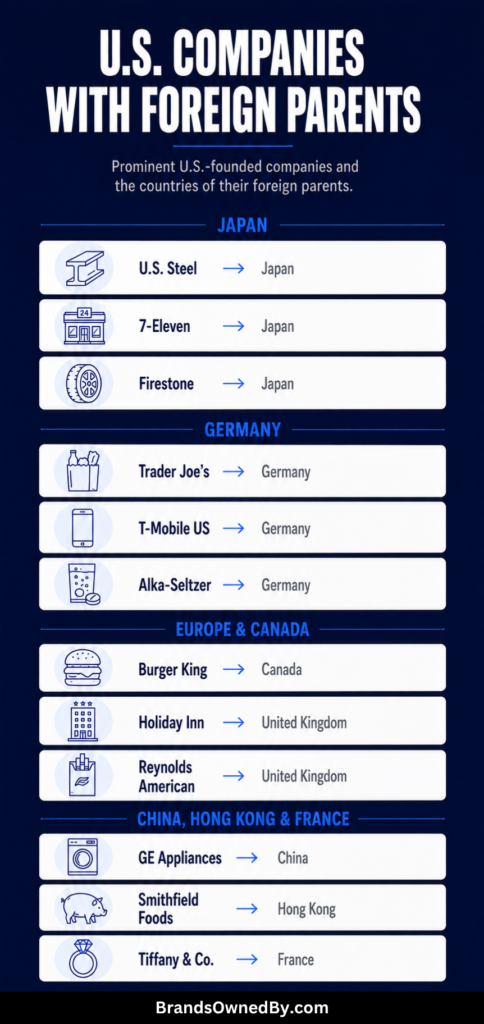
- Major American-founded companies under foreign ownership include U.S. Steel, T-Mobile US, 7-Eleven, Trader Joe’s, GE Appliances, Smithfield Foods, Burger King, and Tiffany & Co.
- Japanese companies control U.S. Steel, 7-Eleven, and Firestone. German interests control Trader Joe’s, T-Mobile US, and Alka-Seltzer.
- Some businesses are wholly owned subsidiaries. Others, including T-Mobile US and Smithfield Foods, remain publicly traded but have controlling foreign shareholders.
- Foreign ownership does not automatically make a company operationally foreign. Many retain U.S. headquarters, factories, executives, franchisees, and workforces.
US companies owned by foreign companies operate across retail, food, technology, manufacturing, hospitality, healthcare, and telecommunications. Many still have American headquarters and employees. Their ultimate parent companies, however, are based outside the United States.
This guide examines prominent American-founded businesses under foreign control as of August 2026. It focuses on complete acquisitions and controlling interests. Small portfolio investments are not treated as foreign ownership.
What Does Foreign Ownership of a US Company Mean?
Foreign ownership describes the equity and governance relationship between a U.S. business and an overseas investor. It does not depend on where the brand originated, where its employees work, or where its products are sold.
The Bureau of Economic Analysis treats a U.S. business as a foreign affiliate when a foreign person owns or controls at least 10% of its voting securities. This is the threshold used to measure foreign direct investment. It is not the same as majority control.
A company becomes a majority-owned U.S. affiliate when foreign investors control more than 50% of its voting interest. At that level, the foreign parent can normally elect directors, consolidate the subsidiary into its financial statements, and exercise substantial influence over major corporate decisions.
The distinction between investment and control is important. A foreign company holding 10% or 20% of an American business may have financial influence without being able to determine its strategy. A shareholder with more than 50% of the voting power can generally control director elections even when other investors own a large portion of the company.
Foreign ownership commonly appears in four forms.
- A foreign parent may acquire the entire American business. Reynolds American, Genentech, Riot Games, Tiffany & Co., and Motorola Mobility are examples of wholly owned subsidiaries.
- A foreign investor may control a publicly traded U.S. company without purchasing every share. Deutsche Telekom controls T-Mobile US, while WH Group controls Smithfield Foods. Both American companies have outside shareholders, but their foreign parents retain majority voting and economic interests.
- A foreign company may own a brand and franchise system while independent operators own individual locations. Restaurant Brands International controls Burger King, but most Burger King restaurants are run by franchisees. IHG owns the Holiday Inn brand even though outside property investors and franchisees own most Holiday Inn buildings.
- Ownership can also involve licensing. Haier owns GE Appliances, while the appliance business continues using the GE name under a long-term trademark licence. The continued appearance of an American corporate name does not prove that the original American company still owns the business.
The most reliable test is to follow the chain of voting control to the ultimate beneficial owner. The immediate parent may be a holding company registered in the Netherlands, Luxembourg, or another financial jurisdiction. The ultimate controlling group may operate from somewhere else.
How Important Are Foreign-Owned Businesses to the U.S. Economy?
Foreign-owned businesses are a substantial part of the American economy. Their role extends far beyond the familiar brands covered in consumer ownership lists.
Majority-owned U.S. affiliates of foreign multinational companies employed approximately 8.57 million workers in 2024. That represented 6.1% of total private-industry employment in the United States. In practical terms, roughly one out of every 16 private-sector employees worked for a majority foreign-owned affiliate.
Manufacturing and retail trade were the largest employment sectors. This reflects the scale of foreign investment in automobile factories, chemical plants, pharmaceutical research, food processing, machinery, electronics, distribution networks, and national store chains.
These businesses generated approximately $1.52 trillion in value added during 2024. Value added measures the direct contribution a business makes to economic output after subtracting the intermediate goods and services it purchases. Foreign-owned affiliates accounted for 6.7% of total U.S. business-sector value added.
Their capital investment was also significant. Majority-owned affiliates spent $328 billion on property, plants, and equipment during 2024. This includes spending on factories, warehouses, machinery, technology infrastructure, stores, offices, and other productive assets.
Research activity provides another important measure. Foreign-owned U.S. affiliates performed $95.5 billion of research and development in 2024. That represented 12.4% of all business-funded research and development conducted in the United States.
The employment footprint is geographically broad. California had approximately 885,200 employees working for majority foreign-owned affiliates in 2024. Texas had 717,400, while New York had 556,700. Manufacturing was the largest foreign-affiliate employment sector in all three states.
These figures explain why foreign acquisitions do not necessarily remove economic activity from the United States. Buyers often want the American company’s factories, engineers, patents, distribution network, customer relationships, regulatory approvals, or established workforce. Moving those assets overseas could destroy much of the value the buyer paid to acquire.
Foreign ownership can also provide an American business with additional capital, international distribution, purchasing scale, and access to new markets. Bridgestone expanded through Firestone’s manufacturing and dealer network. Haier gained a major American appliance platform through GE Appliances. Roche gained Genentech’s biotechnology research capabilities.
The economic effects are not automatically positive in every transaction. A parent may consolidate departments, close overlapping facilities, reduce local decision-making, transfer intellectual property, or direct dividends to shareholders outside the United States. The correct assessment depends on domestic investment, employment, productivity, competition, and the durability of the acquired operation after the transaction.
List of US Companies Owned by Foreign Companies
![US Companies Owned by Foreign Companies [sector-wise]](https://brandsownedby.com/wp-content/uploads/2026/09/US-Companies-Owned-by-Foreign-Companies-sector-wise-484x1024.png)
No practical article can list every foreign-owned business in the United States. Federal data covers thousands of American affiliates. The following list concentrates on prominent U.S.-founded companies and brands whose ownership is often misunderstood.
U.S. Steel
U.S. Steel is owned by Nippon Steel Corporation of Japan. The approximately $14.1 billion acquisition was completed in June 2025.
U.S. Steel became a subsidiary of Nippon Steel. Its former public shareholders received $55 per share in cash. The company is no longer an independently traded American corporation.
The ownership structure includes unusual safeguards. U.S. Steel remains incorporated in the United States and keeps its headquarters in Pittsburgh. A majority of its board must be composed of U.S. citizens. Key management positions must also be held by American citizens.
The U.S. government holds a non-economic “golden share.” It does not receive ordinary financial benefits from the company. It does provide consent rights over specified decisions involving production, headquarters, investments, facilities, and certain governance matters.
This makes U.S. Steel foreign-owned but subject to stronger domestic control protections than a conventional subsidiary.
7-Eleven
7-Eleven is controlled by Japan-based Seven & i Holdings. Its U.S. operating company is headquartered in Irving, Texas.
The business began in Dallas as an ice-house storefront. It later developed into one of America’s most recognizable convenience-store chains. Its ownership shifted to Japanese interests after the financial collapse of its former American parent.
Seven-Eleven Japan and its related parent organization assumed control during the 1990s. The modern Seven & i structure was established in 2005.
Not every 7-Eleven store is directly owned by the Japanese parent. Many locations are run by franchisees. Those franchisees operate under the company’s brand standards, product systems, and franchise agreements.
This is an important distinction. A local franchisee may own the store-level business. Seven & i ultimately controls the 7-Eleven brand and corporate system.
Trader Joe’s
Trader Joe’s is controlled by German family interests associated with the Aldi Nord organization.
Founder Joe Coulombe opened the first Trader Joe’s in Pasadena, California, in 1967. German businessman Theo Albrecht acquired the company in 1979.
Trader Joe’s remains privately held. Its financial and ownership disclosures are therefore more limited than those of a public corporation. The business is generally understood to be held through German family trusts connected to the Aldi Nord side of the Albrecht family.
Trader Joe’s should not be confused with Aldi’s U.S. stores. Aldi stores in the United States are connected to Aldi Süd. Trader Joe’s is associated with the separate Aldi Nord branch.
The companies do not operate as interchangeable retail formats. Trader Joe’s has its own management, product strategy, store network, and customer positioning.
T-Mobile US
T-Mobile US is a publicly traded American telecommunications company controlled by Deutsche Telekom of Germany.
Deutsche Telekom’s economic ownership has increased as T-Mobile US repurchased shares. The German parent reported an effective stake of approximately 53.8% in April 2026. Its voting influence has also been supported by arrangements involving certain shares connected to SoftBank.
Public investors still own a substantial part of T-Mobile US. The company remains listed on Nasdaq. Deutsche Telekom, however, owns enough equity to maintain majority control.
T-Mobile US is headquartered in Bellevue, Washington. Its American operations include the T-Mobile and Metro by T-Mobile brands.
This is an example of foreign control without complete ownership. Minority shareholders participate financially. The foreign parent can still exert decisive influence over major governance matters.
Firestone
Firestone is owned by Bridgestone Corporation of Japan.
Harvey Firestone founded the Firestone Tire & Rubber Company in Akron, Ohio, in 1900. The company became an important supplier to the American automobile industry.
Bridgestone acquired Firestone in 1988 for approximately $2.6 billion. The transaction gave the Japanese tire manufacturer an extensive manufacturing and distribution presence across the Americas and Europe.
Firestone now operates within Bridgestone’s American business. The brand remains prominent in replacement tires, automotive services, commercial tires, and motorsports.
Bridgestone also controls Firestone Complete Auto Care. This means the foreign parent owns more than the tire name. It controls a broader U.S. retail and service network.
Alka-Seltzer
Alka-Seltzer is owned by Bayer AG of Germany.
The effervescent medication was introduced by the Dr. Miles Medicine Company in 1931. Miles Laboratories eventually became part of Bayer through a series of acquisitions.
Bayer organizes Alka-Seltzer under its consumer health portfolio. The product family includes formulations for heartburn, indigestion, and cold or flu symptoms. Available formulations vary by market.
Other familiar American consumer health brands under Bayer include Aleve, Claritin, MiraLAX, Midol, One A Day, and Flintstones vitamins.
The brand is foreign-owned even though its product history and market identity are strongly connected to the United States.
Burger King
Burger King is owned by Restaurant Brands International, or RBI. The parent company is based in Canada.
Burger King began in Florida in the 1950s. Its ownership changed several times before it combined with Tim Hortons in 2014. That transaction created Restaurant Brands International.
RBI also owns Popeyes and Firehouse Subs. Both were founded in the United States. Tim Hortons originated in Canada.
Burger King restaurants are primarily operated by independent franchisees. RBI owns the brand, franchise system, intellectual property, and strategic platform. It generally does not own every restaurant building or local operating company.
A consumer may therefore buy from an American franchisee using a brand controlled by a Canadian parent. Both facts can be true.
Popeyes
Popeyes is another American-founded restaurant brand owned by Canada-based Restaurant Brands International.
The chain began in Louisiana in 1972. RBI acquired Popeyes Louisiana Kitchen in 2017 for approximately $1.8 billion.
Popeyes continues to be positioned around Louisiana-style fried chicken. Its recipes, brand identity, franchise standards, and international expansion are managed within RBI’s restaurant portfolio.
Most locations are franchised. Local operators employ restaurant staff and manage day-to-day operations. RBI controls the larger brand and franchise structure.
Firehouse Subs
Firehouse Subs is controlled by Restaurant Brands International.
Brothers and former firefighters Chris and Robin Sorensen founded the restaurant chain in Jacksonville, Florida, in 1994. RBI acquired it in 2021 for approximately $1 billion.
The brand retained its U.S. identity and franchise-led model. It now benefits from RBI’s purchasing, development, technology, and international franchising capabilities.
RBI’s ownership of Burger King, Popeyes, and Firehouse Subs demonstrates how one foreign parent can control several separate American restaurant systems.
Holiday Inn
Holiday Inn is owned by InterContinental Hotels Group, or IHG, of the United Kingdom.
Kemmons Wilson opened the first Holiday Inn in Memphis, Tennessee, in 1952. The brand expanded through a standardized roadside hotel model.
A British hospitality group acquired Holiday Inn in 1989. The brand later became part of the modern IHG organization.
IHG controls Holiday Inn, Holiday Inn Express, InterContinental, Crowne Plaza, Kimpton, Staybridge Suites, Candlewood Suites, and several other hotel brands.
IHG does not own every Holiday Inn property. Most hotels are owned by franchisees or third-party property investors. IHG provides the brand, reservation platform, loyalty system, operating standards, and marketing infrastructure.
Reynolds American
Reynolds American is an indirect, wholly owned subsidiary of British American Tobacco, or BAT, in the United Kingdom.
BAT already owned a significant position in Reynolds before acquiring the remaining 57.8% in 2017. Reynolds stopped trading as an independent public company after the transaction.
Its operating businesses have included R.J. Reynolds Tobacco Company, Santa Fe Natural Tobacco Company, American Snuff Company, and R.J. Reynolds Vapor Company.
Reynolds-linked brands include Camel, Newport, Natural American Spirit, Grizzly, and Vuse within their relevant U.S. product categories.
This is complete foreign ownership. Unlike T-Mobile US or Smithfield Foods, Reynolds has no separately traded public minority interest.
GE Appliances
GE Appliances is owned by Haier Smart Home of China.
Haier acquired the appliance business from General Electric in 2016 for approximately $5.6 billion. The transaction included the American manufacturing network and appliance operations.
GE Appliances remains headquartered in Louisville, Kentucky. It operates manufacturing facilities in several states and manages brands such as GE, GE Profile, Café, Monogram, Hotpoint, and Haier in the U.S. market.
General Electric does not own GE Appliances. The continued use of the GE name is based on a long-term trademark licensing arrangement.
This arrangement creates a common consumer misconception. Products carrying the GE Appliances name are operated by Haier’s appliance business, not by the American company now known as GE Aerospace.
Smithfield Foods
Smithfield Foods is controlled by WH Group, a Hong Kong-listed company with its principal operations and ownership roots in China.
WH Group acquired Smithfield in 2013 for approximately $7.1 billion, including debt. It was one of the largest Chinese acquisitions of an American company.
Smithfield returned to the U.S. public market in 2025. Its shares trade on Nasdaq. The public listing did not end WH Group’s control.
WH Group retained approximately 88% of Smithfield’s shares based on the latest reported ownership position. Public investors own the remaining minority interest.
Smithfield produces packaged meat and fresh pork. Its portfolio includes Smithfield, Eckrich, Nathan’s Famous licensed products, Farmland, Armour, and Kretschmar.
The company remains headquartered in Smithfield, Virginia. Foreign ownership has not changed its status as a major American employer and food producer.
Tiffany & Co.
Tiffany & Co. is owned by LVMH of France.
Charles Lewis Tiffany and John B. Young established the business in New York in 1837. It developed into one of America’s best-known luxury jewelry companies.
LVMH completed its acquisition in 2021. The final transaction valued Tiffany at approximately $15.8 billion.
Tiffany now operates within LVMH’s watches and jewelry division. LVMH also owns Bulgari, TAG Heuer, Hublot, Chaumet, and several other luxury businesses.
The acquisition removed Tiffany from the U.S. stock market. It became a privately controlled brand inside the French luxury group.
Chrysler, Dodge, Jeep, and Ram
Chrysler, Dodge, Jeep, and Ram are owned by Stellantis N.V.
Stellantis was created in 2021 through the merger of Fiat Chrysler Automobiles and France-based PSA Group. The parent is incorporated in the Netherlands and operates as a multinational automaker.
These four brands have deep American histories. Their vehicles are still designed, assembled, marketed, and sold through substantial North American operations.
Ownership sits at the Stellantis level. The parent also controls Fiat, Peugeot, Citroën, Opel, Alfa Romeo, Maserati, Lancia, and other automotive brands.
The structure is more complex than a straightforward foreign acquisition. American automotive assets were first combined with Italy’s Fiat. That organization later merged with PSA to create the current Dutch-incorporated group.
Anheuser-Busch
Anheuser-Busch is owned by Anheuser-Busch InBev, commonly called AB InBev. The parent company is based in Belgium.
InBev acquired Anheuser-Busch in 2008 for approximately $52 billion. The combination created one of the world’s largest brewing groups.
The American business includes Budweiser, Bud Light, Busch, Michelob Ultra, and other beer brands. AB InBev also owns numerous international labels.
Anheuser-Busch continues to operate major U.S. breweries and maintain a substantial American workforce. Its St. Louis heritage remains central to the company’s brand positioning.
The operating presence is American. Ultimate corporate ownership is Belgian.
Motorola Mobility
Motorola Mobility is wholly owned by Lenovo Group.
Motorola began in Chicago in 1928. Its mobile-device business was separated from Motorola Solutions in 2011. Google acquired Motorola Mobility in 2012 and sold it to Lenovo in 2014.
Lenovo paid approximately $2.9 billion for the smartphone business. Google retained most of the acquired patent portfolio, while Lenovo received the Motorola brand and mobile product operations.
Motorola Mobility continues to have a major presence in Chicago. It produces smartphones under the Moto and Razr product families.
Motorola Solutions is a different company. It remains an independent, publicly traded American business focused on communications, command-center software, and public-safety technology. Lenovo does not own Motorola Solutions.
Riot Games
Riot Games is wholly owned by Tencent Holdings of China.
Brandon Beck and Marc Merrill founded Riot Games in Los Angeles in 2006. Tencent purchased a majority interest in 2011 and acquired the remaining equity in 2015.
Riot is best known for League of Legends, Valorant, Teamfight Tactics, Wild Rift, and its related esports operations.
The company maintains its headquarters and creative operations in Los Angeles. It has its own management and publishing structure. Tencent remains the ultimate owner.
Tencent’s investment in Epic Games is different. Tencent holds a significant minority stake in Epic. It does not own or control Epic in the same complete way that it owns Riot Games.
Penguin Random House
Penguin Random House is wholly owned by Bertelsmann of Germany.
The publishing company was formed in 2013 by combining Bertelsmann’s Random House with Pearson’s Penguin publishing business. Bertelsmann initially held a majority position.
It increased its ownership over time and acquired Pearson’s remaining 25% interest in 2020. Bertelsmann then became the sole owner.
Penguin Random House is headquartered in New York. It operates hundreds of publishing imprints and publishes fiction, nonfiction, children’s books, and audiobooks.
Its American imprints include names such as Knopf, Doubleday, Crown, Viking, Putnam, Ballantine, and Random House. Individual imprints retain editorial identities while operating within a German-owned publishing group.
Genentech
Genentech is wholly owned by Roche of Switzerland.
The company was founded in South San Francisco in 1976. It became one of the early leaders of the biotechnology industry.
Roche began investing in Genentech in 1990. It acquired the remaining publicly held shares in 2009. Genentech then stopped trading as an independent public company.
Genentech remains headquartered in South San Francisco and serves as an important research and development organization within Roche.
The company illustrates why corporate nationality and operating identity should be evaluated separately. Genentech is Swiss-owned but remains deeply embedded in the American biotechnology sector.
Nestlé Purina PetCare
Nestlé Purina PetCare is owned by Nestlé S.A. of Switzerland.
Ralston Purina was founded in St. Louis and developed a major American animal-feed and pet-care business. Nestlé acquired Ralston Purina in 2001 for approximately $10.3 billion.
The transaction combined Ralston Purina with Nestlé’s existing pet-care operations. The resulting business became Nestlé Purina PetCare.
Purina remains headquartered in St. Louis. Its portfolio includes Purina ONE, Pro Plan, Friskies, Fancy Feast, Beneful, Tidy Cats, and other pet-care brands.
The original Ralston Purina public company no longer exists as an independent corporation. Its principal pet-care operations are part of Nestlé.
Sunglass Hut
Sunglass Hut is owned by EssilorLuxottica, a French-headquartered eyewear group.
Sunglass Hut began as a kiosk in Miami in 1971. Italy’s Luxottica acquired the retailer in 2001.
Luxottica later combined with France’s Essilor to create EssilorLuxottica. Sunglass Hut now operates as part of the group’s direct-to-consumer retail network.
EssilorLuxottica also owns eyewear brands such as Ray-Ban, Oakley, Persol, Oliver Peoples, Costa, and Vogue Eyewear. It holds licenses for other designer eyewear brands.
The ownership model gives the parent influence across manufacturing, brand management, wholesale distribution, and physical retail.
Frigidaire
Frigidaire is owned by Electrolux of Sweden.
The company traces its history to the early development of electric refrigerators in the United States. General Motors owned Frigidaire for several decades before selling it in 1979.
Electrolux acquired Frigidaire’s then-parent company, White Consolidated Industries, in 1986. Frigidaire became part of the Swedish appliance group.
The brand sells refrigerators, ranges, dishwashers, freezers, air conditioners, and other home appliances. Its American identity remains commercially valuable, even though the ultimate owner is Swedish.
Good Humor
Good Humor is owned by The Magnum Ice Cream Company, a Netherlands-incorporated public company.
Good Humor began in Ohio during the early 1920s. The brand became famous for ice-cream trucks and individually wrapped frozen products.
For many years, Good Humor was part of Unilever. That ownership changed when Unilever separated its global ice-cream operations. The Magnum Ice Cream Company completed its demerger and became independently listed in December 2025.
The new parent also controls Ben & Jerry’s, Magnum, Breyers, Klondike, Talenti, and several other frozen-dessert brands.
Older articles may still describe these brands as Unilever-owned. That information is no longer current.
Ben & Jerry’s
Ben & Jerry’s is also owned by The Magnum Ice Cream Company.
Ben Cohen and Jerry Greenfield founded the business in Burlington, Vermont, in 1978. Unilever acquired it in 2000 for $326 million.
Ben & Jerry’s retained an independent board with responsibilities related to its social mission. Commercial ownership and financial control remained with the corporate parent.
The brand transferred to The Magnum Ice Cream Company during the 2025 ice-cream demerger. Its founders do not own the company.
The independent board’s special role should not be confused with shareholder ownership. The Magnum Ice Cream Company controls the commercial business, while the board has specific mission-related protections and responsibilities.
Circle K
Circle K is owned by Alimentation Couche-Tard of Canada.
The chain began in El Paso, Texas, in 1951. It expanded into a major U.S. convenience-store operation before passing through several owners.
Alimentation Couche-Tard acquired Circle K through its purchase of ConocoPhillips’ convenience-store network in 2003. It later adopted Circle K as its principal global convenience-store brand.
Couche-Tard also operates stores under regional names and has converted many locations to the Circle K identity.
As with 7-Eleven, individual properties can involve dealer, franchise, or lease arrangements. The Circle K brand and corporate retail platform remain controlled by the Canadian parent.
Foreign Parent Companies by Country
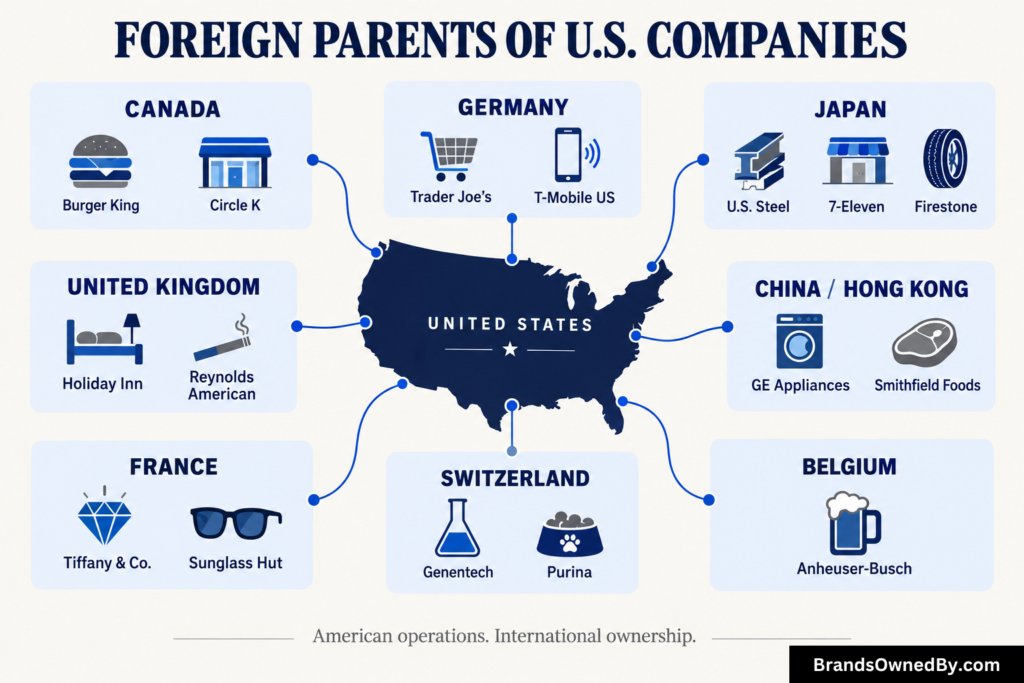
Foreign ownership of American companies is spread across several major economies. It is not limited to consumer brands or one region. Overseas parents control U.S. businesses in manufacturing, retail, telecommunications, food production, hospitality, pharmaceuticals, publishing, and technology.
Country totals must also be interpreted carefully. The parent company’s headquarters, legal incorporation, stock-market listing, and ultimate beneficial owner may be located in different jurisdictions. For this reason, the examples below use the home country most closely associated with the controlling parent. They do not classify a company based only on where a holding entity is registered.
The latest full-year federal data reinforces the scale of this relationship. At the end of 2025, Japan had the largest foreign direct investment position in the United States at $776.3 billion. It was followed by the Netherlands at $751.8 billion, Canada at $747.3 billion, and the United Kingdom at $738.3 billion. Together, these four parent countries accounted for more than half of the total U.S. foreign direct investment position.
Japan
Japanese ownership is particularly important in American manufacturing, transportation, and retail. Nippon Steel’s approximately $14.1 billion acquisition of U.S. Steel in June 2025 added one of America’s most historically significant industrial companies to this group. U.S. Steel is now a Nippon Steel subsidiary, although the transaction includes unusual domestic governance protections.
Japan-based Seven & i Holdings controls 7-Eleven. The convenience-store brand began in Texas and retains its U.S. headquarters in Irving. Its ultimate corporate control, however, rests with the Japanese retail group. Many individual stores are operated by franchisees, so ownership of a local outlet is separate from ownership of the brand and operating system.
Bridgestone’s ownership of Firestone adds another major American-founded business to Japan’s portfolio. Bridgestone acquired Firestone in 1988. It gained an established tire brand, factories, distribution capacity, and an automotive-service network. These examples show that Japanese buyers have generally targeted businesses with substantial physical infrastructure rather than acquiring brand names alone.
Germany
German-controlled American businesses appear across retail, telecommunications, healthcare, and publishing.
Trader Joe’s is owned through German family interests connected with the Aldi Nord side of the Albrecht family. It is not part of the Aldi Süd organization that operates Aldi stores in the United States. Trader Joe’s maintains its own management, product selection, store format, and customer positioning.
Deutsche Telekom controls T-Mobile US through a majority economic interest. T-Mobile US remains an American-incorporated company listed on Nasdaq. Public investors own a meaningful minority position, but Deutsche Telekom has sufficient ownership to exercise decisive influence over governance.
Germany-based Bayer owns American-origin consumer health brands such as Alka-Seltzer, Aleve, Claritin, MiraLAX, Midol, One A Day, and Flintstones vitamins. Bertelsmann wholly owns New York-headquartered Penguin Random House. German ownership therefore extends beyond industrial companies. It includes household products, mobile communications, books, and private-label grocery retail.
Canada
Canadian parent companies control several American restaurant and convenience-store systems.
Restaurant Brands International owns Burger King, Popeyes, and Firehouse Subs. Each brand originated in the United States. Burger King began in Florida, Popeyes in Louisiana, and Firehouse Subs in Jacksonville. Their Canadian parent controls the intellectual property, franchise platforms, development strategy, and long-term capital allocation.
Most restaurants are operated by independent franchisees. Consequently, an American franchisee may own the local restaurant business while Restaurant Brands International owns the brand and franchise system.
Alimentation Couche-Tard owns Circle K. The convenience-store chain was founded in Texas but is now the principal global retail brand of the Canadian group. Couche-Tard’s control covers the larger retail platform, although individual locations may operate through different property, dealer, or franchise arrangements.
United Kingdom
British ownership is prominent in hospitality and tobacco.
IHG Hotels & Resorts owns Holiday Inn and Holiday Inn Express. Holiday Inn was founded in Memphis, but it entered British ownership in 1989. IHG controls the brand standards, reservation system, loyalty platform, marketing infrastructure, and hotel-development network.
The company does not own most Holiday Inn buildings. Properties are commonly owned by franchisees and real estate investors. The British parent owns the hotel brand and commercial system used by those properties.
British American Tobacco wholly owns Reynolds American. BAT acquired the remaining shares it did not already own in 2017. Reynolds therefore has no separately traded public minority interest. Its operating businesses and U.S. tobacco portfolio are controlled through the British group.
China and Hong Kong
Several prominent American businesses are controlled by parent companies based in mainland China or listed in Hong Kong. These structures should not be described as identical, however.
Haier Smart Home owns GE Appliances. Haier acquired the business from General Electric for approximately $5.6 billion in 2016. GE Appliances remains headquartered in Kentucky and operates American factories. The GE name continues through a trademark licence. General Electric, now GE Aerospace, does not own the appliance company.
Lenovo owns Motorola Mobility, while Tencent wholly owns Riot Games. Lenovo’s ownership is limited to the Motorola smartphone business. It does not include Motorola Solutions, which remains an independent American public company. Tencent’s complete ownership of Riot Games must also be distinguished from its minority investments in other gaming companies.
WH Group controls Smithfield Foods. WH Group is listed in Hong Kong and has its operating origins in mainland China. Smithfield returned to Nasdaq in 2025, but the public offering did not transfer control to outside investors. WH Group retained approximately 88% of the company, leaving public shareholders with a minority interest.
France
French-controlled businesses in this list are concentrated in luxury goods and eyewear.
LVMH owns Tiffany & Co. The French luxury group completed its acquisition in 2021 for approximately $15.8 billion. Tiffany is no longer an independent U.S.-listed company. It now operates within LVMH’s watches and jewelry division.
Sunglass Hut is owned by EssilorLuxottica. The group is legally based in France but reflects the combination of France’s Essilor and Italy’s Luxottica. Its ownership of Sunglass Hut provides direct access to consumers alongside eyewear manufacturing, wholesale distribution, owned brands, and licensed designer collections.
Describing every EssilorLuxottica asset as simply French can conceal this cross-border history. France is the appropriate corporate jurisdiction, but the operating group has important French and Italian foundations.
Switzerland
Swiss ownership is especially visible in healthcare and consumer products.
Roche wholly owns Genentech. The biotechnology company retains its South San Francisco headquarters and remains an important research organization within Roche. Its American laboratories and scientific workforce did not become Swiss operations merely because the ultimate shareholder changed.
Nestlé owns Nestlé Purina PetCare. The business was created after Nestlé acquired St. Louis-based Ralston Purina for approximately $10.3 billion in 2001. Purina continues to manage major pet-food and pet-care brands from the United States while reporting into the Swiss consumer-products group.
These acquisitions demonstrate why operating identity and corporate ownership should be evaluated separately. Genentech and Purina remain deeply embedded in their American industries, but their strategic and financial control sits in Switzerland.
Belgium
Belgium’s most recognizable example is Anheuser-Busch.
InBev acquired the St. Louis brewer in 2008 for approximately $52 billion. Anheuser-Busch now operates within Belgium-based AB InBev. Its portfolio includes Budweiser, Bud Light, Busch, Michelob Ultra, and other brands associated with American brewing history.
The acquisition did not remove Anheuser-Busch’s U.S. breweries or domestic workforce. It transferred ultimate ownership, board-level authority, and capital allocation to an international brewing group.
The Netherlands
Dutch corporate structures require additional explanation because the Netherlands is widely used as a legal home for multinational groups. Dutch incorporation does not always mean that the controlling business is culturally or economically Dutch.
Stellantis N.V. is incorporated in the Netherlands and owns Chrysler, Dodge, Jeep, and Ram. However, Stellantis emerged from the merger of Fiat Chrysler Automobiles and France-based PSA Group. Its shareholder base, management, production network, and brand portfolio span several countries. Calling Chrysler or Jeep merely “Dutch-owned” would oversimplify that structure.
Good Humor, Ben & Jerry’s, Breyers, Klondike, and Talenti are now controlled by The Magnum Ice Cream Company. The Netherlands-incorporated company became independent from Unilever through the 2025 ice-cream demerger. Articles that continue to list these brands as Unilever subsidiaries are outdated.
The Netherlands also ranks highly in federal investment data because many international groups use Dutch entities for cross-border holdings. A company’s immediate Dutch parent may therefore differ from the country of its ultimate beneficial owner.
Sweden
Electrolux of Sweden owns Frigidaire.
Electrolux gained control of the American appliance brand through its 1986 acquisition of White Consolidated Industries. Frigidaire’s identity remains closely associated with the development of household refrigeration in the United States. Its ultimate corporate ownership and strategic direction, however, sit within the Swedish appliance group.
Why These Country Distinctions Matter
Grouping foreign parent companies by country reveals more than where corporate headquarters are located. It highlights different acquisition strategies.
Japanese parents have built substantial positions in manufacturing, tires, steel, and convenience retail. German groups are represented in telecommunications, grocery retail, healthcare, and publishing. Canadian companies have assembled large franchise and convenience-store networks. British ownership is prominent in hospitality and tobacco. French and Swiss groups have concentrated on luxury goods, healthcare, food, and consumer brands.
The form of control also varies. Reynolds American, Genentech, Tiffany, Riot Games, and Motorola Mobility are wholly owned subsidiaries. T-Mobile US and Smithfield Foods remain publicly traded but have controlling foreign shareholders. Burger King and Holiday Inn use franchise-heavy structures. Stellantis operates as a multinational parent that cannot be understood through its place of incorporation alone.
The parent’s country is therefore only the starting point. Readers must also examine voting ownership, public minority interests, franchise agreements, licensing arrangements, board rights, and special government protections to understand who actually controls an American company.
Foreign-Owned Does Not Mean Foreign-Operated
Foreign ownership identifies who ultimately controls the equity. It does not mean that every part of the business is managed from another country.
Many foreign-owned companies remain incorporated in the United States. They employ American workers, operate domestic factories, sign contracts under U.S. law, and pay applicable federal, state, and local taxes. Their products may also qualify as American-made when they satisfy the relevant manufacturing and labeling requirements.
GE Appliances is headquartered in Louisville, Kentucky. It operates major manufacturing facilities in several states. Haier owns the company, but its appliance production, engineering, distribution, and management remain substantially American.
Genentech continues to conduct biotechnology research from South San Francisco as part of Roche. Nestlé Purina remains centered in St. Louis. T-Mobile US is headquartered in Bellevue, Washington. Smithfield Foods maintains extensive U.S. farming, processing, distribution, and administrative operations.
U.S. Steel provides an even clearer example. Nippon Steel owns the company, but U.S. Steel remains incorporated in the United States and headquartered in Pittsburgh. Its ownership agreement also includes domestic production, investment, management, and governance commitments.
Operating responsibility can be divided across several parties. The foreign parent may approve long-term strategy and major investments. American executives may manage daily operations. Independent franchisees may employ local workers and operate individual stores. Property investors may own the buildings used by the brand.
Burger King illustrates this separation. Restaurant Brands International owns the brand, trademarks, recipes, franchise agreements, and global development platform. A U.S. franchisee may own the local restaurant company, lease the property, hire the employees, and manage day-to-day service.
Holiday Inn uses a similar model. IHG controls the brand standards, loyalty program, booking system, and operating requirements. The hotel itself may be owned by an American real estate company and managed by a separate hospitality operator.
Corporate nationality, product origin, and operating location are therefore separate questions. A brand can be American-founded, foreign-owned, domestically manufactured, and locally operated at the same time. None of those descriptions automatically cancels the others.
Does a Foreign Parent Control Every Business Decision?
A controlling shareholder usually has authority over major strategic decisions. It does not necessarily approve every operational decision made by the American subsidiary.
A wholly owned parent can normally select directors, replace senior executives, approve annual budgets, determine dividend policy, authorize major acquisitions, and decide whether to sell or restructure the subsidiary. It may also control trademarks, patents, financing arrangements, and transfers between related businesses.
Daily management is often delegated. Local executives generally make decisions about staffing, pricing, suppliers, marketing, product launches, and customer service within an approved budget and strategy. The extent of this autonomy depends on the parent’s management model.
A controlled public company has additional obligations. T-Mobile US and Smithfield Foods have public minority shareholders. Their boards and executives must consider securities laws, disclosure rules, fiduciary duties, and minority-shareholder interests. The controlling parent remains powerful, but the subsidiary is not managed as casually as a small private division.
Foreign parents may also be limited by acquisition agreements or government conditions. Nippon Steel economically owns U.S. Steel, but the U.S. government holds a non-economic golden share with consent rights over specified decisions. These rights cover sensitive matters involving headquarters, production capacity, investments, facilities, and certain governance changes.
An independent or specialized board may hold authority over a narrower area. Ben & Jerry’s has maintained an independent board with responsibilities connected to the brand’s social mission. That board does not own the company or exercise complete commercial control.
Franchise agreements create another division of authority. Restaurant Brands International can set Burger King’s menu standards, branding requirements, technology systems, and franchise rules. It does not ordinarily decide the work schedule of every restaurant employee. The franchisee controls local operations within the contractual system.
Regulated businesses face further limits. Telecommunications, banking, healthcare, energy, defense, and transportation companies must comply with sector-specific rules regardless of who owns them. Regulators can restrict access to sensitive data, require domestic officers, review licence transfers, or impose security controls.
Minority ownership should not be confused with control. Tencent wholly owns Riot Games, but its investment in Epic Games is a minority position. A minority shareholder may receive board representation or contractual rights. That does not automatically allow it to dictate the company’s operating strategy.
The strongest influence of a foreign parent is often found in capital allocation. The parent decides how much money the American subsidiary can reinvest, whether it can pursue acquisitions, how much debt it can carry, and whether cash is retained or distributed. These decisions can shape the business more significantly than involvement in routine operations.
How the United States Reviews Foreign Acquisitions
The United States does not require every foreign acquisition to pass through one universal approval process. The review depends on transaction size, industry, assets, buyer, ownership structure, and potential national security concerns.
The Committee on Foreign Investment in the United States, known as CFIUS, reviews certain transactions involving foreign investment in American businesses. It also has jurisdiction over specified real estate transactions involving foreign persons.
CFIUS is a national security body. It is not a general regulator of whether a transaction is commercially attractive, preserves every job, or benefits existing shareholders. Its analysis focuses on the risks created when a foreign investor gains access to a sensitive American business or asset.
The committee may examine critical technologies, defense supply chains, ports, energy systems, telecommunications infrastructure, large collections of sensitive personal data, agricultural assets, and property near military installations. The buyer’s relationship with a foreign government can also affect the assessment.
Parties can submit a short-form declaration. CFIUS has a 30-day assessment period for this filing. Some declarations are voluntary. Others are mandatory, including certain transactions involving critical technologies or a substantial foreign-government interest in specified U.S. businesses.
Companies seeking a more complete review can submit a formal notice. The initial review period can last up to 45 days. CFIUS may then open an investigation lasting another 45 days. If the matter is referred to the president, the president generally has 15 days to announce a decision.
CFIUS can clear a transaction without conditions. It can also negotiate or impose measures intended to reduce identified risks. These measures may require restrictions on data access, U.S.-citizen directors, government-approved security officers, domestic storage of information, protection of supply commitments, prior approval for facility closures, or limits on the parent’s access to technology.
Approval with mitigation is not the same as government ownership. A regulator may receive monitoring or consent rights without holding an ordinary economic interest in the company.
If national security concerns cannot be resolved, the parties may abandon the transaction. CFIUS can also refer the matter to the president, who can suspend or prohibit the acquisition. A completed transaction can be unwound if necessary.
Filing is largely voluntary outside defined mandatory categories, but ignoring CFIUS does not eliminate its authority. The committee can investigate transactions that were never submitted. It can review pending deals and acquisitions completed years earlier.
National security is only one part of the process. The Federal Trade Commission and Department of Justice examine whether a transaction could substantially reduce competition. Certain large transactions require premerger notification under the Hart-Scott-Rodino Act and cannot close until the applicable waiting period has expired.
Industry regulators may conduct separate reviews. The Federal Communications Commission examines foreign interests connected with certain communications licences. Banking regulators review changes in control involving financial institutions. Other agencies may become involved in aviation, nuclear energy, defense contracting, utilities, transportation, healthcare, or agricultural transactions.
A foreign acquisition may therefore require antitrust clearance, CFIUS review, industry approval, shareholder consent, and state-level authorizations. Passing one review does not guarantee approval under the others.
Common Misconceptions About Foreign-Owned American Companies
Ownership lists frequently become inaccurate because they rely on brand identity, old acquisition announcements, or a single percentage figure. The following distinctions correct the most common errors.
An American Brand Name Does Not Prove American Ownership
A company can retain its original name after being acquired.
GE Appliances still uses the GE name, but Haier acquired the business in 2016. General Electric does not control its appliance operations. The name continues through a trademark licensing arrangement.
Firestone, Frigidaire, Holiday Inn, Tiffany & Co., and Motorola also retain identities tied to their American origins. Their brand histories do not identify their current owners.
Foreign Ownership Does Not Mean the Business Left the United States
An acquisition transfers equity and governance. It does not automatically transfer factories, headquarters, employees, or customers.
GE Appliances continues manufacturing in the United States. Genentech maintains major California research operations. Purina remains centered in St. Louis. U.S. Steel continues operating American steelmaking facilities.
The operating footprint must be evaluated separately from the shareholder’s nationality.
A 10% Foreign Investment Is Not Necessarily Foreign Control
The 10% threshold used in federal foreign direct investment statistics indicates a lasting investment relationship. It does not prove that the investor controls the company.
Control depends on voting power, board rights, shareholder agreements, and the distribution of other shares. A 10% investor may have influence but remain unable to determine the company’s strategy.
Majority ownership is clearer. A shareholder with more than 50% of voting rights can normally elect directors and control ordinary shareholder decisions.
A Public Listing Does Not Guarantee Independent Control
A company can trade on an American stock exchange and still have a controlling foreign shareholder.
T-Mobile US is listed on Nasdaq, but Deutsche Telekom holds a controlling interest. Smithfield Foods also trades publicly, but WH Group retained an overwhelming majority after its 2025 offering.
Public investors can participate financially without gaining control of the company.
A Local Franchisee Does Not Own the Global Brand
Many restaurants, hotels, and convenience stores are operated by independent businesses.
A U.S. franchisee may own a Burger King restaurant. Restaurant Brands International still owns the Burger King brand and franchise platform. An American investor may own a Holiday Inn property, while IHG controls the hotel system.
Store-level ownership and brand ownership answer different questions.
AMC Theatres Is No Longer Controlled by Wanda
China’s Wanda Group acquired AMC Entertainment in 2012 and once held effective control through its ownership and voting rights.
Wanda substantially reduced its position in 2021. AMC is now a publicly traded American company without Wanda’s former controlling interest. Lists that continue to classify AMC as a Chinese-controlled company are outdated.
Ben & Jerry’s Is No Longer Owned by Unilever
Unilever acquired Ben & Jerry’s in 2000 and controlled the commercial business for more than two decades.
That ownership changed when Unilever separated its ice-cream division. Ben & Jerry’s became part of The Magnum Ice Cream Company following the 2025 demerger. Older references to Unilever as the brand’s current owner are no longer accurate.
The brand’s independent mission board should not be mistaken for shareholder ownership. It has specialized responsibilities but does not own the commercial business.
Smithfield Foods Is Not Completely Owned by WH Group
WH Group acquired Smithfield in 2013 and previously owned the entire business.
Smithfield returned to the U.S. public market in 2025. Outside investors now own a minority interest. WH Group retained approximately 88% of the shares and continues to control the company, but describing Smithfield as wholly owned is no longer correct.
Motorola Mobility and Motorola Solutions Are Different Companies
Lenovo owns Motorola Mobility, which produces smartphones under the Moto and Razr families.
It does not own Motorola Solutions. Motorola Solutions is a separately traded American company focused on public-safety communications, command-center software, and related technology.
Using the shortened name “Motorola” without identifying the legal company can produce an incorrect ownership claim.
Tencent Does Not Own Every Company in Which It Invests
Tencent wholly owns Riot Games. It acquired control in stages and purchased the remaining equity in 2015.
Its interest in Epic Games is different. Tencent holds a substantial minority investment, but it does not wholly own Epic Games. Investment size alone should not be treated as proof of control.
Trader Joe’s and Aldi US Do Not Have the Same Direct Owner
Trader Joe’s is held through German family interests associated with Aldi Nord. Aldi stores in the United States are connected with Aldi Süd.
The businesses share Albrecht family history, but they have separate ownership structures, management systems, store formats, and product strategies. Trader Joe’s is not simply the American version of Aldi.
Dutch Incorporation Does Not Always Mean Dutch Operational Control
The Netherlands is a common legal base for multinational holding companies.
Stellantis is incorporated in the Netherlands, but it was formed from Fiat Chrysler Automobiles and France-based PSA Group. Its brands, shareholders, executives, and operations span several countries. Describing Jeep or Chrysler solely as Dutch-owned hides the multinational nature of the parent.
The same distinction applies whenever the immediate holding company and ultimate beneficial owner are based in different jurisdictions. Corporate registration is useful evidence, but it does not always provide the complete ownership picture.
Final Words
U.S. companies owned by foreign companies remain deeply connected to the American economy. They employ millions of people, operate domestic facilities, pay U.S. taxes, and serve American customers.
The most important distinction is between brand identity and corporate control. A company can have an American history, headquarters, workforce, and customer base while being governed by a foreign parent.
Ownership structures also change. Public offerings, demergers, mergers, and government agreements can alter who controls a familiar company. That is why older lists often misclassify businesses such as Ben & Jerry’s, Smithfield Foods, AMC Theatres, and U.S. Steel.
FAQs
What major US companies are owned by foreign companies?
Prominent examples include U.S. Steel, 7-Eleven, Trader Joe’s, T-Mobile US, Firestone, Burger King, Holiday Inn, Reynolds American, GE Appliances, Smithfield Foods, Tiffany & Co., Motorola Mobility, Riot Games, Genentech, and Nestlé Purina PetCare.
What American companies are owned by Chinese companies?
Haier Smart Home owns GE Appliances. Tencent owns Riot Games. Lenovo owns Motorola Mobility. WH Group controls Smithfield Foods through a large majority shareholding, although WH Group is listed in Hong Kong and Smithfield is also publicly traded in the United States.
What American companies are owned by Japanese companies?
Nippon Steel owns U.S. Steel. Seven & i Holdings controls 7-Eleven. Bridgestone owns Firestone. Japanese multinational companies also operate extensive American automotive, electronics, manufacturing, and financial subsidiaries that were established rather than acquired as American brands.
Is U.S. Steel now foreign-owned?
Yes. Nippon Steel of Japan completed its acquisition of U.S. Steel in June 2025. U.S. Steel is a Nippon Steel subsidiary. The U.S. government holds a golden share with special consent and governance rights.
Is 7-Eleven an American or Japanese company?
7-Eleven began as an American business and its U.S. operating company remains headquartered in Texas. Its ultimate parent, Seven & i Holdings, is Japanese. It is therefore an American-founded brand under Japanese corporate ownership.
Is Trader Joe’s owned by Aldi?
Trader Joe’s is owned through German family interests associated with Aldi Nord. Aldi stores in the United States are linked to Aldi Süd, which is a separate branch of the Albrecht family’s business interests.
Is T-Mobile US a German company?
T-Mobile US is an American-incorporated, Nasdaq-listed telecommunications company. Deutsche Telekom of Germany owns a controlling majority of its shares. T-Mobile US is therefore a U.S. public company under German control.
Is GE Appliances still owned by General Electric?
No. Haier acquired GE Appliances in 2016. The business is operated by Haier Smart Home and continues to use the GE name through a long-term licensing agreement.
Is Smithfield Foods completely owned by China?
No. Smithfield returned to the U.S. stock market in 2025. Public investors now own a minority interest. WH Group retains approximately 88% ownership and therefore continues to control the company.
Can a foreign company legally own an American company?
Yes. Foreign investors can acquire most American companies. Transactions involving national security, sensitive technology, communications, infrastructure, personal data, or defense supply chains may face additional federal review.
Who approves foreign acquisitions of U.S. companies?
Different agencies may participate. CFIUS reviews national security risks. The Federal Trade Commission and Department of Justice examine competition issues. Industry regulators may impose additional requirements.
What percentage of American companies are foreign-owned?
There is no reliable single percentage covering every American business. Federal statistics instead measure foreign affiliates, employment, investment, and economic activity. Majority-owned U.S. affiliates of foreign multinational companies employed approximately 8.57 million American workers in 2024.
Does foreign ownership mean a company’s jobs move overseas?
Not necessarily. A foreign buyer may acquire a business specifically for its U.S. factories, employees, distribution network, licenses, or customer relationships. GE Appliances, Genentech, Nestlé Purina, and U.S. Steel continue to maintain substantial American operations.
Are foreign-owned U.S. companies required to pay American taxes?
Yes. U.S. subsidiaries generally remain subject to applicable federal, state, and local taxes. Cross-border payments and transfer-pricing arrangements create additional tax considerations, but foreign ownership does not exempt a company from U.S. tax law.
Are Burger King restaurants owned by a Canadian company?
The Burger King brand and franchise system are owned by Canada-based Restaurant Brands International. Most individual restaurants are operated by franchisees. A local American franchisee may therefore own a restaurant while the brand remains foreign-controlled.