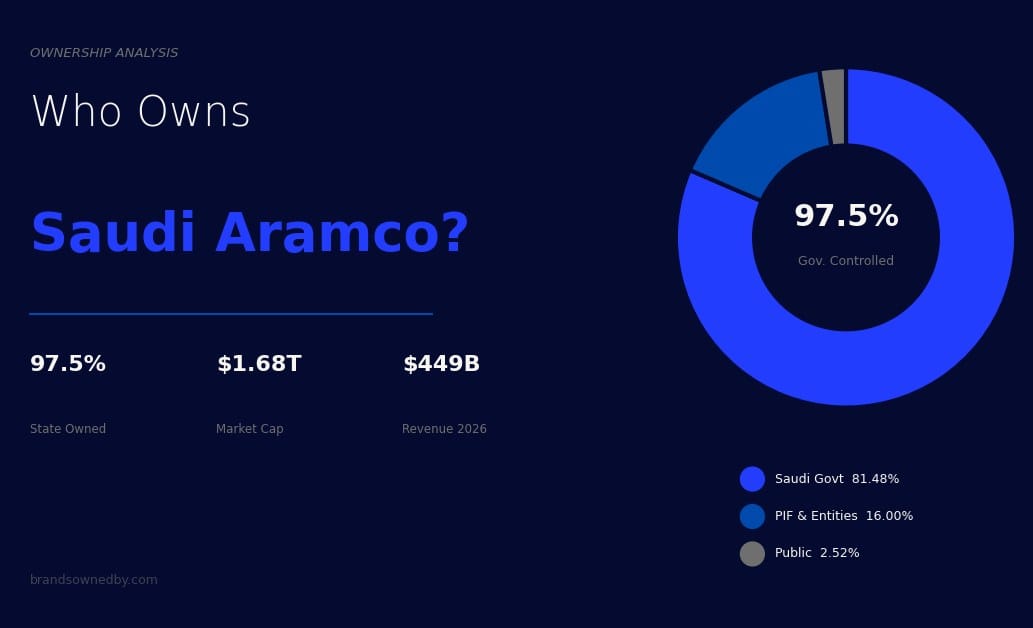

- Saudi Aramco is owned primarily by the Saudi Arabian government, which directly holds 81.48% of outstanding shares as of December 2025. This makes it the world’s most state-concentrated major energy company.
- The Public Investment Fund (PIF), Saudi Arabia’s sovereign wealth fund, controls approximately 16% through various entities including Sanabil Investments and other PIF-affiliated holdings.
- Government and PIF-related entities together account for approximately 97.5% of Aramco’s total share capital, leaving just 2.52% available to public shareholders on the Tadawul exchange.
- No private investor, foreign company, or corporate entity holds a meaningful stake. All major strategic decisions flow directly from the Saudi government and its sovereign institutions.
Saudi Aramco is the world’s largest oil company by both production volume and market value. It supplies roughly 10% of global crude oil output daily and holds the second-largest proven hydrocarbon reserves on earth. Despite its massive global footprint, ownership of the company is remarkably concentrated. The Saudi Arabian government controls it almost entirely, with minimal public participation. Understanding who owns Saudi Aramco requires examining one of the most unusual corporate ownership structures in the world.
Saudi Aramco, officially named the Saudi Arabian Oil Company, is a fully integrated energy and chemicals enterprise headquartered in Dhahran, Saudi Arabia. It explores, produces, refines, transports, distributes, and markets crude oil, natural gas, and petroleum products across more than 50 countries.
The company’s scale is difficult to overstate. It operates the world’s largest oil field by output, the Ghawar Field, which alone produces more oil than most entire countries. Its proven reserves of approximately 259 billion barrels of oil equivalent dwarf those of any privately held competitor. ExxonMobil holds around 17 billion barrels; Chevron around 11 billion.
Beyond hydrocarbons, Aramco has built one of the world’s largest petrochemical platforms through its 70% ownership of SABIC, the Saudi Basic Industries Corporation. This makes the company a major force in plastics, fertilizers, and specialty chemicals in addition to its core oil business.
What Does Saudi Aramco Do?
Aramco’s upstream business produces crude oil and natural gas at a scale no private company can match. Its downstream operations include refining, chemicals manufacturing, lubricants production, and marketing through a global distribution network.
The company also operates a large trading arm, Aramco Trading Company, which manages crude and refined product sales across global markets. It maintains strategic positions in refining assets in the United States, South Korea, Japan, and Malaysia, giving it direct access to key consuming markets.
In recent years, Aramco has expanded into technology and digital infrastructure. It launched Saudi Arabia’s first quantum computer in partnership with Pasqal in May 2026, and it continues to invest in industrial automation, AI, and clean energy research through its venture capital arm.
Scale of Operations
Aramco produced approximately 12.9 million barrels of oil equivalent per day in 2025. It maintains a maximum sustainable crude oil production capacity of 12 million barrels per day. The company operates 24 oil and gas fields, 17 gas processing plants, and an extensive network of pipelines crossing the Arabian Peninsula.
Its global workforce exceeds 70,000 employees across operations in Saudi Arabia, the United States, South Korea, China, Japan, Malaysia, and Europe.
Founders and Origins
The story of Saudi Aramco starts in 1933. Standard Oil of California, then known as SoCal, signed a concession agreement with the Kingdom of Saudi Arabia to explore for oil in the Eastern Province. The joint venture operated under the name California-Arabian Standard Oil Company, abbreviated as CASOC.
Oil was discovered in commercial quantities at Dammam Well No. 7 in 1938. That discovery proved the commercial viability of Saudi reserves. By 1944, SoCal renamed the company the Arabian American Oil Company, which became known worldwide as Aramco. Four American oil majors eventually held stakes: Standard Oil of California, the Texas Company (Texaco), Standard Oil of New Jersey, and Socony-Vacuum (which later became Mobil).
For four decades, these American companies developed Aramco’s infrastructure, trained Saudi engineers, and built one of the most productive oil operations ever assembled. The relationship between the Saudi government and those private owners changed fundamentally during the 1970s.
From Private Concession to National Champion
The oil crisis of 1973 accelerated Saudi Arabia’s desire to control its own resources. The Kingdom began acquiring stakes in Aramco that year. By 1980, the Saudi government had purchased 100% of the company and completed full nationalization.
In 1988, the company was formally renamed the Saudi Arabian Oil Company. It operated for three decades as a fully state-owned enterprise before a partial listing on the Tadawul stock exchange in December 2019, which became the world’s largest IPO at the time with proceeds of approximately $25.6 billion.
Ownership History
Aramco’s ownership history is a story of geopolitical transformation. What began as an American-controlled oil concession became a fully nationalized state enterprise over the course of less than 50 years. Each phase of that transition reflects broader shifts in global energy politics.
The American Era (1933–1972)
For nearly four decades, American oil companies built Saudi Arabia’s energy infrastructure from the ground up. They drilled wells, constructed pipelines, trained local engineers, and developed entire towns and facilities. By the early 1970s, Aramco was producing over five million barrels per day and generating enormous revenues.
Saudi Arabia’s relationship with those American partners was largely cooperative during this period. The government collected royalties and taxes but had no direct ownership. The four American shareholders — SoCal, Texaco, Standard Oil of New Jersey, and Socony-Vacuum — controlled all operational decisions.
Nationalization Era (1973–1980)
The 1973 Arab oil embargo triggered a fundamental reassessment. Saudi Arabia and other OPEC members recognized that control of their oil resources was inseparable from national sovereignty. The Kingdom entered direct negotiations to acquire equity stakes in Aramco.
The process was gradual but deliberate. Saudi Arabia acquired 25% in 1973, then moved to 60% in 1974. It paid the American shareholders fair compensation based on asset valuations. By 1980, Saudi Arabia held 100% of the company and the American companies were fully bought out.
State Enterprise Era (1980–2019)
For nearly four decades after nationalization, Saudi Aramco operated as a fully state-owned enterprise under the direction of the Saudi government and its Ministry of Petroleum. It grew substantially during this period, expanding reserves, building downstream infrastructure, and establishing international refining partnerships.
The company kept a low public profile relative to its economic significance. It did not publish audited financial statements until it began preparing for its public listing.
Partial IPO and Public Listing (2019–Present)
Saudi Aramco’s IPO in December 2019 was the largest in history. The company listed on the Tadawul stock exchange and sold approximately 1.5% of its shares to domestic retail and institutional investors. The IPO valued the company at $1.7 trillion at listing.
Subsequent government actions, including a transfer of shares to the Public Investment Fund, further distributed state-linked ownership while keeping total public float minimal. The free float available to independent investors has remained below 3%.
Who Owns Saudi Aramco: Major Shareholders
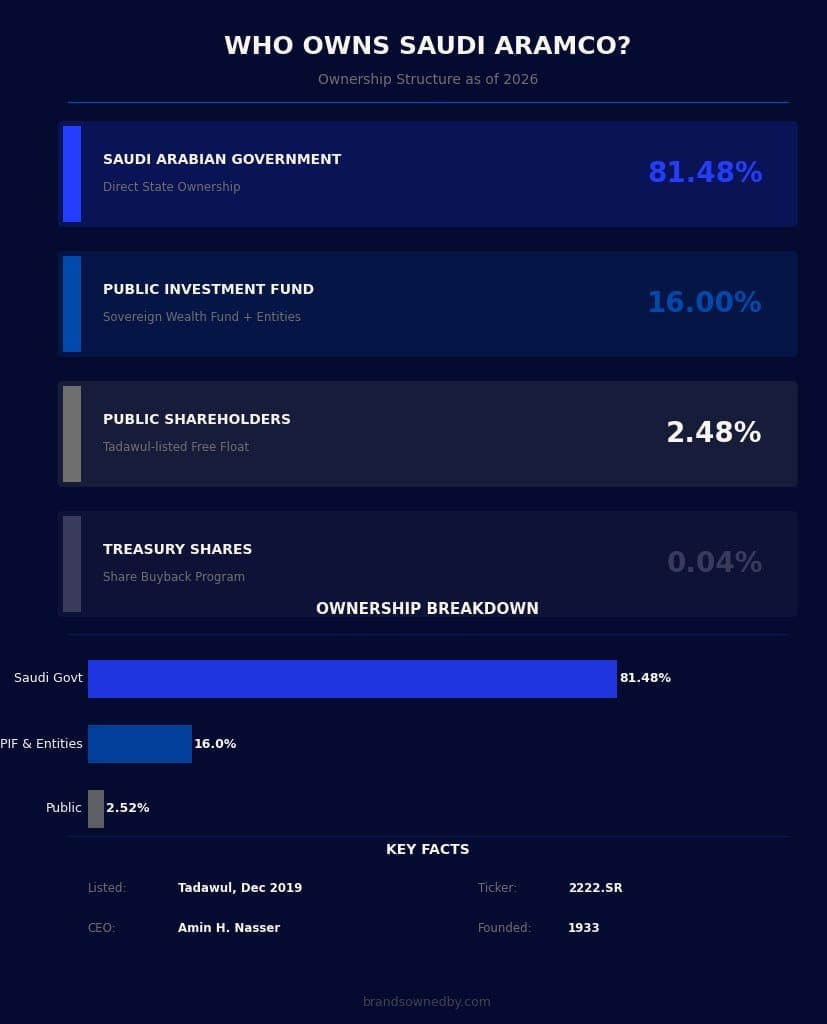
Saudi Aramco’s ownership structure is unlike anything seen among large publicly traded companies in the West. The Saudi government, acting through its treasury and through the Public Investment Fund, controls virtually the entire company. Public shareholders hold a token fraction. There is no founder family, activist investor, or foreign corporation with meaningful influence.
This structure has significant implications. It means that Aramco’s strategy, investment priorities, and production decisions are ultimately determined by the Saudi state, not by independent market forces. Dividend policy, capital expenditure, and production targets all reflect the Kingdom’s broader economic and geopolitical objectives.
Government of Saudi Arabia
The Government of Saudi Arabia is the primary and controlling owner of Saudi Aramco. As of December 31, 2025, the Saudi state directly holds 81.48% of the company’s outstanding shares through its general treasury and the Ministry of Finance.
This stake alone is worth more than $1.37 trillion at current market valuations, making the Saudi government’s Aramco position one of the largest single equity holdings by any government in the world. It gives the state complete control over board composition, dividend policy, executive appointments, and long-term strategy.
The government’s ownership predates the 2019 IPO. It acquired its position through the nationalization process that concluded in 1980. The partial IPO did not reduce the government’s direct stake below its current level. Subsequent share transfers to the PIF redistributed some ownership within state entities without altering the fundamental structure.
Because the Saudi government is a sovereign entity rather than a public company, it is not required to disclose detailed rationale for its decisions. It sets production targets in coordination with OPEC+ and can direct Aramco to prioritize national economic objectives alongside commercial returns.
Public Investment Fund
The Public Investment Fund, commonly known as the PIF, is Saudi Arabia’s sovereign wealth fund and the second-largest owner of Saudi Aramco. The PIF and its affiliated entities collectively hold approximately 16% of the company’s shares.
The PIF received a substantial block of Aramco shares transferred by the Saudi government in 2022, valued at approximately $80 billion at the time of transfer. This transfer was part of the government’s broader effort to fund the PIF’s investment mandates under the Vision 2030 economic diversification plan.
The PIF is chaired by Crown Prince Mohammed bin Salman and managed by Governor Yasir Al-Rumayyan. It manages assets across global technology, real estate, entertainment, and infrastructure investments. Aramco remains by far its largest single holding and the primary source of dividends that fund its diversification activities.
Owning Aramco through the PIF gives the Saudi state a degree of financial flexibility. The PIF can borrow against its Aramco stake, distribute dividends for sovereign purposes, or use the holding as collateral for global investments without requiring the government to sell shares on the open market.
Sanabil Investments
Sanabil Investments is a wholly owned subsidiary of the Public Investment Fund. It holds a portion of the 16% PIF-linked Aramco stake and manages a diversified portfolio of alternative investments on the PIF’s behalf.
Though Sanabil’s exact Aramco share count is not separately disclosed, it forms part of the PIF family of entities collectively holding approximately 16% of the company. Its ownership represents a layer of state-linked institutional holding that sits between the PIF’s direct stake and the Saudi government’s direct position.
Public Shareholders
Public shareholders — both domestic Saudi retail investors and international institutional investors — collectively own approximately 2.48% of Saudi Aramco as of December 2025. This is a small but actively traded free float that gives the stock some price discovery and liquidity on the Tadawul exchange.
International index funds, sovereign wealth funds from other countries, and large institutional investors gained access to Aramco shares following its inclusion in emerging market indices. Global asset managers including Vanguard, BlackRock, and other major fund groups hold positions through those index-tracking mandates.
Despite holding only a small collective stake, the public shareholder base is important for Aramco’s governance optics and for maintaining its listing status on the Saudi Exchange. Institutional holders occasionally weigh in on governance issues through proxy voting.
Treasury Shares
Saudi Aramco holds a small number of its own shares as treasury stock, representing approximately 0.04% of total share capital. These shares were repurchased under a buyback program launched in March 2026.
The buyback targets approximately $2 to $3 billion in share repurchases over 18 months. This is a standard mechanism used by large public companies to return capital to shareholders while supporting the stock price. Treasury shares do not carry voting rights and reduce the effective float available to external investors.
Competitor Ownership Comparison
Saudi Aramco’s ownership structure has no direct parallel among the world’s major oil companies. Most large Western energy companies are widely held public corporations with no dominant shareholder. Aramco sits at the opposite end of the spectrum. Comparing it with its peers reveals just how unusual its governance model is.
Market-Owned (No Controlling Shareholder)
Saudi Aramco vs ExxonMobil
ExxonMobil is the largest Western oil company and Aramco’s most direct peer by revenue and production capability. However, its ownership model is entirely different. ExxonMobil has no controlling shareholder. Vanguard, BlackRock, and State Street are its largest investors, each holding single-digit percentages through index funds. No individual, government, or corporation controls ExxonMobil.
This means ExxonMobil’s management must answer to a broad base of institutional shareholders and justify decisions through quarterly earnings and capital allocation frameworks. Aramco faces no such obligation. Its controlling shareholder is the Saudi state, which sets production strategy through the Supreme Petroleum Council rather than through proxy votes.
Saudi Aramco vs Shell and BP
Shell and BP are two of the world’s most widely held energy companies. Both are publicly traded in London and New York, with diffuse institutional ownership spread across hundreds of global investment funds. Neither has a controlling shareholder, and both operate under intense public scrutiny regarding energy transition strategies.
Aramco, by contrast, has no obligation to satisfy activist investors pushing for faster decarbonization. Its state owner has explicitly committed to long-term oil production growth. This makes Aramco’s strategic outlook fundamentally different from European oil majors despite their comparable scale.
Saudi Aramco vs ADNOC and CNPC
ADNOC, the Abu Dhabi National Oil Company, is the most structurally similar peer. It is state-owned by the Abu Dhabi government and has begun a partial listing process for some subsidiaries. Like Aramco, its production and investment decisions reflect national energy policy rather than purely commercial imperatives.
CNPC, the parent of PetroChina, operates under Chinese government control with approximately 90% state ownership. Both CNPC and ADNOC, like Aramco, use oil revenues to fund national economic objectives and are insulated from the shareholder pressures that shape strategy at Western companies.
Who Controls Saudi Aramco?
Saudi Aramco has no board of directors that operates independently of government direction. The company is ultimately controlled by the Saudi state, which sets energy policy through the Supreme Petroleum Council. Within that framework, Aramco’s executive team manages day-to-day operations, capital allocation, and commercial strategy.
Amin H. Nasser: President and CEO
Amin H. Nasser has served as President and Chief Executive Officer of Saudi Aramco since 2015. He joined the company in 1982 and built his career through upstream operations and engineering leadership before ascending to the top role.
Under Nasser, Aramco completed its record IPO in 2019, acquired a 70% stake in SABIC in 2020 for $69.1 billion, and launched a series of major downstream and petrochemical expansions. He has positioned the company as a long-term supplier of hydrocarbons while defending oil’s continued relevance against the energy transition narrative.
Nasser also serves on the BlackRock Board of Directors, giving him visibility into global capital markets from one of the world’s largest asset managers. He is a member of the World Economic Forum’s International Business Council and various advisory boards for leading academic institutions.
Yasir Al-Rumayyan: Chairman of the Board
Yasir Al-Rumayyan serves as Chairman of Saudi Aramco’s Board of Directors. He is also the Governor of the Public Investment Fund, making him a central figure in Saudi Arabia’s economic transformation under Vision 2030.
Al-Rumayyan’s dual role as Aramco Chairman and PIF Governor reflects the tight integration between Aramco’s governance and Saudi Arabia’s sovereign wealth management. He effectively ensures that Aramco’s strategic decisions align with the Kingdom’s broader economic objectives.
The Board of Directors
Aramco’s board consists of experienced energy, finance, and technology executives. A majority are appointed through government-linked processes rather than independent shareholder nomination. The board approves major capital expenditures, dividend decisions, and strategic acquisitions.
In recent years, the board has added members with international finance and technology backgrounds, reflecting Aramco’s expanding global ambitions. Board members cannot act contrary to directives from the Supreme Petroleum Council without consequence.
The Supreme Petroleum Council
Above Aramco’s board sits the Supreme Petroleum Council, the body that sets Saudi Arabia’s overall oil and gas policy. It is chaired by the Crown Prince and includes senior government ministers. The SPC determines Aramco’s production targets, approves major investments, and sets the framework for national energy strategy.
This structure means that Aramco’s operational leadership manages execution, but fundamental decisions about production levels, pricing strategy, and long-term investment direction originate from the SPC. This is what makes Aramco fundamentally a national oil company, not a commercial one, regardless of its public listing.
Saudi Aramco Annual Revenue and Net Worth
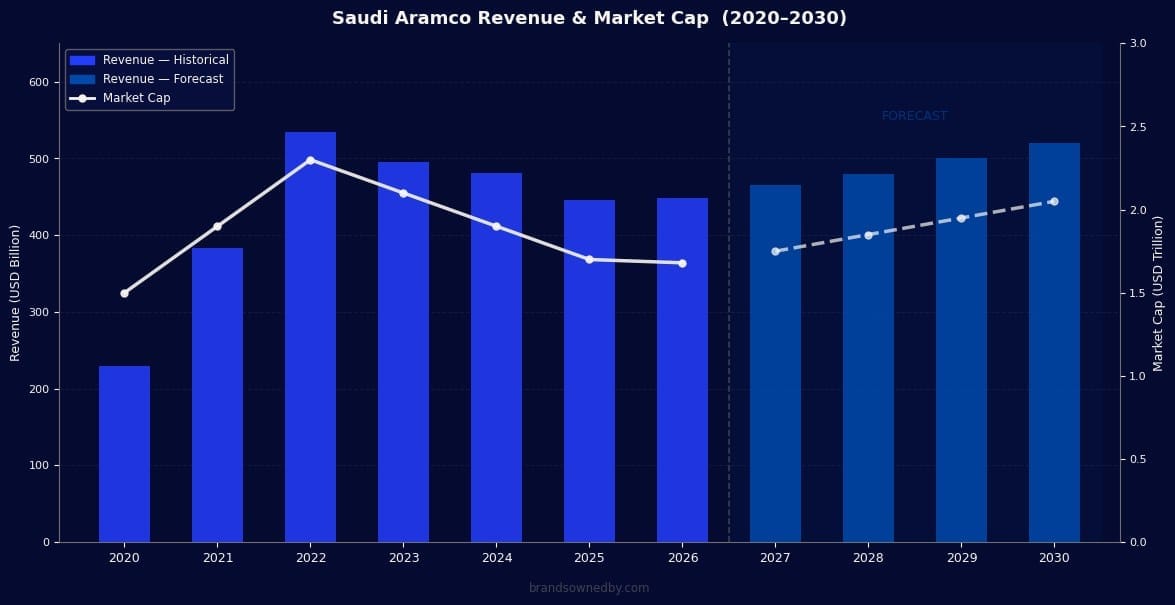
Saudi Aramco generated approximately $449 billion in trailing twelve-month revenue as of mid-2026, making it one of the two or three largest companies in the world by revenue. Its market capitalization stands at roughly $1.68 trillion, placing it among the top 10 most valuable publicly listed companies globally despite a pullback from its 2022 peak of over $2.3 trillion.
Revenue Analysis
Aramco’s revenue is highly sensitive to crude oil prices. The company’s record year was 2022, when it reported $535 billion in revenue and $161 billion in net income — the largest net income ever recorded by any company at the time. That performance reflected both elevated oil prices following the Russia-Ukraine conflict and the full consolidation of SABIC into Aramco’s financials.
Revenue declined in subsequent years as oil prices softened. Full-year 2023 came in at $495 billion, 2024 at $481 billion, and 2025 at $445.7 billion. The 2025 decline reflected a combination of lower average crude prices and reduced OPEC+ quotas constraining production volumes.
The revenue trajectory from 2020 to 2022 was exceptional. Revenue rose from $229 billion in 2020 — when COVID-19 lockdowns destroyed oil demand — to $535 billion in 2022, a 133% increase in just two years. That recovery speed reflects Aramco’s extraordinary leverage to oil price movements.
Where Revenue Comes From?
Aramco’s revenue comes primarily from crude oil and refined product sales. The upstream segment — exploration and production — generates the largest share of revenue and virtually all of its profits. The company produces oil at one of the lowest lifting costs in the world, estimated at under $3 per barrel, which means it remains profitable even at low oil prices.
The downstream segment, which includes refining and chemicals through SABIC, contributes a growing share of revenue. As of 2025, chemicals and refining operations account for an increasing proportion of Aramco’s total output, reducing its dependence on raw crude sales.
Aramco also earns meaningful income from its trading arm, which manages crude oil and petroleum product flows across global markets, and from royalties and fees associated with managed inventory and vending programs at industrial facilities.
Market Capitalization and Net Worth
Aramco reached a peak market capitalization of approximately $2.3 trillion in 2022. Since then, the valuation has contracted as oil prices softened and global investors rotated toward technology stocks. As of June 2026, the company is valued at approximately $1.68 trillion.
Despite the pullback, this figure still makes Aramco larger by market cap than ExxonMobil, Shell, BP, and Chevron combined. Its valuation reflects the sheer scale of its reserves, its ultra-low production costs, and its dominant position in global energy supply.
Aramco paid total dividends of approximately $124 billion in 2024, including both its base dividend and performance-linked dividend. This made it one of the largest dividend-paying companies in the world and directly supported Saudi Arabia’s national budget.
Revenue Forecast Through 2030
Aramco’s future revenue trajectory will depend primarily on global oil demand, OPEC+ production decisions, and the pace of energy transition. Based on current production capacity and analyst estimates, Aramco’s revenue is expected to recover modestly:
- 2027: approximately $465 billion.
- 2028: approximately $480 billion.
- 2029: approximately $500 billion.
- 2030: approximately $520 billion.
Companies Owned by Saudi Aramco
Saudi Aramco owns a portfolio of subsidiaries, joint ventures, and equity stakes that collectively make it one of the most vertically integrated energy companies in the world. Its holdings span petrochemicals, refining, lubricants, trading, venture capital, and digital technology. Each entity plays a role in Aramco’s long-term strategy of capturing value across the entire energy and chemicals value chain.
SABIC — Saudi Basic Industries Corporation
SABIC is the world’s fourth-largest petrochemical company and Aramco’s most significant subsidiary. Aramco acquired a 70% controlling stake from the Public Investment Fund in 2020 for $69.1 billion, making it one of the largest acquisitions in energy history.
SABIC produces a vast range of chemicals, polymers, fertilizers, metals, and specialty materials. It operates manufacturing sites across Saudi Arabia, Europe, the Americas, and Asia. Key products include polyethylene, polypropylene, methanol, ammonia, steel, and engineering plastics.
The acquisition gave Aramco direct access to downstream chemicals markets and reduced its reliance on crude oil sales as a revenue source. As oil demand faces long-term pressure from electrification and efficiency improvements, SABIC provides a hedge through materials that are integral to packaging, construction, agriculture, and manufacturing globally.
Motiva Enterprises
Motiva Enterprises is Aramco’s wholly owned US subsidiary, headquartered in Houston, Texas. It is the operator of the Port Arthur Refinery in Texas, which at 630,000 barrels per day is the largest oil refinery in North America.
Aramco became the sole owner of Motiva in 2017 when it bought out the Shell joint venture. Motiva distributes Shell and 76-branded gasoline across its operating territory in the US South and East. It also produces and markets base oils, lubricants, and other refined products.
The Port Arthur Refinery is one of Aramco’s most important downstream assets. It gives the company direct access to US consumers and provides a captive outlet for Saudi crude that bypasses exposure to spot crude markets.
Saudi Aramco Base Oil Company — Luberef
Saudi Aramco Base Oil Company, known as Luberef, is a publicly listed base oil producer in which Aramco holds approximately 70%. Luberef operates facilities in Jeddah and Yanbu with a combined production capacity of approximately 1.4 million metric tonnes per annum.
Luberef produces Group I, II, and III base oils sold globally under the aramcoDURA, aramcoPRIMA, and aramcoULTRA brand family. The group has approximately a 14% share of the global base oil market, selling one in every seven tonnes produced worldwide.
S-Oil Corporation
S-Oil Corporation is a South Korean integrated refining and petrochemical company in which Aramco holds approximately 17.1%. S-Oil operates a large refinery in Ulsan, South Korea, and is expanding its petrochemical capacity through a major complex currently under development.
S-Oil is the only company in South Korea producing the full lineup of Group I, II, and III base oil products. Aramco’s stake reflects its strategy of securing long-term outlets for Saudi crude in key Asian markets through refinery investments.
Wa’ed Ventures
Wa’ed Ventures is Aramco’s corporate venture capital arm, established to support entrepreneurship and technology investment within Saudi Arabia. It invests in startups and early-stage companies focused on energy technology, industrial innovation, and digital solutions.
Wa’ed has backed dozens of companies across manufacturing, services, and technology. Its mandate aligns with Saudi Arabia’s Vision 2030 objective to diversify the domestic economy beyond oil. By supporting the startup ecosystem, Aramco positions itself as a participant in the broader technology transformation that will shape its own industry.
Aramco Trading Company
Aramco Trading Company is Aramco’s dedicated global crude oil and petroleum product trading subsidiary. It manages the commercial sales of crude oil, refined products, and petrochemicals to customers across Asia, Europe, and the Americas.
The trading arm gives Aramco direct access to global commodity markets and allows it to capture additional value on product flows beyond what it would earn from simple crude sales. It handles both spot market transactions and long-term supply agreements with major refiners worldwide.
Petro Rabigh
Rabigh Refining and Petrochemical Company, known as Petro Rabigh, is a joint venture between Saudi Aramco and Sumitomo Chemical of Japan, each holding approximately 37.5% of the listed entity. The company operates an integrated refining and petrochemical complex in Rabigh on Saudi Arabia’s Red Sea coast.
Petro Rabigh converts crude oil into transportation fuels, naphtha, and a range of petrochemical products. The complex is designed to extract maximum value from each barrel of crude processed and serves as an important part of Aramco’s domestic downstream strategy.
Aramco Overseas Company
Aramco Overseas Company, known as AOC, manages Aramco’s international operations outside Saudi Arabia. It coordinates subsidiaries, joint ventures, and representative offices across Europe, Asia, and North America.
AOC provides the corporate infrastructure through which Aramco engages international partners, manages foreign subsidiaries, and executes overseas investments. It plays a coordination role rather than a direct operational one, ensuring that Aramco’s global activities align with its strategic and commercial objectives.
Final Thoughts
Saudi Aramco remains one of the most consequential companies in the global economy, and its ownership structure is central to understanding how it operates. The Saudi government controls it nearly entirely, with the PIF holding an additional 16% that keeps ownership within the Saudi state ecosystem. Public shareholders hold less than 3% of the company combined.
This concentration of ownership is not an accident. It reflects Saudi Arabia’s strategic choice to maintain sovereign control over its most valuable economic asset. Aramco’s revenues fund the national budget, support Vision 2030’s diversification agenda, and underwrite the Kingdom’s geopolitical ambitions. Those objectives cannot be achieved if ownership and control are dispersed to private investors.
Amin Nasser and the executive team manage a commercially sophisticated enterprise, but they operate within a framework set by the Saudi government and its Supreme Petroleum Council. That framework prioritizes national strategic goals alongside commercial returns.
The question of who owns Saudi Aramco has a clear answer. The Saudi Arabian state does, overwhelmingly and deliberately.
FAQs
When was Saudi Aramco founded?
Saudi Aramco traces its origins to 1933, when Standard Oil of California signed a concession agreement with the Kingdom of Saudi Arabia and established the California-Arabian Standard Oil Company (CASOC). The venture was renamed the Arabian American Oil Company (Aramco) in 1944. Following nationalization, it was formally renamed the Saudi Arabian Oil Company in 1988. Commercial oil was first discovered at Dammam Well No. 7 in 1938, marking the start of Saudi Arabia’s oil era.
Is Saudi Aramco publicly traded?
Yes. Saudi Aramco completed its IPO on the Tadawul stock exchange — the Saudi Exchange — in December 2019. It trades under the ticker symbol 2222. The IPO was the largest in history at the time, raising approximately $25.6 billion. However, the free float available to public investors remains very small at approximately 2.48% of total shares outstanding. The vast majority of the company is owned by the Saudi state and its sovereign wealth institutions.
Who is the largest shareholder of Saudi Aramco?
The Government of Saudi Arabia is the largest shareholder of Saudi Aramco, holding 81.48% of the company’s outstanding shares directly as of December 2025. When combined with the approximately 16% held by the Public Investment Fund and its affiliated entities, the total Saudi state stake exceeds 97%. No private investor or foreign corporation holds a significant position in the company.
What is Saudi Aramco’s annual revenue?
Saudi Aramco generated approximately $445.7 billion in revenue for full-year 2025, down from $480.57 billion in 2024 and a record $535 billion in 2022. The company’s revenue is highly sensitive to crude oil prices. Trailing twelve-month revenue as of mid-2026 is approximately $449 billion. Net income for 2025 was approximately $93.4 billion, despite the revenue decline, reflecting the company’s extraordinarily low production costs.
Who is the CEO of Saudi Aramco?
Amin H. Nasser has served as President and Chief Executive Officer of Saudi Aramco since 2015. He joined the company in 1982 and spent more than three decades in upstream operations and engineering leadership before assuming the top role. Under his leadership, Aramco completed its historic IPO, acquired SABIC, and expanded its downstream and chemicals portfolio significantly. Nasser also serves on the BlackRock Board of Directors.
Does the Saudi royal family own Saudi Aramco?
Saudi Aramco is owned by the Saudi Arabian state, not directly by the royal family as individuals. The company’s shares are held by the Saudi government through its treasury and the Public Investment Fund. The royal family’s influence comes through institutional control of the state and the PIF, which Crown Prince Mohammed bin Salman oversees. Individual members of the royal family do not hold personal equity stakes in Aramco that are publicly disclosed.
What companies does Saudi Aramco own?
Saudi Aramco owns a diversified portfolio of subsidiaries. Its largest holding is a 70% stake in SABIC, one of the world’s largest petrochemical companies. It also wholly owns Motiva Enterprises, which operates North America’s largest oil refinery in Port Arthur, Texas. Other major holdings include a 70% stake in Luberef, a global base oil producer; a 17.1% stake in South Korea’s S-Oil Corporation; Aramco Trading Company; Wa’ed Ventures; Petro Rabigh; and Aramco Overseas Company.
Where is Saudi Aramco headquartered?
Saudi Aramco is headquartered in Dhahran, in the Eastern Province of Saudi Arabia. Dhahran has been the center of Saudi Arabia’s oil industry since the company’s founding in the 1930s. The city is home to Aramco’s corporate campus, research centers, and the King Fahd University of Petroleum and Minerals. The company maintains regional and international offices in Houston, Rotterdam, Singapore, Tokyo, and other major energy hubs worldwide.