

- General Electric Company operates as GE Aerospace and is owned by its public shareholders. No shareholder has majority control.
- The largest reported institutional positions available in August 2026 are BlackRock at 8.75%, Capital Research at 6.78%, Vanguard at 6.40%, TCI Fund Management at 4.58%, and State Street at 4.37%.
- GE Aerospace’s principal wholly owned operating brands include Avio Aero, Unison, Dowty Propellers, and Colibrium Additive. It also owns 50% of CFM International with Safran Aircraft Engines.
- GE Vernova, GE HealthCare, GE Appliances, GE Lighting, NBCUniversal, and Wabtec are not owned by General Electric.
Who owns General Electric is more complicated than it was a few years ago. General Electric Company still exists, still trades under the GE ticker, and now operates as GE Aerospace. It is owned by public shareholders. No founder, family, government, or corporate parent controls it. GE Vernova and GE HealthCare are separate public companies and are no longer General Electric subsidiaries.
The modern ownership structure makes sense only when the legal company and the operating identity are distinguished. General Electric Company is the legal public corporation. GE Aerospace is the name under which it operates.
![Who Owns General Electric [GE Aerospace]](https://brandsownedby.com/wp-content/uploads/2026/08/Who-Owns-General-Electric-GE-Aerospace-683x1024.png)
Who Founded General Electric?
General Electric was formed in 1892 through the merger of Edison General Electric Company and Thomson-Houston Electric Company. Thomas Edison was central to one side of that combination. He was not the sole founder of the merged enterprise.
The Thomson-Houston side was built around the work of Elihu Thomson and Edwin Houston. Charles A. Coffin led Thomson-Houston and became the first president of the combined General Electric. Financier J.P. Morgan helped arrange the consolidation.
This matters because GE did not begin as a family-controlled company. It emerged as a large industrial corporation backed by investors. Its ownership was dispersed through shares from its early years.
General Electric’s Origin
GE began as an electrical equipment company. It produced power-generation equipment, lighting products, motors, and related industrial systems. Its research organization later helped commercialize technologies across aviation, healthcare, broadcasting, energy, and materials science.
GE entered aviation through work on aircraft engine technologies and turbo-superchargers. Its first U.S. jet engine ran in 1942. Aviation grew into one of the group’s most valuable businesses. That business ultimately became the surviving core of General Electric.
General Electric is no longer a diversified conglomerate. General Electric Company now operates as GE Aerospace. It trades on the New York Stock Exchange under ticker GE.
The company focuses on commercial and military aircraft engines, aftermarket services, aircraft systems, propulsion technology, and additive manufacturing. It has an installed base of about 50,000 commercial and 30,000 military engines, including engines produced through joint ventures.
GE Aerospace reports two main segments. Commercial Engines & Services covers commercial propulsion and the large aftermarket operation. Defense & Propulsion Technologies covers military engines, aircraft systems, specialized propulsion, and additive manufacturing.
Important General Electric Milestones
- 1892: Edison General Electric and Thomson-Houston merged to create General Electric.
- 1919: GE helped form the Radio Corporation of America. This connected GE to the early development of U.S. broadcasting.
- 1942: GE ran the first jet engine produced in the United States.
- 1986: GE acquired RCA, including NBC. This expanded the company far beyond its industrial base.
- 2004: NBC was combined with Vivendi Universal Entertainment to create NBCUniversal.
- 2013: Comcast completed its acquisition of NBCUniversal. GE exited media ownership.
- 2016: GE sold GE Appliances to Haier. The products kept using the GE brand under a long-term licensing arrangement.
- 2019: GE Transportation combined with Wabtec. GE shareholders received an economic interest, but the rail business became part of Wabtec.
- 2021: GE announced plans to separate into three focused public companies.
- 2023: GE HealthCare became an independent company.
- 2024: GE Vernova became independent. The remaining General Electric Company launched as GE Aerospace.
General Electric Ownership History
GE’s ownership history is not a sequence of private owners. It is a story of public-company ownership, acquisitions, divestitures, and spin-offs. The shareholder base changed constantly, but the company did not become a privately owned subsidiary.
From an Investor-Backed Merger to a Public Corporation
The 1892 merger combined two major electrical businesses. J.P. Morgan’s financial influence was important, but General Electric was not simply “owned by J.P. Morgan.” Investors owned shares in the combined corporation.
Over time, those shares became widely distributed among individuals, institutions, pension funds, and investment managers. The company eventually became one of the original members of the Dow Jones Industrial Average. It remained in the index until 2018.
The Conglomerate Expansion Era
GE expanded across aviation, power, healthcare, appliances, plastics, locomotives, broadcasting, and financial services. Its ownership did not change during this expansion. Public GE shareholders indirectly owned these operations through General Electric Company.
The structure became especially broad under CEO Jack Welch. GE Capital grew into a major financial operation. RCA brought NBC. Industrial acquisitions added scale across energy, healthcare, and transportation.
This model made GE appear highly diversified. It also made the balance sheet and earnings more difficult to assess. GE Capital’s exposure became a serious weakness during the 2008 financial crisis.
The Long Divestiture Cycle
GE gradually sold businesses to reduce complexity and debt. NBCUniversal went to Comcast. GE Appliances went to Haier. The company sold its biopharma business to Danaher. GE Transportation was combined with Wabtec. GE also reduced and ultimately exited major financial investments that were no longer central to its industrial strategy.
These transactions changed what GE shareholders owned through their GE stock. They did not represent a sale of General Electric itself.
For example, a consumer may still see the GE name on a refrigerator. That does not mean General Electric owns the appliance manufacturer. Haier’s U.S. subsidiary owns GE Appliances and licenses the GE trademark for appliances.
The Three-Company Separation
In November 2021, GE announced that it would separate its healthcare, energy, and aviation operations. The plan replaced the conglomerate with three focused public companies.
GE HealthCare Technologies began independent trading in January 2023. GE distributed approximately 80.1% of the healthcare company to GE shareholders and initially retained approximately 19.9%. GE later monetized its remaining interest. GE HealthCare now has its own shareholders, board, management, and Nasdaq listing under GEHC.
GE Vernova separated in April 2024. GE shareholders received one GE Vernova share for every four GE shares they held at the distribution record date. GE Vernova became an independent energy company under ticker GEV.
After the Vernova separation, General Electric Company began operating as GE Aerospace. It retained the GE ticker, the public-company identity, and the aviation-centered operations.
What the Breakup Did to Shareholder Ownership
The breakup did not give GE Aerospace ownership of the other two companies. Instead, eligible GE shareholders received shares in the separated businesses.
Consider an investor who owned GE before both spin-offs. That investor could have ended up holding three independent stocks: GE Aerospace, GE HealthCare, and GE Vernova. Common shareholders may overlap, but one company does not control the others.
Who Owns General Electric: Major Shareholders
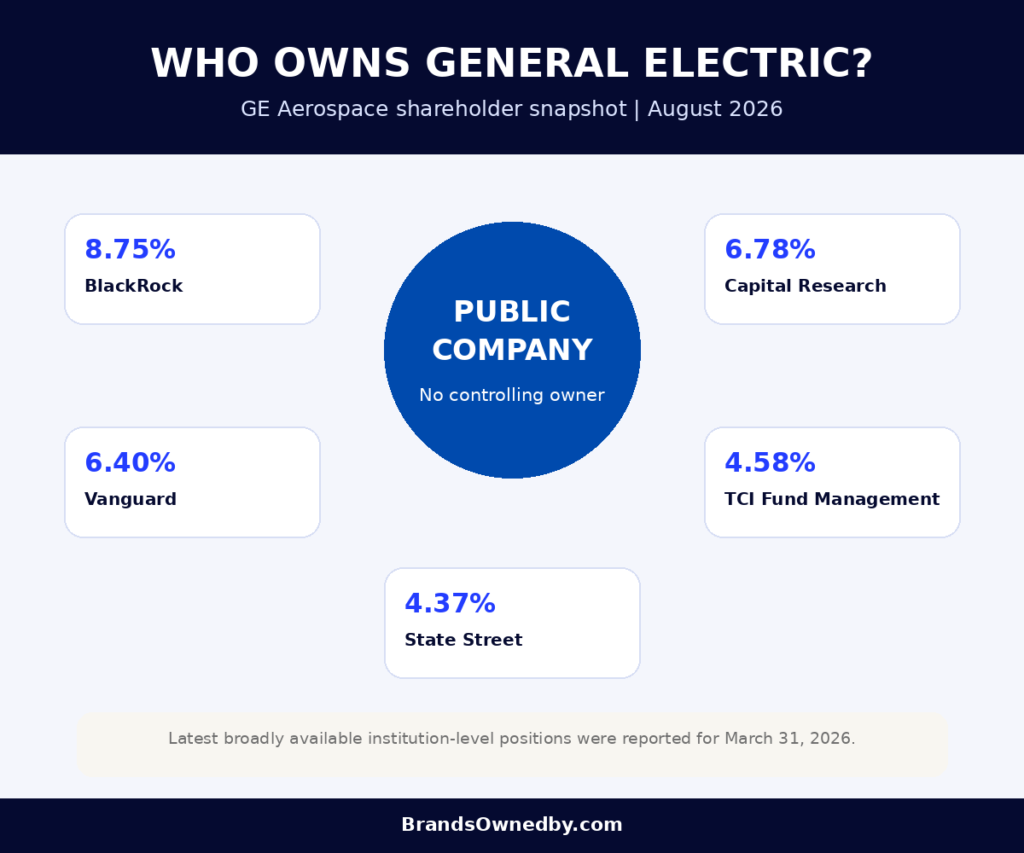
General Electric Company, operating as GE Aerospace, is owned by shareholders who hold its common stock. Institutional investors own much of the float. Retail investors, employees, executives, pension funds, and other asset managers own the rest.
No shareholder owns close to 50%. There is no parent company. There is also no dual-class share structure that gives a founder or insider enhanced voting rights. Each share carries one vote.
The percentages below reflect the latest broadly available institution-level positions as of August 7, 2026. Most were reported for March 31, 2026. This reporting delay is normal. Institutional filings show a position at a past quarter-end, not a live holding throughout the day.
BlackRock – 8.75%
BlackRock is the largest reported institutional holder. It held approximately 90.74 million GE shares, equal to 8.75% of shares outstanding.
Most of this position is held through index funds, exchange-traded funds, and managed portfolios for clients. BlackRock therefore has substantial voting influence. It does not own GE Aerospace in the sense of having operational control.
BlackRock can vote on director elections, executive compensation, auditors, and shareholder proposals. It cannot independently appoint management or approve strategy because its stake is well below a controlling threshold.
Capital Research and Management – 6.78%
Capital Research and Management held approximately 70.37 million shares, or 6.78%. It manages funds associated with the American Funds group and other institutional portfolios.
Capital Research is more active in company selection than a pure index manager. Its position signals substantial long-term investment exposure. It still remains a minority shareholder with no unilateral control.
Vanguard – 6.40%
Vanguard-related investment management entities held approximately 66.43 million shares, equal to 6.40% in the latest consolidated institution-level data.
Vanguard’s position is mainly held for fund investors. It votes the shares that its funds are entitled to vote, subject to its stewardship policies and any investor-directed voting arrangements. Vanguard can influence governance outcomes, but it cannot run GE Aerospace.
Older proxy tables may show a different Vanguard percentage. The difference can result from reporting dates, changes in funds, legal investment-management entities, share repurchases, and the way data providers consolidate holdings.
TCI Fund Management – 4.58%
TCI Fund Management held approximately 47.51 million shares, representing 4.58%. TCI is an investment manager known for concentrated positions and active engagement with public companies.
Its stake is more concentrated than the holdings of many index managers. That can give TCI a louder voice in discussions about capital allocation, margins, executive incentives, and shareholder returns. It still cannot control a shareholder vote on its own.
State Street – 4.37%
State Street held approximately 45.34 million shares, equal to 4.37%. Its asset-management business runs index and institutional portfolios, including major exchange-traded funds.
State Street’s influence is mainly exercised through proxy voting and engagement. Like BlackRock and Vanguard, it is a fiduciary manager of client assets rather than a corporate parent.
Other Institutional and Public Shareholders
The five holders above account for about 30.88% of GE shares. The remaining 69.12% is spread across other institutions, retail investors, employees, executives, and investment vehicles.
That remainder should not be treated as one ownership block. Different investors have different mandates and voting policies. Some track indexes. Others actively select aerospace stocks. Retail investors normally vote independently or may not vote at all.
Executive and Insider Ownership
Insiders own only a small fraction of GE Aerospace. At the end of 2025, Chairman and CEO H. Lawrence Culp Jr. beneficially owned approximately 1.61 million shares. Current directors and executives as a group held less than 1%.
Equity compensation aligns management with shareholders. It does not give executives voting control. Culp is influential because of his management and board roles, not because he owns a dominant equity stake.
Competitor Ownership Comparison
GE Aerospace competes with public companies that use several ownership models. Most are widely held. Safran is the notable exception because the French state and employees own meaningful blocks.
RTX Corporation
RTX is a U.S. public company. It owns Pratt & Whitney, Collins Aerospace, and Raytheon. Its shares are widely held by institutions and public investors.
BlackRock, Vanguard, and State Street are among its largest shareholders. No single investor controls RTX. This is broadly similar to GE Aerospace’s ownership model.
The operating difference is portfolio scope. GE Aerospace is concentrated on propulsion, services, and aircraft systems. RTX combines commercial aerospace with a much larger defense-electronics and missile portfolio.
Rolls-Royce Holdings
Rolls-Royce Holdings is listed in the United Kingdom. Public and institutional shareholders own it. It has no parent company or controlling founder.
Its ownership resembles GE Aerospace’s dispersed model, but the companies have different engine-market exposure. Rolls-Royce is particularly strong in large commercial widebody engines. GE Aerospace has major positions across narrowbody, widebody, military, and aftermarket markets, including its CFM joint venture.
Rolls-Royce also retains a controlling interest in Rolls-Royce SMR. That nuclear business is not comparable to GE Aerospace’s focused aviation portfolio.
Safran
Safran is a French public company. Public investors own about 81.3%. The French state owns about 11.2%, employees own about 7.4%, and treasury shares represent about 0.1%.
This gives Safran a more strategic ownership structure than GE Aerospace. Government and employee blocks are more visible. GE has no comparable U.S. government equity stake.
Safran is both a competitor and a partner. Safran Aircraft Engines and GE Aerospace each own 50% of CFM International. CFM produces the CFM56 and LEAP engine families. Neither parent controls that joint venture alone.
Honeywell Aerospace
Honeywell Aerospace became a separately traded public company in June 2026 following its separation from Honeywell. Its shares are now owned by public investors rather than by Honeywell International.
The company competes in avionics, auxiliary power units, mechanical systems, engines, and aftermarket services. Its ownership is dispersed. It does not have a controlling parent after the separation.
This makes its structure more comparable to GE Aerospace than it was when it operated inside a diversified industrial parent. GE Aerospace remains much more concentrated in large propulsion programs and engine services.
MTU Aero Engines
MTU Aero Engines is a German listed company with a broad institutional and public shareholder base. It has no majority owner.
MTU competes in engine components and maintenance. It also participates as a risk-and-revenue-sharing partner in major programs. Its market value and operating scale are smaller than GE Aerospace’s.
Both companies are publicly owned, but GE has greater control over complete engine architectures and a much larger installed base. MTU often participates through partnerships rather than acting as the sole prime engine manufacturer.
Who Controls General Electric?
No shareholder controls General Electric outright. Control is divided among shareholders, the board, and executive management. Each group has a different role.
Shareholder Voting Control
GE Aerospace has one class of common shares for ordinary voting purposes. Each share carries one vote. Shareholders elect directors and vote on matters such as executive compensation, the auditor, equity plans, and properly submitted proposals.
Because ownership is dispersed, major institutions can influence close votes when they act in the same direction. That influence is not the same as legal control. BlackRock, Capital Research, Vanguard, TCI, and State Street do not form a permanent voting group.
Board-Level Control
The board oversees strategy, risk, capital allocation, succession, executive pay, product safety, and management performance. It can appoint or remove the chief executive.
GE combines the chairman and CEO positions under H. Lawrence Culp Jr. The company offsets this concentration with an independent lead director. Thomas Horton, the former chairman and CEO of American Airlines, holds that role.
Horton works on board agendas, leads sessions of independent directors, acts as a liaison with the chairman, and provides a contact point for significant shareholders. The Audit, Compensation, Governance, and Classified Programs committees have independent chairs.
Executive Control
H. Lawrence Culp Jr. controls day-to-day corporate execution as chairman and CEO. He shapes strategy, operating priorities, investment, supply-chain actions, and capital deployment within the authority granted by the board.
The operating model is decentralized. Mohamed Ali leads Commercial Engines & Services. Amy Gowder leads Defense & Systems. Ricardo Procacci leads Propulsion & Additive Technologies. Rahul Ghai serves as chief financial officer.
These leaders control operations within approved budgets and policies. They do not own the company or have unrestricted authority.
What Institutional Investors Can Actually Do
Large investors can engage with directors, vote against board nominees, oppose compensation, support shareholder proposals, or sell their shares. An active investor can also publicly press for operational or capital-allocation changes.
They cannot direct an engine program, sign a customer contract, or change management without using governance mechanisms. Practical control therefore remains with the board and executive team, subject to shareholder accountability.
General Electric Annual Revenue and Net Worth
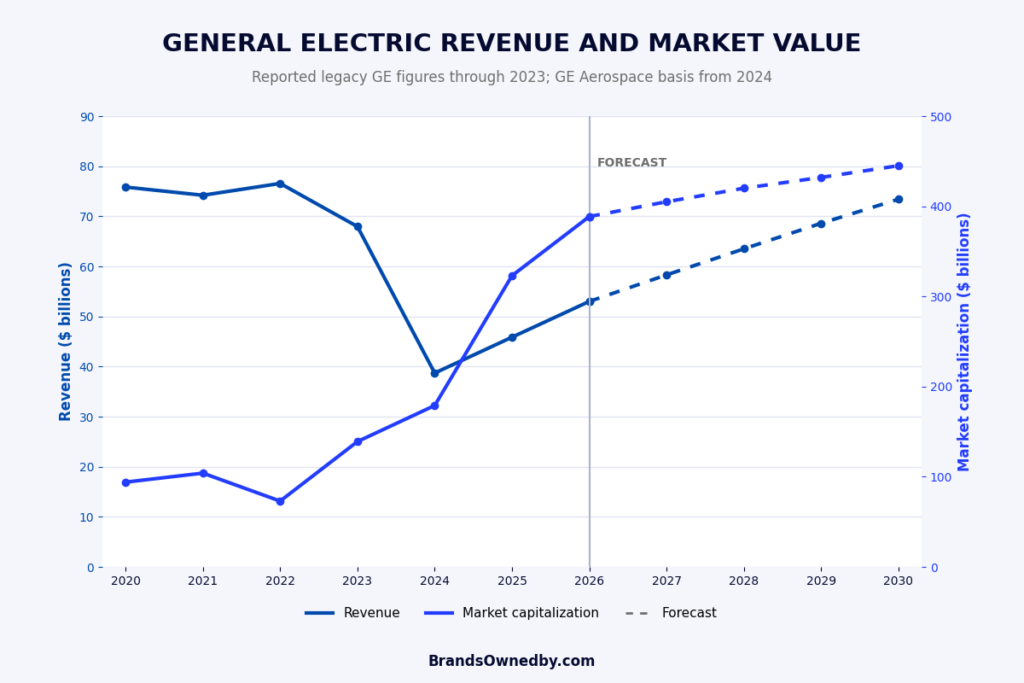
General Electric’s financial history requires careful interpretation. The 2020–2023 figures cover the legacy conglomerate as it disposed of and separated businesses. The figures from 2024 onward reflect GE Aerospace far more closely.
For this analysis, “net worth” means market capitalization. It is the market value of outstanding shares. It is not the same as revenue, book equity, enterprise value, or the price required to acquire the company.
2026 Revenue Position
GE Aerospace generated $25.74 billion of GAAP revenue in the first half of 2026. That was 23% above the first half of 2025. Second-quarter GAAP revenue was $13.35 billion, up 21%.
Adjusted revenue was $24.25 billion for the first half. Management raised full-year adjusted revenue growth guidance to the high teens from a 2025 base of $42.3 billion. That implies adjusted revenue close to $50 billion.
The $53.0 billion full-year GAAP estimate in the table adds expected Corporate & Other revenue and normal second-half seasonality. It is an analytical estimate, not company guidance.
Revenue by Operating Segment
Commercial Engines & Services produced $18.65 billion of first-half 2026 segment revenue. Defense & Propulsion Technologies produced $6.66 billion. Eliminations and other adjustments reduced adjusted revenue by $1.06 billion.
Before eliminations, Commercial Engines & Services represented about 73.7% of segment revenue. Defense & Propulsion Technologies represented about 26.3%.
The second quarter showed the same pattern. Commercial Engines & Services generated $9.73 billion, up 27%. Defense & Propulsion Technologies generated $3.44 billion, up 16%.
Revenue by Equipment and Services
Services are the economic center of GE Aerospace. In 2025, the two operating segments generated $30.44 billion from services and $13.43 billion from equipment. Services therefore represented about 69.4% of total segment revenue. Equipment represented about 30.6%.
Within Commercial Engines & Services, services generated $25.01 billion. That was 75.1% of the segment’s $33.31 billion total. Equipment generated $8.30 billion.
Defense & Propulsion Technologies was more balanced. Services produced $5.43 billion. Equipment produced $5.13 billion.
The mix explains why installed engines matter so much. GE may accept weak economics on the initial delivery of a new commercial engine. It can then earn parts and service revenue over decades of aircraft use.
Revenue by Geography
GE Aerospace generated 60% of its 2025 revenue outside the United States. The United States contributed $18.19 billion, or 39.7%.
Asia contributed $10.82 billion, or 23.6%. Europe contributed $8.60 billion, or 18.8%. The Middle East and Africa contributed $4.58 billion, or 10.0%. The rest of the Americas contributed $3.66 billion, or 8.0%.
This geographic mix diversifies customer demand. It also creates exposure to trade policy, export controls, currencies, airline cycles, and geopolitical risk.
What Drives the Current Valuation?
GE Aerospace’s market capitalization was approximately $388.62 billion on August 7, 2026. The market value is far above annual revenue because investors place a high value on the installed engine base, aftermarket cash flows, intellectual property, barriers to entry, and a backlog above $210 billion.
The market is also pricing in continued growth. Commercial aircraft shortages keep older fleets flying longer. That supports maintenance, shop visits, and spare-parts demand. New LEAP deliveries expand the future service base.
The valuation includes execution risk. Supply constraints can delay engines and parts. Faster equipment growth can temporarily dilute margins because new engines are less profitable than aftermarket services. A lower valuation multiple could reduce market capitalization even if revenue keeps rising.
Revenue Forecast Through 2030
The forecast assumes GAAP revenue reaches about $53.0 billion in 2026. It then grows 10% in 2027, 9% in 2028, 8% in 2029, and 7% in 2030. This produces an estimated $73.4 billion in 2030 revenue.
The growth rates gradually decline because the comparison base becomes larger. This is more credible than extending 20%-plus growth indefinitely.
Several factors support the forecast. GE Aerospace had more than $210 billion of backlog in mid-2026. LEAP deliveries increased 41% in the first half. Commercial services revenue increased 32%. Defense demand remained healthy. The newer engine fleet will also begin generating more shop visits as it ages.
The main constraints are supplier capacity, material availability, inflation, tariffs, engineering costs, and the timing of airframer production. The forecast assumes these issues improve but do not disappear.
Market Capitalization Forecast Through 2030
The market-cap forecast rises more slowly than revenue. It reaches $405 billion in 2027, $420 billion in 2028, $432 billion in 2029, and $445 billion in 2030.
This conservative path assumes earnings and free cash flow continue to grow, but GE’s valuation multiple gradually compresses as growth normalizes. It also assumes share repurchases offset some dilution and support per-share value.
Market capitalization is the least predictable part of the table. Interest rates, investor sentiment, defense budgets, accidents, program delays, and valuation multiples can move the stock independently of reported revenue. The figures should be treated as a base-case scenario, not price targets.
Companies and Brands Owned by General Electric
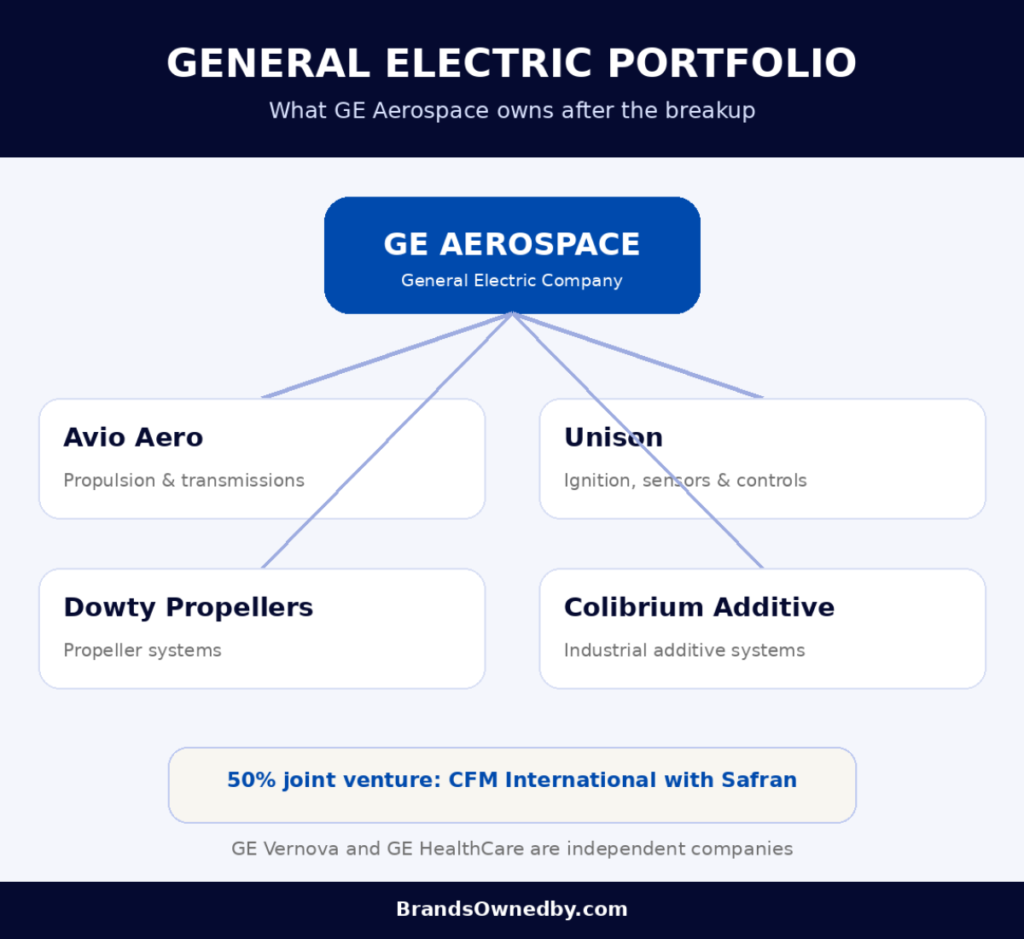
GE Aerospace owns a focused group of aviation businesses. It also participates in major joint ventures. The distinction between wholly owned brands, internal business units, product families, and joint ventures is important.
GE Aerospace
GE Aerospace is the operating identity of General Electric Company. It is not a subsidiary owned by a separate General Electric parent. The legal public company and the aerospace enterprise are effectively the same corporate group.
Its core capabilities include commercial engines, military engines, maintenance, repair and overhaul, spare parts, aircraft systems, propulsion components, and advanced manufacturing.
Avio Aero
Avio Aero is a wholly owned GE Aerospace business based in Italy. GE acquired the aviation business of Avio in 2013.
The company develops and manufactures aero-engine components, mechanical transmissions, turbines, combustors, and propulsion systems. It works in both commercial and defense markets.
Avio Aero is strategically important in Europe. It contributes to the Catalyst turboprop, Eurofighter propulsion programs, the Global Combat Air Programme, and European research initiatives.
Unison
Unison is a wholly owned GE Aerospace brand. It designs and produces ignition systems, power-generation equipment, sensors, switches, wiring, and engine accessories.
Its products support aircraft engines and airframes. The business gives GE exposure to critical components beyond complete engine manufacturing.
Dowty Propellers
Dowty Propellers is a wholly owned GE Aerospace business. GE gained the company through its acquisition of Smiths Aerospace in 2007.
Dowty designs, manufactures, and supports electronically controlled composite propeller systems. Its products serve regional, military transport, and specialized aircraft.
The brand expands GE’s propulsion reach beyond jet engines. It also produces recurring maintenance and support demand.
Colibrium Additive
Colibrium Additive is GE Aerospace’s industrial additive-manufacturing business. The company previously operated under the GE Additive name.
The business was built around GE’s acquisitions of Arcam and Concept Laser. It provides metal additive machines, materials, software, and consulting.
GE uses additive manufacturing inside its engine programs and sells related capabilities to external customers. The technology can reduce part counts, weight, and manufacturing complexity.
CFM International – 50% Joint Venture
CFM International is owned 50% by GE Aerospace and 50% by Safran Aircraft Engines. It is a non-consolidated joint venture. GE does not own Safran, and Safran does not own GE.
CFM produces the CFM56 and LEAP engine families. The LEAP powers variants of the Airbus A320neo, Boeing 737 MAX, and COMAC C919.
The joint venture is one of GE Aerospace’s most important economic assets. It expands the installed engine base and creates decades of parts and service opportunities. Major decisions require cooperation between both partners.
Engine Alliance – 50% Joint Venture
Engine Alliance is a 50-50 venture between GE Aerospace and Pratt & Whitney, an RTX company. It developed and supports the GP7200 engine used on part of the Airbus A380 fleet.
The program is mature and far smaller than CFM. It still creates service and support obligations for an installed fleet.
Edison Works
Edison Works is GE Aerospace’s internal defense innovation organization. It is not a separately owned public company.
The unit develops advanced military propulsion and classified technologies. Its work includes adaptive engines, next-generation propulsion, and systems for emerging defense aircraft.
Commercial Engine Families
GE Aerospace owns and supports major engine product families including the GE90, GE9X, GEnx, CF6, Passport, and Catalyst. Product ownership may include program partners, suppliers, and revenue-sharing participants.
These are product brands rather than separate companies. They create equipment revenue when engines are delivered and services revenue over the operating life of the fleet.
Military Engine Families
GE’s defense portfolio includes the F110, F404, F414, T700, CT7, and other military engine families. It is also developing newer systems such as the XA102 and GE426.
These programs serve U.S. and allied customers. Contract structures, export controls, technical-data rights, and government procurement rules make their economics different from commercial aviation.
Aircraft Systems and Digital Products
GE Aerospace owns aircraft electrical-power, avionics, mechanical-system, and digital-service capabilities. Digital offerings help operators analyze fuel use, safety data, maintenance needs, and flight operations.
These activities sit within GE Aerospace. They should not be confused with the former GE Digital portfolio or GE Vernova’s energy software operations.
Businesses General Electric Does Not Own
Several companies still use the GE name even though GE Aerospace does not own them.
GE Vernova is an independent public energy company. GE HealthCare is an independent public healthcare company. GE Appliances is owned by Haier. GE Lighting’s consumer business is owned by Savant Systems. NBCUniversal is owned by Comcast. Wabtec owns the former GE Transportation business.
Trademark licenses, shared history, and overlapping shareholders do not create a parent-subsidiary relationship.
Final Thoughts
General Electric is owned by its public shareholders and now operates as GE Aerospace. BlackRock is the largest reported institutional holder, but its 8.75% stake does not provide control. Capital Research, Vanguard, TCI, and State Street also hold meaningful minority positions.
Practical control rests with the elected board and the executive team led by Chairman and CEO H. Lawrence Culp Jr. Shareholders retain ultimate voting authority, but no investor can dictate outcomes alone.
The most important ownership distinction is the post-breakup boundary. GE Aerospace owns aviation businesses such as Avio Aero, Unison, Dowty Propellers, and Colibrium Additive. It owns half of CFM International. It does not own GE Vernova, GE HealthCare, GE Appliances, or the many other former GE operations sold or separated over the past two decades.
Frequently Asked Questions
Who owns General Electric now?
Public shareholders own General Electric Company, which operates as GE Aerospace. BlackRock is the largest reported institutional holder at 8.75%. No shareholder has majority control.
Is General Electric owned by China?
No. General Electric Company is a U.S.-listed public company owned by its shareholders. The confusion usually comes from GE Appliances, which is owned by Haier, a Chinese multinational. GE Aerospace does not own GE Appliances.
Does BlackRock own General Electric?
BlackRock owns approximately 8.75% of GE Aerospace through funds and managed accounts. It is the largest reported institutional shareholder, but it does not own or control the entire company.
Who owns GE Aviation?
GE Aviation was renamed GE Aerospace. It is the core operating business of General Electric Company. Public GE shareholders therefore own it indirectly through their GE shares.
Does General Electric still own GE HealthCare?
No. GE HealthCare became an independent public company in January 2023. It trades under ticker GEHC and has its own board, management, and shareholders.
Does General Electric own GE Vernova?
No. GE Vernova became an independent public company in April 2024. It trades under ticker GEV. It is not a GE Aerospace subsidiary.
Does General Electric own GE Appliances?
No. Haier acquired GE Appliances in 2016. The appliance company continues to use the GE name under a trademark license.
Does General Electric own GE Lighting?
GE Aerospace does not own the consumer GE Lighting business. Savant Systems acquired it in 2020 and uses the GE Lighting name under license.
Does General Electric still own NBC?
No. Comcast acquired full ownership of NBCUniversal in 2013. GE has no ownership stake in NBCUniversal.
Is General Electric still a public company?
Yes. General Electric Company remains publicly traded on the New York Stock Exchange under ticker GE. It operates as GE Aerospace.
Who is the CEO of General Electric?
H. Lawrence Culp Jr. is chairman and chief executive officer of GE Aerospace. He leads operations under oversight from the board.
What is General Electric called now?
The legal company remains General Electric Company. It operates and markets itself as GE Aerospace after the April 2024 separation of GE Vernova.
What companies does General Electric own?
Its principal wholly owned operating brands include Avio Aero, Unison, Dowty Propellers, and Colibrium Additive. GE Aerospace also owns 50% of CFM International and 50% of Engine Alliance.
Who owns the GE trademark?
Trademark ownership and licensing are divided through agreements created during sales and spin-offs. GE Aerospace retains rights connected to its business, while independent companies have rights to use GE-related names in defined fields. A shared brand element does not mean one company owns the other.
Can a large institutional investor take control of GE?
An investor would need to acquire a much larger voting position or form a legally recognized voting group. Such a transaction would trigger extensive disclosure, regulatory, financing, and governance requirements. None of the reported major holders currently has control.