- Universal Music Group N.V. is a publicly traded Dutch company with no single majority owner.
- The largest disclosed capital interests are V. Bolloré at 18.51%, Vivendi at 13.43%, and Tencent at 11.45%.
- UMG owns major labels and music-business families including Republic, Interscope, Capitol, Def Jam, Island, EMI, Decca, Motown, Polydor, Verve, Virgin Music Group and Universal Music Publishing Group.
- Economic ownership does not tell the whole control story. Board authority, shareholder voting, a large strategic bloc and UMG’s dispersed public float all influence major decisions.
Universal Music Group is owned by public shareholders, not by one parent company. Its largest disclosed economic owner is Vincent Bolloré, mainly through family-controlled holding companies. Vivendi and Tencent are the next-largest strategic shareholders. No investor owns more than 50% of the company. UMG has traded independently on Euronext Amsterdam since 2021 and is separate from Universal Pictures and NBCUniversal.
![Who Owns Universal Music Group [Infographic]](https://brandsownedby.com/wp-content/uploads/2026/09/Who-Owns-Universal-Music-Group-Infographic-683x1024.png)
Universal Music Group Overview
Universal Music Group N.V., usually shortened to UMG, is the largest of the three global recorded-music majors. Its business is broader than releasing albums. It develops artists, owns and administers recordings and compositions, distributes independent labels, licenses music to digital services, sells merchandise and produces audiovisual content.
The company is incorporated in the Netherlands. Its shares trade on Euronext Amsterdam under the symbol UMG. Corporate headquarters are in Hilversum, while major operating centers include Santa Monica, London and other music markets across more than 60 territories.
Who Founded Universal Music Group?
UMG does not have a single founder in the usual startup sense. The present group emerged from a chain of record-company combinations.
Its oldest direct corporate root is the American branch of Decca Records, established in 1934. Music Corporation of America acquired Decca in 1962. MCA then became part of Matsushita Electric in 1990. Seagram bought an 80% interest in MCA in 1995 and renamed the music operation Universal Music Group in 1996.
That distinction matters. Universal Pictures dates to 1912, but the modern Universal Music Group name dates to 1996. UMG and the film studio share corporate history and branding roots. They are no longer part of the same company.
What Universal Music Group Actually Does
Recorded music is the largest operation. UMG funds, records, markets, distributes and licenses music through label groups such as Republic, Interscope, Capitol and Island. It earns from subscriptions, advertising-supported streaming, physical products, downloads and licensing.
Universal Music Publishing Group operates on the composition side. A sound recording and the underlying song are different rights. UMG may control one, the other or both. Publishing revenue comes from digital use, public performance, mechanical reproduction and synchronization in film, television, advertising and games.
Virgin Music Group and Downtown expand the model into artist and label services. These businesses can distribute or administer music without UMG taking the same ownership position used in a traditional record deal. Bravado handles merchandise, while Mercury Studios and Polygram Entertainment develop music-based screen content.
UMG Is Not NBCUniversal
Universal Music Group is frequently confused with Universal Pictures, Universal Studios and NBCUniversal. Comcast owns NBCUniversal. NBCUniversal owns the Universal film studio and theme-park businesses. It does not own Universal Music Group.
The names remained similar after a series of historical transactions. The ownership paths did not. UMG became part of Vivendi in 2000 and later became an independent listed company. NBCUniversal developed under a different ownership chain and is now a Comcast subsidiary.
Universal Music Group Ownership History
UMG’s ownership history explains why several long-term strategic shareholders still hold unusually large positions. The company moved from industrial owners to a beverage-led conglomerate, then to Vivendi, before reaching the public market.
Decca, MCA and Matsushita
American Decca built a valuable recorded-music and entertainment base. MCA acquired the company in 1962. The combined business later used the MCA Records identity and expanded through labels, catalogs and distribution relationships.
Japan’s Matsushita Electric acquired MCA in 1990 for about $6.6 billion. The transaction placed a major Hollywood and music business inside an electronics group. That ownership lasted only five years in substantially the same form.
Seagram Creates the Universal Music Group Name
Seagram acquired 80% of MCA from Matsushita in 1995. It renamed the entertainment assets around the Universal identity. The music division became Universal Music Group in 1996.
The decisive scale transaction came in 1998. Seagram acquired PolyGram from Philips for roughly $10.6 billion. PolyGram brought important businesses and catalogs associated with Island, Def Jam, A&M, Mercury, Polydor, Deutsche Grammophon and Verve. Combining PolyGram with the existing Universal music operation created the foundation of today’s UMG.
Vivendi Takes Control
Vivendi acquired Seagram in 2000. The deal placed UMG within Vivendi Universal, a large media and communications group. Vivendi later simplified its structure and bought Matsushita’s remaining 20% interest in UMG in 2006. That gave Vivendi full ownership.
UMG’s value rose as paid streaming changed recorded music from a declining physical-product business into a growing royalty platform. Vivendi then began selling minority stakes to establish an external valuation and prepare a separation.
Tencent Buys 20% Before the Listing
A Tencent-led consortium bought an initial 10% stake from Vivendi based on a €30 billion enterprise valuation in 2020. The consortium exercised an option for a second 10% in early 2021 on the same valuation basis.
The investment gave Tencent exposure to the world’s largest music-rights group. It also gave UMG a strategically connected shareholder in Greater China, where licensed streaming and domestic repertoire were becoming more important.
Pershing Square Invests in 2021
Funds managed by Bill Ackman’s Pershing Square acquired 10% of UMG from Vivendi before the listing. The original plan involved Pershing Square Tontine Holdings. Regulatory complications caused that structure to be abandoned, but Pershing funds completed the investment directly.
Pershing later reduced its position. In April 2026, it proposed a cash-and-share transaction that valued UMG at €30.40 per share and approximately €55.75 billion in total. UMG’s board rejected the proposal on May 29, 2026, after concluding that it materially undervalued the company and did not offer a superior path for stakeholders.
Pershing then disposed of its entire remaining position. UMG repurchased 14.156 million of those shares on June 4, 2026, at €17.66 each, for approximately €250 million. The balance was sold to other investors. Pershing is therefore no longer one of UMG’s disclosed major shareholders.
The 2021 Euronext Amsterdam Listing
Vivendi distributed 60% of UMG’s shares to its own shareholders. Trading began in Amsterdam on September 21, 2021. The reference price was €18.50 per share. UMG closed its first trading day at a value of roughly €45 billion.
The distribution changed UMG from a controlled Vivendi subsidiary into an independently listed company. It also placed a large direct UMG holding in the hands of the Bolloré group because the Bolloré family was Vivendi’s largest shareholder.
Who Owns Universal Music Group: Major Shareholders
Universal Music Group is owned by public shareholders rather than one parent company. Its three largest disclosed investors are V. Bolloré, Vivendi and Tencent. Together, their reported capital interests represent 43.39% of UMG. However, none can control the company independently.
The percentages below come from substantial ownership notifications made under Dutch securities rules. Investors must submit a new notification when their ownership crosses thresholds such as 3%, 5%, 10%, 15% or 20%. A published figure can therefore remain unchanged even when the investor has made smaller trades within the same reporting band.
Capital interest and voting rights also need to be separated. UMG’s register continued to display aggregated voting rights connected to the relationship agreement among Vivendi, Bolloré entities and the Tencent consortium in September 2026. Those figures do not mean each participant individually owns or can freely vote that percentage of UMG.
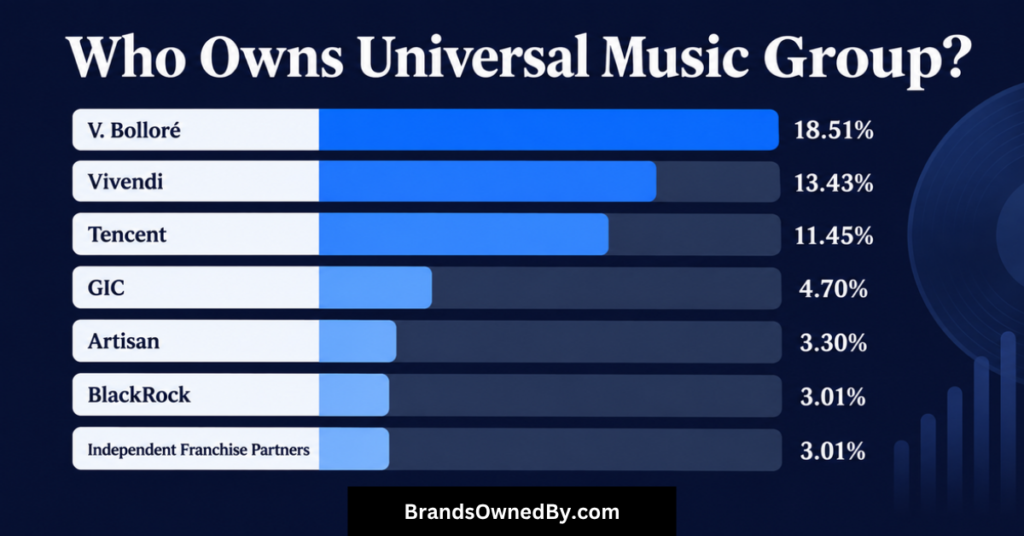
V. Bolloré: 18.51%
V. Bolloré is the largest disclosed economic shareholder in Universal Music Group. The 18.51% capital interest is held largely through Compagnie de l’Odet and Bolloré SE, the listed holding companies associated with the Bolloré family.
The position originated from UMG’s separation from Vivendi in September 2021. Vivendi distributed 60% of UMG’s shares to its own investors. Because Bolloré entities were major Vivendi shareholders, they received a substantial direct UMG position through that distribution.
This makes Bolloré different from a conventional institutional investor. The family did not build the entire stake through open market purchases. Its ownership reflects its earlier control and investment position within Vivendi.
UMG’s register shows 39.90% in aggregated voting rights for V. Bolloré. That percentage reflects the relationship agreement involving the Bolloré entities, Vivendi and the Tencent consortium. It is not the same as Bolloré individually owning 39.90% of UMG.
The family’s practical influence became clear during Pershing Square’s 2026 takeover attempt. Pershing proposed a transaction valuing UMG at approximately €55.75 billion. Cyrille Bolloré publicly opposed the proposal and argued that the valuation was inadequate. The UMG board rejected the offer on May 29, 2026.
Bolloré could not reject the transaction alone. However, an 18.51% direct holding, combined with the family’s influence over Vivendi, made its support essential to any proposal requiring broad shareholder approval. This gives Bolloré the strongest strategic influence among UMG’s shareholders without providing majority ownership.
Vivendi SE: 13.43%
Vivendi has disclosed a 13.43% capital interest in UMG. It is the company’s second largest reported shareholder, but it is no longer UMG’s parent company.
Vivendi previously owned 100% of Universal Music Group. It sold 20% to a Tencent led consortium during 2020 and 2021. It also sold 10% to Pershing Square funds before distributing most of its remaining UMG shares to Vivendi shareholders in September 2021.
The current 13.43% figure requires careful interpretation. It includes a 3.49% potential capital interest associated with an equity swap. Vivendi also disclosed a 3.49% short position. This means the reported capital interest is not equivalent to an entirely unhedged holding of ordinary shares.
An equity swap can provide financial exposure to movements in UMG’s share price without requiring Vivendi to hold the full underlying position in the same manner as a direct registered investor. The associated short disclosure further affects Vivendi’s net economic exposure.
UMG’s register reports 43.38% in aggregated voting rights for Vivendi. That figure results from the relationship agreement and the aggregation rules applied to parties acting together. It does not mean Vivendi independently owns or controls 43.38% of UMG.
Vivendi remains strategically important because of its history with the company, its retained economic interest and its relationship with Bolloré. It can influence major votes when aligned with other large shareholders. It cannot appoint management, approve acquisitions or take UMG private without support from the board and other investors.
Tencent Holdings: 11.45%
Tencent Holdings has disclosed an 11.45% capital interest in Universal Music Group. The shares are held through Tencent Mobility Limited and Tencent Music Entertainment Hong Kong Limited.
Tencent entered UMG’s ownership structure before the public listing. A Tencent led consortium acquired an initial 10% interest from Vivendi in 2020. The transaction valued UMG at €30 billion. The consortium exercised an option for another 10% in early 2021 using the same valuation basis.
Following UMG’s listing and later changes within the consortium, Tencent’s disclosed capital interest stands at 11.45%. It remains the company’s largest shareholder outside the Bolloré and Vivendi interests.
Tencent’s investment has a strategic dimension. Tencent operates one of China’s largest technology ecosystems, while Tencent Music Entertainment runs major music platforms. The relationship gives Tencent exposure to UMG’s global recordings and publishing assets. It also connects UMG with digital distribution and licensing infrastructure in Greater China.
The investment does not give Tencent ownership of UMG’s individual labels or unrestricted access to its catalogs. Commercial licensing agreements remain separate from the shareholder relationship.
Tencent’s reported aggregated voting rights are 39.90%. As with Bolloré, this figure arose from the relationship agreement and does not represent Tencent’s individual economic ownership.
The 2021 prospectus provided for the relevant relationship agreement provisions to end at the earlier of specified ownership events or the fifth anniversary of UMG’s admission to Euronext Amsterdam. That anniversary fell on September 21, 2026. Unless the parties extend or replace the arrangement, future filings may show a different voting rights structure.
GIC Private Limited: 4.70%
GIC Private Limited has disclosed a 4.70% capital interest and 4.70% of voting rights. GIC manages Singapore’s foreign reserves and invests across public equities, private companies, real estate, infrastructure and other asset classes.
Unlike Tencent, GIC does not operate a music streaming platform or record label. Its UMG position is a financial investment in music rights, subscription growth and the long term value of music catalogs.
A 4.70% interest remains meaningful in a company with widely dispersed public ownership. GIC could influence a close shareholder vote, especially if many smaller investors did not participate. It cannot determine the outcome alone.
GIC also partnered with Sony Music Group in a separate program for acquiring music catalogs. That activity shows its broader interest in music rights as an institutional asset class. It does not create an operating relationship between Sony Music and UMG.
GIC’s UMG position was last notified on May 23, 2025. Because the next reporting threshold is 5%, the exact current holding may differ slightly without requiring a new public filing.
Artisan Investments GP LLC: 3.30%
Artisan Investments GP LLC disclosed a 3.30% capital interest and the same percentage of voting rights on March 2, 2026. The position is held through Artisan Partners Limited Partnership.
Artisan Partners is an investment manager rather than a strategic music company. It invests on behalf of funds and institutional clients. Its UMG stake therefore represents managed client capital rather than an attempt to combine UMG with another entertainment business.
Crossing the 3% threshold made Artisan a reportable substantial shareholder under Dutch rules. The filing does not provide Artisan with board representation, special commercial rights or control over UMG’s record labels.
Artisan’s position is still relevant because it places more than 3% of UMG with an active investment manager. Active managers can take positions on executive compensation, capital allocation, acquisitions, share repurchases and takeover proposals.
Its influence depends on the issue and whether other institutional investors support the same position. A 3.30% holding can contribute to a larger voting coalition but cannot dictate an outcome independently.
BlackRock: 3.01% Capital Interest
BlackRock notified a 3.01% capital interest and 3.44% of voting rights on August 31, 2026. The position is held through several BlackRock investment entities rather than through one corporate account.
The filing includes both direct and potential interests. Of the reported totals, 0.46% represents a potential capital interest and 0.48% represents potential voting rights. The potential components may arise from financial instruments that provide exposure or acquisition rights without being identical to ordinary shares already held outright.
BlackRock manages index funds, exchange traded funds and actively managed portfolios for numerous clients. Its UMG position should therefore not be interpreted as one concentrated corporate investment comparable to the Bolloré or Tencent stakes.
The difference between BlackRock’s 3.01% capital interest and 3.44% voting rights can result from the structure of the instruments and voting authority attached to managed shares. BlackRock may exercise voting rights on behalf of clients, but the economic benefits remain distributed across the underlying funds and investors.
Its August 2026 filing makes BlackRock the most recently disclosed addition to UMG’s list of substantial outside shareholders. It also shows that institutional ownership was changing after Pershing Square disposed of its entire position in June 2026.
Independent Franchise Partners: 3.01%
Independent Franchise Partners disclosed a 3.01% capital interest and 3.01% of voting rights on February 9, 2026.
The firm focuses on established companies with durable brands, recurring demand and pricing power. UMG fits that investment profile because music catalogs can produce royalties for decades, while paid streaming creates recurring revenue from a large global subscriber base.
The position is financial rather than operational. Independent Franchise Partners does not own or manage UMG’s labels. It has no disclosed contractual right to select artists, negotiate streaming agreements or direct catalog acquisitions.
Its ownership crossed the 3% threshold shortly before major changes in UMG’s shareholder structure. Pershing Square was reducing its position, UMG was preparing a €500 million share repurchase program and investors were debating the company’s valuation.
At 3.01%, the firm is only slightly above the reporting threshold. A modest reduction could remove it from the published substantial shareholder list even if it continued to own a meaningful number of UMG shares.
Universal Music Group Treasury Shares: More Than 3%
Universal Music Group has reported an interest above 3% in its own share capital because of recent repurchases. These shares are held in treasury and do not represent an outside shareholder.
UMG announced a €500 million share repurchase program in April 2026. It then made a separate purchase connected to Pershing Square’s complete exit. On June 4, 2026, UMG acquired 14.156 million shares from Pershing funds at €17.66 per share. The transaction cost approximately €250 million.
Treasury shares affect the ownership calculation because they reduce the number of shares circulating among outside investors. If UMG cancels the repurchased shares, each remaining shareholder’s percentage ownership increases without that investor purchasing additional shares.
Shares held by the company generally do not carry exercisable voting rights while they remain in treasury. They should therefore be separated from voting shares held by outside investors.
The final effect depends on what UMG does with the shares. They may be cancelled, retained, transferred under employee compensation plans or used for another authorized purpose. Each option has different implications for earnings per share, voting percentages and capital allocation.
Other Institutional and Public Shareholders
The remainder of UMG is owned by investment funds, pension managers, asset managers and individual investors whose positions are below the Dutch reporting thresholds.
These investors collectively hold a large portion of the company, but they do not operate as one coordinated shareholder. Index funds may vote according to stewardship policies. Active funds may focus on valuation or strategy. Retail shareholders may vote independently or not participate at all.
This fragmentation increases the practical importance of the largest strategic holdings. Bolloré, Vivendi and Tencent together have disclosed capital interests equal to 43.39%. They do not form a majority owner, but alignment among them could carry considerable weight in an ordinary shareholder vote.
The disclosed percentages should not simply be added to calculate an exact public float. Vivendi’s figure contains potential exposure, UMG holds treasury shares, and the reported positions are updated only when regulatory thresholds are crossed. The ownership table is therefore a map of disclosed influence, not a real-time register of every outstanding share.
Competitor Ownership Comparison
The music-rights sector contains several very different governance models. UMG is public with large strategic blocks. Sony Music sits inside a diversified Japanese parent. Warner Music is public but controlled through a high-vote owner. The newly enlarged BMG is private. HYBE is public and founder-influenced.
Sony Music Entertainment
Sony Music Entertainment is part of Sony Group Corporation. Investors buy exposure to the music business through the broader Sony parent, whose other operations include gaming, electronics, pictures, imaging and financial services.
Sony’s structure gives management access to a large corporate balance sheet and links music with film, games and consumer technology. It also means outside investors cannot buy a separately listed pure-play Sony Music share. UMG offers more direct public exposure to music rights and services.
Warner Music Group
Warner Music Group is publicly traded on Nasdaq, but its governance is more concentrated than UMG’s. Len Blavatnik’s Access Industries controls Warner through high-vote Class B shares and a large equity position.
Public WMG shareholders participate economically, but Access can determine most shareholder outcomes. UMG has powerful strategic holders, yet no single investor has an equivalent majority voting position based on current disclosed capital interests.
BMG and Concord
BMG and Concord completed their combination on September 1, 2026. The enlarged company operates under the BMG name. It spans recorded music, publishing, theatrical rights, digital distribution and film and television, with a catalog of more than four million works.
The combined business is privately held. Bertelsmann owns the majority, while affiliates of Great Mountain Partners own the remaining stake. This structure can support long-term investment without public-market reporting each quarter. It offers less ownership transparency and liquidity than UMG’s listed model.
HYBE
HYBE is a publicly traded South Korean entertainment company built around artist management, labels, fan platforms and intellectual property. Founder Bang Si-hyuk remains its largest shareholder, while institutional investors hold significant minority stakes.
HYBE’s model is more artist-community and platform-oriented than UMG’s global catalog architecture. UMG is larger and more diversified across Western and local-market recorded music, publishing and services. HYBE retains stronger founder influence.
Believe
Believe developed as a digital distribution and artist-services company, with particular strength in independent music and developing markets. Its ownership has been shaped by founder-led and private-investment interests rather than UMG’s broad strategic-shareholder structure.
The operational comparison is useful. Believe historically emphasized service models for independent creators. UMG has expanded into that territory through Virgin Music Group, Ingrooves and Downtown while retaining a much larger traditional label and owned-catalog base.
Who Controls Universal Music Group?
No shareholder controls Universal Music Group alone. UMG has one class of listed ordinary shares, and its largest disclosed investor owns 18.51%. The company does not have a founder holding super voting shares or a parent company that can appoint management without support from other investors.
Control is divided among the board, executive management and several large shareholders. The board has formal authority over major corporate decisions. Sir Lucian Grainge controls daily operations. Bolloré, Vivendi and Tencent can exert substantial influence through their combined 43.39% reported capital interests, but they do not constitute one legal owner.
The Board Has Formal Corporate Authority
UMG operates under a one tier board structure governed by Dutch law. As of September 2026, the board consisted of two executive directors and nine non executive directors.
Sherry Lansing serves as Chairman of the Board and a non executive director. Her current term runs until the annual general meeting scheduled for 2027. Sir Lucian Grainge serves as Chairman and Chief Executive Officer and as an executive director. His term runs until May 1, 2028. Vincent Vallejo serves as Deputy Chief Executive Officer, Corporate and as the second executive director.
The non executive directors provide oversight of management, financial reporting, executive compensation, acquisitions, risk and capital allocation. The board also operates audit, remuneration and nomination committees.
This structure gives the board authority over matters that cannot be decided by an individual label head or shareholder. These include major acquisitions, disposals, financing, share repurchases, dividend proposals, executive appointments and responses to takeover offers.
The board’s power was demonstrated on May 29, 2026. Pershing Square proposed acquiring UMG through a cash and share transaction that valued the company at €30.40 per share and approximately €55.75 billion. After reviewing the proposal, UMG’s board unanimously rejected it. The board concluded that the offer materially undervalued the company and did not provide a superior outcome for shareholders, artists, employees and other stakeholders.
The proposal never reached a shareholder vote. This showed that even a large investor could not bypass the board and take an acquisition proposal directly to completion.
Sir Lucian Grainge Controls Daily Operations
Sir Lucian Grainge has the strongest operational authority inside UMG. He has served as the group’s chief executive since 2011 and was appointed Chairman and Chief Executive Officer of the listed Dutch company.
Grainge oversees UMG’s global label system, artist investment strategy, streaming negotiations, catalog acquisitions, publishing operations and expansion into independent music services. Senior executives at Republic, Interscope, Capitol, Island, Def Jam, Virgin Music Group and Universal Music Publishing Group ultimately operate within the strategy and financial framework approved by UMG management.
His authority is managerial rather than ownership based. Grainge does not hold enough shares to control a shareholder vote. His power comes from his executive position, board appointment and employment agreement, which runs until May 1, 2028.
The distinction is important. Grainge can direct release strategy, approve management appointments and negotiate commercial agreements within delegated limits. He cannot personally sell the company, issue unlimited shares or approve a major acquisition without the board and, where required, shareholders.
Grainge’s influence can be seen in UMG’s expansion beyond conventional record labels. The company acquired the remaining interest in [PIAS], purchased Downtown Music Holdings through Virgin Music Group and expanded its artist and label services operations. Downtown was consolidated into UMG’s financial results in 2026.
Bolloré Has the Strongest Shareholder Influence
V. Bolloré is UMG’s largest disclosed economic shareholder with an 18.51% capital interest. Most of the position is held through Compagnie de l’Odet and Bolloré SE.
An 18.51% position does not provide majority control. It does, however, make Bolloré difficult to ignore in a major transaction. Shareholder turnout is rarely equal to every outstanding share, which means a block of this size can represent a larger percentage of the votes actually cast.
The Bolloré family also exercises significant influence over Vivendi, which holds a separate 13.43% reported capital interest in UMG. The two positions should not automatically be combined as one legal holding. However, their alignment can create substantial practical influence.
This became visible during Pershing Square’s takeover attempt. Cyrille Bolloré publicly opposed the proposed €30.40 per share valuation before UMG’s board issued its decision. Pershing had already recognized that gaining Bolloré’s support would be critical to completing the transaction.
Bolloré could not reject the offer independently. Its opposition nevertheless removed a realistic route to assembling the shareholder support Pershing would have needed.
Vivendi Retains Influence Without Parent Company Control
Vivendi owns a reported 13.43% capital interest in UMG. It previously owned the entire music company, but UMG stopped being a Vivendi subsidiary when it listed independently in Amsterdam in September 2021.
Vivendi’s disclosed position includes a 3.49% potential capital interest associated with an equity swap. Vivendi also reported a 3.49% short position. Its stated capital interest therefore does not represent an entirely unhedged block of ordinary shares.
Vivendi still matters because of the size of its position and its relationship with Bolloré. It can vote on director appointments, remuneration, financial statements, dividends and other matters submitted to shareholders.
It cannot appoint UMG’s chief executive, approve a takeover or dictate business strategy by itself. Those outcomes would require board action or support from other shareholders.
Tencent Is a Strategic Shareholder, Not UMG’s Controller
Tencent owns an 11.45% capital interest through Tencent Mobility Limited and Tencent Music Entertainment Hong Kong Limited.
The investment originated before UMG became public. A Tencent led consortium purchased 10% of UMG in 2020 and another 10% in early 2021. Both transactions used a €30 billion valuation for UMG.
Tencent’s ownership supports a strategic relationship with UMG in Greater China. Tencent operates technology platforms, while Tencent Music Entertainment controls major music streaming services in the Chinese market.
This commercial relevance does not translate into unilateral control of UMG. Tencent cannot independently appoint the board, direct UMG’s labels or transfer UMG’s catalogs to its own platforms. Licensing agreements and shareholder rights remain separate.
Tencent would need to align with other shareholders to influence a major vote. Its 11.45% position becomes especially important when combined with support from Bolloré, Vivendi or institutional investors.
The Three Largest Shareholders Hold 43.39%
The reported capital interests of V. Bolloré, Vivendi and Tencent total 43.39%.
This concentration gives the three investors considerable influence if they support the same proposal. A coordinated 43.39% position could be decisive in many shareholder votes, particularly when some smaller investors do not participate.
However, the figure does not establish one controlling owner. Vivendi’s reported interest includes potential exposure connected to an equity swap. The shareholders are separate legal entities. They do not necessarily vote together on every matter.
Their interests can also diverge. Bolloré may prioritize long term strategic value. Vivendi may consider liquidity and portfolio management. Tencent may focus on its technology and music interests in China. Alignment must therefore be assessed issue by issue.
The Relationship Agreement Affected Reported Voting Rights
UMG’s investor register displayed aggregated voting rights of 39.90% for V. Bolloré, 39.90% for Tencent and 43.38% for Vivendi in September 2026.
These percentages did not represent the shares individually owned by each party. They arose from Dutch disclosure rules and a relationship agreement signed in September 2021 by Vivendi, the Bolloré entities and companies in the Tencent led consortium.
The agreement covered matters including consultation before general meetings, board representation, dividend policy and specified circumstances in which the parties would act together. Because of these provisions, regulators attributed certain voting rights across the participating parties.
The agreement was not designed to continue indefinitely. UMG’s 2021 prospectus stated that the relevant provisions would terminate at the earlier of specified ownership events or the fifth anniversary of the company’s admission to Euronext Amsterdam. That anniversary occurred on September 21, 2026.
UMG’s shareholder register continued to display the earlier aggregated voting notifications during September 2026. Regulatory registers are updated when new filings are made. The displayed figures should therefore not be interpreted as proof that each shareholder can individually exercise close to 40% of UMG’s votes after the agreement’s scheduled endpoint.
Fresh notifications will be important for determining whether the arrangement was extended, replaced or allowed to expire.
No Shareholder Has Super Voting Shares
UMG does not use the type of dual class share structure found at some media and technology companies. Its listed ordinary shares generally carry equal economic and voting rights.
This makes UMG different from Warner Music Group, where Len Blavatnik’s Access Industries controls the company through a concentrated ownership position and high vote shares.
At UMG, influence comes from the number of ordinary shares owned, participation in shareholder meetings and the ability to build support among other investors. No founder can outvote the wider shareholder base through a separate class carrying multiple votes per share.
Shareholder Approval Is Still Required for Reserved Matters
The board controls strategy and management, but shareholders retain authority over matters reserved for the general meeting.
Shareholders vote on director appointments, annual accounts, dividend distributions, executive remuneration policies, share issuance authorities and authorization for company share repurchases. Certain mergers, reorganizations or transactions affecting the company’s identity can also require shareholder approval.
The voting threshold depends on the resolution, UMG’s articles and Dutch law. Pershing’s 2026 proposal anticipated approval from two thirds of the votes cast at a shareholder meeting. With the three largest disclosed shareholders holding 43.39% of reported capital interests, their position would have been central to reaching that threshold.
Even so, shareholders could not compel UMG to accept the Pershing proposal after the board rejected it. Dutch corporate governance requires directors to consider the interests of the company and its broader stakeholders rather than only the highest immediate price offered to shareholders.
Treasury Shares Do Not Give Management Extra Votes
UMG holds more than 3% of its own capital following its 2026 share repurchases. The company launched a €500 million buyback program and separately acquired 14.156 million shares from Pershing Square funds for approximately €250 million.
Treasury shares are economically important because they reduce the number of shares circulating in the market. They do not normally provide UMG management with additional votes while held by the company.
If UMG cancels the shares, the percentage ownership of the remaining shareholders increases automatically. For example, Bolloré’s percentage could rise even if the group does not purchase another share.
If the shares are retained or used for employee compensation, the longer term effect will be different. The board’s decision on cancellation, retention or transfer therefore affects the future ownership structure.
Control Depends on Coalitions
The most accurate conclusion is that UMG has concentrated influence without a single controller.
The board controls major corporate decisions. Sir Lucian Grainge controls daily operations. Bolloré is the most influential shareholder. Vivendi and Tencent hold additional strategic blocks. GIC, BlackRock, Artisan Partners and Independent Franchise Partners can affect outcomes when major investors are divided.
A takeover, leadership change or major restructuring would require a coalition. No shareholder can currently impose one alone. That balance allows UMG to operate independently, but it also makes the positions of Bolloré, Vivendi and Tencent critical whenever the company faces a contested strategic decision.
Universal Music Group Annual Revenue and Net Worth
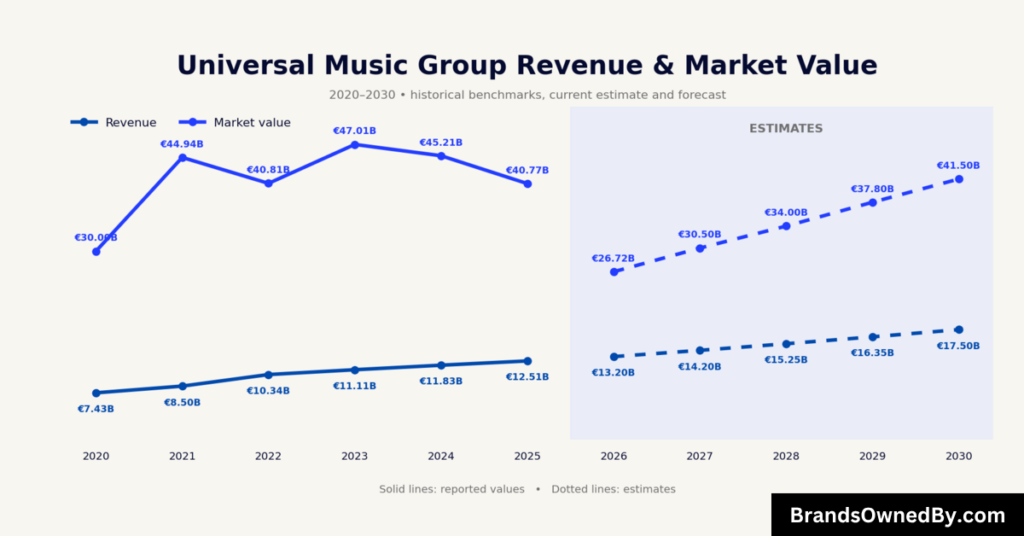
UMG reported revenue of €12.507 billion for 2025. For the first half of 2026, revenue reached €6.194 billion, up 5.3% on a reported basis and 10.8% at constant currency. The consolidation of Downtown, pricing gains under newer streaming agreements, physical sales and licensing supported growth.
For a public company, “net worth” is often used online to mean market capitalization. That is the market value of outstanding shares, not balance-sheet equity and not enterprise value.
2025 Revenue
Recorded Music generated €9.456 billion in 2025, equal to about 75.6% of total revenue before considering intersegment eliminations. It grew 6.2% on a reported basis. Subscription revenue rose 5.6%, physical revenue increased 8.6%, and license and other revenue improved 7.8%.
Music Publishing produced €2.260 billion, up 6.6%. Digital publishing, synchronization, performance and mechanical royalties provide a revenue mix that differs from master-recording economics.
Merchandising and Other generated €811 million, down 3.7%. Touring merchandise improved, but direct-to-consumer sales faced difficult comparisons. The segment’s adjusted EBITDA fell to €16 million, showing that merchandise revenue does not carry the same margin profile as core music rights.
UMG’s total adjusted EBITDA was €2.810 billion. The adjusted EBITDA margin remained 22.5%. That margin stability is important because revenue growth alone can overstate value creation when lower-margin services and physical products grow faster.
2026 Revenue
The €13.20 billion estimate starts with reported H1 revenue of €6.194 billion. UMG usually generates more revenue in the second half because of release schedules, holiday physical sales and merchandise timing. Applying a reasonable seasonal uplift produces full-year revenue close to €13.2 billion.
The estimate assumes reported growth of roughly 5.5% over 2025. It is below H1 constant-currency growth because exchange rates reduced reported growth and because Downtown adds lower-margin service revenue. It also allows for weaker merchandising and uneven release timing.
Upside could come from additional streaming price increases, stronger market share, licensing and the full-year effect of acquired services. Downside could come from currency movements, a softer release slate, market-share pressure, AI-related substitution or slower advertising-supported streaming.
Universal Music Group Net Worth 2026
UMG’s market capitalization was €26.72 billion on September 18, 2026, based on a €14.71 share price. That was far below the rejected takeover proposal and the company’s 2025 year-end market value.
The decline does not mean revenue fell by the same amount. Investors repriced the multiple paid for those earnings. Concerns included slowing streaming growth, market-share pressure, AI disruption, the delayed U.S. listing, lower free cash flow in H1 and the margin effect of services acquisitions.
This is why revenue and net worth move differently in the chart. Revenue can rise while market capitalization falls if investors demand a higher return or reduce the valuation multiple.
Revenue Forecast Through 2030
The forecast reaches €17.50 billion in 2030. That implies a 2026–2030 compound annual growth rate of about 7.3%. The assumptions are grounded in four drivers.
First, subscription price increases should continue to lift revenue even if subscriber growth matures in established markets. Second, emerging-market streaming still has room to add paying users. Third, Downtown and Virgin Music Group expand UMG’s addressable market among independent artists and labels. Fourth, publishing and licensing can monetize the same rights across more platforms, formats and territories.
The model does not assume uninterrupted double-digit growth. It allows growth to settle in the 7% to 8% range. It also assumes UMG protects rights in licensed AI products instead of allowing unlicensed generative systems to erode royalty pools.
Market Value Forecast Through 2030
The market-value path rises from €26.72 billion in September 2026 to €41.50 billion in 2030. This is a scenario, not a management forecast. It assumes revenue growth, gradual margin repair and a partial recovery in the valuation multiple.
The forecast remains below UMG’s 2023 year-end market value until late in the period. That is deliberate. Downtown increases scale but also adds lower-margin services. Investors may require evidence of better cash conversion, stable market share and disciplined acquisition returns before restoring a premium multiple.
A faster recovery could follow a successful U.S. listing, stronger free cash flow or improved confidence in licensed AI economics. A slower result would be justified if market share continues to decline, streaming platforms retain more economics, or catalog investment fails to earn adequate returns.
Labels and Brands Owned by Universal Music Group
UMG operates a network rather than one monolithic record label. Some names below are wholly owned divisions. Others contain joint ventures, distributed labels or artist-owned imprints. A distribution deal does not automatically mean UMG owns the partner or the artist’s masters.

Republic Records
Republic Records is a flagship U.S. label division of UMG. It works across pop, hip-hop, country and soundtrack releases. Republic also supports affiliated imprints and joint ventures.
The label’s strategic value comes from hit development and scale across radio, streaming, physical products and global marketing. An artist released through a Republic-affiliated imprint may have a different contract and ownership arrangement from an artist signed directly to Republic.
Interscope Geffen A&M
Interscope Geffen A&M combines several historic label identities under UMG. Interscope is the main contemporary operating brand. Geffen and A&M contribute catalogs, imprints and selected active releases.
The group sits within UMG’s broader U.S. label organization. Its role includes artist development, marketing and distribution. It should not be confused with artist-owned partner labels that use Interscope services while retaining separate ownership.
Capitol Music Group
Capitol Music Group includes Capitol Records and related businesses such as Blue Note, Astralwerks and Capitol Christian Music Group. UMG gained control of the Capitol and EMI recorded-music assets through the 2012 EMI transaction.
Capitol combines current artist operations with a valuable catalog. Blue Note strengthens jazz, Astralwerks adds electronic music, and Capitol Christian addresses faith-based repertoire.
Def Jam Recordings
Def Jam is a UMG label focused primarily on hip-hop, R&B and related genres. It entered UMG’s lineage through the PolyGram acquisition.
UMG owns the Def Jam operating brand, but not every affiliated imprint is necessarily wholly owned. Joint ventures can give artist-entrepreneurs creative autonomy while UMG supplies financing, distribution and promotion.
Island Records
Island Records is another major brand inherited through PolyGram. Its catalog and active roster span pop, rock, reggae and other genres.
Island’s value lies in both frontline releases and long-tail catalog consumption. Streaming allows older recordings to generate recurring revenue without physical inventory constraints.
EMI
UMG acquired EMI’s recorded-music business in 2012 for approximately £1.2 billion. Regulators required divestitures, so UMG did not retain every former EMI asset.
The EMI name remains active in important markets, particularly the United Kingdom. Capitol, Motown, Blue Note and other assets strengthened UMG’s portfolio, while Parlophone and certain divested operations went elsewhere.
Decca Records
Decca is both a current label and a link to UMG’s earliest corporate roots. Its operations cover classical, stage, film, crossover and selected popular music.
The Decca family includes specialized businesses such as Decca Classics and Decca Broadway. Its deep catalog supports streaming, physical reissues, synchronization and premium editions.
Deutsche Grammophon
Deutsche Grammophon is UMG’s leading classical-music label. It traces its history to 1898 and became part of the group through the PolyGram lineage.
Its economics differ from a hit-driven pop label. Classical catalogs can remain commercially active for decades. High-quality reissues, spatial audio and direct-to-consumer products create additional monetization paths.
Motown Records
Motown operates within UMG’s label structure and controls one of recorded music’s most culturally significant brand legacies. UMG obtained Motown through the PolyGram combination.
The business includes active artist development as well as catalog exploitation. The catalog supports streaming, film and television licensing, documentaries, anniversary campaigns and physical reissues.
Polydor Records
Polydor is a central UMG label brand in the United Kingdom and Europe. It also contributes a substantial international catalog.
Its ownership came through PolyGram. Polydor demonstrates how UMG balances global infrastructure with local label leadership. Repertoire developed in one market can be marketed across the group’s international network.
Verve Label Group
Verve Label Group houses jazz, classical-adjacent and adult-oriented repertoire. Verve Records and Impulse! are among its best-known brands.
The group uses UMG’s distribution and licensing scale while maintaining genre expertise. Its catalogs are particularly suited to long-duration streaming, premium vinyl and synchronization.
Music Corporation of America
UMG renamed its Nashville label operation Music Corporation of America in 2025. The business had previously operated under the Universal Music Group Nashville identity.
The revived MCA name connects the modern country operation with UMG’s corporate heritage. It oversees country artist development and releases while using UMG’s broader commercial infrastructure.
Universal Music Latin Entertainment
Universal Music Latin Entertainment coordinates major parts of UMG’s Latin recorded-music business. Its brands include Universal Music Latino and genre-focused operations serving the U.S. Latin and Latin American markets.
The division matters because Latin music has become a global streaming category rather than a regional niche. UMG can develop repertoire locally and market it across North America, Europe and other territories.
Universal Music Enterprises
Universal Music Enterprises, or UMe, is UMG’s global catalog division. It develops campaigns around recordings that have already completed their initial release cycle.
UMe creates reissues, box sets, anniversary projects, compilations and licensing programs. Catalog management can extend the commercial life of music for decades and often carries lower discovery risk than signing an unproven artist.
Universal Music Publishing Group
Universal Music Publishing Group administers and owns interests in musical compositions. It collects royalties when songs are streamed, performed, reproduced or synchronized.
UMPG is distinct from UMG’s record labels. A writer can be signed to UMPG while recordings of the writer’s songs are released by another label. Conversely, a UMG recording artist’s publishing may be controlled by another publisher.
Virgin Music Group
Virgin Music Group is UMG’s global independent artist and label-services platform. It combines distribution, marketing, technology and related services without requiring every client to use a conventional major-label contract.
Virgin includes capabilities developed through businesses such as Ingrooves and later expanded with Downtown. This lets UMG earn service fees and participate in independent-sector growth while clients retain varying levels of ownership and control.
Downtown Music Holdings
Virgin Music Group completed its acquisition of Downtown Music Holdings and began consolidating the business in 2026. Downtown adds publishing administration, distribution, royalty accounting and services for independent creators and businesses.
The acquisition broadens UMG’s revenue base, but it also changes the margin mix. Service businesses can generate high transaction volume while passing a larger share of revenue to clients. That helps explain why revenue growth and EBITDA growth may diverge.
[PIAS]
UMG acquired the remaining interest in independent music company [PIAS] after taking an initial stake. [PIAS] adds label, distribution and services capabilities with deep roots in European independent music.
Its position within the Virgin Music Group ecosystem strengthens UMG’s alternative to a traditional label deal. It also raises the importance of maintaining credible independence for clients that want global scale without being absorbed into a major-label identity.
Bravado
Bravado is UMG’s merchandise and brand-management business. It develops tour merchandise, direct-to-consumer products, retail programs and licensing partnerships.
Merchandising can deepen fan spending beyond recorded music. It is also operationally different from licensing digital music. Manufacturing, inventory, fulfillment and tour timing create more cost and volatility.
Abbey Road Studios
UMG owns Abbey Road Studios in London. The operation provides recording, mastering and technical services and has expanded into education, events and music-technology initiatives.
The facility is a real operating asset rather than merely a catalog label. Its historical reputation supports premium services and brand extensions, while UMG’s ownership links the studio to a large global creator network.
Mercury Studios and Polygram Entertainment
Mercury Studios develops and produces music-centered film, television and audiovisual projects. Polygram Entertainment also works across music-based screen content within UMG’s portfolio.
These businesses extend music rights into documentaries, concert films and scripted or unscripted productions. A successful audiovisual project can generate direct revenue and increase listening across the underlying catalog.
Final Thoughts
Universal Music Group is best understood as an independent public music-rights company with concentrated strategic influence but no majority owner. V. Bolloré holds the largest disclosed capital interest. Vivendi and Tencent remain major shareholders. Institutional owners and the public market hold the balance.
Ownership and control are not identical. The board governs major corporate decisions. Sir Lucian Grainge leads operations. Bolloré has the strongest shareholder influence, especially when Vivendi’s position is considered. The scheduled fifth-anniversary endpoint of the 2021 relationship agreement makes fresh voting disclosures particularly important after September 21, 2026.
UMG’s underlying asset is not one label. It is a global system of recordings, compositions, artist services, distribution, merchandise and audiovisual businesses. That structure explains both its market power and the complexity behind the simple question: who owns Universal Music?
FAQs
Who owns the most shares in Universal Music Group?
V. Bolloré is the largest disclosed economic shareholder with an 18.51% capital interest, held largely through Compagnie de l’Odet and Bolloré SE. Vivendi follows at 13.43%, while Tencent has 11.45%.
Does Vivendi still own Universal Music Group?
Vivendi owns a minority stake, not the whole company. Its disclosed capital interest is 13.43%. UMG stopped being a Vivendi-controlled subsidiary when it listed independently in Amsterdam in September 2021.
Does Tencent own Universal Music Group?
No. Tencent owns an 11.45% capital interest through Tencent-related entities. It is a major strategic shareholder but does not own a majority and cannot control UMG alone.
Is Universal Music Group publicly traded?
Yes. Universal Music Group N.V. trades on Euronext Amsterdam under the ticker UMG. Trading began on September 21, 2021.
Is Universal Music owned by Disney?
No. Disney does not own Universal Music Group. UMG is independently listed and owned by its public shareholders.
Is Universal Music owned by Comcast or NBCUniversal?
No. Comcast owns NBCUniversal, including Universal Pictures and the Universal theme-park business. Universal Music Group is a separate public company.
Are Universal Music Group and Universal Studios the same company?
No. The businesses share historical roots and the Universal name, but they have separate owners. UMG is publicly traded in Amsterdam. Universal Studios is part of Comcast-owned NBCUniversal.
Who is the CEO of Universal Music Group?
Sir Lucian Grainge is UMG’s Chairman and Chief Executive Officer. His current term runs to May 1, 2028. Sherry Lansing serves separately as Chairman of UMG’s Board and a non-executive director.
What record labels does Universal Music Group own?
Its major label families include Republic, Interscope, Capitol, Def Jam, Island, EMI, Decca, Deutsche Grammophon, Motown, Polydor and Verve. UMG also owns Universal Music Publishing Group, Virgin Music Group, Bravado, Abbey Road Studios and other music businesses.
Does Universal Music Group own artists’ music?
It depends on the contract. UMG may own a master recording, license it for a fixed period, distribute it for an artist-owned label or provide services without owning the master. Publishing rights are governed by separate songwriter and catalog agreements.
How much is Universal Music Group worth?
UMG’s market capitalization was €26.72 billion on September 18, 2026. Market value changes with the share price. It should not be confused with revenue, balance-sheet equity or enterprise value.
Why did Pershing Square sell its UMG stake?
Pershing Square disposed of its entire remaining position after UMG’s board rejected its 2026 takeover proposal. UMG repurchased 14.156 million shares for approximately €250 million, and the remaining Pershing shares were sold to other investors.
What is Universal Music Group’s largest business?
Recorded Music is the largest segment. It generated €9.456 billion of UMG’s €12.507 billion revenue in 2025. Music Publishing generated €2.260 billion, while Merchandising and Other contributed €811 million.