
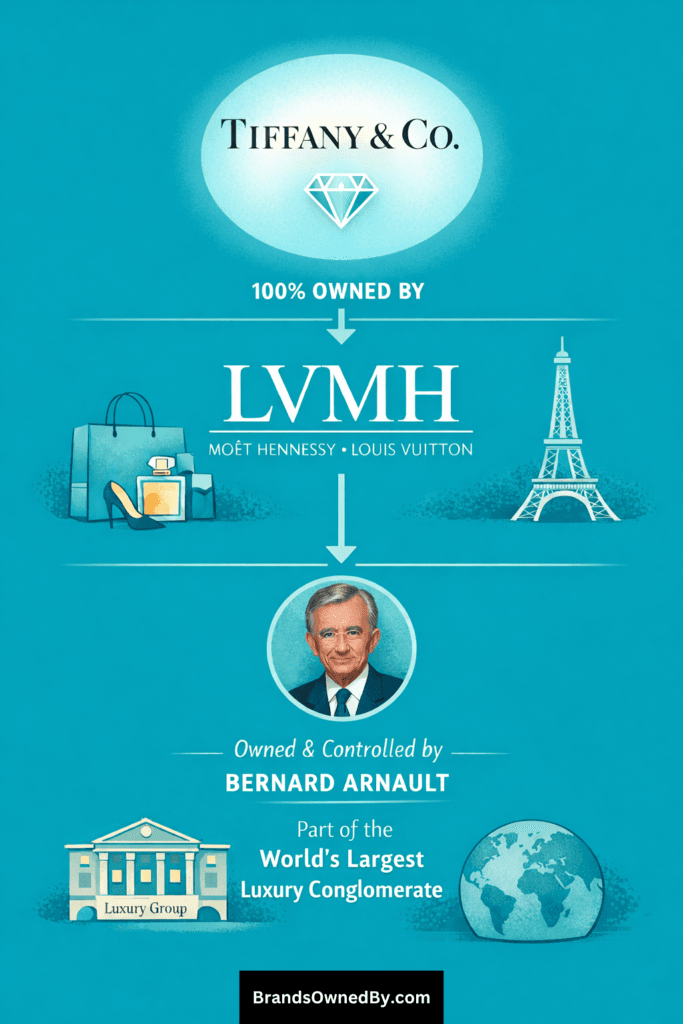
- Tiffany & Co. is fully owned by LVMH, meaning it has no public shareholders and operates as a private subsidiary within the world’s largest luxury group.
- Control ultimately lies with Bernard Arnault, who is the largest shareholder of LVMH and holds decisive influence over Tiffany’s strategy and direction.
- Tiffany transitioned from a publicly traded company to full private ownership after LVMH acquired it for $15.8 billion in 2021, removing institutional investors like BlackRock and The Vanguard Group.
- The current ownership structure allows long-term investment, stronger global expansion, and premium brand positioning without pressure from quarterly stock market performance.
Tiffany & Co. is a global luxury jewelry brand known for its craftsmanship, heritage, and iconic identity. The company was established in New York City and quickly became associated with elegance and premium gifting.
The brand is widely recognized for its signature robin’s egg blue packaging. This visual identity has become one of the most distinctive elements in the luxury industry. It signals authenticity and exclusivity.
Tiffany specializes in fine jewelry, especially diamond engagement rings. Over time, it expanded into watches, accessories, and fragrances. Despite this expansion, jewelry remains at the core of its identity.
The company operates a large global retail network. Its flagship store on Fifth Avenue in New York is one of the most famous luxury retail locations in the world. Tiffany maintains a strong presence in major cities across North America, Europe, and Asia.
The brand focuses heavily on design innovation and heritage storytelling. It blends traditional craftsmanship with modern aesthetics. This approach allows Tiffany to stay relevant across generations while preserving its legacy.
Founders of Tiffany & Co.
Tiffany & Co. was founded in 1837 by Charles Lewis Tiffany and his partner John B. Young.
Charles Lewis Tiffany
Charles Lewis Tiffany is the central figure behind the brand’s success. He was often called the “King of Diamonds.” His vision transformed Tiffany from a small stationery and goods store into a leading jewelry house.
He introduced the concept of fixed pricing. At the time, most retailers negotiated prices. This move helped build trust with customers. It also positioned Tiffany as a premium and transparent brand.
Charles Tiffany also played a major role in establishing the company’s reputation for quality. He focused on sourcing high-quality gemstones and maintaining strict standards. His leadership laid the foundation for Tiffany’s global prestige.
John B. Young
John B. Young was the co-founder and early business partner. He contributed to the financial and operational setup of the company.
While he was less publicly recognized than Charles Tiffany, his role in establishing the business was critical. He helped support the company during its early years when it was still expanding its product range and customer base.
Together, the founders built a company that would grow into one of the most iconic luxury brands in the world.
Ownership History
Tiffany & Co.’s ownership history reflects a clear shift from founder control to public markets, and finally to full integration into a global luxury conglomerate. Each phase changed how the company was financed, governed, and scaled internationally. As of April 2026, Tiffany operates as a wholly owned subsidiary within LVMH’s jewelry and watches division, with centralized strategic control at the group level.
Founder-Controlled Structure (1837–1902)
Tiffany & Co. was established in 1837 by Charles Lewis Tiffany and John B. Young.
Ownership during this period was tightly concentrated. The founders financed the business and retained full equity control. There were no external investors or shared ownership structures.
Charles Lewis Tiffany gradually consolidated control. He shifted the business from stationery and goods into fine jewelry. He introduced standardized pricing and focused on high-grade diamonds. These decisions positioned Tiffany as a premium brand early in its lifecycle.
There was no formal board governance as seen in modern corporations. Strategic decisions were centralized under the founder. This allowed rapid brand positioning but limited access to external capital.
Family Influence and Internal Expansion (1902–1980s)
After Charles Tiffany’s death in 1902, ownership remained within a controlled internal structure. While the company did not immediately go public, leadership transitioned to professional managers and family-linked stakeholders.
Louis Comfort Tiffany influenced design direction, particularly in decorative arts. However, operational control shifted toward corporate management rather than direct family ownership.
During this phase, Tiffany expanded retail operations and strengthened its sourcing capabilities. Ownership remained private, but governance structures became more formal. Internal leadership teams began to resemble modern executive frameworks.
Capital constraints became more apparent as global expansion required larger investments. This set the stage for eventual public listing.
Public Listing and Dispersed Ownership (1987–2020)
Tiffany & Co. went public in 1987. Its shares were listed on the New York Stock Exchange. This fundamentally changed the ownership structure.
Equity ownership became distributed among institutional investors, pension funds, and retail shareholders. No single controlling shareholder existed. Instead, influence was exercised through board governance and shareholder voting.
By the 2000s and 2010s, ownership was dominated by large asset managers such as The Vanguard Group and BlackRock. These firms held significant stakes through index funds and actively managed portfolios.
This structure increased access to capital. It supported global store expansion, supply chain investments, and marketing. However, it also introduced quarterly performance pressure. Management decisions became more aligned with shareholder returns and stock performance.
Tiffany maintained operational independence during this period. It competed directly with European luxury houses while remaining one of the few major American jewelry brands listed publicly.
LVMH Acquisition Process (2019–2021)
In November 2019, LVMH announced an agreement to acquire Tiffany & Co. for approximately $16.2 billion. The deal aimed to strengthen LVMH’s position in high jewelry.
The transaction faced significant disruption in 2020. Global economic uncertainty and legal disputes led LVMH to reconsider the agreed price. Tiffany filed a lawsuit to enforce the agreement.
Negotiations resumed later in 2020. Both parties agreed to a revised price of about $15.8 billion. The deal closed in January 2021.
Following completion, Tiffany shares were delisted. All public shareholders exited. Ownership transferred entirely to LVMH.
Full Integration Under LVMH (2021–April 2026)
As of April 2026, Tiffany & Co. is fully owned by LVMH. It operates within LVMH’s Watches & Jewelry division alongside brands such as Bulgari.
Ultimate control lies with Bernard Arnault, who is the chairman and CEO of LVMH and its largest shareholder. His holding structure ensures long-term control over the group’s strategic direction.
Post-acquisition, LVMH implemented a structured transformation strategy for Tiffany. This includes:
- Repositioning the brand toward high jewelry and ultra-luxury segments
- Renovating flagship stores, including the Fifth Avenue location in New York
- Expanding presence in Asia, particularly China and Japan
- Increasing vertical integration in diamond sourcing and craftsmanship
- Aligning marketing with LVMH’s global luxury positioning.
Operational control remains with Tiffany’s executive team. However, capital allocation, major investments, and brand direction are set at the LVMH group level.
Tiffany is no longer subject to public market pressures. It benefits from long-term investment planning under LVMH’s ownership model.
Who Owns Tiffany & Co.?
As of April 2026, Tiffany & Co. is fully owned by LVMH, the world’s largest luxury group. This ownership places Tiffany inside a global portfolio of elite brands and gives it access to unmatched capital, supply chain control, and retail scale. The shift from a publicly traded U.S. company to a privately held subsidiary under LVMH has fundamentally changed how Tiffany operates, invests, and competes in the high-end jewelry market.
Parent Company: LVMH Ownership Structure and Global Influence
LVMH (Moët Hennessy Louis Vuitton) is a Paris-based luxury conglomerate with a multi-division structure. Its core segments include Fashion & Leather Goods, Watches & Jewelry, Perfumes & Cosmetics, Wines & Spirits, and Selective Retailing.
Tiffany & Co. operates within the Watches & Jewelry division. This division includes brands such as Bulgari, TAG Heuer, and Hublot. However, Tiffany plays a distinct strategic role. It is LVMH’s primary asset in the global diamond jewelry market and its strongest foothold in American luxury.
LVMH operates a hybrid model. Brands maintain their identity, creative direction, and management teams. At the same time, group-level leadership controls capital allocation, major investments, and long-term strategy. This allows Tiffany to retain brand heritage while benefiting from centralized resources.
Ownership control of LVMH is concentrated. Bernard Arnault, the chairman and CEO, holds controlling influence through his family holding companies. This structure gives him decisive authority over all major brands, including Tiffany.
LVMH’s scale provides Tiffany with several structural advantages:
- Access to prime retail locations globally
- Shared expertise in luxury branding and merchandising
- Strong supplier relationships, especially in precious materials
- Centralized marketing power and global campaigns
- Long-term investment capacity without public market pressure.
These factors directly impact Tiffany’s ability to compete with rivals like Cartier and Van Cleef & Arpels.
Acquisition of Tiffany: Deal Structure, Conflict, and Final Outcome
The acquisition of Tiffany & Co. by LVMH was one of the most complex and high-value deals in the luxury sector.
In November 2019, LVMH agreed to acquire Tiffany for approximately $16.2 billion. The deal valued Tiffany at a premium, reflecting its brand strength, global recognition, and growth potential in high jewelry.
However, the transaction entered a contentious phase in 2020. Several factors triggered conflict:
- Global luxury demand weakened during economic uncertainty
- LVMH questioned whether Tiffany’s performance justified the agreed price
- Regulatory and political pressures delayed closing timelines.
LVMH attempted to terminate or renegotiate the deal. In response, Tiffany filed a lawsuit to enforce the original agreement. This escalated into a high-profile legal battle between two major corporate entities.
By late 2020, both sides reached a revised agreement. The final acquisition price was reduced to approximately $15.8 billion. This adjustment allowed the deal to proceed without prolonged litigation.
The transaction officially closed in January 2021. Key outcomes of the acquisition include:
- Tiffany was delisted from the New York Stock Exchange
- All public shareholders were bought out
- LVMH gained 100% ownership and full control
- Tiffany became part of LVMH’s consolidated financial structure.
This acquisition remains LVMH’s largest deal to date and a defining move in its expansion into hard luxury.
Ownership Structure After Acquisition
After the deal closed, Tiffany’s ownership became fully centralized under LVMH.
There are no minority shareholders. Tiffany does not trade publicly. It operates as a wholly owned subsidiary.
The ownership hierarchy is direct:
- Tiffany & Co. → 100% owned by LVMH
- LVMH → controlled by Bernard Arnault and his family.
This structure eliminates external shareholder influence. It allows LVMH to implement long-term strategies without quarterly earnings pressure.
Tiffany’s financials are now integrated into LVMH’s reporting. Individual performance details are disclosed at the segment level rather than as a standalone public company.
Strategic Transformation Under LVMH
Since acquiring Tiffany, LVMH has executed a focused transformation strategy.
The brand has been repositioned toward higher price points. There is a stronger emphasis on high jewelry, rare gemstones, and exclusive collections. This aligns Tiffany more closely with European luxury competitors.
Retail investments have been substantial. Flagship stores have been redesigned to deliver immersive luxury experiences. The Fifth Avenue flagship in New York is a central example of this shift.
Marketing strategy has also evolved. Tiffany now targets younger luxury consumers while maintaining its legacy appeal. Campaigns are more global, digital-first, and culturally aligned.
Operational improvements include greater control over sourcing and production. LVMH is increasing vertical integration in diamonds and craftsmanship. This strengthens quality control and brand storytelling.
Geographically, expansion has accelerated in Asia. Markets like China and Japan are now central to Tiffany’s growth strategy.
Strategic Importance of Tiffany Within LVMH
Within LVMH, Tiffany is a critical asset in the jewelry category.
Before the acquisition, LVMH’s presence in high jewelry was strong but not dominant. Competitors like Richemont controlled a larger share of the market through brands like Cartier.
Tiffany changes that balance. It adds scale, heritage, and strong positioning in engagement jewelry and diamonds.
It also complements Bulgari. Bulgari focuses on bold Italian design and colored gemstones. Tiffany focuses on classic diamond jewelry and American luxury identity. Together, they create a diversified jewelry portfolio.
This dual-brand strategy strengthens LVMH’s competitive position globally.
Control and Decision-Making Framework
Tiffany operates with a layered governance structure.
Day-to-day operations are managed by CEO Anthony Ledru and the executive team. They handle product development, retail operations, and brand execution.
Strategic decisions are controlled at the LVMH level. This includes capital investments, expansion plans, and long-term positioning.
Bernard Arnault remains actively involved in overseeing major brands. His leadership style emphasizes performance, brand elevation, and disciplined expansion.
This structure allows Tiffany to operate independently while aligning with LVMH’s broader luxury strategy.
Competitor Ownership Comparison
The global luxury jewelry market is controlled by a small number of powerful groups. Tiffany’s ownership under LVMH places it in direct competition with brands that are also backed by large, well-capitalized parent companies. Ownership structure plays a critical role in how these brands scale, invest, and compete globally.
| Brand | Parent Company | Ownership Model | Strategic Focus | Competitive Position vs Tiffany |
|---|---|---|---|---|
| Tiffany & Co. | LVMH | Fully owned subsidiary | High jewelry, diamonds, global luxury retail | Strong global scale, backed by LVMH resources |
| Cartier | Compagnie Financière Richemont | Subsidiary under luxury group | High jewelry, watches, heritage luxury | Strongest direct competitor with heavy jewelry focus |
| Bulgari | LVMH | Subsidiary (same parent as Tiffany) | Colored gemstones, Italian luxury design | Internal complement, not direct competitor |
| Harry Winston | The Swatch Group | Subsidiary under watch-focused group | Ultra-high-end jewelry, niche luxury | Smaller scale, less global retail expansion |
| Graff | Laurence Graff | Founder-owned private company | Rare diamonds, ultra-exclusive pieces | Highly exclusive, limited scale vs Tiffany |
| Pandora | Pandora | Publicly traded company | Affordable luxury, mass-market jewelry | Lower price segment, volume-driven strategy |
Tiffany vs Cartier: LVMH vs Richemont
Tiffany’s closest competitor is Cartier, which is owned by Compagnie Financière Richemont.
Richemont is a Switzerland-based luxury group focused heavily on jewelry and watches. Unlike LVMH, which is diversified across multiple luxury categories, Richemont is more concentrated in hard luxury.
Cartier benefits from this focus. It receives a high level of strategic priority and investment within Richemont. The group also owns Van Cleef & Arpels, creating a strong dual-brand dominance in high jewelry.
In contrast, Tiffany operates within LVMH’s broader portfolio. While it benefits from scale and resources, it competes internally for capital with fashion and leather goods brands like Louis Vuitton and Dior.
Key difference:
- Richemont prioritizes jewelry as a core segment
- LVMH uses Tiffany to strengthen a more diversified luxury ecosystem.
Tiffany vs Bulgari: Same Parent, Different Positioning
Bulgari is also owned by LVMH. This creates an internal competitive dynamic.
Despite sharing the same parent, Tiffany and Bulgari target different segments:
- Tiffany focuses on diamond jewelry, engagement rings, and American heritage
- Bulgari emphasizes Italian design, colored gemstones, and bold aesthetics.
LVMH deliberately maintains this separation. It avoids brand overlap and positions each brand to capture different customer segments.
Ownership under the same parent allows both brands to share resources. However, they are strategically differentiated to maximize total market coverage rather than compete directly.
Tiffany vs Harry Winston: Swatch Group Ownership
Harry Winston is owned by The Swatch Group.
Swatch Group is primarily known for watch brands such as Omega and Longines. Jewelry is not its core focus.
As a result, Harry Winston operates with a narrower strategic role compared to Tiffany. It is positioned as an ultra-high-end niche brand rather than a global retail-driven jewelry powerhouse.
In comparison, Tiffany benefits from LVMH’s strong emphasis on brand building, retail expansion, and marketing. This gives it a broader global presence and higher brand visibility.
Key difference:
- Swatch Group focuses on watches, limiting jewelry expansion
- LVMH actively invests in scaling Tiffany’s global jewelry business.
Tiffany vs Graff: Founder-Controlled Structure
Graff remains privately owned by its founder, Laurence Graff.
This ownership model is fundamentally different from Tiffany’s corporate structure. Graff operates as a founder-controlled business with a strong focus on ultra-high-net-worth clients.
The company specializes in rare diamonds and one-of-a-kind pieces. It does not pursue large-scale retail expansion in the same way as Tiffany.
Tiffany, under LVMH, follows a hybrid model. It serves both high jewelry clients and a broader luxury consumer base. This allows it to generate scale while still participating in the ultra-luxury segment.
Key difference:
- Graff prioritizes exclusivity and limited production
- Tiffany balances exclusivity with global retail scale.
Tiffany vs Pandora: Public Company Model
Pandora operates under a public ownership model. It is listed on the stock market and owned by institutional and retail investors.
Unlike Tiffany, which is now privately held under LVMH, Pandora must respond to quarterly earnings expectations and shareholder pressures.
Pandora focuses on affordable luxury and mass-market jewelry. Its ownership structure supports large-scale production and global distribution.
Tiffany operates at a higher price point. Its private ownership allows long-term investment decisions without short-term market pressure.
Key difference:
- Pandora is volume-driven and publicly accountable
- Tiffany is brand-driven and privately controlled.
Ownership Model Impact on Competitive Strategy
Ownership structure directly affects how each brand competes.
Tiffany’s position under LVMH provides:
- Access to long-term capital without stock market pressure
- Integration into a global luxury ecosystem
- Strong brand-building and marketing capabilities
- Ability to invest heavily in flagship stores and high jewelry.
In contrast:
- Richemont brands benefit from category focus and jewelry specialization
- Swatch-owned brands operate within a watch-centric strategy
- Founder-owned brands prioritize exclusivity over scale
- Public companies prioritize growth metrics and shareholder returns.
Competitive Positioning
Tiffany’s ownership gives it a hybrid advantage. It combines scale, heritage, and financial backing.
Under LVMH, Tiffany competes not just as a jewelry brand but as part of a global luxury system. This allows it to challenge both specialized jewelry houses and diversified luxury groups.
Its strongest competition remains Richemont-owned brands. However, its ownership structure ensures it has the resources and strategic support to compete at the highest level of the luxury market.
Who Controls Tiffany?
Control of Tiffany & Co. is defined by its position inside LVMH. Since the 2021 acquisition, Tiffany no longer operates as an independent, publicly governed company. As of April 2026, control is centralized within LVMH’s corporate structure, where strategic authority sits at the group level and operational execution remains with Tiffany’s internal leadership. This creates a clear hierarchy: brand-level management runs the business, but LVMH determines direction, investment, and long-term positioning.
LVMH Control: Centralized Strategy and Capital Authority
LVMH exercises full ownership and ultimate control over Tiffany. This control is not symbolic. It directly shapes how the brand invests, expands, and competes.
LVMH operates a decentralized brand model with centralized decision power. Tiffany retains its identity, but key decisions are approved at the group level. These include global expansion, flagship store investments, product positioning in high jewelry, and allocation of marketing budgets.
Tiffany is part of LVMH’s Watches & Jewelry division. Within this structure, its performance is evaluated alongside brands like Bulgari and TAG Heuer. However, Tiffany holds a distinct role as the group’s primary diamond jewelry brand, which gives it strategic priority in the high-end segment.
Because Tiffany is fully owned, there are no external shareholders influencing decisions. This allows LVMH to pursue long-term brand elevation strategies without short-term market pressure.
Bernard Arnault: Ultimate Decision Authority
At the top of the control structure is Bernard Arnault, chairman and CEO of LVMH and its controlling shareholder.
Arnault holds decisive authority over all major brands within the group. His control is reinforced through a family holding structure that secures majority voting power. This ensures continuity in leadership and long-term strategic consistency.
Tiffany is a high-value asset within LVMH’s portfolio. As a result, it receives direct oversight at this level. Arnault is closely involved in major decisions such as brand repositioning, leadership appointments, and large-scale investments.
His strategy for Tiffany has focused on moving the brand further into high jewelry, strengthening exclusivity, and aligning it more closely with European luxury standards while preserving its American identity.
Executive Leadership: Operational Control at Brand Level
Day-to-day control of Tiffany & Co. is handled by its CEO, Anthony Ledru.
He is responsible for executing LVMH’s strategy across all operational areas. This includes retail performance, product development, merchandising, and regional growth. His leadership focuses on translating group-level direction into market execution.
The executive team under him manages core business functions such as supply chain, design, marketing, and digital operations. They ensure that Tiffany delivers consistent brand experience across all markets.
However, this authority is operational, not strategic. Major decisions, including capital-intensive projects and long-term positioning, require alignment with LVMH leadership.
Governance Structure After Delisting
Before 2021, Tiffany was governed by a public board and accountable to shareholders. That structure no longer exists.
After the acquisition by LVMH, Tiffany was delisted from the New York Stock Exchange. Its independent board was effectively replaced by LVMH’s governance system.
Today, oversight comes from LVMH’s board of directors and senior leadership. Tiffany’s internal management focuses on execution rather than corporate governance.
This shift has streamlined decision-making. It reduces external scrutiny and aligns Tiffany with LVMH’s long-term investment horizon.
Leadership Transition and Strategic Shift
Prior to the acquisition, Tiffany was led by Alessandro Bogliolo. His tenure focused on stabilizing the brand and preparing it for growth.
After LVMH took control, leadership transitioned to Anthony Ledru. This change aligned Tiffany with LVMH’s internal leadership model and strategic priorities.
Under the current structure, leadership is more integrated with the parent company. The focus has shifted toward high-margin segments, stronger brand positioning, and global expansion in key luxury markets.
How Control Works in Practice
Control of Tiffany operates through a layered but tightly aligned system.
LVMH defines strategy, approves investments, and sets performance expectations. Bernard Arnault provides final oversight on major decisions. Tiffany’s leadership executes these strategies across markets and product categories.
This structure allows Tiffany to function as a distinct brand while remaining fully aligned with LVMH’s broader objectives.
Tiffany Annual Revenue and Net Worth
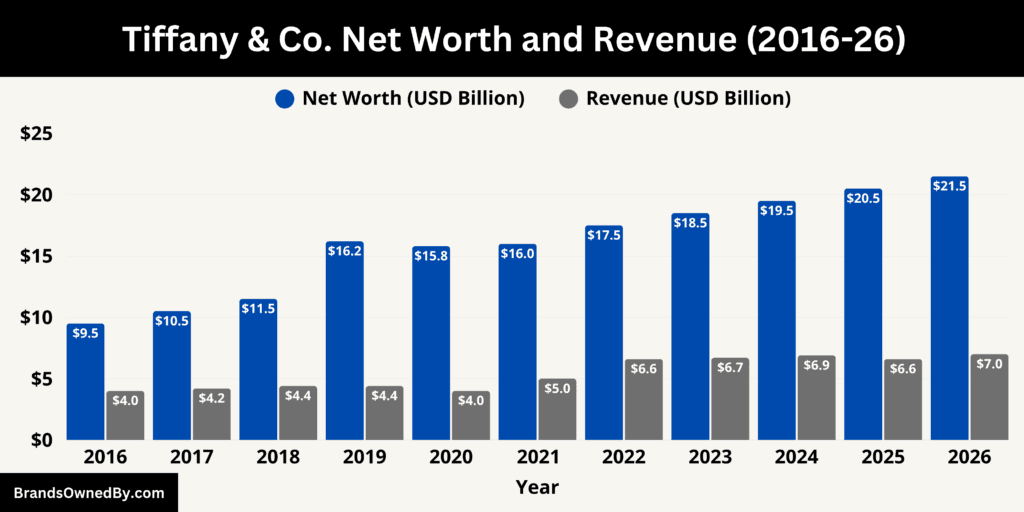
As of April 2026, Tiffany & Co. generates an estimated annual revenue of about $7.0 billion and holds an estimated brand valuation of approximately $21.5 billion. This reflects a strong post-acquisition expansion under LVMH, with growth driven by high jewelry, flagship retail upgrades, and increasing demand across Asia.
Revenue Growth and Structure (2016–2026)
Tiffany’s revenue trajectory shows two distinct phases: steady growth as a public company and accelerated expansion after integration into LVMH.
From 2016 to 2019, revenue increased from $4.0 billion to $4.4 billion. This growth was supported by engagement jewelry demand and international tourism. However, growth remained moderate due to competitive pressure and limited category expansion.
In 2020, revenue dropped to $4.0 billion due to global disruptions. This decline directly impacted store traffic and luxury spending, particularly in key urban markets.
After the 2021 acquisition, Tiffany entered a new growth cycle. Revenue rose to $5.0 billion in 2021, driven by operational restructuring and renewed investment. By 2022, revenue reached $6.6 billion as LVMH accelerated store upgrades and brand repositioning.
From 2023 to 2026, revenue stabilized at a higher level, reaching $7.0 billion in 2026. Growth during this period has been driven by pricing power, high jewelry collections, and stronger performance in Asia.
In terms of revenue mix, jewelry remains dominant. Approximately 90% of total revenue comes from fine jewelry and engagement rings. High jewelry contributes a smaller share but generates significantly higher margins. The remaining revenue comes from watches, fragrances, and accessories, which serve as complementary categories rather than core drivers.
Geographically, the Americas account for roughly 40% of revenue, Asia-Pacific contributes around 35%, and the remaining share comes from Europe and other regions. Asia has been the fastest-growing segment, particularly China and Japan.
Net Worth and Valuation Evolution
Tiffany’s valuation has evolved significantly over the past decade. Before its acquisition, the company’s valuation ranged between $9.5 billion and $11.5 billion from 2016 to 2018. This reflected stable brand equity but limited growth acceleration.
In 2019, the valuation surged to $16.2 billion when LVMH announced its acquisition. This premium reflected Tiffany’s long-term strategic value rather than just its financial performance.
The final acquisition price of $15.8 billion in 2021 established a new baseline for Tiffany’s net worth. Since then, the brand’s valuation has steadily increased due to strategic repositioning and operational improvements.
By 2026, Tiffany’s estimated net worth has reached approximately $21.5 billion. This increase is driven by higher revenue, improved margins, stronger brand positioning, and integration into LVMH’s luxury ecosystem.
Unlike publicly traded companies, Tiffany’s valuation is not updated through stock market pricing. Instead, it is inferred from performance metrics, brand strength, and its strategic role within LVMH.
2026 Financial Position and Key Drivers
In 2026, Tiffany’s financial performance reflects a mature but still expanding luxury brand.
Revenue of $7.0 billion is supported by higher average selling prices, especially in engagement rings and high jewelry. The company has successfully shifted toward premium segments, reducing reliance on entry-level products.
Profitability has improved due to better cost control, vertical integration in sourcing, and higher-margin product categories. Store productivity has also increased following flagship renovations, particularly in New York and key Asian cities.
Brand equity is a major contributor to valuation. Tiffany’s global recognition, heritage, and association with LVMH have strengthened its pricing power and customer loyalty.
Future Revenue Forecast (2027–2030) and Growth Drivers
Tiffany & Co.’s projected revenue growth through 2030 reflects a shift toward higher-margin segments and deeper market penetration in key regions. The forecasts below are based on the current trajectory, brand repositioning, and continued backing from LVMH.
- 2027: $7.4 billion
- 2028: $7.9 billion
- 2029: $8.4 billion
- 2030: $9.0 billion.
The primary driver behind this growth is the continued expansion of high jewelry. Tiffany is increasing its focus on rare diamonds and exclusive collections, which generate significantly higher margins compared to standard jewelry lines. This shift alone is expected to contribute a disproportionate share of revenue growth despite lower volume.
Geographic expansion remains critical. Asia, particularly China and Japan, is expected to contribute the largest incremental revenue. Rising luxury consumption and strong brand recognition in these markets support sustained demand. New flagship stores and localized product strategies will further accelerate growth.
Retail productivity is also improving. Renovated flagship locations are generating higher per-store revenue through enhanced customer experience and higher average transaction values. This model is being replicated across major global cities.
Additionally, tighter integration within LVMH’s supply chain is improving margins and inventory control. Vertical integration in diamond sourcing and manufacturing reduces costs while strengthening brand authenticity.
Overall, Tiffany’s growth outlook is not volume-driven. It is based on pricing power, product mix optimization, and strategic market expansion, positioning the brand to approach $9.0 billion in annual revenue by 2030.
Brands Owned by Tiffany & Co.
Tiffany & Co. operates with a focused, brand-centric structure rather than a diversified portfolio of independent subsidiaries. As of 2026, the company’s ecosystem is built around its core brand, supported by internal collections, vertically integrated operations, and controlled retail infrastructure. Each division functions as a strategic pillar contributing to revenue, brand positioning, and long-term growth.
| Entity / Division | Type | Core Focus | Strategic Role | Key Details |
|---|---|---|---|---|
| Tiffany & Co. (Core Brand) | Core Entity | Global luxury jewelry operations | Central brand and revenue driver | Fully integrated operations across design, retail, and distribution |
| Tiffany Fine Jewelry | Product Division | Engagement rings, bridal jewelry, core collections | Primary revenue generator | Accounts for majority of sales; strong global demand in bridal segment |
| Tiffany High Jewelry | Product Division | Rare diamonds, exclusive pieces | Brand elevation and high-margin sales | Targets ultra-high-net-worth clients; limited volume, high value |
| Tiffany HardWear | Collection | Modern, bold jewelry designs | Attract younger luxury consumers | Strong growth through fashion-forward positioning and digital marketing |
| Tiffany T Collection | Collection | Minimalist jewelry with “T” motif | Entry-level luxury segment | High volume, accessible pricing, strong margins |
| Tiffany Knot Collection | Collection | Symbolic knot-inspired jewelry | Mid-tier luxury and gifting segment | Popular for everyday luxury and gifting occasions |
| Elsa Peretti Collection | Designer Collection | Organic, minimalist designs | Heritage and consistent global demand | Includes iconic designs like Bone Cuff and Open Heart |
| Paloma Picasso Collection | Designer Collection | Artistic, bold jewelry | Expands creative diversity | Appeals to customers seeking expressive, statement pieces |
| Jean Schlumberger Collection | Designer Collection | High craftsmanship, gemstone-rich designs | Ultra-luxury positioning | Key part of Tiffany’s high jewelry heritage |
| Tiffany Watches | Product Division | Luxury watches | Brand diversification | Combines Swiss manufacturing with Tiffany design |
| Tiffany Fragrances | Product Division | Perfumes and lifestyle products | Customer acquisition and accessibility | Entry point into brand for new customers |
| Tiffany Retail Network | Operational Entity | Global stores and e-commerce | Distribution and brand experience | Fully owned retail system with flagship stores in major cities |
| Diamond Sourcing Operations | Operational Entity | Diamond procurement and processing | Supply chain control and trust | Vertical integration ensures quality and traceability |
Tiffany & Co.
Tiffany & Co. is the central operating entity through which all business activities are executed. Unlike conglomerates that manage multiple standalone brands, Tiffany consolidates its operations under a single global identity.
The company controls every major function internally. This includes product design, sourcing, manufacturing, marketing, and retail distribution. Its centralized structure ensures consistency in branding, pricing, and customer experience across all markets.
Tiffany operates hundreds of directly owned stores worldwide. It does not rely on franchising, which allows full control over store presentation and service standards. Its flagship locations, especially in New York, Tokyo, and Shanghai, act as brand showcases and high-revenue drivers.
This unified structure is critical in luxury. It protects brand equity while enabling coordinated global expansion.
Tiffany Fine Jewelry
Tiffany Fine Jewelry is the core revenue engine of the company. This division includes engagement rings, wedding bands, necklaces, bracelets, and earrings.
The segment is anchored by iconic products such as the Tiffany Setting engagement ring. This design has become a global standard in bridal jewelry and continues to drive consistent demand.
The division operates on a combination of standardized collections and customizable offerings. Customers can select diamond size, cut, and setting, which allows Tiffany to maintain both scalability and personalization.
Fine jewelry accounts for the majority of Tiffany’s sales volume. It benefits from recurring demand, especially in the bridal segment, and strong brand trust associated with quality and authenticity.
Tiffany High Jewelry
Tiffany High Jewelry represents the company’s most exclusive and high-margin segment. This division focuses on rare gemstones, large diamonds, and one-of-a-kind creations.
These pieces are often showcased at private exhibitions and exclusive events rather than standard retail environments. Clients typically include ultra-high-net-worth individuals and collectors.
High jewelry plays a strategic role beyond revenue. It elevates Tiffany’s brand image and reinforces its position at the top end of the luxury market. It also allows the company to compete directly with European heritage houses known for high jewelry excellence.
Although the volume is limited, the value per piece is extremely high. This makes it a key contributor to profitability and brand prestige.
Tiffany HardWear Collection
The Tiffany HardWear collection is one of the company’s most successful modern lines. It is inspired by industrial design and urban aesthetics, featuring bold chain links and sculptural forms.
This collection targets younger, fashion-forward consumers. It represents Tiffany’s effort to modernize its image and remain relevant in contemporary luxury markets.
HardWear products are typically crafted in gold and often incorporate diamonds. They are positioned at a premium price point while still being more accessible than high jewelry.
The collection has gained strong traction globally, particularly through celebrity endorsements and digital marketing campaigns.
Tiffany T Collection
The Tiffany T collection is built around a minimalist design language centered on the “T” motif.
It symbolizes connection, strength, and individuality. The collection includes a wide range of products such as rings, cuffs, pendants, and earrings.
This line serves as an entry point into the Tiffany brand for many customers. It is positioned within the accessible luxury segment, making it attractive to younger buyers and first-time luxury consumers.
Despite its relatively lower price point compared to high jewelry, the Tiffany T collection maintains strong margins due to efficient production and high brand value.
Tiffany Knot Collection
The Tiffany Knot collection is inspired by the concept of enduring bonds and connections. It features intricate knot designs crafted in gold and accented with diamonds.
This collection sits between accessible luxury and high jewelry. It targets customers seeking meaningful pieces with symbolic value.
The Knot collection has become an important part of Tiffany’s gifting segment. It appeals to a broad demographic and supports consistent sales throughout the year, not just during bridal seasons.
Its design complexity also reinforces Tiffany’s craftsmanship credentials.
Elsa Peretti Collection
The Elsa Peretti collection is based on the work of Elsa Peretti and remains one of Tiffany’s most enduring product lines.
It features organic, fluid designs inspired by nature and the human form. Signature pieces include the Bone Cuff and Open Heart pendant.
This collection appeals to customers who prefer understated elegance and timeless design. It has strong cross-generational appeal and continues to perform consistently in global markets.
Elsa Peretti’s designs contribute significantly to Tiffany’s identity as a design-led brand.
Paloma Picasso Collection
The Paloma Picasso collection, created by Paloma Picasso, adds a bold and artistic dimension to Tiffany’s offerings.
It is characterized by strong colors, graphic shapes, and expressive forms. The collection stands out from Tiffany’s more traditional designs and attracts customers looking for distinctive statement pieces.
This line enhances Tiffany’s creative diversity. It allows the brand to appeal to a wider audience without diluting its luxury positioning.
Jean Schlumberger Collection
The Jean Schlumberger collection is one of Tiffany’s most prestigious design lines. It is based on the work of Jean Schlumberger.
This collection features highly intricate designs, vibrant gemstones, and exceptional craftsmanship. It includes some of Tiffany’s most iconic high jewelry creations.
Schlumberger pieces are often associated with exclusivity and heritage. They play a key role in Tiffany’s positioning within the ultra-luxury segment.
This collection also strengthens Tiffany’s historical credibility in fine jewelry design.
Tiffany Watches
Tiffany Watches represents the company’s expansion into the luxury timepiece market.
The watches combine Swiss manufacturing standards with Tiffany’s design philosophy. While the segment is smaller compared to jewelry, it serves as an important extension of the brand.
The division targets customers who value both functionality and luxury aesthetics. It also aligns Tiffany with other high-end brands that operate across jewelry and watches.
Tiffany Fragrances
Tiffany Fragrances is a lifestyle extension of the core brand. It includes perfumes designed to reflect Tiffany’s elegance and identity.
This segment plays a strategic role in customer acquisition. Fragrances are priced lower than jewelry, making them accessible to a wider audience.
They act as an entry point into the brand. Many customers begin with fragrances and later transition to higher-value purchases such as jewelry.
Despite lower margins compared to jewelry, fragrances contribute to brand visibility and global reach.
Tiffany & Co. Retail Network
Tiffany operates a fully controlled global retail network. This includes flagship stores, boutiques, and e-commerce platforms.
The company owns and manages its stores directly. This allows it to maintain strict control over customer experience, store design, and product presentation.
Flagship locations are designed as immersive luxury spaces. They combine retail with art, history, and hospitality elements to enhance customer engagement.
Retail remains one of Tiffany’s most important assets. It drives both revenue and brand perception.
Diamond Sourcing and Vertical Integration
Tiffany has invested heavily in controlling its diamond supply chain.
The company manages sourcing, cutting, polishing, and traceability processes. It maintains direct relationships with mines and ensures transparency in sourcing.
This vertical integration enhances quality control and strengthens customer trust. It also supports Tiffany’s positioning as a responsible luxury brand.
By controlling more of the value chain, Tiffany improves margins and reduces dependency on external suppliers.
Conclusion
Tiffany & Co. is no longer an independent brand. It is fully owned by LVMH, the world’s leading luxury group. This ownership has strengthened Tiffany’s global reach, financial power, and competitive position.
Under the leadership of Bernard Arnault and LVMH, Tiffany continues to evolve. It blends heritage with modern luxury. The brand remains a symbol of prestige while benefiting from the scale and expertise of its parent company.
FAQs
Who owns Tiffany and Company?
Tiffany & Co. is fully owned by LVMH as of 2026. It operates as a wholly owned subsidiary within LVMH’s Watches & Jewelry division. This means Tiffany no longer has public shareholders and is fully controlled within the group’s private ownership structure.
Who bought Tiffany and Co?
Tiffany & Co. was acquired by LVMH, led by Bernard Arnault. The deal was finalized in January 2021 for approximately $15.8 billion. It remains one of the largest acquisitions in the global luxury industry.
When was Tiffany founded?
Tiffany & Co. was founded in 1837 by Charles Lewis Tiffany and John B. Young in New York City. The company started as a stationery and fancy goods store before evolving into a leading luxury jewelry brand.
Why did LVMH acquire Tiffany?
LVMH acquired Tiffany to strengthen its position in high-end jewelry, particularly in diamonds and engagement rings. The acquisition also expanded LVMH’s presence in the U.S. market and helped it compete more aggressively with rivals like Richemont, which owns Cartier and Van Cleef & Arpels.
Did Louis Vuitton buy Tiffany?
No, Louis Vuitton did not directly buy Tiffany. Both brands are part of LVMH. Louis Vuitton is one of many brands owned by LVMH, which completed the Tiffany acquisition at the group level.
When did LVMH acquire Tiffany?
LVMH completed the acquisition of Tiffany & Co. in January 2021. The deal was first announced in 2019, delayed in 2020 due to disputes and market conditions, and then finalized after a revised agreement.
Is Tiffany and Co. owned by Trump?
No, Tiffany & Co. has never been owned by Donald Trump. The brand has historically been independent and publicly traded before being acquired by LVMH. There is no ownership or business connection between Trump and Tiffany.
Who owned Tiffany and Co before LVMH?
Before the acquisition, Tiffany & Co. was a publicly traded company listed on the New York Stock Exchange. Ownership was spread across institutional investors such as BlackRock and The Vanguard Group, along with mutual funds and retail investors. No single entity had controlling ownership before LVMH acquired the company.