
- Motorola is 100% owned by Lenovo and operates as a wholly owned subsidiary with no independent shareholders or public listing.
- Control of Motorola ultimately lies with Lenovo’s shareholders, with Legend Holdings as the largest stakeholder, alongside global institutional investors.
- Lenovo’s leadership, led by CEO Yuanqing Yang, directly controls Motorola’s global strategy, product direction, and market expansion.
Motorola is a legacy brand in global communications and consumer electronics. It began as a radio equipment maker. It later became a pioneer in mobile technology and wireless infrastructure.
Motorola helped define the mobile phone industry. It introduced the first handheld cellular phone and drove early innovation in semiconductors and telecom systems. Over decades, the brand built a reputation for engineering reliability and practical design.
As of April 2026, Motorola operates as a smartphone-focused business under Lenovo. Its portfolio includes the Moto G, Moto Edge, and foldable Razr series. The company targets a wide market. It balances affordability with premium innovation.
Motorola maintains a strong presence in North America and Latin America. It is also expanding in Europe and Asia. The brand is known for a near-stock Android experience, durable devices, and competitive positioning in mid-range and upper mid-tier segments.
Motorola Founders
Motorola was founded by Paul V. Galvin and Joseph E. Galvin in 1928. These two brothers built the company from a small manufacturing business into a global technology brand. Their early vision focused on practical innovation and mass-market electronics. This foundation shaped Motorola’s long-term success in communication technology.
Paul V. Galvin
Paul V. Galvin was the key architect behind Motorola’s creation. He co-founded the company under the name Galvin Manufacturing Corporation.
Paul Galvin had strong business instincts. He focused on practical, market-driven innovation. One of his earliest successes was the development of affordable car radios. This product helped the company survive during the Great Depression.
He later introduced the “Motorola” brand name. It reflected the company’s focus on automotive sound systems. Under his leadership, Motorola expanded into communication equipment and electronics. He set the foundation for its future in wireless technology.
Joseph E. Galvin
Joseph E. Galvin co-founded the company alongside his brother Paul. He played a crucial operational role in the early years.
Joseph supported manufacturing, logistics, and business expansion. While Paul focused on vision and strategy, Joseph ensured execution. This partnership helped stabilize the company during its early growth phase.
Together, the Galvin brothers transformed a small startup into a major electronics brand. Their combined efforts laid the groundwork for Motorola’s evolution into a global technology leader.
Ownership History
Motorola’s ownership structure has changed through three decisive transactions. Each phase involved a different strategic objective: restructuring, patent acquisition, and global market expansion. As of April 2026, the Motorola brand in consumer devices sits fully within Lenovo’s corporate structure.
Independent Motorola Corporation (1928–2011)
Motorola operated for decades as a standalone, publicly traded U.S. company. It built deep capabilities in semiconductors, radio systems, and mobile handsets.
By the mid-2000s, the company faced a structural decline in its handset division. Its RAZR success was not sustained. Product cycles slowed. Software integration lagged behind emerging smartphone ecosystems. Market share shifted toward Nokia in feature phones and later toward Apple Inc. and Samsung Electronics in smartphones.
This performance gap led to a strategic breakup.
Structural Split into Motorola Mobility and Motorola Solutions (2011)
In January 2011, Motorola executed a tax-free corporate separation. The goal was to isolate two fundamentally different operating models.
- Motorola Mobility took over consumer-facing products. This included smartphones, tablets, and home devices.
- Motorola Solutions retained government, public safety, and enterprise infrastructure businesses.
This split created two independent companies with separate management teams, capital structures, and strategic priorities. Motorola Mobility became a pure-play consumer hardware company competing directly in the Android ecosystem.
Google Acquisition and Patent Strategy (2012–2014)
In May 2012, Google completed its acquisition of Motorola Mobility for approximately $12.5 billion.
The transaction was primarily IP-driven. Motorola held over 17,000 patents and thousands of additional filings. These covered core wireless standards, including 2G, 3G, and early 4G technologies. Google used this portfolio to defend Android against litigation risks from competitors.
Operationally, Motorola Mobility remained a separate business unit. Google did not fully integrate it into its core structure. Instead, it allowed Motorola to continue building Android devices with a near-stock experience.
Key product releases during this period included:
- Moto X (customization-focused flagship)
- Moto G (high-volume mid-range device).
Despite strong product design, Motorola Mobility remained unprofitable. Google restructured the business. It reduced workforce size and rationalized product lines.
In January 2014, Google announced the sale of Motorola Mobility. It retained the majority of the patent portfolio. This confirms the acquisition’s primary objective was intellectual property, not long-term hardware ownership.
Lenovo Acquisition and Integration (2014–Present)
In October 2014, Lenovo completed the acquisition of Motorola Mobility for about $2.91 billion. The deal included the Motorola brand, trademarks, and device business. Most patents remained with Google, though Lenovo received a license to use them.
Lenovo’s strategy was clear: scale its global smartphone presence using Motorola’s brand equity and carrier relationships, especially in North America and Latin America.
Post-acquisition, Motorola was integrated into Lenovo’s Mobile Business Group. Lenovo adopted a dual-brand strategy:
- “Lenovo” for select markets (mainly Asia)
- “Motorola” for global smartphone markets.
Between 2016 and 2018, Lenovo streamlined overlapping product lines. It phased out redundant Lenovo-branded smartphones in many regions. Motorola became the primary global brand.
From 2019 onward, Motorola focused on:
- Mid-range volume leadership (Moto G series)
- Premium re-entry (Motorola Edge series)
- Foldable innovation (Razr lineup).
As of April 2026, Motorola operates as a wholly owned subsidiary. It does not have an independent public listing or external shareholders. All governance, capital allocation, and strategic direction flow through Lenovo.
Lenovo continues to position Motorola as its primary smartphone growth engine outside China. The brand consistently ranks among the top smartphone vendors in Latin America and holds a stable position in the U.S. market.
Who Owns Motorola?
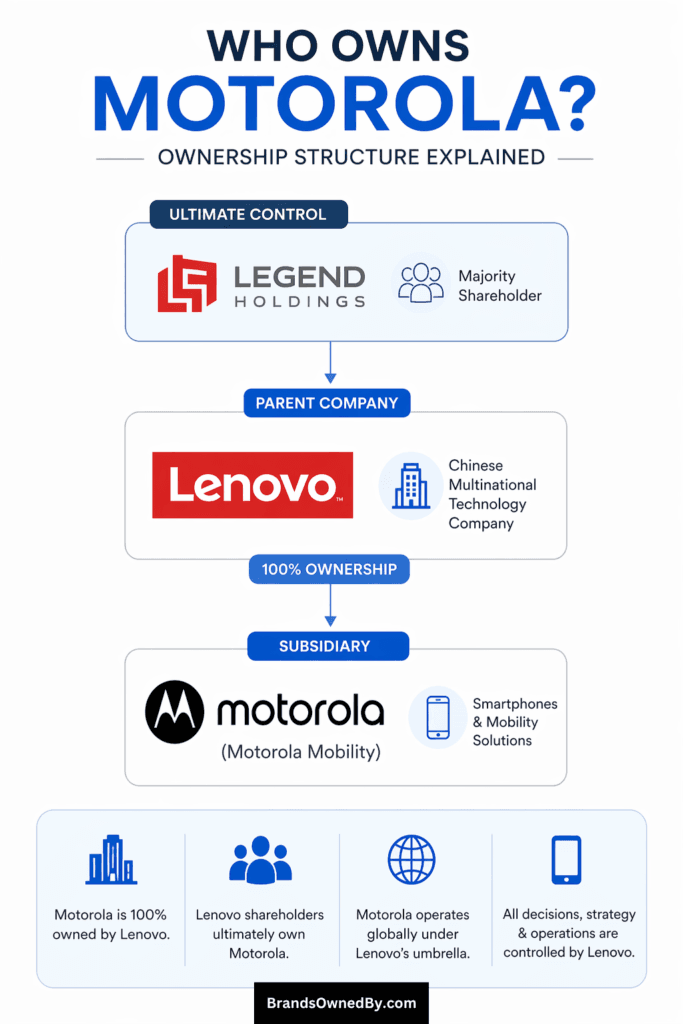
Motorola is fully owned by Lenovo. The consumer business operates under Motorola Mobility LLC, which is a wholly owned subsidiary of Lenovo as of April 2026.
This means Motorola has no independent shareholders, no separate stock listing, and no external ownership stakes. All equity ownership flows through Lenovo. In practical terms, Lenovo controls:
- Motorola’s global strategy
- Product roadmap and investments
- Financial reporting and performance
- Market expansion and partnerships.
Motorola functions as Lenovo’s primary global smartphone brand, especially outside China. It is not an independent company anymore. It is a fully integrated business unit within Lenovo’s corporate structure.
Parent Company: Lenovo
Lenovo is one of the world’s largest technology companies. It operates across PCs, smartphones, servers, and enterprise solutions.
As of April 2026, Lenovo has:
- Operations in 180+ markets worldwide
- Around 70,000+ employees globally
- Dual headquarters in Beijing (China) and Morrisville, North Carolina (U.S.).
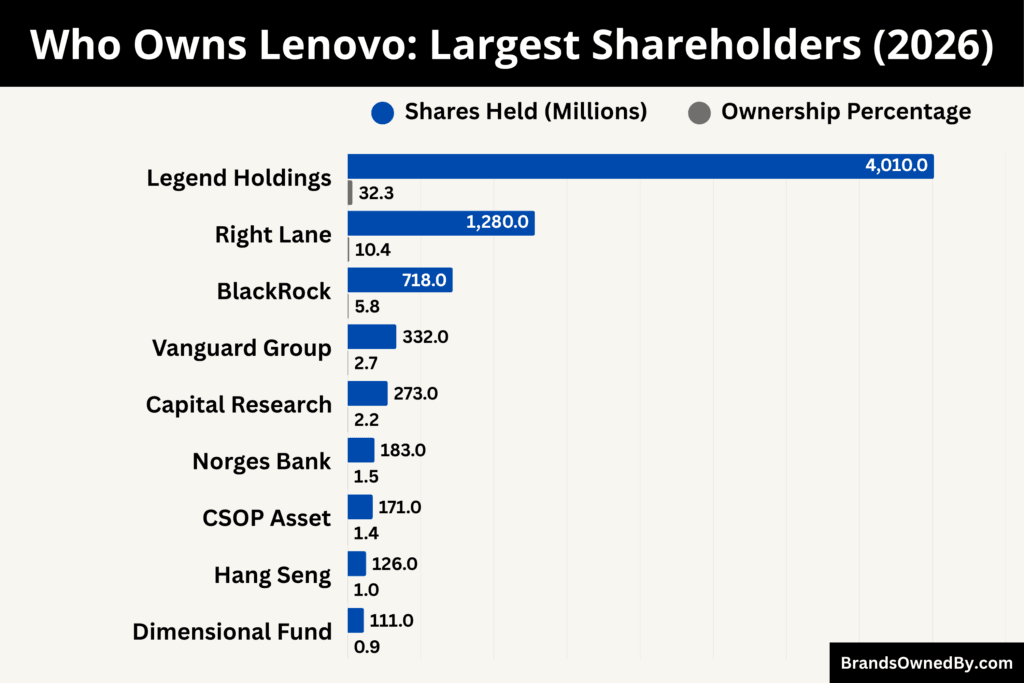
Lenovo is publicly listed on the Hong Kong Stock Exchange. Its ownership is distributed among institutional investors, retail investors, and founding entities. The largest controlling influence comes from Legend Holdings, a major Chinese investment group.
Lenovo’s Strategic Positioning of Motorola
Lenovo does not treat Motorola as a side business. It uses it as a core growth engine in smartphones.
Key strategic roles of Motorola within Lenovo:
- Global brand leverage: Motorola has strong recognition in the U.S. and Latin America
- Carrier relationships: Motorola has long-standing partnerships with telecom operators
- Market diversification: Lenovo avoids relying only on China by scaling Motorola globally.
After acquiring Motorola, Lenovo gradually merged its own smartphone division into Motorola. From 2015 to 2017, Motorola became the dominant smartphone brand for Lenovo globally.
This shows a clear shift: Lenovo did not just buy Motorola. It rebuilt its entire mobile strategy around it.
Acquisition Details and Insights
Before Lenovo, Google acquired Motorola Mobility in 2012 for $12.5 billion.
The primary objective was not hardware. It was intellectual property. Motorola owned:
- Over 17,000 patents
- Critical wireless and telecom technologies.
These patents helped Google defend Android against legal challenges.
However, Google did not fully integrate Motorola into its ecosystem. The hardware business continued to struggle financially. This led to a strategic exit.
Lenovo Acquisition
In 2014, Lenovo acquired Motorola Mobility for approximately $2.91 billion.
The deal structure included:
- $660 million in cash
- $750 million in Lenovo shares
- $1.5 billion in a promissory note (paid over time).
This was significantly lower than what Google paid. It reflects that Google retained the most valuable asset: patents.
What Lenovo Actually Acquired
Lenovo did not buy the entire Motorola ecosystem. It acquired specific operational and brand assets:
- Motorola brand and trademarks
- Smartphone product portfolio (Moto X, Moto G, Droid, etc.)
- Global distribution network
- Engineering and design teams
- Carrier partnerships in key markets.
At the same time:
- Google retained the majority of patents
- Lenovo received licenses to use those patents
- Lenovo gained access to around 2,000 patent assets.
This structure allowed Lenovo to operate Motorola freely without legal risk, while Google kept long-term IP control.
Strategic Rationale Behind Lenovo’s Acquisition
Lenovo’s decision was highly strategic. It addressed three critical gaps:
- Weak smartphone presence outside China
- Limited brand recognition in Western markets
- Lack of strong carrier relationships.
Motorola solved all three immediately.
At the time of acquisition:
- Motorola was already a top smartphone brand in the U.S. and Latin America
- It had established relationships with major telecom carriers
- It had a recognizable global brand.
Lenovo leveraged this to expand internationally.
Post-Acquisition Integration
After completing the deal in October 2014, Lenovo confirmed that Motorola would operate as a wholly owned subsidiary.
Key integration steps included:
- Maintaining Motorola’s headquarters in Chicago
- Retaining its engineering and design teams
- Aligning product development with Lenovo’s global supply chain
- Consolidating Lenovo’s smartphone efforts under Motorola.
By 2016–2017, Lenovo phased out most of its own smartphone branding globally. Motorola became the unified identity.
Competitor Ownership Comparison
Motorola operates under a clear ownership model. It is fully controlled by Lenovo. However, its key competitors follow very different ownership structures. These differences directly affect decision-making speed, product strategy, and global expansion.
| Company | Ownership Type | Key Owners / Control | Structure Model | Strategic Implication |
|---|---|---|---|---|
| Motorola (Lenovo) | Wholly owned subsidiary | Fully owned by Lenovo | Centralized corporate ownership | Strong global scale via Lenovo, but limited independence in decision-making |
| Samsung Electronics | Public (family-influenced) | Lee family via Samsung Group | Hybrid (public + family control) | Long-term strategic control with stability and high R&D investment |
| Apple Inc. | Public | Institutional investors (Vanguard, BlackRock, etc.) | Dispersed ownership | High independence, strong ecosystem control, premium positioning |
| Xiaomi | Public (founder-led) | Founder Lei Jun + public shareholders | Founder-driven public company | Fast execution, aggressive pricing, innovation-driven growth |
| OPPO | Private | BBK Electronics group ownership | Private ownership | High flexibility, aggressive expansion without public pressure |
| Google (Pixel) | Internal division | Fully owned by Google (Alphabet) | Integrated division | Full hardware-software control, strong ecosystem advantage |
Motorola vs Samsung: Family-Influenced Public Ownership
Samsung Electronics is a publicly listed company. However, control is heavily concentrated within the founding Lee family through the broader Samsung Group.
Samsung’s structure combines public ownership with family control. This allows long-term strategic decisions without heavy short-term market pressure.
In contrast, Motorola is not publicly listed. It operates as a subsidiary. Lenovo executives make final decisions. There is no family control element in Motorola’s structure.
Key difference: Samsung has hybrid control (public + family influence). Motorola has centralized corporate control under Lenovo.
Motorola vs Apple: Fully Public Institutional Ownership
Apple Inc. is one of the most widely held public companies in the world. Its ownership is dominated by institutional investors such as asset managers and pension funds.
No single shareholder controls Apple. Instead, governance is driven by its board of directors and executive leadership.
Apple operates with high independence. It generates strong cash flow. This allows it to control its entire ecosystem, from hardware to software.
Motorola, on the other hand, does not operate independently. Its strategy aligns with Lenovo’s broader corporate goals.
Key difference: Apple is independently governed with dispersed ownership. Motorola is centrally owned and controlled by a parent company.
Motorola vs Xiaomi: Founder-Led Public Company
Xiaomi is publicly listed but retains strong founder influence. Its co-founder, Lei Jun, plays a central role in strategic decisions.
Xiaomi combines public market funding with founder-driven leadership. This allows fast decision-making and aggressive pricing strategies.
Motorola does not have a founder influence today. Its leadership structure is corporate. Decisions flow through Lenovo’s executive hierarchy.
Key difference: Xiaomi balances public ownership with founder control. Motorola operates under corporate ownership without founder involvement.
Motorola vs OPPO: Private Ownership Model
OPPO is privately owned under BBK Electronics (now often referred to as part of a broader group structure including Vivo and OnePlus).
This private ownership allows OPPO to operate without public market pressure. It can invest aggressively in innovation and marketing.
Motorola, while not public itself, is tied to a publicly listed parent (Lenovo). This means financial discipline and reporting requirements still apply.
Key difference: OPPO operates under private ownership. Motorola operates under a public parent company.
Motorola vs Google Pixel: Internal Division Ownership
Google develops Pixel smartphones as an internal product line. Pixel is not a separate company. It is fully integrated within Google’s hardware division.
This model is similar to Motorola’s current structure under Lenovo. However, Google controls both hardware and software ecosystems through Android.
Motorola depends on Android but does not control it. This limits vertical integration compared to Google.
Key difference: Both are internal divisions. But Google owns the software platform, while Motorola relies on it.
Strategic Implications of Ownership Differences
Ownership structure directly impacts competitive behavior:
- Speed of decision-making: Founder-led and private companies move faster. Corporate subsidiaries like Motorola align with parent strategies.
- Risk tolerance: Private firms and founder-led companies take more aggressive bets. Public companies balance growth with investor expectations.
- Ecosystem control: Companies like Apple and Google control both hardware and software. Motorola operates within the Android ecosystem controlled by Google.
- Capital allocation: Motorola depends on Lenovo’s priorities. Apple and Samsung allocate capital independently at scale.
Who Controls Motorola?
Motorola is controlled by its parent company, Lenovo. Control is centralized at the group level. Motorola does not operate as an independent decision-making entity. Instead, it functions within Lenovo’s corporate governance and reporting structure as of April 2026.
Top-Level Control: Lenovo Leadership
The ultimate authority over Motorola sits with Lenovo’s senior leadership and board. The company is led by Yuanqing Yang, who has been CEO since 2009. He is the key decision-maker behind Lenovo’s global strategy, including its smartphone business.
Other senior executives involved in strategic oversight include:
- Luca Rossi – President of Lenovo’s Intelligent Devices Group (IDG), which includes PCs, tablets, and smartphones
- Wong Wai Ming – Chief Financial Officer, responsible for capital allocation and financial oversight.
These executives collectively control major decisions that impact Motorola. This includes investment priorities, geographic expansion, and product positioning.
Motorola does not have independent board-level authority. All high-level decisions are approved within Lenovo’s governance framework.
Direct Operational Control: Motorola and Mobile Business Leadership
Motorola’s day-to-day operations are managed by Sergio Buniac. As of April 2026, he serves as President of Motorola and leads Lenovo’s Mobile Business Group.
He is responsible for executing Lenovo’s smartphone strategy globally. His role includes product development, brand positioning, and market performance.
Under his leadership, Motorola has focused on three core areas:
- Strengthening its position in North and Latin America
- Expanding the Motorola Edge and Razr product lines
- Improving profitability in the mid-range smartphone segment.
Buniac reports to Lenovo’s top leadership. He does not operate independently. His execution must align with the group-level strategy defined by Yuanqing Yang and the IDG leadership.
Organizational Structure and Reporting Lines
Motorola is structurally embedded within Lenovo’s Intelligent Devices Group. This is Lenovo’s largest business unit. It combines PCs, tablets, and smartphones under a unified strategy.
The reporting structure is hierarchical:
- Lenovo CEO (Yuanqing Yang) sets overall direction
- IDG President (Luca Rossi) oversees device ecosystem strategy
- Motorola President (Sergio Buniac) executes smartphone operations.
This structure ensures that Motorola’s roadmap is aligned with Lenovo’s broader ecosystem. It also allows integration across hardware, software optimization, and supply chain.
Decision-Making Authority
Motorola’s control model is centralized. Strategic authority remains at Lenovo’s headquarters. This includes:
- Approval of major product investments
- Entry into new markets
- Partnerships with telecom operators
- Long-term innovation priorities.
Motorola leadership has operational flexibility. It can adapt pricing, marketing, and product features for regional markets. However, it cannot make independent strategic shifts without Lenovo approval.
This balance allows Lenovo to maintain consistency across global markets while still enabling localized execution.
Evolution of Control Structure
Motorola’s control model has changed significantly over time.
Before 2011, Motorola operated as an independent company. Leadership decisions were made internally.
Between 2012 and 2014, under Google, Motorola Mobility functioned as a semi-independent division. Executives like Dennis Woodside had more autonomy in product development.
After Lenovo’s acquisition in 2014, control became more centralized. Lenovo integrated Motorola into its corporate structure. Over time, Lenovo reduced internal duplication and aligned all smartphone efforts under Motorola leadership.
As of April 2026, this integrated model is fully established. Motorola operates as a tightly controlled but globally scaled business unit.
Motorola Annual Revenue and Net Worth
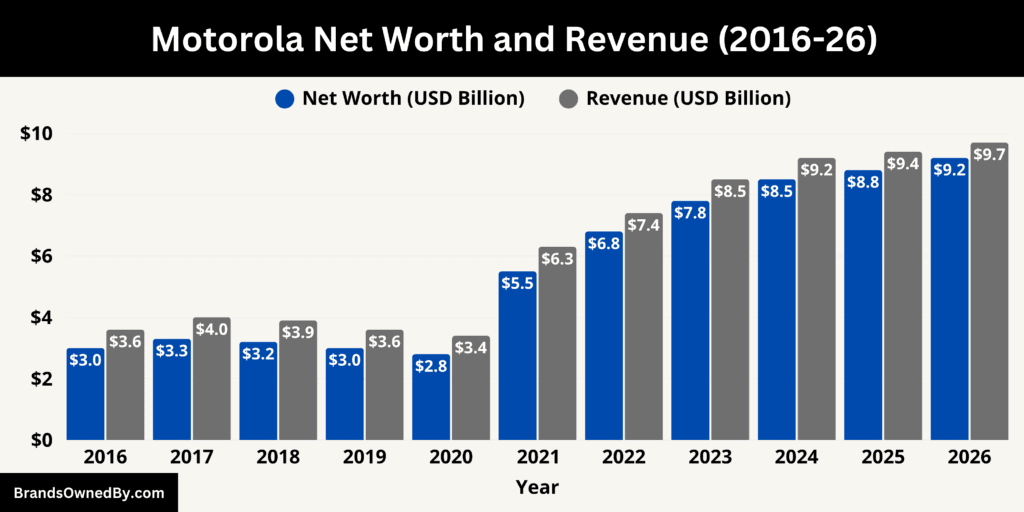
As of April 2026, Motorola generates approximately $9.7 billion in annual revenue, up from $9.4 billion in 2025.
Based on this revenue base and typical smartphone industry valuation multiples, Motorola’s implied net worth (enterprise value) is estimated at $9–$11 billion in 2026. This reflects its profitability, market share, and position as a mid-tier global smartphone brand.
Revenue Breakdown and Business Structure
Motorola’s revenue is heavily concentrated in smartphones, but the mix has evolved significantly.
Smartphones account for over 90% of total revenue, driven by high-volume models like Moto G and increasing traction of premium devices. The company shipped over 60 million smartphones annually by 2025, showing strong volume scale.
Premium smartphones such as the Edge and Razr series now contribute a growing share of revenue. This shift has improved average selling prices and margins. Motorola also became a leader in flip-style foldables, holding a dominant position in that niche segment in key markets.
Geographically, revenue is concentrated in:
- North America (strong carrier partnerships)
- Latin America (market leadership in several countries)
- Emerging growth markets like India and Southeast Asia.
Motorola holds around 5% global smartphone market share and ranks among the top 10 vendors worldwide.
Profitability and Net Worth Estimation
Motorola has been consistently profitable under Lenovo in recent years. This is supported by:
- Scaled production through Lenovo’s supply chain
- Strong mid-range device volumes
- Expansion into higher-margin premium devices.
Since Motorola is not publicly listed, its net worth must be inferred using industry benchmarks. Hardware companies in this segment typically trade at 0.9x–1.2x revenue multiples.
Applying this to 2026 revenue:
- Revenue: $9.7 billion
- Implied valuation: $9–$11 billion.
This places Motorola in the mid-tier global smartphone valuation bracket, significantly below premium ecosystem players but stable within its segment.
2026 Financial Position in Context
Motorola’s $9.7 billion revenue sits within Lenovo’s much larger ecosystem. Lenovo generated over $69 billion in total revenue, highlighting the scale advantage that Motorola benefits from.
Motorola’s contribution is strategically important rather than dominant. It acts as Lenovo’s primary smartphone growth engine globally.
The company’s financial position in 2026 is defined by:
- Stable profitability
- Strong regional dominance (Americas)
- Growing premium segment contribution
- Moderate global market share (5%).
Revenue Forecast (2027–2030)
Motorola’s forward revenue trajectory is shaped by three measurable levers: shipment volume growth, average selling price (ASP) expansion, and geographic mix shift. Unlike top-tier players, Motorola’s growth is not driven by ecosystem lock-in or services revenue. It is driven by hardware scale efficiency and targeted market execution.
As of 2026, Motorola ships an estimated 55–65 million smartphones annually. Its blended ASP sits in the $150–$180 range, reflecting its heavy exposure to mid-range devices. The forecast below models gradual ASP expansion and controlled shipment growth.
2027: $10.4 Billion — Scale Consolidation + 5G Replacement Cycle
In 2027, Motorola’s revenue growth is expected to come primarily from replacement demand in mature markets.
The U.S. market remains critical. Motorola continues to benefit from carrier-led distribution through Verizon, AT&T, and T-Mobile. A large installed base of older 4G devices will transition to 5G. Motorola’s strength in the $200–$400 segment positions it directly in this upgrade cycle.
Shipments are expected to reach 68 million units, with ASP improving slightly to $155–$160 due to better product mix. Latin America remains a volume driver, while North America contributes disproportionately to revenue due to higher pricing.
2028: $11.2 Billion — Emerging Market Acceleration
By 2028, growth shifts toward emerging markets, particularly India and Southeast Asia.
Motorola has been scaling distribution in India through both online and offline channels. This market is critical because of its size and replacement cycle velocity. Southeast Asia also contributes incremental volume, especially in Indonesia, Vietnam, and the Philippines.
Shipments are projected at 72–75 million units, while ASP rises to $160–$165. The increase in ASP is modest but consistent, driven by higher adoption of upper mid-range devices like the Edge series.
At this stage, Motorola’s growth is still volume-led, but early signs of premiumization begin to show in the revenue mix.
2029: $12.0 Billion — Premium Mix Expansion
In 2029, the key driver shifts from volume to product mix optimization.
Motorola’s premium segment, particularly the Razr foldable lineup and Edge series, gains share within its portfolio. Foldables, while still niche, command significantly higher ASPs. Even a small increase in mix can materially impact revenue.
ASP is expected to move toward $170–$175, while shipments stabilize around 75–78 million units. Growth slows in unit terms but accelerates in value terms.
At this stage, Motorola’s revenue growth becomes margin-accretive, not just volume-driven.
2030: $12.8–$13.2 Billion — Structural Plateau with Select Upside
By 2030, Motorola will approach a structural ceiling under its current business model.
Without a proprietary software ecosystem like Apple Inc. or deep vertical integration like Samsung Electronics, Motorola’s ability to expand margins is constrained.
Shipments are expected to plateau at 78–80 million units, while ASP reaches $175–$180. Revenue growth slows to low single digits.
However, upside remains if Motorola successfully scales:
- Foldable devices into mainstream adoption
- Enterprise-focused smartphones (ThinkPhone segment)
- Higher ASP devices in developed markets.
Brands Owned by Motorola
As of 2026, Motorola does not rely on acquisitions to expand. Its strategy is centered on scaling a focused set of brands across price segments and regions.
This makes Motorola a lean, execution-driven smartphone company, where growth comes from product positioning and market expansion rather than portfolio diversification.
Motorola’s owned entities are best understood through its brands, product ecosystems, and legacy acquisitions that still shape its operations.
| Brand / Entity | Category | Positioning | Key Products / Focus | Revenue Contribution | Strategic Role |
|---|---|---|---|---|---|
| Motorola Mobility | Core Operating Entity | Global smartphone and device operations | Product development, manufacturing coordination, distribution | 100% (operational backbone) | Legal and operational entity managing all Motorola business globally |
| Moto (G, E series) | Mass-market smartphone brand | Budget to mid-range | Moto G (mid-range), Moto E (entry-level) | Majority share (70%+ of volume) | Drives global shipments and market share, especially in Latin America and India |
| Motorola Edge | Premium smartphone brand | Upper mid-range to flagship | Edge series (high-performance Android devices) | Growing share (15–20%) | Increases ASP and positions Motorola in premium Android segment |
| Motorola Razr | Foldable smartphone brand | Ultra-premium / innovation | Razr foldable lineup (clamshell design) | Smaller volume, high revenue impact (5–10%) | Enhances brand value and drives margin expansion |
| ThinkPhone by Motorola | Enterprise smartphone brand | Business / corporate users | Secure enterprise devices integrated with Think ecosystem | Niche but high-margin | Expands into enterprise mobility and B2B contracts |
| Motorola Accessories (Moto Ecosystem) | Accessories and peripherals | Complementary ecosystem | Earbuds, chargers, smart accessories | Low (<5%) | Increases ARPU and ecosystem retention |
| Motorola Smart Devices (Licensed) | Smart home / connected devices | Adjacent consumer electronics | Baby monitors, security cameras, communication devices | Minimal | Extends brand into new categories via licensing |
Moto (Moto G, Moto E, Moto X Legacy)
Moto is Motorola’s primary and highest-volume brand, accounting for the majority of its global shipments and revenue.
The Moto G series is the backbone of the business. It dominates the mid-range segment and drives scale, especially in Latin America and India. Devices in this lineup are priced to maximize volume while maintaining consistent margins through Lenovo’s supply chain.
The Moto E series operates at the entry level. It targets price-sensitive markets and first-time smartphone users. While margins are thinner, it supports market share expansion.
The Moto X brand is no longer actively marketed but remains important historically. It introduced Motorola’s clean Android philosophy and design language, which still influences current devices.
As of 2026, the Moto brand contributes the largest share of Motorola’s $9.7 billion revenue, driven by high shipment volumes rather than premium pricing.
Motorola Edge
Motorola Edge is the company’s upper mid-range and premium smartphone brand. It plays a critical role in improving Motorola’s average selling price (ASP).
The Edge lineup focuses on performance, camera systems, and display quality. It competes directly with premium Android devices from Samsung Electronics and Xiaomi.
As of 2026, Edge devices represent a growing share of revenue but a smaller share of total units. This reflects Motorola’s shift toward value-driven premiumization, where fewer units generate higher revenue per device.
Motorola Razr
Motorola Razr is the company’s flagship foldable brand. It operates in the clamshell foldable segment and is one of the few direct competitors to Samsung’s Galaxy Z Flip lineup.
Razr devices are positioned at the high end of the market. They significantly increase Motorola’s ASP and brand perception. Even though shipment volumes are limited compared to Moto G, Razr contributes disproportionately to revenue and margins.
As of April 2026, Motorola has strengthened its position in foldables. The Razr lineup is a key part of its premium strategy and long-term differentiation.
ThinkPhone by Motorola
ThinkPhone is Motorola’s enterprise-focused smartphone brand, developed in alignment with Lenovo’s Think ecosystem.
It targets business users and corporate clients. The devices emphasize security, durability, and integration with enterprise IT systems. ThinkPhone also connects seamlessly with Lenovo ThinkPad devices, creating a cross-device ecosystem.
This brand is strategically important. It allows Motorola to access higher-margin enterprise contracts, which are less volatile than consumer smartphone sales.
Motorola Accessories
Motorola operates a growing ecosystem of accessories under its brand. This includes wireless earbuds, chargers, and connected peripherals designed to complement its smartphones.
While this segment contributes a relatively small portion of total revenue, it plays a role in increasing average revenue per user (ARPU) and strengthening brand retention.
As of 2026, Motorola continues expanding this ecosystem, particularly in audio devices and fast-charging solutions.
Motorola Smart Devices and Licensing Brands
Motorola also maintains a presence in smart home and communication devices through brand licensing and selective in-house development.
Products under this category include home monitoring systems, baby monitors, and communication devices. Many of these are produced through licensed partners but operate under the Motorola brand.
This allows Motorola to extend its brand into adjacent categories without heavy capital investment. However, this segment remains a minor contributor to overall revenue.
Conclusion
Motorola has evolved through multiple ownership phases. It started as an American pioneer. It became part of Google. Now, it is owned by Lenovo.
Understanding who owns Motorola helps explain its current strategy. Lenovo provides financial backing and global reach. Motorola contributes brand legacy and innovation.
The company remains a strong player in the smartphone market. Its future depends on Lenovo’s broader vision and execution.
FAQs
Who makes Motorola?
Motorola smartphones are designed, developed, and marketed by Motorola Mobility, which operates under Lenovo. Manufacturing is handled through Lenovo’s global supply chain, primarily in China, India, and other Asian production hubs.
Who owns Motorola Solutions?
Motorola Solutions is a completely separate company. It was created after Motorola split in 2011. It is publicly traded and not owned by Lenovo. It focuses on enterprise, public safety, and communication systems.
Is Motorola a Chinese company?
Motorola is not originally a Chinese company. It was founded in the United States. However, it is now owned by Lenovo, making it a Chinese-owned brand as of 2026.
Who is Motorola owned by?
Motorola is fully owned by Lenovo. It operates as a wholly owned subsidiary with no independent ownership or shareholders.
Who owns Motorola mobile phones?
Motorola mobile phones are owned and produced by Motorola Mobility, which is fully controlled by Lenovo. So, Lenovo ultimately owns the Motorola smartphone business.
Why did Google buy and sell Motorola?
Google acquired Motorola in 2012 mainly for its patent portfolio, which included thousands of wireless and telecom patents. These were critical for protecting Android.
Google later sold Motorola’s hardware business to Lenovo in 2014 because:
- The hardware division was not highly profitable
- Google wanted to focus on software and services
- It retained most of the valuable patents.
Is Motorola American or Japanese?
Motorola is an American-origin company. It was founded in the United States in 1928. It has never been a Japanese company.
Is Motorola owned by Lenovo?
Yes, Motorola is 100% owned by Lenovo. Lenovo acquired Motorola Mobility from Google in 2014 and continues to own and operate it as of 2026.