
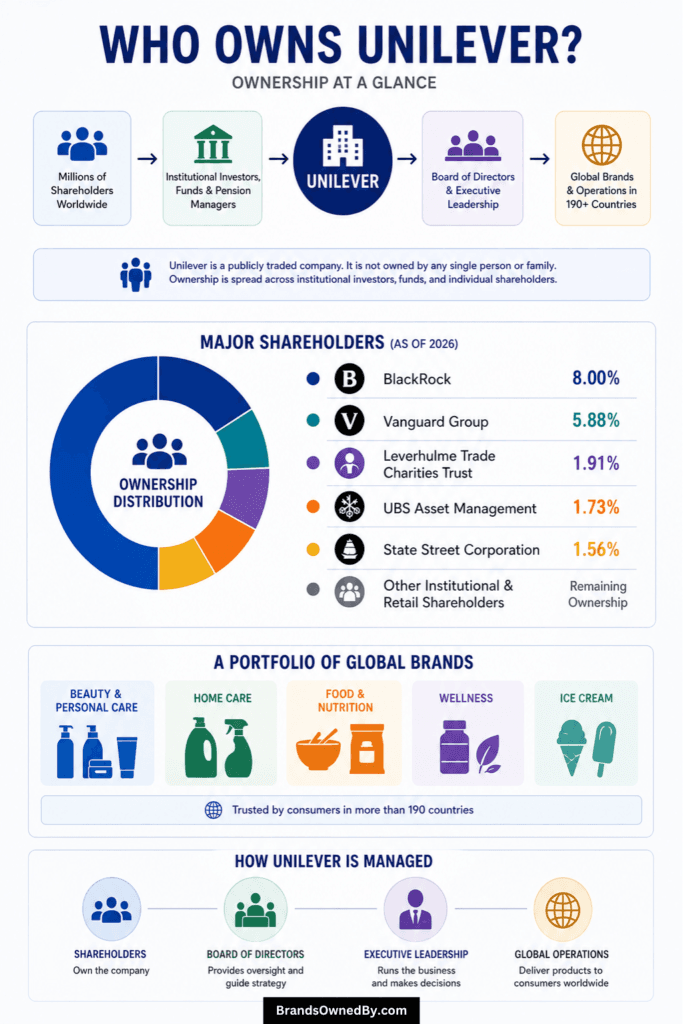
- Unilever is a publicly traded multinational consumer goods company headquartered in London. The company is owned by institutional investors, pension funds, ETFs, mutual funds, and retail shareholders rather than a single owner or founder family.
- BlackRock is the largest shareholder of Unilever as of May 2026, with approximately 8.00% ownership and around 174.61 million shares. Other major shareholders include Vanguard Group with 5.88%, Leverhulme Trade Charities Trust with 1.91%, UBS Asset Management with 1.73%, and State Street Corporation with approximately 1.56% ownership.
- Operational control of Unilever is managed by its board of directors and executive leadership team rather than shareholders directly. As of 2026, the company is led by CEO Fernando Fernandez, who oversees global operations, restructuring programs, acquisitions, and long-term business strategy.
- Unilever owns hundreds of global consumer brands across beauty, personal care, nutrition, wellness, and home care categories, including Dove, Vaseline, Knorr, Rexona, and Hellmann’s, making it one of the world’s largest consumer goods companies.
Unilever is one of the largest consumer goods manufacturers in the world. The company produces products across personal care, beauty, food, nutrition, hygiene, and home care categories.
Its products are sold in supermarkets, convenience stores, pharmacies, wholesale chains, and e-commerce platforms across more than 190 countries.
Unilever built its global presence through aggressive brand expansion, acquisitions, and deep distribution networks in both developed and emerging markets.
The company operates through several major business divisions:
- Beauty and Wellbeing.
- Personal Care.
- Home Care.
- Nutrition.
- Ice Cream.
One reason Unilever became dominant is its ability to localize products for different regions. For example, skincare and haircare products sold in South Asia are often formulated differently from products sold in Europe due to climate and consumer preferences.
Unilever also invests heavily in brand positioning. Brands like Dove focus on inclusive beauty messaging, while Lifebuoy emphasizes hygiene and health awareness campaigns.
Another strength is the company’s diversified portfolio. If demand weakens in one category, strong sales in another category can help stabilize the business.
The company competes directly with global consumer goods giants such as Procter & Gamble, Nestlé, and Reckitt.
Unilever Founders
Unilever was created through the merger of two businesses in 1929.
The company’s roots trace back to the founders of Lever Brothers and Margarine Unie.
William Lever
William Lever was one of the key figures behind the creation of what later became Unilever.
He co-founded Lever Brothers with his brother James Lever in the United Kingdom during the late 19th century.
Lever Brothers became famous for selling Sunlight Soap. The company transformed soap from a luxury item into a mass-market household product.
William Lever was also known for innovative marketing strategies. He invested heavily in branding, packaging, and advertising at a time when many manufacturers sold generic products without strong brand identities.
His approach helped build consumer trust and long-term brand loyalty.
James Lever
James Lever worked alongside William Lever in building the Lever Brothers business.
The brothers expanded production capacity and distribution networks rapidly across international markets.
Their soap business eventually became one of the most powerful consumer goods operations in Europe.
Margarine Unie Founders
The second half of Unilever’s foundation came from Margarine Unie, a Dutch margarine business formed through the merger of several margarine companies in the Netherlands.
These companies specialized in butter alternatives and edible fats.
The merger between Lever Brothers and Margarine Unie created a business with strong positions in both food and household consumer products.
That strategic combination became the foundation for the modern Unilever empire.
Ownership History
The ownership history of Unilever is closely tied to its international expansion, corporate restructuring, and evolution into a publicly traded multinational corporation.
Unlike founder-controlled businesses, Unilever gradually transitioned into a company owned primarily by institutional investors and public shareholders. Its ownership structure changed significantly over the decades as the company expanded across global markets.
The 1929 Merger That Created Unilever
Unilever was officially formed in 1929 through the merger of two major European businesses:
- Lever Brothers from the United Kingdom.
- Margarine Unie from the Netherlands.
Lever Brothers specialized in soap and household cleaning products. Margarine Unie focused on margarine and edible fats.
The merger was strategically important because both companies relied heavily on similar raw materials such as palm oil and vegetable oils. Combining operations allowed them to strengthen supply chains and reduce competitive pressure.
After the merger, ownership was split between British and Dutch corporate interests. Investors from both countries held stakes in the combined business.
This structure gave Unilever a dual-national identity that lasted for decades.
Early Public Shareholding Expansion
As Unilever expanded internationally, ownership became increasingly distributed among public investors.
The company listed shares on stock exchanges, allowing institutional investors and retail shareholders to purchase ownership stakes.
Over time, banks, pension funds, insurance companies, and investment firms accumulated significant positions in the business.
This shift reduced concentrated ownership and increased institutional influence over the company.
Dual Corporate Structure
For much of its history, Unilever operated through two separate parent companies:
- Unilever PLC in the United Kingdom.
- Unilever N.V. in the Netherlands.
Although both entities operated as one business group, they maintained separate legal identities and stock listings.
This structure was designed to preserve the interests of both British and Dutch shareholders after the original merger.
Under this arrangement:
- British investors often held shares in Unilever PLC.
- Dutch investors often held shares in Unilever N.V.
The companies shared management, profits, and strategic direction, but legally remained separate entities.
This structure became increasingly complex as global markets evolved.
Growth of Institutional Ownership
During the late 20th century and early 21st century, institutional ownership increased dramatically.
Large investment firms started dominating shareholder registers across multinational corporations, including Unilever.
Major asset management companies accumulated large stakes through:
- Index funds.
- Pension funds.
- Exchange-traded funds.
- Mutual funds.
- Retirement investment portfolios.
This trend changed the balance of ownership power.
Instead of founders or industrial families controlling the business, voting influence became concentrated among large financial institutions.
For example, firms like BlackRock and Vanguard Group became major shareholders because their investment funds tracked global stock indexes containing Unilever shares.
The Failed Kraft Heinz Takeover Attempt
A major moment in Unilever’s ownership history occurred in 2017 when Kraft Heinz attempted to acquire the company.
The proposed takeover attracted massive attention across global financial markets.
Unilever rejected the offer quickly.
The attempted acquisition pushed Unilever leadership to reevaluate operational efficiency, corporate structure, and shareholder value strategies.
After the failed bid, the company accelerated restructuring efforts and portfolio adjustments.
Corporate Simplification in 2020
One of the biggest ownership changes in Unilever’s history happened in 2020.
The company unified its dual structure into a single legal entity based in the United Kingdom.
This meant:
- Unilever N.V. was absorbed.
- The business became fully unified under Unilever PLC.
The restructuring simplified governance and reduced operational complexity.
It also made acquisitions and divestitures easier because the company no longer needed approval mechanisms across two separate legal entities.
For shareholders, the simplification created a more streamlined ownership structure.
Shift Toward Passive Investment Ownership
Another important change in ownership history has been the rise of passive investing.
Index-tracking investment funds now hold significant percentages of Unilever shares.
This means many shareholders technically own Unilever indirectly through retirement funds and ETFs rather than through direct stock ownership.
For example, a worker contributing to a pension fund may indirectly own Unilever shares without actively choosing the company.
This trend increased the influence of large asset managers that control voting rights tied to passive investment funds.
Activist Investor Influence
Like many multinational corporations, Unilever has faced pressure from activist investors.
These investors push for:
- Higher profitability.
- Business restructuring.
- Asset sales.
- Operational efficiency improvements.
- Shareholder return increases.
Activist pressure has influenced several strategic decisions inside the company.
For example, investor criticism has sometimes pushed Unilever to focus more heavily on high-margin brands and divest slower-growth business segments.
Modern Ownership Structure
As of 2026, Unilever ownership remains highly fragmented.
No individual shareholder controls the company outright.
Ownership is mainly divided among:
- Institutional investors.
- Pension funds.
- Sovereign wealth funds.
- Mutual funds.
- Retail shareholders.
This structure makes Unilever a professionally managed public corporation rather than a founder-led enterprise.
Operational control remains with executives and the board of directors, while ownership power is distributed across global financial institutions and public investors.
Who Owns Unilever: Top Shareholders
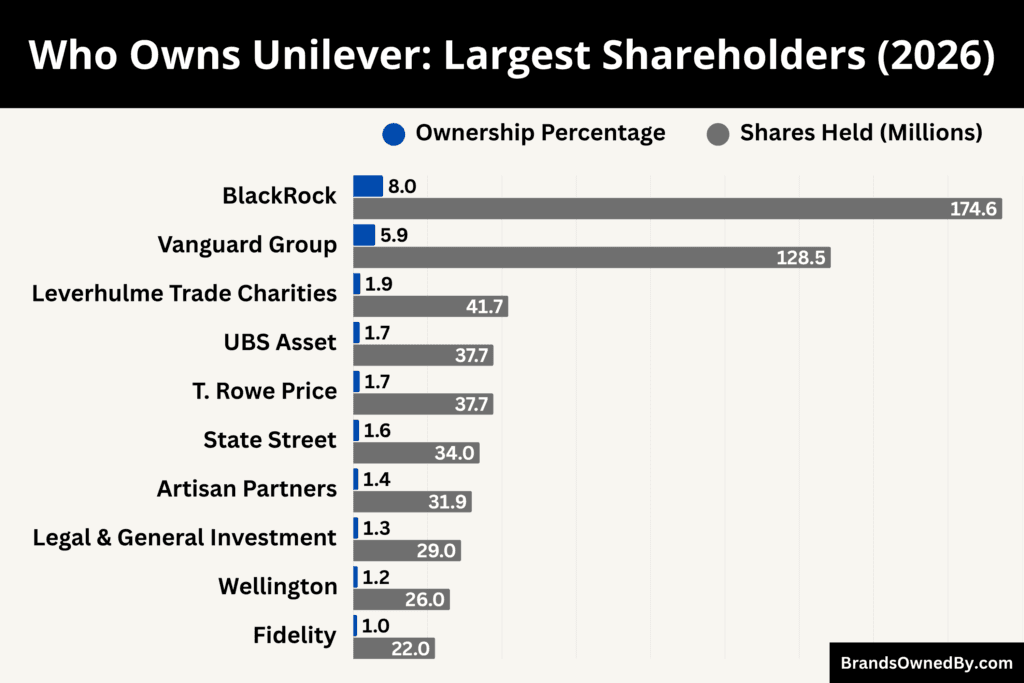
Unilever is a publicly traded multinational consumer goods company listed on the London Stock Exchange under the ticker ULVR. Because it is a public company, ownership is divided among institutional investors, investment funds, pension managers, sovereign wealth funds, charities, and retail shareholders across global financial markets.
It operates under a dispersed ownership structure where institutional investors collectively hold a significant percentage of total outstanding shares. This structure is common among major multinational corporations with large market capitalizations.
The majority of Unilever shares are controlled by institutional asset managers. These institutions invest through index funds, pension portfolios, ETFs, insurance-linked investment vehicles, and actively managed equity funds. Their ownership gives them voting influence over:
- Board appointments.
- Executive compensation.
- Corporate governance policies.
- Sustainability initiatives.
- Acquisitions and divestitures.
- Shareholder resolutions.
As of May 2026, institutional ownership remains dominant. The largest shareholders include global investment firms such as BlackRock and Vanguard Group. These firms do not directly operate the company, but they hold major voting power because of the massive number of shares under their control.
Unilever also has millions of indirect retail investors. For example, a person investing in a global consumer goods ETF or retirement pension fund may indirectly own Unilever shares without buying the stock directly.
Another important aspect of Unilever’s ownership structure is its relatively low insider ownership. Executives and board members own only a small percentage of total shares compared to founder-led businesses. This means operational control comes from executive leadership and the board rather than concentrated founder ownership.
BlackRock
BlackRock is the largest shareholder of Unilever as of May 2026.
The firm controls approximately 174.61 million shares, representing around 8.00% of the company.
BlackRock’s ownership is spread across multiple investment products. These include index funds, pension-linked portfolios, institutional investment accounts, and exchange-traded funds.
A major reason BlackRock owns such a large stake is that Unilever is included in many global benchmark indexes. When BlackRock manages passive index funds tied to those benchmarks, the funds automatically purchase Unilever shares.
This creates long-term ownership stability.
BlackRock’s influence extends beyond simple ownership percentages. Because it controls voting rights attached to millions of shares, the firm can influence major corporate decisions during annual shareholder meetings.
For example, BlackRock can vote on:
- Executive pay packages.
- Board member appointments.
- Climate disclosure policies.
- Sustainability reporting standards.
- Mergers and acquisitions.
- Governance reforms.
The company is also known for engaging directly with corporations regarding long-term operational risks.
For Unilever, this matters because environmental and supply chain issues are major operational risks in industries dependent on agricultural raw materials like palm oil, dairy products, tea, cocoa, and vegetable oils.
BlackRock’s investment strategy generally focuses on long-term stability rather than short-term speculation. This makes it one of the most influential institutional stakeholders inside Unilever’s ownership structure.
Vanguard Group
Vanguard Group is the second-largest shareholder in Unilever.
As of May 2026, Vanguard owns approximately 128.49 million shares, representing about 5.88% ownership in the company.
Vanguard’s ownership mainly comes through passive investment funds and retirement-focused investment products.
Millions of people indirectly own Unilever through Vanguard-managed retirement accounts and ETFs.
For example, an investor holding a global equity ETF managed by Vanguard may unknowingly hold exposure to Unilever shares.
Unlike activist hedge funds, Vanguard usually maintains long-term holdings. The company rarely makes aggressive takeover attempts or demands radical restructuring changes.
However, its influence remains powerful because of the size of its holdings.
Vanguard participates in shareholder voting processes involving:
- Corporate governance reforms.
- ESG reporting requirements.
- Executive leadership oversight.
- Shareholder rights proposals.
The firm’s long-term investment philosophy aligns well with large multinational companies like Unilever that generate stable global consumer demand.
Leverhulme Trade Charities Trust
Leverhulme Trade Charities Trust remains one of the most historically important shareholders connected to Unilever.
As of May 2026, the trust holds approximately 41.71 million shares, representing around 1.91% ownership in the company.
The trust traces its origins to William Lever, whose business empire eventually became part of Unilever.
Unlike institutional investors focused purely on investment returns, the trust has historical and philanthropic ties to the company.
The organization uses dividend income and investment returns to support:
- Educational grants.
- Trade scholarships.
- Charitable initiatives.
- Student financial assistance programs.
Its long-term ownership position gives it a unique role compared to purely financial shareholders.
The trust historically maintains stable ownership rather than actively trading shares.
UBS Asset Management
UBS, through UBS Asset Management, owns approximately 37.72 million Unilever shares as of May 2026.
This represents around 1.73% ownership in the company.
UBS manages investments for institutional clients, pension funds, wealthy individuals, and sovereign investors.
Its stake in Unilever is spread across actively managed and passive investment products.
UBS tends to invest heavily in multinational companies with:
- Strong international diversification.
- Stable consumer demand.
- Global brand recognition.
- Defensive market positioning.
Unilever fits this profile because demand for hygiene, food, and personal care products tends to remain relatively resilient during economic downturns.
UBS also participates in shareholder voting matters involving governance and risk management.
T. Rowe Price Group
T. Rowe Price owns approximately 37.69 million shares in Unilever as of May 2026.
Its ownership stake stands at roughly 1.73%.
Unlike purely passive investment firms, T. Rowe Price actively evaluates companies based on:
- Management quality.
- Brand strength.
- long-term earnings potential.
- operational execution.
- global expansion opportunities.
Its investment teams closely analyze multinational consumer companies before making large portfolio allocations.
T. Rowe Price has historically favored businesses with strong competitive moats and diversified global operations.
Unilever’s global distribution network and strong brand portfolio make it attractive for long-term institutional investment strategies.
State Street Global Advisors
State Street Corporation is another major shareholder in Unilever.
As of May 2026, State Street controls an estimated 34 million shares representing approximately 1.56% ownership.
The company is one of the world’s largest managers of index-linked investment products.
Much of its ownership comes from ETFs and institutional index-tracking portfolios.
Because State Street manages large passive funds, it has major voting influence despite not being involved in daily company operations.
The firm actively participates in governance discussions related to:
- Board accountability.
- diversity standards.
- climate disclosure.
- shareholder transparency.
Artisan Partners
Artisan Partners owns roughly 31.9 million Unilever shares as of 2026.
Its ownership stake is estimated at approximately 1.36%.
Artisan Partners is known for concentrated investment strategies rather than broad passive indexing.
The firm typically invests in companies it believes have strong long-term growth potential and durable competitive advantages.
Its investment in Unilever reflects confidence in the company’s ability to maintain brand strength across multiple consumer categories.
Legal & General Investment Management
Legal & General owns approximately 29 million shares in Unilever.
The firm controls roughly 1.34% of the company.
Legal & General Investment Management is one of Europe’s largest institutional investors.
The company manages large pension-related investment portfolios.
Because of its long-term pension obligations, the firm often favors stable multinational businesses with predictable cash generation and defensive business models.
Unilever’s diversified consumer product portfolio aligns with that investment philosophy.
Wellington Management
Wellington Management owns an estimated 26 million to 64 million shares depending on portfolio reporting structures and filing periods.
Its ownership stake is estimated above 1% and has historically ranked among the company’s larger institutional positions.
Wellington invests heavily in multinational corporations with strong international revenue exposure.
The firm often focuses on businesses capable of sustaining long-term growth through geographic diversification and brand expansion.
Unilever’s extensive international operations make it attractive under that strategy.
Fidelity International
Fidelity International is another notable institutional shareholder in Unilever.
The company controls approximately 22 million shares as of 2026.
Fidelity invests through actively managed global equity portfolios and retirement-focused investment products.
Its ownership reflects continued institutional confidence in Unilever’s ability to maintain global market leadership across multiple consumer sectors.
Retail Shareholders and Public Investors
Beyond institutional investors, millions of smaller investors collectively own a meaningful percentage of Unilever shares.
These investors hold shares through:
- Individual brokerage accounts.
- pension funds.
- retirement savings plans.
- exchange-traded funds.
- mutual funds.
This broad ownership distribution increases market liquidity and reduces the risk of a single entity controlling the company.
Competitor Ownership Comparison
The ownership structure of Unilever differs from some competitors but closely resembles other large publicly traded consumer goods corporations.
Most multinational consumer product companies today are controlled by institutional investors rather than founders or family owners. However, the level of ownership concentration, insider influence, and family control varies significantly between competitors.
Understanding these ownership differences helps explain how each company approaches long-term strategy, acquisitions, shareholder returns, and corporate governance.
| Company | Ownership Type | Largest Shareholder Groups | Ownership Concentration | Control Structure | Strategic Impact of Ownership |
|---|---|---|---|---|---|
| Unilever | Publicly traded | BlackRock, Vanguard Group, State Street Global Advisors, pension funds, institutional investors | Highly dispersed | Controlled by board of directors and executive leadership | Strong institutional investor influence pushes focus on efficiency, portfolio optimization, sustainability reporting, and shareholder returns. |
| Procter & Gamble | Publicly traded | BlackRock, Vanguard Group, State Street Global Advisors | Highly dispersed | Executive leadership and board-led governance | Institutional investors heavily influence operational discipline, dividend policies, and cost management strategies. |
| Nestlé | Publicly traded | Institutional investors, sovereign funds, long-term strategic shareholders | Moderately dispersed | Board-led corporate governance structure | Long-term shareholders support stable growth strategies focused on food, nutrition, and health science expansion. |
| Reckitt | Publicly traded | Global institutional investors and pension funds | Highly dispersed | Executive management with board oversight | Investor pressure often focuses on margin improvement and operational efficiency due to category concentration. |
| Colgate-Palmolive | Publicly traded | Institutional asset managers and index funds | Highly dispersed | Controlled through corporate board and executives | Ownership structure supports long-term brand dominance strategies in oral care and hygiene categories. |
| Mars Incorporated | Privately owned | Mars family | Highly concentrated | Family-controlled leadership structure | Private ownership allows long-term strategic planning without quarterly shareholder pressure. |
| Kenvue | Publicly traded | Institutional investors, mutual funds, asset management firms | Dispersed | Executive and board-controlled governance | Institutional ownership increases pressure for growth in consumer health and wellness categories. |
Unilever’s Ownership Structure
Unilever operates under a highly dispersed ownership model.
No individual shareholder controls the company. Instead, ownership is divided among institutional investors, pension funds, asset managers, ETFs, and retail shareholders.
Its largest shareholders include firms such as:
- BlackRock.
- Vanguard Group.
- State Street Corporation.
This ownership structure gives significant influence to institutional capital rather than company founders.
One advantage of this model is liquidity and broad access to capital markets. However, it can also create pressure for consistent quarterly performance and shareholder returns.
Procter & Gamble Ownership Structure
Procter & Gamble has an ownership structure very similar to Unilever.
The company is publicly traded and heavily owned by institutional investors.
Major shareholders typically include:
- BlackRock.
- Vanguard Group.
- State Street Global Advisors.
Like Unilever, no founder family controls Procter & Gamble today.
However, Procter & Gamble historically maintained stronger operational discipline and tighter brand portfolio management. Institutional investors often favor the company because of its strong margins and dominant positions in categories like diapers, detergents, grooming products, and oral care.
A practical example of institutional influence can be seen in activist investor involvement. Procter & Gamble faced pressure from activist investors in past years regarding operational efficiency and cost management.
Compared to Unilever, Procter & Gamble generally has:
- Higher institutional ownership concentration.
- stronger North American market exposure.
- more aggressive shareholder return programs.
Nestlé Ownership Structure
Nestlé operates under a more complex ownership structure.
The company is publicly traded, but historically had influence from long-term strategic shareholders and Swiss institutional investors.
One of the most notable historical shareholders was the Bettencourt family connection through holdings linked to L’Oréal ownership relationships.
Nestlé also has strong institutional ownership from global investment firms.
Unlike Unilever, Nestlé is more heavily concentrated in food, beverages, nutrition, and health science businesses.
This affects shareholder expectations because food-sector investors often prioritize stability and defensive market positioning.
Nestlé has also experienced activist investor pressure in recent years, particularly regarding portfolio optimization and margin improvement.
Reckitt Ownership Structure
Reckitt is another publicly traded consumer goods company with strong institutional ownership.
Its shareholder base includes large global investment firms and pension-linked institutional investors.
Reckitt differs from Unilever in one major area.
The company is more concentrated in:
- Health products.
- hygiene products.
- household cleaning products.
This narrower focus affects investor expectations and risk exposure.
Institutional investors often evaluate Reckitt differently because of its heavier dependence on fewer product categories.
Compared to Unilever, Reckitt has:
- less diversification across product segments.
- greater exposure to health and hygiene markets.
- higher operational concentration risk.
Colgate-Palmolive Ownership Structure
Colgate-Palmolive is also institutionally owned.
The company’s major shareholders include large asset management firms similar to those holding Unilever shares.
Colgate-Palmolive is more concentrated in oral care and personal hygiene products.
Because of this specialization, investors often view the company as a category-dominant business rather than a broad diversified consumer conglomerate.
Its ownership structure is similar to Unilever in terms of institutional dominance, but its operational model is narrower.
Mars Incorporated Ownership Structure
Mars Incorporated is fundamentally different from Unilever.
Unlike Unilever, Mars is privately owned by the Mars family.
This creates several major differences.
Because Mars is privately held:
- it does not face quarterly public market pressure.
- it does not answer to institutional shareholders.
- strategic decisions can focus on very long-term goals.
- ownership control remains concentrated within one family.
This gives Mars more flexibility in acquisitions and long-term investment planning.
For example, private ownership allows Mars to pursue long-term expansion strategies without worrying about short-term stock market reactions.
Compared to Unilever, Mars has:
- stronger ownership concentration.
- less public transparency.
- greater long-term strategic flexibility.
Johnson & Johnson Consumer Business Comparison
Kenvue, which was spun off from Johnson & Johnson, also provides an interesting comparison.
Kenvue owns many consumer health and personal care brands.
Its ownership structure became more institutionally driven after becoming a publicly traded company.
Like Unilever, ownership is now spread across institutional shareholders rather than concentrated founders.
However, Kenvue remains more focused on consumer health categories compared to Unilever’s broader diversification.
How Ownership Structures Affect Strategy
Ownership structures directly affect how companies operate.
For example, publicly traded companies like Unilever often face pressure from institutional investors to:
- improve margins.
- increase dividends.
- optimize brand portfolios.
- reduce operational costs.
- improve shareholder returns.
Private companies like Mars can operate differently because they are insulated from daily stock market pressure.
This difference can influence:
- acquisition speed.
- long-term investment decisions.
- restructuring strategies.
- research and development priorities.
For Unilever, institutional ownership creates strong pressure for operational efficiency while still requiring long-term brand investment to remain competitive in global consumer markets.
Who Controls Unilever?
Although millions of shares of Unilever are owned by institutional investors and public shareholders, operational control of the company is concentrated within its executive leadership team and board of directors.
This is an important distinction.
Ownership and control are not the same thing.
Large shareholders such as BlackRock and Vanguard own significant stakes in Unilever, but they do not manage the company’s daily operations. Instead, they influence the business indirectly through shareholder voting rights and governance pressure.
Actual operational control comes from:
- The chief executive officer.
- The board of directors.
- Senior executive leadership.
- Division presidents.
- Corporate governance committees.
This structure is common among large publicly traded multinational corporations.
Role of the Board of Directors
The board of directors is one of the most powerful controlling bodies inside Unilever.
The board oversees the company’s long-term strategic direction and monitors executive leadership performance.
Its responsibilities include:
- Approving acquisitions and divestitures.
- Selecting and evaluating the CEO.
- Approving executive compensation.
- Monitoring governance policies.
- Reviewing major investment decisions.
- Overseeing risk management.
- Approving long-term business strategy.
For example, if Unilever plans to acquire a skincare brand or sell a non-performing food division, the board typically reviews and approves the transaction.
The board also acts as a safeguard for shareholders by monitoring management decisions.
Because Unilever operates across global markets, board oversight is critical for handling geopolitical risks, supply chain disruptions, regulatory challenges, and sustainability obligations.
Role of the Chief Executive Officer
The CEO is the most influential executive inside Unilever’s operational structure.
As of 2026, the CEO of Unilever is Fernando Fernandez.
The CEO is responsible for executing corporate strategy and managing global operations.
This includes oversight of:
- Product strategy.
- Brand management.
- Global supply chains.
- Manufacturing operations.
- Regional business divisions.
- Financial performance.
- Innovation and research.
- Talent management.
- Mergers and acquisitions.
The CEO also represents the company during investor meetings, earnings presentations, and major strategic announcements.
In practice, the CEO has enormous influence over how capital is allocated across the business.
For example, decisions involving:
- expanding premium beauty brands.
- reducing underperforming food segments.
- increasing digital commerce investment.
- entering new geographic markets.
are often driven directly by executive leadership under the CEO’s direction.
Fernando Fernandez’s Leadership Role
Fernando Fernandez rose through senior leadership positions inside Unilever before becoming CEO.
His experience across multiple international divisions gave him operational exposure to both developed and emerging consumer markets.
This matters because Unilever generates significant business from regions such as:
- Asia.
- Latin America.
- Africa.
- Europe.
- North America.
A CEO with international operational experience is critical for managing such a geographically diversified business.
Fernandez’s leadership focuses heavily on:
- portfolio optimization.
- operational efficiency.
- brand growth.
- emerging market expansion.
- supply chain resilience.
He also plays a major role in balancing shareholder expectations with long-term brand investment strategies.
Executive Leadership Team
Control inside Unilever is not limited to the CEO alone.
The executive leadership team manages major business divisions and strategic functions.
This includes executives responsible for:
- Beauty and Wellbeing.
- Personal Care.
- Home Care.
- Nutrition.
- Ice Cream.
- Finance.
- Marketing.
- Supply chain operations.
- Human resources.
- Digital transformation.
These executives influence product launches, regional expansion plans, operational restructuring, and pricing strategies.
For example, pricing decisions during inflationary periods often require coordination between finance executives, supply chain leadership, and regional management teams.
Influence of Institutional Shareholders
Although institutional investors do not directly manage Unilever, they still influence control through voting power.
Large shareholders can pressure management regarding:
- profitability targets.
- sustainability initiatives.
- executive compensation.
- restructuring programs.
- capital allocation decisions.
For example, if institutional investors believe Unilever is underperforming relative to competitors, they may pressure the board to implement operational changes or leadership adjustments.
This creates indirect control pressure from shareholders.
Large institutional investors can also influence board appointments through shareholder voting mechanisms.
Activist Investor Pressure
Unilever has experienced pressure from activist investors and large institutional shareholders over operational performance and strategic direction.
Activist investors often demand:
- higher profit margins.
- cost-cutting initiatives.
- asset sales.
- restructuring programs.
- faster growth strategies.
This pressure can influence management decisions significantly.
For example, after the takeover interest from Kraft Heinz in 2017, Unilever accelerated restructuring and operational improvement efforts.
Investor pressure pushed leadership to reevaluate business efficiency and portfolio management strategies.
Corporate Governance Structure
Unilever operates under a formal corporate governance framework designed to balance shareholder interests with executive authority.
The governance structure includes:
- Board committees.
- Audit committees.
- Compensation committees.
- Risk oversight committees.
- Governance and sustainability committees.
These groups help monitor executive decisions and ensure accountability.
For example, compensation committees review executive pay structures to align leadership incentives with shareholder performance goals.
Regional Control Structure
Because Unilever operates globally, the company also relies on regional management structures.
Regional leaders oversee operations in specific geographic markets.
This allows the company to adapt products and strategies to local consumer behavior.
For example:
- skincare products in South Asia may use different formulations than European products.
- food brands may adapt flavors for local consumer preferences.
- pricing strategies may differ between developed and emerging economies.
Regional executives, therefore, hold substantial operational influence within their territories.
How Control Works in Practice
In practice, control inside Unilever works through layered decision-making.
For example, if Unilever wants to acquire a premium skincare company:
- Business division leaders evaluate strategic value.
- Financial teams analyze acquisition risks and costs.
- Executive leadership reviews operational fit.
- The CEO supports or rejects the proposal.
- The board reviews and approves the final decision.
- Shareholders may react through voting or market pressure.
This process shows how control is distributed across management, governance structures, and shareholder influence rather than concentrated in one individual owner.
Unilever Annual Revenue and Net Worth
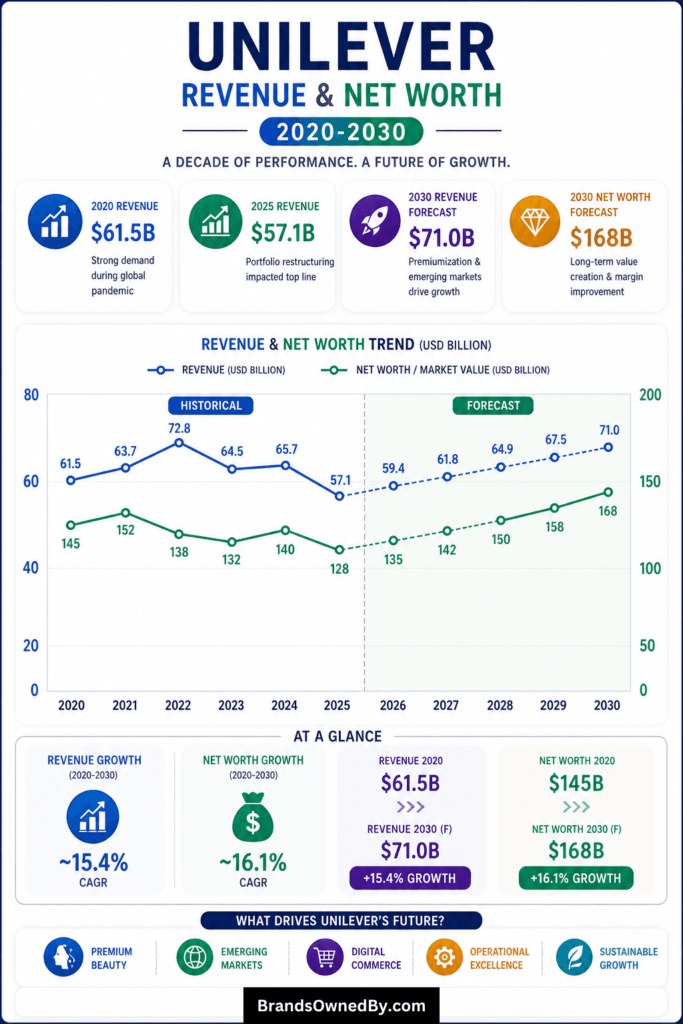
As of May 2026, Unilever generates an estimated annual revenue of approximately $59.4 billion while maintaining an estimated market value and net worth of roughly $135 billion. The company’s financial strength is supported by its global distribution network, premium beauty expansion strategy, pricing power, and strong presence across emerging markets.
Its financial structure has changed significantly in recent years due to portfolio restructuring initiatives, including the separation of its ice cream operations and strategic focus on higher-margin categories such as beauty, wellness, and personal care.
Revenue Breakdown by Business Segments
Unilever generates revenue through five major operating divisions. Each segment contributes differently to overall sales, profitability, and long-term growth strategy.
As of 2026, the company’s business model has become increasingly focused on higher-margin categories such as premium beauty, wellness, personal care, and specialized consumer products. This shift has changed the internal revenue mix significantly compared to previous decades when food products contributed a larger percentage of total revenue.
Beauty and Wellbeing Revenue
The Beauty and Wellbeing division has become one of Unilever’s fastest-growing and highest-margin businesses.
As of 2026, this segment is estimated to generate approximately $14.8 billion in annual revenue, representing nearly 25% of total company revenue.
This division includes:
- Premium skincare products.
- Haircare brands.
- Wellness products.
- Prestige beauty brands.
- Functional nutrition and hydration products.
One major reason this segment became strategically important is margin strength.
Premium beauty products often generate significantly higher operating margins compared to traditional packaged food categories. Consumers in premium skincare and wellness markets are willing to pay higher prices for specialized products with perceived health, dermatology, or cosmetic benefits.
For example, luxury skincare and science-backed beauty products may generate substantially stronger profit margins than low-cost packaged food items.
The company has aggressively expanded this division through acquisitions and product innovation strategies.
Demand growth has been particularly strong across:
- Asia-Pacific beauty markets.
- Premium skincare categories.
- wellness-oriented consumer products.
- anti-aging skincare products.
- hydration and supplement-focused brands.
The segment also benefits from strong digital commerce performance because beauty consumers increasingly purchase products through e-commerce platforms and direct-to-consumer channels.
Personal Care Revenue
The Personal Care division remains one of Unilever’s largest core revenue generators.
As of 2026, the segment contributes an estimated $13.9 billion in annual revenue, accounting for approximately 23% of total company sales.
This division includes major brands such as:
- Dove.
- Rexona.
- Axe.
- Lifebuoy.
The segment benefits from recurring consumer demand because hygiene and personal care products are purchased frequently regardless of economic conditions.
This creates highly stable recurring revenue streams.
For example, deodorants, soaps, shampoos, and body washes generate continuous repeat purchases across global markets.
Emerging markets contribute heavily to this segment’s revenue growth.
In countries across South Asia, Africa, and Latin America, rising middle-class populations continue increasing spending on branded personal care products.
The company also increased premium product penetration within this segment to improve profitability.
Higher-end deodorants, skincare-focused body products, and specialized hygiene products now contribute larger revenue shares than traditional low-cost mass-market products.
Home Care Revenue
The Home Care division contributes approximately $12.4 billion in estimated annual revenue as of 2026.
This represents nearly 21% of total company revenue.
The segment includes products such as:
- Laundry detergents.
- dishwashing liquids.
- fabric conditioners.
- surface cleaners.
- household sanitation products.
Major brands include Surf Excel and several regional household cleaning brands across emerging economies.
One major advantage of the Home Care business is demand stability.
Consumers continue purchasing household cleaning products even during periods of economic weakness.
This defensive demand profile helps stabilize overall corporate revenue during difficult economic cycles.
The segment also benefited heavily during and after the global pandemic because hygiene awareness increased sharply across international markets.
However, the business faces pressure from volatile raw material costs because detergent and cleaning products depend heavily on chemical inputs and packaging materials.
To protect margins, Unilever implemented aggressive pricing increases during inflation-heavy years.
Nutrition Revenue
The Nutrition division contributes an estimated $11.2 billion in annual revenue as of 2026.
This accounts for approximately 19% of company-wide revenue.
The segment includes brands such as:
- Knorr.
- Hellmann’s.
Products include:
- Soups.
- sauces.
- seasonings.
- condiments.
- ready-to-cook meal products.
Although this division remains large, management has increasingly focused on profitability improvements rather than simple volume expansion.
Traditional food categories often generate lower margins compared to premium beauty and personal care businesses.
This is one reason Unilever began shifting strategic focus toward higher-margin segments.
The Nutrition division still remains strategically important because it generates strong global sales volume and maintains broad consumer reach across supermarkets and retail channels.
Emerging markets continue driving growth in affordable packaged food products.
Ice Cream Revenue
Before restructuring activities involving the ice cream business, this division contributed approximately $7 billion to $8 billion annually.
The segment included brands such as:
- Ben & Jerry’s.
- Magnum.
Although ice cream products generated strong consumer demand globally, the business had seasonal revenue fluctuations and operational complexities tied to cold-chain logistics.
Recent restructuring and separation initiatives involving the ice cream business significantly affected reported revenue composition entering 2025 and 2026.
Net Worth and Market Value in 2026
As of May 2026, Unilever’s estimated market capitalization and corporate net worth stand at $135 billion.
This valuation reflects investor expectations regarding future earnings growth, profitability expansion, operational efficiency improvements, and long-term brand strength.
Unlike private companies where net worth may rely heavily on physical assets, publicly traded corporations like Unilever are valued largely through market capitalization.
This means investor confidence plays a major role in determining valuation levels.
Several structural advantages support Unilever’s large market valuation.
Global Brand Power
Unilever owns some of the most recognized consumer brands in the world.
Brands such as Dove and Hellmann’s maintain strong consumer loyalty across multiple international markets.
Strong brand recognition creates pricing power and recurring demand.
This improves investor confidence because predictable consumer purchasing behavior supports long-term revenue stability.
Geographic Revenue Diversification
Unilever generates revenue across more than 190 countries.
No single market dominates total revenue generation completely.
This geographic diversification reduces economic concentration risk.
For example:
- Weak European consumer demand can sometimes be offset by stronger Asian market growth.
- Currency weakness in one region may be balanced through stronger performance elsewhere.
- Emerging market expansion can support growth when developed economies slow down.
Emerging Market Exposure
Nearly 58% to 60% of Unilever revenue historically comes from emerging markets.
This is strategically important because developing economies often experience faster long-term consumer spending growth than mature Western markets.
Population growth and rising incomes in emerging economies continue supporting long-term demand expansion for branded consumer products.
Operational Efficiency Improvements
Investors closely monitor profitability improvements.
Unilever launched several operational efficiency programs designed to reduce manufacturing, procurement, logistics, and supply chain costs.
If these programs successfully improve margins, earnings growth could accelerate significantly.
Higher profit margins often support stronger stock market valuations.
Premiumization Strategy
One major reason investors remain optimistic about Unilever’s long-term value is the company’s premiumization strategy.
Premium beauty and wellness products generate stronger margins than low-cost mass-market food products.
As premium products contribute a larger percentage of total revenue, profitability could improve substantially.
This potential margin expansion supports long-term valuation growth expectations.
Digital Commerce Expansion
Digital sales channels continue becoming more important for long-term valuation growth.
E-commerce improves:
- Consumer targeting capabilities.
- customer data collection.
- digital marketing precision.
- direct-to-consumer relationships.
These advantages can improve long-term profitability and strengthen customer retention.
Valuation Risks Facing Unilever
Despite its strong market position, Unilever also faces risks that can affect future valuation.
These risks include:
- Commodity price volatility.
- currency exchange fluctuations.
- competition from private-label brands.
- inflation pressure.
- supply chain disruptions.
- changing consumer preferences.
- regulatory pressure regarding sustainability and packaging.
Competition from rivals such as Procter & Gamble and Nestlé also creates constant pressure on pricing, innovation, and market share retention.
Revenue and Net Worth Forecast From 2027 to 2030
Analysts expect Unilever’s future financial growth to be driven by premiumization strategies, digital commerce expansion, wellness product demand, and emerging market growth.
Projected revenue and estimated net worth forecasts include:
- 2027 forecast revenue: $61.8 billion with estimated net worth of $142 billion.
- 2028 forecast revenue: $64.9 billion with estimated net worth of $150 billion.
- 2029 forecast revenue: $67.5 billion with estimated net worth of $158 billion.
- 2030 forecast revenue: $71 billion with estimated net worth of $168 billion.
These projections assume continued expansion in:
- Premium beauty products.
- Wellness and supplement categories.
- E-commerce distribution.
- Emerging consumer markets.
- Operational efficiency programs.
The forecasts also assume that Unilever successfully improves margins after major restructuring activities completed during the mid-2020s.
Unilever’s long-term financial outlook remains closely tied to its ability to adapt to changing consumer behavior.
The company is increasingly focusing on premium products with stronger margins rather than relying heavily on lower-margin mass-market food categories.
Growth opportunities remain strongest in:
- Beauty and wellbeing.
- Functional nutrition.
- wellness products.
- premium skincare.
- digital commerce channels.
If the company successfully executes its portfolio transformation strategy, revenue growth and market value expansion could accelerate further through the end of the decade.
Brands Owned by Unilever
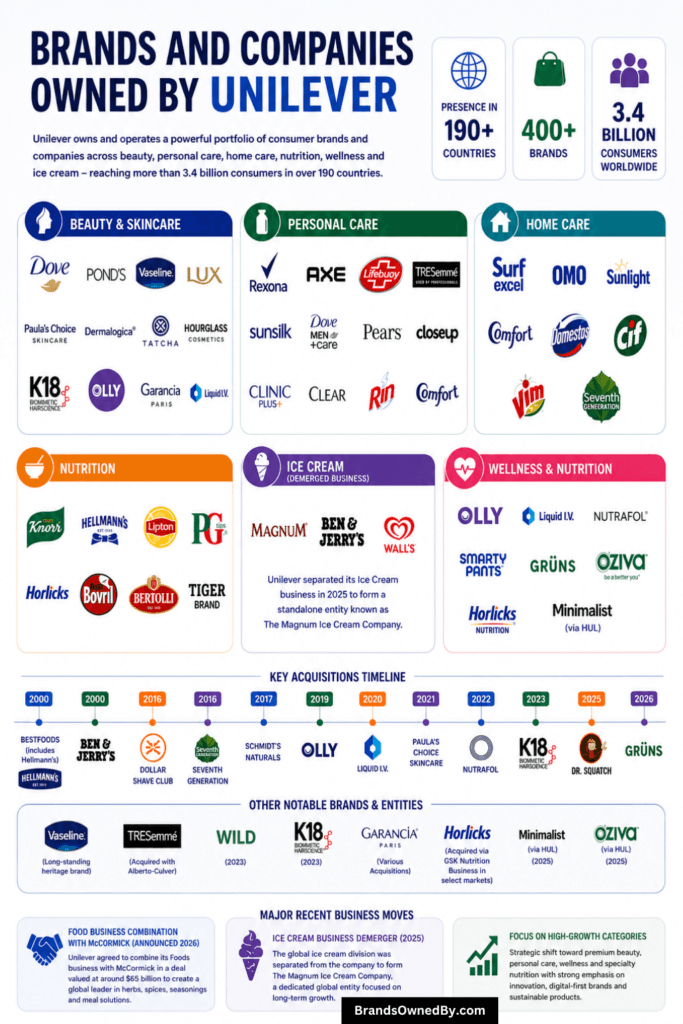
As of 2026, Unilever owns and operates hundreds of consumer brands across beauty, personal care, home care, nutrition, wellness, and ice cream categories.
Unilever’s strategy increasingly focuses on high-growth and high-margin categories such as premium beauty, wellness, personal care, and functional consumer products.
Below are the major companies, brands, and business entities owned and operated by Unilever as of May 2026:
| Brand / Company / Entity | Category | Ownership Status | Acquisition / Launch Details | Key Business Details |
|---|---|---|---|---|
| Dove | Personal Care | Fully owned | Acquired through Lever Brothers portfolio expansion | One of Unilever’s largest global brands across soap, body wash, deodorants, skincare, and haircare products. |
| Rexona | Personal Care | Fully owned | Long-term internal brand portfolio | Sold globally under Rexona, Degree, and Sure branding with strong deodorant market share. |
| Axe | Grooming | Fully owned | Developed internally by Unilever | Major male grooming brand focused on deodorants, body sprays, and hair products. |
| Lifebuoy | Hygiene | Fully owned | Legacy Unilever hygiene brand | Strong antibacterial soap and hygiene product presence across emerging markets. |
| Lux | Beauty Soap | Fully owned | Legacy beauty brand | Major beauty soap brand in Asia, Africa, and Middle Eastern markets. |
| Sunsilk | Haircare | Fully owned | Internal Unilever brand | Large international shampoo and conditioner business focused on emerging markets. |
| Vaseline | Skincare | Fully owned | Acquired historically through Chesebrough-Pond’s merger assets | Major petroleum jelly and skincare brand with global distribution. |
| TRESemmé | Premium Haircare | Fully owned | Acquired through Alberto-Culver acquisition | Salon-positioned haircare brand with strong retail distribution globally. |
| Pond’s | Skincare | Fully owned | Historical acquisition through Chesebrough-Pond’s | Strong facial skincare and anti-aging presence in Asia. |
| Knorr | Nutrition | Majority ownership pending McCormick merger structure | Acquired through Bestfoods acquisition | Major soups, seasonings, and meal solutions brand globally. |
| Hellmann’s | Condiments | Majority ownership pending McCormick merger structure | Acquired through Bestfoods acquisition in 2000 | One of the world’s largest mayonnaise and sauce brands. |
| Ben & Jerry’s | Ice Cream | Previously owned directly before ice cream restructuring | Acquired in 2000 | Premium ice cream brand known for activism-focused branding. |
| Magnum | Ice Cream | Previously part of ice cream division before demerger | Internal Unilever ice cream brand | Premium chocolate-coated ice cream brand with global reach. |
| Wall’s | Ice Cream | Previously part of ice cream division | Historical Unilever brand | Major international ice cream distribution business. |
| Horlicks | Nutrition | Fully owned in key markets | Acquired from GlaxoSmithKline consumer business | Strong malt-based nutrition drink brand in South Asia. |
| Liquid I.V. | Wellness | Fully owned | Acquired in 2020 | Fast-growing hydration and electrolyte wellness brand. |
| Paula’s Choice | Prestige Skincare | Fully owned | Acquired in 2021 | Science-backed skincare brand focused on active ingredients and dermatology-focused products. |
| Dermalogica | Professional Skincare | Fully owned | Acquired through prestige beauty expansion | Distributed through salons, spas, and skincare professionals globally. |
| Hourglass Cosmetics | Luxury Beauty | Fully owned | Acquired in 2017 | Premium cruelty-free cosmetics company. |
| Olly | Wellness Supplements | Fully owned | Acquired in 2019 | Popular vitamins and wellness gummies business in North America. |
| Nutrafol | Wellness | Majority owned | Acquired in 2022 | Fast-growing hair wellness supplement company focused on nutraceuticals. |
| SmartyPants Vitamins | Vitamins & Supplements | Fully owned | Acquired in 2020 | Premium gummy vitamin and supplement business. |
| Seventh Generation | Sustainable Home Care | Fully owned | Acquired in 2016 | Environmentally focused cleaning and household products company. |
| Dollar Shave Club | Grooming Subscription | Majority ownership | Acquired in 2016 | Direct-to-consumer razor and grooming subscription platform. |
| Garancia | Premium Skincare | Fully owned | Acquired to expand prestige beauty portfolio | French premium skincare company focused on science-led formulations. |
| K18 Hair | Biotechnology Haircare | Fully owned | Acquired in 2023 | Molecular hair repair brand with strong salon and prestige beauty growth. |
| Wild | Sustainable Personal Care | Fully owned | Acquired in 2023 | Sustainable refillable deodorant and body care company. |
| Schmidt’s Naturals | Natural Personal Care | Fully owned | Acquired in 2017 | Natural deodorant and plant-based personal care products. |
| Dr. Squatch | Men’s Grooming | Acquired in 2025 | Acquired from Summit Partners | Fast-growing men’s natural soap and grooming brand focused on digital-first sales. |
| Grüns | Wellness Supplements | Acquisition announced in 2026 | Acquired in 2026 | Greens supplement gummy company focused on nutrition and preventive wellness products. |
| Minimalist | Skincare | Controlled through Hindustan Unilever | Acquired in 2025 | Premium actives-led skincare company targeting younger skincare consumers. |
| OZiva | Wellness Nutrition | Fully owned through HUL in 2026 | Full ownership completed in 2026 | Plant-based nutrition and wellness supplement brand focused on fitness and health products. |
| The Magnum Ice Cream Company | Ice Cream Business Entity | Demerged business | Ice cream division demerged in 2025 | Created after separation of Unilever’s global ice cream operations. |
| McCormick | Food Joint Venture / Merger Entity | Pending combined structure | Food business merger announced in 2026 | Unilever agreed to combine food business with McCormick in deal valued around $65 billion. |
Dove
Dove is one of Unilever’s most valuable and globally recognized brands.
The brand operates across multiple categories including:
- Soap bars.
- body wash.
- shampoos.
- conditioners.
- deodorants.
- skincare products.
- men’s grooming products.
Dove became highly successful through its “Real Beauty” marketing campaigns that focused on body positivity and inclusive beauty standards.
The brand generates billions in annual sales and remains one of Unilever’s strongest personal care assets globally.
Rexona
Rexona is one of the world’s largest deodorant brands.
The brand is sold under different regional names including Degree and Sure.
Rexona focuses heavily on sweat protection technology and performance-based marketing.
The brand has strong market penetration across Latin America, Europe, Asia, and emerging economies.
Axe
Axe operates in the male grooming sector.
Its portfolio includes:
- Body sprays.
- deodorants.
- hair styling products.
- shower gels.
- shampoos.
The brand became globally popular through aggressive youth-focused marketing campaigns.
In some markets, Axe operates under the Lynx brand name.
Lifebuoy
Lifebuoy is one of Unilever’s strongest hygiene-focused brands.
The brand is especially dominant in emerging markets across Asia and Africa.
Its products include:
- Antibacterial soaps.
- hand washes.
- sanitizers.
- hygiene products.
Demand for hygiene products increased significantly after the global pandemic, strengthening the brand’s international growth.
Lux
Lux is one of Unilever’s oldest beauty soap brands.
The brand has historically positioned itself around glamour and celebrity endorsements.
Lux remains particularly strong across South Asia, the Middle East, and African markets.
Sunsilk
Sunsilk is a major global haircare brand.
The company markets Sunsilk heavily toward younger consumers.
Its product range includes:
- Shampoos.
- conditioners.
- hair repair products.
- styling products.
The brand performs strongly in emerging markets where haircare demand continues growing rapidly.
Vaseline
Vaseline is one of the world’s most recognized skincare brands.
The brand’s petroleum jelly products remain highly popular across skincare and healthcare markets.
The product line expanded into:
- Body lotions.
- lip care products.
- healing skincare products.
- moisturizers.
The brand benefits from strong consumer trust developed over decades.
TRESemmé
TRESemmé operates in the premium haircare segment.
The brand positions itself around salon-quality haircare products.
Its portfolio includes:
- Professional shampoos.
- conditioners.
- heat protection products.
- styling sprays.
The brand has strong retail distribution across supermarkets, salons, and e-commerce platforms.
Pond’s
Pond’s is a long-established skincare brand.
The brand focuses heavily on facial creams, moisturizers, cleansers, and anti-aging skincare products.
Pond’s remains especially strong across Asian skincare markets.
Hellmann’s
Hellmann’s is one of the leading mayonnaise and condiment brands globally.
The brand expanded beyond mayonnaise into:
- Sauces.
- salad dressings.
- flavored condiments.
Hellmann’s remains a major revenue contributor within Unilever’s nutrition business.
Knorr
Knorr is one of the company’s largest food brands.
Its products include:
- Soups.
- seasoning cubes.
- ready-to-cook products.
- sauces.
- meal solutions.
Knorr maintains strong international market penetration, especially in developing economies.
Ben & Jerry’s
Ben & Jerry’s operates in the premium ice cream category.
The brand is known for creative flavors and social activism campaigns.
Unilever acquired the company in 2000.
Despite restructuring changes involving the ice cream business, Ben & Jerry’s remains one of the company’s most recognized frozen dessert brands.
Magnum
Magnum is positioned as a premium ice cream brand.
The brand focuses on indulgence-focused desserts and premium chocolate-coated ice cream products.
Magnum has strong global distribution across supermarkets and convenience stores.
Wall’s
Wall’s operates as one of Unilever’s major international ice cream businesses.
The brand operates under different regional names in various countries.
It remains a major player in mass-market frozen dessert distribution.
Horlicks
Horlicks became part of Unilever through the acquisition of GlaxoSmithKline’s nutrition business in India and surrounding markets.
The brand focuses on nutritional drinks and health-focused products.
Horlicks maintains strong consumer demand in India and South Asian markets.
Liquid I.V.
Liquid I.V. operates in the fast-growing hydration and wellness category.
The brand specializes in electrolyte hydration products and wellness-focused drink mixes.
This acquisition strengthened Unilever’s expansion into health and wellness markets.
Paula’s Choice
Paula’s Choice is a premium skincare company acquired by Unilever.
The brand focuses on science-backed skincare products.
Its portfolio includes:
- Exfoliants.
- serums.
- anti-aging skincare.
- acne treatment products.
The acquisition strengthened Unilever’s premium skincare portfolio significantly.
Dermalogica
Dermalogica operates in the professional skincare industry.
The brand sells products through salons, dermatology clinics, spas, and retail channels.
It focuses heavily on professional-grade skincare formulations.
Hourglass Cosmetics
Hourglass Cosmetics operates in the luxury beauty sector.
The brand specializes in premium cosmetics products and cruelty-free beauty formulations.
Its acquisition helped expand Unilever’s prestige beauty presence.
Olly
Olly operates in the wellness supplement industry.
The brand focuses on:
- Vitamins.
- sleep supplements.
- beauty supplements.
- nutrition gummies.
This acquisition strengthened Unilever’s position in health-focused consumer products.
Seventh Generation
Seventh Generation focuses on environmentally friendly household products.
Its products include:
- Plant-based cleaners.
- sustainable detergents.
- eco-friendly household cleaning products.
The acquisition supported Unilever’s sustainability-focused business strategy.
Dollar Shave Club
Dollar Shave Club operates as a direct-to-consumer grooming business.
The company disrupted the shaving industry through subscription-based razor delivery services.
The acquisition strengthened Unilever’s digital commerce capabilities and direct-to-consumer experience.
K18 Hair
K18 Hair focuses on biotechnology-based hair repair products.
The brand became highly popular for molecular hair repair treatments.
The acquisition strengthened Unilever’s premium haircare and prestige beauty portfolio.
Wild
Wild focuses on refillable and sustainable deodorant products.
The acquisition aligned with growing consumer demand for sustainable packaging and environmentally conscious personal care products.
Schmidt’s Naturals
Schmidt’s Naturals operates in the natural deodorant and personal care market.
The brand focuses on aluminum-free and plant-based personal care products.
This acquisition expanded Unilever’s presence in the clean beauty and natural wellness sectors.
Final Thoughts
Understanding who owns Unilever shows how modern multinational corporations operate. The company is not controlled by a single owner or family. Instead, ownership is spread across large institutional investors, pension funds, and public shareholders.
Operational control remains with Unilever’s executive leadership and board of directors. The company continues to dominate global consumer goods markets through its massive brand portfolio, worldwide distribution network, and strong presence in emerging economies.
Its diversified structure gives the company resilience across economic cycles and changing consumer trends.
FAQs
Who is Unilever owned by?
Unilever is owned by public shareholders and institutional investors because it is a publicly traded company listed on the London Stock Exchange.
Its ownership is distributed across large investment firms, pension funds, mutual funds, ETFs, and retail investors. No single individual or family owns the company outright.
Major shareholders include firms such as BlackRock, Vanguard Group, and State Street Corporation.
Who owns Unilever brands?
The brands under the Unilever portfolio are owned and operated directly by Unilever.
This includes brands across beauty, personal care, nutrition, home care, and wellness categories.
Examples include:
- Dove.
- Vaseline.
- Knorr.
- Rexona.
- Hellmann’s.
Is Unilever a multinational company?
Yes. Unilever is a multinational corporation operating in more than 190 countries.
The company sells products globally through supermarkets, pharmacies, wholesalers, e-commerce platforms, and retail chains.
Its operations span Europe, Asia, Africa, North America, Latin America, and the Middle East.
Who is the major shareholder of Unilever?
As of 2026, BlackRock is one of the largest shareholders of Unilever.
The investment firm holds approximately 8% ownership in the company through institutional investment funds, ETFs, and index-tracking portfolios.
Is Unilever a British or American company?
Unilever is a British multinational company headquartered in London.
The business originally operated through both British and Dutch corporate structures before unifying into a single British legal entity in 2020.
It is not an American company.
Is the owner of Unilever Israeli?
No. Unilever is not owned by an Israeli individual, government, or corporation.
The company is publicly traded and owned by global institutional investors and public shareholders from multiple countries.
Is Dove still owned by Unilever?
Yes. Dove is still fully owned and operated by Unilever as of 2026.
Dove remains one of the company’s largest and most valuable personal care brands.
Is Unilever owned by BlackRock?
No. BlackRock is a major shareholder in Unilever, but it does not fully own the company.
BlackRock owns only a portion of Unilever shares through investment funds and institutional portfolios.
Unilever remains publicly owned by multiple institutional and retail shareholders.
Is Vaseline a Unilever brand?
Yes. Vaseline is owned by Unilever.
The brand operates globally across skincare categories including petroleum jelly, lotions, moisturizers, and healing skincare products.