
- Hilton owns Hampton, DoubleTree, Embassy Suites, Hilton Garden Inn, Waldorf Astoria, Conrad and its other proprietary hotel brands. Most individual buildings have separate owners.
- Curio, Tapestry, LXR and Outset bring independently named hotels into Hilton’s network. Graduate’s $210 million acquisition bought the brand rights; AJ Capital retained the properties covered by the deal.
- Hilton Grand Vacations is a separate public company. It operates Hilton Grand Vacations Club, Hilton Club and Hilton Vacation Club under a Hilton intellectual-property license.
- Select by Hilton connects independent brands such as YOTEL with Hilton’s platform. YOTEL, Small Luxury Hotels of the World, AutoCamp and Explora Journeys should not be described as Hilton acquisitions.
Hampton, DoubleTree, Embassy Suites, Hilton Garden Inn, Waldorf Astoria and Conrad all belong to Hilton.
But the answer to “what hotels are owned by Hilton” depends on whether you mean hotel brands or hotel buildings. Hilton controls the brands. Independent investors own most properties carrying those names. Its October 2026 portfolio spans 28 brands and platforms, including licensed vacation brands and an announced concept whose first hotel is expected in 2027.
![What Hotels Are Owned by Hilton [Infographic]](https://brandsownedby.com/wp-content/uploads/2026/10/What-Hotels-Are-Owned-by-Hilton-Infographic-683x1024.png)
What Hotels Are Owned by Hilton? Complete Portfolio Overview
The table below maps the full portfolio as of October 2026. These are service categories for navigating the brands, rather than a list of buildings owned outright. Each brand receives its own explanation later in this guide.
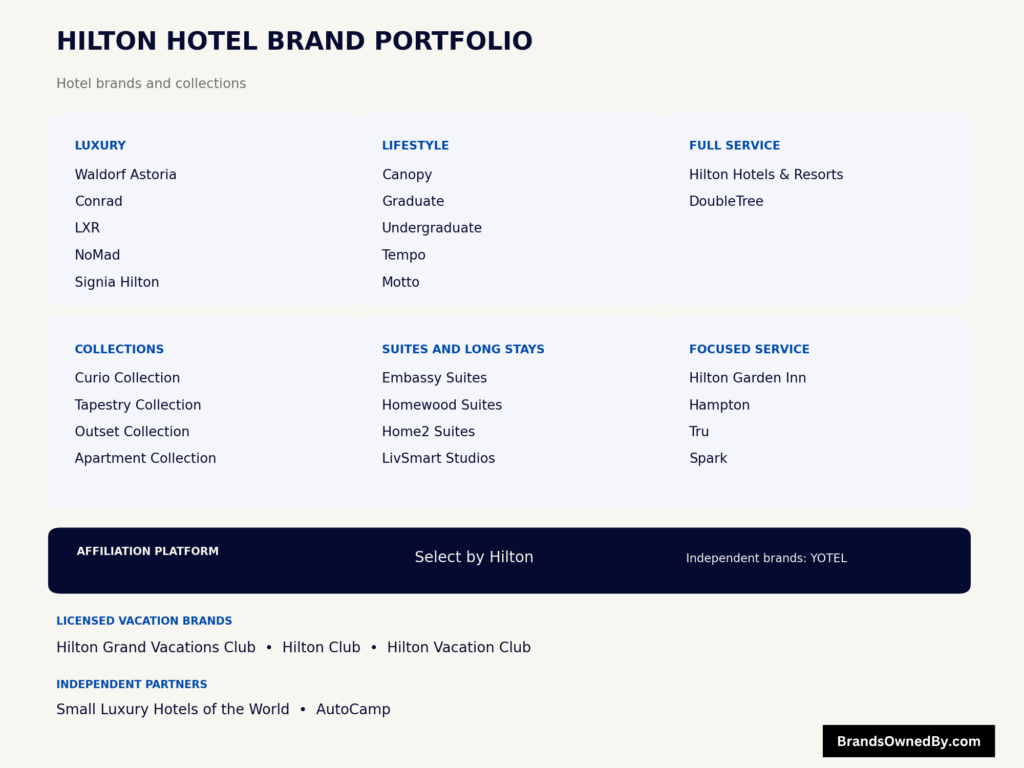
| Category | Hilton brands and platforms | What distinguishes the group |
|---|---|---|
| Luxury | Waldorf Astoria, Conrad, LXR, NoMad, Signia Hilton | Landmark luxury, distinctive resorts and major events. |
| Lifestyle | Canopy, Graduate, Undergraduate, Tempo, Motto | Neighborhood, campus or urban experiences. Undergraduate’s first hotel is anticipated in 2027. |
| Full service | Hilton Hotels & Resorts, DoubleTree | Restaurants, meeting facilities and broader hotel services. |
| Collections | Curio Collection, Tapestry Collection, Outset Collection, Apartment Collection | Independently named hotels or apartment accommodation. |
| Suites and longer stays | Embassy Suites, Homewood Suites, Home2 Suites, LivSmart Studios | Extra living space, kitchen facilities or accommodation for longer visits. |
| Focused service | Hilton Garden Inn, Hampton, Tru, Spark | More streamlined service, across upscale, midscale and economy segments. |
| Independent-brand platform | Select by Hilton | Affiliation for independently owned brands. YOTEL is the first announced participant. |
| Licensed vacation brands | Hilton Grand Vacations Club, Hilton Club, Hilton Vacation Club | Operated by the separate Hilton Grand Vacations company under license. |
This produces 24 hotel and apartment brands, one independent-brand platform and three licensed vacation brands. It explains Hilton’s advertised total of 28 without implying that it owns 28 separate hotel operating companies. SLH, AutoCamp and Explora Journeys are additional partners, rather than entries in that count.
Does Hilton Own the Hotels or Just Their Brands?
Mostly the brands. Hilton Worldwide Holdings Inc. owns the commercial platform behind the network. A property’s real estate owner, local operator and brand owner can be three different businesses.
Franchised Hotels: The Most Common Arrangement
An investor can own a Hampton hotel and hire an independent management company to run it. Hilton supplies the brand, reservation access, loyalty program and operating requirements through a franchise agreement. The owner pays fees for that relationship.
Hilton reported 8,525 franchised or licensed properties at June 30, 2026. That figure includes timeshare properties and strategic partner hotels. A familiar Hilton name therefore does not establish that Hilton bought the land or employs the hotel’s local team.
Hilton-Managed Hotels: Operating Without Owning
Hilton reported 882 managed properties in the same June summary. Under this arrangement, Hilton runs the hotel for its owner and earns management fees. The owner generally funds the building and major capital improvements.
Hilton Hawaiian Village Waikiki Beach Resort provides a clear example of separate property ownership. Park Hotels & Resorts owns the resort. Hilton’s presence in its name identifies the brand relationship, rather than ownership of the real estate by Hilton Worldwide.
Leased Hotels: Real Operating Exposure, Without Outright Building Ownership
Hilton’s June 2026 summary placed 46 hotels in an “ownership” category. That accounting label includes leases and minority interests. It should not be read as 46 buildings owned outright.
The latest detailed annual property schedule, dated December 31, 2025, explains the composition: 42 leased hotels and four properties held through minority-interest entities. The leased portfolio included Rome Cavalieri, Waldorf Astoria Amsterdam, Conrad Osaka and London Hilton on Park Lane.
These are concrete examples of Hilton taking the operating risk of a hotel lease. They differ from a conventional management contract because Hilton pays rent and has a more direct exposure to the property’s operating results. The landlord still owns the building.
Minority Interests: A Stake in the Property Business
The same annual schedule disclosed 24% interests in the entities owning or leasing Hilton Tokyo Bay and Hilton Nagoya. It reported 20% for Hilton Mauritius Resort & Spa and 18% for Hilton Imperial Dubrovnik. Hilton also managed those hotels.
Those percentages refer to the relevant property entities. They do not mean Hilton wholly owns each building. The named examples and percentages are from the annual schedule; the June total is a newer aggregate disclosure.
The scale difference is substantial. The June ownership category represented less than 0.5% of Hilton’s 9,453-property system. Almost all growth comes through relationships with other property owners.
Hilton Overview: Founder, Origins and Business Model
Hilton started by buying hotels. Its current model allows it to expand without financing most of the buildings bearing its brands.
Who Founded Hilton, and Where Did It Begin?
Conrad Hilton bought the Mobley Hotel in Cisco, Texas, in 1919. That purchase began the business. The first hotel formally carrying the Hilton name opened in Dallas in 1925.
Hilton Hotels Corporation was formed and listed on the New York Stock Exchange in 1946. Today’s listed parent is Hilton Worldwide Holdings Inc., headquartered in McLean, Virginia. The founder’s surname survives in the brand, but the company is owned by public shareholders.
Why the Brand Portfolio Matters to Hilton’s Business
A developer building a roadside hotel has different needs from an investor acquiring a landmark resort. Hampton serves the former market. Waldorf Astoria, Conrad or a luxury collection may serve the latter. Extended-stay brands address longer bookings and guests needing cooking facilities.
More brands give Hilton more ways to sign owners. However, the value comes from productive contracts and customer demand. Adding a brand name alone does not produce hotel revenue or prove that a development will succeed.
Hilton Hotel Brands Explained Individually
All the proprietary brands below belong to Hilton’s portfolio. Property counts refer to Hilton’s June 30, 2026 operating summary, the latest quarterly brand breakdown available during September. Announced projects and development pipelines are separate from operating hotels.
Hilton Hotels & Resorts
Hilton Hotels & Resorts is the flagship full-service brand. It serves city, airport, convention and resort markets. Restaurants, meeting space and broader guest services usually distinguish it from focused-service brands such as Hampton.
Its 626-property network illustrates the range of Hilton’s business arrangements: 43 hotels in the ownership category, 312 managed and 271 franchised. London Hilton on Park Lane appears in the annual leased-property schedule. Hilton Hawaiian Village has a separate real estate owner.
For a conference trip, the flagship can provide meeting facilities and on-site dining that a nearby Hampton lacks. The corporate parent is the same; the service format and property ownership can differ.
Hampton by Hilton
Hampton includes Hampton Inn and Hampton Inn & Suites. Its core offer combines included breakfast with a straightforward overnight stay. It joined Hilton through the 1999 Promus acquisition.
With 3,230 hotels, Hampton is Hilton’s largest individual brand by property count. Of those, 3,182 were franchised and 48 managed. None appeared in the ownership category. That is a stronger ownership indicator than simply saying the brand belongs to Hilton.
For a family road trip, included breakfast can change the total cost comparison. Check the room configuration separately. A Hampton Inn & Suites name does not mean every room is a suite.
Hilton Garden Inn
Hilton Garden Inn offers an upscale focused-service format. It generally adds food and beverage facilities and work-friendly spaces without adopting the full service structure of a major convention hotel.
Its network comprised 1,165 hotels: 135 managed and 1,030 franchised. Hilton owns the brand, but this operating mix places the property investment with other owners.
Breakfast is an important distinction from Hampton. It should not automatically be assumed to be included. A traveler comparing similar room rates should add the actual breakfast charge and check any eligible loyalty credit or package.
DoubleTree by Hilton
DoubleTree is a full-service brand known for its warm cookie welcome. It came to Hilton through Promus in 1999. Its flexibility makes it a useful affiliation for existing hotels as well as new developments.
Hilton reported 718 DoubleTrees, including 170 managed and 548 franchised. No properties appeared in the ownership category. The brand name therefore establishes affiliation, rather than Hilton ownership of the hotel building.
Conversion flexibility also means rooms and facilities can vary considerably. Before booking two apparently comparable DoubleTrees, compare renovation history, room dimensions and the actual dining operation. The cookie is consistent branding; the buildings need not be identical.
Embassy Suites by Hilton
Embassy Suites combines two-room suites with included cooked-to-order breakfast and an evening reception. Local rules and property arrangements affect reception offerings. The brand entered Hilton’s portfolio through Promus.
Its 268 hotels included 36 managed and 232 franchised properties. This is a suite-focused full-service concept, rather than a direct substitute for an extended-stay hotel with a kitchen.
A separate bedroom can help parents put children to bed while using the living area. For a weeklong assignment, however, kitchen access may matter more. Compare Embassy Suites with Homewood or Home2 on that basis, rather than treating every “suites” brand as equivalent.
Homewood Suites by Hilton
Homewood Suites is an upscale extended-stay brand acquired with Promus. Studios and one-bedroom suites combine kitchen facilities with hotel services and included breakfast.
Hilton reported 562 properties, of which 555 were franchised and seven managed. Its economics depend on developers funding properties that can serve longer stays as well as shorter leisure visits.
For a relocation or temporary work assignment, calculate the weekly cost after meals, parking and laundry. A room with cooking facilities may justify a higher nightly rate if it reduces restaurant spending. Check whether the booked suite provides the separation between living and sleeping areas you need.
Home2 Suites by Hilton
Home2 Suites offers a more contemporary extended-stay format with suite space, kitchen facilities and included breakfast. Its footprint reached 913 hotels, including 911 franchises and two managed properties.
That scale places Home2 well beyond the status of a niche brand. Its overwhelmingly franchised network also shows how Hilton can expand extended-stay capacity without purchasing hundreds of buildings.
Cooking facilities deserve a close look. A kitchenette does not necessarily provide an oven or the same equipment as a residential kitchen. For a family staying several nights, compare the actual room equipment, sleeping arrangement and grocery access.
LivSmart Studios by Hilton
LivSmart Studios addresses guests staying 20 nights or more. Its value-conscious, apartment-style format serves demand from work assignments, relocation and other extended visits.
Three properties were operating in the June summary, all franchised. This is an early operating network, despite the potentially large market for longer stays. It should not be presented as having Home2’s established scale.
For a monthlong booking, the relevant comparison is the total stay cost and practical living facilities. Review cooking equipment, storage, laundry and cleaning frequency. A long-stay concept is designed around different needs from an overnight roadside hotel.
Tru by Hilton
Tru is a midscale brand with compact rooms, included breakfast and active communal spaces. It trades some private-room space for a simpler stay and a social lobby.
Hilton reported 354 Tru hotels: 340 franchised and 14 managed. This format primarily expands through independently financed properties.
Tru can suit a sightseeing trip where guests spend little time in their rooms. Someone working remotely for several days should compare the desk setup and room dimensions. A lively communal lobby does not automatically replace a quiet workspace.
Spark by Hilton
Spark operates in the premium economy segment. Its conversion model lets owners bring suitable existing hotels into Hilton’s system through renovations and operational changes.
The June network contained 275 hotels, with 274 franchised and one managed. Spark’s value to Hilton is access to a lower-priced market and an existing supply of buildings. It does not require Hilton to buy those properties.
For guests, the useful comparison is the finished hotel, rather than its previous chain affiliation. Look at recent photos and reviews following the conversion. A lower service tier can offer good value, but the destination and travel dates still determine the price.
Waldorf Astoria Hotels & Resorts
Waldorf Astoria is Hilton’s landmark luxury brand. Its portfolio includes historic city hotels and destination resorts. The June summary counted 40 properties, including 38 managed and two in the ownership category.
Those two ownership-category hotels, Rome Cavalieri and Waldorf Astoria Amsterdam, appear in Hilton’s annual leased-property schedule. Separately, Hilton announced the $1.95 billion sale of Waldorf Astoria New York in 2014 with a 100-year management agreement.
These examples make the distinction concrete. Hilton can retain the global luxury brand, lease selected hotels and manage a famous property after selling its building. The Waldorf Astoria name alone does not identify which arrangement applies.
Conrad Hotels & Resorts
Conrad is Hilton’s contemporary luxury brand, named after the founder. Its positioning emphasizes design and local experiences across city and resort destinations.
The 51-hotel network comprised 44 managed properties, six franchises and one in the ownership category. Conrad Osaka, with 164 rooms, appears in the annual leased-property schedule. It provides a specific example of why the accounting category is broader than outright ownership.
When choosing between Conrad and Waldorf Astoria, compare the actual hotels’ settings, restaurants and room types. One can offer the more suitable stay without either brand being universally superior.
LXR Hotels & Resorts
LXR is Hilton’s luxury collection. Individually named hotels retain their character while joining Hilton’s commercial network. Its 17 operating hotels included seven managed and ten franchised properties.
The defining difference from a standardized brand is the individual hotel identity. LXR sits in the luxury segment; Curio and Tapestry serve different positioning within Hilton’s collection strategy. They share a flexible affiliation approach, but they are not interchangeable promises of service.
For guests, assess the particular resort or city hotel first. For owners, LXR offers a route to Hilton distribution without requiring the property to adopt a conventional chain identity.
NoMad
Hilton acquired a majority controlling interest in Sydell Group in April 2024 to expand NoMad. The transaction concerned the brand business. Real estate ownership was not included.
NoMad centers on luxury hospitality with a strong design and dining identity. NoMad London was its sole operating property in Hilton’s June summary, with 91 rooms under management.
Its development story should therefore be distinguished from its existing footprint. Hilton bought a platform it intended to grow. It did not acquire an already extensive chain of NoMad buildings. The transaction combined Sydell’s creative and operating expertise with Hilton’s commercial reach.
Signia Hilton
Signia Hilton combines premium accommodation with a substantial meetings and events focus. Hilton places it in its luxury grouping. All six operating hotels in the June summary were managed properties.
Group business affects the whole hotel. A conference can generate accommodation, banquet and meeting-space revenue together. That makes Signia commercially different from a compact focused-service concept.
For a convention booking, compare the connection to the venue and the meeting facilities. For a leisure stay, consider how a large event could affect the atmosphere. Hilton’s management role does not establish that it owns the surrounding convention development.
Canopy by Hilton
Canopy, also presented as Canopy Hotels, is a lifestyle brand built around neighborhood identity. Local food and design are part of the proposition, rather than decorative additions to a standard business hotel.
The June network included 49 hotels: 15 managed and 34 franchised. The brand gives owners a defined lifestyle format while preserving room for local interpretation.
Its appeal depends heavily on the actual neighborhood. For a city break, map the hotel against restaurants, transit and the places you plan to visit. The neighborhood connection matters more than assuming every Canopy offers the same experience.
Graduate by Hilton
Graduate concentrates on university communities. Hilton completed its $210 million acquisition of the brand rights in May 2024. AJ Capital retained the existing and pipeline real estate covered by the agreement, with the hotels joining through long-term franchises.
All 35 operating Graduate hotels in the June summary were franchised. That confirms the commercial structure described at acquisition: Hilton gained a specialist brand, rather than a portfolio of campus-town buildings.
Campus visits, graduations, reunions and sporting events provide a specific demand base. These events can also move prices sharply. A prospective student’s family should compare dates before assuming a college-town hotel will be inexpensive.
Undergraduate by Hilton
Undergraduate was announced on June 1, 2026 as an upper-midscale complement to Graduate. It extends Hilton’s campus-market strategy through a flexible model supporting both new buildings and conversions.
The first property was anticipated for 2027. As of September 2026, this is an announced Hilton brand, rather than an established operating chain. Including it in the portfolio is appropriate; assigning it an operating hotel count would not be.
It is a hotel concept for visitors such as families, alumni, sports fans and business travelers. The name should not be interpreted as a student-housing acquisition or a university-owned accommodation network.
Tempo by Hilton
Tempo focuses on guests’ daily routines, including work, fitness and relaxation. Tempo by Hilton New York Times Square shows the concept in a major urban destination.
Hilton reported nine operating Tempo hotels, with one managed and eight franchised. It is a smaller lifestyle network than Canopy, despite access to the same wider Hilton commercial platform.
Tempo’s positioning differs from Motto’s emphasis on compact urban rooms. For a trip combining sightseeing and work, compare usable room space and fitness facilities at the individual properties. Lifestyle branding alone does not settle either question.
Motto by Hilton
Motto emphasizes compact accommodation in urban neighborhoods. Connecting-room options at suitable properties can help it serve groups without adopting a traditional all-suite format.
Its 12 operating hotels were all franchised. Owners supply the buildings and local operations, while Hilton controls the brand framework.
The practical trade-off is room space against location and shared facilities. A solo traveler spending the day outside may prefer that balance. A family should check available room combinations and whether connections can actually be confirmed for its chosen booking.
Curio Collection by Hilton
Curio is an upper-upscale collection of individually named hotels and resorts. It preserves a property’s identity while connecting it with Hilton’s reservations and loyalty network.
Its 208 hotels included 33 managed and 175 franchised properties. Elika Cave Suites Cappadocia is a useful example of the collection’s range. A cave hotel can retain an unusual building and local identity instead of adopting a standardized chain format.
Curio belongs to Hilton. The local names and real estate of its member hotels do not automatically become Hilton assets. Compared with Tapestry, its positioning generally emphasizes a higher level of facilities and curated experiences. The exact offering still depends on the hotel.
Tapestry Collection by Hilton
Tapestry is an upscale collection of independent hotels with their own names and stories. Its 206 hotels comprised 197 franchises and nine managed properties.
The Green Leaf Niseko Village illustrates the model in a mountain destination. The hotel retains its identity while participating in Hilton’s network. Tapestry is therefore a commercial affiliation, rather than evidence that Hilton acquired every individually named member hotel.
Compared with Curio, Tapestry generally occupies a broader upscale position. Compared with LXR, it does not carry the same luxury positioning. Travelers should compare the listed facilities rather than interpret “collection” as a guarantee of a spa or extensive resort services.
Outset Collection by Hilton
Outset launched on October 6, 2025. It adds a flexible conversion option in the upscale and upper-midscale collection market. Five hotels were operating in the June summary, all franchised.
ACME Hotel Chicago and Slackline Moab make the distinction tangible. One serves an urban neighborhood. The other serves outdoor exploration. Outset accommodates different food and beverage arrangements, from lighter café service to broader dining, depending on the property and market.
Its flexibility is particularly relevant to owners whose existing hotels do not fit another Hilton format. For guests, it means the collection label should prompt a closer look at the actual offering. Hilton owns Outset; affiliation does not transfer the member hotel’s building to Hilton.
Apartment Collection by Hilton
Apartment Collection adds furnished accommodation ranging from studios to four-bedroom apartments. Its launch involved a partnership with Placemakr. It was not an acquisition of that operator.
Hilton’s June summary listed three properties in the franchised or licensed category. Kitchens, separate living areas and in-unit laundry distinguish the concept from a conventional short-stay hotel room.
For a larger family or relocation stay, compare bedroom count, cleaning frequency and arrival arrangements. Homewood and Home2 also serve longer visits, but Apartment Collection specifically addresses apartment accommodation. The names should not be treated as identical products.
Select by Hilton
Select is a platform for independent hotel brands. YOTEL became its first announced participant through an exclusive agreement in March 2026.
The agreement uses a franchise relationship to connect participating properties with Hilton. YOTEL continues to independently manage and license its own brand. Hilton’s announcement did not describe an outright purchase of YOTEL.
Select therefore differs from Curio or Tapestry. Those collections affiliate individually named hotels under a Hilton collection brand. Select can affiliate an existing independent brand. It expands the distribution relationship without necessarily changing that brand’s corporate ownership.
Hilton Vacation Brands and Independent Partners
Some names visible on Hilton’s booking channels have a different legal relationship from Hampton or DoubleTree. Shared booking access is useful for travelers, but it is not enough to establish corporate ownership.
Hilton Grand Vacations Club
Hilton Grand Vacations Club is a vacation ownership brand operated within Hilton Grand Vacations Inc. The operator became a separate public company after its 2017 separation from Hilton.
Hilton licenses its intellectual property to that business. Resort accommodation can be available for ordinary stays, but purchasing a vacation ownership interest is a separate decision with its own financial obligations.
Hilton Club
Hilton Club sits within the same licensed vacation ownership relationship. It focuses on vacation ownership experiences in selected destinations, including urban markets.
The Hilton name identifies the licensed brand connection. The operating company remains Hilton Grand Vacations, traded separately under HGV, rather than Hilton Worldwide Holdings under HLT.
Hilton Vacation Club
Hilton Vacation Club is another brand used by the separate vacation ownership company under its Hilton license.
Guests should distinguish a hotel room reservation from a membership or ownership purchase. Club structures, ongoing charges and reservation rights depend on the relevant product. A familiar hotel name does not make those terms identical to an ordinary Hilton stay.
Small Luxury Hotels of the World
Small Luxury Hotels of the World, or SLH, has an exclusive strategic partnership with Hilton. Participating hotels can use Hilton’s booking channels and offer eligible Hilton Honors earning and redemption opportunities.
Hilton does not own SLH merely because these hotels appear in its searches. Nor does the arrangement mean Hilton manages every participating boutique hotel.
Travelers should check that their selected SLH property participates and that their booking channel and rate qualify. A relationship covering participating hotels is different from a blanket promise covering every member of the collection.
AutoCamp
AutoCamp offers outdoor accommodation through a partnership with Hilton. Its locations provide an alternative to the conventional hotel room, with distinctive lodging and communal outdoor spaces.
Hilton’s partnership connects participating AutoCamp stays with its commercial and loyalty system. It does not establish that Hilton owns AutoCamp or every property it operates.
For travelers, the important questions concern the accommodation itself: sleeping configuration, bathroom facilities, location and seasonal conditions. Loyalty participation should be an additional consideration, not a substitute for those checks.
Explora Journeys
Explora Journeys extends Hilton’s partnership network into luxury ocean travel. Its Hilton Honors earning and redemption relationship launched during summer 2026, following an earlier partnership announcement.
It is a cruise partner, not a Hilton-owned hotel brand. Its presence on Hilton’s website should not be used as evidence that Hilton bought a cruise line. Eligible benefits depend on the booking and partnership terms, as they do with other independent partners.
Hilton Ownership History
Hilton’s portfolio reflects several different expansion methods. Some brands were developed internally. Others arrived through acquisitions. Real estate businesses were later separated from the hotel management and franchise company.
Early Growth and the Hilton International Split
Conrad Hilton expanded through purchases of major hotels. The $111 million Statler transaction in 1954 strengthened the company’s scale during an era when owning prominent properties was central to hotel expansion.
Hilton International became a separate company in 1964. Trans World Airlines acquired it in 1967. The domestic and international Hilton businesses consequently spent decades under separate ownership.
That history explains the development of different brand and operating arrangements across markets. The global Hilton business familiar to travelers today was not always one unified company.
The Promus Acquisition in 1999
Hilton acquired Promus Hotel Corporation in 1999. The transaction brought DoubleTree, Hampton, Embassy Suites and Homewood Suites into its portfolio.
This was pivotal because it expanded Hilton beyond its flagship full-service hotels. The acquired brands addressed different price points and lengths of stay.
We regard Promus as one of the foundations of Hilton’s modern commercial model. A business traveler could stay at Hampton during a short assignment, then use Homewood Suites for a longer project, while remaining within the same hotel group.
Reuniting Hilton International in 2006
Hilton Hotels Corporation reacquired Hilton International in 2006. The deal reunited the domestic and international businesses after more than four decades apart.
A unified global platform made international brand development easier. It also strengthened Hilton’s ability to serve corporate customers seeking accommodation across multiple countries.
Blackstone’s $26 Billion Acquisition in 2007
Blackstone-affiliated funds acquired Hilton in an approximately $26 billion transaction, completed on October 24, 2007. Hilton became privately owned.
The timing brought substantial financial pressure when the global financial crisis followed. Blackstone nevertheless retained the business through the downturn, while Hilton developed its operating platform and expanded its network.
Christopher Nassetta became president and chief executive officer in 2007. His tenure therefore spans the private ownership period, the return to public markets and the subsequent expansion of the fee-based business.
The Public Listing and Blackstone’s Exit
Hilton returned to public markets in December 2013. Blackstone remained an important shareholder after the IPO and sold its investment over time.
Blackstone reported the sale of its remaining Hilton ownership stake in the second quarter of 2018. Its historical acquisition should not be presented as Hilton’s current ownership structure.
The Park and Hilton Grand Vacations Separations
In January 2017, Hilton separated Park Hotels & Resorts and Hilton Grand Vacations into independent public companies.
Park concentrated on hotel real estate. Hilton Grand Vacations concentrated on vacation ownership. Hilton retained its hotel management, franchise and brand platform.
The separation explains why a property can still be called Hilton while its owner is Park. It also explains why Hilton Grand Vacations appears within the broader Hilton ecosystem without being a current Hilton subsidiary.
The More Recent Brand Expansion
Hilton’s 2024 expansion included the Graduate brand acquisition and its controlling investment in Sydell Group for NoMad. Partnerships with SLH and AutoCamp added accommodation options through a different route.
Outset followed in 2025. Apartment Collection, Select and Undergraduate expanded the portfolio further during 2026.
The commercial logic differs by transaction. Graduate bought a recognizable niche brand. Collections attract independently named hotels. Partnerships broaden customer choice while leaving the partner’s ownership intact.
Who Owns Hilton: Largest Shareholders
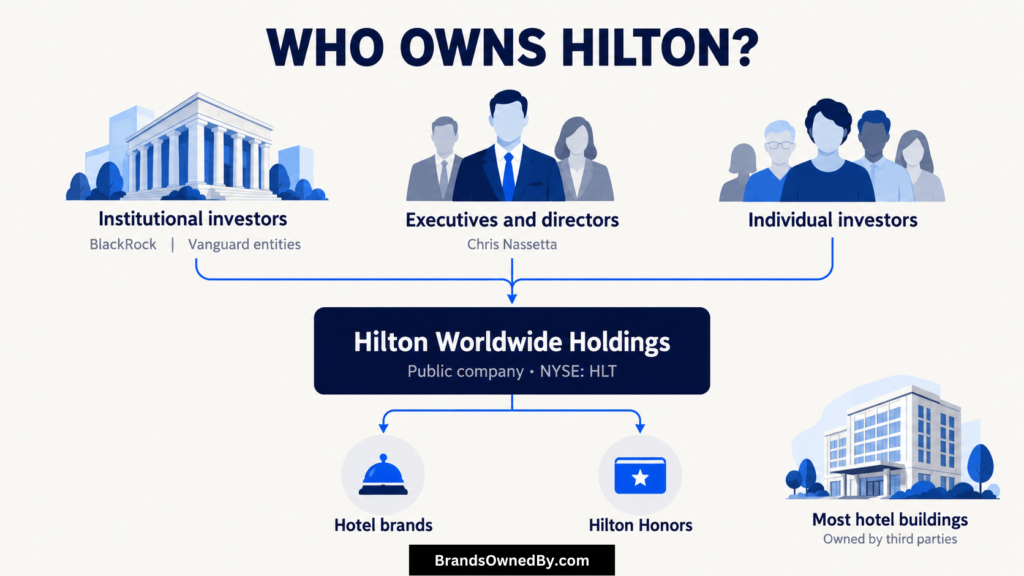
Hilton Worldwide Holdings Inc. is owned by its public shareholders. It trades on the New York Stock Exchange under HLT. No disclosed shareholder has a majority stake.
The latest complete quarterly institutional holdings available during September covered June 30. Those disclosures differ from beneficial-ownership schedules and Hilton’s annual proxy. The figures below distinguish them. They do not represent a verified September 30 shareholder register.
BlackRock
BlackRock’s June 30 institutional portfolio position was approximately 18.98 million Hilton shares. Relative to Hilton’s disclosed June-end shares outstanding, that is roughly 8.4%. The percentage is an estimate from the quarterly position, rather than a newly filed beneficial-ownership percentage.
For comparison, Hilton’s 2026 proxy reported beneficial ownership of 19.333 million shares, or 8.4%, using BlackRock’s January filing. Different reporting dates and share counts can produce similar percentages despite changes in the number of shares held.
BlackRock’s investment-management role does not make it Hilton’s operating parent. Shares held through managed funds and accounts represent investor exposure to the business.
Vanguard Capital Management and Other Vanguard Entities
Vanguard Capital Management’s June 30 Form 13F reported 14.876 million Hilton shares. It filed that report on August 13. The position equates to approximately 6.6% of Hilton’s disclosed June-end shares outstanding.
An earlier beneficial-ownership schedule reported 17.180 million shares and 7.49% at March 31. The quarterly portfolio figure and the beneficial-ownership disclosure have different scopes. They should not be treated as interchangeable measures of voting control.
Vanguard changed its reporting structure during 2026. The parent Vanguard Group’s reported ownership was disaggregated among separate reporting businesses. The older 11.1% figure reproduced in Hilton’s proxy therefore should not be treated as a current consolidated Vanguard stake.
Neither figure is a verified total for every Vanguard entity combined.
Vanguard Portfolio Management
Vanguard Portfolio Management separately reported 7.615 million Hilton shares at June 30. That equates to approximately 3.4% of Hilton’s disclosed June-end share count.
This separate reporting entity helps explain why “Vanguard owns X%” can be misleading. A single manager’s position is not necessarily the investment exposure of all Vanguard funds and affiliates. Combining differently scoped disclosures can also double-count shares.
FMR LLC and Fidelity-Managed Holdings
FMR’s June 30 institutional portfolio position included 11.243 million Hilton shares. That represents approximately 5.0% of Hilton’s disclosed June-end shares outstanding. Its quarterly report was filed on August 13.
An earlier March 31 beneficial-ownership disclosure reported 11.895 million shares, or 5.2%. Abigail Johnson appeared as a reporting person for that same position. Those entries must not be added together as two independent stakes. Like other asset managers, FMR reports investments held through its managed business, rather than ownership of Hilton’s hotel buildings.
Christopher Nassetta
Hilton’s 2026 proxy reported Nassetta’s beneficial ownership at 4.664 million shares, or 2.0%. That figure included vested options and holdings through trusts and an affiliated entity.
His operating authority comes from his executive position and board oversight. A 2.0% beneficial ownership position does not give him majority shareholder control.
Other Shareholders and Insiders
The remaining ownership is spread among other institutions, funds and individual investors. State Street and JPMorgan are also significant institutional holders. Hilton’s proxy reported directors and executive officers collectively at 2.7%; Nassetta’s position is included in that figure.
The Hilton family does not hold a disclosed controlling stake. Paris Hilton’s relationship to the founder does not make her the owner of the public hotel company.
Competitor Ownership Comparison
Hilton’s competitors also separate hotel brands from buildings. The more useful comparison is who owns the parent company and how shareholder voting works.
Marriott International
Marriott is independently listed under MAR. Marriott Hotels, Sheraton, Westin, The Ritz-Carlton and St. Regis belong to its portfolio, not Hilton’s.
The Marriott family retains significant ownership and a visible governance role. Its 2026 proxy reported 17.57% for specified family-related and associated holders after eliminating double-counted shares. David Marriott chairs the board. Hilton has no equivalent disclosed controlling Hilton-family position. Both companies rely heavily on third-party property owners.
Hyatt Hotels Corporation
Hyatt is independently listed under H. Its brands include Hyatt Regency, Park Hyatt, Grand Hyatt and Andaz.
Pritzker family business interests held approximately 89% of voting power in Hyatt’s 2026 proxy disclosure. Its dual-class shares concentrate voting influence beyond the economic stake alone. Hilton’s disclosed ownership is more dispersed. This difference concerns governance, rather than whether a particular Hyatt or Hilton building has an independent owner.
IHG Hotels & Resorts
IHG is the public parent behind Holiday Inn, Holiday Inn Express, Crowne Plaza, InterContinental and Kimpton. It operates separately from Hilton, with its own shareholders and IHG One Rewards program.
Like Hilton, it earns fees from franchise and management relationships. Holiday Inn Express can compete with Hampton for similar trips. Competition for the same guest does not imply common ownership.
Wyndham Hotels & Resorts
Wyndham Hotels & Resorts is independently listed under WH. Days Inn, Super 8, Ramada and La Quinta are among its brands.
Its strong franchise orientation makes separate property ownership especially common. Hilton’s portfolio has a broader presence in landmark luxury and major events. Wyndham Hotels & Resorts should also be distinguished from Travel + Leisure Co., the separate vacation ownership business.
Accor
Accor is a separate listed hotel group with brands including ibis, Novotel, Mercure, Sofitel and Fairmont. Its shareholder base includes institutional and strategic investors.
At June 30, 2026, Accor identified Parvus Asset Management at 14.9%, Kingdom Holding Company at 7.0% and Qatar Investment Authority at 6.6%. Its portfolio also uses joint ventures and other structures. As with Hilton’s partnerships, affiliation should not automatically be interpreted as full corporate ownership.
Who Controls Hilton?
As of September 2026, control is exercised through Hilton’s board, executive management and shareholder voting. Corporate control and the authority to run an individual hotel remain separate questions.
Christopher Nassetta and Executive Management
Christopher Nassetta is Hilton’s president and chief executive officer. Management leads the company’s operating strategy, brand development and relationships with hotel owners.
Its key decisions include where to introduce brands, which developments to support and how to invest in the commercial platform. Those choices affect the fees and growth Hilton can generate from independently financed properties.
Jonathan Gray and the Board
Jonathan Gray chairs Hilton’s board. He also holds a senior leadership role at Blackstone.
That connection should not be mistaken for proof that Blackstone still owns Hilton. Board service, historical investment ownership and current corporate control are distinct matters.
The board oversees management and major corporate decisions. Shareholders influence governance through director elections and other matters put to a vote.
Who Controls Individual Hotels?
At a franchised hotel, the owner and appointed operator handle local operations, subject to the franchise agreement and brand requirements. At a Hilton-managed hotel, Hilton has a more direct operating role.
This division explains why a renovation decision may depend on a property owner while reservation technology depends on Hilton. A customer can encounter both businesses during one stay, even though only one brand appears above the entrance.
Hilton Annual Revenue and Net Worth
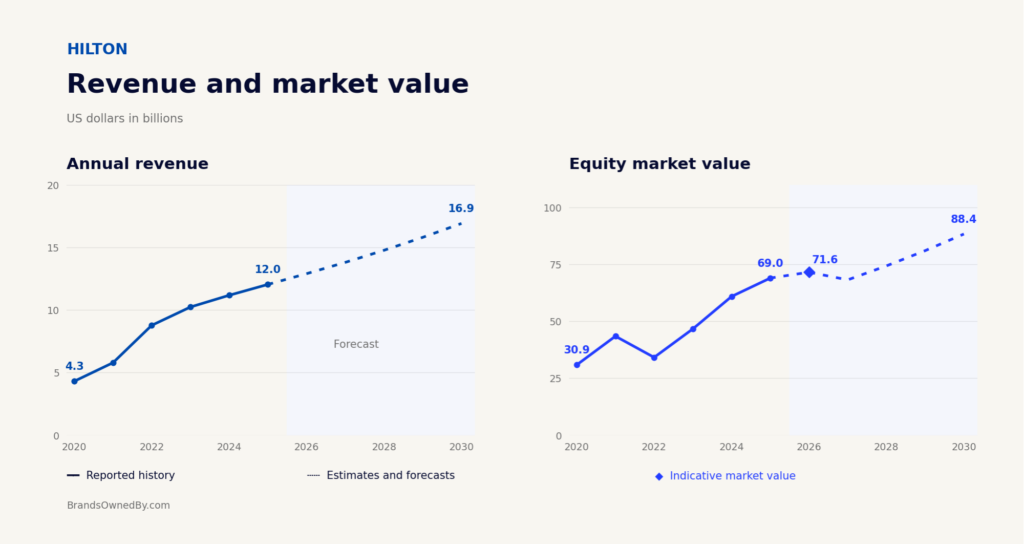
Hilton’s revenue is the parent company’s reported revenue. It is not the combined room revenue of every independently owned hotel in its system. Net worth is defined as, in this particular case, accounting equity and stock-market value give very different answers.
Latest Annual Revenue and Its Main Components
Hilton reported $12.039 billion of revenue in 2025, up 7.7% from $11.174 billion in 2024. Franchise and licensing fees contributed $2.780 billion. Base and other management fees added $376 million, with incentive management fees of $313 million.
Ownership-category revenue was $1.233 billion. Other revenue contributed $252 million. The largest component was $7.085 billion of reimbursements, or 58.9% of total revenue. Reimbursements support programs and services for participating owners. Their profit economics differ from franchise fees.
The U.S. accounted for $9.523 billion of reported revenue. Other countries contributed $2.516 billion. That allocation does not mean 79.1% of Hilton’s properties are in America.
What the 2026 Results Show
First-half 2026 revenue reached $6.278 billion, up 7.6%. Net income was $865 million. Franchise and licensing fees contributed $1.504 billion. Base management fees added $194 million and incentive fees $145 million.
Ownership revenue was $560 million, other revenue $138 million and reimbursements $3.737 billion. Adjusted EBITDA reached $1.955 billion, up 8.4%. Full-year 2026 results were not yet available during September. A complete annual revenue figure must therefore be an estimate.
Market Value and Accounting Net Worth
Hilton shares closed at $318.12 on September 30, 2026. Multiplying that price by the 225.065 million shares disclosed for July 23 gives an indicative equity market value of $71.6 billion. Later repurchases prevent this from being an exact September-end capitalization.
Book equity was negative. Hilton reported a $6.303 billion stockholders’ deficit at June 30, alongside $16.190 billion of accumulated treasury stock. Repurchases help explain why accounting equity differs so sharply from market value. Investors value expected earnings, while book equity reflects recorded assets, liabilities and past transactions.
Hilton also reported $12.380 billion of net debt and leverage of 3.2 times adjusted EBITDA. A valuable brand platform does not eliminate financing risk. The chart uses equity market value, rather than claiming to forecast accounting net worth.
Revenue Forecast (2026–2030)
An illustrative 2026 estimate of $12.9 billion applies roughly 7% growth to the latest annual result. It is close to first-half growth of 7.6%. It is an article estimate, rather than published Hilton revenue guidance.
Maintaining 7% annual growth produces $13.8 billion in 2027, $14.8 billion in 2028, $15.8 billion in 2029 and $16.9 billion in 2030. June net unit growth of 6.1% and a 541,300-room development pipeline support continued expansion. Hilton’s July outlook also expected full-year comparable RevPAR growth of 3.0%–3.5%.
These drivers inform the assumption; they should not simply be added together. Opening dates, management-fee mix and reimbursements affect reported revenue differently. At annual growth of 5% or 9% after 2026, the corresponding 2030 outcomes are $15.7 billion and $18.2 billion.
Market Value Scenarios (2027–2030)
Hilton’s July guidance projected 2026 net income of $1.883 billion–$1.911 billion. The midpoint is $1.897 billion. A scenario using 9% annual earnings growth is broadly anchored to first-half adjusted EBITDA growth of 8.4%. Earnings can diverge because of interest, taxes and other expenses.
Applying a 33-times earnings multiple gives equity values of $68.2 billion in 2027, $74.4 billion in 2028, $81.1 billion in 2029 and $88.4 billion in 2030. The multiple assumes some valuation compression: the indicative September value equates to about 37.7 times the guidance midpoint. That explains the initial decline despite assumed earnings growth.
A lower case uses 5% earnings growth and 28 times earnings, producing $64.6 billion in 2030. A higher case uses 12% growth and 38 times earnings, producing $113.4 billion. These are sensitivity scenarios, not statistical confidence ranges or predictions of the share price. Hotel openings, fee growth and financing costs matter more than brand count alone.
Final Thoughts
Hilton owns many familiar hotel brands, including Hampton, DoubleTree, Embassy Suites, Hilton Garden Inn, Waldorf Astoria and Conrad. Its broader portfolio now covers boutique collections, longer stays, apartments and college-market accommodation.
The important ownership distinction remains consistent. Hilton can own a brand, manage a hotel or supply its booking platform without owning the building. Licensed vacation brands and independent partners add further layers.
For travelers, start with the brand to understand the broad service concept. Then check the specific property’s rooms, facilities, location and recent reviews. For anyone researching corporate ownership, identify the brand owner, property owner and operator separately.
FAQs
Is Hampton Inn Owned by Hilton?
Yes. Hampton Inn and Hampton Inn & Suites are part of Hampton by Hilton. Hilton owns the brand, while most individual properties are owned and operated by franchise businesses.
Is DoubleTree Part of Hilton?
Yes. DoubleTree by Hilton belongs to Hilton’s hotel brand portfolio. A DoubleTree property can be independently owned even though it carries Hilton’s brand and participates in Hilton Honors.
Does Hilton Own Embassy Suites?
Yes. Embassy Suites by Hilton is a Hilton-owned brand. Hilton acquired it through the Promus transaction in 1999. Brand ownership does not mean Hilton owns every Embassy Suites building.
Is Hilton Garden Inn the Same as Hilton?
Hilton Garden Inn and Hilton Hotels & Resorts have the same corporate parent, but they are different brands. Garden Inn uses an upscale focused-service format. The flagship Hilton brand generally offers a broader full-service experience.
Does Hilton Own Holiday Inn or Holiday Inn Express?
No. Holiday Inn and Holiday Inn Express belong to IHG Hotels & Resorts. They are competitors of Hilton brands and use the separate IHG One Rewards loyalty program.
Does Hilton Own Marriott, Sheraton or The Ritz-Carlton?
No. Marriott International is a separate public company. Sheraton and The Ritz-Carlton are Marriott brands. Staying at those hotels does not ordinarily earn Hilton Honors points.
Is Hyatt Owned by Hilton?
No. Hyatt Hotels Corporation is a separate public company. Its hotel brands and World of Hyatt program operate independently of Hilton.
Does Paris Hilton Own Hilton Hotels?
No. Paris Hilton is related to Conrad Hilton, but she does not own or control Hilton Worldwide Holdings. The hotel group is owned by public shareholders and run through its board and executive management.
Does Blackstone Still Own Hilton?
Blackstone is no longer Hilton’s controlling owner. It took Hilton private in 2007 and reported the sale of its remaining investment in 2018. Jonathan Gray’s continuing board chairmanship should not be confused with current Blackstone ownership of the company.
How Many Hotel Brands Does Hilton Have?
As of September 2026, Hilton advertises 28 brands: 24 hotel and apartment brands, Select by Hilton and three licensed vacation brands. Undergraduate is included even though its first hotel is anticipated in 2027. Independent partners such as SLH, AutoCamp and Explora Journeys are separate from that count.
Does Hilton Own Hilton Grand Vacations?
No. Hilton Grand Vacations Inc. became a separate public company in 2017. It licenses Hilton intellectual property and operates the Hilton Grand Vacations Club, Hilton Club and Hilton Vacation Club brands under that relationship.
Did Hilton Buy YOTEL?
Hilton announced an exclusive agreement with YOTEL in March 2026, making it the first independent brand within Select by Hilton. YOTEL retains independent brand management and licensing. The agreement was not announced as an outright acquisition.
Does Hilton Own Small Luxury Hotels of the World?
No. Hilton has a strategic partnership with SLH. Participating hotels gain access to Hilton booking channels and eligible loyalty benefits while retaining their independent ownership arrangements.
Are All Hilton Brands Eligible for the Same Honors Benefits?
No. Earning rules and benefits can differ by brand, property type, region and booking eligibility. Partner hotels and vacation ownership properties also have specific arrangements. Check the applicable terms for the hotel and rate before relying on a particular benefit.
Which Hilton Brands Are Best for Families?
Embassy Suites is useful when a separate bedroom and included breakfast matter. Homewood Suites and Home2 Suites suit travelers wanting kitchen facilities. Apartment Collection can work for larger groups needing residential space. Compare the room configuration and total stay cost at the actual property.
Which Hilton Brands Are Usually More Affordable?
Spark and Tru target more value-conscious segments. Hampton often offers useful value through included breakfast. Prices still depend on location, demand and travel dates. A premium-economy hotel during a major event can cost more than an upscale hotel in a quieter market.