
- Axel Springer SE owns 100% of Politico, including its U.S. and European operations.
- Friede Springer and Axel Springer CEO Mathias Döpfner jointly own 95% of Politico’s parent company.
- Axel Sven Springer and the Friede Springer Foundation share the remaining 5% of Axel Springer.
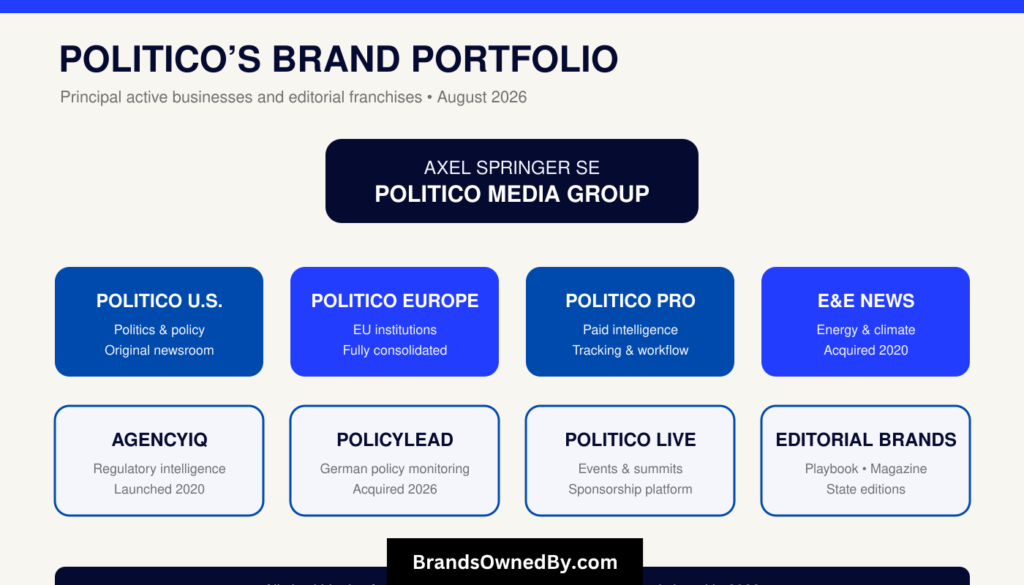
- Politico’s principal commercial brands include Politico Pro, Politico Europe, E&E News, AgencyIQ and Policylead.
Politico is wholly owned by Axel Springer SE, a private transatlantic media company headquartered in Berlin and New York. Axel Springer bought Politico and related assets from founder Robert Allbritton in October 2021. The transaction was valued at more than $1 billion. Politico has no publicly traded stock and no outside shareholders at the operating-company level.
![Who Owns Politico [Infographic]](https://brandsownedby.com/wp-content/uploads/2026/09/Who-Owns-Politico-Infographic-1-683x1024.png)
Politico Overview
Politico is a political news and policy-intelligence company. It covers government, elections, lobbying, regulation and public policy. Its free journalism creates broad reach. Its paid products sell specialized information and workflow tools to organizations that need to follow government decisions closely.
This mix matters. Politico is often described as a digital newspaper, but that description is incomplete. The company also operates a business-to-business information service. Politico Pro subscriptions are purchased by companies, law firms, trade associations, nonprofits and public agencies. That recurring institutional revenue gives the business a different economic profile from an advertising-only news website.
As of September 2026, Politico has more than 1,000 journalists and publishing professionals. Its major operating centers include Washington, Brussels, London, Paris, Berlin, Sacramento and New York.
Who Founded Politico?
Robert Allbritton founded Politico in 2007. He supplied the capital and the operating platform through the Allbritton family’s media business. John F. Harris and Jim VandeHei, both previously at The Washington Post, were central to building the newsroom and its editorial identity.
Politico launched as The Politico on January 23, 2007. Its initial proposition was specific. It would cover the people, institutions and tactical decisions shaping Washington power with speed and insider-level detail. That approach distinguished it from general-interest national newspapers.
Harris and VandeHei are frequently called co-founders because they designed and led the publication with Allbritton. Allbritton, however, was its founding owner and publisher. VandeHei later left and co-founded Axios. Harris remained with Politico and became chairman in 2026.
Politico’s Origin and Business Model
Politico began with a free website and a print newspaper distributed around Washington. Advertising, sponsorships and events funded its early growth. The model expanded in 2011 with Politico Pro, a premium subscription service for professionals who needed deeper policy coverage.
Pro changed the quality of Politico’s revenue. A general news reader may visit only during an election or major policy event. An institutional subscriber uses legislative tracking, regulatory intelligence and specialized reporting throughout the year. That makes the relationship more durable and less dependent on volatile display advertising.
Politico later carried the model into Europe. It also expanded into energy, environmental and regulatory intelligence. The result is a hybrid company. One side influences the public political conversation. The other sells high-value information to customers whose work depends on policy.
Politico Ownership History
Politico has had two ultimate owners since its launch: Robert Allbritton and Axel Springer. The corporate structure changed several times, but outside investors did not own equity in Politico before the Axel Springer sale.
2007 to 2009: Allbritton Communications
Politico launched within Allbritton Communications, the family-controlled broadcasting company associated with Robert Allbritton. The existing organization provided financing, administrative support and experience selling media advertising.
The ownership was concentrated from the beginning. Politico was not created as a venture-backed startup with a long capitalization table. That allowed management to invest for the long term while the publication established its position in Washington.
2009 to 2021: Capitol News Company
In 2009, Politico was placed under Capitol News Company, a private holding company owned by Robert Allbritton. The change separated the growing political-media operation from the family’s television assets.
Capitol News Company later acquired Capital New York in 2013. Its coverage was rebranded under Politico in 2015. The company also launched Protocol in 2020, created AgencyIQ as a regulatory-intelligence business and acquired E&E News in December 2020.
Allbritton remained the ultimate owner throughout this period. Politico did not issue public shares, and its journalists did not collectively own the company.
2014 to 2021: The Politico Europe Joint Venture
Politico and Axel Springer formed a 50-50 joint venture in 2014 to launch Politico Europe. The European publication began operating in 2015 from Brussels.
This was Axel Springer’s first ownership interest in a Politico-branded business. It did not give Axel Springer ownership of the U.S. company. Robert Allbritton continued to own the American operation and his side of the European partnership through Capitol News Company.
The joint venture gave both parties useful information before the later acquisition. Politico demonstrated that its policy-focused format could travel beyond Washington. Axel Springer demonstrated that it could support the brand’s expansion while operating across European markets.
2021: Axel Springer Acquired Full Ownership
Axel Springer announced the acquisition on August 26, 2021, and completed it on October 19, 2021. The reported value exceeded $1 billion.
The purchase covered more than the core Politico website. Axel Springer acquired the Politico business, Robert Allbritton’s 50% interest in Politico Europe, Protocol, E&E News and AgencyIQ. Axel Springer already owned the other 50% of Politico Europe, so the transaction consolidated the European operation under one parent.
That distinction is important when discussing Politico’s valuation. The headline price represented a group of media and intelligence assets. It should not be treated as a precise standalone valuation for only Politico.com.
Robert Allbritton ceased to be an owner when the transaction closed. Protocol was later shut down in November 2022 and is no longer an active Politico brand.
2025: Axel Springer’s Shareholders Changed
Politico remained fully inside Axel Springer when the parent company reorganized on April 29, 2025. KKR and CPP Investments divested their shares in Axel Springer. They took majority ownership of the separated Stepstone and AVIV classifieds businesses instead.
After the separation, Friede Springer and Mathias Döpfner jointly held 95% of Axel Springer. Axel Sven Springer and the Friede Springer Foundation held the remaining 5%. Axel Springer also became debt-free at the corporate level.
This restructuring matters because many online profiles still show KKR and CPP Investments as indirect Politico owners. That information described the earlier structure. It is no longer correct as of September 2026.
2026: Politico Added Policylead
Politico acquired 100% of German policy-monitoring platform Policylead in February 2026. The acquisition strengthened Politico’s paid intelligence offering in Germany and added a specialized workflow product for organizations monitoring policy development.
The transaction did not change who owns Politico. It expanded the group beneath Politico while Axel Springer remained the sole parent.
Who Owns Politico?
Axel Springer SE owns 100% of Politico. The German-founded media company acquired full ownership in October 2021 from Robert Allbritton’s Capitol News Company. Politico is now a privately held subsidiary within Axel Springer’s transatlantic publishing portfolio.
There are no publicly traded Politico shares. Employees, readers and outside investment funds do not hold direct equity in the company. The individuals who ultimately benefit from Politico’s performance are the shareholders of its private parent company.
![who owns Politico [parent company]](https://brandsownedby.com/wp-content/uploads/2026/09/who-owns-Politico-parent-company-1024x585.png)
Axel Springer is Politico’s Direct Parent Company
Axel Springer has been Politico’s sole owner since October 19, 2021. The parent company controls Politico’s corporate strategy, capital allocation, senior executive appointments and major acquisitions.
Politico is one of Axel Springer’s most important international publishing assets. It sits alongside Business Insider, Bild, Welt, Morning Brew and The Telegraph. However, these publications are sister brands. Politico does not own them, and they do not own Politico.
Axel Springer treats Politico as more than a political news website. The business combines a large newsroom with premium policy intelligence, events and professional software. This structure supports advertising revenue while also generating recurring subscription income from companies, law firms, trade associations, nonprofits and government agencies.
That commercial model helps explain why Axel Springer was willing to pay a substantial price. Politico offered an established position in Washington and Brussels, a profitable institutional-subscription business and room to expand into additional policy markets.
Politico Acquisition
Axel Springer announced its agreement to acquire Politico on August 26, 2021. The transaction closed on October 19, 2021, after receiving the required regulatory approvals. The deal was widely valued at more than $1 billion.
That figure did not represent the Politico website alone. Axel Springer acquired a group of related media and policy-intelligence assets previously controlled by Robert Allbritton. The portfolio included:
- Politico’s U.S. business.
- Robert Allbritton’s 50% interest in Politico Europe.
- E&E News.
- AgencyIQ.
- Protocol.
Axel Springer already owned the other 50% of Politico Europe through a joint venture created in 2014. Buying Allbritton’s interest therefore gave it complete ownership of the European operation as well as the U.S. business.
This transaction structure is frequently overlooked. Describing the reported purchase price as the amount paid solely for Politico.com overstates the implied value of the main website. The price also covered specialist subscription products, the European operation and other media assets.
The companies did not disclose how the purchase price was divided among those businesses. It is therefore not possible to assign a precise 2021 acquisition value to Politico, E&E News or AgencyIQ individually.
Protocol was subsequently closed in November 2022. It is no longer an active business within the Politico group.
Who Ultimately Owns Axel Springer?
Politico has one direct shareholder, but its ownership chain continues through Axel Springer.
As of September 2026, Friede Springer and Mathias Döpfner jointly own 95% of Axel Springer. Axel Sven Springer and the Friede Springer Foundation share the remaining 5%.
Axel Springer has not publicly divided these combined blocks into exact current percentages for each individual shareholder. It would therefore be misleading to assign a precise portion of the 95% stake to either Friede Springer or Mathias Döpfner.
Friede Springer provides continuity with the company’s founding family. She is the widow of Axel Springer, who established the publishing company in 1946. Mathias Döpfner combines a major economic interest with executive authority because he is also Axel Springer’s chief executive.
That combination makes Döpfner particularly influential. He participates in the controlling ownership group while directing the parent company’s operating strategy. However, neither Döpfner nor Friede Springer directly owns shares in Politico. Their interests are held at the Axel Springer level.
Axel Sven Springer is a grandson of Axel Springer. He owns part of the remaining 5% alongside the Friede Springer Foundation. Their exact individual percentages have not been publicly disclosed.
KKR and CPP Investments No Longer Own Politico
Older ownership profiles often list KKR and CPP Investments as indirect Politico shareholders. That information is outdated.
KKR became a major Axel Springer investor in 2019 and helped take the company private. CPP Investments subsequently invested alongside KKR. When Axel Springer acquired Politico in 2021, both investment groups had an indirect economic interest through their stakes in the parent company.
That arrangement ended on April 29, 2025. Axel Springer separated its media operations from its digital-classifieds businesses. KKR and CPP Investments divested their shares in the media company containing Politico.
The two institutional investors became majority owners of the separated Stepstone and AVIV businesses. Axel Springer retained a 10% interest in each of those classified-advertising companies.
Politico remained with Axel Springer under the control of Friede Springer and Mathias Döpfner. KKR and CPP Investments therefore have no current ownership stake in Politico or its media parent.
The restructuring also left Axel Springer debt-free at the parent-company level. This is relevant to Politico because less corporate leverage can give the owner greater flexibility to fund newsroom expansion, technology development and acquisitions.
Politico’s Ownership of E&E News, AgencyIQ and Policylead
Axel Springer owns Politico, but several specialist businesses operate underneath the Politico organization.
Politico acquired E&E News in December 2020, before the Axel Springer sale. E&E News retained its established identity and now operates as E&E News by Politico. It covers energy, climate, environmental regulation and natural-resource policy.
AgencyIQ was developed as a Politico business in 2020. It provides regulatory intelligence and workflow tools for organizations operating in regulated industries. Its coverage includes life sciences, food and the work of agencies such as the Food and Drug Administration.
Politico expanded this portfolio again in February 2026 by acquiring 100% of Policylead. The German platform monitors legislation, regulation, political stakeholders and policy developments. The acquisition strengthened Politico’s professional intelligence business in Germany and the wider European market.
These businesses do not introduce new shareholders into Politico. They sit below Politico in the corporate structure, while Axel Springer remains the ultimate owner.
What Politico’s Ownership Structure Means in Practice
Axel Springer has authority over Politico’s capital, executive leadership and long-term commercial direction. It can approve acquisitions, determine investment levels and decide how Politico fits into the wider publishing portfolio.
Politico’s daily operations are led by its own management. Goli Sheikholeslami serves as CEO of Politico Media Group. She oversees the company’s commercial operations and international growth.
Editorial authority is organized separately. Jonathan Greenberger became global editor-in-chief on May 1, 2026, while founding editor John Harris moved into the role of Politico chairman. Greenberger is responsible for the global newsroom and works with senior editors in the United States and Europe.
This division is important. Axel Springer’s shareholders ultimately control the company, but that does not mean they select or approve each article. Their influence is exercised primarily through ownership rights, executive appointments, budgets, acquisitions and overall strategy.
The ownership relationship still carries reputational and strategic implications. Politico’s editorial identity is connected to the decisions and public positions of its parent company. At the same time, Politico has its own newsroom leadership, journalistic processes and commercial management.
The complete ownership chain in September 2026 is therefore:
Politico is wholly owned by Axel Springer. Friede Springer and Mathias Döpfner jointly control 95% of Axel Springer. Axel Sven Springer and the Friede Springer Foundation share the remaining 5%.
Competitor Ownership Comparison
Politico competes in two overlapping markets. In public political news, it competes for audience, advertising and influence. In professional policy intelligence, it competes for expensive institutional subscriptions and workflow budgets. Ownership affects how each rival funds that competition.
Axios: Owned by Cox Enterprises
Cox Enterprises acquired Axios Media in 2022 in a cash transaction valuing it at $525 million. Axios’s founders retained minority stakes and continued to lead the company. Cox is a private, family-controlled conglomerate.
Axios has a direct connection to Politico’s history. Co-founders Jim VandeHei and Mike Allen helped build Politico before creating Axios. Its concise Smart Brevity format competes with Politico’s newsletters and real-time political coverage.
The ownership difference is practical. Axios operates inside a diversified private group, while Politico sits inside a media company focused heavily on journalism and digital information products.
The Hill: Owned by Nexstar Media Group
Nexstar Media Group acquired The Hill for $130 million in August 2021. Nexstar is a publicly traded broadcasting company with a large U.S. local-television footprint and the NewsNation cable network.
The Hill competes with Politico for national political traffic, advertisers and access to Washington decision-makers. It has also expanded paid products, including The Hill Insider.
Nexstar’s public ownership creates quarterly reporting and shareholder-return pressure. Politico’s private parent can make longer-horizon investments without publishing brand-level results every quarter.
CQ Roll Call: Owned by FiscalNote
FiscalNote acquired CQ Roll Call from The Economist Group in 2018 for approximately $180 million. CQ and Roll Call remain part of FiscalNote in September 2026.
This is one of Politico’s closest comparisons in professional policy intelligence. CQ provides legislative data and analysis, while Roll Call covers Congress. FiscalNote combines those editorial products with software, datasets and policy-risk tools.
Politico Pro follows a similar economic logic. Reporting attracts expert users, while workflow features make the service more deeply embedded in daily operations. FiscalNote is publicly traded, whereas Politico and Axel Springer are private.
Punchbowl News: Founder-Led and Privately Held
Punchbowl News was founded by former Politico journalists Jake Sherman, Anna Palmer and John Bresnahan, together with Rachel Schindler. It remains a privately held, founder-led company.
Punchbowl concentrates on congressional leadership, power and the people moving policy. Its premium membership, newsletters, sponsorships and events compete directly with Politico Playbook and parts of Politico Pro.
Its narrower scale gives the founders more direct control over editorial and commercial strategy. Politico has greater international reach, a much larger newsroom and more developed enterprise software.
Bloomberg Government: Part of Bloomberg L.P.
Bloomberg Government belongs to Bloomberg L.P., the private financial-data and media company founded and controlled by Michael Bloomberg. It combines federal and state policy news with legislative, contracting and market intelligence.
Its advantage is integration with a much larger data and technology organization. Politico’s advantage is a political-news identity built around agenda-setting journalism and specialist coverage.
Both businesses show why the category cannot be judged only by website traffic. Their highest-value customers pay for information that saves time, identifies regulatory risk, or improves decisions.
Who Controls Politico?
Control exists at three levels: shareholder control, corporate management and editorial leadership. Treating those layers as interchangeable produces an incomplete answer.
Ultimate Shareholder Control
Friede Springer and Mathias Döpfner control Axel Springer through their combined 95% holding. That position gives them decisive influence over the parent company that owns Politico.
Döpfner’s influence is especially strong because he is also Axel Springer’s chief executive. He can connect ownership priorities with capital allocation, acquisitions and group strategy. Friede Springer provides the dominant ownership partnership and continuity with the founding family.
Corporate and Commercial Control
Goli Sheikholeslami is CEO of Politico Media Group. She oversees operations across the company’s U.S. and European footprint. Her remit includes business performance, product strategy, hiring priorities and execution of the group’s growth plan.
Politico’s business model gives commercial management several levers. It can expand Pro coverage, improve software features, launch into new policy areas, develop events and increase institutional sales. The 2026 Policylead acquisition is a practical example of that strategy.
Editorial Control
Jonathan Greenberger became Politico’s global editor-in-chief on May 1, 2026. He oversees the global newsroom. John Harris, a founding editor, moved into the role of Politico chairman.
Greenberger works with senior U.S. and European editors to decide coverage priorities, newsroom organization and formats. Axel Springer retains ultimate corporate authority, but that does not mean its shareholders select or approve individual Politico stories.
This distinction matters for readers assessing media ownership. Owners influence leadership, budgets, acquisitions and broad institutional direction. Day-to-day editorial judgments are made through the newsroom’s management structure.
Axel Springer’s Strategic Influence
Axel Springer presents Politico as a central asset in its transatlantic publishing portfolio. The parent has emphasized international expansion, paid digital products and technology-supported journalism.
The relationship gives Politico access to capital and operating experience across several media businesses. It also exposes Politico to scrutiny over the parent company’s corporate principles and the public positions of its leadership. That reputational link is a real consequence of ownership even when the newsroom retains editorial processes of its own.
Politico Annual Revenue and Net Worth
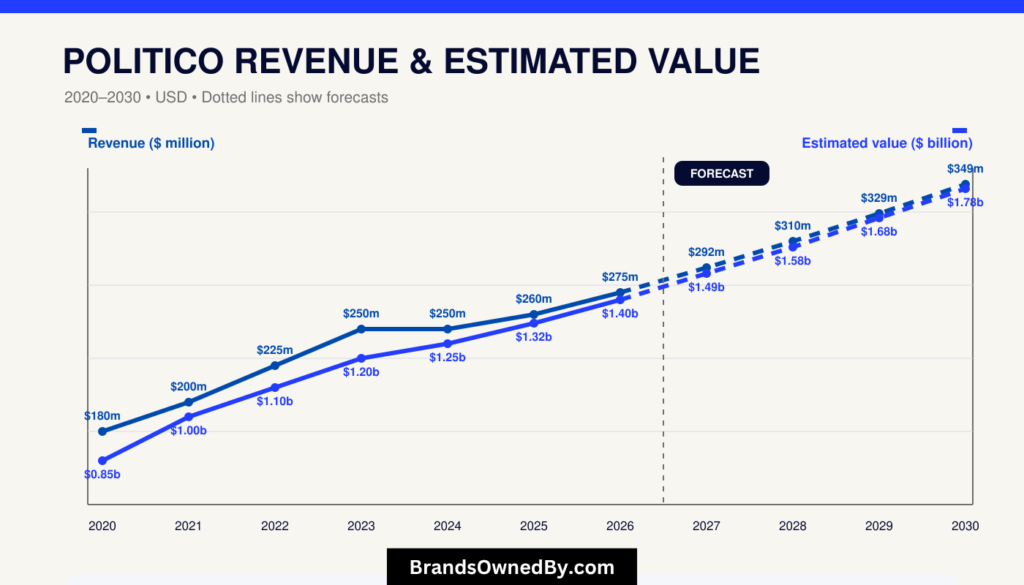
Politico does not publish audited standalone accounts. Axel Springer is private and reports only selected group figures. Any complete 2020–2030 series must therefore combine reported reference points with estimates and forecasts.
Politico Revenue in 2026
We estimate Politico Media Group can generate approximately $275 million in 2026 revenue. This is a modeled full-year figure, not a company-issued forecast.
The estimate begins with reported market references of about $200 million in 2021 and approximately $250 million in 2023 and 2024. We then apply moderate growth for subscription pricing, international expansion, product development and the Policylead acquisition.
The result is deliberately below some automated company databases that estimate revenue from employee counts. Headcount-based models can overstate media revenue because journalists, editors, developers and international teams have very different revenue productivity.
Where Politico’s Revenue Comes From
Politico’s largest strategic revenue engine is its paid professional business. Politico Pro sells policy reporting, alerts, tracking tools, directories and research capabilities to organizations. E&E News and AgencyIQ deepen that subscription base in energy, environment, food and life-sciences regulation.
Advertising and sponsorships remain important across Politico’s free websites, newsletters, print products and events. Those channels monetize the brand’s reach and access to influential audiences.
Events add sponsorship and partnership income while extending the newsroom’s visibility. Licensing, content distribution and related commercial arrangements provide smaller supporting streams.
This mix reduces reliance on any single source. For example, a reduction in subscriptions purchased by U.S. government offices can affect revenue, but it does not remove the private-sector customer base or the advertising and events businesses.
Politico Net Worth in 2026
We estimate Politico Media Group’s September 2026 enterprise value at approximately $1.40 billion. The figure uses 2026 estimated revenue of $275 million and a valuation multiple of roughly 5.1 times revenue.
That multiple is anchored to the 2021 transaction. The reported purchase price exceeded $1 billion when annual sales were around $200 million, implying a portfolio multiple near five times revenue. The deal also included E&E News, AgencyIQ, Protocol and the remaining Politico Europe stake, so it is an anchor rather than a clean Politico-only comparable.
The current estimate recognizes several positives. Politico has recurring institutional revenue, a differentiated Washington and Brussels position, profitable operations and valuable specialist products. It also recognizes risks. Media advertising is cyclical, premium policy information faces software competition and private media assets can receive lower multiples when growth slows.
Revenue Forecast Through 2030
Our base case assumes revenue grows from $275 million in 2026 to $349 million in 2030. That equals a compound annual growth rate of about 6.2%.
The forecast does not assume an election-year surge every year. It relies on durable drivers: higher-value Pro packages, growth in state and European policy coverage, integration of Policylead, broader AgencyIQ applications and increased use of workflow and AI-assisted research tools.
There are clear constraints. Politico already has a mature position in Washington. Government procurement can be politically sensitive. Corporate communications budgets and advertising can weaken during an economic downturn. Artificial intelligence may improve product value, but it also lowers the cost of summarizing public information.
Our revenue path is therefore steady rather than aggressive. It assumes Politico keeps pricing power because customers pay for original reporting, trusted access and structured policy workflows, not merely for summaries of public documents.
Net Worth Forecast Through 2030
The estimated enterprise value rises from $1.40 billion in 2026 to $1.78 billion in 2030. We hold the valuation multiple near 5.1 times revenue rather than assuming speculative multiple expansion.
That choice is important. A forecast should not create value twice by increasing both revenue and the multiple without a strong reason. Politico’s value can grow through operating performance alone if its subscription base expands and retention remains strong.
An upside case could exceed $2 billion if Politico builds a broader global policy platform with strong software margins. A downside case would be closer to $1 billion if paid growth stalls, advertising contracts or customers conclude that lower-cost data tools can replace part of the service.
Brands Owned by Politico
Politico does not publish a complete legal-entity schedule for every regional operation. The list below covers its principal active companies, commercial brands and editorial franchises as of September 2026. It separates businesses with distinct products from labels that sit inside the main Politico newsroom.
Politico U.S.
Politico U.S. is the company’s original and largest editorial operation. It covers the White House, Congress, elections, federal agencies, campaigns, lobbying and policy.
The free website, newsletters, podcasts, video and print products create reach. They also feed the reputation and reporting network that support paid services. Politico U.S. is wholly contained within the Axel Springer-owned Politico group.
Politico Europe
Politico Europe covers European Union institutions and politics across major European capitals. It operates from Brussels with teams in cities including London, Paris and Berlin.
The business began as a 50-50 venture between Politico and Axel Springer. Axel Springer obtained full economic ownership when it bought Robert Allbritton’s interest in 2021. Politico Europe now sits within the same group as the U.S. operation.
Politico Pro
Politico Pro is a paid policy-intelligence platform. It offers specialized reporting, alerts, legislative and regulatory tracking, directories and research tools.
Customers choose federal, state or combined packages and can add coverage areas relevant to their work. Pro is not a separately owned company. It is a commercial brand and product line inside Politico, but it is central to the group’s economics because subscriptions provide recurring revenue.
E&E News by Politico
E&E News covers energy, climate, environmental regulation and natural-resource policy. Politico acquired the company in December 2020 and retained the established brand.
Its publications include Climatewire, Energywire, Greenwire, E&E Daily and E&E News PM. E&E News is integrated with Politico Pro while remaining recognizable as a specialist publication. This structure preserves the brand’s expert audience and adds it to Politico’s sales platform.
AgencyIQ by Politico
AgencyIQ is a regulatory-intelligence service created by Politico in 2020. It focuses on complex regulation affecting life sciences, food and related industries.
The product combines expert analysis with search, tracking, alerts and workflow features. It illustrates Politico’s move beyond journalism into high-value professional software. AgencyIQ was among the assets acquired by Axel Springer in the 2021 transaction.
Policylead
Policylead is a German policy-monitoring platform. Politico acquired 100% of its shares in February 2026.
The platform helps organizations follow policy proposals, stakeholders and regulatory developments. It strengthens Politico’s German and European professional-services position. Unlike a newsletter brand, Policylead entered the group through a corporate acquisition.
Politico Live
Politico Live is the company’s events business. It produces summits, interviews and policy discussions involving elected officials, regulators, executives and subject specialists.
The unit supports sponsorship revenue and reinforces Politico’s access to decision-makers. It is a brand and operating capability within Politico, not a separately disclosed subsidiary.
Politico Playbook
Playbook is Politico’s flagship political newsletter franchise. It began as a guide to the day’s agenda in Washington and expanded into regional and international editions.
Playbook is strategically valuable because it creates a frequent habit among influential readers. It also offers premium sponsorship inventory. It is an editorial franchise, not a company owned through a separate acquisition.
Politico Magazine
Politico Magazine is the organization’s long-form reporting and ideas platform. It provides analysis, essays and narrative work that differ from the speed of Politico’s daily news operation.
The magazine strengthens the parent brand and broadens its editorial range. It is part of Politico rather than a distinct legal entity.
Regional and State Editions
Politico operates coverage and paid products focused on states and regional power centers, including California, New York, New Jersey and Florida. Some of this footprint grew from the 2013 acquisition of Capital New York.
These editions are integrated into the Politico and Politico Pro structure. They should not be counted as separately owned companies merely because they have distinct newsletters or landing pages.
Final Thoughts
The answer to who owns Politico is straightforward at the operating level. Axel Springer owns 100% of the company. The more useful analysis begins above that level.
Friede Springer and Mathias Döpfner jointly control 95% of Axel Springer. Axel Sven Springer and the Friede Springer Foundation share the remaining 5%. KKR and CPP Investments exited the media parent in April 2025, so ownership pages that still include them are outdated.
Politico’s value comes from more than political website traffic. The company combines a globally recognized newsroom with recurring professional subscriptions, specialized intelligence brands and policy workflow products. That combination explains both the billion-dollar 2021 transaction and Axel Springer’s decision to keep Politico at the center of its media portfolio.
FAQs
Who owns Politico in 2026?
Axel Springer SE owns 100% of Politico. The structure was unchanged as of September 2026.
Who ultimately owns Politico’s parent company?
Friede Springer and Mathias Döpfner jointly own 95% of Axel Springer. Axel Sven Springer and the Friede Springer Foundation own the remaining 5% between them.
Is Politico owned by a German company?
Yes. Axel Springer was founded in Germany and has headquarters in Berlin and New York. Politico remains an American-based news organization, but its ultimate parent is a private transatlantic media company with German roots.
Does Robert Allbritton still own Politico?
No. Allbritton sold Politico and related media assets to Axel Springer in 2021. The acquisition closed on October 19, 2021.
How much did Axel Springer pay for Politico?
The transaction was reported at more than $1 billion. The companies did not publish a detailed allocation of the price among Politico, the remaining Politico Europe interest, E&E News, AgencyIQ and Protocol.
Does KKR own Politico?
No. KKR was previously an Axel Springer shareholder, which gave it an indirect economic interest in Politico. KKR divested its Axel Springer stake when the parent’s new corporate structure took effect on April 29, 2025.
Does CPP Investments own Politico?
No. CPP Investments exited Axel Springer alongside KKR in 2025. It now participates in the separately controlled classifieds businesses rather than the media company that owns Politico.
Is Politico publicly traded?
No. Politico is a private subsidiary of privately held Axel Springer. Investors cannot buy Politico shares on a stock exchange.
Who owns Politico Europe?
Axel Springer ultimately owns Politico Europe through the Politico group. Axel Springer and Politico originally operated it as a 50-50 joint venture. The parent consolidated full ownership in 2021.
Who is the CEO of Politico?
Goli Sheikholeslami is CEO of Politico Media Group as of September 2026. She has led the company since February 2022.
Who is Politico’s editor-in-chief?
Jonathan Greenberger has served as global editor-in-chief since May 1, 2026. Founding editor John Harris moved into the role of Politico chairman.
Is Politico funded by the U.S. government?
Politico says it has not received government subsidies, grants or handouts. Government offices have purchased Politico Pro subscriptions through procurement processes, just as private companies and other organizations buy access. A paid subscription is customer revenue, not an ownership stake.
What happened to Protocol?
Protocol was a technology-news publication launched by Robert Allbritton’s company in 2020 and acquired by Axel Springer with Politico in 2021. Axel Springer shut it down in November 2022. It is not an active Politico brand in September 2026.
What is Politico worth?
Politico does not publish a current standalone valuation. Our base-case estimate is approximately $1.40 billion in September 2026, based on estimated revenue, its recurring subscription business and the multiple implied by the 2021 acquisition. This is an analytical estimate, not an audited balance-sheet figure or a new transaction price.