
- NRG Energy owns 100% of Vivint Smart Home, including its integrated security, monitoring, automation, and energy-management operations.
- Vivint mainly operates under one master brand; Home Security, Smart Home, Smart Energy, and Smart Properties are service lines or platforms rather than separately traded companies.
- Space Monkey was acquired for cloud-storage technology and has been absorbed into Vivint’s platform rather than maintained as a major standalone brand.
- Vivint Solar is not owned by Vivint or NRG; it became part of Sunrun in 2020.
Vivint is a professionally installed home-security and automation company. It combines security cameras, sensors, locks, thermostats, monitoring, installation, software, and customer support in one system. As of August 2026, the company protects more than 2 million homes and operates as NRG’s dedicated smart-home segment.
![Who Owns Vivint [Infographic]](https://brandsownedby.com/wp-content/uploads/2026/07/Who-Owns-Vivint-Infographic-484x1024.png)
Who Founded Vivint?
Todd Pedersen and Keith Nellesen founded the business in Utah. It began as APX Alarm Security Solutions in 1999. The early model centered on direct sales, professional installation, and monitored residential alarm systems.
Pedersen became the company’s most visible founder and long-serving chief executive. Nellesen helped establish the sales-driven operating model. That model later became a major part of Vivint’s competitive advantage. The company could sell, install, service, and monitor a system without relying on a separate dealer network for every customer interaction.
From APX Alarm to Vivint
APX Alarm adopted the Vivint name in 2011. The new name reflected a broader strategy. Management wanted the company to be viewed as a smart-home platform rather than only an alarm provider.
The change was more than cosmetic. Vivint expanded into connected cameras, smart thermostats, automated locks, lighting control, cloud video, and mobile management. The company built an integrated system in which several devices could be controlled through one hub and one app.
What Vivint Does?
Vivint’s core offer has three connected layers. The first is home security. This includes intrusion detection, cameras, sensors, and professional monitoring. The second is home automation. Customers can control locks, temperature, lights, and other supported devices. The third is energy management. Vivint uses connected thermostats and related services to help households manage energy use.
For example, a customer can arm the security system, lock the front door, reduce the thermostat setting, and check a doorbell camera from the same app. Vivint’s technicians install and configure the equipment. Its monitoring personnel respond to qualifying security and safety events.
Vivint Company Snapshot
| Item | Details as of August 2026 |
|---|---|
| Legal name | Vivint Smart Home, Inc. |
| Parent company | NRG Energy, Inc. |
| Ownership | 100% owned by NRG Energy |
| Founders | Todd Pedersen and Keith Nellesen |
| Origin | APX Alarm Security Solutions, founded in Utah in 1999 |
| Headquarters | Provo, Utah |
| Industry | Smart-home security, automation, energy management, and monitoring |
| Customer scale | More than 2 million homes protected |
| Former ticker | NYSE: VVNT, delisted after the 2023 acquisition |
| Current status | Wholly owned subsidiary and reportable NRG operating segment |
Ownership History
Vivint has moved through four distinct ownership periods. It began as a founder-led alarm company. It then became a private-equity portfolio company, returned to public markets through a SPAC transaction, and finally became a wholly owned strategic subsidiary of NRG Energy.
Founder-Led APX Alarm Period: 1999–2012
Pedersen and Nellesen built APX Alarm around direct customer acquisition and professional installation. The company grew quickly in the residential security market. It later added automation products and rebranded as Vivint in 2011.
The founders did not retain permanent control. Outside capital became increasingly important as the company scaled its salesforce, subscriber base, technology, and national installation network.
Blackstone Ownership: 2012–2020
Blackstone acquired Vivint in 2012 in a transaction valued at more than $2 billion. This was a controlling private-equity buyout. Blackstone became the central financial owner, while Vivint continued to operate under its own name.
During this period, Vivint expanded from an alarm company into a broader connected-home platform. Its subscriber base grew. It also invested in proprietary devices, cloud services, video products, and mobile software.
Blackstone’s transaction included Vivint and the solar business that had been developed alongside it. The two businesses later followed different paths. Vivint Solar became a separate public company and was acquired by Sunrun in 2020. It is not owned by Vivint or NRG in August 2026.
Mosaic SPAC and Public Ownership: 2020–2023
Vivint returned to public markets in January 2020 through a merger with Mosaic Acquisition Corp., a special-purpose acquisition company. The completed transaction placed an enterprise value of about $4.2 billion on the business. Vivint began trading on the New York Stock Exchange under the VVNT symbol.
Blackstone remained a major shareholder after the listing. Public investors also gained access to the stock. Vivint was therefore publicly traded, but its shareholder base was still influenced by the former private-equity owner and other large institutional holders.
This structure ended when NRG agreed to buy every outstanding share for cash.
NRG Acquisition: 2023–Present
NRG announced the Vivint acquisition in December 2022. The offer was $12 per Vivint share. That represented about $2.8 billion of announced equity consideration and a roughly 33% premium to Vivint’s unaffected closing price. The total announced transaction value was $5.2 billion after including approximately $2.4 billion of assumed net debt.
The transaction closed on March 10, 2023. NRG’s accounting records show a cash purchase price of about $2.623 billion at closing. The difference between this figure and the earlier $2.8 billion announcement reflects the mechanics of the final share count, payments, cash, and closing adjustments.
Vivint survived the merger as a wholly owned NRG subsidiary. Its public shares stopped trading. Former Vivint shareholders received cash and no longer held a direct equity interest in the company.
Who Owns Vivint?
![Who owns Vivint [parent company]](https://brandsownedby.com/wp-content/uploads/2026/07/Who-owns-Vivint-parent-company-1024x939.png)
NRG Energy owns Vivint. The ownership is complete, not a controlling minority stake or a joint venture. As of August 2026, Vivint Smart Home is a wholly owned subsidiary of NRG Energy. It has no separately traded shares and no outside minority shareholders.
This creates two distinct ownership levels. NRG is Vivint’s sole direct owner. Investors in publicly traded NRG hold an indirect economic interest in Vivint as one part of the wider NRG group. An NRG shareholder does not own a ring-fenced percentage of Vivint’s assets, revenue, or customer contracts.
NRG Energy: Parent Company
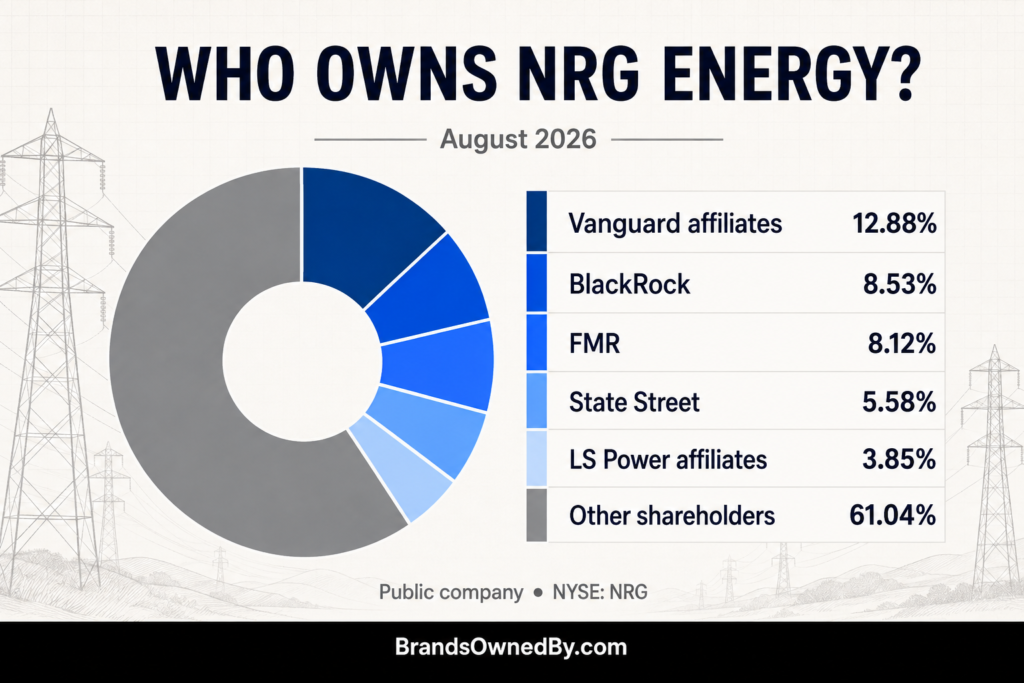
NRG holds 100% of Vivint’s equity. It includes Vivint’s assets, liabilities, revenue, expenses, and cash flows in its consolidated accounts. NRG also reports the operation as its Vivint Smart Home segment. This provides useful segment-level performance data even though Vivint is no longer a public company.
Full ownership gives NRG the legal authority to appoint Vivint’s directors and determine the subsidiary’s strategic direction. NRG can approve major financing, capital spending, acquisitions, restructuring, or a future sale. Vivint’s management runs the operating business, but it does so within priorities and budgets established by the parent company.
NRG Energy is a publicly traded energy and consumer-services company. Its shares trade on the New York Stock Exchange under the ticker NRG. The group sells electricity and natural gas, owns and operates power-generation assets, and offers services for homes and businesses.
Vivint expanded NRG beyond the traditional utility relationship. It brought approximately two million smart-home subscribers at acquisition. It also added hardware, software, professional monitoring, installation, technical support, and an established in-home sales and service network.
NRG’s strategic case was based on combining energy and connected-home services. A practical example is Vivint Home Essentials. The offer allows NRG to introduce a smart-home service to customers reached through its broader retail-energy channels. This illustrates why Vivint is more than a passive financial holding for its parent.
Vivint remains important enough to be reported as a separate operating segment. In the first half of 2026, that segment produced $595 million of adjusted EBITDA. The separate reporting indicates that NRG manages Vivint as a material operating platform while retaining full ownership at the parent level.
How NRG Acquired Vivint
NRG announced the agreement to acquire Vivint on December 6, 2022. The transaction was structured as a cash merger. NRG formed Jetson Merger Sub, Inc. as an acquisition vehicle. At closing, that entity merged into Vivint Smart Home, Inc. Vivint survived the merger and became NRG’s wholly owned subsidiary.
The offer valued each outstanding Vivint share at $12 in cash. This represented an announced equity value of approximately $2.8 billion and a premium of about 33% to Vivint’s unaffected closing share price. Including approximately $2.4 billion of net debt, NRG presented the total transaction value as $5.2 billion.
Vivint shareholders holding approximately 59% of its outstanding Class A shares approved the merger through written consent after the agreement was signed. The deal then completed on March 10, 2023. NRG’s final accounting showed about 216.9 million common shares purchased for roughly $2.603 billion, with cash payments for other equity awards bringing the acquisition-date cash consideration to approximately $2.623 billion.
NRG financed the purchase with several sources. These included $740 million of senior secured notes, $650 million of preferred stock, $900 million drawn from revolving and receivables facilities, and available cash. Therefore, the $5.2 billion transaction value should not be confused with the cash paid solely for Vivint’s common shares.
What Changed After the Acquisition
Former Vivint shareholders received cash for their shares. They did not receive NRG shares as merger consideration. Vivint’s public listing ended, and its former investors stopped holding any direct ownership interest in the business.
The Vivint name, customer contracts, technology platform, monitoring operations, sales organization, and installation network continued inside the acquired company. The legal entity survived, but its governance changed. Decisions that once required consideration of Vivint’s public shareholders moved under NRG’s corporate structure.
The acquisition also shifted Vivint’s financial profile. It became part of a larger parent with energy retail, power generation, and home-services operations. NRG assumed the economic exposure associated with Vivint’s debt, customer acquisition spending, recurring monitoring income, equipment sales, and regulatory risks.
Competitor Ownership Comparison
Vivint competes with businesses that look similar to customers but have very different owners. Some are standalone public companies. Others are controlled by private-equity firms, lenders, technology groups, or cable companies. Ownership matters because it determines who supplies capital, appoints directors, approves acquisitions, and decides whether home security remains a core business.
As of August 2026, Vivint has one direct shareholder. NRG Energy owns 100% of the company. The closest competitors do not share that exact structure. ADT has public and strategic shareholders. SimpliSafe is controlled by private equity. Amazon owns Ring. Brinks Home is privately held after a debt restructuring. Xfinity Home is an operating service within Comcast rather than a separately owned company.
| Company or brand | August 2026 direct owner | Ownership and control position | Main ownership implication |
| Vivint | NRG Energy | 100% owned subsidiary | Full strategic control rests with NRG |
| ADT | Public shareholders | Public company; State Farm is the leading disclosed strategic holder; Apollo exited in May 2026 | Investors can own the security company directly |
| SimpliSafe | GTCR-led investor group | Private-equity controlled; founders remain substantial investors and directors | Concentrated private control with limited public disclosure |
| Ring | Amazon | Amazon-owned business | Access to Amazon’s devices, retail, cloud, and AI resources |
| Brinks Home | Monitronics International’s private investor group | Principal ownership emerged from its 2023 lender-backed restructuring | Creditor-origin ownership and limited financial disclosure |
| Xfinity Home | Comcast | Internal Comcast service line; Brian Roberts holds 33 1/3% of parent voting power | Security supports a larger broadband and household-services bundle |
ADT: Public Ownership After Apollo’s Exit
ADT Inc. is a standalone public company listed on the New York Stock Exchange. Its shareholders own ADT directly. This gives investors a pure-play route into a large monitored-security provider. Vivint does not offer that option because its former public shares were cancelled when NRG completed the acquisition in 2023.
Apollo Global Management was once ADT’s controlling sponsor. That position no longer reflects the company’s ownership. Apollo-affiliated funds sold their remaining 102 million ADT shares in May 2026. Three Apollo-appointed directors resigned in connection with the exit. ADT also removed Apollo-related governance provisions from its bylaws. This ended the private-equity sponsor’s direct ownership and board influence.
State Farm is now ADT’s most important disclosed strategic shareholder. It owns 133.3 million shares. Its latest beneficial-ownership filing reported an 18.09% interest, based on ADT’s April 23, 2026 share count. ADT subsequently repurchased 29.1 million shares during Apollo’s secondary offering. Therefore, State Farm’s percentage could be higher after the buyback if its shareholding remained unchanged. State Farm also has a board nomination right and a commercial relationship with ADT.
Google owns 54.7 million Class B shares. Those shares represent a meaningful economic interest but do not vote in director elections. The investment supports ADT’s use of Google Nest products. Vanguard and other institutions also hold substantial public-market positions, but no shareholder owns a majority.
ADT’s model provides more ownership transparency than Vivint because it files its own financial statements, proxy materials, and shareholder disclosures. It also exposes ADT more directly to market pressure. Vivint can be managed as one component of NRG’s consumer platform without maintaining a separate public valuation.
SimpliSafe: GTCR-Controlled Private Ownership
SimpliSafe is privately held. However, Hellman & Friedman is no longer its controlling owner. GTCR completed its acquisition of SimpliSafe in November 2025. Financial terms and the exact equity percentages were not disclosed.
The ownership did not transfer entirely to GTCR alone. Founders Chad and Eleanor Laurans remained substantial investors and board members after the transaction. Their continuing investment preserves founder participation, while GTCR supplies the controlling capital and has the principal influence normally associated with a private-equity sponsor. SimpliSafe also appointed new executive leadership when the sale closed.
This structure gives SimpliSafe concentrated ownership and greater operating privacy. It does not publish a public shareholder table, quarterly ownership filings, or a standalone market capitalization. GTCR can support product development and expansion, but it will also expect an eventual return through a sale, recapitalization, or public offering.
The comparison with Vivint is important. Both companies are private at the operating-company level. However, Vivint has a permanent strategic parent whose main business is energy and consumer services. SimpliSafe has a financial sponsor whose investment has a defined return objective. SimpliSafe also leans toward direct-to-consumer and self-installed systems. Vivint commits more capital to professional sales, installation, monitoring, and field service.
Ring: Wholly Owned by Amazon
Amazon acquired Ring in April 2018. Ring has since operated as an Amazon-owned smart-home business rather than a separately traded company. Customers can buy Ring products, but investors cannot buy Ring shares. Any financial exposure comes through Amazon stock.
Amazon’s public shareholders ultimately own the economic interest in Ring. Amazon has a dispersed institutional and retail shareholder base. Founder and Executive Chair Jeff Bezos remains its largest individual shareholder, but no investor owns a majority. Amazon’s board and senior device executives control capital allocation for Ring.
Amazon ownership gives Ring access to a global retail channel, cloud infrastructure, artificial-intelligence resources, and a wider connected-device portfolio. Ring can be integrated with Alexa, Blink, Sidewalk, and other Amazon services. This creates a scale advantage that a standalone security company would struggle to reproduce.
Vivint competes with Ring in cameras, video doorbells, alarms, subscriptions, and connected-home access. The operating models remain different. Ring is hardware-led and designed for broad retail distribution, including self-installation. Vivint is service-led. It uses professional installation, monitoring, technicians, and a unified customer account. NRG bought Vivint to deepen its household-service relationship. Amazon uses Ring to strengthen its devices and connected-home ecosystem.
Brinks Home: Privately Held After Creditor Restructuring
Brinks Home is not owned by The Brink’s Company, the public cash-management and armored-transportation business. Monitronics International operates the home-security company under a long-term license to use the Brinks name. This brand-license arrangement is one of the most frequently misunderstood ownership structures in the market.
Monitronics is privately held following its 2023 Chapter 11 restructuring. The plan reduced funded debt by approximately $488 million and transferred principal equity ownership to lender-backed investors. Monarch Alternative Capital and Invesco-related lenders were identified as the principal owners supporting the restructuring. Current individual ownership percentages are not publicly disclosed.
This is materially different from Vivint. NRG acquired Vivint through a cash merger based on a strategic plan to build a broader consumer platform. Brinks Home’s current ownership emerged from a balance-sheet restructuring. Its owners are therefore closely connected to the company’s former debt capital and financial recovery.
Both companies offer professional monitoring and installed smart-home security. However, Vivint has access to NRG’s public-company cash flows and capital allocation. Brinks Home depends on a private capital structure and does not provide the same ongoing financial visibility. The distinction between legal ownership and brand licensing also makes its structure less straightforward than Vivint’s.
Xfinity Home: A Comcast-Owned Service Line
Xfinity Home is not a separately incorporated public security company with its own shareholders. It is a Comcast service offered under the Xfinity consumer brand. Comcast shareholders therefore own the economic interest indirectly as part of a much larger broadband and communications group.
Comcast is publicly traded, but its voting control is more concentrated than its economic ownership suggests. Brian L. Roberts owns all outstanding Class B shares. Those shares carry 33 1/3% of Comcast’s combined voting power and are generally protected against dilution. His economic interest is much smaller than that voting position. This gives the Roberts-controlled Class B stake considerable influence over the parent company that houses Xfinity Home.
The strategic logic is similar to NRG’s ownership of Vivint. Each parent can extend an existing household relationship into security and automation. Comcast begins with broadband, Wi-Fi, entertainment, and communications. NRG begins with electricity, energy services, and a large residential customer base.
There is still an important difference. Vivint is a distinct acquired subsidiary with its own brand, installed base, monitoring operations, and separately reported business metrics within NRG. Xfinity Home is a service inside the broader Xfinity platform. Comcast can use security to improve bundling and customer retention even if it does not manage the service as a standalone growth company.
What the Ownership Comparison Shows
Vivint’s ownership is strategically concentrated but financially indirect. NRG owns the entire operating company, while NRG’s shareholders own Vivint only through their NRG shares. This gives NRG complete legal control and lets it coordinate home security with energy products.
ADT offers the cleanest direct investment in residential security because it is publicly traded on its own. SimpliSafe and Brinks Home have concentrated private ownership but very different backers. GTCR owns SimpliSafe as a growth-oriented private-equity investment. Brinks Home’s ownership is rooted in lender-led restructuring. Ring and Xfinity Home have the deepest technology or connectivity ecosystems, although neither provides shareholders with a standalone security-company investment.
From a competitive standpoint, parent-company resources matter more than the ownership label alone. Amazon can fund devices and artificial intelligence at global scale. Comcast can bundle security with broadband. ADT can raise capital in its own name and use strategic shareholders such as State Farm and Google. Vivint’s advantage is NRG’s combination of consumer reach, energy capabilities, and full ownership control.
Who Controls Vivint?
Ownership and operational control are related, but they are not identical. NRG holds the legal control rights. NRG’s board and chief executive set the parent company’s capital and strategic direction. Vivint’s leaders manage the smart-home business within that framework.
NRG’s Board of Directors
NRG’s board has ultimate oversight of the consolidated company. It can approve major acquisitions, divestitures, financing decisions, executive appointments, and capital-allocation policies. Because NRG owns all Vivint equity, there is no separate group of public Vivint shareholders with competing governance rights.
The board does not normally decide routine customer-service or product matters. Those decisions are delegated through NRG management to Vivint’s operating leadership.
NRG President and CEO Robert J. Gaudette
Robert J. Gaudette became NRG’s chief executive on April 30, 2026. He is the senior executive responsible for NRG’s overall performance, including the Vivint Smart Home segment.
Gaudette can shape Vivint’s investment priorities, cross-selling strategy, cost targets, and role within NRG’s broader home-services platform. He remains accountable to NRG’s board and shareholders.
Vivint Operating Leadership
Vivint’s operating leaders manage products, sales, installation, monitoring, customer retention, technology, and service delivery. Rasesh Patel has served as Vivint’s president, while David Porter has been identified as its managing director in current company communications.
Their authority is operational. It exists within budgets, performance targets, policies, and strategic direction approved at the NRG level.
Does Any NRG Shareholder Control Vivint?
No outside NRG shareholder has majority voting control. Large fund managers can influence NRG through proxy voting and engagement, but none can unilaterally direct Vivint.
Practical control follows a clear chain. NRG shareholders elect the NRG board. The board oversees NRG’s executive management. NRG management allocates authority to Vivint’s leaders. NRG remains the legal owner throughout that chain.
Vivint Annual Revenue and Net Worth

Vivint’s revenue can be measured from historical filings and NRG’s segment reporting. “Net worth” requires more care. Vivint has no public stock price after March 2023. The most useful valuation proxy is estimated enterprise value, which measures the operating business before separating debt from equity.
Vivint Revenue in 2026
Vivint entered 2026 with strong customer and margin momentum. NRG reported 2.35 million smart-home portfolio customers at the end of 2025. This included a growing contribution from Vivint Home Essentials. The portfolio had 89.9% retention and monthly recurring revenue per customer of $75.86 during 2025.
In the first quarter of 2026, Vivint Smart Home segment revenue reached $578 million. This was materially higher than the comparable prior-year period. First-quarter adjusted EBITDA was $294 million.
Second-quarter adjusted EBITDA rose to $301 million. First-half adjusted EBITDA reached $595 million, up $56 million from the prior-year period. NRG attributed the increase to higher new-customer additions and stronger monthly recurring service margin per customer.
Based on first-half momentum, customer growth, and recurring monthly revenue, the table uses a $2.34 billion full-year revenue estimate. This is not a separate NRG guidance figure. It is an analytical estimate for Vivint’s segment.
Vivint’s economic model has four main revenue drivers.
Recurring service revenue is the foundation. Customers pay monthly fees for monitoring, software access, video services, and related support. Historically, more than 90% of Vivint’s revenue has been recurring. This creates better visibility than a hardware-only model.
Equipment revenue comes from hubs, cameras, sensors, locks, thermostats, and other devices. Financing can affect the timing of cash collection, but the equipment helps establish a long customer relationship.
Installation and service activity supports customer acquisition and system performance. Vivint’s technicians configure the equipment, connect devices, test coverage, and teach the customer how to use the system.
Smart-energy and adjacent home-service revenue remains smaller, but it matters strategically. NRG can connect security, energy management, and home services across its customer base.
Vivint Net Worth in 2026
Vivint does not have an observable market capitalization. NRG owns every share and does not publish a standalone fair value each quarter. A reasonable August 2026 enterprise-value estimate is approximately $6.15 billion.
This estimate is supported by three anchors. First, NRG paid a $5.2 billion enterprise value in 2023. Second, Vivint’s adjusted EBITDA increased from the acquisition-era run rate to $1.092 billion in 2025 and $595 million in the first half of 2026. Third, the business has recurring revenue, long customer relationships, and improving customer-acquisition economics.
Applying a conservative enterprise-value-to-adjusted-EBITDA range to an annualized 2026 earnings base produces a value near $6 billion. A higher multiple would lift the estimate. Higher borrowing costs, customer-acquisition problems, regulatory costs, or weaker retention would reduce it.
This figure should not be confused with book equity. It should also not be added directly to NRG’s market capitalization. NRG’s share price already reflects investors’ view of Vivint alongside the parent company’s energy, generation, retail, and other operations.
Revenue Forecast for 2027–2030
The forecast assumes revenue growth moderates from the stronger 2026 pace. It uses approximately 8.1% growth in 2027, 7.5% in 2028, 7.4% in 2029, and 7.5% in 2030.
These rates are supported by several operating drivers. Vivint can add new subscribers through direct sales and NRG channels. Monthly service revenue can rise with pricing and product mix. Home Essentials can reach households that may not purchase a full traditional package. Energy-management services can deepen the relationship. Product improvements can support retention and customer lifetime value.
The forecast is not risk free. Housing activity, consumer credit, equipment affordability, sales conduct, competition, and customer churn can slow growth. The estimates therefore avoid assuming double-digit expansion through the entire period.
Net Worth Forecast for 2027–2030
The estimated enterprise value rises from $6.55 billion in 2027 to $7.90 billion in 2030. The forecast assumes continued adjusted EBITDA growth and a stable, conservative valuation multiple.
The valuation can grow faster than revenue if customer-acquisition costs fall, recurring service margins expand, and retention improves. NRG reported lower net acquisition cost per new customer in 2025. That is important because Vivint spends heavily to win a household before earning service revenue over several years.
The valuation can also underperform the forecast. A lower market multiple, higher financing costs, regulatory penalties, or a sustained increase in attrition would reduce enterprise value even if revenue continues to rise.
Brands Owned by Vivint
Vivint is not a diversified holding company with dozens of independently operated subsidiaries. It is primarily one integrated brand. Its named offerings are business lines, platforms, and acquired technology rather than a portfolio of separately traded companies.

Vivint Smart Home
Vivint Smart Home is the core company and operating platform. It combines proprietary and third-party devices with software, professional installation, monitoring, and support.
NRG owns the legal company. Vivint controls the customer experience within the authority delegated by NRG. The platform’s main feature is integration. A customer does not need separate apps and service relationships for every supported device.
Vivint Home Security and Professional Monitoring
Vivint Home Security is the consumer-facing security offer. It includes intrusion sensors, cameras, video doorbells, connected locks, safety sensors, and 24/7 monitoring.
This is a Vivint service line, not a separately owned public company. Its key feature is active response. Monitoring professionals can assess qualifying alerts and contact emergency services when required.
Vivint Smart Home Automation
The automation platform connects the hub, mobile app, locks, thermostats, lights, cameras, and supported devices. Customers can create rules and manage the home remotely.
For example, a departure routine can lock doors, arm the system, and adjust temperature. The integration helps Vivint compete on convenience rather than selling isolated hardware.
Vivint Smart Energy
Vivint Smart Energy covers energy-management products and services. It uses connected devices and partnerships to help households monitor or manage energy use.
The business line is strategically important to NRG. NRG can link electricity, natural gas, demand response, thermostats, and home automation. However, Vivint Smart Energy should not be confused with the former Vivint Solar company.
Vivint Smart Properties
Vivint Smart Properties is designed for multifamily owners, developers, property managers, and residents. It applies connected locks, thermostats, access control, and smart-home management across rental properties.
This is a business offering under the Vivint platform. It is not disclosed as an independently capitalized subsidiary with outside shareholders.
Space Monkey Technology
Vivint acquired the cloud-storage startup Space Monkey in 2014. The acquisition helped strengthen local and cloud video-storage capabilities.
Space Monkey is best understood as acquired technology and talent absorbed into Vivint’s platform. It is not presented as a major standalone consumer brand in August 2026.
Vivint Solar Is Not Owned by Vivint
Vivint Solar originated alongside the broader Vivint organization, but it became a separate public company. Sunrun acquired Vivint Solar in 2020.
NRG’s purchase of Vivint Smart Home did not include ownership of the former solar company. Consumers may still associate the names because of their shared history, but the ownership chains are different.
Final Thoughts
NRG Energy owns Vivint outright. The March 2023 acquisition ended Vivint’s period as a public company and made it a wholly owned NRG subsidiary. NRG now controls the company through its board, executive management, and full equity ownership.
Vivint remains operationally distinct enough to be reported as its own NRG segment. That structure preserves the brand and its specialized smart-home model while giving it access to NRG’s capital, energy customers, and broader home-services strategy.
The ownership answer is therefore simple, even though the history is not. NRG is the direct owner. Large asset managers own indirect interests through NRG shares. Vivint’s founders, Blackstone, Mosaic investors, and former VVNT shareholders no longer own direct public stakes in the company.
Frequently Asked Questions
Who is the current owner of Vivint?
NRG Energy is the current owner of Vivint. NRG owns 100% of Vivint Smart Home as of August 2026.
Is Vivint still owned by Blackstone?
No. Blackstone controlled Vivint after its 2012 buyout and remained a major owner after the 2020 public listing. Its direct ownership ended when NRG acquired all outstanding Vivint shares in 2023.
Is Vivint a publicly traded company?
No. Vivint stopped being publicly traded after NRG completed the acquisition on March 10, 2023. The former VVNT ticker is no longer active for trading.
How much did NRG pay for Vivint?
NRG announced an equity purchase price of approximately $2.8 billion and a total transaction value of $5.2 billion, including assumed net debt. The final accounting purchase price for the equity was approximately $2.623 billion in cash.
Does BlackRock own Vivint?
BlackRock does not directly own Vivint shares. It owns NRG shares through managed funds and accounts. Its reported NRG stake therefore creates indirect economic exposure to Vivint.
Does ADT own Vivint?
No. ADT and Vivint are competitors. ADT is a separately traded security company. NRG Energy owns Vivint.
Who is the CEO of Vivint?
Vivint operates within NRG’s management structure. Rasesh Patel has served as Vivint’s president, and David Porter has been identified as managing director. Robert J. Gaudette is NRG’s president and CEO and has ultimate executive responsibility for the consolidated group.
Does Vivint own Vivint Solar?
No. Vivint Solar became a separate company and was acquired by Sunrun in 2020. It is not part of NRG’s Vivint Smart Home subsidiary.
Is Vivint owned by the Mormon Church?
No. Vivint was founded in Utah, but it is not owned by The Church of Jesus Christ of Latter-day Saints. NRG Energy owns the company.
Can investors buy Vivint stock?
Investors cannot buy standalone Vivint shares. They can buy NRG Energy stock for indirect exposure, but NRG also contains substantial energy, retail, generation, and other businesses.