

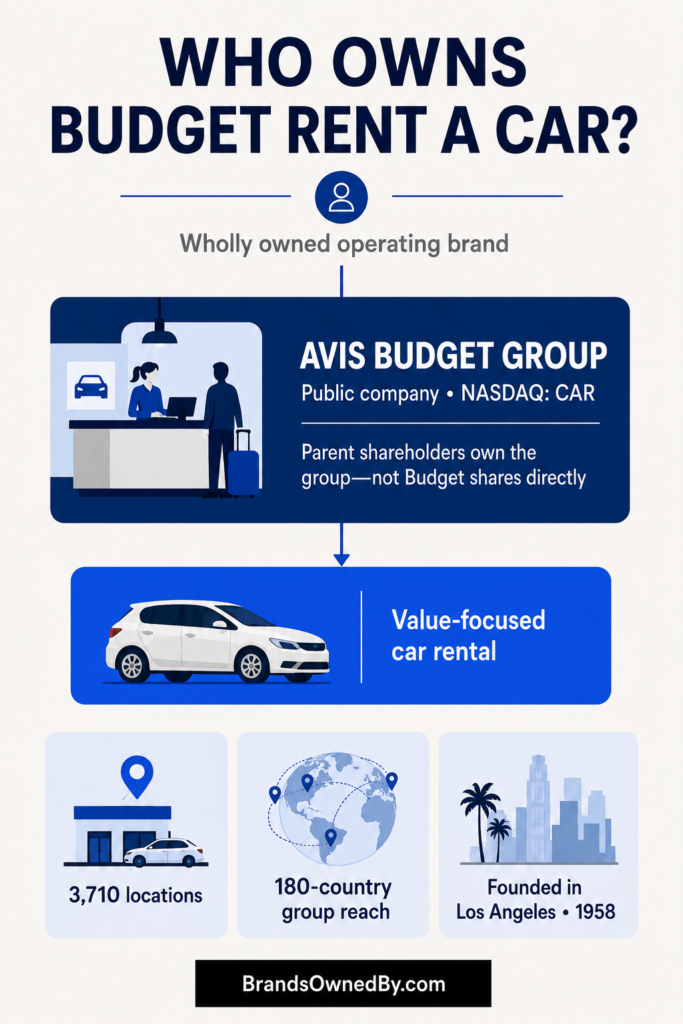
- Avis Budget Group wholly owns Budget Rent a Car. Investors own shares in the parent, not in Budget directly.
- SRS Investment Management is the dominant disclosed parent shareholder with 49.34%, subject to a proportional-voting commitment for shares above 45%.
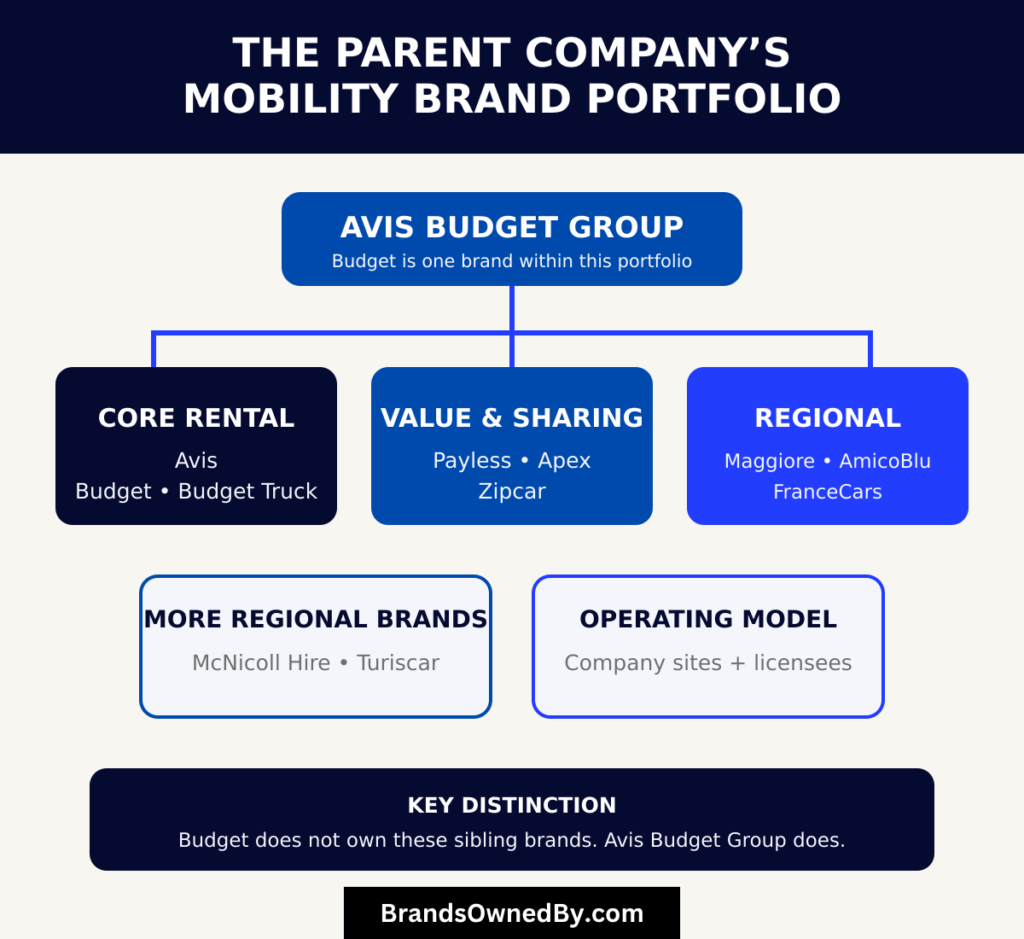
- Budget’s parent also owns Avis, Budget Truck, Zipcar, Payless, Apex, Maggiore, AmicoBlu, FranceCars, McNicoll Hire, and Turiscar.
- Budget generated $4.325 billion in 2025 and $2.088 billion in the first half of 2026, but it has no separately reported official net worth.
Budget Rent a Car is the value-focused vehicle-rental brand in Avis Budget Group’s global portfolio. It sits alongside Avis Car Rental but serves a more price-conscious customer base. The company’s network combines locations operated by Avis Budget Group subsidiaries with independently operated licensed locations.
Budget Rent a Car is not separately traded on a stock exchange. It does not have an independent public market value or shareholder register. Avis Budget Group owns and controls the brand, reports its revenue, and includes its operations in the parent company’s consolidated financial statements.
Budget Rent a Car Company Profile
Budget Rent a Car began as a small Los Angeles car-rental business in 1958. Its original proposition was easy to understand. The company offered substantially lower daily and mileage charges than the established airport-based rental operators.
That value positioning remains central to the business. Budget Rent a Car now serves customers through thousands of airport and local-market locations. Leisure renters generate most of its revenue. The company also benefits from the fleet purchasing, reservation technology, financing capacity, and operating infrastructure of Avis Budget Group.
Who Founded Budget Rent a Car?
Morris “Morey” Mirkin founded Budget Rent a Car in Los Angeles in 1958. He invested $10,000 and opened the first operation with a fleet of 10 vehicles. Mirkin and his wife initially managed the small business themselves.
The original rate was $4 per day plus 4 cents per mile. Established airport rental companies were charging considerably more. This price gap gave Budget Rent a Car a specific market position from the start. It was built for the “budget-minded” personal renter rather than the premium or corporate traveler.
Some company histories associate Jules Lederer with the founding of Budget Rent a Car. The more precise account is that Mirkin established the original business in 1958. Lederer joined in 1959 and became the key early partner who helped formalize and expand it.
Morris Mirkin’s Role in the Company’s Origin
Mirkin created the original customer proposition. Instead of competing directly for costly airport business, Budget Rent a Car initially used an off-airport model. Lower property and concession costs supported lower rental rates.
This was more than a promotional discount. It was a different cost structure. A customer who needed basic transportation could accept a less convenient location in exchange for a much lower price. That trade-off gave Budget Rent a Car a practical way to enter a market already occupied by larger rental companies.
Mirkin also gave the company a name that communicated its strategy without explanation. “Budget” signaled affordability and made the target customer clear. The name, rate structure, and operating model reinforced the same position.
Jules Lederer’s Role in Expansion
Jules Lederer joined Budget Rent a Car in 1959. His role was important, but it differed from Mirkin’s. Mirkin started the original rental business. Lederer helped turn that local operation into a structured, scalable company.
In 1960, the business was formalized as Budget Rent a Car Corporation and its headquarters moved to Chicago. The company then expanded through a combination of corporate locations and franchises. This reduced the amount of capital required to enter every new market directly.
The franchise model also gave Budget Rent a Car access to local operators who understood their markets. The central company supplied the brand and operating framework. Franchisees supplied local capital and management. That structure supported national and later international growth.
Why the Budget Rent a Car Concept Worked
Budget Rent a Car entered the market with a defined customer, a clear price advantage, and a cost base designed to support that advantage. The company did not present itself as a cheaper version of a premium service. It built its identity around practical value.
The model was also easy to replicate. A local operator could adopt the Budget Rent a Car name, follow the company’s standards, and serve value-conscious renters without building a new brand from the ground up. The combination of franchising and company-operated locations allowed the network to grow faster than a fully corporate model would have permitted.
For example, a family renting a car for a vacation normally places more weight on total price than a corporate traveler whose employer pays the bill. Budget Rent a Car’s proposition was designed for that family. This explains why leisure demand remains much more important to the company than commercial demand.
Budget Rent a Car’s Current Operating Profile
Budget Rent a Car generated $4.325 billion in revenue during 2025. That figure included Budget Truck Rental. The combined brand represented about 37% of Avis Budget Group’s $11.7 billion in consolidated revenue.
At the end of 2025, Budget Rent a Car had approximately 3,710 car-rental locations. Avis Budget Group subsidiaries operated 2,120 of them. Independent licensees operated the remaining 1,590. The network included 1,950 locations in the Americas and 1,760 in international markets.
The revenue mix shows how the original value proposition has evolved. About 83% of Budget Rent a Car’s 2025 revenue came from leisure customers. Airport rentals generated approximately 74%, even though the company began with an off-airport strategy. The Americas produced about 87% of brand revenue.
Budget Rent a Car is therefore no longer a small off-airport operator. It is a large, airport-oriented global rental network. However, its customer positioning still reflects Mirkin’s original idea: compete for renters who carefully compare price and overall value.
Ownership History of Budget Rent a Car
Budget Rent a Car has moved through founder ownership, conglomerate ownership, leveraged buyouts, public ownership, bankruptcy, and corporate consolidation. The brand’s history is more complex than a simple sale from one company to another. At several points, ownership of the central business was separate from the independent licensees operating local rental locations.
1958–1968 Founder ownership Morris Mirkin · Jules Lederer
Morris Mirkin launched Budget Rent a Car with 10 vehicles. Jules Lederer joined in 1959 and helped build its franchise-led expansion model.1968–1986 Transamerica Corporation Conglomerate ownership
Transamerica acquired the central company and supported wider corporate and international expansion. Independent franchisees continued to own many local operations.1986 Management-led buyout Approximately $205 million
Gibbons, Green, van Amerongen, company management, and selected investors acquired Budget Rent a Car through a leveraged buyout.1987 Public ownership IPO of 3.2 million shares
Budget Rent a Car sold a minority interest to public investors. The buyout group retained concentrated control.1997–2002 Budget Group, Inc. Formerly Team Rental Group
The largest U.S. franchisee acquired the central company and renamed itself Budget Group. Expansion and financing obligations contributed to mounting pressure.2002–2006 Cendant Corporation Bankruptcy asset sale
After Budget Group entered Chapter 11, Cendant bought the core assets for about $110 million and refinanced about $2.6 billion of vehicle debt. Other international rights went to Avis Europe.2006–present Avis Budget Group Cendant vehicle-rental successor
Cendant separated its other businesses and renamed the remaining rental company Avis Budget Group. Budget Rent a Car became part of its controlled subsidiary structure.2011 Global rights reunited Avis Europe acquired
Avis Budget Group acquired Avis Europe, bringing major Budget Rent a Car operations across Europe, the Middle East, and Africa back under the same parent.1958–1968: Ownership by Morris Mirkin and Jules Lederer
Morris “Morey” Mirkin established Budget Rent a Car in Los Angeles in 1958. He invested $10,000 and began with 10 vehicles. Mirkin and his wife initially managed the operation themselves.
Jules Lederer joined the business in 1959. He formed a vehicle-leasing company that helped Mirkin increase the rental fleet without buying every vehicle directly. In 1960, Mirkin and Lederer established Budget Rent a Car Corporation in Chicago.
The founders expanded Budget Rent a Car through a combination of company-operated outlets and franchises. This structure allowed the company to enter new markets without providing all the local capital. Franchisees owned and managed their individual businesses, while the central company controlled the brand and operating system.
Budget Rent a Car grew rapidly across the United States and entered international markets during the 1960s. The founders remained the central owners until the company was sold to a much larger corporate group.
1968–1986: Transamerica Corporation Ownership
Transamerica Corporation acquired Budget Rent a Car in 1968. The transaction ended the company’s founder-controlled period.
Transamerica was a diversified conglomerate with interests in insurance, financial services, transportation, and other industries. Budget Rent a Car therefore became one operating business inside a much broader corporate portfolio.
This ownership gave Budget Rent a Car access to institutional capital and corporate resources. It supported further expansion of the rental network. However, the brand was no longer controlled by Mirkin, Lederer, or their families.
Budget Rent a Car continued to use company-operated and franchised locations. Transamerica owned the central corporate business and brand system, while independent franchisees retained ownership of their local operations under contractual agreements.
1986–1987: The $205 Million Leveraged Buyout
Transamerica sold Budget Rent a Car in 1986 for approximately $205 million. The buyers included private-equity firm Gibbons, Green, van Amerongen, members of Budget Rent a Car’s management, and selected investors.
The acquisition was structured as a leveraged buyout. This meant that a meaningful portion of the purchase was financed with debt rather than being funded entirely with the buyers’ equity.
Management participation gave Budget Rent a Car’s executives a financial interest in the company. However, the transaction also introduced the financing pressure commonly associated with leveraged acquisitions. Rental-car companies already require substantial capital because they must finance large vehicle fleets. Additional acquisition debt can make that structure more demanding.
1987–1989: Budget Rent a Car Becomes Public
Budget Rent a Car returned to public ownership in 1987 through an initial public offering of 3.2 million shares. The offering sold approximately 28% of the company to public investors.
Gibbons, Green, van Amerongen and associated investors retained a controlling position after the offering. Budget Rent a Car was therefore publicly traded, but its ownership remained concentrated.
The public listing gave Budget Rent a Car access to equity capital and provided a market value for its shares. It also subjected the company to public reporting and shareholder scrutiny.
This public-company period was brief. Budget Rent a Car was taken private again through another leveraged transaction.
1989–1997: Beech Holdings and Ford Motor Company
Beech Holdings Corporation acquired Budget Rent a Car for approximately $333 million in a transaction announced in late 1988 and completed during the following ownership period. Beech Holdings included Budget Rent a Car management, Gibbons, Green, van Amerongen, and Ford Motor Company.
Ford Motor Company supplied much of the transaction’s financing by purchasing non-voting shares in Beech Holdings. This gave Ford a substantial economic interest without giving it the same voting rights attached to ordinary controlling shares.
Ford’s involvement also created a strategic relationship. A rental business needs a consistent supply of vehicles, while an automaker benefits from placing large numbers of cars into rental fleets. Rental companies can later sell those vehicles into the used-car market.
Budget Rent a Car operated as a privately controlled company during this period. Its management and financial investors remained involved, while Ford became an important capital and fleet-supply partner.
1997–2002: Team Rental Group and Budget Group, Inc.
Team Rental Group acquired Budget Rent a Car in 1997. Team Rental was already Budget Rent a Car’s largest franchisee in the United States. It had expanded by purchasing local operations and operated more than 150 locations before acquiring the central company.
The transaction had a reported value of approximately $376 million for the ownership interests involved. Broader estimates sometimes appear much higher because they include acquisition financing, vehicle obligations, and other debt-related commitments.
The acquisition reversed the usual franchise relationship. Instead of the central company acquiring a franchisee, the largest franchisee acquired the central company.
After completing the deal, Team Rental Group changed its name to Budget Group, Inc. The combined company traded on the New York Stock Exchange. Budget Rent a Car therefore returned to public ownership, but through Budget Group rather than through the previously listed corporate structure.
Budget Group expanded aggressively. It acquired additional rental operations and developed its consumer truck-rental business. In 1998, Budget Group agreed to acquire Ryder TRS, a consumer truck-rental company, in a cash-and-stock transaction worth approximately $265 million. The company also assumed substantial Ryder TRS debt.
These acquisitions increased the scale of Budget Group. They also added debt, fleet-financing obligations, and integration demands. The rental business was particularly sensitive to financing costs, vehicle resale values, travel demand, and access to asset-backed credit.
2002: Bankruptcy Ends Budget Group Ownership
Budget Group filed for Chapter 11 bankruptcy protection in 2002. The company had significant debt and vehicle-financing obligations that it could no longer manage under its existing capital structure.
The bankruptcy did not mean that Budget Rent a Car stopped operating. Chapter 11 allowed the business to continue serving customers while its assets were sold and its financial obligations were addressed.
Budget Group was delisted from the New York Stock Exchange. Its shareholders lost control of the Budget Rent a Car assets as the company moved through the court-supervised sale process.
The bankruptcy marked the end of Budget Group as the long-term corporate owner. It also led to a geographic division of Budget Rent a Car’s operations and brand rights.
2002–2006: Cendant Corporation Acquires the Core Operations
Cendant Corporation agreed to purchase substantially all of Budget Group’s domestic assets and selected international operations in 2002. The transaction covered Budget Rent a Car operations in the United States, Canada, Latin America, the Caribbean, Australia, and New Zealand.
Cendant paid approximately $110 million in cash, excluding transaction expenses. It also refinanced approximately $2.6 billion in asset-backed vehicle debt. The large difference between the cash purchase price and the vehicle financing shows why the transaction cannot be understood from the headline cash payment alone.
Cendant already owned Avis Car Rental. The acquisition placed Avis Car Rental and Budget Rent a Car under the same corporate owner.
Cendant maintained the two businesses as separate customer-facing brands. Avis Car Rental remained more closely associated with commercial and premium renters. Budget Rent a Car retained its value-oriented and leisure-focused position.
The brands could share administrative systems, fleet purchasing capabilities, financing arrangements, technology, and corporate overhead without being presented to customers as the same rental service.
Budget Rent a Car’s headquarters moved from Lisle, Illinois, to Parsippany, New Jersey, where Cendant’s vehicle-rental operations were based.
The 2002 Geographic Division of Budget Rent a Car
Cendant did not acquire every Budget Rent a Car operation worldwide in the bankruptcy transaction. Other international assets and rights were sold to Avis Europe plc.
This created a divided global ownership structure. Cendant controlled the Budget Rent a Car business in the United States and several other major markets. Avis Europe controlled or licensed Budget Rent a Car operations across Europe, the Middle East, Africa, and parts of Asia.
The two groups were commercially connected but independently owned. As a result, the Budget Rent a Car name appeared globally even though all regional operations were not yet controlled by one parent company.
Local franchisees and licensees added another layer. A customer could rent from a Budget Rent a Car location operated by an independent business, even though the brand rights were ultimately controlled by Cendant or Avis Europe in that territory.
2006: Budget Rent a Car Becomes Part of Avis Budget Group
Cendant separated its major businesses in 2006. Its real-estate operations became Realogy. Its hospitality operations became Wyndham Worldwide. Its travel-distribution business was sold as Travelport.
The remaining company primarily contained the Avis Car Rental, Budget Rent a Car, and Budget Truck Rental operations. Cendant changed its name to Avis Budget Group, Inc.
Budget Rent a Car System, Inc. became a subsidiary within the Avis Budget Group structure. This established the parent-company relationship that continues in August 2026.
The ownership change was different from a conventional acquisition. Avis Budget Group did not purchase Budget Rent a Car from an outside seller in 2006. Cendant already owned the relevant business. The Cendant name disappeared after the unrelated divisions were separated, and the remaining vehicle-rental company was renamed Avis Budget Group.
2011: Global Brand Rights Are Reunited
Avis Budget Group acquired Avis Europe plc in 2011. Avis Europe had been an independently owned licensee operating the Avis Car Rental and Budget Rent a Car brands across Europe, the Middle East, and Africa. It also controlled Avis-branded operations in parts of Asia.
The acquisition reunited major international Budget Rent a Car operations with the parent company that controlled the brand in the Americas and other markets.
This was an important ownership milestone. Before the transaction, Budget Rent a Car had a shared global identity but a divided corporate structure. After the Avis Europe acquisition, substantially more of the international brand network came under Avis Budget Group’s ownership and strategic control.
The transaction also gave Avis Budget Group greater authority over global fleet strategy, technology, licensing, marketing, and operating standards.
2011–Present: Consolidation Under Avis Budget Group
Budget Rent a Car has remained part of Avis Budget Group since 2006. Later acquisitions and licensee buyouts expanded the number of locations directly controlled by the parent company.
For example, Avis Budget Group acquired certain long-standing licensee operations in markets such as Southern California, Las Vegas, Poland, and other international territories. These transactions converted some independently operated locations into company-operated businesses.
This did not represent a change in ownership of the global Budget Rent a Car brand. It changed who operated particular regional locations.
As of August 2026, Avis Budget Group owns Budget Rent a Car through its controlled subsidiary structure. Independent licensees continue to operate many individual locations, but they do not own the global brand, trademarks, reservation network, or overall corporate system.
Investors cannot purchase shares in Budget Rent a Car as a standalone company. They obtain an indirect ownership interest by purchasing shares of Avis Budget Group. Changes in the shareholder base of Avis Budget Group therefore affect the ultimate ownership of Budget Rent a Car, even though the brand itself remains wholly controlled within the parent company.
Who Owns Budget Rent a Car?
Avis Budget Group, Inc. owns Budget Rent a Car. The brand operates through Budget Rent A Car System, Inc. and other regional subsidiaries within the Avis Budget Group structure.
Budget Rent a Car is not an independently traded company. It does not have its own public shareholders, stock ticker, or separate market capitalization. Its financial results are included in the consolidated accounts of Avis Budget Group.
![Who Owns Budget Rent a Car [Parent company]](https://brandsownedby.com/wp-content/uploads/2026/08/Who-Owns-Budget-Rent-a-Car-Parent-company-1024x805.png)
Avis Budget Group, Inc.: The Parent Company
Avis Budget Group is a publicly traded mobility company headquartered in Parsippany, New Jersey. Its shares trade on the Nasdaq Global Select Market under the ticker CAR.
The parent company owns and operates several mobility brands. Its three most prominent brands are Avis Car Rental, Budget Rent a Car, and Zipcar.
Budget Rent a Car is positioned as the group’s value-focused rental brand. Avis Car Rental targets a more premium and commercially oriented customer base. The two brands remain separate in the market, but they share parts of the same corporate infrastructure.
Avis Budget Group owns the Budget Rent a Car trademarks, central reservation infrastructure, operating systems, and related intellectual property through its subsidiaries. The parent company also includes Budget Rent a Car’s company-operated revenue, expenses, assets, and liabilities in its consolidated financial statements.
Did Avis Budget Group Acquire Budget Rent a Car?
Avis Budget Group did not acquire Budget Rent a Car under its current corporate name. Its predecessor, Cendant Corporation, acquired the core Budget Rent a Car business in 2002.
The acquisition followed the financial collapse of Budget Group, Inc., which then owned Budget Rent a Car. Budget Group had expanded through debt-financed acquisitions and carried substantial vehicle-financing obligations. It filed for Chapter 11 bankruptcy protection in 2002.
The bankruptcy created an opportunity for Cendant to acquire the Budget Rent a Car brand and major operating assets through a court-supervised transaction.
Cendant’s 2002 Acquisition of Budget Rent a Car
Cendant agreed to acquire substantially all of Budget Group’s domestic vehicle-rental assets and selected international operations in August 2002. The transaction closed in November 2002.
The purchase included the Budget Rent a Car brand, the U.S. car-rental operations, the Budget Truck Rental business, and selected operations outside the United States.
The announced cash consideration was approximately $107.5 million. Cendant later described the purchase price as approximately $110 million before transaction costs. The relatively small cash amount did not represent the full financial scale of the deal.
Cendant also refinanced approximately $2.6 billion of Budget Group’s asset-backed vehicle debt. This debt had been used to finance the rental fleet. The vehicle-financing requirement was therefore much larger than the direct cash payment for the business assets.
The transaction gave Cendant control of Budget Rent a Car operations in:
- The United States.
- Canada.
- Latin America.
- The Caribbean.
- Australia.
- New Zealand.
Cendant also acquired selected additional assets and contractual rights connected with the business.
Why Cendant Acquired Budget Rent a Car
Cendant already owned Avis Car Rental when it purchased Budget Rent a Car. The acquisition allowed the company to serve two distinct parts of the vehicle-rental market.
Avis Car Rental had a stronger position among business travelers and premium customers. Budget Rent a Car was more heavily associated with leisure travelers and customers who prioritized price.
Cendant kept the brands separate rather than combining them into one rental identity. This preserved their different market positions.
At the same time, Cendant could combine parts of their corporate infrastructure. The brands could share fleet purchasing, vehicle financing, airport facilities, reservation technology, administrative systems, and back-office functions.
For example, Avis Car Rental and Budget Rent a Car may use vehicles from a shared fleet in markets where both brands operate. The customer still books through a separate brand with its own pricing and service proposition.
The acquisition therefore created a premium-and-value brand structure. That structure remains central to Avis Budget Group’s business model.
What Happened to Budget Rent a Car’s Other International Operations?
Cendant did not acquire every Budget Rent a Car operation worldwide in the 2002 bankruptcy transaction.
Other international assets and regional rights were sold to Avis Europe plc. Avis Europe was an independently owned company that operated the Avis and Budget brands under licensing arrangements in Europe, the Middle East, Africa, and parts of Asia.
This produced a divided ownership structure. Cendant controlled Budget Rent a Car in the United States and several other major markets. Avis Europe operated Budget Rent a Car across many international territories.
The customer-facing brand appeared global, but the underlying companies were not yet controlled by the same corporate parent.
Cendant Becomes Avis Budget Group
Cendant remained the parent company of the acquired Budget Rent a Car business from 2002 until 2006.
Cendant was a diversified corporation with businesses in vehicle rental, real estate, hospitality, and travel distribution. It later decided to separate these divisions into independent companies.
Its real-estate business became Realogy. Its hospitality operations became Wyndham Worldwide. Its travel-distribution division was sold as Travelport.
After these transactions, the remaining Cendant business primarily consisted of Avis Car Rental, Budget Rent a Car, and Budget Truck Rental. Cendant changed its name to Avis Budget Group, Inc. in September 2006.
This was not another acquisition of Budget Rent a Car. Cendant already owned the business. The name change reflected the fact that vehicle rental had become the remaining company’s core operation.
Budget Rent A Car System, Inc. became a subsidiary within the newly named Avis Budget Group structure.
The 2011 Acquisition of Avis Europe
Avis Budget Group completed another important transaction on October 3, 2011. It acquired the entire issued share capital of Avis Europe plc.
Avis Europe operated the Budget Rent a Car brand through approximately 950 locations in 59 countries. It also operated more than 3,100 Avis locations across 112 countries.
Avis Budget Group paid approximately $976 million for Avis Europe’s share capital. It subsequently repaid approximately $649 million of debt assumed with the acquired company.
The transaction reunited the major global Avis Car Rental and Budget Rent a Car operations under one corporate parent. Before the acquisition, Avis Budget Group and Avis Europe operated connected brands in different territories. After the acquisition, the parent company gained direct ownership of major operations across Europe, the Middle East, Africa, and Asia.
This gave Avis Budget Group a more consistent global platform. It could coordinate brand strategy, technology, fleet management, licensing, and capital investment across a much larger international network.
Budget Rent a Car’s Current Relationship With Avis Budget Group
As of August 2026, Budget Rent a Car remains a wholly owned brand within Avis Budget Group.
Avis Budget Group controls the brand through operating subsidiaries in the United States and international markets. Budget Rent A Car System, Inc. is one of the principal U.S. legal entities associated with the business.
Other Budget Rent a Car subsidiaries include companies registered in markets such as Australia, New Zealand, and Canada. The specific legal entity responsible for a rental depends on the country and operating structure.
Avis Budget Group reports Budget Rent a Car as a major brand rather than as an independent financial segment. The brand generated approximately $4.325 billion in revenue during 2025, including Budget Truck Rental.
Company-Operated and Licensed Locations
Avis Budget Group does not directly operate every Budget Rent a Car location.
At the end of 2025, the Budget Rent a Car network included approximately 3,710 car-rental locations. Avis Budget Group subsidiaries operated 2,120 locations. Independent licensees operated approximately 1,590.
Licensees own or manage their local operating businesses under agreements with Avis Budget Group. They receive permission to use the Budget Rent a Car name, systems, and reservation network in defined territories.
A licensee does not own the global brand. Avis Budget Group and its subsidiaries retain ownership of the central trademarks, intellectual property, and corporate system.
The mixed structure allows Budget Rent a Car to maintain a broad international presence without Avis Budget Group directly funding and operating every location.
Competitor Ownership Comparison
As of August 2026, Budget Rent a Car competes against brands operating under several distinct ownership models. Some belong to publicly traded rental groups, while others are controlled by founding families or private investment consortiums.
| Competitor group | Parent company or owner | Ownership model | Major rental brands |
|---|---|---|---|
| Budget Rent a Car | Avis Budget Group, Inc. | Public company | Avis, Budget Rent a Car, Payless, Zipcar |
| Enterprise Rent-A-Car | Enterprise Mobility | Private, Taylor family-owned | Enterprise, National, Alamo |
| Hertz | Hertz Global Holdings, Inc. | Public company | Hertz, Dollar, Thrifty |
| Sixt | Sixt SE | Public, Sixt family-controlled | Sixt |
| Europcar | Green Mobility Holding S.A. | Private consortium | Europcar, Goldcar, Fox Rent A Car |
Enterprise Rent-A-Car: Privately Owned by the Taylor Family
Enterprise Rent-A-Car is owned by Enterprise Mobility, a privately held company controlled by the Taylor family of St. Louis, Missouri. Jack Taylor founded the business in 1957, and the company remains under family ownership several generations later.
Enterprise Mobility is one of the largest vehicle rental organizations in the world. It operates more than 2.4 million vehicles and over 9,500 locations across more than 90 countries and territories. Its operations generated approximately $39 billion in revenue during its 2025 fiscal year.
The group’s private ownership distinguishes it from Avis Budget Group, Inc., the publicly traded parent company of Budget Rent a Car. Enterprise Mobility does not answer to public shareholders or publish the same level of quarterly financial information as a listed company. This structure allows the Taylor family to retain a long-term approach to expansion, fleet investment and customer service.
Enterprise Rent-A-Car is the group’s flagship brand. It is particularly strong in neighborhood rentals, insurance replacement vehicles and local transportation. Budget Rent a Car has traditionally maintained a stronger value-oriented identity and greater emphasis on airport and leisure customers.
National Car Rental and Alamo Rent A Car: Part of Enterprise Mobility
National Car Rental and Alamo Rent A Car are not independently owned competitors. Both belong to Enterprise Mobility and operate alongside Enterprise Rent-A-Car.
The Taylor family expanded into these brands in 2007 by acquiring Vanguard Car Rental Group. Vanguard owned National Car Rental and Alamo Rent A Car at the time. The acquisition gave Enterprise a broader airport network and allowed it to compete across several customer segments.
Each brand serves a different role:
- National Car Rental primarily targets business travelers and frequent renters.
- Alamo Rent A Car focuses on leisure travelers, families and vacation destinations.
- Enterprise Rent-A-Car serves local, replacement and general rental demand.
Alamo Rent A Car is the most direct competitor to Budget Rent a Car within this portfolio because both brands emphasize value-conscious leisure customers. National Car Rental generally competes more closely with premium and business-focused rental services.
Enterprise Mobility’s ownership of all three brands gives it a broad market presence without requiring a single brand to serve every type of renter. Avis Budget Group, Inc. follows a comparable multi-brand approach, using Avis for more premium and business-oriented demand and Budget Rent a Car for value-focused customers.
Hertz, Dollar and Thrifty: Owned by Hertz Global Holdings
Hertz, Dollar and Thrifty are owned by Hertz Global Holdings, Inc., a publicly traded vehicle rental company. The Hertz Corporation functions as the group’s main operating subsidiary.
Hertz is the group’s principal global brand. Dollar Rent A Car and Thrifty Car Rental provide lower-priced alternatives aimed largely at leisure travelers and cost-conscious renters. As a result, Dollar and Thrifty compete more directly with Budget Rent a Car than the flagship Hertz brand does in many markets.
Hertz Global Holdings operates through a combination of company-operated and franchised locations. At the end of 2025, its brands were represented at approximately 11,000 locations across around 160 countries and jurisdictions.
The company’s present ownership structure resulted from its financial reorganization. Hertz filed for Chapter 11 bankruptcy protection in May 2020 after the sharp decline in travel demand created severe liquidity and fleet-financing pressures. It emerged from bankruptcy in June 2021 under a reorganized public company with new investors and a substantially restructured balance sheet.
Among the major competitors, Hertz Global Holdings has the ownership model most similar to Avis Budget Group, Inc. Both are publicly traded American companies that own several rental brands positioned at different price levels. Both also rely on a combination of directly operated locations, franchises and international licensing arrangements.
The main difference is corporate history. Budget Rent a Car became part of its current group through Cendant Corporation’s acquisition of Budget’s principal assets in 2002. Hertz retained its core corporate identity but passed through bankruptcy and financial restructuring before returning as a reorganized public company.
Sixt: Publicly Listed but Family-Controlled
Sixt is owned by Sixt SE, a publicly listed German mobility company. However, it differs from Avis Budget Group, Inc. and Hertz Global Holdings because the founding Sixt family retains a controlling position.
As of August 2026, Erich Sixt Vermögensverwaltung GmbH holds approximately 58.3% of Sixt SE’s ordinary voting shares. That company is owned directly and indirectly by members of the Sixt family. Public investors can purchase Sixt shares, but the family remains the company’s long-term controlling shareholder.
Sixt was founded in Munich in 1912 and has remained closely associated with the Sixt family throughout its history. The company operates directly in important European and North American markets while using franchise and cooperation partners in other territories.
Unlike Avis Budget Group, Inc., Enterprise Mobility and Hertz Global Holdings, Sixt does not depend on a large portfolio of separately positioned international rental brands. Most of its market presence is concentrated under the Sixt name. The brand generally emphasizes premium vehicles, digital booking and higher-value airport customers.
Sixt’s ownership model combines access to public capital with stable family leadership. Budget Rent a Car, by comparison, operates as one brand within a publicly owned multi-brand group and does not have comparable founder-family ownership.
Europcar, Goldcar and Fox Rent A Car: Owned by a Private Consortium
Europcar Mobility Group is privately owned by Green Mobility Holding S.A. The holding company is backed by three major investors:
- Volkswagen Group holds a 66% economic interest.
- Attestor holds a 27% interest.
- Pon Holdings holds a 7% interest.
The consortium acquired Europcar Mobility Group through a public tender process completed in 2022. The transaction valued the company at approximately €2.5 billion. After acquiring the remaining shares through a squeeze-out procedure, Green Mobility Holding took full ownership and Europcar was removed from the public stock market.
Volkswagen’s involvement made the acquisition strategically different from a conventional rental-company takeover. The investment gave the automotive group a direct position in vehicle rental and mobility services. Attestor contributed investment and restructuring experience, while Pon Holdings brought additional automotive and mobility expertise.
Europcar Mobility Group owns several brands serving different market segments. Europcar is its main international rental brand. Goldcar concentrates on lower-cost leisure rentals, particularly in European vacation markets. Fox Rent A Car provides a value-oriented presence in the United States.
Goldcar and Fox Rent A Car therefore compete more directly with Budget Rent a Car on price and leisure travel. Europcar’s primary brand competes across a broader mix of leisure, airport and business rentals.
Europcar differs from Budget Rent a Car because it belongs to a privately held consortium led economically by a major vehicle manufacturer. Budget Rent a Car belongs to Avis Budget Group, Inc., an independent publicly traded mobility and vehicle rental company.
What the Ownership Differences Mean for Budget Rent a Car
Budget Rent a Car operates in a market where many apparently separate competitors share the same parent company. Enterprise Rent-A-Car, National Car Rental and Alamo Rent A Car all belong to Enterprise Mobility. Hertz, Dollar and Thrifty belong to Hertz Global Holdings. Europcar, Goldcar and Fox Rent A Car operate within Europcar Mobility Group.
This consolidation allows competing groups to address different customer segments through separate brands while sharing fleet purchasing, technology, distribution and administrative infrastructure.
Budget Rent a Car follows the same broad portfolio strategy within Avis Budget Group, Inc. Its role is to attract value-conscious leisure and business customers, while Avis primarily serves customers seeking a more premium rental experience. This places Budget Rent a Car in the closest competitive range with Alamo Rent A Car, Dollar Rent A Car, Thrifty Car Rental, Goldcar and Fox Rent A Car.
The principal ownership distinction is that Budget Rent a Car and the Hertz brands belong to publicly traded American rental groups. Enterprise’s brands are privately owned by a founding family, Sixt combines public ownership with family control, and Europcar belongs to a private consortium led economically by Volkswagen Group.
Who Controls Budget Rent a Car?
Budget Rent a Car does not have a separate controlling owner, board or chief executive. The brand is controlled through Avis Budget Group, Inc., its publicly traded parent company. Strategic authority flows from Avis Budget Group’s shareholders to its board and then to the group’s executive leadership.
Corporate Control Sits With Avis Budget Group
Avis Budget Group controls the Budget Rent a Car brand, its intellectual property, corporate strategy and company-operated rental network. The parent company determines fleet investment, pricing systems, technology spending, brand positioning and major commercial partnerships.
Budget Rent a Car is integrated with the group’s other operations. It shares vehicles, rental facilities, reservation technology and administrative infrastructure with Avis and other brands where operationally practical. This means important decisions are generally made at the group or regional level, rather than by a separate Budget Rent a Car management team.
SRS Investment Management Has the Strongest Shareholder Influence
Avis Budget Group is publicly traded, but its ownership is unusually concentrated. As of March 25, 2026, SRS Investment Management beneficially owned approximately 17.43 million shares, representing 49.34% of the company’s outstanding common stock.
SRS is therefore the most influential shareholder behind the parent company. However, its ownership does not make Budget Rent a Car a privately owned SRS business. Avis Budget Group remains a listed company with an elected board and public shareholders.
A cooperation agreement also limits how SRS votes shares held above 45% of Avis Budget Group’s outstanding stock. Voting rights attached to those excess shares must generally be exercised in the same proportion as votes cast by other shareholders. This restriction prevents the position above 45% from automatically creating unrestricted majority voting power.
SRS nevertheless has a significant presence in Avis Budget Group’s governance. Jagdeep Pahwa, president of SRS Investment Management, serves as executive chairman. Karthik Sarma, SRS’s founder and managing partner, is a director and chairs the board’s compensation committee. Chief Executive Officer Brian Choi was also a partner at SRS before joining Avis Budget Group’s executive team.
These connections give SRS substantial strategic influence without replacing the company’s formal board and management structure.
The Board Provides Strategic Oversight
Avis Budget Group’s six-member board was reelected at the company’s annual shareholder meeting on May 20, 2026. It consists of Jagdeep Pahwa, Anu Hariharan, Bernardo Hees, Lynn Krominga, Glenn Lurie and Karthik Sarma.
Jagdeep Pahwa has served as executive chairman since March 2025. He leads the board and works with management on the company’s strategic direction. Lynn Krominga serves as lead independent director, providing an additional layer of independent board oversight.
The board’s audit, compensation and corporate governance committees consist entirely of directors classified as independent under Nasdaq standards. These committees oversee financial reporting, executive pay, board nominations, internal controls and regulatory compliance.
The board appoints the company’s senior officers and can remove them. It also approves major matters affecting Budget Rent a Car, including senior leadership changes, capital allocation, fleet financing and significant strategic transactions.
Brian Choi Leads Day-to-Day Corporate Management
Brian Choi has served as chief executive officer of Avis Budget Group since July 1, 2025. He is the senior executive responsible for the performance of Budget Rent a Car and the parent company’s other brands.
Choi previously served as chief transformation officer and chief financial officer. His current priorities include fleet discipline, vehicle utilization, pricing, technology and customer experience. These areas directly affect Budget Rent a Car because vehicle purchasing and disposal, rental rates and digital systems are managed across the broader group.
Daniel Cunha has served as executive vice president and chief financial officer since July 2025. He oversees the company’s finances, capital structure and financial planning. His role is important because rental fleet purchases require substantial financing and careful management of vehicle depreciation and resale values.
James Adams became executive vice president and chief revenue officer in January 2026. He leads global revenue management, including the pricing and demand-management systems used across the group’s rental brands.
Ravi Simhambhatla serves as executive vice president and chief digital and innovation officer. He leads the global technology organization responsible for digital reservations, customer-facing systems and operational technology.
Regional Leaders Manage Rental Operations
Operational responsibility is divided between the Americas and International segments rather than assigned to a separate global president of Budget Rent a Car.
John O’Neill became executive vice president and chief operating officer for the Americas in January 2026. He oversees operations in the United States and Canada, including field operations, fleet management, workforce planning, local-market rentals and the truck-rental business.
Anna Pawlak-Kuliga serves as president of International. She is responsible for the group’s operations across Europe, the Middle East, Africa, Asia, Australia and New Zealand.
These regional executives manage both Budget Rent a Car and other Avis Budget Group brands in their territories. This structure allows the parent company to coordinate fleet capacity, staffing and facilities across brands while maintaining Budget Rent a Car’s value-focused market position.
Control Varies Between Corporate and Licensed Locations
Avis Budget Group directly controls company-operated Budget Rent a Car locations. As of December 31, 2025, the network included approximately 2,120 company-operated locations and 1,590 licensee locations.
Independent licensees own and operate licensed locations under agreements with Avis Budget Group. They manage local staffing and routine operations but must follow the group’s brand, service and operating requirements. They also pay royalty fees based on applicable revenue.
Therefore, direct operational control depends on the location. Avis Budget Group exercises full corporate control over company-operated businesses and contractual brand control over licensed operations.
The Practical Control Structure
In practical terms, Budget Rent a Car is controlled through four connected levels:
- Avis Budget Group shareholders elect the parent company’s board.
- The board, led by Executive Chairman Jagdeep Pahwa, sets oversight and appoints senior management.
- Chief Executive Officer Brian Choi and the executive team establish group strategy and operating priorities.
- Regional executives and licensees implement those decisions across individual markets.
SRS Investment Management has the strongest shareholder influence because of its near-50% beneficial ownership and its representation within the board’s leadership. Formal authority, however, remains divided among the elected board, its independent committees and Avis Budget Group’s executive management.
Budget Rent a Car Annual Revenue and Net Worth
Budget Rent a Car does not publish standalone financial statements. Its financial results are consolidated into those of Avis Budget Group, Inc. However, the parent company reports revenue generated under the Budget Rent a Car brand, which provides a reliable measure of its operating scale.
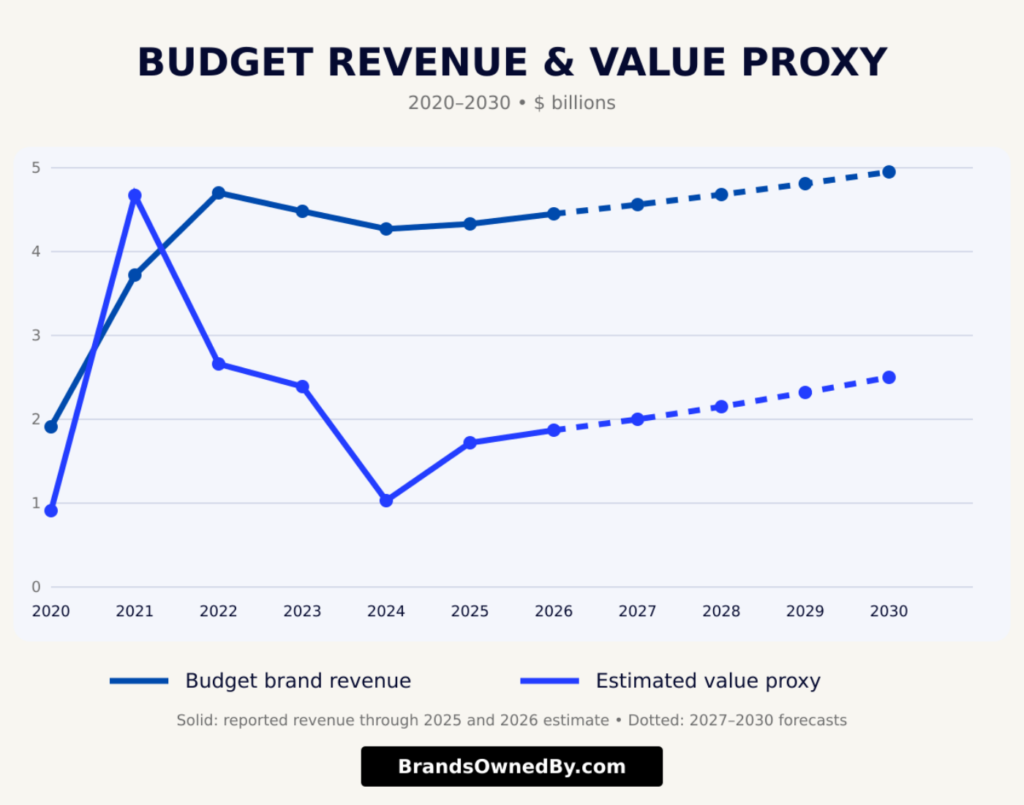
Budget Rent a Car Annual Revenue
Budget Rent a Car generated approximately $4.3 billion in revenue during 2025. This represented about 37% of Avis Budget Group’s consolidated revenue of $11.7 billion.
The reported figure primarily covers company-operated Budget Rent a Car activities. These include vehicle rentals, Budget Truck operations and ancillary products such as fuel options, roadside assistance, toll services and other rental-related charges. Avis Budget Group also earns royalties from independently operated locations. Licensee royalties accounted for approximately 1% of Budget Rent a Car revenue in 2025.
Revenue fell sharply in 2020 because pandemic restrictions reduced airport traffic and general travel demand. Budget Rent a Car revenue recovered to $3.7 billion in 2021 and reached $4.7 billion in 2022 as rental demand and pricing strengthened.
Revenue then declined to $4.5 billion in 2023 and $4.3 billion in 2024. It remained at approximately $4.3 billion in 2025. The recent pattern indicates that the brand has retained much of its post-pandemic scale, but the unusually strong pricing conditions of 2022 have moderated.
Latest 2026 Financial Performance
A complete 2026 revenue figure for Budget Rent a Car was not available as of August 2026 because the financial year was still in progress. Avis Budget Group had reported results through June 30, 2026, but its quarterly announcement did not provide a separate year-to-date revenue figure for the Budget Rent a Car brand.
The parent company generated $5.528 billion in revenue during the first six months of 2026. This was 1% higher than the $5.469 billion reported during the same period in 2025.
Second-quarter revenue was $2.998 billion, down 1% from $3.039 billion a year earlier. Rental days declined 2%, while reported revenue per rental day increased 1%. The average fleet was reduced by 5%, but vehicle utilization improved from 70.7% to 72.6%.
These figures show that Avis Budget Group protected revenue by operating a smaller fleet more efficiently. The company also reduced per-unit fleet costs by 4% during the second quarter. Its second-quarter 2026 results reported net income of $63 million and adjusted EBITDA of $286 million.
For the first six months of 2026, the group recorded a net loss of $171 million. The loss attributable specifically to Avis Budget Group shareholders was $248 million. Adjusted EBITDA was $173 million, compared with $184 million during the first half of 2025.
How Budget Rent a Car Generates Revenue
Vehicle rental charges are the primary source of Budget Rent a Car revenue. The amount collected depends on rental volume, rental duration and the average daily rate charged for each vehicle.
The brand also earns revenue from optional and usage-based products. These can include:
- Collision and damage-waiver products.
- Additional driver charges.
- Fuel purchase options.
- Child safety seats and other equipment.
- Roadside assistance.
- Electronic toll services.
- Vehicle licensing and airport concession recoveries.
- Budget Truck rentals.
- Licensee royalties.
Airport demand remains important because airport customers often rent vehicles for several days and purchase additional services. Off-airport locations support local rentals, insurance-replacement demand and Budget Truck activity.
Revenue should not be confused with profit. Vehicle rental companies face substantial fleet depreciation, vehicle interest, staffing, maintenance, insurance and airport concession costs. Small movements in fleet costs or used-vehicle resale prices can therefore have a much larger effect on profit than on revenue.
What Is Budget Rent a Car’s Net Worth?
Budget Rent a Car does not have a separately reported net worth. It is a wholly owned brand within Avis Budget Group rather than an independently listed company. Avis Budget Group does not publish a standalone balance sheet, market capitalization or formal valuation for the Budget Rent a Car business.
Assigning the parent company’s entire market value to Budget Rent a Car would be misleading. Avis Budget Group also owns Avis, Zipcar, Payless Car Rental, Apex Car Rentals, Budget Truck Rental and several regional mobility brands.
Budget Rent a Car’s $4.3 billion in annual revenue confirms that it is a major part of the parent company. However, revenue alone cannot establish the brand’s value. A credible standalone valuation would also require brand-specific profit, cash flow, fleet obligations, debt allocation and capital expenditure data. Avis Budget Group does not publicly disclose all of these figures for Budget Rent a Car.
Avis Budget Group’s Accounting Net Worth
The closest audited measure is Avis Budget Group’s stockholders’ equity. This represents assets minus liabilities under accounting rules.
Stockholders’ equity attributable to Avis Budget Group was negative $3.129 billion at December 31, 2025. It declined to negative $3.388 billion at June 30, 2026.
Negative stockholders’ equity does not mean Budget Rent a Car has no commercial value. Avis Budget Group’s balance sheet includes more than $10 billion of treasury stock recorded at cost following historical share repurchases. Recent net losses have also reduced retained earnings.
The group remained operationally funded at June 30, 2026. It reported approximately $1 billion in liquidity and another $1.9 billion in available fleet-funding capacity. The more relevant issue is therefore the company’s ability to generate cash, finance vehicles and manage fleet depreciation rather than the negative book-equity figure alone.
Market Value Is Different From Accounting Net Worth
Market capitalization represents the stock market’s valuation of Avis Budget Group’s equity. It is calculated by multiplying the company’s share price by its outstanding shares.
Avis Budget Group had approximately 35.3 million weighted-average shares outstanding during the second quarter of 2026. When its shares traded near $144 following the July 2026 earnings release, the implied market capitalization was approximately $5.1 billion.
This market value covered the entire Avis Budget Group portfolio. It was not a valuation of Budget Rent a Car alone. It also changed significantly during 2026 because the company’s relatively limited public share supply contributed to unusually volatile trading.
Market capitalization and accounting equity answer different questions. Market capitalization reflects what investors are willing to pay for the parent company’s future earnings and cash flow. Stockholders’ equity reflects historical accounting values after liabilities, losses and treasury-stock transactions.
Financial Assessment
Budget Rent a Car remains a large revenue-generating brand. Its $4.3 billion of 2025 revenue accounted for more than one-third of Avis Budget Group’s consolidated business.
The brand’s revenue has stabilized after declining from its 2022 peak. Current performance depends less on rapid revenue growth and more on fleet utilization, rental pricing and vehicle costs. Avis Budget Group’s second-quarter 2026 figures show improvement in utilization and fleet costs, but weaker rental volume remains a constraint.
The most accurate conclusion is that Budget Rent a Car does not have a publicly disclosed standalone net worth. Its financial value is embedded within Avis Budget Group. The parent had negative accounting equity of $3.388 billion at June 30, 2026, while its publicly traded equity carried a positive multibillion-dollar market value.
Revenue and Valuation Forecast for 2026–2030
The values shown for 2026–2030 are analytical estimates. They are not company guidance. Avis Budget Group does not publish standalone financial forecasts or a separate valuation for Budget Rent a Car.
The graphic uses dotted lines from 2027 onward to distinguish forecasts from historical results. The 2026 revenue figure is also an estimate because the full financial year had not ended as of August 2026.
Basis for the 2026 Revenue Estimate
The estimated 2026 revenue of $4.45 billion represents growth of approximately 3.5% from the $4.3 billion reported in 2025.
This estimate considers Avis Budget Group’s first-half results, normal seasonal demand and the operational improvements reported during the second quarter. Group revenue increased 1% during the first six months of 2026. Revenue per rental day improved, while fleet utilization increased from 70.7% to 72.6%.
Avis Budget Group does not disclose separate quarterly revenue for Budget Rent a Car in its earnings releases. The $4.45 billion figure should therefore be treated as a reasoned estimate rather than a reported result.
Revenue Forecast for 2027–2030
The forecast assumes annual Budget Rent a Car revenue growth of approximately 2.5% to 3%. Revenue consequently increases from $4.56 billion in 2027 to $4.95 billion in 2030.
This is a mature-brand forecast. It does not assume a major acquisition, sharp increase in rental prices or substantial expansion of the company-operated network. Growth is expected to come from moderate increases in travel demand, pricing, ancillary services and international rental activity.
The forecast also assumes that improvements in vehicle utilization offset some weakness in rental volumes. Better utilization allows the company to generate more rental days from each vehicle without increasing the fleet at the same rate as revenue.
The projected figures imply a compound annual growth rate of approximately 2.9% between the reported 2025 revenue of $4.3 billion and the 2030 forecast of $4.95 billion.
How the Budget Value Proxy Was Estimated
The values labeled as “net worth” in the graphic are valuation proxies. They are not reported book values, appraisals or market capitalizations for Budget Rent a Car.
The proxy begins with Budget Rent a Car’s contribution to Avis Budget Group revenue. Budget Rent a Car generated approximately 37% of the parent company’s consolidated revenue in 2025. A corresponding portion of the parent company’s market value was then used as a starting point for estimating the brand’s value.
Under this approach, Budget Rent a Car’s estimated value increases from $2.00 billion in 2027 to $2.50 billion in 2030. The forecast assumes moderate revenue growth, more disciplined fleet management and gradual normalization in the parent company’s market valuation.
The value proxy grows faster than revenue because it assumes some improvement in the valuation placed on future earnings and cash generation. The forecast does not assume that a 1% increase in revenue automatically produces a 1% increase in value.
Brands Owned by Budget Rent a Car’s Parent Company
Avis Budget Group, Inc. owns a portfolio of vehicle rental, car-sharing and commercial vehicle brands. Its three principal global brands are Avis Car Rental, Budget Rent a Car and Zipcar. It also owns value-focused and regional businesses that help the group serve specific customer segments and geographic markets.
As of August 2026, the group’s network included approximately 10,000 rental locations across about 180 countries. It completed approximately 38 million rental transactions and operated an average fleet of 684,000 vehicles during 2025. The current portfolio is confirmed in the company’s 2025 annual report.
Avis Car Rental
Avis Car Rental is Avis Budget Group’s premium vehicle rental brand. It serves business travelers, corporate accounts and leisure customers seeking newer vehicles, loyalty benefits and a more service-oriented rental experience.
Avis generated approximately $6.6 billion in revenue during 2025, making it the largest brand in the group by revenue. At the end of that year, it had approximately 4,695 locations. Of these, 2,745 were company-operated and 1,950 were operated by licensees.
Avis and Budget Rent a Car are positioned differently but share substantial infrastructure. They can use common rental facilities, vehicles, reservation technology, fleet-management systems and administrative functions. Avis generally occupies the premium position, while Budget Rent a Car targets customers seeking stronger value.
Avis Budget Group also operates Avis Car Sales. This business sells selected late-model vehicles retired from the rental fleet directly to consumers. Avis Car Sales is better viewed as a fleet-disposal channel under the Avis name than as a separate global rental brand.
Budget Truck Rental
Budget Truck Rental provides local and one-way rentals of moving trucks, cargo vans and light commercial vehicles. Avis Budget Group obtained the business with its acquisition of Budget’s principal assets in 2002.
During 2025, Budget Truck Rental operated an average fleet of approximately 24,000 vehicles. These vehicles were available through about 800 company-operated and independently owned dealer locations in the continental United States. Approximately half of those locations were company-operated.
The business serves two main customer groups. Consumers use Budget trucks for household moves. Small businesses and commercial customers rent cargo vans and light- to medium-duty trucks for deliveries, temporary fleet needs and other work-related uses.
Budget Truck Rental is related to Budget Rent a Car but operates as a distinct rental service. Its fleet, customer needs and location model differ from the passenger-car business.
Zipcar
Zipcar is Avis Budget Group’s car-sharing brand. It provides vehicles that members can reserve for short periods, including hourly and daily use. Cars are placed in designated parking spaces in cities, neighborhoods, business districts and university campuses.
Avis Budget Group completed its acquisition of Zipcar in March 2013. It paid $12.25 per share in cash, giving the transaction a total value of approximately $500 million. Zipcar then became a wholly owned subsidiary and its shares stopped trading publicly.
As of August 2026, Zipcar had nearly one million members. Its network covered approximately 25 cities and more than 300 university campuses across North America and Europe.
Zipcar serves a different use case from Budget Rent a Car. Budget Rent a Car generally handles conventional daily and weekly rentals. Zipcar focuses on self-service access for shorter urban trips and customers who want occasional vehicle use without owning a car.
Payless Car Rental
Payless Car Rental is the group’s deep-value rental brand. It is positioned below Budget Rent a Car on price and primarily targets cost-conscious leisure and business customers.
Avis Budget Group acquired Payless in July 2013 for approximately $50 million in cash. Payless was retained as a separate customer-facing brand rather than being absorbed into Budget Rent a Car.
At the end of 2025, Avis Budget Group operated or licensed approximately 310 Payless locations worldwide. Around 115 were company-operated, primarily in North America. Approximately 195 were operated by licensees. Many locations are situated at or near major airports.
Payless also supports the group’s fleet-management strategy. Some vehicles that exceed the preferred age or mileage limits for Avis or Budget Rent a Car can be transferred to Payless. This allows Avis Budget Group to extend their rental life before selling them.
Apex Car Rentals
Apex Car Rentals is a value-oriented brand concentrated in Australia and New Zealand. It primarily serves leisure travelers and is known for affordable rentals, longer rental periods and off-airport operations.
Avis Budget Group agreed to acquire Apex in September 2012 and completed the transaction the following month. The initial consideration included approximately $29 million in cash, the book value of Apex’s rental fleet and potential performance-based payments.
Apex currently operates approximately 30 locations in Australia and New Zealand. Its presence gives Avis Budget Group an additional value brand in markets where Avis and Budget Rent a Car already have substantial operations.
Apex is positioned as a locally recognized alternative to the group’s international brands. It allows Avis Budget Group to compete for customers who may prioritize price and straightforward service over loyalty benefits or premium airport facilities.
Maggiore
Maggiore is an established Italian vehicle rental brand. It serves airport, railway, urban and local-market customers across Italy.
Avis Budget Group acquired Maggiore Group in April 2015. The net purchase price was approximately $160 million. At the time, Maggiore operated more than 140 locations and was Italy’s fourth-largest vehicle rental company.
The acquisition expanded Avis Budget Group’s company-operated presence in Italy. It also added a respected domestic brand that could serve Italian customers alongside the internationally recognized Avis and Budget Rent a Car brands.
Maggiore now benefits from the parent company’s purchasing scale, reservation systems and fleet-management capabilities. It remains separately branded because of its strong recognition in the Italian market.
AmicoBlu
AmicoBlu is an Italian commercial vehicle rental brand. It provides vans and specialized vehicles for short- and medium-term rentals.
The brand offers vehicles designed for household moves, deliveries and commercial transportation. Its fleet includes conventional cargo vans, refrigerated or insulated vehicles and vans fitted with hydraulic loading platforms.
AmicoBlu joined Avis Budget Group as part of the 2015 Maggiore Group acquisition. It complements Maggiore’s passenger-car operations by giving the parent company a dedicated commercial vehicle business in Italy.
Morini Rent
Morini Rent is another Italian vehicle rental business within the broader Avis Budget Group portfolio. It was founded in Turin in 1949 and focuses on both passenger and specialized commercial vehicles.
Its services include cars, cargo vans, refrigerated vehicles, minibuses and vehicles adapted for customers with disabilities. The business is designed for local consumers and commercial customers who need more specialized vehicles than a conventional airport rental fleet typically provides.
Morini Rent is not one of Avis Budget Group’s major global brands. It operates as a regional business and represents a relatively small part of the parent company’s consolidated operations.
FranceCars
FranceCars is a French vehicle rental company with a strong position in vans and light commercial vehicles. It serves individuals, small businesses and commercial customers through local-market locations.
Avis Budget Group completed its acquisition of FranceCars in December 2016. The purchase price was not publicly disclosed. At the time of the acquisition, the combination made Avis Budget Group the second-largest light commercial vehicle fleet operator in France.
FranceCars strengthens the group’s presence outside the airport rental market. It gives Avis Budget Group access to customers renting vehicles for moving, deliveries, construction work and temporary business requirements.
The brand continues to operate under its established French identity while benefiting from the parent company’s fleet purchasing, financing and operating systems.
ACL Hire
ACL Hire is a Scottish commercial vehicle rental business. It rents vans and other commercial vehicles to businesses and local customers.
ACL Hire became part of Avis Budget Group in 2017. Since the acquisition, the business has expanded its fleet and geographic reach within the United Kingdom.
The brand gives Avis Budget Group a stronger position in specialized commercial rentals. Its customer base and vehicle requirements differ from those of the group’s airport-focused passenger-car brands.
McNicoll Hire
McNicoll Hire is a Scottish car, van and minibus rental company serving Edinburgh and surrounding areas. Avis Budget Group acquired the business in 2023.
The acquisition expanded the group’s local-market presence in Scotland. It also added minibuses and other vehicles used by families, community groups, tradespeople and small businesses.
McNicoll Hire operates as a regional brand rather than being converted into Avis or Budget Rent a Car. Retaining the established name allows Avis Budget Group to preserve its local customer relationships and market recognition.
Turiscar
Turiscar is a Portuguese vehicle rental brand. It provides passenger and commercial vehicle rentals to local consumers, businesses and travelers.
The brand expands Avis Budget Group’s coverage beyond Portugal’s major airport market. It supports rentals in urban and local markets where demand may come from residents and commercial customers rather than international tourists alone.
Turiscar remains a regional identity within the parent company’s international portfolio. Avis Budget Group owns the Turiscar trademarks and integrates the business into its broader European operating structure.
Final Thoughts
Budget Rent a Car is owned by Avis Budget Group. That answer is legally and commercially more accurate than naming a founder, hedge fund, or local franchisee.
SRS is the parent’s most influential shareholder, but Budget remains a wholly owned corporate brand governed through Avis Budget Group’s board and management. Local licensees may operate individual counters. They do not own the global system.
The financial distinction also matters. Budget publishes brand revenue within its parent’s filings, but it has no standalone stock price or official market capitalization. Any estimate of Budget’s net worth should be labeled as a valuation proxy, not presented as a reported fact.
FAQs
Who owns Budget Rent a Car?
Avis Budget Group, Inc. owns Budget Rent a Car. Avis Budget Group is publicly traded on Nasdaq under the ticker CAR.
Is Budget owned by Avis?
Budget is not owned by the Avis brand. Avis and Budget are sister brands owned by the same parent, Avis Budget Group.
Does Hertz own Budget Rent a Car?
No. Hertz Global Holdings owns Hertz, Dollar, Thrifty, and Firefly. It does not own Budget.
Is Budget owned by Enterprise?
No. Enterprise Rent-A-Car belongs to the privately held Enterprise Mobility group. That company also owns National and Alamo.
Who founded Budget Rent a Car?
Morris Mirkin founded Budget in Los Angeles in 1958. His wife helped run the original 10-car operation. Jules Lederer joined in 1959 and helped expand the company through franchising.
Who is the CEO of Budget Rent a Car?
Budget is managed within Avis Budget Group. Brian Choi is the chief executive officer of the parent company as of August 2026.
Who owns Budget Truck Rental?
Avis Budget Group owns Budget Truck Rental through its operating-company structure. Budget Truck is part of the broader Budget business.
Are all Budget locations owned by Avis Budget Group?
No. At the end of 2025, 2,120 Budget car-rental locations were company-operated and 1,590 were operated by independent licensees. The licensees run local businesses under agreements with the brand owner.
Is Budget Rent a Car a public company?
Budget itself is not separately public. Its parent, Avis Budget Group, is a public company traded under the ticker CAR.
How much revenue does Budget Rent a Car generate?
Budget generated $4.325 billion in 2025. It recorded $2.088 billion during the first half of 2026.
What is Budget Rent a Car’s net worth?
Budget has no officially reported standalone net worth or market capitalization. A revenue-share allocation of the parent’s August 2026 market value produces a rough proxy of $1.87 billion. That is an estimate, not a company-reported valuation.
Does the founder’s family still own Budget?
No. The founder’s family sold its interest decades ago. Budget passed through Transamerica, leveraged-buyout investors, Budget Group, and Cendant before becoming part of Avis Budget Group.