
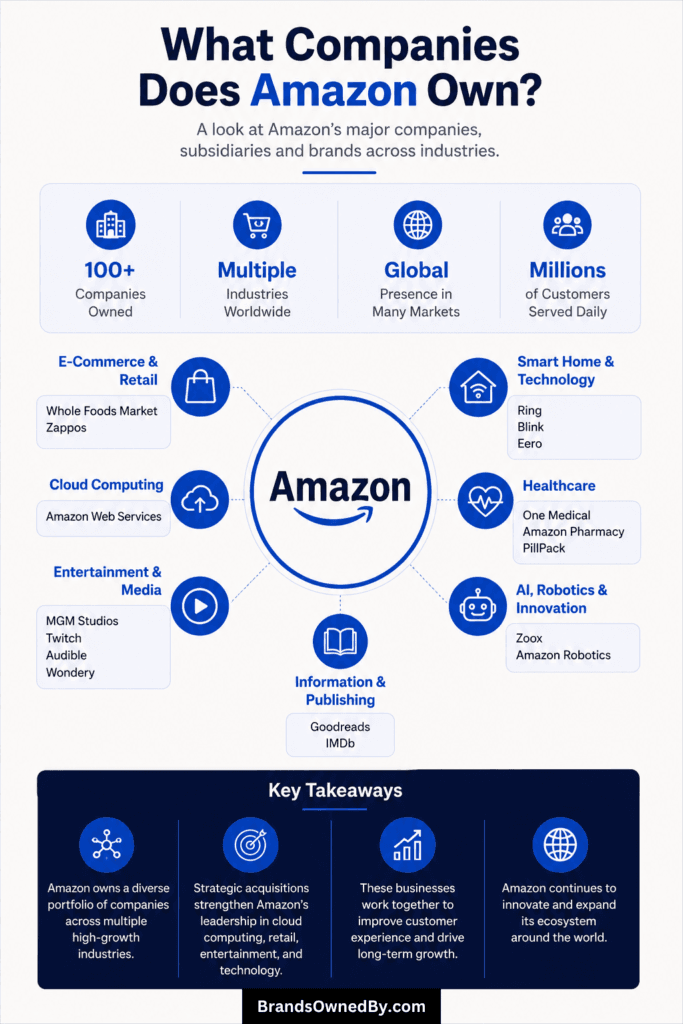
- Amazon owns more than 100 companies and brands across multiple industries, including Amazon Web Services (AWS), Whole Foods Market, MGM Studios, Twitch, Audible, Ring, Zappos, One Medical, Amazon Pharmacy, Zoox, Goodreads, IMDb, Blink, Eero, Wondery, Veeqo, Wickr, and Amazon Robotics.
- Amazon’s largest acquisitions include Whole Foods Market ($13.7 billion), MGM Studios ($8.45 billion), One Medical ($3.9 billion), Zoox ($1.2+ billion), Zappos ($1.2 billion), and Ring ($1+ billion), reflecting its expansion into grocery retail, entertainment, healthcare, autonomous vehicles, and smart home technology.
- Amazon’s subsidiaries operate across e-commerce, cloud computing, digital advertising, logistics, healthcare, artificial intelligence, entertainment, smart home devices, robotics, grocery retail, publishing, and enterprise software, making Amazon one of the world’s most diversified technology companies.
- While Amazon owns many businesses, it continues to operate most major acquisitions as independent brands. Companies such as Whole Foods, Audible, Twitch, Ring, Goodreads, IMDb, Zappos, Blink, Eero, and One Medical retain their own identities while benefiting from Amazon’s technology, logistics, and global infrastructure.
What companies does Amazon own is one of the most searched questions about the world’s largest e-commerce company.
Amazon has expanded far beyond online retail. It owns businesses in cloud computing, entertainment, healthcare, smart home technology, grocery retail, logistics, autonomous vehicles, gaming, and artificial intelligence. Some subsidiaries operate under the Amazon brand, while others continue using their original names. Understanding Amazon’s portfolio helps investors, businesses, and consumers see how the company has built one of the most diversified technology ecosystems in the world.
Amazon Company Profile
Amazon.com, Inc. is an American multinational technology company headquartered in Seattle, Washington. Jeff Bezos founded the company in 1994 as an online bookstore. The business officially launched its website in 1995. Over the following decades, Amazon expanded into nearly every major consumer and enterprise technology sector.
Today, Amazon is one of the world’s largest companies by market capitalization. Its operations span more than 100 countries through retail websites, cloud infrastructure, logistics networks, subscription services, digital entertainment platforms, and enterprise technology solutions.
The company organizes its operations into several major business segments. These include online stores, third-party seller services, Amazon Web Services (AWS), advertising, subscription services, physical stores, and international operations. AWS remains Amazon’s most profitable division and powers millions of websites, applications, and enterprise systems worldwide.
Amazon also invests heavily in artificial intelligence, robotics, healthcare, satellite internet, autonomous driving, and consumer electronics. Many of these initiatives were built through strategic acquisitions rather than internal development.
Quick Facts About Amazon
| Detail | Information |
|---|---|
| Founded | July 5, 1994 |
| Founder | Jeff Bezos |
| Headquarters | Seattle, Washington, United States |
| Industry | Technology, E-commerce, Cloud Computing |
| CEO | Andy Jassy |
| Stock Exchange | NASDAQ |
| Stock Symbol | AMZN |
| Employees | More than 1.5 million |
| Primary Businesses | E-commerce, Cloud Computing, Advertising, AI, Logistics, Digital Media |
List of Companies Owned by Amazon
Amazon has acquired more than 100 companies throughout its history. Some acquisitions were small technology startups. Others were multi-billion-dollar deals that transformed entire industries.
Below are the most significant companies and brands currently owned by Amazon.
Amazon’s Business Empire
Major Companies & Brands Owned by Amazon
AWS
Global cloud computing leader powering millions of businesses.
Whole Foods
Premium grocery chain focused on natural and organic foods.
MGM Studios
Hollywood studio with thousands of films and TV titles.
Prime Video
Streaming platform with movies, series, originals and live sports.
Twitch
World-leading live streaming platform for gaming and creators.
Audible
Largest audiobook and spoken-word entertainment service.
Zappos
Online retailer specializing in shoes, apparel and fashion.
Ring
Smart home security with cameras, alarms and video doorbells.
One Medical
Membership-based primary healthcare provider.
Amazon Pharmacy
Online prescription medication and home delivery service.
PillPack
Pre-sorted prescription packets for easier medication management.
Zoox
Developer of fully autonomous robotaxi technology.
Amazon Robotics
Warehouse robots that automate fulfillment operations.
Blink
Affordable smart security cameras and doorbells.
Eero
Mesh Wi-Fi systems for seamless home internet coverage.
IMDb
World’s largest online movie and TV database.
Goodreads
Popular social platform for readers and book recommendations.
iRobot
Not owned.
Amazon’s acquisition was terminated.
Amazon Web Services (AWS)
Amazon Web Services is Amazon’s cloud computing division. It launched in 2006 and has become the world’s largest cloud infrastructure provider. AWS offers computing power, data storage, artificial intelligence services, databases, networking, analytics, cybersecurity, and machine learning tools.
Millions of businesses rely on AWS. Customers include startups, governments, universities, banks, and Fortune 500 companies.
Although AWS operates as a separate business segment, it remains wholly owned by Amazon. It contributes a significant share of Amazon’s operating income despite representing a smaller portion of total revenue.
A practical example is Netflix, which uses AWS infrastructure to stream content to millions of viewers worldwide.
Whole Foods Market
Amazon acquired Whole Foods Market in 2017 for approximately $13.7 billion. The acquisition marked Amazon’s biggest move into physical retail.
Whole Foods continues operating under its own brand while benefiting from Amazon’s logistics and technology capabilities. Prime members receive exclusive discounts, and many stores now support Amazon package returns and grocery delivery.
The company specializes in organic foods, natural products, and premium grocery shopping. It operates hundreds of stores across North America and the United Kingdom.
The acquisition also helped Amazon strengthen its grocery delivery business and compete with Walmart, Costco, and Kroger.
MGM Studios
Amazon completed its acquisition of Metro-Goldwyn-Mayer (MGM) in 2022. The deal was valued at approximately $8.45 billion.
MGM is one of Hollywood’s oldest film studios. It owns one of the largest movie and television libraries in the entertainment industry. Its catalog includes thousands of films and television episodes.
Well-known franchises include James Bond, Rocky, Creed, Stargate, Legally Blonde, and The Pink Panther.
MGM continues operating as a separate entertainment studio within Amazon MGM Studios. Its content strengthens Prime Video and supports Amazon’s global streaming strategy.
Prime Video
Prime Video is Amazon’s streaming platform. Although it was developed internally rather than acquired, it operates as one of Amazon’s most valuable entertainment businesses.
The platform offers original productions, licensed movies, live sports, documentaries, and television series.
Popular Amazon Originals include The Boys, Reacher, Fallout, The Lord of the Rings: The Rings of Power, and Jack Ryan.
Prime Video is bundled with Amazon Prime in many countries, making it one of the largest subscription streaming services globally.
Twitch
Amazon acquired Twitch Interactive in 2014 for approximately $970 million.
Twitch is the world’s leading live-streaming platform for gaming and interactive entertainment. Millions of creators broadcast gameplay, music, esports, podcasts, and live discussions every day.
The platform generates revenue through subscriptions, advertising, and digital purchases.
Amazon integrates Twitch with Prime Gaming, allowing Prime members to receive free monthly channel subscriptions and exclusive gaming rewards.
Audible
Amazon purchased Audible in 2008 for around $300 million.
Audible is the global leader in audiobooks and spoken-word entertainment. The service offers millions of audiobooks, podcasts, guided wellness programs, and exclusive audio content.
Audible operates independently but benefits from Amazon’s ecosystem through Kindle integration and Amazon account connectivity.
For example, readers can switch between reading an eBook on Kindle and listening through Audible without losing their place.
Zappos
Amazon acquired Zappos in 2009 in a deal worth approximately $1.2 billion.
Zappos is one of America’s best-known online footwear and fashion retailers. The company became famous for exceptional customer service, free shipping, and generous return policies.
Unlike many acquisitions, Amazon allowed Zappos to maintain its unique corporate culture and management structure.
Today, Zappos continues selling shoes, clothing, handbags, and accessories while operating as an Amazon subsidiary.
Ring
Amazon acquired Ring in 2018 for more than $1 billion.
Ring develops smart home security products. Its portfolio includes video doorbells, indoor cameras, outdoor cameras, alarm systems, floodlight cameras, and smart security accessories.
Ring products integrate with Alexa and Amazon Echo devices. Users can monitor their homes through mobile apps and receive real-time alerts.
The acquisition strengthened Amazon’s smart home ecosystem and expanded its presence in home security.
One Medical
Amazon acquired One Medical in 2023 for approximately $3.9 billion.
One Medical provides membership-based primary healthcare services. Patients receive virtual consultations, preventive care, routine checkups, chronic disease management, and same-day appointments.
Amazon integrated One Medical into its healthcare strategy to improve access to affordable medical services.
For example, customers can combine One Medical services with Amazon Pharmacy to manage prescriptions and healthcare appointments more efficiently.
Amazon Pharmacy
Amazon Pharmacy evolved from Amazon’s acquisition of PillPack in 2018.
The service allows customers to order prescription medications online. It offers automatic refills, price comparisons, insurance support, and home delivery.
Amazon Pharmacy also integrates with Prime membership by offering discounts on eligible medications.
The platform competes directly with traditional pharmacy chains such as CVS, Walgreens, and Rite Aid.
PillPack
PillPack was acquired by Amazon in 2018 for approximately $753 million.
The company specializes in organizing prescription medications into clearly labeled daily packets. This system helps patients who take multiple medications each day.
Following the acquisition, PillPack’s technology became the foundation of Amazon Pharmacy.
Many patients continue using PillPack-branded medication packaging while benefiting from Amazon’s nationwide delivery network.
Zoox
Amazon acquired autonomous vehicle startup Zoox in 2020 for more than $1.2 billion.
Zoox develops fully autonomous robotaxis designed specifically for urban transportation.
Unlike many autonomous vehicle companies, Zoox designed its vehicles from the ground up instead of modifying existing cars.
The company continues operating independently while benefiting from Amazon’s investment in robotics, artificial intelligence, and autonomous mobility.
Its technology could eventually support future transportation and logistics services across Amazon’s network.
iRobot
Amazon announced plans to acquire iRobot, the maker of Roomba robotic vacuum cleaners. However, the transaction was terminated after facing significant regulatory opposition in multiple jurisdictions.
As a result, iRobot is not an Amazon-owned company.
This distinction is important because many online lists still incorrectly include iRobot among Amazon subsidiaries.
Kiva Systems (Amazon Robotics)
Amazon acquired Kiva Systems in 2012 for approximately $775 million.
After the acquisition, Amazon renamed the company Amazon Robotics.
The business develops autonomous warehouse robots that transport inventory throughout Amazon fulfillment centers.
Today, hundreds of thousands of robots work alongside employees in Amazon warehouses worldwide.
These robotic systems have significantly improved order processing speed, warehouse efficiency, and inventory management.
Blink
Amazon acquired Blink in 2017.
Blink manufactures affordable smart security cameras, video doorbells, and home monitoring systems.
The brand targets consumers looking for simple wireless security products with long battery life.
Blink continues operating under its own brand while integrating with Amazon Alexa and Echo smart devices.
Eero
Amazon acquired Eero in 2019.
Eero develops mesh Wi-Fi systems that provide seamless wireless internet coverage throughout homes and offices.
The company’s products automatically optimize network performance and improve internet reliability.
Amazon has integrated Eero into its smart home ecosystem, making setup easier through Alexa-enabled devices.
IMDb
Amazon acquired the Internet Movie Database (IMDb) in 1998.
IMDb is the world’s largest online database for movies, television shows, actors, directors, writers, and entertainment professionals.
Millions of users visit IMDb every month to read reviews, check ratings, explore cast information, and discover upcoming releases.
IMDb also supports Amazon’s entertainment ecosystem through IMDbPro, advertising services, and connections with Prime Video.
Goodreads
Amazon acquired Goodreads in 2013.
Goodreads is the world’s largest social networking platform for readers.
Users can review books, create reading lists, join discussion groups, and receive personalized recommendations.
The platform integrates closely with Kindle devices, helping readers discover new books and share reading progress across Amazon’s ecosystem.
Major Acquisitions by Amazon
Amazon has completed more than 100 acquisitions since its founding. While many of its flagship subsidiaries have already been covered, several other acquisitions have quietly become important parts of Amazon’s ecosystem. These businesses strengthen Amazon’s cloud infrastructure, logistics, artificial intelligence capabilities, enterprise software, digital media, and international operations.
Unlike Amazon’s consumer-facing brands, many of these companies operate behind the scenes and power services used by millions of customers and businesses every day.
Amazon’s Major Acquisitions
Strategic acquisitions that expanded Amazon into cloud computing, grocery retail, entertainment, healthcare, AI, robotics, logistics, smart home technology and enterprise software.
IMDb
World’s largest movie and TV database supporting Prime Video, IMDbPro and Amazon’s entertainment ecosystem.
Audible
Global leader in audiobooks and spoken-word entertainment integrated with Kindle and Amazon subscriptions.
Zappos
Online footwear and fashion retailer known for outstanding customer service.
Kiva Systems
Renamed Amazon Robotics and now powers automation across Amazon fulfillment centers.
Goodreads
Largest social network for readers with deep Kindle integration.
IVONA Software
Speech synthesis technology that helped power Amazon Alexa.
Twitch
Leading gaming and live-streaming platform integrated with Prime Gaming.
Annapurna Labs
Designs custom AWS processors including Graviton, Inferentia and Trainium.
Elemental Technologies
Now AWS Elemental, delivering enterprise-grade video processing and streaming.
Cloud9 IDE
Cloud development environment fully integrated into AWS.
Whole Foods Market
Amazon’s largest acquisition, expanding into premium grocery retail.
Souq.com
Expanded Amazon’s marketplace across the Middle East.
Blink
Wireless security cameras and home monitoring products.
Harvest.ai
Behavioral AI technology strengthening AWS security services.
Ring
Video doorbells, alarms and smart home security ecosystem.
PillPack
Foundation for Amazon Pharmacy and prescription delivery.
Eero
Mesh Wi-Fi systems integrated with Alexa smart homes.
Health Navigator
Clinical decision software supporting Amazon’s healthcare services.
Zoox
Developer of fully autonomous robotaxis and AI transportation technology.
Wondery
Major podcast producer integrated into Amazon Music.
Wickr
Enterprise-grade encrypted messaging integrated with AWS.
Veeqo
Inventory management and shipping platform for online merchants.
MGM Studios
Iconic film studio with James Bond, Rocky, Creed and thousands of titles.
Cloostermans
Industrial robotics and automated material-handling systems.
One Medical
Membership-based primary healthcare provider integrated with Amazon Pharmacy.
Amazon’s Acquisition Strategy
25+
Major acquisitions shown
$35B+
Combined disclosed acquisition value
10+
Industries expanded into
1998–2023
Timeline covered
Souq.com
- Acquisition Year: 2017
- Purchase Price: Approximately $580 million
Souq.com was the largest e-commerce marketplace in the Middle East before Amazon acquired it. The acquisition gave Amazon an established presence in the rapidly growing Gulf region without having to build an entirely new marketplace from scratch.
Following the acquisition, Amazon gradually transitioned Souq’s operations to the Amazon brand in key markets, including the United Arab Emirates and Saudi Arabia. Although the Souq brand has been retired, its technology, logistics network, seller relationships, and regional expertise remain fully integrated into Amazon’s international business.
Annapurna Labs
- Acquisition Year: 2015
- Purchase Price: Approximately $350 million
Annapurna Labs is one of Amazon’s most strategically valuable technology acquisitions. The Israeli semiconductor company designs custom processors for cloud computing and artificial intelligence.
Its engineers played a key role in developing Amazon’s Graviton, Inferentia, and Trainium processors used throughout Amazon Web Services (AWS). These custom chips reduce infrastructure costs while delivering better performance for cloud customers running machine learning, data analytics, and enterprise applications.
Today, Annapurna Labs remains a core part of Amazon’s hardware engineering organization.
Elemental Technologies
- Acquisition Year: 2015
- Purchase Price: Approximately $500 million
Elemental Technologies specialized in cloud-based video processing software before joining Amazon.
The company’s technology became the foundation of AWS Elemental, a suite of cloud media services used by broadcasters, streaming companies, sports leagues, and government organizations.
AWS Elemental enables customers to encode, process, store, and distribute high-quality video across multiple devices and streaming platforms. It has become an important component of Amazon’s cloud media infrastructure.
Wondery
- Acquisition Year: 2021
- Purchase Price: Approximately $300 million
Wondery is one of the world’s leading podcast studios. It produces original podcasts covering true crime, business, history, sports, entertainment, and investigative journalism.
Amazon integrated Wondery into Amazon Music to strengthen its position in the growing podcast market. Subscribers receive early or exclusive access to many Wondery productions, helping Amazon compete with Spotify and Apple Podcasts.
Wondery continues operating under its own brand while expanding Amazon’s audio entertainment portfolio.
Wickr
- Acquisition Year: 2021
- Purchase Price: Undisclosed
Wickr develops secure communication software for enterprises, government agencies, and organizations with strict security requirements.
The platform offers end-to-end encrypted messaging, voice calls, video conferencing, and secure file sharing.
Amazon incorporated Wickr into AWS, allowing enterprise customers to deploy highly secure communication systems within Amazon’s cloud environment. The acquisition strengthened AWS’s cybersecurity and compliance offerings.
Veeqo
- Acquisition Year: 2021
- Purchase Price: Undisclosed
Veeqo develops inventory management and multichannel shipping software for online retailers.
The platform allows merchants to synchronize inventory across multiple sales channels, automate order fulfillment, print shipping labels, and manage warehouse operations.
Amazon now offers Veeqo as part of its seller ecosystem, helping businesses streamline logistics while encouraging greater use of Amazon’s fulfillment and shipping services.
Cloud9 IDE
- Acquisition Year: 2016
- Purchase Price: Undisclosed
Cloud9 IDE is a browser-based integrated development environment that allows developers to write, test, and deploy software directly from the cloud.
After acquiring Cloud9, Amazon integrated the platform into AWS. Developers can now build applications without installing software locally, making cloud-native development faster and more collaborative.
Cloud9 remains a useful tool for software engineers building applications on Amazon Web Services.
Harvest.ai
- Acquisition Year: 2017
- Purchase Price: Undisclosed
Harvest.ai developed artificial intelligence software that detects unusual user behavior and identifies potential cybersecurity threats.
Amazon integrated the company’s technology into AWS security services, helping enterprise customers better protect sensitive data and cloud workloads.
The acquisition strengthened Amazon’s growing portfolio of AI-powered cybersecurity solutions.
Health Navigator
- Acquisition Year: 2019
- Purchase Price: Undisclosed
Health Navigator developed clinical decision-support software that helps patients determine the appropriate level of medical care based on their symptoms.
Amazon incorporated the technology into its healthcare initiatives, improving patient triage and digital health services. The acquisition complemented Amazon’s broader investments in healthcare, including Amazon Pharmacy and One Medical.
Cloostermans
- Acquisition Year: 2022
- Purchase Price: Undisclosed
Belgium-based Cloostermans designs advanced warehouse automation systems, robotic machinery, conveyor technology, and material-handling equipment.
The acquisition expanded Amazon’s automation capabilities beyond mobile warehouse robots. Cloostermans’ technology supports automated pallet handling, packaging, and high-speed fulfillment operations across Amazon’s logistics network.
As Amazon continues investing in next-generation fulfillment centers, Cloostermans plays an increasingly important role in warehouse automation.
IVONA Software
- Acquisition Year: 2013
- Purchase Price: Undisclosed
IVONA specialized in high-quality text-to-speech technology.
Its speech synthesis technology became an important foundation for Amazon Alexa and other voice-enabled products.
The acquisition accelerated Amazon’s development of natural-sounding voice assistants and strengthened its long-term investments in conversational artificial intelligence.
Book Depository
- Acquisition Year: 2011
- Purchase Price: Undisclosed
Book Depository was an online bookstore known for offering free worldwide shipping.
The acquisition strengthened Amazon’s global book business and expanded its international reach among readers.
Although Amazon later closed Book Depository as part of a broader cost-reduction strategy, the acquisition itself remains part of Amazon’s publishing history. The standalone brand no longer operates, so it is not considered one of Amazon’s active consumer brands today.
Who Owns Amazon?
Amazon.com, Inc. is a publicly traded company listed on the NASDAQ under the ticker symbol AMZN. Unlike founder-led companies such as Meta or Alphabet that have dual-class voting shares, Amazon has a single-class share structure, meaning every common share carries one vote. As a result, ownership is distributed among institutional investors, company insiders, and millions of retail shareholders.
Although Jeff Bezos founded Amazon in 1994, he no longer owns a controlling stake. Over the years, he has sold shares to diversify his investments, fund Blue Origin, support philanthropic initiatives, and manage his personal portfolio. Even after these sales, Bezos remains Amazon’s largest individual shareholder and continues to hold significant influence over the company’s long-term direction.
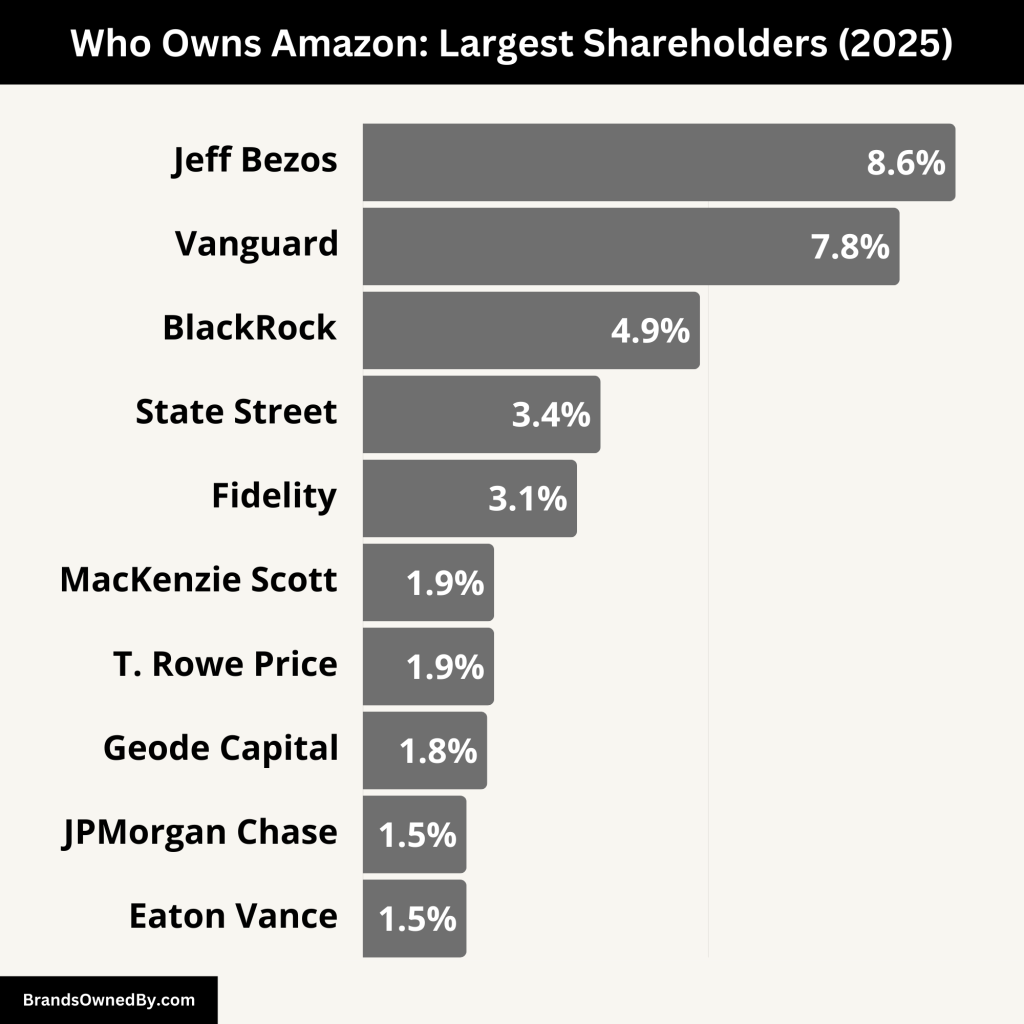
Amazon’s Largest Shareholders (July 2026)
Ranked by percentage of outstanding shares owned.
Amazon Ownership Structure
Institutional
Mutual funds, ETFs, pension funds and asset managers.
Retail Investors
Millions of individual shareholders worldwide.
Company Insiders
Executives and directors, led by Jeff Bezos.
Jeff Bezos
Jeff Bezos is Amazon’s founder and remains its largest individual shareholder. As of July 2026, he owns approximately 8.8% of the company’s outstanding shares, despite selling portions of his holdings over the years to fund Blue Origin, philanthropic initiatives, and diversify his investments.
Although Bezos no longer serves as Chief Executive Officer, he continues as Executive Chairman of Amazon’s Board of Directors. His substantial ownership stake, combined with his position on the board and decades of leadership experience, gives him significant influence over Amazon’s long-term strategy, major acquisitions, executive appointments, and corporate governance.
The Vanguard Group
The Vanguard Group is one of Amazon’s largest institutional shareholders, holding approximately 6.8% of the company’s outstanding shares as of July 2026.
Vanguard manages this investment through hundreds of mutual funds, index funds, and exchange-traded funds (ETFs) on behalf of millions of individual and institutional investors. Since Amazon is a major constituent of the S&P 500 and Nasdaq-100, nearly every Vanguard index fund owns Amazon stock.
While Vanguard does not participate in Amazon’s day-to-day management, it plays an important role during shareholder votes on director elections, executive compensation, governance policies, and other corporate matters.
BlackRock
BlackRock is another of Amazon’s largest institutional investors and owns approximately 6.8% of the company’s shares.
The investment is spread across BlackRock’s actively managed funds, pension portfolios, and iShares ETFs. Because BlackRock manages assets for governments, retirement plans, corporations, and individual investors worldwide, its Amazon stake represents client investments rather than direct ownership.
As one of the world’s largest asset managers, BlackRock regularly participates in shareholder voting and corporate governance decisions affecting Amazon.
State Street Corporation
State Street Corporation owns approximately 3.6% of Amazon’s outstanding shares, making it one of the company’s largest institutional shareholders.
Most of its holdings are managed through index funds and institutional investment portfolios that track major stock market indices. State Street has maintained a long-term investment in Amazon and is considered one of the “Big Three” passive investment firms alongside Vanguard and BlackRock.
Although State Street does not influence Amazon’s daily operations, its voting rights give it meaningful input on governance matters presented to shareholders.
Fidelity Investments (FMR LLC)
Fidelity Investments is another significant shareholder of Amazon through its mutual funds, retirement accounts, institutional portfolios, and actively managed investment strategies.
The investment firm owns approximately 3.2% of Amazon’s outstanding shares. Unlike passive index fund providers, Fidelity actively adjusts many of its positions based on market conditions, valuation, and long-term growth expectations.
Amazon has remained one of Fidelity’s largest technology investments for many years due to its leadership in e-commerce, cloud computing, artificial intelligence, and digital advertising.
Geode Capital Management
Geode Capital Management owns approximately 2.0% of Amazon’s outstanding shares, making it another major institutional investor.
The firm primarily manages index-based investment portfolios for institutional clients and retirement funds. Although Geode receives less public attention than Vanguard or BlackRock, it consistently ranks among Amazon’s largest shareholders because of the size of its passive investment strategies.
JPMorgan Asset Management
JPMorgan Asset Management owns approximately 1.8% of Amazon’s outstanding shares through its mutual funds, pension portfolios, institutional accounts, and wealth management products.
The investment reflects JPMorgan’s long-term confidence in Amazon’s diversified business model and future growth prospects. As one of the world’s largest financial institutions, JPMorgan also participates in shareholder voting and governance decisions affecting the company.
T. Rowe Price Associates
T. Rowe Price Associates owns approximately 1.5% of Amazon’s shares through a variety of actively managed equity funds and retirement investment products.
The firm has been a long-term investor in large-cap technology companies and continues to view Amazon as one of the strongest companies in the global technology sector because of its leadership across cloud computing, artificial intelligence, online retail, logistics, and digital services.
Eaton Vance
Eaton Vance, which operates as part of Morgan Stanley Investment Management, owns approximately 1.5% of Amazon’s outstanding shares.
Its investment is spread across institutional portfolios, wealth management accounts, and actively managed investment funds. The firm’s long-term investment philosophy aligns well with Amazon’s consistent revenue growth and strong cash generation.
Norges Bank Investment Management
Norges Bank Investment Management, which manages Norway’s Government Pension Fund Global, is among Amazon’s largest international shareholders.
The fund has invested billions of dollars in Amazon as part of its globally diversified equity portfolio. Its ownership reflects confidence in Amazon’s long-term earnings potential rather than any attempt to influence day-to-day management.
As one of the world’s largest sovereign wealth funds, Norges Bank actively exercises its shareholder voting rights on governance, sustainability, and board-related matters.
Capital Research and Management Company
Capital Research and Management Company, the investment adviser behind the American Funds family, is another major institutional shareholder of Amazon.
The firm manages hundreds of billions of dollars in long-term investment assets and maintains substantial positions in many of the world’s largest technology companies. Its investment in Amazon reflects confidence in the company’s continued leadership across e-commerce, cloud computing, artificial intelligence, advertising, and logistics.
Like most institutional investors, Capital Research holds Amazon shares on behalf of millions of clients rather than as a strategic owner.
Other Institutional Investors
Amazon’s shareholder base extends far beyond its largest investors. Thousands of pension funds, insurance companies, sovereign wealth funds, mutual fund managers, hedge funds, ETFs, and asset management firms collectively own the majority of the company’s shares.
Because Amazon is included in virtually every major U.S. and global stock market index, institutional ownership remains exceptionally broad. This diversified ownership structure provides stability while ensuring that no single institutional investor has enough shares to control the company independently. More than 7,500 institutional investors report holdings in Amazon through regulatory filings.
Competitor Ownership Comparison
Amazon competes with several of the world’s largest e-commerce and technology companies. While most of these businesses are publicly traded, their ownership structures differ significantly. Some remain heavily influenced by founding families, while others use dual-class voting shares that allow founders to retain control despite owning a relatively small percentage of the company’s equity.
Walmart
Walmart is a publicly traded company listed on the NASDAQ, but unlike Amazon, it remains firmly controlled by its founding family. As of July 2026, the Walton family collectively owns approximately 45% of Walmart’s outstanding shares through Walton Enterprises, the Walton Family Holdings Trust, and direct family ownership.
This gives the family effective control over the company’s governance despite institutional investors such as Vanguard, BlackRock, and State Street also holding significant stakes. Walmart is widely regarded as one of the largest publicly traded family-controlled companies in the world.
Alibaba Group
Alibaba Group is publicly traded on both the New York Stock Exchange (NYSE) and the Hong Kong Stock Exchange (HKEX). Its ownership is widely distributed among institutional investors, sovereign wealth funds, company executives, and retail shareholders.
Unlike Amazon, Alibaba does not have a single controlling shareholder. However, the company’s governance is shaped by its partnership structure, which gives senior partners significant influence over board nominations and strategic decisions. Chairman Joseph Tsai is the company’s largest individual shareholder following Jack Ma’s gradual reduction in ownership.
eBay
eBay is an independent publicly traded company with a highly diversified ownership structure. The majority of its shares are held by institutional investors, including Vanguard, BlackRock, and State Street, while no founder or individual investor owns a controlling interest. Its governance model closely resembles Amazon’s, with strategic decisions overseen by the Board of Directors and executive leadership rather than by a dominant shareholder.
Shopify
Shopify is publicly traded on both the Toronto Stock Exchange and NASDAQ. Although institutional investors own a significant portion of the company’s shares, founder and Chief Executive Officer Tobi Lütke retains effective control through Shopify’s dual-class share structure.
This gives him substantially greater voting power than his economic ownership alone would suggest. As a result, Shopify remains founder-controlled even though public investors collectively own most of the company’s outstanding shares.
MercadoLibre
MercadoLibre is publicly traded on the NASDAQ and has a broadly diversified shareholder base dominated by institutional investors. Founder and Chief Executive Officer Marcos Galperin remains one of the company’s largest individual shareholders and continues to play a central role in its strategic direction.
However, like Amazon, no single shareholder owns a majority of the company’s outstanding shares, and corporate governance is shared between the board, executive management, and shareholders.
JD.com
JD.com is listed on both the NASDAQ and the Hong Kong Stock Exchange. Its ownership is spread across institutional investors, public shareholders, and company executives. Founder Richard Liu (Liu Qiangdong) remains one of the company’s largest shareholders and retains significant voting control through JD.com’s dual-class share structure. This allows him to influence major corporate decisions despite holding a minority of the company’s total economic interest.
Coupang
Coupang is publicly traded on the New York Stock Exchange and has a dispersed shareholder base consisting primarily of institutional investors. Founder Bom Kim retains substantial voting control through a dual-class share structure that provides enhanced voting rights. Although institutional investors own most of Coupang’s economic interest, the company’s governance remains heavily influenced by its founder.
Ownership Structure Comparison
Among Amazon’s largest competitors, ownership structures generally fall into three categories:
- Founder-controlled: Shopify, JD.com, and Coupang use dual-class share structures that allow their founders to retain significant voting control.
- Family-controlled: Walmart remains under the effective control of the Walton family through its substantial ownership stake.
- Widely held public companies: Amazon, eBay, Alibaba Group, and MercadoLibre have broadly distributed ownership, with institutional investors collectively holding the largest stakes while boards of directors and executive leadership oversee corporate strategy.
Amazon Annual Revenue and Net Worth
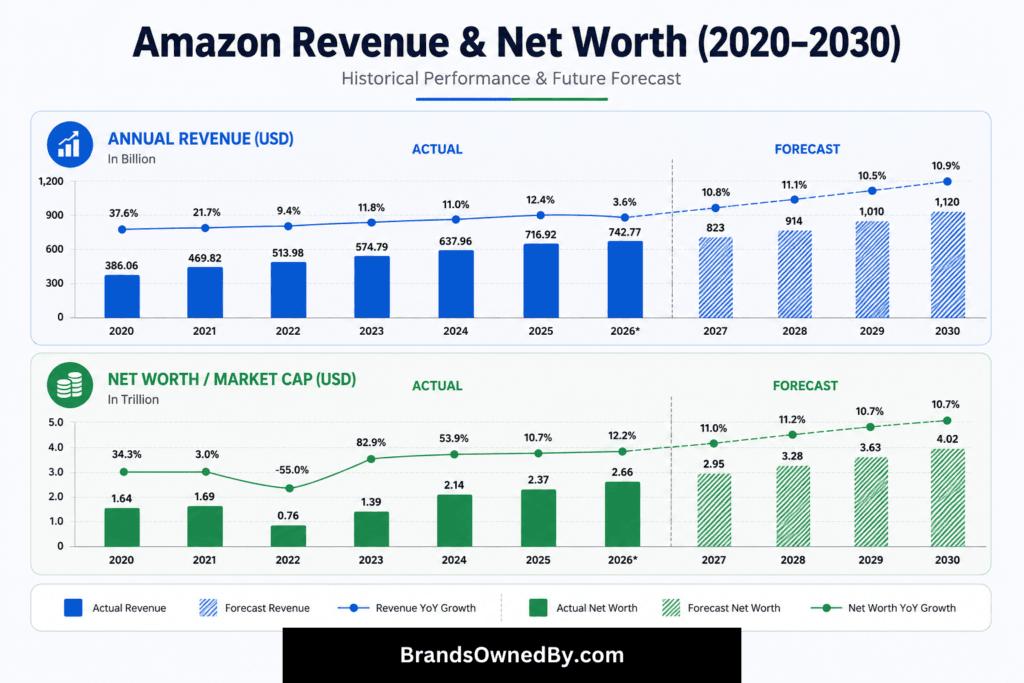
Amazon has evolved from an online bookstore into one of the world’s largest and most valuable companies. As of July 2026, the company generates more than $742 billion in annual revenue and has an estimated market capitalization of approximately $2.66 trillion. Unlike traditional retailers, Amazon’s revenue comes from a diversified portfolio of businesses, including e-commerce, cloud computing, digital advertising, subscription services, logistics, healthcare, and physical retail. This diversification has improved profitability and reduced the company’s reliance on direct product sales.
Amazon Revenue in 2026
As of July 2026, Amazon reported trailing twelve-month (TTM) revenue of $742.77 billion, following record fiscal year 2025 revenue of $716.92 billion, representing 12.4% year-over-year growth. Amazon now generates an average of more than $1.96 billion in revenue every day, approximately $81.4 million every hour, and nearly $1.36 million every minute.
The company’s revenue growth continues to outpace most large multinational corporations despite its enormous size. During 2025, Amazon benefited from strong demand across Amazon Web Services (AWS), third-party seller services, digital advertising, Prime subscriptions, and international marketplace operations. Improvements in operating efficiency and logistics also helped the company increase profitability while maintaining double-digit revenue growth.
Revenue Breakdown by Business Segment
Amazon no longer depends primarily on online retail. Its revenue is now distributed across multiple high-growth businesses.
Online Stores remained Amazon’s largest business during fiscal 2025, generating approximately $269.3 billion, which accounted for 37.5% of total company revenue. This includes direct sales through Amazon’s global marketplaces. Although this segment remains the largest by revenue, its contribution has gradually declined as Amazon’s higher-margin service businesses continue to expand.
Third-Party Seller Services generated approximately $172.2 billion, representing 24.0% of total revenue. This segment includes Fulfillment by Amazon (FBA), seller commissions, shipping services, warehousing, and payment processing. More than 60% of all products sold on Amazon now come from independent third-party sellers, making this one of Amazon’s most important long-term growth businesses.
Amazon Web Services (AWS) contributed approximately $128.7 billion, or 17.9% of total revenue. AWS continues to dominate the global cloud infrastructure market and serves millions of customers, including startups, Fortune 500 companies, financial institutions, healthcare providers, and government agencies. Demand for artificial intelligence infrastructure and cloud migration continues to accelerate AWS growth.
Advertising Services generated approximately $69.4 billion, contributing 9.7% of Amazon’s total revenue. Amazon has become the world’s third-largest digital advertising company behind Google and Meta. Brands increasingly advertise on Amazon because shoppers are already searching with purchase intent, resulting in higher conversion rates than traditional online advertising.
Subscription Services produced approximately $49.6 billion, accounting for 6.9% of total revenue. This segment includes Amazon Prime, Prime Video, Amazon Music, Audible, Kindle Unlimited, and other subscription-based services. Recurring subscription revenue provides predictable cash flow while encouraging higher customer spending across Amazon’s ecosystem.
Physical Stores, including Whole Foods Market and Amazon Fresh, generated approximately $22.6 billion, representing 3.1% of total revenue. Although physical retail contributes a relatively small portion of total sales, it strengthens Amazon’s omnichannel retail strategy by combining online ordering with in-store shopping, grocery pickup, and same-day delivery.
Which Business Generates the Most Profit?
Although Online Stores generate the largest share of Amazon’s revenue, Amazon Web Services (AWS) is by far the company’s most profitable business.
In fiscal 2025, AWS generated approximately $45.6 billion in operating income, despite contributing less than 18% of Amazon’s total revenue. By comparison, Amazon’s retail operations operate on much thinner margins because they require significant spending on inventory, fulfillment centers, shipping, transportation, labor, and last-mile delivery.
Advertising is another high-margin business that continues to improve Amazon’s profitability. Unlike retail sales, advertising requires relatively little additional infrastructure while producing substantial operating margins. This is one reason Amazon has aggressively expanded sponsored products, display advertising, Prime Video advertising, and retail media services.
A major shift in Amazon’s business model has also improved its financial performance. In fiscal 2025, service-based businesses generated nearly 60% of Amazon’s total revenue, overtaking first-party product sales. Businesses such as AWS, advertising, third-party seller services, subscriptions, and logistics now contribute a larger share of revenue than traditional retail while generating significantly higher margins.
Amazon Net Worth in 2026
As of July 2026, Amazon has an estimated market capitalization of approximately $2.66 trillion, making it one of the five most valuable publicly traded companies in the world.
Unlike annual revenue, market capitalization reflects investors’ expectations about the company’s future earnings potential rather than its current sales. Amazon’s valuation has increased significantly since 2023 as profitability improved, free cash flow strengthened, and investors placed greater value on the company’s artificial intelligence and cloud computing businesses.
Amazon’s share price has also benefited from continued expansion in AWS, strong advertising growth, increasing operating margins, and higher demand for enterprise AI infrastructure.
Why is Amazon Worth More Than $2.6 Trillion?
Several factors support Amazon’s multi-trillion-dollar valuation.
First, AWS has become one of the world’s most valuable cloud computing businesses. Many analysts estimate that AWS alone would be worth well over $1 trillion if it operated as an independent company because of its market leadership, recurring enterprise revenue, and strong profit margins.
Second, Amazon has built one of the world’s largest logistics networks. The company operates hundreds of fulfillment centers, sortation facilities, delivery stations, cargo aircraft, trucks, and last-mile delivery operations. This infrastructure creates a significant competitive advantage that few companies can replicate.
Third, Amazon’s advertising business has become one of the fastest-growing segments within the company. With annual advertising revenue approaching $70 billion, Amazon now competes directly with Google and Meta for global digital advertising budgets.
Artificial intelligence has become another major valuation driver. Amazon continues investing tens of billions of dollars in AI infrastructure, custom processors such as Trainium and Inferentia, data centers, and generative AI services through Amazon Bedrock. These investments are expected to drive future AWS growth as enterprise demand for AI computing continues to increase.
Amazon also benefits from a highly diversified business model. Revenue comes from e-commerce, cloud computing, advertising, subscriptions, healthcare, logistics, entertainment, smart home technology, and enterprise software. This diversification reduces business risk while creating multiple long-term growth opportunities.
Amazon Revenue & Net Worth Forecast (2027–2030)
Based on historical growth trends, continued expansion of AWS, increasing enterprise adoption of artificial intelligence, higher advertising spending, and ongoing international marketplace growth, Amazon is expected to maintain strong financial performance throughout the remainder of the decade.
- 2027: Annual revenue is projected to reach approximately $823 billion, while market capitalization could increase to around $2.95 trillion. Growth is expected to be driven by AWS, AI infrastructure services, advertising, and third-party marketplace expansion.
- 2028: Revenue is forecast to reach approximately $914 billion, with an estimated market capitalization of $3.28 trillion. Continued cloud adoption, AI workloads, and subscription growth are expected to remain the primary growth drivers.
- 2029: Amazon is projected to surpass $1 trillion in annual revenue for the first time, reaching approximately $1.01 trillion. Market capitalization could approach $3.63 trillion as profitability continues to improve and high-margin service businesses contribute a larger share of earnings.
- 2030: Annual revenue is expected to reach approximately $1.12 trillion, while market capitalization could exceed $4.02 trillion. By this stage, artificial intelligence, AWS, advertising, automation, robotics, healthcare, and global e-commerce are expected to represent the company’s primary long-term growth engines.
Outlook
Amazon’s financial performance demonstrates how successfully the company has transformed from an online retailer into a diversified technology conglomerate. While retail continues to generate the largest share of revenue, the company’s highest-value businesses are increasingly AWS, advertising, subscriptions, and enterprise technology. If Amazon continues executing its artificial intelligence strategy while maintaining leadership in cloud computing and e-commerce, it is well positioned to remain one of the world’s most valuable companies throughout the next decade.
Final Words
Amazon owns one of the most diversified business portfolios in the technology industry. Its subsidiaries extend far beyond online shopping and include cloud computing, grocery retail, entertainment, healthcare, robotics, smart home technology, autonomous vehicles, digital media, and enterprise software.
Unlike many technology companies, Amazon is not controlled by a single shareholder. Although Jeff Bezos remains the company’s largest individual shareholder and Executive Chairman, ownership is widely distributed among institutional investors and public shareholders. Day-to-day operations are led by Chief Executive Officer Andy Jassy, while long-term governance is overseen by the Board of Directors.
Through strategic acquisitions such as Whole Foods Market, MGM Studios, Twitch, Ring, One Medical, and Zoox, Amazon has expanded into industries that support its long-term growth strategy. Combined with continued investment in artificial intelligence, cloud computing, logistics, and healthcare, Amazon remains one of the world’s most influential and valuable companies.
FAQs
How many companies does Amazon own?
Amazon owns more than 100 companies, brands, and subsidiaries acquired since its founding. Many continue operating under their original names, while others have been integrated into Amazon’s ecosystem. Some of the most notable Amazon-owned companies include Amazon Web Services (AWS), Whole Foods Market, MGM Studios, Twitch, Audible, Ring, Zappos, One Medical, Amazon Pharmacy, Zoox, Goodreads, IMDb, Blink, Eero, Wondery, Amazon Robotics, Veeqo, and Wickr.
What is owned by Amazon?
Amazon owns businesses across a wide range of industries, including e-commerce, cloud computing, entertainment, healthcare, grocery retail, smart home technology, robotics, artificial intelligence, logistics, digital advertising, publishing, and autonomous vehicles. Its best-known subsidiaries include AWS, Whole Foods Market, MGM Studios, Audible, Twitch, Ring, Zappos, One Medical, Amazon Pharmacy, Goodreads, IMDb, Blink, Eero, Zoox, and Wondery.
What stores does Amazon own?
Amazon owns several retail store brands, including Whole Foods Market, Amazon Fresh, Amazon Go, and Amazon Books. Although Amazon has closed many of its physical bookstore and Amazon 4-star locations, Whole Foods Market and Amazon Fresh remain the company’s largest physical retail businesses. Amazon also operates convenience-style Amazon Go stores in select locations.
What apps does Amazon own?
Amazon owns and operates numerous consumer and business applications. Some of the most popular include the Amazon Shopping app, Prime Video, Amazon Music, Audible, Kindle, Alexa, Amazon Photos, IMDb, Goodreads, Twitch, Ring, Blink Home Monitor, and the Amazon Seller app. It also provides enterprise applications and cloud services through Amazon Web Services (AWS).
What brands does Amazon own?
Amazon owns many globally recognized brands, including Amazon Web Services (AWS), Whole Foods Market, MGM Studios, Audible, Twitch, Ring, Blink, Eero, Zappos, Goodreads, IMDb, One Medical, Amazon Pharmacy, Amazon Fresh, Amazon Go, Wondery, Zoox, and Amazon Robotics. These brands operate across technology, entertainment, healthcare, retail, cloud computing, and smart home markets.
Why did Jeff Bezos give up Amazon?
Jeff Bezos did not give up ownership of Amazon. In 2021, he stepped down as Chief Executive Officer to focus on long-term initiatives, including his role as Executive Chairman, Blue Origin, philanthropy, and new innovation projects. Andy Jassy succeeded Bezos as CEO, while Bezos remained Amazon’s largest individual shareholder and continues to influence the company’s long-term strategy.
Does Amazon own Snapchat?
No. Amazon does not own Snapchat. Snapchat is owned and operated by Snap Inc., a publicly traded technology company headquartered in California. Although Amazon has partnered with Snap on advertising and shopping features, it has never acquired the company.
What media companies does Amazon own?
Amazon owns several major media and entertainment companies. These include Amazon MGM Studios, Prime Video, Twitch, Audible, Wondery, IMDb, and Goodreads. Together, these businesses produce and distribute movies, television shows, live streaming content, podcasts, audiobooks, books, and digital entertainment to millions of users worldwide.
Does Amazon own Disney?
No. Amazon does not own Disney. The Walt Disney Company is an independent publicly traded entertainment company that owns Disney, Pixar, Marvel, Lucasfilm, ESPN, Hulu, and other well-known brands. Although Amazon distributes some Disney content through Prime Video and Fire TV, the two companies remain separate businesses.
Does Amazon own Twitch?
Yes. Amazon acquired Twitch Interactive in 2014 for approximately $970 million. Twitch remains the world’s leading live-streaming platform for gaming, esports, and creator content. It continues operating under its own brand and is integrated with Amazon Prime through Prime Gaming, which provides subscribers with exclusive gaming benefits and monthly channel subscriptions.