
- The Port Authority owns and operates the 16-acre World Trade Center campus, including its public transit infrastructure. Private rights in individual buildings and shops do not transfer ownership of the entire site.
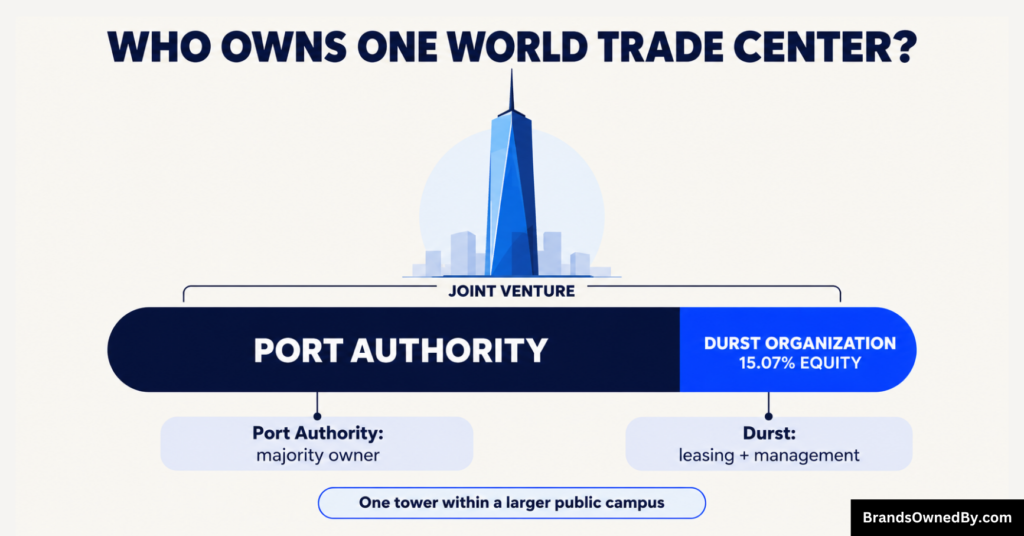
- One World Trade Center is a Port Authority–Durst joint venture. Durst’s equity interest is 15.07% effective in 2026, and it helps manage and lease the tower.
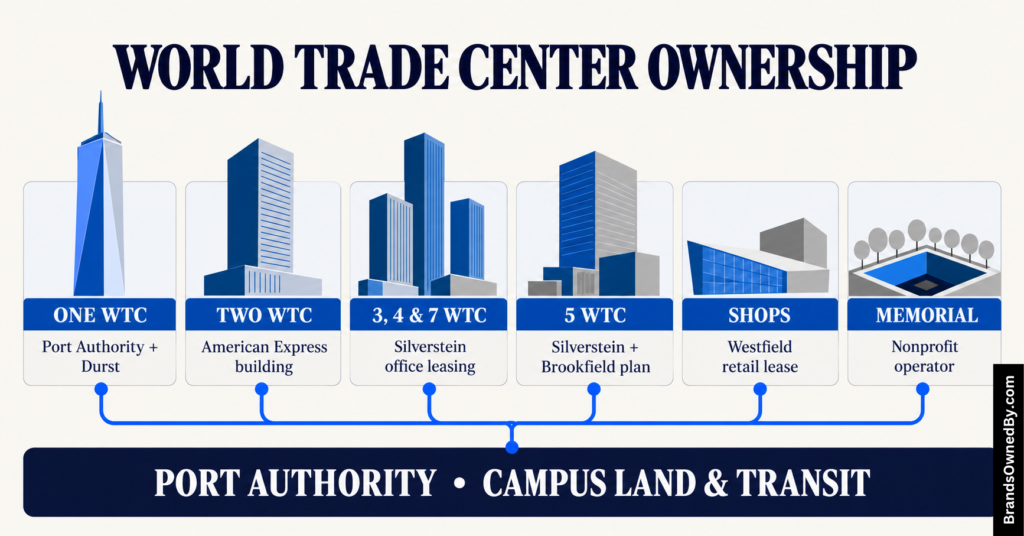
- American Express will own and occupy the new 2 World Trade Center building. Silverstein Properties is developing it on Port Authority-owned land under a long-term ground lease. Silverstein also manages and leases 3, 4, and 7 World Trade Center.
- Unibail-Rodamco-Westfield holds the long-term lease on World Trade Center retail. The National September 11 Memorial & Museum is run by a separate nonprofit.
The Port Authority of New York and New Jersey owns the World Trade Center campus in Lower Manhattan. Yet the answer changes when you ask about a particular building.
The Port Authority has a majority interest in One World Trade Center, alongside the Durst Organization. American Express is developing its own future headquarters at 2 World Trade Center. Silverstein Properties controls the commercial interests in 3, 4, and 7 World Trade Center. Retail has a separate long-term lease. These arrangements explain why several organizations are called the site’s “owners.”
![Who Owns the World Trade Center [Infographic]](https://brandsownedby.com/wp-content/uploads/2026/09/Who-Owns-the-World-Trade-Center-Infographic-683x1024.png)
Who Owns the World Trade Center Site?
The Port Authority of New York and New Jersey is the public agency behind the World Trade Center campus. It describes itself as the owner and operator of the site. The campus covers approximately 16 acres in Lower Manhattan and combines office buildings, public space, transport, stores, cultural facilities, and the 9/11 Memorial & Museum.
That does not mean Port Authority staff operate every shop, sign every office lease, or run the museum. The agency retains the underlying public interest while working with commercial developers and independent institutions. Some partners hold long-term rights to a tower or a defined retail area. Others manage a facility on the campus. Each role needs to be identified separately.
For example, a company can own the economic interest in a building constructed on land it leases from the Port Authority. A retail operator can control storefronts inside a transit complex without owning the PATH station around them. A nonprofit can manage the memorial without managing the adjacent office towers. The site is physically connected, but its property and operating arrangements are divided.
The Port Authority itself is a public agency created by New York and New Jersey. It is not Larry Silverstein’s company, an arm of American Express, or a federal agency. It develops and operates regional infrastructure, including PATH. That infrastructure role is especially visible at the World Trade Center, where offices, shopping, and transportation share entrances and below-grade space.
World Trade Center Ownership by Building and Facility
The Port Authority of New York and New Jersey owns the World Trade Center campus. That answer applies to the site as a whole. It does not mean the agency has the same economic interest in every tower or operates every facility.
The differences become clearer when each property is examined separately. One tower is held through a joint venture. Another is being built for a company that will own and occupy it. Several office buildings have Silverstein-related leaseholds. The shops and memorial have their own arrangements.
One World Trade Center: Port Authority and Durst
One World Trade Center is held through a joint venture between the Port Authority and the Durst Organization. The Port Authority has the majority interest. Durst has an equity stake and participates in the tower’s management and leasing.
The stake is more specific than the 10% figure found in some older accounts. The Port Authority’s 2025 financial statements calculate Durst’s equity interest at 15.07% effective in 2026. That percentage applies to the One World Trade Center venture. It is not a share of the entire World Trade Center campus.
The tower contains approximately 3 million square feet of space. As of December 31, 2025, about 2.8 million square feet of its office space was leased, representing approximately 94% of leasable offices. The building also has separate arrangements for rooftop broadcasting space and the observation deck on floors 100 through 102.
Those agreements show the difference between owning and occupying the tower. Durst is an equity partner and commercial manager. Office tenants lease floors. Legends OWO leases space for the observatory. None of those tenants or operators owns the whole building simply because it conducts business there.
2 World Trade Center: American Express, Silverstein, and the Port Authority
The new 2 World Trade Center has three distinct parties with three distinct roles. The Port Authority owns the land. Silverstein Properties is developing the tower. American Express will be the sole owner and occupant of the completed headquarters building.
American Express is therefore more than a prospective office tenant. It is building a headquarters for its own use on land held under a long-term ground lease. Calling Silverstein the owner of the finished tower would confuse its development role with American Express’s building interest.
The planned headquarters at 200 Greenwich Street will have more than 2 million square feet across 55 floors. Groundbreaking took place in July 2026, and American Express expects to move in during 2031. The company plans to remain at its existing Lower Manhattan headquarters until the new building is ready.
Work on the site did not begin from an untouched plot. Foundation and below-ground construction had already taken place during earlier phases of the World Trade Center redevelopment. The American Express agreement moved the long-delayed above-ground tower forward. That history helps explain why older reports describe 2 World Trade Center as a Silverstein project without describing the current building ownership arrangement.
3 World Trade Center: Silverstein’s Office Leasehold
Three World Trade Center opened in June 2018 at 175 Greenwich Street. The 80-story tower contains approximately 2.5 million square feet of office space. Silverstein Properties developed it and remains responsible for managing, operating, and leasing the offices.
Silverstein’s role comes through the commercial leasehold structure negotiated with the Port Authority during the site’s redevelopment. The firm can market space to office tenants and manage the building without owning the whole World Trade Center campus. A business leasing several floors at 3 World Trade Center becomes a tenant of that commercial operation, not an owner of the property.
The building also has five retail levels, including space below and above street level. Those areas connect to the wider shopping and transportation network. Their presence makes it especially important to distinguish Silverstein’s office leasing role from the separate retail arrangement across the campus. A company looking for offices and a merchant looking for a shop may deal with different parties at the same address.
4 World Trade Center: Silverstein’s Tower With Public and Private Tenants
Four World Trade Center opened in November 2013. The 72-story tower has approximately 2.3 million square feet of office space. Silverstein Properties developed it and handles its office management and leasing.
The Port Authority and the City of New York have been among the building’s tenants. That can make its ownership look confusing: the Port Authority is the underlying public landowner, has occupied office space in the tower, and is connected to the redevelopment agreements. Silverstein still has the commercial role of operating and leasing the office tower. A government agency’s lease of floors does not make it the sole owner of the building.
The tower also includes retail space linked to the surrounding concourses. A visitor can move from shopping areas into an office lobby without seeing the boundary between the two commercial arrangements. For an ownership analysis, those boundaries matter more than the appearance of one continuous complex.
7 World Trade Center: Silverstein’s First Rebuilt Tower
Seven World Trade Center stands at 250 Greenwich Street, north of the main memorial plaza. It opened in 2006 and was the first World Trade Center office tower rebuilt after September 11. The 52-story building contains approximately 1.7 million square feet of space.
Silverstein Properties developed the present tower and manages, operates, and leases its offices. Silverstein also had a separate interest in the original 7 World Trade Center before the 2001 lease transaction involving the Twin Towers. Its history at this particular address therefore predates its better-known deal for the original complex.
That history is sometimes flattened into the claim that Silverstein owns the World Trade Center. The more accurate statement identifies 7 World Trade Center as one of the firm’s commercial properties within the wider campus. Its operating rights do not extend to the Port Authority’s PATH station, the memorial, or One World Trade Center’s joint venture.
5 World Trade Center: The Planned Silverstein–Brookfield Development
Five World Trade Center is planned for 130 Liberty Street on the southern side of the campus. The Port Authority controls the site, while a partnership involving Silverstein Properties and Brookfield Properties was selected to develop it. It remains a development project rather than an occupied residential tower.
The proposed building would add a use that the completed office towers do not provide at this scale: housing. Plans call for approximately 1,200 apartments, with about 400 designated as permanently affordable. A portion of the homes is intended for New Yorkers affected by September 11. The proposal also includes office, community, amenity, and retail space.
The Public Authorities Control Board approved the mixed-use project in July 2023. Approval and selection of a developer are significant steps, but they should not be mistaken for completion or for an unchanged final ownership structure. As of September 2026, the useful ownership distinction is between the Port Authority’s interest in the site and the Silverstein–Brookfield team’s planned development role.
The Oculus and PATH Station: Port Authority Infrastructure
The Oculus forms part of the World Trade Center Transportation Hub. The Port Authority owns and operates the hub and the PATH facilities within it. The transit complex opened in 2016 and connects commuters to the wider campus and nearby subway routes.
The Oculus has direct connections to One World Trade Center, 3 World Trade Center, and 4 World Trade Center. It also links to Brookfield Place through the West Concourse. These connections make the campus work as one destination, but they do not merge the ownership of every connected property.
Consider a commuter who arrives on PATH, walks through the Oculus, and enters an office tower. The Port Authority operates the station. A separate company may lease the retail space passed along the way. The office tenant’s lease belongs to the commercial arrangement for its particular tower. One journey crosses several property interests.
World Trade Center Shops: Westfield’s Long-Term Retail Lease
The World Trade Center’s retail space is leased and operated by a Unibail-Rodamco-Westfield entity. The shopping areas span approximately 365,000 square feet across the campus. They include stores and restaurants associated with the Oculus and other connected spaces.
This is a substantial commercial interest, but it is not ownership of the entire World Trade Center. The Port Authority’s 2025 financial statements describe a net lease of the retail premises running through 2100. Westfield’s role is to lease and operate those premises. The Port Authority continues to own and operate the transportation infrastructure around them.
The retail deal also has a separate financial history from the office towers. The Port Authority reports receiving $897 million in connection with transferring its interests in the World Trade Center retail venture to Westfield-related entities. That figure includes Westfield’s initial $100 million joint-venture contribution. It describes the retail transaction, not the sale price or value of the whole campus.
The 9/11 Memorial & Museum: An Independent Nonprofit Operator
The 9/11 Memorial occupies eight acres within the 16-acre World Trade Center campus. Its reflecting pools mark the footprints of the original Twin Towers. The memorial opened in 2011, followed by the museum in 2014.
The National September 11 Memorial & Museum is the nonprofit organization responsible for operating both facilities. The Port Authority’s financial statements distinguish the memorial and museum from the infrastructure it operates. The agency does not run their day-to-day operations or maintenance.
This arrangement gives the memorial a purpose and decision-making structure separate from the surrounding commercial buildings. The nonprofit manages remembrance, exhibitions, collections, and the visitor experience. Silverstein Properties handles office leasing at its towers. The Port Authority runs transit and other public infrastructure. All three operate within the World Trade Center, but each is responsible for a different part of it.
Who Owns One World Trade Center?
One World Trade Center, previously nicknamed the Freedom Tower, is the campus’s best-known building. Its ownership is different from that of the Silverstein-developed towers. The Port Authority and the Durst Organization formed a joint venture covering the building’s construction, financing, leasing, management, and operation.
The Port Authority retains the majority economic interest. Durst is a minority equity partner and a working commercial partner. Its responsibilities include property management and leasing. This is why both organizations appear on One World Trade Center materials and in leasing announcements. Neither reference means Durst owns the entire World Trade Center campus.
The precise size of Durst’s stake deserves attention. Older summaries often say 10%, reflecting early descriptions of the deal. The Port Authority’s financial statements for 2025 say Durst’s calculated equity interest is 15.07% effective in 2026. The calculation reflects its original $100 million capital contribution, other noncash contributions, and the tower’s stabilized operating income. That figure describes Durst’s interest in the One World Trade Center joint venture. It is not a percentage of the whole campus.
One World Trade Center has about 3 million square feet of space. At the end of 2025, approximately 2.8 million square feet of its office space was leased, representing around 94% of leasable offices. The tower also has distinct rooftop broadcasting arrangements and an observation deck on floors 100 through 102. The observatory operates under a lease to Legends OWO. An observatory operator can therefore sell tickets in the tower without becoming the owner of the tower or the land.
The business model is easy to picture. The Port Authority provides the public land position and participates through the joint venture. Durst has a defined equity stake and runs key commercial functions. Office tenants pay for rights to occupy their space. The observatory has its own operating lease. Those agreements exist within one skyscraper, but they do not give each participant the same kind of ownership.
Is One World Trade Center the Original North Tower?
No. The original North Tower and today’s One World Trade Center are different buildings that used the same numbered address in different eras.
The North Tower was the original 1 World Trade Center. It stood 110 stories tall and formed one half of the Twin Towers alongside the original 2 World Trade Center, or South Tower. Tenants began moving into the North Tower in December 1970, before the original complex was formally dedicated in 1973. The Port Authority developed and owned it. In July 2001, it leased the tower and other parts of the complex to a group led by Silverstein Properties. The North Tower was destroyed on September 11, 2001.
Today, the North Tower’s footprint is marked by the North Pool of the 9/11 Memorial. The present One World Trade Center stands nearby on a different part of the rebuilt campus. It opened in 2014 and is held through a Port Authority–Durst joint venture.
That difference matters when reading an ownership claim. “1 WTC” in a document from 2001 refers to the original North Tower and its Silverstein lease. “One World Trade Center” in a current leasing announcement refers to the newer building and its Port Authority–Durst arrangement. The shared name does not mean the original tower survived or that its 2001 lease describes ownership of the present building.
Who Owns 2 World Trade Center?
The answer changed materially in 2026. American Express announced plans for a new global headquarters at 2 World Trade Center, at 200 Greenwich Street. American Express will be the sole owner and occupant of the new building. Silverstein Properties is the developer. The Port Authority owns the land beneath it, which is subject to a long-term ground lease.
That combination is unusual enough to spell out. American Express is more than an anchor tenant in the ordinary sense. It is investing in a headquarters it will own and occupy. Silverstein’s role is to develop the project. The Port Authority’s land position remains separate from ownership of the planned building. Describing 2 World Trade Center simply as “owned by Silverstein” misses the structure of the American Express deal.
The proposed tower is designed to have more than 2 million square feet across 55 floors. Groundbreaking took place in July 2026. American Express expects to move into the building in 2031. It plans to remain at its current 200 Vesey Street headquarters until the new building is ready.
There is also an important distinction between work below and above ground. Foundations and other site improvements had been undertaken before the current headquarters agreement. The 2026 project advances the above-ground tower. Earlier stories about an unbuilt 2 World Trade Center were accurate when written, but they do not describe the current project.
The deal shows why a single ownership table must name the subject of ownership. American Express can own the headquarters building while leasing the ground on which it stands. Silverstein can develop the tower without owning either the whole campus or, upon completion, American Express’s building. The Port Authority can retain the land while another party finances and occupies the structure.
What Does Silverstein Properties Control at the World Trade Center?
Silverstein Properties is central to the site’s commercial redevelopment. It developed the present 3, 4, and 7 World Trade Center towers and manages, operates, and leases their office space. Its commercial rights are substantial, but they should not be mistaken for ownership of every part of the site.
The distinction matters because “Silverstein owns the World Trade Center” is a familiar shortcut. It arose partly from the company’s high-profile 2001 lease of the original complex. It also reflects the firm’s leading role in rebuilding major office towers. But One World Trade Center has its own Port Authority–Durst venture, 2 World Trade Center has the new American Express structure, and the memorial and transportation hub have different operators.
3 World Trade Center
Three World Trade Center opened in 2018. Silverstein Properties developed the tower and remains responsible for its management, operation, and office leasing. The building combines office space with retail levels, including floors connected to the wider shopping and transit network.
This mixed use does not mean that one landlord necessarily controls every space a visitor walks through. The office tower’s leasing role belongs to Silverstein. Retail premises across the campus have a separate Westfield arrangement. A company negotiating an office lease in 3 World Trade Center would therefore approach a different commercial counterparty from a store seeking retail space within the WTC shopping network.
4 World Trade Center
Four World Trade Center opened in 2013. The 72-story building contains about 2.3 million square feet of office space. Silverstein Properties developed it and handles management, operations, and office leasing. Public tenants have also occupied significant space in the building, but being a tenant does not make an agency the sole owner of the tower.
Four World Trade Center has retail levels as well. That creates another point of confusion when visitors move from a commercial concourse into an office building. The legal and commercial boundaries do not necessarily match what looks like one continuous interior space.
7 World Trade Center
Seven World Trade Center was the first office tower rebuilt after the attacks. It opened in 2006 on a block north of the main memorial plaza. Silverstein Properties developed it and manages, operates, and leases the offices. The original 7 World Trade Center also had a Silverstein lease before September 11, separate from the 2001 agreement for the Twin Towers and other parts of the original complex.
The tower’s position across Vesey Street can make it seem like a separate project. Commercially, it is part of Silverstein’s World Trade Center portfolio. Its development history also helps explain why some accounts say Silverstein was involved at the site before the 2001 Twin Towers lease.
Who Will Develop 5 World Trade Center?
Five World Trade Center is planned as a mixed-use tower at 130 Liberty Street, on the southern side of the campus. The Port Authority and the Lower Manhattan Development Corporation selected a partnership led by Silverstein Properties and Brookfield Properties for the development. It should be described as a planned project, not as a completed residential building.
The proposal is distinctive because housing, rather than a conventional office tower, is its central feature. Current project materials describe approximately 1,200 apartments. About one-third are planned to be permanently affordable, with a portion intended for people affected by 9/11. The project also includes community space and commercial space.
Development rights and a proposed building are different from finished ownership and operation. The project has involved multiple public bodies, approvals, and commercial partners. As of September 2026, the clearest reader-facing answer is that the Port Authority controls the site and a Silverstein–Brookfield team is associated with its planned redevelopment. Future transactions or changes to the project should be checked when the building advances.
Who Owns the Oculus and the World Trade Center Shops?
The Oculus is the striking public entrance to the World Trade Center Transportation Hub. The Port Authority owns and operates the transportation facilities, including the PATH station. It also operates Liberty Park and other public spaces and infrastructure on the campus.
The stores in and around the hub have a different commercial arrangement. A Unibail-Rodamco-Westfield entity holds a long-term net lease on World Trade Center retail premises. The Port Authority’s 2025 financial statements say that lease runs through 2100. Westfield leases and operates the shopping space, including retail associated with the Oculus and other parts of the site.
In everyday terms, a commuter stepping off a PATH train uses Port Authority transit infrastructure. When the same commuter enters a shop, that store occupies space governed by the retail leasing arrangement. The shell, circulation system, train platforms, and store interiors are related physically, but the business rights differ.
Westfield’s present role also has a financial history. It partnered in the 2001 leasing transaction for retail in the original complex. The rebuilt site’s retail arrangements were subsequently restructured. The Port Authority’s 2025 accounts record $897 million received in connection with the transfer of its interests in the retail venture to Westfield-related entities, including an initial $100 million joint-venture contribution. That amount is a transaction history, not the current annual revenue of the mall or the value of the entire campus.
This explains why a sign for Westfield Shops at the Oculus does not answer who owns the World Trade Center. Westfield has a valuable long-term retail interest. The Port Authority still has the campus and transportation role.
Who Runs the 9/11 Memorial & Museum?
The National September 11 Memorial & Museum is a nonprofit organization that oversees the memorial and the underground museum. Its purpose, governance, and finances differ from those of the surrounding office landlords. The Port Authority’s financial statements explicitly distinguish these facilities from the infrastructure it operates and say the agency is not responsible for their operation and maintenance.
The memorial occupies a central place on the campus, including the reflecting pools at the footprints of the original towers. The museum presents artifacts and the history of the 1993 bombing and September 11 attacks. These functions are not managed as an extension of a commercial office lease.
That distinction becomes practical when people ask who can make decisions. Questions about an exhibition or museum admission belong with the nonprofit. Questions about a train station belong with the Port Authority. Questions about an office lease at 4 World Trade Center belong with Silverstein Properties. The campus has a shared identity, but authority over its different spaces is divided.
The St. Nicholas Greek Orthodox Church and National Shrine and the Perelman Performing Arts Center are other examples of institutions within the World Trade Center environment that are not operated as ordinary Port Authority office space. Their presence broadens the site’s role beyond a collection of skyscrapers.
Does Larry Silverstein Own the World Trade Center?
Larry Silverstein does not personally own the entire World Trade Center. His company, Silverstein Properties, has played a major role in leasing and redeveloping its commercial towers. The answer depends on which building and which legal interest the question refers to.
In July 2001, Silverstein Properties and Westfield completed a transaction to lease much of the original World Trade Center complex from the Port Authority. The agreement ran for 99 years and was valued at approximately $3.2 billion. Silverstein’s side involved the office properties; Westfield was the retail partner. It was not a straightforward purchase of the land outright.
The attacks of September 11 came only weeks later. The parties then had to address rebuilding obligations, insurance, infrastructure, and the future design of the site. Subsequent agreements changed which party would develop particular towers. The Port Authority took responsibility for One World Trade Center and the 5 World Trade Center site, while Silverstein continued with major eastern office towers.
The widely repeated claim that Silverstein “bought the Twin Towers just before 9/11” compresses a complex lease into a misleading sentence. His company acquired long-term leasehold rights. The Port Authority remained the public property owner. Silverstein’s current role also cannot be inferred from the 2001 deal alone, because the redevelopment agreements and the 2026 American Express transaction changed the allocation of rights.
Silverstein Properties remains commercially important at 3, 4, and 7 World Trade Center and as the developer of the American Express headquarters at 2 World Trade Center. It is also involved in the proposed 5 World Trade Center development. None of those facts make the company the universal owner of the entire campus.
Who Owned the Original Twin Towers?
The original Twin Towers were developed and owned by the Port Authority of New York and New Jersey. The North Tower was 1 World Trade Center; the South Tower was 2 World Trade Center. Their names should not be confused with today’s One World Trade Center and the newly planned 2 World Trade Center headquarters.
For most of the original complex’s life, the Port Authority had the direct operating role. In 2001, it entered into the 99-year leasing transaction with Silverstein Properties and Westfield. That transferred substantial operational and commercial rights shortly before the towers were destroyed. It did not erase the distinction between the public owner and the private leaseholders.
After the attacks, rebuilding could not simply reproduce the old lease map. New roads, the memorial, transit connections, and differently designed towers required new agreements. The Port Authority and private partners divided the work and economics across the rebuilt campus. This is why the owner of the original North Tower and the parties behind today’s One World Trade Center cannot be treated as the same ownership answer without explaining the intervening redevelopment.
How Does World Trade Center Ownership Work in Practice?
Four questions resolve most apparent contradictions: Who owns the underlying land? Who holds the building or long-term leasehold interest? Who develops and manages the property? Who occupies or operates a particular space?
At 2 World Trade Center, those roles can be split among the Port Authority, American Express, and Silverstein Properties. The Port Authority owns the land. American Express will own and occupy its headquarters building. Silverstein is developing it. Calling any one of those parties simply “the owner” without identifying the asset leaves out essential information.
At One World Trade Center, the Port Authority and Durst share a joint venture, with the Port Authority holding the majority interest. Durst manages and helps lease the tower. Office tenants occupy space under agreements. An observatory operator has a separate lease. The same building can produce rent and operating income for different participants without becoming four separately owned skyscrapers.
At the Oculus, public transport and private retail meet in one structure. The Port Authority operates the transit hub. The Westfield entity controls retail premises under its long-term lease. The retail lease does not give Westfield ownership of PATH, just as a PATH ticket does not give the Port Authority the right to operate every shop.
These arrangements are common in large, long-lived urban developments. A ground lease permits investment in buildings while the landowner retains its underlying position. Joint ventures divide equity and operating responsibilities. Tenant leases generate income from specific floors or premises. What makes the World Trade Center unusual is the number of public, commercial, and memorial uses integrated on one historic site.
Conclusion
The Port Authority owns the World Trade Center campus, but its individual properties have different investors, leaseholders, developers, and operators. One World Trade Center belongs to a Port Authority–Durst joint venture. American Express will own its new 2 World Trade Center headquarters on Port Authority land. Silverstein Properties runs the office leasing at 3, 4, and 7 World Trade Center. Westfield operates the retail space under a long lease, while an independent nonprofit operates the 9/11 Memorial & Museum.
The most reliable way to answer “who owns the World Trade Center?” is therefore to name the particular asset and the kind of ownership involved. The land, a tower, a store, and the memorial can have different answers while all remaining part of the same campus.
FAQs
Is the World Trade Center privately owned?
The Port Authority is the public owner and operator of the campus. Private organizations hold important commercial interests in individual buildings and retail space. The site therefore combines public ownership with private development, investment, and leasing.
Who owns the Freedom Tower?
“Freedom Tower” is a former nickname for today’s One World Trade Center. The building is held through a Port Authority–Durst joint venture. The Port Authority has the majority interest. The Port Authority’s 2025 financial statements calculate Durst’s equity share at 15.07% effective in 2026.
Does Larry Silverstein own One World Trade Center?
No. One World Trade Center is associated with the Port Authority–Durst venture. Silverstein Properties is closely associated with 3, 4, and 7 World Trade Center and is developing the new 2 World Trade Center headquarters for American Express.
Who owns 2 World Trade Center?
American Express will own and occupy the new headquarters building. Silverstein Properties is the developer, and the Port Authority owns the underlying land. The project broke ground in July 2026 and is expected to be ready for American Express in 2031.
Who owns the original Twin Towers site?
The Port Authority remains the principal public owner of the World Trade Center campus. The footprints of the original Twin Towers are now occupied by the memorial pools, which are operated as part of the nonprofit 9/11 Memorial & Museum.
Who owns the stores in the Oculus?
A Unibail-Rodamco-Westfield entity holds a long-term lease for World Trade Center retail premises and operates the shops. The Port Authority owns and operates the Oculus transportation hub and PATH facilities.
Who owns 5 World Trade Center?
The Port Authority controls the development site. A team involving Silverstein Properties and Brookfield Properties was selected to develop the planned mixed-use tower. The completed building’s ultimate arrangements should be checked as the project progresses.
Did Silverstein buy the World Trade Center for $3.2 billion?
The approximately $3.2 billion figure describes the value of a 99-year lease transaction announced in 2001 involving Silverstein Properties and Westfield. It was not an outright purchase of all World Trade Center land.
Meta title: Who Owns the World Trade Center? Towers and Land Explained
Meta description: Who owns the World Trade Center? See how the Port Authority, Durst, American Express, Silverstein, and Westfield divide the land, towers, and shops.