

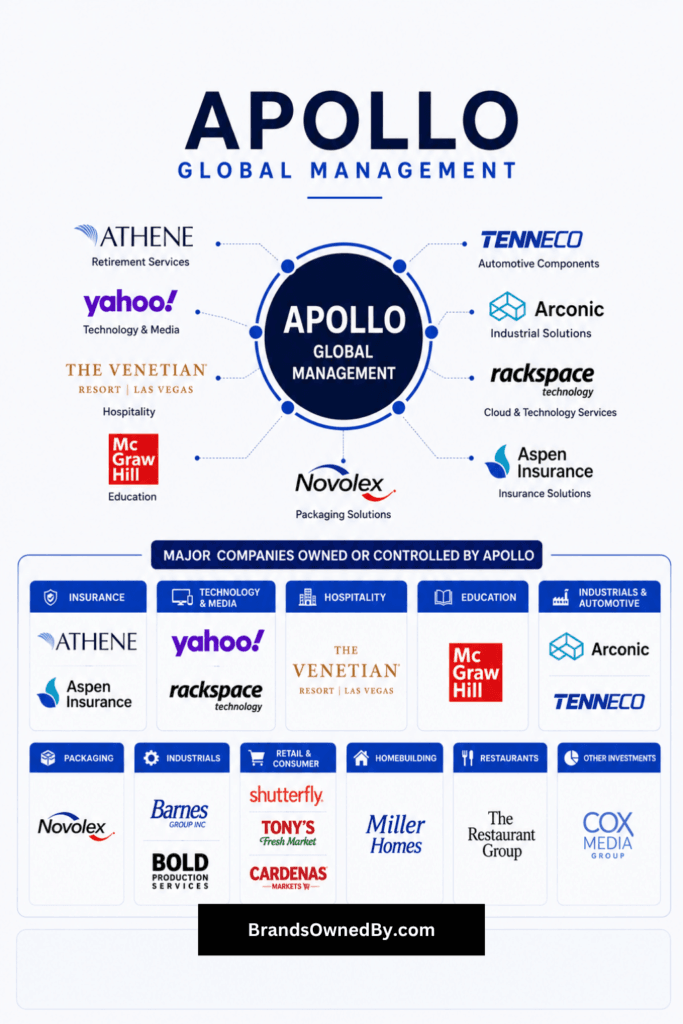
- Apollo Global Management owns or controls approximately 18 major companies across insurance, technology, hospitality, education, industrial manufacturing, retail, media, automotive, cloud computing, and financial services. Its largest strategic businesses include Athene, Yahoo, The Venetian Resort Las Vegas, McGraw Hill, Novolex, Tenneco, Arconic, Shutterfly, Rackspace Technology, and Aspen Insurance.
- Athene is Apollo’s most important subsidiary, serving as its retirement services and insurance platform. It provides permanent investment capital that supports Apollo’s private credit, infrastructure, real estate, and alternative investment strategies, making it the cornerstone of the company’s long-term growth.
- Apollo has diversified well beyond private equity. Its portfolio now includes leading companies in digital media (Yahoo), hospitality (The Venetian Resort), education (McGraw Hill), packaging (Novolex), automotive components (Tenneco), industrial manufacturing (Arconic), retail (Tony’s Fresh Market and Cardenas Markets), cloud computing (Rackspace Technology), homebuilding (Miller Homes), and insurance (Aspen Insurance).
- Unlike traditional holding companies, Apollo combines wholly owned subsidiaries, controlling stakes, and strategic investments to build long-term value. The company continues to expand its portfolio through acquisitions while focusing on businesses that generate recurring cash flows and complement its alternative asset management, insurance, and private credit operations.
Apollo Global Management is a leading American alternative asset management company specializing in private equity, credit, infrastructure, real estate, and retirement services. Founded in 1990, the firm has grown into one of the world’s most influential investment companies by acquiring, managing, and expanding businesses across a wide range of industries.
Unlike traditional corporations that manufacture products or sell consumer services, Apollo primarily invests in businesses with strong long-term growth potential. Its portfolio includes companies in technology, insurance, media, hospitality, education, manufacturing, logistics, financial services, and consumer industries. Apollo also manages capital on behalf of pension funds, sovereign wealth funds, insurance companies, endowments, and other institutional investors.
Headquartered in New York City, Apollo has built a global investment platform with operations and portfolio companies across North America, Europe, Asia-Pacific, and other international markets.
Apollo Global Management follows a value-driven investment strategy focused on identifying businesses with strong long-term potential. The company acquires, finances, or invests in businesses that can benefit from operational improvements, strategic expansion, or restructuring. After investing, Apollo works closely with management teams to improve efficiency, accelerate growth, and increase long-term value.
The company operates through three primary business segments:
- Asset Management.
- Retirement Services.
- Principal Investing.
Apollo invests across numerous industries, including insurance, technology, telecommunications, healthcare, manufacturing, industrials, chemicals, transportation, hospitality, gaming, education, packaging, media, and financial services. This diversification helps reduce risk while creating opportunities across different economic cycles.
One of Apollo’s defining strengths is its integration with Athene, a leading retirement services company. This relationship provides Apollo with a stable source of long-term capital that supports investments across multiple asset classes and allows the firm to pursue larger and more diversified transactions.
Apollo Global Management Founders
Apollo Global Management was founded in 1990 by Leon Black, Josh Harris, and Marc Rowan. The three founders previously worked together at Drexel Burnham Lambert, where they gained extensive experience in leveraged finance, mergers and acquisitions, and corporate restructuring. They established Apollo with the goal of investing in undervalued businesses and distressed assets while creating long-term value through operational improvements and disciplined capital allocation. Their combined expertise laid the foundation for Apollo’s growth into one of the world’s largest alternative asset managers.
Leon Black
Leon Black is the co-founder of Apollo Global Management and served as the firm’s Chief Executive Officer for many years. He was instrumental in developing Apollo’s investment philosophy, which focuses on value investing, distressed assets, and private equity acquisitions. Under his leadership, Apollo completed numerous high-profile transactions that established its reputation as a global investment powerhouse.
Josh Harris
Josh Harris is a co-founder of Apollo Global Management and played a key role in expanding the firm’s private equity platform. Throughout his career, he has overseen investments across multiple industries and helped build Apollo into a diversified investment company. Outside Apollo, Harris is also widely recognized for his investments in several professional sports franchises.
Marc Rowan
Marc Rowan is a co-founder of Apollo Global Management and currently serves as the company’s Chief Executive Officer. He has been a driving force behind Apollo’s expansion into credit investing and retirement services. Rowan also led the integration of Athene into Apollo’s business model, strengthening the firm’s long-term investment strategy. Today, he oversees Apollo’s global operations, investment strategy, and corporate growth initiatives.
List of Major Companies Owned by Apollo Global Management
Apollo Global Management owns and controls businesses across retirement services, insurance, technology, media, hospitality, education, manufacturing, and consumer industries. Most of these companies are held through Apollo-managed private equity funds, while others are wholly owned subsidiaries or controlled through majority ownership. The firm’s investment strategy focuses on acquiring businesses with strong long-term growth potential, improving their operations, and creating value through strategic expansion.
Apollo Global Management Portfolio
Major operating companies and controlling investments (June 2026).
18+
Companies10+
SectorsGlobal
Presence1990
FoundedAthene
100% OwnedRetirement services, annuities and pension solutions.
Yahoo
90% OwnedYahoo Mail, Finance, Sports, News, Search and Advertising.
Cox Media Group
Controlling StakeTelevision, radio and digital media network.
The Venetian Resort
Operating ControlLuxury resort, casino and convention business.
Shutterfly
OwnedPhoto printing and brands including Snapfish and Lifetouch.
McGraw Hill
OwnedEducational publishing and digital learning.
Novolex
Majority StakeFood service and sustainable packaging products.
Aspen Insurance
Controlling StakeSpecialty insurance and reinsurance.
Rackspace Technology
Significant StakeManaged cloud and cybersecurity services.
Tenneco
100% OwnedGlobal automotive components manufacturer.
Arconic
100% OwnedAluminum and engineered products.
Miller Homes
100% OwnedUK residential homebuilder.
The Restaurant Group
100% OwnedOwner of Wagamama and hospitality brands.
Tony’s Fresh Market
ControlledChicago-area supermarket chain.
Cardenas Markets
ControlledLeading Hispanic supermarket chain.
Bridge Investment Group
100% OwnedReal estate investment management.
Barnes Group
100% OwnedPrecision engineering and aerospace components.
Bold Production Services
Majority StakeNatural gas production infrastructure.
Athene
Athene is Apollo Global Management’s largest and most strategically important operating company. Apollo completed its all-stock merger with Athene in 2022, making the retirement services provider a wholly owned subsidiary and fully integrating it into Apollo’s corporate structure. Unlike a traditional portfolio investment, Athene now operates as one of Apollo’s core business segments and serves as the foundation of its retirement services platform.
Athene specializes in fixed annuities, indexed annuities, pension risk transfer solutions, retirement income products, institutional retirement services, and reinsurance. The company works with individual retirees, insurance companies, pension plans, corporations, financial advisors, and institutional investors across North America and international markets.
The acquisition fundamentally changed Apollo’s business model. Rather than relying primarily on third-party investment funds, Apollo now benefits from permanent capital generated through Athene’s insurance operations. Insurance premiums collected by Athene are invested across private credit, infrastructure, real estate, asset-backed finance, and private equity. This provides Apollo with a stable source of long-term investment capital that differentiates it from many competing private equity firms.
Today, Athene remains one of the world’s largest retirement services companies and is central to Apollo’s long-term growth strategy.
Yahoo
Apollo Funds acquired 90% of Yahoo from Verizon in 2021 for approximately $5 billion, while Verizon retained the remaining 10% ownership interest. Since the acquisition, Yahoo has continued operating as an independent technology and digital media company under Apollo’s ownership.
Yahoo operates one of the internet’s largest collections of consumer brands and digital services. Its portfolio includes Yahoo Mail, Yahoo Finance, Yahoo News, Yahoo Sports, Yahoo Search, Yahoo Fantasy Sports, Yahoo Entertainment, Yahoo Life, Yahoo Weather, Yahoo Advertising, Yahoo DSP, Engadget, MAKERS, and Flurry.
The company generates revenue primarily through digital advertising, premium subscription services, search partnerships, financial media, sports content, and advertising technology. Yahoo Finance remains one of the world’s most visited financial news platforms, while Yahoo Mail continues to serve hundreds of millions of users worldwide.
Since acquiring Yahoo, Apollo has focused on modernizing its technology infrastructure, expanding artificial intelligence capabilities, strengthening its advertising platform, and investing in digital content. The company continues to position Yahoo as one of the leading consumer internet brands globally.
Cox Media Group
Apollo Global Management controls Cox Media Group through a majority ownership stake acquired by Apollo-managed funds, while Cox Enterprises continues to retain a minority ownership interest. Although the exact ownership percentage has never been publicly disclosed, Apollo has operational control of the business.
Cox Media Group is one of the largest local media companies in the United States. It owns and operates dozens of television stations, radio stations, local news websites, streaming platforms, podcast networks, digital advertising businesses, and content production operations.
Its television and radio stations serve millions of viewers and listeners across major metropolitan markets. In addition to traditional broadcasting, the company provides digital marketing services, political advertising, local news production, weather coverage, sports broadcasting, and business advertising solutions.
Apollo has supported Cox Media Group’s expansion into digital media while maintaining its strong presence in local television and radio broadcasting. The company continues to invest in streaming technologies, audience analytics, and advertising platforms as consumer viewing habits evolve.
The Venetian Resort Las Vegas
Apollo controls the operating business of The Venetian Resort Las Vegas through a joint venture transaction completed in 2022. While VICI Properties owns the underlying real estate, Apollo acquired and operates the hospitality and gaming business under a long-term operating structure. This gives Apollo control over the resort’s business operations even though the real estate ownership remains separate.
The Venetian Resort is one of the largest integrated hospitality and entertainment destinations in the United States. The property includes The Venetian Hotel, The Palazzo Hotel, the Venetian Expo convention center, luxury retail shopping, world-class restaurants, entertainment venues, meeting facilities, convention space, casinos, and premium hospitality services.
The resort attracts millions of tourists, convention attendees, and business travelers each year. Its convention center is among the largest privately owned exhibition facilities in North America and hosts hundreds of major trade shows and corporate events annually.
The acquisition reflects Apollo’s long-term strategy of investing in high-quality hospitality assets with stable cash flows and significant real estate value.
Shutterfly
Apollo acquired Shutterfly in 2019 through Apollo-managed investment funds and continues to own the company. The acquisition also included the combination of Shutterfly with Snapfish, creating one of the largest personalized photo product companies in North America.
Shutterfly specializes in customized photo products, personalized gifts, digital printing, and creative consumer products. The company enables customers to create photo books, greeting cards, calendars, wall art, home décor, wedding invitations, stationery, personalized gifts, business printing products, and custom merchandise.
Under its ownership, Shutterfly operates several well-known consumer brands, including:
- Shutterfly.
- Snapfish.
- Lifetouch.
- Spoonflower.
- Tiny Prints.
- Groovebook.
- BorrowLenses.
These brands collectively serve families, schools, professional photographers, artists, designers, small businesses, and consumers throughout North America. Apollo has continued investing in product innovation, digital commerce, and operational efficiency to strengthen Shutterfly’s market position.
McGraw Hill
Apollo acquired McGraw Hill through its private equity platform and continues to own the global education company. The acquisition expanded Apollo’s presence in the education technology and digital learning sectors.
McGraw Hill develops educational content, adaptive learning platforms, digital curriculum, textbooks, assessment tools, classroom technologies, and professional learning solutions. Its products are used by K-12 schools, colleges, universities, educators, corporate training organizations, government agencies, and professional certification providers worldwide.
The company offers educational materials across mathematics, science, engineering, healthcare, business, social sciences, language learning, finance, and professional education. Over recent years, McGraw Hill has shifted its focus toward digital learning platforms, artificial intelligence-powered educational tools, and subscription-based educational services.
Apollo has supported McGraw Hill’s digital transformation strategy by investing in online learning technologies, adaptive assessment systems, cloud-based educational platforms, and personalized learning solutions. Today, McGraw Hill remains one of the world’s leading educational publishing and education technology companies.
Novolex
Apollo Funds acquired a majority ownership stake in Novolex from Carlyle in 2022, while Carlyle retained a minority investment in the company. Although Apollo has not publicly disclosed its exact equity percentage, it is the controlling shareholder and oversees the company’s long-term strategic direction.
Novolex is one of North America’s largest manufacturers of packaging products for the food service, retail, grocery, healthcare, hospitality, and industrial sectors. The company develops and manufactures paper bags, plastic bags, compostable packaging, reusable containers, food-service packaging, beverage carriers, cutlery, cups, plates, food containers, and specialty packaging products.
Over the years, Novolex has expanded through numerous acquisitions, creating a diverse portfolio of packaging brands that serve restaurants, supermarkets, convenience stores, food manufacturers, healthcare organizations, and e-commerce businesses. The company has also invested heavily in sustainable packaging, recyclable materials, compostable products, and circular economy initiatives to meet growing environmental regulations and customer demand.
Apollo acquired Novolex because of its strong market position, diversified customer base, and consistent cash generation. The company remains one of Apollo’s largest industrial manufacturing investments.
Aspen Insurance
Apollo Funds acquired all outstanding shares of Aspen Insurance Holdings, making the specialty insurer a wholly owned portfolio company through an all-cash transaction valued at approximately $2.6 billion. Aspen later returned to the public markets, but Apollo has remained its controlling shareholder.
Aspen Insurance is a global specialty insurance and reinsurance company serving customers across North America, Europe, Asia, and other international markets. The company provides commercial property insurance, casualty insurance, marine insurance, aviation insurance, energy insurance, environmental liability coverage, financial institutions insurance, cyber insurance, professional liability insurance, and reinsurance solutions.
Aspen serves corporations, financial institutions, governments, insurers, and multinational organizations that require complex risk management solutions. Its global reinsurance business also provides capital and underwriting support to insurance companies around the world.
The acquisition strengthened Apollo’s insurance platform alongside Athene and expanded its presence across the global specialty insurance market.
Rackspace Technology
Apollo originally acquired Rackspace in 2016 and took the company private before later returning it to the public markets. Through Apollo-managed investment vehicles and subsequent transactions, Apollo has continued to maintain a significant ownership position and influence over the company, although its exact current ownership percentage has not been publicly disclosed.
Rackspace Technology is a global provider of cloud computing, managed hosting, cybersecurity, hybrid cloud infrastructure, artificial intelligence infrastructure, application modernization, database management, managed services, and cloud consulting.
The company helps organizations design, migrate, secure, and manage cloud environments across major platforms including Amazon Web Services (AWS), Microsoft Azure, Google Cloud Platform, Oracle Cloud Infrastructure, and VMware.
Rackspace serves enterprise customers in healthcare, banking, manufacturing, retail, telecommunications, government, education, and energy. Apollo’s investment has supported the company’s transition from traditional hosting services toward higher-margin cloud and digital transformation solutions.
Tenneco
Apollo Funds acquired 100% of Tenneco in a transaction valued at approximately $7.1 billion, taking the automotive supplier private and making it one of Apollo’s largest industrial investments.
Tenneco is a global automotive components manufacturer supplying original equipment manufacturers (OEMs) and the aftermarket. The company designs and manufactures suspension systems, braking components, clean-air technologies, emission control systems, engine products, ignition systems, ride performance products, sealing solutions, and aftermarket replacement parts.
Its portfolio includes several well-known automotive brands, including Monroe, Walker, Champion, Fel-Pro, Wagner, MOOG, Rancho, DRiV, Öhlins, and others serving both passenger vehicles and commercial transportation markets.
Tenneco supplies products to many of the world’s leading automotive manufacturers, including companies operating in North America, Europe, and Asia. Apollo acquired the business because of its global manufacturing footprint, diversified customer relationships, and strong aftermarket business that generates recurring revenue.
Arconic
Apollo Funds completed the acquisition of Arconic, taking the company private through an all-cash transaction. Following the acquisition, Arconic became a wholly owned portfolio company of Apollo-managed funds, with a minority investment from funds affiliated with Irenic Capital Management.
Arconic is a leading manufacturer of advanced aluminum sheet, plate, and architectural products used across multiple industries. The company supplies lightweight engineered materials for aerospace, automotive, commercial transportation, building and construction, industrial manufacturing, packaging, defense, and consumer products.
Its manufacturing facilities produce rolled aluminum products, architectural panels, building façade systems, industrial components, and engineered metal solutions that are used by aircraft manufacturers, vehicle manufacturers, commercial construction companies, and industrial customers around the world.
Apollo viewed Arconic as a long-term industrial investment with opportunities to improve operational efficiency, strengthen manufacturing capabilities, and benefit from growing demand for lightweight materials across transportation and aerospace industries.
Miller Homes
Apollo Funds acquired 100% of Miller Homes from Bridgepoint Group in late 2021, making the British homebuilder part of Apollo’s growing residential real estate portfolio. Financial terms of the acquisition were not publicly disclosed.
Founded in 1934, Miller Homes is one of the United Kingdom’s leading residential property developers. The company designs, develops, and builds detached homes, semi-detached homes, townhouses, apartments, and large residential communities across England, Scotland, and Wales.
Miller Homes focuses primarily on suburban housing developments and family homes while also undertaking mixed-use residential projects. The company operates across multiple regional markets and manages the entire development process, including land acquisition, planning, construction, sales, and customer service.
Apollo invested in Miller Homes to capitalize on long-term housing demand within the United Kingdom. Since the acquisition, the company has continued expanding its land bank, increasing housing developments, and investing in sustainable construction practices, energy-efficient homes, and modern residential communities.
The Restaurant Group
Apollo Funds acquired 100% of The Restaurant Group plc in 2023 through a transaction valued at approximately £506 million, taking the company private. The acquisition strengthened Apollo’s presence in the hospitality and food service sector while providing an opportunity to improve the company’s long-term operational performance.
The Restaurant Group is one of the United Kingdom’s largest restaurant operators. The company owns, operates, and franchises restaurants across high streets, airports, railway stations, retail parks, and leisure destinations.
Its portfolio includes several well-known restaurant brands, including:
- Wagamama.
- Brunning & Price.
- Barburrito.
- Concessions operated under franchise agreements with brands such as Burger King and Starbucks in travel locations.
Among these, Wagamama is the company’s flagship brand and one of the UK’s most recognizable Asian-inspired restaurant chains. Brunning & Price operates premium pubs throughout England and Wales, while Barburrito specializes in Mexican-style fast-casual dining.
Apollo intends to strengthen the group’s digital ordering capabilities, expand profitable brands, improve operational efficiency, and accelerate growth across the hospitality sector.
Tony’s Fresh Market
Apollo Funds acquired Tony’s Fresh Market in 2022 and now owns the grocery retailer through its private equity platform. Although Apollo has not publicly disclosed its exact ownership percentage, the company is fully controlled by Apollo-managed investment funds and forms part of Apollo’s growing food retail platform.
Founded in 1979, Tony’s Fresh Market has grown into one of the leading independent supermarket chains in the Chicago metropolitan area. The company specializes in fresh produce, premium meats, seafood, bakery products, dairy items, prepared foods, international groceries, organic products, and specialty food items.
Tony’s Fresh Market is particularly known for serving multicultural communities by offering products from Europe, Latin America, Asia, and the Middle East. The retailer combines traditional supermarket offerings with specialty international food selections that differentiate it from larger national grocery chains.
Following Apollo’s acquisition, Tony’s Fresh Market became part of a broader grocery platform alongside Cardenas Markets, allowing the businesses to benefit from shared purchasing, supply chain efficiencies, and operational expertise while continuing to operate under their individual brands.
Cardenas Markets
Apollo Funds acquired Cardenas Markets in 2022 from KKR. While Apollo has not disclosed its precise ownership percentage, the supermarket chain is controlled by Apollo-managed funds and operates alongside Tony’s Fresh Market under Apollo’s grocery investment platform.
Cardenas Markets is one of the largest Hispanic supermarket chains in the United States. The company operates dozens of stores across California, Nevada, and Arizona, serving millions of customers each year.
The retailer specializes in authentic Hispanic groceries, fresh produce, meat and seafood departments, in-store bakeries, tortillerias, prepared meals, dairy products, imported Latin American foods, spices, beverages, and household products.
Its stores are designed to provide customers with products from Mexico, Central America, South America, and the Caribbean while also offering traditional supermarket merchandise.
Apollo acquired Cardenas because of its strong regional market position, loyal customer base, and long-term growth potential within the expanding Hispanic grocery sector.
Bold Production Services
Apollo Funds acquired a majority ownership stake in Bold Production Services in early 2025. While the exact ownership percentage has not been publicly disclosed, Apollo controls the business through its investment funds.
Bold Production Services is a leading provider of production-linked gas treatment solutions for the energy industry. The company designs, builds, owns, and operates natural gas processing infrastructure that helps upstream energy producers treat and prepare natural gas for transportation and commercial use.
Its services include gas treatment, sulfur recovery, carbon dioxide removal, hydrogen sulfide removal, dehydration systems, processing equipment, and production infrastructure.
Unlike traditional energy service providers, Bold focuses on long-term contracted infrastructure solutions rather than one-time equipment sales. This creates predictable recurring revenue supported by long-term customer agreements.
Apollo invested in Bold to expand its infrastructure portfolio and increase exposure to essential midstream energy assets.
Bridge Investment Group
Apollo announced the acquisition of Bridge Investment Group in February 2025 and completed the transaction in September 2025. Following completion, Bridge became a wholly owned subsidiary of Apollo Global Management while continuing to operate under its established brand and management team.
Bridge Investment Group is a leading real estate investment manager specializing in residential housing, industrial properties, logistics facilities, office buildings, seniors housing, student housing, affordable housing, debt strategies, and opportunity zone investments.
The company manages real estate assets on behalf of pension funds, insurance companies, endowments, family offices, and institutional investors.
The acquisition significantly strengthened Apollo’s real estate platform by combining Bridge’s specialized property investment expertise with Apollo’s existing global real estate business. The combined platform now manages a substantially larger portfolio across multiple real estate asset classes and geographic markets.
Barnes Group
Apollo Funds acquired 100% of Barnes Group in early 2025, taking the industrial manufacturer private through an all-cash transaction. Barnes became another important addition to Apollo’s industrial manufacturing portfolio.
Barnes Group is a global engineering and manufacturing company that designs precision components, industrial technologies, and engineered products for aerospace, transportation, healthcare, automation, packaging, and industrial manufacturing.
Its product portfolio includes aerospace components, precision springs, tooling systems, molds, automation equipment, industrial gas products, and engineered manufacturing solutions.
Barnes serves many of the world’s largest aerospace manufacturers and industrial companies through long-term customer relationships built over more than a century.
Apollo acquired Barnes because of its strong engineering capabilities, recurring aftermarket revenue, global customer base, and opportunities for operational improvement.
Who Owns Apollo Global Management?
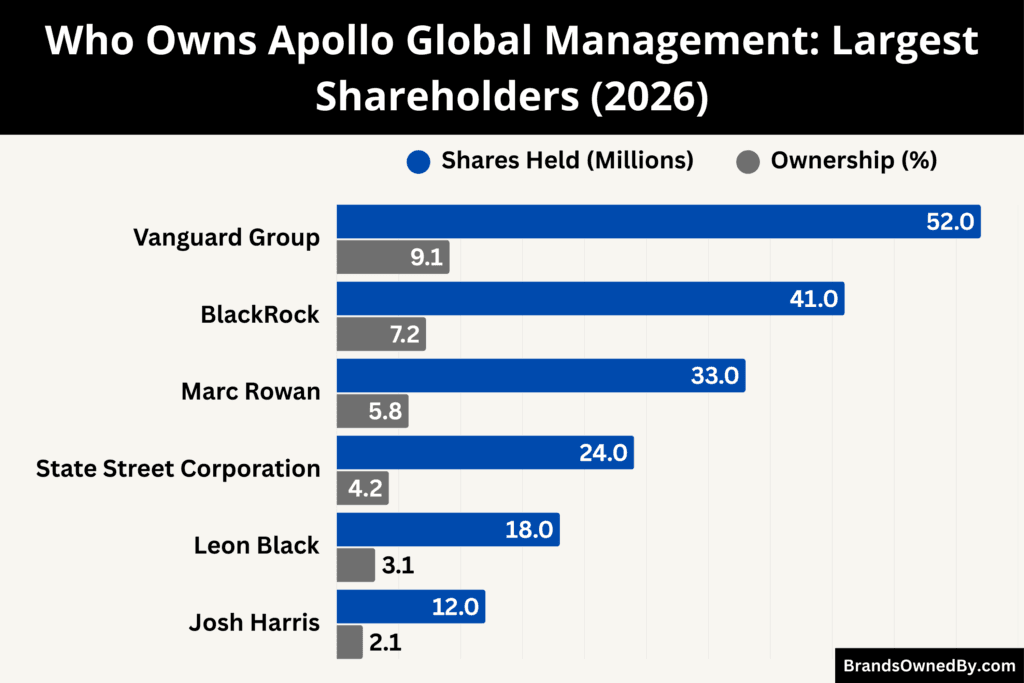
Apollo Global Management is a publicly traded alternative asset management company listed on the New York Stock Exchange (NYSE: APO). Because it is a public company, ownership is distributed among institutional investors, company executives, founders, and retail shareholders. However, institutional investors collectively own the majority of Apollo’s outstanding shares, giving them significant influence over shareholder voting and corporate governance.
While no single shareholder owns a majority of the company, Apollo’s founders and senior executives continue to hold substantial equity stakes. Combined with support from large institutional investors, they play an important role in shaping the company’s long-term strategy.
Who Owns Apollo Global Management?
The Vanguard Group
The Vanguard Group is Apollo Global Management’s largest institutional shareholder. As of June 2026, Vanguard owns approximately 8–9% of the company’s outstanding shares through its index funds, exchange-traded funds (ETFs), and actively managed investment portfolios.
Vanguard invests in Apollo on behalf of millions of investors worldwide. Although it is the largest shareholder, Vanguard does not participate in Apollo’s day-to-day management. Instead, it exercises influence through shareholder voting on matters such as director elections, executive compensation, governance policies, and major corporate proposals.
BlackRock Inc.
BlackRock is another major shareholder of Apollo Global Management. As of June 2026, BlackRock owns approximately 6–7% of Apollo’s outstanding shares through its ETFs, mutual funds, and institutional investment portfolios.
Like Vanguard, BlackRock is a passive institutional investor that does not manage Apollo’s daily operations. However, its sizeable ownership gives it considerable voting power during shareholder meetings and on corporate governance matters.
Capital Research and Management Company
Capital Research and Management Company, the investment manager behind American Funds, is one of Apollo’s largest long-term institutional shareholders. Recent ownership filings indicate the firm controls approximately 7–8% of Apollo’s outstanding shares.
Capital Research invests in Apollo because of its strong position in alternative asset management, private credit, insurance, and retirement services. The firm’s investment is held across multiple actively managed mutual funds and institutional portfolios.
State Street Global Advisors
State Street Global Advisors is another significant institutional investor in Apollo Global Management. As of June 2026, it owns approximately 4% of the company’s outstanding shares through its index funds and institutional investment products.
State Street is among the “Big Three” asset managers alongside Vanguard and BlackRock. Together, these firms hold a meaningful percentage of Apollo’s publicly traded shares and collectively influence shareholder voting outcomes.
Marc Rowan
Marc Rowan is Apollo Global Management’s Chief Executive Officer, Chair of the Board, and one of its co-founders. He is also one of the company’s largest individual shareholders, owning approximately 6% of Apollo’s outstanding shares through direct and indirect holdings.
Rowan has played a central role in Apollo’s evolution, particularly in expanding its private credit business and integrating Athene into the company’s long-term strategy. His significant ownership aligns his interests closely with those of other shareholders and reinforces his influence over Apollo’s strategic direction.
Leon Black
Leon Black is Apollo’s co-founder and former Chief Executive Officer. Although he stepped down as CEO in 2021, he remains one of the company’s largest individual shareholders. Public ownership data indicates that Black continues to own approximately 6–7% of Apollo’s outstanding shares.
Despite no longer being involved in the company’s day-to-day management, Black’s substantial shareholding makes him an influential long-term investor.
Josh Harris
Josh Harris is another co-founder of Apollo Global Management and remains a significant shareholder. His ownership is estimated at approximately 6% of the company’s outstanding shares through direct holdings.
Although Harris is less involved in Apollo’s daily operations than in earlier years, he continues to maintain a substantial financial interest in the firm’s long-term success.
Other Institutional Investors
In addition to the largest shareholders, Apollo Global Management is owned by numerous institutional investors, pension funds, insurance companies, mutual funds, hedge funds, and exchange-traded funds. Other notable shareholders include Fidelity Management & Research (FMR LLC), Geode Capital Management, Capital World Investors, Capital International Investors, and various institutional asset managers.
Collectively, institutional investors own roughly 70% of Apollo’s outstanding shares, making them the dominant ownership group. Individual investors, insiders, and retail shareholders own the remaining shares.
Competitor Ownership Comparison
Ownership structure is one of the biggest factors that differentiates the world’s leading alternative asset managers. Although firms such as Blackstone, KKR & Co., Brookfield Asset Management, The Carlyle Group, and Ares Management compete in many of the same investment sectors, their shareholder composition varies considerably. Some remain strongly influenced by their founders through large individual ownership stakes, while others are primarily controlled by institutional investors.
These ownership differences directly affect corporate governance, leadership succession, strategic decision-making, capital allocation, and long-term business strategy. Companies with concentrated founder ownership often benefit from consistent leadership and a long-term vision, whereas firms with broad institutional ownership generally emphasize stronger governance, shareholder accountability, and independent board oversight.
Blackstone Inc.
Blackstone is the world’s largest alternative asset manager and one of the closest competitors in private equity, private credit, real estate, infrastructure, insurance, and hedge fund solutions. The company is publicly traded and is primarily owned by institutional investors, including Vanguard, BlackRock, and State Street.
Despite the large institutional ownership, Blackstone remains heavily influenced by its founder, Stephen A. Schwarzman, who continues to be the company’s largest individual shareholder. His ownership stake is significantly larger than that of any executive at competing firms, allowing him to maintain substantial influence over strategic decisions, board appointments, executive succession, and long-term capital allocation.
This combination of strong founder ownership and institutional investment has provided Blackstone with stable leadership for decades while preserving founder influence over the company’s future direction.
KKR & Co.
KKR & Co. has evolved from a founder-led buyout firm into one of the world’s largest diversified alternative investment companies. Today, institutional investors collectively own most of the company’s outstanding shares, making KKR’s ownership structure considerably more diversified than it was during its early years.
Unlike Blackstone, KKR no longer relies on a dominant founder for strategic leadership. Following changes in executive leadership and ownership over time, the company is now governed primarily through its Board of Directors, executive management, and institutional shareholders.
Current Co-Chief Executive Officers Joseph Bae and Scott Nuttall continue to own meaningful equity positions, ensuring management remains aligned with shareholders. However, ownership is much more broadly distributed than at founder-controlled investment firms.
Brookfield Asset Management
Brookfield Asset Management has one of the most institutionally diversified ownership structures among global alternative asset managers. The majority of its shares are held by institutional investors, pension funds, mutual funds, exchange-traded funds, and public shareholders.
Unlike several of its competitors, Brookfield is no longer closely associated with founder ownership. Strategic decisions are primarily driven by executive management, independent directors, and institutional shareholders rather than a small group of founders.
Brookfield also differs because it directly owns and operates infrastructure assets, renewable power businesses, utilities, data centers, logistics facilities, and commercial real estate around the world. This operating model has attracted a highly diversified shareholder base seeking long-term exposure to real assets and infrastructure investments.
The Carlyle Group
The Carlyle Group continues to maintain a stronger founder presence than most publicly traded investment firms. Although institutional investors own a significant percentage of the company, co-founders Daniel D’Aniello, William Conway Jr., and David Rubenstein remain among its largest individual shareholders.
Because multiple founders continue to hold substantial ownership positions, they maintain meaningful influence over corporate governance, leadership transitions, and long-term strategy. This ownership model provides continuity while preserving the founders’ role in shaping Carlyle’s future.
Compared with more institutionally owned competitors, Carlyle’s governance remains more founder-oriented, even though public shareholders now own the majority of outstanding shares.
Ares Management
Ares Management has become one of the fastest-growing competitors in alternative asset management, particularly in private credit, direct lending, infrastructure, secondaries, and real estate investing.
Like many leading investment firms, Ares is publicly traded and primarily owned by institutional investors. Several founders and senior executives also retain meaningful ownership stakes, helping align management with shareholder interests.
Rather than being controlled by a single founder, Ares follows a balanced ownership model where institutional investors provide most of the capital while executive ownership supports long-term strategic decision-making. This structure has allowed the company to expand rapidly while maintaining strong corporate governance and leadership continuity.
How Competitor Ownership Structures Compare
Among the industry’s largest investment firms, ownership structures generally fall into three categories.
Blackstone and Carlyle continue to exhibit relatively strong founder influence because their founders remain among the company’s largest individual shareholders. Their ownership positions provide meaningful influence over long-term strategy and governance despite broad institutional ownership.
KKR and Ares represent a more balanced approach, where institutional investors own the majority of shares while executives and senior management retain meaningful ownership that aligns their interests with shareholders. These firms rely less on founder influence and more on professional executive leadership.
Brookfield stands apart as one of the most institutionally owned firms in the industry. Its governance is driven primarily by institutional shareholders, executive management, and an independent board, making it less dependent on founder ownership than many of its peers.
These ownership models demonstrate that although the world’s leading alternative asset managers compete across many of the same industries, they have adopted different approaches to governance, leadership, and shareholder influence. Those differences continue to shape their investment strategies, acquisition decisions, executive succession, and long-term corporate growth.
Who Controls Apollo Global Management?
Apollo Global Management does not have a controlling shareholder. Instead, control is exercised through a combination of executive leadership, the Board of Directors, Apollo Asset Management, Athene, and shareholder governance. Although institutional investors collectively own most of the company’s outstanding shares, they do not direct the firm’s daily operations or investment decisions.
As of June 2026, operational control is concentrated within a small group of senior executives led by Marc Rowan, supported by President Jim Zelter, Co-President Scott Kleinman, Co-President John Zito, and the leadership of Athene. This management structure was strengthened in 2025 as part of Apollo’s five-year growth strategy and succession planning.
Marc Rowan Sets Apollo’s Strategic Direction
Marc Rowan serves as Chief Executive Officer and Chair of the Board of Directors, making him the most influential individual within Apollo Global Management. As a co-founder of the firm, Rowan is responsible for defining Apollo’s long-term vision, approving major acquisitions, determining capital allocation priorities, and overseeing relationships with institutional investors, regulators, and shareholders.
Since becoming CEO in 2021, Rowan has transformed Apollo from a traditional private equity firm into a diversified alternative asset manager centered on private credit, retirement services, insurance, infrastructure, and asset-backed finance. Under his leadership, private credit has become the firm’s largest business, while Athene has evolved into Apollo’s primary source of permanent investment capital.
Rowan also chairs Apollo’s Board, giving him significant influence over strategic initiatives, executive appointments, corporate governance, and long-term business planning. Although he owns a meaningful equity stake in the company, his authority primarily comes from his executive leadership role rather than majority ownership.
Jim Zelter Oversees Enterprise Operations
In January 2025, Apollo created the new position of President of Apollo Global Management and appointed Jim Zelter to the role. The appointment reflected Apollo’s growing size and the increasing complexity of managing both its asset management and retirement services businesses.
As President, Zelter works directly with Marc Rowan to execute Apollo’s corporate strategy across the entire organization. His responsibilities include coordinating operations between Apollo Asset Management and Athene, leading strategic initiatives, improving operational efficiency, and supporting the firm’s long-term expansion plans.
Zelter is widely regarded as one of Apollo’s most experienced executives. Before becoming President, he played a leading role in building Apollo’s global credit platform, which has become one of the firm’s largest sources of earnings and assets under management.
Scott Kleinman Leads the Private Equity Business
Scott Kleinman serves as Co-President of Apollo Asset Management and is responsible for overseeing Apollo’s flagship private equity business. He supervises investment strategy across corporate buyouts, portfolio company management, operational improvements, exits, and value creation initiatives.
Apollo’s private equity platform continues to manage investments across manufacturing, industrials, healthcare, technology, financial services, consumer products, media, hospitality, and business services. Kleinman also works closely with Apollo’s investment committees when evaluating major acquisitions and portfolio decisions.
His role ensures that Apollo’s traditional private equity operations remain closely aligned with the firm’s expanding credit and insurance businesses.
John Zito Leads Credit and Asset Management
John Zito was promoted to Co-President of Apollo Asset Management in 2025 while continuing to lead Apollo’s global credit business. The promotion recognized the growing importance of private credit within Apollo’s overall strategy.
Today, Apollo is one of the world’s largest private credit managers, and Zito oversees investment activities across direct lending, structured credit, asset-backed finance, investment-grade private credit, aviation finance, infrastructure finance, and specialty lending.
Because private credit represents the largest portion of Apollo’s assets under management, Zito has become one of the firm’s most influential investment leaders. His team is responsible for sourcing, underwriting, structuring, and managing billions of dollars of financing transactions each year.
Athene Leadership Controls the Retirement Services Platform
Athene has become one of the most strategically important businesses within Apollo following the companies’ merger. Rather than operating as a traditional portfolio company, Athene functions as Apollo’s retirement services and insurance platform, providing long-term permanent capital that supports investment activities across the organization.
The leadership teams of Apollo and Athene work closely together to manage retirement products, annuities, pension risk transfer, reinsurance, and insurance investment portfolios. This integrated structure allows Apollo to deploy insurance capital into private credit, infrastructure, real estate, and asset-backed investments while maintaining strict regulatory oversight.
The close relationship between Apollo and Athene is one of the firm’s biggest competitive advantages compared with many other alternative asset managers.
Investment Committees Drive Capital Allocation
Although senior executives provide strategic leadership, Apollo’s investment decisions are not made by one individual.
Major acquisitions, private equity investments, private credit transactions, infrastructure investments, real estate investments, and portfolio exits are reviewed by specialized investment committees composed of senior partners and experienced investment professionals.
This committee-based decision-making process helps reduce concentration risk and ensures that investment opportunities undergo extensive financial, operational, legal, and risk analysis before capital is committed.
Given Apollo’s scale, this collaborative governance model has become increasingly important as the firm manages investments across hundreds of portfolio companies and multiple asset classes.
The Board of Directors Provides Independent Oversight
Apollo’s Board of Directors serves as the company’s highest governance body and oversees executive management on behalf of shareholders. The Board reviews major acquisitions, capital allocation strategies, executive compensation, succession planning, enterprise risk management, regulatory compliance, and corporate governance policies.
The Board does not manage Apollo’s daily investment activities. Instead, it provides independent oversight while ensuring that management’s decisions align with the interests of shareholders and long-term investors.
Institutional Investors Influence Governance
Large institutional shareholders—including Vanguard, BlackRock, Capital Research & Management, and State Street—do not participate in Apollo’s day-to-day management. However, because they collectively own a substantial portion of the company’s outstanding shares, they influence governance through shareholder voting.
These investors vote on director elections, executive compensation, governance proposals, auditor appointments, and other major corporate matters. Their ownership also encourages strong governance standards, financial transparency, and long-term value creation.
How Control Is Distributed
As of June 2026, Apollo’s control structure is built around specialized leadership rather than a single decision-maker.
Marc Rowan provides overall corporate leadership and strategic direction. Jim Zelter coordinates enterprise-wide operations and strategic execution. Scott Kleinman oversees private equity investments, while John Zito leads the firm’s rapidly expanding private credit platform. Athene’s leadership manages the retirement services and insurance operations that provide Apollo with permanent investment capital. Independent directors oversee governance, and institutional shareholders provide external accountability through shareholder voting.
This multi-layered leadership structure enables Apollo to manage one of the world’s largest alternative investment platforms while maintaining clear accountability across its private equity, private credit, insurance, infrastructure, real estate, and retirement services businesses.
Apollo Global Management Annual Revenue and Net Worth
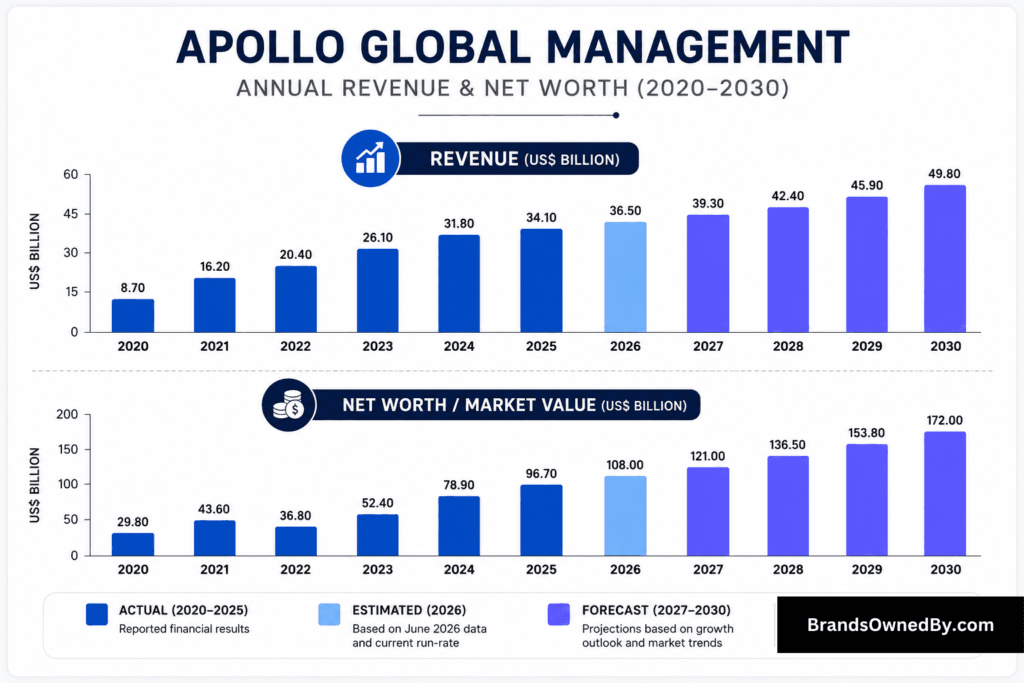
Apollo Global Management has transformed from a traditional leveraged buyout firm into one of the world’s largest alternative asset managers. As of 2026, the company is estimated to generate approximately $36.5 billion in annual revenue, while its estimated market value stands at around $108 billion. Revenue has increased more than fourfold since 2020, driven by rapid expansion in private credit, the full integration of Athene, higher fee-generating assets under management, and increasing demand for retirement and insurance-related investment products.
Unlike many competitors that rely heavily on private equity exits, Apollo now generates a significant portion of its earnings from recurring management fees, spread-related earnings, and insurance investment income. This has improved the predictability of cash flows and supported a substantial increase in the company’s market valuation.
Apollo Global Management Revenue in 2026
Apollo is estimated to report $36.5 billion in revenue during 2026, compared with approximately $34.1 billion in 2025, representing annual growth of around 7%. Since 2020, estimated revenue has increased from $8.7 billion to $36.5 billion, representing cumulative growth of nearly 320%.
The company’s revenue base has become considerably more diversified over the past several years. Private Credit remains the largest contributor, while Retirement Services through Athene has emerged as the second-largest earnings platform. Private Equity, once Apollo’s primary business, now contributes a much smaller share of total revenue as the company continues expanding into long-duration investment strategies.
Revenue Breakdown by Business Segment (2026)
Although Apollo does not publicly disclose revenue by investment strategy, the following estimates are based on its assets under management, business mix, earnings composition, fee-generating assets, insurance operations, and management commentary.
| Business Segment | Estimated Revenue | Share of Total Revenue |
|---|---|---|
| Private Credit | $15.0 Billion | 41% |
| Retirement Services (Athene) | $9.9 Billion | 27% |
| Private Equity | $5.1 Billion | 14% |
| Asset-Backed Finance & Structured Credit | $2.9 Billion | 8% |
| Infrastructure | $1.8 Billion | 5% |
| Real Estate | $1.1 Billion | 3% |
| Other Investment & Advisory Income | $0.7 Billion | 2% |
| Total Estimated Revenue | $36.5 Billion | 100% |
Private Credit Revenue
Private Credit is estimated to contribute approximately $15.0 billion, accounting for nearly 41% of Apollo’s total revenue in 2026. This has become the firm’s largest operating platform and the primary driver of earnings growth.
The business benefits from continued demand for private lending from corporations, infrastructure developers, financial institutions, and institutional borrowers. Revenue is generated through recurring management fees, financing spreads, origination fees, underwriting income, structured financing transactions, and investment returns across direct lending, investment-grade private credit, asset-backed lending, aviation finance, infrastructure finance, specialty finance, and corporate credit.
Private Credit has steadily increased its contribution to Apollo’s overall earnings and now generates almost three times the revenue produced by the company’s traditional private equity business.
Retirement Services (Athene) Revenue
Apollo’s Retirement Services platform, operated through Athene, is estimated to generate approximately $9.9 billion, representing around 27% of total annual revenue.
Athene has become one of Apollo’s most valuable businesses following its full integration into the company. Revenue is primarily generated through annuity sales, pension risk transfer transactions, spread-related earnings, insurance investment income, reinsurance operations, and investment management fees.
Unlike conventional asset managers that depend heavily on fundraising cycles, Athene continuously provides permanent investment capital. This allows Apollo to invest insurance assets into private credit and other alternative investments while generating stable recurring earnings.
The Retirement Services business is now estimated to contribute more than one-quarter of Apollo’s total annual revenue, making it the company’s second-largest operating segment.
Private Equity Revenue
Private Equity is estimated to contribute approximately $5.1 billion, or roughly 14% of total revenue.
Although Apollo built its global reputation through leveraged buyouts, the relative importance of private equity has gradually declined as newer investment platforms expanded more rapidly.
Revenue comes from management fees, carried interest, portfolio company exits, recapitalizations, advisory income, and transaction-related fees generated across investments in healthcare, industrial manufacturing, technology, financial services, consumer products, hospitality, education, transportation, and business services.
While Private Equity remains a core business, its contribution has fallen significantly as Apollo’s insurance and credit businesses continue to expand.
Asset-Backed Finance and Structured Credit Revenue
Asset-Backed Finance and Structured Credit are estimated to contribute approximately $2.9 billion, accounting for nearly 8% of annual revenue.
This platform includes aircraft leasing, equipment finance, transportation assets, consumer finance, mortgage portfolios, commercial receivables, structured credit products, specialty lending, and securitized investments.
The increasing demand for customized financing solutions has made this one of Apollo’s fastest-growing investment platforms and an important contributor to recurring fee income.
Infrastructure Revenue
Infrastructure investments are estimated to generate approximately $1.8 billion, representing around 5% of total revenue.
Apollo has expanded aggressively into digital infrastructure, renewable energy, transportation, utilities, communications networks, logistics facilities, and energy infrastructure.
These long-term investments provide recurring management fees while benefiting from increasing institutional demand for infrastructure assets with predictable cash flows.
Real Estate Revenue
Apollo’s Real Estate platform is estimated to generate approximately $1.1 billion, contributing nearly 3% of annual revenue.
Revenue is generated from commercial real estate investments, industrial properties, logistics assets, hospitality investments, residential developments, office buildings, real estate credit, and opportunistic property acquisitions.
Although considerably smaller than the company’s Private Credit platform, Real Estate continues to provide stable recurring management fees and portfolio diversification.
Other Investment and Advisory Revenue
Other investment activities are estimated to contribute approximately $700 million, or roughly 2% of annual revenue.
This category includes advisory services, hybrid value investments, secondary transactions, treasury activities, fund administration, and miscellaneous investment income generated outside Apollo’s primary operating businesses.
Apollo Global Management Net Worth in 2026
Apollo’s estimated market value stands at approximately $108 billion in 2026, compared with roughly $96.7 billion in 2025. Since 2020, the company’s valuation has increased by more than 260%, reflecting sustained earnings growth, expanding assets under management, higher recurring fee income, and increasing investor confidence in its diversified business model.
Unlike accounting net assets, market value reflects investors’ expectations of future earnings, long-term profitability, competitive positioning, capital allocation, and growth potential. Apollo’s transition toward recurring earnings from insurance and private credit has significantly improved the quality of its earnings, resulting in higher valuation multiples compared with its earlier private-equity-focused business model.
Net Worth Breakdown by Business Platform
Apollo does not disclose the value of each operating platform separately. Based on earnings contribution, strategic importance, assets under management, and comparable market valuations, the company’s estimated $108 billion market value can be broadly allocated as follows.
| Business Platform | Estimated Value | Share of Market Value |
| Private Credit | $45.4 Billion | 42% |
| Retirement Services (Athene) | $30.2 Billion | 28% |
| Private Equity | $16.2 Billion | 15% |
| Asset-Backed Finance | $7.6 Billion | 7% |
| Infrastructure & Real Estate | $8.6 Billion | 8% |
| Estimated Market Value | $108 Billion | 100% |
Private Credit is estimated to account for the largest share of Apollo’s valuation because it generates stable recurring fee income, manages one of the industry’s largest credit platforms, and continues to experience strong institutional demand. Retirement Services follows closely due to Athene’s permanent capital model and predictable spread-related earnings.
Private Equity, while still strategically important, now represents a much smaller proportion of Apollo’s enterprise value than it did several years ago. Infrastructure, Asset-Backed Finance, and Real Estate continue to increase their contribution as Apollo expands into long-duration alternative investment strategies.
Future Revenue and Net Worth Forecast (2027–2030)
Based on Apollo’s long-term growth strategy, continued expansion in private credit, increasing insurance assets, higher fee-generating assets under management, and ongoing acquisition activity, the company’s financial outlook remains positive.
- 2027: Revenue projected at $39.3 billion, with an estimated market value of $121.0 billion.
- 2028: Revenue projected at $42.4 billion, with an estimated market value of $136.5 billion.
- 2029: Revenue projected at $45.9 billion, with an estimated market value of $153.8 billion.
- 2030: Revenue projected at $49.8 billion, with an estimated market value of $172.0 billion.
If Apollo continues executing its strategy of expanding private credit, retirement services, infrastructure, and asset-backed finance while increasing fee-generating assets under management, the company is expected to remain one of the fastest-growing alternative asset managers globally throughout the remainder of the decade.
Final Words
So, what companies does Apollo Global Management own?
It has built one of the world’s most diversified investment portfolios. Through acquisitions, strategic partnerships, and long-term investments, the company owns or controls businesses across finance, hospitality, technology, manufacturing, insurance, media, education, and logistics.
While portfolio companies change as investments are bought and sold, Apollo remains focused on acquiring businesses with long-term growth potential and improving their operational performance. Its combination of private equity expertise and insurance capital through Athene continues to differentiate the firm from many of its competitors.
FAQs
Who owns Apollo Global Management?
Apollo Global Management is a publicly traded company listed on the New York Stock Exchange (NYSE: APO). It is owned by a combination of institutional investors, company founders, executives, and retail shareholders. As of June 2026, institutional investors collectively own approximately 70% of the company’s outstanding shares. The largest shareholders include The Vanguard Group, Capital Research & Management, BlackRock, and State Street Global Advisors. Among insiders, Marc Rowan, Leon Black, and Josh Harris remain the largest individual shareholders. No single investor owns a majority stake in the company.
What are the major Apollo Global Management Inc. subsidiaries?
Apollo Global Management owns and controls several major operating companies and investment platforms. The most significant subsidiary is Athene Holding Ltd., which serves as Apollo’s retirement services and insurance business. Other major companies and controlled investments include Yahoo, The Venetian Resort Las Vegas, McGraw Hill, Shutterfly, Novolex, Tenneco, Aspen Insurance, Rackspace Technology, Arconic, Miller Homes, Bridge Investment Group, Barnes Group, The Restaurant Group, Tony’s Fresh Market, Cardenas Markets, Bold Production Services, and Cox Media Group through a controlling ownership interest.
How many companies does Apollo Global Management own?
Apollo Global Management has invested in hundreds of businesses since its founding in 1990. As of June 2026, the firm directly owns or controls approximately 18 major operating companies and strategic businesses through wholly owned subsidiaries, controlling stakes, and long-term investments. In addition, Apollo manages investments in hundreds of portfolio companies across its private equity, private credit, infrastructure, real estate, and hybrid investment funds. The exact number changes regularly as the company completes acquisitions, exits investments, and restructures portfolio holdings.
What companies are under the Apollo Group?
Apollo Global Management controls businesses across multiple industries, including insurance, technology, hospitality, education, industrial manufacturing, automotive components, packaging, cloud computing, retail, media, and financial services. Some of its best-known companies include Athene, Yahoo, The Venetian Resort, McGraw Hill, Shutterfly, Novolex, Tenneco, Arconic, Aspen Insurance, Rackspace Technology, Miller Homes, Bridge Investment Group, Barnes Group, The Restaurant Group, Tony’s Fresh Market, Cardenas Markets, and Bold Production Services.
Is Apollo bigger than Blackstone?
No. As of June 2026, Blackstone remains the world’s largest alternative asset manager based on assets under management and market value. Apollo Global Management is one of Blackstone’s largest competitors and has grown rapidly through its expansion into private credit, retirement services, and insurance. While Apollo manages more than $1 trillion in assets, Blackstone continues to manage a larger global investment platform and has a higher market capitalization. However, Apollo has become one of the industry’s fastest-growing firms and continues to narrow the gap in several business segments, particularly private credit.
Who is the majority owner of Apollo Global Management?
Apollo Global Management does not have a majority owner. Because it is a publicly traded company, ownership is distributed among institutional investors, insiders, and retail shareholders. The Vanguard Group is the company’s largest institutional shareholder, but its ownership is well below 10%. As a result, no individual investor or organization controls more than 50% of Apollo’s outstanding shares.
How much of Apollo Global Management does BlackRock own?
As of June 2026, BlackRock owns approximately 6% to 7% of Apollo Global Management’s outstanding shares. The investment is held through BlackRock’s mutual funds, exchange-traded funds (ETFs), and institutional investment portfolios. Although BlackRock is one of Apollo’s largest shareholders, it does not participate in the company’s day-to-day management. Its influence is primarily exercised through shareholder voting on matters such as director elections, executive compensation, and corporate governance.
Why did Apollo and Athene merge?
Apollo and Athene merged to create a fully integrated alternative asset management and retirement services company with access to large pools of permanent capital. Before the merger, Apollo managed Athene’s investment portfolio while Athene operated independently as a publicly traded insurance company. By combining the two businesses, Apollo simplified its corporate structure, aligned shareholder interests, eliminated potential conflicts of interest, and strengthened its ability to deploy long-term insurance capital into private credit, infrastructure, real estate, and other alternative investments. The transaction also increased recurring fee-related and spread-related earnings, making Apollo less dependent on fundraising cycles and private equity exits while supporting its long-term growth strategy.