
- NRG Energy is a public company. No individual, family, or corporation owns a controlling interest.
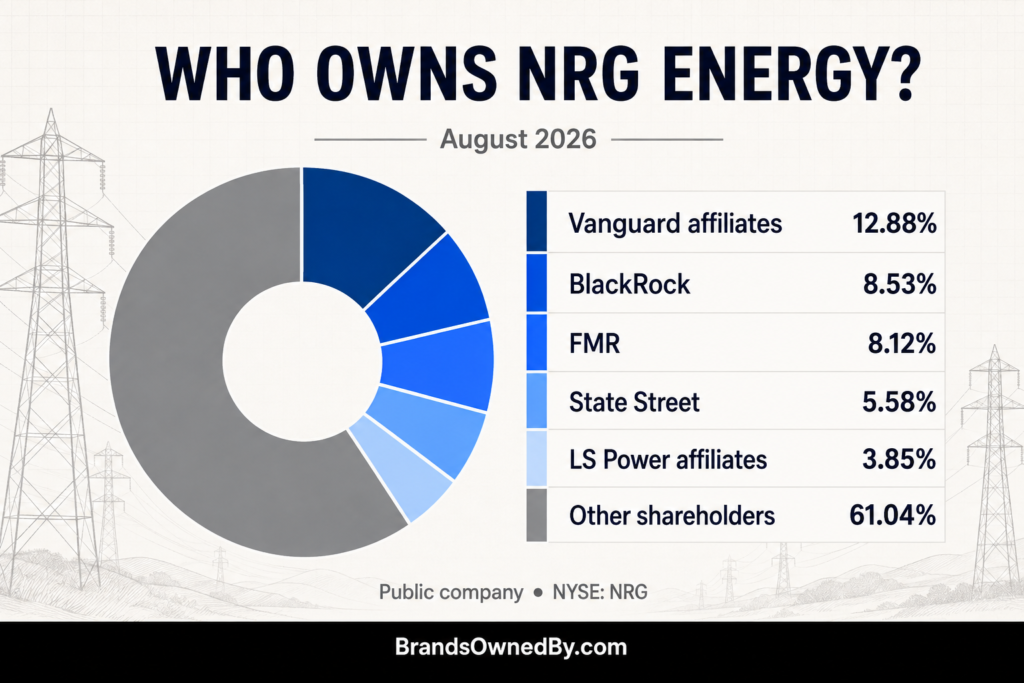
- BlackRock is the largest single disclosed institutional holder, with approximately 8.53% in the latest March-quarter ownership data available in August 2026.
- NRG’s major businesses include Reliant, Direct Energy, Green Mountain Energy, Vivint, XOOM Energy, Cirro Energy, Discount Power, CPower, NRG Protects, and Allied.
- NRG serves approximately 8 million customers and operates about 25 gigawatts of generation capacity after completing its LS Power portfolio acquisition.
NRG Energy is owned by its public shareholders. It has no parent company, founder-controlled voting block, or majority owner. Its shares trade on the New York Stock Exchange under the ticker NRG. Institutional investment managers hold most of the stock. BlackRock is the largest single disclosed holder in the latest available ownership data. NRG’s board and executive team control daily operations.
NRG Energy is a North American energy and home-services company headquartered in Houston, Texas. It sells electricity and natural gas. It operates power plants. It also provides smart-home, security, protection-plan, and flexible-demand services.
The company’s scale changed substantially in January 2026. NRG completed the acquisition of 18 generating facilities and CPower from LS Power. The transaction doubled NRG’s generation capacity to approximately 25 gigawatts.
![Who Owns NRG Energy [infographic]](https://brandsownedby.com/wp-content/uploads/2026/07/Who-Owns-NRG-Energy-infographic-484x1024.png)
Who Founded NRG Energy?
NRG Energy was formed in 1989 as a subsidiary of Northern States Power Company, commonly known as NSP. Seth Allen is generally credited as NRG’s founder.
NRG did not begin as a conventional founder-funded startup. Its original purpose was to pursue power-generation opportunities outside NSP’s regulated utility operations. That corporate origin explains why NRG’s early business was built around wholesale power plants rather than household electricity plans.
NSP later merged with New Century Energies and became Xcel Energy. NRG was therefore associated with both NSP and Xcel during its early history. Neither company owns NRG today.
Where Did NRG Energy Originate?
NRG originated in Minnesota under Northern States Power. Its business later expanded across the United States and into international power markets.
The company’s operational center gradually shifted toward Texas. Houston became its sole corporate headquarters in 2021. Texas is now one of NRG’s most important markets for generation, retail electricity, customer growth, and new power-development projects.
What Does NRG Energy Do?
NRG’s business has four connected parts.
First, it owns and operates power-generation facilities. Its fleet includes natural gas, dual-fuel, coal, oil, and nuclear interests.
Second, it sells electricity and natural gas through brands such as Reliant, Direct Energy, Green Mountain Energy, XOOM Energy, Cirro Energy, and NRG.
Third, Vivint gives NRG a large smart-home and security platform. This creates recurring service revenue that is less exposed to daily wholesale electricity prices.
Fourth, CPower manages flexible commercial and industrial electricity demand. It helps customers reduce or shift their consumption when power systems are under pressure.
The integrated model gives NRG several ways to earn from the same energy market. It can generate electricity, sell it to customers, manage consumption, and connect household devices to virtual power plant programs.
NRG Energy Ownership History
NRG’s ownership has changed several times. It moved from utility ownership to public ownership, returned briefly to complete parent-company ownership, went through bankruptcy, and emerged as an independent public company.
1989: Northern States Power Creates NRG
Northern States Power formed NRG Energy in 1989 as a wholly owned subsidiary. NSP supplied the original corporate structure and capital.
During this period, NRG was not independently owned. Its ultimate owner was NSP.
2000: NRG Becomes Public
NRG completed an initial public offering in May 2000. Its shares began trading on the New York Stock Exchange.
The IPO introduced outside shareholders. However, NSP retained a substantial interest. NSP’s merger with New Century Energies also created Xcel Energy, which became NRG’s parent during this period.
2002: Xcel Reacquires the Public Shares
Xcel Energy reacquired the publicly held portion of NRG in 2002. That transaction temporarily returned NRG to wholly owned subsidiary status.
The timing was difficult. NRG had expanded rapidly and accumulated heavy debt. Weak power markets, lower asset values, and financing pressure pushed the business toward restructuring.
2003: Bankruptcy Ends Xcel’s Ownership
NRG filed for Chapter 11 bankruptcy protection in May 2003. Its restructuring eliminated billions of dollars in debt and claims.
As part of the reorganization, Xcel relinquished its ownership interest. Creditors received equity and cash under the approved plan. NRG emerged from bankruptcy in December 2003 as an independent public company.
This is the decisive point in its ownership history. Modern NRG is not an Xcel subsidiary. It is a separate company owned by its shareholders.
2006–2012: Generation and Retail Acquisitions
NRG bought Texas Genco in 2006. The acquisition expanded its Texas power-generation portfolio.
It acquired Reliant Energy’s retail electricity business in 2009. Green Mountain Energy followed in 2010.
NRG merged with GenOn Energy in 2012. The transaction substantially expanded its generation fleet. The GenOn name was later retired, and parts of that portfolio were restructured or divested.
2014–2019: Consumer Energy Brands Expand
NRG acquired the Dominion retail energy business and Cirro Energy in 2014. It also acquired portable-power company Goal Zero.
XOOM Energy was acquired in 2018. Stream Energy’s retail electricity and natural gas operations followed in 2019.
During the same period, NRG sold several noncore generation, renewable-development, and infrastructure businesses. These divestitures simplified the group and reduced debt.
2021: Direct Energy Joins NRG
NRG acquired Direct Energy from Centrica in January 2021 for $3.625 billion in cash.
Direct Energy gave NRG a much larger customer base across the United States and Canada. It also brought several retail energy, protection, and service operations into the portfolio.
2023: NRG Acquires Vivint Smart Home
NRG completed its acquisition of Vivint Smart Home in March 2023. The equity purchase price was approximately $2.8 billion. NRG also assumed Vivint debt.
Vivint changed the economics of the group. NRG gained a large base of customers who pay monthly fees for home security and automation services.
The acquisition initially faced criticism because of its price, leverage, and strategic fit. Vivint later produced stronger customer growth, retention, and recurring service margins.
2026: LS Power Portfolio and CPower Acquisition
NRG completed its acquisition of assets from LS Power on January 30, 2026.
The transaction included:
- 18 natural gas and dual-fuel generating facilities.
- Approximately 13 gigawatts of generation capacity.
- Assets spread across nine states.
- CPower’s commercial and industrial demand-response platform.
The transaction had an announced enterprise value of approximately $12 billion. Consideration included cash, NRG shares, and assumed debt.
LS Power affiliates received NRG stock as part of the transaction. They subsequently sold a large portion through a secondary offering. NRG did not receive proceeds from that share sale.
Who Owns NRG Energy: Top Shareholders & Ownership Structure
NRG Energy is owned collectively by investors in its publicly traded common stock. It does not have a parent company, majority shareholder, founder-controlled voting block, or dual-class share structure.
Approximately 210.3 million common shares were outstanding on June 30, 2026. Each common share generally carries one vote. This means ownership and voting power rise or fall together.
Institutional investment managers hold most NRG shares. These positions are primarily maintained through mutual funds, exchange-traded funds, pension portfolios, and managed accounts. The investment managers exercise voting or investment authority. However, the underlying economic interests generally belong to their fund investors and clients.
BlackRock
BlackRock is the largest single disclosed institutional holder in the latest comparable March-quarter data. It held approximately 18 million shares, representing about 8.53% of NRG.
The shares are managed through BlackRock investment products and client portfolios. These may include index funds, exchange-traded funds, actively managed funds, and institutional accounts.
BlackRock’s position gives it meaningful influence in shareholder votes. It can vote on director elections, executive compensation, auditor appointments, equity plans, and shareholder proposals. It can also communicate privately with the board about governance, capital allocation, climate exposure, risk management, and executive accountability.
That influence does not amount to corporate control. BlackRock cannot independently elect the board, appoint the CEO, approve an acquisition, or direct NRG’s power plants and retail businesses. Its 8.53% interest leaves more than 91% of the voting stock in other hands.
BlackRock is also an investment manager rather than NRG’s economic parent. The financial benefits of the shares generally flow to the investors and institutions participating in the funds or accounts that hold them.
FMR
FMR LLC is the parent organization associated with Fidelity Investments. It held approximately 17.12 million NRG shares in the latest March-quarter data. This represented about 8.12% of the company.
FMR’s position is distributed across investment funds and managed accounts. It is not a direct strategic investment comparable to one company buying a stake in another company to obtain board representation or operational influence.
FMR can vote the shares over which it has voting authority. It can support or oppose directors, compensation policies, governance proposals, and significant transactions presented to shareholders.
Its ownership remains well below a controlling threshold. FMR has no disclosed contractual right to appoint directors or executives. It also has no special rights over NRG’s assets, dividends, debt, brands, or subsidiaries.
The size of the position can change considerably. Fidelity-managed funds may increase or reduce their exposure based on valuation, earnings expectations, portfolio construction, and investor redemptions.
Vanguard Capital Management
Vanguard Capital Management reported beneficial ownership of 15,849,100 NRG shares as of March 31, 2026. Its filing reported a 7.38% interest.
The manager reported sole voting authority over approximately 2.05 million shares. It had sole authority to dispose of all 15.85 million reported shares.
This difference is important. Dispositive power concerns the ability to buy, sell, or otherwise manage shares. Voting power concerns the authority to vote those shares at shareholder meetings. An investment manager can therefore report a large economic position while having direct voting authority over a smaller portion.
Vanguard Capital Management holds NRG shares through Vanguard funds, client portfolios, and affiliated investment operations. Its filing states that the shares were acquired in the ordinary course of business. They were not acquired to change or influence control of NRG.
The 7.38% position provides voting influence. It does not allow Vanguard Capital Management to manage NRG or act as its parent company.
State Street
State Street held approximately 11.77 million NRG shares in the latest March-quarter ownership data. This represented about 5.58% of the company.
Much of State Street’s equity exposure is connected with index-tracking and institutionally managed portfolios. NRG’s inclusion in major stock-market indexes can therefore create recurring ownership through State Street funds.
State Street can vote shares held through portfolios for which it possesses voting authority. Its stewardship teams may assess board independence, executive compensation, governance policies, shareholder rights, and financial oversight.
Its influence is still limited by dispersed ownership. State Street cannot determine the result of a shareholder vote on its own. It also has no direct authority over NRG’s generation fleet, retail brands, Vivint, CPower, financing, or capital expenditures.
Vanguard Portfolio Management
Vanguard Portfolio Management reported 11.3 million NRG shares as of March 31, 2026. Its filing placed the position at 5.30%.
The manager reported sole voting authority over only 53,745 shares. It held sole dispositive authority over the full 11.37 million-share position.
This position must be presented separately from Vanguard Capital Management. Vanguard completed an internal reporting realignment in January 2026. Certain investment-management businesses that previously appeared under The Vanguard Group now report beneficial ownership independently.
Vanguard Portfolio Management and Vanguard Capital Management follow related investment strategies. However, their filings cover separately reported pools of securities. Combining the positions under one heading can incorrectly imply that one legal reporting person owns or votes the entire amount.
Vanguard Portfolio Management certified that its shares were acquired in the ordinary course of business. Its position was not accumulated for the purpose of changing or influencing NRG’s control.
LS Power Affiliates
LS Power affiliates became NRG shareholders through the January 2026 asset acquisition. NRG issued 24.25 million common shares as part of the purchase consideration.
The original position represented more than 11% of NRG immediately after the acquisition. It was different from the passive positions held by index-fund managers because it resulted directly from a strategic transaction.
NRG and the selling LS Power affiliates later completed a secondary offering. The affiliates sold 12.3 million shares to public investors. NRG also repurchased approximately 1.83 million shares directly from them for about $300 million.
These transactions reduced the LS Power-related position to approximately 8.12 million shares, or about 3.85% of NRG. The reduced position placed the group below the 5% reporting threshold.
The original ownership also included a voting limitation. Approximately 3.3 million shares were placed into a voting trust to keep the affiliates’ aggregate voting rights below 10%. This arrangement helped address federal energy-regulatory requirements connected with the acquisition.
LS Power affiliates have an economic interest in NRG’s stock performance. They do not have a controlling interest, disclosed board appointment right, or authority over daily operations.
NRG Directors and Executives
Insider ownership is relatively small. NRG’s 2026 proxy reported that its directors and executive officers collectively beneficially owned 916,128 shares as of March 3, 2026. This was less than 1% of the company.
Robert Gaudette held 48,528 shares before becoming CEO. Antonio Carrillo held 42,951 shares before becoming independent board chair. Other directors and executives also held common shares, deferred stock units, restricted stock units, and performance-based awards.
These holdings align part of management’s financial interest with shareholders. Executives can benefit when NRG’s share price rises. They can also lose value when operating performance or investor confidence weakens.
Insider ownership does not provide voting control. Directors and executives collectively cannot determine shareholder elections or approve major shareholder matters without support from outside investors.
Their operational authority comes from corporate office and board delegation, not from owning a large percentage of NRG.
Other Institutional Shareholders
The remaining institutional ownership is divided among mutual-fund managers, pension funds, insurance portfolios, quantitative investors, hedge funds, banks, and wealth-management firms.
Some hold NRG because it is included in an index. Others invest based on power prices, earnings growth, free cash flow, share repurchases, data-center electricity demand, or the performance of Vivint and CPower.
No single investment strategy dominates this group. Passive managers may maintain long-term positions. Active funds can enter or exit much more quickly. Hedge funds may hold shares for shorter periods or use derivatives to adjust their economic exposure.
This fragmented institutional base prevents any one smaller investor from controlling the company. It can still create coordinated pressure when several large managers reach similar conclusions about governance or performance.
Individual and Public Investors
Individual investors own NRG shares directly and indirectly. Direct holders can purchase common stock through brokerage accounts. Other individuals gain exposure through mutual funds, retirement plans, exchange-traded funds, and pension funds.
A retail investor’s voting power is small when considered separately. Collectively, public investors can influence close elections and shareholder proposals.
Beneficial investors in brokerage accounts may receive voting instructions from their brokers. If they do not submit instructions, the broker’s ability to vote depends on whether the proposal is classified as routine or non-routine.
Competitor Ownership Comparison
NRG’s principal competitors do not all follow the same ownership model. Vistra, Constellation Energy, Duke Energy, and Talen Energy remain publicly traded. AES is publicly owned in August 2026 but is under an agreement to be acquired by an infrastructure-investment consortium.
The comparison also shows why the name of the largest shareholder does not tell the full story. Most large positions are held by investment managers on behalf of funds and clients. Strategic shareholders created through acquisitions can have different economic interests, even when they lack formal control.
| Company | Ownership structure in August 2026 | Notable disclosed positions | Controlling owner? | Main distinction from NRG |
|---|---|---|---|---|
| NRG Energy | Public and institutionally owned | BlackRock 8.53%; FMR 8.12%; LS Power affiliates 3.85% | No | Generation, retail energy, Vivint and CPower |
| Vistra | Public and institutionally owned | Vanguard Capital Management 7.25%; Vanguard Portfolio Management 5.01%; Qatar Investment Authority 5.5% in the latest company proxy | No | Larger generation and retail-energy emphasis |
| Constellation Energy | Public with institutional and transaction-related shareholders | Vanguard 11.7%; BlackRock 7.2%; ECP ControlCo 7.0% | No | Nuclear-led fleet combined with Calpine |
| Duke Energy | Public and institutionally owned | Vanguard 10%; BlackRock 7.52%; State Street 5.42% | No | Predominantly regulated utility model |
| AES | Public pending an approved acquisition | Public shareholders until closing; proposed consortium led by GIP and EQT | No current controlling owner; consortium would control after closing | International utilities, renewables and storage |
| Talen Energy | Public with a more concentrated investor base | Vanguard 10.5%; BlackRock 8.6%; Rubric Capital 7.8%; MFN Partners 6.6% | No | Generation-led platform with data-center exposure |
Vistra
Vistra is NRG’s closest operating competitor. Both companies combine competitive retail electricity businesses with large power-generation fleets.
Vistra has no corporate parent or majority shareholder. Its ownership is distributed among investment managers and other public investors. Following Vanguard’s 2026 reporting realignment, Vanguard Capital Management separately reported 24.57 million Vistra shares, or 7.25%. Vanguard Portfolio Management reported another 16.99 million shares, or 5.01%. These are separately reported positions and should not automatically be combined as one controlling block. Vanguard Capital Management’s filing states that its shares were held in the ordinary course rather than to influence control.
Qatar Investment Authority also held a reported 5.5% position. This gives Vistra a notable strategic institutional shareholder alongside traditional asset managers. It still does not provide QIA with unilateral control.
Vistra’s board and executives govern the company in the same broad manner as NRG. The operational difference is more important than the ownership difference. Vistra is more heavily centered on electricity generation and retail power. Its fleet includes natural gas, nuclear, coal, solar and battery-storage assets.
NRG has a more diversified customer-services model. Vivint adds smart-home subscriptions, while CPower adds commercial demand response. These businesses give NRG revenue streams that do not depend entirely on selling or generating electricity.
Constellation Energy
Constellation Energy is publicly owned and has no majority shareholder. Its 2026 proxy listed Vanguard at 11.7%, BlackRock at 7.2%, State Street at 5.7%, Capital International Investors at 5.5%, and ECP ControlCo at 7.0%. Constellation’s 2026 proxy statement based these percentages on approximately 313.3 million outstanding shares.
ECP ControlCo’s position is different from a conventional index-fund holding. It resulted from Constellation’s acquisition of Calpine. Former Calpine investors received Constellation shares as part of the transaction consideration.
Constellation completed the Calpine acquisition on January 7, 2026. Calpine is now an indirect, wholly owned Constellation subsidiary. ECP has a substantial economic interest in the combined company, but its 7.0% position does not provide majority voting power or independent operational control.
Constellation’s portfolio is more nuclear-focused than NRG’s. Calpine added natural gas and geothermal generation. NRG has less nuclear exposure but a stronger household-services position through Vivint, Reliant, Direct Energy and its protection-plan businesses.
Duke Energy
Duke Energy is also publicly owned, but it operates under a materially different commercial model.
Duke’s 2026 proxy listed Vanguard at 10%, BlackRock at 7.52%, and State Street at 5.42%. No investor had majority ownership. Shareholders elect the board, while Duke’s directors and executives oversee operations. Duke Energy’s 2026 proxy confirms that these large positions are institutional holdings rather than a parent-company relationship.
Much of Duke’s business operates through regulated electric and natural gas utilities. State regulators approve customer rates, capital-recovery plans and permitted returns. This provides greater earnings visibility, although it also subjects Duke to regulatory review and large infrastructure-spending requirements.
NRG operates primarily in competitive markets. Its financial performance is more exposed to wholesale power prices, capacity markets, fuel costs, generation availability, customer retention and retail margins. NRG’s potential returns can respond faster to favorable power-market conditions. Its earnings can also be more volatile than those of a regulated utility.
AES Corporation
AES provides the clearest contrast because its ownership structure is in transition.
AES remains publicly traded in August 2026. However, it has agreed to be acquired for $15 per share in cash by a consortium led by Global Infrastructure Partners and EQT Infrastructure VI. CalPERS and the Qatar Investment Authority are also participating. The transaction values AES at approximately $10.7 billion in equity and $33.4 billion including debt.
AES shareholders approved the merger on June 26, 2026. Approximately 479.1 million shares voted in favor, compared with 10.1 million against. Regulatory approvals and other closing conditions remain outstanding. The transaction is expected to close in late 2026 or early 2027. AES reported the shareholder vote in its June 2026 filing.
Until closing, AES continues to be owned by its public shareholders and governed by its existing board. After closing, its public shares would be cancelled, AES would leave the New York Stock Exchange, and the acquisition consortium would jointly control the private company.
Global Infrastructure Partners is part of BlackRock. This role should not be confused with BlackRock’s passive fund-management holdings in companies such as NRG. At NRG, BlackRock manages a minority investment position for funds and clients. In the proposed AES transaction, a BlackRock-owned infrastructure manager would participate directly in the controlling acquisition group.
AES also has greater international exposure than NRG. Its portfolio includes regulated utilities, renewable generation, energy storage and power assets across multiple countries. NRG is primarily concentrated in the United States, with additional retail and service operations in Canada.
Talen Energy
Talen Energy is publicly traded, but its shareholder base is more concentrated than NRG’s.
Talen’s 2026 proxy listed Vanguard at 10.5%, BlackRock at 8.6%, Rubric Capital at 7.8%, and MFN Partners at 6.6%. Together, these four disclosed positions represented approximately one-third of the company. Talen’s 2026 ownership disclosure was based on approximately 45.4 million outstanding shares.
Rubric and MFN are active investment firms rather than large index-fund operators. Their positions can create more concentrated shareholder influence than NRG’s broadly distributed institutional ownership. However, none holds a majority or has disclosed unilateral authority over Talen’s board and operations.
Talen is more generation-focused than NRG. Its Susquehanna nuclear facility and power assets positioned near major data-center markets are central to its investment case.
NRG has broader operating diversification. It earns from generation, residential and commercial energy supply, Vivint subscriptions, protection services and CPower’s demand-response platform. Talen offers more concentrated exposure to generation values and large-load electricity demand.
What the Comparison Shows
NRG, Vistra, Constellation, Duke and Talen all operate without a majority shareholder. Their boards and executives control corporate decisions, while institutional investors exercise influence through voting and engagement.
The important differences are:
- Constellation and Vistra have notable shareholders whose positions are connected with major acquisitions.
- Duke’s regulated utility model produces a different risk and return profile.
- Talen has a more concentrated group of active and institutional shareholders.
- AES is moving toward private consortium ownership, subject to closing.
- NRG remains publicly owned while combining generation, retail energy, smart-home services and demand response.
NRG’s ownership is therefore not unusual for a large public energy company. What distinguishes it is the breadth of its operating model and the post-acquisition role of LS Power affiliates, not the existence of a controlling shareholder.
Who Controls NRG Energy?
As of August 2026, no individual shareholder or outside company controls NRG Energy. Governance authority rests with its shareholder-elected board. Executive authority is delegated to President and CEO Robert Gaudette and his management team.
Ownership Does Not Create a Controlling Shareholder
NRG has dispersed public ownership. BlackRock is the largest single disclosed institutional holder at approximately 8.53%. FMR holds about 8.12%. Other major positions are divided among Vanguard-affiliated managers, State Street, LS Power affiliates, and additional investors.
These shareholders can influence director elections and governance votes. However, none can determine an outcome independently. They cannot appoint executives, approve acquisitions, set electricity-market strategy, or direct NRG’s subsidiaries without support from the board or other shareholders.
NRG’s equity plan generally treats ownership of at least 50% of the voting stock as one form of a change in control. No disclosed shareholder is close to that threshold.
Shareholders Hold the Ultimate Voting Authority
Each share of NRG common stock generally carries one vote. Shareholders elect directors annually. Uncontested director nominees must receive more votes “for” than “against” to be elected.
Shareholders also vote on executive compensation, equity incentive plans, auditor ratification, mergers, and other matters requiring approval. Some votes, such as the advisory vote on executive compensation, do not directly bind the board. They can still influence compensation policies and future governance decisions.
NRG also provides proxy access. A shareholder or group of up to 20 shareholders that continuously owns at least 3% of the company for three years can nominate candidates representing up to 20% of the board.
The Board of Directors Exercises Governance Control
NRG had 11 directors in August 2026. Ten were independent. Robert Gaudette was the only management director.
The board does not operate power plants or manage customer accounts. Its role is to supervise management and protect shareholders’ long-term interests. Its responsibilities include approving:
- The annual budget and long-term business plan.
- Major acquisitions and divestitures.
- Capital allocation, dividends, and share repurchases.
- Significant financing and debt decisions.
- Corporate risk limits and strategic investments.
- CEO selection, compensation, and succession.
This authority is particularly important after the LS Power acquisition. The board must monitor integration, debt reduction, new-generation investments, data-center agreements, and the performance of CPower and the acquired plants.
Antonio Carrillo Leads the Board
Antonio Carrillo has served as NRG’s independent board chair since April 30, 2026. He succeeded Lawrence Coben.
Carrillo organizes the board’s oversight work. He helps establish meeting priorities, facilitates discussions among directors, and acts as the principal governance counterpart to the CEO.
The chair and CEO positions are now separated. This strengthens accountability because Gaudette manages the company while Carrillo leads the body responsible for evaluating his performance.
Carrillo does not manage NRG’s daily operations. He also cannot make major corporate decisions alone. Those decisions require approval from the full board or the relevant board committee.
Independent Committees Provide Additional Oversight
NRG’s Audit, Compensation, Governance and Nominating, and Finance and Risk Management committees consist entirely of independent directors.
The Audit Committee supervises financial reporting, internal controls, compliance, and the independent auditor. The Compensation Committee sets executive-performance goals and recommends or approves senior leadership compensation.
The Governance and Nominating Committee oversees board composition, director nominations, governance policies, and succession planning. The Finance and Risk Management Committee monitors liquidity, financing, commodity trading, counterparty exposure, cybersecurity, data privacy, and enterprise risk.
These committees limit the ability of one executive or director to exercise unchecked authority.
Robert Gaudette Directs NRG’s Operations
Robert Gaudette became president in January 2026 and CEO on April 30, 2026. He also serves as a director.
Gaudette has executive control over NRG’s daily business. He is responsible for carrying out the board-approved strategy, allocating resources within authorized limits, supervising senior executives, and coordinating the company’s generation, retail energy, smart-home, and demand-response operations.
His immediate priorities include integrating the LS Power assets, improving fleet performance, managing the expanded debt burden, growing Vivint, developing new Texas generation, and pursuing large-load electricity agreements.
Gaudette has substantial decision-making authority. However, he remains accountable to the board. The board can modify his authority, reject major proposals, adjust his compensation, or replace him.
Executive Management Runs the Business Units
Gaudette is supported by executives with defined operating and financial responsibilities.
Bruce Chung serves as executive vice president and chief financial officer. He oversees financial planning, reporting, financing, liquidity, capital allocation, and balance-sheet management.
Brad Bentley serves as executive vice president and president of NRG Consumer. He leads the company’s residential energy, Vivint smart-home, and consumer-services activities.
Matthew Pistner serves as senior vice president and president of NRG Wholesale. His responsibilities cover wholesale power, generation, market operations, and related commercial activities.
Business-unit leaders can make operating decisions within approved budgets and risk limits. Transactions exceeding management’s delegated authority must be reviewed by the appropriate board committee or the full board.
Who Has Effective Control?
NRG operates through three distinct layers of authority:
Shareholders possess voting control. They elect directors and decide specified corporate matters.
The board possesses governance control. It approves strategy, capital allocation, major transactions, risk limits, and senior leadership.
Robert Gaudette and the executive team possess operational control. They manage NRG’s businesses and implement the board-approved plan.
Therefore, the most accurate answer is that NRG is collectively controlled through its public-company governance system. No shareholder controls it alone. Antonio Carrillo leads independent board oversight, while Robert Gaudette controls daily execution.
NRG Energy Annual Revenue and Net Worth
NRG’s revenue is highly sensitive to power prices, natural gas prices, weather, customer volumes, and hedge accounting. Revenue can rise even when margins weaken. It can also fall while cash flow improves.
NRG Energy Revenue in 2026
NRG reported $17.737 billion in GAAP revenue for the first six months of 2026. This was $2.393 billion, or 15.6%, higher than the same period in 2025.
Management’s segment presentation shows $17.741 billion of adjusted revenue. The $4 million difference reflects mark-to-market and contract-amortization adjustments. Before $26 million of corporate eliminations, the operating segments generated $17.767 billion.
| Operating segment | First-half 2026 revenue | Share of segment revenue | Change from 2025 | Economic gross margin |
|---|---|---|---|---|
| East | $9.954 billion | 56.0% | Up 35.7% | $1.601 billion |
| Texas | $5.140 billion | 28.9% | Down 2.7% | $1.546 billion |
| West/Other | $1.508 billion | 8.5% | Down 12.0% | $259 million |
| Vivint Smart Home | $1.165 billion | 6.6% | Up 12.8% | $1.053 billion |
East Became NRG’s Largest Revenue Segment
East generated $9.954 billion, representing 56.0% of gross segment revenue. Revenue increased by $2.618 billion from the first half of 2025.
The increase came mainly from the generation facilities and CPower acquired from LS Power. Higher capacity prices also supported results. East produced $1.601 billion in economic gross margin and $933 million in adjusted EBITDA. It contributed 40.6% of NRG’s consolidated adjusted EBITDA.
This segment now generates the most revenue. However, its 16.1% economic gross margin shows that a large portion of energy revenue is absorbed by fuel, purchased power, capacity costs, and other direct costs.
Texas Remained a Major Margin Contributor
Texas generated $5.140 billion, or 28.9% of segment revenue. This was $141 million lower than the comparable 2025 period.
Mild winter weather reduced retail electricity and natural gas demand. Higher supply costs also affected performance. Texas nevertheless produced $1.546 billion in economic gross margin. This equaled 30.1% of segment revenue.
Adjusted EBITDA was $597 million, down from $811 million one year earlier. Texas therefore remained economically important, but its earnings contribution weakened despite its large customer base and generation position.
Vivint Generated Less Revenue but Stronger Recurring Margins
Vivint Smart Home produced $1.165 billion, or only 6.6% of segment revenue. Revenue increased by $132 million, or 12.8%, from the first half of 2025.
Its economics were materially different from the energy segments. Vivint generated $1.053 billion in economic gross margin and $595 million in adjusted EBITDA. Its adjusted EBITDA margin was approximately 51.1%.
Vivint contributed almost 25.9% of consolidated adjusted EBITDA despite producing less than 7% of segment revenue. Higher customer additions and increased monthly recurring service margin per customer supported the improvement.
West and Other Operations Had a Smaller Revenue Role
West/Other generated $1.508 billion, representing 8.5% of segment revenue. This was $206 million lower than the prior-year period.
The segment produced $259 million in economic gross margin and $177 million in adjusted EBITDA. Lower operating expenses following a lease expiration helped EBITDA increase even though revenue declined.
Revenue Does Not Show Each Segment’s Full Economic Value
Energy operations accounted for 93.4% of NRG’s gross segment revenue. They contributed a smaller 74.3% of adjusted EBITDA. Vivint accounted for only 6.6% of revenue but approximately one-quarter of adjusted EBITDA.
This difference is important. Energy sales create high reported revenue but require substantial spending on fuel and purchased electricity. Vivint records less revenue, yet its recurring monitoring and service model produces much higher margins per dollar of sales. NRG’s revenue mix is therefore dominated by energy, while its earnings mix is more balanced between energy operations and smart-home services.
Why Revenue Rose Between 2020 and 2022
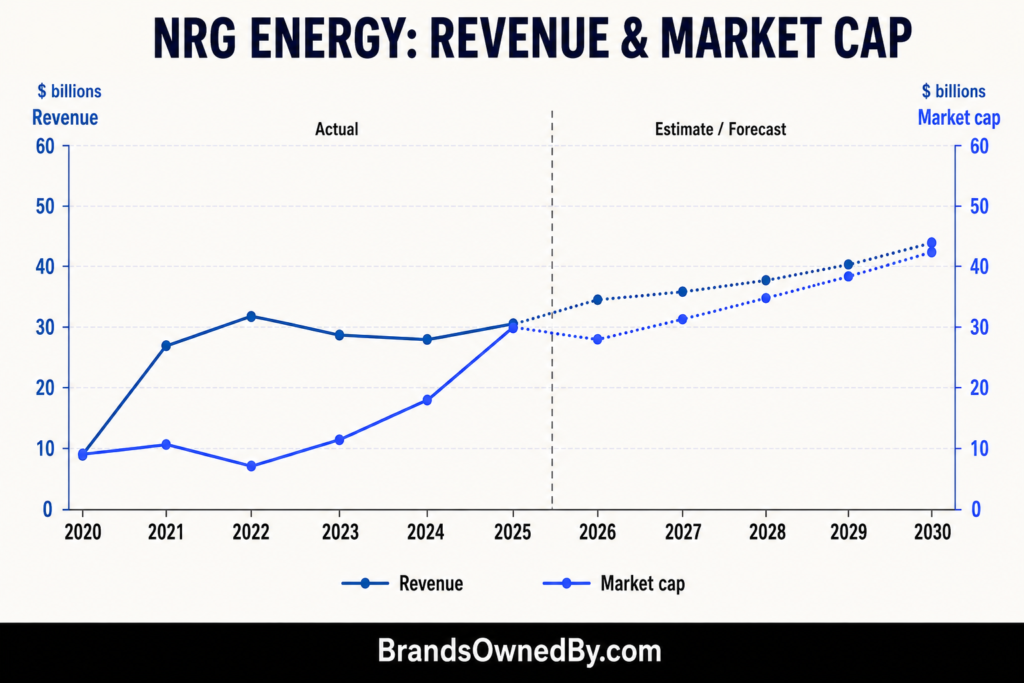
Revenue increased from $9.09 billion in 2020 to $26.99 billion in 2021. The Direct Energy acquisition was the main structural reason.
Revenue reached $31.54 billion in 2022. Elevated commodity prices and energy-market volatility increased the dollar value of electricity and natural gas sales.
That growth did not translate into an equivalent rise in market capitalization. Investors focused on margins, cash generation, risk, debt, and the durability of earnings.
NRG Energy Net Worth in August 2026
NRG’s market capitalization was approximately $28.33 billion in early August 2026. That is below its 2025 year-end market value of roughly $30.52 billion.
The decline does not mean the underlying business lost the same amount in operating value. NRG issued shares for the LS Power transaction. Its share count increased. The company also assumed and issued substantial debt.
Higher interest expense affected second-quarter adjusted earnings. NRG reported $310 million of interest expense for the quarter, compared with $148 million one year earlier.
At the same time, adjusted EBITDA increased to $1.217 billion in the second quarter. The East segment benefited from the acquired generation assets, CPower, and higher capacity prices.
The August valuation therefore reflects two competing factors. NRG owns a much larger and more strategically valuable generation fleet. It also carries more debt, interest expense, integration risk, and share dilution.
Why Market Capitalization Accelerated After 2023
NRG’s market value rose from $7.33 billion at the end of 2022 to $30.52 billion at the end of 2025.
Several factors supported the revaluation. NRG improved operating performance. It generated strong free cash flow. It repurchased shares. Vivint’s results strengthened. Power-market expectations also improved as data-center demand became a larger investment theme.
The LS Power transaction reinforced NRG’s exposure to rising electricity demand. It also increased financial risk. That helps explain why the stock’s valuation has remained sensitive to interest costs and integration progress.
Revenue Forecast for 2027–2030
The forecast assumes revenue rises from $36.2 billion in 2027 to $43 billion in 2030.
Growth should come from several sources. NRG will receive a full year of revenue from the acquired generation fleet. Higher PJM capacity prices should support the East business. Vivint can add customers and increase recurring service revenue. CPower can expand demand-response participation.
NRG also plans to bring 1.5 gigawatts of Texas Energy Fund-supported capacity online. The 415-megawatt T.H. Wharton facility began commercial operations in May 2026. Two additional projects are expected by mid-2028.
The forecast does not assume an uninterrupted rise in commodity prices. That would be unrealistic. It assumes normal volatility and gradual growth in customer demand, capacity revenue, generation output, and service subscriptions.
Net-Worth Forecast for 2027–2030
The market-cap forecast rises from $31.5 billion in 2027 to $44 billion in 2030.
That represents a more measured valuation path than simply applying management’s per-share growth target to the current market cap. The discount accounts for integration risk, higher debt, interest costs, power-price volatility, and the capital required for new generation.
NRG targets at least 14% annual growth in adjusted earnings per share and free cash flow per share over its five-year planning period. Share repurchases could support per-share growth by reducing the share count.
The company also plans at least $1 billion of annual repurchases, subject to credit metrics and available capital. It had completed $932 million of its 2026 program through July 31.
The 2030 estimate also considers data-center opportunities. NRG has existing long-term power agreements covering 445 megawatts. It is advancing a proposed 1.2-gigawatt Texas generation project with a global cloud and artificial intelligence customer. The project could expand to 2.4 gigawatts.
The initial facility is targeted for late 2029. A 15-year customer-backed structure could improve earnings visibility. However, final documentation, land matters, construction execution, and capital costs remain important risks.
Companies and Brands Owned by NRG Energy
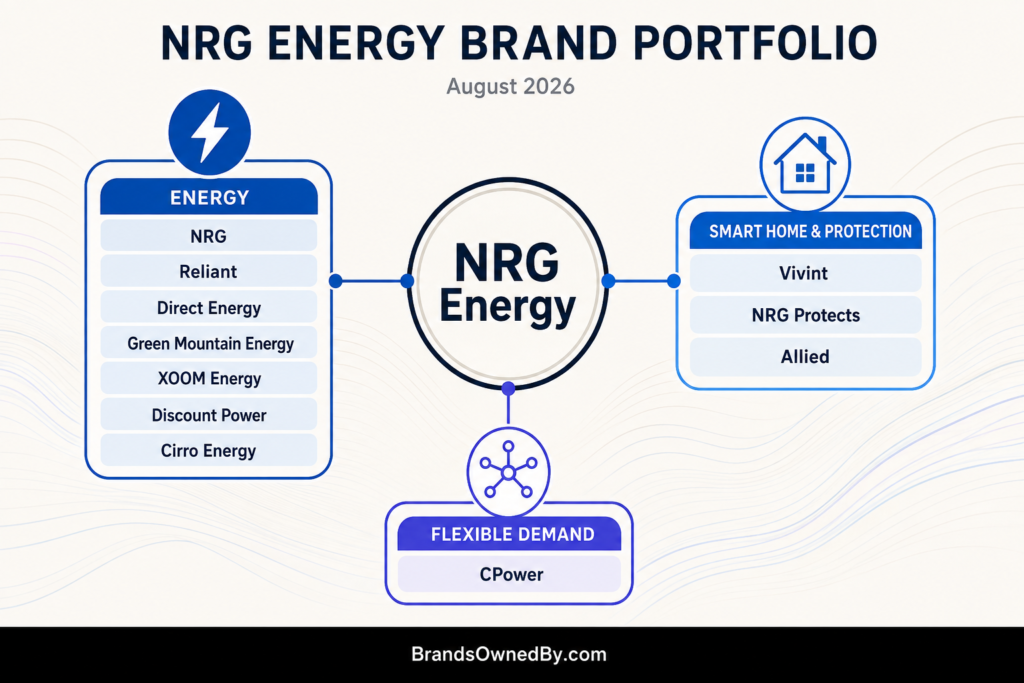
NRG operates through numerous legal subsidiaries. Many exist for licensing, financing, power-plant ownership, or regulatory purposes. The following list covers its principal operating platforms and customer-facing brands rather than every special-purpose legal entity.
NRG
NRG is the parent corporate identity and an active customer-facing energy brand.
It supplies electricity and natural gas in competitive markets. NRG also uses the name for commercial energy, home energy, generation, and integrated customer programs.
The corporate entity is NRG Energy, Inc. Its operating products are delivered through multiple subsidiaries that hold the necessary state licenses.
Reliant
NRG owns Reliant through its retail energy subsidiaries. Reliant is one of the company’s most important Texas electricity brands.
NRG acquired Reliant’s retail electricity business in 2009. Reliant serves residential and business customers with fixed-rate, time-of-use, renewable, and connected-home electricity plans.
Reliant is a supplier. It does not own the local transmission and distribution network that delivers power to each property.
Direct Energy
Direct Energy became part of NRG in January 2021. NRG bought the business from Centrica.
Direct Energy sells electricity, natural gas, and related services across the United States and Canada. It brought NRG a wider geographic footprint and a large base of residential and commercial customers.
Some commercial operations have been consolidated under the NRG name. Direct Energy remains a significant consumer-facing brand.
Green Mountain Energy
NRG acquired Green Mountain Energy in 2010.
Green Mountain specializes in electricity products connected with renewable energy. Its plans may use renewable energy certificates to match customer consumption with qualifying renewable generation.
The brand gives NRG a differentiated position among customers who prioritize renewable-energy options.
Vivint Smart Home
Vivint is a wholly owned NRG subsidiary. NRG completed the acquisition in March 2023.
Vivint sells professionally installed security, automation, camera, monitoring, and connected-home services. Customers generally pay an upfront or financed equipment cost and a monthly service fee.
Vivint is financially important because it provides recurring revenue and customer relationships beyond electricity supply.
XOOM Energy
NRG acquired XOOM Energy in 2018.
XOOM sells electricity and natural gas in multiple competitive markets. Its products are generally marketed to residential and small-business customers.
The brand expands NRG’s market coverage without requiring the company to use the same retail identity in every state.
Discount Power
Discount Power is part of NRG’s retail energy portfolio.
The brand focuses mainly on electricity plans in competitive markets. It gives NRG an additional customer-acquisition channel and allows the group to target different price and service preferences.
The energy supply is provided by an NRG subsidiary. Delivery remains the responsibility of the local utility.
Cirro Energy
NRG acquired Cirro Energy as part of its 2014 retail transaction with Dominion.
Cirro primarily serves Texas residential and commercial electricity customers. It operates as a distinct brand while sharing NRG’s broader supply, risk-management, technology, and customer-service capabilities.
CPower
NRG acquired CPower from LS Power in January 2026.
CPower manages demand response and distributed energy resources for commercial and industrial customers. It helps facilities earn value by reducing or shifting electricity usage during important grid periods.
This business complements NRG’s generation fleet. A power plant can add supply, while CPower can temporarily reduce demand. Both actions can improve grid reliability.
NRG Protects
NRG Protects is the company’s consumer protection-plan platform.
It offers protection products for household systems, appliances, electronics, and related equipment. The exact product and service provider can vary by plan and market.
The platform creates fee-based customer relationships that are not directly tied to wholesale power prices.
Allied
Allied is part of NRG’s protection and service portfolio.
It provides warranty and protection-plan administration. Its services support relationships with customers, retailers, manufacturers, and service partners.
The business is separate from power generation but fits NRG’s broader household-services strategy.
Goal Zero
NRG acquired Goal Zero in 2014.
Goal Zero develops portable power stations, batteries, solar panels, lighting, and related equipment. The business gives NRG exposure to personal and off-grid power products.
Goal Zero is not as central to NRG’s current corporate brand directory as Reliant, Vivint, or Direct Energy. It nevertheless remains part of the company’s reported service operations unless formally divested.
Stream Energy and Legacy Retail Entities
NRG acquired Stream Energy’s retail electricity and natural gas business in 2019.
Some Stream legal entities and licenses remain within NRG’s corporate structure. Customer-facing activity may be integrated, migrated, or marketed through other NRG brands depending on the state.
NRG also operates licensed entities associated with names such as Gateway Energy Services and Energy Plus. These legal companies support retail operations but are less prominent than the group’s principal national brands.
NRG Generation Portfolio
NRG owns approximately 25 gigawatts of generation capacity. The fleet includes both legacy plants and the 18 facilities acquired from LS Power.
Generation assets are normally held through individual subsidiaries. These structures separate financing, environmental, regulatory, and operating obligations.
NRG also holds a 44% interest in the South Texas Project nuclear facility. A partial interest gives NRG rights to its share of output and economics. It does not mean NRG owns the entire nuclear station.
Final Thoughts
NRG Energy is owned by public shareholders. BlackRock is the largest single disclosed institutional holder, but its approximately 8.53% interest does not constitute control.
Operational authority rests with NRG’s board and management. Antonio Carrillo chairs the board. Robert Gaudette serves as president and CEO.
NRG is now much larger than a conventional retail electricity supplier. Its portfolio combines approximately 25 gigawatts of generation, 8 million customers, Vivint’s smart-home platform, CPower’s demand-response capabilities, and a broad group of retail energy brands.
The January 2026 LS Power acquisition strengthened NRG’s position in a period of rising electricity demand. It also increased debt, interest expense, and integration risk. Those factors will shape both ownership returns and NRG’s valuation through the end of the decade.
FAQs
Who owns NRG Energy?
NRG Energy is owned by its public shareholders. BlackRock is the largest single disclosed institutional holder, with approximately 8.53% in the latest comparable ownership data available in August 2026.
Is NRG Energy privately owned?
No. NRG Energy is publicly traded on the New York Stock Exchange under the ticker NRG.
Does Xcel Energy own NRG Energy?
No. Xcel relinquished its ownership during NRG’s 2003 bankruptcy restructuring. NRG emerged as an independent public company.
Is Reliant the owner of NRG?
No. The ownership relationship runs in the opposite direction. NRG owns the Reliant retail energy business.
Does NRG own Direct Energy?
Yes. NRG acquired Direct Energy from Centrica in January 2021 for $3.625 billion in cash.
Does NRG own Vivint?
Yes. Vivint Smart Home is a wholly owned NRG subsidiary. NRG completed the acquisition in March 2023.
Who is the CEO of NRG Energy?
Robert Gaudette is NRG Energy’s president and chief executive officer. He became CEO on April 30, 2026.
Who is the chair of NRG Energy?
Antonio Carrillo is chair of NRG’s board of directors. He succeeded Lawrence Coben on April 30, 2026.
Did LS Power acquire NRG Energy?
No. NRG acquired 18 power plants and CPower from LS Power. LS Power affiliates received NRG shares as part of the consideration, but they do not control NRG.
How much of NRG does LS Power own?
LS Power affiliates held approximately 8.12 million NRG shares in the latest post-transaction data. That represented about 3.85%.
Is NRG Energy the same company as NRG Stadium?
No. NRG Energy did not own the stadium. It previously held naming rights to the Houston sports complex. The facility returned to the Reliant Stadium name in August 2026.
Does NRG own power plants?
Yes. NRG operates approximately 25 gigawatts of generation capacity after completing the LS Power portfolio acquisition.
How many customers does NRG Energy serve?
NRG serves approximately 8 million electricity, natural gas, smart-home, and related service customers across North America.
What is NRG Energy’s net worth?
Using market capitalization as the measure, NRG Energy was worth approximately $28.33 billion in early August 2026. Market capitalization changes with the company’s share price and outstanding share count.