
- The Butt family controls H-E-B’s voting shares; eligible employees participate through the Partner Stock Plan. H-E-B has not published a September 2026 ownership table for each person.
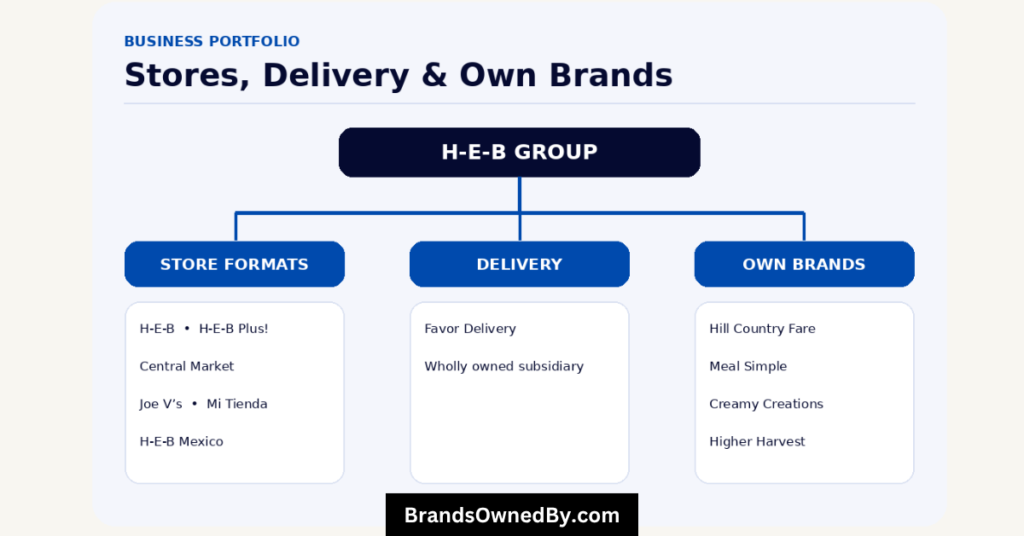
- H-E-B operates its namesake supermarkets, Central Market, Joe V’s Smart Shop, Mi Tienda, H-E-B Plus! and stores in Mexico. These are formats within the same retail group.
- Favor Delivery is a separately branded, wholly owned subsidiary acquired in 2018. H-E-B also sells extensive own-brand product lines, including Hill Country Fare, Meal Simple and Creamy Creations.
- Charles Butt is chairman, Howard Butt III is CEO, and Roxanne Orsak became president in January 2026. Management roles and ownership stakes are separate questions.
Florence Butt opened a grocery store in Kerrville, Texas, with $60 in 1905. Her descendants still control it. So who owns H-E-B now?
The Butt family holds the voting shares, while eligible employees hold an economic interest through a stock plan. That distinction matters more than a simple family ownership percentage. It explains who can make long-term decisions for a retailer with more than $50 billion in annual sales and stores across Texas and Mexico.
![Who Owns H-E-B [Infographic]](https://brandsownedby.com/wp-content/uploads/2026/09/Who-Owns-H-E-B-Infographic-683x1024.png)
H-E-B Overview
H-E-B is a privately held food retailer based in San Antonio. Its assortment spans groceries, prepared meals, pharmacy and household goods. The company serves customers through several store formats, online ordering and delivery. Its presence in northern Mexico makes it more than a Texas-only chain.
Florence Butt and the Kerrville Store
Florence Butt opened the original store in Kerrville in 1905 with a $60 investment. It was a practical response to a family need for income. The business began as a small local grocery, not as a chain backed by outside capital. This point is often lost when accounts credit Howard Edward Butt as the founder because his initials appear on the stores.
Howard, Florence’s youngest son, took over the business around 1919. He changed its economics by expanding beyond a single shop and developing lower-cost grocery distribution. The name H-E-B recognizes his role in building the chain. It does not change who started the enterprise. The distinction also explains why the current Butt owners are descendants of Florence rather than buyers who acquired a brand named for someone else.
How Large is H-E-B?
H-E-B has described its annual sales as exceeding $50 billion, with about 460 stores in Texas and Mexico and more than 175,000 Partners. These company-wide figures cover a retailer with several ways of selling food. They should not be mistaken for the revenue or employee count of an individual banner. H-E-B does not publish a revenue breakdown for Central Market, Joe V’s, Mi Tienda, Favor or its Mexico business.
The range of store concepts is unusually important to the ownership story. An H-E-B supermarket may combine a pharmacy, bakery, curbside pickup and a fuel station. Central Market serves specialty-food customers. Joe V’s is built around a sharper value proposition. Mi Tienda focuses on Mexican and Central American food traditions. H-E-B also has manufacturing and distribution operations that support its own brands and physical stores.
In May 2026, H-E-B outlined a proposed $700 million expansion of its manufacturing and supply chain operations at its Foster Road campus in San Antonio. It had already invested more than $445 million there, including a warehouse and manufacturing plant exceeding 2 million square feet. The proposed next stage had not been completed as of September 2026. Its scale illustrates why the company cannot be assessed solely as a collection of supermarket signs: the group also invests in the infrastructure behind the shelves.
Ownership History
The ownership story has three important turns: Florence Butt’s founding, the family’s expansion of the chain, and the decision to share an economic stake with employees.
From Florence Butt to Howard Edward Butt
Florence ran the Kerrville grocery before Howard Edward Butt took charge around 1919. His expansion turned a local shop into a regional operation. The business adopted the initials for which it is now known. Ownership stayed with the family through that growth rather than passing to a national supermarket company.
Howard’s tenure is relevant to today’s shareholder structure because it established the family succession pattern. The enterprise developed stores, procurement and distribution under family leadership. Later generations inherited interests in an operating company, not just rights to a historical name. The fact that several branches of the family appear among today’s owners traces back to that transition.
Charles Butt Scales the Family Business
Charles Butt became president in 1971, when H-E-B recorded $221 million in annual sales and employed about 6,000 Partners across roughly 120 stores. The figure provides a useful baseline: the retailer H-E-B now describes as exceeding $50 billion in annual sales is more than 200 times that size in nominal sales. Inflation and acquisitions of customers through new stores explain part of the increase, so it is not a like-for-like productivity measure.
His era included the launch of Central Market in Austin in 1994, expansion into Mexico in the late 1990s, H-E-B Plus! in 2004, Mi Tienda in 2006, and Joe V’s Smart Shop in 2010. These were different retail formats created under the same ownership umbrella. The 2018 purchase of Favor was different: H-E-B bought an existing delivery company and kept its brand operating separately.
Charles handed the CEO role to his nephew Howard Butt III in 2021 and continued as chairman. That transition changed who ran the business day-to-day. It did not turn H-E-B into a publicly traded company or remove family voting control. This distinction is useful when an article calls Charles the “owner” and Howard the “CEO”; both descriptions can be true without either man owning 100% of the retailer.
Employees Receive Stock from 2016
H-E-B announced its Partner Stock Plan in November 2015 as it marked 110 years in business. The company said 55,000 employees would initially be eligible. The first awards, scheduled for January 2016, equaled 3% of an eligible Partner’s salary plus $100 in stock value for each year of continuous service through 2015. Future annual contributions would depend on company performance.
The plan’s launch rules required a Partner to be at least 21, have one year of service and work 1,000 hours in a calendar year. Eligible employees were enrolled without buying their initial grant. H-E-B positioned the awards alongside its other benefits, including a separate 401(k) with a company match. Owning a plan interest therefore did not require an employee to purchase shares in a brokerage account.
H-E-B said employees could own approximately 15% of the company over time. That was an expectation at the plan’s introduction. It was not a claim that workers already owned 15% in 2016, and H-E-B has not published a September 2026 plan ownership percentage. Treating the old target as a current cap-table figure would make the ownership section appear more precise than the evidence allows.
Who Owns H-E-B?
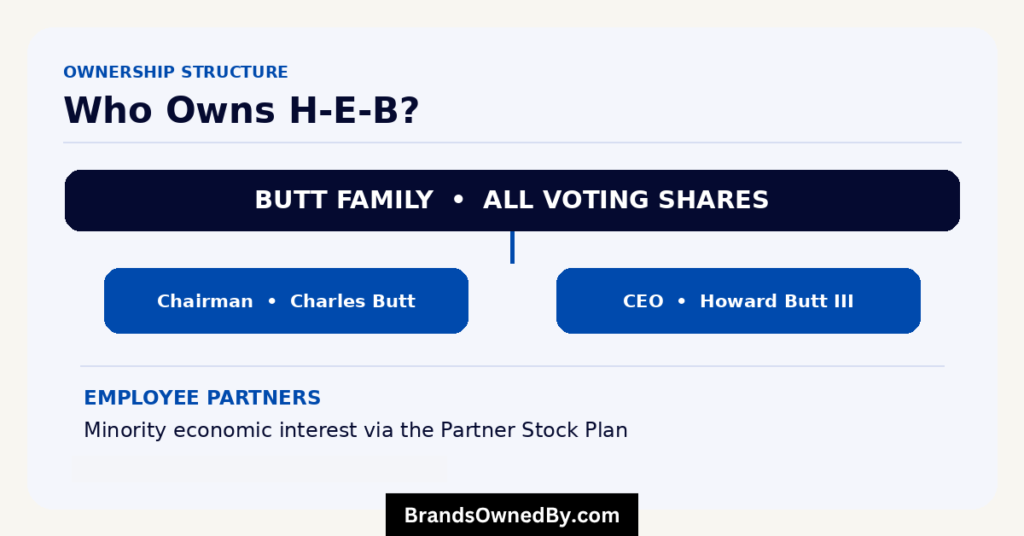
The Butt family owns H-E-B’s voting shares and controls the private business. Eligible employees participate through the Partner Stock Plan. Voting rights and economic rights are different: an employee may share in company value without gaining a vote equivalent to a family holder’s voting interest. The company has not published a September 2026 schedule showing how much each person owns.
Forbes estimated in 2022 that the extended family held approximately 90% of the economic interest and employees the rest. H-E-B did not confirm the individual stakes in that account. The 2022 estimate is useful context, but it cannot establish the split four years later. Ownership presentations that confidently put a current 85%, 87% or 90% beside the family name often fail to explain the date or method behind the number.
Charles Butt
Charles is H-E-B’s chairman and its most visible individual family owner. Forbes estimated in 2022 that he owned a little more than one-third of the company. That was an estimate of his interest at the time, not a September 2026 share register. It also does not mean he personally owns a majority of H-E-B.
His authority has two sources that should be kept separate. He has a personal ownership interest, and he chairs a business whose family collectively controls the voting shares. Since passing the CEO role to Howard Butt III in 2021, he has remained involved in governance while other executives lead operations. A customer-facing decision about prices or a particular store should not automatically be attributed to Charles simply because he is the best-known owner.
The difference is especially relevant for large capital decisions. H-E-B has described a potential $700 million supply chain expansion in San Antonio. The company did not disclose a family shareholder vote on that project. Still, a family-controlled board and management team can evaluate such an investment without seeking capital from public shareholders. That is a structural observation, not evidence that Charles individually approved the proposal.
Eleanor Butt Crook and Her Family
Eleanor Butt Crook is Charles’s sister and another granddaughter of Florence Butt. Forbes described Eleanor and her children’s combined position in 2022 as roughly half the size of Charles’s estimated stake. The comparison concerns the family branch as a group, not necessarily Eleanor’s personal holding. The precise division among her children is private.
Eleanor served on H-E-B’s board but has not been described as running its day-to-day grocery operations. That is a useful example of the difference between a significant family owner and an operating executive. A person can have influence through board service and voting ownership without directing store merchandising, logistics or digital delivery.
Her family’s participation also shows why the answer cannot be reduced to “Charles Butt owns H-E-B.” Several descendants of Florence hold economic interests. Public wealth rankings estimate some of those individuals’ fortunes, but an individual’s net worth is not a direct statement of current H-E-B shares, cash distributions, or company valuation.
Howard Butt III, Stephen Butt and Other Family Holders
Howard Butt III and Stephen Butt are nephews of Charles and Eleanor. Both are among the family members whose H-E-B interests have been estimated by outside wealth publications. Neither has a current publicly filed H-E-B share percentage that can be quoted as an exact September 2026 holding.
Howard became CEO in 2021. Before that, he led development of the company’s Mexico division. That background links his current group-wide role to an operating business outside Texas. Stephen has long led Central Market and is president of shareholder relations. His job title is particularly relevant to a private company with multiple family holders: coordinating shareholder relationships is a distinct function from overseeing a grocery banner.
The brothers’ leadership jobs should not be used to calculate their ownership. Executive authority comes from the position; an equity stake comes from the private company’s ownership records. Forbes estimated each brother’s wealth in 2022, but that is not a substitute for a cap table. Other family interests add another reason to avoid a simplified list of three or four “owners” adding up to 100%.
Employee Partners
H-E-B calls employees Partners. Eligible Partners receive allocations under a company-funded stock plan rather than buying publicly traded H-E-B shares. At launch, the grant was tied to salary and years of service. Later contributions were to reflect company performance. The value available to an individual depends on the plan’s terms and the company’s internal valuation, not on a live ticker price.
That creates an economic stake in the employer. A Partner can benefit if H-E-B’s value grows, subject to plan rules, even if they work in a store rather than the corporate office. It does not mean every employee is eligible or that every Partner holds an equal number of shares. It also does not give the workforce the voting control held by the Butt family.
For example, a qualifying long-serving store worker may have a larger allocation than someone who joined recently. Neither can sell shares on the NYSE or vote as an outside shareholder of a public grocer. The plan is an important ownership fact precisely because it combines broad employee participation with continued family governance.
Competitor Ownership Comparison
The ownership structures of H-E-B’s rivals differ in ways that affect capital raising and decision-making. Similar shelves and prices do not imply the same shareholder model.
Walmart: Public Shares with Walton Family Influence
Walmart is publicly traded, while the Walton family remains a major shareholder group. Its public investors can see quarterly earnings, segment revenue, cash flow and debt disclosures. H-E-B’s owners do not have to provide the same level of financial reporting to outside readers. Both companies have family influence, but only Walmart allows ordinary investors to buy shares.
The competitive overlap is clearest in the everyday grocery basket. Walmart’s national purchasing scale puts pressure on prices. H-E-B answers with localized assortments, fresh departments, its own brands and convenient pickup. A shopper comparing the same milk, produce and household essentials in a Texas market sees a retail contest; an analyst comparing the owners sees two very different routes to financing that contest.
Kroger: A Public Supermarket Company
Kroger trades on the NYSE under KR. Its shareholders can inspect periodic financial statements and vote in corporate elections. It is a direct comparison for H-E-B’s core grocery business because both compete in fresh foods, private-label goods, pharmacy and digital ordering. The ownership difference affects what an outsider can measure: Kroger reports detailed finances, while H-E-B releases only selected company-wide figures.
Kroger owns multiple retail banners across different regions. H-E-B also varies formats, but it does so inside a private company controlled by a family. In Texas, a Kroger store and an H-E-B store may look like straightforward substitutes to customers. Kroger’s filings let an analyst inspect its margins and debt. H-E-B provides too little public financial detail to calculate comparable figures.
Albertsons: Public Ownership Across Multiple Banners
Albertsons Companies trades publicly under ACI and operates multiple banners, including Tom Thumb in Texas. The name above an individual store is therefore not necessarily the name of its ultimate corporate owner. The same principle applies to a Central Market store, which sits inside the H-E-B group.
Albertsons must report consolidated results to public investors. H-E-B does not disclose a Central Market or Mi Tienda profit statement for a comparable analysis. In a neighborhood where Tom Thumb competes with H-E-B, store count or shelf prices alone cannot establish which format produces better returns. The comparison is useful because it reminds readers to keep the retail banner and its parent-company shareholders distinct.
Publix: Private and Employee Owned
Publix is private and describes itself as the largest employee-owned company in the United States. It provides employees opportunities to own shares and publishes financial statements and a company-set stock price. H-E-B also has employee owners, but its family holds the voting shares and its financial disclosure is much narrower. The similarity in employee participation should not erase the difference in who controls each retailer.
Publix provides a useful test for the phrase “employee owned.” At Publix it is central to the ownership identity. At H-E-B it describes a minority economic participation program within a family-controlled company. For readers comparing two private grocers, the right questions are who has voting power, how employees acquire interests, and what financial information the business releases.
Whole Foods Market: Owned by Amazon
Amazon acquired Whole Foods Market in 2017, making the grocery chain part of a public technology and retail group. H-E-B developed Central Market internally and kept it within its private family-controlled company. The two specialty formats can compete for customers who care about produce selection, prepared food, cheese and other premium items. Their parent companies have very different capital sources.
Central Market’s existence is not evidence that Whole Foods owns it, or that H-E-B bought Whole Foods. H-E-B’s specialty banner opened in Austin in 1994, long before Amazon’s Whole Foods transaction. That chronology matters because ownership searches often blur competition, influence and actual corporate ownership.
Who Controls H-E-B?
As of September 2026, control rests with the Butt family through its voting shares. Leadership is delegated among the chairman, CEO and president. Economic participation by employees does not change the basic control structure.
Chairman Charles Butt and Family Voting Power
Charles chairs H-E-B after stepping down as CEO in 2021. The family collectively holds the voting shares. Its control therefore operates through governance rather than through a public shareholder vote each time the company opens a new store. The precise allocation of those votes among individual relatives has not been published.
Board oversight and day-to-day management are separate. The company announced in 2025 that outgoing president Craig Boyan would remain on the board and join a Board Oversight and Advisory Committee as he moved into a senior advisory role in 2026. That disclosure offers a glimpse of H-E-B’s governance bodies. It does not provide a full board roster, committee charter or shareholder voting breakdown.
CEO Howard Butt III and President Roxanne Orsak
Howard Butt III directs the company as CEO. His earlier work developing H-E-B’s Mexico division gives him experience with an operation beyond the Texas store network. The CEO title concerns executive management. It does not establish that he personally holds a majority of the equity or all family voting shares.
Roxanne Orsak became president in January 2026 after serving as chief operating officer. She joined H-E-B as a store management trainee in 1988 and subsequently worked in store operations, merchandising, procurement and format design. H-E-B credited her with contributions to the launch of H-E-B Plus! in 2004 and Joe V’s Smart Shop in 2010. Those assignments make the presidency an operating role with direct relevance to the format strategy discussed in this article.
Craig Boyan, her predecessor, planned to retire at the end of 2026 and moved to a senior advisory position while remaining on the board. That transition shows the distinction between an operating handover and shareholder control. Orsak’s promotion did not transfer ownership away from the Butt family; it put a long-serving executive in charge of a major part of the company’s leadership work.
Control in Practice
The North Texas expansion gives a concrete example. H-E-B bought more than 600 acres in Valley View, Cooke County, in January 2026 for a proposed multi-phase supply chain campus. It also bought 122 acres next to its Temple distribution campus. The company said there was no construction timetable for the Valley View project. Those land decisions are part of planning store growth, replenishment and delivery capacity over years rather than a single reporting quarter.
Management assesses the locations, costs and operational needs. The board and controlling family oversee the broad direction. H-E-B has not publicly described the precise approval path for either land purchase, so an outsider cannot attribute a vote to a particular relative. Employees can participate economically through the stock plan, but the available evidence does not give them equivalent voting control over those investments.
H-E-B Annual Revenue and Net Worth
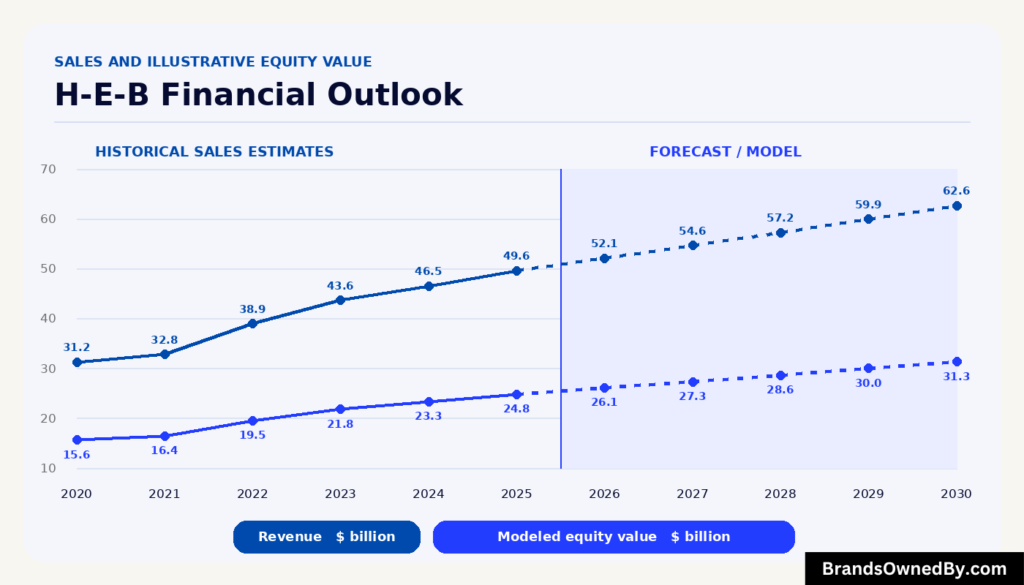
H-E-B’s sales put it among America’s largest private retailers, but the company does not publish the detailed financial statements of a listed grocer. Outside estimates show revenue rising from $31.2 billion in 2020 to $49.6 billion in 2025. H-E-B has separately described its annual sales as exceeding $50 billion. Its scale is clear. Its profit, debt, cash holdings and current company value are much less visible.
How Much Revenue Does H-E-B Generate?
The outside estimate for 2025 is $49.6 billion. It follows $46.5 billion in 2024 and $43.6 billion in 2023. The increase from 2024 to 2025 was $3.1 billion, or about 6.7%. H-E-B’s own description of sales above $50 billion is broadly consistent with a business of that size, though the company has not reconciled the two figures or released an audited 2026 sales total.
Growth was uneven over the earlier years. Estimated sales moved from $31.2 billion in 2020 to $32.8 billion in 2021, then to $38.9 billion in 2022. The $6.1 billion increase in 2022 coincided with unusually strong food-price inflation. Higher shelf prices lift dollar sales even when the number of items in a customer’s basket does not rise at the same rate. Revenue should therefore not be read as a direct measure of unit volume or profit.
Store growth provides another explanation. H-E-B has opened large supermarkets in Dallas–Fort Worth while investing in existing stores elsewhere in Texas. A new location adds revenue to the group even if sales at established stores are flat. A renovation can also improve an existing store’s basket size or traffic without adding a location. H-E-B does not disclose same-store sales, so the contribution from new stores cannot be separated precisely from inflation and growth at mature stores.
An estimated $52.1 billion in 2026 revenue would represent roughly 5% growth from the $49.6 billion 2025 figure. That level is plausible given H-E-B’s store expansion and its statement that annual sales already exceed $50 billion. It remains a forecast. H-E-B has not issued a public quarterly revenue series or company guidance that would establish its actual 2026 total.
How Much Is H-E-B Worth?
H-E-B has no public stock price, and it does not disclose the balance sheet needed to calculate its book net worth. The value of the company is also different from the personal wealth of Charles Butt or other relatives. Their fortunes may include assets outside H-E-B, while a buyer assessing the grocer would consider its earnings, cash, debt and future investment needs.
Forbes estimated H-E-B’s company value at just over $17 billion in 2022. That is a historical outside valuation, not a price established by a sale. H-E-B’s estimated annual revenue has grown since then, but revenue alone cannot show how much the business’s value has changed. A grocer can generate more sales while absorbing higher wages, distribution costs or investment in new facilities.
Applying a 0.5-times-sales multiple to estimated 2026 revenue of $52.1 billion produces a value proxy of $26.1 billion. This calculation shows how value might move with sales under a fixed assumption. It is not a current appraisal. A sales multiple generally indicates enterprise value first. The amount attributable to owners would depend on net debt and other adjustments that H-E-B has not disclosed.
The sensitivity is substantial. At 0.4 times the same sales estimate, the value proxy falls to $20.8 billion. At 0.6 times, it rises to $31.3 billion, before any debt adjustment. A shift of only 0.2 in the multiple changes the result by $10.5 billion. H-E-B’s undisclosed earnings and net debt make it impossible to turn that range into a reliable September 2026 net-worth figure.
Revenue and Value Outlook Through 2030
With annual growth easing from about 5% toward 4.5%, H-E-B’s revenue could reach $54.6 billion in 2027, $57.2 billion in 2028 and $59.9 billion in 2029. That path reaches $62.6 billion in 2030. It implies an increase of $13.0 billion from the $49.6 billion 2025 estimate and roughly 4.8% annualized growth. That pace is below the roughly 9.7% annualized rise recorded in the 2020–2025 estimates, a period affected by the pandemic and food inflation.
Expansion provides a basis for continued growth. H-E-B has entered additional Dallas–Fort Worth communities. In January 2026, it bought more than 600 acres in Valley View for a proposed North Texas supply chain campus. In May, it outlined a possible $700 million expansion of its San Antonio manufacturing and distribution operations. These investments could support more stores and higher volumes. The Valley View project had no construction timetable, and the Foster Road expansion remained conditional, so their full effect cannot be assumed to arrive immediately.
The constraints are equally concrete. New supermarkets require land, construction, inventory and staff before they reach mature sales levels. Price competition with Walmart, Kroger and other chains can limit margins. Curbside and home delivery can increase customer reach while adding labor and fulfillment costs. If openings slow or shoppers trade down, revenue may fall short of $62.6 billion. Stronger store productivity or faster North Texas expansion could push it higher.
At a constant 0.5-times-sales multiple, $62.6 billion in 2030 revenue corresponds to a $31.3 billion value proxy. It is a mechanical extension of the sales outlook. Actual company value could move differently. Higher operating margins and strong cash generation would support a stronger valuation; heavy capital spending, debt or weaker margins would pull it lower. H-E-B has not disclosed the financial detail needed to forecast that outcome precisely.
Brands Owned by H-E-B
Store banners, subsidiaries and product labels are different kinds of assets. Central Market is a retail format, Favor is a separately branded subsidiary, and Creamy Creations is a product brand. Treating them all as independently acquired companies would overstate H-E-B’s acquisition history.
H-E-B Supermarkets
The namesake supermarkets are H-E-B’s main retail format. They combine national products with the company’s own food and household brands. Individual locations can include full-service meat and seafood departments, a bakery and tortilleria, pharmacy, curbside pickup, home delivery, fuel and prepared-food counters. Those features vary by store rather than appearing in every location.
The store format can also be adapted to a neighborhood. The 101,000-square-foot Manor store that opened in 2025 includes a bakery and tortilleria, pharmacy, curbside service, and prepared-food options. A customer can buy a national-brand cereal, H-E-B own-brand milk and an in-store prepared meal in the same trip. This combination of branded goods, proprietary products and services explains why the flagship banner produces more than just grocery shelf sales.
These stores are company-operated parts of the private H-E-B group. They are not a franchise network with separate local franchise owners. Their purchasing volume supports the economics of H-E-B’s own brands and distribution facilities. Those facilities, in turn, help the company stock stores consistently as it enters another North Texas community.
Central Market
H-E-B opened its first Central Market in Austin in 1994. As of 2026, the division describes a ten-store Texas network, including locations in Austin, Dallas, Fort Worth, Houston, Plano and Southlake. Stephen Butt serves as president of shareholder relations and the Central Market division. A Central Market store is an H-E-B operation, not a separate public company with its own shareholders.
The format is designed for food discovery rather than a small-discount grocery run. Central Market describes extensive produce and cheese selections, an 80-foot seafood case, about 2,500 wine labels and cooking classes. Those features attract a different shopping occasion from a standard weekly basket. H-E-B can use the banner to serve specialty demand without repositioning every namesake supermarket at a premium price point.
Central Market is also used on packaged products sold within H-E-B’s wider network. That dual use can confuse ownership lists. A Central Market-labeled item is a product brand; the Central Market on a building is a store banner. Both are controlled within H-E-B. Neither should be counted as an acquired rival.
The San Antonio Broadway location illustrates how H-E-B manages the format. The building opened as an H-E-B store in 1951 and was converted to Central Market in 1999. H-E-B later announced renovation plans for the roughly 90,000-square-foot property. This is the reinvestment and repositioning of an existing company asset, not evidence that ownership changed in 1999.
Joe V’s Smart Shop
Joe V’s Smart Shop launched in 2010 as H-E-B’s value-focused grocery format. H-E-B reported 14 Joe V’s stores and more than 2,700 Partners across the Houston and Dallas areas in July 2026. The company announced two more Houston-area stores for 2027, but those planned locations should not be added to the 14-store operating count as of September 2026.
The value positioning does not mean a bare warehouse with no fresh departments. At the 58,000-square-foot Irving store opened in November 2025, H-E-B highlighted produce, meats cut in store, tortillas and bread made in store, daily sushi and prepared meals. It described operational cost reductions that support lower shelf prices. The brand can therefore compete for budget-conscious customers while retaining some of H-E-B’s fresh-food strengths.
The Irving opening was Joe V’s third North Texas location and fourteenth statewide at the time. H-E-B has also discussed a future Garland store. This format lets the group enter or deepen a market with a different price proposition from a conventional H-E-B. A Joe V’s store does not have its own independent shareholder base; its growth is part of the parent company’s format strategy.
Mi Tienda
H-E-B launched Mi Tienda as a Houston-area retail concept in 2006. Its emphasis is Mexican and Central American food shopping, with features such as a panaderia, tortilleria, aguas frescas, specialty meat cuts and prepared dishes. The company has operated two Mi Tienda stores in the Houston area as of early 2026. The limited store count makes it a targeted concept rather than a second large national chain.
The name also appears on H-E-B products stocked in ordinary supermarkets. For example, a shopper may find Mi Tienda cheeses or prepared ingredients at a namesake H-E-B store without visiting a Mi Tienda location. The store format and packaged-product label serve overlapping tastes, but their distribution footprints are different.
Both belong to the H-E-B business. That distinction matters when compiling a portfolio: it would be inaccurate to list every Mi Tienda product as another subsidiary, or to assume a Mi Tienda-branded package was made by a separately owned grocery chain. No stand-alone Mi Tienda revenue or valuation has been disclosed.
H-E-B Plus! and H-E-B Mexico
H-E-B Plus! debuted in 2004. The format broadens the usual supermarket mix with more general merchandise, giving shoppers a larger one-stop trip for groceries and household purchases. It remains an H-E-B banner, not a separately owned big-box chain. The format is relevant to the company’s capital allocation because larger assortments require different floor space, inventory and replenishment from a smaller neighborhood grocery.
The Mexico business is a geographic operation rather than a Texas store concept. H-E-B began opening stores in Mexico in the late 1990s. Howard Butt III led development of the division before taking the group CEO role. The company’s combined Texas-and-Mexico store count does not tell readers how much revenue or profit is earned on either side of the border; those figures are not separately published.
H-E-B’s Mexico website and U.S. site present distinct customer storefronts, but the group remains under family control. Mexico also introduces different suppliers, currencies and consumer preferences. A claim that every item sold by the Texas chain is made in Texas would therefore be misleading. The more defensible point is that H-E-B uses local formats and sourcing choices across its markets while retaining the same controlling family.
Favor Delivery
H-E-B acquired Austin-based Favor in February 2018. Unlike Central Market or Joe V’s, Favor existed before joining H-E-B. The company has explicitly described it as a wholly owned subsidiary that operates independently under its own brand. The purchase added a consumer ordering platform and an on-demand delivery network to a grocer already developing curbside and home delivery services.
The strategic logic goes beyond delivering bags from an H-E-B store. Favor can deliver restaurant and other local orders, while H-E-B can use delivery technology and customer insights to strengthen its broader digital operation. In a 2023 anniversary announcement, H-E-B said Favor’s network had completed more than 70 million deliveries and that its Curbside and Home Delivery services covered more than 270 H-E-B, Central Market and Joe V’s stores at that time. Those are historical milestones, not verified September 2026 totals.
Keeping the Favor name visible lets it serve use cases that do not fit neatly under a supermarket banner. Ownership has not changed merely because an app carries a different name. H-E-B has not published Favor’s stand-alone sales, earnings, purchase price or current valuation, so claims about how much of the parent company’s worth Favor represents would be speculative.
Hill Country Fare
Hill Country Fare is a value-oriented H-E-B grocery brand. It appears on everyday products such as pantry items, dairy and frozen foods. The line gives the company a way to offer a lower price point within its own-brand range while retaining control over product specifications and shelf placement.
The positioning differs from Central Market-branded specialty goods. H-E-B can put both on a shelf and address different budgets without needing to acquire another packaged-food company. That is a practical benefit of owning several product labels rather than selling every house product under a single H-E-B name.
Hill Country Fare does not operate a supermarket or release independent financial statements. The commercial value comes from its role across H-E-B’s existing stores. A product manufacturer may make an item for the retailer under contract; the presence of such a supplier would not mean the supplier owns the Hill Country Fare brand.
Meal Simple
Meal Simple is H-E-B’s prepared and ready-to-cook food line. Its assortment includes entrées, sides and family meals for shoppers who want a faster dinner than buying every ingredient separately. H-E-B markets these items from fresh and prepared-food areas as well as through its digital shopping channels where available.
The brand is commercially different from a packaged pantry label. Fresh food requires forecasting, labor, refrigeration and careful waste management. A successful Meal Simple item can increase the value of a customer’s basket and keep an occasion that might otherwise go to a restaurant or delivery app. The costs of that convenience also differ from selling a shelf-stable product. H-E-B does not disclose the line’s sales or margins.
The “by H-E-B” name on many Meal Simple products makes the ownership explicit. It remains a proprietary product brand inside the grocery group, not a separate meal-kit company acquired from outside. At Joe V’s Irving store, H-E-B included Meal Simple among the prepared options, showing that an own-brand line can move across store formats.
Creamy Creations and Mootopia
Creamy Creations is H-E-B’s ice-cream line. H-E-B has said that some Creamy Creations products are made in San Antonio. The brand supports flavors and seasonal product launches that can give a shopper a reason to select the retailer’s product over a national label. Its Texas-focused identity is a marketing asset, but it is not a separately traded ice-cream company.
Mootopia is H-E-B’s distinctive dairy label, including milk products. The two brands serve different aisles and use cases: one is a dessert purchase, and the other is part of a routine dairy basket. Their common owner can use store distribution and its manufacturing and supply chain infrastructure to develop, stock and promote them.
H-E-B does not report sales for Creamy Creations or Mootopia separately. A list that assigns an independent net worth to either brand without a transaction or disclosed financials would be inventing precision. Their importance is visible in H-E-B’s assortment and repeat customer recognition, not in a public subsidiary balance sheet.
Other H-E-B Brands
H-E-B’s own-brand directory extends well beyond the best-known food labels. Organics and Higher Harvest address shoppers seeking particular ingredient or dietary choices. Field & Future covers household and personal-care products with an environmental positioning. Texas Tough appears on utility items such as foil and trash bags. Heritage Ranch covers pet products. These are different merchandising roles within one retailer’s portfolio.
Other names identify specific meal or beverage occasions. Sushiya is used for sushi and related offerings; Café Olé for coffee; and Kitchen & Table for home and kitchen goods. The directory also lists brands such as Texas Roots, Season’s Select, Our Finest, Haven & Key and H-E-B Baby. A bakery label or line within a meat department should not be confused with an independently incorporated company.
There is no stable, public master list of every SKU and seasonal sublabel to reproduce in an ownership article. The assortment changes, and a product brand’s presence can vary by store or online location. The meaningful distinction is that H-E-B controls these own brands and uses them alongside national products across its retail system. Unlike Favor, most are not acquired stand-alone operating companies.
Final Thoughts
The answer to who owns H-E-B has two layers. The Butt family retains voting control of a business founded by Florence Butt in 1905. Eligible employees share in its economic value through a stock plan. The group uses that structure to operate multiple grocery formats, a Mexico division, an acquired delivery subsidiary and a broad own-brand range. Public sales estimates show the scale of the business. They do not reveal an audited current valuation or an exact September 2026 cap table.
FAQs
Who is the owner of H-E-B right now?
The Butt family collectively owns H-E-B’s voting shares and controls the private company. Eligible employee Partners hold an economic interest through the Partner Stock Plan. The individual ownership percentages have not been published in a current public cap table.
Does Charles Butt own all of H-E-B?
No. He is chairman and a major family owner, but other Butt family members and eligible employees also have interests. An outside estimate in 2022 placed Charles’s stake at a little more than one-third. That figure should not be treated as a current ownership filing.
Is H-E-B owned by Walmart or Kroger?
No. The Butt family controls H-E-B’s voting shares. Walmart is publicly traded and has substantial Walton family ownership. Kroger is also publicly traded. Both compete with H-E-B for grocery spending, but neither is its parent.
What does H-E-B stand for?
The initials stand for Howard Edward Butt. He took over and expanded the grocery business founded by his mother, Florence Butt, in Kerrville in 1905. Florence founded the company; Howard’s initials became its retail name.
Is H-E-B publicly traded, and can I buy its stock?
No. H-E-B is private and has no public ticker or shares available through an ordinary brokerage account. Eligible employees may receive interests through the Partner Stock Plan under its rules. Buying Walmart, Kroger or another grocery stock does not provide an ownership interest in H-E-B.
Do H-E-B employees own the company?
Eligible employees can receive company stock through the Partner Stock Plan. H-E-B said in 2015 that Partners might own approximately 15% over time, but it has not published that as a verified September 2026 percentage. The Butt family retains voting control.
Does H-E-B own Central Market and Favor?
Yes, but their structures differ. Central Market is a specialty grocery division H-E-B launched in 1994. It reported ten Texas stores in 2026. Favor is a delivery business that H-E-B acquired in 2018 and has described as a wholly owned subsidiary operating under its own brand. Both sit within the H-E-B group.
How much is H-E-B worth?
There is no public market capitalization or audited current net-worth figure. Forbes estimated a company value just above $17 billion in 2022. That historical outside estimate is not a September 2026 valuation. The figures in our annual table are explicitly illustrative and depend on an assumed sales multiple.