
- Piggly Wiggly is owned by Piggly Wiggly, LLC, an affiliate of C&S Wholesale Grocers. C&S acquired the national grocery brand and franchise operations in 2003.
- Rick Cohen and the Cohen family are the ultimate controlling owners through their private ownership of C&S. Exact ownership percentages are not publicly disclosed because neither C&S nor Piggly Wiggly is publicly traded.
- Eric Winn is the CEO of C&S Wholesale Grocers and manages the parent company’s daily operations. Rick Cohen serves as executive chairman and retains significant ownership and governance authority.
- Most Piggly Wiggly supermarkets are independently owned and operated under license. Local retailers control many store-level decisions, while C&S controls the national brand, trademarks and licensing system.
Piggly Wiggly is one of the oldest supermarket brands in the United States. Clarence Saunders founded the business in Memphis, Tennessee, in 1916.
The company helped establish the modern self-service grocery model. Before its introduction, customers usually gave their shopping lists to store clerks. The clerks collected the products and brought them to the counter.
Saunders allowed customers to walk through aisles and select products themselves. This model reduced labor requirements. It also gave customers more freedom and encouraged additional purchases.
Piggly Wiggly introduced or popularized several practices that later became supermarket standards. These included organized aisles, checkout lanes, individually priced products, shopping baskets and branded product displays.
The modern Piggly Wiggly system differs from a conventional national supermarket chain. It combines centralized brand ownership with decentralized store ownership.
| Company detail | Information |
|---|---|
| Legal brand owner | Piggly Wiggly, LLC |
| Parent company | C&S Wholesale Grocers |
| Ultimate ownership | Privately controlled by the Cohen family |
| Founder | Clarence Saunders |
| Founded | 1916 |
| Original location | Memphis, Tennessee |
| Corporate headquarters | Keene, New Hampshire |
| Business model | Licensed and independently operated supermarkets, plus selected corporate operations |
| Primary markets | Southern and Midwestern United States |
| Publicly traded | No |
| Stock symbol | None |
More than 500 Piggly Wiggly stores serve communities across 18 states. The precise store count can change as independent retailers open, close, sell or convert locations.
Many stores are located in smaller cities and rural communities. These markets may not support the large-format stores operated by Walmart, Kroger or other national chains.
Piggly Wiggly’s decentralized system gives local operators flexibility. One owner may emphasize fresh meat and regional products. Another may compete through weekly promotions, prepared food or personalized service.
This explains why two Piggly Wiggly locations can have different prices, layouts, loyalty programs and product selections.
Ownership History
Ownership timeline
Piggly Wiggly Ownership History
From a retail pioneer to a family-controlled grocery group with locally owned stores.
Controls the national name and licensing system.
Acquired the brand through Fleming assets in 2003.
Local operators own and manage many locations.
How ownership changed
Nine milestones shaped the modern structure.
Clarence Saunders founds the chain
The first self-service store opens in Memphis.
Franchising fuels expansion
Independent grocers adopt the name and retail model.
Piggly Wiggly trades publicly
Outside investors gain access through the NYSE.
Saunders loses control
A failed battle with short sellers ends the founder-led era.
Regional ownership develops
Stores and territorial rights pass to different operators.
Malone & Hyde acquires the brand
The supermarket name joins a major grocery wholesaler.
Fleming becomes the owner
Fleming acquires Malone & Hyde and Piggly Wiggly.
C&S acquires Piggly Wiggly
Fleming’s bankruptcy transfers the brand to its current parent.
Regional operations expand
C&S adds Carolina support operations and Piggly Wiggly Midwest.
Who controls it today?
Independent retailers still control many individual stores.
Piggly Wiggly’s ownership history is more complicated than that of a conventional supermarket chain. The company began as a founder-led business. It later became publicly traded. Financial conflict caused its founder to lose control. The brand then passed through several corporate owners before reaching C&S Wholesale Grocers.
Regional licensing also played an important role. Many Piggly Wiggly stores were owned by independent retailers even when the national brand belonged to a larger corporation. That distinction remains central to the company’s ownership structure.
Clarence Saunders Founds Piggly Wiggly
Clarence Saunders founded Piggly Wiggly in Memphis, Tennessee, in 1916. The first store introduced a self-service shopping model that was unusual at the time.
Traditional grocery stores kept products behind counters. Customers gave their orders to clerks. The clerks gathered the products and calculated the final bill.
Saunders redesigned this process. Customers entered through a controlled entrance, moved through organized aisles and selected their own products. They then paid at a checkout counter.
The new format reduced the number of clerks needed to serve customers. It also exposed shoppers to more products. This encouraged additional purchases and helped stores process more customers.
The concept expanded quickly. Saunders established Piggly Wiggly Corporation to control the company’s intellectual property, operating system and growing retail network.
The Early Franchise Model
Saunders did not rely entirely on company-owned stores. Piggly Wiggly expanded through franchise agreements with independent grocery retailers.
Local business owners received the right to use the Piggly Wiggly name and operating model. This approach helped the company enter new markets without financing every new store.
Piggly Wiggly Corporation controlled the brand, patents and business format. Local operators invested in individual stores and managed their everyday operations.
This early strategy created a lasting characteristic of Piggly Wiggly. Ownership of the national brand was separated from ownership of many physical supermarkets.
The franchise system drove rapid expansion. Hundreds of stores eventually operated under the Piggly Wiggly name.
Piggly Wiggly Becomes a Public Company
Piggly Wiggly Corporation issued shares to investors as the business expanded. Its stock traded on the New York Stock Exchange.
Public ownership gave the company access to additional capital. It also exposed Saunders to outside shareholders, market speculation and pressure from Wall Street.
Saunders remained the company’s dominant executive and public figure. However, he no longer operated within the simple ownership structure of a founder-controlled private business.
The company’s share price became the focus of a major financial confrontation during the early 1920s.
The Wall Street Conflict
A group of traders began selling Piggly Wiggly shares short. Short sellers expected the stock price to decline. They planned to buy the shares back later at a lower price.
Saunders believed the traders were deliberately attacking his company. He responded by attempting to buy most of the available Piggly Wiggly shares.
His objective was to control the supply of stock. Short sellers would then have difficulty finding shares to fulfill their obligations. Saunders could demand a higher price from them.
The strategy initially appeared successful. Saunders gained control of a significant portion of Piggly Wiggly’s publicly available shares. However, he financed many of the purchases with borrowed money.
The New York Stock Exchange intervened in the dispute. It gave short sellers additional time to settle their positions and restricted trading in Piggly Wiggly shares.
These actions weakened Saunders’ position. He had substantial debts but could no longer force short sellers to purchase shares under his preferred terms.
Clarence Saunders Loses Control
The failed stock-market strategy created severe financial pressure. Saunders could not meet all the obligations associated with his share purchases and loans.
He eventually lost control of Piggly Wiggly in the early 1920s. His personal and business assets were placed under financial strain. He later declared bankruptcy.
Saunders had no ownership or management role in Piggly Wiggly after losing control. He pursued other retail concepts, including Keedoozle, but never regained the Piggly Wiggly company.
This period ended the company’s founder-controlled era. It also contributed to the fragmented regional structure that developed afterward.
Piggly Wiggly Is Divided Among Regional Operators
After Saunders lost control, Piggly Wiggly did not continue as one fully integrated national supermarket company.
Parts of the business were divided and transferred to different regional operators. Several grocery companies acquired Piggly Wiggly stores or territorial rights in specific markets.
Companies associated with parts of the historical network included Kroger, Safeway, National Tea and Colonial Stores. These transactions did not mean that one of these companies acquired permanent ownership of the entire national Piggly Wiggly brand.
Instead, different businesses gained control of stores or regional operations. Some locations retained the Piggly Wiggly name. Others were converted to new supermarket banners.
The Canadian Piggly Wiggly business followed a similar path. Canadian Safeway acquired 179 Piggly Wiggly stores in 1935.
Some early Piggly Wiggly locations in Texas also became connected with the business that developed into H-E-B. However, H-E-B does not own the current Piggly Wiggly brand.
The Brand Continues Through Licensing
Despite the division of the original company, the Piggly Wiggly name remained valuable.
The brand continued to operate through licensing and franchise relationships. Independent grocers used the name while managing their own stores.
A national or regional licensing company controlled trademark use and certain operating standards. The local retailer controlled the store’s employees, property, inventory and community relationships.
This structure helped Piggly Wiggly remain active in markets where a centrally operated national chain might have withdrawn. Local owners could adjust their stores to smaller cities and rural communities.
The arrangement also created differences among locations. Store appearance, pricing, promotions and product selection could vary substantially from one owner to another.
Malone & Hyde Acquires Piggly Wiggly
Malone & Hyde acquired the Piggly Wiggly brand in 1982.
Malone & Hyde was a major wholesale grocery distributor. It supplied products and support services to supermarkets and independent retailers.
Piggly Wiggly complemented that business model. Malone & Hyde could supply independent stores while also offering them access to a recognized supermarket identity.
A local grocer could obtain products through the distributor and operate under the Piggly Wiggly name. The arrangement created wholesale revenue for Malone & Hyde and brand recognition for the retailer.
The 1982 transaction brought the Piggly Wiggly name under the control of a larger grocery distribution company. However, independently owned stores remained an important part of the system.
Fleming Companies Acquires Malone & Hyde
Fleming Companies acquired Malone & Hyde in 1988. Piggly Wiggly transferred to Fleming as part of the transaction.
Fleming was one of the largest grocery wholesalers in the United States. It supplied independent supermarkets and operated several retail support programs.
Under Fleming, Piggly Wiggly remained closely connected to grocery distribution. Fleming could use the brand to support independent supermarket customers that needed a recognizable retail banner.
Fleming’s ownership did not create a completely standardized Piggly Wiggly chain. Regional operators and independent store owners continued to play significant roles.
Fleming’s Financial Problems
Fleming encountered major financial and operational problems in the early 2000s.
The company lost important customers and faced accounting concerns, debt pressure and declining confidence. It filed for Chapter 11 bankruptcy protection in 2003.
Fleming’s assets included warehouses, wholesale operations, customer relationships and retail brands. The bankruptcy process led to the sale of these assets to other grocery companies.
Piggly Wiggly’s ownership changed again as part of Fleming’s restructuring and asset sales.
C&S Wholesale Grocers Acquires Piggly Wiggly
C&S Wholesale Grocers acquired significant Fleming assets in 2003. The transaction included the Piggly Wiggly brand and its franchise operations.
C&S was a natural strategic owner. Its core business involved supplying supermarkets and independent grocery retailers. Piggly Wiggly already had a large network of independently operated stores.
Under C&S, Piggly Wiggly, LLC became the company responsible for the national brand and its licensing arrangements.
C&S gained control of the Piggly Wiggly name, trademarks and franchise system. It could combine those assets with its distribution, procurement, marketing and store-support services.
The acquisition established the ownership structure that remains in place. C&S owns the national Piggly Wiggly brand, but it does not own every store using the name.
C&S Acquires Piggly Wiggly Carolina Operations
Piggly Wiggly Carolina developed as an important regional operation in South Carolina and neighboring markets.
The regional company supported stores through branding, advertising, accounting, technology and administrative services. It also maintained relationships with independent Piggly Wiggly retailers.
C&S acquired the operating assets of Piggly Wiggly Carolina in 2014. The transaction strengthened C&S’s control over the regional support system.
However, the deal was not a simple purchase of every Piggly Wiggly store in the Carolinas. Many stores were already independently owned. Others were sold or transferred to independent operators.
C&S primarily acquired the infrastructure that supported the regional network. Local retailers continued to own and manage many individual supermarkets.
For example, an independent owner could operate a South Carolina Piggly Wiggly while receiving brand, technology or supply support through the C&S system.
C&S Acquires Piggly Wiggly Midwest
C&S expanded its direct involvement again when it acquired Piggly Wiggly Midwest in 2021.
The regional business traced its development through Wisconsin-based grocery operations. Paul Butera and his family had acquired control of the company that became Piggly Wiggly Midwest during the 2000s.
Piggly Wiggly Midwest supported supermarkets in Wisconsin and surrounding areas. Its operations included distribution, marketing and retail support.
The C&S acquisition added these functions to the parent company’s existing Piggly Wiggly platform. It also gave C&S greater control over selected corporate-operated stores in the region.
Independent ownership remained common. Some Midwest locations continued to be owned by local families and regional grocery companies.
The acquisition therefore expanded C&S’s operational footprint without eliminating the brand’s decentralized structure.
Piggly Wiggly Under C&S Today
Piggly Wiggly now operates as part of the C&S Wholesale Grocers organization.
C&S controls the national trademark through Piggly Wiggly, LLC. It approves qualified retailers, administers licensing relationships and protects the brand’s intellectual property.
The parent company can also provide wholesale distribution, merchandising, advertising and store-support services. Selected Piggly Wiggly locations are operated through C&S affiliates.
Most stores remain independently owned and operated. Their owners may include local families, small supermarket groups and retailer cooperatives.
This creates three distinct levels of ownership:
- The Cohen family controls C&S Wholesale Grocers.
- C&S owns Piggly Wiggly, LLC and the national brand.
- Independent retailers own and operate many individual Piggly Wiggly stores.
The structure allows Piggly Wiggly to maintain a national identity while adapting to local markets. It also explains why ownership can differ from one location to another.
A customer visiting a Piggly Wiggly in Alabama may be shopping at a locally owned business. A customer visiting another location may be shopping at a store operated through a C&S affiliate. Both stores use the same national brand, but their immediate legal owners may be different.
Who Owns Piggly Wiggly?
![Who Owns Piggly Wiggly [infographic]](https://brandsownedby.com/wp-content/uploads/2026/07/Who-Owns-Piggly-Wiggly-infographic-683x1024.png)
As of July 2026, Piggly Wiggly is owned by C&S Wholesale Grocers through Piggly Wiggly, LLC. C&S is a privately held grocery wholesaler and retailer controlled by Rick Cohen and the Cohen family. Piggly Wiggly has no public stock, ticker symbol or institutional shareholder list. Most supermarkets using the name are independently owned. Those store operators own their local businesses, but they do not own shares in the national Piggly Wiggly brand.
Piggly Wiggly is legally organized as a limited liability company. Therefore, the more accurate term for its direct owner is “member” rather than “shareholder.” However, shareholder is commonly used when discussing company ownership.
Only one ultimate ownership group is publicly identifiable: Rick Cohen and the Cohen family. Exact ownership percentages are unavailable because neither Piggly Wiggly nor C&S publishes a shareholder register.
Ownership explained
Who Owns Piggly Wiggly?
The Cohen family controls the national brand through C&S. Many individual stores have separate local owners.
Ownership data: July 2026The ownership chain
C&S-affiliated stores
Selected locations are operated through corporate affiliates.
Independent stores
Local retailers own many stores under license.
C&S Wholesale Grocers: Immediate Corporate Owner
C&S Wholesale Grocers is the immediate parent company behind Piggly Wiggly.
C&S acquired the Piggly Wiggly brand and franchise operations from the assets of Fleming Companies in 2003. Fleming had entered bankruptcy after experiencing financial and operational problems.
The acquisition gave C&S control of the Piggly Wiggly name, trademarks and licensing system. Piggly Wiggly, LLC now functions as an affiliate within the C&S organization.
C&S can decide which retailers qualify to operate under the Piggly Wiggly name. It can also establish brand requirements and manage licensing relationships.
Its responsibilities can include:
- Protecting the Piggly Wiggly trademarks.
- Approving qualified store operators.
- Administering franchise and licensing agreements.
- Providing wholesale grocery distribution.
- Supporting merchandising and marketing programs.
- Managing selected corporate-operated stores.
- Coordinating regional Piggly Wiggly operations.
C&S also owns and operates businesses outside Piggly Wiggly. Its broader operations include grocery distribution, supply-chain services, corporate supermarkets and private-label products.
The company operates more than 200 corporate-run stores under banners that include Piggly Wiggly, Grand Union, Family Fare, Martin’s Super Markets and D&W Fresh Market. Its retail portfolio expanded after the acquisition of SpartanNash was completed in September 2025.
Those other banners are not owned by Piggly Wiggly. They are sibling businesses within the larger C&S organization.
Although C&S clearly controls Piggly Wiggly, it does not publish the precise legal membership interest it holds in Piggly Wiggly, LLC. The brand is consistently identified as a C&S-owned or C&S-affiliated business. No outside equity owner of Piggly Wiggly, LLC has been publicly disclosed.
Rick Cohen and the Cohen Family: Ultimate Controlling Owners
Rick Cohen and the Cohen family are the ultimate controlling owners behind Piggly Wiggly.
Rick Cohen is the owner and executive chairman of C&S Wholesale Grocers. He represents the third generation of his family to lead the company.
His grandfather, Israel Cohen, established C&S with Abraham Siegel in 1918. Israel Cohen’s son, Lester Cohen, later joined the business. Rick Cohen eventually became the company’s chief executive officer in 1989.
The Cohen family expanded C&S from a regional grocery distributor into a major national supply-chain and retail organization. Its acquisition of Piggly Wiggly added a historic supermarket brand to the family-controlled enterprise.
Rick Cohen no longer serves as the day-to-day CEO of C&S. However, his position as executive chairman gives him substantial influence over governance, ownership strategy and major capital decisions.
The exact percentage owned by Rick Cohen and other members of the Cohen family is not publicly available. C&S is private and does not file the detailed proxy statements required from publicly traded companies.
No reliable public filing provides:
- Rick Cohen’s precise C&S ownership percentage.
- Ownership percentages held by other Cohen family members.
- The number of C&S shares or membership units outstanding.
- Voting rights attached to individual family holdings.
- A complete list of minority investors, if any.
For that reason, it would be misleading to assign the family an estimated percentage. The defensible conclusion is that the Cohen family controls C&S, while Rick Cohen holds the leading ownership and governance position.
The family’s influence reaches Piggly Wiggly through the corporate ownership chain:
Cohen family → C&S Wholesale Grocers → Piggly Wiggly, LLC → Piggly Wiggly brand and licensing system.
Rick Cohen and his family were estimated to have a net worth of approximately $20.6 billion in July 2026. However, most of that estimated wealth was connected to the family’s interest in warehouse automation company Symbotic. It should not be treated as Piggly Wiggly’s value or C&S’s standalone valuation.
Independent Piggly Wiggly Store Owners
Independent Piggly Wiggly operators are store owners, not shareholders in the national brand.
Piggly Wiggly reports more than 500 stores across 18 states. Many are owned by local families, regional supermarket companies or retailer groups.
An independent operator usually owns the company that manages a specific location or group of locations. It may own the store property or lease it from a real estate owner.
The operator is generally responsible for:
- Employing store workers.
- Managing local operating costs.
- Choosing certain products and suppliers.
- Setting permitted local prices and promotions.
- Maintaining the store.
- Building relationships with the surrounding community.
- Paying obligations connected with its licensing arrangement.
The national brand remains under C&S control. The local operator receives permission to use that brand under a franchise or licensing agreement.
Consider a family that owns four Piggly Wiggly supermarkets in Georgia. The family may own 100% of the operating companies behind those four stores. It does not own 100% of Piggly Wiggly, LLC. It also does not automatically own shares in C&S.
This distinction explains why ownership must be examined at the location level. The Piggly Wiggly name identifies the licensed supermarket brand. It does not necessarily identify the legal company that owns a particular store.
Regional Piggly Wiggly Groups
Some independent operators control multiple stores within a specific market.
These regional businesses may use the Piggly Wiggly name across their store portfolios. They can benefit from shared advertising, centralized purchasing and local management.
Examples include Fox Bros. Piggly Wiggly in Wisconsin and JTM Corporation’s Piggly Wiggly operations in Georgia and Alabama. These companies operate licensed supermarkets but are not publicly reported as shareholders of Piggly Wiggly, LLC.
Alabama also has retailer-owned cooperative arrangements involving Piggly Wiggly operators. A cooperative can help independent retailers coordinate distribution and purchasing. Participation does not transfer ownership of the national Piggly Wiggly brand to the cooperative.
Regional operators may have substantial authority over their locations. They do not replace C&S as the national brand owner.
C&S-Owned Piggly Wiggly Stores
Not every Piggly Wiggly supermarket is independently owned.
C&S operates selected stores through corporate subsidiaries or affiliated operating companies. These locations fall more directly under the parent company’s retail organization.
At a corporate-operated location, a C&S affiliate may control:
- Store employment.
- Inventory procurement.
- Pricing systems.
- Property leases.
- Capital improvements.
- Store closures and relocations.
- Financial performance.
C&S strengthened its corporate and regional involvement by acquiring Piggly Wiggly Carolina support operations in 2014 and Piggly Wiggly Midwest in 2021.
Even within these regions, ownership can vary. One store may be operated by a C&S affiliate. A nearby store may be owned by an independent family under license.
Consumers cannot determine the immediate legal owner from the storefront name alone.
Competitor Ownership Comparison
As of July 2026, Piggly Wiggly has a different ownership model from most of its largest competitors. C&S Wholesale Grocers owns the national brand. However, independent retailers own and operate many individual stores.
Walmart, Kroger, Aldi, Publix and Food Lion primarily use centralized store ownership. Their parent companies control most locations directly. This creates greater consistency in pricing, technology and store operations.
Walmart
Walmart Inc. is a publicly traded company listed on the Nasdaq under the ticker WMT. It competes with Piggly Wiggly through its Supercenters, Neighborhood Markets and online grocery services.
The Walton family remains Walmart’s most influential ownership group. Entities associated with the family controlled approximately 44% of Walmart shares according to its 2026 disclosures.
Unlike Piggly Wiggly, Walmart owns and controls its stores directly. Corporate management determines pricing systems, technology, store formats and supply-chain investments. This gives Walmart stronger purchasing power and greater operational consistency.
Kroger
The Kroger Co. is publicly traded on the New York Stock Exchange under the ticker KR. Its supermarket portfolio includes Kroger, Harris Teeter, Ralphs, Fred Meyer, King Soopers and several regional banners.
Kroger has dispersed institutional ownership. Its 2026 proxy identified BlackRock as its largest disclosed shareholder with 7.5%. Berkshire Hathaway held 7%, while State Street controlled 5.1%.
No individual shareholder has control comparable to the Cohen family at C&S. Kroger’s board represents the company’s wider shareholder base. Greg Foran has served as CEO since February 2026.
Kroger directly controls most stores across its banners. Piggly Wiggly gives local operators more independence but cannot match Kroger’s centralized technology, loyalty data and national purchasing scale.
Aldi
Aldi US is part of Aldi Süd, a privately controlled German discount grocery group. It has no publicly traded shares or publicly available shareholder percentages.
Aldi’s ownership is connected to the Albrecht family’s private foundation structure. Its US operations are led by CEO Atty McGrath.
Aldi owns and manages its stores directly. Its centralized system supports small stores, limited product selection and a heavy focus on private-label products.
Piggly Wiggly provides more local flexibility and usually carries a broader mix of national and regional brands. Aldi has greater control over costs, product selection and store design.
Publix
Publix Super Markets is a private, employee-owned supermarket company. Its shares are available only to eligible employees, directors and other approved insiders.
Publix’s Employee Stock Ownership Plan held 20.93% of outstanding shares in February 2026. Its 401(k) plan held another 8.66%. Jenkins family interests remain connected to the company, but no individual family shareholder was listed with more than 5% in the latest disclosure.
Publix directly operates its supermarkets. Employees can benefit from ownership, but individual store managers do not own their locations.
Piggly Wiggly’s model creates independent local entrepreneurs. Publix creates employee shareholders within one integrated company. Publix therefore maintains more consistent customer service, store design and product standards.
Food Lion
Food Lion is owned by Ahold Delhaize USA. Ahold Delhaize is a publicly traded Dutch-Belgian grocery group listed on Euronext Amsterdam and Euronext Brussels under the ticker AD.
The parent company has dispersed ownership. BlackRock held approximately 5.2% as of July 2026. Vanguard controlled about 3.2%, while State Street held approximately 3%. No single investor controlled the company.
Food Lion operates more than 1,100 stores across the Southeast and Mid-Atlantic. These stores are managed within the Ahold Delhaize corporate structure.
Food Lion combines regional branding with centralized corporate ownership. Piggly Wiggly also maintains a strong regional identity, but more operating authority remains with independent store owners.
How Piggly Wiggly’s Ownership Model Compares
Piggly Wiggly is the most decentralized business in this competitor group. C&S owns the brand, while local operators own many stores.
This model gives independent owners flexibility. They can adjust products, promotions and services to suit local communities. It can be effective in smaller towns where personal relationships influence customer loyalty.
The disadvantage is reduced consistency. Store quality, pricing, loyalty programs and product selection can differ between locations.
Walmart, Kroger, Aldi, Publix and Food Lion have stronger centralized control. They can introduce technology, store renovations and national promotions more quickly. They also benefit from larger corporate investment budgets.
Piggly Wiggly’s competitive advantage comes from local ownership and community knowledge. Its competitors gain their advantage from scale, standardization and centralized decision-making.
Who Controls Piggly Wiggly?
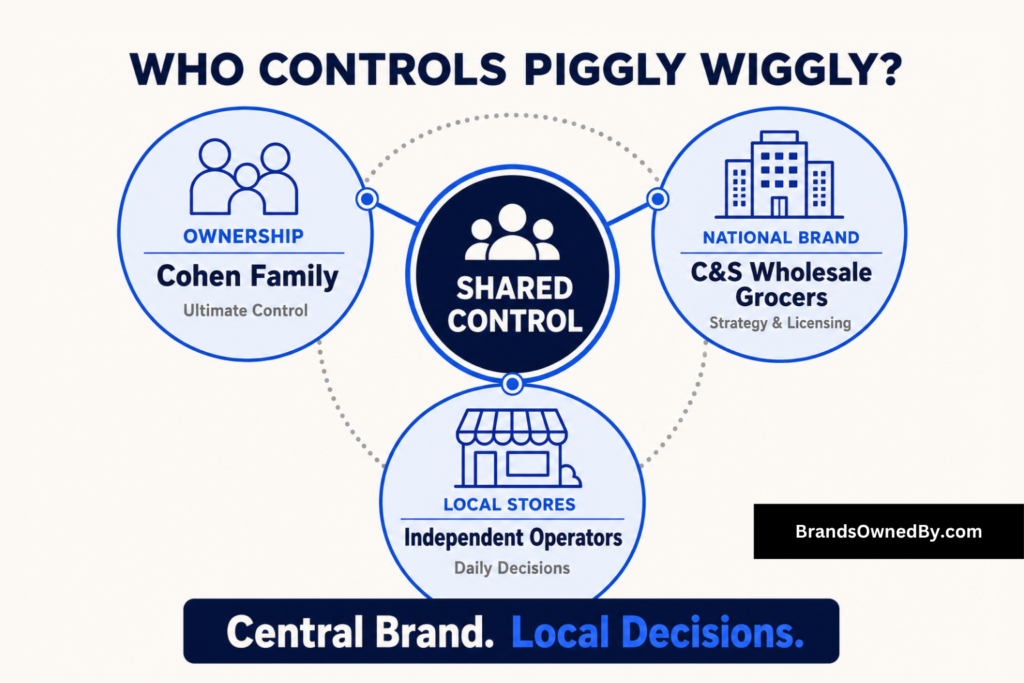
Piggly Wiggly does not have one executive controlling every store. Control is divided among the Cohen family, C&S Wholesale Grocers, Piggly Wiggly, LLC and independent store owners.
As of July 2026, the Cohen family holds ultimate ownership control through C&S Wholesale Grocers. C&S controls the national brand and licensing system. Independent retailers control the daily operations of many individual supermarkets.
The Cohen Family Holds Ultimate Ownership Control
The Cohen family is the ultimate controlling ownership group behind Piggly Wiggly.
The family controls C&S Wholesale Grocers, which owns Piggly Wiggly, LLC. C&S is privately held. It has no public shareholders or stock exchange listing.
The precise percentages owned by individual Cohen family members are not publicly disclosed. However, the family’s controlling position is well established.
Its authority includes major ownership-level decisions involving:
- Long-term corporate strategy.
- Major acquisitions and asset sales.
- Capital allocation.
- Board appointments.
- Executive succession.
- Expansion into new markets.
- Ownership of retail banners.
The Cohen family does not normally make routine decisions for every Piggly Wiggly supermarket. Its control operates through C&S’s board and executive leadership.
Rick Cohen Serves as Executive Chairman
Rick Cohen is the most influential individual owner connected with Piggly Wiggly. He serves as executive chairman of C&S Wholesale Grocers.
He represents the third generation of the Cohen family to lead C&S. His grandfather, Israel Cohen, established the company with Abraham Siegel in 1918.
Rick Cohen became C&S’s chief executive officer in 1989. He led its development into a major national grocery wholesaler and retail operator.
As executive chairman, Cohen focuses on ownership, governance and long-term corporate direction. He is not responsible for every operational decision. However, he remains influential when C&S considers acquisitions, leadership changes or major investments.
His position is different from that of a public-company chairman. C&S is family-controlled. Therefore, Cohen combines board-level influence with the authority that comes from private ownership.
C&S Wholesale Grocers Controls the National Business
C&S Wholesale Grocers is Piggly Wiggly’s parent company. It acquired the brand through the purchase of Fleming Companies assets in 2003.
C&S controls the corporate structure surrounding Piggly Wiggly. Its authority includes the national brand, licensing platform and selected retail operations.
The company can make decisions about:
- Who qualifies to operate under the Piggly Wiggly name.
- How the trademark may be used.
- National brand standards.
- Franchise and licensing agreements.
- Wholesale distribution relationships.
- Corporate-operated stores.
- Regional support operations.
- Strategic acquisitions and store conversions.
C&S also provides services such as grocery distribution, procurement, merchandising and retail support. Independent Piggly Wiggly operators may use some of these services.
The parent company does not exercise identical control over every location. Its authority depends on whether a store is corporate-operated or independently owned.
Eric Winn Controls Day-to-Day Parent-Company Operations
Eric Winn is the chief executive officer of C&S Wholesale Grocers. He became CEO in October 2023.
Winn is responsible for the parent company’s strategy, growth plan, customer relationships and daily operations. His responsibilities extend across C&S’s wholesale, supply-chain and retail businesses.
He is therefore the leading operating executive above Piggly Wiggly.
Winn can influence decisions involving distribution, corporate stores, technology, operational investment and relationships with independent retailers. He also oversees the execution of C&S’s broader growth strategy.
However, Winn is not publicly identified as a major owner of C&S or Piggly Wiggly. His authority comes from his executive position rather than a disclosed controlling equity stake.
Rick Cohen and the Cohen family retain ownership-level control. Winn manages the business within that governance structure.
Does Piggly Wiggly Have Its Own CEO?
Piggly Wiggly does not publicly identify a separate national CEO who controls the entire store network.
Calling Eric Winn the “CEO of Piggly Wiggly” is an oversimplification. He is the CEO of C&S Wholesale Grocers, the parent company.
This distinction matters because many Piggly Wiggly stores are independent businesses. A C&S executive cannot manage every local store in the same way that Walmart’s leadership controls Walmart locations.
Regional executives and local owners may manage different parts of the system. The responsible decision-maker therefore depends on the issue.
For a national trademark or licensing decision, authority sits with Piggly Wiggly, LLC and C&S. For a local hiring or inventory decision, authority may sit with the independent store owner.
Piggly Wiggly, LLC Controls the Brand
Piggly Wiggly, LLC is the corporate entity associated with the national supermarket brand.
Its central function is to manage the Piggly Wiggly identity and licensing system. It issues franchises or licenses to qualified independent grocery retailers.
The LLC can control:
- Use of the Piggly Wiggly name.
- Trademarked designs and brand elements.
- Franchise or licensing approvals.
- Contractual operating requirements.
- Brand presentation.
- Certain advertising and promotional programs.
- Compliance with licensing terms.
A local store cannot use the Piggly Wiggly name simply because its owner operates a grocery business. The retailer must have an appropriate agreement with the brand owner.
Piggly Wiggly, LLC can enforce contractual standards. It may also restrict unauthorized or inconsistent use of the brand.
This gives the company control over the identity displayed by stores. It does not necessarily give it ownership of the store property, inventory or local operating company.
Independent Owners Control Many Individual Stores
Independent retailers control many Piggly Wiggly supermarkets.
These operators may be local families, regional grocery companies or retailer groups. Some own one location. Others manage several stores.
An independent owner generally controls:
- Employee hiring and management.
- Store-level operating expenses.
- Local product selection.
- Permitted pricing decisions.
- Community partnerships.
- Store maintenance.
- Customer service practices.
- Local advertising.
- Property ownership or leasing.
The exact authority depends on the owner’s licensing, supply and regional agreements.
For example, an independent store may obtain most of its inventory from an approved distributor. It may participate in shared weekly promotions. However, it can still decide to carry products from local farms or regional food producers.
This local authority is one of Piggly Wiggly’s defining features. It also explains why store experiences can differ.
Corporate-Operated Stores Have More Centralized Control
C&S operates selected Piggly Wiggly stores through corporate affiliates. These locations are subject to more centralized control.
A C&S affiliate may own the store’s operating company or directly manage the location. It can control employment, inventory, pricing systems and capital improvements.
Corporate control may also cover:
- Store openings and closures.
- Property leases.
- Renovation budgets.
- Technology systems.
- Loyalty programs.
- Regional marketing.
- Financial performance targets.
Customers may not be able to tell whether a location is independently owned or operated by a C&S affiliate. Both can display the same Piggly Wiggly name.
The immediate legal owner must be identified through the individual store’s business records, employment documents or property information.
Regional Operations Provide Another Control Layer
Piggly Wiggly’s regional structure adds another level of management.
C&S acquired Piggly Wiggly Carolina’s support operations in 2014. It later acquired Piggly Wiggly Midwest in 2021.
These regional operations can coordinate distribution, marketing, technology and store support. They help connect the national brand with local supermarket operators.
Regional management may determine:
- Area-wide promotions.
- Distribution arrangements.
- Advertising materials.
- Technology support.
- Merchandising programs.
- Operational guidance.
- Relationships with independent retailers.
Regional control does not necessarily mean regional ownership of every store. Independent operators can participate in a regional system while retaining ownership of their businesses.
Who Controls Pricing at Piggly Wiggly?
There is no single national pricing authority for every Piggly Wiggly store.
Independent owners may set many of their prices based on wholesale costs, local competition and operating expenses. Regional promotions can influence advertised prices.
C&S may affect pricing indirectly through product distribution, purchasing terms and promotional programs. However, the final shelf price can differ between independently owned locations.
Corporate-operated stores are more likely to follow centralized or regional pricing systems.
This is why the same product may cost differently at two Piggly Wiggly supermarkets.
Who Controls Products and Inventory?
Product selection is also divided between central and local decision-makers.
C&S can supply national brands, private-label products and standard grocery categories. Regional organizations can coordinate purchasing and merchandising.
Independent operators may add products that appeal to local customers. These can include regional meat cuts, locally produced sauces, community bakery items and market-specific brands.
A store in Wisconsin may therefore carry a different product mix from one in Alabama or South Carolina.
This flexibility allows local adaptation. It also prevents Piggly Wiggly from offering the complete consistency found at centrally controlled chains such as Aldi.
Who Controls Store Openings and Closures?
The decision depends on who owns the location.
For an independently owned store, the local operator may decide to open, sell, relocate or close the business. The decision can be influenced by leases, profitability, competition and licensing obligations.
C&S controls decisions involving its corporate-operated locations. It can close underperforming stores, purchase additional locations or convert properties to another banner.
The brand owner also decides whether a new retailer can operate under the Piggly Wiggly name.
A store closure does not necessarily indicate that the national company ordered a broad market withdrawal. It may reflect the decision of one independent owner.
How the Decision-Making Structure Works
Piggly Wiggly’s control structure can be summarized in four levels:
- The Cohen family controls C&S at the ownership level.
- Rick Cohen and the C&S board provide governance and strategic oversight.
- Eric Winn and C&S executives manage parent-company operations.
- Independent owners manage many individual Piggly Wiggly stores.
Piggly Wiggly, LLC sits between the parent company and store network. It controls the national brand and administers licensing relationships.
This structure is more decentralized than the ownership models used by Walmart, Kroger, Aldi, Publix and Food Lion.
Brands Owned by Piggly Wiggly
Piggly Wiggly is primarily a grocery brand and licensing organization. It is not a diversified holding company with a large collection of subsidiaries.
There is no publicly disclosed portfolio of major companies directly owned by Piggly Wiggly, LLC. Instead, the brand operates through regional organizations, corporate stores and independent licensees.
Piggly Wiggly Midwest
Piggly Wiggly Midwest is a regional operation serving Wisconsin and surrounding markets. C&S acquired the business in 2021.
The operation includes support for Piggly Wiggly supermarkets in the region. Some stores may be corporate-operated, while others are independently owned.
Piggly Wiggly Midwest should be viewed as part of C&S’s Piggly Wiggly platform. It is not evidence that every store in the Midwest has the same legal owner.
Piggly Wiggly Carolina Operations
C&S acquired the support operations of Piggly Wiggly Carolina in 2014.
The deal covered functions such as branding, marketing, accounting, information technology and administrative services. Many Carolina stores remained in the hands of independent retailers.
This arrangement allowed local businesses to continue operating Piggly Wiggly supermarkets while C&S managed important brand and support functions.
Corporate-Operated Piggly Wiggly Stores
C&S owns or operates selected Piggly Wiggly locations through corporate affiliates. These stores are different from independently licensed supermarkets.
At a corporate location, a C&S affiliate may control employment, inventory, pricing systems and store-level investment. The parent organization takes on the operating risk and receives the store’s financial results.
The number of corporate locations may change as C&S buys, sells, opens or closes stores.
Independently Owned Piggly Wiggly Groups
Several regional companies operate multiple Piggly Wiggly stores. These companies are licensees rather than subsidiaries owned by the national brand.
Examples include family-run supermarket groups and retailers’ cooperatives in states such as Alabama, Georgia and Wisconsin.
JTM Corporation, for example, operates a regional group of Piggly Wiggly supermarkets. Fox Bros. also operates Piggly Wiggly stores in Wisconsin. These businesses use the Piggly Wiggly identity but retain their own operating ownership.
Piggly Wiggly Alabama Distributing Company is another important example. It is associated with independent retailers that coordinate distribution and support functions. It should not automatically be described as a wholly owned Piggly Wiggly subsidiary.
Brands Owned by C&S Wholesale Grocers
Piggly Wiggly does not own C&S’s other supermarket banners. The ownership relationship runs in the opposite direction. C&S owns or operates Piggly Wiggly alongside other retail banners.
C&S’s broader retail portfolio includes names such as Grand Union, Family Fare, Martin’s Super Markets and D&W Fresh Market. The portfolio expanded after C&S completed its acquisition of SpartanNash in 2025.
These companies and brands are corporate siblings of Piggly Wiggly within the C&S organization. They are not companies owned by Piggly Wiggly itself.
C&S also maintains private-label product portfolios. These products may be available in Piggly Wiggly stores and other supermarkets supplied by C&S. Product availability can vary by region and operator.
Final Thoughts
C&S Wholesale Grocers owns Piggly Wiggly through Piggly Wiggly, LLC. C&S is a privately held company controlled by the Cohen family. Rick Cohen serves as executive chairman, while Eric Winn manages the parent company as CEO.
That answer covers ownership of the national brand. It does not mean C&S owns every supermarket displaying the Piggly Wiggly name.
Most Piggly Wiggly stores are independently owned and operated under license. Local retailers control many everyday store decisions. Piggly Wiggly, LLC and C&S control the brand, licensing system and broader strategic relationship.
The result is a hybrid ownership model. It combines the purchasing and distribution capabilities of a large grocery organization with the flexibility of local supermarket ownership.
FAQs
Who owns Piggly Wiggly?
Piggly Wiggly, LLC owns the national grocery brand. The LLC is part of C&S Wholesale Grocers, a privately held grocery distribution and retail company.
Who is the largest shareholder of Piggly Wiggly?
Piggly Wiggly does not have publicly traded shares. Its parent company, C&S Wholesale Grocers, is controlled by the Cohen family. Exact family ownership percentages are not publicly disclosed.
Does C&S own every Piggly Wiggly store?
No. C&S owns the Piggly Wiggly brand and operates selected locations through its affiliates. Most stores are independently owned and operate under licensing agreements.
Is Piggly Wiggly a franchise?
Piggly Wiggly uses a franchise-style licensing system. Piggly Wiggly, LLC issues licenses to qualified independent grocery retailers. The legal terms can vary by operator and region.
Is Piggly Wiggly family-owned?
The national brand is owned by C&S Wholesale Grocers, which is controlled by the Cohen family. Many individual Piggly Wiggly supermarkets are also owned by local families or independent retail groups.
Who is the CEO of Piggly Wiggly?
Piggly Wiggly does not publicly identify a separate national CEO with authority over every independently owned store. Eric Winn is the CEO of C&S Wholesale Grocers, Piggly Wiggly’s parent company.
Who founded Piggly Wiggly?
Clarence Saunders founded Piggly Wiggly in Memphis, Tennessee, in 1916. He developed the self-service grocery format that influenced the modern supermarket industry.
Is Piggly Wiggly owned by Kroger?
No. Kroger does not own Piggly Wiggly. C&S Wholesale Grocers owns the Piggly Wiggly brand.
Is Piggly Wiggly owned by Walmart?
No. Piggly Wiggly is not owned by Walmart. The two operate under separate ownership structures.
Is Piggly Wiggly publicly traded?
No. Piggly Wiggly is not publicly traded and has no stock symbol. Its parent company, C&S Wholesale Grocers, is also privately held.
Why are Piggly Wiggly stores different from one another?
Many locations have different independent owners. Those operators can make local decisions about products, pricing, staffing, promotions and store design. Their licensing agreements still require them to follow applicable Piggly Wiggly brand standards.
Who owns Piggly Wiggly stores in Alabama?
Different independent companies and local grocery operators own Piggly Wiggly stores in Alabama. Some participate in cooperative distribution arrangements. The national Piggly Wiggly name remains controlled by Piggly Wiggly, LLC and C&S.
How many Piggly Wiggly stores are there?
The Piggly Wiggly system reports more than 500 stores across 18 states. The exact number changes as independent retailers open, close or convert locations.
What is Piggly Wiggly’s annual revenue?
Piggly Wiggly does not disclose audited standalone annual revenue. Estimates published by third parties may combine different corporate and independently owned operations. C&S Wholesale Grocers’ estimated revenue should not be treated as Piggly Wiggly’s revenue.
What is Piggly Wiggly’s net worth?
Piggly Wiggly’s net worth is not publicly disclosed. The company is private, and the financial information required to calculate a reliable standalone valuation is unavailable.
Does Piggly Wiggly own Grand Union?
No. Piggly Wiggly does not own Grand Union. Both banners are part of the broader C&S Wholesale Grocers organization.