

- Culver’s is controlled by the Culver family, which has retained majority ownership since the company’s founding in 1984. The family remains the controlling shareholder group as of July 2026.
- Roark Capital is Culver’s minority shareholder. Roark invested in Culver’s in 2017 and received board representation, but it did not acquire the company. The Culver family retained majority control.
- Culver’s is led operationally by CEO Julie Fussner. She oversees the corporate organization and its network of more than 1,000 restaurants, while the board and shareholders provide governance and ownership oversight.
- Individual Culver’s restaurants can have separate franchise owners. More than 670 owner-operators run restaurants under the Culver’s brand, but these franchisees do not own the parent company or control the Culver’s brand.
Culver’s is a privately held American restaurant chain known for ButterBurgers, Fresh Frozen Custard, Wisconsin cheese curds, and cooked-to-order meals. The company operates through a franchise system and has built its brand around Midwestern hospitality and owner-operated restaurants.
The chain started in Sauk City, Wisconsin, in 1984. It has since expanded well beyond its Wisconsin roots. Culver’s had reached the 1,000-restaurant milestone across 26 states, and the company continues to expand its footprint in 2026. Its restaurants are primarily located across the Midwest and other parts of the central and southern United States.
Culver’s differentiates itself through its combination of food and service. Its ButterBurgers are made with fresh, never-frozen beef. Its Fresh Frozen Custard is another major part of the brand identity. The menu also includes chicken, seafood, salads, soups, sides, desserts, and seasonal offerings.
The company continues to emphasize food prepared to order rather than relying entirely on the standardized speed-oriented model associated with traditional fast-food chains. For example, a customer ordering a ButterBurger can expect the burger to be prepared after the order rather than pulled from a pre-cooked holding line.
The franchise model is equally important to Culver’s identity. Individual owner-operators run restaurants within the company’s system. This gives local franchisees a direct role in restaurant operations and community relationships.
Culver’s is also investing in its digital customer experience. In late 2025, it introduced Delicious Rewards, its loyalty program. In 2026, the company is expanding the program with features designed around customer preferences and personalized offers.
The company is also continuing menu development in 2026. Its plans include new pub-style ButterBurgers, seasonal pumpkin desserts, new Flavors of the Day, and other menu items inspired by Wisconsin supper-club traditions. This shows how Culver’s is trying to modernize the menu without moving away from its core identity.
As of 2026, Culver’s officially describes its system as having 1,000 family-owned and operated restaurants across 26 states. The company continues to use the 1,000-location milestone in its corporate materials even as additional restaurants are being developed.
Who Founded Culver’s?
Culver’s was founded by Craig Culver, Lea Culver, George Culver, and Ruth Culver.
The four founders were members of the same family. Craig and Lea were married, while George and Ruth were Craig’s parents.
The first Culver’s restaurant opened on July 18, 1984, in Sauk City, Wisconsin. The family introduced the ButterBurger and Fresh Frozen Custard at the original restaurant. Those two products became the foundation of the brand and remain central to its menu more than four decades later.
The Culver family’s restaurant experience predates the creation of Culver’s. George and Ruth had operated restaurants before their son launched the Culver’s concept. In 1961, they purchased an A&W Root Beer property and later operated other restaurants and supper clubs in the Sauk County area.
That experience shaped the philosophy behind Culver’s. Ruth was known for hospitality and treating customers warmly. George focused heavily on food quality and kitchen operations. Their approach became part of the culture that Craig later carried into Culver’s.
A good example is George’s Chili. The recipe originated with Craig’s father and became a long-running Culver’s menu item. The story behind it illustrates how the company incorporated the family’s restaurant experience into the new brand.
Craig Culver
Craig Culver is the most prominent of the four Culver’s founders. He helped create the restaurant concept and played a major role in shaping the company’s food and service philosophy.
Craig grew up around the restaurant business. His parents operated restaurants and supper clubs in Wisconsin. He worked in the family business before gaining additional experience in the restaurant industry.
When Culver’s opened in 1984, Craig brought together several ideas from his earlier experience. The restaurant would serve high-quality food, prepare key menu items to order, and make customers feel welcome.
This emphasis on hospitality became one of the most important characteristics of the Culver’s brand.
Craig also played a major role in the company’s franchise expansion. Rather than treating franchisees simply as investors, Culver’s developed a model centered on active owner-operators. The company’s own history continues to emphasize the importance of owners being present and engaged in their restaurants.
Craig Culver remains an important figure in the company. He continues to serve as a co-founder and has remained involved in the brand’s leadership and culture.
Lea Culver
Lea Culver co-founded Culver’s alongside her husband, Craig.
She was part of the family team that launched the original restaurant in Sauk City. Her contribution was important during the company’s early development, when the business was still a local family restaurant rather than a national franchise system.
Lea was also closely associated with the hospitality philosophy that became central to Culver’s identity.
The company’s founders viewed restaurant service as more than simply delivering food. They wanted customers to feel welcomed. That approach remains part of Culver’s positioning today.
George Culver
George Culver was Craig’s father and one of the four founders of Culver’s.
He brought decades of restaurant experience to the business. George and Ruth had operated restaurants before Culver’s opened, giving the family practical experience in food preparation, hospitality, staffing, and restaurant management.
George’s influence is particularly visible in Culver’s food culture. His approach emphasized quality and avoiding shortcuts.
His chili recipe eventually became George’s Chili, which remains associated with the Culver’s menu. The company continues to tell the story of George’s approach to food quality as part of its brand history.
Ruth Culver
Ruth Culver was Craig’s mother and another co-founder of Culver’s.
She contributed extensive restaurant experience to the family business. Her approach focused strongly on hospitality and the way customers were treated.
That philosophy became one of the defining principles of Culver’s. The company continues to describe its restaurant culture in terms of welcoming guests and treating people like family.
This is important when examining who owns Culver’s today. The company’s current ownership structure is not completely disconnected from its origins. The family values established by George, Ruth, Craig, and Lea remain part of the company’s operating philosophy.
Ownership History
Culver’s has remained closely connected to the Culver family since the first restaurant opened in 1984. The company began as a family-run restaurant in Sauk City, Wisconsin, and gradually developed into a national franchise system.
The ownership history is important because Culver’s has expanded significantly without becoming a publicly traded company or being fully acquired by an outside corporation.
Culver’s Ownership History
From a Wisconsin family restaurant to a national franchise.
Culver’s Founded
Craig, Lea, George & Ruth Culver open the first restaurant in Wisconsin.
Franchising Begins
Culver Franchising System is established.
First Franchise
The first successful franchised restaurant opens in Baraboo, Wisconsin.
National Expansion
Culver’s expands beyond Wisconsin through franchise ownership.
Roark Capital Invests
Roark Capital becomes a minority investment partner.
Family Control Continues
Culver’s remains privately held as the family retains majority ownership.
Leadership Transition
Julie Fussner becomes CEO as the company enters its next growth phase.
Family-Controlled Today
Culver’s remains privately held with the Culver family retaining majority ownership.
CURRENT OWNERSHIP1984: Culver’s Begins as a Family Business
Culver’s was founded by Craig Culver, his wife Lea, and his parents, George and Ruth Culver. The family opened the first Culver’s restaurant in Sauk City, Wisconsin, on July 18, 1984.
The founders already had extensive experience in the restaurant industry. George and Ruth had operated restaurants before Culver’s was established. Craig also gained restaurant experience while working in the family business and elsewhere in the industry.
The original restaurant introduced the concept that would become the foundation of the Culver’s brand. It combined ButterBurgers, Fresh Frozen Custard, and a strong focus on hospitality.
The business initially operated as a family enterprise. The Culvers were directly involved in developing the restaurant concept, managing operations, and establishing the service standards that later became part of the franchise system.
1987: Culver Franchising System Is Established
Culver’s began formalizing its franchise operation in 1987 with the establishment of Culver Franchising System.
This marked an important stage in the company’s ownership history. Culver’s could now expand through independent franchise operators rather than relying exclusively on restaurants owned and operated by the founding family.
The franchise model allowed individual entrepreneurs to own and operate Culver’s restaurants while the corporate company retained ownership of the brand and franchise system.
This distinction remains important today. A person who owns a Culver’s restaurant does not necessarily own Culver Franchising System or the overall Culver’s brand.
1990: Franchise Expansion Begins
Culver’s opened its first successful franchised restaurant in Baraboo, Wisconsin, in 1990.
Franchising became the primary mechanism for expanding the brand. The company sought franchise operators who would be actively involved in their restaurants and who could maintain the service standards established by the founding family.
This approach allowed Culver’s to grow while preserving a relatively local feel at individual restaurants.
Over time, more franchisees became independent owners within the Culver’s system. The corporate business remained privately held, while individual restaurants were increasingly owned and operated by franchisees.
1990s and 2000s: Expansion Beyond Wisconsin
Culver’s gradually expanded outside Wisconsin during the 1990s and 2000s.
The company first established a strong presence throughout the Midwest. It later entered additional U.S. markets as the franchise network expanded.
The ownership model remained consistent during this period. The Culver family continued to own the corporate business, while franchise operators owned and operated individual locations.
This structure allowed the company to grow without requiring the Culver family to directly finance and operate every new restaurant.
The family also continued to play an important role in the company’s culture. Craig Culver remained closely associated with the brand and its emphasis on hospitality, food quality, and franchisee relationships.
2017: Roark Capital Invests in Culver’s
The biggest change in Culver’s ownership history occurred in 2017.
Culver Franchising System announced that affiliates of Roark Capital had acquired an interest in the company. Roark is a private equity firm known for investing in franchise and restaurant businesses.
The transaction was structured as a minority investment rather than an outright acquisition.
This distinction is critical. The Culver family did not sell the entire company to Roark Capital. The family retained majority ownership and continued to have an important role in the business.
The transaction was connected to the family’s long-term succession and estate-planning considerations. It provided an opportunity to bring an experienced investment partner into the business while allowing Culver’s to remain privately held.
Roark’s investment also gave Culver’s access to a partner with experience in franchise-based businesses. This was particularly relevant as the company continued expanding its restaurant network.
2017–2024: Family Ownership Continues
Following the Roark Capital transaction, Culver’s continued operating as a privately held company.
The investment did not fundamentally change the company’s franchise structure. Individual franchisees continued owning and operating restaurants under the Culver’s brand.
The Culver family also remained involved in the company. Craig Culver continued to serve as an important figure within the business and remained associated with the brand’s culture and development.
During this period, Culver’s continued expanding its footprint across the United States. The company grew from its strong Midwestern base into additional markets while maintaining its franchise-focused operating model.
2025–2026: Leadership Evolves While Ownership Remains Family Controlled
Culver’s experienced an important leadership transition in 2025 when Julie Fussner became CEO.
Fussner joined Culver’s in 2017 and previously served as the company’s first chief marketing officer. Her appointment represented a change in executive management rather than a change in ownership.
The distinction is important when examining Culver’s current structure. A new CEO does not mean the company was sold or that the Culver family relinquished ownership.
Craig Culver remains closely associated with the business and continues to represent the founding family’s connection to the brand.
By 2026, Culver’s had grown into a national restaurant chain with more than 1,000 locations while continuing to operate as a privately held business.
Culver’s Ownership Today
As of July 2026, Culver’s remains a privately held company with the Culver family retaining majority ownership.
Roark Capital remains an outside investment partner following its minority investment in 2017. There has been no publicly announced transaction indicating that Roark has acquired Culver’s outright or that the Culver family has sold its controlling position.
The company’s restaurant network also includes independently owned franchise locations. These franchisees own their individual businesses and operate them under agreements with Culver Franchising System.
Therefore, Culver’s ownership history can be viewed as a progression from family-owned restaurant → family-owned franchise company → national franchise system with an outside minority investment partner.
The fundamental ownership philosophy has remained consistent despite the company’s growth. Culver’s has expanded nationally while preserving its private ownership structure and the founding family’s connection to the brand.
Who Owns Culver’s?
As of July 2026, Culver’s ownership structure is anchored by two disclosed corporate stakeholders: the Culver family and Roark Capital. The Culver family remains the controlling ownership group, while Roark Capital is the outside investor that bought a minority interest in 2017.
It did not publicly disclose the exact transaction terms, so the precise percentage split is not available in public records. What is clearly disclosed is that the Culver family kept majority ownership and Roark received a minority stake with board involvement.
![Who Owns Culver's [infographic]](https://brandsownedby.com/wp-content/uploads/2026/07/Who-Owns-Culvers-infographic-683x1024.png)
The Culver Family
The Culver family is the founding and controlling shareholder group behind Culver’s. Craig, Lea, George, and Ruth Culver opened the first restaurant in Sauk City, Wisconsin, in 1984, and the business has grown from that family launch into a nationwide restaurant system. The family’s role is not symbolic. It is the central ownership block that has kept Culver’s aligned with its original operating philosophy of cooked-to-order food, hospitality, and franchise-led growth.
The strongest public statement on family control came with the 2017 ownership transaction. At that time, the company said the Culver family would maintain majority ownership and that the family had been working through ownership succession planning while aiming to remain family-owned and privately held.
That is the key fact that still defines the shareholder structure in July 2026. Craig Culver was identified in that announcement as company co-founder and board chairman, which shows that the family’s influence extended beyond ownership into governance as well.
The family’s continued control also helps explain Culver’s long-term consistency. The company still markets itself around its original identity: ButterBurgers, Fresh Frozen Custard, Wisconsin cheese curds, and guest-first service. That continuity matters because it shows the ownership group has protected the brand’s core positioning while the restaurant base expanded beyond Wisconsin. Culver’s now describes its system as more than 1,000 family-owned and operated restaurants across 26 states.
Roark Capital Group
Roark Capital is the outside shareholder in Culver’s corporate ownership structure. In October 2017, affiliates of Roark acquired a minority interest in the company. The official announcement made two things explicit: the Culver family would keep majority ownership, and the terms of the transaction would not be disclosed publicly. Roark’s entry therefore changed the capital structure, but it did not replace family control.
Roark’s role is best understood as that of a strategic financial partner rather than a controlling owner. Roark specializes in franchise and multi-unit businesses, which makes it a natural investor for a company like Culver’s. Its portfolio page still lists Culver’s as one of its current investments in 2026, confirming that the relationship remains active.
What Roark adds is scale support, capital discipline, and experience with franchised brands. That matters for a restaurant system that continues to grow while keeping a strong owner-operator model. In practical terms, Roark sits behind the balance sheet and governance structure, while the Culver family remains the ownership anchor. The available public facts support that distinction clearly.
Franchise Owner-Operators
Culver’s restaurant network also includes a large base of franchise owner-operators. In 2025, the company said Julie Fussner would lead more than 670 owner-operators and 45,000 team members across 26 states. That number is important because it shows how much of the brand’s footprint is run through local owners rather than corporate store management.
These owner-operators are not the corporate shareholders of Culver’s. They own and operate individual restaurants under franchise agreements. That means they control a local business, but they do not own the parent company or the brand itself. This is a common point of confusion, especially for readers who see a local Culver’s and assume the restaurant owner is part of the corporate equity structure.
The franchise model is one reason Culver’s has been able to expand while maintaining a neighborhood-style feel. A local operator can tailor staffing, community engagement, and execution at the store level, while the parent company keeps brand standards, menu direction, and system-level consistency in place. That structure is central to understanding how ownership and operations differ at Culver’s.
How Control Works Today
The current ownership picture is simple in principle, even if the exact percentage split is not public. The Culver family is the controlling shareholder group. Roark Capital is the minority investor. Franchise owners run individual restaurants. Julie Fussner, who became CEO in 2025, manages day-to-day company leadership, but that role change did not alter ownership.
That structure gives Culver’s a stable governance model. The family keeps long-term ownership continuity. Roark provides outside investment support. Franchise owners execute the concept in local markets. For a restaurant brand built on consistency, hospitality, and guest loyalty, that combination has been a durable ownership model through July 2026.
Competitor Ownership Comparison
As of July 2026, Culver’s can be understood best by comparing it with burger chains that use very different ownership models. Some are still family-controlled. Some are public companies. Some sit inside a larger parent company. Others are backed by private equity. That mix matters because ownership usually shapes how aggressively a brand expands, how much control founders keep, and how tightly the company protects its original identity.
Who Owns the Burger Brands
Clean visual comparison of ownership models. Family control. Public markets. Parent-company ownership. Private equity.
fully controlled
+ Roark stake
franchise scale
owned
portfolio model
shareholders
Culver’s sits between family control and outside capital. Exact equity splits are not public.
In-N-Out Burger: Family-Owned and Fully Controlled
In-N-Out is the clearest family-owned comparator. The company says it has been a family-owned business since 1948, that it is still owned and operated by the Snyder family, and that none of its restaurants are franchised.
Its 2026 materials also say the company is now guided by Harry and Esther Snyder’s granddaughter, Lynsi Snyder. That makes In-N-Out one of the purest examples of direct family control in the burger category.
That ownership structure shows up in the way the brand grows. In-N-Out expands slowly, keeps a narrow footprint, and protects its operating model very tightly. For a reader comparing Culver’s to its rivals, In-N-Out is the best example of a brand that treats ownership as a tool for control rather than a vehicle for aggressive scaling.
Five Guys: Family Business with Franchise Expansion
Five Guys is also strongly family-centered, but it uses a more franchise-heavy growth model than In-N-Out. The company’s own story says Jerry and Janie Murrell started the business with their sons in 1986, and Five Guys’ 2026 story materials say the Murrell family opened a small carry-out burger joint in Arlington and later expanded the concept. The company’s franchise page says Five Guys now operates more than 1,900 restaurants worldwide, and its FAQs state that it is privately owned and does not currently plan to go public.
This makes Five Guys a useful comparison point for Culver’s because both brands combine family identity with scale. The difference is in execution. Five Guys has grown more globally and leans heavily on franchising, while still presenting itself as a family business built on the Murrell family story. That makes it closer to Culver’s than to a public-chain model, but still different from In-N-Out’s no-franchise approach.
Wendy’s: Public Shareholder Ownership
Wendy’s is a completely different ownership case. The Wendy’s Company is publicly traded on Nasdaq under the ticker WEN, and the company says Wendy’s and its franchisees operate more than 7,000 restaurants worldwide. That means the business answers to public shareholders rather than a founding family or a single outside owner.
The current ownership story is also shaped by activist investors. Reuters reported in May 2026 that Nelson Peltz held a 16.24% personal stake and that Trian Fund Management held a 7.85% stake, while exploring a potential take-private bid. That puts Wendy’s in the classic public-company plus activist-investor category, where ownership is dispersed but still influenced by large institutional holders.
For ownership comparison purposes, Wendy’s matters because it shows the opposite of family control. Strategic decisions are made through a public-market governance structure, not through a single family’s long-term control of the business.
Shake Shack: Public Company with Board-Led Governance
Shake Shack is also a public company. Its investor relations page identifies the business and its corporate governance page shows a board-led structure. Its July 2026 investor relations materials also identify the company as NYSE: SHAK and show executive leadership handling quarterly reporting and investor communication.
That matters because Shake Shack is run for public investors, not for a founding family or a private sponsor. The company’s ownership is spread across shareholders in the public market, while the board and executive team manage strategy and operations. Compared with Culver’s, this is a much more market-driven model.
Shake Shack is a useful peer because it shows how a fast-casual burger brand can scale with public capital. The trade-off is that it must balance growth, margins, and shareholder expectations in a way that private or family-controlled competitors do not.
Burger King: Brand Ownership Inside a Parent Company
Burger King does not sit on its own at the ownership level. Restaurant Brands International owns Burger King along with Tim Hortons, Popeyes, and Firehouse Subs. RBI is one of the world’s largest quick-service restaurant companies, with over 32,000 restaurants in more than 120 countries and territories.
This is a different kind of ownership entirely. Burger King is a brand inside a holding company, so strategic decisions are influenced by a broader portfolio structure rather than by a single brand-led ownership group. That is a major contrast with Culver’s, which is judged more as a standalone restaurant system than as one brand inside a multi-brand conglomerate.
Burger King is therefore a good example of portfolio ownership. It has scale, global reach, and a large parent company behind it, but it does not have the same family-rooted governance identity that shapes Culver’s.
Freddy’s: Private-Equity-Owned Growth Brand
Freddy’s is the clearest private-equity comparator. In September 2025, investment funds affiliated with Rhône acquired Freddy’s from Thompson Street Capital Partners. The seller’s announcement said the brand had more than 550 locations in the U.S. at the time of the transaction.
That makes Freddy’s a useful contrast with Culver’s because it shows the PE-backed ownership path that many restaurant chains take after founder-led growth. Private equity typically looks for a combination of franchise economics, unit growth, and operational consistency. Freddy’s fits that pattern closely.
The practical effect is that Freddy’s ownership is more investor-driven than family-driven. That can accelerate expansion, but it can also change the pressure points around returns, brand strategy, and operational priorities.
What This Means for Culver’s
Taken together, these competitors show four very different ownership models. In-N-Out represents full family control. Five Guys represents a family business that has scaled with franchising. Wendy’s and Shake Shack represent public shareholder ownership. Burger King represents brand ownership inside a larger parent company. Freddy’s represents private-equity ownership.
That comparison is useful because it shows where Culver’s sits in the market. It is closer to the family-controlled and family-influenced end of the spectrum than to the fully public or heavily conglomerate-owned end. In practical terms, that usually means more emphasis on continuity, franchise discipline, and brand consistency.
Who Controls Culver’s?
Culver’s control structure in July 2026 has three clear layers. At the top is the Culver family, which kept majority ownership when Roark Capital entered the business. Next is Roark Capital, which holds a minority interest and has board representation. Below that is the executive team, led by Julie Fussner, which runs the business day-to-day.
Separate from all of that is the franchise system, where more than 670 owner-operators run individual restaurants under the Culver’s brand. The company’s public records make this distinction clear: ownership, governance, and restaurant operations are related, but they are not the same thing.
The Culver Family Controls the Ownership Layer
The Culver family is still the controlling ownership group. In the company’s 2017 transaction announcement, Culver’s said the family would maintain majority ownership after Roark’s investment. That same release described the deal as part of the family’s succession planning, with Craig Culver saying the goal was to remain a family-owned business and stay privately held. The family’s role is therefore not just historical. It remains the main ownership anchor behind the company’s direction.
That matters because Culver’s has grown from a single Wisconsin restaurant into a large multi-state chain without shifting into public ownership or handing control to a parent conglomerate. The founding family still sits at the center of the company’s identity, and the brand continues to emphasize its Midwestern roots, hospitality, and made-to-order positioning. Culver’s current site still frames the business as a national franchise built from one Wisconsin restaurant, which is consistent with family-led control rather than market-led ownership.
Roark Capital Has Influence, Not Control
Roark Capital is the outside investor, but the public record does not support treating it as the controller of Culver’s. The 2017 announcement was explicit that Roark acquired a minority interest, not the whole company. It also said the Culver family would keep majority ownership and that no additional shares were planned to be sold at that time. That is the most concrete disclosure available about the ownership split.
Roark’s influence comes from two places. First, it is a financial stakeholder in the corporate structure. Second, the 2017 agreement gave Roark representation on Culver’s board of directors. That means Roark has governance participation, but not full control. Roark’s own portfolio page in 2026 still lists Culver’s as one of its current investments, which confirms the relationship remains active.
Roark is also a particularly relevant partner for Culver’s because its investment model focuses on franchised and multi-unit businesses. Roark’s own materials say it specializes in franchise and multi-unit brands, and its role is that of a value-added board-level partner that provides capital and insight while management runs the business. That description matches Culver’s structure closely.
Julie Fussner Runs Day-to-Day Corporate Leadership
The current CEO is Julie Fussner. Culver’s announced her appointment on April 28, 2025, and described her as the brand’s fifth CEO and first woman in the role. The company said she would lead the system’s more than 670 owner-operators and 45,000 team members across 26 states. Fussner joined Culver’s in 2017 as vice president of marketing, later became the company’s first chief marketing officer, and then moved into the chief executive role.
That background matters because it shows how Culver’s executive leadership is built around internal continuity. Fussner was not brought in as a generic turnaround executive. She grew inside the brand, worked on marketing and guest experience, and then moved into the top job. The 2025 announcement also quoted co-founder Craig Culver as saying she brought vision, business expertise, and a strong fit with Culver’s culture. That suggests the board and ownership group wanted a leader who could protect the brand’s identity while managing growth.
Jim Esposito Oversees Operations and Growth Execution
Below the CEO, the company’s operational layer is led by Jim Esposito, who joined as chief operating officer in 2022. Culver’s said he would oversee restaurant operations, innovation, new restaurant growth, and design strategy. His background is important because it came from major restaurant brands, including BurgerFi, Wendy’s, Burger King, and Panera Bread. That means the company has a seasoned operator handling system execution, not just a brand marketer at the top.
For governance purposes, this creates a clear division of labor. Julie Fussner sets overall company direction and brand leadership. Jim Esposito manages execution in the field, including operating standards and growth. In a franchise system like Culver’s, that separation is important because system performance depends on keeping hundreds of owner-operated restaurants aligned on operations, quality, and expansion discipline.
Brad O’Bryan Handles the Financial Control Layer
Culver’s added another important executive in 2024 when it hired Brad O’Bryan as chief financial officer. The company said he brought more than 30 years of industry experience and had most recently served as CFO of Great Wolf Resorts. His role matters because CFO control is a major part of governance in any franchised restaurant system. The CFO sits at the center of capital allocation, financial planning, and reporting discipline.
That makes the current leadership structure more complete. Culver’s is not run through one founder making every call. It has a CEO focused on brand and organizational leadership, a COO focused on restaurant execution and growth, and a CFO focused on financial control. That is the practical management structure underneath the family ownership layer.
Craig Culver Still Anchors the Governance Story
Craig Culver remains the most important founding figure in the governance story. In the 2017 transaction announcement, he was identified as company co-founder and board chairman, and the company said he would continue in that role. That same announcement said the management team would remain in place, which shows that the ownership transition to Roark was designed to preserve continuity rather than reset control.
His role matters because he represents continuity between founding family ownership and modern corporate leadership. Even as day-to-day management has been handed to professional executives, the company’s public messaging still ties the brand back to the founding family’s standards and values. That is one reason Culver’s can grow without losing the identity that made it successful in the first place.
Franchise Owner-Operators Control the Restaurants
Culver’s restaurant system is built on owner-operators, and that is a separate layer from corporate control. The company’s 2025 CEO announcement said Julie Fussner would lead more than 670 owner-operators. Culver’s public materials also describe the system as more than 1,000 family-owned and operated restaurants across 26 states. These operators own and manage individual restaurants, but they do not control the corporate parent or the Culver’s brand at the ownership level.
This is a crucial distinction. A franchisee can own a local Culver’s restaurant and still have no equity claim in the parent company. The local business is real ownership, but it is not the same as the company’s shareholder structure. That is why the governance question has to separate restaurant ownership from corporate control.
How Governance Works in Practice
In practice, Culver’s governance works like a layered system. The Culver family controls the ownership direction. Roark Capital participates as a minority investor and board stakeholder. The CEO and executive team run daily corporate operations. The COO handles restaurant execution and growth. The CFO handles financial discipline. Franchise owner-operators run the individual restaurants.
That structure gives Culver’s a balance that many restaurant chains do not have. It keeps control close to the founding family, but it also brings in professional management and outside capital. Roark’s own philosophy says it works best through close partnership with management and a value-added board, while leaving execution to company leaders. Culver’s current structure fits that model well.
Culver’s Annual Revenue and Net Worth
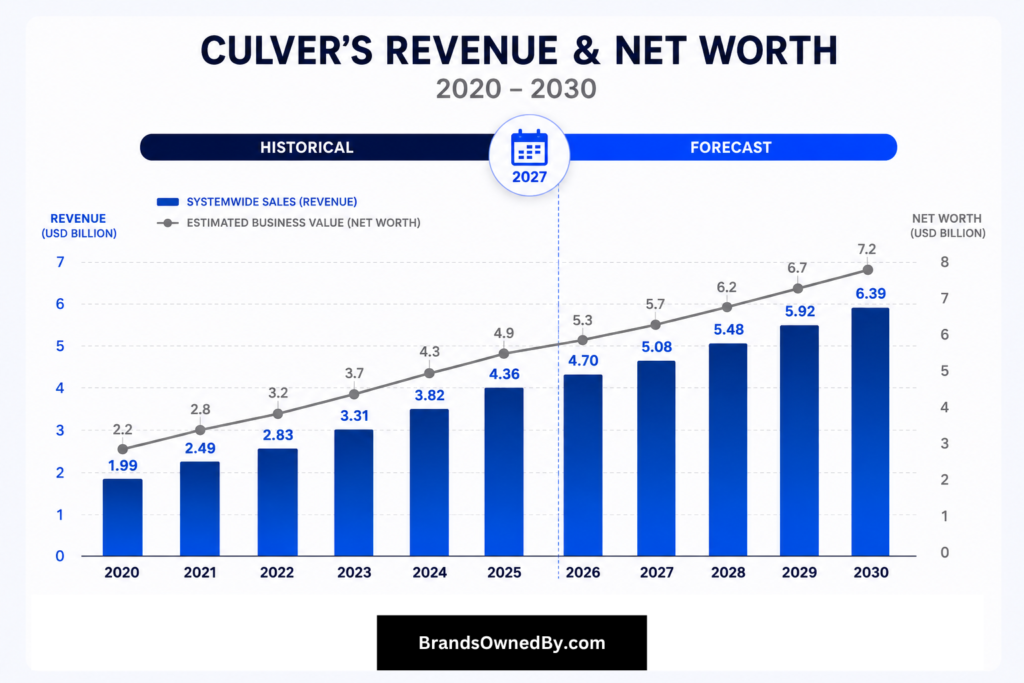
As of July 2026, Culver’s generates approximately $4.6 billion in annual U.S. systemwide sales. The corporate franchisor is much smaller on an accounting basis. It reported $337.7 million in operating revenue in 2025 and is estimated to generate roughly $365 million in corporate revenue in 2026.
Culver’s does not disclose an official company valuation or net worth. Based on its sales, profitability, franchise network, restaurant-level economics, and growth, its estimated 2026 business value is approximately $5.5 billion to $6.5 billion. This is an analytical estimate, not a disclosed transaction value.
Culver’s 2026 Revenue
The most relevant measure of Culver’s overall size is systemwide sales. These represent the combined sales generated by restaurants across the franchise network.
Culver’s generated approximately $4.36 billion in U.S. systemwide sales in 2025. That was up from approximately $3.82 billion in 2024, representing growth of about 14%.
For 2026, systemwide sales are estimated at approximately $4.6 billion. This estimate reflects continued restaurant expansion, strong average unit volumes, and positive customer traffic.
Culver’s entered 2026 with approximately 1,066 restaurants across 26 states. Its latest franchise disclosure data also showed approximately $4.14 million in average annual gross sales among qualifying franchised restaurants, with median sales of approximately $4.04 million.
Those numbers demonstrate that growth is coming from both a larger restaurant network and strong sales per location.
Corporate Revenue vs. Restaurant Sales
Culver’s systemwide sales should not be confused with the revenue reported by Culver Franchising System.
The corporate franchisor reported $337.7 million in operating revenue in 2025, compared with $298.6 million in 2024. That represents approximately 13.1% growth.
Franchise revenue accounted for $305.6 million of the 2025 total. It represented approximately 90.5% of operating revenue. Company-operated restaurant sales contributed approximately $32.1 million.
This difference exists because most Culver’s restaurants are operated by franchisees. Customers may collectively spend more than $4 billion across the system, but the franchisor records only its contractual franchise, royalty, advertising, and related revenue.
For 2026, corporate operating revenue is estimated at approximately $365 million, while systemwide restaurant sales are estimated at approximately $4.6 billion.
Culver’s 2025 Profitability
Culver’s financial results show that the business is not simply growing revenue. Its corporate earnings are also increasing.
Operating income increased from $102.2 million in 2024 to $121.6 million in 2025, a rise of approximately 19%.
Net income increased from $104.2 million to $125.6 million, representing approximately 20.6% growth.
The faster increase in profit compared with operating revenue indicates strong operating leverage in the franchising model.
Franchise revenue is particularly valuable because the franchisor does not have to fund the full construction and operating costs of every restaurant. Franchisees provide most of the capital for their locations while Culver’s earns recurring revenue from the system.
Culver’s Revenue Growth Since 2020
Culver’s has more than doubled its systemwide sales since 2020.
U.S. systemwide sales were approximately $1.99 billion in 2020. They increased to $2.49 billion in 2021, $2.83 billion in 2022, $3.31 billion in 2023, $3.82 billion in 2024, and approximately $4.36 billion in 2025.
That represents approximately 119% growth from 2020 through 2025.
The longer-term growth rate is also notable. Compared with 2019, Culver’s U.S. sales increased approximately 143% through 2025, according to industry sales data.
This performance has allowed Culver’s to move well beyond its traditional Midwestern footprint and become one of the largest regional burger chains in the United States.
Culver’s 2026 Net Worth
Its 2025 financial statements reported approximately $83.2 million in ending member’s equity. However, this is an accounting figure for the corporate entity and should not be treated as the value of the entire Culver’s brand.
The economic value of the overall system is considerably larger because the corporate balance sheet does not capture the full value of independently owned franchise restaurants, future franchise royalties, brand equity, and the earnings potential of the network.
Estimated Culver’s Business Value in 2026
A reasonable estimate places Culver’s 2026 business value at approximately $5.5 billion to $6.5 billion, with a midpoint of roughly $6 billion.
This estimate reflects several measurable factors. Culver’s has approximately 1,066 restaurants, systemwide sales of roughly $4.6 billion, average franchised restaurant sales above $4 million, and corporate net income of $125.6 million in 2025.
The estimate should not be presented as an official net worth. The actual value could only be established through a private transaction, formal valuation, or another disclosed equity event.
Culver’s Revenue Forecast Through 2030
Culver’s has not published official revenue guidance through 2030. The following forecast assumes approximately 7% annual growth in systemwide sales. This is more conservative than the company’s historical growth rate and reflects the expectation that percentage growth will moderate as the restaurant base becomes larger.
- 2027: Approximately $4.92 billion in systemwide sales.
- 2028: Approximately $5.26 billion.
- 2029: Approximately $5.63 billion.
- 2030: Approximately $6.02 billion.
Under this scenario, Culver’s would add approximately $1.4 billion in annual systemwide sales between 2026 and 2030.
What Could Drive Culver’s Growth?
Restaurant expansion remains the biggest long-term growth driver. Culver’s already has more than 1,000 locations but operates in only 26 states, leaving substantial room for geographic expansion.
Its unit economics are another advantage. Average annual gross sales of approximately $4.14 million give franchise operators a strong sales base and make new locations attractive when development costs can be controlled.
Customer traffic is also supporting the business. Culver’s CEO Julie Fussner said in 2026 that traffic was approximately 5% higher than the previous year. If that momentum continues alongside new restaurant openings, systemwide sales could exceed the base forecast.
Brands Owned by Culver’s
As of July 2026, Culver’s has a focused single-brand corporate structure. It has not built a portfolio of separate restaurant chains through acquisitions. Its business is centered on the Culver’s brand and the corporate entities that support its franchising and restaurant operations.
Culver’s
Culver’s is the primary restaurant brand owned and operated through the Culver’s corporate system. Founded in 1984 in Sauk City, Wisconsin, the chain was established by Craig and Lea Culver and Craig’s parents, George and Ruth Culver.
The brand is known primarily for its ButterBurgers, frozen custard, cheese curds, and Wisconsin-inspired menu. Its growth has been driven largely by franchising rather than acquisitions.
As of July 2026, Culver’s has approximately 1,066 restaurants across 26 states. The vast majority are operated by independent franchise owners under the Culver’s system.
Culver’s remains the company’s only major consumer-facing restaurant brand. Unlike restaurant groups that own multiple concepts, Culver’s has concentrated its expansion on increasing the size and reach of this single brand.
Culver Franchising System, Inc.
Culver Franchising System, Inc. is the principal corporate and franchising entity behind the Culver’s brand.
It manages the franchise system and provides the infrastructure required to operate a large restaurant network. Its responsibilities include franchise development, restaurant standards, training, marketing, operational support, and brand management.
The entity also records the majority of Culver’s corporate revenue. In 2025, it reported approximately $337.7 million in operating revenue, compared with roughly $4.36 billion in systemwide restaurant sales across the Culver’s network.
The difference exists because franchisees generally own and operate their individual restaurants. Culver Franchising System earns franchise-related revenue rather than recording the entire sales volume of every independently owned restaurant as its own revenue.
Culver’s Company-Operated Restaurants
Culver’s also operates a limited number of company-owned restaurants. These locations are directly operated within the corporate system rather than being owned by independent franchisees.
Company-operated restaurants give Culver’s direct experience with restaurant operations. They can also serve as testing grounds for operational procedures, menu initiatives, training practices, and customer-experience improvements before those practices are introduced across the wider franchise network.
These restaurants are part of the Culver’s brand rather than a separate brand or company.
Conclusion
Culver’s is owned primarily by Roark Capital Group, while the Culver family continues to hold a meaningful ownership stake and remains actively involved in the business. This combination of private equity investment and family leadership has allowed the company to expand nationwide without losing the customer-focused culture established when the first restaurant opened in Wisconsin. Today, Culver’s remains one of America’s strongest privately owned restaurant franchises and continues to grow through a disciplined franchise model.
FAQs
Who founded Culver’s restaurant?
Culver’s was founded by Craig Culver, Lea Culver, George Culver, and Ruth Culver. Craig and Lea Culver were married, while George and Ruth were Craig’s parents. Together, the family opened the first Culver’s restaurant in Sauk City, Wisconsin, in 1984. The family introduced the ButterBurger and Fresh Frozen Custard concept that became the foundation of the chain.
Where is the original Culver’s?
The original Culver’s is in Sauk City, Wisconsin, the hometown of the Culver family. The restaurant opened there on July 18, 1984, under the original name Culver’s Frozen Custard and ButterBurgers.
Where did Culver’s originate?
Culver’s originated in Sauk City, Wisconsin. Craig and Lea Culver and Craig’s parents, George and Ruth, chose their hometown for the first restaurant. The concept was rooted in Wisconsin food traditions, particularly fresh frozen custard and ButterBurgers.
Where was Culver’s founded?
Culver’s was founded in Sauk City, Wisconsin, in 1984. The first restaurant opened on July 18, 1984. The chain remained closely associated with its Wisconsin roots even as it expanded across the United States.
Is Culver’s family owned?
Yes. Culver’s remains family-controlled. The Culver family retained majority ownership when Roark Capital acquired a minority interest in the company in 2017. Roark is an outside investor and does not own Culver’s outright. Individual Culver’s restaurants can also be owned by independent franchise operators, but that is separate from ownership of the overall Culver’s company.
When was Culver founded?
Culver’s was founded in 1984. The first restaurant opened on July 18, 1984, in Sauk City, Wisconsin. The company later began franchising, with its first franchise location opening in Baraboo, Wisconsin, in 1990.
Is the original Culver’s still open?
Yes. The original Culver’s location in Sauk City, Wisconsin, remains open. It continues to operate as a Culver’s restaurant more than four decades after the family opened the first location in 1984. The restaurant has also become an important part of the brand’s history, including the story of its first guest, Jim Olson, who visited before the official opening.