
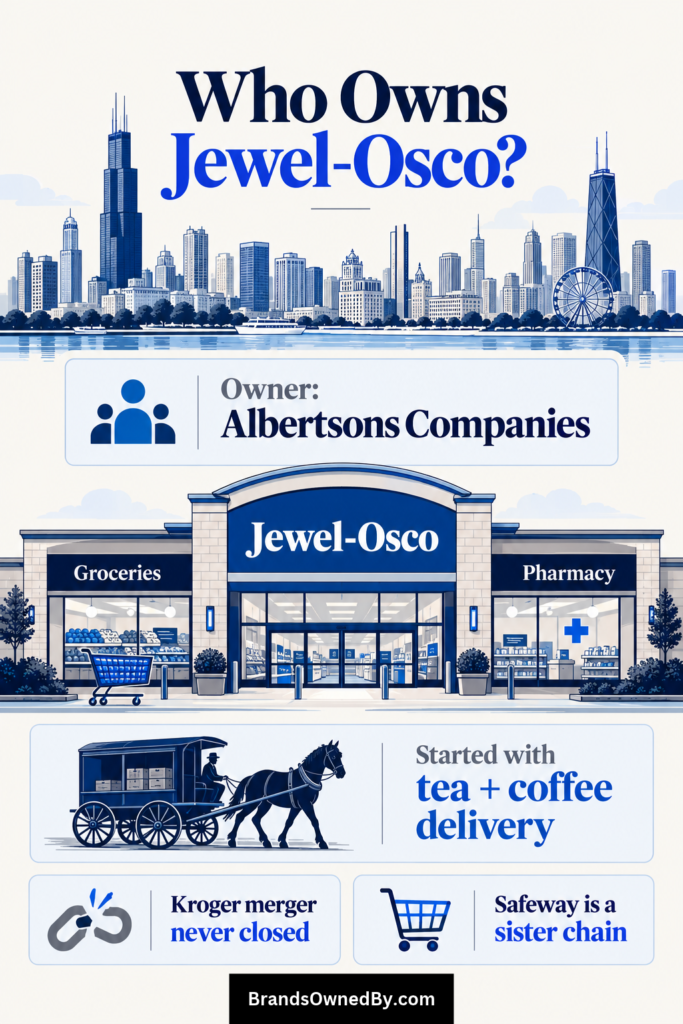
- Albertsons Companies owns Jewel-Osco, including its supermarket and in-store pharmacy operations.
- Signature Select, O Organics, Lucerne and Open Nature are Albertsons store brands sold at Jewel-Osco, rather than separate companies owned by Jewel-Osco.
- Safeway, Vons, ACME and Shaw’s are sister supermarket banners under Albertsons.
- Kroger’s proposed purchase of Albertsons never closed, so Jewel-Osco and Kroger-owned Mariano’s remain under separate corporate owners.
Jewel-Osco is owned by Albertsons Companies, the publicly traded grocery group behind Safeway, Vons and several other regional supermarket chains. As of October 2026, Kroger does not own Jewel-Osco. Its proposed acquisition of Albertsons collapsed in December 2024. Jewel-Osco remains a Chicago-centered grocery and pharmacy business within Albertsons, whose largest shareholder is Cerberus Capital Management.
Jewel-Osco Overview
Jewel-Osco combines a regional supermarket identity with the purchasing and support infrastructure of a national grocery company. Its name reflects two businesses that developed separately before groceries and pharmacy services were brought together.
Who Founded Jewel-Osco?
Frank Ross and his brother-in-law Frank Skiff founded the Jewel Tea Company in Chicago in 1899. They started with $700, a rented horse and a secondhand wagon. Their business delivered tea and coffee directly to customers.
The delivery route was the original storefront. Regular household visits created repeat purchases without requiring customers to travel to a shop. This helps explain why Jewel’s origins are different from those of supermarket businesses founded around a single neighborhood store.
Jewel later expanded into physical grocery retail. The combination-store business recognizable today emerged through subsequent acquisitions and operating changes.
How Jewel and Osco Came Together
Jewel acquired Osco Drug in 1961. Grocery shopping and prescription services could then serve the same household through adjacent locations.
The integration took time. Many early Jewel and Osco stores operated side by side. During the 1980s, the company increasingly consolidated the two formats under one roof.
That combination still defines the customer proposition. A shopper can buy groceries, collect a prescription and purchase household necessities during one visit. The pharmacy adds another reason to return between larger grocery trips.
Where Jewel-Osco Operates?
Jewel-Osco’s footprint is concentrated in Illinois and the Chicago metropolitan area, with additional stores in Indiana and Iowa. As of October 2026, its live store directory lists 190 locations. Its pharmacy directory separately lists 182 locations.
This concentration matters commercially. A dense regional network can support local advertising, distribution routes and familiarity with neighborhood shopping patterns. Albertsons supplies the broader corporate scale, while Jewel-Osco supplies the local identity.
Jewel-Osco Ownership History
Jewel-Osco has passed through several corporate owners. Its connection to Albertsons began in 1999, but that relationship was interrupted when the original Albertsons business was broken up in 2006.
Independent Growth and the Osco Acquisition
Jewel developed from a delivery business into a substantial grocery operator before becoming part of a national consolidator. Its purchase of Osco added a complementary drugstore business.
The commercial logic extended beyond convenience. Grocery purchases brought frequent traffic. Pharmacy services added recurring prescription visits and sales of health and personal-care products.
Those businesses have different economics. Food retail depends heavily on basket size, spoilage and shelf availability. Pharmacy depends on prescription volumes, reimbursement arrangements and dispensing costs. Combining the two creates opportunities, but it also requires distinct operating expertise.
American Stores Acquired Jewel in 1984
American Stores purchased Jewel Companies in 1984. The transaction moved Jewel into a larger retail group and ended its independence.
Jewel’s established position in Chicago was an important part of its appeal. The buyer acquired a functioning regional business with customer relationships and a distribution network. It did not have to build a Chicago presence store by store.
The Jewel name remained valuable after the acquisition. Keeping a familiar banner allowed the new owner to retain local recognition while changing the corporate structure behind it.
Albertsons Acquired American Stores in 1999
Albertsons acquired American Stores in 1999. Jewel-Osco entered the Albertsons organization through that larger transaction.
This is the origin of the frequently repeated statement that Albertsons has owned Jewel-Osco since 1999. However, that statement leaves out the subsequent period under Supervalu.
The distinction matters when tracing ownership. A brand can retain the same storefront name while moving between corporate groups. Customers may see continuity even when financing, procurement and shareholder control change substantially.
Supervalu Took Ownership in 2006
In 2006, a consortium divided the original Albertsons business among multiple buyers. Supervalu acquired Jewel-Osco as part of its portion of the transaction.
The buyers also included CVS and a Cerberus-led investor group. They acquired different assets. CVS’s involvement in the wider deal does not mean that it became the owner of today’s Jewel-Osco supermarket chain.
For Jewel-Osco, the relevant owner during this period was Supervalu. This explains why older corporate records associate the chain with Supervalu rather than its present parent.
The Cerberus-Led Acquisition in 2013
In 2013, AB Acquisition, an affiliate of a Cerberus-led investor group, acquired five grocery banners from Supervalu. They included Albertsons, ACME, Jewel-Osco, Shaw’s and Star Market.
The transaction covered 877 stores across those banners. Its announced structure included $100 million in cash and approximately $3.2 billion of debt retained by the acquired business.
That $3.3 billion headline value covered the wider transaction. It was not a disclosed purchase price for Jewel-Osco alone.
The acquisition reunited the previously separated Albertsons store businesses under common ownership. Jewel-Osco became part of the organization that developed into today’s Albertsons Companies.
Safeway Joined the Group in 2015
The completion of the Safeway merger in 2015 substantially expanded Jewel-Osco’s parent organization.
Jewel-Osco and Safeway became sister businesses within the same grocery group. Safeway did not become Jewel-Osco’s ultimate parent.
The enlarged organization created a wider platform for purchasing, distribution, technology and private-label products. This helps explain why shoppers encounter several of the same store brands at geographically distant Albertsons-owned chains.
Albertsons Became Public in 2020
Albertsons Companies began trading on the New York Stock Exchange in June 2020 under the ticker ACI.
The listing opened ownership of the parent company to public-market investors. It did not create a separate Jewel-Osco stock.
An investor buying ACI gains exposure to Albertsons’ consolidated business. That includes Jewel-Osco alongside other supermarket banners, pharmacies and related operations.
The Kroger Merger Failed in 2024
Kroger announced its proposed $24.6 billion acquisition of Albertsons in October 2022. The deal would have placed Jewel-Osco within a larger group that also included Mariano’s.
Regulators challenged the transaction. A federal court granted an injunction on December 10, 2024, and Albertsons terminated the merger agreement the following day.
The related plan to sell hundreds of stores and selected assets to C&S Wholesale Grocers also depended on the merger. It did not make C&S the owner of Jewel-Osco.
The distinction remains important in 2026. A proposed buyer, a proposed divestiture recipient and the current owner are three different things.
The financial dispute outlasted the proposed transaction. A Delaware trial over Albertsons’ claims against Kroger began on October 19, 2026. That litigation concerns the failed agreement. It does not place Jewel-Osco under Kroger’s ownership.
Who Owns Jewel-Osco in 2026?
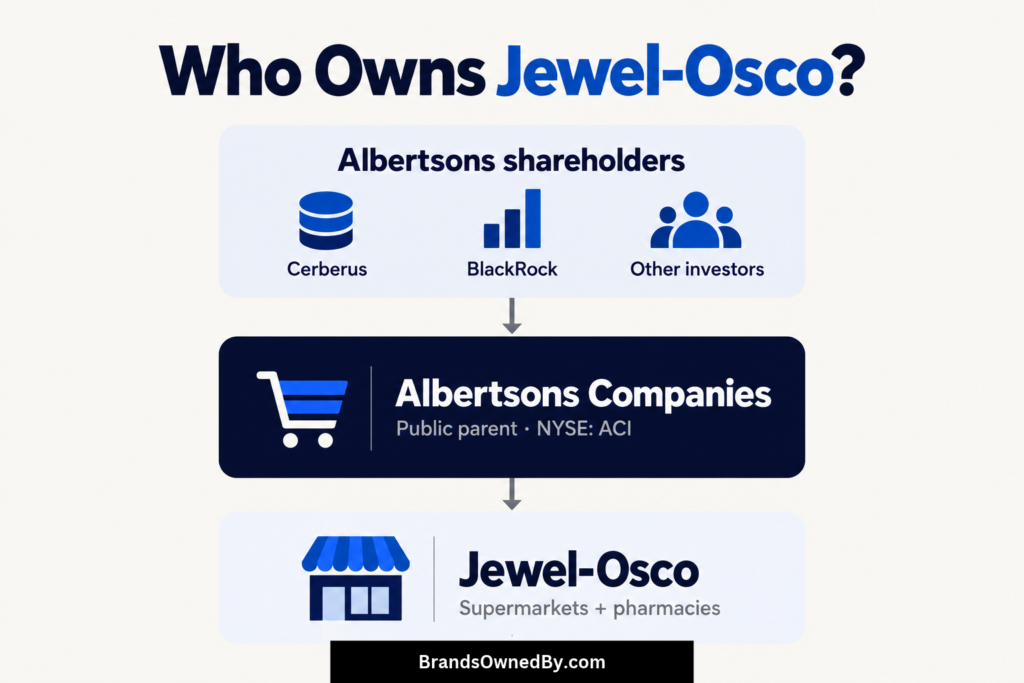
Jewel-Osco is wholly owned within Albertsons Companies, Inc., the publicly traded American grocery group headquartered in Boise, Idaho. As of October 2026, the chain remains part of Albertsons. Kroger, C&S Wholesale Grocers and CVS do not own the current Jewel-Osco supermarket business.
The ownership covers more than the name above the entrance. Jewel-Osco’s grocery operations, in-store pharmacies and associated operating companies sit within Albertsons’ corporate organization. Public investors hold shares in the parent company rather than direct ownership stakes in the regional chain.
Albertsons Owns the Business Through Its Subsidiary Structure
Jewel-Osco is a retail banner supported by several legal entities. Albertsons’ subsidiary schedule published in 2026 includes Jewel Companies, Inc., Jewel Food Stores, Inc. and American Drug Stores LLC.
These names reflect the businesses that were brought together over decades of acquisitions. Jewel Food Stores is associated with the supermarket operation. American Drug Stores is part of the corporate history and structure behind the drugstore business.
This explains why customers may encounter different company names on employment documents, licenses or legal records. The public-facing store name does not have to match the legal entity responsible for a particular activity.
For example, a supermarket can trade as Jewel-Osco while its food-store license identifies Jewel Food Stores, Inc. That does not indicate a separate independent owner. Both the operating entity and the customer-facing banner belong within the wider Albertsons organization.
How Albertsons Acquired the Current Jewel-Osco Business
The transaction establishing Jewel-Osco’s current ownership lineage closed on March 21, 2013. Supervalu sold New Albertson’s, Inc., the subsidiary containing Jewel-Osco and several other grocery businesses, to AB Acquisition LLC.
The sale included the Albertsons, ACME, Jewel-Osco, Shaw’s and Star Market banners. Related Osco and Sav-on in-store pharmacies were also included. The acquisition therefore transferred functioning grocery and pharmacy businesses, rather than simply licensing their names to another retailer.
AB Acquisition was affiliated with an investor consortium led by Cerberus Capital Management. Other participants included Kimco Realty, Klaff Realty, Lubert-Adler and Schottenstein interests.
The wider transaction covered 877 stores and was valued at approximately $3.3 billion. Its structure included $100 million in cash and approximately $3.2 billion in debt. Those figures covered the acquired group. They were not a separately disclosed purchase price for Jewel-Osco.
The grocery organization subsequently expanded through the Safeway merger in 2015. Albertsons Companies became publicly traded in 2020. Jewel-Osco remained inside the operating group throughout those later changes.
Why Albertsons’ Ownership is Sometimes Dated to 1999?
Albertsons first acquired Jewel-Osco when it purchased American Stores in 1999. However, its ownership history contains an interruption.
In 2006, the original Albertsons business was divided among several buyers. Supervalu acquired the Jewel-Osco operation, including its combination-store pharmacies. Jewel-Osco remained under Supervalu until the 2013 sale to AB Acquisition.
Consequently, saying that Albertsons has owned Jewel-Osco continuously since 1999 leaves out a material change of ownership. The more accurate explanation is that Jewel-Osco first entered Albertsons in 1999, moved to Supervalu in 2006, and returned to the Albertsons organization through the 2013 acquisition.
This distinction also explains why older records identify Supervalu as the parent. Those references can be historically correct without describing the chain’s current ownership.
What Cerberus Owns in Relation to Jewel-Osco?
Cerberus helped assemble the investor group behind the 2013 acquisition. It remains the largest shareholder in Albertsons Companies.
The parent company’s 2026 proxy reported Cerberus beneficial ownership of 151.819 million shares, representing 31.0% at the June record date. Its investment gives it substantial exposure to Jewel-Osco through Albertsons.
However, that percentage applies to Albertsons stock. It is not a separately registered 31.0% stake in Jewel-Osco.
The distinction affects how the chain should be described. Albertsons owns Jewel-Osco within its subsidiary structure. Cerberus holds a large minority investment in Albertsons, alongside other institutional and individual shareholders. Jewel-Osco is therefore neither independently listed nor wholly owned by Cerberus alone.
Why Safeway and CVS Are Not Jewel-Osco’s Owners?
Safeway and Jewel-Osco belong to the same corporate group. Their shared ownership explains why both chains sell products such as O Organics and Signature Select.
Safeway is a sister supermarket business, rather than Jewel-Osco’s ultimate parent. Albertsons Companies sits above both.
The CVS connection comes from a different transaction. During the 2006 breakup of the original Albertsons business, CVS acquired standalone drugstore assets. Supervalu acquired Jewel-Osco’s supermarket operation and the pharmacies inside its combination stores.
That division matters. A former freestanding Osco drugstore that became CVS followed a different ownership path from an Osco pharmacy inside a Jewel-Osco supermarket. The shared historical name does not establish common ownership today.
What the Failed Kroger Merger Meant for Jewel-Osco?
The proposed Kroger-Albertsons merger created two different possibilities for Jewel-Osco. Most of the chain would have moved under Kroger through its acquisition of Albertsons. A small number of individual stores were designated for sale to C&S Wholesale Grocers.
Neither transfer happened through that merger. Understanding the difference explains why old headlines about Jewel-Osco being sold can give the wrong impression today.
Most Jewel-Osco Stores Would Have Joined Kroger
Kroger announced its proposed acquisition of Albertsons in October 2022. The transaction was valued at approximately $24.6 billion and covered Albertsons’ wider grocery business.
Jewel-Osco would have changed ultimate corporate ownership because its parent was being acquired. Kroger was not buying only the Jewel-Osco name or negotiating a separate purchase of the Chicago-area chain.
The planned combination raised a particular competitive issue in Chicago. Kroger already owned Mariano’s through Roundy’s. Acquiring Albertsons would have placed much of Jewel-Osco and the retained portions of Kroger’s local business within the same corporate organization.
For shoppers, two familiar supermarket entrances could therefore have led to businesses answering to the same ultimate owner. That overlap helped make the Chicago market relevant to scrutiny of the wider deal.
Four Jewel-Osco Stores Were Proposed for Sale to C&S
The revised divestiture package announced in April 2024 covered 579 stores across the combined companies. It included 35 Illinois locations.
The subsequent store list identified four Jewel-Osco locations: 12001 South Pulaski Road in Alsip, 87 West 87th Street in Chicago, 1537 North Larkin Avenue in Joliet, and 12803 South Harlem Avenue in Palos Heights.
The remaining 31 Illinois stores on that list operated under Mariano’s.
Those details show why “Jewel-Osco was being sold to C&S” was an incomplete description. C&S was designated to acquire selected Jewel-Osco stores as part of a much larger package. It was not purchasing the entire Jewel-Osco chain.
The distinction also separates a store business from a retail banner. Acquiring a particular location does not automatically transfer ownership of the chain’s name across every other market.
The Mariano’s Name Was Included in the Proposed Transfer
The proposed C&S agreement extended beyond individual stores. It included the Mariano’s, QFC, Carrs and Haggen banner names, alongside other assets and specified licensing arrangements.
The Jewel-Osco banner was not among those four names designated for transfer.
That created an unusual potential outcome in Chicago. C&S could have owned the Mariano’s name and selected former Jewel-Osco locations, while Kroger would have owned Albertsons and much of the Jewel-Osco business.
The companies also said stores retained by Kroger under transferred banners would be renamed using retained Kroger or Albertsons banners. However, that did not establish a final replacement name for every affected location.
For readers examining older announcements, the essential distinction is between ownership of stores, ownership of brand names and temporary rights to use a name. The proposed transaction addressed all three in different ways.
Why the Proposed Store Sales Never Took Effect
On December 10, 2024, a federal court granted an injunction preventing the Kroger-Albertsons merger from proceeding. Albertsons terminated the merger agreement the following day.
The C&S divestiture was tied to completion of the larger transaction. Once the merger collapsed, the proposed package did not close as planned.
Consequently, appearing on the 2024 divestiture list did not itself transfer a Jewel-Osco store to C&S. Nor did announcements about the Mariano’s banner establish that it had changed owners.
As of October 2026, Jewel-Osco remains within Albertsons, while Mariano’s remains within Kroger. The failed transaction did not combine their ownership or complete the proposed C&S transfers.
What Happened to Jewel’s Former Brands and Businesses?
Today’s Jewel-Osco is the surviving supermarket and pharmacy identity of a business that once operated across several retail formats. Its predecessor, Jewel Companies, owned businesses ranging from regional supermarkets to discount department stores and convenience shops.
Those former holdings help explain why Jewel appears in the histories of brands that shoppers would not necessarily associate with the current chain.
White Hen Pantry: Jewel’s Convenience Store Business
Jewel entered convenience retail in 1965 with a business initially called Kwik Shoppe. It was renamed White Hen Pantry shortly afterward.
White Hen served a different shopping occasion from a full-size Jewel supermarket. Customers could make a quick stop for a sandwich, milk or another immediate purchase without completing a larger grocery trip.
The business left the Jewel corporate family after American Stores acquired Jewel Companies. American Stores sold White Hen in 1985.
White Hen later passed through other owners before 7-Eleven acquired it in 2006. Its familiar Chicago-area identity therefore belongs to Jewel’s historical portfolio, rather than its current operations.
This also explains why White Hen should not appear on a list of companies currently owned by Jewel-Osco. The historical relationship ended decades before today’s Albertsons ownership structure took shape.
Turn Style: Jewel’s Discount Department Stores
Jewel acquired Turn Style in 1961. The business sold general merchandise and gave Jewel a presence beyond food and prescriptions.
Some locations combined department-store shopping with Osco pharmacy services. Jewel also experimented with larger shopping formats that brought multiple retail activities together.
The concept was broader than the modern Jewel-Osco supermarket. A customer could shop across food, pharmacy and department-store categories within the wider Jewel retail organization.
Jewel exited the Turn Style department-store business in 1978 through a sale to May Department Stores. Many acquired locations were converted to the Venture format. Other properties retained by Jewel were adapted for Osco operations.
Turn Style’s history shows that Jewel once pursued a much wider retail strategy. The present chain preserves the grocery and pharmacy combination, rather than that former department-store portfolio.
Star Market: A Former Jewel Holding That Became a Sister Chain
Jewel acquired Massachusetts-based Star Market in 1964. It retained the regional name, allowing the New England business to preserve its established identity.
The relationship also supported food-and-drug combinations using the Star-Osco name. That extended Jewel’s grocery and pharmacy approach beyond its Midwestern home market.
Star Market passed to American Stores through its 1984 acquisition of Jewel Companies. American Stores sold Star Market to Investcorp in 1994. Star subsequently joined Shaw’s.
The businesses eventually returned to common ownership. Star Market and Jewel-Osco were both included in the grocery banners acquired from Supervalu by AB Acquisition in 2013.
Their relationship today differs from the original arrangement. Star Market is a fellow Albertsons banner, rather than a supermarket chain operated as part of today’s Jewel-Osco business. It is a useful example of how former holdings can become sister businesses after several rounds of grocery consolidation.
Competitor Ownership Comparison
Jewel-Osco competes with businesses supported by several ownership models. These include another listed grocery group, a private discount retailer, a family-operated regional company and diversified public corporations.
Mariano’s: Owned by Kroger
Mariano’s belongs to Kroger through its acquisition of Roundy’s in 2015. That transaction was valued at approximately $800 million including debt.
It is the most relevant ownership comparison for many Chicago shoppers. Mariano’s and Jewel-Osco operate in the same regional market, but their corporate parents remain separate.
Both benefit from national grocery infrastructure and retain local retail identities. Because the Kroger-Albertsons merger failed, their owners continue to compete for grocery spending rather than consolidate it within one company.
ALDI: Part of ALDI SOUTH
ALDI’s U.S. business is part of the privately held ALDI SOUTH group. It has no publicly traded U.S. grocery stock comparable to ACI.
Its operating model also differs. A tightly selected assortment and emphasis on exclusive products reduce the complexity associated with a conventional full-service supermarket.
For a customer comparing a weekly basket, ownership matters through the model it supports. ALDI’s structure supports a focused discount proposition. Jewel-Osco combines a broader assortment with fresh departments, pharmacy services and promotional offers.
Meijer: Privately Owned and Family Operated
Meijer remains privately owned and family-operated. The Michigan-based retailer traces its origins to Hendrik Meijer’s first grocery business in 1934.
Its supercenter format combines food with a substantial general-merchandise offering. That makes it relevant to households looking to complete several categories of shopping in one trip.
Compared with Jewel-Osco’s listed parent, Meijer has a more concentrated ownership structure. However, private ownership alone does not establish which retailer offers lower prices or better stores. Store execution and local competition still determine the customer experience.
Walmart: Publicly Traded With a Large Walton Family Position
Walmart is a public company with a substantial Walton family ownership position. A March 2026 filing attributed 44.21% beneficial ownership to Walton Enterprises, including shares over which it held voting authority through a family trust.
Walmart’s grocery business operates within a much broader retail platform. General merchandise, membership services and advertising provide additional sources of earnings.
This changes the competitive calculation. Walmart can evaluate grocery as both a business and a source of customer traffic across its wider assortment. Jewel-Osco operates within a parent more heavily concentrated in food and drug retail.
Whole Foods Market: Owned by Amazon
Whole Foods Market is owned by Amazon, which acquired the chain in 2017 in a transaction valued at approximately $13.7 billion including net debt.
Whole Foods has a distinct premium and natural-food positioning. Its corporate ownership also connects it with Amazon’s broader shopping and delivery ecosystem.
The comparison with Jewel-Osco is therefore about more than store count. Amazon can link grocery purchases with membership benefits and digital services. Albertsons must build customer engagement around its own grocery, pharmacy and loyalty platforms.
Who Controls Jewel-Osco?
Control operates at several levels. Albertsons’ board oversees the parent company. Senior executives allocate resources and set strategy. Operating leaders and store teams execute those decisions within the business.
Albertsons’ Board and Cerberus’ Influence
The 2026 proxy described Cerberus’ right to designate up to four directors for election. That gives the investment firm influence beyond an ordinary small shareholding.
However, designation rights are not the same as owning every board seat. Other directors also participate in oversight, and directors have duties to the corporation.
Decisions about a major Jewel-Osco disposal or acquisition would therefore sit within Albertsons’ governance and approval processes. They would not be decided independently by an individual store manager.
Susan Morris and Meg Whitman
Susan Morris is Albertsons’ chief executive officer. Meg Whitman became executive chair on September 9, 2026.
Whitman’s appointment expanded the board to 11 members. Her role includes supporting Morris on strategy and operating execution. Kim Fennebresque moved from chair to lead independent director.
These roles connect Jewel-Osco to parent-level decisions about investment and business structure. A regional store banner may retain its familiar name while its technology, procurement and capital priorities are set nationally.
The New Regional Operating Structure
Albertsons announced a realignment in July 2026 that consolidated 11 divisions into four regions and centralized center-store merchandising.
For Jewel-Osco, that changes the balance between local identity and corporate decision-making. Centralized merchandising can coordinate purchasing and category decisions across the wider business.
A practical example is packaged cereal. Albertsons can negotiate and plan the category at enterprise scale, while a particular Jewel-Osco store still has to keep shelves stocked and execute promotions correctly.
Jewel-Osco also announced the retirement of president Tom Lofland in July. Older profiles naming him as the current president no longer reflect that change.
Could the Ownership Change Again?
Albertsons announced a comprehensive business review in October 2026. The review includes its portfolio of banners, markets, assets and businesses.
That creates scope for strategic changes. It does not establish that Jewel-Osco has been sold.
As of October 2026, the current ownership answer remains Albertsons Companies. A review, a potential sale and a completed transfer of ownership are different stages.
Brands Owned by Jewel-Osco
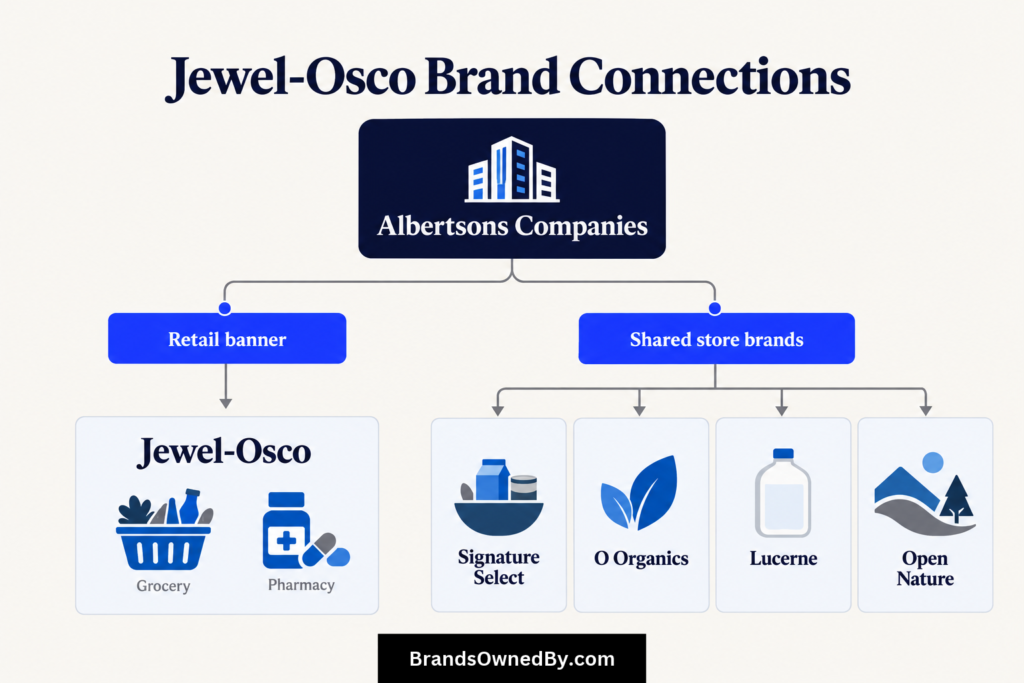
Jewel-Osco is primarily an operating supermarket banner, rather than a holding company with a separately disclosed portfolio of acquired businesses.
Its grocery and pharmacy operations sit within Albertsons. The consumer brands on its shelves also include products owned or managed at the wider parent-company level. That distinction prevents sister chains and shared product labels from being incorrectly described as Jewel-Osco subsidiaries.
Jewel Food Stores
Jewel Food Stores is the grocery identity associated with the chain’s supermarket business.
Its customer offer includes packaged groceries and fresh departments such as produce, meat, bakery and deli. These activities form the core of the store visit.
The historical name should not be treated as evidence of a separate modern acquisition portfolio. It is part of the development and operating identity of the Jewel-Osco business.
Osco Pharmacy
Osco represents the pharmacy side of the combined format. Its services include prescription dispensing and related pharmacy care.
The commercial benefit is recurring household contact. A customer collecting a monthly prescription may also purchase food or personal-care products.
The Osco name also has a wider history across drugstore transactions. That history does not mean that every former Osco location remains owned by Jewel-Osco. The relevant business here is the pharmacy operation within the current Albertsons-owned chain.
Signature Select
Signature Select is a shared Albertsons private-label brand sold at Jewel-Osco. It covers everyday grocery and household categories.
It is a product brand within the parent company’s portfolio, rather than a company Jewel-Osco independently acquired.
For shoppers, its role is straightforward. It provides a store-brand option alongside national brands across routine purchases. For the retailer, it offers greater influence over product positioning and assortment.
O Organics
O Organics is Albertsons’ organic private-label brand. Jewel-Osco sells it as part of the wider group’s product offering.
Its products compete for customers who want organic alternatives without shopping exclusively at a specialist retailer.
The ownership connection explains why an O Organics product may appear at Jewel-Osco and Safeway. Shared availability reflects the parent company’s brand platform. It does not mean that one supermarket chain owns the other.
Lucerne
Lucerne is an Albertsons dairy brand available through its grocery banners, including Jewel-Osco.
Dairy is commercially important because many products are frequent household purchases. Milk, cheese and other refrigerated staples can generate regular store visits.
A familiar shared dairy label gives the parent continuity across regional chains. Jewel-Osco provides the local retail relationship, while the product brand belongs to the broader corporate portfolio.
Open Nature
Open Nature is another Albertsons-owned product brand sold through the group’s stores. It emphasizes selected ingredients and products positioned around its “free from” approach.
Open Nature and O Organics have different propositions. The Open Nature name alone does not mean that a product is certified organic. Shoppers should check the particular product’s labeling.
For Jewel-Osco, the two brands serve different customer priorities within the same store. That allows the chain to address several price and product preferences without owning separate specialist supermarket businesses.
Other Shared Albertsons Labels
The wider Albertsons portfolio also includes names such as Primo Taglio, Waterfront Bistro, Soleil and Value Corner. Local assortment and availability vary.
These labels should be classified as parent-group product brands. They are not evidence that Jewel-Osco controls an independent collection of food companies.
The same principle applies to Safeway, Vons, ACME and Shaw’s. Those are fellow retail banners within Albertsons, rather than businesses owned by Jewel-Osco.
Final Thoughts
Albertsons Companies owns Jewel-Osco as of October 2026. Cerberus is the largest shareholder in the parent, while institutional and individual investors hold the remaining shares.
The chain’s value lies in the combination of a familiar regional supermarket business, in-store pharmacies and access to Albertsons’ wider infrastructure. Its ownership should be understood through that structure.
The next corporate developments will depend on Albertsons’ business review. Until a completed transaction changes the position, neither the failed Kroger merger nor speculation about strategic alternatives alters Jewel-Osco’s current owner.
FAQs
Is Jewel-Osco Owned by Kroger?
No. Jewel-Osco is owned by Albertsons Companies. Kroger proposed acquiring Albertsons in 2022, but the deal was blocked and terminated in December 2024.
Are Jewel-Osco and Mariano’s Owned by the Same Company?
No. Jewel-Osco belongs to Albertsons, while Mariano’s belongs to Kroger. The failed merger would have changed their relationship, but the companies remain separate.
Does Safeway Own Jewel-Osco?
No. Safeway and Jewel-Osco are sister supermarket banners within Albertsons Companies. Their common parent explains the overlap in several store-brand products.
Is Jewel-Osco Still Owned by Supervalu?
No. Supervalu owned Jewel-Osco from 2006 until the 2013 sale to AB Acquisition. Jewel-Osco subsequently became part of today’s Albertsons Companies.
Did C&S Wholesale Grocers Buy Jewel-Osco?
No. The proposed C&S divestiture package was connected to the Kroger-Albertsons merger. The merger did not close, and Jewel-Osco remains within Albertsons.
Can You Buy Jewel-Osco Stock?
Jewel-Osco has no separately listed stock. Investors can buy shares in its parent, Albertsons Companies, under the NYSE ticker ACI. Those shares represent the consolidated group.
Is Jewel-Osco Family Owned?
Jewel began as a business founded by Frank Ross and Frank Skiff. Today, it belongs to a publicly traded corporation. It is not controlled as an independent founding-family supermarket chain.
Who Owns Jewel-Osco Pharmacies?
The pharmacies operating within Jewel-Osco belong to the Albertsons corporate group alongside the supermarket business. Their Osco name reflects the chain’s drugstore heritage.
How Much Is Jewel-Osco Worth?
Jewel-Osco has no separately disclosed current market valuation or public balance sheet. Albertsons’ market value and book equity cover the wider group and should not be presented as Jewel-Osco’s standalone worth.
Does Jewel-Osco Own Its Store Buildings?
Retail operations and property ownership are separate questions. A supermarket can operate in owned premises or occupy space under a lease. The owner of a particular Jewel-Osco building must be checked using property records or transaction documents for that location.
Is Jewel-Osco Being Sold?
Albertsons announced a review of its banners, markets, assets and businesses in October 2026. That review does not constitute a completed sale of Jewel-Osco. Its current parent remains Albertsons Companies.