

- Thrifty Rental Car is owned by Hertz Global Holdings, Inc. and operates through The Hertz Corporation as part of the wider Hertz rental group.
- CK Amarillo LP is Hertz Global Holdings’ controlling shareholder with a 57.6% stake, giving it effective voting control over the company and indirect control over Thrifty.
- TD Securities owns about 8.1% of Hertz, while BlackRock holds approximately 6.2%; directors and executives collectively own less than 1%.
- Thrifty has no separate publicly traded stock or shareholder structure, so investors gain exposure to the brand only by owning shares in Hertz Global Holdings.
Thrifty Rental Car is owned by Hertz Global Holdings, Inc. The brand operates through The Hertz Corporation, which is a wholly owned subsidiary within the Hertz corporate structure.
Thrifty Car Rental is a value-focused vehicle rental brand. It primarily serves leisure travelers, families, tourists, and customers looking for competitive rental rates.
The company competes through airport locations, neighborhood branches, online reservations, franchise partnerships, and international licensees. Its positioning is generally more price-conscious than the flagship Hertz brand.
![Who Owns Thrifty Rental Car [infographic]](https://brandsownedby.com/wp-content/uploads/2026/07/Who-Owns-Thrifty-Rental-Car-infographic-683x1024.png)
Who Founded Thrifty Rental Car?
Thrifty Rent-A-Car System was founded in 1958. The business originated in the United States and developed during a period of rapid growth in domestic air travel and highway tourism.
The company was founded in Tulsa, Oklahoma. Its early business model relied heavily on franchising. This allowed Thrifty to expand without owning every rental location directly.
Rather than competing only through premium vehicles and corporate travel contracts, Thrifty focused on affordability. It appealed to customers who wanted practical transportation without paying premium-brand prices.
The Origin of the Thrifty Name
The word “thrifty” communicates careful spending and value. That positioning became central to the company’s identity.
The name helped customers understand the offer before reaching the rental counter. Thrifty was designed to represent a lower-cost alternative within the car rental industry.
This remains important under Hertz ownership. Hertz can use different brands to serve customers at different price points without forcing every traveler into the same offer.
How Thrifty Makes Money
Thrifty generates revenue from vehicle rentals and related services. A customer may begin with a basic daily rental price. The total transaction can also include optional products and fees.
Examples include:
- Vehicle upgrades.
- Additional-driver charges.
- Child safety seat rentals.
- Toll-management services.
- Fuel-related charges.
- Insurance and damage-waiver products.
- One-way rental charges.
- Young-driver fees.
- Airport concession-related charges.
Thrifty locations may be company-operated, franchised, or licensed. The exact operating model differs by country and market.
At a company-operated location, the Hertz organization manages the fleet and rental operation. At a franchised or licensed location, an independent operator may use the Thrifty name, reservation system, and operating standards under a contractual agreement.
Thrifty’s Market Position
Thrifty is positioned mainly in the value segment of the rental car market. It sits below Hertz’s flagship brand in terms of premium positioning.
A practical example is an airport customer comparing several rental options. A business traveler may choose Hertz for loyalty benefits, service speed, or corporate arrangements. A vacationing family may choose Thrifty because the quoted price is lower for a similar vehicle category.
That does not mean every Thrifty booking is cheaper than every Hertz booking. Rental prices change according to location, season, vehicle supply, demand, and booking timing. The brands still serve different strategic roles within the same parent company.
Thrifty Rental Car Ownership History
Thrifty has passed through several ownership structures. It began as an independent rental operation. It later became part of an automobile manufacturer, a publicly traded rental group, and finally Hertz.
1958: Thrifty Is Established
Thrifty was established in 1958 in Tulsa, Oklahoma. The company expanded through a franchise-oriented model.
Franchising was important because the rental car industry requires significant local infrastructure. Operators need vehicles, parking facilities, airport access, staff, maintenance arrangements, and reservation systems.
The franchise structure allowed local business owners to operate under a recognized national name.
1981: Bill Lobeck and Investors Acquire Thrifty
In 1981, Bill Lobeck and a group of investors acquired Thrifty.
Lobeck became an important figure in the company’s development. Under the investor group, Thrifty expanded its presence and strengthened its position in the value-oriented rental market.
The ownership change moved the business into a more growth-focused period. It also prepared the company for eventual access to public capital.
1987: Thrifty Becomes Publicly Traded
Thrifty completed an initial public offering in 1987.
The IPO gave the company access to public investors. It also created liquidity for existing shareholders and provided additional resources for expansion.
At that stage, Thrifty could be owned directly through publicly traded shares. That is no longer possible because the brand is now part of Hertz.
1989: Thrifty Acquires Snappy Car Rental
Thrifty expanded through acquisition by purchasing Snappy Car Rental in 1989.
The transaction added locations and increased the company’s operational scale. Acquisitions were a practical way to gain airport access, fleet capacity, customer relationships, and local market coverage.
The Snappy brand was later sold. However, the acquisition demonstrated Thrifty’s ambition to grow beyond its original franchise network.
1989: Chrysler Acquires Thrifty
Chrysler acquired Thrifty in 1989.
The transaction reflected a broader strategy among automobile manufacturers. Owning a rental car business could create a significant source of demand for new vehicles.
A manufacturer-controlled rental company could purchase large numbers of cars. Those vehicles could later enter the used-car market after completing their rental service.
Chrysler placed Thrifty within its transportation-related operations. It later added Dollar Rent A Car to the same corporate group.
1990: Chrysler Acquires Dollar Rent A Car
Chrysler acquired Dollar Rent A Car in 1990.
Dollar and Thrifty continued to operate as separate customer-facing brands. However, their ownership was brought together under Chrysler.
The combination created operational opportunities. The two brands could share purchasing power, fleet management systems, technology, and administrative functions while preserving different market identities.
Dollar generally concentrated on value-conscious leisure travel. Thrifty occupied a similar broad segment but maintained separate pricing, locations, and brand recognition.
1997: Dollar Thrifty Automotive Group Is Created
Chrysler separated its rental operations through the creation and public listing of Dollar Thrifty Automotive Group.
The company traded publicly under the ticker DTG. Dollar and Thrifty became the group’s principal rental brands.
This structure allowed Chrysler to separate the capital-intensive rental operation from its core vehicle manufacturing business.
After the transaction, investors could gain direct exposure to the Dollar and Thrifty businesses by purchasing shares in Dollar Thrifty Automotive Group.
2000s: Dollar Thrifty Expands Its Rental Network
Dollar Thrifty Automotive Group expanded its company-operated and franchised network during the 2000s.
The group competed with Hertz, Avis Budget, Enterprise, National, and Alamo. Its airport presence was particularly important.
Airport rental concessions can be difficult to obtain. Rental operators must meet airport requirements and often pay concession fees. An established airport network therefore represents a meaningful competitive asset.
The company also developed international relationships through franchise and licensing arrangements.
2010–2012: Hertz and Avis Compete for Dollar Thrifty
Dollar Thrifty became the subject of a lengthy acquisition contest.
Both Hertz and Avis Budget viewed the company as strategically valuable. Acquiring Dollar Thrifty offered several benefits:
- Greater exposure to value-oriented travelers.
- More airport rental locations.
- A larger combined fleet.
- Stronger purchasing power.
- Additional reservation volume.
- Reduced overlap in corporate costs.
- Better coverage across multiple price segments.
The bidding process lasted for several years. Regulatory considerations were also important because the U.S. airport rental market was already concentrated among a small number of large groups.
2012: Hertz Acquires Dollar Thrifty
Hertz completed its acquisition of Dollar Thrifty Automotive Group in November 2012.
The transaction valued Dollar Thrifty at approximately $2.3 billion. Dollar Thrifty became a wholly owned part of Hertz.
This was the defining ownership change for Thrifty. The brand moved from a separately traded rental group into a much larger global mobility organization.
Hertz gained both Dollar and Thrifty through the acquisition. It also gained their locations, customer relationships, fleet operations, technology connections, franchise arrangements, and airport presence.
2020: Hertz Enters Chapter 11
The COVID-19 pandemic caused a sudden collapse in travel demand during 2020. Hertz faced severe liquidity pressure because the rental business carries substantial fleet-related costs.
Hertz filed for Chapter 11 bankruptcy protection in the United States in May 2020.
Thrifty continued to operate during the restructuring. The bankruptcy filing did not mean the Thrifty brand was permanently closed or sold to another rental company.
Instead, Hertz used the court-supervised process to restructure debt and stabilize the business.
2021: Hertz Emerges From Bankruptcy
Hertz emerged from Chapter 11 in 2021 under a reorganized ownership structure.
The reorganized Hertz Global Holdings returned to the public market. Its common shares began trading under the Nasdaq ticker HTZ.
Thrifty remained part of the Hertz organization. It continued to operate as one of the group’s main rental brands.
2022–2026: Thrifty Remains a Hertz Value Brand
Thrifty remains under Hertz ownership in July 2026.
Hertz manages its major rental brands as part of one operating platform. This can include shared fleet procurement, technology, financing, vehicle remarketing, customer support, and administrative infrastructure.
However, Thrifty retains its own consumer-facing identity. Customers still book through Thrifty-branded channels and encounter a value-oriented offer.
Who Owns Thrifty Rental Car?
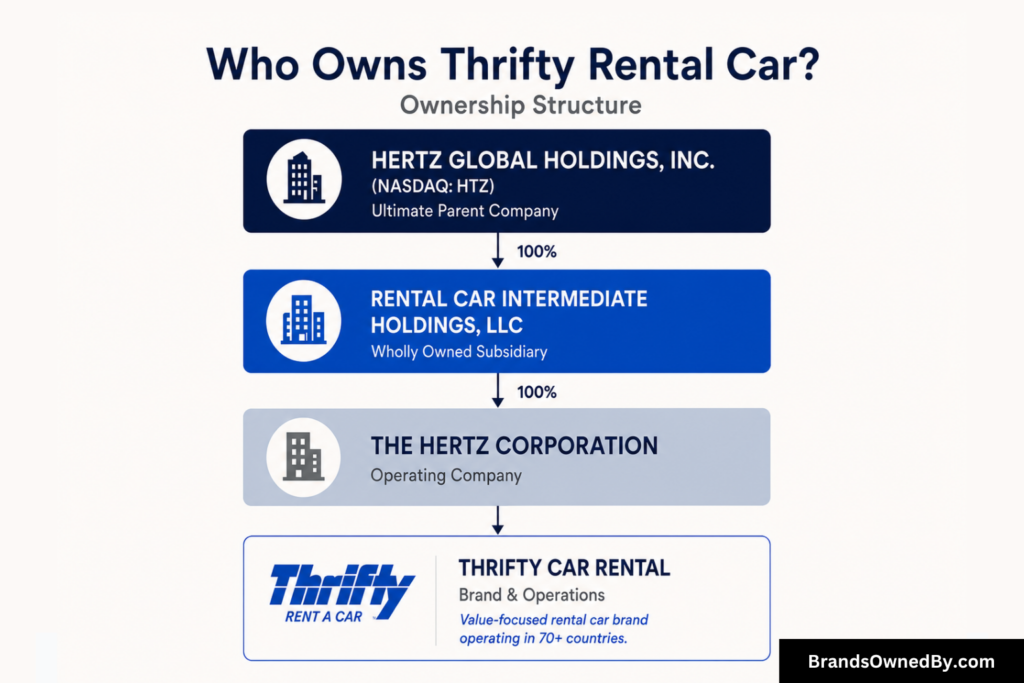
Thrifty Rental Car is owned by Hertz Global Holdings, Inc. It operates through The Hertz Corporation, the principal operating subsidiary of Hertz Global Holdings.
Thrifty is not an independent public company. It has no separately traded stock, public market valuation, or standalone shareholder register. Investors who own Hertz Global Holdings shares have indirect exposure to Thrifty alongside the Hertz, Dollar, and Firefly rental brands.
Hertz Global Holdings trades on the Nasdaq under the ticker HTZ. Its ownership structure includes one controlling investment group, several large financial institutions, company directors, executives, and public investors.
As of July 2026, CK Amarillo LP is the controlling shareholder of Hertz Global Holdings. It beneficially owns 181.46 million shares, representing 57.6% of the company. TD Securities and BlackRock are the other disclosed holders with ownership above 5%.
CK Amarillo LP
CK Amarillo LP is the largest shareholder of Hertz Global Holdings.
It beneficially owns approximately 181.46 million Hertz shares. This represents 57.6% of the company’s outstanding common stock based on Hertz’s latest proxy ownership table.
A holding above 50% gives CK Amarillo effective voting control over Hertz. It can generally determine the outcome of ordinary shareholder votes when it votes as a unified holder.
CK Amarillo is managed through a partnership involving Knighthead Capital Management and Certares Opportunities. CK Amarillo GP serves as its general partner, while Knighthead and Certares act as investment managers.
The investment committee responsible for the Hertz position includes representatives connected with both investment managers. Several members of that committee also serve on Hertz’s board of directors.
This creates a direct link between the controlling shareholder and the company’s governance structure.
CK Amarillo does not own Thrifty separately. Its 57.6% interest is in Hertz Global Holdings, which owns the corporate group that operates Thrifty.
Its indirect economic exposure also includes Hertz Rent A Car, Dollar Rent A Car, Firefly, fleet assets, vehicle-sales activities, franchise income, and Hertz’s other operations.
Knighthead Capital Management
Knighthead Capital Management is one of the investment managers behind CK Amarillo.
The firm became involved with Hertz during the company’s restructuring and emergence from Chapter 11. It participated in the investor group that provided capital for Hertz’s reorganization.
Knighthead does not report a separate 57.6% ownership position in addition to CK Amarillo. Its influence comes through its role in managing the shares held by CK Amarillo.
The firm shares authority over major investment decisions relating to the position. These decisions can include voting the shares and determining whether they should be retained, transferred, or sold.
Because CK Amarillo holds a majority interest, Knighthead has substantial indirect influence over Hertz’s board composition, governance, and long-term corporate direction.
That influence extends to Thrifty only through Hertz. Knighthead does not manage Thrifty’s daily rental prices, locations, fleet allocation, or customer service.
Certares Opportunities
Certares Opportunities is the other principal investment manager associated with CK Amarillo.
Certares specializes in travel, tourism, hospitality, and related industries. Its involvement is strategically relevant because Hertz operates within the global travel ecosystem.
Certares shares investment-management authority over CK Amarillo’s Hertz position. It can therefore participate in decisions concerning how the controlling block of Hertz shares is voted or managed.
The firm’s exposure to Thrifty remains indirect. Certares does not separately own the Thrifty trademark or rental network.
Its economic interest is tied to the performance of the complete Hertz organization.
TD Securities (USA) LLC
TD Securities is the second-largest disclosed beneficial holder of Hertz securities in the latest 2026 filing.
It reported beneficial ownership of approximately 27.85 million shares, representing 8.1% of the applicable share base.
Most of this position consists of shares that TD Securities could receive by exercising Hertz warrants. Only a smaller portion represents common shares already held directly.
A warrant gives its holder the right to purchase common shares under specified terms. SEC beneficial-ownership rules generally count shares obtainable through exercisable warrants when calculating ownership.
This means TD Securities’ reported 8.1% beneficial interest is not the same as holding 27.85 million ordinary shares outright on the reporting date.
The position is connected with the wider Toronto-Dominion Bank corporate group. However, TD Securities is the entity reporting the principal voting and disposal authority over the securities.
TD Securities does not directly own Thrifty. Its investment provides indirect exposure through Hertz Global Holdings.
BlackRock, Inc.
BlackRock is another major institutional shareholder of Hertz Global Holdings.
The company’s 2026 proxy listed BlackRock with approximately 19.60 million shares. This represented 6.2% of Hertz’s outstanding common stock under the ownership calculation used in the proxy.
BlackRock generally holds shares for investment funds, exchange-traded funds, institutional portfolios, and other managed accounts.
The shares are therefore held on behalf of many underlying investors rather than as a traditional strategic acquisition of Hertz by BlackRock itself.
BlackRock may exercise voting authority over many of these shares according to its stewardship and proxy-voting policies.
Its 6.2% position gives it meaningful influence in shareholder votes. However, it does not provide control because CK Amarillo holds a majority interest.
BlackRock’s investors gain exposure to the entire Hertz group. They do not hold separately identifiable shares in Thrifty Rental Car.
Hertz Directors and Executive Officers
Hertz directors and current executive officers collectively own approximately 3.08 million shares.
Their combined ownership represents less than 1% of Hertz Global Holdings.
Executive and director ownership includes common shares, vested equity awards, and securities that may become exercisable or transferable within the period covered by SEC ownership rules.
Wayne “Gil” West, Hertz’s chief executive officer, was the largest disclosed individual insider holder in the proxy table. He beneficially owned approximately 1.27 million shares.
Other directors and executives held smaller individual positions. These included Mark Fields, Scott Haralson, Sandeep Dube, Vincent Intrieri, Jennifer Feikin, and other members of Hertz’s leadership.
Insider ownership helps align part of management’s financial interests with those of shareholders.
However, directors and executives do not control Hertz through their personal holdings. Their combined stake is significantly smaller than CK Amarillo’s majority position.
Their managerial authority comes primarily from their executive positions and board responsibilities rather than from the percentage of shares they own.
Public and Other Institutional Shareholders
The remaining Hertz shares are held by public investors, investment managers, hedge funds, pension-related accounts, banks, brokerage firms, and other institutions.
No other shareholder was identified in Hertz’s 2026 proxy as beneficially owning more than 5% of the company.
These investors collectively provide the publicly traded portion of Hertz’s ownership structure.
Their holdings may change frequently. Investment funds rebalance portfolios, traders purchase or sell shares, and institutions update their positions through quarterly or event-driven regulatory filings.
Ordinary shareholders can vote on matters such as director elections, executive compensation, and other proposals submitted for shareholder approval.
However, their combined influence is limited by CK Amarillo’s 57.6% controlling position.
Competitor Ownership Comparison
Thrifty competes with brands that operate under several ownership models.
Some rivals are privately controlled. Others are owned by public companies. Several appear to be separate competitors but are actually sister brands under one parent organization.
Enterprise Rent-A-Car
Enterprise Rent-A-Car is owned by Enterprise Mobility, formerly known as Enterprise Holdings.
Enterprise Mobility is privately held by the Taylor family. It also owns National Car Rental and Alamo Rent A Car.
This creates a three-brand structure:
- Enterprise focuses heavily on neighborhood rentals, replacement vehicles, and a broad consumer market.
- National is strongly associated with frequent business travelers.
- Alamo is positioned toward leisure and vacation customers.
Enterprise’s private ownership allows the Taylor family to take a long-term approach without quarterly public-market reporting pressure.
Thrifty differs because its ultimate parent, Hertz Global Holdings, is publicly traded.
Alamo Rent A Car
Alamo is also owned by Enterprise Mobility.
It is one of Thrifty’s closest competitors in leisure-focused airport rentals. Both brands target travelers who compare prices, vehicle categories, airport convenience, and family-related needs.
The ownership difference remains significant. Alamo is part of a privately held family-controlled company. Thrifty is part of a publicly traded corporate group.
Avis Car Rental
Avis is owned by Avis Budget Group, Inc.
Avis Budget Group trades on the Nasdaq under the ticker CAR. Its shareholders therefore own Avis indirectly through the listed parent company.
Avis is generally positioned as the group’s more premium mainstream rental brand. It competes more directly with Hertz’s flagship brand in many corporate and airport channels.
However, Avis can still compete with Thrifty when pricing overlaps.
Budget Rent a Car
Budget is also owned by Avis Budget Group.
Budget is the closer strategic comparison to Thrifty. Both target value-conscious travelers while operating under larger publicly traded rental groups.
The ownership structures are similar:
- Budget is owned through Avis Budget Group.
- Thrifty is owned through Hertz Global Holdings.
Neither brand has its own separately traded stock.
Sixt
Sixt is controlled through Sixt SE, a publicly traded German mobility company.
The Sixt family retains significant voting influence. This gives the company a combination of public-market ownership and family control.
Sixt often presents itself as a premium or premium-value rental provider. It has expanded its U.S. airport presence and competes with Hertz, Avis, National, and Thrifty in selected locations.
Unlike Thrifty, Sixt is the primary global brand of its parent company rather than a secondary brand inside a large U.S. multi-brand group.
Europcar
Europcar operates under Europcar Mobility Group. The company was acquired by Green Mobility Holding, an investment consortium led by Volkswagen Group with participation from Attestor and Pon Holdings.
Europcar therefore operates under consortium ownership rather than as an independent public rental company.
Its ownership is strategically connected to automotive manufacturing, mobility services, and investment capital.
Thrifty’s parent is different. Hertz is primarily focused on rental vehicles, fleet management, mobility services, and vehicle remarketing.
Dollar Rent A Car
Dollar is not only a competitor to Thrifty. It is also a sister brand.
Both are owned by Hertz. They may appear together in airport searches and travel-booking platforms.
The two brands can offer different prices for similar vehicles. This allows Hertz to capture more search traffic and serve multiple customer groups.
From a corporate perspective, revenue from either brand supports the same ultimate parent.
Who Controls Thrifty Rental Car?
Hertz Global Holdings controls Thrifty through its ownership of The Hertz Corporation and the underlying operating structure.
Control should not be confused with ordinary share ownership. A shareholder may own part of Hertz without having authority over daily business decisions.
Hertz Global Holdings’ Board of Directors
The board of directors has ultimate oversight of Hertz Global Holdings.
The board approves major strategic priorities. It also oversees senior leadership, risk management, capital allocation, financing, executive compensation, and corporate governance.
Decisions that could materially affect Thrifty may include:
- Major changes to the group’s brand strategy.
- Large fleet commitments.
- Significant debt transactions.
- Acquisitions or disposals.
- Entry into major partnerships.
- Restructuring initiatives.
- Capital-raising decisions.
The board does not normally determine the price of an individual Thrifty booking. That is handled through operating systems and management processes.
Hertz Executive Management
Hertz’s executive leadership manages the company’s daily operations.
This includes fleet procurement, pricing systems, technology, customer experience, labor planning, airport relationships, franchise support, marketing, and vehicle disposal.
Thrifty does not operate as a completely separate corporation with an independent public-company management structure. It functions within Hertz’s broader operating platform.
Brand Management
Brand management teams control how Thrifty is positioned in the market.
They determine how the brand communicates value, which customer segments it targets, and how it differs from Hertz and Dollar.
For example, Hertz may emphasize premium service, loyalty benefits, and business travel. Thrifty may emphasize savings, straightforward rentals, and leisure travel.
The brands can still share vehicles, facilities, systems, or employees in certain markets.
Major Shareholder Influence
Large Hertz shareholders can influence the company through voting rights and engagement with the board.
Pershing Square became particularly significant because of the size of its investment. Its involvement increased market attention on Hertz’s turnaround strategy, cost structure, fleet economics, and potential earnings recovery.
However, influence is not the same as unilateral control. Hertz remains governed by its board, corporate charter, securities rules, debt agreements, and shareholder voting structure.
Franchise and Licensee Control
Some Thrifty locations are operated by franchisees or licensees.
These operators control many local activities. They may employ staff, maintain vehicles, manage facilities, and serve customers.
They do not own the Thrifty brand itself. Their right to use the name depends on an agreement with Hertz or an affiliated entity.
This creates two levels of control:
Hertz controls the brand, standards, systems, and intellectual property.
The local operator controls defined aspects of the location under the franchise or license agreement.
Thrifty Rental Car Annual Revenue and Net Worth
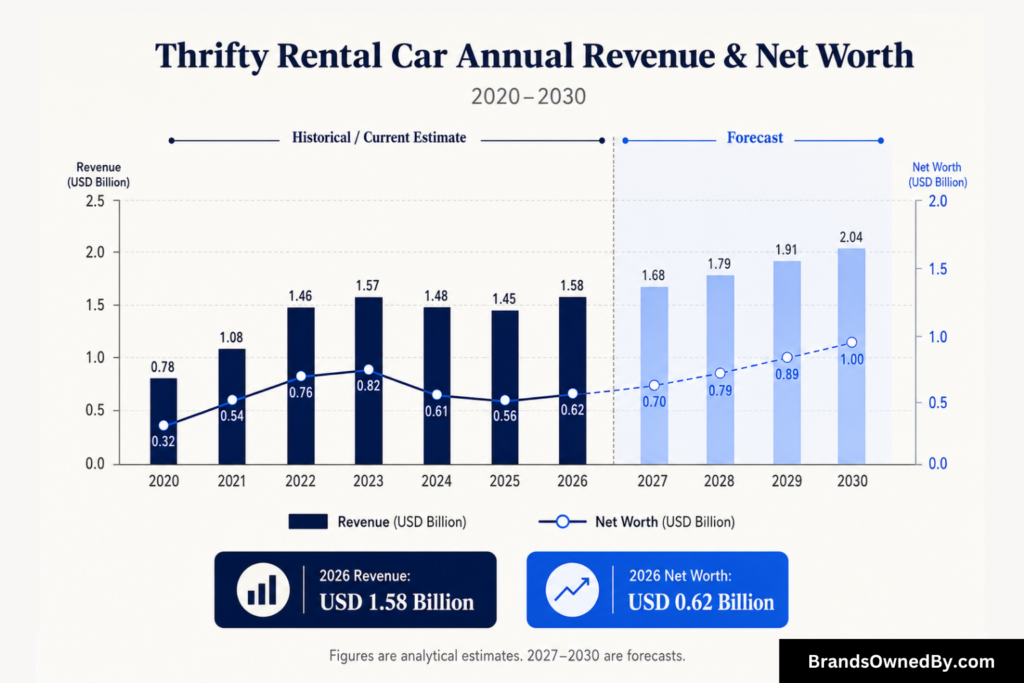
Thrifty Rental Car is estimated to generate approximately $1.58 billion in revenue in 2026. Its estimated brand and operating value is approximately $620 million.
Thrifty does not publish standalone financial statements. Hertz combines Thrifty’s results with its wider rental operations. The figures below are therefore analytical estimates based on Hertz’s performance, rental demand, pricing trends, and Thrifty’s likely contribution to the group.
Thrifty Rental Car Revenue in 2026
Thrifty’s estimated 2026 revenue is $1.58 billion, up approximately 9% from an estimated $1.45 billion in 2025.
The increase is supported by stronger rental pricing, higher travel demand, improved fleet management, and better revenue per rental day across Hertz’s operations.
Hertz generated $2.004 billion in consolidated revenue during the first quarter of 2026. This was an 11% increase from the same period in 2025. Revenue per rental day also increased 5.5%.
Thrifty benefits from many of the same conditions because it uses Hertz’s fleet, pricing systems, airport network, reservation technology, and operational infrastructure.
Revenue Breakdown
Core vehicle rentals are estimated to generate approximately $1.17 billion, or 74% of Thrifty’s 2026 revenue.
This includes daily and weekly rental charges across economy cars, sedans, SUVs, vans, and other vehicle categories.
Ancillary products and services are estimated at $237 million, or 15%. These include vehicle upgrades, additional-driver charges, toll services, fuel fees, protection products, child seats, and one-way rental charges.
Franchise, licensing, and reservation-related income is estimated at $95 million, or 6%.
The remaining $78 million, or 5%, is estimated to come from cancellation fees, administrative charges, damage recoveries, and other rental-related income.
What is Driving Revenue Growth?
Higher rental prices are a major contributor.
A small increase in the average daily rental rate can produce meaningful revenue growth when applied across millions of rental days.
Travel demand is another important factor. Thrifty has strong exposure to airport and leisure rentals. It benefits when more people travel for vacations, family visits, events, and international tourism.
Fleet utilization also matters. Hertz reported utilization of 79% during the first quarter of 2026. Vehicle recalls reduced reported utilization and affected approximately 930,000 rental days.
The recalls lowered Hertz’s quarterly revenue by around $50 million. Thrifty likely experienced part of this disruption because it operates within the same fleet network.
Revenue Compared With 2025
Thrifty’s estimated revenue increased by approximately $130 million between 2025 and 2026.
This represents growth of about 9%.
The improvement reflects stronger pricing and demand rather than a major expansion of the Thrifty brand.
Hertz also entered 2026 with a younger fleet, improved pricing systems, and better operating discipline than in previous years.
Thrifty Rental Car Net Worth in 2026
Thrifty’s estimated net worth is approximately $620 million in 2026.
This is an estimate of the brand’s economic and operating value. It is not reported shareholder equity.
Thrifty has value because of its recognized name, airport presence, customer base, franchise relationships, reservation traffic, trademarks, and access to Hertz’s fleet and technology.
The brand also has strategic value. It allows Hertz to compete for price-conscious customers without changing the positioning of its premium Hertz brand.
Net Worth Breakdown
Thrifty’s brand name and intellectual property are estimated to represent approximately $180 million, or 29% of its total value.
Its rental network and airport presence are estimated at $155 million, or 25%.
Franchise and licensing relationships account for an estimated $90 million, or 15%.
Customer relationships, direct bookings, digital assets, and loyalty data are estimated at $75 million, or 12%.
The remaining $120 million, or 19%, represents estimated future cash-generating potential.
These figures are analytical estimates because Hertz does not publish a separate Thrifty valuation.
Net Worth Growth
Thrifty’s estimated value increased from $560 million in 2025 to $620 million in 2026.
This represents growth of approximately 10.7%.
The increase reflects stronger revenue expectations and improvements in fleet economics.
Hertz reported vehicle depreciation of $312 per vehicle per month during the first quarter of 2026. This was a 13% improvement from the previous year.
Lower depreciation can significantly improve rental profitability because vehicles are the industry’s largest operating assets.
Financial Risks
Thrifty’s financial outlook remains closely tied to Hertz.
Hertz reported a GAAP net loss of $333 million during the first quarter of 2026. Adjusted corporate EBITDA was negative $161 million.
Vehicle recalls, depreciation, financing costs, used-car prices, and high operating expenses remain important risks.
Thrifty may generate meaningful revenue while still facing pressure on profitability if fleet and financing costs rise.
Thrifty Revenue Forecast Through 2030
The forecast assumes moderate growth in travel demand, rental pricing, direct bookings, and ancillary revenue.
- 2027: Revenue is forecast to reach $1.68 billion, an increase of 6.3%.
- 2028: Revenue is forecast to reach $1.79 billion, an increase of 6.5%.
- 2029: Revenue is forecast to reach $1.91 billion, an increase of 6.7%.
- 2030: Revenue is forecast to reach $2.04 billion, an increase of 6.8%.
The forecast represents an estimated compound annual growth rate of approximately 6.6% from 2026 to 2030.
Net Worth Forecast Through 2030
Thrifty’s estimated brand and operating value is forecast to rise from $620 million in 2026 to approximately $1 billion in 2030.
The estimated values are:
- 2027: $700 million.
- 2028: $790 million.
- 2029: $890 million.
- 2030: $1 billion.
The forecast assumes that Hertz improves fleet profitability, reduces depreciation, maintains the Thrifty brand, and continues investing in its rental network.
Financial Outlook
Thrifty remains a valuable part of the Hertz portfolio.
Its estimated $1.58 billion in 2026 revenue gives it meaningful scale in the value-focused rental market.
Its estimated $620 million brand and operating value reflects its name recognition, airport access, franchise relationships, customer demand, and future earnings potential.
Future performance will depend on travel demand, rental pricing, fleet utilization, vehicle depreciation, financing costs, and Hertz’s broader financial recovery.
Final Thoughts
Thrifty Rental Car is owned by Hertz Global Holdings through The Hertz Corporation.
The brand began as an independent rental company in 1958. It later passed through investor ownership, public ownership, Chrysler control, and Dollar Thrifty Automotive Group.
Hertz acquired Dollar Thrifty in 2012 for approximately $2.3 billion. Thrifty has remained part of Hertz since that transaction.
The brand does not have separately traded stock. It also does not publish standalone financial statements. Investors seeking exposure to Thrifty must invest in Hertz Global Holdings under the Nasdaq ticker HTZ.
Thrifty continues to play a clear strategic role. It gives Hertz a recognized value brand for customers who prioritize price, airport access, and practical transportation.
FAQs
Who owns Thrifty Rental Car?
Thrifty Rental Car is owned by Hertz Global Holdings, Inc. It operates through The Hertz Corporation, which is part of the Hertz corporate group.
Is Thrifty owned by Hertz?
Yes. Hertz acquired Dollar Thrifty Automotive Group in 2012. The acquisition brought both Dollar Rent A Car and Thrifty Car Rental under Hertz ownership.
Is Thrifty owned by Dollar?
No. Thrifty and Dollar are sister brands.
They were previously the two main brands of Dollar Thrifty Automotive Group. Hertz now owns both.
Is Thrifty Rental Car a public company?
No. Thrifty is not independently listed on a stock exchange.
Its ultimate parent, Hertz Global Holdings, is publicly traded on the Nasdaq under the ticker HTZ.
Can I buy Thrifty stock?
You cannot buy shares in Thrifty as a standalone company.
You can buy shares in Hertz Global Holdings. That provides indirect exposure to Thrifty and Hertz’s other operations.
Who is the largest shareholder of Thrifty?
Thrifty has no separate public shareholders because it is controlled within The Hertz Corporation.
At the parent-company level, Pershing Square Capital Management is one of the most influential Hertz investors. Institutional investors and public shareholders own the remaining Hertz shares.
Does Enterprise own Thrifty?
No. Enterprise Mobility does not own Thrifty.
Enterprise Mobility owns Enterprise Rent-A-Car, National Car Rental, and Alamo Rent A Car.
Does Avis own Thrifty?
No. Avis Budget Group does not own Thrifty.
Avis Budget Group owns Avis and Budget. Thrifty belongs to Hertz Global Holdings.
Are Hertz and Thrifty the same company?
They are not the same brand, but they operate under the same corporate group.
Hertz is the flagship brand. Thrifty is positioned toward value-conscious customers.
Are Dollar and Thrifty the same company?
Dollar and Thrifty are separate rental brands under Hertz ownership.
They may share operating resources in some locations. However, they maintain separate names, websites, pricing, and customer-facing offers.
Who founded Thrifty Car Rental?
Thrifty was established in 1958 in Tulsa, Oklahoma. It later became closely associated with Bill Lobeck, who led an investor group that acquired the company in 1981.
Where is Thrifty Rental Car headquartered?
Thrifty operates within The Hertz Corporation, which is headquartered in Estero, Florida.
When did Hertz buy Thrifty?
Hertz completed its acquisition of Dollar Thrifty Automotive Group in November 2012.
How much did Hertz pay for Thrifty?
Hertz paid approximately $2.3 billion for Dollar Thrifty Automotive Group.
The purchase included both the Dollar and Thrifty brands. Therefore, the full acquisition price should not be attributed to Thrifty alone.
Did Thrifty go bankrupt?
Thrifty’s parent, Hertz, entered Chapter 11 bankruptcy protection in 2020.
Hertz emerged from bankruptcy in 2021. Thrifty remained part of the reorganized company and continued operating.
Is Thrifty cheaper than Hertz?
Thrifty is generally positioned as a more value-oriented brand.
However, the actual price depends on location, dates, demand, vehicle category, fees, and promotions. A Hertz offer can sometimes be cheaper than a Thrifty offer for the same trip.
Is Thrifty a franchise?
Thrifty uses a combination of company-operated, franchised, and licensed locations.
The operating model varies by country and market. The Thrifty name and brand system remain controlled by Hertz.
Does Thrifty own its rental cars?
Vehicles used at company-operated Thrifty locations are generally owned or leased within the Hertz fleet structure.
A franchisee may use a different fleet ownership or financing arrangement, subject to its agreement and local operating model.
How does Hertz benefit from owning Thrifty?
Thrifty allows Hertz to serve price-conscious customers without weakening the premium positioning of its flagship brand.
The group can also benefit from shared fleet purchasing, airport facilities, reservation technology, vehicle financing, maintenance systems, and used-car remarketing.
How much revenue does Thrifty make?
Hertz does not disclose Thrifty’s standalone revenue.
An analytical estimate places Thrifty’s 2026 revenue at approximately $1.58 billion. This is not a reported company figure.
What is Thrifty Rental Car’s net worth?
Thrifty does not publish a standalone net-worth figure.
Its brand and operating value is estimated at approximately $620 million in 2026. This estimate is separate from Hertz’s market capitalization and accounting equity.
What brands are owned by Thrifty?
Thrifty does not directly own Hertz’s other major rental brands.
Instead, Thrifty, Hertz, Dollar, and Firefly are related through common ownership under Hertz Global Holdings.
Who controls Thrifty in 2026?
Hertz Global Holdings controls Thrifty through The Hertz Corporation.
Strategic oversight comes from the Hertz board of directors. Daily control rests with Hertz’s executive and operating leadership.