
- Maplebear Inc. owns Instacart Marketplace, Instacart Ads, Carrot Ads, Caper Carts, and its wider enterprise grocery technology platform.
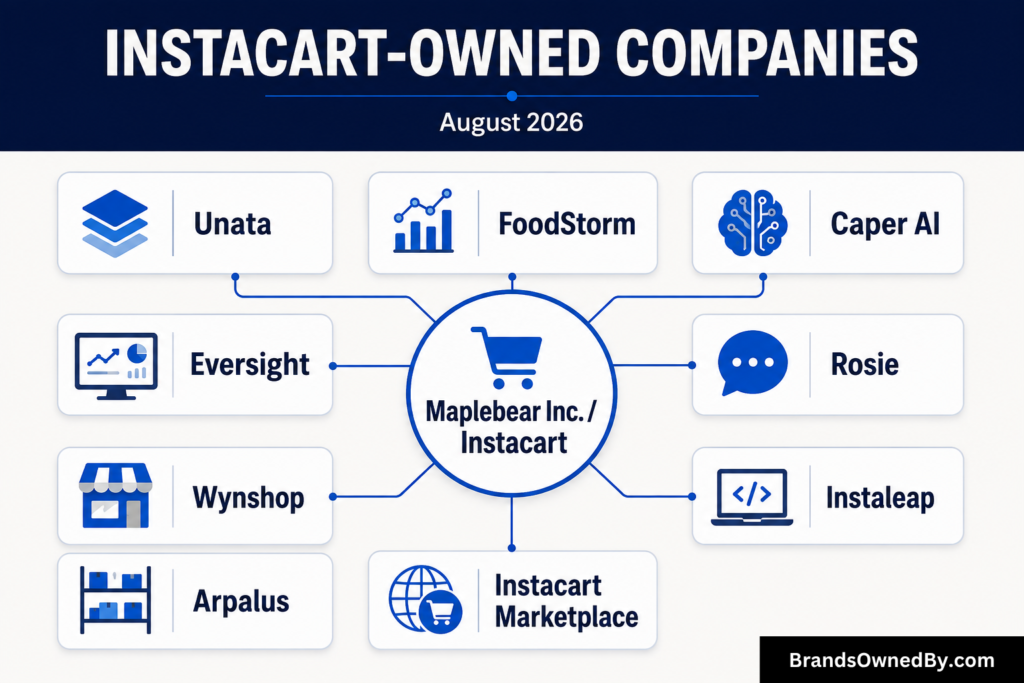
- Its major acquired businesses include Unata, FoodStorm, Caper AI, Eversight, Rosie, Wynshop, Instaleap, and Arpalus.
- Wynshop and Instaleap expand retailer e-commerce and fulfillment capabilities, while Arpalus and Caper AI strengthen Instacart’s in-store technology.
- Instacart owns technology platforms, not the independent grocery retailers or product brands available through its marketplace.
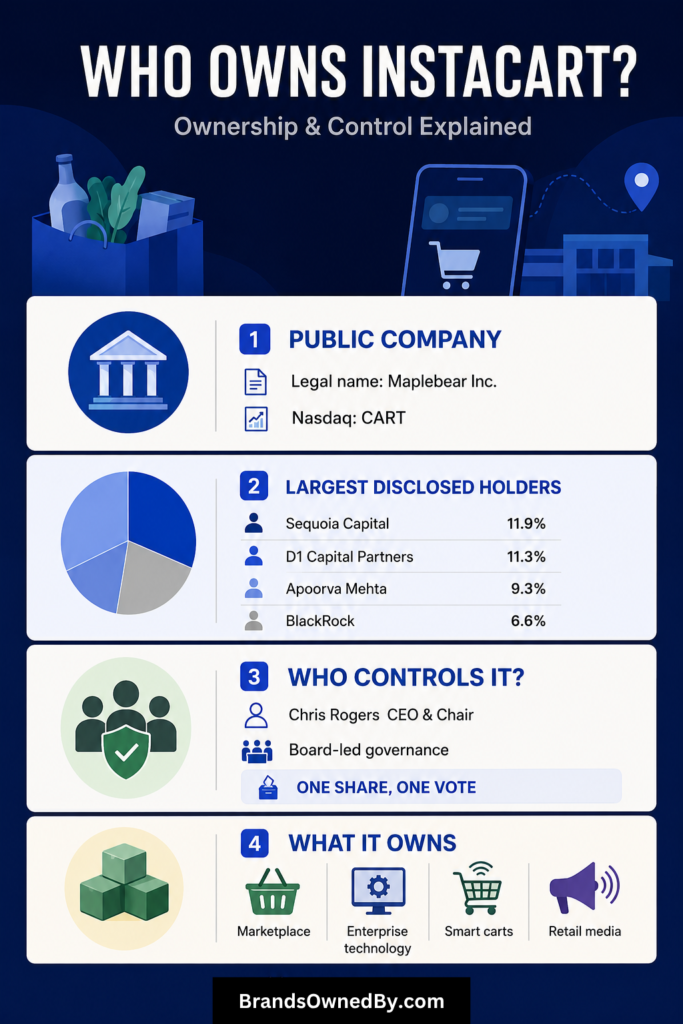
Instacart is owned by the shareholders of Maplebear Inc., a publicly traded company listed on Nasdaq under the ticker CART. No parent company or individual owns the business outright. Sequoia Capital is the largest disclosed shareholder. D1 Capital Partners and founder Apoorva Mehta also hold substantial positions. Chris Rogers leads the company as CEO and chair, but strategic control is shared between management, the board, and voting shareholders.
Instacart is more than a grocery delivery application. It has developed into a broader grocery technology platform. Its operations cover online ordering, fulfillment, retail advertising, smart carts, enterprise software, and in-store inventory tools.
The consumer-facing Instacart name is a trade name. The legal corporate entity behind it is Maplebear Inc.
Who Founded Instacart?
Apoorva Mehta, Max Mullen, and Brandon Leonardo founded Instacart in 2012.
Mehta was born in India and raised in Canada. Before starting Instacart, he worked as a supply-chain engineer at Amazon. He later left Amazon and experimented with several startup concepts. Most failed to gain traction.
The grocery problem stood out to him because buying groceries remained inconvenient. Consumers could purchase books, electronics, and other products online. Grocery shopping still required a physical store visit in most markets.
Mehta developed the early version of Instacart and reportedly placed one of its first test orders himself. Max Mullen and Brandon Leonardo joined as co-founders. Their combined experience helped turn the initial application into a functioning marketplace.
Where Did Instacart Originate?
Instacart originated in San Francisco, California. The company participated in Y Combinator’s 2012 startup program.
Its initial model connected customers with personal shoppers. A customer selected products through the Instacart application. A shopper then visited the chosen store, purchased the products, and delivered them.
This structure allowed Instacart to expand without building warehouses or purchasing grocery inventory. It used existing retailer locations as its fulfillment network.
That asset-light model remains central to the business. However, the company now provides much more technology to retailers, brands, and shoppers.
How Instacart’s Business Model Works
Instacart operates a multi-sided platform. It serves consumers, grocery retailers, consumer-product brands, and independent shoppers.
The company earns transaction revenue from several sources. These include delivery fees, service charges, memberships, retailer agreements, and fulfillment services.
It also sells advertising and promotional placements to brands. A cereal producer, for example, can pay to have its products displayed more prominently when a customer searches for breakfast food.
Its enterprise software adds another dimension. Retailers can use Instacart technology for their own websites, applications, order management, smart carts, advertising, and fulfillment operations.
Instacart does not normally own the groceries sold through its marketplace. The participating retailer owns the inventory and generally determines the underlying product prices.
Major Instacart Milestones
Instacart’s development can be summarized through several important events:
- 2012: Apoorva Mehta, Max Mullen, and Brandon Leonardo founded Instacart.
- 2013: The company expanded beyond San Francisco and attracted larger venture investors.
- 2015: Instacart’s valuation reached approximately $2 billion after a major financing round.
- 2018: Instacart acquired Unata, adding white-label grocery e-commerce technology.
- 2020: Pandemic-related demand accelerated online grocery adoption. Instacart’s private valuation reached $17.7 billion late in the year.
- 2021: A new funding round valued the business at $39 billion. Fidji Simo became CEO. Instacart also acquired FoodStorm and Caper AI.
- 2022: The company acquired Eversight and Rosie to expand its retailer technology portfolio.
- 2023: Maplebear Inc. completed its initial public offering. Its shares began trading on Nasdaq under the CART ticker.
- 2025: Chris Rogers replaced Fidji Simo as CEO. Instacart acquired Wynshop.
- 2026: The company acquired Instaleap and Arpalus. These transactions expanded its international enterprise and shelf-intelligence capabilities.
Ownership History
Instacart’s ownership has passed through three broad phases. It began as a founder-owned startup. It then became a privately financed venture-backed company. It finally became a publicly traded corporation.
Each phase changed the distribution of economic ownership and corporate influence.
Founder and Seed Ownership
The three co-founders initially owned the operating company. Their percentages were diluted as Instacart issued shares to employees and outside investors.
Y Combinator was one of the company’s earliest institutional backers. Other early investors included Khosla Ventures, Canaan Partners, FundersClub, and angel investors.
Early-stage investors accepted substantial operating risk. Instacart had not yet demonstrated that consumers would consistently pay for third-party grocery delivery. It also had to convince supermarkets that the platform would complement their stores rather than weaken customer relationships.
Venture-Capital Expansion
Instacart required significant outside capital to enter new markets, recruit shoppers, develop technology, and acquire customers.
Andreessen Horowitz, Sequoia Capital, D1 Capital Partners, Fidelity, T. Rowe Price, DST Global, and General Catalyst became important investors during the private-company period.
These investments diluted founder ownership. They also placed experienced investors and industry executives around the company’s board.
Sequoia became particularly influential. Its involvement extended beyond share ownership. Ravi Gupta served as Instacart’s chief financial officer and chief operating officer before becoming a Sequoia partner. He later joined Instacart’s board and became lead independent director.
The Pandemic Valuation Increase
Demand for grocery delivery rose sharply during 2020. Consumers who previously preferred stores tried digital grocery services for the first time.
Instacart raised capital at a $13.7 billion valuation in June 2020. Additional financing later that year increased its valuation to approximately $17.7 billion.
In March 2021, Instacart raised another $265 million. That transaction valued the company at $39 billion.
The $39 billion figure represented a private financing valuation. It did not mean the business had $39 billion in assets or cash. It reflected the price investors were willing to pay for a small portion of the company at that time.
Valuation Reset Before the IPO
Online grocery growth moderated as consumers returned to physical stores. Public technology valuations also declined.
Instacart reduced its internal valuation to approximately $24 billion in early 2022. Further reductions brought the figure to about $10 billion late in the year.
This valuation reset did not mean Instacart had lost three-quarters of its operations. Revenue was still growing. The reduction primarily reflected lower valuation multiples and more conservative expectations for post-pandemic growth.
Instacart’s Public Listing
Maplebear Inc. completed its IPO in September 2023. The offering priced 22 million shares at $30 each. This created an initial equity valuation of approximately $10 billion.
The shares began trading publicly under the CART ticker. From that point, Instacart’s ownership became transferable through the stock market.
Existing investors did not disappear after the IPO. Sequoia Capital, D1 Capital Partners, Apoorva Mehta, and other pre-IPO holders retained substantial positions.
However, Instacart did not adopt a founder-controlled dual-class structure. Its common shares generally follow a one-share, one-vote system. That makes its governance different from DoorDash, where founder-controlled shares carry enhanced voting rights.
PepsiCo’s Preferred-Shares Investment
PepsiCo invested $175 million in Instacart alongside the IPO. It received 5.83 million Series A redeemable convertible preferred shares at $30 per share.
These securities are different from Instacart’s publicly traded common stock. They contain conversion and redemption provisions. They do not make PepsiCo Instacart’s parent company.
The investment created an important commercial and financial relationship. PepsiCo is also a major consumer-products advertiser. However, it does not control Instacart’s board or ordinary shareholder votes.
Who Owns Instacart: Top Shareholders
![Who Owns Instacart [top shareholders]](https://brandsownedby.com/wp-content/uploads/2026/09/Who-Owns-Instacart-top-shareholders-1024x683.png)
Maplebear Inc.’s shareholders collectively own Instacart. The following percentages represent the latest usable public disclosures available in August 2026. Filing dates and share-count reference dates differ, so percentages can change when investors trade shares or Instacart repurchases stock.
No disclosed investor has majority ownership. The shareholder register is concentrated enough to give several early investors influence, but not unilateral control.
Sequoia Capital (11.9%)
Entities affiliated with Sequoia Capital beneficially own approximately 27.93 million Instacart shares. This represents about 11.9% of the common stock using the outstanding share count referenced in Sequoia’s latest filing.
Sequoia is the largest disclosed shareholder. Its relationship with Instacart dates back to the private-company period.
Sequoia’s influence is strengthened by its board connection. Ravi Gupta is a Sequoia partner and Instacart’s lead independent director. He previously served as Instacart’s chief financial officer and chief operating officer.
This does not give Sequoia legal control. It does provide significant strategic context, board-level representation, and voting influence.
D1 Capital Partners (11.3%)
D1 Capital Partners beneficially owns approximately 26.68 million shares. Its position represents roughly 11.3% of Instacart based on the company’s more recent outstanding share count.
D1 is an investment firm founded by Daniel Sundheim. Sundheim serves on Instacart’s board.
Part of D1’s disclosed beneficial ownership includes shares connected to investment vehicles and accounts over which D1 exercises voting or investment authority. Beneficial ownership therefore does not always mean every share belongs directly to the investment manager.
D1’s shareholding and board position make it one of Instacart’s most influential financial investors. It still lacks enough votes to control shareholder decisions independently.
Apoorva Mehta (9.3%)
Co-founder Apoorva Mehta beneficially owns approximately 22.28 million shares under the latest detailed company disclosure. That equates to about 9.3%.
His reported position includes shares held through a revocable trust, AM Investment Holdings LLC, and exercisable stock options.
Mehta no longer manages Instacart. He stepped down as CEO in 2021 and later left the board. His influence is therefore primarily economic and shareholder-based.
This distinction matters. Mehta is Instacart’s largest individual disclosed shareholder, but he is not the company’s controlling executive. He cannot appoint directors or approve transactions without support from other shareholders.
BlackRock (6.6%)
BlackRock beneficially owns approximately 15.92 million shares, equal to 6.6% of Instacart.
The investment is held through BlackRock-managed business units and investment products. BlackRock is an asset manager. The economic beneficiaries are generally clients and fund investors rather than BlackRock’s operating company itself.
BlackRock reported sole voting authority over approximately 15.40 million shares and sole dispositive authority over about 15.92 million shares.
Its position gives it a meaningful vote on director elections, compensation, and governance matters. It does not give BlackRock operating control.
Vanguard-Related Funds
Instacart’s 2026 proxy displayed an earlier Vanguard position of approximately 19.25 million shares, or 8%.
However, Vanguard subsequently reported zero shares at the parent reporting level after an internal reporting realignment. Certain subsidiaries or business divisions now report beneficial ownership separately.
That filing should not be interpreted as proof that all Vanguard-managed funds sold their Instacart shares. It means the parent entity no longer aggregates those holdings in the same way.
For that reason, presenting Vanguard as a current 8% owner without explanation would be misleading.
Directors and Executive Officers
The 2026 proxy reported that Instacart’s then-current directors and executive officers beneficially owned approximately 24% as a group.
Most of that figure was connected to the positions attributed to Sequoia-affiliated Ravi Gupta and D1 founder Daniel Sundheim. It should not be read as management personally owning one-quarter of the company.
CEO Chris Rogers owned less than 1% at the proxy measurement date. His influence comes from his executive and board positions rather than a dominant equity stake.
Other Public Shareholders
The remaining shares are held by other institutions, mutual funds, exchange-traded funds, hedge funds, employees, founders, and individual investors.
This group represents approximately 60.9% after accounting for the four largest disclosed positions.
Ownership changes daily because CART shares trade publicly. Instacart’s repurchase program can also alter percentages. When the company retires shares, a continuing investor’s percentage can rise even if that investor purchases nothing.
Competitor Ownership Comparison
Instacart competes with delivery marketplaces and retailer-owned grocery services. Their ownership structures differ significantly.
These differences affect management accountability, acquisition flexibility, voting control, and the ability of founders or parent companies to set long-term priorities.
DoorDash
DoorDash is a publicly traded company. However, its voting structure is much more founder-controlled than Instacart’s.
DoorDash has Class A shares with one vote each and Class B shares with 20 votes each. Co-founder and CEO Tony Xu also holds voting proxies over Class B shares associated with co-founders Andy Fang and Stanley Tang.
Together, these arrangements gave Xu approximately 55.5% of DoorDash’s total voting power in its 2026 proxy disclosure.
DoorDash is therefore publicly owned but effectively founder-controlled. Instacart is publicly owned and board-controlled. No Instacart founder has comparable voting authority.
Uber Technologies
Uber is a publicly traded company with widely dispersed institutional ownership. Major asset managers hold significant positions, but no individual shareholder has majority control.
CEO Dara Khosrowshahi manages the company under board oversight. Uber’s founders no longer control shareholder voting.
This makes Uber’s ownership structure closer to Instacart’s than DoorDash’s. Both have market-based ownership and professional management. However, Instacart retains stronger representation from major pre-IPO investors through Sequoia and D1 board connections.
Walmart
Walmart is publicly traded, but the Walton family remains its dominant shareholder group. Walton family entities collectively control a large minority of Walmart’s outstanding shares.
That position gives the family far more influence than any Instacart shareholder possesses individually.
Walmart’s grocery delivery operation is an internal business unit. Customers using Walmart delivery are purchasing from Walmart’s own retail ecosystem. Instacart instead connects customers with thousands of different retailer locations.
Walmart shareholders own the delivery operation through their ownership of Walmart Inc. There is no separately traded Walmart delivery company.
Amazon
Amazon is publicly owned. Founder Jeff Bezos remains a major individual shareholder and serves as executive chair, but he does not hold a voting majority.
Amazon Fresh and Whole Foods Market operate within Amazon’s broader corporate structure. Amazon acquired Whole Foods in 2017.
Amazon combines retail ownership, warehousing, technology, advertising, and delivery. Instacart generally avoids owning grocery inventory. It provides an intermediary marketplace and technology infrastructure to independent retailers.
Amazon does not own Instacart. The companies compete for online grocery spending, advertising budgets, memberships, and fulfillment demand.
Shipt and Target
Shipt is wholly owned by Target Corporation. Target acquired Shipt in 2017 for approximately $550 million.
Shipt is therefore not an independently owned public company. Target shareholders indirectly own it through their ownership of Target stock.
The parent-subsidiary structure gives Target direct strategic control. It can integrate Shipt with Target stores, memberships, pricing, and fulfillment operations.
Instacart operates independently of any single retailer. That neutrality can be valuable when dealing with grocery chains that compete with Target, Walmart, and Amazon.
Who Controls Instacart?
No single shareholder controls Instacart in August 2026. Control is divided among the board, executive management, and common shareholders.
The company’s governance structure gives major shareholders influence without granting any one investor automatic decision-making authority.
Chris Rogers: CEO and Chair
Chris Rogers is Instacart’s CEO, president, and chair of the board.
He joined Instacart in 2019 and held senior retail and business roles before becoming chief business officer. He replaced Fidji Simo as CEO in August 2025.
Rogers became chair after Simo resigned from the board in November 2025. Combining the CEO and chair positions gives him considerable influence over management priorities and board agendas.
However, Rogers owns less than 1% of the company. His authority comes from his corporate positions. The board can evaluate his performance and replace him if necessary.
The Board of Directors
Instacart’s board oversees strategy, executive appointments, risk, compensation, capital allocation, and major transactions.
Following the 2026 annual meeting, the board was reduced to eight members:
- Chris Rogers.
- Victoria Dolan.
- Ravi Gupta.
- Mary Beth Laughton.
- Meredith Kopit Levien.
- Lily Sarafan.
- Josh Silverman.
- Daniel Sundheim.
The board is divided into three classes with staggered terms. Only one class normally faces election each year.
A classified board can provide continuity. It also makes a rapid board takeover more difficult because an activist investor cannot replace every director in one annual election.
Ravi Gupta: Lead Independent Director
Ravi Gupta serves as lead independent director.
This position is important because Chris Rogers holds both the CEO and chair roles. The lead independent director can preside over independent-director meetings, coordinate board evaluations, and act as a liaison between independent directors and the chair.
Gupta’s history with Instacart gives him deep operational knowledge. His Sequoia role also creates a connection to the largest disclosed shareholder.
Instacart identifies him as an independent director under applicable governance standards. His affiliation should still be considered when assessing the practical balance of influence.
One Share, One Vote
Instacart’s publicly traded common stock generally carries one vote per share.
The company does not have the type of perpetual super-voting founder stock used by DoorDash and several other technology companies.
This makes economic ownership more closely aligned with voting power. A shareholder owning 10% of the voting common stock generally has about 10% of ordinary voting authority.
It also means founder Apoorva Mehta’s influence has declined as his economic ownership has fallen. He cannot retain majority voting control through a special high-vote-share class.
Major Shareholder Influence
Sequoia and D1 each own more than 10% and have connected directors on the board. Together, their disclosed positions represent more than one-fifth of the company.
They could influence the outcome of a close shareholder vote. They cannot automatically approve a proposal because they still require support from other investors.
A coordinated position among Sequoia, D1, Apoorva Mehta, and BlackRock would carry substantial weight. There is no public indication that these shareholders operate as a unified controlling group.
Capital Allocation and Share Repurchases
Instacart’s board and management also exercise practical control through capital allocation.
The company repurchased $349 million of shares in the first quarter of 2026 and another $325 million in the second quarter. It ended the second quarter with approximately $998 million of remaining repurchase authorization.
Repurchases reduce the outstanding share count. This can increase continuing shareholders’ proportional ownership and earnings per share.
It also shows that Instacart’s governance is shifting from startup-era capital raising toward public-company capital management.
Instacart Annual Revenue and Net Worth
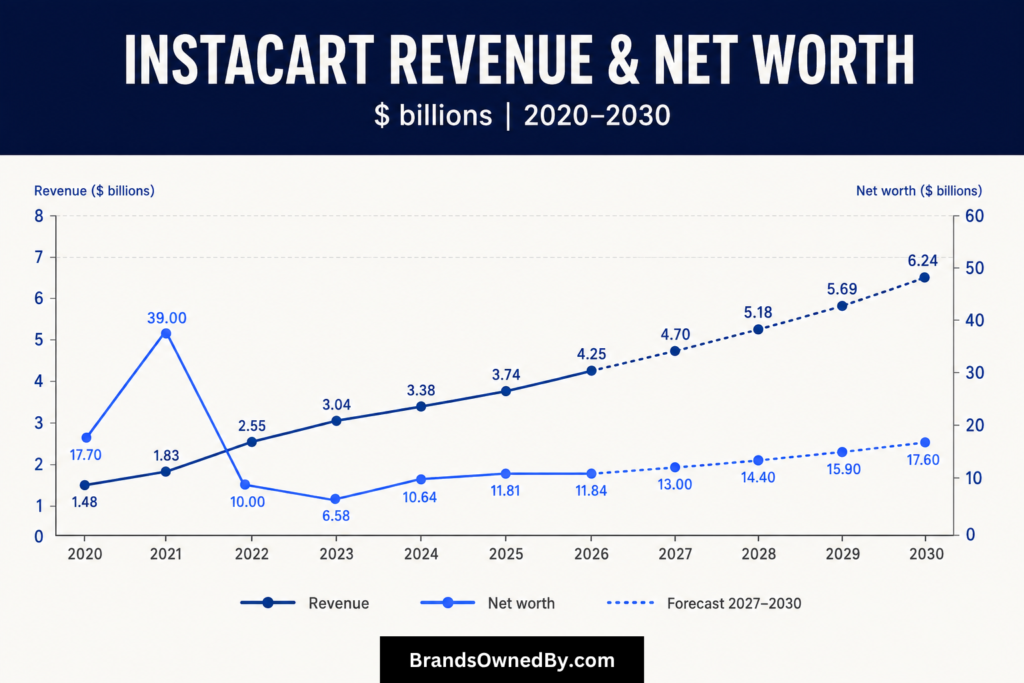
Instacart’s revenue has grown every year in the image. Its valuation has been much more volatile.
“Net worth” is used here as an estimated equity valuation. For 2020 through 2022, it represents the latest relevant private-company valuation. From 2023 onward, it represents market capitalization. These measurements are useful for comparison, but they are not identical accounting concepts.
Instacart’s 2026 Revenue
Instacart generated $1.019 billion of revenue in the first quarter of 2026. Second-quarter revenue reached $1.043 billion.
First-half revenue was therefore $2.062 billion. This represented approximately 14% growth over the comparable period.
A full-year estimate of $4.25 billion assumes that revenue growth remains near the low-to-mid-teens range during the second half. That is supported by management’s third-quarter outlook and recent acceleration in gross transaction value.
The forecast is not company-issued revenue guidance. It is an analytical estimate based on reported first-half performance and the existing revenue mix.
Transaction Revenue
Transaction revenue reached $733 million in the first quarter and $746 million in the second quarter.
First-half transaction revenue was $1.479 billion. It represented approximately 71.7% of total revenue.
This category includes consumer fees, memberships, retailer payments, fulfillment services, and related transaction economics. It does not equal gross transaction value.
For example, Instacart reported second-quarter gross transaction value of $10.35 billion. It recognized only $746 million as transaction revenue because the value of the groceries generally belongs to the retailer.
Transaction revenue represented 7.2% of gross transaction value in the second quarter.
Advertising and Other Revenue
Advertising and other revenue reached $286 million in the first quarter and $297 million in the second quarter.
The first-half total was $583 million. That represented about 28.3% of company revenue.
Second-quarter advertising and other revenue grew 16%. This was faster than transaction revenue growth.
Advertising is strategically important because it carries attractive incremental margins. Instacart already has consumer purchase-intent data when a customer searches for a product. Brands pay to appear within that decision process.
The company is also expanding advertising beyond its own marketplace through Carrot Ads and publishing partnerships. That broadens the addressable market but creates publisher payments that can affect gross margins.
Revenue Mix Estimate for 2026
Based on first-half results and current growth rates, the $4.25 billion full-year estimate can be divided approximately as follows:
Transaction revenue could reach about $3.03 billion. Advertising and other revenue could approach $1.22 billion.
That would leave the mix near 71% transaction revenue and 29% advertising and other revenue.
This balance is healthy. Transaction activity supplies purchase data and customer demand. Advertising monetizes that activity at a higher margin. Enterprise technology helps retain retailers and can place Instacart’s advertising tools on more digital properties.
Instacart’s 2026 Net Worth
Instacart’s equity market value was approximately $11.84 billion on August 7, 2026.
Market capitalization changes with the CART share price. It can move substantially after earnings reports, changes in interest rates, regulatory developments, or revisions to growth expectations.
The 2026 figure should not be confused with shareholders’ equity on Instacart’s balance sheet. Accounting equity measures recorded assets minus liabilities. Market capitalization reflects what investors are willing to pay for the outstanding common shares.
The preferred shares issued to PepsiCo and the effect of employee equity awards can also complicate comparisons between basic market capitalization and a fully diluted valuation.
Why Revenue and Net Worth Do Not Move Together
Instacart’s revenue rose from $1.83 billion in 2021 to $2.55 billion in 2022. Its estimated valuation fell from $39 billion to approximately $10 billion.
The business did not shrink by 74%. Investors simply assigned a much lower valuation multiple to each dollar of revenue.
The $39 billion private valuation assumed durable pandemic-era growth and strong technology-market pricing. The 2022 valuation reflected slower online grocery adoption, higher interest rates, and lower public technology multiples.
This is why revenue is an operating measure while net worth is a market expectation. One describes business activity. The other incorporates growth, risk, profitability, interest rates, and investor sentiment.
Revenue Forecast for 2027–2030
The forecast assumes revenue growth gradually moderates:
- 2027: 10.6% growth to $4.70 billion.
- 2028: 10.2% growth to $5.18 billion.
- 2029: 9.8% growth to $5.69 billion.
- 2030: 9.7% growth to $6.24 billion.
The forecast does not rely on another pandemic-style demand surge. It assumes grocery e-commerce penetration increases gradually.
Several growth drivers support the estimate. Instacart can add customers, increase order frequency, improve average order value, and expand membership adoption. Advertising can continue growing faster than gross transaction value.
Enterprise technology provides another lever. Wynshop, Instaleap, and Arpalus expand Instacart’s potential outside its core North American marketplace.
International enterprise expansion may contribute before international consumer delivery does. Selling software to an established overseas retailer requires less capital than building a new consumer marketplace from the ground up.
Net-Worth Forecast for 2027–2030
The net-worth forecast rises from $13 billion in 2027 to $17.6 billion in 2030.
That implies a valuation of approximately 2.8 times forecast 2030 revenue. The multiple is below the level assigned to the company during the 2021 private-market peak.
This is deliberate. Instacart has a scalable advertising and software business, but much of its revenue remains connected to lower-margin grocery transactions. It also faces competition from retailer-owned fulfillment, DoorDash, Uber, Amazon, and Walmart.
The forecast assumes improving free cash flow and moderate revenue growth. Share repurchases could support per-share value if they are completed below the company’s long-term intrinsic value.
The valuation could be higher if advertising, enterprise software, and international expansion outperform. It could be lower if retailer relationships weaken, regulatory costs rise, or grocery-delivery competition forces sustained fee reductions.
Companies and Brands Owned by Instacart
Maplebear Inc. owns the Instacart platform and a portfolio of acquired grocery technology businesses.
Some acquired names continue as identifiable products or subsidiaries. Others have been absorbed into the wider Instacart Enterprise Platform. The company does not provide separate revenue figures for most of them.
Instacart Marketplace
Instacart Marketplace is the company’s central consumer platform. It allows customers to order groceries, household products, alcohol where permitted, and other goods from participating retailers.
The marketplace connects four groups: customers, retailers, shoppers, and advertisers.
Instacart owns the platform and customer-facing technology. It does not own participating retailers or most inventory listed on the service.
The marketplace also supports Instacart+, its membership offering. Members receive benefits such as reduced delivery costs on qualifying orders.
Unata
Instacart acquired Unata in January 2018 for approximately $65 million.
Unata developed white-label digital grocery technology. Its products helped retailers create branded e-commerce experiences, digital circulars, loyalty integrations, and personalized promotions.
The acquisition was strategically important. It showed that Instacart wanted to power retailer-controlled digital storefronts, not only direct customers to the Instacart marketplace.
Unata’s capabilities have largely been integrated into Instacart’s enterprise technology portfolio. It is less visible as a standalone consumer brand.
FoodStorm
Instacart acquired FoodStorm in October 2021.
FoodStorm provides a software-as-a-service order management system for prepared foods, catering, and order-ahead services.
A supermarket can use FoodStorm to manage a large catering order involving several departments. The platform coordinates ordering, production, pickup, and customer communication.
FoodStorm continues to operate as an identifiable Instacart-backed enterprise product. It complements the standard grocery marketplace because prepared-food orders involve different workflows from ordinary shelf-item delivery.
Caper AI
Instacart acquired Caper AI in October 2021 for approximately $350 million.
Caper developed smart shopping carts and computer-vision checkout technology. Its carts can identify products, display promotions, help customers navigate stores, and support checkout.
The technology now appears primarily under the Caper Carts name.
Caper is central to Instacart’s in-store strategy. It allows the company to participate in physical grocery transactions rather than limiting itself to online orders.
The carts can also connect with loyalty programs and advertising. This gives Instacart another opportunity to link digital promotions with in-store purchasing behavior.
Eversight
Instacart acquired Eversight in September 2022.
Eversight developed artificial-intelligence tools for pricing and promotional experimentation. Retailers and consumer-product companies used the technology to analyze how different offers affected demand.
The platform later attracted criticism over online pricing tests. Instacart discontinued item-level price testing on its marketplace following customer concerns and regulatory scrutiny.
Ending those tests did not reverse the acquisition. Instacart continues to own Eversight’s technology and intellectual property. Its future use is likely to place greater emphasis on transparent promotions, analytics, and retailer decision support.
Rosie
Instacart acquired Rosie in September 2022.
Rosie developed e-commerce solutions for independent grocers and wholesalers. This customer base differs from large national chains that may have substantial internal technology teams.
Rosie helps smaller retailers launch branded online storefronts and offer pickup or delivery without building a full technology platform themselves.
Its capabilities have been integrated into Instacart’s enterprise offering. The acquisition broadened Instacart’s reach among community and independently operated grocery stores.
Wynshop
Instacart acquired Wynshop in May 2025.
Wynshop provides cloud-based e-commerce technology to grocery retailers. Its customers have included Wakefern, Pattison Food Group, and other retailers in North America and international markets.
Instacart stated that Wynshop would initially operate as a wholly owned subsidiary. This makes its ownership structure clearer than that of products already absorbed into the enterprise platform.
Wynshop strengthens Instacart’s white-label capabilities. A retailer can maintain its own digital brand and customer interface while using Instacart-controlled technology behind the scenes.
Instaleap
Instacart acquired Instaleap in April 2026.
Instaleap provides grocery fulfillment and e-commerce enablement technology. At the time of the acquisition, it operated in nearly 30 countries and had relationships with almost 100 retailers and marketplaces outside North America.
The transaction gives Instacart an immediate international enterprise footprint.
Instaleap’s value is not limited to geographic expansion. Its fulfillment technology addresses routing, order orchestration, picking, and delivery management.
Instacart can combine those tools with its advertising, storefront, fulfillment, and in-store products.
Arpalus
Instacart acquired Arpalus in July 2026.
Arpalus develops computer-vision shelf-intelligence technology. A store employee can record shelf conditions using a mobile device. The technology converts the video into information about product availability and shelf placement.
Arpalus reported average item-identification accuracy exceeding 95%.
Inventory accuracy is a persistent online grocery problem. A retailer’s system may show an item as available even when the shelf is empty. This leads to substitutions, refunds, and dissatisfied customers.
Arpalus can improve the information supplied to Instacart shoppers, Caper Carts, retailer systems, and online customers. Its technology is therefore relevant across both physical and digital grocery operations.
Instacart Ads and Carrot Ads
Instacart Ads is an internally developed business rather than an acquired company.
It allows brands to purchase sponsored product placements, display advertising, promotions, and other marketing inventory.
Carrot Ads extends Instacart advertising technology to retailer-owned websites and other partner properties. The retailer gains advertising capabilities while Instacart provides the underlying infrastructure and demand relationships.
These businesses are important enough to mention because advertising and other revenue represented 28.3% of Instacart’s first-half 2026 revenue.
They are business lines owned by Maplebear Inc., but they are not separately incorporated public companies.
Final Thoughts
Instacart is owned by public shareholders through Maplebear Inc. Sequoia Capital is the largest disclosed holder, followed closely by D1 Capital Partners. Founder Apoorva Mehta remains a significant individual shareholder, but he no longer manages or controls the company.
Chris Rogers holds day-to-day executive authority as CEO and chair. The board oversees his leadership. Shareholders elect directors through a one-share, one-vote structure.
The company’s strategic direction is also changing. Delivery remains essential, but its long-term value increasingly depends on advertising, enterprise software, smart carts, international retailer technology, and inventory intelligence.
FAQs
Is Instacart Owned by Amazon?
No. Amazon does not own Instacart.
Instacart is owned by Maplebear Inc.’s shareholders. Amazon is a competitor through Amazon Fresh, Whole Foods Market, and its wider delivery and advertising operations.
Instacart founder Apoorva Mehta previously worked at Amazon, but that employment history does not create an ownership connection.
Is Instacart Owned by Kroger?
No. Kroger does not own Instacart.
Kroger and Instacart have maintained commercial relationships involving delivery and technology. A commercial partnership does not give Kroger ownership of Maplebear Inc.
Kroger is itself a publicly traded grocery company.
Is Instacart Owned by Publix?
No. Publix does not own Instacart.
Publix is an employee-owned supermarket company and a major Instacart retail partner. Instacart provides ordering and delivery infrastructure for eligible Publix locations.
The two companies remain legally separate.
Is Instacart Owned by Costco?
No. Costco does not own Instacart.
Costco uses Instacart for delivery services in supported markets. Costco members and non-members may encounter different pricing or service arrangements, but Costco is a partner rather than a parent company.
Is Instacart Owned by Walmart?
No. Walmart does not own Instacart.
Walmart operates its own pickup and delivery ecosystem. It competes with Instacart for online grocery customers.
The Walton family is Walmart’s dominant shareholder group. It has no comparable controlling position in Instacart.
Is Instacart Owned by DoorDash?
No. DoorDash and Instacart are separate publicly traded companies.
DoorDash trades under DASH. Instacart’s legal parent, Maplebear Inc., trades under CART.
They compete in grocery, convenience, retail delivery, memberships, and advertising.
Is Instacart Owned by PepsiCo?
No. PepsiCo does not own or control Instacart.
PepsiCo purchased $175 million of Series A redeemable convertible preferred shares when Instacart completed its IPO. This made PepsiCo an investor, but not Instacart’s parent company.
PepsiCo cannot unilaterally direct Instacart’s operations or board.
Does Apoorva Mehta Still Own Instacart?
Apoorva Mehta still owns a significant minority position in Instacart.
His latest detailed disclosed beneficial ownership was approximately 22.28 million shares, or about 9.3%. His holdings include shares held through trusts, an investment company, and exercisable options.
He does not own the entire company and no longer serves as CEO or a director.
Who Is the Largest Shareholder of Instacart?
Sequoia Capital is the largest disclosed Instacart shareholder in August 2026.
Its affiliated entities beneficially own approximately 27.93 million shares, representing about 11.9% of the company.
D1 Capital Partners is close behind with approximately 26.68 million shares.
Who Is the CEO of Instacart?
Chris Rogers is the CEO, president, and chair of Instacart.
He became CEO in August 2025 after Fidji Simo resigned to pursue another opportunity. Rogers had previously served as Instacart’s chief business officer.
What is the Difference Between Instacart and Maplebear?
Maplebear Inc. is the legal corporate entity. Instacart is its principal trade name and consumer brand.
Investors purchase shares of Maplebear Inc. on Nasdaq under the CART ticker. Those shares represent ownership in the entire company, including the Instacart marketplace and its enterprise technology businesses.
Is Instacart a Private Company?
No. Instacart has been publicly traded since September 2023.
Its parent company, Maplebear Inc., is listed on the Nasdaq Global Select Market under CART.
Before the IPO, Instacart was privately owned by founders, employees, venture-capital firms, and other institutional investors.
Can Anyone Buy Instacart Stock?
Eligible investors can purchase Maplebear Inc. common stock through a brokerage that supports Nasdaq-listed securities.
The ticker is CART. Buying CART shares gives the investor a small ownership interest in Maplebear Inc. It does not provide ownership of an individual grocery store or the products sold through Instacart.
Does Instacart Own the Stores on Its App?
No. Instacart generally does not own the grocery stores available through its marketplace.
Participating stores remain owned by their respective retail companies. Instacart supplies marketplace, ordering, advertising, and fulfillment technology.
Does Instacart Own Its Shoppers?
No. A company cannot own workers.
Most full-service Instacart shoppers operate as independent contractors. Certain operational roles may be performed by employees or third-party providers depending on the service and location.
Shopper classification remains an important legal and regulatory issue for delivery platforms.
Is Instacart Profitable?
Instacart is profitable on both GAAP and adjusted measures, although quarterly results can fluctuate.
It reported GAAP net income of $144 million in the first quarter of 2026 and $111 million in the second quarter. First-half GAAP net income therefore reached $255 million.
Stock-based compensation, legal expenses, acquisition costs, and working-capital movements can create differences between net income, adjusted EBITDA, and free cash flow.
Could Another Company Acquire Instacart?
Yes, a sufficiently large company could propose an acquisition. However, a transaction would require board approval, shareholder support, financing, and regulatory clearance.
Instacart’s classified board could slow an unsolicited takeover. Major shareholders would also have substantial influence over the outcome.
There was no announced agreement for another company to acquire Instacart as of August 2026.