
- Wesfarmers Limited owns 100% of Bunnings Group. Bunnings has no external or public shareholders of its own.
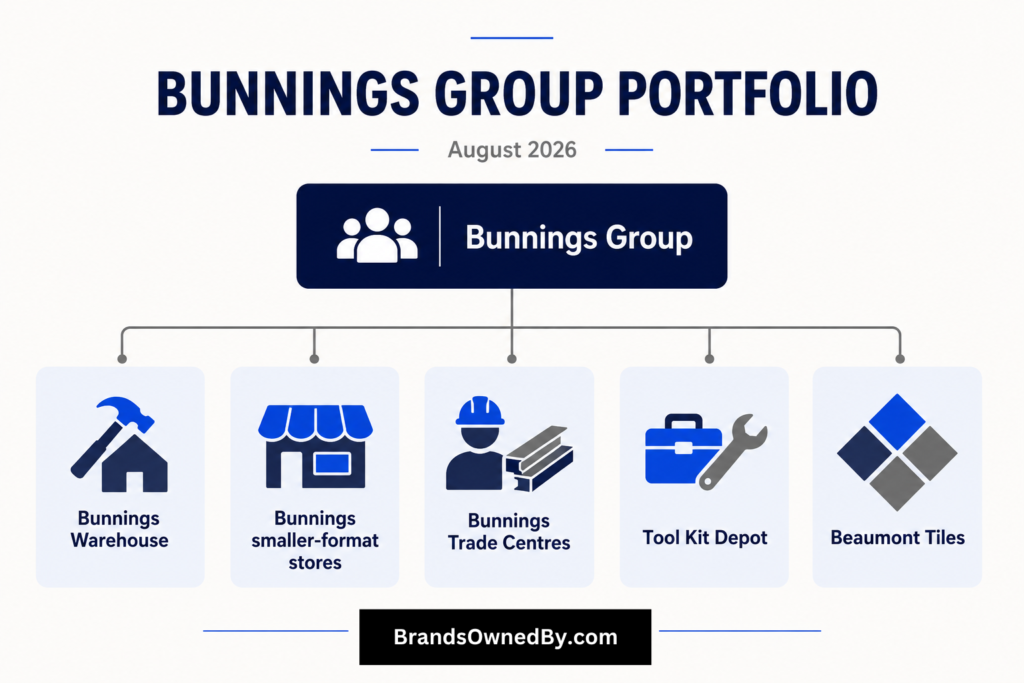
- Bunnings Group operates Bunnings Warehouse, smaller-format Bunnings stores, Bunnings Trade Centres, Tool Kit Depot, and Beaumont Tiles.
- Tool Kit Depot developed from the Adelaide Tools business acquired in 2020, while Beaumont Tiles was acquired in 2021.
- Bunnings is not a franchise chain. Its core stores are controlled by the group, although some specialist operations may use different property, dealer, or operating arrangements.
Bunnings Group Limited is wholly owned by Wesfarmers Limited. Wesfarmers gained full control in 1994 and remains the company’s sole shareholder as of August 2026. Bunnings is not independently listed on the Australian Securities Exchange. Investors can gain indirect exposure to the hardware retailer by owning shares in Wesfarmers under the ASX ticker WES.
Bunnings is the largest home improvement and hardware retailer in Australia and New Zealand. Its business serves household customers, tradespeople, builders, property managers, and commercial buyers.
The group operates large warehouses, smaller hardware stores, trade centres, and specialist retail chains. Its portfolio also includes Tool Kit Depot and Beaumont Tiles.
![Who Owns Bunnings [Infographic]](https://brandsownedby.com/wp-content/uploads/2026/08/Who-Owns-Bunnings-Infographic-683x1024.png)
Who Founded Bunnings?
Brothers Arthur and Robert Bunning founded the business in Western Australia in 1886. They had arrived from England and began by acquiring a sawmill.
The business initially focused on timber production and distribution. Bunning Bros was formally incorporated in 1907.
Bunnings expanded beyond sawmilling as Western Australia’s construction market developed. It added building supplies and became an important hardwood supplier to the housing industry.
From Timber Company to Hardware Retailer
Bunnings became a public company in 1952. Its operations increasingly moved toward building materials, home improvement products, and hardware retailing.
The acquisition of Alco Handyman in 1989 significantly increased its exposure to the consumer do-it-yourself market. The company then purchased McEwans in 1993. That transaction gave it a substantial retail presence in Victoria and South Australia.
The first warehouse-format Bunnings store opened in Sunshine, Victoria, in August 1994. The format combined broad product selection, high inventory volumes, trade supplies, garden products, and competitive pricing under one roof.
Bunnings Today
As of December 2025, the latest reported network included:
- 287 Bunnings Warehouses.
- 66 smaller-format Bunnings stores.
- 28 Bunnings Trade Centres.
- 16 Tool Kit Depot stores.
- 110 Beaumont Tiles stores.
That represented 507 locations across the group. The network operates primarily in Australia and New Zealand.
Bunnings reported A$10.713 billion in revenue for the first half of FY2026. Revenue increased 4.2% from the corresponding period. Sales rose across every product category, operating region, and customer segment.
Digital sales reached 7.6% of total sales during the half. That percentage represents approximately A$814 million of sales, although Bunnings does not report digital revenue as a separate accounting segment.
Ownership History
Bunnings existed for more than a century before becoming a wholly owned Wesfarmers subsidiary. The current ownership structure resulted from a gradual investment followed by a complete takeover.
Family and Public Ownership
Arthur and Robert Bunning established the original business in 1886. The company remained closely associated with the Bunning family during its early development.
Bunnings became publicly owned when it converted into a public company in 1952. Its shares could then be held by outside investors.
This structure gave the company access to capital for expansion. It also meant that Wesfarmers could begin acquiring an interest through share purchases.
Wesfarmers’ Initial Investment in 1987
Wesfarmers entered the hardware sector in 1987 by acquiring a substantial interest in Bunnings Limited. Its initial position was approximately 10%.
The investment was strategically logical. Wesfarmers already understood timber, rural supplies, construction inputs, and Western Australian distribution. Bunnings gave it direct exposure to the growing consumer hardware market.
Wesfarmers increased its holding over the following years. It eventually owned 48% of Bunnings before making its final takeover move.
Full Acquisition in 1994
Wesfarmers acquired the remaining 52% of Bunnings in November 1994. It paid A$594 million for the shares it did not already own.
The takeover offer valued the remaining shares at A$11.39 each. Once the transaction was completed, Bunnings became a wholly owned Wesfarmers subsidiary.
This acquisition was transformative for both companies. Bunnings gained access to Wesfarmers’ capital, property expertise, governance systems, and acquisition capacity. Wesfarmers gained a platform that would become its largest operating division.
BBC Hardware Acquisition in 2001
Wesfarmers acquired Howard Smith in 2001. The deal brought BBC Hardware, Hardwarehouse, and Benchmark stores into the group.
BBC Hardware added approximately 60 Hardwarehouse locations, along with a wider Australian and New Zealand network. Many sites were converted into Bunnings stores.
The acquisition accelerated Bunnings’ national expansion. It also removed a large competitor and provided established locations that would have taken years to build organically.
The Homebase Acquisition and UK Exit
Wesfarmers acquired the Homebase home improvement chain in 2016 for approximately £340 million, equivalent to about A$705 million at the time. Homebase operated in the United Kingdom and Ireland.
The plan was to convert Homebase stores to the Bunnings warehouse model. However, the British market differed from Australia. Product preferences, seasonal demand, store sizes, supplier relationships, and shopping habits were not sufficiently preserved during the transition.
The operation accumulated major losses. Wesfarmers sold Homebase to Hilco Capital in 2018 for a nominal £1. The exit resulted in losses and write-offs of approximately A$1.96 billion.
Homebase is not owned by Bunnings or Wesfarmers today. The experience also explains why Bunnings’ current international focus remains concentrated on Australia and New Zealand.
Specialist Acquisitions
Bunnings acquired Adelaide Tools in April 2020. The business was subsequently developed under the Tool Kit Depot name.
In November 2021, Bunnings completed its acquisition of Beaumont Tiles. The transaction expanded the group into specialist tiles, bathroom products, and related renovation categories.
These acquisitions followed a more focused strategy than the Homebase deal. Both businesses operate in familiar Australian markets and serve customer groups that already overlap with Bunnings.
Who Owns Bunnings?
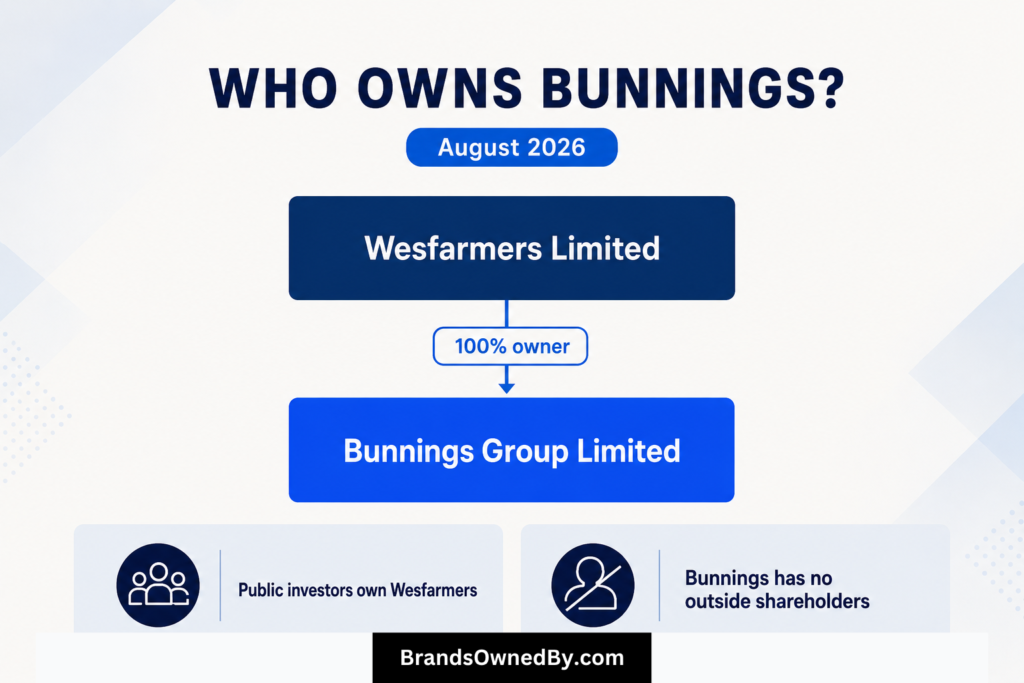
Wesfarmers Limited owns 100% of Bunnings Group Limited. Bunnings is therefore a wholly owned business within the Wesfarmers corporate group.
It has no outside investors, minority partners, private equity owners, or separately traded shares. The Bunning family also no longer holds a controlling stake. Wesfarmers holds all economic and voting rights through its controlled corporate structure.
Wesfarmers Limited: Bunnings’ Parent Company
Wesfarmers is a diversified Australian public company headquartered in Perth. Its shares trade on the Australian Securities Exchange under the ticker WES.
Bunnings operates as Wesfarmers’ home improvement and outdoor living division. It is one of several major businesses controlled by the parent company. Other Wesfarmers divisions include Kmart Group, Officeworks, Wesfarmers Health, WesCEF, and Industrial and Safety.
These businesses are sister divisions. Kmart, Target, and Officeworks are not owned by Bunnings. They share the same ultimate parent company.
Wesfarmers consolidates Bunnings’ revenue, earnings, assets, and liabilities into its group financial statements. Bunnings does not publish a separate market capitalization because it is not independently listed.
How Wesfarmers Acquired Bunnings
Wesfarmers did not purchase Bunnings in a single transaction. It began building its ownership position in 1987, when it acquired an initial stake of approximately 10%.
The investment gave Wesfarmers exposure to hardware retailing, timber, and building supplies. These activities complemented its existing experience in rural products, industrial distribution, and Western Australian markets.
Wesfarmers gradually increased its interest and held approximately 48% of Bunnings before launching its final takeover.
In November 1994, Wesfarmers acquired the remaining 52% for A$594 million. The offer valued the outstanding Bunnings shares at A$11.39 each. Once the transaction was completed, Bunnings became a wholly owned Wesfarmers subsidiary.
The acquisition gave Bunnings access to greater capital, property expertise, supplier relationships, and centralized corporate support. It also allowed Wesfarmers to fund the retailer’s national warehouse expansion.
Bunnings’ Corporate Structure
The ownership chain can be summarized as follows:
Wesfarmers Limited → Bunnings Group Limited → Bunnings operating formats and controlled specialist businesses.
Bunnings Group controls the main Bunnings Warehouse network, smaller-format Bunnings stores, Bunnings Trade Centres, Tool Kit Depot, and Beaumont Tiles.
Tool Kit Depot developed from Adelaide Tools, which Bunnings acquired in April 2020. Beaumont Tiles became part of Bunnings following an acquisition completed in November 2021.
These businesses sit within the Bunnings division. They are not separate Wesfarmers divisions comparable to Kmart Group or Officeworks.
The core Bunnings Warehouse network is also not a conventional franchise system. Bunnings controls the stores, merchandise strategy, pricing framework, digital operations, and customer proposition. Some Beaumont Tiles locations may operate under dealer arrangements, but the Beaumont Tiles business and brand remain under Bunnings ownership.
Who Ultimately Owns Bunnings?
Because Wesfarmers is publicly listed, its shareholders are the ultimate economic owners of the wider corporate group. They include Australian retail investors, superannuation funds, index funds, asset managers, and international institutions.
However, these investors own shares in Wesfarmers rather than Bunnings itself. A fund holding 3% of Wesfarmers does not directly own 3% of Bunnings. Its interest represents indirect exposure to every business within the Wesfarmers portfolio.
Wesfarmers has more than 480,000 shareholders and no single investor owns a majority of the company. Bunnings is therefore ultimately backed by a widely distributed shareholder base, but its only corporate owner remains Wesfarmers.
Can Investors Buy Bunnings Shares?
Investors cannot purchase Bunnings shares directly. The retailer has no independent stock-market listing.
The only practical way to obtain public-market exposure to Bunnings is to buy Wesfarmers shares. However, this also creates exposure to Wesfarmers’ other retail, healthcare, chemicals, industrial, and investment operations.
This distinction matters when assessing Bunnings’ ownership. Wesfarmers owns and controls the business outright, while Wesfarmers’ shareholders own indirect interests in Bunnings through their investment in the parent company.
Property Ownership Is Different From Business Ownership
Bunnings does not own every building from which it operates. Some warehouse properties are leased from BWP Trust and other property investors.
A property owner may own the land and building occupied by a Bunnings store without owning the retail business. Bunnings remains responsible for the store’s products, employees, pricing, and operations under its lease.
BWP Trust is therefore not the owner of Bunnings. Wesfarmers owns Bunnings Group, regardless of whether an individual warehouse property is owned, leased, or sold under a leaseback arrangement.
Competitor Ownership Comparison
Bunnings competes with several ownership models. Some rivals are divisions of public companies. Others combine corporate brand ownership with independently operated stores. Several important trade suppliers remain family controlled.
The difference affects purchasing power, store investment, local decision-making, and access to capital.
Mitre 10: Owned by Metcash
Mitre 10 Australia is owned by Metcash Limited. Metcash acquired full ownership of the Mitre 10 corporate business in 2012.
Metcash is publicly traded on the ASX under the ticker MTS. It also owns or supports several other hardware banners.
The Mitre 10 ownership model differs from Bunnings. Metcash owns the brand, wholesaling infrastructure, and support platform. However, many Mitre 10 stores are independently owned and operated.
This gives local owners flexibility over product selection and customer service. It can also make national execution less uniform than Bunnings’ centrally controlled model.
Home Hardware: Owned by Metcash
Home Hardware is also part of Metcash’s hardware portfolio. It became part of the group through the acquisition of Home Timber & Hardware and the formation of Independent Hardware Group.
The brand is commonly used by independently operated hardware businesses. Metcash supplies products, systems, marketing support, and brand infrastructure.
Home Hardware competes strongly in local communities and regional markets. However, it does not have Bunnings’ unified corporate store network or comparable national warehouse scale.
Total Tools: Owned by Metcash
Metcash acquired an initial 70% interest in Total Tools in 2020. It increased its ownership to 85% and acquired the remaining 15% in November 2023.
Total Tools Holdings is now wholly owned by Metcash. Individual retail stores can still have franchise or joint-venture ownership arrangements.
In June 2025, Metcash combined Independent Hardware Group and Total Tools into the Total Tools and Hardware Group. The structure brings Mitre 10, Home Hardware, Total Tools, and related banners under one coordinated division.
Total Tools is more narrowly focused than Bunnings. It primarily targets professional tradespeople and serious tool buyers. Bunnings competes through a wider offer that combines tools with garden, building, renovation, storage, and household categories.
Reece Group: Publicly Listed but Family Controlled
Reece Limited is listed on the ASX under the ticker REH. It specializes in plumbing, bathrooms, waterworks, HVAC, and related trade products.
The Wilson family controls approximately 67% of Reece through several holdings. L.T. Wilson Pty Ltd alone held 24.33% in the company’s August 2025 shareholder register.
This gives Reece a different governance model. Public investors own shares, but the founding family maintains effective voting control.
Reece competes with Bunnings in plumbing, bathrooms, kitchens, fixtures, irrigation, and trade supplies. Its specialist branch network and professional relationships provide an advantage in complex trade categories.
Bowens: Family Owned
Bowens is a fourth-generation Australian family business. The Bowen family continues to own and manage the company.
Its operations focus heavily on timber, construction materials, builders, and tradespeople. The company’s private ownership supports long-term reinvestment without pressure from public market reporting cycles.
Bowens does not match Bunnings’ national consumer footprint. It can, however, compete effectively in specialist building supplies, project service, trade credit, and rapid job-site delivery.
What the Comparison Shows
Bunnings has the most centralized ownership structure among these competitors. Wesfarmers owns the operating group, controls its core stores, funds large investments, and sets group-wide strategy.
Metcash uses a hybrid model. It owns the brands and wholesale platform but works with many independent store operators.
Reece combines public ownership with family control. Bowens remains privately and family owned.
Bunnings’ structure supports consistent pricing, national inventory planning, large technology investments, and rapid implementation. The trade-off is less local owner autonomy than an independent hardware network.
Who Controls Bunnings?
Wesfarmers has ultimate corporate control over Bunnings. Operational authority is delegated to the Bunnings management team.
Control therefore exists at three levels: the Wesfarmers shareholders, the Wesfarmers board and executive team, and Bunnings’ divisional management.
Wesfarmers Board
The Wesfarmers board has ultimate oversight of the group. It approves major acquisitions, divestments, capital allocation decisions, risk policies, and executive remuneration.
Michael Chaney remained chairman as of August 9, 2026. Ken MacKenzie joined the board in June 2026 as chairman-elect. He is expected to succeed Chaney after the conclusion of the 2026 annual general meeting.
This distinction is important. MacKenzie had joined the board by August 2026, but he had not yet formally become chairman.
Rob Scott
Rob Scott is the managing director and chief executive officer of Wesfarmers. He has held the position since November 2017.
Scott is responsible for group strategy and capital allocation. He does not run individual Bunnings stores, but Bunnings management reports through the Wesfarmers executive structure.
His influence is especially relevant when Bunnings proposes a major acquisition, enters a new market, develops a large property program, or requires substantial group capital.
Michael Schneider
Michael Schneider is managing director of Bunnings Group. He has led the division since May 2017, after previously heading Bunnings Australia and New Zealand.
Schneider controls daily strategy and execution within the division. His responsibilities include pricing, merchandise, store operations, digital development, trade services, workplace culture, and network expansion.
For practical purposes, Schneider runs Bunnings. However, his authority is delegated by Wesfarmers and remains subject to group governance.
How Control Works in Practice
Suppose Bunnings wants to open a standard warehouse in a new metropolitan area. Its management team evaluates demand, competition, property availability, expected sales, and return on capital.
The Bunnings team can manage routine network development within approved budgets. A larger acquisition or international expansion would require additional review and approval from Wesfarmers.
This arrangement gives Bunnings operational independence while preserving financial discipline at the parent level.
No Controlling Outside Shareholder
Wesfarmers does not have one majority shareholder. Its ownership is spread across institutions and individual investors.
Institutional managers can influence board elections and governance policies. They cannot directly instruct Bunnings management on store pricing, inventory, or employment decisions.
Effective control rests with the Wesfarmers board and management team, subject to shareholder voting and Australian corporate law.
Bunnings Annual Revenue and Net Worth
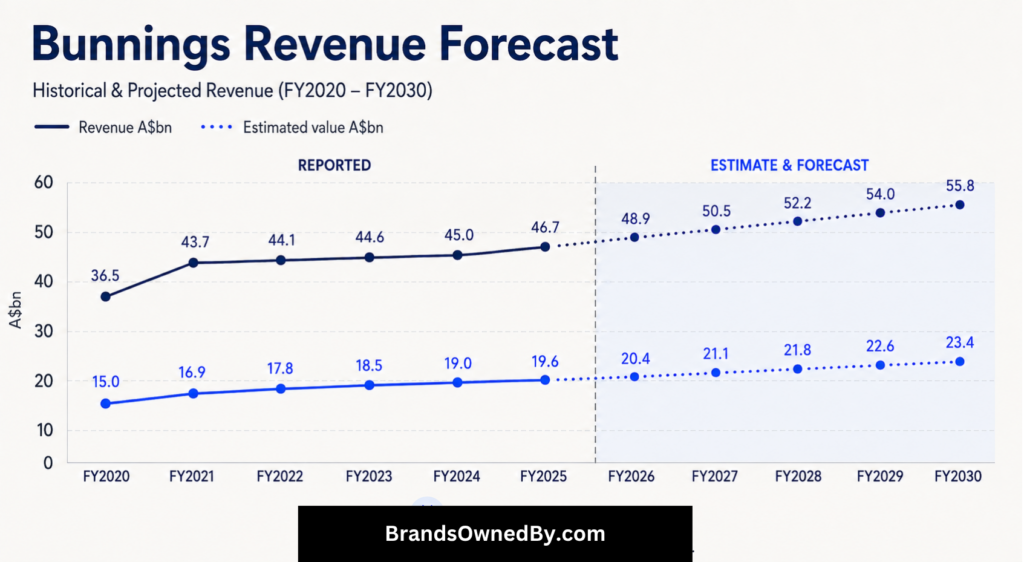
Bunnings reports revenue and earnings as a Wesfarmers operating division. It does not report a separate public market capitalization or official “net worth.”
The value figures below are analytical estimates. They apply a 20-times multiple to normalized pre-tax earnings. This is below the parent group’s recent market valuation on an EBIT basis, allowing for the fact that Bunnings is not separately listed and segment-level debt is not disclosed.
FY2025 Revenue and Earnings
Bunnings generated A$19.595 billion in FY2025 revenue. This was 3.3% higher than the previous year.
Pre-tax earnings rose 3.8% to A$2.336 billion. The result produced an earnings margin of approximately 11.9%.
Revenue growth exceeded simple store-count expansion. It reflected higher comparable sales, commercial customer demand, digital growth, product-range development, and continued investment in specialist formats.
Bunnings contributed approximately 42.9% of Wesfarmers’ A$45.7 billion FY2025 group revenue. That makes it the parent company’s largest revenue division.
FY2026 Revenue
The FY2026 full-year result had not been released as of August 9, 2026. Wesfarmers had scheduled its full-year results for August 27.
Bunnings reported A$10.713 billion in first-half revenue. This was 4.2% above the previous corresponding half.
The second half is normally smaller than the first. Simply doubling A$10.713 billion would therefore overstate the likely annual result.
A seasonally adjusted estimate produces FY2026 revenue of approximately A$20.4 billion. This assumes second-half growth close to the first-half rate without treating the two halves as equal.
Estimated pre-tax earnings of approximately A$2.44 billion support a stand-alone valuation estimate of A$48.9 billion under the stated methodology.
Revenue by Customer Segment
Bunnings serves two broad customer groups: consumers and commercial customers.
Consumer revenue includes DIY projects, gardening, outdoor living, home repairs, storage, cleaning, paint, and household improvement products.
Commercial revenue includes builders, tradespeople, project customers, property maintenance operators, and small businesses. PowerPass accounts, trade desks, delivery, frame and truss operations, and trade centres support this segment.
Bunnings does not publish the exact dollar split between consumer and commercial sales. Any precise percentage attributed to either segment would therefore be speculative.
The first-half FY2026 update confirmed growth in both segments. This is important because consumer and commercial demand do not always follow the same cycle.
Revenue by Store
The core Bunnings network contained 381 locations at the end of December 2025. This included 287 warehouses, 66 smaller stores, and 28 trade centres.
Warehouses represented approximately 75.3% of the core Bunnings store network. They are likely to generate the majority of group revenue because of their size and wider product range. Bunnings does not disclose revenue by format.
Tool Kit Depot and Beaumont Tiles added 126 specialist locations. Together, these specialist stores represented approximately 24.9% of the total 507-location group network.
Store count should not be treated as revenue share. A large Bunnings Warehouse can generate far more sales than a smaller specialist location.
Digital Sales
Digital sales accounted for 7.6% of total first-half FY2026 sales, up from 6.3% in the previous corresponding period.
Applied to reported revenue, 7.6% is equivalent to approximately A$814 million. The calculation is useful for scale, but it is not a separately audited digital revenue figure.
Digital sales include online orders, app transactions, and marketplace activity. Many orders still rely on physical stores for collection, inventory, advice, and fulfillment.
Bunnings is therefore better described as an omnichannel retailer than a pure online business.
Geographic Revenue
Bunnings operates in Australia and New Zealand. Australia is the dominant market based on store numbers, population, and network scale.
The company does not publish a separate Australian and New Zealand revenue table. It only confirms whether sales increased or decreased across operating regions.
First-half FY2026 sales increased in both operating regions. This reduced reliance on a single geographic growth source, even though Australia remains materially larger.
What Supports the 2027–2030 Forecast?
The forecast assumes annual revenue growth of roughly 3.3% to 3.6%. This is more conservative than the 4.2% first-half FY2026 increase.
Several factors support continued growth.
First, Bunnings sells many maintenance and repair products that cannot be deferred indefinitely. A leaking tap, broken tool, damaged fence, or failed electrical fitting creates practical demand even when discretionary spending is weak.
Second, commercial customers provide a different growth engine from household DIY buyers. Housing construction, property maintenance, renovations, and infrastructure work support trade demand.
Third, digital penetration still has room to expand. Growth can come from better search, marketplace range, delivery, apps, project planning, and business purchasing tools.
Fourth, Tool Kit Depot and Beaumont Tiles expand Bunnings into specialist categories. These businesses can grow without requiring every sale to pass through a standard warehouse.
The forecast does not assume another large international acquisition. That is deliberate. Bunnings’ strongest economics remain tied to Australia and New Zealand.
Risks to the Forecast
Housing weakness could reduce demand for building materials and renovation products. High interest rates can delay discretionary projects.
Labour, energy, rent, and supply-chain costs may also pressure earnings. Bunnings must balance its value positioning against the need to protect margins.
Regulatory intervention presents another risk. Bunnings’ market size can attract scrutiny concerning suppliers, competition, privacy, data use, and exclusive commercial agreements.
A forecast above 5% annual growth would require stronger store expansion, higher inflation, meaningful market-share gains, or a major acquisition. The estimates in the table avoid relying on those outcomes.
Brands Owned by Bunnings
Bunnings Group operates several retail formats and specialist brands. The portfolio is narrower than the full Wesfarmers group because Kmart, Target, Officeworks, and other Wesfarmers businesses are not owned by Bunnings.
They are sister divisions under the same parent company.
Bunnings Warehouse
Bunnings Warehouse is the group’s main large-format retail operation. The stores carry extensive ranges across tools, timber, paint, garden, outdoor living, storage, plumbing, kitchens, bathrooms, electrical supplies, and building materials.
Warehouses serve both consumers and commercial buyers. Their large footprints allow Bunnings to combine project products, bulky materials, nursery areas, and trade services in one location.
Bunnings Group owns and controls the operating format. However, it does not necessarily own every property occupied by a warehouse. Many locations are leased from property owners and investment trusts.
Smaller-Format Bunnings Stores
Smaller Bunnings stores serve markets where a full warehouse is unnecessary or impractical. They usually carry a more concentrated hardware and home improvement range.
These locations can be useful in regional areas, established suburbs, and markets with limited large-format property availability.
The stores remain part of Bunnings Group. They are not independently owned local franchises.
Bunnings Trade Centres
Bunnings Trade Centres focus on commercial customers, project builders, and tradespeople. Their product mix can include timber, building materials, frame and truss products, and job-site supplies.
The format prioritizes trade access, account management, bulk quantities, and delivery.
Trade Centres complement the warehouse network. A builder can use a trade centre for project materials while using a warehouse for tools, fittings, paint, or smaller purchases.
Tool Kit Depot
Tool Kit Depot is Bunnings Group’s specialist professional tool retailer. Its origins lie in Adelaide Tools, which Bunnings acquired in April 2020.
The business was repositioned and expanded under the Tool Kit Depot name. It had 16 stores at the end of December 2025.
Tool Kit Depot carries professional tools, accessories, safety products, storage systems, and workshop equipment. Its specialist positioning allows it to compete more directly with Total Tools and independent tool retailers.
Bunnings Group owns the Tool Kit Depot corporate brand and business.
Beaumont Tiles
Bunnings acquired Beaumont Tiles in November 2021. The specialist retailer sells tiles, bathroom products, flooring solutions, and related renovation materials.
Beaumont Tiles had 110 locations in the reported network at the end of December 2025. Its network includes different operating arrangements, including company-controlled and dealer locations.
The acquisition gave Bunnings specialist sales expertise in a category where customers often need design guidance, technical advice, samples, and installation support.
Beaumont Tiles retains its separate customer-facing identity. It is owned within Bunnings Group rather than presented as a standard Bunnings department.
Bunnings Marketplace and Digital Services
Bunnings operates digital shopping and marketplace capabilities through its website and app. Marketplace products allow the company to expand its online assortment without carrying every item in every store.
PowerPass supports commercial customers through accounts, pricing tools, purchase management, and transaction records.
These are important business platforms, but they are not separate companies comparable to Tool Kit Depot or Beaumont Tiles.
Brands Sold by Bunnings but Not Necessarily Owned
Bunnings sells thousands of manufacturer and private-label products. Retail availability does not prove brand ownership.
A brand may be owned by a supplier, licensed to Bunnings, manufactured under contract, or distributed exclusively through the retailer.
Products sold only at Bunnings should not automatically be included in a list of companies owned by Bunnings. The reliable portfolio consists of the operating banners and controlled businesses identified above.
Final Thoughts
Wesfarmers Limited owns Bunnings outright. It began investing in Bunnings in 1987 and acquired the remaining 52% for A$594 million in 1994.
The acquisition developed into one of the most successful investments in Australian retail history. Bunnings grew from a timber and hardware business into a network spanning warehouses, smaller stores, trade centres, Tool Kit Depot, and Beaumont Tiles.
Wesfarmers provides ultimate financial and corporate control. Michael Schneider and the Bunnings leadership team manage daily operations.
Investors cannot buy Bunnings shares directly. They must invest through Wesfarmers, which means accepting exposure to the parent company’s entire portfolio rather than Bunnings alone.
FAQs
Who owns Bunnings in Australia?
Wesfarmers Limited owns 100% of Bunnings Group Limited. The ownership structure is the same for the group’s Australian operations.
Who owns Bunnings in New Zealand?
Bunnings’ New Zealand operations are controlled by Bunnings Group and ultimately owned by Wesfarmers Limited.
The New Zealand business is not separately owned by a local company or franchise group.
Is Bunnings Australian owned?
Yes. Bunnings is owned by Wesfarmers, an Australian public company headquartered in Perth, Western Australia.
Wesfarmers has international institutional shareholders, but it remains incorporated, listed, headquartered, and governed in Australia.
Is Bunnings owned by Woolworths?
No. Woolworths Group does not own Bunnings.
Woolworths previously competed with Bunnings through Masters Home Improvement, a joint venture with Lowe’s. Masters closed in 2016.
Is Bunnings owned by Coles?
No. Coles does not own Bunnings.
Wesfarmers previously owned Coles, but it demerged the supermarket business in 2018. Bunnings remained with Wesfarmers.
Is Bunnings owned by Wesfarmers?
Yes. Wesfarmers owns the entire Bunnings Group. It achieved full ownership in November 1994.
Can I buy shares in Bunnings?
No. Bunnings does not have separately traded shares.
Investors can obtain indirect exposure by purchasing Wesfarmers shares on the ASX under the ticker WES.
Is Bunnings a franchise?
The core Bunnings Warehouse, smaller-format store, and trade-centre network is not a conventional franchise system. Bunnings Group controls these operations.
Some specialist networks, particularly Beaumont Tiles, can include dealer or other operating arrangements.
Does Bunnings own Beaumont Tiles?
Yes. Bunnings Group acquired Beaumont Tiles in November 2021.
Beaumont Tiles continues to trade under its own name and specialist retail format.
Does Bunnings own Tool Kit Depot?
Yes. Tool Kit Depot is part of Bunnings Group.
It developed from Adelaide Tools, which Bunnings acquired in April 2020.
Does Bunnings still own Homebase?
No. Wesfarmers sold Homebase to Hilco Capital in 2018 for a nominal £1.
Bunnings and Wesfarmers have no current ownership of Homebase.
Who is the CEO of Bunnings?
Michael Schneider is the managing director of Bunnings Group. He is the senior executive responsible for the division.
Rob Scott is the managing director and CEO of Bunnings’ parent company, Wesfarmers.
Who is the chairman of Bunnings’ parent company?
Michael Chaney remained chairman of Wesfarmers as of August 9, 2026.
Ken MacKenzie was chairman-elect. He was expected to become chairman after the 2026 Wesfarmers annual general meeting.
Does Bunnings own all its store buildings?
No. Bunnings owns some properties but leases many others from property trusts and institutional owners.
The retailer can sell a warehouse property and continue operating from the site under a long-term lease. Selling the building does not mean selling the Bunnings business.
Is BWP Trust the owner of Bunnings?
No. BWP Trust owns a portfolio of retail properties, many of which are leased to Bunnings.
Owning a property occupied by Bunnings is different from owning Bunnings Group. Wesfarmers owns the retail company.
What is Bunnings worth?
Bunnings has no official stand-alone market value because it is not separately listed.
Based on normalized earnings and a 20-times pre-tax earnings multiple, its estimated stand-alone value is approximately A$48.9 billion for FY2026. This is an analytical estimate, not a reported market capitalization.
Is Bunnings the largest part of Wesfarmers?
Bunnings is Wesfarmers’ largest division by revenue. It generated A$19.595 billion in FY2025, equal to approximately 42.9% of Wesfarmers’ group revenue.
Who originally founded Bunnings?
Arthur and Robert Bunning founded the business in Western Australia in 1886. It began with sawmilling before expanding into timber, building supplies, and hardware retailing.