
- Rogers Communications owns major telecom brands including Rogers Wireless, Fido, Chatr, Rogers Xfinity, Shaw Direct, and Rogers Business.
- Its media portfolio includes Sportsnet, Sportsnet+, Citytv, CityNews, OMNI Television, TSC, and a large group of radio stations.
- Rogers directly owns the Toronto Blue Jays and Rogers Centre, while its 75% stake in MLSE gives it controlling interests in the Toronto Maple Leafs, Toronto Raptors, Toronto FC, and Toronto Argonauts.
- The company also owns Rogers Bank and Rogers Insurance, and it holds a 50% joint venture interest in Glentel, which operates WirelessWave and Tbooth Wireless.
Rogers Communications Inc. is a Canadian telecommunications, media, sports, and entertainment company.
The company provides wireless services, residential internet, television, home phone, business connectivity, and digital services. It also owns major media networks, sports teams, entertainment properties, and financial-service brands.
Rogers operates one of Canada’s largest wireless and broadband networks. Its services are used by consumers, small businesses, large companies, and government organizations.
The company’s main telecommunications brands include Rogers, Fido, Chatr, Rogers Xfinity, and Shaw Direct. Its media portfolio includes Sportsnet, Citytv, CityNews, OMNI Television, and several radio stations.
Rogers also owns the Toronto Blue Jays and Rogers Centre. It holds a controlling interest in Maple Leaf Sports & Entertainment. That company owns teams such as the Toronto Maple Leafs, Toronto Raptors, Toronto FC, and Toronto Argonauts.
Rogers Communications is headquartered in Toronto, Ontario. Its shares trade on the Toronto Stock Exchange under RCI.A and RCI.B. Its Class B shares also trade on the New York Stock Exchange under RCI.

Who Founded Rogers?
Rogers Communications was founded by Edward Samuel “Ted” Rogers Jr.
Ted Rogers launched the business in 1960 after acquiring Canada’s first FM radio licence. He established radio station CHFI-FM in Toronto and used it as the foundation for the wider Rogers business.
He was an entrepreneur with a strong interest in radio technology, broadcasting, and communications. His early work focused on improving how radio signals were received and distributed.
Ted Rogers later expanded the company into cable television. Rogers entered the cable business during the 1960s and gradually built one of Canada’s largest cable networks.
The company continued to grow into wireless communications, internet services, television broadcasting, publishing, and professional sports.
Ted Rogers remained closely involved in the company’s strategy and development until his death in 2008.
The Rogers Family’s Role
The Rogers family remains closely connected to the company through the Rogers Control Trust.
Ted Rogers created the trust to preserve family control over Rogers Communications across future generations. The trust holds almost all of the company’s Class A voting shares.
Edward Rogers, Ted Rogers’ son, serves as Executive Chair of Rogers Communications and Chair of the Rogers Control Trust.
Melinda Rogers-Hixon, Ted Rogers’ daughter, serves as Vice-Chair of the trust.
The company is publicly traded, but the voting-share structure allows the Rogers family to retain effective control over major corporate decisions.
Key Development Milestones
Rogers began as a Toronto radio business and later entered cable television.
The company launched and acquired wireless operations as mobile communications became a major part of Canada’s telecommunications market.
Rogers expanded its media presence through television networks, radio stations, sports broadcasting, and digital platforms.
It acquired the Toronto Blue Jays in 2000 and Rogers Centre in 2004.
The company purchased Fido’s former parent company, Microcell Telecommunications, in 2004.
Rogers acquired the Citytv stations in 2007 and expanded Sportsnet through additional channels and broadcasting rights.
Its acquisition of Shaw Communications in 2023 significantly increased its cable, internet, and business-service footprint across Western Canada.
These developments transformed Rogers from a regional radio company into a national communications, media, and sports group.
List of Companies Owned by Rogers
Rogers Communications operates through numerous subsidiaries, operating divisions, brands, partnerships, and controlled investments. Some names represent incorporated companies. Others are customer-facing brands within a Rogers subsidiary.
Below is the list of the most important companies and brands owned or controlled by Rogers as of July 2026:
Companies and Brands Owned by Rogers
A visual view of Rogers Communications’ major telecom, media, sports, and financial assets.
Selected major assets only. Licensed channel brands and naming-rights properties are excluded.
Rogers Wireless
Rogers Wireless is the company’s primary mobile communications business.
It provides mobile voice, messaging, data, roaming, device financing, and connected-device services. It also serves businesses through corporate wireless plans and managed mobility solutions.
Rogers Wireless operates one of Canada’s largest national mobile networks. Its infrastructure supports 5G and 5G+ services in cities, towns, rural communities, transportation corridors, and commercial areas.
The business serves premium and mainstream customers under the Rogers brand. It also supports lower-cost customers through Fido and Chatr.
Rogers Wireless is not an independent public company. It operates under Rogers Communications’ consolidated wireless segment.
A practical example is a household that combines a Rogers mobile plan with Rogers home internet. Rogers can use bundled pricing to reduce churn and increase the total revenue generated from that household.
Fido
Fido is a mobile phone and wireless service brand owned by Rogers Communications.
Rogers acquired Microcell Telecommunications, Fido’s former parent company, in 2004. Fido was then integrated into the Rogers wireless operation.
Fido primarily competes in the value-oriented and mid-market segment. Its plans are usually positioned below the flagship Rogers brand.
The company offers mobile plans, smartphones, financing arrangements, roaming services, and customer rewards. It has historically appealed to younger customers and price-conscious users who still want postpaid service.
Fido uses Rogers’ mobile network. It does not operate a separate national wireless infrastructure.
This structure gives Rogers multiple pricing tiers. A premium customer can use Rogers, while a more price-sensitive customer can remain within the group through Fido.
Chatr Mobile
Chatr is Rogers Communications’ prepaid wireless brand.
It targets customers seeking simple plans, predictable monthly costs, and fewer long-term commitments. The brand is also used by customers who may not qualify for conventional postpaid plans.
Chatr offers talk, text, and data services over the Rogers network. It is positioned below both Rogers and Fido in the company’s brand hierarchy.
The brand helps Rogers compete with prepaid and discount services offered by Bell, Telus, Quebecor, and independent mobile virtual network operators.
Chatr is wholly controlled by Rogers through its wireless operations.
Rogers Cable
Rogers Cable is the group’s traditional cable and fixed-line communications business.
The company provides residential internet, television, home phone, and related services. It also owns and operates a substantial portion of Rogers’ wireline network infrastructure.
Rogers built much of its original cable presence in Ontario, New Brunswick, and Newfoundland and Labrador. Its acquisition of Shaw substantially expanded the company’s network across Western Canada.
Rogers Cable is now integrated into the company’s broader residential and connectivity operations. Customers typically see the Rogers brand rather than Rogers Cable as a separate corporate identity.
The network is strategically important. It allows Rogers to sell several services to the same address. These can include internet, television, mobile service, home security, and streaming packages.
Rogers Xfinity
Rogers Xfinity is the primary consumer brand used for many of Rogers’ residential internet, television, streaming, and smart-home services.
Rogers introduced the branding through its technology relationship with Comcast. The company previously marketed many of these products under the Ignite name.
Rogers Xfinity includes high-speed internet, WiFi equipment, television services, voice controls, streaming integration, and connected-home features.
Rogers owns the Canadian customer relationships and telecommunications operations behind the service. However, Rogers does not own Comcast or the underlying Xfinity brand globally. The name and certain technologies are used through commercial agreements.
This distinction is important. Rogers Xfinity is a Rogers-operated Canadian service, but Xfinity itself originated as a Comcast brand in the United States.
Shaw Communications
Shaw Communications became part of Rogers after Rogers completed its acquisition of the company in April 2023.
Shaw was founded in 1966 and developed into one of Canada’s largest cable and telecommunications companies. Its strongest regional presence was in British Columbia, Alberta, Saskatchewan, and Manitoba.
The acquired operations included residential internet, television, satellite television, business services, network infrastructure, and other connectivity assets.
Shaw no longer operates as an independent publicly traded company. Its principal cable operations are being integrated into Rogers.
The Shaw acquisition created a national-scale cable and wireless group. It combined Rogers’ strong position in Central and Eastern Canada with Shaw’s large Western Canadian footprint.
Rogers did not retain Freedom Mobile. That wireless business was sold to Quebecor’s Videotron as part of the regulatory process surrounding the Shaw acquisition.
Shaw Direct
Shaw Direct is a satellite television provider owned by Rogers Communications through its acquisition of Shaw.
The company delivers television programming directly to homes and businesses using satellite technology. It is particularly relevant in rural and remote areas where cable infrastructure may not be available.
Shaw Direct offers television packages, receivers, recording features, premium channels, and specialty programming.
Although streaming and fibre-based services are growing, satellite television still serves customers outside major wired network areas.
Rogers continues to own the Shaw Direct business. It gives the company a distribution option beyond its cable footprint.
Rogers Business
Rogers Business provides telecommunications and technology services to commercial and public-sector customers.
Its clients range from small businesses to large corporations, government agencies, healthcare organizations, retailers, and financial institutions.
The business provides internet connectivity, private networking, cloud connections, cybersecurity, managed services, mobile communications, voice systems, and Internet of Things solutions.
Rogers Business also incorporates enterprise assets acquired from Shaw. These operations expanded the company’s fibre network and commercial reach in Western Canada.
A retail chain, for example, can purchase mobile devices, store connectivity, cloud access, security tools, and private networking from the same Rogers group.
Rogers for Business
Rogers for Business is the customer-facing identity used for many small and medium-sized business services.
It sells commercial mobile plans, internet services, collaboration tools, business phone systems, security products, and managed connectivity.
The brand is part of Rogers Communications rather than a separately traded company.
Its purpose is to package consumer-style accessibility with commercial service requirements. A small restaurant may use Rogers for internet access, payment-terminal connectivity, employee mobile plans, and security monitoring.
Rogers Sports & Media
Rogers Sports & Media is the media and entertainment division of Rogers Communications.
It manages the group’s television stations, radio stations, sports networks, digital media properties, content production, advertising operations, and selected sports assets.
Its portfolio includes Sportsnet, Citytv, CityNews, OMNI Television, radio stations, and digital platforms.
Rogers Sports & Media generates revenue from advertising, subscriptions, content distribution, production, sponsorships, and licensing arrangements.
The division also supports Rogers’ telecommunications strategy. Exclusive sports coverage and entertainment programming can make Rogers television, internet, and streaming bundles more attractive.
Sportsnet
Sportsnet is Rogers Communications’ flagship sports media brand.
It operates national and regional television channels, digital services, streaming products, radio programming, and sports news platforms.
Sportsnet broadcasts major professional sports. Its programming includes hockey, baseball, basketball, soccer, curling, and other competitions.
Rogers owns Sportsnet through Rogers Sports & Media.
Sportsnet is a strategically important asset because live sports retain strong audience engagement. That makes the network valuable to advertisers and distributors.
Rogers also holds long-term Canadian media rights for National Hockey League programming. These rights strengthen Sportsnet’s position but do not mean Rogers owns the NHL.
Sportsnet+
Sportsnet+ is Rogers’ direct-to-consumer sports streaming service.
It allows viewers to stream Sportsnet programming without relying entirely on a conventional cable subscription. Packages may include regional and national sports coverage, depending on the customer’s location and subscription level.
The service is owned and operated by Rogers through Sportsnet.
Sportsnet+ helps Rogers respond to cord-cutting. It also creates a direct relationship with sports viewers who may not subscribe to a Rogers television package.
Sportsnet 360
Sportsnet 360 is a Canadian specialty sports channel owned by Rogers.
It evolved from earlier sports and entertainment channels, including The Score. Rogers acquired Score Media’s television business in 2012 and later integrated the channel into the Sportsnet portfolio.
The channel carries sports news, analysis, live events, highlights, and related programming.
Sportsnet 360 is fully integrated into Rogers Sports & Media.
Sportsnet One
Sportsnet One is another national specialty sports channel owned by Rogers.
It provides additional capacity for live games and sports programming that cannot fit on the main regional Sportsnet channels.
This is useful when several events occur at the same time. Rogers can distribute them across Sportsnet, Sportsnet One, Sportsnet 360, and its streaming platforms.
Citytv
Citytv is a Canadian television network owned by Rogers Communications.
Rogers acquired the Citytv stations from CTVglobemedia in 2007. The network became a central part of Rogers’ conventional television portfolio.
Citytv broadcasts entertainment programs, local content, reality shows, dramas, comedies, and selected sports programming. It also distributes locally produced news through CityNews.
Rogers controls the network through Rogers Sports & Media.
Citytv gives Rogers access to free-to-air television audiences. It also provides national advertising inventory and a platform for distributing Rogers-produced content.
CityNews
CityNews is Rogers’ local and national news brand.
It operates television newscasts, digital news platforms, radio services, mobile content, and online video. CityNews has operations in several Canadian markets.
The brand is owned by Rogers through Rogers Sports & Media.
CityNews helps Rogers maintain a presence in local journalism. It also creates content that can be distributed across Citytv stations, websites, radio stations, apps, and social platforms.
CityNews Radio
CityNews Radio is the branding used for several Rogers-owned news and talk radio stations.
The stations provide local news, traffic, weather, interviews, business updates, and public-affairs programming.
Rogers has converted selected existing radio stations to the CityNews format. This allows the company to use a common news identity across television, radio, and digital services.
CityNews Radio is operated within Rogers Sports & Media.
OMNI Television
OMNI Television is a multilingual television system owned by Rogers Communications.
It serves culturally diverse communities through programming in multiple languages. Its content includes news, public affairs, entertainment, films, and community programming.
OMNI operates through conventional television stations and national distribution arrangements.
The service is particularly important in large multicultural markets. It also helps Rogers meet audience needs that are not fully served by English- and French-language mainstream networks.
Rogers Radio
Rogers owns and operates a portfolio of radio stations across Canada.
The stations use several local brands and formats. These include news, talk, sports, contemporary music, country music, adult hits, and other programming.
Not every station uses the Rogers name. Listeners usually interact with the local station brand.
Rogers Radio is part of Rogers Sports & Media. The stations generate advertising and sponsorship revenue. They also support cross-promotion with Citytv, CityNews, Sportsnet, and Rogers-owned events.
KiSS Radio
KiSS is a music radio brand used by several Rogers-owned stations.
Its format generally focuses on contemporary hit music or adult contemporary programming. The exact format varies by market.
The KiSS stations are owned and operated through Rogers Sports & Media.
The brand allows Rogers to use a recognizable identity across multiple local radio markets while preserving market-specific hosts and programming.
JACK FM
JACK FM is a radio format used by selected Rogers-owned stations.
It is known for playing a broad variety of popular music rather than following a narrow playlist. Rogers operates JACK-branded stations in certain Canadian markets.
Rogers owns the stations it operates. However, the JACK FM format has also been licensed and used by other broadcasters internationally. Rogers does not own every JACK FM station worldwide.
98.1 CHFI
98.1 CHFI is a major Toronto radio station owned by Rogers Communications.
It typically broadcasts adult contemporary music and seasonal programming. The station has historically been one of the most commercially significant radio properties in the Toronto market.
CHFI operates under Rogers Sports & Media.
The Shopping Channel
The Shopping Channel, also known as TSC, is a Canadian television and e-commerce retailer owned by Rogers.
It sells products through television programming, online shopping, and digital channels. Its merchandise includes fashion, beauty products, jewellery, electronics, home goods, and fitness products.
TSC combines media distribution with direct retail sales. Unlike a standard television network, it earns revenue primarily by selling products rather than relying only on advertising.
The company is controlled through Rogers Sports & Media.
Toronto Blue Jays
The Toronto Blue Jays are a Major League Baseball team owned by Rogers Communications.
Rogers acquired the team in 2000. The Blue Jays are one of the most prominent sports assets in the company’s portfolio.
The team generates revenue from ticket sales, broadcasting, sponsorships, merchandise, concessions, premium seating, and league distributions.
Ownership also provides strategic benefits for Sportsnet. Rogers can combine team ownership, media distribution, sponsorship sales, and telecommunications promotions.
For example, a Blue Jays game can produce ticket revenue for the team, television audiences for Sportsnet, advertising revenue for Rogers Sports & Media, and promotional opportunities for Rogers mobile customers.
Rogers Centre
Rogers Centre is a stadium in downtown Toronto owned by Rogers Communications.
It is the home venue of the Toronto Blue Jays. The stadium was previously known as SkyDome.
Rogers acquired the property in 2004 and renamed it Rogers Centre in 2005.
The company has invested heavily in renovations. These upgrades have improved seating, food and beverage areas, social spaces, player facilities, and the overall baseball experience.
Rogers Centre also hosts concerts and other large events when scheduling permits.
Maple Leaf Sports & Entertainment
Maple Leaf Sports & Entertainment, commonly called MLSE, is one of North America’s most valuable sports organizations.
Rogers currently owns 75% of MLSE. It acquired an initial 37.5% interest alongside Bell in 2012. Rogers later purchased Bell’s 37.5% interest, increasing its ownership to 75%.
In July 2026, Rogers signed an agreement to acquire the remaining 25% from Kilmer Sports for C$4.35 billion. The transaction is expected to close in the fourth quarter, subject to league approvals and other closing conditions.
Until the acquisition closes, Rogers should be described as MLSE’s 75% owner rather than its sole owner.
MLSE owns several teams, venues, and related sports businesses.
Toronto Maple Leafs
The Toronto Maple Leafs are a National Hockey League team owned by MLSE.
Because Rogers owns 75% of MLSE, it indirectly holds a controlling economic interest in the Maple Leafs.
The team generates revenue from tickets, sponsorships, merchandise, media arrangements, premium seating, and league distributions.
Rogers does not currently own the Maple Leafs directly as a standalone subsidiary. Its ownership is held through MLSE.
Toronto Raptors
The Toronto Raptors are a National Basketball Association team owned by MLSE.
Rogers controls its interest in the Raptors through its majority ownership of MLSE.
The team’s commercial value extends beyond game revenue. It provides sponsorship, media, merchandise, event, and international brand opportunities.
Raptors programming also contributes to the value of Canadian sports broadcasting and streaming rights.
Toronto FC
Toronto FC is a Major League Soccer club owned by MLSE.
Rogers indirectly controls the club through its MLSE stake.
The team plays its home matches at BMO Field. Its revenue sources include ticket sales, sponsorships, merchandise, concessions, and league-level media distributions.
Toronto Argonauts
The Toronto Argonauts are a Canadian Football League team owned by MLSE.
Rogers therefore holds an indirect controlling interest through its ownership of MLSE.
The team also plays at BMO Field. It benefits from MLSE’s shared venue, sponsorship, ticketing, marketing, and administrative infrastructure.
Toronto Marlies
The Toronto Marlies are an American Hockey League team owned by MLSE.
The Marlies are the primary development affiliate of the Toronto Maple Leafs.
Rogers indirectly controls the team through MLSE. The development structure allows the Maple Leafs to train and evaluate players within the same corporate sports system.
Raptors 905
Raptors 905 are the NBA G League affiliate of the Toronto Raptors.
The team is owned through MLSE. Rogers therefore has an indirect controlling interest.
Raptors 905 support player development, coaching development, and talent evaluation for the Raptors organization.
Toronto FC II
Toronto FC II is the development team associated with Toronto FC.
It competes in MLS NEXT Pro and provides a pathway for younger players to move into the senior club.
The team is owned through MLSE and is indirectly controlled by Rogers.
Scotiabank Arena
Scotiabank Arena is operated by MLSE and serves as the home venue of the Toronto Maple Leafs and Toronto Raptors.
Rogers’ ownership interest in the arena is indirect through MLSE.
The venue generates revenue through professional sports, concerts, premium seating, sponsorships, food and beverage sales, and other live events.
The Scotiabank name comes from a naming-rights agreement. Scotiabank does not own the arena or MLSE.
BMO Field
BMO Field is the home of Toronto FC and the Toronto Argonauts.
The stadium is owned by the City of Toronto and managed by MLSE under long-term arrangements. Therefore, it should not be described as a property wholly owned by Rogers.
Rogers nevertheless benefits economically through MLSE’s team operations and venue-management role.
This is an example of the difference between ownership and operating control.
Coca-Cola Coliseum
Coca-Cola Coliseum is a Toronto arena used by the Toronto Marlies and for other events.
The venue is municipally owned and operated under arrangements involving MLSE. Rogers does not directly own the building.
Its connection comes through MLSE’s sports operations and event activities.
Rogers Bank
Rogers Bank is a federally regulated Canadian bank owned by Rogers Communications.
It provides credit cards and related financial products. Its offerings are designed to complement Rogers’ telecommunications services and customer rewards system.
Rogers Bank credit cards can provide enhanced rewards for purchases made in Canadian dollars and additional value when rewards are redeemed against eligible Rogers, Fido, or Shaw transactions.
The bank gives Rogers a direct financial relationship with customers. It also supports loyalty and service bundling.
Rogers Bank is a distinct regulated subsidiary. However, it remains wholly owned within the Rogers corporate group.
Rogers Insurance
Rogers Insurance is a consumer-facing service through which Rogers has expanded into selected insurance offerings.
The products may be provided or underwritten by third-party insurers. Rogers primarily provides the customer platform, brand relationship, or distribution channel.
Therefore, Rogers Insurance should not be interpreted as meaning Rogers independently underwrites every policy sold through the service.
The model allows Rogers to use its large customer base to distribute adjacent financial products.
Glentel
Glentel is a Canadian wireless retail and distribution company jointly owned by Rogers Communications and BCE.
Each group owns 50% of the business.
Glentel operates wireless retail outlets and sells mobile devices, plans, accessories, and related products. Its retail brands and partnerships have included WirelessWave, Tbooth Wireless, and Costco wireless kiosks in Canada.
Because Rogers owns only 50%, Glentel is not a wholly owned Rogers subsidiary. It is a jointly controlled investment.
The partnership also creates an unusual ownership arrangement. Rogers and Bell compete in telecommunications but jointly own this wireless retail company.
WirelessWave
WirelessWave is a mobile phone retail brand operated by Glentel.
Stores sell devices and wireless plans from multiple service providers. This gives customers an opportunity to compare plans in one location.
Rogers has an indirect 50% interest through its ownership of Glentel.
WirelessWave is not exclusively a Rogers carrier store. It can sell services from competing telecommunications companies.
Tbooth Wireless
Tbooth Wireless is another multi-carrier retail brand connected to Glentel.
It sells smartphones, mobile plans, accessories, and related services.
Rogers indirectly owns 50% of the operation through Glentel. BCE holds the other 50% interest in the parent business.
Today’s Shopping Choice
Today’s Shopping Choice is the expanded name associated with TSC, Rogers’ television and online shopping business.
The operation combines live product demonstrations with e-commerce ordering and direct delivery.
Rogers owns the business through its media division.
The service is distinct from a conventional marketplace. Rogers selects merchandise, produces sales programming, processes customer transactions, and manages the shopping experience.
Brands Associated With Rogers but Not Owned by Rogers
Rogers carries and promotes many external entertainment brands. This does not always mean it owns them.
Understanding this distinction prevents ownership lists from overstating the company’s portfolio.
HGTV Canada
Rogers operates and distributes the Canadian version of HGTV under a content and branding agreement.
The underlying HGTV brand is not globally owned by Rogers. It is associated with Warner Bros. Discovery.
Rogers controls the Canadian channel operation under its licensing arrangement, but it does not own the worldwide HGTV intellectual property.
Food Network Canada
Food Network Canada is operated by Rogers under Canadian licensing and content arrangements.
Rogers does not own the global Food Network brand. The international brand is associated with Warner Bros. Discovery.
The Canadian channel is part of Rogers’ media offering, but the brand rights are licensed.
Discovery Canada
Rogers operates Canadian Discovery-branded services through licensing arrangements.
It does not own Warner Bros. Discovery or the Discovery brand worldwide.
The relationship gives Rogers access to recognized factual-entertainment programming while allowing the global owner to expand its Canadian distribution.
Bravo Canada
Rogers operates a Canadian Bravo-branded service under an agreement with NBCUniversal.
Rogers does not own the worldwide Bravo brand or NBCUniversal.
The channel is a Rogers-controlled Canadian media service using licensed branding and programming.
FX Canada
FX Canada is operated through a relationship involving Rogers and the owner of the FX content brand.
Rogers does not own the global FX network or The Walt Disney Company.
The channel illustrates how media operations can involve local ownership and distribution rights without ownership of the original international brand.
NHL
Rogers owns valuable Canadian NHL media rights, but it does not own the National Hockey League.
The media agreement gives Rogers the right to distribute specified games and related programming in Canada across television, streaming, and other platforms.
League ownership remains with its member clubs.
Rogers Arena and Rogers Place
Rogers does not own Rogers Arena in Vancouver or Rogers Place in Edmonton merely because the venues use the Rogers name.
These names come from sponsorship and naming-rights agreements.
Rogers Arena is associated with the Vancouver Canucks. Rogers Place is associated with the Edmonton Oilers and its local arena ownership structure.
Naming rights provide advertising exposure. They do not automatically transfer property ownership.
Who Owns Rogers: Major Shareholders
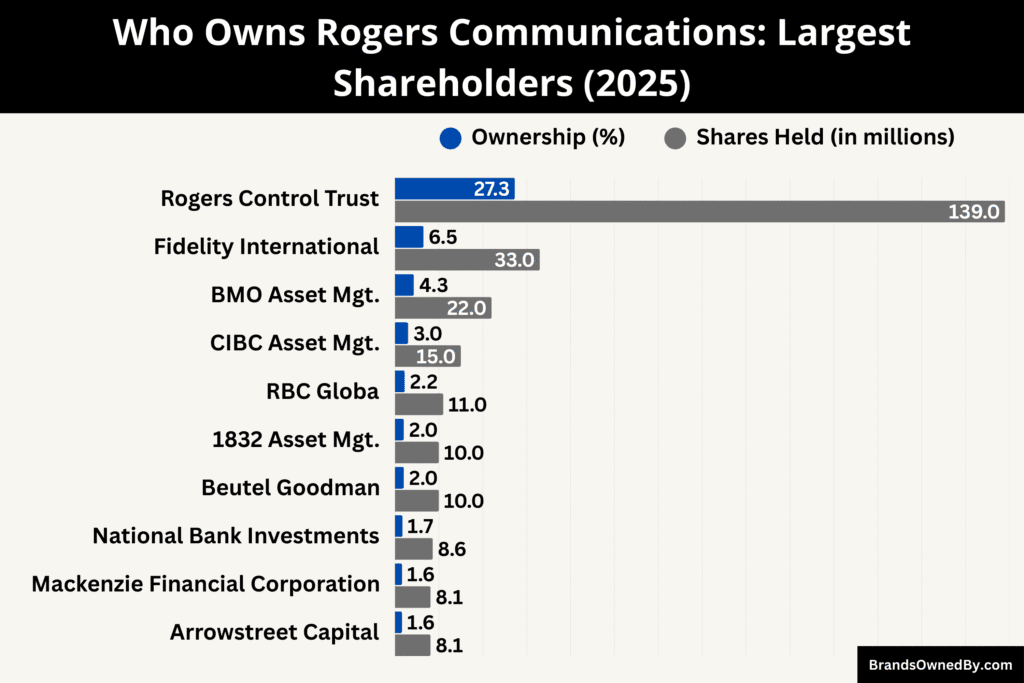
Rogers Communications is a publicly traded company. Its shares are held by the Rogers family, investment managers, banks, pension and mutual funds, and individual investors.
However, ownership of Rogers must be viewed in two different ways.
Economic ownership shows who holds the company’s equity. Voting control shows who has the authority to elect directors and approve major corporate decisions.
Rogers has two principal share classes:
- Class A Voting Shares.
- Class B Non-Voting Shares.
Each Class A share carries 50 votes on a poll. Class B shares provide economic ownership but generally do not carry voting rights.
This dual-class structure allows the Rogers family to control the company without owning most of its combined outstanding shares.
Who Owns Rogers?
Major economic shareholders and the separate voting-control structure.
Its voting influence is much greater than its economic stake.
Class A voting shares
Controlled by the Rogers Control Trust and related family holding companies.
Each Class A share carries 50 votes on a poll. This class determines effective corporate control.
Most public investors hold economic exposure through this more widely traded share class.
Rogers Control Trust and Rogers Family Holding Companies
The Rogers Control Trust and related family holding companies are the largest economic shareholders of Rogers Communications.
Together, they hold approximately 147.34 million Class A and Class B shares. This represents about 27.27% of the company’s combined outstanding equity.
Their influence is much greater than this percentage suggests.
The trust and related family companies own approximately 97.53% of Rogers’ outstanding Class A Voting Shares. As a result, they have effective control over director elections and other matters requiring shareholder approval.
The Rogers Control Trust was established to preserve control of the company for successive generations of the family of founder Ted Rogers.
Edward Rogers serves as Chair of the Rogers Control Trust. He is also Executive Chair of Rogers Communications.
Melinda Rogers-Hixon serves as Vice-Chair of the trust.
Fidelity International
Fidelity International holds approximately 25.94 million Rogers shares.
This represents an estimated 4.80% economic interest in the company.
Fidelity holds shares through investment funds and managed client portfolios. It is one of Rogers’ largest institutional investors.
Its investment represents economic ownership. It does not give Fidelity control comparable to the Rogers Control Trust because most institutional investors hold Class B Non-Voting Shares.
BMO Asset Management
BMO Asset Management holds approximately 20.90 million Rogers shares.
This represents an estimated 3.87% ownership interest.
BMO holds the shares through mutual funds, exchange-traded funds, pension mandates, and other managed investment portfolios.
Although BMO is a major economic shareholder, it does not control Rogers’ board or corporate strategy.
Canadian Imperial Bank of Commerce
Canadian Imperial Bank of Commerce and its investment-management operations hold approximately 13.41 million Rogers shares.
This represents about 2.48% of the company’s combined equity.
The position may be distributed across investment funds, institutional accounts, private portfolios, and other financial products managed by CIBC-related entities.
CIBC remains an investment shareholder rather than a controlling owner.
RBC Global Asset Management
RBC Global Asset Management holds approximately 13.05 million Rogers shares.
This represents an estimated 2.42% economic interest.
RBC Global Asset Management manages funds and institutional portfolios that invest in Rogers shares.
Its investment gives clients exposure to Rogers’ business performance. It does not provide effective control over the company.
National Bank of Canada
National Bank of Canada and related investment entities hold approximately 10.96 million Rogers shares.
This represents an estimated 2.03% ownership interest.
The shares may be held through investment funds, institutional portfolios, brokerage accounts, and managed financial products.
National Bank is one of the larger institutional holders that should be included in a detailed Rogers shareholder list.
Its position is an economic investment and does not provide voting control over Rogers.
TD Asset Management
TD Asset Management holds approximately 8.73 million Rogers shares.
This represents an estimated 1.62% interest in the company.
TD Asset Management invests through mutual funds, pension accounts, exchange-traded funds, and institutional mandates.
The firm benefits from changes in Rogers’ share price and dividends on behalf of its clients. However, its holding does not provide meaningful control over the company’s governance.
Fiera Capital
Fiera Capital holds approximately 7.44 million Rogers shares.
This represents an estimated 1.38% economic interest.
Fiera Capital is an independent investment-management company. It manages assets for institutions, financial intermediaries, and private clients.
Its Rogers position is held as a portfolio investment rather than as a strategic or controlling stake.
Other Institutional and Public Shareholders
The remaining approximately 54.13% of Rogers’ combined equity is held by other institutions, funds, investment firms, pension plans, brokerage clients, and individual shareholders.
This category can include additional banks, asset managers, index funds, insurance companies, private investment firms, and retail investors.
Examples of other reported institutional holders can include Royal Bank of Canada entities, RBC Dominion Securities, Arrowstreet Capital, Beutel Goodman, 1832 Asset Management, and other Canadian and international investment managers.
Their individual positions may change frequently. Some holdings are also reported under different subsidiaries of the same financial group.
These investors collectively own a large part of Rogers’ economic equity. However, they do not collectively control the company because most of their exposure is held through Class B Non-Voting Shares.
Competitor Ownership Comparison
Rogers operates under a family-controlled dual-class ownership structure. The Rogers Control Trust owns about 27.27% of the company’s combined equity but controls approximately 97.53% of its Class A Voting Shares.
This gives the Rogers family decisive voting power. Most competing Canadian telecom companies use different ownership models.
How Rogers Compares With Telecom Rivals
A visual comparison of family control, public ownership, and government ownership.
Rogers Communications
Family-controlled through the Rogers Control Trust.
BCE
Telus
Quebecor
Cogeco
SaskTel
BCE
BCE is the parent company of Bell Canada, Bell Mobility, and Bell Media.
BCE is a widely held public company. It does not have a controlling family, trust, corporation, or individual shareholder.
Its common shares are distributed among institutional investors, pension funds, mutual funds, exchange-traded funds, and retail investors. Each common share generally carries one vote.
This makes BCE’s ownership structure significantly different from Rogers.
Rogers’ board composition can be determined through the Rogers Control Trust’s dominant voting position. BCE’s directors must instead receive support from a broader group of shareholders.
Large asset managers can influence BCE collectively. However, no individual institutional investor can independently control the company.
BCE also no longer owns an interest in Maple Leaf Sports & Entertainment. It sold its 37.5% MLSE stake to Rogers. This increased Rogers’ controlling interest in MLSE to 75%.
As of July 2026, BCE remains more conventionally governed by public shareholders, while Rogers remains controlled by its founding family.
Telus
Telus is another widely held public telecommunications company.
It has one principal class of common shares. Telus does not have a controlling shareholder or a superior-voting share class comparable to Rogers’ Class A shares.
Its ownership is divided among Canadian and international institutions, investment funds, company insiders, and individual shareholders.
The Telus board is elected through votes cast by its broader shareholder base. Its executives manage daily operations but do not control the company through a separate block of high-vote shares.
This gives Telus shareholders more equal voting rights than Rogers shareholders.
Most public Rogers investors own Class B Non-Voting Shares. Their investment provides economic exposure but little direct influence over board elections.
Telus also completed the privatization of Telus Digital in October 2025. It now owns 100% of that business. However, Telus itself remains broadly owned by public investors rather than controlled by a founder or family trust.
Compared with Rogers, Telus has a more conventional one-share, one-vote governance model and greater dependence on continued institutional shareholder support.
Quebecor
Quebecor has the ownership structure most similar to Rogers.
The company is publicly traded but remains controlled by Pierre Karl Péladeau and related interests.
Quebecor has Class A Multiple Voting Shares and Class B Subordinate Voting Shares. The Class A shares carry greater voting power.
This allows the controlling shareholder to retain authority over board elections and major corporate decisions without owning the same percentage of total economic equity.
Rogers uses a similar principle. Its Class A shares provide the Rogers Control Trust with far more voting influence than its combined economic ownership suggests.
The main difference involves management.
At Rogers, Edward Rogers leads the controlling trust and serves as Executive Chair. Tony Staffieri manages daily operations as CEO.
At Quebecor, Pierre Karl Péladeau combines controlling-shareholder influence with the positions of President and CEO. This places voting control and executive management more directly under the same individual.
Both companies offer public investors economic participation with limited ability to change ultimate control.
Quebecor’s major telecom assets include Videotron, Freedom Mobile, Fizz, and VMedia. Its acquisition of Freedom Mobile expanded the group beyond its traditional Quebec market.
As of July 2026, Rogers and Quebecor are the clearest examples of family-controlled public telecom companies in Canada.
Cogeco
Cogeco is also a family-controlled public communications company.
The Audet family controls Cogeco through Gestion Audem and a multiple-voting share structure.
Cogeco’s multiple voting shares carry 20 votes per share. Its subordinate voting shares are publicly traded and carry fewer voting rights.
This arrangement allows the Audet family to control the company while public investors own most of the more widely traded share class.
Cogeco’s structure is therefore similar to Rogers in principle.
Both companies were founded by prominent Canadian communications entrepreneurs. Both later created dual-class structures that preserved family control after becoming publicly traded.
The difference is that Rogers is a much larger national telecom, media, and sports group. Cogeco focuses mainly on broadband and communications services in Canada and the United States.
The Audet family’s control has practical consequences. A takeover cannot normally succeed without support from the controlling family.
This became clear when Gestion Audem rejected acquisition proposals involving Rogers and Altice. Public shareholders could not force the transaction despite the premium being offered.
As of July 2026, Cogeco remains controlled through the Audet family’s multiple-voting shares. Rogers remains controlled through the Rogers Control Trust’s Class A shares.
SaskTel
SaskTel has a completely different ownership structure from Rogers.
It is not publicly traded. It is a provincial Crown corporation owned by the people of Saskatchewan through the provincial government.
SaskTel operates under Saskatchewan legislation and is overseen through Crown Investments Corporation of Saskatchewan.
There are no publicly traded SaskTel shares. Institutional investors and retail investors cannot purchase an ownership position in the company.
Its board and strategic direction are shaped through government and Crown-corporation governance rather than through public shareholder voting.
This creates a different set of priorities.
Rogers is expected to generate returns for its public shareholders and controlling family trust. SaskTel must balance commercial performance with public-policy objectives, provincial connectivity, employment, and service coverage.
Rogers can raise equity through public capital markets. SaskTel relies on its operating cash flow, borrowing arrangements, and decisions made within the provincial Crown system.
As of July 2026, SaskTel remains wholly government-owned. It is the only major regional Canadian telecom competitor in this comparison that has no private shareholders.
How Rogers Compares With Its Competitors
Rogers, Quebecor, and Cogeco are publicly traded but controlled through superior-voting shares or concentrated family interests.
BCE and Telus are widely held public companies. Their directors depend on support from a broad shareholder base.
SaskTel is government-owned and has no public shareholders.
Rogers has the most concentrated disclosed control over a dedicated voting share class. The Rogers Control Trust and related family entities own approximately 97.53% of its Class A Voting Shares.
Quebecor and Cogeco also protect family control. However, their precise voting structures and controlling interests differ from those used by Rogers.
BCE and Telus provide public shareholders with more conventional voting participation. No founding family can independently select their boards or block a change of control.
The practical distinction is clear.
A major strategic change at Rogers, Quebecor, or Cogeco generally requires the support of the controlling shareholder. At BCE or Telus, a successful proposal requires broader institutional and public shareholder support. At SaskTel, major ownership decisions ultimately involve the Government of Saskatchewan.
Who Controls Rogers?
Rogers Communications is controlled through the Rogers Control Trust.
Management handles daily operations. The board oversees corporate affairs. However, the trust’s ownership of approximately 97.53% of the Class A Voting Shares gives it the power to elect directors and influence major shareholder decisions.
Rogers Control Trust
The Rogers Control Trust is the company’s controlling shareholder.
Its purpose is to hold voting control for the benefit of successive generations of the Rogers family.
The trust and related family companies can elect the company’s directors and control most matters requiring shareholder approval.
This authority is far greater than its percentage of total economic ownership suggests. The difference results from Rogers’ dual-class share structure.
Edward Rogers
Edward Rogers is the Executive Chair of Rogers Communications and Chair of the Rogers Control Trust.
As Control Trust Chair, he represents the controlling shareholder and exercises significant influence over the voting of Class A shares held by private Rogers family companies.
His responsibilities include voting proxies in director elections. He can also approve, reject, or seek to influence other matters affecting Rogers, subject to the trust’s governing arrangements.
Edward Rogers also chairs important board committees. These positions reinforce his strategic influence.
He does not manage every daily operating decision. That responsibility rests with the CEO and executive team.
Rogers Control Trust Advisory Committee
The trust has an Advisory Committee that oversees important governance matters.
Its members include Rogers family representatives, trustees, and other appointed individuals.
The committee is responsible for matters such as appointing or removing the Control Trust Chair and Vice-Chair. It must also approve certain major transactions.
These transactions can include a change of control, the sale of substantially all company assets, or the acquisition of significant assets.
Major committee decisions generally require approval from two-thirds of its members and the concurrence of the trustee.
Trustee of the Rogers Control Trust
A trust company subsidiary of a Canadian chartered bank acts as trustee.
The trustee administers the trust and performs duties established under Ted Rogers’ estate arrangements.
These responsibilities include appointing individuals to trust governance positions, executing proxies, and preparing stewardship reports.
The trustee provides legal and administrative oversight. It does not independently run Rogers Communications.
Board of Directors
The Rogers Communications board oversees management, strategy, risk, capital allocation, governance, and executive performance.
The Rogers Control Trust can elect the board because it controls almost all Class A voting shares.
The board includes company executives, Rogers family representatives, and independent directors.
Independent directors provide oversight for public shareholders. However, the controlling shareholder retains the final voting power to shape the board’s composition.
Tony Staffieri
Tony Staffieri is the President and Chief Executive Officer of Rogers Communications.
He controls the company’s day-to-day operations under the board’s authority.
His responsibilities include business strategy, financial performance, network investment, customer operations, integration of acquired assets, and executive management.
The distinction is important. Tony Staffieri manages Rogers, but the Rogers Control Trust ultimately controls the company through voting rights.
Rogers Annual Revenue and Net Worth
Rogers Communications reports its financial results in Canadian dollars.
Revenue represents income generated from wireless services, internet, television, business connectivity, media, sports, equipment sales, and related operations.
Net worth can be measured in different ways. In this section, net worth refers to market capitalization. It reflects the total market value of Rogers’ outstanding shares.
Market capitalization is different from shareholder equity and enterprise value. It changes with the company’s share price.
Rogers Revenue in 2025
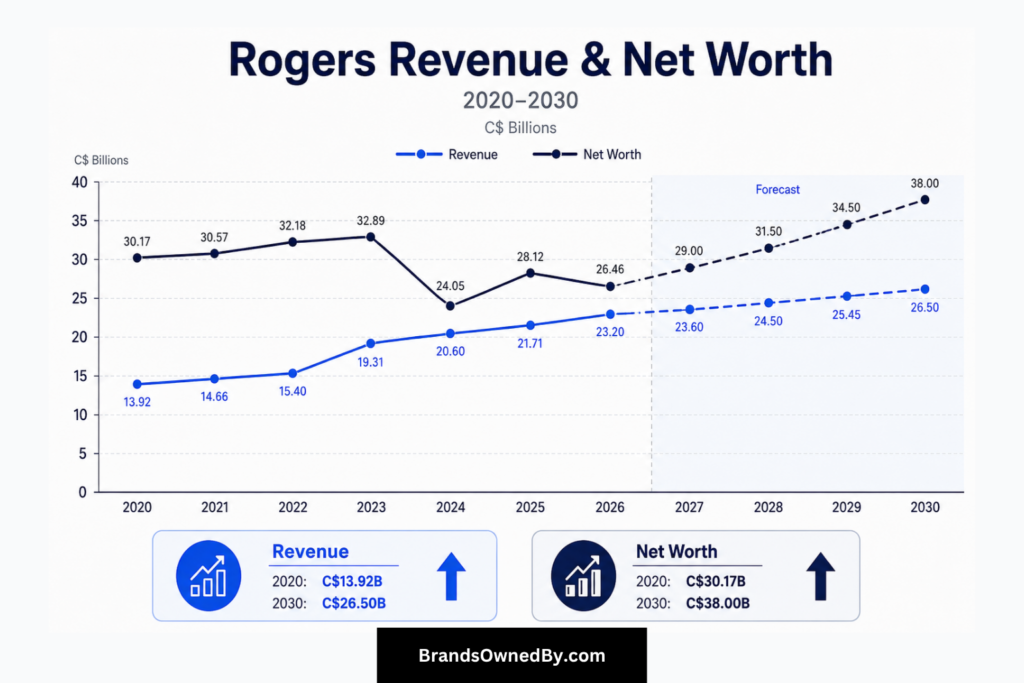
Rogers Communications generated approximately C$21.71 billion in revenue during 2025.
This was the latest completed annual revenue figure available as of July 2026.
Wireless and cable remained the company’s largest revenue sources. These businesses generate recurring income from mobile plans, broadband subscriptions, television services, business connectivity, roaming, and equipment sales.
Media and sports became more important during 2025.
Rogers increased its ownership of Maple Leaf Sports & Entertainment to 75% and began consolidating MLSE into its financial results from July 1, 2025.
This added revenue from the Toronto Maple Leafs, Toronto Raptors, Toronto FC, Toronto Argonauts, Scotiabank Arena, sponsorships, ticket sales, concessions, merchandise, and live events.
The company also generated revenue through Sportsnet, Citytv, CityNews, OMNI Television, the Toronto Blue Jays, Rogers Centre, radio stations, and digital media platforms.
Rogers’ revenue structure is now more diversified than that of a conventional telecommunications company.
Wireless and broadband provide stable monthly income. Sports and media add advertising, subscriptions, sponsorships, ticketing, and event revenue.
Rogers Revenue Performance in 2026
Rogers reported approximately C$11.10 billion in revenue during the first six months of 2026.
Second-quarter revenue reached approximately C$5.62 billion. This was about 8% higher than the same period in 2025.
Media produced the strongest growth.
Media revenue reached approximately C$2.14 billion during the first half of 2026. This was 65% higher than the comparable period in 2025.
Most of the increase came from the consolidation of MLSE. Stronger Toronto Blue Jays attendance, sponsorships, media subscriptions, and sports-related activity also supported growth.
Wireless generated approximately C$5.13 billion during the first six months.
Wireless service revenue remained relatively stable. Rogers continued adding subscribers, but pricing competition and lower average revenue per user limited growth.
Equipment revenue performed better because of higher device sales and demand for premium smartphones.
Cable generated approximately C$3.93 billion during the first half.
Internet services supported the segment. Traditional television and home-phone subscriptions continued to decline.
These results show that Rogers’ growth is shifting.
Wireless and cable remain the financial foundation of the company. However, sports and media are becoming more important sources of incremental revenue.
Rogers Current Net Worth in 2026
Rogers had an estimated market capitalization of approximately C$26.46 billion in July 2026.
This represents the company’s current market-based net worth.
The figure is calculated by multiplying Rogers’ share price by the number of outstanding Class A and Class B shares.
Rogers’ market value reflects its telecommunications networks, customer base, media properties, sports teams, venues, financial services, and other operating assets.
Its major assets include Rogers Wireless, Fido, Chatr, Rogers Xfinity, Shaw Direct, Sportsnet, Citytv, the Toronto Blue Jays, Rogers Centre, and its controlling interest in MLSE.
However, market capitalization does not represent the total value of Rogers’ assets.
The company carries substantial debt. This increased after the acquisitions of Shaw Communications and additional MLSE interests.
Enterprise value, which includes debt, is therefore much higher than market capitalization.
Investors also apply a discount for financial leverage, regulatory risks, capital expenditure requirements, pricing competition, and the cost of sports rights.
The private-market value of Rogers’ sports assets may be higher than the value currently reflected in its share price.
Rogers agreed to acquire the remaining 25% of MLSE for C$4.35 billion. This implied a total MLSE valuation of approximately C$17.4 billion.
That valuation demonstrates the strategic value of the sports portfolio. However, investors also consider how the transaction will be financed and how quickly Rogers can reduce debt afterward.
Rogers Revenue Forecast for 2027–2030
Rogers’ revenue is forecast to increase from approximately C$23.60 billion in 2027 to C$26.50 billion in 2030.
This represents average annual growth of approximately 4%.
The forecast assumes that Rogers completes the acquisition of the remaining 25% of MLSE and receives a full-year contribution from those operations.
Sports and media should remain the strongest growth areas.
Full MLSE ownership would increase Rogers’ exposure to ticket sales, sponsorships, merchandise, concessions, venue operations, live events, advertising, and media rights.
The company can also generate additional value by coordinating MLSE, Sportsnet, the Toronto Blue Jays, Rogers Centre, and its telecommunications platforms.
For example, Rogers can sell combined advertising packages that include television coverage, digital media, arena sponsorship, team partnerships, and customer promotions.
This structure may improve revenue per advertiser and reduce duplication across the group.
Residential internet should provide another source of steady growth.
Broadband has become an essential household service. Rogers can support revenue through customer additions, speed upgrades, equipment improvements, and moderate pricing increases.
Wireless growth is expected to remain slower.
Canada’s mobile market is mature. Rogers faces strong competition from Bell, Telus, Freedom Mobile, Fizz, and discount brands.
Growth will depend more on premium plans, roaming, device financing, connected devices, business mobility, and higher data usage than on rapid subscriber expansion.
Business services may also contribute.
Rogers can sell internet connectivity, cloud access, cybersecurity, private networks, mobile plans, and Internet of Things services to the same commercial customer.
The forecast does not assume another acquisition comparable with Shaw.
It is based mainly on organic growth, MLSE consolidation, sports monetization, internet services, and selective price increases.
A 2030 revenue estimate of C$26.50 billion is therefore achievable without requiring unusually aggressive assumptions.
Rogers Net Worth Forecast for 2027–2030
Rogers’ market capitalization is forecast to increase from approximately C$29 billion in 2027 to C$38 billion in 2030.
This forecast assumes a gradual improvement in the company’s valuation rather than a rapid increase in revenue.
The main driver will be debt reduction.
Rogers generates substantial operating cash flow. If capital expenditure declines and earnings remain stable, the company can use more cash to reduce borrowings.
Lower debt would reduce interest expenses and financial risk. It could also increase the value attributed to shareholders.
The forecast also assumes successful integration of MLSE.
Rogers owns a rare combination of telecommunications infrastructure, media rights, sports teams, venues, and direct customer relationships.
The Toronto Maple Leafs, Toronto Raptors, Toronto Blue Jays, Sportsnet, Rogers Centre, and Scotiabank Arena create commercial opportunities that competitors cannot easily reproduce.
Professional sports assets may also appreciate faster than mature telecommunications operations.
The number of major professional teams is limited. Their values can increase through media rights, sponsorships, ticket pricing, venue improvements, international audiences, and scarcity.
Rogers may also sell a minority interest in its combined sports and media assets.
Such a transaction could establish an independent valuation for the portfolio. It could also provide cash for debt repayment without requiring Rogers to give up operational control.
A higher market capitalization will still depend on the telecom business.
Investors will expect Rogers to protect wireless margins, retain internet customers, maintain dividends, control capital spending, and avoid another heavily leveraged acquisition.
The forecast assumes that the market gradually assigns Rogers a stronger valuation multiple as debt declines and sports earnings become more visible.
A C$38 billion market capitalization in 2030 would represent an increase of approximately 44% from the July 2026 level.
This is a reasonable base-case estimate rather than an aggressive forecast.
The company could exceed it if sports valuations rise faster than expected, debt falls more quickly, or Rogers sells a minority sports stake at a premium valuation.
It could fall below the estimate if wireless prices weaken, regulatory pressure increases, interest rates remain high, or sports costs grow faster than revenue.
Revenue and Net Worth Outlook
Rogers is expected to remain a moderate-growth company.
Its main advantage is the combination of stable telecommunications revenue and high-value sports and media assets.
Wireless and broadband provide recurring monthly cash flow. Sports and media provide growth, differentiation, advertising inventory, live events, and long-term asset value.
The main challenge is financial leverage.
Rogers must reduce debt while continuing to invest in networks, sports properties, customer service, and dividends.
If the company executes successfully, revenue could reach approximately C$26.50 billion and market capitalization could approach C$38 billion in 2030.
Final Words
Rogers owns much more than a wireless network.
Its core portfolio includes Rogers Wireless, Fido, Chatr, Rogers Xfinity, former Shaw cable operations, Shaw Direct, Rogers Business, and Rogers Bank.
Its media holdings include Sportsnet, Sportsnet+, Citytv, CityNews, OMNI Television, radio stations, and TSC.
Rogers also owns the Toronto Blue Jays and Rogers Centre. It currently owns 75% of Maple Leaf Sports & Entertainment and has agreed to purchase the remaining 25%.
This combination gives Rogers control over connectivity, media distribution, advertising, sports content, teams, venues, and customer financial products.
The company is publicly traded, but it is not broadly controlled by public investors. The Rogers Control Trust owns approximately 97.53% of its voting shares. That structure keeps effective control within the Rogers family.
FAQs
What companies are owned by Rogers?
Rogers owns or controls Rogers Wireless, Fido, Chatr, Rogers Cable, Rogers Xfinity, Shaw’s former cable operations, Shaw Direct, Rogers Business, Rogers Sports & Media, Sportsnet, Citytv, CityNews, OMNI Television, Rogers Bank, the Toronto Blue Jays, Rogers Centre, and TSC.
It also owns 50% of Glentel and 75% of Maple Leaf Sports & Entertainment. Rogers has agreed to acquire the remaining 25% of MLSE later in 2026.
What brands does Rogers own?
Major Rogers-owned brands include Rogers, Fido, Chatr, Sportsnet, Sportsnet+, Citytv, CityNews, OMNI, TSC, Shaw Direct, and Rogers Bank.
It also owns the Toronto Blue Jays and Rogers Centre.
Some channels operated by Rogers use licensed international brands. These include HGTV, Food Network, Discovery, and Bravo. Rogers operates their Canadian services but does not own the global brands.
Does Rogers own Shaw?
Yes. Rogers Communications acquired Shaw Communications in April 2023.
Shaw’s cable, internet, satellite television, business, and infrastructure operations became part of Rogers.
However, Freedom Mobile was sold to Quebecor’s Videotron. It is not owned by Rogers.
Does Rogers own Freedom Mobile?
No. Rogers does not own Freedom Mobile.
Freedom Mobile was previously owned by Shaw Communications. It was sold to Quebecor’s Videotron as part of the regulatory arrangements required for Rogers’ acquisition of Shaw.
Does Rogers own Fido?
Yes. Rogers Communications owns Fido.
Rogers acquired Fido’s former parent, Microcell Telecommunications, in 2004. Fido now operates as a value-oriented mobile brand using the Rogers network.
Does Rogers own Chatr?
Yes. Chatr is a prepaid wireless brand owned by Rogers Communications.
It operates on the Rogers mobile network and targets customers seeking lower-cost, commitment-free wireless plans.
Does Rogers own Bell?
No. Rogers does not own Bell.
Bell is operated by BCE Inc., a separate publicly traded Canadian telecommunications company. Rogers and Bell are major competitors.
The two companies jointly own Glentel, with each holding a 50% interest.
Does Bell own part of Rogers?
Bell does not own or control Rogers Communications.
BCE and Rogers have shared investments and commercial relationships in certain areas. Their most notable continuing joint investment is Glentel.
Bell previously owned 37.5% of MLSE. Rogers purchased that interest, increasing its own MLSE ownership to 75%.
Does Rogers own the Toronto Blue Jays?
Yes. Rogers Communications owns the Toronto Blue Jays.
It acquired the Major League Baseball team in 2000. Rogers also owns Rogers Centre, where the Blue Jays play their home games.
Does Rogers own the Toronto Maple Leafs?
Rogers indirectly owns a controlling interest in the Toronto Maple Leafs through Maple Leaf Sports & Entertainment.
Rogers currently owns 75% of MLSE. It has agreed to acquire the remaining 25%, subject to closing conditions and league approvals.
Until that transaction closes, Rogers is not yet the sole owner of the Maple Leafs.
Does Rogers own the Toronto Raptors?
Rogers indirectly owns a 75% controlling interest in the Toronto Raptors through its ownership of MLSE.
The remaining 25% is currently associated with Kilmer Sports. Rogers has signed an agreement to acquire that interest.
What sports teams does Rogers own?
Rogers directly owns the Toronto Blue Jays.
Through its 75% interest in MLSE, it also has controlling interests in the Toronto Maple Leafs, Toronto Raptors, Toronto FC, Toronto Argonauts, Toronto Marlies, Raptors 905, and Toronto FC II.
Does Rogers own Sportsnet?
Yes. Sportsnet is owned by Rogers Communications through Rogers Sports & Media.
The Sportsnet portfolio includes television networks, digital platforms, radio programming, and the Sportsnet+ streaming service.
Does Rogers own Citytv?
Yes. Rogers Communications owns Citytv.
Rogers acquired the Citytv stations in 2007. The network now operates within Rogers Sports & Media.
Does Rogers own CityNews?
Yes. CityNews is owned and operated by Rogers Communications.
The brand includes television news, digital news, radio services, and local reporting in several Canadian markets.
Does Rogers own OMNI Television?
Yes. Rogers Communications owns OMNI Television.
OMNI provides multilingual and multicultural television programming, news, and community content.
Does Rogers own HGTV and Food Network?
Rogers operates the Canadian HGTV and Food Network services under licensing and content arrangements.
It does not own the global HGTV or Food Network brands. Those brands are associated with Warner Bros. Discovery.
Does Rogers own the NHL?
No. Rogers does not own the National Hockey League.
Rogers owns Canadian NHL broadcasting and media rights under long-term agreements. The NHL itself is controlled through its member teams and league governance structure.
Does Rogers own Rogers Arena?
No. Rogers does not own Rogers Arena merely because the venue carries its name.
Rogers holds naming and sponsorship rights. The arena is associated with the Vancouver Canucks and its local ownership structure.
Does Rogers own Rogers Place?
No. Rogers Place in Edmonton is not owned by Rogers Communications.
The Rogers name comes from a commercial naming-rights agreement. The venue is associated with the Edmonton Oilers and local arena ownership arrangements.
Who owns Rogers Communications?
Rogers Communications is publicly traded, but the Rogers Control Trust is its controlling shareholder.
The trust and related Rogers family companies own approximately 97.53% of the Class A Voting Shares. They also own approximately 9.08% of the Class B Non-Voting Shares.
Is Rogers still family-owned?
Rogers is publicly traded, so public and institutional investors own most of its total economic equity.
However, it remains family-controlled. The Rogers Control Trust holds almost all of the company’s voting shares for the benefit of successive generations of the Rogers family.
How much of Rogers does the Rogers family own?
The Rogers Control Trust and related family holding companies own approximately 27% of the company’s combined outstanding shares.
More importantly, they control approximately 97.53% of the Class A Voting Shares. This gives the family effective control over Rogers Communications.
Who is the CEO of Rogers?
Tony Staffieri is the President and Chief Executive Officer of Rogers Communications.
He manages the company’s operations and executes its corporate strategy under the supervision of the board.
Who controls Rogers Communications?
The Rogers Control Trust controls Rogers Communications through its ownership of approximately 97.53% of the Class A Voting Shares.
Edward Rogers serves as Chair of the trust and Executive Chair of Rogers Communications.
Is Rogers owned by a larger company?
No. Rogers Communications is not a subsidiary of another telecommunications company.
It is an independent publicly traded corporation controlled by the Rogers Control Trust.
What is Rogers’ largest acquisition?
The acquisition of Shaw Communications was Rogers’ largest completed corporate acquisition.
The transaction had an enterprise value of approximately C$26 billion. It significantly expanded Rogers’ cable, internet, business, and infrastructure operations across Western Canada.
How does Rogers make money?
Rogers earns money from wireless plans, mobile devices, internet services, television subscriptions, business connectivity, advertising, sports broadcasting, streaming subscriptions, banking products, ticket sales, sponsorships, merchandise, and live events.
Its largest recurring revenue sources remain wireless and residential communications services.