

- Lionsgate Studios is a public company. It is not owned by Disney, Amazon, Comcast, Sony, or Starz.
- Its core businesses include Lionsgate Motion Picture Group, Lionsgate Television, Summit Entertainment, 3 Arts Entertainment, Pilgrim Media Group, and the acquired eOne film and television operations.
- Liberty Strategic Capital is the largest disclosed shareholder, with about 12.6% of outstanding shares. No investor has majority voting control.
- Starz became a separate public company in May 2025. Lionsgate retained its film and television studios, talent-management interests, production labels, and a library of more than 20,000 titles.
Lionsgate Studios is an independent, publicly traded entertainment company. Its shares trade on the New York Stock Exchange under the ticker LION. No parent company or single investor owns a majority.
Instead, ownership is split among institutional funds, strategic investors, insiders, and public shareholders.
The answer to “who owns Lionsgate Studios?” changed materially in May 2025, when the studio completed its separation from Starz.
![Who Owns Lionsgate Studios [Infographic]](https://brandsownedby.com/wp-content/uploads/2026/09/Who-Owns-Lionsgate-Studios-Infographic-683x1024.png)
Lionsgate Studios Overview
Lionsgate Studios develops, produces, finances, licenses, and distributes films and television programs. It also earns revenue from its content library, talent management, home entertainment, and international licensing.
The current company is more focused than the pre-separation Lions Gate Entertainment Corp. It no longer includes the Starz premium network and streaming business.
Who Founded Lionsgate?
Canadian financier Frank Giustra founded Lions Gate Entertainment in Vancouver in 1997. The company took its name from the Lions Gate Bridge in British Columbia. Its early strategy was practical. It acquired film assets, built a distribution operation, and targeted projects that larger studios often overlooked.
Lionsgate later moved its principal corporate base to the United States. Its Canadian origin still matters, but the modern business is a U.S.-listed global studio. That distinction explains why Lionsgate is often described as both Canadian-founded and American-based.
How Lionsgate Became a Major Independent Studio
Lionsgate did not grow by trying to copy a traditional Hollywood conglomerate. It assembled a studio platform through acquisitions and disciplined franchise development. Trimark Pictures strengthened its film library. Artisan Entertainment added distribution capability and valuable titles. Summit Entertainment brought the Twilight franchise and a larger theatrical pipeline.
The studio also developed or expanded franchises such as The Hunger Games, John Wick, Saw, and Now You See Me. These properties created several revenue streams. A film can generate theatrical receipts, digital sales, home entertainment revenue, television licensing, international distribution fees, and library value long after its initial release.
What the Modern Company Does?
The business has two primary reporting segments: Motion Picture and Television Production. Motion Picture includes theatrical production, acquisitions, distribution, home entertainment, and library licensing. Television Production includes scripted series, unscripted programming, syndication, talent management, and related production services.
This structure gives Lionsgate more flexibility than a studio that depends on one release channel. For example, an original drama may be produced for a third-party streaming platform. Lionsgate can earn production fees and retain negotiated distribution or library rights without operating the streaming service itself.
Lionsgate Studios Ownership History
Lionsgate’s ownership story is best understood as a series of strategic changes. The company moved from a small Canadian venture to a diversified public entertainment group. It then separated its studio assets from Starz to create two focused public companies.
1997: The Original Lions Gate Entertainment
Frank Giustra launched Lions Gate Entertainment in July 1997. The company used acquisitions to establish scale quickly. Its public-company structure allowed it to use stock, debt, and cash to fund expansion.
The early company was not controlled by a legacy Hollywood family. It was built as an investor-owned corporation. That remains a defining feature of Lionsgate today.
2000–2012: Building the Film Platform
Lionsgate acquired Trimark Pictures in 2000 and Artisan Entertainment in 2003. These transactions expanded its distribution network and library. The 2012 acquisition of Summit Entertainment was especially important. It added a functioning film studio, experienced executives, and major franchise assets.
The result was a broader independent studio with enough scale to compete for talent and global distribution. It still remained much smaller than Disney, Warner Bros., or Universal. That size difference became part of its strategy. Lionsgate could pursue mid-budget films and outside financing structures that were less attractive to larger conglomerates.
2016: Lionsgate Acquires Starz
Lionsgate acquired Starz in a transaction valued at about $4.4 billion. The logic was vertical integration. Lionsgate owned a large content library and production operation. Starz owned premium television networks and a subscription streaming service.
The combination created cross-selling opportunities. It also increased leverage and added a consumer-facing distribution business with different economics. Over time, investors assigned different valuation profiles to the studio and Starz. That made a separation increasingly attractive.
2023: The eOne Film and Television Acquisition
Lionsgate bought most of Entertainment One’s film and television operations from Hasbro in December 2023 for about $375 million. The purchase added production capabilities, rights, personnel, and a deeper library. It also strengthened Lionsgate’s presence in Canada and unscripted television.
Not every former eOne asset moved to Lionsgate. Hasbro retained important family brands and related intellectual property. The acquired operations should therefore be described as the eOne film and television business, not the entire historic eOne group.
2024: Lionsgate Studios Becomes a Separately Traded Company
In May 2024, Lionsgate combined its studio business with Screaming Eagle Acquisition Corp. The transaction created separately traded Lionsgate Studios shares. Existing Lionsgate investors retained most of the economic interest, while the public investment vehicle supplied a smaller float.
This was an intermediate step. The old parent still held a controlling economic stake. Investors could trade the studio shares, but the corporate separation was not yet complete.
2025: Lionsgate and Starz Complete the Separation
The full separation closed on May 6, 2025. Lionsgate Studios became a standalone public company. Starz became a separate public company with its premium networks and streaming operation.
The split removed a common source of confusion. Starz does not own Lionsgate Studios. Lionsgate Studios does not own Starz. They have shared history, but they now have separate boards, capital structures, shareholders, and strategies.
Who Owns Lionsgate Studios?
Lionsgate Studios is owned by its shareholders. Each Class A voting share generally carries one vote. No disclosed shareholder owns more than 50%, so there is no majority owner. Based on the latest ownership disclosures available through September 2026, strategic and institutional investors hold several meaningful blocks.
![Who Owns Lionsgate Studios [Top Shareholders]](https://brandsownedby.com/wp-content/uploads/2026/09/Who-Owns-Lionsgate-Studios-Top-Shareholders-1024x536.png)
Liberty Strategic Capital
Liberty Strategic Capital is the largest disclosed Lionsgate Studios shareholder. The investment firm, led by former U.S. Treasury Secretary Steven Mnuchin, reported 37.6 million shares. That represents about 12.6% of outstanding shares.
This is more than a passive index position. Liberty built a strategic stake, and Mnuchin joined the Lionsgate Studios board in January 2026. The combination of equity ownership and board representation gives Liberty a meaningful voice. It still does not give the firm unilateral control.
In practice, Liberty can influence major discussions. Those may include capital allocation, asset sales, merger proposals, debt reduction, or a full-company transaction. Any binding deal would still require the relevant board and shareholder approvals.
Mark Rachesky, MHR Fund Management, and the RenWave-Linked Stake
Mark Rachesky has been one of the most influential figures in Lionsgate’s modern history. He serves as board chair and has long been associated with a large shareholding through MHR Fund Management.
In July 2026, a roughly 10% block associated with Rachesky was transferred into a RenWave vehicle backed by South Korea’s Kore Group. The transaction changed the vehicle holding the shares. It did not create a majority owner. Rachesky’s board leadership and long relationship with the company continue to give him influence beyond a simple percentage figure.
This distinction matters. Economic ownership measures who benefits from the shares. Corporate control also depends on board seats, voting coalitions, governance rights, and management authority.
Vanguard-Managed Funds
Vanguard-managed funds collectively held about 22.2 million shares, or roughly 7.5%. These shares are spread across investment products rather than functioning like one strategic corporate block.
A March 2026 filing showed The Vanguard Group itself at zero after an internal reporting realignment. That did not mean every Vanguard-managed fund sold Lionsgate. The underlying fund holdings still represented a significant aggregate position. Ownership databases that ignore this reporting change can produce a misleading result.
Vanguard typically votes according to its stewardship policies. It does not manage Lionsgate’s daily operations. Its influence is most visible in director elections, executive compensation votes, governance proposals, and major transactions presented to shareholders.
FMR LLC
FMR LLC, the parent organization associated with Fidelity-managed investments, disclosed 19.3 million shares as of August 2026. That equaled about 6.7% of the company.
FMR is an institutional owner, not Lionsgate’s parent. Its percentage can move as funds rebalance portfolios. A position above 5% is significant because it triggers detailed ownership reporting and can matter in a close shareholder vote.
BlackRock
BlackRock reported about 16.43 million shares, or approximately 5.5%, in late August 2026. Much of this exposure is likely held through indexed and actively managed funds on behalf of clients.
BlackRock’s stake makes it a major voting shareholder. It does not give BlackRock operational control. The firm generally evaluates governance, board quality, compensation, and transaction terms through a fiduciary lens for its funds.
Neuberger Berman and Other Public Shareholders
Neuberger Berman reported about 9.35 million shares, equal to approximately 3.2%. Other institutions, active managers, insiders, and retail investors own the remaining public float.
This dispersed ownership is important. No single shareholder can dictate an outcome. A major proposal may require support from several large institutions plus other investors. Strategic holders can shape the debate, but they must build a coalition.
Competitor Ownership Comparison
Lionsgate is unusual among major Hollywood studios because investors can own the studio directly. Most competitors sit inside much larger technology, media, or electronics groups. That difference affects capital allocation, investor visibility, and strategic flexibility.
Universal Pictures: Owned by Comcast
Universal Pictures operates within NBCUniversal, which is owned by Comcast. Comcast shareholders therefore own Universal indirectly. They also own cable, broadband, media, theme-park, and other entertainment assets through the same parent.
Universal benefits from substantial distribution and theme-park infrastructure. Its studio performance is less visible as a standalone investment. Lionsgate offers a purer exposure to film, television production, talent management, and library monetization.
Sony Pictures: Owned by Sony Group
Sony Pictures Entertainment is wholly owned by Sony Group Corporation. It sits alongside businesses in gaming, music, electronics, imaging, and financial services.
Sony can coordinate film properties with games, music, and consumer technology. Lionsgate lacks that conglomerate reach. It can make partnership decisions without balancing the priorities of a hardware or gaming division.
Amazon MGM Studios: Owned by Amazon
Amazon MGM Studios is owned by Amazon. The studio supports Prime Video and Amazon’s broader subscription ecosystem. Its strategic value is not measured only by film or television profit. Content can improve Prime retention, engagement, advertising, and commerce.
Lionsgate follows a different model. It frequently sells or licenses content to multiple platforms. That supplier position can preserve buyer competition. It also means Lionsgate does not have a trillion-dollar technology parent funding its content slate.
Paramount: Controlled Through the Paramount Skydance Structure
Paramount’s ownership reflects the Skydance-led transaction and the influence of the Ellison family and RedBird Capital. Its studio is part of a broader media group that includes broadcast television, cable networks, and streaming.
The comparison highlights two forms of control. Paramount has concentrated strategic sponsorship. Lionsgate has dispersed public ownership, with influential minority blocks. Lionsgate’s board must balance more independent shareholder groups.
Warner Bros.: Part of Warner Bros. Discovery
Warner Bros. operates within Warner Bros. Discovery. The parent is publicly traded and includes film, television, streaming, cable networks, and a large content library. Announced consolidation plans may change that structure if and when all required conditions are satisfied.
Until a transaction closes, legal ownership does not change merely because a deal is proposed. This is the same principle investors should apply to Lionsgate sale speculation. Interest from a potential buyer is not the same as completed ownership.
Who Controls Lionsgate Studios?
No one controls Lionsgate Studios through majority share ownership in September 2026. Control is shared across the board, senior management, and shareholders. Strategic investors have influence, but formal decisions follow the company’s governance documents and applicable law.
Shareholders Elect the Board
Shareholders vote for directors. They also vote on certain major transactions and other matters submitted for approval. Because voting ownership is dispersed, large institutions can be decisive when they vote in the same direction.
Consider a hypothetical acquisition offer. Liberty Strategic Capital could support the deal. The Rachesky-linked holder could oppose it. Neither position would settle the question. The board would evaluate the offer, and the required shareholder vote would depend on support from additional investors.
Mark Rachesky Leads the Board
Mark Rachesky serves as chair. The chair helps shape board agendas, governance, executive oversight, and strategic deliberations. His long tenure and ownership history make him a central figure in any discussion of who controls Lionsgate Studios.
Board influence is not the same as personal ownership. Rachesky cannot treat corporate assets as his own. Directors owe legal duties to the company and its shareholders.
Jon Feltheimer Runs the Business
Chief Executive Officer Jon Feltheimer has operational authority, subject to board oversight. His team chooses projects, negotiates distribution, manages the library, allocates production capital, and executes corporate strategy. Vice Chair Michael Burns also remains an important senior leader.
This is managerial control. It is different from voting control. Executives run the company, while the board hires and supervises senior management on behalf of shareholders.
Strategic Investors Can Shape Outcomes
Liberty Strategic Capital’s 12.6% stake, its board representation, and the roughly 10% Rachesky-linked position create a meaningful strategic bloc if the holders agree. Combined, they still fall well short of a majority.
Their influence may be greater in a low-turnout vote or when other institutions follow the board’s recommendation. It may be weaker when index managers, active funds, and event-driven investors take opposing views.
Sale Exploration Does Not Change Current Ownership
Lionsgate explored strategic interest in 2026. Potential buyers were reported, but no completed sale had transferred ownership as of September 2026. Lionsgate therefore remains an independent public company.
This is a practical point for readers checking headlines. A company can hire advisers, receive expressions of interest, and negotiate terms without changing hands. Ownership changes only when a transaction is signed, approved where necessary, and closed.
Debt Holders Have Contractual Protections, Not Equity Control
Lenders can influence financial flexibility through covenants, maturity schedules, interest costs, and collateral rights. They do not normally vote as common shareholders. If financial distress occurred, their leverage could grow. Under normal conditions, they do not control film selection or board elections.
Lionsgate Studios Annual Revenue and Equity Market Value
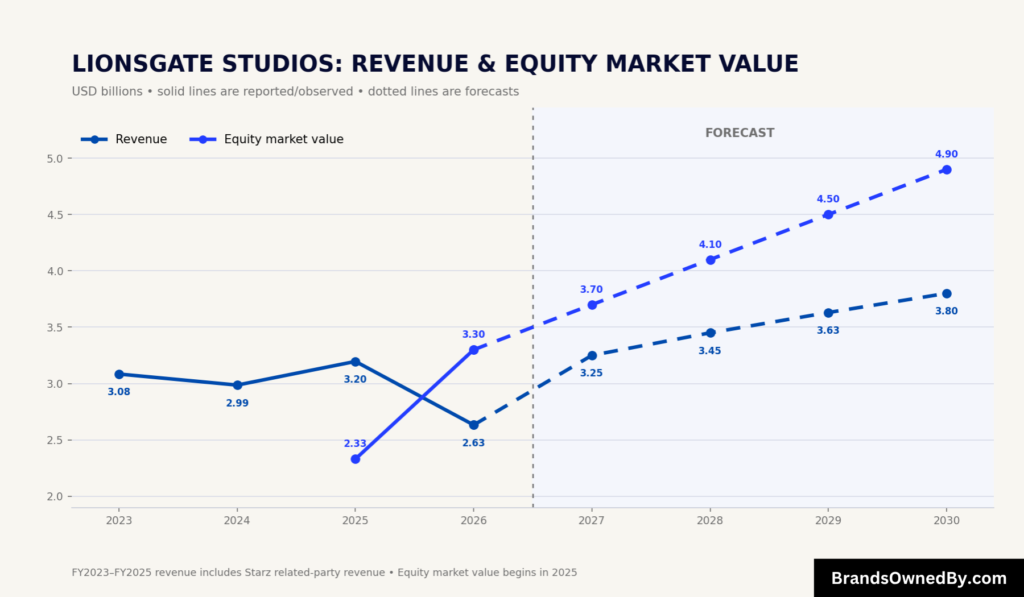
Lionsgate Studios reported audited Studio Business revenue before becoming fully independent from Starz. Revenue was $3.084 billion in fiscal 2023, $2.986 billion in 2024, and $3.196 billion in 2025. The company generated $2.632 billion in fiscal 2026, its first full reporting year under the post-separation structure.
Equity market value measures the value of outstanding shares. It is different from revenue and enterprise value. Lionsgate did not have a directly comparable standalone market capitalization in fiscal 2023 or 2024. The valuation series therefore begins with the completed Starz separation in 2025.
Revenue Before the Starz Separation
Fiscal 2023 revenue consisted of $1.324 billion from Motion Picture and $1.760 billion from Television Production. Total Studio Business revenue reached $3.084 billion. Television contributed 57% of the total, making it the larger segment that year.
The mix reversed in fiscal 2024. Motion Picture revenue increased to $1.656 billion, supported by titles including John Wick: Chapter 4 and The Hunger Games: The Ballad of Songbirds & Snakes. Television Production revenue fell to $1.330 billion. Total revenue declined 3.2% to $2.986 billion.
Fiscal 2025 revenue increased 7% to $3.196 billion. Motion Picture generated $1.590 billion, while Television Production contributed $1.606 billion. The two segments were almost evenly balanced. The eOne operations contributed approximately $123.4 million to Motion Picture revenue, compared with $19.5 million during the short post-acquisition period in fiscal 2024.
These totals include business conducted with Starz before the separation. Related-party revenue was $775.5 million in fiscal 2023, $545.9 million in fiscal 2024, and $619.7 million in fiscal 2025. The amounts primarily reflect content licensed by the studio operations to Starz. They were recorded as revenue in Lionsgate Studios’ audited carve-out financial statements.
Fiscal 2026 Revenue
Lionsgate Studios generated $2.632 billion in fiscal 2026 revenue. Motion Picture contributed approximately $1.617 billion. Television Production contributed about $1.045 billion. Intersegment eliminations reduced the combined amount by roughly $30 million.
Revenue declined 17.6% from fiscal 2025. Television Production accounted for most of the reduction. Its revenue fell from $1.606 billion to approximately $1.045 billion. Motion Picture revenue increased slightly from $1.590 billion to $1.617 billion.
The studio produced gross profit of approximately $1.078 billion and operating income of $178.5 million. It recorded a net loss of $198.9 million after interest, amortization, restructuring, and other corporate expenses.
Fourth-quarter performance was substantially stronger. The March 2026 quarter generated $906.5 million in revenue, $117.5 million in operating income, and $70.2 million in net income.
Fiscal 2027 Started With Higher Revenue and Cash Flow
The June 2026 quarter, which was the first quarter of fiscal 2027, generated $776.6 million in revenue. Revenue increased 48% from the comparable prior-year period. Motion Picture revenue reached approximately $603 million, while Television Production contributed about $174 million.
The quarter produced $79.3 million of adjusted OIBDA and $128.9 million of free cash flow. Trailing 12-month revenue reached approximately $2.883 billion.
Library revenue totaled $987 million over the same period. The film and television backlog increased 21% to approximately $1.5 billion. Net leverage declined to 4.3 times adjusted OIBDA.
How Lionsgate Generates Revenue
Motion Picture is the larger segment, but its quarterly performance can be volatile. One theatrical release can generate revenue through several stages. These include box office receipts, premium video, digital transactions, physical media, television licensing, and international distribution.
Television Production follows a different delivery cycle. Revenue depends on completed episodes, series renewals, syndication, international licensing, and unscripted production volume. Talent management and production services provide additional income.
The library generates recurring licensing revenue across both segments. Lionsgate controls or participates in more than 20,000 film and television titles. Trailing 12-month library revenue of $987 million represented approximately 34% of total company revenue at the June 2026 run rate.
Revenue Forecast Through 2030
The fiscal 2027 revenue estimate is $3.25 billion. That represents 23.5% growth from fiscal 2026. The estimate is supported by the $2.883 billion trailing revenue base, the $1.5 billion production backlog, and management’s expectation that scripted television deliveries will approximately double in fiscal 2027.
Revenue is forecast to reach $3.45 billion in 2028, $3.63 billion in 2029, and $3.80 billion in 2030. These estimates imply growth of 6.2% in 2028, 5.2% in 2029, and 4.7% in 2030. The full forecast represents a 9.6% compound annual growth rate from fiscal 2026 through fiscal 2030.
The largest source of forecast growth is the recovery in television deliveries. Motion Picture growth depends on the timing and performance of franchise releases, including theatrical receipts and downstream licensing. Library revenue provides a recurring base near $1 billion, while new films and television episodes expand the catalog available for future licensing.
Equity Market Value in September 2026
At a share price of approximately $10.74 on September 18, 2026, Lionsgate Studios had an equity market capitalization of about $3.30 billion. The value was approximately $970 million higher than its $2.33 billion post-separation baseline in 2025. That represents an increase of about 42%.
Enterprise value was approximately $7.12 billion. The $3.82 billion difference between enterprise value and market capitalization primarily reflects net debt and other financial claims. This gap is material because debt reduction can increase shareholder value even when the operating business is valued at the same enterprise multiple.
Equity-Value Forecast Through 2030
Equity market value is forecast at $3.70 billion in 2027, $4.10 billion in 2028, $4.50 billion in 2029, and $4.90 billion in 2030. The 2030 estimate represents a 10.4% compound annual increase from the September 2026 market value.
The valuation path depends on revenue growth converting into operating income and free cash flow. The company generated $128.9 million of free cash flow in the first quarter of fiscal 2027, while net leverage stood at 4.3 times adjusted OIBDA. Sustained cash generation would allow Lionsgate to reduce debt and move a larger portion of enterprise value to common shareholders.
The $4.90 billion estimate does not include an acquisition premium. A strategic buyer would evaluate the 20,000-title library, franchise rights, production backlog, talent-management interests, and net debt together. A transaction price would therefore be negotiated using enterprise value rather than market capitalization alone.
Titles and Brands Owned by Lionsgate Studios
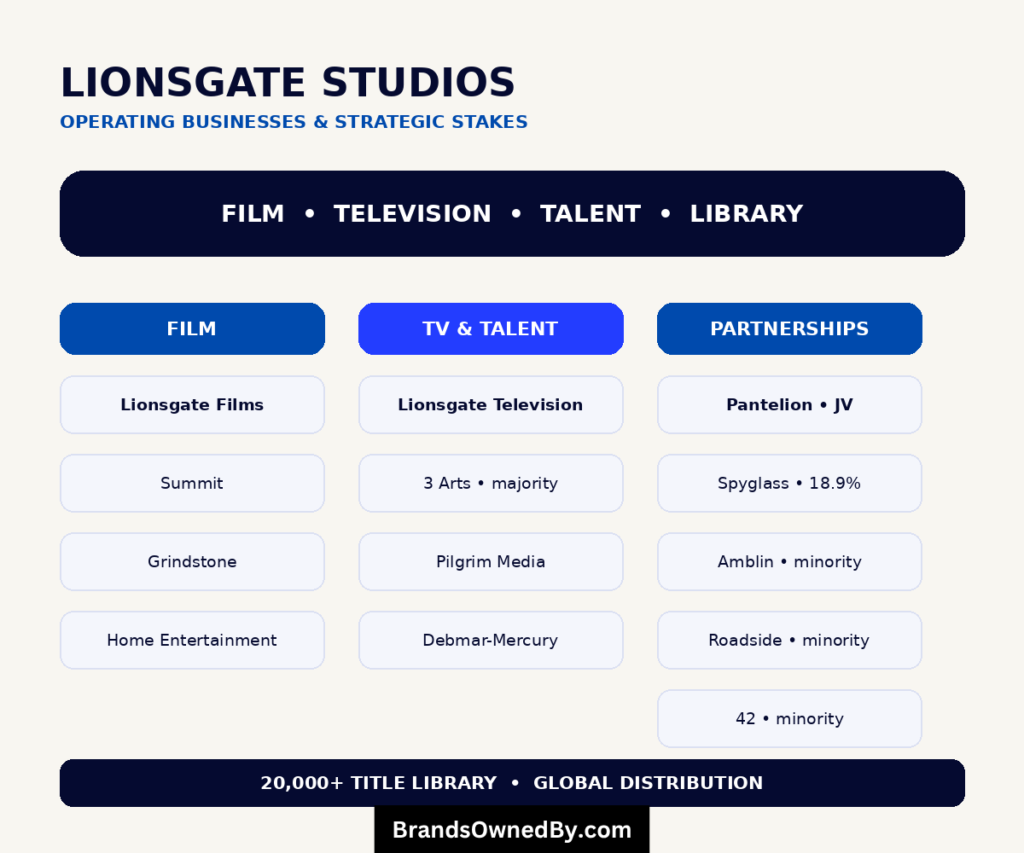
Lionsgate’s portfolio includes wholly owned operating units, majority-owned businesses, joint ventures, minority investments, and distribution labels. Those categories should not be treated as interchangeable.
The following list covers the company’s material publicly identified studio businesses and strategic holdings as of September 2026.
Lionsgate Motion Picture Group and Lionsgate Films
The Motion Picture Group is the company’s core film operation. Lionsgate Films is its primary theatrical label. The group develops, acquires, produces, finances, and distributes films across theatrical and downstream channels.
Its key advantage is flexibility. Lionsgate can fully finance a project, share risk with partners, acquire distribution rights, or earn a fee for distributing an outside production. That lets management tailor capital exposure to each film.
Summit Entertainment
Summit Entertainment is a wholly owned film label acquired in 2012. It brought the Twilight films and a proven production and distribution team. Summit remains a valuable label within the Motion Picture Group.
The name can help position a project for buyers and audiences, but it does not operate as an independent public company. Its financial results are consolidated into Lionsgate Studios.
Grindstone Entertainment Group
Grindstone focuses on acquiring and distributing films, including titles suited to digital, home entertainment, and other targeted channels. It supports Lionsgate’s high-volume acquisition strategy.
This business is useful because not every film needs a wide theatrical release. A project can be profitable when acquired at the right price and distributed to a defined audience through lower-cost channels.
Lionsgate Television
Lionsgate Television produces scripted series for broadcast networks, cable channels, and streaming platforms. It can work with outside buyers while retaining negotiated rights and library participation.
That supplier model reduces dependence on a single platform. It also creates recurring value when a series is renewed, sold internationally, or licensed after its original run.
Lionsgate Alternative Television
Lionsgate Alternative Television is the umbrella for unscripted and reality production activities. The unit brings together production companies and formats serving broadcasters, cable networks, and streaming platforms.
Unscripted content often has lower production costs and shorter development cycles than premium scripted drama. It gives the company a different risk profile and a steady flow of deliverable episodes.
Pilgrim Media Group
Pilgrim Media Group is a Lionsgate-owned unscripted production company. It develops reality series, documentaries, competition formats, and factual entertainment.
Pilgrim gives Lionsgate an established production engine rather than just a distribution label. Its capabilities can be used across third-party platforms without requiring Lionsgate to own a network.
Entertainment One Film and Television Operations
Lionsgate owns the film and television operations acquired from Hasbro in 2023. These assets expanded production capacity, library depth, and relationships with creators and buyers.
The ownership boundary is important. Hasbro did not sell every eOne-related brand or family property. Lionsgate owns the acquired entertainment operations and associated rights defined in the transaction.
Lionsgate Canada
Lionsgate Canada houses important Canadian production and distribution activities, including capabilities added through eOne. It supports local production, international co-productions, and relationships with Canadian creators and institutions.
This operation connects the company’s Canadian roots with its current global studio strategy. It also provides access to a significant production market and local content ecosystem.
3 Arts Entertainment
Lionsgate holds a majority interest in 3 Arts Entertainment. The business manages writers, actors, directors, and producers. It also participates in film and television production.
3 Arts gives Lionsgate access to talent relationships and project origination. The company is not merely a casting pipeline. Its clients work throughout the entertainment industry, including with competing studios and platforms.
Debmar-Mercury
Debmar-Mercury is Lionsgate’s television distribution and syndication business. It sells programming to local stations and other buyers. Syndication can create durable revenue from large episode libraries.
The unit is particularly valuable when a program has enough episodes for repeat scheduling. It extends the commercial life of content beyond its original network or platform window.
Lionsgate Home Entertainment
Lionsgate Home Entertainment manages distribution across digital purchase, rental, physical media, and related transactional channels. The exact mix continues to shift toward digital formats.
Home entertainment remains relevant even as streaming grows. A film can earn revenue through premium digital rental before moving into subscription and television licensing windows.
Pantelion Films
Pantelion Films is a joint venture focused on films for Latino audiences. Lionsgate participates with its venture partner rather than owning the business in the same way it owns Summit.
The label combines audience specialization with Lionsgate’s distribution capabilities. Its structure illustrates how Lionsgate enters focused markets without assuming all the capital risk alone.
Roadside Attractions
Lionsgate holds a minority stake in Roadside Attractions. Roadside specializes in independent films and targeted theatrical releases.
Because the stake is not full ownership, Roadside should not be described as a wholly owned Lionsgate label. Lionsgate can still benefit from distribution relationships and the value of its investment.
Amblin Partners
Lionsgate holds a minority investment in Amblin Partners. The relationship provides strategic exposure to a respected film and television producer without full corporate control.
Amblin retains its own identity and governance. Lionsgate’s economics depend on its investment rights and specific project or distribution arrangements.
Spyglass Media Group
Lionsgate owns an approximately 18.9% interest in Spyglass Media Group. Spyglass develops and produces film and television content and has interests in recognizable entertainment properties.
This is a strategic minority holding. Lionsgate does not own 100% of Spyglass and should not present every Spyglass asset as a wholly owned Lionsgate property.
42
Lionsgate holds a minority stake in 42, a management and production company with operations in the United Kingdom and the United States. The investment expands access to creators and project development.
As with Amblin and Roadside, this is an equity relationship rather than full ownership. The distinction matters when assessing control and consolidated financial results.
International Distribution Operations
Lionsgate maintains international sales and distribution capabilities, including operations in the United Kingdom and India. These units license content, manage local relationships, and support global releases.
International distribution is central to project economics. Presales and territorial licensing can reduce production risk before a film reaches theaters.
The Lionsgate Library and Franchise Portfolio
The company controls or participates in a library of more than 20,000 film and television titles. The portfolio includes rights connected to The Hunger Games, John Wick, Twilight, Saw, and other properties. Rights can vary by title, territory, medium, sequel, and contractual partner.
These franchises are assets, not separate companies. Their value comes from sequels, prequels, television extensions, games, consumer products, licensing, and recurring distribution of existing titles.
Final Words
Lionsgate Studios is owned by public shareholders. Liberty Strategic Capital is the largest disclosed holder at about 12.6%. The Rachesky-linked block, Vanguard-managed funds, FMR, BlackRock, and other investors hold meaningful positions. None owns a majority.
Control is therefore distributed. Mark Rachesky leads the board. Jon Feltheimer leads operations. Strategic shareholders influence major decisions, while the broader shareholder base ultimately owns the company.
The cleanest way to evaluate Lionsgate is as a standalone content company. It owns film and television operations, production labels, talent-management interests, strategic stakes, and a deep library. It does not own Starz, and Starz does not own it. Any future acquisition could change that answer. Until a transaction closes, Lionsgate Studios remains independent and publicly traded.
FAQs
Is Lionsgate owned by Disney?
No. Disney does not own Lionsgate Studios. Lionsgate is a separate public company listed on the New York Stock Exchange under LION.
Does Starz own Lionsgate Studios?
No. Lionsgate and Starz completed their corporate separation in May 2025. They are now separately owned public companies with different boards and strategies.
Who is the largest owner of Lionsgate Studios?
Liberty Strategic Capital is the largest disclosed shareholder based on available September 2026 data. It owns about 37.65 million shares, or approximately 12.6%.
Who founded Lionsgate?
Frank Giustra founded Lions Gate Entertainment in Vancouver in 1997. The company was named after the Lions Gate Bridge in British Columbia.
Is Lionsgate Studios publicly traded?
Yes. Lionsgate Studios trades on the New York Stock Exchange under the ticker symbol LION.
Who is the CEO of Lionsgate Studios?
Jon Feltheimer is the chief executive officer. He manages operations under the oversight of the board.
Who is the chair of Lionsgate Studios?
Mark Rachesky is the board chair. His long history as an investor and director makes him an influential figure, but he is not a majority owner.
Does Steven Mnuchin own Lionsgate?
Steven Mnuchin does not personally own all of Lionsgate. Liberty Strategic Capital, the firm he leads, owns about 12.6%. Mnuchin also serves on the board.
Is Lionsgate a Canadian or American company?
Lionsgate was founded in Canada. The modern studio is U.S.-based and listed on the New York Stock Exchange. It maintains important Canadian operations through Lionsgate Canada.
Does Lionsgate own Summit Entertainment?
Yes. Lionsgate acquired Summit Entertainment in 2012. Summit is now a wholly owned film label within Lionsgate’s Motion Picture Group.
Does Lionsgate own The Hunger Games?
Lionsgate controls significant film and franchise rights connected to The Hunger Games. The underlying publishing rights and creative rights are subject to separate agreements. It is more precise to say Lionsgate owns and exploits the film franchise rights than to say it owns every aspect of the property.
Does Lionsgate own John Wick?
Lionsgate is the principal studio and distributor behind the John Wick screen franchise and controls valuable related rights. Specific participations and rights can be shared with producers and other contractual partners.
Is Lionsgate Studios for sale?
The company explored strategic interest in 2026, and potential buyers were reported. No completed sale had changed ownership as of September 2026. Exploration does not guarantee a transaction.
What is Lionsgate Studios worth?
Its equity market value was about $3.30 billion on September 18, 2026. Enterprise value was higher because it includes net debt and other financial claims.
How does Lionsgate make money?
Lionsgate earns revenue from theatrical distribution, television production, digital and home entertainment, international licensing, library sales, syndication, talent management, and production services. A single title can generate revenue through several release windows.