

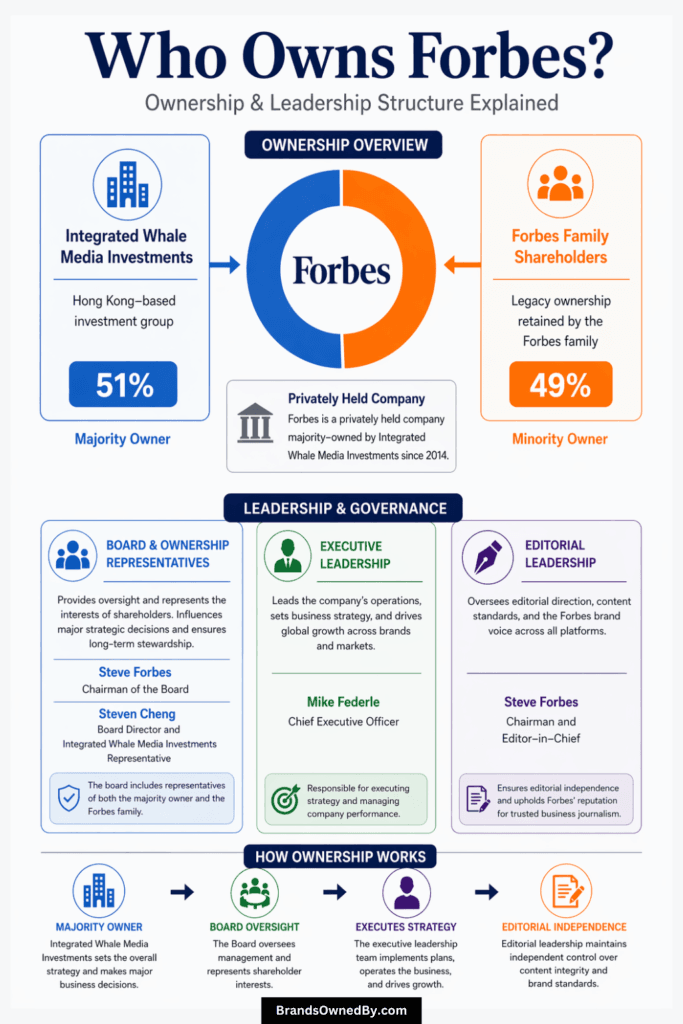
- Integrated Whale Media Investments is the majority owner of Forbes, controlling approximately 51% of the company after acquiring the stake in 2014 for a reported deal value of around $475 million.
- The Forbes family remains a significant minority shareholder with an estimated combined stake of roughly 49% through retained legacy ownership interests. Steve Forbes continues to influence the company through his leadership role as chairman and editor-in-chief.
- Forbes operates as a privately owned global media business focused on digital publishing, financial affiliate platforms, executive membership communities, international licensing, branded events, and luxury-focused business platforms as of April 2026.
- The company’s ownership structure combines international investor control with long-standing family influence, allowing Forbes to maintain its historic brand identity while expanding aggressively into digital media and global business services.
Forbes is a global business media and publishing company focused on entrepreneurship, finance, technology, leadership, investing, and wealth-related journalism. The company is widely recognized for its rankings, industry lists, and business analysis.
The brand became internationally known for publishing influential rankings such as the Forbes 400, World’s Billionaires List, and lists covering top companies, richest athletes, and powerful women in business.
Over the years, Forbes evolved from a traditional print magazine into a digital-first media platform. The company now operates across multiple channels including digital publishing, video media, podcasts, events, and international licensing partnerships.
Its audience includes:
- Business executives
- Investors
- Entrepreneurs
- Startup founders
- Corporate decision-makers
- Finance professionals.
One of the company’s biggest strengths is its global brand recognition. Forbes has expanded into many international markets through regional editions and licensing partnerships. This helped the company build a strong presence outside the United States.
The company also developed businesses beyond publishing. These include executive networking platforms, branded conferences, and financial guidance platforms.
Founders of Forbes
Forbes was founded in 1917 by two experienced publishing professionals, B. C. Forbes and Walter Drey. The founders built the company with a clear focus on business journalism, entrepreneurship, corporate leadership, and wealth reporting. At a time when most newspapers treated business news as a secondary topic, they created a publication dedicated almost entirely to the business world.
Their combined experience in journalism and publishing helped Forbes grow into one of the most recognized business media brands globally. As of April 2026, the company still reflects many of the editorial principles established by its founders, especially its strong focus on entrepreneurs, investors, executives, and global wealth rankings.
B. C. Forbes
B. C. Forbes was the primary editorial force behind the creation of Forbes. Born in Scotland, he later moved to the United States and became a respected financial journalist.
Before launching Forbes, he worked for several financial publications and developed strong relationships with major business leaders and industrialists. His reporting style focused on leadership, business growth, and the personalities behind major companies.
He believed business leaders should be given the same importance as political figures and public celebrities. This approach became one of the defining characteristics of Forbes.
Under his leadership, the magazine built credibility among executives, investors, and entrepreneurs across the United States.
Walter Drey
Walter Drey co-founded Forbes and played an important role in the publishing and operational side of the business.
While B. C. Forbes focused heavily on editorial direction and business journalism, Walter Drey helped manage publishing operations and business development during the company’s early years.
His involvement helped stabilize the company during its early expansion phase and supported the growth of the publication into a nationally recognized business magazine.
How the Founders Influenced Forbes
The founders created a publication that focused heavily on capitalism, entrepreneurship, innovation, and wealth creation. That strategy separated Forbes from many traditional newspapers of the early 20th century.
For example, Forbes regularly profiled industrialists, company founders, and corporate executives instead of focusing only on stock market updates. This helped the magazine build a strong identity around business leadership and success stories.
As of April 2026, Forbes still follows many of these principles through its entrepreneur coverage, billionaire rankings, executive interviews, and business-focused editorial strategy.
Ownership History
The ownership history of Forbes reflects the broader transformation of the global media industry. The company started as a family-controlled publishing business and later evolved into an internationally backed digital media company. Over more than a century, Forbes went through several major ownership and leadership transitions that reshaped its strategy, operations, and expansion plans.
Founding and Early Family Ownership (1917–1950s)
B. C. Forbes and Walter Drey founded Forbes in 1917.
During its early decades, the company operated as a privately owned publishing business controlled by its founders and later by the Forbes family. The publication focused heavily on business reporting, industrial growth, investing, and corporate leadership.
At the time, business journalism was still developing as a specialized media category. Forbes positioned itself differently from traditional newspapers by concentrating almost entirely on business leaders, entrepreneurs, and financial success stories.
The family ownership structure allowed the company to maintain editorial independence for decades. Major business and publishing decisions were handled internally by the founders and family leadership.
Expansion Under Malcolm Forbes (1950s–1990)
A major turning point in Forbes ownership history came with the rise of Malcolm Forbes.
After joining the company, Malcolm Forbes expanded the publication aggressively and transformed it into a globally recognized business media brand. He became one of the most publicly visible media executives in the United States.
Under his leadership, Forbes increased its focus on wealth, luxury lifestyles, entrepreneurship, and high-profile rankings. The company also expanded circulation and strengthened its advertising business.
Malcolm Forbes helped turn the Forbes name into a global brand rather than just a business magazine.
For example, the Forbes 400 ranking became one of the publication’s most influential features during this era. It attracted strong public attention and increased the company’s visibility among wealthy audiences and advertisers.
Despite this growth, the company remained under Forbes family control throughout Malcolm Forbes’ leadership period.
Transition to Steve Forbes Leadership (1990–2014)
After Malcolm Forbes died in 1990, leadership shifted to his son Steve Forbes.
Steve Forbes became chairman and editor-in-chief of the company. He also became nationally known for his political campaigns and economic views.
During this period, Forbes faced major changes in the media industry. Traditional print advertising revenue started declining across the publishing sector as digital media platforms expanded rapidly.
The company responded by increasing investment in online publishing and digital journalism.
Forbes launched stronger digital operations and experimented with new publishing models. One of the most important changes was the expansion of its contributor network model. This system allowed outside experts, entrepreneurs, and industry specialists to publish articles under the Forbes platform.
The strategy helped Forbes increase content production at scale while growing digital traffic.
However, like many traditional media companies, Forbes faced pressure from changing consumer habits and declining print revenue during this era.
Sale to Integrated Whale Media Investments (2014)
The biggest ownership change in Forbes history happened in 2014.
The Forbes family sold a majority stake in the company to Integrated Whale Media Investments.
Reports at the time estimated the deal value at around $475 million. The transaction marked the end of direct majority control by the Forbes family after nearly a century.
Although the family lost majority ownership, it retained a minority stake in the company. Steve Forbes also remained actively involved in leadership after the deal.
The acquisition reflected a growing trend in global media where international investors began acquiring established American publishing brands.
Integrated Whale Media Investments viewed Forbes as a globally recognized media asset with strong international expansion potential.
Digital Transformation After the Acquisition
After the 2014 acquisition, Forbes accelerated its digital-first strategy.
The company expanded several areas including:
- Digital publishing operations
- International licensing partnerships
- Branded content services
- Membership communities
- Financial advice platforms
- Business conferences and events.
The company also focused heavily on search-driven content and online audience growth.
For example, Forbes expanded platforms such as Forbes Advisor to capture high-value finance-related traffic and affiliate revenue opportunities.
International licensing also became more important. Forbes expanded regional editions across Asia, Europe, the Middle East, and Latin America.
This allowed the company to grow globally without fully owning every local publishing operation.
SPAC Merger Attempt and Ownership Developments
In 2021, Forbes announced plans to go public through a merger with a special purpose acquisition company known as Magnum Opus Acquisition Limited.
The proposed transaction attracted attention because it would have transformed Forbes into a publicly traded media company.
However, the deal was later terminated after market conditions changed and investor interest weakened.
As a result, Forbes remained privately owned.
The failed public listing attempt showed both the challenges and opportunities facing digital media businesses in modern financial markets.
Forbes Ownership Structure as of April 2026
As of April 2026, Integrated Whale Media Investments remains the majority owner of Forbes.
The Forbes family continues to maintain a minority ownership position and remains connected to company leadership through Steve Forbes.
The company now operates as a globally recognized private media business with ownership influence coming from both international investors and legacy family leadership.
Its ownership evolution reflects how traditional publishing companies adapted to digital disruption, international investment trends, and changing media consumption habits.
Who Owns Forbes: Top Shareholders
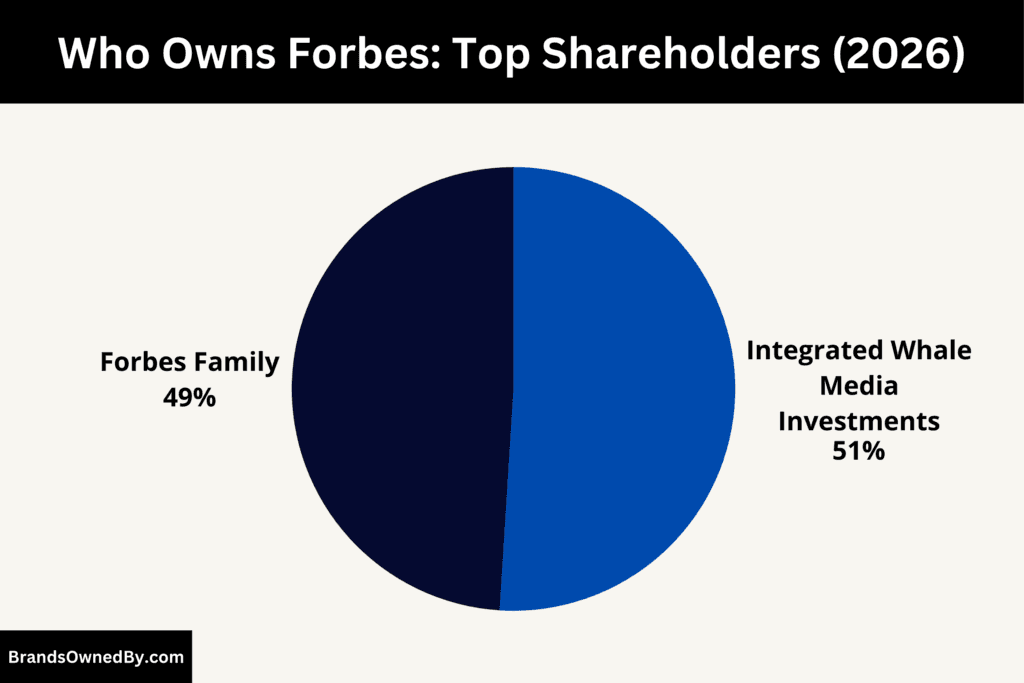
The ownership structure of Forbes has evolved from a tightly controlled family-owned publishing business into an internationally backed private media company. For nearly a century, the Forbes family controlled the organization and shaped its editorial direction, expansion strategy, and corporate identity.
That structure changed in 2014 when a majority stake in the company was sold to outside investors. The transaction reshaped the company’s governance model and brought in international investment capital to support digital expansion and global growth initiatives.
As of April 2026, Forbes remains privately owned. The company is primarily controlled by Integrated Whale Media Investments, which holds the majority ownership stake. The Forbes family continues to own a minority interest and still maintains influence through leadership positions and board-level involvement.
Because Forbes is privately held, complete shareholder disclosures are not publicly available in the same way as publicly traded companies. However, available ownership data and industry reporting provide a clear picture of the company’s major stakeholders and control structure.
Integrated Whale Media Investments: Majority Shareholder
Integrated Whale Media Investments is the controlling shareholder of Forbes.
The investment group acquired approximately 51% of Forbes in 2014 in a deal reportedly valued at around $475 million. This acquisition gave the firm majority control over the company and ended direct majority ownership by the Forbes family after almost 100 years.
The investor group was formed by international investors connected to media, finance, and investment management sectors. The acquisition was structured to help Forbes accelerate its digital transformation and international growth strategy.
At the time of the acquisition, traditional publishing businesses were under heavy pressure from declining print advertising revenue and growing competition from digital platforms. Integrated Whale Media Investments viewed Forbes as a valuable global media asset with strong brand recognition and expansion potential.
After securing majority ownership, the firm supported several major strategic initiatives including:
- Expansion of digital publishing operations
- Growth of international licensing partnerships
- Development of sponsored content businesses
- Investment in financial comparison platforms
- Expansion of executive membership communities
- International brand licensing growth.
The ownership group also encouraged Forbes to diversify revenue streams beyond traditional magazine publishing.
For example, Forbes significantly expanded businesses such as Forbes Advisor and Forbes Councils after the ownership transition.
As of April 2026, Integrated Whale Media Investments still controls the majority stake in Forbes and remains the most powerful shareholder in terms of corporate governance and long-term strategic decision-making.
The firm’s majority ownership position gives it substantial influence over:
- Executive appointments
- Corporate investments
- Expansion strategies
- Financial planning
- International partnerships
- Acquisition discussions.
Its ownership control also means that major corporate decisions typically require approval from representatives connected to the investment group.
The Forbes Family
The Forbes family remains an important minority shareholder in Forbes.
After the 2014 sale, the family retained roughly 49% ownership combined with certain legacy stakeholders and retained interests connected to the original ownership structure. Over time, the exact percentage may have shifted slightly due to internal ownership arrangements and investment restructuring. However, the family continues to hold a significant minority position as of April 2026.
Although the family no longer controls the company outright, it still maintains meaningful influence because of its historical connection to the brand and continued leadership involvement.
Steve Forbes remains one of the company’s most influential figures. As chairman and editor-in-chief, he continues to shape the public identity and editorial positioning of Forbes.
His continued role gives the Forbes family influence over:
- Editorial direction
- Brand reputation management
- Public positioning
- Leadership discussions
- Long-term strategic planning.
The Forbes family connection also remains commercially valuable. The Forbes name itself is deeply tied to the company’s identity and global reputation.
For example, many readers associate Forbes directly with wealth rankings, billionaire coverage, entrepreneurship reporting, and business leadership journalism because of the long-standing family legacy behind the publication.
The family’s continued involvement helps preserve continuity between the company’s historical identity and its modern digital media operations.
Highlander Management LLC: Associated Ownership Stakeholder
Highlander Management LLC has been associated with ownership and holding structures connected to Forbes corporate entities.
While Forbes does not publicly disclose full private shareholder breakdowns, Highlander Management LLC has appeared in ownership-related filings and investment structures tied to Forbes Global Media Holdings.
The company appears to function as part of investment management and holding arrangements associated with the broader ownership framework surrounding Forbes.
Its exact ownership percentage has not been publicly disclosed as of April 2026. However, its involvement suggests that Forbes ownership includes layered investment and holding structures beyond the primary controlling shareholder.
This is common in privately held media companies where ownership stakes are sometimes distributed through investment vehicles, holding companies, or management entities connected to major investors.
Ownership Influence and Control Structure
Although multiple stakeholders are connected to Forbes, operational control largely remains concentrated around the majority ownership position held by Integrated Whale Media Investments.
However, the Forbes family still retains influence because of:
- Minority ownership interests
- Leadership involvement
- Historical brand association
- Executive and editorial participation.
This creates a hybrid ownership structure where financial control and brand influence are shared across different stakeholders.
For example, ownership investors may focus heavily on growth strategy, monetization, and expansion opportunities, while long-standing family leadership may prioritize editorial identity and brand reputation.
As of April 2026, this balance continues to shape how Forbes operates as a global private media company.
Competitor Ownership Comparison
The ownership structure of Forbes is very different from many of its competitors in the global business media industry. Some competitors are controlled by billionaires. Others are owned by large public corporations or international media conglomerates.
These ownership structures directly affect editorial strategy, expansion plans, monetization models, and long-term business priorities.
For example, privately owned business media companies often focus on long-term brand growth without the short-term pressure of public shareholders. In contrast, publicly traded media companies usually face stronger pressure to increase quarterly revenue and advertising performance.
| Company | Ownership Type | Main Owner(s) | Ownership Structure | How Ownership Impacts the Business |
|---|---|---|---|---|
| Forbes | Privately owned | Integrated Whale Media Investments and the Forbes family | Integrated Whale Media Investments owns the majority stake at approximately 51%, while the Forbes family retains a significant minority stake and leadership influence. | The private ownership structure gives Forbes flexibility to focus on long-term digital expansion, international licensing, and brand growth without pressure from public shareholders. The Forbes family still influences editorial identity through Steve Forbes. |
| Bloomberg L.P. | Privately held | Michael Bloomberg | Michael Bloomberg maintains majority control over the company. | Strong founder control allows Bloomberg to operate with long-term strategic focus and invest heavily in journalism, technology, and financial data services without outside shareholder pressure. |
| The Wall Street Journal | Subsidiary of public corporation | News Corp | Operates under News Corp, which is heavily influenced by the Rupert Murdoch family. | Access to large corporate resources and media infrastructure supports global operations, but the business also faces pressure from public shareholders and corporate profitability goals. |
| Fortune | Privately owned | Chatchaval Jiaravanon | Controlled by private investor ownership after its acquisition in 2018. | Private ownership gives Fortune flexibility to expand digital operations, conferences, and international business initiatives without quarterly public market pressure. |
| Business Insider | Subsidiary ownership | Axel Springer | Fully controlled by German media giant Axel Springer. | Corporate backing supports aggressive digital expansion, subscription growth, and international scaling focused on younger online audiences. |
| CNBC | Subsidiary of multinational media corporation | Comcast | Operates through NBCUniversal under Comcast ownership. | Corporate ownership provides major broadcasting infrastructure, advertising reach, and cross-platform distribution capabilities for global financial news coverage. |
Forbes
As of April 2026, Forbes is primarily controlled by Integrated Whale Media Investments, which owns the majority stake in the company.
The Forbes family still maintains a minority ownership interest and leadership influence through Steve Forbes.
This hybrid ownership structure combines international investment capital with legacy family involvement.
One major advantage of this structure is flexibility. Because Forbes is privately held, it does not face the same quarterly earnings pressure as publicly traded media companies.
However, private ownership can also limit transparency because detailed financial and shareholder disclosures are not publicly available.
Bloomberg L.P.
Bloomberg L.P. operates under one of the strongest founder-controlled ownership structures in financial media.
The company was founded by Michael Bloomberg, who still controls a large majority ownership stake as of April 2026.
Unlike Forbes, Bloomberg generates massive revenue from financial data terminals rather than relying heavily on advertising-driven publishing.
This ownership structure gives Bloomberg enormous financial stability and allows it to invest aggressively in journalism, technology infrastructure, and global expansion.
Because Michael Bloomberg maintains strong control over the company, Bloomberg can operate with a long-term strategy without pressure from outside shareholders.
The Wall Street Journal
The Wall Street Journal is owned by News Corp, a publicly traded media conglomerate controlled by the Rupert Murdoch family.
This structure differs significantly from Forbes because ownership is tied to a much larger corporate ecosystem that includes newspapers, television assets, publishing businesses, and digital media operations.
Public ownership means News Corp faces shareholder expectations related to revenue growth, profitability, and stock performance.
The Wall Street Journal benefits from strong corporate resources and large-scale media infrastructure. However, it also operates within broader corporate financial priorities.
Fortune
Fortune was acquired in 2018 by Thai businessman Chatchaval Jiaravanon.
The acquisition showed how international investors became increasingly interested in established American business media brands.
Like Forbes, Fortune operates under private ownership. This gives the company greater flexibility in long-term strategic planning compared to public media companies.
After the acquisition, Fortune expanded its digital operations, conferences, and international business initiatives.
Both Forbes and Fortune now rely heavily on diversified revenue streams beyond traditional print publishing.
Business Insider
Business Insider is owned by German media giant Axel Springer.
This ownership structure gives Business Insider strong financial backing and international operational support.
Axel Springer has invested heavily in digital-first publishing businesses. As a result, Business Insider focuses aggressively on online traffic growth, digital subscriptions, and younger digital audiences.
Compared to Forbes, Business Insider operates with a more modern digital-native media structure rather than a legacy magazine-based identity.
CNBC
CNBC operates under Comcast through its NBCUniversal media operations.
This gives CNBC access to major corporate media infrastructure, advertising networks, and television distribution systems.
Unlike Forbes, CNBC depends heavily on television broadcasting and live financial news programming.
Corporate ownership allows CNBC to leverage large-scale production resources and cross-platform media distribution.
However, it also means the network operates within the priorities of a major multinational media corporation.
How Forbes Differs From Its Competitors
Forbes stands in a unique position between traditional family-owned publishing and modern international investor-backed media ownership.
Unlike Bloomberg, Forbes does not have a billionaire founder providing massive financial backing.
Unlike The Wall Street Journal or CNBC, Forbes is not controlled by a publicly traded media conglomerate.
Unlike Business Insider, Forbes still carries strong legacy magazine branding tied to a historic family name.
This ownership structure gives Forbes a mix of advantages and limitations.
Advantages include:
- Strong global brand recognition
- Flexible private ownership structure
- International investment backing
- Continued family brand influence
- Ability to focus on long-term expansion.
Challenges include:
- Competition from larger corporate-owned media groups
- Dependence on digital advertising markets
- Limited public financial transparency
- Pressure to continuously diversify revenue streams.
As of April 2026, Forbes continues operating as one of the most recognizable privately owned business media brands in the world while competing against billionaire-backed, conglomerate-owned, and digitally native media rivals.
Who Controls Forbes?
Control of Forbes is divided between ownership influence, executive leadership, and editorial management. While the company is majority-owned by Integrated Whale Media Investments, operational and editorial control also involves senior executives and long-standing leadership figures connected to the Forbes brand.
This creates a layered control structure where investors influence corporate strategy, while executives manage day-to-day operations and editorial teams oversee content direction.
As of April 2026, Forbes operates under a combination of shareholder influence, executive management, and editorial leadership.
Integrated Whale Media Investments Controls Strategic Direction
Because Integrated Whale Media Investments owns the majority stake in Forbes, it holds the strongest influence over major corporate decisions.
The company’s majority ownership position allows it to influence:
- Long-term business strategy
- Executive appointments
- Expansion planning
- Investment decisions
- International partnerships
- Financial restructuring decisions
- Large-scale acquisitions or partnerships.
In private companies like Forbes, majority ownership typically gives investors significant board-level power. This means the controlling shareholder can shape the overall direction of the business even if it does not manage daily editorial operations directly.
For example, decisions related to digital expansion, international licensing growth, or major platform investments would likely require approval from ownership representatives connected to Integrated Whale Media Investments.
The investor group played a major role in pushing Forbes toward a more aggressive digital-first business model after acquiring majority ownership in 2014.
Sherry Phillips Leads Daily Operations as CEO
Sherry Phillips serves as the CEO of Forbes as of April 2026.
The CEO is responsible for overseeing the company’s operational performance and business execution.
Her responsibilities include:
- Managing corporate operations
- Overseeing revenue growth strategies
- Expanding digital business operations
- Managing partnerships and advertising relationships
- Supervising international business growth
- Leading monetization and expansion initiatives.
As CEO, Sherry Phillips plays a central role in translating ownership goals into operational strategy.
For example, if ownership stakeholders prioritize growth in financial services content or international licensing partnerships, the executive leadership team would be responsible for implementing those strategies operationally.
She also oversees different divisions connected to advertising, events, branded content, licensing, and digital media operations.
Steve Forbes Maintains Strong Editorial Influence
Steve Forbes remains one of the most influential individuals within the company.
Even though the Forbes family no longer controls majority ownership, Steve Forbes continues serving as chairman and editor-in-chief.
His position gives him major influence over:
- Editorial direction
- Brand identity
- Public positioning
- Opinion content strategy
- Leadership messaging
- Long-term brand reputation.
Steve Forbes has been closely associated with the publication for decades. His continued involvement helps maintain continuity between the company’s historical identity and its modern digital operations.
For example, Forbes still strongly focuses on entrepreneurship, capitalism, wealth creation, and business leadership themes that have historically defined the brand.
His public visibility also strengthens the connection between the Forbes family name and the publication itself.
Editorial Teams Control Content Operations
Beyond executive leadership and ownership stakeholders, editorial teams play a major role in controlling daily content production across Forbes platforms.
These teams manage:
- Business news coverage
- Contributor content review
- Editorial standards
- Digital publishing operations
- Video and multimedia production
- Ranking and list development.
Forbes operates a large contributor network model where outside writers and industry experts contribute articles to the platform.
Because of this structure, editorial oversight is especially important in maintaining consistency and protecting the company’s reputation.
Editorial leadership teams help manage quality control and content policies across a very large publishing network.
Board and Corporate Governance Structure
Like many private media companies, Forbes operates through a corporate governance structure involving executives, board-level leadership, and ownership representatives.
The board structure likely includes representatives connected to major ownership stakeholders and senior company leadership.
These governance structures help oversee:
- Corporate strategy
- Financial planning
- Executive performance
- Risk management
- Investment decisions
- Business expansion initiatives.
In practice, this means control of Forbes is not concentrated entirely in one individual.
Instead, control is distributed across:
- Majority ownership stakeholders
- Executive leadership
- Editorial leadership
- Governance and board structures.
Past CEOs and Leadership Evolution
Several leadership figures have helped shape Forbes across different periods of its history.
Malcolm Forbes
Malcolm Forbes transformed Forbes into a globally recognized business media brand during the second half of the 20th century.
He expanded the publication’s visibility and strengthened its focus on wealth, entrepreneurship, and high-profile business coverage.
Steve Forbes
Steve Forbes helped guide the company through major industry changes including the transition from print-focused publishing to digital media operations.
He also became one of the public faces of the Forbes brand through his political campaigns and economic commentary.
Mike Federle
Mike Federle played an important role in expanding Forbes’ digital publishing operations and branded content business.
During his leadership, the company increased focus on digital monetization strategies and audience growth.
Sherry Phillips
Sherry Phillips represents the company’s modern leadership era focused on digital scalability, diversified revenue streams, and international business expansion.
How Control at Forbes Differs From Competitors
Control at Forbes differs from many major competitors in the media industry.
For example:
- Bloomberg L.P. is heavily controlled by founder ownership through Michael Bloomberg.
- The Wall Street Journal operates under a public corporate ownership structure tied to News Corp.
- CNBC functions inside a large corporate media ecosystem controlled by Comcast.
Forbes operates with a hybrid control structure that combines private investment ownership with legacy family leadership involvement.
As of April 2026, this combination continues to shape the company’s editorial direction, operational priorities, and global expansion strategy.
Forbes Annual Revenue and Net Worth
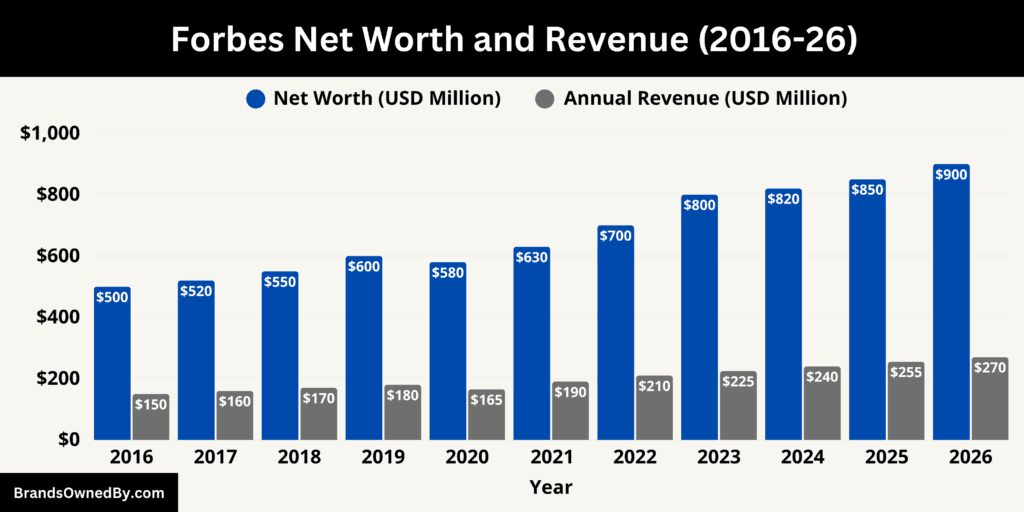
As of April 2026, Forbes is estimated to generate more than $270 million in annual revenue, while the company’s estimated market valuation is believed to be close to $900 million.
The company’s financial position has improved significantly over the last decade because of its transition from a traditional print-focused publication into a diversified digital media business. Forbes expanded into financial affiliate platforms, international licensing, executive membership communities, branded content, and live business events.
Unlike many legacy magazine publishers that struggled with declining print advertising revenue, Forbes diversified aggressively into high-margin digital businesses. This strategy helped stabilize revenue growth and strengthen the long-term value of the Forbes brand.
Forbes Revenue Structure in 2026
As of 2026, Forbes generates revenue through several major business divisions rather than relying only on magazine advertising.
Digital Advertising Revenue
Digital advertising remains one of the company’s largest revenue sources.
Forbes generates substantial advertising income through its website traffic, sponsored business content, premium advertising placements, and video advertising partnerships.
Industry estimates suggest digital advertising and sponsored media partnerships contribute roughly $85 million to $95 million annually to the company’s total revenue.
The company benefits from strong advertiser demand in sectors such as:
- Financial services
- Technology
- Luxury products
- Investment platforms
- Business software
- Executive education.
Because Forbes attracts business professionals and high-income readers, advertisers often pay premium advertising rates compared to general news websites.
Forbes Advisor Revenue
Forbes Advisor has become one of the company’s fastest-growing revenue divisions.
The platform generates revenue through affiliate partnerships tied to financial products such as:
- Credit cards
- Insurance products
- Loans
- Banking services
- Investment platforms.
When users sign up for financial services through Forbes Advisor recommendations, the company earns referral commissions.
As of April 2026, industry analysts estimate Forbes Advisor contributes roughly $60 million to $75 million annually in revenue.
This division is especially important because affiliate finance businesses often generate significantly higher profit margins than traditional advertising operations.
International Licensing Revenue
Forbes licenses its brand to publishers and media operators across multiple international markets.
These partnerships allow local operators to publish regional Forbes editions while paying licensing fees to the parent company.
International licensing operations are estimated to generate approximately $35 million to $45 million annually as of 2026.
This business model is highly scalable because Forbes can expand internationally without directly operating every regional publication.
Forbes Councils and Membership Revenue
Forbes Councils generates recurring membership revenue from executives, entrepreneurs, and business professionals.
Members pay annual fees for networking access, publishing opportunities, and executive branding benefits.
This division is estimated to contribute roughly $25 million to $35 million annually in recurring revenue.
The membership model helps create stable income streams that are less dependent on advertising market fluctuations.
Events and Conferences Revenue
Forbes also generates revenue through leadership conferences, entrepreneur summits, and business networking events.
These events attract corporate sponsors, investors, executives, and entrepreneurs.
As of 2026, Forbes’ events business is estimated to generate approximately $20 million to $30 million annually.
Large sponsorship deals tied to executive events remain an important monetization strategy for the company.
Forbes Net Worth and Brand Valuation
The estimated $900 million valuation of Forbes is heavily tied to brand value rather than physical assets.
The Forbes name remains one of the most recognized brands in global business media.
Its valuation is supported by several major factors.
Global Brand Recognition
Forbes operates one of the most recognizable business media brands in the world.
Its billionaire rankings, entrepreneur coverage, and executive-focused journalism create strong international visibility.
This brand recognition increases advertising demand and licensing opportunities.
Strong Digital Audience
The company attracts millions of monthly readers across its digital publishing network.
Its audience includes executives, investors, entrepreneurs, and finance-focused readers who are highly valuable to advertisers.
This audience quality significantly strengthens the company’s commercial value.
Diversified Revenue Streams
Unlike traditional magazine publishers that depended mostly on print advertising, Forbes now operates multiple revenue channels.
This diversification reduces financial risk and improves long-term valuation stability.
International Expansion Potential
Forbes continues expanding through licensing agreements in international markets.
This gives the company long-term growth opportunities without requiring massive operational investments in every country.
Future Revenue Forecast for Forbes (2027–2030)
Based on current digital growth trends, affiliate finance expansion, international licensing growth, and executive membership monetization, industry analysts expect Forbes to continue increasing revenue through 2030.
- 2027: $290 million
- 2028: $315 million
- 2029: $340 million
- 2030: $375 million.
Much of this projected growth is expected to come from finance-related affiliate businesses, AI-enhanced publishing systems, international licensing expansion, and recurring membership revenue models.
If Forbes successfully expands subscription products and premium executive communities further, revenue growth could accelerate beyond current projections.
Brands Owned by Forbes
As of April 2026, Forbes operates a diversified portfolio of media brands, digital businesses, executive communities, licensing operations, and content platforms. While Forbes is primarily known for business journalism, the company has expanded into financial services publishing, executive networking, branded events, and international media licensing.
Unlike large media conglomerates that own dozens of unrelated subsidiaries, Forbes focuses mainly on businesses connected to business media, entrepreneurship, finance, leadership, and executive audiences.
The company’s expansion strategy over the last decade focused heavily on scalable digital businesses and recurring revenue platforms rather than traditional print publishing alone.
Below are the major companies, brands, divisions, and business entities operated by Forbes as of 2026:
| Company / Brand | Business Type | Primary Focus | Key Revenue Model | Key Details |
|---|---|---|---|---|
| Forbes Media | Business media and publishing division | Business journalism, rankings, digital publishing, and editorial operations | Digital advertising, sponsored content, subscriptions, and media partnerships | Operates the core Forbes publishing business including Forbes.com, print magazine operations, contributor networks, video content, and global business rankings. Covers industries such as finance, technology, entrepreneurship, healthcare, and investing. |
| Forbes Advisor | Financial publishing and affiliate platform | Personal finance and financial product comparisons | Affiliate commissions and finance-related partnerships | Focuses on insurance, loans, credit cards, banking products, investment platforms, and financial education content. One of Forbes’ fastest-growing revenue-generating businesses as of 2026. |
| Forbes Councils | Executive membership and networking platform | Professional communities and executive thought leadership | Membership fees and recurring subscriptions | Operates invitation-based executive communities for professionals across industries including technology, finance, HR, and business leadership. Members gain networking access and publishing opportunities. |
| ForbesBooks | Business publishing platform | Leadership and entrepreneurship publishing | Publishing services and executive branding programs | Works with entrepreneurs, executives, and business leaders to publish books focused on leadership, business growth, and professional authority building. |
| Forbes Global Properties | Luxury real estate branding platform | High-end residential real estate marketing | Partnership agreements and luxury brokerage collaborations | Connects luxury real estate brokerages and premium property firms globally. Focuses on marketing high-value real estate to affluent buyers. |
| Forbes Travel Guide | Hospitality rating and luxury travel platform | Luxury hotels, restaurants, resorts, and spas | Hospitality partnerships, branding programs, and consulting services | Known for its luxury star-rating system used across the global hospitality industry. Strongly connected to affluent consumer markets. |
| Forbes Events | Events and conference business | Leadership forums, business summits, and networking conferences | Sponsorships, ticket sales, and corporate partnerships | Organizes conferences focused on entrepreneurship, technology, investing, women in business, AI, and leadership development. |
| Forbes Licensing | Global licensing operation | International Forbes-branded publishing partnerships | Licensing fees and international agreements | Manages regional licensing partnerships across Asia, Europe, the Middle East, and Latin America to expand the Forbes brand globally. |
| Forbes Marketplace | Affiliate commerce and lead generation business | Consumer finance and business service monetization | Affiliate marketing and performance-based partnerships | Supports commerce-focused monetization strategies through lead generation and financial product partnerships tied to Forbes traffic. |
| Forbes Content Studio | Branded content and corporate storytelling division | Sponsored media campaigns and branded business content | Corporate marketing partnerships and sponsored campaigns | Creates custom branded content campaigns including sponsored articles, executive interviews, videos, and digital storytelling projects for corporate clients. |
Forbes Media
Forbes Media is the core operating division of the Forbes business.
This division manages the company’s main publishing operations including:
- Forbes.com
- Print magazine publishing
- Digital editorial operations
- Video content production
- Business rankings and lists
- Editorial contributor networks.
The platform covers multiple industries including:
- Finance
- Technology
- Healthcare
- Investing
- Entrepreneurship
- Leadership
- Real estate
- Small business.
The digital publishing operation became the company’s largest audience driver after Forbes shifted toward online-first publishing strategies.
One of the most important parts of this division is its contributor network model. Forbes works with hundreds of contributors, industry experts, executives, and analysts who publish content across different business sectors.
This model helped Forbes scale content production rapidly while increasing search engine visibility and audience growth.
As of 2026, Forbes Media remains the foundation of the company’s global operations and brand identity.
Forbes Advisor
Forbes Advisor is one of the most important digital businesses operated by Forbes.
The platform focuses on personal finance and consumer financial products.
It provides comparisons, rankings, educational guides, and reviews related to:
- Credit cards
- Insurance products
- Mortgages
- Personal loans
- Banking services
- Investment platforms
- Tax software
- Small business financial tools.
The platform operates primarily through affiliate marketing partnerships. When users sign up for financial products through Forbes Advisor recommendations, the company earns referral commissions.
This business became extremely valuable because financial affiliate marketing generates higher profit margins than traditional advertising.
For example, insurance and credit card referral partnerships often produce significant recurring revenue opportunities for finance publishers.
As of April 2026, Forbes Advisor is considered one of the company’s fastest-growing revenue-generating businesses.
Forbes Councils
Forbes Councils is an executive membership and networking business operated under the Forbes brand.
The platform offers invitation-based communities for professionals and executives across different industries.
Members pay annual fees to access networking opportunities, brand-building tools, and publishing opportunities on Forbes platforms.
The business operates several specialized councils including:
- Technology leadership councils
- Finance executive councils
- HR leadership groups
- Business development communities
- Real estate leadership councils
- Agency leadership networks.
The platform combines networking with content marketing opportunities.
For example, executives can publish thought leadership articles connected to their industries through Forbes-related publishing channels.
This creates recurring membership revenue while also increasing engagement with business professionals and corporate decision-makers.
ForbesBooks
ForbesBooks operates as a business-focused publishing platform connected to the Forbes brand.
The company works with entrepreneurs, executives, consultants, and business leaders to publish books focused on leadership, entrepreneurship, business growth, and professional expertise.
Unlike traditional publishing houses that rely entirely on mass-market book sales, ForbesBooks operates using a business-oriented publishing model focused on executive branding and authority building.
Authors often use these books as part of broader business positioning strategies.
The brand strengthens Forbes’ connection to executive audiences and leadership communities.
Forbes Global Properties
Forbes Global Properties is a luxury real estate branding and marketing platform launched under the Forbes brand.
The platform connects high-end real estate brokerages and luxury property firms worldwide.
It focuses on premium residential real estate markets and luxury property marketing.
The business benefits from the Forbes brand’s association with wealth and affluent audiences.
Luxury real estate companies use the platform to market premium properties to high-net-worth buyers globally.
As of 2026, the platform continues expanding partnerships with luxury brokerage firms across international markets.
Forbes Travel Guide
Forbes Travel Guide operates as a luxury hospitality rating and travel evaluation business associated with the Forbes brand.
The platform evaluates and rates:
- Luxury hotels
- Resorts
- Restaurants
- Spas
- Hospitality experiences.
Its star-rating system is recognized internationally within the luxury hospitality industry.
The platform generates revenue through hospitality partnerships, training services, branding programs, and luxury travel-related business relationships.
The business aligns closely with Forbes’ wealthy audience demographics and premium brand positioning.
Forbes Events
Forbes Events manages the company’s conferences, summits, networking events, and leadership forums.
The division organizes events focused on:
- Entrepreneurship
- Technology innovation
- Investing
- Women in business
- Leadership development
- AI and digital transformation
- Healthcare innovation.
These events attract executives, founders, investors, sponsors, and corporate partners.
Large sponsorship agreements connected to these events generate significant revenue opportunities for the company.
The events division also strengthens the Forbes brand’s influence among business leaders and corporate decision-makers.
Forbes Licensing Operations
Forbes Licensing manages global licensing agreements connected to the Forbes brand.
Instead of directly operating all international editions, Forbes licenses its brand to regional publishing partners.
These partnerships allow local operators to launch Forbes-branded editions and business platforms in international markets.
This model helps Forbes expand globally while reducing operational costs and risks.
As of 2026, Forbes licensing operations extend across regions including:
- Asia
- Europe
- Middle East
- Latin America.
The licensing strategy became one of the company’s most important international expansion tools.
Forbes Marketplace and Affiliate Operations
Forbes Marketplace operates commerce-focused and affiliate monetization businesses tied to consumer financial products and business services.
This division supports monetization through product comparisons, lead generation partnerships, and performance-based marketing relationships.
The business became increasingly important as digital publishers shifted toward commerce-based monetization models.
Forbes uses its authority in finance and business journalism to drive high-intent consumer traffic toward affiliate offers and partner services.
Forbes Content Studio
Forbes Content Studio develops sponsored campaigns and branded storytelling projects for corporate clients.
The division works with major brands to create custom business-focused media campaigns.
These projects often include:
- Sponsored articles
- Executive interviews
- Video campaigns
- Interactive digital features
- Corporate storytelling initiatives.
This business became increasingly important as branded content advertising grew across the digital publishing industry.
Final Thoughts
The answer to who owns Forbes is no longer as simple as naming the Forbes family. The company is primarily owned by Integrated Whale Media Investments, which acquired a majority stake in 2014.
Still, the Forbes family continues to influence the business through leadership involvement and minority ownership. The company now operates as a modern global media brand with strong digital operations, licensing partnerships, and diversified revenue streams.
Its transformation reflects a broader shift in the media industry. Legacy publishing brands increasingly rely on international investors, digital monetization, and global expansion to remain competitive.
FAQs
Who owns Forbes Advisor?
Forbes Advisor is owned and operated by Forbes. It operates as one of the company’s major digital finance businesses and focuses on financial product comparisons, insurance, banking, loans, and investment-related content. Since Forbes is majority-owned by Integrated Whale Media Investments, Forbes Advisor ultimately falls under the same ownership structure.
Who owns Forbes magazine?
Forbes, including Forbes magazine, is primarily owned by Integrated Whale Media Investments, which controls the majority stake in the company. The Forbes family still retains a significant minority ownership interest and remains involved in leadership through Steve Forbes.
Who started Forbes magazine?
B. C. Forbes and Walter Drey founded Forbes magazine in 1917. They created the publication to focus on business journalism, entrepreneurship, investing, and corporate leadership during a period when dedicated business media publications were still uncommon in the United States.
Does Forbes support Trump?
Forbes does not officially endorse political candidates as a company-wide organization in the same way some newspapers issue formal political endorsements.
However, Steve Forbes has publicly expressed support for several conservative economic policies that aligned with parts of Donald Trump’s economic agenda, particularly on tax cuts and deregulation.
At the same time, Forbes publishes content from a wide range of contributors with differing political and economic views. Because of its contributor network model, opinions published on the platform can vary significantly.
What family started Forbes?
The Forbes family became associated with the company after B. C. Forbes co-founded the publication in 1917. The family later controlled the company for decades through multiple generations including Malcolm Forbes and Steve Forbes.
The Forbes family helped transform the publication into one of the world’s most recognized business media brands.
Is Forbes controlled by China?
Forbes is not controlled by the Chinese government.
However, the company’s majority owner, Integrated Whale Media Investments, is a Hong Kong-based investment group that acquired a majority stake in Forbes in 2014.
Because of this ownership structure, some public discussions have questioned foreign influence over the company. Despite that, Forbes continues operating as an American business media company headquartered in the United States with editorial operations led by its executive and editorial leadership teams.