
- Empire State Realty Trust controls the Empire State Building through Empire State Realty OP, L.P., the partnership that holds substantially all of ESRT’s assets and conducts its business.
- Qatar Investment Authority, through Quark Holding LLC, is the largest disclosed Class A shareholder with 29,894,869 shares, but a voting agreement limits its independent voting power to 9.9%.
- Chairman and CEO Anthony E. Malkin does not personally own the tower. His reported interests represented 14.7% of ESRT’s voting power and 13.5% of combined common stock and operating-partnership units as of March 2, 2026.
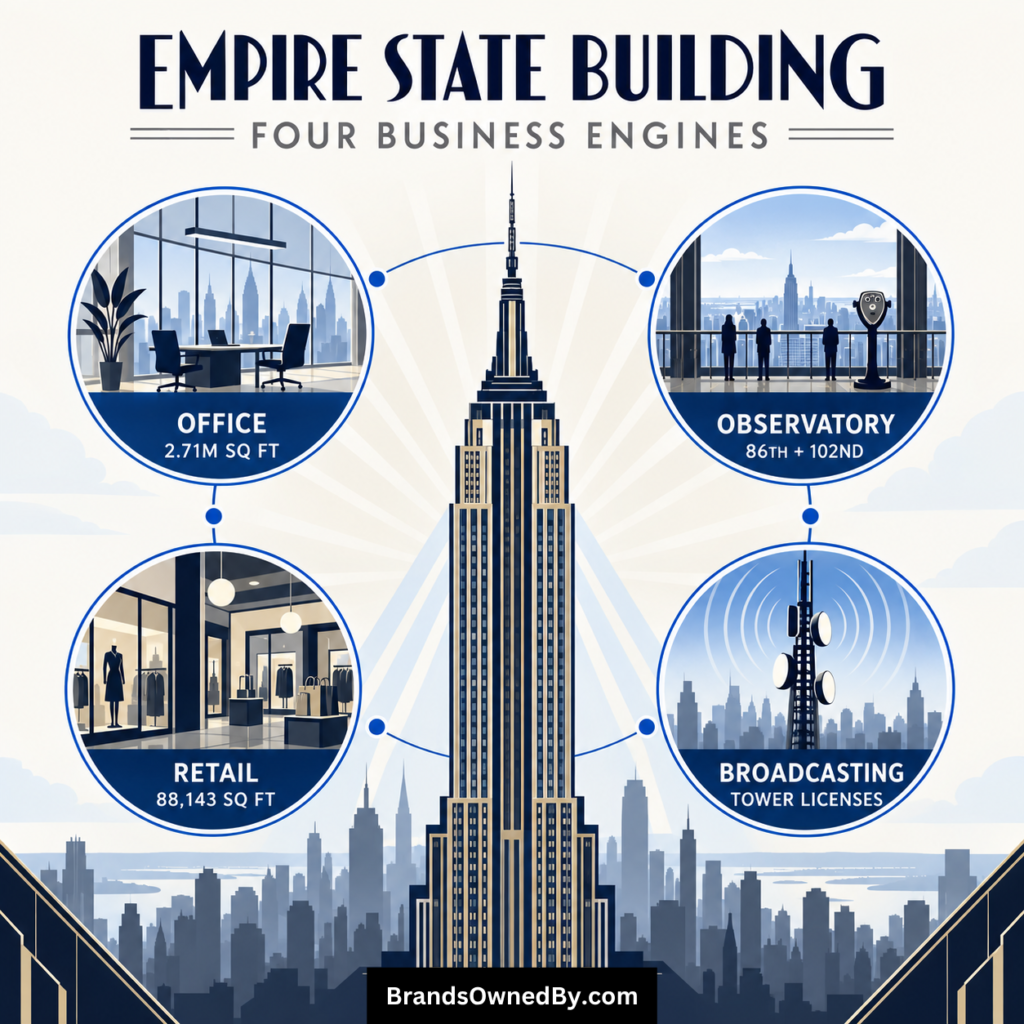
- The tower produces income from office and retail rent, its 86th- and 102nd-floor observatories, broadcasting licenses, sponsorships, and brand-related activity.
Empire State Realty Trust, Inc. owns and controls the Empire State Building through Empire State Realty OP, L.P., its operating partnership. ESRT is a publicly traded real estate investment trust. Its shareholders and operating-partnership investors have indirect economic interests in the tower, while ESRT’s board and management control the property. Anthony Malkin leads ESRT but does not personally own the building.
Who Owns the Empire State Building?
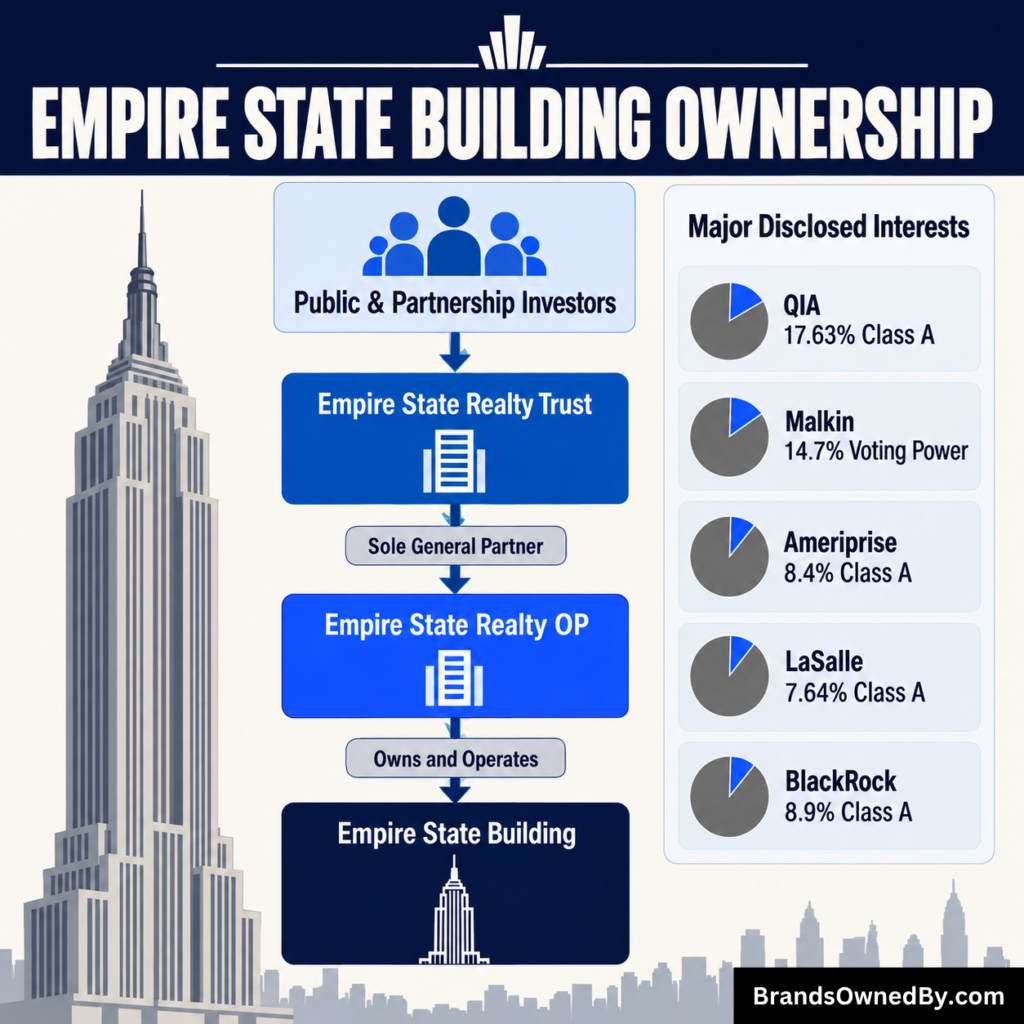
The shortest accurate answer is that Empire State Realty Trust controls the Empire State Building through Empire State Realty OP and its subsidiaries. ESRT is publicly traded, so its investors have indirect economic exposure to the tower. They do not individually hold pieces of the deed.
The shareholder figures below describe ownership of ESRT, not direct percentage ownership of the Empire State Building. Dates differ because institutional investors report positions on different filing schedules. The percentages are the latest disclosed snapshots available through September 2026, not one synchronized cap table.
Empire State Realty Trust is the listed company through which public investors gain exposure to the Empire State Building. ESRT is a Maryland corporation. Its Class A shares trade on the New York Stock Exchange under the ticker ESRT.
The property itself sits lower in the corporate structure. ESRT is the sole general partner of Empire State Realty OP, L.P. The operating partnership holds substantially all of the company’s real estate assets and conducts its property operations through subsidiaries.
This arrangement is known as an UPREIT structure. ESRT shareholders own stock in the listed parent. Some investors who contributed properties to the original portfolio hold operating-partnership units instead. Those units provide an economic interest in the operating partnership and may become exchangeable for Class A shares or cash, subject to the partnership agreement and ESRT’s election.
The distinction matters when assessing ownership. A shareholder does not own a direct percentage of the Empire State Building’s deed. The shareholder owns part of ESRT. ESRT controls the operating partnership, and the operating partnership owns the entities through which the building is held and operated.
This structure also keeps strategic authority centralized. ESRT appoints management and makes capital-allocation decisions as the operating partnership’s general partner. Office leasing, Observatory investment, financing, renovations, and major property decisions ultimately fall under ESRT’s corporate governance system.
Qatar Investment Authority Through Quark Holding LLC
Qatar Investment Authority holds its ESRT investment through Quark Holding LLC, a wholly owned subsidiary. Quark reported approximately 29.89 million Class A shares as of December 31, 2025.
That position represented 17.63% of ESRT’s outstanding Class A shares. It equaled 10.76% of the company’s fully diluted economic interests after operating-partnership units and other potentially exchangeable interests were considered.
QIA built most of the position through a strategic investment in August 2016. It purchased approximately 29.61 million shares at $21 per share. ESRT received about $621.8 million in gross proceeds. Quark later acquired another 0.28 million shares in 2018 through a contractual top-up right.
The investment made QIA ESRT’s largest disclosed outside Class A shareholder. Its economic exposure is substantial. However, its independent voting power is restricted.
Under the investment arrangement, QIA’s voting power is capped at 9.9%. Shares above that limit are subject to an irrevocable proxy. Those excess shares are voted in the same proportion as votes cast by other eligible common shareholders.
The cap prevents QIA from converting its full economic position into equivalent voting control. It cannot independently use the entire 17.63% Class A stake to elect directors, block proposals, or direct ESRT’s operations.
QIA therefore has a major financial interest in ESRT without unilateral control of the company or the Empire State Building. The arrangement gave ESRT significant long-term capital while protecting the existing governance structure from a single outside shareholder gaining disproportionate voting authority.
Anthony E. Malkin and Malkin-Related Interests
Anthony E. Malkin has the strongest combination of management authority, partnership ownership, and voting influence inside ESRT. He serves as the company’s chairman and chief executive officer.
As of March 2, 2026, Malkin beneficially owned approximately 0.06 million Class A shares and 0.64 million Class B shares. He also beneficially owned approximately 36.80 million operating-partnership units. The reported total included vested LTIP units and interests held through family trusts and related entities.
These interests represented 13.5% of ESRT’s combined common shares and operating-partnership units. His voting position was stronger than the economic percentage suggests. Malkin controlled approximately 14.7% of total common-stock voting power.
The difference results partly from ESRT’s Class B structure. Each eligible Class B share carries 50 votes when it remains paired with the required operating-partnership units. The structure gives Malkin-related interests more voting influence than the same number of ordinary Class A shares would provide.
Malkin’s operating-partnership units are also economically important. Their value is tied to the performance of the operating partnership that holds ESRT’s properties. This creates direct financial exposure to the company’s real estate portfolio, including the Empire State Building.
His influence does not come from personally holding the building’s deed. It comes from three connected positions: his role as chairman and CEO, his large operating-partnership interest, and the enhanced voting power attached to eligible Class B shares.
Malkin cannot act without the board or override every shareholder decision. However, the combination gives him considerably more influence over strategy, leadership, capital spending, financing, and property operations than any ordinary institutional shareholder.
BlackRock, Inc.
BlackRock reported beneficial ownership of approximately 14.86 million ESRT Class A shares in the position included in ESRT’s 2026 proxy statement. The holding represented about 8.9% of the outstanding Class A stock at the applicable reporting date.
The stake was held through BlackRock’s asset-management subsidiaries for investment funds and client accounts. It should not be viewed as a single corporate purchase made with BlackRock’s own operating capital. Beneficial ownership reporting reflects the voting or investment authority exercised by BlackRock entities over shares held in managed portfolios.
An 8.9% position gives BlackRock meaningful influence in shareholder votes. Its voting decisions can matter in director elections, executive compensation proposals, governance changes, and other matters submitted to ESRT investors.
The holding does not provide board control or operational authority. BlackRock cannot direct office leasing, Observatory pricing, property financing, or capital improvements at the Empire State Building.
BlackRock’s stake is best understood as a large institutional position in ESRT. It provides the underlying funds and clients with economic exposure to the REIT’s entire portfolio. It does not represent an 8.9% direct ownership interest in the Empire State Building.
Ameriprise Financial, Inc.
Ameriprise Financial reported beneficial ownership of approximately 14.49 million ESRT Class A shares as of June 30, 2026. The position represented about 8.4% of the outstanding class.
A substantial portion of the shares was reported through Threadneedle-related investment-management subsidiaries. These entities manage portfolios for funds and institutional clients. Ameriprise was therefore reported as a beneficial owner because its subsidiaries exercised investment or voting authority over the shares.
The position increased from approximately 11.93 million shares at the end of 2025. Ameriprise and its related entities added about 2.56 million shares during the first half of 2026. That was an increase of approximately 21.4%.
The increase moved Ameriprise closer to BlackRock in ESRT’s institutional ownership ranking. It also made Ameriprise one of the largest investors with a position reported through the June 2026 filing cycle.
The purchase did not represent an acquisition of the Empire State Building or an attempt to take over ESRT. Ameriprise’s subsidiaries held the shares as investments for managed portfolios.
At 8.4%, the position can still affect close shareholder votes. It does not give Ameriprise the authority to appoint management, control the board, or direct the operation of ESRT’s properties.
LaSalle Investment Management Securities LLC
LaSalle Investment Management Securities LLC reported beneficial ownership of 13.1 million ESRT Class A shares as of June 30, 2026. This represented 7.64% of the outstanding class and made LaSalle one of ESRT’s largest institutional shareholders.
However, the position does not mean LaSalle owned the entire stake for its own corporate account. The shares were held through discretionary accounts managed for institutional and other investment clients. Under SEC reporting rules, an asset manager may be treated as a beneficial owner when it has authority to vote or dispose of securities held in client portfolios.
No individual client account represented more than 5% of ESRT’s Class A shares. The reported 7.64% position was therefore spread across multiple accounts rather than concentrated with one underlying investor.
LaSalle’s holding gives the investment manager meaningful voting influence. It can participate in director elections and other shareholder decisions on behalf of managed accounts. It does not provide operational control over ESRT or direct ownership of the Empire State Building. Strategic authority remains with ESRT’s board, management team, and operating partnership structure.
Southeastern Asset Management and Longleaf Partners
Southeastern Asset Management reported beneficial ownership of 8.7 million ESRT Class A shares as of June 30, 2026. The position represented approximately 5.1% of the outstanding class.
Most of the reported investment was held by Longleaf Partners Small-Cap Fund, which owned 8.7 million shares within the jointly disclosed position. Southeastern serves as the fund’s investment adviser. The two names should not be interpreted as holding separate blocks of 8.7 million shares. They were reporting interests connected to substantially the same position.
Crossing the 5% threshold required public beneficial-ownership disclosure. This makes the position important for ownership analysis, but it does not make Southeastern or Longleaf a controlling shareholder.
The filing classified the investment as one made in the ordinary course of business. It was not acquired to change or influence control of ESRT. Southeastern can still vote the shares and engage with management on matters such as governance, capital allocation, property strategy, and shareholder returns. However, the filing did not indicate an activist campaign, board challenge, or attempt to direct ESRT’s operations.
The position represents institutional exposure to ESRT as a public REIT. It does not give Southeastern or Longleaf direct title to the Empire State Building. Their economic interest remains tied to ESRT shares and the performance of the company’s wider real estate portfolio.
Cohen & Steers: A Former Major Shareholder
ESRT’s April 2026 proxy statement listed Cohen & Steers as the beneficial owner of approximately 11.13 million Class A shares. That information reflected an earlier ownership disclosure and made the investment manager appear to be one of ESRT’s largest institutional shareholders.
The position changed sharply during the first half of 2026. An amended filing submitted in August reported only nine shares as of June 30, 2026.
The reported holding therefore fell by more than 11.12 million shares. The reduction removed Cohen & Steers from ESRT’s current group of major shareholders.
This change is important because annual proxy statements are not live ownership registers. A proxy may reproduce the most recent filing available when the document is prepared. Later Schedule 13G amendments can show that an investment manager increased, reduced, or almost completely exited its position.
Cohen & Steers should therefore be described as a former major holder rather than a current leading shareholder. Including its earlier 11.13 million-share position without the August amendment would materially overstate its ownership as of September 2026.
Empire State Building Overview
The Empire State Building is a 102-story Art Deco skyscraper at 350 Fifth Avenue in Midtown Manhattan. Its business is larger than a conventional office tower. It combines approximately 2.8 million rentable square feet of office and retail space with a global visitor attraction, a broadcasting platform, and a valuable landmark brand.
Who Founded the Empire State Building?
The project was developed by Empire State, Inc. The corporation was formed in 1929 by a group led by financier John J. Raskob. Raskob had previously served as an executive at General Motors and DuPont. Former New York Governor Alfred E. Smith became the corporation’s president and the project’s public face.
Other early backers included members of the du Pont business circle and prominent investors of the period. Smith handled politics, publicity, and coordination. Raskob supplied financial leadership and the ambition to build the world’s tallest building.
The development site had been occupied by the original Waldorf-Astoria hotel. The hotel closed in 1929 and was demolished. Construction of the new tower began in March 1930.
How and When Was It Built?
Architectural firm Shreve, Lamb & Harmon designed the tower. Starrett Bros. & Eken served as general contractor. The construction program became famous for its speed. The structure rose at an average pace of more than four floors per week during its fastest phase.
The Empire State Building formally opened on May 1, 1931. It reached 1,250 feet to the original top of its mast and remained the world’s tallest building for roughly four decades. Its opening during the Great Depression created an immediate commercial challenge. Much of the office space initially stood empty, and New Yorkers sometimes called it the “Empty State Building.” Observatory income helped support the property while leasing slowly improved.
What the Property Includes in 2026
The modern asset is not just the silhouette seen from the street. At the end of 2025, ESRT reported 2,711,351 rentable square feet of office space and 88,143 rentable square feet of retail space at the property. The office portion was 96.0% leased. Its annualized office rent was $172.54 million, while annualized retail rent was $7.99 million.
The Observatory occupies the 86th and 102nd floors. It is reported as a separate operating segment because tourism, ticket pricing, marketing, and visitor volumes behave differently from office leasing. The tower also supports broadcasting and communications equipment through licensed space near its mast.
Empire State Building Ownership History
The building’s ownership history involves several separate layers. At different points, the land, fee title, master lease, operating sublease, and management rights belonged to different investors. That distinction explains why historical accounts sometimes name different “owners” for the same period.
1929 to 1951: Empire State, Inc.
Empire State, Inc. assembled the site and developed the building. John J. Raskob was the central financial organizer, while Al Smith served as president. The building cost roughly $40 million to develop, including the land. It opened into a weak office market and required patient capital before it became a stable commercial property.
Observatory admissions were economically important from the beginning. The attraction gave the building a second earnings stream that did not depend on office occupancy. That dual-income model remains central to the asset in 2026.
1951 to 1961: The Stevens and Crown Era
In 1951, a group led by Roger L. Stevens acquired the property in a transaction widely reported at approximately $51 million. The deal was considered a record-setting real estate transaction at the time.
Prudential Insurance Company acquired the land beneath the tower for approximately $17 million. The building interest and the land were then separated through a long-term lease structure. This division between fee ownership and operating rights would complicate the ownership story for the next half-century.
Chicago financier Henry Crown increased his position and eventually gained control of the ownership group. The Crown period was financially important because it connected the tower to a sophisticated private investment network rather than a single local developer.
1961 to 2002: Wien, Malkin, and Helmsley Syndication
In 1961, a syndicate led by Lawrence A. Wien, Peter L. Malkin, and Harry B. Helmsley acquired the Empire State Building for $65 million. The purchase did not include the land. The investors held a long-term leasehold and operating interests above property owned separately by Prudential.
Wien and Malkin used a syndication structure that divided economic participation among thousands of investors. Empire State Building Associates held the master leasehold. Empire State Building Company operated the property under a sublease. This structure made the building accessible to many private participants, but it also separated legal title, economic ownership, and management.
Helmsley-affiliated organizations managed the building for years. The Malkin organization gradually took fuller control of day-to-day management after disputes and a negotiated transition in the early 2000s.
1994 to 2002: Donald Trump’s Interest Was in the Land
Donald Trump did not own the operating building. His connection came through the land beneath it.
In 1994, the land was acquired for a reported $42 million by Japanese investor Hideki Yokoi and later transferred into Trump Empire State Partners, a venture involving Trump and a member of the Yokoi family. The land remained burdened by long-term lease arrangements. That meant control of the land did not give the venture practical control over office leasing or building operations.
On March 18, 2002, a Peter Malkin-led partnership agreed to acquire the land for $57.5 million. Empire State Building Associates completed the fee acquisition through Empire State Land Associates on April 17, 2002. The transaction reunited the fee title and land with the Malkin-led ownership structure, although the internal master-lease and sublease arrangements remained relevant.
2013: The Empire State Realty Trust IPO
The decisive modern transaction occurred on October 7, 2013. The Empire State Building and other Malkin-supervised properties were contributed to Empire State Realty OP, L.P. as part of the formation of Empire State Realty Trust.
ESRT completed an initial public offering at $13 per Class A share. The transaction replaced a fragmented private syndication model with a public REIT and operating partnership. Former participants received combinations of cash, public shares, and operating-partnership units according to the formation terms.
The process was contested by some investors. Litigation centered on fiduciary duties, valuation, tax consequences, and the fairness of the consolidation. A $55 million class settlement was approved before the IPO. The transaction nevertheless moved forward and created the ownership structure that remains in place.
2013 to September 2026: Public REIT Ownership
Since the IPO, the Empire State Building has been the flagship asset of ESRT. Empire State Realty OP holds substantially all of the group’s properties and businesses. Empire State Realty Trust is the operating partnership’s sole general partner and controls its management.
ESRT owned approximately 61.0% of the aggregate operating-partnership units as of June 30, 2026. The remaining economic interests included units held by continuing investors and holders of other partnership-unit series. This means ESRT controls the partnership even though it does not own every economic unit.
Empire State Building Ownership vs. Competing Landmarks
The Empire State Building competes with four major New York observation destinations. These properties also compete for premium office tenants, sponsorships, events, and tourist spending.
Their ownership models differ sharply. Some combine the building and attraction under one owner. Others separate the observation business from the underlying real estate. That distinction determines who controls pricing, receives visitor revenue, funds improvements, and reports financial results.
One Vanderbilt and SUMMIT One Vanderbilt
One Vanderbilt is the Empire State Building’s closest direct competitor. Both properties combine high-end offices with a paid observation attraction. Both are also connected to publicly traded Manhattan office REITs.
The ownership structure at One Vanderbilt has changed since the tower opened. As of September 2026, SL Green Realty holds an economic interest of approximately 55% and remains the controlling partner. South Korea’s National Pension Service owns 27.6%. Mori Building owns 16% after buying an 11% interest in 2024 and another 5% interest in 2025. Hines owns the remaining 1.4%.
The transactions involving Mori Building valued One Vanderbilt at $4.7 billion on a gross asset basis. That figure applies to the One Vanderbilt investment. It should not be treated as a standalone valuation for SUMMIT.
SL Green remains responsible for the property’s strategic direction. It manages the joint venture and reports One Vanderbilt’s performance through its public filings. The outside partners contribute institutional capital but do not control daily operations.
SUMMIT is more integrated with the underlying real estate than many competing observation decks. Its results are connected to the wider One Vanderbilt investment. This gives SL Green exposure to office rent, retail activity, tourism, events, and premium visitor experiences at the same address.
SUMMIT generated $55.65 million in operating revenue during the first half of 2026. The Empire State Building Observatory generated $42.74 million during the same period. SUMMIT therefore produced $12.91 million more revenue, or approximately 30.2% more.
This is a revenue comparison. It does not prove that SUMMIT earned more profit. The attractions have different operating costs, lease arrangements, marketing budgets, and capital requirements.
The competitive pressure is still significant. SUMMIT combines skyline views with immersive installations and event spaces. Its location beside Grand Central Terminal also gives it access to commuters, business travelers, and Midtown tourists.
The Empire State Building has a stronger historical identity. One Vanderbilt has a newer physical product. From an ownership perspective, both attractions are backed by public REIT platforms. However, SL Green owns only about 55% of One Vanderbilt, while ESRT has more direct economic exposure to the Empire State Building through its operating partnership.
One World Trade Center and One World Observatory
One World Trade Center uses a public-private ownership structure. The Port Authority of New York and New Jersey is the principal owner. The Durst Organization holds a minority membership interest and serves as a private development and management partner.
Durst entered the project with a minimum investment of $100 million. Its responsibilities extend beyond passive ownership. The organization has played a central role in leasing, property management, tenant improvements, and the commercial operation of the tower.
One World Observatory follows a different model. Legends operates the attraction through a dedicated entity under a 15-year lease arrangement. The original agreement provided for fixed and variable rent. Total payments to the Port Authority were projected at $875 million over the lease term.
This structure separates the economics of the attraction from the economics of the building. The Port Authority receives contractual rent. Legends controls the visitor operation and assumes much of the direct operating risk.
ESRT does not rely on an unrelated third-party observatory tenant in the same way. It consolidates the Empire State Building Observatory’s revenue and expenses. Strong attendance can therefore produce more direct upside for ESRT. Weak attendance also affects ESRT more quickly.
One World Observatory competes through height, modern construction, and its Lower Manhattan location. The experience occupies the upper levels of the tallest building in the Western Hemisphere. It also benefits from traffic generated by the wider World Trade Center campus.
Its ownership model makes direct financial comparisons difficult. Legends does not publish the same detailed quarterly attraction results that ESRT reports for the Empire State Building Observatory. Analysts can evaluate ESRT’s attraction revenue, expenses, and net operating income. They cannot perform an equally detailed public analysis of One World Observatory.
Rockefeller Center and Top of the Rock
Rockefeller Center is privately controlled by an ownership group led by Tishman Speyer and the Crown family. The partnership acquired the original Rockefeller Center complex for $1.85 billion in 2000.
Top of the Rock operates as part of the wider Rockefeller Center destination. The attraction supports the complex’s offices, retail spaces, restaurants, seasonal events, and public areas. Tishman Speyer can coordinate these uses across the campus.
The ownership of 30 Rockefeller Plaza requires one qualification. NBCUniversal owns a portion of the lower floors used for television studios and related operations. Tishman Speyer controls the remaining commercial portions associated with the broader Rockefeller Center investment.
This is different from the Empire State Building’s more unified public ownership story. A person who buys ESRT shares receives indirect exposure to the company that owns and operates the Empire State Building. There is no comparable publicly traded Rockefeller Center ownership vehicle.
Private ownership offers operational flexibility. Tishman Speyer can renovate visitor areas, adjust the tenant mix, create events, and reposition retail spaces without explaining every decision through quarterly public-company reporting.
That flexibility comes with less transparency. Rockefeller Center does not disclose Top of the Rock’s revenue, expenses, attendance, or net operating income every quarter. Its $3.5 billion refinancing in 2024 provided useful information about the capital structure of the wider campus. It did not reveal a standalone value or profit figure for Top of the Rock.
Top of the Rock competes through its central location and open-air views. It also gives visitors a direct view of the Empire State Building. This creates an unusual competitive advantage. The Empire State Building is the attraction being viewed, while Rockefeller Center receives the ticket revenue.
ESRT counters with a stronger connection between the visitor and the landmark itself. Guests enter the Empire State Building, move through its historical exhibits, and stand inside the structure they came to experience.
30 Hudson Yards and Edge
The ownership structure at 30 Hudson Yards is more fragmented than it first appears. Related Companies and Oxford Properties developed the tower as part of the larger Hudson Yards project. The building also contains separately owned condominium interests connected to major corporate occupants.
Edge is not simply an attraction operated as a department of the office landlord. In 2021, a KKR-controlled joint venture acquired a 75% interest in the observation-deck business for approximately $508.5 million. The transaction involved affiliates of Related, Oxford, Carlyle, and other investors.
KKR’s investment created a clear separation between the visitor-experience business and much of the underlying office real estate. Hudson Yards Experiences includes Edge, City Climb, and associated hospitality and event operations. Related retains an interest, but KKR holds the controlling position in the experience platform.
This structure allows a specialist investment group to focus on ticketing, events, hospitality, sponsorships, and visitor growth. The office tower can follow a separate leasing and capital strategy.
The Empire State Building follows a more integrated model. ESRT benefits from the relationship between the Observatory and the building’s global identity. The attraction supports office leasing, sponsorships, retail traffic, and brand licensing. ESRT also bears the consequences when tourism demand declines.
Edge competes through product design. Its outdoor platform extends from the 100th floor. City Climb adds a premium experience that can command a higher ticket price. These features position Hudson Yards Experiences as an entertainment business, rather than a traditional observation deck alone.
The ownership separation can also complicate comparisons. Edge does not release detailed quarterly revenue and profit figures comparable to ESRT’s Observatory disclosures. The reported $508.5 million transaction price represented the investment in the attraction platform. It was not the value of the entire 30 Hudson Yards tower.
What Makes the Empire State Building’s Ownership Model Different?
The Empire State Building has the clearest public connection between property ownership and attraction performance. ESRT owns the property through its operating partnership. It also consolidates the Observatory’s financial results.
Public investors therefore receive indirect exposure to several income streams at one landmark. These include office rent, retail rent, broadcasting income, Observatory tickets, premium experiences, and licensing activity.
One Vanderbilt is the closest structural comparison. SL Green controls the property and reports SUMMIT’s results. However, SL Green’s economic interest in One Vanderbilt is approximately 55%, with the balance held by three institutional partners.
One World Trade Center combines government ownership, private property management, and a third-party Observatory lease. Rockefeller Center uses private ownership with limited public reporting. Edge places majority control of the visitor business in a KKR-led investment structure that is separate from much of the tower’s office ownership.
ESRT’s structure creates both an advantage and a risk. When tourism is strong, the company captures the Observatory’s operating upside. When attendance falls, the decline is visible in its reported results.
Office leases can run for many years and generate relatively predictable rent. Observation-deck revenue can change much faster. Weather, international travel, ticket pricing, competition, and consumer spending can affect results within a single quarter.
That exposure makes the Empire State Building more than an office investment. It is a publicly controlled combination of commercial real estate, tourism, media value, and global brand recognition. None of its four main competitors packages those elements in exactly the same way.
Who Controls the Empire State Building?
![Who Owns the Empire State Building [Infographic]](https://brandsownedby.com/wp-content/uploads/2026/09/Who-Owns-the-Empire-State-Building-Infographic-683x1024.png)
Control sits with Empire State Realty Trust, its board, and executive management. No outside institutional shareholder has unilateral authority over the tower.
ESRT Controls the Operating Partnership
Empire State Realty Trust is the sole general partner of Empire State Realty OP. Limited partners have economic rights, but they do not manage the partnership in that capacity. ESRT therefore has responsibility and discretion over the partnership’s business and assets.
This legal position matters more than ESRT’s approximately 61.0% economic ownership of partnership units. General-partner authority allows ESRT to direct property operations, capital investment, leasing, financing, and asset strategy.
Anthony Malkin Leads Strategy and Management
Anthony E. Malkin has served as chairman and CEO since ESRT’s 2013 IPO. He joined predecessor entities in 1989 and has decades of direct experience with the portfolio. His combined leadership role gives him substantial influence over strategy, capital allocation, brand positioning, leasing standards, and the Observatory.
The board stated in its 2026 proxy that combining the chairman and CEO positions provides continuity and clear responsibility for execution. Steven J. Gilbert serves as lead independent director to provide counterbalancing board leadership.
The Board Retains Corporate Authority
ESRT’s board had ten directors nominated for election in 2026. Eight were classified as independent. Anthony Malkin and his son, George L. W. Malkin, were the two non-independent directors.
The board oversees management, major transactions, executive compensation, financial reporting, risk, and capital decisions. Public shareholders elect directors. Their influence is therefore exercised through governance rather than direct instructions about individual building leases or ticket prices.
QIA’s Voting Cap Prevents De Facto Control
QIA is the largest disclosed Class A shareholder, but it cannot independently vote its entire position. Its 9.9% voting cap and proportional proxy for excess shares reduce the risk that its large economic stake could become unilateral voting control.
This arrangement leaves the Malkin-led management team and board in control while QIA remains a major long-term capital provider.
Property and Observatory Teams Run Daily Operations
ESRT uses specialized teams for the building’s two main businesses. Property management handles office tenants, retail space, building systems, security, maintenance, and capital work. A separate Observatory team manages admissions, reservations, marketing, pricing, staffing, and the guest experience.
This division is economically logical. A multi-year office lease and a same-day tourist ticket have different customers, costs, demand cycles, and pricing decisions.
Empire State Building Revenue and Asset Value
The Empire State Building does not publish a standalone income statement or balance sheet. Empire State Realty Trust, or ESRT, reports the Observatory as a separate business. It does not provide the building’s complete office and retail revenue as a standalone line item. That distinction matters. ESRT’s companywide rental revenue cannot be presented as revenue from the Empire State Building.
The most reliable view therefore uses reported Observatory results, disclosed leasing data, and ESRT’s consolidated figures for context. It also separates the building’s operating performance from its asset value. Revenue measures money earned during a period. Asset value measures what the property could be worth at a point in time.
2025 Revenue
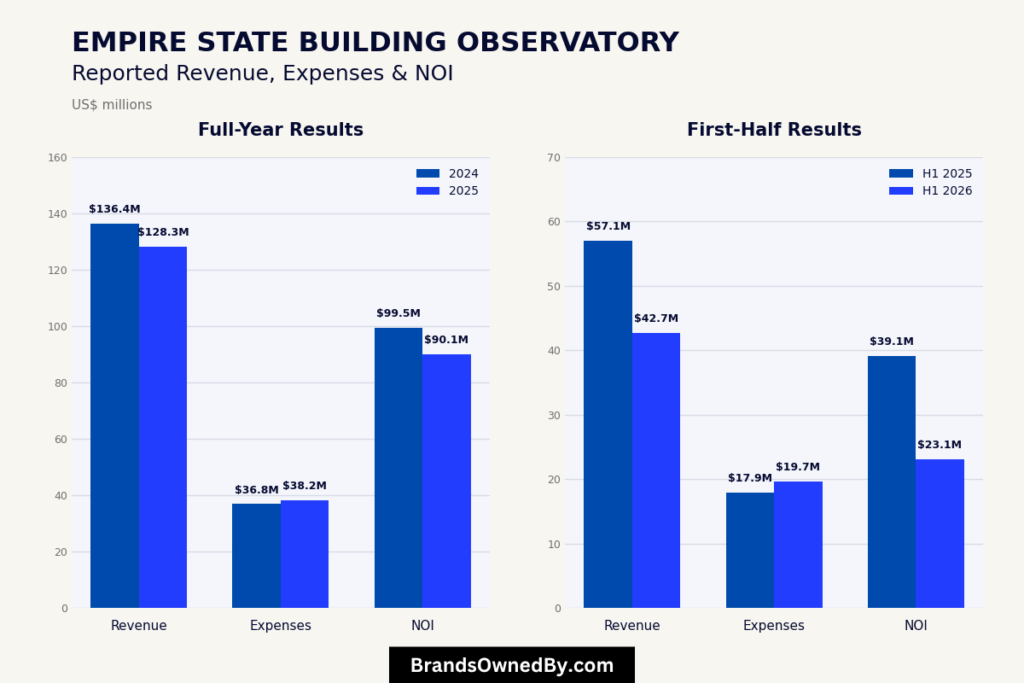
ESRT reported $768.27 million of total company revenue in 2025. This included $626.21 million of rental revenue across its portfolio and $128.33 million from the Empire State Building Observatory. The remaining revenue came from lease termination fees, management fees, and other sources.
The Observatory’s 2025 expenses were $38.24 million. Its net operating income was $90.1 million. That produced a 70.2% NOI margin before intercompany rent. The attraction remained a high-margin business, but its performance weakened from the prior year.
In 2024, Observatory revenue was $136.38 million and expenses were $36.83 million. Revenue declined 5.9% in 2025, while expenses increased 3.8%. Observatory NOI consequently fell from $99.54 million to $90.1 million, a decline of 9.5%.
These figures are actual reported results for the Observatory. They are not the total revenue of the Empire State Building. Office rent, retail rent, tenant reimbursements, and broadcasting income are included within broader ESRT reporting categories.
Actual Results Through June 2026
The Observatory generated $42.74 million of revenue during the first six months of 2026. It produced $57.06 million in the same period of 2025. That was a 25.1% year-over-year decline.
The cost trend moved in the opposite direction. First-half Observatory expenses increased 9.6%, from $17.94 million to $19.66 million. NOI fell from $39.12 million to $23.07 million. The decline was 41.0%. The NOI margin contracted from 68.6% to 54.0%.
The second quarter shows the pressure more clearly. Observatory revenue fell 28.5% to $24.23 million. Expenses rose 20.1% to $11.80 million. Quarterly NOI dropped 48.4% to $12.43 million. ESRT attributed the weakness to reduced international tourism and lower business from sightseeing-pass programs.
The office component remained much steadier. The Empire State Building was 96.1% leased in first-quarter reporting. ESRT then signed United Talent Agency to a 16-year lease for 100.95 thousand square feet across four floors. The lease adds long-duration contracted income and supports the building’s position as a premium Midtown office property.
ESRT’s portfolio rental revenue reached $331.27 million during the first half of 2026, up 7.5% from $308.08 million a year earlier. That is a companywide figure. It confirms that ESRT’s rental platform grew even as the Observatory declined, but it does not disclose the Empire State Building’s exact rental revenue.
What the Building Is Actually Worth
There is no published standalone market valuation for the Empire State Building in ESRT’s financial statements. The company reports real estate at historical cost less accumulated depreciation. It does not mark the tower to an estimated sale price each quarter.
ESRT reported $4.48 billion of real estate at cost and $3.14 billion of net real estate assets on June 30, 2026. Those amounts cover the entire portfolio. They are not the value of the Empire State Building. ESRT also reported $4.27 billion of total assets and $2.48 billion of total liabilities at the company level. Subtracting those figures would produce ESRT’s accounting equity, not the building’s net worth.
The clearest 2026 valuation signal was the $166.11 million non-cash impairment recorded against the Observatory reporting unit. ESRT’s goodwill fell from $491.48 million at the end of 2025 to $325.37 million at June 30, 2026. The impairment reflected lower expected economics for the Observatory business. It did not write down the Empire State Building’s office tower by $166.11 million, and it did not establish a market price for the property.
A defensible sale valuation would require property-level net operating income, current rent rolls, lease-expiration data, capital spending requirements, an appropriate capitalization rate, and a separate value for the Observatory. ESRT does not publish all of those inputs for the tower as one standalone asset. For that reason, a precise claim that the Empire State Building is worth a specific amount should be treated as an estimate, not a reported fact.
How the Empire State Building Makes Money
The Empire State Building is a real estate asset rather than a holding company. ESRT earns money from several operating platforms attached to the property. Office leasing and the Observatory are the largest disclosed components, while retail, broadcasting, sponsorships, and licensing provide additional income.
Empire State Building Observatory
The Observatory includes the 86th-floor open-air deck and 102nd-floor enclosed deck, along with exhibitions and visitor areas. ESRT operates it through taxable REIT subsidiaries because admission income does not generally qualify as traditional REIT rental income.
The attraction generated $128.33 million in 2025 and $42.74 million during the first half of 2026. Tickets are sold through reservations and demand-based pricing. This business has high brand power and attractive revenue per visitor, but it also faces tourism and competition risk.
Empire State Building Office Leasing
The office platform covered 2,711,351 rentable square feet at the end of 2025. It was 91.8% occupied and 96.0% leased, which indicates that signed leases had not all commenced or reached occupancy.
The tenant mix includes technology, media, consumer, business-services, and professional firms. LinkedIn was ESRT’s largest office tenant at the end of 2025 and occupied a substantial block at the Empire State Building. The property’s office strategy depends on modernized systems, large floor plates, amenities, and the marketing value of the address.
Empire State Building Retail Leasing
The retail component contained 88,143 rentable square feet at the end of 2025. It was 78.3% occupied and leased, with annualized rent of $7.99 million.
Retail at the base of the tower benefits from office workers, local foot traffic, and Observatory visitors. Its economics differ from a destination shopping center because it is integrated into a mixed-use landmark.
Empire State Building Broadcasting and Communications Platform
The mast supports television, radio, data, and communications equipment. ESRT licenses tower space to third-party broadcasters and service providers.
Broadcasting is smaller than rental and Observatory revenue, but it turns the building’s height and central location into a separate commercial asset. The segment also requires specialized infrastructure, maintenance, and regulatory compliance.
Empire State Building Brand, Sponsorship, and Licensing
ESRT uses the building’s global recognition in marketing, sponsorships, lighting partnerships, events, and licensing. The company has identified further brand monetization as a strategic opportunity.
This business is difficult to value separately because ESRT does not report a standalone brand-revenue line. Its indirect value is substantial. The name supports visitor demand, tenant marketing, media exposure, and corporate partnerships.
Final Thoughts
Empire State Realty Trust owns and controls the Empire State Building through its operating partnership. Public shareholders and operating-partnership investors provide the underlying economic ownership. Anthony Malkin leads the company and has meaningful voting and partnership interests, but he is not the building’s sole owner.
Qatar Investment Authority is the largest disclosed Class A investor. Its voting cap prevents that large stake from becoming unilateral control. BlackRock, Ameriprise, LaSalle, and Southeastern are also important institutional holders, while Cohen & Steers exited nearly its entire previously reported position during the first half of 2026.
The tower’s economics are equally distinctive. Stable office rent sits beside a more volatile tourism business. That combination explains both its earning power and its 2026 pressure. The building is best understood as a controlled asset inside a public REIT, not as private property belonging to one famous individual or family.
FAQs
Who owns the Empire State Building in September 2026?
Empire State Realty Trust controls the Empire State Building through Empire State Realty OP, L.P. and related subsidiaries. ESRT is a publicly traded REIT listed on the New York Stock Exchange.
Does Anthony Malkin own the Empire State Building?
Not personally. Anthony Malkin is ESRT’s chairman and CEO and holds significant stock, high-vote shares, and operating-partnership interests. His reported holdings represented 14.7% of common-stock voting power and 13.5% of combined common shares and partnership units as of March 2, 2026.
Does the Malkin family still own the Empire State Building?
The family retains meaningful economic, voting, board, and management influence. It does not own the building outright. The property is inside a public REIT structure with public shareholders and operating-partnership investors.
Is the Empire State Building privately owned?
Yes, but through a public-company structure. The tower is not owned by New York City, New York State, or another government entity. It is held within Empire State Realty Trust’s operating partnership. ESRT itself is publicly traded, so public investors can buy shares in the company that controls the property.
Does Donald Trump own the Empire State Building?
No. A Trump joint venture held an interest in the land beneath the building from the 1990s until 2002. A Peter Malkin-led partnership acquired the land for $57.5 million in 2002. Trump has had no ownership role in the building since that transaction.
Did Leona Helmsley own the Empire State Building?
Leona Helmsley inherited interests connected to the building after Harry Helmsley’s death, but she was not its sole owner. The property was held through syndicates, leasehold entities, and investor partnerships. Helmsley-related management control ended after disputes with the Malkin organization, and the interests were later consolidated into ESRT’s 2013 formation transaction.
Does Qatar own the Empire State Building?
No. Qatar Investment Authority is the largest disclosed Class A shareholder of ESRT through Quark Holding LLC. That gives it an indirect economic interest in ESRT’s entire portfolio, not direct title to the tower. Its independent voting power is capped at 9.9%.
Who owns the land under the Empire State Building?
The fee title to the building and land was reunited within the Malkin-led structure in 2002. It was later contributed to ESRT’s operating-partnership structure during the 2013 formation transaction. The property is no longer split between an unrelated ground owner and building operator.
Who owns the Empire State Building Observatory?
The Observatory is part of ESRT’s consolidated business. It operates through taxable REIT subsidiaries and is reported as a separate business segment. ESRT controls its strategy, pricing, marketing, and operations.
Can anyone buy part of the Empire State Building?
Investors can buy ESRT Class A shares on the New York Stock Exchange. That provides indirect exposure to the Empire State Building and the rest of ESRT’s portfolio. It does not give a shareholder a direct deeded interest in the tower.
How much revenue does the Empire State Building make?
ESRT does not publish total standalone revenue for the entire building. It separately reported $128.33 million of Observatory revenue in 2025 and $42.74 million during the first six months of 2026. Office rent, retail rent, tenant reimbursements, and broadcasting income are included within broader ESRT reporting categories.
What is the Empire State Building worth?
There is no current public sale appraisal for the Empire State Building. ESRT reports the tower within its consolidated real estate portfolio rather than publishing a standalone market value. A credible valuation would require property-level NOI, the rent roll, lease expirations, capital requirements, a market capitalization rate, and a separate assessment of the Observatory business.
Is the Empire State Building owned by New York City or New York State?
No. It is privately owned through a publicly traded REIT. Landmark regulation affects alterations, but landmark status does not make the city or state the owner.
What companies are inside the Empire State Building?
Major tenants include LinkedIn, Centric Brands, Coty, and United Talent Agency, among others. Tenants rent space; they do not own the building.
Why is it called the Empire State Building?
The name comes from “The Empire State,” New York’s long-standing nickname. Empire State, Inc., the original development corporation, adopted the name for the project.
Who was the original owner of the Empire State Building?
Empire State, Inc., the development company organized by John J. Raskob and his investor group, was the original owner. Former Governor Al Smith served as its president.