
- Airbus SE has no majority owner. Free-float investors hold 74.2%, while France and Germany each hold 10.8% and Spain holds 4.1%.
- Its three core businesses are Commercial Aircraft, Airbus Helicopters, and Airbus Defence and Space.
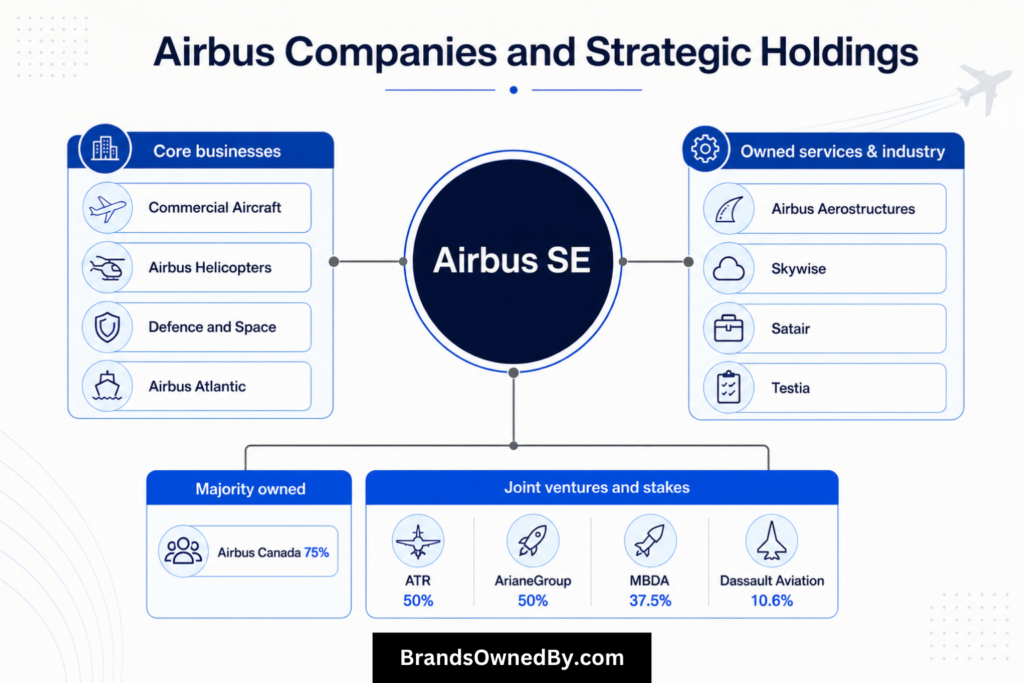
- Major controlled companies include Airbus Atlantic, Airbus Aerostructures, Airbus Canada, Skywise, Satair, Testia, Airbus UpNext, and Airbus Aerosystems Kinston.
- Airbus also holds strategic interests in ATR, ArianeGroup, MBDA, and Dassault Aviation, but these companies are not wholly owned Airbus subsidiaries.
Airbus SE is primarily owned by public investors. However, the governments of France, Germany, and Spain hold strategic minority stakes. France owns 10.8% through SOGEPA. Germany owns 10.8% through GZBV. Spain owns 4.1% through SEPI. The remaining 74.2% is free float. No shareholder controls Airbus independently.
All ownership, governance, and financial information below is updated through August 2026.
The parent company is Airbus SE. It is incorporated in the Netherlands. Its operational headquarters are in Toulouse, France.
Airbus shares trade under the symbol AIR in France, Germany, and Spain. The company had 792.3 million issued shares on June 30, 2026.
![Who Owns Airbus [Infographic]](https://brandsownedby.com/wp-content/uploads/2026/08/Who-Owns-Airbus-Infographic-683x1024.png)
Who Founded Airbus?
Airbus was not created by one conventional entrepreneur. It emerged from cooperation among European aerospace manufacturers and governments.
The original Airbus Industrie consortium was formed in 1970. France’s Aérospatiale and a group of German manufacturers operating through Deutsche Airbus were the founding industrial partners. Spain’s CASA joined in 1971. British Aerospace became a full member in 1979.
Several executives were instrumental in turning the concept into an operating aircraft manufacturer. Roger Béteille shaped the technical and commercial strategy. Henri Ziegler helped build political support in France. Franz Josef Strauss promoted German participation.
These individuals are frequently described as Airbus’s founding leaders. However, Airbus was fundamentally a multinational industrial project rather than the creation of a single founder.
Why Airbus Was Created
European aircraft manufacturers were fragmented during the 1960s. Each national company lacked the scale to compete effectively with large American producers.
Airbus brought its engineering, production, and financial resources together. Its first aircraft was the A300, a twin-engine wide-body jet. The A300B1 made its first flight in October 1972.
The program established a model that Airbus still uses. Major components are produced at different European facilities and then brought together for final assembly.
| Item | Details |
|---|---|
| Legal name | Airbus SE |
| Business type | Public European company |
| Founded | 1970 as Airbus Industrie |
| Modern parent created | 2000 as EADS |
| Operational headquarters | Toulouse, France |
| Legal registration | Leiden, Netherlands |
| Stock symbol | AIR |
| Issued shares | 792,283,683 |
| Employees | 168,754 at June 30, 2026 |
| CEO | Guillaume Faury |
| Board chair | René Obermann |
| Incoming board chair | Amparo Moraleda, effective October 1, 2026 |
| Main businesses | Commercial aircraft, helicopters, defence, and space |
Ownership History
Airbus’s ownership changed as the business moved from a multinational consortium to an integrated public company.
1970: Airbus Industrie Is Established
Airbus Industrie began as a Groupement d’Intérêt Économique, or GIE. This structure allowed participating companies to cooperate while remaining legally separate.
The French and German partners initially held the central positions. CASA later represented Spain. British Aerospace eventually held a 20% interest.
The consortium coordinated aircraft development and sales. Its member companies remained responsible for producing major components.
1992: Eurocopter Expands the European Model
Aérospatiale and Germany’s DASA combined their helicopter activities in 1992. The resulting company was called Eurocopter.
Eurocopter later became Airbus Helicopters. The transaction demonstrated that European aerospace companies could move beyond project-level cooperation and create integrated operating businesses.
2000: EADS Is Formed
The modern Airbus parent began on July 10, 2000. France’s Aérospatiale-Matra, Germany’s DaimlerChrysler Aerospace, and Spain’s CASA combined to establish the European Aeronautic Defence and Space Company, commonly called EADS.
EADS became a publicly traded company. Its initial structure still reflected the political and industrial balance among France, Germany, and Spain.
Airbus was one of the major businesses held by EADS. Other operations included military aircraft, space systems, helicopters, and defence electronics.
2001–2006: EADS Takes Full Ownership of Airbus
The Airbus commercial aircraft operation was converted from a consortium into Airbus SAS in 2001. EADS initially owned 80%. BAE Systems owned the remaining 20%.
In 2006, EADS purchased BAE Systems’ interest. Airbus SAS then became wholly owned by EADS.
This was an important control milestone. The commercial aircraft business was no longer split between EADS and an outside industrial shareholder.
2013: Government Ownership and Governance Are Restructured
EADS simplified its ownership and governance in 2013. The old controlling shareholder arrangement was replaced with a more conventional public-company model.
France, Germany, and Spain retained strategic holdings. Their combined ownership was reduced and capped. The free float increased substantially.
At the end of 2013, France owned approximately 12.0%, Germany held approximately 10.9%, and Spain owned approximately 4.1%. Public investors held more than 72% of the company.
The restructuring reduced direct political management of ordinary commercial decisions. It did not eliminate the states’ strategic influence.
2014–2017: EADS Becomes Airbus SE
EADS adopted the Airbus Group name in January 2014.
The company then moved toward a single corporate identity. Airbus Group SE was formally renamed Airbus SE in April 2017.
The commercial aircraft segment became known simply as Airbus. Airbus Helicopters and Airbus Defence and Space remained the other major divisions.
2020: Airbus Increases Its A220 Ownership
Airbus had acquired control of Bombardier’s C Series aircraft program in 2018. That operation became Airbus Canada and the aircraft was renamed the A220.
Bombardier left the partnership in 2020. Airbus’s ownership increased to 75%. The Government of Québec retained 25%.
The arrangement gave Airbus operational control of the A220 program without requiring immediate ownership of the entire partnership.
2022–2026: Industrial Operations Are Consolidated
Airbus created Airbus Atlantic in 2022. It combined major aerostructure and seating activities into a wholly owned subsidiary.
Airbus also established Airbus Aerostructures around its German and Romanian production operations. The legal integration of Premium AEROTEC Industry into Airbus Aerostructures was completed during 2025.
In December 2025, Airbus acquired selected Spirit AeroSystems industrial assets serving Airbus programs. These operations included facilities and work packages connected with the A220 and A350 supply chains.
Airbus launched a wholly owned Skywise subsidiary in April 2026. It brought together the existing Skywise digital-services operation and NAVBLUE’s flight-operations capabilities.
Who Owns Airbus: Top Shareholders
Airbus is owned by public investors and three European governments. No founder, family, corporation, or private equity firm owns a majority interest.
The official ownership structure as of June 30, 2026, was 74.2% free float, 10.8% French government ownership, 10.8% German government ownership, and 4.1% Spanish government ownership. The percentages do not add to exactly 100% because they are rounded.
![Who Owns Airbus [Top Shareholders]](https://brandsownedby.com/wp-content/uploads/2026/08/Who-Owns-Airbus-Top-Shareholders-1024x683.png)
Free-Float Shareholders: 74.2%
Free-float investors collectively own almost three-quarters of Airbus. This group includes pension funds, asset managers, exchange-traded funds, mutual funds, insurers, hedge funds, employees, and individual investors.
It is not a unified voting bloc. Each investor makes separate trading and voting decisions.
Large global asset managers may appear among Airbus’s institutional shareholders. Their positions can change as funds receive capital, track indexes, or rebalance portfolios. An asset manager also normally holds shares for fund clients rather than owning the full economic interest for itself.
This makes the free float economically dominant but operationally fragmented. Public shareholders can influence director elections, remuneration votes, dividends, and major resolutions. They do not normally manage Airbus’s daily operations.
French Government Through SOGEPA: 10.8%
The French government owns approximately 10.8% of Airbus through SOGEPA. The underlying holding is about 85.8 million shares.
SOGEPA is a French state-owned holding company used for strategic aerospace investments. France’s interest reflects the importance of Airbus to employment, industrial capacity, defence programs, and national security.
The stake does not give France majority control. France cannot independently appoint the entire board or approve normal shareholder resolutions.
France does have special protections relating to sensitive military activities. These include rights connected with certain ballistic-missile assets and the approval of outside directors at designated French defence holding entities.
Those protections are narrower than ownership of Airbus as a whole. They safeguard national-security interests rather than allowing France to operate the commercial aircraft business.
German Government Through GZBV: 10.8%
Germany owns approximately 10.8% through GZBV. The position represents about 85.7 million Airbus shares.
GZBV is the German government’s Airbus holding vehicle. Its ownership is connected to the state-backed KfW structure.
Germany’s stake is almost equal to France’s. This balance is intentional. It prevents one of Airbus’s two largest industrial countries from dominating the other through share ownership.
Germany also has specific rights relating to sensitive German defence operations. These may apply when protected activities or assets could be transferred outside Airbus or outside Germany.
As with France, those security arrangements do not amount to general corporate control.
Spanish Government Through SEPI: 4.1%
Spain owns approximately 4.1% of Airbus through SEPI. This represents about 32.3 million shares.
SEPI is Spain’s state industrial holding company. Spain’s interest is smaller than the French and German positions but remains strategically important.
Airbus maintains major commercial aircraft, military aircraft, and space operations in Spain. The Spanish state also has protections relating to designated sensitive defence assets.
SEPI participates in the agreement among the three state shareholders. It also benefits from certain transfer protections if France and Germany propose to dispose of their interests together.
Do the Three Governments Jointly Own Airbus?
France, Germany, and Spain collectively hold approximately 25.7%. That is a powerful strategic block, but it is not a majority.
Their shareholder agreement coordinates certain matters. It includes transfer provisions, pre-emption arrangements, and protections intended to preserve a stable balance among the governments.
The agreement does not give the states unrestricted control over Airbus. They remain subject to the company’s articles, voting rules, board structure, and duties under Dutch corporate law.
A useful practical distinction is:
- Public investors own most of Airbus economically.
- The three governments form its most stable strategic shareholder group.
- The board controls corporate policy.
- The CEO and Executive Committee run daily operations.
Competitor Ownership Comparison
Airbus’s state-backed minority ownership makes it different from most American aerospace companies. However, it is not a conventional state-owned enterprise.
| Company | Publicly traded | Government ownership model | Majority owner |
|---|---|---|---|
| Airbus | Yes | France 10.8%, Germany 10.8%, Spain 4.1% | None |
| Boeing | Yes | No strategic government equity block | None |
| Embraer | Yes | Brazilian government golden share | None |
| Lockheed Martin | Yes | No direct federal equity stake | None |
| RTX | Yes | No direct federal equity stake | None |
| Leonardo | Yes | Italian government owns about 30.2% | None |
Boeing
Boeing is a publicly traded American corporation. Its shares are widely held by institutional and retail investors.
No government owns a strategic equity block comparable to the French, German, and Spanish stakes in Airbus. Large fund managers hold Boeing shares for clients, but no single institution has majority control.
Both Boeing and Airbus have dispersed public ownership. The difference is that Airbus also has a stable 25.7% government block and formal national-security arrangements.
Embraer
Embraer is a publicly traded Brazilian aircraft manufacturer. It has dispersed private ownership, but the Brazilian government holds a special golden share.
That golden share provides veto rights over specified strategic actions. It does not represent majority economic ownership.
Airbus’s governments hold ordinary equity as well as benefiting from security arrangements. Embraer’s Brazilian state influence is more concentrated in the special rights attached to the golden share.
Lockheed Martin
Lockheed Martin is a publicly traded American aerospace and defence company. Institutional investors hold most of its shares.
The U.S. government is its largest customer, not its owner. Government contracting rules and security restrictions influence the company, but the federal government does not hold an Airbus-style strategic shareholding.
Lockheed Martin’s ownership is therefore more conventionally private. Airbus combines public-market ownership with direct government investment.
RTX
RTX is another widely held American public company. It owns businesses such as Pratt & Whitney, Collins Aerospace, and Raytheon.
Asset managers and pension funds are its largest shareholder categories. The U.S. government has extensive regulatory and procurement influence, but it is not an equity owner.
This contrasts with Airbus, where government influence includes both customer relationships and direct share ownership.
Leonardo
Leonardo is a publicly traded Italian aerospace and defence company. The Italian Ministry of Economy and Finance owns approximately 30.2%.
Italy’s position is larger than any individual government stake in Airbus. It also exceeds the combined blocking threshold commonly associated with major corporate resolutions.
Leonardo is therefore more directly state-influenced through one national shareholder. Airbus divides its government ownership among France, Germany, and Spain. That balance limits unilateral national control.
Who Controls Airbus?
No single shareholder controls Airbus in August 2026. Control is divided among shareholders, the board, the CEO, and specific government security arrangements.
The Board of Directors Controls Corporate Policy
Airbus uses a one-tier board structure. The Board of Directors is legally responsible for managing the company.
The board approves matters such as:
- Overall strategy and the strategic plan.
- Annual budgets and operating plans.
- Major investments and acquisitions.
- Significant industrial-site decisions.
- Appointment or removal of the CEO.
- Appointment of Executive Committee members.
- Material changes in the nature or scope of the business.
Most board decisions require a simple majority. Certain sensitive matters require a qualified majority. No individual director or category of directors has a general veto over board decisions.
René Obermann Is Board Chair in August 2026
René Obermann remains chair of the Airbus Board of Directors in August 2026.
He is scheduled to step down as chair on October 1, 2026. Amparo Moraleda has been selected to succeed him on that date.
This planned transition does not change the company’s ownership. It changes the leadership of the board that oversees strategy, governance, executive succession, and management accountability.
Guillaume Faury Controls Day-to-Day Management
Guillaume Faury is Airbus’s chief executive officer. He became CEO in April 2019 and was reappointed in 2025.
The board delegates daily management and execution of the approved strategy to the CEO. Faury chairs the Executive Committee.
The Executive Committee includes the leaders of Commercial Aircraft, Airbus Helicopters, Airbus Defence and Space, finance, operations, human resources, legal affairs, digital operations, strategy, and sustainability.
The CEO seeks consensus within the committee. If consensus cannot be reached, the CEO has authority to decide. He cannot independently approve transactions reserved for the board.
The Governments Exercise Strategic Influence
France, Germany, and Spain influence Airbus through three channels.
First, they collectively own approximately 25.7%. Their votes matter at shareholder meetings.
Second, their shareholder agreement helps preserve the balance among their holdings.
Third, separate security agreements protect designated military assets and operations.
These mechanisms provide influence over strategic and security-sensitive questions. They do not give the governments routine authority over aircraft pricing, customer negotiations, production scheduling, or commercial investment decisions.
Public Shareholders Retain Final Voting Rights
Shareholders elect directors and vote on major corporate resolutions at the annual general meeting.
Public investors own enough shares to determine outcomes when they vote collectively. In practice, however, the free float is spread across many independent investors.
This is why Airbus has stable government influence without a conventional controlling owner.
Airbus Annual Revenue and Net Worth
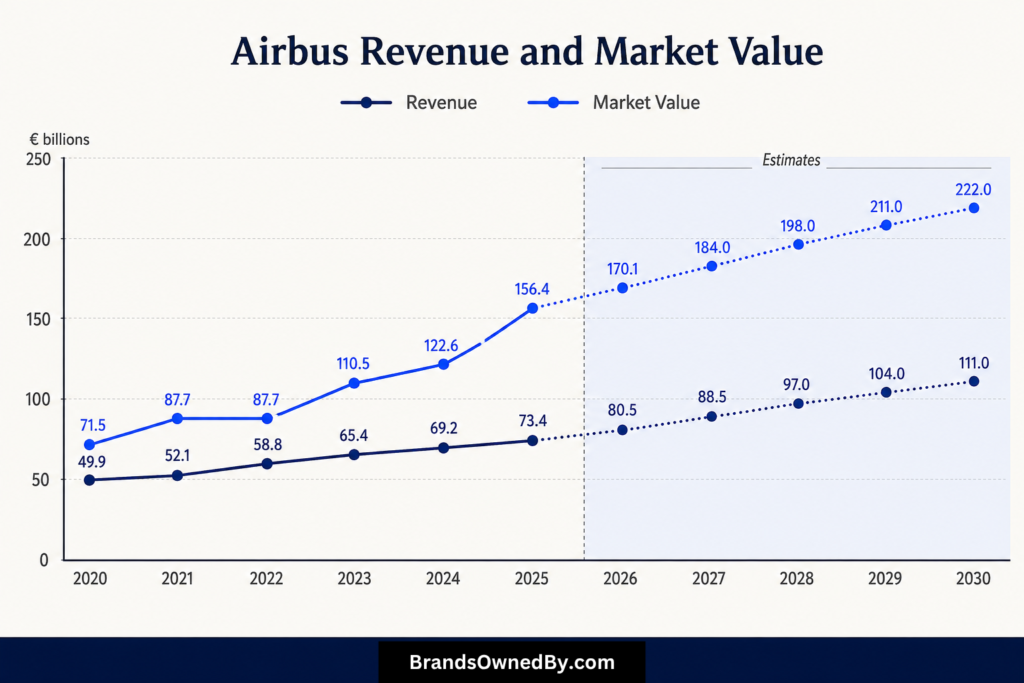
Airbus reported €73.4 billion in revenue for 2025. Revenue reached €33.2 billion during the first half of 2026, an increase of 12% from the comparable 2025 period.
Airbus does not publish an official “net worth” figure in the same way that personal wealth is calculated. For a listed company, market capitalization is the more useful measure. It represents the market price of all outstanding shares.
Airbus Revenue in 2026
The €80.5 billion estimate implies annual growth of approximately 9.6%.
This estimate is supported by Airbus’s first-half performance. Revenue grew 12% to €33.2 billion. Commercial aircraft revenue increased 15%, while Defence and Space revenue grew 9%.
Airbus expects around 870 commercial aircraft deliveries for the full year. That would be roughly 9.7% more than the 793 aircraft delivered in 2025.
Aircraft revenue is weighted toward the second half because deliveries normally accelerate late in the year. This makes doubling first-half revenue an unreliable forecasting method. The estimate instead accounts for delivery timing, currency movements, product mix, and supply-chain constraints.
Revenue by Business Segment
Commercial aircraft remains the economic center of Airbus.
| Business | FY 2025 revenue | Share before eliminations | H1 2026 revenue | H1 change |
|---|---|---|---|---|
| Commercial Aircraft | €52.6 billion | 70.2% | €23.9 billion | 15% |
| Airbus Helicopters | €9.0 billion | 12.0% | €3.7 billion | Broadly unchanged |
| Defence and Space | €13.4 billion | 17.9% | €6.3 billion | 9% |
| Intersegment eliminations | (€1.5 billion) | Not applicable | (€0.7 billion) | Not applicable |
| Consolidated Airbus | €73.4 billion | 100% | €33.2 billion | 12% |
The segment percentages use revenue before intersegment eliminations. They therefore differ slightly from percentages calculated directly against consolidated revenue.
Commercial Aircraft generated approximately 72% of consolidated 2025 revenue before considering the overlap created by eliminations. The A320 family is the largest volume driver.
Helicopters contributed approximately €9.0 billion. It benefits from a mix of aircraft sales, maintenance, spare parts, training, and military support contracts.
Defence and Space generated €13.4 billion. Its portfolio includes military aircraft, satellites, communications systems, intelligence services, and security solutions.
Airbus Market Capitalization in August 2026
Airbus’s market capitalization was approximately €170.1 billion in early August 2026. The estimate is based on its market price and roughly 792.3 million issued shares.
Market capitalization changes every trading day. It is not the same as:
- Shareholders’ equity on the balance sheet.
- Enterprise value.
- Revenue.
- Cash held by the company.
- The replacement cost of Airbus’s factories and intellectual property.
For example, Airbus had a net cash position of €8.4 billion at June 30, 2026. That is an important balance-sheet measure, but it is not the company’s net worth in stock-market terms.
Why Revenue Could Reach €111 Billion in 2030
The forecast assumes that Airbus progressively increases production rather than achieving a sudden jump.
Airbus targets an A320-family rate of between 70 and 75 aircraft per month by the end of 2027. It is targeting 13 A220s per month in 2028, 12 A350s per month in 2028, and five A330s per month in 2029.
The company also had a commercial aircraft backlog of 9,222 units at June 30, 2026. This provides long-term demand visibility. The backlog does not guarantee revenue, but it reduces the need to find new buyers for every planned production slot.
Defence spending provides another growth driver. Airbus Defence and Space recorded €9.3 billion in first-half 2026 orders, an increase of 83%. Helicopters ended June with a backlog of 1,108 units.
The forecast assumes growth moderates after the current production ramp-up. It also assumes no severe recession, extended engine shortage, major program cancellation, or prolonged factory disruption.
Why Market Value Could Reach €222 Billion in 2030
The market-value forecast assumes Airbus continues increasing revenue, improves delivery reliability, and converts more of its backlog into cash.
It does not assume continuous expansion of the valuation multiple. That would be too aggressive. Instead, most of the projected increase comes from higher earnings and cash generation.
Several factors could produce a lower valuation:
- Supply-chain failures.
- Engine shortages.
- Cost overruns on defence or space programs.
- Adverse currency movements.
- New aircraft certification delays.
- Lower airline demand.
- Industrial or geopolitical disruption.
A stronger production ramp, improved Defence and Space margins, or faster service growth could produce a higher valuation.
Companies and Brands Owned by Airbus
Airbus has hundreds of subsidiaries and legal entities. The following list covers its principal operating businesses, customer-facing brands, controlled industrial companies, and material strategic holdings as of August 2026.
Product names such as A220, A320, A330, A350, H145, and A400M are product families. They are not separate companies.
Airbus SAS and Commercial Aircraft
Airbus SAS is the core commercial aircraft operating company. Airbus SE controls it through the group structure.
The business develops, manufactures, markets, and supports the A220, A320, A330, and A350 aircraft families. It also provides training, maintenance support, spare parts, digital tools, and fleet services.
Commercial Aircraft is Airbus’s largest segment. It generated €52.6 billion in 2025 revenue.
Airbus Helicopters
Airbus Helicopters is a wholly controlled Airbus division. It evolved from Eurocopter and adopted the Airbus Helicopters name in 2014.
Its portfolio covers light, medium, and heavy civil and military helicopters. It also provides maintenance, training, upgrades, and mission-support services.
The business delivered 392 helicopters in 2025 and received 536 net orders.
Airbus Defence and Space
Airbus Defence and Space is a wholly controlled division of Airbus.
It produces military transport and combat aircraft systems, satellites, secure communications platforms, intelligence systems, and unmanned aircraft technologies.
Its major programs include the A400M, A330 Multi Role Tanker Transport, C295, Eurofighter-related work, and multiple civil and military satellite systems.
Airbus Atlantic
Airbus Atlantic is wholly owned by Airbus. It was established in January 2022.
The company manufactures aerostructures and complete aircraft sections. It also produces pilot seats and premium passenger seating.
The STELIA Aerospace name continues as a seating brand within Airbus Atlantic. The subsidiary employs more than 14,000 people across France, Canada, Tunisia, Morocco, and Portugal.
Airbus Aerostructures
Airbus Aerostructures is a wholly owned subsidiary. It operates production facilities in Germany and Romania.
The company makes aircraft structures and detailed components for commercial and military programs. It also works with metallic materials, composites, titanium components, and additive manufacturing.
Premium AEROTEC Industry was legally integrated into Airbus Aerostructures during 2025.
Airbus Canada
Airbus owns 75% of Airbus Canada Limited Partnership. The Government of Québec owns the remaining 25%.
Airbus Canada manages the A220 program. Final assembly takes place in Mirabel, Québec, and Mobile, Alabama.
Airbus has operational control because it holds the majority interest. Québec remains an important financial and industrial partner.
Skywise
Skywise became a wholly owned Airbus subsidiary in April 2026.
The new structure combines Airbus’s Skywise digital ecosystem with NAVBLUE’s flight-operations solutions. It serves Airbus and non-Airbus fleets.
Its services cover aircraft-health data, flight planning, operational control, performance calculations, technical operations, and ground activities.
Satair
Satair is wholly owned by Airbus.
It provides aircraft parts, logistics, inventory management, repair support, and aftermarket material services. Its activities cover Airbus aircraft and products produced by other manufacturers.
Satair also owns VAS Aero Services through its American subsidiary. That acquisition expanded its used-serviceable-material and end-of-life aircraft capabilities.
Testia
Testia is an Airbus company specializing in aerostructure inspection and integrity.
It supplies non-destructive testing equipment, inspection services, training, engineering support, and structural-health-monitoring solutions.
Testia’s services are used by manufacturers, airlines, maintenance organizations, and defence operators.
Airbus Corporate Jets
Airbus Corporate Jets is a customer-facing business within Commercial Aircraft. It is not an independently owned public company.
The business markets corporate versions of Airbus aircraft. Its range includes aircraft based on the A220 and A320 families, as well as wide-body corporate platforms.
Airbus retains ownership of the brand and manages it within the commercial aircraft operation.
Airbus Beluga Transport
Airbus Beluga Transport is a controlled air-cargo operation created to offer oversized freight capacity to external customers.
It uses Beluga aircraft developed from Airbus wide-body platforms. The service is designed for cargo that cannot fit inside conventional freighters.
This business extends the use of Airbus’s specialized transport fleet beyond internal aircraft logistics.
Airbus UpNext
Airbus UpNext is a wholly owned innovation subsidiary.
It develops and tests emerging aerospace technologies through focused demonstration projects. Its work includes autonomy, alternative propulsion, new wing concepts, flight operations, and connected systems.
The company allows Airbus to test technologies faster without immediately committing them to a full commercial aircraft program.
Acubed
Acubed is Airbus’s innovation center in Silicon Valley.
It works on technologies such as artificial intelligence, digital design, autonomous systems, and advanced air mobility. It operates as part of Airbus’s broader innovation network.
Acubed’s role is exploratory. Its projects may support existing Airbus divisions or create technologies for future aerospace platforms.
Airbus Aerosystems Kinston
Airbus Aerosystems Kinston is a wholly owned subsidiary of Airbus Americas.
The North Carolina operation was acquired as part of the Spirit AeroSystems transaction. It manufactures advanced composite components for the A350, including fuselage and wing-related structures.
Bringing this capability under Airbus ownership gives the company more direct control over a critical part of its supply chain.
ATR: 50% Ownership
Airbus owns 50% of ATR. Leonardo owns the other 50%.
ATR manufactures regional turboprop aircraft, principally the ATR 42 and ATR 72. Neither Airbus nor Leonardo controls the venture independently.
Airbus produces major components and manages its investment through the Airbus ATR organization.
ArianeGroup: 50% Ownership
Airbus Defence and Space owns 50% of ArianeGroup. Safran owns the remaining 50%.
ArianeGroup develops launch vehicles and strategic missile systems. Its activities include the Ariane 6 launcher and the Maia reusable mini-launcher program through MaiaSpace.
The venture is jointly controlled. Airbus cannot make major decisions without Safran.
MBDA: 37.5% Ownership
Airbus Defence and Space holds 37.5% of MBDA.
BAE Systems owns 37.5%, while Leonardo owns 25%. MBDA develops missile systems, air-defence systems, countermeasures, and related support services.
Airbus has substantial influence but does not control MBDA alone.
Dassault Aviation: 10.6% Ownership
Airbus held approximately 10.6% of Dassault Aviation’s share capital at the end of 2025.
Dassault Aviation manufactures Falcon business jets and Rafale combat aircraft. It remains an independent public company.
Airbus’s position is a strategic minority investment. It does not make Dassault an Airbus subsidiary or brand.
Future Space Joint Venture
Airbus, Leonardo, and Thales are working to combine selected space activities into a new jointly owned business.
The planned ownership is 35% for Airbus, 32.5% for Leonardo, and 32.5% for Thales. The transaction remained subject to implementation and regulatory conditions in August 2026.
It should not yet be described as a fully operating Airbus subsidiary. Once completed, it would be jointly controlled rather than majority owned by Airbus.
Final Thoughts
Airbus is best described as a publicly owned company with strategic European government shareholders.
France, Germany, and Spain provide long-term ownership stability. Their combined 25.7% holding also reflects the importance of Airbus to European industrial and defence policy. However, they do not hold a majority.
The Board of Directors controls corporate strategy. Guillaume Faury and the Executive Committee manage daily operations. Public shareholders retain most of the economic ownership and voting power.
This balance distinguishes Airbus from both private aerospace companies and traditional state-owned enterprises. It gives the company commercial independence while protecting strategically sensitive European aerospace capabilities.
FAQs
Who is the largest owner of Airbus?
No individual shareholder owns a controlling stake. Free-float investors collectively own 74.2%.
Among disclosed government shareholders, France is marginally the largest. It holds approximately 10.8% through SOGEPA, representing about 85.8 million shares. Germany also owns approximately 10.8%, with a slightly smaller underlying share count.
Is Airbus owned by France or Germany?
Airbus is not exclusively owned by either country.
France owns 10.8%, and Germany owns 10.8%. Spain owns another 4.1%. Public investors hold most of the company.
Is Airbus a government-owned company?
Airbus is not a majority government-owned company. It is publicly traded.
The French, German, and Spanish governments collectively own approximately 25.7%. Their holdings provide strategic influence but not majority ownership.
Does Boeing own Airbus?
No. Boeing does not own any part of Airbus as a corporate parent.
Airbus and Boeing are independent public companies and direct competitors in the commercial aircraft market.
Does the European Union own Airbus?
No. The European Union does not directly own Airbus shares.
Individual European governments own stakes through national holding companies. These are France, Germany, and Spain.
Is Airbus a French company?
Airbus has major French operations and its operational headquarters are in Toulouse. However, it is legally a European company incorporated in the Netherlands.
Its industrial base spans France, Germany, Spain, the United Kingdom, the United States, Canada, and several other countries.
Where is Airbus legally registered?
Airbus SE is legally registered in Leiden, the Netherlands. Its statutory seat is in Amsterdam.
Its operational headquarters and much of its senior management are based in Toulouse, France.
Who is the CEO of Airbus?
Guillaume Faury is the CEO of Airbus. He has held the position since April 2019 and was reappointed in 2025.
He leads the Executive Committee and manages daily operations under authority delegated by the Board of Directors.
Who is the chairman of Airbus?
René Obermann is the Airbus board chair in August 2026.
Amparo Moraleda is scheduled to become chair on October 1, 2026. Obermann will remain a director until the end of his existing mandate unless another change occurs.
Can France and Germany control Airbus together?
France and Germany collectively own approximately 21.6%. Adding Spain brings the three-state block to around 25.7%.
This gives the governments meaningful influence. It does not automatically give them enough votes to control ordinary shareholder decisions. Their influence is strengthened by a shareholder agreement and specific national-security arrangements.
Is Airbus publicly traded?
Yes. Airbus shares trade under the symbol AIR.
The shares are listed in France, Germany, and Spain. Airbus had approximately 792.3 million issued shares at June 30, 2026.
Who owns Airbus Canada?
Airbus owns 75% of Airbus Canada Limited Partnership. The Government of Québec owns 25%.
Airbus Canada manages the A220 aircraft program.
Does Airbus own ATR?
Airbus owns 50% of ATR. Leonardo owns the other 50%.
ATR is a joint venture. It is not a wholly owned Airbus subsidiary.
Does Airbus own Dassault Aviation?
Airbus owns a strategic minority stake of approximately 10.6% in Dassault Aviation.
Dassault remains an independent company. Airbus does not control its daily operations or own the Dassault and Falcon brands.
What is Airbus’s net worth?
Using market capitalization as the measure, Airbus was worth approximately €170.1 billion in early August 2026.
This figure changes with the Airbus share price. It should not be confused with revenue, shareholders’ equity, enterprise value, or cash on the balance sheet.
What is the difference between Airbus SE and Airbus SAS?
Airbus SE is the publicly traded parent company.
Airbus SAS is the principal commercial aircraft operating company within the group. Airbus SE also controls Airbus Helicopters, Airbus Defence and Space, and numerous industrial and service subsidiaries.
What percentage of Airbus is publicly owned?
Approximately 74.2% of Airbus is classified as free float.
This includes institutional investors, investment funds, employees, and individual shareholders whose shares are available for public trading.
Does Airbus have one controlling family?
No. Airbus has no controlling family, founder, billionaire owner, or private equity sponsor.
Its ownership is divided among public shareholders and three European governments.