
- Prada is primarily owned by the Prada-Bertelli family through Prada Holding S.p.A., which controls approximately 80% of the company’s outstanding shares as of July 2026. The remaining 20% is publicly traded on the Hong Kong Stock Exchange and owned by institutional and retail investors.
- Control of Prada rests with the Prada-Bertelli family rather than public shareholders. Patrizio Bertelli serves as Chairman, Miuccia Prada is an Executive Director and Co-Creative Director, while Andrea Guerra manages day-to-day operations as Chief Executive Officer under the Board’s strategic oversight.
- Prada is an independent luxury fashion company and is not owned by LVMH, Kering, or any other luxury conglomerate. Its concentrated family ownership enables long-term decision-making, preserves creative independence, and reduces the risk of hostile takeovers.
- As of July 2026, Prada Group owns a focused portfolio of luxury brands, including Prada, Miu Miu, Versace, Church’s, Car Shoe, and Marchesi 1824. This selective ownership strategy differentiates Prada from larger luxury groups that manage dozens of brands while allowing it to maintain strong brand identity and premium positioning.
Prada is an Italian luxury fashion company that designs, manufactures, and sells premium fashion products worldwide. The company is best known for its luxury handbags, ready-to-wear clothing, footwear, leather goods, eyewear, jewelry, fragrances, and fashion accessories. It operates under Prada S.p.A., the parent company of several internationally recognized luxury brands.
Founded in Milan, Italy, Prada has evolved from a small leather goods shop into one of the world’s leading luxury fashion groups. The company combines traditional Italian craftsmanship with modern design, making its products popular among consumers seeking high-end fashion and timeless quality. Today, Prada serves customers through a global network of directly operated boutiques, selected luxury retailers, department stores, and its official e-commerce platforms.
Prada Group has continued to strengthen its position in the luxury industry through brand expansion, digital innovation, sustainability initiatives, and strategic acquisitions. The completion of the Versace acquisition further expanded the group’s portfolio, making it one of Italy’s largest independent luxury fashion companies.
What Does Prada Do?
Prada focuses on designing and selling luxury lifestyle products across multiple categories. Its core business includes:
- Luxury handbags and leather goods.
- Men’s and women’s ready-to-wear fashion.
- Footwear and sneakers.
- Eyewear through licensed partnerships.
- Fragrances and beauty products.
- Fine jewelry and fashion accessories.
- Luxury lifestyle and hospitality through select subsidiaries.
The company serves customers in major luxury markets across Europe, North America, Asia-Pacific, the Middle East, and Latin America through hundreds of retail stores and online channels.
Prada is headquartered in Milan, Italy. The company’s corporate headquarters oversee global operations, product development, retail expansion, marketing, manufacturing, and brand management.
Milan remains the center of Prada’s creative and business operations and plays a key role in the company’s fashion shows, product launches, and strategic decision-making.
![Who Owns Prada [infographic]](https://brandsownedby.com/wp-content/uploads/2026/07/Who-Owns-Prada-infographic-683x1024.png)
Who Founded Prada?
Prada was founded in 1913 by brothers Mario Prada and Martino Prada, who established a luxury leather goods store called Fratelli Prada in Milan’s historic Galleria Vittorio Emanuele II.
The original business specialized in handcrafted leather handbags, travel trunks, beauty cases, luxury accessories, and imported English steamer trunks. The exceptional quality of its products helped the company earn recognition as an official supplier to the Italian royal household, significantly enhancing the brand’s reputation.
Mario Prada
Mario Prada was an Italian entrepreneur and craftsman who laid the foundation for what would become one of the world’s most prestigious luxury fashion brands. His focus on premium materials, meticulous craftsmanship, and elegant design established the values that continue to define Prada today.
Although Mario built a successful business, he believed women should not play a role in managing the company. Ironically, the brand’s greatest transformation occurred decades later under the leadership of his granddaughter, Miuccia Prada, who turned the family business into a global luxury powerhouse.
Martino Prada
Martino Prada co-founded the business alongside his brother Mario. While Mario became the public face of the company, Martino contributed to the early development and operation of Fratelli Prada during its formative years. Together, they established the company’s reputation for producing premium leather goods and luxury travel accessories that attracted affluent customers from across Europe.
Ownership History
Prada’s ownership history is unusual in the luxury fashion industry. Many iconic fashion houses have been acquired by large luxury conglomerates such as LVMH or Kering. Prada, however, has remained under the control of the founding family for more than a century. Although the company became publicly listed in 2011, the Prada-Bertelli family continues to hold approximately 80% of the company’s shares through Prada Holding S.p.A. as of July 2026. This long-term family ownership has allowed Prada to maintain its creative independence and pursue a consistent business strategy.
Prada Ownership History
From a small Milan leather goods shop to one of the world’s largest independent luxury fashion groups, Prada has remained under the control of the founding family for more than a century.
1913–1958: The Founding by Mario and Martino Prada
Prada was established in 1913 by brothers Mario Prada and Martino Prada, who opened a luxury leather goods store called Fratelli Prada in Milan’s prestigious Galleria Vittorio Emanuele II.
During the early years, ownership was entirely held by the Prada family. The business focused on handcrafted leather bags, travel trunks, beauty cases, luxury accessories, and imported English steamer trunks. The company’s reputation for exceptional craftsmanship quickly attracted wealthy Italian and international customers.
A significant milestone came in 1919 when Prada was appointed an official supplier to the Italian Royal Household. This recognition strengthened the company’s reputation and elevated the value of the family-owned business. Throughout this period, Mario Prada maintained complete ownership and control over all business operations.
1958–1978: Ownership Passes to Luisa Prada
Following Mario Prada’s death, ownership passed to his daughter, Luisa Prada.
At the time, the company remained a respected Italian luxury leather goods manufacturer but had not yet become an international fashion brand. Luisa focused on preserving the company’s heritage, product quality, and loyal customer base rather than pursuing aggressive expansion.
During her leadership, Prada remained entirely family-owned. The business continued to operate as a traditional luxury manufacturer with a relatively small international footprint. Although growth was modest, Luisa preserved the brand through changing economic conditions and prepared it for the next generation of family leadership.
1978–1990: Miuccia Prada Takes Control
A major turning point in Prada’s ownership history came in 1978, when Miuccia Prada, Mario Prada’s granddaughter, assumed leadership of the family business.
Although ownership remained within the Prada family, the company’s direction changed dramatically. Miuccia introduced a modern design philosophy that combined minimalism, functionality, and understated luxury. Her creative vision distinguished Prada from many traditional luxury brands.
One of her most influential innovations was the launch of black nylon handbags and backpacks made from industrial-grade Pocono nylon. Initially viewed as unconventional for luxury fashion, these products became global bestsellers and redefined Prada’s identity.
Ownership during this period remained concentrated within the family, but the company evolved from a regional leather goods manufacturer into an internationally recognized luxury fashion house.
Patrizio Bertelli Joins the Business
Another defining moment occurred when Patrizio Bertelli joined Prada in the late 1970s.
Bertelli brought extensive expertise in manufacturing, sourcing, retail operations, and international business development. While Miuccia Prada led the creative side of the business, Bertelli transformed the company’s commercial operations.
Together, they established a vertically integrated business model in which Prada retained greater control over product development, manufacturing, distribution, and retail. This strategy helped protect product quality and strengthen the company’s premium positioning.
Their partnership also reshaped ownership. Over time, Miuccia Prada and Patrizio Bertelli became the principal owners of the company through Prada Holding S.p.A., creating the ownership structure that continues today.
1990–2010: Expansion While Remaining Family Controlled
Throughout the 1990s and 2000s, Prada experienced rapid international growth without giving up family ownership.
The company expanded its retail network across Europe, North America, Asia, and the Middle East while investing heavily in manufacturing facilities, logistics, and flagship stores. During this period, Prada also broadened its portfolio through acquisitions and new brand development.
Important milestones included:
- Launch of Miu Miu in 1992.
- Acquisition of Church’s in 1999.
- Expansion into eyewear through long-term licensing partnerships.
- Acquisition of Car Shoe.
- Investment in Pasticceria Marchesi.
Despite its rapid expansion, ownership remained concentrated in the Prada-Bertelli family, allowing management to make long-term investments without pressure from outside controlling shareholders.
2011: Prada Becomes a Public Company
Prada entered a new phase of its ownership history when it completed its Initial Public Offering (IPO) on the Hong Kong Stock Exchange (HKEX) in June 2011.
The listing raised substantial capital from international investors while allowing the founding family to retain effective control.
Unlike many public companies where founders gradually dilute their ownership, Prada structured its IPO so that Prada Holding S.p.A. continued to own the overwhelming majority of voting rights.
This approach provided several strategic benefits:
- Access to global capital markets.
- Greater visibility among Asian investors.
- Improved liquidity for shareholders.
- Continued family control over corporate strategy.
The IPO marked one of the largest luxury listings in Asia and reinforced Prada’s position as an independent global luxury group rather than a subsidiary of a larger fashion conglomerate.
2011–2024: Stable Family Ownership
Following the public listing, Prada maintained one of the most stable ownership structures in the luxury industry.
Throughout this period, Prada Holding remained the controlling shareholder, while the remaining shares traded freely on the Hong Kong Stock Exchange.
The company also strengthened its corporate governance by appointing experienced executives and independent directors while preserving family oversight through the Board of Directors.
This balance between professional management and family ownership allowed Prada to pursue long-term investments in sustainability, digital commerce, manufacturing, and retail expansion without sacrificing its creative identity.
2025–July 2026: A New Chapter Under Family Leadership
The most significant ownership-related development in recent years was Prada Group’s acquisition of Versace, completed in late 2025. The transaction became the largest acquisition in the company’s history and significantly expanded the group’s luxury portfolio.
At the same time, the Prada family continued preparing for long-term succession. Lorenzo Bertelli, the son of Miuccia Prada and Patrizio Bertelli, assumed increasingly important leadership responsibilities within the group, including oversight of strategic initiatives and a key role in the future development of Versace. This reflects the family’s intention to preserve long-term ownership while gradually transitioning operational responsibilities to the next generation.
As of July 2026, Prada’s ownership structure remains largely unchanged:
| Shareholder | Ownership |
|---|---|
| Prada Holding S.p.A. | 80.00% |
| Public Shareholders (HKEX Free Float) | 20.00% |
This structure means the Prada-Bertelli family continues to exercise decisive control over board appointments, major acquisitions, dividend policy, and long-term corporate strategy. It also makes Prada one of the few major global luxury companies that has remained independently controlled by its founding family despite being publicly traded.
Who Owns Prada: Major Shareholders
Prada is a publicly listed luxury fashion company, but it remains one of the few major global fashion houses that is still controlled by its founding family. Unlike competitors such as Burberry, whose ownership is widely dispersed among institutional investors, Prada has maintained a concentrated ownership structure that gives the Prada-Bertelli family effective control over the business.
Prada S.p.A. has been listed on the Hong Kong Stock Exchange (HKEX) since 2011 under the stock code 1913. Although its shares are publicly traded, control remains firmly with Prada Holding S.p.A., the family investment company owned by Miuccia Prada, Patrizio Bertelli, and members of the Bertelli family. This structure allows Prada to access international capital markets while preserving long-term family ownership and strategic independence.
As of July 2026, Prada Holding owns approximately 80% of Prada S.p.A.’s issued share capital, while the remaining 20% is held by public shareholders. Because Prada Holding owns four-fifths of the company’s shares, it possesses sufficient voting power to appoint directors, approve major acquisitions, determine dividend policy, and influence virtually every important corporate decision.
80%
Family ControlOwnership Breakdown
Prada Holding S.p.A.
Prada Holding S.p.A. is the controlling shareholder and the foundation of Prada’s ownership structure. It owns approximately 2.05 billion shares, representing around 80% of Prada S.p.A.’s issued share capital.
The holding company was established to preserve long-term family ownership while allowing Prada to become a publicly traded company. Rather than distributing ownership among numerous family members, the Prada and Bertelli families consolidated their interests through Prada Holding, creating a stable controlling shareholder that has remained in place since the company’s IPO.
Because Prada Holding owns such a significant majority of the company’s shares, it controls shareholder voting at annual and extraordinary general meetings. This gives it the ability to:
- Elect the majority of the Board of Directors.
- Approve mergers and acquisitions.
- Authorize major investments.
- Determine dividend distributions.
- Approve capital increases or share buybacks.
- Shape the company’s long-term strategic direction.
This ownership model has helped Prada avoid hostile takeover attempts and maintain creative independence in an industry where many luxury brands have become part of larger conglomerates.
Miuccia Prada
Miuccia Prada is one of the principal owners of Prada through her ownership interest in Prada Holding S.p.A. As the granddaughter of founder Mario Prada, she represents the third generation of family ownership.
She assumed leadership of the company in 1978 and transformed a respected Italian leather goods manufacturer into one of the world’s most influential luxury fashion brands. Her innovative approach to design, including the introduction of Prada’s iconic nylon products, redefined modern luxury and significantly increased the company’s global value.
Beyond her role as a designer, Miuccia Prada remains deeply involved in the group’s long-term strategic direction. Through Prada Holding, she continues to influence major corporate decisions, including brand development, acquisitions, governance, and succession planning.
Her continued ownership ensures that the company’s creative vision remains closely aligned with the values established by the founding family.
Patrizio Bertelli
Patrizio Bertelli is the other principal owner of Prada through Prada Holding S.p.A. He joined the company in the late 1970s and is widely regarded as the architect of Prada’s commercial success.
While Miuccia Prada focused on creative innovation, Bertelli built the business infrastructure that enabled Prada to become a global luxury leader. He modernized manufacturing, introduced vertically integrated production, expanded the retail network, and established direct control over distribution and supply chain management.
As Chairman of Prada S.p.A., Bertelli continues to play a central role in major corporate decisions. His ownership interest gives him substantial influence over the company’s governance, investment strategy, international expansion, and portfolio development.
The long-standing partnership between Miuccia Prada and Patrizio Bertelli is widely recognized as one of the most successful founder-management partnerships in the luxury goods industry.
Lorenzo Bertelli
Although Lorenzo Bertelli is not listed separately as a major direct shareholder of Prada S.p.A., he is an important member of the controlling family and represents the next generation of ownership.
The son of Miuccia Prada and Patrizio Bertelli, Lorenzo has taken on increasing responsibilities within the Prada Group over recent years. He currently oversees several strategic initiatives, including corporate social responsibility, digital transformation, marketing, and sustainability projects.
Following Prada Group’s acquisition of Versace, Lorenzo Bertelli has also assumed a more prominent role in the integration and future development of the expanded luxury portfolio.
His growing leadership responsibilities demonstrate the family’s long-term succession planning and its commitment to maintaining family control for future generations.
Public Shareholders (Free Float)
Approximately 20% of Prada’s outstanding shares are publicly traded on the Hong Kong Stock Exchange. These shares are collectively known as the company’s free float and are owned by a diverse group of investors around the world.
Unlike Prada Holding, no individual public shareholder owns a sufficiently large stake to influence the company’s strategic direction. Instead, ownership is spread among institutional investors, investment funds, insurance companies, pension funds, ETFs, and retail investors.
Public shareholders provide liquidity to the stock and allow investors to participate in Prada’s long-term growth. They also receive voting rights, dividends, and other shareholder benefits in proportion to their shareholdings.
However, because Prada Holding controls approximately 80% of the voting rights, public investors have limited influence over major corporate decisions.
Institutional Investors
Although no institutional investor owns a controlling interest in Prada, a number of international asset managers have reported shareholdings through regulatory filings and investment disclosures.
These investors typically include:
- State Street Global Advisors.
- Principal Asset Management.
- Pacer Advisors.
- Seligson & Co.
- White Creek Capital LLP.
- Various Asian and European investment funds.
Each institution generally owns only a small percentage of Prada’s outstanding shares, often well below 1% individually. Collectively, institutional investors contribute to trading liquidity and reflect global investor confidence in Prada’s long-term prospects, but they do not have sufficient ownership to challenge the control exercised by Prada Holding.
Why Prada’s Ownership Structure Is Unique
Prada’s ownership structure is increasingly rare in the luxury fashion industry. Many iconic brands have become subsidiaries of multinational luxury groups or have ownership spread across thousands of shareholders.
Prada has taken a different approach. By retaining approximately 80% ownership through Prada Holding, the Prada-Bertelli family has preserved decisive control over the company’s future while still benefiting from access to public capital markets.
This structure provides several strategic advantages:
- It protects the company from hostile takeovers.
- It supports long-term decision-making instead of focusing solely on quarterly earnings.
- It preserves Prada’s creative independence.
- It enables consistent brand management across generations.
- It allows the family to pursue acquisitions, such as Versace, without relinquishing control.
As of July 2026, Prada remains one of the largest publicly listed luxury fashion companies that is still effectively controlled by its founding family, making its ownership structure a distinguishing feature within the global luxury goods industry.
Competitor Ownership Comparison
Ownership structures vary considerably across the global luxury fashion industry. While many of Prada’s competitors are publicly traded, the way they are controlled differs significantly. Some remain under the influence of founding families, others are managed by billionaire founders through holding companies, while several operate without any controlling shareholder at all.
These ownership models directly influence how quickly companies can make strategic decisions, respond to market changes, pursue acquisitions, appoint leadership, and preserve their brand identity over multiple generations.
Luxury Competitor Ownership Comparison
Comparison of ownership structures among the world’s leading luxury fashion companies (July 2026).
LVMH
LVMH is the world’s largest luxury goods company and owns more than 75 prestigious brands, including Louis Vuitton, Dior, Tiffany & Co., Bulgari, Fendi, Givenchy, Sephora, and Moët & Chandon. Despite being publicly traded on Euronext Paris, the company remains firmly controlled by the Arnault family.
As of July 2026, Bernard Arnault and his family control LVMH primarily through Groupe Arnault and Christian Dior SE, giving them a controlling voting position despite the company’s enormous market capitalization. This ownership structure enables the Arnault family to appoint senior executives, approve multi-billion-dollar acquisitions, and implement long-term investment strategies without depending on changing institutional shareholder sentiment.
Unlike many listed corporations where institutional investors dominate governance, LVMH’s concentrated family control has provided exceptional stability for decades. It has also allowed the company to pursue aggressive acquisitions while maintaining consistent leadership across multiple economic cycles.
Kering
Kering, the owner of Gucci, Saint Laurent, Balenciaga, Bottega Veneta, Alexander McQueen, and several other luxury brands, is another example of a family-controlled public company.
Control is exercised by the Pinault family through its investment company Groupe Artémis. As of July 2026, Artémis continues to own a controlling interest in Kering, allowing the Pinault family to retain decisive influence over board appointments, executive leadership, capital allocation, and long-term strategy.
The family-controlled structure has enabled Kering to reposition its luxury portfolio over the past two decades, including divesting non-core businesses and investing heavily in premium fashion brands. Similar to other family-controlled luxury groups, Kering is less exposed to activist shareholder campaigns than companies with dispersed ownership.
Hermès
Hermès is widely regarded as one of the strongest examples of successful family ownership in the luxury sector.
As of July 2026, descendants of the Hermès family collectively maintain control through H51 SAS, a family holding company established to preserve ownership across future generations. The holding company was strengthened after LVMH accumulated a significant minority stake in Hermès during the previous decade, prompting the family to consolidate their ownership and prevent any hostile takeover attempts.
Today, the Hermès family retains substantial voting power while the remaining shares are publicly traded. This structure allows Hermès to prioritize craftsmanship, exclusivity, and long-term brand value over short-term revenue growth, making it one of the most stable ownership models in the luxury industry.
Burberry
Burberry operates under a very different governance model.
Unlike several European luxury competitors, Burberry does not have a controlling family, founder, or majority shareholder. As of July 2026, ownership is widely dispersed among institutional investors, including global asset managers, pension funds, mutual funds, ETFs, and retail shareholders.
Investment firms such as BlackRock, The Vanguard Group, Legal & General Investment Management, and Norges Bank Investment Management periodically rank among Burberry’s largest shareholders, although none owns a controlling stake.
Because ownership is fragmented, Burberry’s board and executive management are significantly more accountable to institutional investors. Leadership changes, strategic restructurings, dividend policies, and capital allocation decisions often receive greater scrutiny from shareholders than in family-controlled luxury companies.
Moncler
Moncler combines founder leadership with public ownership.
As of July 2026, Chairman and CEO Remo Ruffini remains the company’s largest shareholder through his investment vehicle Double R S.r.l. Although Moncler has a broad international shareholder base, Ruffini’s substantial ownership stake gives him significant influence over strategic direction, executive appointments, and long-term business planning.
Unlike companies with dispersed ownership, Moncler benefits from continuity in leadership while still attracting substantial institutional investment. This hybrid ownership model has enabled the company to pursue rapid international expansion without sacrificing management stability.
Richemont
Compagnie Financière Richemont owns several of the world’s leading luxury brands, including Cartier, Van Cleef & Arpels, IWC Schaffhausen, Jaeger-LeCoultre, Piaget, and Montblanc.
Although Richemont is publicly listed on the SIX Swiss Exchange, it remains effectively controlled by founder and chairman Johann Rupert.
As of July 2026, Rupert exercises control primarily through Compagnie Financière Rupert, which owns high-voting Class B shares. While these shares represent only a portion of the company’s economic ownership, they provide the majority of voting rights, allowing Rupert to maintain effective control over corporate governance and strategic decisions.
This dual-class share structure differs from the traditional family holding company model used by several other luxury firms but achieves the same objective of preserving long-term leadership.
Which Luxury Companies Remain Family Controlled?
The luxury industry has increasingly consolidated under large multinational groups over the past three decades. Despite this trend, only a relatively small number of global luxury companies continue to be controlled by their founders or founding families.
Among Prada’s largest competitors, Hermès, LVMH, and Kering all retain strong family influence through dedicated holding companies, while Moncler remains founder-controlled through Remo Ruffini’s investment vehicle. Richemont continues to be controlled through a dual-class voting structure that concentrates decision-making in the hands of Johann Rupert.
By contrast, companies such as Burberry operate under a dispersed institutional ownership model in which no single shareholder has the authority to dictate long-term strategy.
How Ownership Influences Competition
Ownership structures have a direct impact on how luxury companies compete in the global market. Family-controlled businesses generally have greater freedom to pursue long-term objectives, invest heavily in craftsmanship, preserve brand heritage, and withstand short-term market volatility. Concentrated ownership also enables faster decision-making because fewer stakeholders are involved in approving major strategic initiatives.
Companies with dispersed institutional ownership often benefit from stronger external oversight and greater market liquidity, but management teams typically face more pressure to deliver quarterly earnings growth and shareholder returns.
The continued prevalence of family ownership among several of the world’s most successful luxury brands demonstrates that concentrated control remains a competitive advantage in an industry where heritage, exclusivity, and long-term brand equity are often more valuable than short-term financial performance.
Who Controls Prada?
Although Prada S.p.A. is a publicly listed company on the Hong Kong Stock Exchange (HKEX: 1913), control of the business is not determined by public shareholders. Instead, the company is effectively controlled by the Prada-Bertelli family through Prada Holding S.p.A., which owns approximately 80% of Prada’s outstanding shares. This majority ownership gives the family overwhelming voting power, allowing it to appoint directors, influence executive leadership, approve acquisitions, determine dividend policy, and shape the company’s long-term strategic direction.
Unlike many publicly traded fashion companies where institutional investors have significant influence over management decisions, Prada operates under a concentrated ownership model. The family’s control extends beyond share ownership through its active participation in the Board of Directors and senior executive management, ensuring that the company’s creative vision and corporate strategy remain closely aligned.
Prada Holding S.p.A.
Prada Holding S.p.A. is the controlling shareholder of Prada Group and serves as the primary vehicle through which the Prada-Bertelli family exercises control over the company.
As of July 2026, Prada Holding owns 2,046,470,760 shares, representing 80% of Prada’s issued share capital, while the remaining 20% constitutes the public free float traded on the Hong Kong Stock Exchange. This ownership structure gives Prada Holding sufficient voting rights to approve virtually all ordinary shareholder resolutions, including the appointment of directors and approval of major corporate decisions.
The holding company also provides continuity across generations by keeping ownership concentrated within the founding family rather than allowing control to become fragmented among external investors.
Patrizio Bertelli
Patrizio Bertelli is the most influential executive within Prada’s governance structure.
As of July 2026, he serves as Chairman of the Board of Directors and an Executive Director. Although Andrea Guerra oversees the day-to-day management of the company as Chief Executive Officer, Bertelli remains responsible for setting the Group’s long-term strategic direction, overseeing major investments, capital allocation, acquisitions, and board leadership.
Bertelli joined the Prada business in the late 1970s and transformed what was then a small Italian leather goods company into one of the world’s leading luxury groups. His partnership with Miuccia Prada has shaped virtually every major strategic decision over the past four decades, including Prada’s international expansion, the development of Miu Miu, the Hong Kong listing in 2011, and more recently, the acquisition and integration of Versace.
Although Prada is publicly traded, Bertelli’s position as both Chairman and a member of the controlling shareholder family gives him substantial influence over virtually every significant corporate decision.
Miuccia Prada
Miuccia Prada remains one of the most powerful individuals within the Prada Group despite no longer serving as Chief Executive Officer.
As of July 2026, she is an Executive Director of Prada S.p.A., Co-Creative Director of Prada alongside Raf Simons, and Creative Director of Miu Miu. She previously served as Chairwoman of the Board and Co-Chief Executive Officer before the company transitioned to its current governance structure.
While her primary responsibilities are creative rather than operational, Miuccia Prada continues to influence the company’s long-term brand strategy, product development, and creative identity. Her position on the Board also allows her to participate directly in major corporate decisions affecting the future of the business.
Her dual role as both a principal shareholder and senior executive ensures that the family’s creative vision remains central to Prada’s global strategy.
Andrea Guerra
Andrea Guerra is responsible for Prada Group’s day-to-day business operations.
He has served as Chief Executive Officer and Executive Director since 2023, overseeing the execution of corporate strategy approved by the Board of Directors. Guerra manages global operations, finance, retail expansion, supply chain, investor relations, and overall business performance while reporting to the Board led by Chairman Patrizio Bertelli.
His appointment marked an important evolution in Prada’s governance by separating operational management from family ownership. This structure allows experienced professional management to run the company while strategic control remains firmly with the founding family.
Lorenzo Bertelli
Lorenzo Bertelli represents the next generation of Prada leadership.
As of July 2026, he serves as an Executive Director, Chief Marketing Officer, and Head of Corporate Social Responsibility. He has become increasingly involved in strategic planning, digital transformation, sustainability initiatives, and global brand development.
Following Prada Group’s acquisition of Versace, Lorenzo Bertelli also assumed the role of Executive Chairman of Versace, further strengthening his leadership responsibilities within the expanding Prada Group. Industry observers widely view him as the family’s long-term successor, with Patrizio Bertelli publicly confirming succession plans in recent years.
His growing executive responsibilities indicate that Prada’s leadership transition is being implemented gradually while preserving continuity in governance and family control.
Paolo Zannoni
Paolo Zannoni serves as Executive Deputy Chairman and an Executive Director.
A veteran international banker and corporate adviser, Zannoni provides strategic advice on corporate governance, international finance, capital markets, mergers and acquisitions, and board matters. He works closely with Patrizio Bertelli and Andrea Guerra on major strategic initiatives and helps strengthen Prada’s governance with extensive experience gained from Goldman Sachs and numerous international board positions.
Although he is not part of the controlling shareholder family, Zannoni plays a central role in balancing family leadership with professional corporate governance.
Board of Directors and Independent Oversight
Prada’s governance model combines concentrated family ownership with independent oversight.
As of July 2026, the Board of Directors includes executive directors from the Prada-Bertelli family, senior executives such as Andrea Guerra and Andrea Bonini, and multiple independent non-executive directors, including Pamela Culpepper, Ilaria Resta, Cristiana Ruella, Anna Maria Rugarli, and Yoël Zaoui. Independent directors chair key committees responsible for audit and risk management, nominations, remuneration, and sustainability, providing oversight while preserving accountability to all shareholders.
This governance structure seeks to balance the stability of long-term family ownership with the transparency and oversight expected of a publicly listed international company.
How Control is Exercised at Prada
Control of Prada is not concentrated in a single individual but rather shared among the Prada-Bertelli family through their majority ownership and representation across the company’s leadership structure.
Patrizio Bertelli provides strategic leadership as Chairman, Miuccia Prada oversees the creative direction of the Group’s flagship brands, Andrea Guerra manages daily operations as Chief Executive Officer, Lorenzo Bertelli is leading the next generation of executive leadership, and Paolo Zannoni contributes governance and financial expertise at board level.
This combination of concentrated ownership, active family participation, professional executive management, and independent board oversight has enabled Prada to maintain consistent leadership while remaining one of the few global luxury companies that continues to be effectively controlled by its founding family.
Prada Annual Revenue and Net Worth
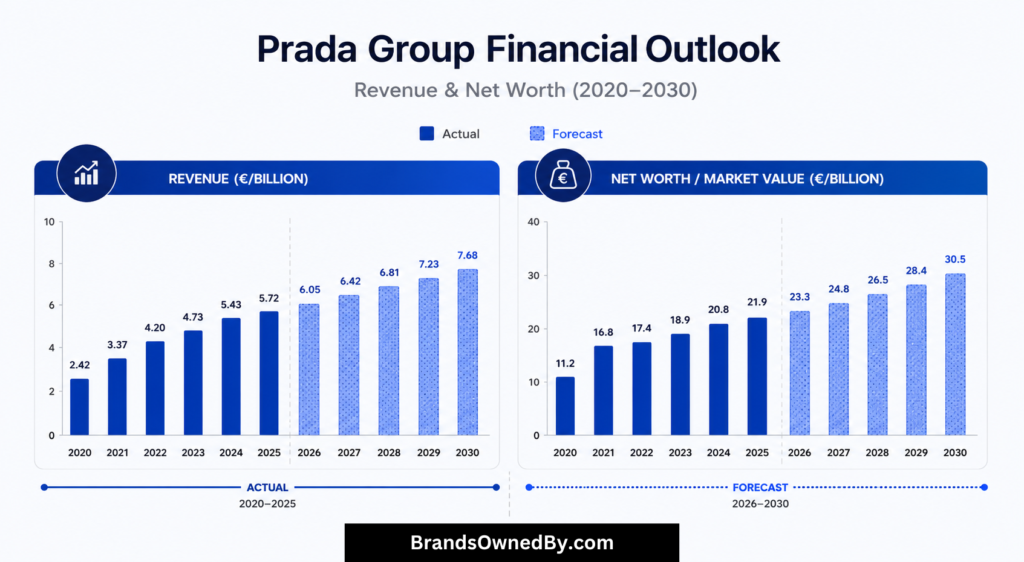
Prada has evolved into one of the world’s largest publicly listed luxury fashion companies, with consistent revenue growth and a steadily increasing market valuation over the past several years. As of July 2026, the Prada Group generates annual revenue of approximately €5.72 billion (FY2025 results), while its estimated market value (often referred to as corporate net worth) is approximately €23.3 billion. The Group continues to benefit from the global strength of the Prada and Miu Miu brands, expanding retail operations, and the strategic acquisition of Versace, positioning it for continued long-term growth.
Unlike privately owned businesses, Prada does not publish a “net worth” figure. Therefore, the company’s net worth is generally represented by its market capitalization, which reflects the total market value of all outstanding shares and changes with investor sentiment, financial performance, and broader market conditions.
Prada Revenue History (2020–2030)
The table below shows Prada’s historical revenue together with projected revenue through 2030. Figures from 2020–2025 are based on reported financial results, 2026 represents an estimate based on current business performance, while 2027–2030 are forward-looking projections.
Prada Revenue in 2026
Although Prada had not yet released its full-year 2026 financial statements as of July 2026, the company entered the year with strong momentum. The Group reported €5.718 billion in net revenue for FY2025, representing 9% year-over-year growth (8% organic growth) despite a challenging global luxury market. The business also recorded its 20th consecutive quarter of revenue growth, highlighting the resilience of its premium positioning.
During the first quarter of 2026, Prada generated €1.43 billion in net revenue, reflecting a positive start to the year despite softer industry demand and the ongoing integration of Versace. Retail sales remained the company’s primary revenue source, contributing more than 87% of total revenue, while direct-to-consumer channels and e-commerce continued to outperform wholesale operations.
Based on the company’s quarterly performance, management guidance, and current analyst expectations, Prada’s full-year 2026 revenue is estimated at approximately €6.05 billion, representing annual growth of roughly 5.8%. This estimate assumes continued expansion of Miu Miu, resilient demand for Prada’s leather goods and ready-to-wear collections, and an increasing contribution from Versace following its acquisition.
Revenue Breakdown by Business
Prada’s revenue is generated through a diversified portfolio of luxury brands, retail formats, and geographic markets.
The Retail channel remains the company’s largest business, accounting for approximately 89% of total Group revenue through directly operated boutiques and e-commerce platforms. Wholesale operations contribute a much smaller share, while royalties and licensing income provide an additional recurring revenue stream.
From a brand perspective, Prada remains the largest contributor to Group revenue. However, Miu Miu has become the fastest-growing business within the portfolio. In FY2025, Miu Miu achieved approximately 35% retail sales growth, significantly outperforming most global luxury brands and becoming one of the primary drivers of Group expansion.
Geographically, Prada continues to generate substantial revenue from Asia-Pacific, followed by Europe, the Americas, Japan, and the Middle East. The company’s global network of directly operated boutiques remains one of its strongest competitive advantages, enabling higher gross margins and tighter control over customer experience.
Prada Net Worth in 2026
Prada’s estimated market value of approximately €23.3 billion in July 2026 reflects strong investor confidence in the company’s long-term growth prospects. This valuation has increased substantially from approximately €11.2 billion in 2020, representing an increase of more than 108% in six years.
Several factors have contributed to this higher valuation. Prada has consistently delivered profitable growth, maintained healthy operating margins, strengthened its balance sheet, and generated strong cash flows despite global economic uncertainty. The continued success of Miu Miu has significantly enhanced investor sentiment, while the acquisition of Versace has transformed Prada from a two-brand luxury group into a broader luxury conglomerate with additional long-term growth opportunities.
Although the Versace acquisition temporarily diluted operating margins and increased net debt, investors generally view the transaction as a strategic investment that could enhance the Group’s earnings potential over the coming decade once restructuring is complete.
Factors Driving Future Revenue Growth
Several long-term trends are expected to support Prada’s financial performance over the remainder of the decade.
Continued expansion of Miu Miu is expected to remain one of the largest growth drivers, supported by strong global demand among younger luxury consumers. The integration of Versace into the Prada Group should gradually create operational efficiencies, improve manufacturing capabilities, and strengthen the Group’s overall market position. Management also continues to invest heavily in flagship retail stores, digital commerce, product innovation, and customer experience, while maintaining disciplined pricing and limited discounting to preserve brand exclusivity.
These initiatives are expected to support steady revenue growth while gradually restoring profitability following the initial impact of the Versace integration.
Revenue Forecast (2027–2030)
Based on historical performance, industry growth expectations, and Prada’s long-term strategic initiatives, the Group’s revenue could continue expanding over the next several years.
- 2027: €6.42 billion
- 2028: €6.81 billion
- 2029: €7.23 billion
- 2030: €7.68 billion.
If these projections are achieved, Prada would add nearly €2 billion in annual revenue between 2025 and 2030, representing cumulative growth of approximately 34% over the five-year period. Much of this expansion is expected to come from premium leather goods, continued international retail expansion, the sustained strength of Miu Miu, and the gradual turnaround of Versace under Prada’s ownership.
Brands Owned by Prada
Over more than a century, Prada has evolved from a single Milan-based leather goods manufacturer into one of the world’s leading luxury fashion groups. As of July 2026, the Prada Group owns and operates a portfolio of internationally recognized luxury brands spanning fashion, leather goods, footwear, jewelry, fragrances, dining, and lifestyle experiences.
Unlike luxury conglomerates such as LVMH and Kering, Prada follows a focused portfolio strategy. Rather than owning dozens of brands, the company concentrates on a small number of premium luxury houses, investing heavily in craftsmanship, design innovation, retail expansion, and brand exclusivity. This approach has enabled Prada to maintain strong pricing power while preserving the distinct identity of each brand.
Following the acquisition of Versace in 2025, Prada significantly expanded its presence in the global luxury market, creating one of Italy’s largest luxury fashion groups.
Prada Group Brand Portfolio
Luxury brands, acquisitions and strategic businesses operated by Prada Group (July 2026)
GROUP
Prada
Leather Goods
Miu Miu
Accessories
Versace
Lifestyle
Church’s
Car Shoe
Marchesi 1824
Pastry
Prada
Prada is the flagship brand of the Prada Group and accounts for the largest share of the company’s revenue. Founded in Milan in 1913 by Mario Prada, the brand has become synonymous with Italian luxury, minimalist design, and exceptional craftsmanship.
Today, Prada designs and manufactures luxury handbags, ready-to-wear clothing, footwear, travel accessories, eyewear, jewelry, fragrances, and lifestyle products. The brand operates hundreds of directly managed boutiques across Europe, North America, Asia-Pacific, the Middle East, and Latin America.
Under the creative leadership of Miuccia Prada and Raf Simons, the brand continues to influence global fashion through innovative collections that combine contemporary aesthetics with traditional Italian craftsmanship.
Prada remains the Group’s largest business and its most valuable brand by revenue, global recognition, and profitability.
Miu Miu
Miu Miu is Prada Group’s second-largest fashion brand and one of the fastest-growing luxury labels in the world.
Founded by Miuccia Prada in 1993, Miu Miu targets a younger and more fashion-forward audience while maintaining the same commitment to craftsmanship and premium quality that defines the Prada brand.
The brand offers luxury ready-to-wear collections, handbags, footwear, accessories, eyewear, jewelry, fragrances, and leather goods. Over the past several years, Miu Miu has experienced exceptional growth driven by strong demand among younger luxury consumers, celebrity endorsements, and highly successful fashion collections.
During 2025, Miu Miu recorded approximately 35% retail sales growth, making it one of the strongest-performing luxury brands globally despite a slowdown across much of the luxury industry.
Today, Miu Miu operates an extensive international retail network and has become one of the primary contributors to Prada Group’s overall revenue growth.
Versace
Versace became part of the Prada Group following the completion of its acquisition from Capri Holdings in 2025.
Founded by Gianni Versace in 1978, the Italian fashion house is internationally recognized for its bold designs, luxury apparel, iconic Medusa branding, and strong presence in haute couture, accessories, fragrances, home furnishings, and luxury lifestyle products.
The acquisition represented the largest corporate transaction in Prada Group’s history and significantly expanded the company’s scale within the global luxury industry.
Following the acquisition, Prada announced plans to preserve Versace’s creative identity while leveraging the Group’s manufacturing expertise, retail operations, supply chain, and global distribution network to improve profitability and accelerate long-term growth.
As of July 2026, Lorenzo Bertelli serves as Executive Chairman of Versace, reflecting the strategic importance of the brand within Prada’s future expansion plans.
Church’s
Church’s is one of Britain’s oldest luxury footwear manufacturers and has been owned by Prada Group since 1999.
Founded in Northampton, England, in 1873, Church’s is internationally recognized for its handcrafted Goodyear-welted leather shoes, premium boots, formal footwear, and luxury leather accessories.
Prada acquired Church’s to strengthen its presence in the luxury footwear segment while preserving the company’s traditional manufacturing techniques and British heritage.
Today, Church’s continues to operate as an independent luxury brand within the Prada Group while benefiting from Prada’s international retail network and global distribution capabilities.
Car Shoe
Car Shoe is a luxury Italian footwear brand specializing in driving shoes and casual leather footwear.
Founded in 1963 by Gianni Mostile, the company pioneered the modern driving loafer featuring distinctive rubber pebble soles designed for enhanced comfort while driving.
Prada acquired Car Shoe in 2001 as part of its strategy to expand into premium lifestyle footwear.
Today, Car Shoe offers luxury driving shoes, loafers, sneakers, leather accessories, and travel products while maintaining its distinctive Italian craftsmanship and heritage.
Although considerably smaller than Prada and Miu Miu, Car Shoe continues to complement the Group’s footwear portfolio.
Marchesi 1824
Marchesi 1824 is one of Italy’s most prestigious historic pastry houses.
Founded in Milan in 1824, the company is renowned for its luxury pastries, chocolates, cakes, desserts, confectionery, and traditional Italian café experience.
Prada acquired a majority interest in Marchesi in 2014, later increasing its ownership to full control.
Rather than functioning as a traditional fashion brand, Marchesi strengthens Prada’s positioning within the broader luxury lifestyle market by combining hospitality, heritage, and Italian craftsmanship.
Today, Marchesi operates elegant cafés in Milan and London, attracting both international tourists and luxury consumers seeking premium dining experiences.
Luna Rossa Prada Pirelli
Luna Rossa Prada Pirelli is Prada Group’s professional sailing team and represents one of the company’s most prestigious sporting investments.
The team competes in the America’s Cup, the world’s oldest and most prestigious international sailing competition.
Prada has sponsored and managed the team for more than two decades, using the partnership to showcase Italian engineering, innovation, sustainability, and technical excellence.
Although Luna Rossa does not operate as a commercial fashion brand, it has become an important component of Prada’s global marketing strategy and contributes significantly to the company’s premium brand image.
Prada Beauty
Prada Beauty represents the company’s luxury beauty division, offering premium fragrances and cosmetics under the Prada name.
The brand includes luxury perfumes for men and women, makeup collections, skincare products, and beauty accessories distributed through luxury department stores, specialty beauty retailers, airports, and Prada boutiques worldwide.
Prada Beauty has expanded rapidly in recent years as consumer demand for luxury fragrances and cosmetics continues to grow. The beauty category also provides Prada with a highly profitable entry point for consumers who may later purchase higher-priced fashion products.
Prada Eyewear
Prada Eyewear is one of the company’s most recognized licensed product categories.
The collection includes luxury sunglasses, prescription frames, fashion eyewear, and performance-inspired designs for both men and women.
Prada Eyewear is sold globally through optical retailers, luxury department stores, travel retail outlets, and Prada boutiques, making it one of the brand’s most visible product categories.
The division contributes to Prada’s worldwide brand recognition while extending the company’s presence beyond apparel and leather goods.
Prada Fine Jewelry
Prada Fine Jewelry represents the company’s expansion into the high-end jewelry market.
The collection includes necklaces, bracelets, rings, earrings, and other luxury pieces crafted using recycled gold, diamonds, and precious gemstones.
The business reflects Prada’s increasing emphasis on sustainability while allowing the company to compete more directly with established luxury jewelry houses.
Although still smaller than the Group’s fashion business, Prada Fine Jewelry continues to expand through selected flagship boutiques and premium retail locations.
Prada Re-Nylon
Prada Re-Nylon is one of the company’s most important sustainability initiatives.
Rather than operating as an independent company, Re-Nylon is a dedicated product platform based on regenerated nylon produced from recycled ocean plastics, discarded fishing nets, textile waste, and industrial plastic waste.
Initially introduced in 2019, the collection has become a central component of Prada’s environmental strategy and now spans handbags, backpacks, luggage, ready-to-wear, footwear, and accessories.
The initiative demonstrates Prada’s commitment to circular manufacturing while reinforcing its leadership in sustainable luxury fashion.
Final Thoughts
The answer to who owns Prada is straightforward. Prada remains largely controlled by the founding family despite being publicly traded. Prada Holding S.p.A. owns approximately 80% of the company, giving Miuccia Prada and Patrizio Bertelli effective control over its future.
This ownership model has helped Prada preserve its creative independence while expanding into one of the world’s most valuable luxury fashion groups. Combined with professional management, iconic brands, and strategic acquisitions such as Versace, Prada continues to strengthen its position in the global luxury market.
FAQs
Who is the wife of Mario Prada?
There is no verified public record identifying the wife of Mario Prada, the founder of Prada. Historical accounts primarily focus on his business rather than his personal life. What is well documented is that his daughter, Luisa Prada, took over the company after his retirement because he had no sons involved in the business. Luisa later passed the business to her daughter, Miuccia Prada, who transformed Prada into one of the world’s leading luxury fashion brands.
Is Miuccia Prada still alive?
Yes. As of July 2026, Miuccia Prada is alive and remains actively involved in the Prada Group. She serves as an Executive Director of Prada S.p.A., Co-Creative Director of Prada alongside Raf Simons, and Creative Director of Miu Miu. Although Andrea Guerra manages the company’s daily operations as Chief Executive Officer, Miuccia Prada continues to shape the creative vision and long-term direction of the Group.
Who does Prada own?
As of July 2026, Prada Group owns several luxury brands and businesses. Its portfolio includes Prada, Miu Miu, Versace, Church’s, Car Shoe, and Marchesi 1824. The Group also operates businesses such as Prada Beauty, Prada Fine Jewelry, Prada Eyewear through licensing partnerships, and the Luna Rossa Prada Pirelli America’s Cup sailing team. The acquisition of Versace in 2025 significantly expanded Prada’s position in the global luxury industry.
What is Prada known for?
Prada is best known for its luxury handbags, leather goods, ready-to-wear fashion, footwear, accessories, and innovative minimalist designs. Founded in Milan in 1913, the company has become one of Italy’s most prestigious luxury fashion houses. Prada is particularly recognized for its premium craftsmanship, iconic nylon bags, Saffiano leather products, high-fashion runway collections, and its influence on modern luxury fashion. The company also owns the rapidly growing Miu Miu brand and, since 2025, the Versace fashion house.
Prada is from which country?
Prada is an Italian luxury fashion company. It was founded in Milan, Italy, in 1913 by Mario Prada as a leather goods and luggage manufacturer. Today, Prada’s global headquarters remain in Milan, and the company continues to represent Italian craftsmanship, luxury design, and fashion excellence while operating boutiques in more than 70 countries.
What is the net worth of Miuccia Prada?
As of July 2026, Miuccia Prada’s estimated net worth is approximately US$6–7 billion. Her wealth primarily comes from her ownership stake in Prada Holding S.p.A., which controls about 80% of Prada Group, as well as decades of value creation from transforming Prada into one of the world’s largest publicly traded luxury fashion companies. Her exact net worth fluctuates with Prada’s share price and other investment holdings.
Why did Versace sell to Prada?
Versace was sold to Prada after its former owner, Capri Holdings, decided to streamline its portfolio and improve financial performance. Following weaker sales growth, declining profitability, and changing conditions in the global luxury market, Capri agreed to sell Versace to Prada in 2025.
For Prada, the acquisition was a strategic opportunity to expand beyond its existing portfolio and strengthen its position against larger luxury conglomerates such as LVMH and Kering. The deal brought together two of Italy’s most iconic fashion houses and is expected to generate long-term synergies in manufacturing, retail, sourcing, and global distribution while allowing Versace to retain its distinct creative identity.
Is Prada owned by LVMH?
No. Prada is not owned by LVMH. As of July 2026, Prada remains an independent publicly listed company on the Hong Kong Stock Exchange. Approximately 80% of the company’s shares are owned by Prada Holding S.p.A., which is controlled by the Prada-Bertelli family. The remaining shares are publicly traded and held by institutional and retail investors. LVMH has never owned or controlled Prada.
Who owns Prada clothing?
Prada clothing is owned by Prada S.p.A., the parent company of the Prada Group. The company is controlled by Prada Holding S.p.A., which owns approximately 80% of Prada’s outstanding shares. Prada Holding is owned by members of the Prada-Bertelli family, including Miuccia Prada and Patrizio Bertelli, giving the family effective control over the company’s fashion, retail, and luxury goods businesses. Although Prada is publicly traded, strategic control remains firmly with the founding family through their majority ownership.