
- Mattel is a publicly traded company listed on the NASDAQ under the ticker symbol MAT and is not owned by a parent company or any single individual.
- As of July 2026, EdgePoint Investment Group is Mattel’s largest shareholder, owning approximately 16.3% of the company’s outstanding shares, followed by major institutional investors such as Vanguard, PRIMECAP Management, BlackRock, Ariel Investments, and State Street.
- No shareholder has majority ownership or controlling interest in Mattel. Ownership is widely distributed among institutional investors, retail shareholders, and company insiders, while the Board of Directors and executive management oversee the company’s operations.
- Mattel owns a portfolio of globally recognized brands, including Barbie, Hot Wheels, Fisher-Price, American Girl, UNO, Matchbox, Monster High, Thomas & Friends, and MEGA, making it one of the world’s largest toy and family entertainment companies.
Mattel, Inc. is one of the world’s largest toy and family entertainment companies. It designs, manufactures, markets, and licenses toys, games, dolls, vehicles, educational products, and digital experiences for children and collectors. The company is headquartered in El Segundo, California, and sells its products in more than 150 countries through retailers, e-commerce platforms, distributors, and licensing partners.
Over the decades, Mattel has evolved from a traditional toy manufacturer into a global intellectual property (IP) company. In addition to physical toys, it now develops films, television series, mobile games, publishing, consumer products, and licensing partnerships based on its iconic brands. This strategy allows the company to generate revenue from multiple channels while expanding the reach of its franchises.
Mattel owns some of the most recognizable toy brands in the world, including Barbie, Hot Wheels, Fisher-Price, American Girl, Thomas & Friends, Matchbox, UNO, Polly Pocket, MEGA, and Masters of the Universe. These brands have remained popular across multiple generations and continue to be expanded through new product launches and entertainment content.
The company places a strong emphasis on innovation, sustainability, and brand development. It regularly collaborates with major entertainment studios, sports organizations, fashion brands, and technology companies to introduce licensed products and create new consumer experiences.
![Who Owns Mattel [infographic]](https://brandsownedby.com/wp-content/uploads/2026/07/Who-Owns-Mattel-infographic-683x1024.png)
Founders of Mattel
Mattel was founded in 1945 by Harold “Matt” Matson and Elliot Handler in Southern California. The company’s name was created by combining “Matt” from Harold Matson’s surname with “El” from Elliot Handler’s first name.
Harold “Matt” Matson
Harold Matson co-founded Mattel and initially helped establish the business by producing picture frames. However, due to health reasons, he left the company shortly after its formation and sold his ownership stake to Elliot Handler and Ruth Handler. Although his involvement was brief, his contribution remains part of the company’s identity through its name.
Elliot Handler
Elliot Handler was an inventor, designer, and entrepreneur who played a major role in building Mattel into a global toy company. He believed toys should inspire creativity and imagination rather than simply entertain children. His focus on product innovation led to the development of numerous successful toy lines and helped establish Mattel as an industry leader.
Ruth Handler
Ruth Handler joined the company alongside her husband, Elliot Handler, and became one of Mattel’s most influential leaders. She is best known for creating Barbie in 1959 after noticing that her daughter preferred playing with adult-looking paper dolls instead of baby dolls. Barbie revolutionized the doll industry and became one of the best-selling toys in history.
Beyond Barbie, Ruth Handler pioneered modern toy marketing by promoting products directly to children through television advertising. Her vision transformed Mattel from a small toy manufacturer into an internationally recognized brand and left a lasting impact on the global toy industry.
Ownership History
Mattel’s ownership has evolved from a founder-led private business into a publicly traded corporation owned by institutional and retail investors worldwide. Unlike many consumer brands that have been acquired by larger companies, Mattel has remained an independent public company throughout its history. Today, no single individual, family, or corporation owns Mattel. Instead, ownership is distributed among investment firms, mutual funds, pension funds, ETFs, and individual shareholders.
1945–1960: Founder Ownership
Mattel was founded in 1945 by Harold “Matt” Matson and Elliot Handler, with Ruth Handler joining shortly afterward as a co-founder and business leader. During its early years, the company was privately owned and operated by its founders.
The business initially manufactured picture frames before shifting its focus to toy production after discovering strong demand for dollhouse furniture made from leftover wood. As the company expanded, Harold Matson left due to health reasons and sold his ownership interest to Elliot and Ruth Handler. This made the Handler family the primary owners of Mattel during its formative years.
Under their leadership, Mattel introduced innovative marketing strategies, including television advertising aimed directly at children. The launch of Barbie in 1959 transformed the company into one of the fastest-growing toy manufacturers in the United States.
1960: Initial Public Offering (IPO)
Mattel became a publicly traded company in 1960 by listing its shares on the stock market. The initial public offering (IPO) marked a major turning point in the company’s ownership structure.
Going public allowed Mattel to raise capital for expanding manufacturing facilities, entering international markets, investing in research and development, and acquiring new brands. Although public investors became shareholders, Elliot and Ruth Handler continued to lead the business and remained influential figures in its strategic direction.
The IPO also introduced a formal corporate governance structure, including a Board of Directors responsible for representing shareholder interests.
1960s–1980s: Institutional Investors Begin to Dominate
As Mattel grew into a global toy company, ownership gradually shifted from its founders to institutional investors. Mutual funds, pension funds, insurance companies, and investment management firms steadily accumulated shares because of Mattel’s strong portfolio of brands and consistent global presence.
During this period, the company’s shareholder base became increasingly diversified. While institutional investors held larger stakes, no investor gained majority ownership. Mattel continued operating as an independent company with dispersed ownership.
At the same time, the company expanded internationally and strengthened its position with successful brands such as Barbie, Hot Wheels, and Fisher-Price, making its stock attractive to long-term investors.
1990s–2010s: Ownership Becomes Widely Distributed
Throughout the 1990s and 2000s, Mattel completed several major acquisitions that expanded both its product portfolio and investor appeal.
Notable acquisitions included:
- Fisher-Price.
- American Girl.
- HIT Entertainment.
- MEGA Brands.
These acquisitions diversified Mattel beyond fashion dolls and die-cast vehicles, reducing its dependence on any single product category.
As the company matured, ownership became even more fragmented. Millions of shares came to be held through retirement accounts, exchange-traded funds (ETFs), index funds, and actively managed mutual funds. Individual investors also purchased Mattel stock through public exchanges, further broadening the shareholder base.
2018–Present: Transformation Under New Leadership
A new phase of Mattel’s history began in 2018 when Ynon Kreiz was appointed Chief Executive Officer. Rather than focusing solely on toy manufacturing, the company repositioned itself as an intellectual property (IP) and entertainment business.
This strategic shift attracted increased interest from institutional investors that viewed Mattel as more than a traditional toy company. The success of entertainment projects, digital gaming partnerships, licensing agreements, and media initiatives further strengthened investor confidence in the company’s long-term growth strategy.
Ownership remained widely distributed, with large asset managers increasing or adjusting their holdings through regular market trading.
Mattel’s Ownership Structure Today
As of July 2026, Mattel remains a publicly traded company listed on the NASDAQ under the ticker symbol MAT. Approximately 290.6 million common shares were outstanding as of March 2026, and ownership is primarily concentrated among institutional investors rather than company insiders.
The largest disclosed shareholders include:
| Shareholder | Ownership |
|---|---|
| EdgePoint Investment Group | 16.3% |
| The Vanguard Group | 11.9% |
| PRIMECAP Management Company | 11.4% |
| BlackRock, Inc. | 10.5% |
Collectively, these institutional investors own a substantial portion of Mattel’s outstanding shares. However, none holds a majority stake, meaning no single shareholder has unilateral control over the company.
Does Anyone Own Mattel?
No individual or organization owns Mattel outright. Instead, the company operates under a dispersed ownership model, which is common among large publicly traded corporations.
Institutional investors own shares on behalf of pension funds, retirement plans, mutual funds, ETFs, universities, insurance companies, charities, and millions of individual investors. Retail shareholders also own Mattel stock through brokerage accounts, giving them voting rights on matters such as board elections and major corporate proposals.
This ownership structure ensures that Mattel is governed through its Board of Directors and executive management rather than being controlled by a founder, family, or parent company. It also provides stability by preventing excessive influence from any single shareholder while allowing investors worldwide to participate in the company’s long-term growth.
Who Owns Mattel: Major Shareholders
Mattel, Inc. is a publicly traded company, so it is not owned by a single individual, family, or parent corporation. Instead, ownership is divided among millions of common shares that trade on the NASDAQ under the ticker symbol MAT. Anyone can become a part-owner of Mattel by purchasing its shares through the stock market.
Unlike family-controlled businesses such as LEGO or privately held companies like MGA Entertainment, Mattel has a widely dispersed ownership structure. The majority of its shares are held by institutional investors, including asset managers, pension funds, mutual funds, exchange-traded funds (ETFs), and insurance companies. These institutions invest on behalf of millions of clients, including retirement savers and individual investors, rather than for themselves.
As of July 2026, institutional investors collectively own well over 90% of Mattel’s outstanding shares, while company executives and directors own only a small percentage. Because no shareholder owns more than half of the company, Mattel does not have a controlling owner. Instead, major corporate decisions are made through shareholder voting, the Board of Directors, and the executive leadership team led by CEO Ynon Kreiz.
Who Owns Mattel?
Largest Shareholders • July 2026
EdgePoint Investment Group (Largest Shareholder)
EdgePoint Investment Group is Mattel’s largest shareholder, owning approximately 16.9% of the company’s outstanding common stock. The Canadian investment management firm specializes in long-term value investing and typically acquires significant positions in businesses that it believes are undervalued and capable of delivering sustainable growth.
EdgePoint’s investment reflects confidence in Mattel’s transformation from a traditional toy manufacturer into a broader entertainment and intellectual property company. Although it is the company’s largest shareholder, its ownership is far below a controlling interest. Consequently, EdgePoint cannot unilaterally determine Mattel’s strategy or management decisions. Instead, it influences the company through shareholder voting, engagement with management, and corporate governance initiatives.
PRIMECAP Management Company
PRIMECAP Management Company is one of Mattel’s largest long-term institutional investors, holding approximately 10.2% of the company’s outstanding shares.
Founded in California, PRIMECAP manages investment portfolios for mutual funds, pension plans, endowments, and institutional clients. The firm is known for identifying companies with attractive long-term earnings potential rather than focusing on short-term market movements.
Its continued investment in Mattel demonstrates confidence in the company’s globally recognized brands, expanding entertainment business, licensing opportunities, and product innovation. PRIMECAP has remained one of Mattel’s most significant shareholders for several years, making it an important voice in shareholder matters.
The Vanguard Group
The Vanguard Group owns approximately 10.1% of Mattel, making it another major institutional shareholder.
Vanguard is one of the world’s largest asset management companies, managing trillions of dollars through index funds, ETFs, retirement plans, and mutual funds. Its Mattel shares are held across numerous investment products that are owned by millions of individual investors.
Unlike activist investors, Vanguard generally follows a passive investment strategy. However, it remains highly influential because it votes on behalf of its clients during shareholder meetings. Vanguard regularly participates in decisions involving director elections, executive compensation, governance practices, and shareholder proposals designed to improve long-term shareholder value.
BlackRock, Inc.
BlackRock owns approximately 9.4% of Mattel’s outstanding shares, placing it among the company’s largest shareholders.
As the world’s largest asset manager, BlackRock manages investments for governments, sovereign wealth funds, pension funds, corporations, financial institutions, and individual investors. Like Vanguard, BlackRock’s ownership comes primarily through index funds and ETFs rather than a strategic attempt to control the company.
BlackRock’s Investment Stewardship team regularly engages with public companies regarding board effectiveness, executive compensation, capital allocation, governance standards, and long-term business strategy. Although BlackRock owns millions of Mattel shares, it does not control the company because its stake remains well below a majority.
Ariel Investments
Ariel Investments owns approximately 4.1% of Mattel and has been one of the company’s notable long-term institutional investors.
Founded in 1983, Ariel Investments is a U.S.-based asset management firm recognized for its patient, value-oriented investment philosophy. The firm often invests in established companies that it believes are trading below their intrinsic value.
Its investment in Mattel reflects confidence in the company’s strong portfolio of iconic brands, improving profitability, and expanding entertainment strategy. Although Ariel’s ownership is smaller than that of the four largest shareholders, it remains a meaningful investor with voting rights on significant corporate matters.
Southeastern Asset Management
Southeastern Asset Management owns more than 4% of Mattel’s outstanding shares.
The investment firm is known for taking an active role in companies where it sees opportunities to unlock shareholder value. In 2026, Southeastern publicly argued that Mattel could create greater value through strategic alternatives, including a potential sale or merger with another company. This demonstrated that, while it does not control Mattel, it is willing to actively engage with management and the Board of Directors regarding the company’s strategic direction.
Dimensional Fund Advisors
Dimensional Fund Advisors (DFA) is another significant institutional shareholder in Mattel, with an ownership stake of approximately 2%.
The firm manages hundreds of billions of dollars for institutional and individual investors worldwide. DFA follows a systematic, research-based investment strategy and typically holds diversified portfolios of publicly traded companies.
Its investment in Mattel primarily reflects the company’s inclusion in various investment portfolios rather than an effort to influence day-to-day operations. Nevertheless, DFA exercises shareholder voting rights on behalf of its clients and contributes to the company’s broad institutional ownership base.
State Street Corporation
State Street Corporation is also among Mattel’s largest institutional shareholders, holding approximately 2% of the company’s shares.
As one of the world’s largest custodial banks and asset managers, State Street invests through a wide range of index funds and exchange-traded funds. Similar to Vanguard and BlackRock, its ownership is largely passive, but its voting power makes it an influential participant in shareholder meetings.
State Street works with public companies on governance issues such as board diversity, executive accountability, risk oversight, and long-term shareholder returns.
Company Insiders
Mattel’s executive officers and directors collectively own less than 1% of the company’s outstanding common stock. Their holdings primarily consist of restricted stock units, performance-based equity awards, and shares received through long-term incentive compensation plans.
Although insider ownership is relatively low compared with institutional investors, senior executives have substantial financial exposure to the company’s performance because a significant portion of their compensation is tied to long-term share price appreciation and business performance. This helps align management’s interests with those of shareholders.
Individual and Retail Shareholders
Mattel also has thousands of individual shareholders around the world. These investors purchase shares through brokerage accounts, retirement plans, and online investment platforms.
Each share of Mattel common stock generally carries one voting right. Retail investors can vote on matters such as the election of directors, executive compensation proposals, equity compensation plans, and other major corporate resolutions. While individual investors typically own relatively small stakes, together they represent an important component of Mattel’s ownership structure.
Competitor Ownership Comparison
Mattel competes with several of the world’s largest toy and family entertainment companies. However, these competitors have very different ownership structures. Some are publicly traded and owned by institutional investors, while others remain privately owned by founding families or individual entrepreneurs. These ownership models influence how each company makes strategic decisions, raises capital, and pursues long-term growth.
The comparison below highlights how Mattel’s ownership differs from its biggest competitors as of July 2026:
Mattel vs Competitors
Ownership Comparison • July 2026
EdgePoint Investment Group
16.3%
Institutional Investors
Kirk Kristiansen Family
(KIRKBI)
Institutional Investors
+ Founders
Isaac Larian
3
Public Companies
2
Private Companies
2
Founder / Family Controlled
2
No Controlling Shareholder
Mattel vs. Hasbro
Mattel and Hasbro are the two largest publicly traded toy companies in the United States, and their ownership structures are remarkably similar.
Both companies are listed on public stock exchanges and are primarily owned by institutional investors such as Vanguard, BlackRock, pension funds, mutual funds, and exchange-traded funds. Neither company has a majority shareholder capable of exercising unilateral control. Instead, strategic decisions are overseen by independently elected boards of directors and professional management teams.
The main difference is that Mattel’s shareholder register is more concentrated at the top. As of July 2026, EdgePoint Investment Group is Mattel’s largest shareholder with approximately 16.3% ownership, while Hasbro’s largest institutional investors each own smaller individual stakes. This results in Mattel having a more prominent lead shareholder, although EdgePoint still does not control the company. Mattel and Hasbro have also attracted shareholder activism during 2026, including proposals for strategic alternatives and renewed discussions about industry consolidation.
Mattel vs. LEGO Group
Unlike Mattel, LEGO Group is not a publicly traded company.
The Danish toy manufacturer remains privately owned by the Kirk Kristiansen family through KIRKBI A/S, the family’s investment and holding company. This ownership structure allows LEGO to make long-term business decisions without the quarterly earnings pressure faced by public companies.
Because the company is privately held, LEGO does not disclose ownership changes through public stock market filings, nor can outside investors purchase shares. The family maintains effective control over the company’s strategy, governance, and long-term investments.
This represents one of the biggest differences between LEGO and Mattel. While Mattel answers to millions of shareholders worldwide, LEGO’s strategic direction remains firmly under family control.
Mattel vs. Spin Master
Spin Master operates under a hybrid ownership model.
The Canadian toy company is publicly listed on the Toronto Stock Exchange, allowing institutional and retail investors to own shares. However, its founders—including Ronnen Harary, Anton Rabie, and Ben Varadi—continue to hold meaningful ownership interests and maintain significant influence over the business through their voting power and leadership positions.
Compared with Mattel, Spin Master has greater founder involvement in corporate governance. Mattel, by contrast, has largely transitioned to institutional ownership, with company insiders owning only a small percentage of outstanding shares.
Mattel vs. MGA Entertainment
MGA Entertainment has one of the most centralized ownership structures in the global toy industry.
The company is privately owned and controlled by its founder and Chief Executive Officer, Isaac Larian. Because MGA is privately held, it does not issue publicly traded shares and is not required to disclose detailed shareholder information.
This ownership model enables MGA to make decisions quickly without shareholder approval or public reporting obligations. It also allows the company to pursue long-term strategies while remaining independent from institutional investors.
Mattel operates very differently. As a publicly traded corporation, it must comply with extensive disclosure requirements, hold annual shareholder meetings, and remain accountable to a broad base of investors.
Which Ownership Structure Is Stronger?
Each ownership model offers distinct advantages.
Mattel’s publicly traded structure provides access to capital markets, strong corporate governance, and a diversified shareholder base that reduces dependence on any single investor. However, management must balance long-term investments with shareholder expectations and public market performance.
Private competitors such as LEGO Group and MGA Entertainment benefit from greater strategic flexibility because they are not subject to quarterly earnings pressure. Family or founder ownership allows them to invest over longer time horizons and make decisions without obtaining shareholder approval.
Spin Master occupies a middle ground by combining public market access with continued founder influence, giving it characteristics of both public and private ownership models.
Overall, Mattel’s ownership structure reflects the governance model of a mature multinational corporation. Its dispersed institutional ownership promotes transparency, accountability, and stability, while ensuring that no single shareholder controls the company’s future. As of July 2026, this remains one of the defining differences between Mattel and several of its largest global competitors.
Who Controls Mattel?
Although Mattel has several large institutional shareholders, no investor controls the company. Instead, Mattel operates under a modern corporate governance structure in which authority is shared among shareholders, the Board of Directors, and the executive leadership team.
As of July 2026, Mattel remains a publicly traded company listed on the NASDAQ under the ticker symbol MAT. Its largest shareholder, EdgePoint Investment Group, owns approximately 16.3% of the company’s outstanding shares, which is significant but far below the majority required to control corporate decisions. As a result, Mattel is governed through a system of checks and balances that ensures no single shareholder, executive, or institution has unilateral control.
How Mattel’s Corporate Governance Works
Mattel follows a governance structure commonly used by large publicly traded U.S. corporations.
Ownership and decision-making are divided among three primary groups:
- Shareholders, who elect the Board of Directors.
- The Board of Directors, which oversees the company and represents shareholder interests.
- Executive management, which manages Mattel’s day-to-day operations and executes the company’s long-term strategy.
This structure separates ownership from management. Shareholders provide capital and vote on major corporate matters, while professional executives are responsible for running the business under the Board’s supervision. This model promotes accountability, transparency, and independent oversight.
Board of Directors
The Board of Directors is the highest governing body within Mattel and is ultimately responsible for protecting the interests of shareholders.
Its responsibilities include:
- Appointing and evaluating the Chief Executive Officer.
- Approving Mattel’s long-term corporate strategy.
- Reviewing major acquisitions and investments.
- Monitoring financial performance and risk management.
- Approving executive compensation.
- Overseeing corporate governance and regulatory compliance.
As of July 2026, Mattel’s Board consists of experienced leaders from industries including consumer products, entertainment, finance, technology, media, and global business. Approximately 90% of the directors are independent, meaning they do not participate in Mattel’s day-to-day management. The Board also maintains a balanced mix of expertise, with 50% women directors and approximately 30% racially or ethnically diverse directors, reflecting the company’s focus on strong governance and broad business experience.
Ynon Kreiz – Chairman and Chief Executive Officer
The most influential individual at Mattel is Ynon Kreiz, who serves as both Chairman of the Board and Chief Executive Officer (CEO).
As Chairman, Kreiz leads Board meetings, helps establish corporate priorities, and works with directors to oversee governance. As CEO, he is responsible for executing Mattel’s business strategy, managing global operations, allocating capital, and leading the executive leadership team.
Since becoming CEO in 2018, Kreiz has led one of the most significant transformations in Mattel’s history. Rather than positioning the company solely as a toy manufacturer, he has expanded Mattel into an intellectual property and entertainment company. Under his leadership, Mattel has accelerated licensing partnerships, digital gaming initiatives, television production, theatrical releases, and consumer products based on its iconic brands.
The global success of the Barbie movie, continued growth of Mattel Films and Mattel Studios, and expansion of licensing partnerships have reinforced this strategy. While Kreiz is the company’s most powerful executive, his authority is subject to oversight by the independent Board of Directors and ultimately by shareholders.
Executive Leadership Team
Mattel’s executive leadership team is responsible for managing the company’s worldwide operations and implementing the strategy approved by the Board.
The leadership team oversees key functions including:
- Global finance and capital allocation.
- Brand management.
- Product design and innovation.
- Supply chain and manufacturing.
- Marketing and consumer insights.
- Human resources.
- Legal and corporate governance.
- Entertainment, licensing, and digital businesses.
As of July 2026, several senior executives play critical roles alongside CEO Ynon Kreiz, including Paul Ruh (Chief Financial Officer), who oversees Mattel’s financial strategy, investor relations, capital allocation, and financial reporting, and Karen Ancira (Executive Vice President and Chief People Officer), who leads global talent management, organizational development, and company culture. Mattel’s leadership team also includes executives responsible for commercial operations, legal affairs, global supply chain, franchise management, and content production, reflecting the company’s evolution into a diversified entertainment business.
Do Institutional Investors Control Mattel?
Institutional investors own the majority of Mattel’s shares, but they do not directly manage the company.
Large shareholders such as EdgePoint Investment Group, Vanguard, BlackRock, and PRIMECAP influence Mattel primarily through shareholder voting. They elect directors, vote on executive compensation, approve certain corporate proposals, and engage with management on governance and long-term strategy.
However, none of these investors owns enough shares to dictate corporate policy independently. In most cases, important decisions require broad shareholder support, preventing any single institution from exercising complete control over the company.
Key Board Committees
Much of Mattel’s governance is carried out through specialized Board committees composed primarily of independent directors.
These committees include:
Audit Committee
Responsible for overseeing financial reporting, accounting policies, internal controls, enterprise risk management, and the work of the company’s independent external auditor.
Compensation Committee
Determines executive compensation, approves long-term incentive plans, and ensures management rewards are aligned with shareholder interests and long-term company performance.
Governance and Social Responsibility Committee
Oversees corporate governance practices, director nominations, ESG initiatives, ethics, sustainability, and Board succession planning.
Each committee reports its findings and recommendations to the full Board, ensuring independent oversight across all major aspects of Mattel’s operations.
Who Ultimately Controls Mattel?
No individual, family, or institution controls Mattel.
Instead, control is distributed across a corporate governance framework designed to balance the interests of shareholders, directors, and management. Shareholders elect the Board of Directors, the Board appoints and oversees executive management, and the executive leadership team runs the company’s daily operations.
While Ynon Kreiz is Mattel’s most influential executive because he serves as both Chairman and CEO, his authority is governed by the Board, corporate bylaws, securities regulations, and shareholder oversight. This governance model provides stability, transparency, and accountability while allowing Mattel to pursue long-term growth as one of the world’s leading toy and entertainment companies.
Mattel Annual Revenue and Net Worth
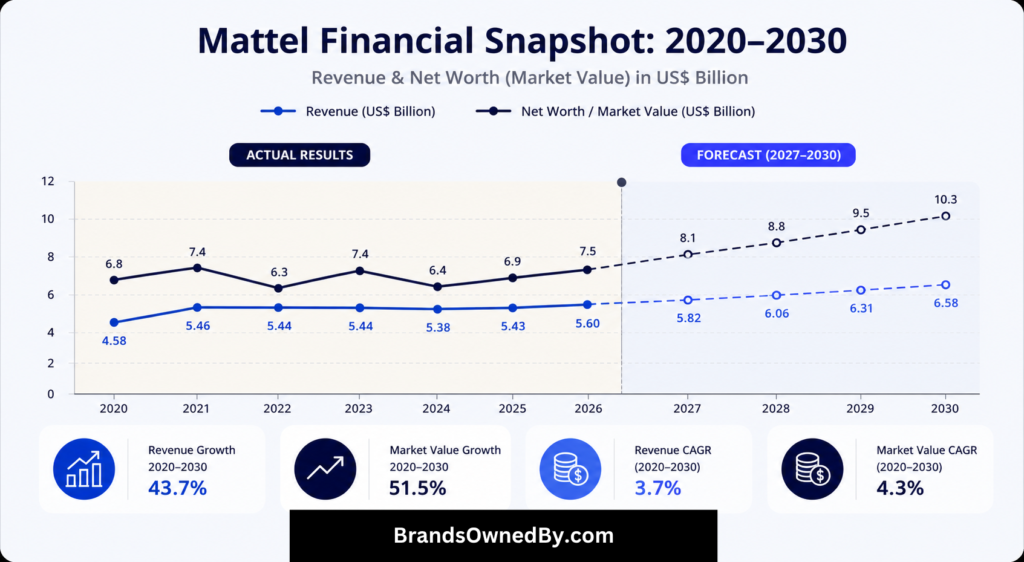
As of July 2026, the company is expected to generate approximately $5.60 billion in annual revenue, while its market capitalization—widely used as a measure of its corporate net worth—is estimated at around $7.5 billion. Supported by globally recognized brands such as Barbie, Hot Wheels, Fisher-Price, UNO, American Girl, and Thomas & Friends, Mattel has evolved from a traditional toy manufacturer into a diversified entertainment and intellectual property company with operations in more than 150 countries.
Mattel Revenue in 2026
Mattel is projected to generate approximately $5.60 billion in revenue during 2026, representing annual growth of around 3.1% compared with the estimated $5.43 billion reported in 2025. The increase is primarily driven by continued demand for its flagship toy brands, expanding licensing partnerships, higher entertainment-related income, and stronger international sales.
Although the extraordinary momentum created by the Barbie movie has naturally moderated, Mattel continues to benefit from a diversified business model. Revenue is no longer generated solely through toy manufacturing. Today, the company earns income from physical products, film and television production, licensing agreements, digital gaming partnerships, publishing, consumer products, and franchise development.
Barbie and Hot Wheels remain Mattel’s two largest revenue-generating brands, while Fisher-Price, American Girl, Thomas & Friends, UNO, Monster High, and MEGA continue to contribute significant annual sales. North America remains the company’s largest market, accounting for roughly half of total revenue, while Europe, Latin America, and Asia-Pacific collectively generate a substantial share of international sales.
Revenue Breakdown by Business Segment
Mattel’s diversified product portfolio helps reduce dependence on any single category or brand.
Dolls, led by Barbie and Monster High, account for approximately 34% of total revenue, making them the company’s largest business segment. Vehicles, including Hot Wheels and Matchbox, contribute around 24%, while the Infant and Preschool category, anchored by Fisher-Price and Thomas & Friends, generates approximately 18%.
Action figures, games, and construction toys contribute roughly 14% of annual sales. The remaining 10% comes from Mattel’s rapidly growing entertainment, licensing, publishing, digital gaming, and intellectual property businesses. This shift toward higher-margin licensing and entertainment revenue has become one of the company’s most important long-term growth drivers.
Mattel Net Worth in 2026
As a publicly traded company, Mattel does not publish an official corporate net worth. Instead, investors generally measure the company’s value using its market capitalization, which represents the total value of all outstanding shares.
As of July 2026, Mattel’s market capitalization is estimated at approximately $7.5 billion, representing an increase of nearly 9% compared with approximately $6.9 billion in 2025. This improvement reflects investor confidence in Mattel’s long-term transformation strategy, stronger operating performance, and continued expansion of its intellectual property portfolio.
The company’s market value has fluctuated over recent years. Following a valuation of approximately $6.8 billion in 2020, Mattel reached around $7.4 billion in both 2021 and 2023 before declining to approximately $6.4 billion in 2024 amid softer consumer demand and broader market pressures. The recovery during 2025 and 2026 demonstrates renewed investor optimism supported by stronger licensing revenue, disciplined cost management, and continued growth in entertainment initiatives.
What Drives Mattel’s Revenue and Valuation?
Several long-term factors continue to support Mattel’s financial performance.
The company owns one of the most valuable toy portfolios in the world, with brands generating billions of dollars in annual consumer spending. These globally recognized franchises provide consistent demand across multiple age groups and geographic markets.
Mattel has also transformed its intellectual property into entertainment franchises. Revenue from theatrical films, television programming, streaming content, licensing agreements, publishing, consumer products, and digital gaming now represents an increasingly important share of overall income. This diversification reduces dependence on seasonal toy sales while creating recurring revenue opportunities.
Operational improvements have further strengthened the business. Investments in product innovation, supply chain optimization, inventory management, pricing strategies, and premium product launches have improved profitability while positioning Mattel for sustainable long-term growth.
Revenue and Net Worth Growth
Over the past several years, Mattel has demonstrated steady financial resilience despite changing consumer spending patterns and economic uncertainty. Revenue increased from $4.58 billion in 2020 to an estimated $5.60 billion in 2026, representing cumulative growth of more than 22%. During the same period, the company’s market capitalization increased from approximately $6.8 billion to around $7.5 billion, reflecting stronger investor confidence and improved long-term growth prospects.
Mattel Revenue Forecast (2027–2030)
Mattel is expected to continue expanding over the remainder of the decade as licensing, entertainment, and digital initiatives contribute a larger share of total revenue.
- 2027: Revenue is projected to reach approximately $5.82 billion, supported by continued growth in licensing, entertainment, and international markets.
- 2028: Revenue is forecast to increase to around $6.06 billion, driven by stronger digital gaming partnerships, consumer products, and franchise expansion.
- 2029: Revenue is expected to reach approximately $6.31 billion, reflecting higher monetization of Mattel’s intellectual property portfolio and sustained demand for its flagship brands.
- 2030: Revenue is projected to approach $6.58 billion, while the company’s market capitalization could exceed $10.3 billion if current growth trends continue and entertainment, licensing, and global expansion initiatives perform as expected.
Brands Owned by Mattel
As of July 2026, the company manages dozens of globally recognized intellectual properties spanning dolls, vehicles, action figures, preschool toys, games, collectibles, digital entertainment, and media production. Over the decades, Mattel has expanded its portfolio through acquisitions, licensing agreements, and internal brand development, allowing it to maintain a strong presence across multiple consumer categories.
In addition to toy brands, Mattel also operates entertainment divisions, film and television studios, publishing businesses, and digital gaming partnerships that help monetize its intellectual property beyond traditional toy sales.
Mattel Brand Portfolio
Toy Brands
Preschool
Games
Entertainment
Construction
Licensed
Barbie
Barbie is Mattel’s most valuable and recognizable brand. Introduced in 1959 by Ruth Handler, Barbie has grown into one of the world’s best-selling toy franchises, with more than one billion dolls sold globally. Today, Barbie extends far beyond dolls into clothing, accessories, books, animated films, television series, video games, consumer products, licensing, and live experiences.
Following the global success of the Barbie movie, the brand has become one of Mattel’s largest revenue generators and serves as the company’s flagship entertainment franchise. Mattel continues to expand Barbie through collaborations with fashion designers, celebrities, luxury brands, and major retailers worldwide.
Hot Wheels
Hot Wheels is Mattel’s leading die-cast vehicle brand and one of the best-selling toy franchises in history. Launched in 1968, Hot Wheels includes toy cars, racing tracks, collector editions, remote-controlled vehicles, digital games, animated series, and licensed merchandise.
The brand appeals to both children and adult collectors, making it one of Mattel’s strongest recurring revenue sources. Mattel has also expanded Hot Wheels into entertainment, esports, gaming collaborations, and theatrical film development.
Fisher-Price
Fisher-Price is one of the world’s largest infant and preschool toy brands. Acquired by Mattel in 1993, it develops educational toys, baby gear, learning products, activity centers, walkers, playsets, and developmental toys designed for infants and young children.
The brand has maintained a strong global reputation for safety, durability, and early childhood development, making it one of Mattel’s most trusted businesses.
American Girl
American Girl specializes in premium dolls, books, accessories, clothing, and educational products designed to inspire young girls through historical and contemporary storytelling.
Since acquiring American Girl in 1998, Mattel has expanded the brand through retail stores, cafés, publishing, movies, digital content, and exclusive collector products. American Girl remains one of Mattel’s highest-priced premium toy brands.
Thomas & Friends
Thomas & Friends joined Mattel’s portfolio through the acquisition of HIT Entertainment in 2012.
The franchise includes toy trains, railway playsets, books, television programs, animated series, clothing, consumer products, and licensing partnerships. Thomas remains one of the world’s most recognizable preschool entertainment brands and continues to generate significant licensing revenue for Mattel.
UNO
UNO is one of the best-selling card games in history and has become a major global gaming franchise under Mattel.
The brand now includes dozens of themed editions, mobile games, digital experiences, travel editions, family entertainment products, and international tournament events. UNO continues to experience strong growth through licensing and online gaming initiatives.
Matchbox
Matchbox is Mattel’s second-largest die-cast vehicle brand.
Originally created in the United Kingdom, Matchbox focuses on realistic vehicles, emergency services, construction equipment, military vehicles, and collectible automobiles. The brand complements Hot Wheels by targeting consumers interested in authentic vehicle designs.
Monster High
Monster High combines fashion dolls with horror-inspired fictional characters.
Since its relaunch, the franchise has experienced renewed popularity through animated television series, streaming content, licensed merchandise, books, fashion collaborations, and collectible dolls. Monster High has become one of Mattel’s fastest-growing brands among older children and collectors.
MEGA
MEGA is Mattel’s construction toy business acquired through the purchase of MEGA Brands in 2014.
The company produces construction sets, educational building toys, licensed collectibles, and premium building kits based on popular entertainment franchises including Pokémon, Halo, Barbie, Hot Wheels, and numerous other licensed properties.
Polly Pocket
Polly Pocket remains one of Mattel’s most recognizable compact doll brands.
The miniature playsets feature portable worlds, accessories, vehicles, animals, and collectible characters. Mattel has modernized the franchise through new product designs, digital content, and licensing partnerships aimed at younger audiences.
Masters of the Universe
Masters of the Universe is one of Mattel’s most valuable action figure franchises.
Centered around He-Man, Skeletor, and Eternia, the brand includes action figures, animated series, comics, novels, collectibles, apparel, and licensed merchandise. Mattel has continued investing heavily in the franchise through streaming series, collector editions, and an upcoming live-action movie.
MEGA Pokémon
Through a long-term licensing agreement with The Pokémon Company, Mattel manufactures MEGA Pokémon construction sets.
Although Pokémon itself is not owned by Mattel, the MEGA Pokémon product line has become one of the company’s most successful licensed construction businesses.
Jurassic World Toys
Mattel holds the global master toy license for the Jurassic World franchise.
The company designs and markets action figures, dinosaurs, vehicles, playsets, collectibles, and role-play products inspired by the blockbuster film series. The partnership continues to generate substantial licensing revenue.
Disney Princess and Frozen Toys
Beginning in 2023, Mattel regained the global licensing rights to manufacture dolls based on Disney Princess and Disney’s Frozen characters.
The partnership significantly strengthened Mattel’s fashion doll business by adding globally recognized characters such as Elsa, Anna, Cinderella, Ariel, Belle, Moana, Rapunzel, Jasmine, and Snow White to its product portfolio.
Barney
Barney returned to Mattel’s portfolio following the company’s revitalization of the classic preschool franchise.
Mattel has relaunched Barney through animated programming, consumer products, books, toys, and digital content aimed at introducing the character to a new generation of children.
Enchantimals
Enchantimals is Mattel’s fantasy doll franchise featuring characters with animal-inspired personalities.
The brand includes dolls, pets, playsets, accessories, books, digital content, and licensed consumer products marketed primarily toward younger children.
Little People
Little People is one of Fisher-Price’s oldest and most successful preschool brands.
The franchise includes figures, educational playsets, vehicles, interactive toys, seasonal collections, and licensed editions based on popular entertainment properties.
Imaginext
Imaginext develops action figures and interactive playsets for preschool-aged children.
The product line covers superheroes, dinosaurs, castles, space exploration, pirates, vehicles, and licensed entertainment characters designed to encourage imaginative play.
Thomas Wooden Railway
Thomas Wooden Railway operates as a premium extension of the Thomas & Friends franchise.
The product line focuses on high-quality wooden trains, tracks, accessories, and collectible railway systems that appeal to both children and collectors.
Mattel Films
Mattel Films serves as the company’s in-house film production division.
The studio develops movies based on Mattel’s intellectual property, including Barbie, Hot Wheels, Masters of the Universe, Matchbox, Polly Pocket, UNO, Barney, Rock ‘Em Sock ‘Em Robots, Major Matt Mason, Magic 8 Ball, American Girl, and numerous additional franchises currently in development.
Mattel Films represents a major component of the company’s strategy to transform toy brands into long-term entertainment franchises.
Mattel Television Studios
Mattel Television Studios develops and produces animated and live-action television programming based on Mattel’s brands.
The studio creates content for streaming platforms, broadcasters, and international media partners while supporting toy sales through entertainment-driven storytelling.
Mattel Creations
Mattel Creations is Mattel’s direct-to-consumer platform focused on premium collectibles and limited-edition products.
The business sells exclusive Barbie dolls, Hot Wheels collector vehicles, Masters of the Universe figures, Monster High collectibles, designer collaborations, and convention-exclusive merchandise directly to consumers worldwide.
Mattel Games
Mattel Games oversees the company’s board games, card games, family games, and party games.
Its portfolio includes UNO, Phase 10, Blink, DOS, Apples to Apples, Pictionary, KerPlunk, Magic 8 Ball, and numerous internationally recognized family games sold across global markets.
Conclusion
The answer to who owns Mattel is straightforward. Mattel is a publicly traded company owned by thousands of shareholders worldwide. Institutional investors such as EdgePoint Investment Group, Vanguard, PRIMECAP Management, and BlackRock collectively hold the largest ownership stakes, while no single shareholder controls the company.
Operational control rests with Chairman and CEO Ynon Kreiz and the Board of Directors, who oversee strategy, capital allocation, and long-term growth. With globally recognized brands including Barbie, Hot Wheels, Fisher-Price, American Girl, and UNO, Mattel continues to strengthen its position as one of the world’s leading toy and family entertainment companies.
FAQs
Is Mattel owned by Hasbro?
No, Mattel is not owned by Hasbro. The two companies are separate publicly traded corporations and are among the largest competitors in the global toy industry. Mattel trades on the NASDAQ under the ticker symbol MAT, while Hasbro trades under HAS. Although reports of a possible merger have emerged from time to time, no acquisition or merger has ever taken place.
Who is Mattel owned by?
Mattel is owned by its shareholders because it is a publicly traded company. As of July 2026, the company’s shares are primarily held by institutional investors, with EdgePoint Investment Group being the largest shareholder, owning approximately 16.3% of the outstanding shares. Other major shareholders include Vanguard, PRIMECAP Management, BlackRock, Ariel Investments, Southeastern Asset Management, State Street, and Dimensional Fund Advisors. No single investor owns a majority stake in the company.
Who owns Mattel company?
Mattel is collectively owned by thousands of institutional and individual shareholders. Since no shareholder owns more than 50% of the company’s stock, ownership is widely distributed. The company is governed by its Board of Directors, while day-to-day operations are managed by its executive leadership team led by CEO Ynon Kreiz.
Is Mattel still in business?
Yes, Mattel is still in business and remains one of the world’s leading toy and family entertainment companies. Founded in 1945, the company operates in more than 150 countries and owns some of the world’s most recognizable brands, including Barbie, Hot Wheels, Fisher-Price, UNO, American Girl, Thomas & Friends, and Matchbox. In recent years, Mattel has expanded beyond toys into films, television, digital gaming, publishing, and licensing.
What companies does Mattel own?
Mattel owns a diverse portfolio of companies, brands, and business divisions. Its major owned brands include Barbie, Hot Wheels, Fisher-Price, American Girl, Matchbox, Monster High, Polly Pocket, Masters of the Universe, Thomas & Friends, UNO, MEGA, Little People, Imaginext, Barney, and Enchantimals. The company also operates Mattel Films, Mattel Television Studios, Mattel Games, and Mattel Creations. Over the years, Mattel has strengthened its portfolio through acquisitions such as Fisher-Price, American Girl, HIT Entertainment, and MEGA Brands.
Who is the largest shareholder of Mattel?
As of July 2026, EdgePoint Investment Group is Mattel’s largest shareholder, owning approximately 16.3% of the company’s outstanding shares. Despite being the largest investor, EdgePoint does not have majority ownership or exclusive control over Mattel. Major corporate decisions remain subject to approval by the Board of Directors and shareholders.
Who originally owned Mattel?
Mattel was originally founded in 1945 by Harold “Matt” Matson and Elliot Handler. Shortly after the company was established, Matson sold his ownership interest to Handler because of health reasons. Elliot Handler and his wife, Ruth Handler, subsequently became the principal owners and transformed Mattel into one of the world’s largest toy companies. Ruth Handler later created the iconic Barbie doll in 1959, which became the company’s most successful product.
What is Mattel’s most profitable brand?
Barbie is Mattel’s most profitable and valuable brand. Since its launch in 1959, the franchise has generated billions of dollars in global revenue through dolls, accessories, clothing, animated content, films, video games, licensing agreements, and consumer products. The success of the 2023 Barbie movie further strengthened the brand’s commercial value and reinforced its position as Mattel’s flagship intellectual property.
Who owns Mattel Barbie?
Mattel is the sole owner of the Barbie brand and all associated intellectual property. The company created Barbie in 1959 and continues to own, manufacture, market, and license the brand worldwide. Mattel controls every aspect of the Barbie franchise, including dolls, toys, movies, television series, books, digital content, apparel, games, and licensed merchandise.