
- Craftsman is fully owned by Stanley Black & Decker, which acquired the brand from Sears Holdings in 2017 in a deal valued at approximately $0.90 billion, giving Stanley Black & Decker complete ownership and operational control over the brand.
- Because Craftsman is a brand and not an independent public company, it does not have its own separate shareholders or stock listing. Instead, its ownership is tied directly to the shareholders of Stanley Black & Decker, its parent company.
- As of April 2026, the largest shareholders of Stanley Black & Decker—and therefore the largest indirect owners of Craftsman—are The Vanguard Group with approximately 12%–13%, Capital Research Global Investors with around 10%–11%, BlackRock with roughly 8%–9%, and State Street Corporation with about 5%–6% ownership.
- Control over Craftsman is exercised through Stanley Black & Decker’s executive leadership and board of directors, led by CEO Donald Allan Jr., meaning all strategic, financial, and operational decisions for the brand are made within the parent company’s corporate structure.
Craftsman is a well-known American tool and outdoor equipment brand specializing in hand tools, power tools, lawn and garden machinery, storage solutions, and automotive accessories. The brand has built its reputation around producing reliable, affordable, and durable products for homeowners, DIY users, mechanics, and professional tradespeople.
Craftsman is considered one of the most recognizable names in the American hardware market. For decades, it has been associated with home garages, workshops, and construction sites across the country. The brand is especially known for its wide product catalog, lifetime warranty offerings on many hand tools, and strong presence in major retail stores.
Today, Craftsman products are sold through major retailers such as Lowe’s, Ace Hardware, Amazon, and independent hardware stores. Its product lineup includes mechanics’ tool sets, drills, saws, lawnmowers, pressure washers, generators, toolboxes, and garage storage systems.
The brand operates as part of Stanley Black & Decker and serves as one of the company’s flagship mid-range tool brands, positioned between entry-level and premium professional offerings.
Core Product Categories
Craftsman’s portfolio spans several major product categories that serve both consumer and professional markets.
Its hand tools division includes wrenches, ratchets, socket sets, screwdrivers, pliers, hammers, and measuring tools. These products remain among the brand’s most popular offerings.
Its power tools segment includes cordless drills, impact drivers, saws, sanders, grinders, and specialty workshop equipment. Many of these products use Craftsman’s V20 battery platform.
The outdoor equipment division produces lawn mowers, trimmers, leaf blowers, snow blowers, chainsaws, and pressure washers.
Craftsman also sells storage and workspace products such as rolling tool chests, cabinets, shelving systems, and garage organizers.
Market Position
Craftsman occupies the mid-tier segment of the tool industry. It targets users who want dependable quality at more affordable prices than premium industrial brands.
The brand competes directly with names such as Ryobi, Kobalt, and Husky in the consumer and prosumer markets.
Its long-standing reputation and brand recognition give it an advantage among customers seeking established and trusted tool manufacturers.
Craftsman Founders
Unlike many companies that were started by individual entrepreneurs, Craftsman was not founded by a single person. Instead, the brand was created by executives at Sears, Roebuck and Co. in 1927 as an in-house tool brand for the retailer.
Arthur Barrows
The individual most commonly credited with helping launch Craftsman is Arthur Barrows, who served as head of Sears’ hardware department during the brand’s formation.
Barrows reportedly purchased the rights to the Craftsman name from the Marion-Craftsman Tool Company for a relatively small sum. He believed the name would appeal strongly to customers because it conveyed quality workmanship and skilled craftsmanship.
After acquiring the trademark, Sears introduced Craftsman as its exclusive hardware and tools label.
Sears Leadership Behind the Launch
Although Arthur Barrows played a major role, the overall development of Craftsman was backed by Sears’ corporate leadership team. Sears executives wanted to create a premium in-house tool brand that could compete with independent hardware manufacturers while boosting store loyalty.
This strategy proved highly successful. Craftsman rapidly became one of Sears’ strongest-performing private labels.
Founding Purpose of Craftsman
Craftsman was originally created to serve as a high-quality yet affordable tool brand for American consumers. Sears wanted the brand to appeal to farmers, mechanics, tradespeople, and homeowners who needed dependable tools without paying premium industrial prices.
The company emphasized durability, trust, and warranty protection from the start. These values helped Craftsman become one of the most iconic hardware brands in U.S. retail history.
Ownership History
The ownership history of Craftsman spans nearly a century and reflects the broader evolution of the American retail and tool industries. While many people know Craftsman as a household name in hardware, the brand has gone through several important ownership and structural changes since its launch in 1927. From its origins under Sears to its acquisition by Stanley Black & Decker, Craftsman’s journey shows how a retailer-created brand transformed into part of a global manufacturing giant.
Creation Under Sears (1927)
Craftsman was originally created in 1927 by Sears, Roebuck and Co., which at the time was one of the largest retailers in the United States. Sears wanted to launch its own exclusive hardware brand that could compete with independent tool manufacturers while giving shoppers a reason to purchase directly from Sears stores and catalogs.
The name “Craftsman” was reportedly acquired by Sears hardware executive Arthur Barrows, who purchased the trademark from the Marion-Craftsman Tool Company. After obtaining the rights, Sears began using the Craftsman name on its own line of tools and workshop products.
From the beginning, Craftsman was positioned as a premium-quality but affordable brand. Sears marketed it heavily toward homeowners, farmers, mechanics, and tradespeople. The goal was to provide dependable tools at prices lower than industrial-grade brands while still maintaining a reputation for reliability.
Growth Into Sears’ Flagship Tool Brand
During the 1930s, 1940s, and 1950s, Craftsman rapidly grew into Sears’ most successful hardware label. As Sears expanded across the United States, Craftsman products became available in department stores, mail-order catalogs, and eventually nationwide retail outlets.
The brand gained significant popularity because of its:
- Strong durability reputation
- Affordable pricing
- Wide product variety
- Famous lifetime warranty on hand tools.
By the mid-20th century, Craftsman had become one of the most trusted names in the American tool market. For many consumers, the brand became synonymous with garage workshops and home repair.
Throughout this period, Sears retained full ownership of Craftsman and operated it as a wholly owned private-label brand. Craftsman products were largely sold exclusively through Sears locations, making the retailer the only place customers could purchase them for decades.
Ownership Under Sears Holdings
A major corporate restructuring occurred in 2005 when Sears, Roebuck and Co. merged with Kmart to form Sears Holdings.
As part of this merger, ownership of Craftsman transferred from the legacy Sears organization to the newly formed Sears Holdings corporation.
Under Sears Holdings, Craftsman remained one of the company’s most valuable intellectual properties and best-known consumer brands. However, during this period, Sears and Kmart began struggling financially due to:
- Falling retail sales
- Increased competition from Amazon and Walmart
- Poor store performance
- Rising debt levels
- Declining mall traffic.
Despite Craftsman’s continued popularity, Sears Holdings’ financial condition worsened throughout the late 2000s and early 2010s.
Stanley Black & Decker Acquisition (2017)
The most significant ownership change in Craftsman’s history occurred in January 2017.
Facing severe financial pressure, Sears Holdings agreed to sell Craftsman to Stanley Black & Decker in a deal valued at approximately $900 million.
The acquisition structure included multiple parts:
- $525 million paid upfront at closing
- Additional payments spread over several years
- Revenue-sharing arrangements tied to future sales.
This sale marked the first time in nearly 90 years that Craftsman was no longer owned by Sears-related entities.
For Stanley Black & Decker, acquiring Craftsman was a strategic move aimed at strengthening its position in the consumer and professional tool market. The company saw major potential in expanding Craftsman beyond Sears’ shrinking retail footprint.
Transition Period After Acquisition
Even after Stanley Black & Decker purchased Craftsman, Sears initially retained limited rights to continue selling Craftsman products through its stores for a transition period under licensing agreements.
However, Stanley Black & Decker gained full control over the brand’s manufacturing, marketing, product development, and broader distribution strategy.
This allowed the company to rapidly expand Craftsman into new retailers, including:
- Lowe’s
- Ace Hardware
- Amazon
- Independent hardware distributors.
This expansion dramatically increased the brand’s accessibility compared to its former Sears-exclusive model.
Craftsman Under Stanley Black & Decker Today
Today, Craftsman operates as a wholly owned brand within Stanley Black & Decker’s tool portfolio. It sits alongside several other major brands under the company’s umbrella, including:
- DeWalt
- Stanley Tools
- Black+Decker
- Irwin Tools
- Mac Tools.
Stanley Black & Decker has since repositioned Craftsman as a broader mass-market and prosumer brand. It now targets homeowners, DIY enthusiasts, and semi-professional users while maintaining the heritage and reputation built under Sears.
Who Owns Craftsman?
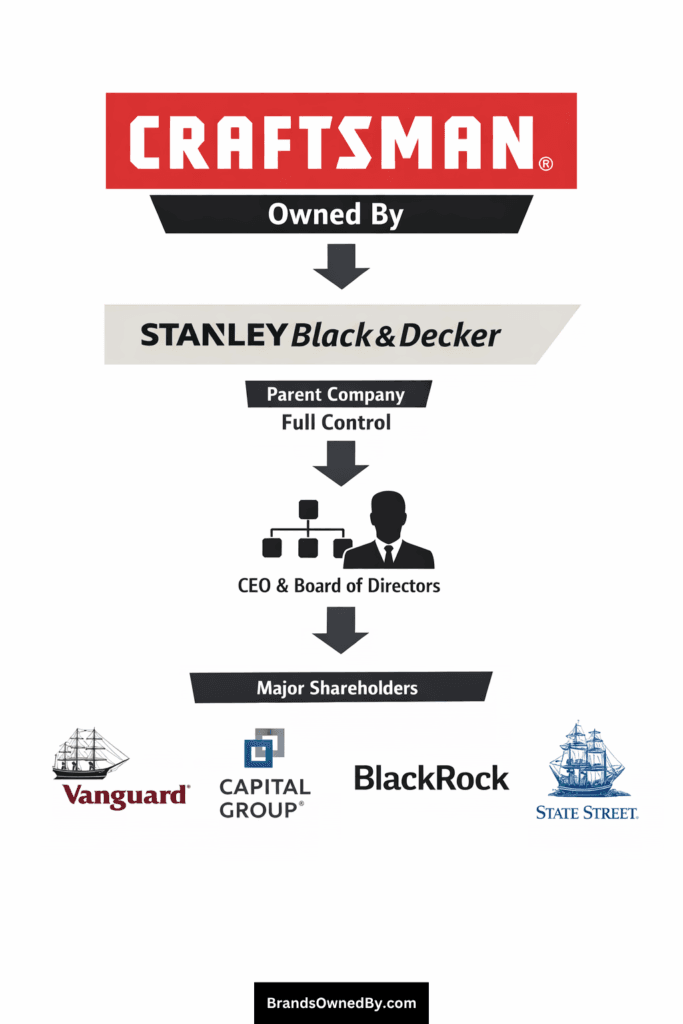
Craftsman is fully owned by Stanley Black & Decker, one of the world’s largest industrial and tool manufacturing companies. Stanley Black & Decker acquired the Craftsman brand from Sears Holdings in 2017 and has maintained 100% ownership since then.
Craftsman operates as a wholly owned brand within Stanley Black & Decker’s portfolio, meaning the parent company has complete authority over the brand’s manufacturing, product strategy, licensing, retail partnerships, expansion plans, and financial decisions.
All major decisions regarding Craftsman are ultimately made at the parent company level by Stanley Black & Decker’s executive leadership and board of directors.
Parent Company: Stanley Black & Decker
Stanley Black & Decker is an American multinational industrial corporation headquartered in New Britain, Connecticut. It is widely regarded as one of the largest and most influential tool manufacturers in the world.
The company was formed in 2010 through the merger of Stanley Works and Black & Decker, combining two historic industrial manufacturers into one global powerhouse. Since that merger, Stanley Black & Decker has aggressively expanded its market presence through acquisitions, brand development, and international distribution.
Today, the company operates across more than 60 countries and sells products in over 175 countries worldwide. Its business focuses heavily on professional tools, industrial equipment, outdoor products, engineered fastening systems, and infrastructure solutions.
Stanley Black & Decker owns numerous major brands, including:
- DeWalt
- Black+Decker
- Stanley Tools
- Irwin Tools
- Mac Tools
- Lenox
- Porter-Cable
- Craftsman.
Within the company’s broader portfolio, Craftsman serves as a mainstream and mid-tier tool brand aimed primarily at homeowners, DIY consumers, mechanics, and semi-professional users.
Stanley Black & Decker reported over $15 billion in annual revenue in recent years and remains one of the dominant players in the global tools and hardware market.
Shareholder Ownership Structure Behind Craftsman
Since Craftsman is owned by Stanley Black & Decker, indirect ownership of the brand belongs to the shareholders of the parent company.
As of April 2026, institutional investors collectively own a very large majority of Stanley Black & Decker stock, with reports showing institutional ownership above 87%.
The largest major shareholders include:
The Vanguard Group
The Vanguard Group is the largest shareholder of Stanley Black & Decker and owns approximately 12%–13% of the company’s outstanding shares as of April 2026.
Vanguard holds its shares through various mutual funds and ETFs, including major index funds. Because of its ownership size, Vanguard has significant influence over shareholder voting matters and board elections.
Capital Research Global Investors
Capital Research Global Investors owns roughly 10%–11% of Stanley Black & Decker shares.
The firm is one of the largest active institutional investors in the company and has maintained a substantial long-term position.
BlackRock
BlackRock controls approximately 8%–9% of Stanley Black & Decker stock through its various institutional funds and ETF holdings.
As one of the world’s largest asset managers, BlackRock plays a major governance role in many large public corporations.
State Street Corporation
State Street Corporation owns approximately 5%–6% of the company’s shares.
State Street remains another major passive institutional investor through index-tracking funds.
Together, these four firms control a substantial portion of Stanley Black & Decker, meaning they indirectly hold major economic ownership in Craftsman through the parent company.
Acquisition of Craftsman From Sears
Craftsman’s current ownership structure began after Stanley Black & Decker completed its landmark acquisition of the brand from Sears Holdings in 2017.
The transaction was officially announced in January 2017 and completed in March 2017.
At the time, Sears was facing severe financial difficulties, declining store traffic, rising debt, and worsening liquidity issues. To raise cash and stabilize operations, Sears decided to sell Craftsman, one of its most valuable remaining assets.
Stanley Black & Decker agreed to purchase the brand in a transaction valued at approximately $900 million net present value.
Detailed Deal Structure
The acquisition was structured in multiple payment phases:
- $525 million cash payment made at closing
- $250 million deferred payment due after three years
- Additional annual payments tied to new Craftsman sales for 15 years
- Royalty-based payments ranging between 2.5% and 3.5% on certain future sales during the agreement period.
This complex payment structure allowed Sears to receive both immediate liquidity and long-term participation in the brand’s future growth.
Rights Acquired in the Deal
Under the acquisition agreement, Stanley Black & Decker gained the rights to:
- Develop Craftsman-branded products
- Manufacture Craftsman products
- Sell Craftsman products globally
- Expand Craftsman into non-Sears retail channels
- License and market the brand internationally.
However, Sears retained a perpetual license to continue selling Craftsman-branded goods in its own retail channels, royalty-free for the first 15 years.
Why Stanley Black & Decker Bought Craftsman
Stanley Black & Decker’s acquisition of Craftsman was viewed as highly strategic for several reasons.
Strengthening Mid-Tier Market Position
Before acquiring Craftsman, Stanley Black & Decker had strong premium and entry-level brands, but less dominance in the mid-tier market.
Craftsman helped fill that gap perfectly.
It gave the company a stronger positioning between premium brands like DeWalt and more consumer-oriented lower-tier offerings.
Access to Massive Brand Equity
Despite Sears’ decline, Craftsman itself remained one of the most recognized tool brands in America.
Stanley Black & Decker acquired decades of goodwill, brand trust, and recognition through the transaction.
Retail Expansion Opportunity
At the time of acquisition, only around 10% of Craftsman sales occurred outside Sears channels. Stanley believed the brand had enormous untapped retail potential.
Following the acquisition, Stanley rapidly expanded Craftsman into:
This significantly broadened the brand’s market reach.
Competitor Ownership Comparison
Craftsman operates in one of the most competitive segments of the global tools and hardware market. The brand competes against several major manufacturers across hand tools, power tools, outdoor equipment, mechanics’ tools, and storage systems. However, one interesting aspect of the industry is that many competing brands are not standalone businesses. Instead, they are owned by large multinational corporations, retailers, or industrial holding groups.
Understanding competitor ownership helps show where Craftsman stands in the market and how its corporate backing compares to rival brands. Since Craftsman is owned by Stanley Black & Decker, it benefits from the resources, manufacturing scale, and financial backing of one of the largest industrial companies in the world. Many of its competitors operate under similar ownership structures.
| Competitor Brand | Parent Company / Owner | Ownership Type | Main Market Position vs Craftsman | Key Comparison With Craftsman |
|---|---|---|---|---|
| DeWalt | Stanley Black & Decker | Wholly owned brand/subsidiary | Premium professional-grade tools | DeWalt and Craftsman share the same parent company, but DeWalt targets contractors and professionals while Craftsman focuses more on DIY users, homeowners, and mid-tier buyers. |
| Milwaukee Tool | Techtronic Industries | Wholly owned brand/subsidiary | Premium/professional cordless and industrial tools | Milwaukee competes more heavily in the professional segment and often overlaps with DeWalt, though it also challenges Craftsman in cordless and mechanic tools. |
| Ryobi | Techtronic Industries | Wholly owned brand/subsidiary | Affordable DIY and homeowner tools | Ryobi directly competes with Craftsman in the consumer and homeowner market, especially in cordless tools and outdoor equipment. |
| Husky | The Home Depot | Retailer-owned private label brand | Mid-tier mechanics and hand tools | Husky is Home Depot’s in-house brand and competes with Craftsman in hand tools, storage, and mechanics’ equipment. |
| Kobalt | Lowe’s | Retailer-owned private label brand | Mid-tier DIY and home improvement tools | Kobalt competes directly with Craftsman in similar categories and is sold mainly as Lowe’s exclusive store brand. |
| Snap-on Incorporated | Public shareholders | Independent public company | Premium automotive and industrial tools | Snap-on targets professional mechanics and industrial users, offering significantly more premium and expensive products than Craftsman. |
| Harbor Freight Tools | Smidt Family | Privately owned company | Budget/value-focused tools | Harbor Freight competes on affordability and targets lower-budget consumers compared to Craftsman’s mid-tier positioning. |
DeWalt Ownership Comparison
DeWalt is one of Craftsman’s closest competitors in the professional and premium power tools market. However, unlike most competitors, DeWalt is actually owned by the same parent company as Craftsman.
DeWalt is also fully owned by Stanley Black & Decker and operates as a sister brand to Craftsman within the company’s broader tools portfolio.
While both brands share ownership, they target different market segments:
- Craftsman is positioned as a mid-tier brand focused on homeowners, DIY users, mechanics, and semi-professionals.
- DeWalt is positioned as a premium professional-grade brand targeting contractors, construction professionals, and industrial users.
This dual-brand strategy allows Stanley Black & Decker to serve multiple customer segments without internal overlap.
Compared to Craftsman, DeWalt generally commands higher prices and is viewed as more performance-focused, but both benefit from the same manufacturing and corporate infrastructure.
Milwaukee Tool Ownership Comparison
Milwaukee Tool is one of Craftsman’s strongest competitors in cordless tools and professional equipment.
Milwaukee is owned by Techtronic Industries (TTI), a Hong Kong-based multinational manufacturing company founded in 1985.
Techtronic Industries owns several tool and floorcare brands, including:
- Milwaukee Tool
- Ryobi
- Hoover
- Dirt Devil
- Oreck.
Milwaukee is positioned primarily as TTI’s premium professional-grade brand, similar to how DeWalt functions under Stanley Black & Decker.
Compared to Craftsman:
- Milwaukee generally focuses more heavily on professionals and contractors
- Craftsman has a stronger emphasis on mainstream consumer and DIY buyers
- Milwaukee often competes more directly with DeWalt than Craftsman in high-end segments.
However, Milwaukee overlaps with Craftsman in certain cordless and mechanic tool categories.
Ryobi Ownership Comparison
Ryobi is another direct competitor to Craftsman, particularly in the DIY and homeowner market.
Like Milwaukee, Ryobi is owned by Techtronic Industries.
Ryobi is positioned as a more affordable consumer-oriented brand and competes directly with Craftsman in several categories, including:
- Cordless drills
- Saws
- Outdoor lawn equipment
- Garage storage
- Home workshop tools.
Compared to Craftsman:
- Ryobi often emphasizes innovation and battery ecosystem expansion
- Craftsman places more focus on heritage branding and mechanic tool reputation
- Both target similar middle-market consumers.
This creates significant competition between Stanley Black & Decker and Techtronic Industries in the consumer tool market.
Husky Ownership Comparison
Husky competes heavily with Craftsman in hand tools, mechanics’ tools, and storage systems.
Husky differs from many competitors because it is not owned by a manufacturing conglomerate. Instead, Husky is owned by The Home Depot, one of the largest home improvement retailers in the world.
Husky functions as Home Depot’s private-label house brand. This gives Home Depot direct control over:
- Product sourcing
- Manufacturing partnerships
- Pricing strategy
- Retail placement
- Marketing.
Compared to Craftsman:
- Husky is more retailer-controlled than manufacturer-controlled
- Craftsman benefits from independent multi-retailer distribution
- Husky is sold almost exclusively through Home Depot.
This gives Craftsman a broader retail reach, while Husky benefits from Home Depot’s massive in-store traffic.
Kobalt Ownership Comparison
Kobalt is another major competitor in the DIY and home improvement segment.
Kobalt is owned by Lowe’s and serves as Lowe’s in-house private-label tool brand.
Much like Husky at Home Depot, Kobalt is retailer-owned rather than manufacturer-owned.
Kobalt competes directly with Craftsman in:
- Power tools
- Outdoor tools
- Hand tools
- Mechanics’ tools
- Tool storage.
Interestingly, both Craftsman and Kobalt are sold at Lowe’s, though Kobalt is Lowe’s exclusive house brand while Craftsman is a third-party brand.
Compared to Craftsman:
- Kobalt offers retailer exclusivity through Lowe’s
- Craftsman has a broader brand recognition historically
- Craftsman benefits from stronger national heritage branding.
Snap-on Ownership Comparison
Snap-on Incorporated is another major player in the tool industry, especially in automotive and industrial tools.
Unlike Craftsman and many competitors, Snap-on operates as an independent publicly traded company rather than as a subsidiary or brand under another corporation.
Snap-on owns and operates its own branded tool business directly.
Compared to Craftsman:
- Snap-on focuses heavily on premium mechanics and industrial professionals
- Craftsman targets more mainstream consumers and non-industrial mechanics
- Snap-on products are significantly higher priced.
Snap-on competes more in the premium automotive technician market, but overlaps with Craftsman in mechanic tool sets and garage equipment.
Harbor Freight Ownership Comparison
Harbor Freight Tools competes with Craftsman primarily in budget and value-focused tools.
Harbor Freight is privately owned by the Smidt family through family-controlled ownership rather than public shareholders.
Unlike Craftsman’s corporate-backed public ownership structure, Harbor Freight remains privately controlled.
Its private ownership allows it greater flexibility in pricing and operations, but limits public capital access compared to Stanley Black & Decker.
Comparative Ownership Strength
When comparing ownership structures, Craftsman benefits from one of the strongest corporate parents in the industry.
Its ownership advantages include:
- Backing from a Fortune 500 industrial manufacturer
- Access to global manufacturing and supply chains
- Significant research and development resources
- Broad retail distribution partnerships
- Strong financial resources for expansion
Many competitor brands also have strong ownership backing, but several rely heavily on retailer exclusivity or smaller ownership structures.
Who Controls Craftsman?
Craftsman is controlled through the corporate leadership and governance structure of its parent company, Stanley Black & Decker. Because Craftsman is not a separate public company or standalone subsidiary with independent leadership, it does not have its own CEO or independent board of directors. Instead, all meaningful decisions regarding the brand are made within Stanley Black & Decker’s centralized management structure.
As of April 2026, control of Craftsman flows through multiple levels of leadership, beginning with the CEO and board of directors, then moving down through executive officers and divisional leadership responsible for the company’s Tools & Outdoor operations.
Ultimate Executive Authority: Donald Allan Jr.
The individual with the highest level of control over Craftsman is Donald Allan Jr., who serves as President and Chief Executive Officer of Stanley Black & Decker.
As CEO, Donald Allan holds final executive authority over every brand and business unit within the company, including Craftsman. No major strategic initiative involving the brand can move forward without executive approval from his office or his delegated senior leadership team.
His responsibilities include overseeing:
- Corporate-wide strategy and long-term planning
- Approval of major investments and capital allocation
- Acquisition and expansion strategy
- Brand portfolio management
- Operational restructuring and cost controls
- Profitability and shareholder performance goals.
In practice, this means if Stanley decides to expand Craftsman into new markets, launch a major new product line, restructure pricing, increase manufacturing investment, or reposition the brand strategically, Donald Allan would either directly approve the decision or oversee the executive team that does.
Board of Directors and Governance Oversight
Above day-to-day management, Craftsman is also indirectly controlled by Stanley Black & Decker’s board of directors, which oversees corporate governance and supervises executive leadership.
The board does not run daily operations, but it influences Craftsman through its authority over the company’s highest-level strategic decisions.
As of April 2026, key board members include:
Carlos Cardoso – Chairman of the Board
Carlos Cardoso serves as Chairman of the Board.
As chairman, he leads board meetings, oversees governance matters, and works closely with executive leadership on long-term strategy. He is one of the most influential figures in Stanley’s corporate oversight structure.
Andrea Ayers – Independent Director
Andrea Ayers serves as an independent board director and contributes expertise in corporate leadership and operational strategy.
George Buckley – Independent Director
George Buckley, former CEO of 3M, provides industrial and manufacturing expertise to the board.
Janet Hill – Independent Director
Janet Hill contributes financial and governance expertise through her board role.
Jocelyn Konrad – Independent Director
Jocelyn Konrad provides executive and financial oversight experience.
Together, the board approves major matters such as:
- Long-term business strategy
- Large-scale acquisitions or divestitures
- Executive compensation and appointments
- Major capital expenditures
- Corporate restructuring initiatives
- Risk management and governance policies.
Because Craftsman is one of Stanley’s flagship brands, any major strategic shift related to the brand would likely fall under board review if it materially impacts company performance.
Operational Control Through Executive Leadership Team
While the CEO sets direction and the board provides oversight, day-to-day strategic execution for Craftsman is managed by Stanley Black & Decker’s executive leadership team.
These executives help translate corporate strategy into operational decisions.
Christopher Nelson – Chief Operating Officer
Christopher Nelson serves as Chief Operating Officer.
Nelson oversees enterprise operations, manufacturing systems, supply chain execution, and operating performance. Since Craftsman depends heavily on manufacturing efficiency and distribution scale, he plays a direct role in controlling how the brand is produced and delivered to market.
His responsibilities influence:
- Supply chain logistics
- Factory and manufacturing strategy
- Inventory planning
- Distribution systems
- Productivity improvements.
Patrick Hallinan – Chief Financial Officer
Patrick Hallinan serves as Executive Vice President and Chief Financial Officer.
Hallinan controls budgeting, capital allocation, and financial planning across Stanley Black & Decker. This gives him influence over how much financial investment Craftsman receives for:
- Product development
- Marketing campaigns
- Retail expansion
- Manufacturing upgrades
- Innovation initiatives.
Divisional and Brand-Level Management Structure
Below top executives, Craftsman is managed through Stanley Black & Decker’s Tools & Outdoor division, which houses many of the company’s major tool brands.
This divisional structure oversees:
- Product category strategy
- Brand positioning
- Retail relationships
- Market competitiveness
- Product launches
- Consumer research.
Within that structure, dedicated internal Craftsman brand managers and product executives handle the brand’s daily business operations.
These teams manage:
- Individual product launches
- Marketing campaigns
- Packaging and branding
- Retail promotions
- Consumer targeting strategies
- Competitive pricing decisions.
However, these managers do not act independently. They operate within budgets, goals, and strategic frameworks approved by senior executives.
How Control Decisions Flow
Craftsman’s control structure typically follows a top-down model.
Strategic decisions generally move through the following chain:
- Internal brand managers identify opportunities or issues
- Divisional leadership evaluates proposals
- Executive leadership reviews budgets and strategic alignment
- CEO approves major initiatives
- Board involvement occurs for large-scale strategic matters if necessary.
This ensures that Craftsman remains aligned with Stanley Black & Decker’s overall corporate objectives rather than operating independently.
Shareholder Influence on Control
Although shareholders do not directly manage Craftsman, Stanley Black & Decker’s major investors indirectly influence the brand through voting power over company leadership.
Large institutional shareholders such as:
- The Vanguard Group
- BlackRock
- Capital Research Global Investors
- State Street Corporation.
influence Craftsman indirectly by voting on:
- Board elections
- Executive compensation
- Corporate governance proposals
- Shareholder resolutions.
Because these investors own significant portions of Stanley Black & Decker, they help shape the leadership structure that ultimately governs Craftsman.
Craftsman Annual Revenue and Net Worth
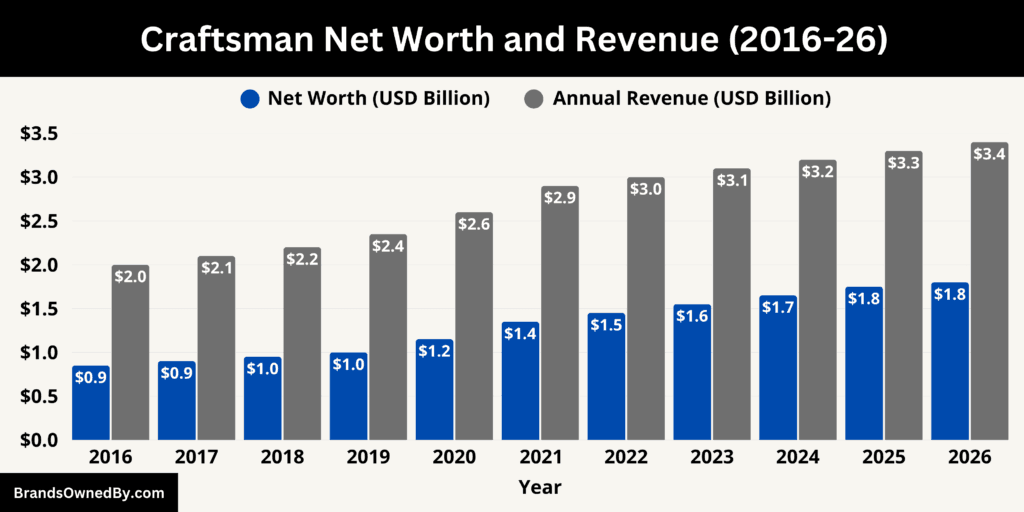
Craftsman remains one of the most valuable tool brands in the North American hardware market, with an estimated 2026 annual revenue of approximately $3.40 billion and an implied standalone brand net worth of around $1.80 billion to $2.00 billion as of April 2026. While Craftsman does not publicly release separate audited financial statements because it operates under Stanley Black & Decker, analysts and industry experts estimate its financial performance based on retail sales volume, historical acquisition data, market share, distribution growth, and brand valuation trends.
Since being acquired from Sears in 2017, Craftsman has significantly increased both its annual sales and market valuation. The brand has transformed from a declining retailer-exclusive label into a broadly distributed national hardware powerhouse sold across major retailers and digital marketplaces.
Craftsman Revenue Breakdown and Business Performance
Craftsman’s estimated $3.40 billion in 2026 revenue comes from multiple business segments across tools, storage, and outdoor equipment. The brand generates revenue primarily through retail product sales in physical stores and e-commerce channels.
A large portion of Craftsman’s revenue comes from its hand and mechanics tools division, which likely contributes roughly $1.20 billion to $1.30 billion annually. This segment includes ratchets, sockets, wrenches, screwdrivers, tool kits, and mechanic sets, which remain among the brand’s strongest-performing legacy categories.
Its power tools segment is estimated to generate approximately $0.95 billion to $1.05 billion annually, driven by cordless drills, saws, grinders, sanders, and battery-powered workshop tools. Craftsman has significantly expanded this division since launching its V20 cordless battery platform.
The outdoor and lawn equipment category likely contributes another $0.70 billion to $0.80 billion, including lawn mowers, trimmers, blowers, pressure washers, and snow equipment. This area has become increasingly important as Craftsman continues broadening beyond traditional workshop tools.
The remaining $0.30 billion to $0.40 billion comes from storage solutions, garage organization products, automotive accessories, compressors, generators, and miscellaneous hardware products.
Craftsman Net Worth and Brand Valuation 2026
As of April 2026, Craftsman’s current estimated brand valuation of $1.80 billion to $2.00 billion reflects the significant appreciation in value since Stanley Black & Decker acquired the brand for approximately $0.90 billion in 2017.
The valuation increase has been driven by several measurable factors.
First, Craftsman’s annual sales have increased by approximately 70% since 2016, growing from around $2.00 billion to $3.40 billion over the ten-year period.
Second, the brand’s retail footprint has expanded substantially. Under Sears, Craftsman’s sales were largely limited to Sears stores. Today, the brand is sold through:
- Lowe’s
- Ace Hardware
- Amazon
- Independent hardware stores
- Farm and ranch retailers.
Third, Craftsman has diversified its product mix into faster-growing segments such as cordless power tools and battery-powered outdoor equipment, increasing overall revenue potential and brand attractiveness.
Financial Growth Since Stanley Black & Decker Acquisition
The acquisition of Craftsman by Stanley Black & Decker in 2017 proved financially transformative for the brand.
At the time of acquisition, Craftsman was still heavily dependent on the struggling Sears retail network. Stanley’s broader distribution strategy immediately allowed the brand to access millions of additional consumers nationwide.
Between 2017 and 2026:
Craftsman’s estimated revenue increased from $2.10 billion to $3.40 billion, representing nearly 62% total growth.
Its estimated brand valuation rose from $0.90 billion to nearly $2.00 billion, meaning its implied net worth has more than doubled since the acquisition.
This strong financial performance has made Craftsman one of Stanley Black & Decker’s most strategically valuable mid-market brands.
Future Revenue Forecast Through 2030
Based on Craftsman’s historical growth trend, current market positioning, and the continued expansion strategy of Stanley Black & Decker, analysts expect the brand to maintain steady revenue growth through the end of the decade. Craftsman has consistently increased its estimated annual revenue since its 2017 acquisition, adding roughly $0.10 billion to $0.30 billion in additional yearly sales in most years. If this pace continues, the brand is projected to remain one of the fastest-growing major mid-tier tool brands in North America.
Several factors support this positive long-term forecast. First, Craftsman continues expanding its retail footprint through deeper partnerships with Lowe’s, Ace Hardware, Amazon, and regional hardware distributors. Second, Stanley Black & Decker has been aggressively investing in new product development, particularly in cordless tools, battery ecosystems, outdoor power equipment, and garage storage systems. Third, the overall DIY and home improvement market remains strong, especially as more consumers continue investing in home maintenance, repairs, and workshop equipment.
Another major growth catalyst is product diversification. Historically, Craftsman was known primarily for hand tools and mechanics’ sets, but the brand has expanded significantly into higher-growth categories such as cordless power tools, riding mowers, pressure washers, generators, and smart garage storage solutions. These newer categories offer higher average selling prices and larger revenue opportunities than traditional hand tools alone.
International expansion could also contribute to future growth. While Craftsman remains heavily concentrated in North America, Stanley Black & Decker has opportunities to push the brand further into Latin America, Europe, and select international markets over time, which could unlock additional revenue streams beyond its traditional U.S.-focused customer base.
Taking these factors into account, projected future revenue estimates are as follows:
- 2027: $3.55 billion
- 2028: $3.70 billion
- 2029: $3.90 billion
- 2030: $4.10 billion.
If Craftsman reaches these projections, it would represent total growth of approximately 20.6% between 2026 and 2030, adding around $0.70 billion in new annual revenue over four years.
Projected Long-Term Brand Valuation Growth
As revenue rises, Craftsman’s implied brand valuation is also expected to continue increasing. If the company maintains its current sales momentum and profitability trends, analysts estimate Craftsman’s standalone brand value could grow substantially through 2030.
Projected valuation estimates include:
- 2027: $2.10 billion
- 2028: $2.25 billion
- 2029: $2.40 billion
- 2030: $2.60 billion.
At this pace, Craftsman could be worth more than $2.5 billion by 2030, nearly triple its valuation at the time of Stanley Black & Decker’s 2017 acquisition.
Strategic Outlook Through 2030
Looking ahead, Craftsman’s growth strategy will likely focus on strengthening its presence in several high-potential segments. The brand is expected to continue expanding its cordless V20 battery ecosystem, introduce more outdoor and smart-tool technologies, and deepen penetration in professional-adjacent “prosumer” markets where consumers want contractor-style quality at affordable prices.
Stanley Black & Decker also sees Craftsman as a critical brand for competing against rivals such as Ryobi, Kobalt, and Husky. Because of this, the company is likely to keep investing heavily in Craftsman’s innovation, shelf space, and advertising.
If market conditions remain stable, Craftsman could realistically surpass $4 billion in annual sales before 2030 and continue cementing its position as one of the most valuable mainstream tool brands in the industry.
Brands Owned by Craftsman
Craftsman operates several internal branded product lines, equipment divisions, and product categories under the broader Craftsman name. These serve as the main “entities” directly operated by the brand as of 2026.
Because Craftsman functions as a unified consumer tool and equipment brand, the businesses and entities associated with it are structured primarily through branded product segments rather than legally separate companies.
| Company / Brand / Entity Operated by Craftsman | Type | Main Products / Services | Relevant Details |
|---|---|---|---|
| Craftsman Hand Tools | Product Division / Core Business Segment | Ratchets, socket sets, wrenches, screwdrivers, pliers, hammers, measuring tools | Craftsman Hand Tools is the brand’s oldest and most recognized division. It formed the foundation of Craftsman’s reputation and remains one of its highest-selling product categories, particularly among homeowners, mechanics, and workshop users. |
| Craftsman Power Tools | Product Division / Core Business Segment | Cordless drills, saws, impact drivers, grinders, sanders, nailers | This is one of Craftsman’s fastest-growing segments. It has expanded heavily since 2017 and includes the brand’s V20 cordless battery platform, helping Craftsman compete in the modern power tools market. |
| Craftsman Outdoor Equipment | Product Division / Outdoor Equipment Segment | Lawn mowers, riding mowers, trimmers, chainsaws, blowers, hedge trimmers | This segment focuses on lawn and garden machinery and has become a major revenue driver as Craftsman expanded beyond workshop tools into broader home improvement categories. |
| Craftsman Storage and Garage Solutions | Product Division / Storage Segment | Tool chests, cabinets, shelving, organizers, workbenches, mobile carts | This division supports Craftsman’s garage and workshop ecosystem by offering storage and organization products that complement its core tool business. |
| Craftsman Mechanics and Automotive Tools | Specialty Product Division | Mechanic sets, torque wrenches, jacks, creepers, battery chargers, compressors | One of Craftsman’s most historic and strongest niche categories, serving mechanics, automotive enthusiasts, and garage users. |
| Craftsman Generators and Jobsite Equipment | Utility Equipment Segment | Portable generators, air compressors, wet/dry vacs, lighting, pressure washers | This division expands Craftsman into contractor-adjacent and utility-focused products beyond traditional hand and power tools. |
| Craftsman Licensed Merchandise and Accessories | Accessories / Licensing Segment | Tool bags, batteries, chargers, blades, attachments, safety gear | Includes supporting accessories and replacement products that help expand recurring sales and strengthen Craftsman’s broader product ecosystem. |
Craftsman Hand Tools
Craftsman Hand Tools is one of the brand’s oldest and most iconic operating divisions. This segment includes the traditional products that originally made Craftsman famous throughout the 20th century.
The hand tools lineup includes:
- Ratchets
- Socket sets
- Wrenches
- Screwdrivers
- Pliers
- Hammers
- Tape measures
- Utility knives
- Hex key sets.
This remains one of Craftsman’s most recognized product categories and continues to generate a major share of the brand’s total revenue. Craftsman hand tools are especially popular among mechanics, homeowners, garage users, and general contractors.
The division is also central to Craftsman’s long-standing brand reputation because many of its hand tools continue to carry warranty-backed durability positioning.
Craftsman Power Tools
Craftsman Power Tools represents one of the brand’s fastest-growing modern business segments. This division has expanded significantly since Stanley Black & Decker acquired the brand and repositioned it for broader retail distribution.
The power tools segment includes:
- Cordless drills
- Impact drivers
- Circular saws
- Reciprocating saws
- Sanders
- Grinders
- Nailers
- Routers
- Specialty workshop equipment.
A major focus within this division is the Craftsman V20 battery-powered ecosystem, which has become the brand’s flagship cordless platform.
This segment allows Craftsman to compete directly against brands like Ryobi, Kobalt, and Milwaukee in the growing battery-powered power tools market.
Craftsman Outdoor Equipment
Craftsman Outdoor Equipment has become one of the brand’s most valuable expansion categories in recent years.
This division includes lawn and garden machinery such as:
- Lawn mowers
- Riding mowers
- String trimmers
- Leaf blowers
- Hedge trimmers
- Chainsaws
- Snow blowers
- Pressure washers.
Craftsman significantly expanded its outdoor offerings after leaving Sears exclusivity, allowing the brand to compete more aggressively in seasonal outdoor and landscaping categories.
The outdoor division has become increasingly important because it provides exposure to the high-growth home improvement and landscaping equipment markets.
Craftsman Storage and Garage Solutions
Craftsman also operates a major storage and organization segment under its branded garage solutions line.
Products include:
- Rolling tool chests
- Tool cabinets
- Storage organizers
- Garage shelving
- Wall-mounted systems
- Workbenches
- Mobile carts.
This segment helps strengthen Craftsman’s position as a complete garage and workshop solutions provider rather than simply a tools manufacturer.
Storage products are particularly important because they often drive higher-margin accessory sales and complement the brand’s hand and power tools business.
Craftsman Mechanics and Automotive Tools
Craftsman operates a dedicated mechanics and automotive-focused segment targeted toward vehicle owners, hobbyists, and technicians.
Products in this category include:
- Mechanic tool sets
- Torque wrenches
- Automotive jacks
- Creepers
- Diagnostic accessories
- Battery chargers
- Garage equipment
- Air compressors.
This category remains one of Craftsman’s strongest specialty niches and continues to reinforce the brand’s historic association with automotive repair and garage workshop culture.
Craftsman Generators and Jobsite Equipment
Craftsman has expanded into portable power and jobsite support equipment through its generators and heavy-duty utility products.
This includes:
- Portable generators
- Air compressors
- Wet/dry vacuums
- Pressure washers
- Portable lighting
- Jobsite support tools.
These products broaden Craftsman’s appeal beyond simple hand and power tools into more industrial and contractor-adjacent use cases.
Craftsman Licensed Merchandise and Accessories
In addition to core equipment, Craftsman operates a wide range of licensed and branded accessory products.
These include:
- Tool bags
- Workwear accessories
- Safety gear
- Replacement batteries
- Chargers
- Tool attachments
- Replacement blades and accessories.
These accessory lines help expand recurring revenue while reinforcing the brand ecosystem.
Craftsman Acquisitions and Mergers
As of 2026, Craftsman itself has not completed any standalone acquisitions or mergers in its own name.
Because the brand is not structured as an independent corporation, it does not have the authority to acquire businesses separately from Stanley Black & Decker. Any acquisitions involving the Craftsman brand would be executed through the parent company rather than directly by Craftsman.
Likewise, Craftsman has not merged with any other companies as an independent entity.
Its most significant corporate event remains its own acquisition by Stanley Black & Decker in 2017, when ownership of the entire brand transferred from Sears Holdings.
Craftsman Licensing and Brand Partnerships
Craftsman also operates through select licensing and manufacturing partnerships that expand its product offerings into adjacent categories.
Under these arrangements, third-party manufacturers may produce Craftsman-branded products under license in categories such as:
- Outdoor machinery
- Specialty automotive tools
- Seasonal equipment
- Home hardware accessories.
These partnerships allow Craftsman to broaden its product catalog without directly manufacturing every item internally.
Final Thoughts
Craftsman is owned by Stanley Black & Decker, which acquired the iconic tool brand from Sears in 2017. While Craftsman began as a Sears-exclusive product line, it now operates under one of the world’s largest industrial tool companies. Stanley Black & Decker fully controls Craftsman’s operations, strategy, and expansion, while major institutional investors such as Vanguard and BlackRock indirectly hold ownership through the parent company. With strong sales, a billion-dollar brand valuation, and backing from a major corporation, Craftsman remains one of the most powerful names in the tool industry.
FAQs
Who owns Craftsman brand?
Craftsman is owned by Stanley Black & Decker. The company acquired the Craftsman brand from Sears Holdings in 2017 for approximately $0.90 billion. Since then, Stanley Black & Decker has had full ownership and control over the brand.
Who makes Craftsman tools?
Most Craftsman tools are manufactured, sourced, and distributed by Stanley Black & Decker. The company oversees Craftsman’s product development, manufacturing partnerships, design, and distribution network. However, some Craftsman-branded products are produced by third-party manufacturing partners under licensing or contract manufacturing agreements.
Who bought out Craftsman?
Stanley Black & Decker bought out Craftsman in 2017 when it acquired the brand from Sears Holdings. The acquisition was part of Sears’ efforts to raise capital during its financial struggles and restructuring period.
How much did Lowe’s buy Craftsman for?
Lowe’s did not buy Craftsman. Instead, Stanley Black & Decker purchased Craftsman for approximately $0.90 billion in 2017. Lowe’s later became one of the largest retail distributors of Craftsman products through a retail partnership agreement.
Are DeWalt and Craftsman owned by the same company?
Yes, both DeWalt and Craftsman are owned by Stanley Black & Decker. They operate as sister brands within the company’s larger tools portfolio, though they target different customer segments and price ranges.
Did Milwaukee buy Craftsman?
No, Milwaukee Tool did not buy Craftsman. Milwaukee is owned by Techtronic Industries, while Craftsman is owned by Stanley Black & Decker. The two brands are competitors in the tool industry.
Did Sears own Craftsman?
Yes, Sears, Roebuck and Co. originally created and owned Craftsman from 1927 until 2017. Craftsman was one of Sears’ most valuable in-house brands for nearly 90 years before being sold to Stanley Black & Decker.
Where are Craftsman tools sold?
Craftsman tools are sold through a wide range of retailers and online marketplaces, including:
- Lowe’s
- Ace Hardware
- Amazon
- Independent hardware stores
- Farm and ranch supply stores
- Various e-commerce platforms.
Craftsman products are widely available across the United States and select international markets.
What Craftsman tools are made in USA?
Some Craftsman products are made or assembled in the United States, particularly select hand tools, mechanics tool sets, storage products, and certain power tool lines. Stanley Black & Decker has invested in expanding domestic production for specific Craftsman product categories, though not all Craftsman products are U.S.-made.
Where are Craftsman tools made?
Craftsman tools are manufactured in multiple countries depending on the product category. Production takes place in the United States as well as internationally in countries such as China, Taiwan, Mexico, and other global manufacturing locations. The manufacturing origin varies by specific tool type and product line.