

- The Hermès family is the controlling shareholder of Hermès, collectively owning approximately 66.7% of the company’s share capital through H51 and related family entities. This majority stake gives the family effective control over the luxury brand’s governance, leadership, and long-term strategy.
- H51 is the largest shareholder with approximately 66.72% ownership, followed by Nicolas Puech (4.91%), the Arnault family (1.87%), the Nicolas Puech Foundation (0.85%), and Hermès treasury shares (0.79%). The remaining 24.86% is held by institutional investors and public shareholders.
- Hermès is a publicly traded company listed on Euronext Paris, but family ownership remains dominant. Through their controlling stake, the descendants of founder Thierry Hermès maintain significant influence over board appointments, executive leadership, and major corporate decisions.
- Unlike competitors such as Louis Vuitton, which is owned by LVMH, and Gucci, which is owned by Kering, Hermès remains independently controlled by its founding family. This ownership structure has helped preserve the company’s exclusivity, craftsmanship standards, and long-term business approach for generations.
Hermès is a French luxury goods company that specializes in leather goods, fashion, accessories, jewelry, watches, fragrances, home décor, and lifestyle products. Founded in Paris in 1837, the company has grown from a small harness workshop into one of the most respected luxury brands in the world.
It is known for its focus on craftsmanship rather than mass production. Unlike many luxury brands that rely heavily on licensing and outsourced manufacturing, Hermès maintains strict control over its production process. Many of its products are still handcrafted by highly trained artisans in company-owned workshops.
Hermès operates through several product categories. Leather goods remain its flagship business, with iconic products such as the Birkin and Kelly bags. The company also has strong positions in silk scarves, ready-to-wear fashion, fine jewelry, watches, fragrances, beauty products, and luxury home furnishings.
One of the defining characteristics of Hermès is scarcity. The company deliberately limits production of many products to preserve exclusivity and maintain high quality standards. This strategy has helped create some of the most sought-after luxury products in the global market.
As of June 2026, Hermès operates hundreds of retail locations across Asia, Europe, North America, the Middle East, and other international markets. The brand continues to expand its manufacturing network while maintaining its commitment to artisanal craftsmanship and family-led governance.
It remains one of the few major luxury businesses that is still substantially controlled by its founding family. This ownership structure has allowed Hermès to focus on long-term brand value rather than short-term growth targets.
Founders of Hermès
Hermès was founded by Thierry Hermès in 1837 in Paris, France. While Thierry Hermès established the company as a premium harness and saddlery workshop, later generations of the Hermès family, particularly Charles-Émile Hermès, Adolphe Hermès, Émile-Maurice Hermès, and Jean-Louis Dumas, played crucial roles in transforming the business into one of the world’s most prestigious luxury brands.
The history of Hermès is unique because the descendants of founder Thierry Hermès have remained involved in the company for nearly two centuries. Their leadership helped expand Hermès from an equestrian goods maker into a global luxury house known for leather goods, fashion, jewelry, watches, fragrances, and home collections. As of June 2026, members of the Hermès family remain the company’s largest shareholder group and continue to influence its long-term direction.
Thierry Hermès
Thierry Hermès founded Hermès in 1837 in Paris, France. He was a master harness maker and leather craftsman who specialized in creating high-quality saddles, bridles, and riding equipment for European aristocrats and wealthy customers.
His commitment to craftsmanship and durability quickly earned the company a reputation for excellence. These principles remain central to the Hermès brand today and continue to distinguish the company from many luxury competitors.
Charles-Émile Hermès
Charles-Émile Hermès, the son of Thierry Hermès, succeeded his father and expanded the business during the late nineteenth century. He relocated the company to 24 Rue du Faubourg Saint-Honoré in Paris, which remains the historic headquarters of Hermès.
Under his leadership, the company strengthened its position among Europe’s elite and laid the groundwork for future international growth.
Émile-Maurice Hermès
Émile-Maurice Hermès, grandson of Thierry Hermès, is widely regarded as one of the most influential figures in the company’s history. He introduced innovative products and helped diversify Hermès beyond its traditional equestrian business.
He secured exclusive rights to use the zipper in leather goods and clothing in France and played a key role in developing the company’s leather accessories business. His vision helped prepare Hermès for the changing consumer market of the twentieth century.
Jean-Louis Dumas
Although not a founder, Jean-Louis Dumas was instrumental in shaping modern Hermès. He led the company for several decades and oversaw significant international expansion.
Under his leadership, Hermès launched many of its most successful products and strengthened its reputation for exclusivity and craftsmanship. The globally recognized Birkin bag was introduced during his tenure, becoming one of the most valuable luxury products in the world.
The Hermès Family Legacy
The success of Hermès extends beyond its original founder. Six generations of the Hermès family have contributed to the company’s development, making it one of the longest-running family-controlled luxury businesses in the world.
This continuity has helped preserve the values established by Thierry Hermès while allowing the company to adapt to changing consumer preferences and global markets. The ongoing involvement of the Hermès family remains one of the defining characteristics of the company as of 2026.
Ownership History
The ownership history of Hermès is unusual in the luxury industry. While many famous fashion houses have been acquired by large luxury groups or private investors, Hermès has remained largely under the control of the founding Hermès family for nearly two centuries.
The company’s ownership structure evolved gradually as the business expanded from a small Paris workshop into a global luxury leader. Despite becoming a publicly traded company, the descendants of founder Thierry Hermès have successfully maintained control through multiple generations.
1837–1880: Thierry Hermès Establishes the Family Business
Hermès was founded in 1837 by Thierry Hermès as a workshop specializing in harnesses, saddles, and equestrian equipment. During this period, ownership was entirely concentrated in the founder’s hands.
The company operated as a family-owned business, with decision-making and management controlled directly by Thierry Hermès. Its customer base primarily consisted of European aristocrats, wealthy merchants, and royal households.
At this stage, there were no outside shareholders or institutional investors. The company was a traditional, privately owned family enterprise.
1880–1900: Ownership Passes to Charles-Émile Hermès
Following Thierry Hermès’ retirement and later death, ownership passed to his son, Charles-Émile Hermès.
Charles-Émile expanded the company and relocated it to 24 Rue du Faubourg Saint-Honoré in Paris, which remains the historic headquarters of Hermès today.
This transition marked the beginning of multi-generational family ownership. Control remained fully within the Hermès family, establishing a succession model that would continue for decades.
Early 1900s: Expansion Under the Third Generation
The next major ownership transition occurred when Thierry Hermès’ grandsons, Adolphe Hermès and Émile-Maurice Hermès, became involved in the business.
Émile-Maurice Hermès eventually emerged as the key leader and owner of the company. Under his leadership, Hermès expanded beyond equestrian products and entered new luxury categories such as leather goods, travel accessories, and fashion items.
Ownership remained concentrated among family members, and the company continued operating as a private family-controlled business.
Mid-Twentieth Century: Family Ownership Strengthens
Throughout the twentieth century, Hermès remained privately held by descendants of Thierry Hermès.
Unlike many luxury brands that sought external investors to finance expansion, Hermès relied heavily on internal resources and family leadership. This approach allowed the company to preserve its independence and maintain control over production, branding, and long-term strategy.
As the luxury industry consolidated, many competitors were acquired by larger groups. Hermès chose a different path and continued operating as an independent family business.
1978–2006: The Jean-Louis Dumas Era
A major chapter in Hermès ownership history began when Jean-Louis Dumas assumed leadership.
As a fifth-generation family member, Jean-Louis Dumas modernized the company while preserving family control. During his tenure, Hermès expanded internationally and became one of the world’s most respected luxury brands.
Although the company grew substantially, ownership remained concentrated among members of the Hermès family. This period demonstrated that a family-controlled company could compete successfully against large luxury conglomerates.
Public Listing and Outside Shareholders
Hermès eventually became a publicly traded company through a listing on the Paris Stock Exchange.
The public listing allowed institutional investors, mutual funds, pension funds, and retail investors to purchase shares in the company.
However, the Hermès family carefully structured ownership to ensure it would retain effective control. Even after becoming public, family members collectively held a majority of voting rights.
This strategy enabled Hermès to access capital markets while preserving its independence.
2010: LVMH’s Surprise Stake Acquisition
One of the most significant events in Hermès ownership history occurred in 2010.
Luxury giant LVMH, controlled by Bernard Arnault, disclosed that it had quietly accumulated a substantial stake in Hermès. The announcement surprised both investors and members of the Hermès family.
LVMH’s position quickly grew to more than 20% of the company and later exceeded 23%.
Many industry observers speculated that LVMH could eventually attempt to acquire full control of Hermès. Such a transaction would have created one of the largest mergers in luxury industry history.
The move triggered significant concern among Hermès family shareholders, who viewed independence as a core part of the company’s identity.
Creation of the H51 Family Holding Company
In response to the LVMH investment, members of the Hermès family took action to strengthen their ownership position.
More than 50 family shareholders created a holding company known as H51. The purpose of this structure was to pool family shares and prevent fragmentation of ownership.
The agreement restricted the sale of shares for a long period and ensured that family members would continue acting together as a controlling shareholder group.
The creation of H51 became one of the most important defensive measures in the company’s history. It significantly reduced the likelihood of a hostile takeover.
Resolution of the LVMH Ownership Dispute
The relationship between Hermès and LVMH remained tense for several years.
Eventually, an agreement was reached under which LVMH distributed most of its Hermès shares to its own shareholders and reduced its direct involvement in the company.
This outcome preserved Hermès’ independence and strengthened the position of the founding family.
The episode is often cited as one of the most successful examples of a family-controlled company defending itself against a potential takeover attempt by a much larger competitor.
Ownership Structure as of 2026
As of 2026, Hermès remains predominantly controlled by descendants of founder Thierry Hermès.
The Hermès family collectively owns a significant portion of the company’s shares and controls the majority of voting rights through direct holdings and family investment structures such as H51.
Other shareholders include institutional investors, asset management firms, pension funds, sovereign wealth funds, and public market investors. However, no outside investor comes close to matching the influence of the Hermès family.
The ownership structure continues to support the company’s long-term strategy, allowing management to focus on brand preservation, craftsmanship, and sustainable growth rather than short-term market pressures.
Who Owns Hermès: Top Shareholders
![Who Owns Hermès [infographic]](https://brandsownedby.com/wp-content/uploads/2026/06/Who-Owns-Hermes-infographic-683x1024.png)
Hermès is a publicly traded company listed on Euronext Paris, but it remains firmly controlled by the descendants of founder Thierry Hermès. This makes Hermès one of the few major global luxury brands that has successfully maintained family control despite operating as a public company.
As of June 2026, the Hermès family collectively controls approximately 66.7% of the company’s share capital through various family holding structures, direct ownership stakes, and the influential H51 holding company. Public investors, institutional shareholders, mutual funds, and pension funds own the remaining shares, but no external shareholder has enough voting power to challenge the family’s control.
The current ownership structure was largely shaped by the family’s response to LVMH’s attempted accumulation of Hermès shares in the early 2010s. Since then, family members have strengthened their ownership arrangements to preserve the company’s independence for future generations.
Here’s the Hermès shareholding structure as of June 2026
| Shareholder | Ownership Stake |
|---|---|
| H51 Family Holding Company | 66.72% |
| Nicolas Puech | 4.91% |
| Arnault Family | 1.87% |
| Nicolas Puech Foundation | 0.85% |
| Hermès International Treasury Shares | 0.79% |
| Public Float and Institutional Investors | 24.86% |
The Hermès family ultimately controls the overwhelming majority of voting rights through these holdings and related family structures.
H51 Family Holding Company (66.72%)
H51 is the most important shareholder in Hermès and serves as the cornerstone of the company’s ownership structure.
The holding company was created in 2011 after LVMH unexpectedly disclosed a large stake in Hermès. More than 50 descendants of Thierry Hermès agreed to place their shares into H51 to prevent any future takeover attempts and preserve family control.
Today, H51 owns approximately 66.72% of Hermès and represents the primary mechanism through which the family exercises control over the company. The structure binds together multiple branches of the Hermès family, including the Dumas, Guerrand, and Puech families.
One of the most significant features of H51 is its long-term lock-up agreement. Family members agreed to restrict the sale of shares, ensuring that ownership remains concentrated within the family and reducing the risk of hostile acquisitions.
For practical purposes, H51 is the controlling shareholder of Hermès and the main reason the company remains independent from luxury conglomerates such as LVMH and Kering.
Nicolas Puech (4.91%)
Nicolas Puech is one of the largest individual shareholders of Hermès.
He is a fifth-generation descendant of founder Thierry Hermès and inherited a substantial ownership stake in the company. Unlike many family members whose shares are held through collective structures, Nicolas Puech has historically maintained a significant direct ownership position.
His stake makes him one of the wealthiest members of the extended Hermès family. Because Hermès has experienced extraordinary share price appreciation over the past two decades, even a relatively small percentage ownership represents tens of billions of dollars in value.
Although he remains an important shareholder, control over the company continues to rest primarily with the broader family ownership structure centered around H51.
Arnault Family (1.87%)
The Arnault family, led by Bernard Arnault, remains a shareholder in Hermès through a relatively small residual stake.
This ownership position is a remnant of the highly publicized battle between Hermès and LVMH that began in 2010. At one point, LVMH had accumulated more than 23% of Hermès, leading to concerns that it might attempt to acquire the company.
Following negotiations and regulatory scrutiny, LVMH distributed most of its Hermès shares to its own shareholders and significantly reduced its direct exposure to the company. Today, the Arnault family’s remaining stake is small and does not provide meaningful influence over Hermès’ strategic decisions.
Nevertheless, the Arnault family continues to appear among the notable shareholders due to the historical significance of its investment.
Nicolas Puech Foundation (0.85%)
The Nicolas Puech Foundation is another identifiable shareholder within the Hermès ownership structure.
This entity holds approximately 0.85% of the company’s shares. While its ownership stake is relatively small compared to H51, it remains one of the largest named shareholders outside the main family holding company.
The foundation’s ownership reflects the long-standing connection between the Puech branch of the Hermès family and the company.
Hermès International Treasury Shares (0.79%)
Hermès itself owns a small percentage of its outstanding shares through treasury stock holdings.
Treasury shares are shares that have been repurchased by the company and are held on its balance sheet. These shares generally do not carry voting rights and are often used for employee compensation plans, stock-based incentives, or future corporate purposes.
The treasury share position is relatively small but provides additional flexibility for corporate management.
Public and Institutional Investors (24.86%)
The remainder of Hermès shares is owned by public market investors and institutional shareholders.
This group includes:
- Asset management firms.
- Pension funds.
- Sovereign wealth funds.
- Insurance companies.
- Mutual funds.
- Individual retail investors.
Large global investment firms such as BlackRock, Vanguard, Amundi, Norges Bank Investment Management, and other institutional investors are commonly found among the company’s institutional shareholder base. These investors hold shares primarily for investment purposes rather than corporate control.
Because the Hermès family controls more than two-thirds of the company, institutional investors have limited influence over strategic decisions despite collectively owning a significant portion of the public float.
Why the Hermès Family Maintains Control
Several factors explain why the Hermès family has successfully maintained control for nearly two centuries.
First, ownership is concentrated through H51 and related family structures. Second, multiple generations of the family remain actively involved in governance and management. Third, the family has repeatedly demonstrated a willingness to prioritize independence over short-term financial gains.
This ownership model differs significantly from competitors such as Gucci, which is controlled by Kering, and Louis Vuitton, which operates within the LVMH group.
As of June 2026, Hermès remains one of the world’s largest and most valuable family-controlled public companies, with the descendants of Thierry Hermès firmly maintaining control over its future direction.
Competitor Ownership Comparison
Hermès operates in one of the most competitive luxury markets in the world. However, its ownership structure is very different from most of its rivals. While many luxury brands are owned by large conglomerates, private investment groups, or widely distributed public shareholders, Hermès remains predominantly controlled by the descendants of its founder.
This distinction influences everything from business strategy and product development to expansion plans and long-term decision-making. Understanding how competitors are owned provides valuable context for why Hermès has maintained its unique position in the luxury industry.
| Company | Founded | Main Luxury Brands | Ownership Type | Largest Shareholder / Controller | Approximate Control | Publicly Traded |
|---|---|---|---|---|---|---|
| Hermès | 1837 | Hermès | Family-Controlled Public Company | Hermès Family (H51 Holding Company) | ~66.7% | Yes |
| Louis Vuitton | 1854 | Louis Vuitton | Subsidiary of Luxury Conglomerate | LVMH (Controlled by Arnault Family) | LVMH owns 100% | No (Brand) |
| Gucci | 1921 | Gucci | Subsidiary of Luxury Conglomerate | Kering (Controlled by Pinault Family) | Kering owns ~100% | No (Brand) |
| Chanel | 1910 | Chanel | Private Family Company | Wertheimer Family | 100% | No |
| Prada | 1913 | Prada, Miu Miu, Church’s | Family-Controlled Public Company | Prada-Bertelli Family | ~80% Voting Control | Yes |
| Burberry | 1856 | Burberry | Widely Held Public Company | Institutional Investors | No Controlling Shareholder | Yes |
| Richemont | 1988 | Cartier, Van Cleef & Arpels, IWC, Jaeger-LeCoultre | Family-Controlled Luxury Group | Rupert Family | ~51% Voting Rights | Yes |
| Moncler | 1952 | Moncler, Stone Island | Founder-Controlled Public Company | Remo Ruffini | ~22% Equity, Majority Voting Control | Yes |
Hermès: Controlled by the Founding Family
Hermès remains one of the largest family-controlled luxury companies in the world.
As of 2026, the Hermès family controls approximately two-thirds of the company’s share capital through H51 and other family ownership structures. This gives the family effective control over corporate governance, board appointments, and long-term strategy.
Because ownership is concentrated among family members, Hermès can focus on preserving exclusivity, craftsmanship, and brand heritage without facing significant pressure from external shareholders.
This family-controlled model is one of the key reasons Hermès has remained independent despite repeated acquisition interest from larger luxury groups.
Louis Vuitton: Owned by LVMH
Louis Vuitton is one of Hermès’ biggest competitors in luxury leather goods, fashion, accessories, and travel products.
Unlike Hermès, Louis Vuitton is not an independent company. It is owned by LVMH Moët Hennessy Louis Vuitton, the world’s largest luxury conglomerate.
LVMH controls dozens of luxury brands across fashion, jewelry, cosmetics, wines, spirits, and hospitality. The group itself is controlled by Bernard Arnault and his family through a combination of direct ownership and holding companies.
This structure gives Louis Vuitton access to the resources of a massive luxury ecosystem. However, strategic decisions are made at the LVMH group level rather than by a founding family dedicated solely to the Louis Vuitton brand.
Gucci: Owned by Kering
Gucci is another major competitor that differs significantly from Hermès in terms of ownership.
The brand is owned by Kering, a French luxury group that manages multiple luxury and lifestyle companies. Kering is controlled by the Pinault family through their investment vehicle, Groupe Artémis.
While Gucci benefits from being part of a large luxury portfolio, it operates within a broader corporate structure focused on multiple brands.
Hermès, in contrast, focuses exclusively on developing and protecting a single luxury house rather than managing a portfolio of brands.
Chanel: Controlled by the Wertheimer Family
Chanel is perhaps the closest ownership comparison to Hermès.
The company is privately owned by the Wertheimer family, descendants of Pierre Wertheimer, who partnered with Coco Chanel during the early development of the brand.
Like Hermès, Chanel remains under long-term family control and is not owned by a luxury conglomerate.
This ownership structure allows Chanel to maintain significant independence and pursue long-term strategies without public market pressure.
However, unlike Hermès, Chanel is not publicly traded. Its shares are privately held by family owners.
Prada: Controlled by the Prada Family
Prada operates under a structure that shares similarities with Hermès.
The company is publicly traded but remains controlled by the Prada family, particularly Miuccia Prada and Patrizio Bertelli.
Through holding companies and voting arrangements, the founding family maintains effective control over the business despite its public listing.
Both Prada and Hermès demonstrate how family-controlled companies can access public capital markets while retaining strategic independence.
However, Hermès has a much higher concentration of family ownership and a stronger defensive structure through H51.
Burberry: Widely Held Public Company
Burberry represents a very different ownership model.
The company is publicly traded and does not have a controlling family shareholder.
Ownership is distributed among institutional investors, pension funds, mutual funds, asset managers, and individual shareholders.
Because no single shareholder controls the company, management must balance the interests of a diverse investor base.
This structure often results in greater shareholder influence over strategy, executive compensation, and business performance targets.
Hermès faces considerably less pressure from activist investors because of its dominant family ownership.
Richemont: Controlled by the Rupert Family
Compagnie Financière Richemont is the owner of luxury brands such as Cartier, Van Cleef & Arpels, IWC, Jaeger-LeCoultre, and several other luxury watch and jewelry companies.
Richemont is controlled by South African billionaire Johann Rupert and his family through a dual-class share structure.
Although Richemont is publicly traded, the Rupert family holds the majority of voting rights, giving them effective control over the group.
This structure resembles Hermès in terms of concentrated control, but Richemont functions as a multi-brand luxury conglomerate rather than a single-brand luxury house.
Moncler: Controlled by Remo Ruffini
Moncler is one of the leading luxury outerwear brands and a growing competitor in premium fashion.
The company is publicly traded but remains controlled by chairman and chief executive officer Remo Ruffini through his investment company.
Ruffini’s controlling stake allows him to guide long-term strategy while benefiting from access to public capital markets.
This ownership structure shares some similarities with Hermès, although control is concentrated around a single entrepreneur rather than an extended family dynasty.
Luxury Industry Ownership Models Compared
The luxury industry generally operates under three primary ownership models.
Family-Controlled Luxury Companies
These companies remain controlled by founding families or descendants.
Examples include:
- Hermès.
- Chanel.
- Prada.
- Ferragamo.
Family-controlled businesses often prioritize brand heritage, craftsmanship, and long-term value creation.
Luxury Conglomerate Ownership
These brands operate as part of larger corporate groups.
Examples include:
- Louis Vuitton (LVMH).
- Dior (LVMH).
- Fendi (LVMH).
- Gucci (Kering).
- Bottega Veneta (Kering).
- Balenciaga (Kering).
Conglomerates benefit from economies of scale, shared resources, and global distribution networks.
Widely Held Public Companies
These businesses have no controlling family or individual shareholder.
Examples include:
- Burberry.
- Some regional luxury companies.
Management teams in these companies are often more accountable to institutional investors and public shareholders.
Why Hermès’ Ownership Structure Is Different
Hermès occupies a unique position among global luxury companies.
Most luxury brands have either been acquired by conglomerates or have diluted family ownership over time. Hermès has successfully avoided both outcomes.
The creation of H51, the family’s commitment to retaining ownership, and the company’s strong financial performance have enabled Hermès to remain independent while continuing to grow globally.
As of 2026, Hermès stands alongside Chanel as one of the strongest examples of family influence in the luxury industry. However, Hermès is even more unusual because it combines public-market access with one of the highest levels of founding-family control among major global luxury companies.
Who Controls Hermès?
Hermès is controlled by a combination of family ownership, family-led governance, and executive leadership. While the company is publicly traded on Euronext Paris, effective control remains with the descendants of founder Thierry Hermès through their majority ownership stake and voting power.
As of June 2026, the Hermès family controls approximately 66.7% of the company’s share capital through H51 and related family ownership structures. This gives the family decisive influence over the election of directors, strategic decisions, executive appointments, and the long-term direction of the company.
Unlike many luxury competitors that are controlled by conglomerates such as LVMH or Kering, Hermès remains one of the few global luxury companies where the founding family still exercises direct control over both ownership and leadership.
| Area of Control | Key Individual or Group |
|---|---|
| Majority Ownership | Hermès Family (through H51 and related entities) |
| Executive Leadership | Axel Dumas |
| Creative Direction | Pierre-Alexis Dumas |
| Supervisory Oversight | Éric de Seynes |
| Active Partner Governance | Henri-Louis Bauer and Emile Hermès SARL |
| Manufacturing Strategy | Guillaume de Seynes |
| Long-Term Corporate Control | Hermès Family |
Axel Dumas: The Executive Chairman of Hermès
The most powerful executive at Hermès is Axel Dumas.
As of June 2026, Axel Dumas serves as Executive Chairman of Hermès International. He is a sixth-generation descendant of founder Thierry Hermès and has led the company since 2013. His appointment continued a long tradition of family leadership that stretches back nearly two centuries.
Before becoming the company’s leader, Dumas managed several important divisions within Hermès, including jewelry and leather goods. He joined the company in 2003 and steadily advanced through senior management roles before succeeding Patrick Thomas.
Under Dumas’ leadership, Hermès has expanded its manufacturing capacity, increased its global retail presence, strengthened its leather goods production network, and become one of the world’s most valuable luxury companies. Rather than pursuing aggressive acquisitions, he has focused on controlled growth and preserving the exclusivity of the brand.
Pierre-Alexis Dumas: The Creative Force Behind Hermès
While Axel Dumas oversees the business, Pierre-Alexis Dumas is responsible for much of the brand’s creative direction.
Pierre-Alexis Dumas serves as Artistic Executive Vice President and Artistic Director of Hermès. He is also a sixth-generation family member and plays a crucial role in maintaining the company’s design philosophy and brand identity.
His responsibilities include overseeing product design, artistic strategy, craftsmanship initiatives, store concepts, collaborations, and brand storytelling. Because Hermès relies heavily on heritage and craftsmanship, Pierre-Alexis Dumas has significant influence over how the company evolves while maintaining its traditional identity.
The combination of Axel Dumas leading business operations and Pierre-Alexis Dumas directing creative strategy gives the Hermès family direct influence over both commercial and artistic decisions.
Éric de Seynes and the Supervisory Board
Corporate oversight at Hermès is provided by the Supervisory Board.
As of 2026, Éric de Seynes serves as Chairman of the Supervisory Board. The board oversees management performance, corporate governance, strategic planning, and risk management.
Although Hermès employs professional governance structures similar to other public companies, the family’s majority ownership means it retains substantial influence over board composition and strategic oversight.
The Supervisory Board acts as a bridge between shareholders and executive management while ensuring the company remains aligned with its long-term objectives.
Henri-Louis Bauer and Emile Hermès SARL
Another important figure in the control structure is Henri-Louis Bauer.
He serves as Executive Manager and Chairman of Emile Hermès SARL, the family-controlled entity that acts as the active partner in Hermès’ corporate structure.
Emile Hermès SARL plays a unique role in governance because Hermès operates as a Société en Commandite par Actions (SCA), a French partnership limited by shares. This structure provides additional protection against hostile takeover attempts and strengthens family control.
The arrangement allows family representatives to maintain significant authority even though the company is publicly traded.
The Executive Committee
Daily operations at Hermès are managed by a senior executive committee composed of some of the company’s most influential leaders.
As of June 2026, key members include:
| Executive | Position |
|---|---|
| Axel Dumas | Executive Chairman |
| Pierre-Alexis Dumas | Artistic Executive Vice President |
| Guillaume de Seynes | Executive Vice President, Manufacturing Division and Equity Investments |
| Éric du Halgouët | Executive Vice President, Finance |
| Florian Craen | Executive Vice President, Sales and Distribution |
| Olivier Fournier | Executive Vice President, Corporate Development and Social Affairs |
| Agnès de Villers | Executive Vice President, Hermès Perfume and Beauty |
| Charlotte David | Executive Vice President, Communication |
| Wilfried Guerrand | Managing Director, Métiers, Information Systems and Data |
| Sharon MacBeath | Group Director of Human Resources |
This leadership team manages the company’s global operations, manufacturing network, retail expansion, digital strategy, supply chain, human resources, and financial planning.
The Influence of Guillaume de Seynes
Among current executives, Guillaume de Seynes is particularly important because he oversees manufacturing and equity investments.
As Executive Vice President of the Manufacturing Division, he manages the workshops, artisans, production facilities, and industrial investments that support Hermès’ growth.
Because Hermès continues to open new leather goods workshops across France, his role is central to maintaining product quality while expanding production capacity.
How Family Control Shapes Decision-Making
The Hermès family’s influence extends far beyond ownership percentages.
Because family members occupy key positions throughout the organization, major decisions often reflect a long-term perspective rather than short-term market pressures. This can be seen in several strategic choices:
- Gradual increases in production capacity rather than mass expansion.
- Significant investments in French manufacturing facilities.
- Limited product availability to preserve exclusivity.
- Continued emphasis on artisanal craftsmanship.
- Resistance to large-scale acquisitions.
These policies have remained remarkably consistent across multiple generations of leadership. They are a direct result of family control and differentiate Hermès from many publicly traded competitors.
Hermès Annual Revenue and Net Worth
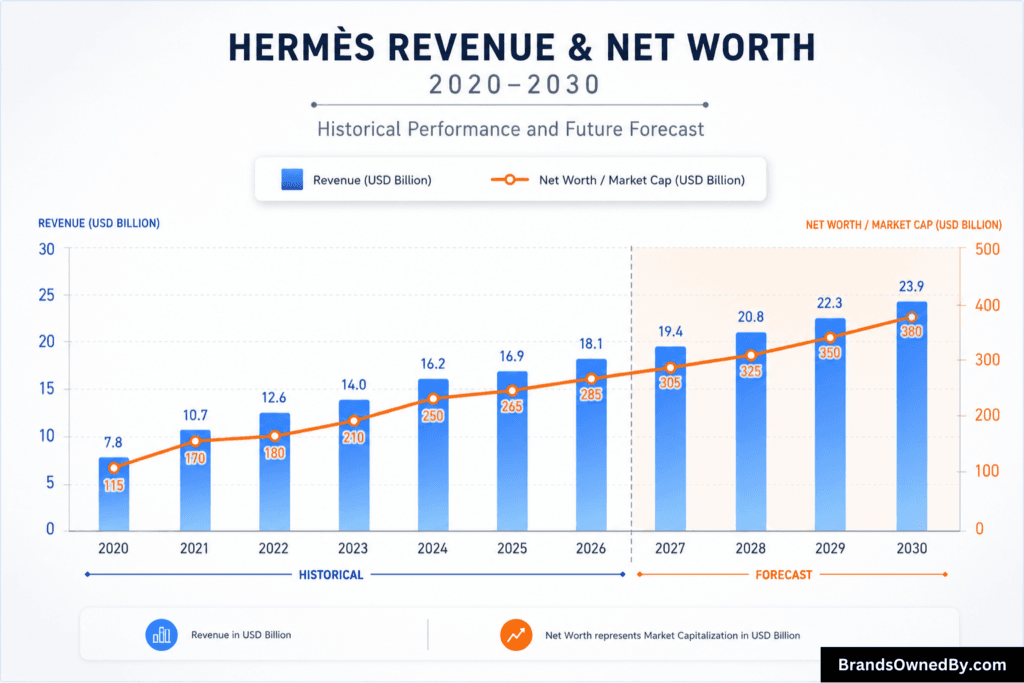
As of June 2026, Hermès is estimated to generate annual revenue of approximately $18.1 billion and has a market capitalization of approximately $285 billion. This means investors value Hermès at nearly sixteen times annual sales, a premium rarely seen among large global consumer brands.
The company’s growth has been driven by strong demand for leather goods, expansion of manufacturing capacity in France, increasing sales in Asia and North America, and continued success in categories such as jewelry, watches, beauty products, and ready-to-wear fashion.
Revenue Growth Since 2020
Hermès has more than doubled its revenue since 2020.
Revenue increased from approximately $7.8 billion in 2020 to an estimated $18.1 billion in 2026. This represents cumulative growth of more than 132% in six years.
The growth trajectory is particularly impressive because Hermès deliberately limits production. Unlike most luxury companies, management does not attempt to maximize volume. Instead, the company focuses on maintaining exclusivity while gradually increasing manufacturing capacity through new artisan workshops.
This means revenue growth comes primarily from three sources:
First, rising demand for flagship products such as the Birkin, Kelly, Constance, and Picotin bags.
Second, periodic price increases that the market has historically absorbed with little impact on demand.
Third, controlled expansion of production capacity through new leather workshops across France.
Revenue Breakdown by Business Segment
Hermès generates revenue from several luxury product categories, although leather goods remain the foundation of the business.
| Business Segment | Estimated Revenue Share | Estimated 2026 Revenue |
|---|---|---|
| Leather Goods & Saddlery | 42% | $7.6 billion |
| Ready-to-Wear & Accessories | 29% | $5.2 billion |
| Silk & Textiles | 7% | $1.3 billion |
| Perfume & Beauty | 5% | $0.9 billion |
| Watches | 4% | $0.7 billion |
| Jewelry | 4% | $0.7 billion |
| Homeware & Other Activities | 9% | $1.7 billion |
The leather goods division alone generates more revenue than many standalone luxury companies.
Products such as the Birkin and Kelly bags have become some of the most profitable luxury products in the world. Waiting lists, limited production, and strong resale values allow Hermès to maintain pricing power that few competitors can match.
Geographic Revenue Distribution
Hermès has evolved into a truly global luxury company.
Asia-Pacific remains the largest market and accounts for nearly half of company revenue. China continues to be a critical growth driver despite periodic economic slowdowns.
North America has become one of the fastest-growing regions for Hermès, supported by strong demand from affluent consumers and continued expansion of the retail network.
Europe remains a major contributor, benefiting from both local customers and luxury tourism.
| Region | Estimated Share of Revenue |
|---|---|
| Asia-Pacific (excluding Japan) | 46% |
| Japan | 10% |
| Americas | 19% |
| Europe | 22% |
| Other Regions | 3% |
This geographic diversification reduces dependence on any single market and provides resilience during regional economic downturns.
Hermès Profitability
Revenue alone does not explain Hermès’ valuation.
The company’s profitability is among the strongest in the luxury industry. Operating margins frequently exceed 40%, a level that most global consumer companies never achieve.
For every $100 generated in sales, Hermès converts an unusually large portion into operating profit. This efficiency stems from several factors:
The company owns much of its production network.
Products command premium pricing.
Demand consistently exceeds supply.
Marketing expenses are lower than many competitors because the brand’s exclusivity generates organic demand.
These characteristics create a business model with exceptional economics.
Hermès Net Worth in 2026
As of June 2026, Hermès has an estimated market capitalization of approximately $285 billion. This valuation is remarkable because Hermès operates a single luxury brand, whereas many competitors achieve similar valuations through portfolios of multiple brands.
For perspective, Hermès generates substantially less revenue than LVMH, yet its market value is approaching that of the world’s largest luxury group. Investors are effectively assigning a premium to Hermès because of its unique business model.
Luxury Industry Valuation Comparison
| Company | Estimated Market Value (2026) | Number of Major Brands |
|---|---|---|
| LVMH | $320 billion | 75+ |
| Hermès | $285 billion | 1 |
| Richemont | $110 billion | 20+ |
| Kering | $30 billion | 10+ |
| Burberry | $5 billion | 1 |
The table highlights how unusual Hermès’ valuation is. LVMH owns Louis Vuitton, Dior, Tiffany & Co., Fendi, Bulgari, Sephora, TAG Heuer, Moët & Chandon, Hennessy, and dozens of other brands. Hermès achieves nearly the same market value while relying primarily on a single luxury house.
This premium valuation reflects investor confidence in the long-term strength of the Hermès brand rather than the size of its operations.
Why Hermès is Worth So Much
Several factors explain why investors value Hermès more highly than many larger competitors.
The first is scarcity. Most luxury brands attempt to maximize sales by increasing production. Hermès deliberately limits supply. Popular products such as Birkin and Kelly bags often have waiting lists that can extend for months or years. This creates a supply-demand imbalance that supports pricing power.
The second factor is profitability. Hermès consistently generates operating margins above 40%, among the highest in the global luxury sector. Few consumer companies can match this level of profitability.
The third factor is pricing power. Hermès routinely increases prices across product categories without materially reducing customer demand. This ability to raise prices while maintaining exclusivity is a major competitive advantage.
The fourth factor is ownership stability. Because the Hermès family controls approximately 66.7% of the company, investors view the business as less vulnerable to short-term strategic shifts, activist investors, or takeover attempts.
Value of the Hermès Family’s Stake
The Hermès family’s ownership stake is one of the most valuable family-controlled holdings in the world.
| Year | Estimated Market Value | Family Ownership (66.7%) | Estimated Family Stake Value |
|---|---|---|---|
| 2024 | $250 billion | 66.7% | $167 billion |
| 2025 | $265 billion | 66.7% | $177 billion |
| 2026 | $285 billion | 66.7% | $190 billion |
| 2027 Forecast | $305 billion | 66.7% | $203 billion |
| 2030 Forecast | $380 billion | 66.7% | $253 billion |
If Hermès reaches the projected $380 billion market value by 2030, the family’s collective stake could exceed $250 billion, making it one of the wealthiest family fortunes globally.
Revenue and Net Worth Forecast (2027–2030)
Hermès’ future growth will likely be driven by controlled expansion rather than aggressive volume increases.
Unlike competitors that frequently acquire brands to boost revenue, Hermès focuses on increasing production capacity gradually through new workshops and artisan training programs. This approach allows the company to maintain exclusivity while growing sales.
Several long-term trends support continued growth.
Demand for ultra-luxury products continues to rise among high-net-worth individuals. Wealth creation in Asia, North America, and the Middle East is expanding the customer base for premium luxury goods. At the same time, Hermès continues to invest in leather goods manufacturing facilities throughout France to increase output without compromising quality.
Revenue Forecast Through 2030
| Year | Revenue Forecast | Annual Growth |
|---|---|---|
| 2026 | $18.1 billion | — |
| 2027 | $19.4 billion | 7.2% |
| 2028 | $20.8 billion | 7.2% |
| 2029 | $22.3 billion | 7.2% |
| 2030 | $23.9 billion | 7.2% |
If these projections are achieved, Hermès would add approximately $5.8 billion in annual revenue between 2026 and 2030.
Most of this growth is expected to come from leather goods, jewelry, ready-to-wear fashion, and beauty products. Leather goods will likely remain the company’s largest revenue contributor, accounting for more than $10 billion in annual sales by the end of the decade.
Market Value Forecast Through 2030
| Year | Projected Market Value | Increase from Prior Year |
|---|---|---|
| 2026 | $285 billion | — |
| 2027 | $305 billion | $20 billion |
| 2028 | $325 billion | $20 billion |
| 2029 | $350 billion | $25 billion |
| 2030 | $380 billion | $30 billion |
The projected increase in market value is larger than the increase in revenue because investors tend to reward companies with strong profitability, pricing power, and scarcity-driven business models.
Even if revenue growth moderates, Hermès could continue to command a premium valuation because of its unique competitive position.
Key Growth Drivers Through 2030
| Growth Driver | Expected Impact |
|---|---|
| New French manufacturing workshops | Higher production capacity |
| Continued demand for Birkin and Kelly bags | Strong leather goods growth |
| Expansion of jewelry collections | Higher average selling prices |
| Growth in Asia and the Middle East | Larger customer base |
| Beauty and fragrance expansion | Increased recurring revenue |
| Controlled annual price increases | Margin expansion |
Among these factors, leather goods production capacity is likely to be the most important. Demand for many Hermès products already exceeds available supply. The company’s ability to train artisans and gradually increase output will largely determine how much additional revenue it can generate through 2030.
This provides readers with actual valuation analysis, ownership implications, competitor comparisons, family wealth calculations, growth drivers, and future outlook rather than simply listing revenue figures.
Brands Owned by Hermès
As of 2026, Hermès owns a small but highly valuable portfolio of luxury brands, manufacturing businesses, creative entities, and operating divisions. Many of these acquisitions were made to strengthen the company’s expertise in leather goods, crystal, silverware, watchmaking, and luxury lifestyle products.
In addition to standalone brands, Hermès operates numerous internal business divisions responsible for some of the world’s most profitable luxury product categories.
| Company / Brand / Entity | Ownership Type | Acquired / Established | Primary Business | Strategic Importance |
|---|---|---|---|---|
| Hermès Sellier | Core Operating Division | 1837 | Leather Goods and Saddlery | Largest revenue-generating business and home of Birkin, Kelly, Constance, and other iconic products. |
| John Lobb | Wholly Owned Subsidiary | 1976 | Luxury Footwear | Strengthens Hermès’ presence in premium handcrafted shoes and bespoke shoemaking. |
| Saint-Louis | Wholly Owned Subsidiary | 1989 | Crystal and Home Décor | Expands Hermès into luxury crystal products, glassware, and chandeliers. |
| Puiforcat | Wholly Owned Subsidiary | 1993 | Luxury Silverware | Provides access to the high-end dining and luxury tableware market. |
| Hermès Parfums | Operating Division | Internal Development | Fragrances and Beauty | Manages perfumes, cosmetics, and beauty products globally. |
| Hermès Horloger | Operating Division | Internal Development | Luxury Watches | Oversees watch design, manufacturing, and distribution. |
| La Montre Hermès | Swiss Subsidiary | Controlled Since 1978 | Watch Manufacturing | Supports vertical integration and Swiss watchmaking expertise. |
| Hermès Bijouterie | Operating Division | Internal Development | Fine Jewelry | Designs and markets luxury jewelry collections. |
| Hermès Maison | Operating Division | Internal Development | Home Furnishings | Expands the brand into luxury interiors and lifestyle products. |
| Hermès Ready-to-Wear | Operating Division | Internal Development | Fashion Apparel | Manages men’s and women’s fashion collections. |
| Hermès Silk & Textiles | Operating Division | 1937 Expansion | Scarves and Textiles | Produces iconic silk scarves, shawls, and ties. |
| Cristalleries Saint-Louis | Manufacturing Entity | 1586 (Acquired 1989) | Crystal Production | One of Europe’s oldest luxury manufacturing operations. |
| Hermès Beauty | Operating Division | 2020 Expansion | Cosmetics and Makeup | Fast-growing category attracting new luxury consumers. |
| Hermès Equestrian Division | Operating Division | 1837 | Saddlery and Equestrian Products | Preserves the company’s original heritage business. |
| Hermès Digital Commerce Operations | Operating Entity | Internal Development | E-Commerce | Supports global direct-to-consumer sales. |
| Hermès Retail Network | Global Subsidiaries | Internal Development | Luxury Retail | Operates more than 300 Hermès stores worldwide. |
John Lobb
John Lobb is one of the most prestigious shoemaking companies in the world and is among Hermès’ most successful acquisitions.
Founded in London in 1866, John Lobb specializes in handcrafted luxury footwear and bespoke shoe services. The company became part of Hermès in 1976.
John Lobb is known for producing handmade shoes using traditional shoemaking techniques. Many products require dozens of hours of skilled craftsmanship and are targeted at high-net-worth customers.
The brand operates independently from Hermès but benefits from the parent company’s financial resources and luxury expertise. John Lobb boutiques can be found in major luxury markets including Paris, London, New York, Tokyo, and Hong Kong.
Today, John Lobb remains one of the world’s most respected luxury footwear brands and serves as Hermès’ flagship presence in the premium footwear segment.
Saint-Louis
Saint-Louis is one of the oldest crystal manufacturers in Europe and one of Hermès’ most valuable heritage acquisitions.
The company traces its origins to 1586 and specializes in luxury crystal products including glassware, chandeliers, decorative objects, lighting solutions, and tableware.
Hermès acquired Saint-Louis in 1989 as part of its strategy to expand into luxury home furnishings and decorative arts.
Saint-Louis products are renowned for their handcrafted production methods. Many pieces require extensive cutting, engraving, and polishing processes performed by skilled artisans.
The acquisition allows Hermès to participate in the growing luxury home décor market while maintaining its focus on craftsmanship and exclusivity.
Puiforcat
Puiforcat is a French luxury silverware manufacturer owned by Hermès.
Founded in 1820, the company specializes in premium silver flatware, tableware, decorative objects, and custom-made luxury pieces.
Hermès acquired Puiforcat in 1993 to strengthen its presence in luxury dining and lifestyle products.
Puiforcat is particularly known for combining traditional silversmithing techniques with contemporary design. Many of its products are used in luxury hotels, fine dining establishments, and private collections worldwide.
The acquisition supports Hermès’ broader strategy of serving affluent consumers across multiple aspects of luxury living rather than focusing solely on fashion products.
Hermès Sellier
Hermès Sellier is the historical core business of Hermès and remains the company’s most important operating division.
The division traces its origins directly to founder Thierry Hermès’ saddlery workshop established in 1837.
Today, Hermès Sellier is responsible for the company’s leather goods, saddlery products, travel goods, and iconic handbags.
Products produced under this division include:
- Birkin.
- Kelly.
- Constance.
- Picotin.
- Lindy.
- Evelyne.
- Garden Party.
- Bolide.
Leather goods generate the largest share of Hermès revenue and remain the foundation of the company’s profitability.
Hermès Sellier is therefore not merely a product division but the economic engine of the entire company.
Hermès Parfums
Hermès Parfums manages the company’s fragrance and beauty business.
The division develops, manufactures, markets, and distributes luxury perfumes, cosmetics, and beauty products worldwide.
Notable fragrance collections include:
- Terre d’Hermès.
- Twilly d’Hermès.
- H24.
- Jour d’Hermès.
- Eau des Merveilles.
- Un Jardin Series.
Over the past decade, beauty products have become an increasingly important growth area for Hermès.
The division has expanded into luxury lipsticks, skincare-related products, nail colors, and cosmetics while maintaining the premium image associated with the brand.
Hermès Horloger
Hermès Horloger is the company’s watchmaking division.
The business develops luxury watches that combine Swiss manufacturing expertise with Hermès design aesthetics.
The division produces collections such as:
- Arceau.
- Cape Cod.
- H08.
- Heure H.
- Slim d’Hermès.
- Cut Collection.
To strengthen its watchmaking capabilities, Hermès has invested heavily in Swiss watch production facilities and specialized manufacturing operations.
The watch division represents one of the company’s most important diversification efforts outside leather goods.
Hermès Bijouterie
Hermès Bijouterie manages the company’s jewelry operations.
The division designs and manufactures fine jewelry collections using gold, diamonds, gemstones, platinum, and other precious materials.
Important collections include:
- Chaîne d’Ancre.
- Kelly Jewelry.
- Farandole.
- Galop d’Hermès.
- Ever Chaine.
- Kelly Gavroche.
The jewelry business has become a significant growth driver because it allows Hermès to increase average transaction values while expanding its presence in high-margin luxury categories.
Hermès Maison
Hermès Maison represents the company’s luxury home and interior design division.
The division creates products including:
- Furniture.
- Home textiles.
- Decorative accessories.
- Tableware.
- Lighting.
- Wallpapers.
- Interior furnishings.
Hermès Maison extends the brand beyond fashion and accessories into luxury living environments.
Many products incorporate the same craftsmanship standards used throughout the company’s fashion and leather goods businesses.
Hermès Silk and Textiles
Silk products have been central to Hermès since the company introduced its first silk scarf in 1937.
Today, the silk and textile division remains one of the company’s most recognizable businesses.
The division produces:
- Silk scarves.
- Shawls.
- Ties.
- Pocket squares.
- Textile accessories.
- Cashmere products.
Hermès scarves have become iconic luxury products and are sold in markets worldwide.
Many designs become collectible pieces and contribute significantly to the brand’s heritage and cultural influence.
Hermès Ready-to-Wear
The Ready-to-Wear division manages men’s and women’s fashion collections.
This business includes:
- Women’s apparel.
- Men’s apparel.
- Outerwear.
- Knitwear.
- Footwear.
- Seasonal collections.
Although fashion generates less revenue than leather goods, it plays an important role in reinforcing Hermès’ luxury positioning and attracting new customers.
The division regularly showcases collections during Paris Fashion Week and other major industry events.
La Montre Hermès
La Montre Hermès is the Swiss watchmaking subsidiary responsible for the production and development of Hermès watches.
The company operates from Switzerland and manages much of the technical development behind Hermès’ luxury timepieces.
Ownership of La Montre Hermès gives the company greater control over watch design, production quality, and innovation.
This vertical integration supports Hermès’ long-term ambitions in the luxury watch market.
Cristalleries Saint-Louis
Although commonly referred to simply as Saint-Louis, the legal operating entity remains Cristalleries Saint-Louis.
The business continues to manufacture crystal products in France and serves both private customers and luxury hospitality clients.
The company represents one of the oldest continuously operating luxury manufacturing businesses owned by Hermès.
Its heritage strengthens Hermès’ position in the luxury home segment.
Acquisitions Made by Hermès
Hermès has historically been conservative regarding acquisitions.
Unlike LVMH, which has acquired dozens of luxury companies, Hermès has completed only a small number of major acquisitions.
| Acquisition | Acquisition Year | Industry |
|---|---|---|
| John Lobb | 1976 | Luxury Footwear |
| Saint-Louis | 1989 | Crystal and Home Décor |
| Puiforcat | 1993 | Luxury Silverware |
| La Montre Hermès Expansion Investments | Various Years | Luxury Watchmaking |
The company generally prefers organic growth rather than acquisition-driven expansion.
Final Thoughts
When examining who owns Hermès, one theme stands out: continuity. The company remains closely connected to the descendants of its founder, allowing it to preserve its heritage while operating as a global luxury leader. This rare combination of family control and public ownership continues to distinguish Hermès from many of its competitors.
The company’s ownership structure has supported a long-term approach to growth, product development, and brand management. Rather than pursuing rapid expansion, Hermès has focused on maintaining quality, craftsmanship, and exclusivity. These principles continue to shape the company’s identity and strengthen its position within the luxury industry.
FAQs
Who owns the Hermès brand?
The Hermès brand is owned by Hermès International S.A., the French luxury goods company founded in 1837 by Thierry Hermès. While the company is publicly traded, the Hermès family remains the controlling shareholder through H51 and other family-owned entities. As of 2026, descendants of founder Thierry Hermès collectively control approximately two-thirds of the company’s share capital and voting rights, giving them effective control over the brand and its long-term direction.
What is the net worth of the Hermès owner?
Hermès does not have a single owner. Instead, it is controlled by the extended Hermès family. Based on Hermès’ estimated market capitalization of approximately $285 billion as of 2026 and the family’s ownership stake of about 66.7%, the collective value of the Hermès family’s holdings is estimated at around $190 billion. This makes the Hermès family one of the wealthiest business dynasties in Europe and among the richest family-controlled ownership groups in the world.
Does LVMH own Hermès?
No, LVMH does not own Hermès. In 2010, LVMH disclosed that it had accumulated a significant stake in Hermès, eventually exceeding 23% ownership. This led to concerns that LVMH might attempt to acquire the company. However, the Hermès family strengthened its ownership position through the H51 holding structure, and LVMH later reduced its stake. As of 2026, Hermès remains independent and controlled by the Hermès family rather than LVMH.
What brands does Hermès own?
Hermès owns a small portfolio of luxury brands and subsidiaries that complement its core business. The most notable brands owned by Hermès include John Lobb, a luxury shoemaker; Saint-Louis, a renowned crystal manufacturer; and Puiforcat, a prestigious French silverware company. In addition, Hermès operates several internal divisions such as Hermès Parfums, Hermès Horloger, Hermès Maison, Hermès Bijouterie, and Hermès Sellier, which manage the company’s fragrance, watchmaking, home décor, jewelry, and leather goods businesses.
Is Hermès a publicly traded company?
Yes, Hermès is a publicly traded company. Hermès International is listed on Euronext Paris and its shares are available for purchase by public investors. However, despite being publicly traded, the company remains under the effective control of the Hermès family through its majority ownership stake and voting rights. This allows Hermès to combine access to public capital markets with long-term family leadership.
Who is the CEO of Hermès?
As of 2026, Axel Dumas is the Executive Chairman and principal executive leader of Hermès. He is a sixth-generation descendant of founder Thierry Hermès and has led the company since 2013. Under his leadership, Hermès has expanded its manufacturing capacity, strengthened its global presence, and maintained its focus on craftsmanship, exclusivity, and long-term growth while preserving the company’s family-controlled structure.
Why is Hermès called the giant killer?
Hermès is often referred to as the “giant killer” because it has successfully competed against much larger luxury conglomerates despite operating primarily as a single-brand company. While rivals such as LVMH, Kering, and Richemont own dozens of luxury brands, Hermès has achieved a market value that rivals or exceeds many of these groups through the strength of its own brand. The nickname also reflects Hermès’ successful defense against LVMH’s attempt to build a significant ownership stake in the company. By maintaining its independence and continuing to outperform many larger competitors, Hermès earned a reputation for defeating industry giants while remaining true to its heritage and business model.