
- GMC is wholly owned by General Motors (GM) and is not an independent company. Anyone who owns General Motors stock indirectly owns a stake in GMC.
- The largest shareholders of General Motors as of 2026 are major institutional investors, including Vanguard Group, BlackRock, and State Street Corporation. These firms collectively own significant portions of GM on behalf of millions of investors.
- GMC has remained under General Motors ownership for more than 100 years, making it one of the most stable automotive brands in the industry. The brand originated from the merger of Rapid Motor Vehicle Company and Reliance Motor Car Company under GM’s control.
- GMC operates as GM’s premium truck and SUV division, overseeing brands and vehicle lines such as Sierra, Yukon, Acadia, Terrain, Canyon, Hummer EV, Denali, and AT4, while strategic control remains with General Motors’ board of directors and executive leadership led by CEO Mary Barra.
GMC is an American automotive brand specializing in pickup trucks, SUVs, commercial vehicles, and electric utility vehicles. The brand operates as a division of General Motors and is headquartered in Detroit, Michigan.
The company traces its roots back to the early commercial vehicle industry. Today, GMC is known for its “Professional Grade” positioning, which focuses on premium design, advanced technology, towing capability, and off-road performance. GMC occupies a higher market position than Chevrolet while remaining below Cadillac in General Motors’ brand hierarchy.
As of June 2026, GMC’s lineup includes the Sierra, Canyon, Terrain, Acadia, Yukon, Yukon XL, Sierra EV, Hummer EV Pickup, and Hummer EV SUV. The brand continues to focus heavily on trucks and SUVs rather than passenger cars. This strategy has helped GMC build a distinct identity within the highly competitive North American automotive market.
One of GMC’s biggest strengths is its premium sub-brands. The Denali trim has become one of the most successful luxury vehicle packages in the industry. Meanwhile, the AT4 lineup targets buyers looking for enhanced off-road capability. These product families have allowed GMC to attract customers who want both utility and upscale features.
GMC vehicles are primarily sold in the United States, Canada, Mexico, the Middle East, South Korea, Australia, New Zealand, and selected international markets. In recent years, General Motors has expanded GMC’s international presence as demand for premium trucks and SUVs continues to grow.
GMC Founders
Unlike many automotive brands that can be traced to a single founder, GMC was created through the efforts of several entrepreneurs and business leaders who helped shape America’s early truck industry. The brand’s origins date back to the beginning of the twentieth century, when commercial vehicles were replacing horse-drawn transportation across the United States.
The foundation of GMC began with the Grabowsky brothers, whose truck manufacturing business became one of the earliest successful commercial vehicle companies in America. Later, automotive pioneer William C. Durant acquired and consolidated several truck manufacturers under General Motors, leading to the creation of the GMC brand. Because of this unique history, Max Grabowsky, Morris Grabowsky, and William C. Durant are widely considered the key figures behind GMC’s founding and development.
Max Grabowsky
Max Grabowsky was one of the original pioneers behind GMC’s history. In 1900, he co-founded the Grabowsky Motor Company in Detroit, Michigan, with his brother Morris. At a time when automobiles were still a new technology, Max focused on designing durable trucks for commercial use.
His vision centered on creating vehicles capable of carrying heavy loads more efficiently than horse-drawn wagons. This approach helped the company gain attention from businesses that needed reliable transportation solutions.
The company’s early success led to its reorganization as the Rapid Motor Vehicle Company. Rapid quickly became known for producing dependable commercial trucks and established itself as one of America’s leading truck manufacturers. Many historians consider Max Grabowsky one of the earliest innovators in the U.S. trucking industry, making his contributions essential to GMC’s eventual creation.
Morris Grabowsky
Morris Grabowsky worked closely with his brother Max during the company’s formative years. While Max focused heavily on engineering and product development, Morris played an important role in expanding the business and supporting manufacturing operations.
Together, the brothers built a company that helped demonstrate the commercial potential of motorized trucks. Their vehicles were adopted by businesses seeking faster and more efficient transportation methods.
The Grabowsky brothers’ work laid the groundwork for modern commercial trucking. Without their early innovations and business success, Rapid Motor Vehicle Company likely would not have become an attractive acquisition target for General Motors.
William C. Durant
William C. Durant played the most important role in transforming the Grabowsky brothers’ truck business into the GMC brand known today. Durant founded General Motors in 1908 and pursued an aggressive strategy of acquiring promising automotive companies.
Recognizing the growing importance of commercial vehicles, Durant acquired Rapid Motor Vehicle Company and Reliance Motor Car Company, another truck manufacturer. Rather than operating these businesses separately, he merged their operations to create a unified truck division within General Motors.
In 1911, the General Motors Truck Company was officially established. The following year, the GMC name began appearing on vehicles, marking the beginning of the modern brand.
Durant’s consolidation strategy provided GMC with access to greater manufacturing resources, nationwide distribution, and financial backing. These advantages helped GMC grow from a regional truck manufacturer into one of the most recognized commercial vehicle brands in North America.
The Founding of GMC
The creation of GMC was not the result of a single event. Instead, it occurred through a series of strategic developments that brought together entrepreneurial innovation and corporate expansion.
The Grabowsky brothers built one of America’s earliest successful truck manufacturers through Rapid Motor Vehicle Company. William C. Durant then incorporated that business into General Motors and combined it with other truck operations. This merger ultimately led to the formation of the General Motors Truck Company and the GMC brand.
This combination of engineering innovation, business leadership, and corporate consolidation helped establish GMC as one of the oldest continuously operating truck brands in the automotive industry. More than a century later, the brand continues to build on the foundation created by Max Grabowsky, Morris Grabowsky, and William C. Durant.
Ownership History
GMC’s ownership history is unusual compared to many modern automotive brands. While competitors such as Jeep, Jaguar, Land Rover, Volvo, and Chrysler have changed owners multiple times, GMC has spent virtually its entire existence under the control of General Motors.
The brand’s roots predate General Motors itself. However, once it became part of GM in the early twentieth century, it remained integrated into the company’s long-term strategy through economic booms, recessions, world wars, industry consolidations, and even General Motors’ historic bankruptcy restructuring.
This uninterrupted ownership has helped GMC build one of the most stable brand identities in the automotive industry.
GMC Ownership History
Before GMC: The Rapid Motor Vehicle Company Era
The story begins in 1900 when Max and Morris Grabowsky founded the Grabowsky Motor Company in Detroit.
At the time, the automobile market was fragmented. Hundreds of small manufacturers were experimenting with different vehicle designs. The Grabowsky brothers focused specifically on commercial transportation rather than passenger automobiles.
Their trucks gained attention because businesses needed more efficient alternatives to horse-drawn wagons. As demand increased, the company evolved into the Rapid Motor Vehicle Company.
Rapid quickly became one of America’s leading truck manufacturers. Its products earned a reputation for reliability at a time when many early vehicles were mechanically unreliable.
This growing success attracted the attention of William C. Durant, who was building General Motors into a national automotive powerhouse.
General Motors Acquires Rapid (1908)
In 1908, William C. Durant founded General Motors with a vision of creating a holding company that would own multiple automotive brands serving different market segments.
Unlike Henry Ford, who focused on a single brand, Durant believed in building a portfolio of specialized vehicle manufacturers.
Shortly after forming General Motors, Durant acquired Rapid Motor Vehicle Company. The acquisition gave GM immediate access to the growing commercial truck market.
The purchase was strategically important because trucks were becoming increasingly essential to businesses, farms, municipalities, and industrial operations across the United States.
Rather than developing a truck division from scratch, General Motors acquired an established manufacturer with proven products and an existing customer base.
The Reliance Acquisition and Industry Consolidation
General Motors did not stop with Rapid.
Durant also acquired Reliance Motor Car Company, another respected truck manufacturer operating during the same period.
Reliance had developed expertise in larger commercial vehicles and possessed valuable engineering knowledge.
Owning both Rapid and Reliance created overlap within GM’s truck operations. Rather than allowing the companies to compete against one another, General Motors chose to consolidate them.
This reflected Durant’s broader strategy of integrating acquired businesses into a coordinated corporate structure.
The decision would ultimately lead to the creation of the GMC brand.
Creation of General Motors Truck Company
In 1911, General Motors merged Rapid Motor Vehicle Company and Reliance Motor Car Company to form the General Motors Truck Company.
This represented more than a simple name change.
The merger unified engineering teams, manufacturing facilities, distribution networks, dealer relationships, and product development efforts under a single organization.
For General Motors, the move created a dedicated commercial vehicle division capable of competing with Ford and other emerging truck manufacturers.
For customers, it created a stronger and more recognizable truck brand backed by the resources of one of America’s fastest-growing automotive companies.
This merger is widely regarded as the moment GMC was officially born.
GMC Becomes a Core GM Brand
In 1912, General Motors began using the GMC name on its trucks.
During the following decades, GMC evolved from a commercial truck manufacturer into one of GM’s most important vehicle divisions.
The brand supplied military vehicles during both World Wars and became a major producer of buses, work trucks, heavy-duty vehicles, and consumer pickups.
Unlike some GM brands that targeted specific market niches, GMC developed a reputation for durability and capability across multiple vehicle categories.
As General Motors expanded globally, GMC remained an integral part of its North American operations.
Ownership remained unchanged throughout this period, with General Motors maintaining complete control over the brand.
The Rise of GMC’s Premium Positioning
For much of its history, GMC and Chevrolet trucks were closely related products.
However, beginning in the late twentieth century, General Motors increasingly differentiated GMC from Chevrolet.
Rather than competing solely on utility and work capability, GMC was repositioned as a more premium truck and SUV brand.
The introduction of the Denali trim in 1999 became a turning point.
Denali transformed GMC from a traditional truck manufacturer into a premium utility brand. Customers were willing to pay significantly higher prices for luxury features, advanced technology, and upscale interiors.
This strategy proved highly successful.
Over time, GMC became one of General Motors’ most profitable divisions, generating strong margins on trucks and SUVs while strengthening GM’s position against Ford, Toyota, and luxury competitors.
Surviving the General Motors Bankruptcy
One of the biggest tests in GMC’s ownership history came during the 2008 financial crisis.
General Motors faced severe financial challenges and entered Chapter 11 bankruptcy protection in 2009.
During the restructuring process, GM was forced to evaluate its entire brand portfolio.
Several historic brands disappeared.
Pontiac was discontinued.
Saturn was shut down.
Saab was sold.
Hummer was divested.
Many industry observers expected GMC to be merged into Chevrolet because the two brands shared numerous vehicle platforms.
Instead, General Motors chose to retain GMC.
The reason was simple. GMC had developed a loyal customer base, strong dealer network, and attractive profit margins. The brand consistently delivered results that justified its continued existence.
The decision ultimately proved correct, as GMC became one of GM’s strongest-performing divisions in the years following the restructuring.
GMC’s Role in General Motors’ EV Strategy
The next major evolution in ownership occurred through strategic investment rather than a change in control.
As General Motors shifted toward electrification, GMC became one of the company’s flagship EV brands.
In 2020, GM revived the Hummer name under GMC rather than creating a separate standalone brand.
This decision highlighted GMC’s growing importance within the corporation.
The Hummer EV served as a technology showcase for GM’s Ultium battery platform and advanced electric vehicle architecture.
Subsequent launches such as the Sierra EV further strengthened GMC’s position within GM’s future product strategy.
By placing some of its most advanced electric vehicles under GMC, General Motors demonstrated confidence in the brand’s long-term value and market appeal.
Ownership Structure Today
As of June 2026, GMC remains a wholly owned division of General Motors Company.
The brand has no separate stock listing, independent shareholders, or standalone corporate ownership structure.
Instead, GMC operates under the broader General Motors organization alongside Chevrolet, Cadillac, Buick, BrightDrop, GM Energy, and other business units.
This means every GMC vehicle sold ultimately contributes to General Motors’ overall performance.
More importantly, it means that GMC’s future remains closely tied to General Motors’ strategic priorities, including electrification, software-defined vehicles, autonomous technologies, and global expansion.
More than a century after General Motors acquired Rapid Motor Vehicle Company, GMC remains one of the clearest examples of a successful long-term automotive ownership strategy. Unlike many competitors that have passed through multiple owners, GMC has remained under the same corporate parent since its earliest days, giving the brand remarkable continuity and stability.
Who Owns GMC?
![Who Owns GMC [infographic]](https://brandsownedby.com/wp-content/uploads/2026/06/Who-Owns-GMC-infographic-1024x683.png)
GMC is wholly owned by General Motors Company (GM), one of the largest automobile manufacturers in the world. Unlike some automotive brands that operate as independent companies with their own shareholders and stock listings, GMC functions as a vehicle division within General Motors.
As of 2026, GMC does not have separate ownership, independent investors, or publicly traded shares. Instead, ownership of GMC is tied directly to the ownership of General Motors. Anyone who owns shares of GM indirectly owns a portion of the GMC brand.
Today, GMC is one of General Motors’ most strategically important divisions, serving as the company’s premium truck and SUV brand.
GMC Ownership Structure
The ownership structure of GMC is relatively straightforward.
At the top sits General Motors Company, the publicly traded parent corporation. GMC operates as one of several automotive brands owned and managed by General Motors.
The ownership hierarchy can be summarized as follows:
General Motors Company (NYSE: GM)
↓
GMC
↓
Sierra, Yukon, Acadia, Terrain, Canyon, Hummer EV, Sierra EV and other GMC vehicles
Because GMC is fully integrated into General Motors’ operations, major decisions involving product development, manufacturing, investments, electrification, technology, and international expansion are ultimately approved by GM leadership.
Parent Company: General Motors
General Motors serves as GMC’s parent company and has controlled the brand for more than a century.
Founded in 1908 by William C. Durant, General Motors was created as a holding company designed to acquire and manage multiple automotive businesses. Over time, GM acquired numerous vehicle manufacturers and transformed into one of the largest automotive groups in the world.
Today, General Motors owns several major automotive and mobility businesses, including:
Each brand serves a different customer segment. GMC’s role within the portfolio is to target buyers seeking premium trucks, SUVs, and utility vehicles.
This positioning allows General Motors to compete across multiple market segments without relying on a single brand.
How General Motors Acquired GMC
Unlike many modern acquisitions involving billions of dollars and complex transactions, GMC emerged through a series of strategic acquisitions made during the early years of the automobile industry.
The origins of GMC can be traced to the Rapid Motor Vehicle Company, which was founded by Max and Morris Grabowsky.
In 1908, shortly after creating General Motors, William C. Durant acquired Rapid Motor Vehicle Company as part of his broader strategy to build a diversified automotive empire.
General Motors later acquired Reliance Motor Car Company, another truck manufacturer operating during the same period.
Rather than managing both companies separately, General Motors merged their truck operations in 1911 to create the General Motors Truck Company.
In 1912, the GMC brand officially emerged from this consolidation.
The acquisition was significant because it gave General Motors an immediate foothold in the rapidly growing commercial vehicle industry. It also provided GM with established truck engineering expertise and an existing customer base.
More than a century later, GMC remains under the same corporate ownership established through those early acquisitions.
Why General Motors Kept GMC
Throughout its history, General Motors has owned numerous automotive brands. Some were sold, while others were discontinued during restructuring efforts.
Brands such as Pontiac, Saturn, Oldsmobile, Hummer, and Saab either disappeared or changed ownership over time.
GMC survived because it consistently occupied a valuable position within General Motors’ portfolio.
Several factors contributed to its long-term survival:
- Strong reputation in trucks and utility vehicles.
- Loyal customer base.
- Premium pricing power.
- Successful Denali luxury lineup.
- High-profit truck and SUV sales.
- Strong dealer network throughout North America.
These advantages helped GMC remain one of GM’s most important vehicle divisions even during challenging periods such as the 2009 bankruptcy restructuring.
Who Are the Ultimate Owners of GMC?
Since General Motors is a publicly traded company, GMC is ultimately owned by GM shareholders.
Ownership is distributed among institutional investors, mutual funds, pension funds, exchange-traded funds, and individual retail investors.
The largest shareholders are typically major investment management firms that hold GM stock on behalf of millions of investors worldwide.
These shareholders do not directly manage GMC’s daily operations. Instead, they elect the General Motors Board of Directors, which oversees corporate governance and long-term strategy.
This structure means that ownership and operational control are separated.
Shareholders provide capital and elect directors, while GM executives manage the business.
GMC’s Strategic Importance Within General Motors
GMC occupies a unique position within the General Motors portfolio.
Chevrolet focuses on mainstream consumers.
Cadillac targets luxury buyers.
Buick serves the premium crossover market.
GMC bridges the gap between mainstream and luxury vehicles by offering upscale trucks and SUVs.
This strategy has become increasingly important as consumer demand has shifted toward higher-margin utility vehicles.
Vehicles such as the Sierra Denali, Yukon Denali, AT4 lineup, Sierra EV, and Hummer EV help General Motors compete in premium and luxury utility segments where customers are willing to pay significantly higher prices for advanced technology, performance, and comfort.
As a result, GMC has evolved from a traditional truck manufacturer into one of General Motors’ most valuable automotive brands.
Does GMC Have Separate Shareholders?
No. GMC does not have separate shareholders because it is not an independent corporation.
The brand operates entirely under General Motors.
This means:
- GMC stock does not exist.
- GMC is not publicly traded.
- GMC does not issue separate financial reports.
- GMC does not have its own board of directors.
- GMC ownership is entirely tied to General Motors.
Investors seeking exposure to GMC must purchase shares of General Motors rather than a standalone GMC stock.
Competitor Ownership Comparison
GMC operates under General Motors, one of the world’s largest automotive groups. However, its major competitors are backed by very different ownership structures. Some are divisions of multinational automotive conglomerates, while others are brands owned directly by publicly traded manufacturers.
Understanding these ownership structures helps explain how competitors fund research and development, expand globally, invest in electric vehicles, and compete in the highly profitable truck and SUV segments.
As of June 2026, GMC remains one of the few major truck brands that has stayed under the same corporate owner for more than a century.
GMC vs Competitor Ownership (2026)
GMC vs Ford
Ford represents GMC’s oldest and most significant competitor in North America.
Unlike GMC, Ford is not merely a vehicle brand. It is the primary brand of the Ford Motor Company itself. This means Ford trucks, SUVs, commercial vehicles, and electric vehicles operate under the same corporate identity as their parent company.
One of the most unique aspects of Ford’s ownership structure is the Ford family’s continued influence. Through special Class B shares, descendants of founder Henry Ford maintain disproportionate voting power relative to their economic ownership. This gives the Ford family significant control over corporate governance despite Ford being a publicly traded company.
GMC follows a different model. The brand is fully owned and managed by General Motors and has no separate corporate governance structure. Strategic decisions involving GMC ultimately flow through GM’s board of directors and executive leadership team.
GMC vs Ram
Ram is one of GMC’s closest competitors in the pickup truck market.
Unlike GMC, which is owned by General Motors, Ram operates under Stellantis, a multinational automotive group formed through the merger of Fiat Chrysler Automobiles and France’s PSA Group in 2021.
Stellantis owns a large portfolio of vehicle brands including Jeep, Ram, Dodge, Chrysler, Fiat, Peugeot, Citroën, Opel, Maserati, Alfa Romeo, and several others.
This ownership structure gives Ram access to a vast global manufacturing network and significant financial resources. However, Ram must compete internally for investment and resources against numerous sister brands.
GMC faces a different environment within General Motors, where the company manages a smaller and more focused brand portfolio.
GMC vs Toyota
Toyota presents one of the strongest challenges to GMC in both trucks and SUVs.
Unlike GMC, Toyota is not owned by a larger automotive parent company. Instead, Toyota Motor Corporation serves as both the manufacturer and the primary operating brand.
Toyota’s ownership structure is also distinct because of its historical ties to the Toyota Group, a network of affiliated companies connected through cross-shareholdings and long-standing business relationships.
This structure gives Toyota considerable independence and long-term strategic flexibility. Decisions affecting the Toyota brand are generally made within Toyota Motor Corporation itself rather than through a separate parent organization.
GMC, by contrast, functions as one component of General Motors’ broader corporate strategy.
GMC vs Jeep
Jeep competes with GMC primarily in the SUV and off-road vehicle segments.
The ownership histories of the two brands differ dramatically.
GMC has remained under General Motors ownership since the early twentieth century. Jeep, however, has passed through multiple owners during its history.
The brand has been controlled by Willys-Overland, Kaiser Motors, American Motors Corporation, Chrysler Corporation, DaimlerChrysler, Cerberus-backed Chrysler LLC, Fiat Chrysler Automobiles, and now Stellantis.
This makes Jeep one of the most transferred major automotive brands in the industry.
Despite these ownership changes, Jeep has maintained a strong global identity. GMC, meanwhile, has benefited from over a century of ownership continuity under General Motors.
GMC vs Tesla
Tesla represents a very different type of competitor.
Unlike GMC, Tesla does not operate as a division within a larger automotive group. Tesla vehicles are developed, manufactured, and sold directly under Tesla, Inc.
The company remains heavily influenced by Elon Musk, who continues to be one of its largest individual shareholders and most influential decision-makers.
Tesla’s ownership structure allows for rapid decision-making and aggressive investment strategies. GMC, on the other hand, benefits from the stability, manufacturing scale, and financial resources of General Motors.
The contrast highlights two very different approaches to competing in the electric vehicle market.
GMC vs Rivian
Rivian has emerged as another notable competitor in the premium electric truck segment.
Like Tesla, Rivian operates as an independent public company rather than as a brand within a larger automotive group.
Its shareholder base includes major institutional investors, investment funds, and strategic partners. Unlike GMC, Rivian’s future depends entirely on the success of a single corporate entity.
GMC benefits from General Motors’ diversified operations, global manufacturing footprint, dealer network, and extensive research capabilities.
This gives GMC access to resources that many younger EV manufacturers are still working to build.
GMC vs Chevrolet
One of the most interesting ownership comparisons involves Chevrolet.
Unlike Ford, Ram, Toyota, or Jeep, Chevrolet is not actually a competitor from an ownership perspective because both Chevrolet and GMC are owned by General Motors.
General Motors intentionally positions the two brands differently to target different customer groups.
Chevrolet serves the mainstream market, while GMC targets buyers seeking more premium trucks and SUVs.
This dual-brand strategy allows General Motors to compete against multiple rivals without forcing customers to leave the GM ecosystem.
For example, a customer considering a premium truck may choose a GMC Sierra Denali, while a more value-oriented buyer may select a Chevrolet Silverado.
Both sales ultimately benefit General Motors.
Ownership Stability: GMC’s Biggest Advantage
When comparing ownership structures across the automotive industry, GMC stands out for its exceptional stability.
Many well-known automotive brands have experienced mergers, buyouts, restructurings, bankruptcy proceedings, private-equity ownership, or international acquisitions during their histories.
GMC has largely avoided these disruptions.
Since General Motors acquired the businesses that eventually became GMC in the early 1900s, the brand has remained under the same corporate umbrella. Even during General Motors’ historic bankruptcy restructuring in 2009, GMC survived while brands such as Pontiac, Saturn, Saab, and Hummer either disappeared or left the company.
This continuity has allowed GMC to maintain a consistent market position, strong dealer relationships, and a clear long-term strategy.
What the Ownership Comparison Reveals
The comparison highlights that GMC is not simply competing against other vehicle brands. It is competing against some of the largest and most influential automotive organizations in the world.
Ford is supported by Ford Motor Company and influenced by the Ford family. Ram and Jeep are backed by Stellantis. Toyota operates under Toyota Motor Corporation. Tesla and Rivian function as independent public companies focused heavily on electric vehicles.
GMC’s advantage comes from its position within General Motors. The brand benefits from GM’s financial resources, engineering expertise, manufacturing scale, software development capabilities, battery technology investments, and global supply chain.
As of June 2026, GMC remains one of the strongest examples of a century-old automotive brand that has retained stable ownership while continuing to adapt to major industry shifts, including electrification, connected vehicles, and advanced driver-assistance technologies.
Who Controls GMC?
Although GMC is owned by General Motors, control of the brand is distributed across a multi-layered leadership structure rather than a single executive.
At the highest level, GMC is controlled by General Motors’ Board of Directors and executive leadership team. These leaders determine the company’s long-term strategy, capital investments, manufacturing footprint, electrification roadmap, software development priorities, and brand portfolio management.
At the operational level, GMC’s products, marketing, sales, and customer experience are managed by executives specifically responsible for the Buick and GMC brands.
As of June 2026, ultimate authority over GMC rests within General Motors’ leadership hierarchy, headed by Chair and CEO Mary Barra.
Who Controls GMC?
Mary Barra: The Executive With Ultimate Authority
Mary Barra is the Chair and Chief Executive Officer of General Motors.
Since becoming CEO in 2014, she has overseen one of the most significant transformations in the company’s history, including the shift toward electric vehicles, software-defined vehicles, autonomous technologies, and connected mobility services. She also serves as Chair of the Board, giving her substantial influence over both strategic and operational decisions.
Every major decision affecting GMC ultimately falls under the authority of the leadership team led by Barra.
Examples include:
- Approval of new GMC vehicle programs.
- Investment in Sierra EV and Hummer EV platforms.
- Manufacturing expansion plans.
- Product portfolio strategy.
- Capital allocation for future technologies.
- Global market expansion initiatives.
While Barra is not involved in daily GMC operations, no major long-term strategic initiative involving the brand moves forward without approval from General Motors’ senior leadership.
Rory Harvey and Global Markets Leadership
Directly below the CEO level, GMC operates within General Motors’ Global Markets organization.
As of 2026, Rory Harvey serves as Executive Vice President and President of Global Markets. His organization oversees the commercial performance of GM’s vehicle brands across numerous international regions and plays a key role in determining sales, market expansion, and growth strategies.
Because GMC is one of GM’s most important truck and SUV brands, many decisions involving market positioning, international growth, and business performance pass through the Global Markets leadership structure.
This places GMC within a much broader corporate framework than many consumers realize.
Duncan Aldred’s Role in Controlling GMC
One of the most influential executives connected to GMC is Duncan Aldred.
As of June 2026, Aldred serves as Senior Vice President and President of GM North America, overseeing sales, service, and marketing activities across the United States, Canada, and Mexico. His responsibilities include supervision of GMC, Chevrolet, Cadillac, Buick, OnStar, GM Energy, ACDelco, and other GM businesses.
Aldred is particularly important to GMC because of his long history with the brand.
Prior to his promotion into GM’s senior leadership team, he spent years leading Buick and GMC operations. During that period, he helped oversee the growth of the Denali lineup, the expansion of GMC’s premium positioning, and the launch of several major truck and SUV programs.
In practical terms, Aldred is one of the executives with the greatest influence over GMC’s commercial performance and brand strategy in North America.
GMC Brand Leadership
While General Motors executives establish overall corporate direction, GMC also has dedicated brand leadership responsible for day-to-day operations.
These executives focus on:
- Product planning.
- Brand positioning.
- Marketing campaigns.
- Dealer relations.
- Customer experience.
- Sales performance.
- Market research.
- Pricing strategies.
Their role is to ensure GMC maintains a distinct identity within the General Motors portfolio.
This is particularly important because GMC shares many engineering platforms and manufacturing facilities with Chevrolet. Brand leadership is responsible for ensuring that vehicles such as the Sierra, Yukon, Acadia, and Hummer EV maintain a premium image that differentiates them from Chevrolet products.
How Major Decisions Are Made
Control of GMC follows a structured decision-making process.
Vehicle development typically begins with engineering, market research, and product planning teams. Proposed projects are then reviewed by GMC leadership, General Motors product executives, finance teams, manufacturing leaders, and senior corporate management.
Major projects eventually move through General Motors’ executive approval process.
For example, launching a new generation of the GMC Yukon or investing billions of dollars into electric truck development requires approval from multiple levels of leadership rather than a single executive.
This system allows General Motors to coordinate resources across Chevrolet, GMC, Cadillac, Buick, and other divisions while maintaining separate brand identities.
The Role of the Board of Directors
The General Motors Board of Directors represents the interests of shareholders and serves as the company’s highest governing body.
The board does not decide advertising campaigns or vehicle specifications. Instead, it oversees corporate governance, executive performance, risk management, and long-term strategic planning.
Responsibilities include:
- Appointing and evaluating the CEO.
- Approving major investments.
- Reviewing acquisition and divestiture decisions.
- Monitoring corporate performance.
- Protecting shareholder interests.
Because GMC operates within General Motors, the board indirectly influences every major decision affecting the brand.
GMC Annual Revenue and Net Worth
GMC Revenue & Brand Value (2020–2030)
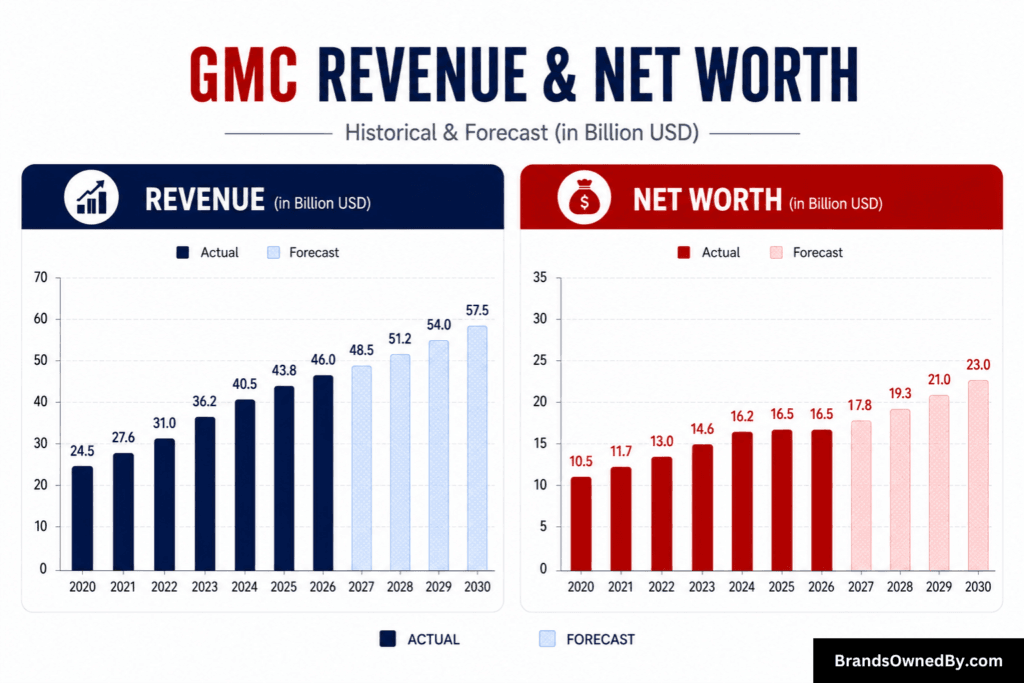
As of June 2026, GMC remains one of General Motors’ most valuable automotive brands. Although GMC does not publish standalone financial statements, industry estimates based on vehicle sales, average transaction prices, market share, and brand positioning suggest that GMC generates approximately $46 billion in annual revenue and has an estimated brand net worth of $16.5 billion.
The brand has benefited from strong demand for premium pickup trucks, full-size SUVs, Denali luxury models, AT4 off-road vehicles, and electric vehicles such as the Hummer EV and Sierra EV. These products command higher selling prices than many mainstream vehicles, making GMC one of General Motors’ most profitable divisions.
GMC Revenue in 2026
GMC’s estimated revenue for 2026 stands at approximately $46 billion.
A significant portion of this revenue comes from the Sierra pickup lineup. The Sierra remains GMC’s best-selling vehicle and represents the backbone of the brand’s business. Full-size pickups continue to generate substantial revenue because of their higher average selling prices and extensive customization options.
The Yukon and Yukon XL are another major source of revenue. These full-size SUVs occupy the premium end of the utility vehicle market and are particularly popular among families, executives, and commercial customers seeking spacious and capable vehicles.
The Acadia, Terrain, and Canyon also contribute meaningful revenue, although they account for a smaller share of total sales compared to the Sierra and Yukon families.
Electric vehicles are becoming an increasingly important contributor as well. The GMC Hummer EV and Sierra EV have strengthened the brand’s presence in the premium electric truck segment and expanded its revenue opportunities beyond traditional gasoline-powered vehicles.
Revenue Breakdown by Vehicle Segment
Based on industry estimates, GMC’s revenue distribution in 2026 can be broadly categorized across its major vehicle segments.
Full-size pickup trucks account for the largest share of revenue, generating approximately $23 billion to $25 billion annually. The Sierra lineup alone contributes more than half of the brand’s total revenue.
Full-size SUVs such as the Yukon and Yukon XL generate an estimated $10 billion to $11 billion in annual revenue. These vehicles command some of the highest transaction prices within the GMC portfolio.
Midsize and compact SUVs, including the Acadia and Terrain, contribute approximately $6 billion to $7 billion annually.
The Canyon midsize pickup generates roughly $2 billion to $3 billion in revenue, while the Hummer EV and Sierra EV collectively contribute an estimated $3 billion to $4 billion as production volumes continue to expand.
This diversified revenue mix helps GMC reduce dependence on any single vehicle line while maintaining a strong focus on high-margin trucks and SUVs.
GMC Net Worth in 2026
GMC’s estimated brand net worth is approximately $16.5 billion as of June 2026.
Unlike a standalone corporation, GMC does not have an independently reported balance sheet. Therefore, net worth estimates are based primarily on brand value, market position, customer loyalty, dealer network strength, intellectual property, and earnings potential.
Several factors support GMC’s valuation.
The brand enjoys strong recognition throughout North America and maintains one of the most loyal customer bases in the truck and SUV market. GMC also benefits from extensive manufacturing support, advanced engineering capabilities, and access to General Motors’ global technology platform.
The continued success of premium trims such as Denali and AT4 further strengthens GMC’s overall brand value. These models allow the company to generate higher profit margins while differentiating itself from mainstream competitors.
What Drives GMC’s Financial Strength?
One of GMC’s biggest advantages is its concentration in profitable vehicle categories.
Unlike many automakers that still depend heavily on sedans and smaller passenger cars, GMC focuses almost entirely on trucks, SUVs, and utility vehicles. These segments typically generate stronger margins and higher average transaction prices.
The Denali sub-brand is particularly important. Denali models often sell for tens of thousands of dollars more than standard variants, contributing significantly to GMC’s revenue and profitability.
The AT4 lineup provides another growth opportunity by targeting consumers interested in off-road capability. This has allowed GMC to compete more effectively against brands such as Jeep, Toyota, and Ford.
Meanwhile, the expansion of electric vehicles is creating new revenue streams. The Hummer EV and Sierra EV demonstrate GMC’s ability to maintain premium pricing while transitioning toward electrification.
GMC Revenue Growth Since 2020
GMC’s estimated revenue has increased significantly over the past several years.
In 2020, revenue was estimated at approximately $24.5 billion. By 2023, it had grown to roughly $36.2 billion, reflecting strong demand for trucks and SUVs following the pandemic recovery period.
Revenue continued climbing to approximately $40.5 billion in 2024 and $43.8 billion in 2025 before reaching an estimated $46 billion in 2026.
This growth has been supported by higher vehicle prices, premium trim expansion, increased consumer demand for utility vehicles, and the introduction of new electric products.
GMC Revenue and Net Worth Forecast Through 2030
Industry projections suggest that GMC will continue expanding its revenue and brand value throughout the remainder of the decade.
Expected growth drivers include electrification, premium vehicle demand, software-enabled vehicle services, and continued strength in the truck and SUV market.
- 2027: Estimated revenue of $48.5 billion and estimated brand net worth of $17.8 billion.
- 2028: Estimated revenue of $51.2 billion and estimated brand net worth of $19.3 billion.
- 2029: Estimated revenue of $54.0 billion and estimated brand net worth of $21.0 billion.
- 2030: Estimated revenue of $57.5 billion and estimated brand net worth of $23.0 billion.
If GMC successfully expands its electric vehicle lineup while maintaining its dominance in premium trucks and SUVs, the brand could surpass these projections and become an even larger contributor to General Motors’ overall financial performance.
GMC enters the second half of the decade from a position of strength. The brand combines a highly profitable truck business with a growing luxury SUV portfolio and an expanding electric vehicle lineup.
With estimated revenue approaching $46 billion and an estimated brand value of $16.5 billion in 2026, GMC has evolved far beyond its origins as a commercial truck manufacturer. Today, it stands as one of General Motors’ most valuable assets and one of the most influential premium truck and SUV brands in North America.
Brands Owned by GMC
Unlike many large corporations, GMC does not own separate companies or subsidiaries. The brand operates as a division of General Motors and manages a portfolio of vehicle lines, premium sub-brands, and commercial offerings under the GMC name.
Over the decades, GMC has expanded beyond traditional trucks and now oversees one of the most diverse utility vehicle portfolios in North America. Its operations span full-size pickups, premium SUVs, electric vehicles, off-road models, luxury trims, and commercial transportation solutions.
GMC Brand Ecosystem (2026)
GMC Sierra
The GMC Sierra is the flagship vehicle line of the GMC brand and one of its most important assets.
Introduced as a standalone model name in 1988, the Sierra has become one of the best-selling full-size pickup trucks in North America. The lineup includes light-duty, heavy-duty, commercial, luxury, and off-road variants.
The Sierra plays a central role in GMC’s revenue generation and brand identity. It competes directly with the Ford F-Series, Ram 1500, Toyota Tundra, and Nissan Titan.
The current lineup includes:
- Sierra 1500.
- Sierra HD.
- Sierra Denali.
- Sierra Denali Ultimate.
- Sierra AT4.
- Sierra AT4X.
- Sierra EV.
The Sierra family represents the largest vehicle franchise operated by GMC.
GMC Yukon
The Yukon is GMC’s flagship SUV franchise.
First introduced in the early 1990s, the Yukon evolved from a traditional utility vehicle into one of the most recognized premium full-size SUVs in North America.
The vehicle is particularly popular among large families, executives, government fleets, and luxury SUV buyers seeking capability and space.
The Yukon lineup includes:
- Yukon.
- Yukon XL.
- Yukon Denali.
- Yukon Denali Ultimate.
- Yukon AT4.
The Yukon franchise has become one of GMC’s most valuable assets due to its high transaction prices and strong customer loyalty.
GMC Acadia
The Acadia serves as GMC’s midsize SUV offering.
Originally launched in 2006, the Acadia helped GMC expand beyond trucks and full-size SUVs into the growing crossover market.
The vehicle targets consumers seeking a balance of practicality, technology, comfort, and premium features.
Over multiple generations, the Acadia has become a significant contributor to GMC’s overall sales volume and serves as an entry point for many customers entering the GMC ecosystem.
GMC Terrain
The Terrain is GMC’s compact SUV franchise.
Introduced in 2009, the Terrain allows GMC to compete in one of the largest vehicle segments in the automotive industry.
The model appeals to urban drivers, young families, and consumers seeking GMC’s premium image in a smaller and more affordable package.
The Terrain also plays an important strategic role by helping GMC attract customers who may later upgrade into larger vehicles such as the Acadia or Yukon.
GMC Canyon
The Canyon is GMC’s midsize pickup truck division.
Positioned below the Sierra, the Canyon targets consumers who want pickup truck capability without the size and operating costs of a full-size truck.
The latest generation Canyon has strengthened GMC’s position in the midsize truck market through premium design, advanced technology, and off-road-focused variants.
Major trims include:
- Canyon Elevation.
- Canyon AT4.
- Canyon Denali.
- Canyon AT4X.
The Canyon has become increasingly important as demand for midsize trucks continues to grow.
GMC Hummer EV
The Hummer EV represents one of the most significant product launches in GMC’s modern history.
Although the original Hummer brand previously existed as a separate GM division, General Motors revived the nameplate under GMC in 2020.
Today, Hummer EV operates as a premium electric vehicle franchise within GMC rather than as an independent brand.
The lineup includes:
- Hummer EV Pickup.
- Hummer EV SUV.
The Hummer EV serves as a technology showcase for GMC and demonstrates the brand’s transition toward electrification.
GMC Sierra EV
The Sierra EV represents GMC’s dedicated electric pickup program.
Built on General Motors’ next-generation electric vehicle architecture, the Sierra EV combines traditional pickup functionality with advanced battery technology, software integration, and premium features.
The vehicle plays a critical role in GMC’s long-term electric vehicle strategy and is expected to become one of the company’s most important growth platforms through the remainder of the decade.
Denali
Denali is GMC’s premium luxury sub-brand.
Introduced in 1999, Denali transformed GMC from a traditional truck manufacturer into a premium utility vehicle brand.
Denali models feature:
- Premium interior materials.
- Exclusive styling.
- Advanced technology packages.
- Enhanced comfort features.
- Luxury-oriented customer experience.
Today, Denali is one of the most successful premium vehicle sub-brands in the automotive industry and contributes significantly to GMC’s profitability.
For many consumers, Denali functions almost as a standalone luxury brand within GMC.
Denali Ultimate
Denali Ultimate represents the highest level of luxury offered by GMC.
The sub-brand was created to compete more directly with premium and luxury SUV manufacturers while maintaining GMC’s truck-focused identity.
Vehicles carrying the Denali Ultimate badge feature upgraded interiors, exclusive design elements, advanced technology systems, and additional premium amenities.
The introduction of Denali Ultimate has allowed GMC to push further into higher-margin luxury segments.
AT4
AT4 is GMC’s off-road performance sub-brand.
Launched in 2019, AT4 was developed to capitalize on growing consumer demand for adventure-oriented vehicles.
AT4 models feature:
- Off-road suspension systems.
- Increased ground clearance.
- All-terrain tires.
- Enhanced traction technologies.
- Rugged exterior styling.
The AT4 lineup has become one of GMC’s fastest-growing product families and competes directly with Ford Tremor, Toyota TRD, and Ram Rebel models.
AT4X
AT4X serves as GMC’s most extreme off-road offering.
The sub-brand expands on the standard AT4 formula by incorporating specialized hardware and advanced off-road technologies.
AT4X vehicles target enthusiasts seeking maximum off-road performance while maintaining premium comfort and technology features.
The lineup strengthens GMC’s position in the growing high-performance off-road market.
GMC Commercial Vehicles
In addition to consumer vehicles, GMC continues to operate a commercial vehicle business.
This division supplies vehicles to:
- Construction companies.
- Municipal governments.
- Utility providers.
- Transportation fleets.
- Small businesses.
- Commercial contractors.
Commercial offerings include chassis cabs, work trucks, fleet vehicles, and specialized utility vehicles.
This segment reflects GMC’s historic roots as a commercial truck manufacturer and remains an important part of the brand’s overall operations.
Final Thoughts
So, who owns GMC?
It is fully owned by General Motors Company and has been part of the GM family for more than a century. While the brand operates independently in terms of marketing and vehicle development, strategic control ultimately rests with General Motors, its board of directors, and its shareholders.
As of June 2026, GMC remains one of GM’s most valuable brands, driven by strong demand for premium trucks, SUVs, and electric vehicles such as the Hummer EV.
FAQs
Who bought GMC?
GMC was not purchased as a standalone modern brand. Its origins trace back to the Rapid Motor Vehicle Company, which was acquired by General Motors in 1908. General Motors later merged Rapid Motor Vehicle Company with Reliance Motor Car Company in 1911 to form the General Motors Truck Company, which eventually became GMC. Since then, GMC has remained under General Motors ownership.
Who owns GMC and Chevy?
Both GMC and Chevrolet are owned by General Motors Company (GM). They operate as separate vehicle brands within the General Motors portfolio. Chevrolet primarily targets mainstream consumers, while GMC focuses on premium trucks and SUVs.
Who owns GMC company?
GMC is owned by General Motors Company. It is not an independent corporation and does not have separate shareholders or publicly traded stock. Ownership of GMC is tied directly to the ownership of General Motors.
What does General Motors own?
As of 2026, General Motors owns several major automotive and mobility brands and businesses. These include GMC, Chevrolet, Cadillac, Buick, GM Energy, OnStar, and various technology, software, and mobility operations. GMC itself is one of the company’s most important truck and SUV divisions.
What does GMC stand for?
GMC stands for General Motors Company in modern branding. Historically, the initials originated from General Motors Truck Company, the name used when GM consolidated its truck operations in the early twentieth century. Although the official corporate name changed over time, the GMC initials remained.
Is GMC American or Chinese?
GMC is an American automotive brand. The company was founded in the United States and remains headquartered under General Motors in Detroit, Michigan. GMC vehicles are designed, engineered, and marketed by General Motors, an American automaker.
Is GMC made by Chevy?
No, GMC is not made by Chevrolet. However, both brands are owned by General Motors and often share vehicle platforms, engines, and manufacturing facilities. For example, the GMC Sierra and Chevrolet Silverado share many components, but they are marketed as separate brands with different positioning and features.
Does BMW own GMC?
No, BMW does not own GMC. GMC is wholly owned by General Motors Company. BMW Group is a separate German automotive company that owns brands such as BMW, MINI, and Rolls-Royce Motor Cars.
How much of GMC is owned by China?
China does not own GMC. GMC is wholly owned by General Motors. While General Motors operates joint ventures and manufacturing partnerships in China, these arrangements do not give China ownership of the GMC brand. As of 2026, GMC remains under the control of General Motors and its shareholders.
Is GMC owned by Ford?
No, GMC is not owned by Ford. GMC is owned by General Motors, while Ford vehicles are owned and operated by Ford Motor Company. The two companies are competitors in the truck, SUV, and commercial vehicle markets.
Is GMC owned by GM?
Yes. GMC is fully owned by General Motors Company. It operates as one of GM’s core vehicle brands alongside Chevrolet, Cadillac, and Buick.
Is GMC American made?
GMC is an American brand, but vehicle production takes place in multiple countries depending on the model. Many GMC trucks and SUVs are assembled in the United States, while some vehicles and components are produced in Canada, Mexico, and other countries within General Motors’ global manufacturing network. Despite its international production footprint, GMC remains an American-owned automotive brand.