
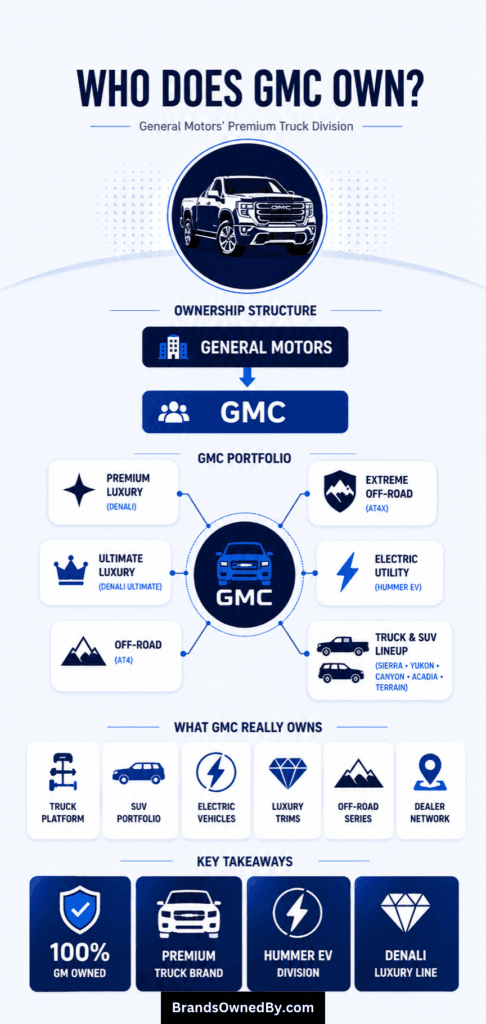
- GMC does not own separate companies but operates several major brands and sub-brands, including Hummer EV, Denali, Denali Ultimate, AT4, and AT4X, which strengthen its presence in the premium truck, luxury SUV, and off-road vehicle markets.
- The GMC Sierra, Yukon, Acadia, Terrain, Canyon, Hummer EV, and Sierra EV are the core vehicle brands and product lines driving GMC’s estimated $40.5 billion revenue in 2026, making GMC one of General Motors’ most profitable divisions.
- Hummer EV is GMC’s most significant modern acquisition-related asset, having been revived by General Motors and integrated into GMC as a premium electric truck and SUV brand sold through GMC dealerships.
- As of 2026, GMC remains wholly owned and controlled by General Motors, serving as GM’s premium truck and utility vehicle division while focusing on luxury, off-road, commercial, and electric vehicle segments through brands such as Denali, AT4, and Hummer EV.
GMC is an American automotive brand that specializes in trucks, sport utility vehicles (SUVs), commercial vans, and electric utility vehicles. The brand operates as a division of General Motors (GM), one of the world’s largest automobile manufacturers. GMC is headquartered in Detroit, Michigan, and primarily serves customers in North America, the Middle East, South Korea, Australia, and New Zealand.
The brand is known for its “Professional Grade” positioning. GMC vehicles are typically marketed as more premium alternatives to comparable Chevrolet models. This strategy allows GMC to target buyers seeking advanced technology, upscale interiors, and enhanced towing and hauling capabilities.
As of June 2026, GMC’s lineup includes popular vehicles such as the Sierra pickup truck, Yukon SUV, Acadia, Terrain, Canyon, Savana commercial van, Hummer EV Pickup, Hummer EV SUV, and Sierra EV. The brand continues to play a major role in General Motors’ truck, SUV, and electric vehicle strategy.
GMC has built a strong reputation for durability and utility over more than a century. While the company originally focused on commercial and heavy-duty trucks, it has evolved into a premium truck and SUV brand that competes with Ford, Ram, Toyota, Jeep, and Nissan in several vehicle categories.
Founders of GMC
The origins of GMC can be traced to two brothers, Max Grabowsky and Morris Grabowsky, who established the Grabowsky Motor Company in Detroit in 1900. Their business was among the earliest manufacturers of commercial trucks in the United States and helped lay the foundation for the modern truck industry.
In 1902, the company evolved into the Rapid Motor Vehicle Company, which became known for producing innovative commercial vehicles. General Motors founder William C. Durant acquired Rapid Motor Vehicle Company in 1909 as part of GM’s expansion strategy.
In 1911, General Motors merged Rapid Motor Vehicle Company with Reliance Motor Car Company to form the General Motors Truck Company, the direct predecessor of GMC. The GMC brand name first appeared on vehicles in 1912. Because of this history, both the Grabowsky brothers and William C. Durant are widely recognized as key figures in GMC’s founding and development.
Max Grabowsky
Max Grabowsky was a pioneering automotive engineer and entrepreneur. He helped design some of the earliest commercial trucks in America. His engineering work focused on creating durable vehicles capable of carrying heavy loads, a concept that would later become central to GMC’s identity.
Morris Grabowsky
Morris Grabowsky worked alongside his brother in developing and expanding the company’s early truck operations. Together, the brothers transformed their small commercial vehicle business into one of the most influential truck manufacturers of the early twentieth century.
William C. Durant
William C. Durant, founder of General Motors, played the crucial role of bringing the Grabowsky brothers’ truck business into the GM family. His acquisition and consolidation strategy led to the creation of General Motors Truck Company in 1911, which ultimately evolved into the GMC brand known today.
List of Companies & Brands Owned by GMC
Although GMC does not own independent companies, it operates several well-known brands, sub-brands, and business divisions. These entities help GMC target different customer segments ranging from luxury SUV buyers to commercial fleet operators.
GMC Brand Ecosystem
Brands & Operating Entities • 2026
Denali
Luxury DivisionDenali Ultimate
Flagship LuxuryAT4
Off-Road SeriesAT4X
Extreme Off-RoadHummer EV
Electric SupertruckSierra
Pickup BrandSierra EV
Electric PickupCanyon
Midsize TruckYukon
Full-Size SUVAcadia
Midsize SUVTerrain
Compact SUVSavana
Commercial VansGMC Commercial
Fleet SolutionsAccessories
CustomizationProfessional Grade
Brand PlatformDenali
Denali is GMC’s flagship luxury brand and one of the most successful premium vehicle sub-brands in the automotive industry.
Introduced in 1998 with the Yukon Denali, the brand was created to provide luxury-oriented versions of GMC vehicles. Over time, Denali evolved into a complete premium lineup spanning SUVs and pickup trucks.
Denali models feature exclusive exterior styling, premium leather interiors, real wood accents, advanced driver-assistance systems, upgraded suspension systems, larger infotainment displays, and enhanced sound systems.
Today, customers can purchase Denali versions of the Sierra, Yukon, Acadia, Canyon, and Terrain. In many markets, Denali vehicles account for a significant share of GMC’s total sales because of their higher profit margins and luxury appeal.
Unlike an independent company, Denali remains fully owned and managed by GMC and serves as the brand’s luxury division.
Denali Ultimate
Denali Ultimate represents the highest trim level within the Denali family.
GMC launched this sub-brand to compete more directly with premium offerings from Ford, Ram, Jeep, and luxury manufacturers. The vehicles feature exclusive interior materials, open-pore wood finishes, massaging seats, unique grille designs, premium audio systems, and advanced towing technologies.
The Sierra Denali Ultimate and Yukon Denali Ultimate are among GMC’s most premium vehicles.
Denali Ultimate serves as GMC’s answer to the growing demand for luxury trucks and high-end SUVs.
AT4
AT4 is GMC’s off-road performance brand.
The division was created to appeal to customers seeking adventure-focused vehicles with enhanced off-road capabilities. AT4 models include specialized suspension systems, increased ground clearance, all-terrain tires, skid plates, hill-descent control systems, and advanced four-wheel-drive technologies.
The lineup includes:
- Sierra AT4.
- Canyon AT4.
- Yukon AT4.
- Acadia AT4.
AT4 has become one of GMC’s fastest-growing product families because of increasing consumer interest in outdoor recreation and overlanding vehicles.
AT4X
AT4X is the extreme off-road extension of the AT4 lineup.
Vehicles carrying the AT4X badge receive substantial upgrades compared to standard AT4 models. Features often include advanced Multimatic DSSV dampers, locking differentials, underbody armor, specialized off-road drive modes, and enhanced suspension travel.
The Canyon AT4X has become one of GMC’s most capable off-road vehicles and competes directly with models such as the Ford Ranger Raptor and Toyota Tacoma TRD Pro.
AT4X represents GMC’s most aggressive off-road offering.
Hummer EV
Hummer EV is GMC’s dedicated electric supertruck brand.
The original Hummer brand operated separately within General Motors until it was discontinued during GM’s restructuring efforts. Rather than relaunching Hummer as a standalone division, General Motors integrated the revived Hummer name into GMC.
Today, GMC sells:
- GMC Hummer EV Pickup.
- GMC Hummer EV SUV.
These vehicles are built on GM’s Ultium electric vehicle platform and feature advanced technologies such as CrabWalk, Watts to Freedom launch mode, adaptive air suspension, and four-wheel steering.
Hummer EV allows GMC to compete in the rapidly growing electric truck and SUV market.
Sierra
Sierra is GMC’s full-size pickup truck division.
Since its introduction in 1988, Sierra has become one of GMC’s most important product lines. The Sierra lineup includes light-duty, heavy-duty, commercial, luxury, off-road, and electric variants.
The Sierra family includes:
- Sierra 1500.
- Sierra HD.
- Sierra Denali.
- Sierra AT4.
- Sierra AT4X.
- Sierra EV.
The Sierra brand directly competes with the Ford F-Series, Ram Pickup, Toyota Tundra, and Nissan Titan.
Sierra EV
Sierra EV is GMC’s dedicated electric pickup truck brand extension.
Built on General Motors’ Ultium platform, Sierra EV combines electric power with premium truck capabilities. It targets both traditional truck owners and customers transitioning to electric vehicles.
The Sierra EV is positioned as a premium electric truck and complements the Hummer EV lineup.
Canyon
Canyon is GMC’s midsize truck brand.
The vehicle targets customers seeking truck functionality in a smaller and more maneuverable package than the full-size Sierra.
Modern Canyon models include advanced towing technologies, off-road packages, premium interiors, and digital driver-assistance systems.
The Canyon lineup has expanded significantly and now includes premium and off-road-focused variants such as the AT4 and AT4X.
Yukon
Yukon is GMC’s flagship SUV brand.
The Yukon competes in the full-size SUV segment and serves families, business owners, and luxury vehicle buyers.
The lineup includes:
- Yukon.
- Yukon XL.
- Yukon Denali.
- Yukon Denali Ultimate.
- Yukon AT4.
Yukon has become one of GMC’s most profitable vehicle families because of strong demand for premium SUVs.
Acadia
Acadia is GMC’s midsize crossover SUV division.
The vehicle serves customers seeking a balance between passenger comfort, cargo capacity, and advanced technology.
Acadia models are available in standard, luxury Denali, and off-road-focused AT4 trims.
The Acadia competes against vehicles such as the Ford Explorer, Toyota Grand Highlander, Honda Pilot, and Kia Telluride.
Terrain
Terrain is GMC’s compact SUV brand.
It is designed for urban drivers and small families seeking premium features in a smaller package.
Terrain offers advanced safety systems, modern infotainment technology, and upscale styling compared with many competitors in the compact SUV segment.
The vehicle plays an important role in attracting first-time GMC buyers.
Savana
Savana is GMC’s commercial and passenger van division.
The vehicle serves multiple industries including logistics, transportation, construction, healthcare, and government operations.
Available configurations include:
- Cargo vans.
- Passenger vans.
- Cutaway vans.
- Fleet vehicles.
Savana remains one of GMC’s most important commercial products and continues to be widely used throughout North America.
GMC Commercial
GMC Commercial is the brand’s fleet and business vehicle operation.
The division provides trucks, vans, and utility vehicles for businesses, municipalities, emergency services, and government agencies.
Customers include:
- Construction companies.
- Utility providers.
- Delivery services.
- Public sector organizations.
- Transportation companies.
GMC Commercial represents a major portion of the brand’s business-to-business operations.
Professional Grade
Professional Grade is GMC’s core brand identity and operating philosophy.
Introduced as a marketing platform, Professional Grade has evolved into a strategic business initiative influencing vehicle engineering, product development, customer service, and brand positioning.
The concept emphasizes capability, durability, premium craftsmanship, and advanced technology.
Although not a separate company, Professional Grade is one of GMC’s most valuable brand assets and helps differentiate GMC from Chevrolet and other competitors.
GMC Accessories
GMC Accessories operates as the brand’s official vehicle customization and aftermarket division.
The business offers factory-approved upgrades including:
- Tonneau covers.
- Lift kits.
- Off-road equipment.
- Wheels and tires.
- Bed protection systems.
- Performance accessories.
- Cargo management solutions.
These products allow customers to personalize their vehicles while maintaining factory warranties and GMC quality standards.
Who Owns GMC?
![Who Owns GMC [infographic]](https://brandsownedby.com/wp-content/uploads/2026/06/Who-Owns-GMC-infographic-1024x683.png)
GMC is wholly owned by General Motors Company (GM). Unlike many automotive brands, GMC is not a standalone corporation and does not have publicly traded shares. Instead, it operates as one of General Motors’ core vehicle divisions. This means every GMC asset, including its manufacturing operations, intellectual property, dealerships, vehicle lineup, and sub-brands such as Denali, AT4, and Hummer EV, ultimately belongs to General Motors.
As of 2026, GMC remains one of GM’s most important divisions. The brand focuses on premium trucks, SUVs, commercial vehicles, and electric utility vehicles. Because GMC generates significant sales through high-margin products such as the Sierra, Yukon, Denali, and Hummer EV lineups, it plays a critical role in General Motors’ overall business strategy.
How General Motors Acquired GMC
Many people assume General Motors purchased GMC from another company. In reality, GMC was created through a series of acquisitions and mergers completed by General Motors during the early years of the automotive industry.
Acquisition of Rapid Motor Vehicle Company
The origins of GMC can be traced to the Rapid Motor Vehicle Company, which was founded by brothers Max and Morris Grabowsky. Rapid became one of America’s early leaders in commercial truck manufacturing and developed a reputation for building reliable heavy-duty vehicles.
Recognizing the growth potential of the commercial transportation industry, General Motors founder William C. Durant acquired Rapid Motor Vehicle Company in 1909. This acquisition provided General Motors with an established truck manufacturing business and gave the company a foothold in the rapidly expanding commercial vehicle market.
The acquisition remains one of the most significant transactions in General Motors’ history because it laid the foundation for what would eventually become GMC.
Merger With Reliance Motor Car Company
After acquiring Rapid, General Motors continued expanding its truck operations. In 1911, GM merged Rapid Motor Vehicle Company with Reliance Motor Car Company, another truck manufacturer under its control.
This merger created the General Motors Truck Company. The newly formed organization became General Motors’ dedicated truck manufacturing business and served as the direct predecessor of GMC.
Unlike many modern acquisitions where an existing brand is purchased and retained, GMC was effectively built by combining multiple truck businesses already owned by General Motors.
Creation of the GMC Brand
The GMC name first appeared on vehicles in 1912. Over the following decades, the company expanded from commercial trucks into military vehicles, pickup trucks, fleet vehicles, SUVs, and eventually electric trucks.
One of the unique aspects of GMC’s history is that it has never left General Motors’ ownership. While many automotive brands have changed hands multiple times through mergers, acquisitions, bankruptcies, or divestitures, GMC has remained part of General Motors for more than a century.
Parent Company of GMC: General Motors
General Motors is the sole parent company of GMC.
Founded in 1908, General Motors is one of the world’s largest automotive manufacturers and oversees several major vehicle brands. Within the GM portfolio, GMC occupies a distinct position as the company’s premium truck and utility vehicle division.
The brand sits between Chevrolet and Cadillac. Chevrolet focuses on mainstream consumers, while Cadillac targets the luxury segment. GMC fills the gap by offering premium trucks and SUVs with enhanced capability, technology, and upscale features.
Today, GMC’s lineup includes the Sierra, Canyon, Yukon, Acadia, Terrain, Savana, Hummer EV, and Sierra EV. The brand’s success has made it one of the most profitable divisions within General Motors, particularly in North America where trucks and SUVs generate substantial revenue.
Because GMC is wholly owned by General Motors, the shareholders of General Motors are effectively the indirect owners of GMC. While no investor owns shares directly in GMC, these shareholders collectively own the parent company that controls the brand.
The Vanguard Group
The Vanguard Group is the largest shareholder of General Motors as of 2026. Through its extensive network of index funds, mutual funds, retirement funds, and exchange-traded funds, Vanguard owns approximately 11% to 12% of General Motors’ outstanding shares.
Vanguard’s ownership makes it one of the most influential investors behind GMC. Although the company does not participate in daily operations, its voting power gives it significant influence over board elections, executive compensation policies, governance matters, and major shareholder proposals.
Because Vanguard represents millions of investors worldwide, its position reflects broad institutional confidence in General Motors and the long-term strength of brands such as GMC.
UAW Retiree Medical Benefits Trust
The UAW Retiree Medical Benefits Trust is one of General Motors’ most unique and influential shareholders. The trust was established through agreements between General Motors and the United Auto Workers union to help fund healthcare benefits for retired employees.
As of 2026, the trust owns approximately 10% to 11% of General Motors. This makes it one of the company’s largest long-term investors.
Unlike traditional investment firms, the trust’s primary objective is protecting the value of assets that support retiree healthcare obligations. As a result, it has a vested interest in General Motors’ long-term financial health and operational success. GMC’s continued profitability directly benefits the trust because strong vehicle sales support General Motors’ overall performance.
BlackRock
BlackRock is another major shareholder of General Motors and owns approximately 8% to 9% of the company.
As the world’s largest asset manager, BlackRock manages trillions of dollars on behalf of pension funds, institutions, governments, and individual investors. Its substantial ownership stake gives it considerable influence over corporate governance matters and strategic decisions affecting General Motors.
BlackRock has historically maintained large positions in leading industrial companies and views General Motors as a significant player in both traditional automotive manufacturing and the transition toward electric vehicles. Because GMC is a major contributor to GM’s truck and SUV business, BlackRock indirectly owns a significant portion of GMC through its investment in the parent company.
State Street Corporation
State Street Corporation owns approximately 5% of General Motors and ranks among the company’s largest institutional investors.
The firm manages assets for pension funds, sovereign wealth funds, insurance companies, and institutional clients around the world. Through its ownership position, State Street participates in shareholder voting and governance decisions that influence the future direction of General Motors.
State Street’s long-term investment approach reflects confidence in General Motors’ ability to maintain leadership in the truck, SUV, commercial vehicle, and electric vehicle markets where GMC plays a major role.
Capital World Investors
Capital World Investors is one of the largest active investment managers holding General Motors shares. The firm owns approximately 3% to 4% of the company and has maintained a significant position in GM for years.
The company typically invests in businesses with strong competitive advantages and long-term growth potential. Its continued ownership of General Motors demonstrates confidence in the company’s ability to compete in a rapidly changing automotive industry.
GMC’s strong position in the premium truck and SUV segments is one of the factors that helps make General Motors attractive to long-term institutional investors such as Capital World Investors.
Franklin Resources
Franklin Resources, through its Franklin Templeton investment funds, owns approximately 2% to 3% of General Motors.
The company has a long history of investing in major industrial and manufacturing businesses. Its stake in General Motors reflects confidence in the automaker’s long-term prospects and the strength of its core brands.
Although Franklin Resources owns a smaller percentage than Vanguard or BlackRock, it remains an important institutional shareholder with meaningful voting power in corporate governance matters.
Geode Capital Management
Geode Capital Management is another significant shareholder of General Motors, controlling approximately 2% to 3% of the company’s outstanding shares.
The firm specializes in index-based investment strategies and manages assets for a wide range of institutional clients. While Geode generally follows a passive investment approach, its large holdings make it an important participant in shareholder votes and corporate governance decisions.
Its investment in General Motors represents another layer of institutional ownership supporting GMC and the broader GM business.
Insider Shareholders
General Motors executives and directors also own shares in the company. Among insiders, Chair and Chief Executive Officer Mary Barra is the most notable shareholder.
Although insider ownership represents a relatively small percentage of General Motors compared with large institutional investors, executives have substantial influence because they are responsible for managing the company. Their share ownership helps align management interests with those of shareholders and encourages long-term value creation.
Competitor Ownership Comparison
GMC competes against some of the largest automotive brands in the world. However, one factor that differentiates GMC from many rivals is its ownership structure. GMC is not an independent company. It operates as a wholly owned division of General Motors, giving it direct access to GM’s engineering resources, manufacturing facilities, research and development budget, supply chain network, and global purchasing power.
Many competitors operate under very different ownership models. Some are independent public companies, while others belong to multinational automotive groups formed through mergers and acquisitions. Understanding these ownership structures helps explain how GMC competes in the global truck, SUV, and electric vehicle markets.
Automotive Ownership Comparison (2026)
Who Owns GMC and Its Major Competitors?
GMC vs Ford
Ford is GMC’s longest-running competitor in the North American truck market. The GMC Sierra competes directly with the Ford F-Series, while the Yukon competes against the Ford Expedition.
The biggest difference lies in corporate governance. GMC is fully owned by General Motors, whereas Ford operates under Ford Motor Company as a publicly traded corporation.
As of June 2026, Ford remains heavily influenced by the Ford family through its Class B shares. Although the Ford family owns a relatively small percentage of Ford’s economic interest, it controls approximately 40% of the company’s voting power. This dual-class share structure gives the family substantial influence over corporate decisions.
General Motors uses a traditional one-share-one-vote structure. As a result, institutional investors such as Vanguard, the UAW Retiree Medical Benefits Trust, BlackRock, and State Street collectively exert more influence over GMC’s parent company than any founding family.
This creates a fundamental difference between the two rivals. Ford remains partially family-controlled, while GMC operates within a corporation primarily influenced by institutional investors and professional management.
GMC vs Ram
Ram is GMC’s most direct competitor in the full-size pickup truck market. The Ram 1500 competes against the GMC Sierra 1500, while Ram Heavy Duty trucks compete against the GMC Sierra HD lineup.
Unlike GMC, Ram does not belong to a traditional American automaker. It is owned by Stellantis, a multinational automotive group formed through the 2021 merger of Fiat Chrysler Automobiles (FCA) and France’s PSA Group.
As of June 2026, Stellantis is heavily influenced by Exor N.V., the investment company controlled by Italy’s Agnelli family. Exor remains Stellantis’ largest shareholder with roughly 14% of the company’s equity and approximately 22% of voting rights.
This means Ram ultimately operates under a multinational ownership structure with strong family influence from one of Europe’s wealthiest business dynasties.
GMC’s ownership is considerably simpler. The brand reports directly through General Motors’ North American operations and remains entirely controlled by GM shareholders.
GMC vs Jeep
Jeep competes directly with GMC’s AT4 and AT4X off-road vehicle lineup. Models such as the Jeep Wrangler, Gladiator, and Grand Cherokee target many of the same customers who consider GMC’s Canyon AT4X, Yukon AT4, and Sierra AT4 models.
Jeep shares the same ownership structure as Ram because both belong to Stellantis. The brand has experienced numerous ownership transitions throughout its history. Jeep has been controlled by Willys-Overland, Kaiser Jeep, American Motors Corporation, Chrysler Corporation, DaimlerChrysler, Cerberus Capital Management, Fiat Chrysler Automobiles, and now Stellantis.
By comparison, GMC has remained under General Motors ownership since its formation more than a century ago. This stability has allowed GMC to maintain a consistent brand identity focused on premium trucks and utility vehicles.
GMC vs Toyota
Toyota represents one of GMC’s strongest competitors globally. The Toyota Tundra competes with the Sierra, while the Land Cruiser, Sequoia, and 4Runner compete with several GMC SUV models.
Unlike GMC, Toyota operates as an independent global corporation rather than a division within a larger automotive group. Toyota Motor Corporation controls its own manufacturing, research, vehicle development, financing, and global operations.
As of June 2026, Toyota’s largest shareholder remains Toyota Industries Corporation, which owns approximately 9% of Toyota Motor Corporation. Other major shareholders include Japanese financial institutions, trust banks, pension funds, and international institutional investors.
Toyota’s ownership structure is characterized by extensive cross-shareholding relationships among companies within the Toyota Group. These relationships provide long-term stability and help protect Toyota from hostile takeover attempts.
In contrast, GMC’s future is directly tied to General Motors’ strategic priorities and shareholder decisions.
GMC vs Nissan
Nissan competes against GMC primarily in the SUV segment and historically competed in the pickup truck market through the Titan.
Nissan Motor Company operates as an independent publicly traded corporation based in Japan. The company remains connected to Renault and Mitsubishi Motors through the Renault-Nissan-Mitsubishi Alliance, one of the world’s largest automotive partnerships.
As of June 2026, Renault remains one of Nissan’s largest shareholders, while Nissan maintains a strategic stake in Renault. Although the alliance has undergone significant restructuring in recent years, ownership ties between the companies continue to influence governance and strategic decision-making.
Compared with GMC’s straightforward ownership structure under General Motors, Nissan operates within a far more complex alliance-based governance framework involving multiple automotive manufacturers.
GMC vs Tesla
Tesla has emerged as one of GMC’s most significant competitors in the electric truck market. The Tesla Cybertruck competes directly with the GMC Sierra EV and Hummer EV.
Tesla’s ownership structure differs dramatically from GMC’s. Tesla is an independent public company and remains heavily influenced by its founder and CEO, Elon Musk.
As of June 2026, Elon Musk remains Tesla’s largest individual shareholder with ownership exceeding 12% of outstanding shares. Vanguard and BlackRock are also among Tesla’s largest institutional investors.
This gives Tesla a more founder-driven governance model than General Motors. Strategic decisions often reflect Musk’s vision and leadership style, whereas GMC’s direction is shaped by a broader corporate management structure, board oversight, and institutional shareholder interests.
GMC vs Rivian
Rivian competes directly with GMC in the electric truck and electric SUV markets through the R1T pickup and R1S SUV.
Unlike GMC’s century-old corporate structure, Rivian is a relatively young company founded in 2009. The company operates independently and remains publicly traded.
As of June 2026, Rivian’s largest shareholders include founder RJ Scaringe, Amazon, Vanguard, and BlackRock. Amazon remains one of Rivian’s most important strategic investors due to its commercial electric vehicle partnership with the company.
Although Rivian possesses innovative technology and a strong electric vehicle focus, it lacks the manufacturing scale, dealer network, supply chain strength, and financial resources available to GMC through General Motors.
GMC vs Chevrolet
One of GMC’s most unusual competitors is Chevrolet because both brands belong to General Motors.
The GMC Sierra and Chevrolet Silverado share many underlying components, manufacturing facilities, and engineering resources. Similarly, the GMC Yukon and Chevrolet Tahoe are built on related vehicle platforms.
However, General Motors intentionally positions the brands differently. Chevrolet targets mainstream consumers seeking affordability and value, while GMC focuses on premium truck and SUV buyers willing to pay more for upscale styling, technology, and luxury features.
Because both brands share the same parent company and ownership structure, competition between them is based on market segmentation rather than corporate rivalry.
Ownership Stability Comparison
One of GMC’s strongest competitive advantages is ownership stability.
Many competitors have experienced significant ownership changes during their histories. Jeep has passed through multiple corporate owners. Ram became part of Stellantis through a major multinational merger. Nissan continues to operate within a complex alliance structure. Rivian remains a relatively young company with evolving ownership dynamics.
GMC has remained under General Motors ownership since the creation of General Motors Truck Company in 1911. More than 115 years later, the brand continues to operate under the same parent organization.
This long-term stability provides strategic advantages in product planning, manufacturing investments, dealer relationships, supplier negotiations, and brand development.
GMC occupies a unique position among major automotive competitors. It is not an independent company like Tesla, Toyota, Nissan, or Rivian. It is also not part of a merger-created automotive group like Ram and Jeep under Stellantis.
Instead, GMC functions as a wholly owned division of General Motors, one of the world’s largest automakers. This structure allows GMC to maintain a distinct premium truck and SUV identity while benefiting from GM’s massive engineering capabilities, manufacturing infrastructure, global purchasing power, and financial resources.
As of 2026, this combination of brand independence and corporate backing remains one of GMC’s most significant competitive advantages in the automotive industry.
Who Controls GMC?
Although GMC is one of the most recognizable automotive brands in North America, it does not operate as an independent company. Control of GMC ultimately resides within General Motors, which owns the brand outright and integrates it into its broader corporate structure.
As of 2026, GMC is controlled through a layered governance system consisting of General Motors shareholders, the Board of Directors, the Chief Executive Officer, senior executive leadership, and GMC’s own brand management team. Each level plays a distinct role in determining the direction of the brand.
Unlike standalone automakers such as Tesla, Rivian, or Ford, GMC does not have its own board of directors, public shareholders, or independent executive team. Instead, all major decisions involving GMC must align with General Motors’ corporate strategy and receive approval through GM’s leadership structure.
Who Controls GMC?
Governance & Leadership Structure (2026)
GM Shareholders
Vanguard • UAW Trust • BlackRock • State StreetBoard of Directors
Corporate Oversight & Strategic ApprovalMary Barra
Chair & CEO, General MotorsEngineering
Manufacturing
Finance
Technology
GMC Brand Leadership
Product Strategy • Marketing • Pricing • Dealer NetworkProduct Teams
Factories
Dealers
Technology Teams
General Motors is the Ultimate Controlling Authority
The most important fact about GMC’s governance structure is that General Motors has complete authority over the brand.
Because GMC is a wholly owned division rather than a separate corporation, every significant decision ultimately flows through GM’s leadership framework. This includes decisions involving:
- Vehicle development.
- Manufacturing investments.
- Factory allocation.
- Product launches.
- Electric vehicle strategy.
- International expansion.
- Dealer operations.
- Marketing budgets.
- Technology investments.
GMC executives manage the brand, but they do so within guidelines established by General Motors.
For example, major programs such as the Sierra EV, Hummer EV, Yukon Denali Ultimate, and Canyon AT4X required approval and funding from General Motors before entering production.
The General Motors Board of Directors
At the top of the governance structure sits the General Motors Board of Directors.
The board represents GM shareholders and serves as the highest governing authority within the company. While the board does not manage GMC’s daily operations, it controls the strategic framework within which GMC operates.
As of June 2026, the board consists of leaders with backgrounds in technology, manufacturing, finance, logistics, aerospace, consumer products, and global business management.
The board’s responsibilities include approving:
- Multi-billion-dollar manufacturing investments.
- Electric vehicle expansion plans.
- Major capital expenditures.
- Executive appointments.
- Long-term corporate strategy.
- Risk management policies.
- Large-scale technology initiatives.
Because GMC is one of GM’s highest-margin divisions, many board-level decisions directly impact the brand’s future.
For example, decisions regarding battery manufacturing facilities, EV production capacity, software development spending, and autonomous driving technology all influence GMC’s vehicle lineup.
Mary Barra: The Most Powerful Person at GMC
When discussing who controls GMC, no individual has more influence than Mary Barra.
As Chair and Chief Executive Officer of General Motors, Barra serves as the highest-ranking executive overseeing GMC and all other GM brands.
Since becoming CEO in 2014, she has transformed General Motors from a traditional automaker into a company increasingly focused on electrification, software, connectivity, and advanced mobility technologies.
Virtually every major GMC initiative during the past decade has been approved under her leadership.
This includes:
- Expansion of the Denali portfolio.
- Launch of Denali Ultimate.
- Development of the AT4 and AT4X sub-brands.
- Revival of Hummer as an electric vehicle brand.
- Introduction of Sierra EV.
- Expansion of Super Cruise technology.
- Growth of GMC’s premium SUV lineup.
Although institutional investors technically own General Motors, Mary Barra exercises more operational authority over GMC than any individual shareholder.
In practical terms, she is the person most responsible for determining GMC’s future direction.
The Executive Leadership Team
Directly below the CEO sits General Motors’ executive leadership team.
These executives oversee major business functions including engineering, manufacturing, finance, technology, supply chain management, software development, marketing, and product planning.
Their influence over GMC is substantial because they control the resources required to bring vehicles from concept to production.
When General Motors allocates billions of dollars toward electric vehicles, battery production, software platforms, and factory modernization, executive leadership determines how much of those resources are directed toward GMC products.
As a result, many of GMC’s future opportunities depend on decisions made at the corporate level rather than within the brand itself.
GMC Brand Leadership
While General Motors controls the company at the highest level, GMC’s daily operations are managed by dedicated brand leadership.
The GMC leadership team oversees:
- Product strategy.
- Market positioning.
- Pricing.
- Advertising.
- Dealer relations.
- Customer experience.
- Sales performance.
- Competitive analysis.
One of the team’s primary responsibilities is maintaining clear separation between GMC, Chevrolet, and Cadillac.
This task has become increasingly important because GMC shares many platforms and technologies with Chevrolet while simultaneously competing in a more premium segment.
GMC leadership helps determine how vehicles are differentiated through design, features, technology, and marketing.
Product Development Governance
Vehicle development within GMC involves one of the most complex decision-making processes in the company.
New products typically move through several levels of approval before reaching production.
The process generally begins with GMC product planners identifying market opportunities. These proposals are then evaluated by engineering teams, financial analysts, manufacturing executives, and senior management.
Only after receiving approval from General Motors leadership can major projects proceed.
This governance process helps explain why vehicles such as the Hummer EV and Sierra EV required years of planning and billions of dollars in corporate investment before launch.
It also ensures that GMC’s product portfolio aligns with General Motors’ broader objectives.
Manufacturing Control Structure
GMC does not operate independent factories.
Instead, production is managed through General Motors’ manufacturing organization.
The company’s manufacturing leadership determines:
- Which plants build GMC vehicles.
- Production volumes.
- Factory upgrades.
- Workforce planning.
- Supply chain allocation.
- Capacity expansion projects.
For example, decisions regarding Sierra production, Hummer EV manufacturing, or future electric truck facilities are made within GM’s manufacturing hierarchy rather than by GMC alone.
This centralized approach allows General Motors to optimize production across multiple brands while controlling costs.
Technology Governance
Technology has become one of the most important areas of control within GMC.
Many of the technologies that define modern GMC vehicles originate from General Motors’ corporate technology divisions rather than from the GMC brand itself.
These technologies include:
- Ultium battery systems.
- Super Cruise hands-free driving.
- Vehicle software architecture.
- Connected services.
- Over-the-air updates.
- Electric powertrains.
- Advanced driver-assistance systems.
As software becomes increasingly important, control over GMC’s future is shifting toward technology executives, software engineers, and corporate innovation teams within General Motors.
This makes technology governance one of the most influential components of GMC’s leadership structure in 2026.
How Shareholders Influence GMC
Although shareholders do not manage GMC directly, they influence the brand through General Motors’ governance framework.
Major investors such as Vanguard, the UAW Retiree Medical Benefits Trust, BlackRock, and State Street vote on board elections and important corporate matters.
By selecting directors and approving governance policies, these investors help shape the leadership team that ultimately oversees GMC.
However, their influence is indirect. Day-to-day decisions remain firmly in the hands of General Motors executives and GMC management.
Who Has the Most Control Over GMC?
As of 2026, General Motors exercises complete corporate control over GMC. Within that structure, Mary Barra remains the most influential individual shaping the brand’s future.
The Board of Directors establishes oversight and approves major strategic initiatives. The executive leadership team allocates resources and manages operations. GMC’s brand leadership executes strategy and oversees day-to-day activities.
Together, this governance structure allows GMC to operate with a distinct brand identity while benefiting from the financial resources, technology platforms, manufacturing network, and corporate leadership of General Motors.
GMC Annual Revenue and Net Worth
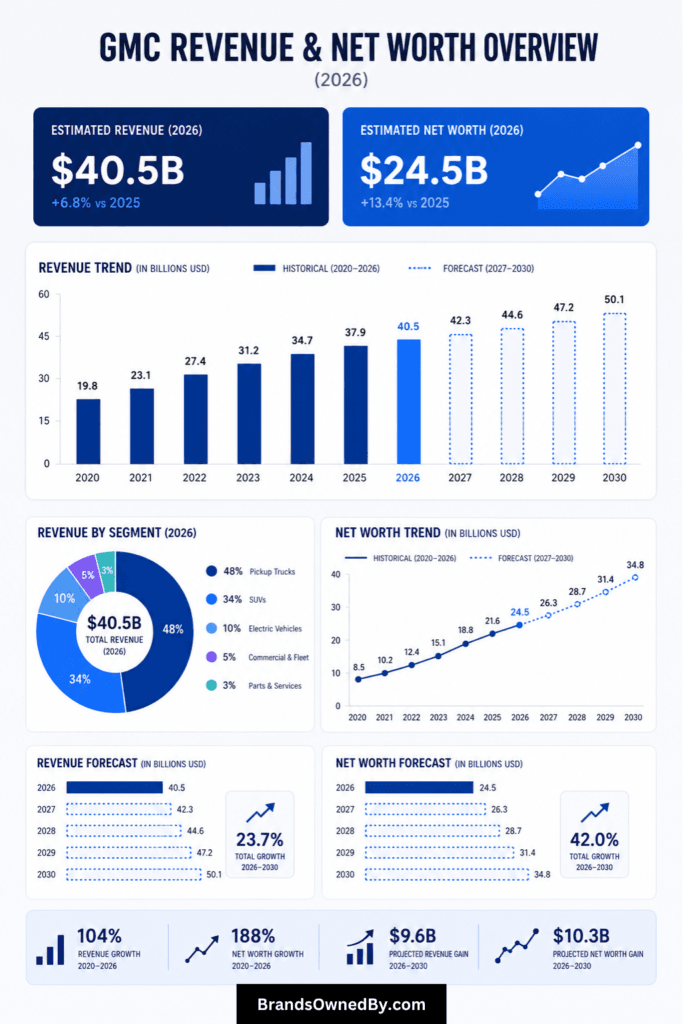
As of June 2026, GMC continues to be one of General Motors’ most valuable vehicle divisions. While GMC does not publish standalone audited financial statements, industry estimates suggest the brand generates approximately $40.5 billion in annual revenue and has an estimated brand value and net worth of approximately $24.5 billion.
The brand’s financial strength is largely driven by its dominance in the North American truck and SUV markets. High-margin vehicles such as the Sierra, Yukon, Yukon XL, Denali, Denali Ultimate, Hummer EV, and Sierra EV contribute significantly to GMC’s earnings potential. Unlike mass-market automotive brands that rely heavily on volume, GMC benefits from premium pricing, strong customer loyalty, and higher average transaction values.
GMC Revenue in 2026
GMC’s estimated revenue reached approximately $40.5 billion in 2026, representing substantial growth compared to the early 2020s. The brand has benefited from increasing demand for premium trucks, luxury SUVs, off-road vehicles, and electric utility vehicles.
A major contributor to revenue growth has been the continued success of the Sierra lineup. The Sierra 1500 remains one of the best-selling premium pickup trucks in North America, while the Sierra HD series maintains strong demand among commercial users, contractors, and towing-focused customers.
The Yukon and Yukon XL also contribute significantly to GMC’s revenue. These full-size SUVs command some of the highest average transaction prices within the General Motors portfolio, particularly Denali and Denali Ultimate models.
Industry estimates suggest GMC’s revenue composition in 2026 is approximately:
| Revenue Segment | Estimated Contribution |
|---|---|
| Pickup Trucks (Sierra & Canyon) | 48% |
| SUVs (Yukon, Acadia, Terrain) | 34% |
| Electric Vehicles (Hummer EV & Sierra EV) | 10% |
| Commercial Vehicles & Fleet Sales | 5% |
| Parts, Accessories & Services | 3% |
This means pickup trucks alone are estimated to generate nearly $19.4 billion of GMC’s annual revenue, while SUVs contribute approximately $13.8 billion.
Premium Vehicles Drive Higher Profitability
One reason GMC generates substantial revenue despite lower sales volumes than some competitors is its premium positioning.
Over the last decade, GMC has successfully transformed itself from a traditional truck manufacturer into a premium truck and SUV brand. The expansion of Denali and Denali Ultimate trim levels has significantly increased average selling prices across the lineup.
Industry analysts estimate that Denali-branded vehicles account for a substantial percentage of GMC sales and contribute disproportionately to profitability. Denali and Denali Ultimate models often sell for tens of thousands of dollars more than base trims, generating stronger margins for the brand.
Similarly, the AT4 and AT4X off-road models have helped GMC capture higher-income customers seeking premium adventure-oriented vehicles.
GMC Net Worth and Brand Value in 2026
GMC’s estimated net worth and brand value stands at approximately $24.5 billion as of June 2026.
Since GMC is not an independent company, this figure represents an estimated valuation of the GMC brand, intellectual property, dealer network, customer loyalty, vehicle portfolio, and future earnings potential rather than a standalone balance-sheet value.
Several factors support GMC’s strong valuation:
The brand possesses one of the strongest truck reputations in North America. It operates an extensive dealer network across the United States, Canada, Mexico, and select international markets. GMC also benefits from more than a century of brand recognition and maintains a loyal customer base that frequently repurchases GMC vehicles.
The growing success of premium sub-brands such as Denali, Denali Ultimate, and AT4 has further strengthened GMC’s valuation.
Additionally, GMC’s transition toward electric vehicles through the Hummer EV and Sierra EV provides long-term growth opportunities that enhance future earnings potential.
Revenue and Net Worth Growth Since 2020
GMC Revenue & Net Worth (2020–2030)
Estimated Revenue and Brand Value in Billions of Dollars
GMC has experienced consistent financial growth throughout the decade.
Estimated revenue increased from approximately $19.8 billion in 2020 to $40.5 billion in 2026, representing growth of more than 104% over six years.
Several factors contributed to this expansion.
First, average vehicle transaction prices increased significantly across the industry. Second, GMC expanded its premium offerings through Denali Ultimate and AT4X models. Third, the introduction of electric vehicles created new revenue streams and attracted higher-income buyers.
The company’s continued focus on trucks and SUVs also proved advantageous because these segments remained among the most profitable categories in the automotive industry.
GMC’s estimated brand value increased from approximately $8.5 billion in 2020 to $24.5 billion in 2026.
This growth reflects increasing revenue, stronger profit margins, enhanced brand recognition, and expanding participation in the electric vehicle market.
The launch of Hummer EV significantly strengthened GMC’s innovation image. Meanwhile, the continued success of Sierra and Yukon reinforced the brand’s position in premium utility vehicles.
As a result, GMC’s estimated net worth has nearly tripled since 2020.
Future Revenue and Net Worth Forecast Through 2030
Industry estimates suggest GMC’s revenue could continue growing throughout the remainder of the decade as premium trucks, luxury SUVs, and electric vehicles gain market share.
Projected revenue estimates include:
- 2027: Approximately $42.3 billion.
- 2028: Approximately $44.6 billion.
- 2029: Approximately $47.2 billion.
- 2030: Approximately $50.1 billion.
If these projections materialize, GMC would generate more than $9.5 billion in additional annual revenue between 2026 and 2030.
GMC’s brand value is also expected to increase as the company expands its premium and electric vehicle portfolios.
Current estimates suggest GMC’s net worth could reach:
- 2027: Approximately $26.3 billion.
- 2028: Approximately $28.7 billion.
- 2029: Approximately $31.4 billion.
- 2030: Approximately $34.8 billion.
This would represent an increase of more than 42% compared with 2026 levels.
Much of this projected growth is expected to come from continued Sierra sales, stronger adoption of Sierra EV, expansion of the Hummer EV lineup, increased software and connected-vehicle revenue, and the continued success of GMC’s premium Denali and AT4 brands.
Looking ahead, GMC appears well-positioned to remain one of the most valuable truck and SUV brands in North America. The combination of premium pricing, strong customer loyalty, a profitable product mix, and growing electric vehicle offerings provides a solid foundation for future growth.
If current trends continue, GMC could surpass $50 billion in annual revenue and approach $35 billion in brand value by 2030, further strengthening its position within the General Motors portfolio and the global automotive industry.
Final Words
When people ask what companies does GMC own, the reality is different from many large conglomerates. GMC does not own a portfolio of independent companies. Instead, it operates as a vehicle division within General Motors. Its primary sub-brands include Denali, AT4, Hummer EV, GMC Commercial, and Professional Grade product lines.
The real parent company behind GMC is General Motors, one of the world’s largest automakers. Through GM’s resources, GMC continues expanding its presence in trucks, SUVs, electric vehicles, and commercial transportation while maintaining its premium “Professional Grade” identity.
FAQs
What Companies Does GMC Own in the USA?
GMC does not own separate companies in the way that large automotive groups such as Stellantis or Volkswagen do. GMC operates as a vehicle division of General Motors and focuses on designing, marketing, and selling trucks, SUVs, commercial vehicles, and electric vehicles.
The primary brands and vehicle families operated under GMC include Sierra, Canyon, Yukon, Yukon XL, Acadia, Terrain, Hummer EV, Sierra EV, Denali, Denali Ultimate, AT4, and AT4X. These are products and sub-brands rather than independent companies.
What Brands Does GMC Own?
As of 2026, GMC operates several important vehicle brands and sub-brands within its portfolio.
Hummer EV
Hummer EV is GMC’s flagship electric vehicle brand. General Motors revived Hummer as an all-electric premium off-road vehicle and placed it under GMC rather than operating it as a separate brand.
Denali
Denali is GMC’s luxury sub-brand. It represents the premium trim level available across much of the GMC lineup and has become one of the most successful luxury vehicle names in North America.
Denali Ultimate
Denali Ultimate sits above the standard Denali lineup and serves as GMC’s highest-end luxury offering. These vehicles feature premium materials, advanced technology, and exclusive styling.
AT4
AT4 is GMC’s off-road-focused sub-brand. It provides enhanced suspension systems, all-terrain capabilities, and rugged styling for adventure-oriented customers.
AT4X
AT4X is the most extreme off-road version of GMC’s AT4 lineup. It competes with vehicles such as the Ford Raptor and Ram TRX in certain segments.
Does Chevy Own GMC?
No. Chevrolet does not own GMC.
Both Chevrolet and GMC are owned by General Motors. They operate as sister brands within the General Motors portfolio.
Chevrolet primarily targets mainstream consumers, while GMC focuses on premium trucks and SUVs. Although the brands share platforms, engines, technologies, and manufacturing facilities, neither brand owns the other.
What Brands Does GM Own?
As of 2026, General Motors owns several major automotive brands:
- GMC.
- Chevrolet.
- Cadillac.
- Buick.
- BrightDrop.
General Motors also operates various technology, software, autonomous vehicle, and commercial mobility businesses. GMC is one of the company’s most profitable divisions and serves as GM’s premium truck and SUV brand.
Does GMC Own Hummer?
Yes.
GMC currently operates the Hummer EV lineup, including the Hummer EV Pickup and Hummer EV SUV.
However, GMC did not originally create Hummer. The Hummer brand was previously owned by General Motors before being discontinued during GM’s restructuring. General Motors later revived Hummer as an all-electric vehicle brand and integrated it into GMC’s portfolio.
Today, Hummer EV is marketed and sold through GMC dealerships throughout North America.
Does GMC Own a Truck?
Yes.
In fact, trucks are the foundation of GMC’s business.
GMC designs, markets, and sells several truck models, including:
- GMC Sierra 1500.
- GMC Sierra HD.
- GMC Sierra EV.
- GMC Canyon.
The Sierra lineup is GMC’s largest revenue-generating vehicle family and one of the best-selling premium truck brands in North America.
Does BMW Own GMC?
No.
BMW has no ownership stake in GMC.
BMW Group is a German automotive manufacturer that owns BMW, MINI, and Rolls-Royce Motor Cars. GMC is a wholly owned division of General Motors, an American automotive company headquartered in Detroit, Michigan.
The two companies operate independently and compete in certain luxury vehicle segments.
Is Volvo Owned by GMC?
No.
Volvo is not owned by GMC.
Volvo Cars is owned by China’s Geely Holding Group. Volvo Trucks and Volvo Construction Equipment are part of Sweden-based AB Volvo, which is a separate company from Volvo Cars.
GMC has no ownership interest in either organization.
Is GMC Owned by GM?
Yes.
GMC is wholly owned by General Motors.
The relationship dates back to 1911, when General Motors acquired the Rapid Motor Vehicle Company and Reliance Motor Company and combined them to create General Motors Truck Company. Over time, that business evolved into the modern GMC brand.
As of 2026, General Motors retains 100% ownership of GMC. The brand operates as GM’s premium truck, SUV, commercial vehicle, and electric utility vehicle division. GMC does not have separate shareholders, publicly traded stock, or independent corporate ownership. All control ultimately rests with General Motors and its leadership team.