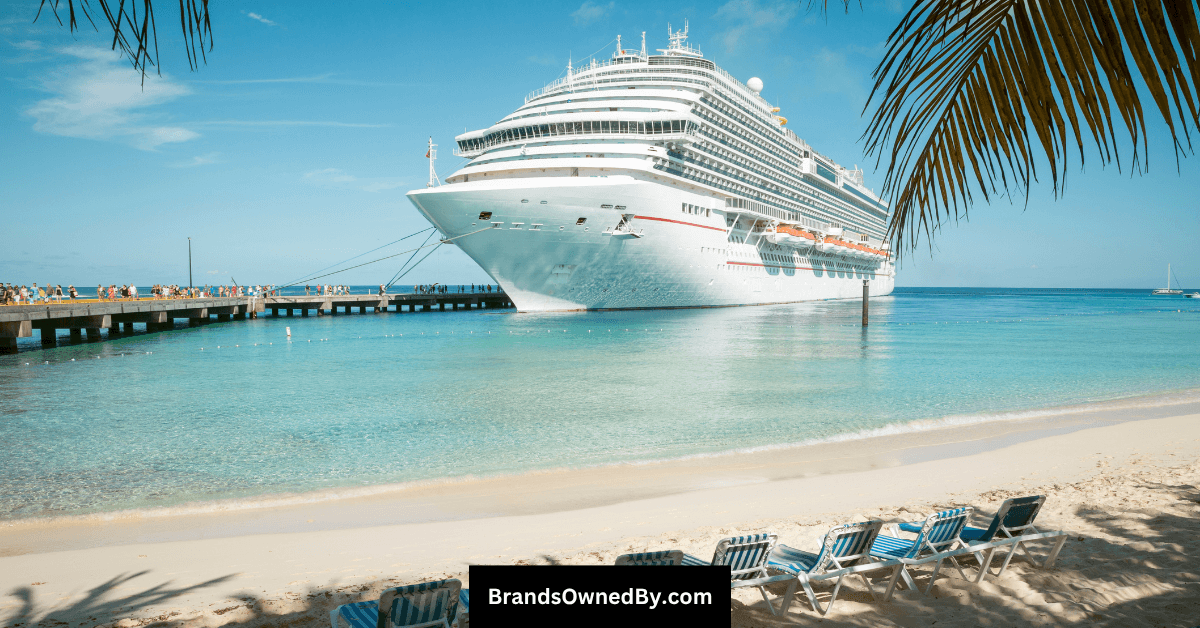

- Carnival Cruise Line is wholly owned by Carnival Corporation & plc, meaning the cruise line is not an independently traded company. Investors gain ownership of Carnival Cruise Line through shares of Carnival Corporation.
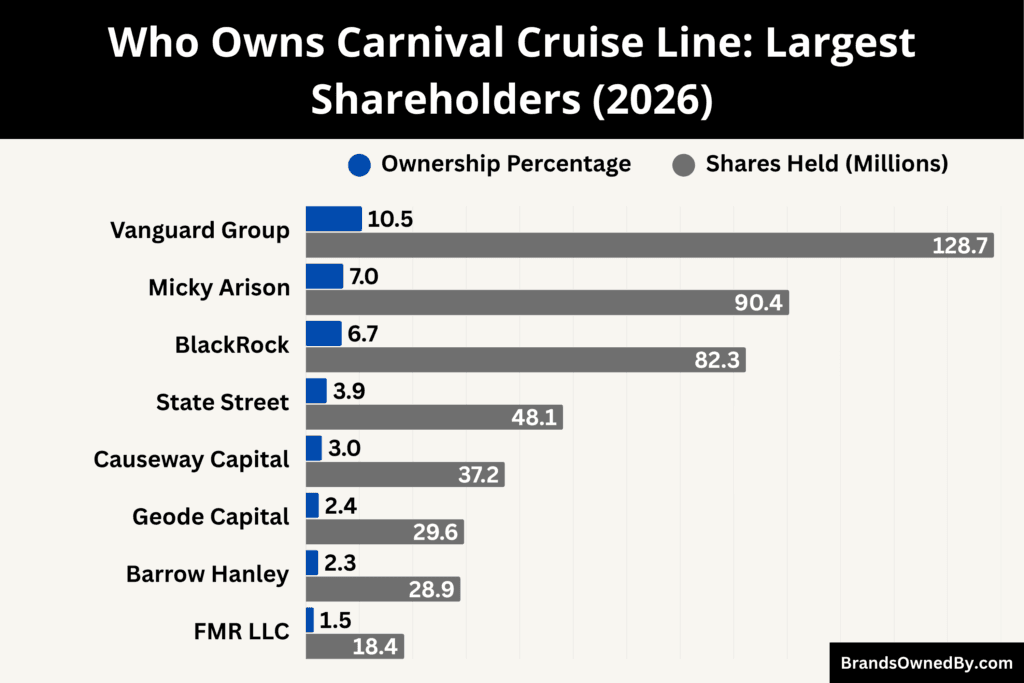
- The largest shareholder of Carnival Corporation as of 2026 is The Vanguard Group with approximately 10.5% ownership, followed by Micky Arison (7.0%), BlackRock (6.7%), and State Street Corporation (3.9%). Together, institutional investors control the majority of the company’s shares.
- Control of Carnival Cruise Line is shared among several stakeholders. Christine Duffy oversees the cruise line’s daily operations, Josh Weinstein leads Carnival Corporation as CEO, and Micky Arison serves as Chairman while remaining the largest individual shareholder.
- Carnival Corporation owns eight major cruise brands, including Carnival Cruise Line, Princess Cruises, Holland America Line, Cunard, Seabourn, Costa Cruises, AIDA Cruises, and P&O Cruises, making it the world’s largest cruise company by passenger volume and fleet size.
Carnival Cruise Line is one of the world’s largest cruise vacation brands and serves as the flagship cruise operator of Carnival Corporation & plc. The company specializes in contemporary cruises that target families, couples, groups, and first-time cruise travelers.
Headquartered in Miami, Florida, Carnival Cruise Line operates a large fleet of ships that visit destinations across North America, the Caribbean, Mexico, Alaska, Europe, and other regions. The brand is widely recognized for offering affordable cruise vacations combined with entertainment, dining, and onboard activities.
Over the decades, Carnival Cruise Line has helped make cruising accessible to a broader audience. Rather than focusing exclusively on luxury travelers, the company built its reputation around value-oriented vacation experiences. This strategy allowed it to attract millions of passengers and become one of the most recognizable names in the cruise industry.
Today, Carnival Cruise Line remains the largest brand within Carnival Corporation’s portfolio and plays a central role in the group’s global operations.
What Does Carnival Cruise Line Do?
Carnival Cruise Line operates vacation cruises aboard a fleet of passenger ships. These cruises combine transportation, accommodation, dining, entertainment, and recreational activities into a single travel package.
The company offers a wide range of itineraries, including:
- Caribbean cruises.
- Bahamas cruises.
- Mexican Riviera cruises.
- Alaska cruises.
- European cruises.
- Transatlantic voyages.
Passengers can choose from short weekend trips to longer international journeys. Onboard amenities typically include restaurants, theaters, water parks, casinos, fitness centers, spas, and family entertainment venues.
The company’s primary focus is on providing affordable and enjoyable cruise vacations for mainstream travelers.
![Who Owns Carnival Cruise Line [infographic]](https://brandsownedby.com/wp-content/uploads/2026/06/Who-Owns-Carnival-Cruise-Line-infographic-683x1024.png)
Carnival Cruise Line Founder
Carnival Cruise Line was founded in 1972 by Ted Arison, an Israeli-American entrepreneur who later became one of the most influential figures in the global cruise industry.
Arison had previous experience in the cruise business before launching Carnival. He believed the industry could attract a much larger customer base if cruises were marketed as affordable vacations rather than exclusive luxury experiences.
The company’s first ship was the Mardi Gras, which was purchased as a used ocean liner and converted into a cruise vessel. Despite facing financial challenges during its early years, Carnival gradually expanded its operations and gained popularity among travelers seeking budget-friendly vacations.
Ted Arison’s vision transformed Carnival from a small startup into a global cruise leader. His emphasis on mass-market cruising helped reshape the entire industry and influenced how cruise vacations are marketed today.
Ted Arison’s Legacy
Ted Arison remained closely involved in the company’s growth for many years. Under his leadership, Carnival expanded its fleet, entered new markets, and became one of the fastest-growing travel companies in the world.
His long-term strategy centered on increasing passenger volume, improving operational efficiency, and making cruise vacations accessible to ordinary consumers. These principles continue to influence Carnival Cruise Line’s business model today.
Even after his passing in 1999, the Arison family’s connection to the company remained strong. Family members have continued to hold significant ownership interests and leadership roles within Carnival Corporation.
Ownership History
The ownership history of Carnival Cruise Line is closely tied to the growth of Carnival Corporation, the parent company that eventually became the world’s largest cruise operator. What started as a single cruise line in the early 1970s evolved into a global cruise empire through public listings, strategic acquisitions, and major corporate mergers.
Founding and Early Ownership (1972–1987)
Carnival Cruise Line was founded in 1972 by Ted Arison. At the time, the company was privately owned and operated as an independent cruise business.
Arison believed the cruise industry could appeal to a much larger audience if cruises were marketed as affordable vacations rather than luxury experiences reserved for wealthy travelers. This vision shaped the company’s business model from the beginning.
During its early years, ownership remained concentrated among Ted Arison and a small group of private investors. The company focused on building its customer base and expanding its fleet despite facing financial and operational challenges.
As Carnival grew in popularity throughout the 1970s and early 1980s, it established itself as one of the leading cruise operators in North America.
Carnival Corporation Goes Public (1987)
A major turning point in the company’s ownership history occurred in 1987 when Carnival Corporation completed its initial public offering (IPO).
The public listing allowed the company to raise substantial capital from investors. These funds were used to expand the fleet, improve operations, and pursue future acquisitions.
After the IPO, ownership shifted from being concentrated among founders and private investors to being distributed among public shareholders. However, Ted Arison remained the company’s dominant shareholder and retained significant influence over strategic decisions.
The public listing also increased the company’s visibility in financial markets and provided access to additional financing opportunities.
Expansion Through Acquisitions (1990s)
Throughout the 1990s, Carnival Corporation pursued an aggressive acquisition strategy that significantly changed its ownership structure and market position.
Rather than relying solely on organic growth, the company acquired established cruise brands to expand its global presence and serve different customer segments.
Some of the most important acquisitions included:
- Holland America Line.
- Windstar Cruises.
- Seabourn Cruise Line.
- Costa Cruises.
These acquisitions transformed Carnival from a single-brand cruise operator into a diversified cruise company with multiple brands targeting different markets.
Ownership of Carnival Cruise Line itself did not change during this period. However, Carnival Corporation became the owner of several additional cruise businesses, increasing its influence across the global cruise industry.
Acquisition of Cunard and Seabourn
One of Carnival’s most notable transactions occurred in 1998 when it acquired Cunard Line and increased its position in the luxury cruise market.
Cunard brought a rich maritime heritage and iconic ships to Carnival’s growing portfolio. The acquisition strengthened Carnival’s presence in premium and luxury cruising while diversifying its customer base.
The deal demonstrated Carnival’s strategy of owning multiple cruise brands rather than relying on a single flagship operation.
The P&O Princess Cruises Merger (2003)
The most significant event in Carnival Cruise Line’s ownership history occurred in 2003.
Carnival Corporation completed a merger with P&O Princess Cruises, one of its largest competitors. The transaction created Carnival Corporation & plc, a dual-listed company structure that still exists today.
Rather than forming a traditional merged corporation, the companies adopted a dual-listed arrangement. Under this structure, Carnival Corporation shares trade in the United States while Carnival plc shares trade in the United Kingdom.
Although the two entities have separate stock listings, they operate as a single economic enterprise with one management team and one board of directors.
This merger significantly expanded Carnival’s global footprint and added several major cruise brands, including:
- Princess Cruises.
- P&O Cruises.
- P&O Cruises Australia.
- AIDA Cruises.
The transaction cemented Carnival’s position as the largest cruise company in the world.
The Arison Family’s Continuing Influence
Even after becoming a publicly traded corporation, the Arison family continued to play a major role in the company’s ownership structure.
Ted Arison’s son, Micky Arison, became one of the most influential figures within Carnival. He served as Chief Executive Officer for many years and later became Chairman of the Board.
Through substantial share ownership, the Arison family maintained significant voting power and influence over major corporate decisions.
Although the company is publicly owned, the family’s long-term involvement has provided continuity in leadership and strategic direction.
Growth of Institutional Ownership
As Carnival Corporation expanded, institutional investors became increasingly important shareholders.
Large asset management firms accumulated significant stakes through mutual funds, pension funds, and exchange-traded funds. Today, ownership is spread across thousands of investors worldwide.
The largest institutional shareholders typically include:
- The Vanguard Group.
- BlackRock.
- State Street Corporation.
These firms do not actively manage day-to-day operations. Instead, they own shares on behalf of millions of individual investors and retirement savers.
The rise of institutional ownership has made Carnival’s shareholder base more diversified than at any point in its history.
Ownership During the COVID-19 Crisis
The COVID-19 pandemic created one of the most challenging periods in Carnival’s history.
With global cruise operations suspended, the company needed to raise substantial amounts of capital to strengthen its financial position and maintain liquidity.
To accomplish this, Carnival issued additional shares and secured financing from investors and lenders. These actions increased the number of outstanding shares and slightly diluted the ownership percentages of existing shareholders.
Despite these changes, Carnival remained under the control of its board of directors and management team, while institutional investors continued to hold significant stakes.
Current Ownership Structure
As of 2026, Carnival Cruise Line remains wholly owned by Carnival Corporation & plc.
The parent company is publicly traded, meaning ownership is distributed among institutional investors, mutual funds, pension funds, retail investors, and company insiders.
No single shareholder owns a majority of the company. However, large investment firms such as Vanguard, BlackRock, and State Street collectively hold significant ownership positions.
The Arison family also remains an important shareholder group and continues to influence the company’s long-term strategic direction.
Today, Carnival Cruise Line operates as the flagship brand within Carnival Corporation’s portfolio, benefiting from the resources, global scale, and ownership structure of the world’s largest cruise company.
Who Owns Carnival Cruise Line: Top Shareholders
Carnival Cruise Line is wholly owned by Carnival Corporation & plc, a publicly traded cruise company that operates some of the world’s most recognized cruise brands. Because Carnival Cruise Line is not independently listed on a stock exchange, its ownership is determined by the shareholders of Carnival Corporation.
As of June 2026, the largest shareholders include The Vanguard Group, Micky Arison, BlackRock, and State Street Corporation. While no single investor owns a majority stake, these shareholders collectively have significant influence over the company’s governance and long-term strategy.
The Vanguard Group
The Vanguard Group is the largest shareholder of Carnival Corporation as of June 2026.
Vanguard owns its shares primarily through index funds, retirement funds, and exchange-traded funds. Because Carnival is included in many broad-market indexes, Vanguard holds shares on behalf of millions of investors worldwide.
Recent filings show Vanguard controls approximately 10% to 11% of Carnival Corporation’s outstanding shares, making it the company’s largest shareholder. The firm owns well over 128 million shares and has continued increasing its position through periodic purchases.
Although Vanguard does not participate in day-to-day management, its voting power gives it significant influence over:
- Director elections.
- Executive compensation policies.
- Corporate governance proposals.
- Major shareholder resolutions.
Because of its size, Vanguard’s voting decisions often influence the outcome of important shareholder matters.
Micky Arison
Micky Arison is the largest individual shareholder of Carnival Corporation and remains one of the most influential figures in the company’s history.
He is the son of Carnival founder Ted Arison and spent decades leading the company. Under his leadership, Carnival expanded through acquisitions and became the world’s largest cruise operator.
As of 2026, Micky Arison owns roughly 6.8% to 7.2% of Carnival Corporation’s outstanding shares, representing more than 90 million shares. This makes him one of the few insiders with substantial ownership.
His ownership position provides significant influence over long-term strategy and major corporate decisions. Even though he is no longer the CEO, he continues to serve as Chairman Emeritus and remains closely associated with the company.
Micky Arison’s stake also represents the continuing involvement of the founding family in Carnival’s ownership structure.
BlackRock
BlackRock is the second-largest institutional shareholder of Carnival Corporation.
The investment management giant holds approximately 6% to 7% of the company’s outstanding shares through its various mutual funds, pension funds, and iShares ETFs. Recent filings indicate ownership of roughly 90 million shares.
Like Vanguard, BlackRock acts primarily as a fiduciary on behalf of clients rather than as an active operator of the business.
BlackRock’s influence stems from:
- It has large voting rights.
- Corporate governance engagement.
- Environmental and sustainability oversight.
- Board accountability initiatives.
Given its size, BlackRock is considered one of the most important institutional stakeholders in Carnival Corporation.
State Street Corporation
State Street is another major shareholder and one of the three dominant institutional investors in Carnival Corporation.
The company owns approximately 3.5% to 4% of outstanding shares through its investment management division and SPDR exchange-traded funds. Its holdings exceed 48 million shares.
State Street’s ownership reflects the widespread inclusion of Carnival stock in large institutional portfolios and index funds.
While it does not participate in daily operations, State Street plays an important role in:
- Shareholder voting.
- Governance oversight.
- Board evaluations.
- Executive accountability.
Together, Vanguard, BlackRock, and State Street control a substantial portion of Carnival Corporation’s voting shares.
Causeway Capital Management
Causeway Capital Management is one of Carnival Corporation’s largest active institutional investors.
The investment firm owns approximately 2.5% to 3% of the company’s shares, representing more than 37 million shares.
Unlike index fund managers, Causeway actively selects investments based on its research and valuation models. Its sizeable position demonstrates confidence in Carnival’s long-term growth prospects and recovery potential.
The firm’s investment has made it one of the most significant non-index shareholders in the company.
Geode Capital Management
Geode Capital Management is another major institutional shareholder.
The firm manages assets for various institutional clients and investment funds. As of 2026, Geode owns more than 29 million shares, representing approximately 2% to 3% of Carnival Corporation.
Much of Geode’s ownership comes from passive investment strategies linked to major stock indexes.
Although less visible than Vanguard or BlackRock, Geode remains one of Carnival’s largest shareholders.
Barrow Hanley Mewhinney & Strauss
Barrow Hanley Mewhinney & Strauss has emerged as another notable shareholder.
The investment management firm owns more than 29 million Carnival shares, representing roughly 2% of the company.
The firm’s investment approach focuses on value-oriented opportunities. Its large ownership position reflects confidence in Carnival’s long-term earnings potential and asset base.
FMR LLC (Fidelity Investments)
FMR LLC, the parent company of Fidelity Investments, also maintains a significant ownership stake.
Fidelity’s various mutual funds and retirement products hold approximately 1% to 2% of Carnival Corporation shares.
As one of the world’s largest asset managers, Fidelity’s investment represents another layer of institutional support for the company.
Retail and Individual Investors
In addition to large institutions, Carnival Corporation has thousands of retail shareholders.
These investors include:
- Individual stockholders.
- Retirement account holders.
- Private wealth clients.
- Employee shareholders.
Collectively, retail investors own a meaningful percentage of the company. However, their ownership is fragmented across a large number of accounts, meaning no individual retail investor has substantial influence over corporate decisions.
Competitor Ownership Comparison
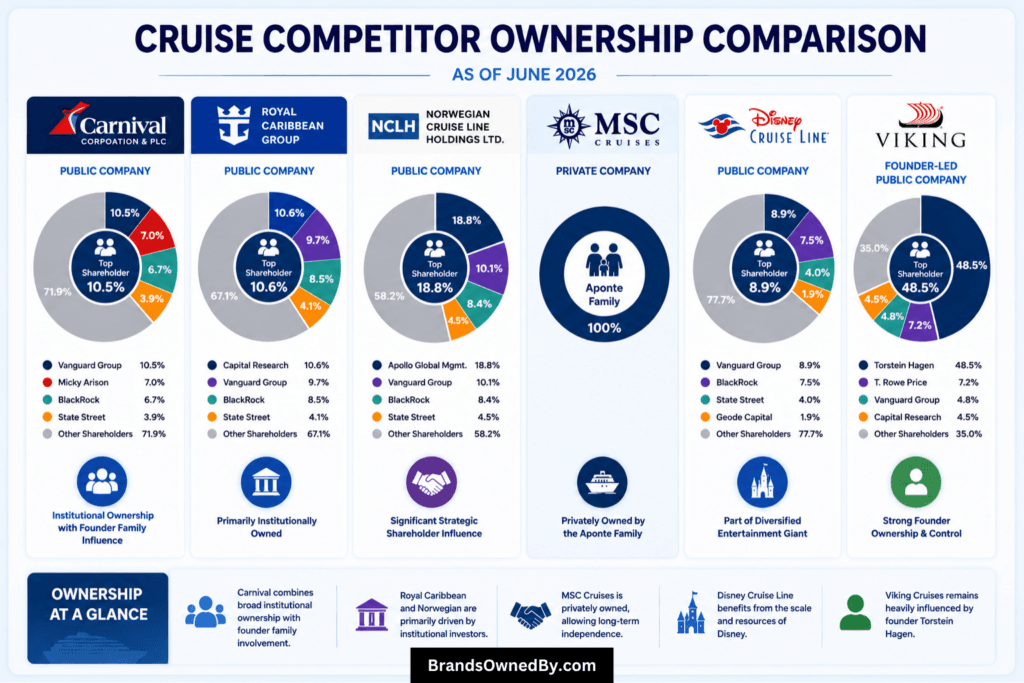
Carnival Cruise Line is the largest brand within Carnival Corporation & plc, but its ownership structure differs significantly from several major cruise competitors. Some rivals are controlled almost entirely by institutional investors, while others remain under family ownership. These differences affect how companies make decisions, raise capital, and pursue long-term growth strategies.
As of June 2026, Carnival Corporation’s largest shareholders include The Vanguard Group, Micky Arison, BlackRock, and State Street Corporation. The company combines broad institutional ownership with continued influence from the Arison family, giving it a unique position within the cruise industry.
Royal Caribbean International
Royal Caribbean International is owned by Royal Caribbean Group, the second-largest cruise company in the world.
Like Carnival Cruise Line, Royal Caribbean International is not a standalone public company. Investors gain ownership through shares of Royal Caribbean Group rather than through the cruise brand itself.
The company’s ownership is dominated by institutional investors. Capital Research Global Investors, Vanguard, BlackRock, and State Street rank among its largest shareholders as of 2026. Unlike Carnival, Royal Caribbean does not have a founding family that continues to hold a major ownership stake.
This creates a different governance model. Strategic decisions are largely influenced by institutional shareholders and the board of directors rather than by a major insider shareholder. Carnival, in contrast, still benefits from the involvement of Micky Arison, whose ownership stake provides continuity with the company’s founding leadership.
Norwegian Cruise Line
Norwegian Cruise Line operates under Norwegian Cruise Line Holdings Ltd., which also owns Oceania Cruises and Regent Seven Seas Cruises.
The company’s ownership structure is more concentrated than Carnival’s. Apollo Global Management remains one of the largest shareholders, reflecting the company’s private-equity history. Vanguard, BlackRock, and other major investment firms also hold substantial positions.
Compared with Carnival, Norwegian has fewer major brands and a smaller overall market presence. Carnival’s shareholder base is generally more diversified, reducing reliance on any single investor. Norwegian’s ownership structure has historically been more influenced by large strategic investors and private-equity interests.
MSC Cruises
MSC Cruises represents the biggest ownership contrast to Carnival Cruise Line.
Unlike Carnival Corporation, MSC Cruises is privately owned by the Aponte family through MSC Group. The company does not have publicly traded shares, institutional shareholders, or quarterly reporting requirements.
This ownership model gives MSC Cruises a significant degree of independence. The Aponte family can make long-term investments without seeking approval from public shareholders or responding to short-term market pressures.
The strategy has worked well for MSC. The company has expanded aggressively in recent years and has become one of Carnival’s fastest-growing competitors, particularly in Europe and North America.
While Carnival answers to millions of shareholders worldwide, MSC remains controlled by a single family.
Disney Cruise Line
Disney Cruise Line operates under The Walt Disney Company.
This creates a very different ownership structure from Carnival. Disney Cruise Line is only one small division within a much larger entertainment company that includes theme parks, movie studios, television networks, streaming services, and consumer products.
The Walt Disney Company’s largest shareholders include Vanguard, BlackRock, and State Street. Because Disney is highly diversified, cruise operations represent only a small portion of the company’s overall business.
As a result, Disney Cruise Line’s strategic priorities are often linked to broader Disney initiatives. Carnival, on the other hand, is entirely focused on cruise operations and maritime tourism.
Viking Cruises
Viking Cruises has one of the most founder-centric ownership structures in the cruise industry.
Unlike Carnival, where ownership is widely distributed among institutions, Viking remains heavily influenced by founder Torstein Hagen. Even after becoming publicly traded, Hagen continues to hold a substantial ownership position and significant voting influence.
This allows Viking to maintain a long-term strategic focus without relying heavily on institutional shareholder support. The company has used this structure to build a strong position in river cruising, luxury ocean voyages, and expedition travel.
Carnival’s ownership is much more dispersed, which creates greater accountability to shareholders but also limits the influence of any single individual.
Which Ownership Model is Strongest?
Each ownership structure offers different advantages.
Carnival benefits from access to public capital markets and support from major institutional investors. The continued involvement of Micky Arison also provides long-term stability and industry expertise.
Royal Caribbean and Norwegian rely more heavily on institutional investors and professional management teams.
MSC Cruises benefits from the flexibility of private ownership, allowing faster decision-making and long-term planning.
Viking enjoys strong founder leadership, while Disney Cruise Line benefits from the financial resources and global brand power of The Walt Disney Company.
Who Controls Carnival Cruise Line?
Carnival Cruise Line is owned by Carnival Corporation & plc, but control of the business is concentrated among a small group of executives, directors, and influential shareholders. The company’s governance structure operates on three levels: brand leadership, corporate leadership, and board oversight.
At the brand level, Carnival Cruise Line is led by President Christine Duffy. At the corporate level, ultimate executive authority rests with Carnival Corporation CEO Josh Weinstein. Above both sits the Board of Directors, chaired by Micky Arison, whose family remains one of the company’s largest shareholders. Together, these groups control strategy, capital allocation, fleet growth, executive appointments, and major business decisions.
Christine Duffy Controls Day-to-Day Operations
Christine Duffy serves as President of Carnival Cruise Line, the largest brand within Carnival Corporation’s portfolio.
She oversees virtually every aspect of the cruise line’s operations, including fleet deployment, marketing, guest experience, onboard operations, pricing strategy, revenue generation, and commercial performance. Carnival Cruise Line operates a fleet of 29 ships and serves nearly six million guests annually, making Duffy the executive directly responsible for the brand’s performance. She reports directly to Carnival Corporation CEO Josh Weinstein.
In practical terms, if Carnival launches a new onboard concept, changes its itinerary strategy, expands into a new market, or adjusts its customer experience initiatives, those decisions typically originate from Duffy and her leadership team.
Josh Weinstein Holds Ultimate Executive Authority
While Christine Duffy runs Carnival Cruise Line, Josh Weinstein has authority over the entire Carnival Corporation organization.
As Chief Executive Officer of Carnival Corporation & plc, Weinstein oversees all eight cruise brands owned by the company, including Carnival Cruise Line, Princess Cruises, Holland America Line, Cunard, Costa Cruises, AIDA Cruises, P&O Cruises, and Seabourn.
His responsibilities include:
- Corporate strategy.
- Capital allocation.
- Fleet investment decisions.
- Major acquisitions and divestitures.
- Financial performance.
- Investor relations.
- Long-term growth planning.
For example, major decisions such as ordering new ships, allocating billions of dollars in capital expenditures, expanding private destinations, or restructuring brands require approval from Weinstein and the corporate leadership team. Recent decisions such as Carnival’s multi-ship order program and portfolio realignment were executed under his leadership.
This makes Weinstein the most powerful executive within the Carnival organization.
Micky Arison Controls Board-Level Influence
Although Micky Arison is no longer the CEO, he remains one of the most influential individuals within Carnival.
He serves as Chair of the Boards of Directors of both Carnival Corporation and Carnival plc. In addition, the Arison family remains one of the company’s largest shareholder groups. As of 2026, the Arison Group controls approximately 6.8% of the combined voting power of Carnival Corporation & plc.
This gives Arison influence in several ways:
- Board leadership.
- Executive oversight.
- Director nominations.
- Governance decisions.
- Long-term strategic direction.
- Shareholder voting matters.
Because he led Carnival for decades and helped transform it into the world’s largest cruise company, his influence extends well beyond his formal title. Major strategic initiatives typically receive scrutiny and guidance from the board he chairs.
The Board of Directors Provides Strategic Oversight
The Board of Directors sits at the top of Carnival’s governance structure.
The board does not manage daily operations. Instead, it oversees management and protects shareholder interests. As of 2026, Carnival’s board includes Micky Arison, Josh Weinstein, and several independent directors with backgrounds in finance, governance, operations, and global business.
The board’s authority includes:
- Appointing and removing the CEO.
- Approving executive compensation.
- Authorizing major ship orders.
- Reviewing mergers and acquisitions.
- Monitoring risk management.
- Approving long-term corporate strategy.
The board operates through specialized committees covering audit, compensation, governance, compliance, and health, environmental, safety, and security matters. These committees review key decisions before they reach the full board for approval.
Financial Control Is Concentrated Within Corporate Leadership
Carnival Cruise Line cannot independently approve major capital expenditures.
Financial authority is centralized at the Carnival Corporation level. David Bernstein, the company’s Chief Financial Officer and Chief Accounting Officer, oversees treasury, accounting, planning, tax, investor relations, technology, sourcing, and capital allocation across the entire corporation. He reports directly to Josh Weinstein.
This means decisions involving:
- New ship construction.
- Debt financing.
- Share repurchases.
- Major investments.
- Corporate restructuring.
are controlled by Carnival Corporation leadership rather than Carnival Cruise Line management alone.
How Shareholders Influence Control
Although institutional investors do not run the company, they influence governance through voting rights.
The largest shareholders include Vanguard, BlackRock, State Street, and the Arison family. Together, these investors control a significant portion of Carnival’s voting power and play an important role in director elections, executive compensation votes, and governance matters.
Institutional investors generally influence policy through board elections and shareholder proposals rather than direct operational involvement.
Carnival Cruise Line Control Structure
The company’s control hierarchy can be summarized as follows:
- Board Level: Micky Arison and the Board of Directors oversee governance, executive accountability, and long-term strategy.
- Corporate Level: Josh Weinstein controls Carnival Corporation’s overall strategy, capital allocation, and portfolio management.
- Brand Level: Christine Duffy manages Carnival Cruise Line’s operations, commercial performance, and customer experience.
- Shareholder Level: Vanguard, BlackRock, State Street, the Arison family, and other investors influence governance through voting power.
Who Ultimately Controls Carnival Cruise Line?
The individual with the greatest operational authority over Carnival Cruise Line is Christine Duffy. The executive with the greatest corporate authority is Josh Weinstein. However, the highest level of oversight rests with the Board of Directors chaired by Micky Arison.
As a result, Carnival Cruise Line is not controlled by a single person. Instead, control is shared among the brand’s leadership team, Carnival Corporation’s executive management, the board of directors, and major shareholders. This governance structure allows the company to balance operational execution, shareholder accountability, and long-term strategic planning.
Carnival Cruise Line Annual Revenue and Net Worth
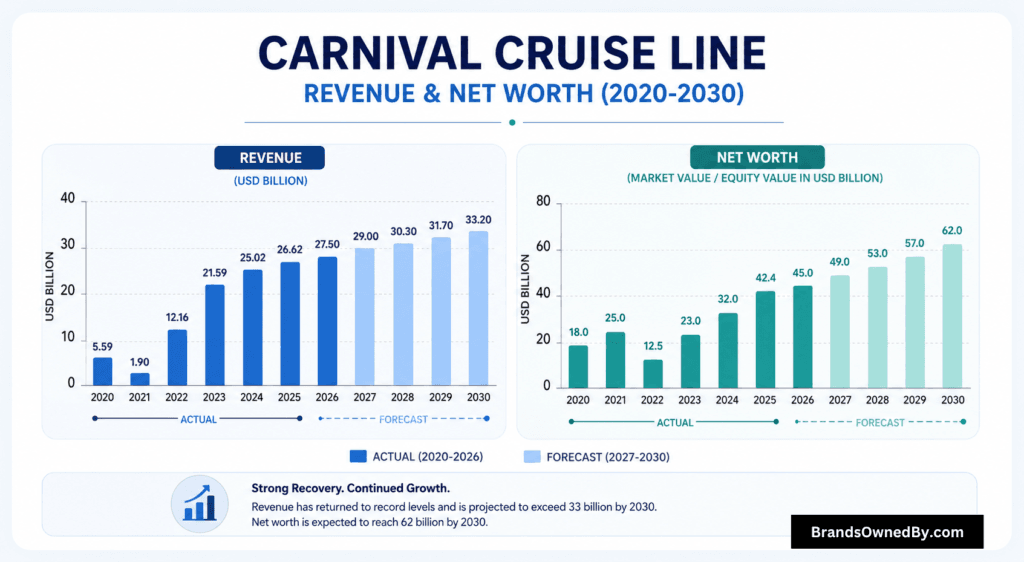
Carnival Cruise Line reports its financial results through parent company Carnival Corporation & plc. As of June 2026, Carnival Corporation generates an estimated $27.5 billion in annual revenue and carries an estimated market value of approximately $45 billion. The company has recovered from the pandemic-era downturn and now exceeds its pre-2020 revenue levels.
The recovery has been driven by record passenger volumes, higher onboard spending, strong booking trends, and improved pricing power across its portfolio of cruise brands. Carnival Cruise Line remains the corporation’s largest brand and contributes a significant portion of total passenger volume and revenue.
Revenue Breakdown by Segment
Carnival’s revenue is generated from two primary sources: passenger ticket revenue and onboard revenue.
Historically, passenger ticket revenue accounts for approximately 72%–75% of total revenue, while onboard and other revenue contributes approximately 25%–28%.
Based on the projected 2026 revenue of $27.5 billion, the revenue mix can be estimated as follows:
| Revenue Segment | Estimated 2026 Revenue | Share of Revenue |
|---|---|---|
| Passenger Ticket Revenue | $20.3 billion | 73.8% |
| Onboard & Other Revenue | $7.2 billion | 26.2% |
| Total Revenue | $27.5 billion | 100% |
Passenger ticket revenue includes cruise fares, suite upgrades, premium cabin packages, and bundled vacation products.
The onboard segment includes spending on casinos, beverage packages, specialty dining, internet access, retail stores, shore excursions, spas, photography services, and entertainment upgrades.
The onboard category is particularly important because it generally carries higher profit margins than ticket sales.
Revenue Per Passenger Analysis
The strength of Carnival’s recovery is not solely driven by passenger growth.
Passenger spending has increased significantly.
With more than 14 million annual passengers expected across Carnival Corporation’s brands in 2026, projected revenue of $27.5 billion implies average revenue generation of approximately $1,960 per passenger.
This figure includes both cruise fares and onboard purchases.
Before the pandemic, average passenger revenue was substantially lower. Increased pricing power and stronger onboard spending have helped drive the company’s earnings recovery.
What Drives Carnival’s Revenue Growth?
Several measurable factors are supporting revenue growth.
Occupancy levels across the fleet have returned to historical highs and frequently exceed 100% because cruise operators calculate occupancy based on double occupancy rather than total cabin capacity.
Carnival has also expanded premium offerings across its brands. Beverage packages, specialty restaurants, luxury suites, exclusive shore excursions, and private-destination experiences generate significantly more revenue than standard cruise fares.
Another major contributor is onboard spending. Over the last several years, onboard revenue has consistently grown faster than passenger ticket revenue, making it one of the company’s most valuable growth drivers.
Carnival Net Worth 2026
The estimated $45 billion net worth figure, as of June 2026, refers to Carnival Corporation’s market capitalization rather than book value.
Investors assign this valuation because of the company’s earnings potential, fleet assets, market leadership, and future cash-flow generation.
Carnival owns one of the largest cruise fleets in the world, consisting of nearly 90 ships spread across multiple brands.
The replacement cost of these vessels alone is estimated to exceed $60 billion, given that many modern cruise ships cost between $800 million and $1.5 billion each to construct.
Beyond ships, Carnival owns valuable intangible and operating assets including:
- Global cruise brands.
- Customer loyalty programs.
- Reservation systems.
- Port infrastructure agreements.
- Private destinations.
- Intellectual property.
- Distribution networks.
These assets create substantial barriers to entry for competitors.
Why Carnival’s Valuation Has Increased
Carnival’s market value increased from approximately $12.5 billion in 2022 to around $45 billion in 2026.
This increase was driven by several factors:
- Revenue more than doubled during the period.
- Net income returned after years of losses.
- Occupancy levels normalized.
- Debt reduction accelerated.
- Booking volumes reached record levels.
Investors also became more confident that cruise demand would remain resilient despite inflation and economic uncertainty.
As a result, Carnival’s valuation expanded significantly.
Revenue and Net Worth Forecast
Carnival’s future revenue growth will depend on fleet expansion, passenger growth, pricing power, and onboard spending trends.
Current forecasts assume annual revenue growth of approximately 4%–6%.
- 2027: Revenue reaches $29.0 billion, supported by continued pricing strength and high occupancy levels.
- 2028: Revenue rises to $30.3 billion as new ships and premium offerings increase passenger spending.
- 2029: Revenue climbs to $31.7 billion, driven by higher onboard revenue and expanding private-destination experiences.
- 2030: Revenue reaches approximately $33.2 billion, representing a gain of $5.7 billion compared with 2026.
Under this scenario, Carnival would generate roughly $121 billion in cumulative revenue between 2027 and 2030 alone.
The projected increase in market value is based on improving profitability, stronger cash flow, and ongoing debt reduction.
- 2027: Net worth reaches approximately $49 billion.
- 2028: Net worth rises to approximately $53 billion.
- 2029: Net worth increases to approximately $57 billion.
- 2030: Net worth reaches approximately $62 billion.
If achieved, Carnival’s market value would grow by roughly $17 billion between 2026 and 2030.
This projection assumes continued earnings growth, stable economic conditions, healthy consumer demand for travel, and successful execution of fleet modernization initiatives.
As of 2026, Carnival Corporation has fully restored revenue beyond pre-pandemic levels and re-established itself as the dominant company in the global cruise industry. With annual revenue approaching $30 billion, onboard revenue exceeding $7 billion annually, a fleet worth tens of billions of dollars, and projected revenue of more than $33 billion by 2030, Carnival remains one of the most financially significant companies in the global leisure travel sector.
Brands Owned by Carnival Cruise Line
Unlike its parent company Carnival Corporation & plc, Carnival Cruise Line does not own a portfolio of separate cruise companies. Instead, the brand operates a fleet of cruise ships, private destinations, vacation programs, entertainment concepts, and guest experience brands that collectively form the Carnival Cruise Line business.
Over the years, Carnival Cruise Line has expanded primarily through fleet growth and destination development rather than through major acquisitions. As of 2026, the company operates several notable brands, programs, and destinations under the Carnival Cruise Line umbrella.
| Entity / Brand | Category | Description | Primary Purpose |
|---|---|---|---|
| Carnival Cruise Line | Cruise Brand | The flagship cruise brand of Carnival Corporation and the largest cruise line by passenger volume. Operates nearly 30 ships across multiple global destinations. | Cruise Operations |
| Celebration Key | Private Destination | Exclusive destination on Grand Bahama developed specifically for Carnival guests. Features beaches, entertainment areas, dining venues, and recreation facilities. | Destination Experience |
| RelaxAway, Half Moon Cay | Private Island Destination | Award-winning private island in The Bahamas used extensively on Carnival itineraries. Known for beaches, excursions, and premium experiences. | Destination Experience |
| Mahogany Bay Cruise Center | Private Cruise Port | Carnival-operated cruise destination in Roatán, Honduras, featuring beach access, retail areas, and excursion facilities. | Port & Destination Operations |
| Carnival Journeys | Cruise Program | Specialized collection of longer voyages including transatlantic, Panama Canal, and unique destination itineraries. | Premium Cruise Experiences |
| Camp Ocean | Youth Program | Children’s activity program offering supervised educational and recreational experiences for younger guests. | Family Entertainment |
| Circle “C” | Youth Program | Dedicated onboard social and entertainment program designed for pre-teen passengers. | Family Entertainment |
| Club O2 | Youth Program | Teen-focused entertainment program featuring social events, games, music, and dedicated lounge areas. | Family Entertainment |
| Cloud 9 Spa | Wellness Brand | Carnival’s onboard spa and wellness concept providing treatments, fitness programs, thermal suites, and beauty services. | Wellness & Spa Services |
| Chef’s Table | Premium Dining Experience | Exclusive culinary experience featuring multi-course meals, chef interactions, and galley tours. | Premium Dining |
| Guy’s Burger Joint | Dining Brand | Signature burger restaurant developed with celebrity chef Guy Fieri and available on many Carnival ships. | Food & Beverage |
| BlueIguana Cantina | Dining Brand | Mexican-inspired dining concept serving tacos, burritos, and fresh casual cuisine onboard. | Food & Beverage |
| BlueIguana Tequila Bar | Beverage Brand | Poolside bar concept specializing in tequila-based cocktails and frozen drinks. | Beverage Services |
| RedFrog Rum Bar | Beverage Brand | Caribbean-themed rum bar offering tropical drinks and island-inspired beverages. | Beverage Services |
| Alchemy Bar | Beverage Brand | Cocktail-focused venue featuring handcrafted drinks prepared by mixologists. | Premium Beverage Services |
| Fahrenheit 555 Steakhouse | Dining Brand | Premium steakhouse concept offering upscale dining experiences and specialty menus. | Premium Dining |
| Bonsai Sushi | Dining Brand | Japanese-inspired sushi restaurant available across many Carnival vessels. | Specialty Dining |
| Bonsai Teppanyaki | Dining Brand | Interactive Japanese dining concept featuring live teppanyaki cooking experiences. | Specialty Dining |
| Seafood Shack | Dining Brand | Casual seafood venue serving lobster rolls, shrimp baskets, and seafood specialties. | Specialty Dining |
| Carnival WaterWorks | Entertainment Brand | Onboard water park concept featuring slides, splash zones, and family attractions. | Family Entertainment |
| Playlist Productions | Entertainment Brand | Carnival’s signature live theater production program featuring music-based performances. | Live Entertainment |
| Punchliner Comedy Club | Entertainment Brand | Dedicated comedy venue featuring stand-up comedians and nightly performances. | Live Entertainment |
| Carnival HUB App | Digital Platform | Mobile application allowing guests to access schedules, reservations, excursions, purchases, and onboard communication. | Digital Services |
| Pixels Photography | Photography Service | Onboard photography operation offering professional cruise photos and digital imaging services. | Guest Services |
| The Fun Shops | Retail Brand | Carnival’s onboard retail network selling duty-free products, souvenirs, jewelry, and luxury goods. | Retail Operations |
Carnival Cruise Line
Carnival Cruise Line is the flagship operating brand.
Founded in 1972, it has grown into the largest cruise brand in the world by passenger volume. The company operates nearly 30 cruise ships serving destinations across North America, the Caribbean, Mexico, Alaska, Europe, Hawaii, and the South Pacific.
The brand focuses on mainstream and family-oriented cruising, offering affordable vacations combined with entertainment, dining, and onboard activities.
Carnival Cruise Line generates billions of dollars in annual revenue and carries millions of passengers each year, making it the largest contributor to Carnival Corporation’s passenger volume.
Celebration Key
Celebration Key is one of Carnival Cruise Line’s most important destination developments.
Located on Grand Bahama Island, Celebration Key was developed exclusively for Carnival guests and represents one of the company’s largest destination investments.
The destination features:
- Private beaches.
- Family recreation areas.
- Adult-only zones.
- Retail and dining venues.
- Water attractions.
- Shore excursion facilities.
Celebration Key was created to provide Carnival with greater control over the guest experience while generating additional revenue from destination spending.
As of 2026, it serves as a major component of Carnival’s Caribbean growth strategy.
RelaxAway, Half Moon Cay
RelaxAway, Half Moon Cay is a private island destination used extensively by Carnival Cruise Line.
Located in The Bahamas, the destination is consistently ranked among the most popular private cruise islands in the world.
The island offers:
- Private beaches.
- Water sports.
- Cabana rentals.
- Nature excursions.
- Family activities.
Although shared with other Carnival Corporation brands, Half Moon Cay remains one of the most valuable destination assets used by Carnival Cruise Line itineraries.
Mahogany Bay Cruise Center
Mahogany Bay is Carnival Cruise Line’s private cruise destination in Roatán, Honduras.
The destination was specifically developed to accommodate Carnival ships and provide guests with a controlled resort-style environment.
Features include:
- Private beach access.
- Retail shopping.
- Restaurants and bars.
- Shore excursion facilities.
- Transportation infrastructure.
The destination helps Carnival capture a larger share of passenger spending while enhancing the overall cruise experience.
Camp Ocean
Camp Ocean is Carnival Cruise Line’s onboard children’s entertainment brand.
The program serves as one of the company’s most important family-focused offerings and caters to children through age-specific activity groups.
The program includes:
- Educational activities.
- Interactive games.
- Arts and crafts.
- Ocean-themed experiences.
- Supervised recreation.
Camp Ocean plays a significant role in attracting family travelers and differentiating Carnival from competitors.
Circle “C”
Circle “C” is Carnival’s dedicated youth program for pre-teens.
The program offers age-appropriate activities, social events, and entertainment experiences designed specifically for younger teenagers.
Circle “C” has become a key component of Carnival’s family-focused cruise strategy.
Club O2
Club O2 is Carnival Cruise Line’s teen entertainment brand.
The program is designed for older teenagers and provides dedicated lounges, social events, games, music experiences, and supervised activities.
Club O2 helps Carnival attract multi-generational families by offering specialized experiences for teenage guests.
Carnival Journeys
Carnival Journeys is a specialized cruise program offering longer and more unique itineraries.
The program includes:
- Transatlantic cruises.
- Panama Canal voyages.
- Extended Caribbean sailings.
- Exotic destination cruises.
These voyages target experienced cruisers seeking destinations and experiences beyond standard vacation itineraries.
Chef’s Table
Chef’s Table is one of Carnival Cruise Line’s premium dining brands.
The experience provides guests with exclusive multi-course meals, behind-the-scenes galley tours, and interactions with senior culinary staff.
Chef’s Table represents Carnival’s effort to expand high-margin premium dining offerings across its fleet.
Cloud 9 Spa
Cloud 9 Spa is Carnival’s wellness and spa brand.
Available across much of the fleet, the concept includes:
- Spa treatments.
- Fitness programs.
- Thermal suites.
- Beauty services.
- Wellness experiences.
Cloud 9 Spa generates substantial onboard revenue while enhancing the guest experience.
Guy’s Burger Joint
Guy’s Burger Joint is one of Carnival’s most recognizable onboard dining brands.
Created in partnership with celebrity chef Guy Fieri, the concept has become a signature feature across much of the fleet.
The venue serves freshly prepared burgers and has become one of the most popular dining experiences onboard Carnival ships.
BlueIguana Cantina
BlueIguana Cantina is Carnival’s Mexican-inspired dining concept.
The venue specializes in tacos, burritos, fresh ingredients, and casual dining experiences.
It has become a core component of Carnival’s onboard food and beverage strategy.
Carnival HUB App
The Carnival HUB App is the company’s digital guest platform.
The application allows passengers to:
- View daily schedules.
- Book excursions.
- Purchase packages.
- Access onboard messaging.
- Make dining reservations.
The platform has become an increasingly important part of Carnival’s customer engagement and onboard revenue strategy.
Final Thoughts
For those asking who owns Carnival Cruise Line, the answer is straightforward. Carnival Cruise Line is fully owned by Carnival Corporation & plc, a publicly traded cruise company that controls some of the world’s most recognized cruise brands.
While ownership is spread among institutional and retail investors, major shareholders such as Vanguard, BlackRock, and State Street hold the largest stakes. Operational control rests with the company’s executives and board of directors. This structure allows Carnival Cruise Line to benefit from the financial strength, global reach, and extensive brand portfolio of one of the largest cruise operators in the world.
FAQs
Who is Carnival owned by?
Carnival Cruise Line is wholly owned by Carnival Corporation & plc, one of the largest cruise companies in the world. The cruise line itself is not publicly traded. Instead, it operates as the flagship brand within Carnival Corporation’s portfolio. Ownership of Carnival Cruise Line is therefore determined by the shareholders of Carnival Corporation, which include major institutional investors such as The Vanguard Group, BlackRock, and State Street, along with individual shareholders including Micky Arison.
What cruise companies are owned by Carnival?
Carnival Cruise Line does not own other cruise companies. However, its parent company, Carnival Corporation & plc, owns several major cruise brands. As of 2026, these include Carnival Cruise Line, Princess Cruises, Holland America Line, Cunard, Seabourn, Costa Cruises, AIDA Cruises, and P&O Cruises. Together, these brands operate nearly 90 ships and serve millions of passengers annually across global markets.
Who is the Carnival Cruise founder?
Carnival Cruise Line was founded in 1972 by Ted Arison, an Israeli-American entrepreneur who is widely regarded as one of the pioneers of the modern cruise industry. Arison launched the company with a single ship, Mardi Gras, and built it into one of the world’s most recognized cruise brands. His vision of offering affordable cruise vacations helped transform cruising from a luxury product into a mainstream travel option.
How many ships are owned by Carnival?
As of 2026, Carnival Cruise Line operates a fleet of approximately 29 cruise ships. These vessels range from smaller legacy ships to some of the largest and most advanced ships in the company’s history, including Mardi Gras, Carnival Celebration, and Carnival Jubilee. Across all brands, parent company Carnival Corporation operates nearly 90 ships, making it the largest cruise operator in the world by fleet size and passenger capacity.
Does Carnival own Cunard?
Yes. Cunard is owned by Carnival Corporation & plc. The luxury cruise line became part of Carnival’s portfolio following the acquisition of Cunard in the late 1990s. Today, Cunard operates as a separate premium brand within Carnival Corporation and is known for iconic ships such as Queen Mary 2, Queen Victoria, Queen Elizabeth, and Queen Anne.
Who is the CEO of Carnival Cruise Line?
As of 2026, Christine Duffy serves as President of Carnival Cruise Line and is responsible for the brand’s day-to-day operations, commercial strategy, guest experience, and fleet deployment. At the parent-company level, Josh Weinstein serves as President and Chief Executive Officer of Carnival Corporation & plc and oversees all of the corporation’s cruise brands worldwide.
Who is the largest shareholder of Carnival?
The Vanguard Group is the largest shareholder of Carnival Corporation as of 2026, owning approximately 10.5% of the company’s outstanding shares. Vanguard holds its stake through various index funds, mutual funds, and exchange-traded funds. The largest individual shareholder is Micky Arison, the son of founder Ted Arison, who owns approximately 7.0% of the company and remains one of the most influential figures in Carnival’s governance and long-term strategy.