
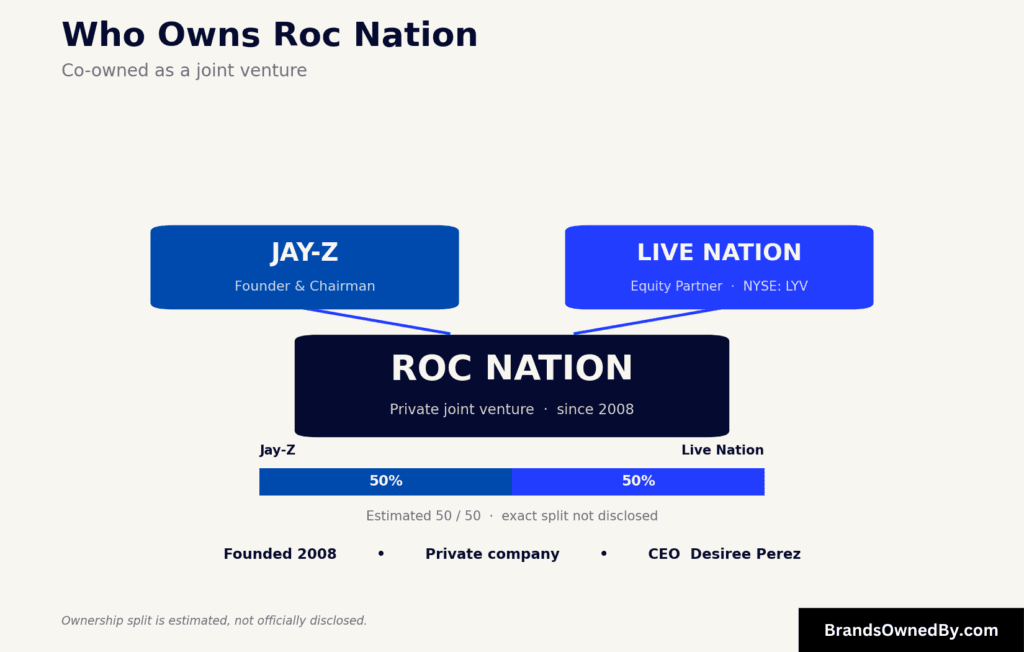
- Roc Nation is co-owned by its founder, Shawn “Jay-Z” Carter, and Live Nation Entertainment, which have run it as a joint venture since 2008.
- The company is private, so the exact ownership split is not disclosed; it is widely described as a roughly 50/50 partnership.
- Jay-Z serves as founder and chairman with control over strategy, while Live Nation is the equity partner providing capital and global touring reach.
- There is no third shareholder at the Roc Nation level; because Live Nation is publicly traded (NYSE: LYV), its own shareholders sit only indirectly above the company.
Roc Nation is an American entertainment company founded in 2008. Jay-Z built it as the successor to his Roc-A-Fella Records era. It is not a single-purpose label. It is a full-service operation that spans several sides of the entertainment business at once. That breadth is central to understanding who owns Roc Nation and why the company matters.
The company works across many disciplines. It runs a record label. It operates a talent and management agency. It handles music publishing, touring, and production. It moves into film and television.
It represents professional athletes through a dedicated sports arm. It also runs distribution, philanthropy, and live events. Internally, the business is organized into a set of distinct verticals, each aimed at a different part of an artist’s or athlete’s career.
Roc Nation is headquartered in New York City. It keeps additional offices in Los Angeles and London. That footprint gives it reach across the United States and into international markets. The London base, in particular, anchors its work in global soccer and rugby.
Who Roc Nation Represents
The client list is a big part of the company’s identity. Its music roster has included Rihanna, Alicia Keys, J Balvin, Megan Thee Stallion, Big Sean, DJ Khaled, and A$AP Rocky. On the sports side, its athletes have included LaMelo Ball, Skylar Diggins, Kevin De Bruyne, and Vinícius Júnior.
The company also holds a long-term partnership with the National Football League and produces the Super Bowl Halftime Show. That mix of music, sports, and live spectacle defines its public profile.
A useful way to frame Roc Nation is as a talent company, not just a label. It earns by representing careers across music, sports, and media. The name on the door says records. The model underneath says management. That distinction shapes everything about how the company is owned and run.
Who Owns Roc Nation
One founder. One public-company partner. A joint venture built over two decades.
How the structure formed
1995 → todayRoc Nation Founders
Roc Nation was founded by Shawn “Jay-Z” Carter in 2008. He is the company’s founder and remains its chairman. This was not his first venture, and that experience showed. By 2008 he had already run a label and led a major one. He built Roc Nation as the next step, designed from the start to be broader than a record company.
The Roc-A-Fella Roots
The founder’s story starts more than a decade earlier. In 1995, Jay-Z co-founded the independent label Roc-A-Fella Records with Damon Dash and Kareem “Biggs” Burke. That label launched his recording career and proved he could own the business, not just perform on it. Roc Nation carries that lineage forward. It is the direct successor to the Roc-A-Fella chapter.
The Def Jam Experience
Between the two ventures, Jay-Z gained executive experience at scale. He served as president of Def Jam Recordings from 2004 to 2007. Running a major label taught him the mechanics of the industry from the inside. He brought that knowledge to Roc Nation when he founded it. This is why the company launched as a full operation rather than a startup label.
The Founding Leadership Team
Jay-Z founded the company, but he did not build it alone. A core group of executives helped shape Roc Nation from its early years. That team has included Desiree Perez, now the chief executive officer, and Jay Brown, who serves as vice chairman and previously led the company as CEO.
Juan Perez has run the sports division. Tyran “Ty Ty” Smith, a longtime Jay-Z associate, was part of the founding group. This bench of operators is a key reason the company scaled beyond music so quickly.
Live Nation, the Founding Partner
One founding relationship sits at the ownership level. When Jay-Z launched Roc Nation in 2008, he did so alongside Live Nation Entertainment. The company was structured as a joint venture from the start.
So while Jay-Z is the founder in creative and public terms, Live Nation has been an ownership partner since day one. That detail links the founders story directly to the ownership story.
Ownership History
The current Roc Nation ownership did not appear overnight. It was built through two decades of deals, one label predecessor, and a single partnership that has held firm. To understand who owns Roc Nation today, you have to trace how the structure formed.
The path runs from an independent record label in the 1990s to a joint venture with a public entertainment giant. Each step locked in the two-party model that still defines the company. Here is how it happened.
How Roc Nation
came to be owned
Roc-A-Fella Records
The independent label that came first.
Roc Nation is born
A touring deal seeds the joint venture. Live Nation is a partner from day one.
The verticals grow
Roc Nation Sports launches. Ownership stays the same.
Partnership renewed
Buyout rumors surface. UMG stake talk is denied. The joint venture continues.
The structure holds
Founder control. Public-company partner. Split stays private.
The Roc-A-Fella Foundation That Preceded It
The Roc Nation ownership story starts before Roc Nation existed. In 1995, unable to land a record deal, Jay-Z co-founded the independent label Roc-A-Fella Records with Damon Dash and Kareem “Biggs” Burke.
That label proved he could own the business, not just the music. He later ran Def Jam as its president from 2004 through 2007. When that chapter closed, he had the relationships and the credibility to build something bigger on his own terms. Roc Nation was the result.
The 2008 Deal That Created Roc Nation
Roc Nation began as a touring deal, not a label launch. In 2008, Jay-Z signed a ten-year, $150 million agreement with Live Nation. He called himself the “Rolling Stones of hip-hop” at the time. That contract did more than fund tours. The original deal included touring, music publishing, the release of three albums, and a joint venture that begat Roc Nation. From the first day, Live Nation was an equity partner. This is the fact that defines who owns Roc Nation. It was never a solo-owned label.
Distribution stayed separate. Universal Music Group served as the distributor for Roc Nation’s recorded music, a relationship rooted in Jay-Z’s Def Jam history. That detail matters later.
Building the Verticals
Through the 2010s, Jay-Z expanded the company far beyond music. He launched Roc Nation Sports in 2013 to represent professional athletes. He added management, publishing, and international divisions. Each new vertical grew the value of the joint venture. None of that expansion changed the core ownership. Jay-Z remained the founder and chairman. Live Nation remained the equity partner beside him.
The 2017 Renewal and the Buyout Rumors
The partnership faced its real test in 2017, when the original deal reached its end. Speculation swirled that Jay-Z might sell Live Nation’s stake. Reports suggested Universal Music Group, the company’s own distributor, could buy in. That would have reshaped the Roc Nation ownership picture entirely.
It did not happen. A representative for UMG said the company was never in talks to purchase Live Nation’s stake. Instead, the two sides renewed. Jay-Z signed a new ten-year, exclusive worldwide pact with Live Nation worth $200 million, covering his touring. Live Nation and Roc Nation continued to handle management and the recorded music side as a joint venture.
Reports of a triggered buy-sell clause, which would have let either side buy the other out, proved unfounded. Sources indicated that was not the case, and Live Nation stayed on. A Live Nation spokesperson stated the company expected to continue as equity partners in Roc Nation for many years to come.
The Live Nation Ownership Layer
Understanding the Roc Nation owner means looking one level up. Live Nation is not a private backer. According to the SEC, Roc Nation is described as a Live Nation Entertainment subsidiary. Live Nation itself is a public company traded on the New York Stock Exchange under the ticker LYV.
Its own register is concentrated. Liberty Media Corporation is the largest single shareholder, holding roughly 30% of Live Nation’s shares. Liberty nominates directors proportional to its stake and holds about 31% voting power.
So Roc Nation’s corporate parent answers, in part, to public shareholders and to Liberty Media. That is a layer most explainers skip.
Where Ownership Stands Now
The structure has held for well over a decade. No public filing or announcement has signaled a change to the two-party arrangement. Jay-Z founded the company and chairs it. Live Nation holds equity as his partner.
The exact split stays private because Roc Nation is a private company. What is documented is the relationship, renewed and reaffirmed across the 2008 and 2017 deals. For anyone tracking Roc Nation ownership, the takeaway is stability. The founder holds control.
The public-company partner holds a stake. That balance is the whole story.
Who Owns Roc Nation: Largest Shareholders
Roc Nation is a private company. It is not listed on any stock exchange. So it has no public share price and no open shareholder register.
Ownership sits with two parties. Shawn “Jay-Z” Carter founded the company. Live Nation Entertainment came in as his partner. Together they have run Roc Nation as a joint venture since 2008.
That two-owner setup is the core answer to who owns Roc Nation. There is no third equity holder above them at the Roc Nation level. The two shareholders are covered below, with their stakes explained.
Shawn “Jay-Z” Carter
Jay-Z is the founder and the individual owner of Roc Nation. He launched it in 2008 and chairs it today.
His exact percentage has never been officially released. The company is private, so the figures stay confidential. The venture has long been described as an even, roughly 50/50 split. On that basis, Jay-Z’s stake is understood to sit near half the company.
His control runs deeper than the equity math. He holds founder control over the brand and the strategy. He is the reason the company exists and its public face. Even at a shared stake, the creative and strategic direction is his.
There is one more wrinkle worth noting. Some social-media claims in 2025 suggested Jay-Z had bought out his partner to own 100% of Roc Nation. Those claims are unverified. No official filing or credible report has confirmed a buyout, and recent authoritative references still describe the company as co-owned.
Live Nation Entertainment
Live Nation is the corporate co-owner of Roc Nation. It has held an equity stake since the 2008 launch. It trades publicly under the ticker LYV.
Its stake is also undisclosed in exact terms. Under the widely cited 50/50 structure, Live Nation’s share is understood to sit near the other half. The company has never published a precise figure, and neither has Jay-Z.
Its role is structural rather than operational. It supplies capital, touring muscle, and global reach. It does not run Roc Nation day to day. When the two sides renewed their deal in 2017, Live Nation stated it expected to remain an equity partner in the company for years to come.
The Ownership Split Explained
The precise percentage split has never been made public. That is normal for a private joint venture. Both owners have kept the exact numbers confidential since 2008.
What is clear is the shape of the deal. It has been treated as an even partnership between the two sides. Jay-Z holds founder control. Live Nation holds a matching equity position.
The split held firm through a key test. When the original deal ended in 2017, reports suggested a buy-sell clause could let one side buy out the other. That clause was not triggered. Speculation that Universal Music Group would buy Live Nation’s stake also proved false. The joint venture simply continued.
So the honest summary on Roc Nation ownership is this. Two shareholders, an understood 50/50 partnership, and a founder who controls the direction regardless of the final decimal. The exact stakes stay private, but the structure is well established.
Competitor Ownership Comparison
Roc Nation’s ownership model is unusual. It pairs a founder with a single public-company partner in a private joint venture. Most of its rivals are owned very differently. They tend to fall into three camps. Some are held by private equity. Some sit under a controlling family or conglomerate. Some trade on public markets with strategic investors on the register. Comparing them shows what makes the Roc Nation ownership structure distinct.
Six companies,
six ways to be owned
The ownership shape says it all.
Creative Artists Agency
CAA is a direct rival in talent and sports representation. Its ownership sits with a family investment company. In 2023, Artémis acquired a majority stake in CAA in a deal valuing the agency at around $7 billion. Artémis is the holding company of French billionaire François-Henri Pinault.
That parent brings a luxury pedigree. Artémis also controls Kering, the group behind Gucci and Saint Laurent, plus the Christie’s auction house. Singapore’s Temasek remains a minority investor. CAA’s leadership, led by Bryan Lourd, stayed on to run the agency.
The contrast with Roc Nation is clear. CAA answers to a luxury-focused family conglomerate. Roc Nation answers to its founder and a live-entertainment partner.
WME Group
WME is the other agency giant, and its ownership recently changed hands. In March 2025, the private equity firm Silver Lake completed a deal to take the parent company private. The transaction valued the business at roughly $25 billion. The former Endeavor was then rebranded as WME Group.
Ari Emanuel moved from chief executive to executive chairman. Co-investors in the deal included Mubadala and the Dell family office. The group holds WME, the IMG licensing business, and other representation assets.
This is a private-equity ownership model. Silver Lake bought the company to manage and eventually exit. Roc Nation, by contrast, was built and held by its founder, not acquired by a fund.
Universal Music Group
UMG is Roc Nation’s longtime distribution partner and a rival on the label side. Its ownership is public and layered. UMG trades on the Euronext Amsterdam exchange.
Several strategic holders anchor the register. The Bolloré family holds close to 18% directly. Vivendi, which the Bolloré family controls, holds around another 10%. A Tencent-led consortium holds roughly 20%. Bill Ackman’s Pershing Square holds about 10%. In early 2026, Pershing Square even made an approach to acquire the whole company.
So UMG is owned by public shareholders and a cluster of strategic stakeholders. That is a far broader base than Roc Nation’s two-owner setup.
Warner Music Group
Warner Music is another of the major labels and a useful comparison. It is publicly listed, but control sits with one owner. Access Industries holds the controlling stake. That is the holding company of billionaire Len Blavatnik.
Access owns most of Warner Music and steers its direction. Public shareholders hold the rest. This gives Warner a single controlling owner behind a public listing.
The parallel to Roc Nation is partial. Both have a dominant controlling figure. But Warner is public, while Roc Nation is fully private.
Sony Music
Sony Music completes the major-label picture. It is not a standalone company. It operates as a division of Sony Group Corporation, the Japanese technology and entertainment conglomerate.
Sony Group is publicly traded. Its music arm sits alongside its electronics, gaming, and film businesses. Ownership therefore flows up through a diversified public parent.
Roc Nation is the opposite in scale and focus. It is a private, entertainment-only venture with two owners, not a unit inside a global conglomerate.
How Roc Nation Compares
Line the rivals up and a pattern appears. CAA sits under a luxury family office. WME sits under private equity. UMG trades publicly with strategic stakeholders. Warner has a controlling owner over a public float. Sony Music is a conglomerate division.
Roc Nation fits none of these molds cleanly. It is privately held. It has a founder who controls direction. And it has one public-company partner holding equity beside him. That hybrid is the defining feature of Roc Nation ownership. Few competitors share it, which is a large part of why the ownership question keeps drawing attention.
Who Controls Roc Nation?
Ownership and control are two different things. Roc Nation is co-owned by Jay-Z and Live Nation. But the people who run it every day are a small leadership team. Understanding who controls Roc Nation means looking at that team, not just the cap table.
The structure is founder-led with a professional chief executive at the helm. Below are the key figures and how decisions move through the company as of mid-2026.
Desiree Perez, Chief Executive Officer
Desiree Perez is the CEO of Roc Nation. She has held the role since 2019. She is also one of the company’s five co-founders, going back to its 2008 launch.
Perez runs the business day-to-day. She oversees every operating vertical, from the record label to management, publishing, touring, film and television, sports, and philanthropy. Before becoming CEO, she served as chief operating officer for a decade.
Her influence is deep and specific. She helped drive the $200 million touring deal with Live Nation. She was central to the NFL partnership. In 2026, she ranked among the top figures on Billboard’s Power 100 list. She is widely described as the engine that runs the company.
Shawn “Jay-Z” Carter, Chairman
Jay-Z is the founder and chairman. He sits above the CEO in the structure. He holds the ultimate strategic and creative voice.
His control is not operational. He does not manage the verticals day to day. He sets the vision, protects the brand, and makes the big strategic calls. In practice, the direction of Roc Nation is his, while the execution runs through Perez.
This split is deliberate. It lets the founder focus on strategy and culture. It lets an experienced operator run the machine.
The Founding Leadership Team
Roc Nation is not controlled by two people alone. Three more co-founders hold senior roles. Together they form the core leadership.
Jay Brown serves as vice chairman. He previously held the CEO title before Perez. He focuses on partnerships and expanding the Roc brand.
Juan Perez is president of Roc Nation Sports. He leads the athlete-representation side of the business. Tyran “Ty Ty” Smith is president of A&R. He guides the company’s talent and music direction.
This bench matters for control. Decisions are spread across a tight group of long-tenured founders, not concentrated in a single office.
How Decisions Get Made
Roc Nation is organized into distinct verticals. Each one covers a different part of a client’s career. The CEO holds oversight across all of them.
Strategy flows from the top. Jay-Z sets direction. Perez turns that direction into operating decisions. The vertical leaders execute within their areas.
The company runs lean for its reach. It employs several hundred people across offices in New York, Los Angeles, London, and São Paulo. That structure keeps decision-making fast and centered on the founding team.
A practical example shows the model at work. When Roc Nation produces the Super Bowl Halftime Show, the creative vision, the artist choice, and the execution all run through this leadership chain. The 2026 show, headlined by Bad Bunny, set global viewership records. That is the control structure delivering a flagship result.
Where Live Nation Fits in
Live Nation is a co-owner, but it does not run Roc Nation. Its role is financial and structural. It provides capital, touring infrastructure, and global reach.
Its influence comes through its equity stake and the touring partnership, not through daily management. The operating decisions stay with the founding team in New York. So while Live Nation shapes the ownership of Roc Nation, control of the business sits firmly with Jay-Z and Desiree Perez.
Roc Nation Annual Revenue and Net Worth
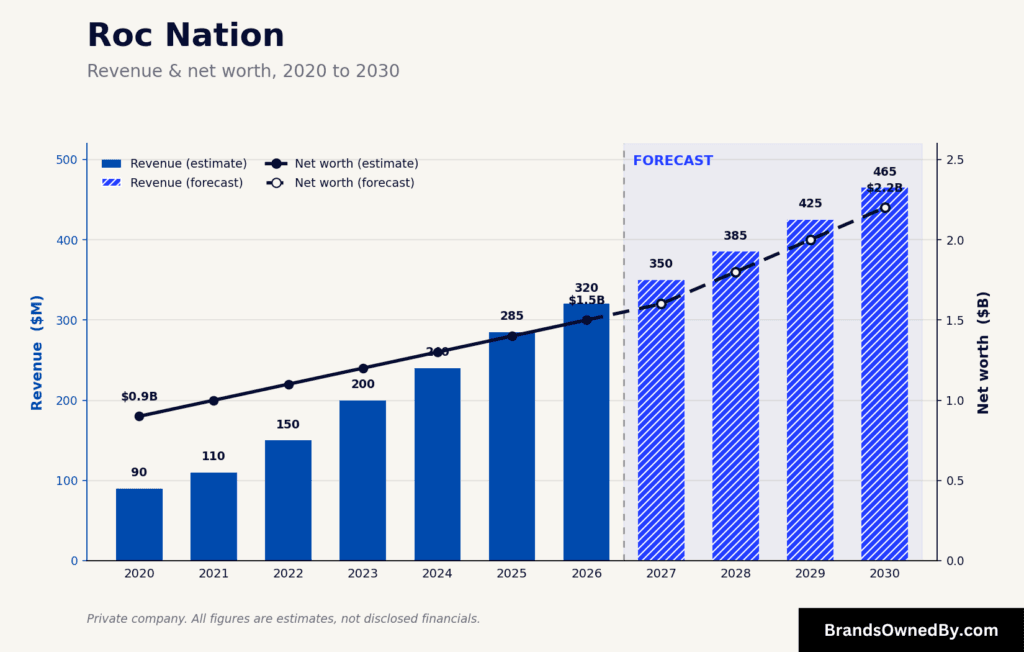
Roc Nation’s estimated revenue in 2026 is around $320 million. Its estimated value, often described as its net worth, sits near $1.5 billion. Both numbers are estimates, not disclosed figures. Roc Nation is a private company, so it does not publish audited financials. What follows breaks the picture down using the best available data.
Roc Nation Revenue in 2026
The company’s 2026 revenue is estimated at roughly $320 million. That marks steady growth from an estimated $285 million in 2025. The trend line has climbed every year since the pandemic dip in 2020.
This figure is a directional estimate, not an audited result. Different trackers produce very different numbers, from tens of millions on the low end to several hundred million on the high end. The mid-range estimate used here reflects the company’s scale across music, sports, and live events. The exact number stays private.
Where the Revenue Comes From
Roc Nation’s revenue splits across several verticals. No single line carries the whole business. This diversification is a core reason the company keeps growing.
Management and music make up the base. Roc Nation earns a percentage of income from a roster of more than 200 artists and athletes. Sports representation adds a second stream, through marketing and endorsement deals for its athletes. Live events form a third, anchored by the NFL partnership and the Super Bowl Halftime Show. Distribution and ventures round out the mix, including the distribution dashboard and the company’s investment activity.
The practical effect of this split is resilience. When touring slows, management and sports hold steady. When one client leaves, hundreds remain. The revenue base does not depend on any single deal.
Roc Nation Net Worth in 2026
Roc Nation’s estimated net worth, meaning its company valuation, is close to $1.5 billion in 2026. As with revenue, this is an estimate. The company has never published a valuation.
Estimates here vary sharply, and the gap is worth understanding. A narrow view of the management company alone lands in the low hundreds of millions. A broader view, applying entertainment-industry revenue multiples to the full operation, exceeds $1.5 billion. The higher figure reflects the value of recurring revenue across a large client base.
Company Value Versus the Founder’s Fortune
There is an important distinction between Roc Nation’s worth and Jay-Z’s personal fortune. The two are often confused. They are not the same.
Roc Nation the company is estimated near $1.5 billion. Jay-Z the individual is estimated between $2.5 billion and $2.8 billion in 2026. His personal net worth is far larger because it includes assets beyond Roc Nation, such as his spirits exits, technology stakes, art, and real estate. Roc Nation is one valuable piece of his portfolio, not the whole of it.
Revenue Forecast to 2030
The projected revenue path for Roc Nation runs as follows.
- 2027: around $350 million in estimated revenue.
- 2028: around $385 million as sports and live events scale.
- 2029: around $425 million on continued client growth.
- 2030: around $465 million, roughly a 45% rise over 2026.
Alongside revenue, the company’s estimated valuation is projected to climb from about $1.5 billion in 2026 toward the $2 billion range by the end of the decade. That trajectory assumes no major disruption and steady expansion across the verticals.
Brands Owned by Roc Nation
Roc Nation is a family of businesses, not a single label. It runs through a set of verticals and subsidiaries, each targeting a different part of an artist’s or athlete’s career. The entities below are owned or operated by Roc Nation directly. They do not include the separate holdings of its parent partner, Live Nation.
One company,
many arms
18 entities across music, sports, ventures, and impact.
Roc Nation Records
Roc Nation Records is the flagship label and the company’s original business. It launched in 2008, with J. Cole as its first signed artist. Today its roster includes names such as Rihanna, Megan Thee Stallion, Alicia Keys, and Lil Uzi Vert. The label sits at the center of the wider entertainment operation.
Roc Nation Management
Roc Nation Management handles artist and talent management across the roster. It guides careers, deals, and brand strategy for musicians and other creators. This division is the engine behind much of the company’s recurring revenue, since it earns a percentage of client income.
Roc Nation Publishing
Roc Nation Publishing manages songwriter and producer catalogs. It helps clients navigate the release and licensing of their work. A Nashville division, added in 2016, extended the business into country and multi-genre publishing.
Roc Nation Distribution
Roc Nation Distribution is the company’s independent distribution arm. It was formed in 2024 by merging Equity Distribution with Roc Nation Records. It lets independent artists distribute music across more than 200 platforms while keeping ownership of their masters. A proprietary dashboard, launched in 2025, gives artists real-time analytics and audience data. Clipse released their first album in sixteen years through this arm in 2025.
Equity Distribution
Equity Distribution was Roc Nation’s independent label and distribution service, launched in 2018. It focused on giving artists reach without giving up their rights. In 2019, it acquired the rights to Jay-Z’s 1996 debut, Reasonable Doubt, for digital release. It was folded into Roc Nation Distribution in the 2024 merger.
Roc Nation Sports
Roc Nation Sports launched in 2013 to represent professional athletes. It applies the same career-building model the company uses for musicians. It handles marketing, endorsements, and brand strategy, and it operates a boxing promotion division. Clients have included LaMelo Ball, Skylar Diggins, Kevin De Bruyne, and Vinícius Júnior.
Roc Nation Sports International
Roc Nation Sports International opened in 2019 with a London office. It anchors the company’s work in global soccer and rugby. It has built content and marketing partnerships across international sport, including tie-ins with the E1 raceboat series and Matchroom Boxing.
Roc Nation Sports Brazil
Roc Nation Sports Brazil launched in 2023 to expand into South American soccer. It gave the company a direct foothold in one of the world’s deepest talent pools. The division brought stars such as Vinícius Júnior into the wider Roc Nation roster.
TFM Agency
TFM was a Brazilian soccer agency that Roc Nation acquired in 2023. The purchase was the foundation of Roc Nation Sports Brazil. It is a clear example of the company buying local expertise to enter a new market rather than building from scratch.
Three Six Zero Entertainment
Three Six Zero Entertainment is a management subsidiary formed in 2015 with the Three Six Zero Group. It represents clients across film, television, and literary work. It broadened Roc Nation’s management reach beyond music.
Roc Nation Latin
Roc Nation Latin launched in 2016 to serve the Latin music market. Romeo Santos was named its chief executive at the start. The venture reflected the company’s push into fast-growing global genres.
Arrive
Arrive is Roc Nation’s in-house venture capital platform. It invests in startups across fintech, insurtech, edtech, gaming, and wellness. By 2024 it had reportedly made dozens of investments, with partner companies spanning Robinhood, Epic Games, and other high-growth names. It lets the company earn beyond entertainment.
Paper Planes
Paper Planes is the streetwear brand associated with the Roc Nation umbrella, trademarked in 2018. It extends the company into apparel and lifestyle. The brand ties the company’s cultural identity to a consumer product line.
Team Roc
Team Roc is the company’s philanthropic and social-justice arm, formed in 2018. It focuses on criminal justice reform, education, and community support. It has mobilized significant funding and helped clients build their own foundations.
United Justice Coalition
The United Justice Coalition grew out of Team Roc’s work. It brings together advisors to promote criminal justice reform and raise awareness of racial justice issues. It reflects the company’s blend of business and advocacy.
Made in America
Made in America is Roc Nation’s flagship live event, first held in Philadelphia in 2012. It has featured a wide range of headliners across genres. The festival anchors the company’s presence in live entertainment.
Roc Nation School of Music, Sports and Entertainment
This is an academic program Roc Nation launched with Long Island University in Brooklyn in 2020. It offers instruction and scholarships in music, sports, and entertainment management. It builds a talent pipeline while extending the brand into education.
Roc Lit 101
Roc Lit 101 is a publishing imprint formed with Random House in 2020. It publishes books on music, sports, pop culture, and activism. It gave the company a foothold in the literary side of entertainment.
Final Thoughts
The short answer to who owns Roc Nation is a partnership. Jay-Z founded and chairs it. Live Nation Entertainment owns an equity stake beside him. The exact split stays private, but the relationship is well documented through their 2008 and 2017 deals. Desiree Perez runs the company as CEO, while Jay-Z holds the strategic reins.
For anyone studying the business, the lesson is structural. Roc Nation is a talent holding company wearing a record-label name. Its value lives in equity and recurring revenue, not in one hit or one tour. That is why the Roc Nation ownership question keeps drawing interest. The company was designed to outlast any single moment, and its co-ownership model is a big reason why.
FAQs
Who owns Roc Nation?
Roc Nation is co-owned by its founder Jay-Z and Live Nation Entertainment. Jay-Z launched the company in 2008 and remains chairman. Live Nation holds an equity stake as his long-term partner. The exact ownership percentages are not public because the company is private.
Is Roc Nation owned by Live Nation?
Partly. Live Nation Entertainment is an equity partner in Roc Nation, and SEC-related filings have described Roc Nation as a Live Nation subsidiary. It is not solely owned by Live Nation. Jay-Z co-owns it and controls its strategic direction as founder and chairman.
Who is the CEO of Roc Nation?
Desiree Perez is the CEO of Roc Nation. She was appointed in December 2019 after serving as chief operating officer since 2009. She oversees the company’s operating verticals across music, sports, and media, while Jay-Z serves as chairman.
Does Jay-Z still own Roc Nation?
Yes. Jay-Z remains the founder and chairman of Roc Nation and holds an ownership position in the joint venture. His 2017 touring deal with Live Nation renewed their partnership, and Live Nation confirmed it expected to stay an equity partner in the company.
How much is Roc Nation worth?
Roc Nation is private, so its value is estimated rather than disclosed. Estimates range from around $140 million to over $1 billion, depending on the revenue multiple used. Annual revenue estimates start above $100 million and run higher when the full sports and management operation is included.
What companies does Roc Nation own?
Roc Nation operates many divisions, including Roc Nation Records, Roc Nation Management, Roc Nation Publishing, Roc Nation Sports, Roc Nation Sports International, ROC Nation distribution, Roc Lit 101, Three Six Zero Entertainment, and Team Roc. It also runs the Made in America festival and produces the Super Bowl Halftime Show.