
- Interscope Records is owned by Universal Music Group (UMG), the world’s largest music company. The label operates under the Interscope Geffen A&M division and is no longer independently owned.
- Universal Music Group acquired Interscope through a series of transactions beginning in 1996, when MCA Inc. purchased a 50% stake. Universal later gained full ownership and integrated the label into its global music portfolio.
- Interscope was founded in 1990 by Jimmy Iovine and Ted Field, but neither founder owns the company today. Ownership resides entirely with Universal Music Group, while day-to-day operations are led by Chairman and CEO John Janick.
- As of 2026, Interscope controls and operates major label brands including Geffen Records, A&M Records, and Lost Highway Records, while also supporting affiliated labels and imprints such as Aftermath Entertainment, Shady Records, Darkroom Records, and KIDinaKORNER. These businesses help make Interscope one of the most influential music organizations in the industry.
Interscope Records is one of the most influential music labels in the world. Founded in 1990, the company built its reputation by signing innovative artists and giving them greater creative freedom than many traditional record labels. This artist-first approach helped Interscope become a dominant force in hip-hop, pop, rock, R&B, alternative, and electronic music.
The label operates under Interscope Geffen A&M, a division of Universal Music Group (UMG), the world’s largest music company. As of 2026, Interscope remains home to many of the industry’s biggest artists, including Billie Eilish, Kendrick Lamar, Lady Gaga, Olivia Rodrigo, Selena Gomez, Playboi Carti, and Imagine Dragons.
What separates Interscope from many competitors is its long history of identifying talent before artists become global stars. The label played a critical role in the rise of Eminem, Dr. Dre, 50 Cent, Lady Gaga, Billie Eilish, and Olivia Rodrigo. Several of these artists became defining figures of their generation and helped shape global music trends.
Today, Interscope’s business extends beyond traditional record releases. The company supports artists through marketing, streaming partnerships, licensing, merchandising, touring support, brand collaborations, and digital fan engagement. Its reach spans major music markets across North America, Europe, Asia, and Latin America.
What Does Interscope Records Do?
Interscope Records provides a wide range of music industry services:
- Artist discovery and development.
- Music recording and production.
- Album and single releases.
- Global distribution.
- Streaming platform partnerships.
- Marketing and promotion.
- Licensing for films, television, and video games.
- Merchandise and brand collaborations.
- Fan engagement and digital strategy.
The company’s role is not limited to releasing music. It helps artists build long-term careers and global audiences.
Interscope Records Founders
Interscope Records was founded in 1990 by music executive Jimmy Iovine and entrepreneur Ted Field. Iovine brought decades of experience in music production and artist management, while Field contributed business expertise and entertainment industry leadership. Their partnership created a label that challenged traditional music industry practices and eventually became one of the most successful record companies in the world.
Jimmy Iovine
Jimmy Iovine is the most recognized founder of Interscope Records and is widely credited with shaping the label’s creative culture.
Before launching Interscope, Iovine worked as a recording engineer and producer for some of the biggest names in music. His credits included Bruce Springsteen, U2, Tom Petty, Patti Smith, Stevie Nicks, and John Lennon. These relationships gave him a deep understanding of artist needs and the music business.
When Iovine co-founded Interscope, he focused on building a label that prioritized artist creativity. This philosophy attracted groundbreaking performers across multiple genres. Under his leadership, Interscope became home to major artists such as Dr. Dre, Tupac Shakur, Eminem, No Doubt, and later Lady Gaga.
Iovine served as the company’s leading executive for more than two decades. In 2014, he stepped down following Apple’s acquisition of Beats Electronics, the audio company he co-founded with Dr. Dre.
Ted Field
Ted Field co-founded Interscope Records alongside Jimmy Iovine and played a critical role in building the company’s business foundation.
Before entering the music industry, Field founded Interscope Communications, a successful film and television production company. His experience in entertainment financing, operations, and corporate strategy helped Interscope compete against much larger record labels during its early years.
While Iovine became the public face of the company, Field worked behind the scenes to secure partnerships, expand operations, and support the label’s rapid growth. His entrepreneurial background provided the financial and organizational structure needed to transform Interscope from a startup label into a major music industry player.
Why the Founders Were Successful
The success of Interscope Records came from the combination of Jimmy Iovine’s creative vision and Ted Field’s business expertise.
Iovine understood artists, music trends, and talent development. Field understood company building, partnerships, and long-term growth. Together, they created a label that was willing to take risks on emerging artists while maintaining a strong commercial strategy.
Many industry analysts consider Interscope one of the most successful independent label launches of the modern music era. The founders’ approach continues to influence the company’s culture and artist development strategy as of 2026.
Ownership History
The ownership history of Interscope Records reflects the transformation of the music industry over the past three decades. What started as an independent record label eventually became part of the world’s largest music company. Several acquisitions, partnerships, and industry mergers shaped the company’s ownership structure and helped turn Interscope into a global music powerhouse.
Here’s an overview of the ownership timeline:
- 1990: Jimmy Iovine and Ted Field founded Interscope Records.
- 1990: Atlantic Records acquired a 50% ownership stake.
- 1995: Warner Music Group sold its interest in the company.
- 1996: MCA Inc. (later Universal Music Group) acquired a 50% stake.
- 1998: Universal gained effective control of Interscope Records.
- 1999: Interscope Geffen A&M was formed following Universal’s industry restructuring.
- 2000s: Interscope became one of Universal’s flagship labels.
- 2014: John Janick replaced Jimmy Iovine as CEO, while ownership remained unchanged.
- 2024: Universal launched the Interscope Capitol Labels Group.
- 2026: Universal Music Group remains the sole owner of Interscope Records.
1990: Interscope Records Was Founded as an Independent Label
Interscope Records was founded in 1990 by Jimmy Iovine and Ted Field.
At launch, the company operated as an independent record label. Jimmy Iovine contributed his extensive experience as a music producer and executive, while Ted Field provided business leadership and financial backing through his entertainment company, Interscope Communications.
The founders wanted to create a label that gave artists more creative freedom than traditional record companies. This approach helped attract musicians looking for greater control over their careers and music.
Unlike many labels at the time, Interscope focused on entrepreneurial decision-making and artist development rather than strict corporate oversight. This strategy allowed the company to grow rapidly during its early years.
1990: Atlantic Records Acquired an Initial Stake
Although Interscope was founded independently, the company needed distribution and industry support to compete with larger record labels.
To achieve this, Atlantic Records acquired a 50% stake in Interscope shortly after its formation. Atlantic was part of Warner Music Group, one of the largest music companies in the world.
This partnership gave Interscope access to distribution networks, marketing resources, and industry relationships while allowing the founders to maintain operational control over the label.
The arrangement proved successful. Interscope quickly gained attention through artists such as Marky Mark and the Funky Bunch, Primus, and later Death Row Records artists.
1995: Warner Music Group Exited the Partnership
By the mid-1990s, Interscope had become one of the fastest-growing labels in the music industry.
However, some of the label’s releases generated controversy. In particular, artists associated with Death Row Records attracted criticism from political groups and advocacy organizations.
As public pressure increased, Warner Music Group decided to sell its ownership interest in Interscope. The company wanted to distance itself from the controversy surrounding certain artists and lyrics.
This decision created uncertainty about the future ownership of Interscope. Despite these challenges, the label continued growing and remained highly valuable due to its artist roster and commercial success.
1996: MCA Inc. and Universal Acquired a Major Stake
A major turning point occurred in 1996 when MCA Inc. purchased a 50% ownership stake in Interscope Records for approximately $200 million.
MCA was the predecessor of Universal Music Group. The acquisition gave Universal a significant presence in the rapidly growing hip-hop and alternative music markets.
For Interscope, the deal provided access to greater financial resources, international distribution, and long-term corporate support.
Importantly, Jimmy Iovine remained deeply involved in the company’s leadership and creative direction. This allowed Interscope to maintain its distinctive culture while benefiting from the resources of a larger parent company.
1998: Universal Acquired Full Control
In 1998, Universal increased its ownership position and effectively gained full control of Interscope Records.
The acquisition occurred during a period of major consolidation within the global music industry. Large music companies were actively purchasing labels and combining operations to strengthen their competitive positions.
Although Interscope became part of Universal’s corporate structure, the label continued operating under its own brand and leadership team.
This ownership arrangement remains largely intact today.
1999: Creation of Interscope Geffen A&M
One of the most significant ownership-related developments occurred in 1999.
After Universal Music Group acquired PolyGram, the company reorganized several record labels. As part of this restructuring, Interscope Records was combined with Geffen Records and A&M Records.
The result was the formation of Interscope Geffen A&M (IGA).
This was not a change in ownership but rather a corporate restructuring designed to improve efficiency and share resources across multiple labels.
Under the new structure:
- Interscope retained its brand identity.
- Geffen continued operating as a separate label.
- A&M Records remained part of the organization.
- Universal Music Group became the ultimate parent company.
The formation of IGA strengthened Universal’s position in the music industry and gave Interscope access to additional talent, executives, and resources.
2000s: Universal Integrated Interscope Into Its Global Network
Throughout the 2000s, Universal Music Group further integrated Interscope into its worldwide operations.
The label became one of Universal’s flagship businesses and played a key role in the company’s growth. During this period, Interscope released music from artists such as Eminem, 50 Cent, The Black Eyed Peas, Gwen Stefani, and Lady Gaga.
Universal’s ownership allowed these artists to benefit from global marketing campaigns, international distribution, licensing opportunities, and growing digital music platforms.
As streaming services emerged, Interscope became one of the industry’s most successful labels in adapting to changing consumer behavior.
2014: Leadership Transition Following Jimmy Iovine’s Departure
Although ownership remained unchanged, 2014 marked an important milestone in Interscope’s history.
Jimmy Iovine stepped down from his executive role after Apple acquired Beats Electronics, the company he co-founded with Dr. Dre.
John Janick succeeded Iovine as Chairman and CEO of Interscope Geffen A&M.
Despite the leadership transition, Universal Music Group retained full ownership of the label and continued supporting its expansion.
The successful transition demonstrated that Interscope had evolved beyond its founders and become an institutional part of Universal’s global music empire.
2024–2026: Interscope Under Universal Music Group
As of 2026, Interscope Records remains wholly owned by Universal Music Group through the Interscope Geffen A&M division.
The label continues to operate as one of UMG’s most important music businesses. It manages a roster that includes some of the world’s biggest artists and remains a major contributor to Universal’s recorded music operations.
In recent years, Universal has further strengthened the label’s position by creating the Interscope Capitol Labels Group under John Janick’s leadership. This expanded management structure oversees multiple labels and artist rosters within UMG’s U.S. operations.
Who Owns Interscope Records?
![who owns Interscope Records [infographic]](https://brandsownedby.com/wp-content/uploads/2026/06/who-owns-Interscope-Records-infographic-683x1024.png)
Interscope Records is owned by Universal Music Group (UMG), the largest music company in the world. The label operates under the Interscope Geffen A&M division, which is one of UMG’s most important recorded music businesses.
Although Interscope was originally founded as an independent record label by Jimmy Iovine and Ted Field in 1990, ownership gradually shifted through a series of strategic investments and acquisitions. Today, Universal Music Group has full ownership and ultimate control over the company.
The ownership structure of Interscope Records is relatively straightforward.
Universal Music Group (UMG) sits at the top of the corporate structure and serves as the ultimate parent company.
Under UMG is Interscope Geffen A&M (IGA), a major label group that manages Interscope Records alongside Geffen Records and A&M Records.
The structure can be summarized as follows:
- Universal Music Group (Parent Company).
- Interscope Geffen A&M.
- Interscope Records.
- Interscope Geffen A&M.
This structure allows Interscope to operate as its own label brand while benefiting from Universal’s global infrastructure, financial resources, distribution network, licensing operations, and marketing capabilities.
Parent Company: Universal Music Group
Universal Music Group is the parent company of Interscope Records.
UMG is one of the three major music companies that dominate the global music industry, alongside Sony Music Entertainment and Warner Music Group. The company owns or controls hundreds of record labels, music publishing businesses, merchandising companies, and artist services organizations.
As of 2026, Universal’s portfolio includes some of the most valuable music brands in the world, including:
- Interscope Records.
- Republic Records.
- Def Jam Recordings.
- Capitol Records.
- Island Records.
- Motown Records.
- Geffen Records.
- A&M Records.
- Virgin Music Group.
Being part of Universal provides Interscope with significant competitive advantages. The label gains access to international distribution channels, streaming partnerships, licensing opportunities, data analytics, and promotional resources that independent labels often cannot match.
How Universal Acquired Interscope Records
The acquisition of Interscope Records was not completed through a single transaction. Instead, Universal gradually increased its ownership over several years.
Initial Investment by MCA
In 1996, MCA Inc., which later became part of Universal Music Group, acquired a 50% ownership stake in Interscope Records.
At the time, Interscope had become one of the fastest-growing labels in the United States. The company had successfully expanded through partnerships with labels such as Death Row Records and had built a strong reputation in hip-hop, alternative music, and rock.
Universal recognized the label’s growth potential and invested approximately $200 million to secure a major ownership position.
The deal provided Interscope with greater financial resources and international reach while allowing Jimmy Iovine to continue leading the company.
Universal Gains Full Control
Following additional transactions and industry consolidation during the late 1990s, Universal eventually gained full ownership and control of Interscope Records.
Rather than completely absorbing the label into its corporate identity, Universal chose to preserve the Interscope brand because of its strong reputation among artists and consumers.
This strategy proved highly successful. Interscope continued attracting major artists while benefiting from Universal’s global infrastructure.
Why Universal Wanted Interscope
The acquisition offered several strategic benefits for Universal Music Group.
Access to Fast-Growing Music Genres
During the 1990s, hip-hop and alternative music were growing rapidly. Interscope had become one of the most influential labels in both markets.
By acquiring Interscope, Universal gained immediate access to some of the industry’s most commercially successful artists and producers.
Strong Executive Leadership
Jimmy Iovine was widely regarded as one of the most respected executives in the music business.
Universal’s investment allowed the company to benefit from Iovine’s artist relationships, industry expertise, and talent development strategy.
Expanding Market Share
The acquisition helped Universal strengthen its position against competitors such as Sony Music and Warner Music Group.
Interscope’s artist roster, combined with Universal’s existing labels, significantly increased the company’s influence across multiple music genres.
The Formation of Interscope Geffen A&M
A major ownership-related development occurred in 1999 after Universal completed its acquisition of PolyGram.
Following the merger, Universal reorganized several record labels and created Interscope Geffen A&M.
This new label group combined:
- Interscope Records.
- Geffen Records.
- A&M Records.
The purpose of the restructuring was to improve operational efficiency and allow the labels to share executive resources, marketing teams, and distribution systems.
Importantly, the individual label brands remained active and continued signing artists independently.
Does Jimmy Iovine Still Own Interscope Records?
No, Jimmy Iovine no longer owns Interscope Records.
Although he co-founded the company and played a central role in its growth, ownership gradually shifted to Universal Music Group through acquisitions and corporate restructuring.
Iovine remained involved in leadership for many years after Universal acquired the label. However, he stepped down from his executive role in 2014 following Apple’s acquisition of Beats Electronics.
Today, Interscope is fully owned by Universal Music Group rather than its founders.
Who Benefits From Interscope’s Ownership Structure?
The current ownership structure benefits multiple stakeholders.
Artists
Artists gain access to Universal’s worldwide distribution network, streaming partnerships, licensing teams, and promotional resources.
For example, artists such as Billie Eilish, Olivia Rodrigo, Lady Gaga, and Kendrick Lamar can release music globally through Universal’s extensive infrastructure.
Universal Music Group
Universal benefits from the commercial success of Interscope’s artist roster and music catalog.
The label consistently contributes hit albums, streaming revenue, licensing income, and market share growth.
Investors
Because Universal Music Group is a publicly traded company, shareholders indirectly benefit from Interscope’s performance through UMG’s overall financial results.
Ownership and Control Are Different
While Universal Music Group owns Interscope Records, day-to-day management is handled by label executives.
Ownership belongs to Universal, but operational decisions are largely made within the Interscope Geffen A&M organization.
John Janick, Chairman and CEO of Interscope Geffen A&M, oversees artist signings, strategic initiatives, label operations, and talent development. Major corporate decisions, however, ultimately align with Universal Music Group’s broader business objectives.
Competitor Ownership Comparison
When analyzing who owns Interscope Records, it is important to compare its ownership structure with those of its largest competitors. As of 2026, the global music industry is largely controlled by three major music companies: Universal Music Group (UMG), Sony Music Entertainment (SME), and Warner Music Group (WMG).
Interscope Records operates under Universal Music Group, while many of its biggest rivals are controlled by Sony Music Entertainment or Warner Music Group. The ownership backing behind each label influences its financial resources, global distribution capabilities, artist development budgets, acquisition strategy, and market reach.
| Record Label | Parent Company | Ultimate Owner | Ownership Structure | Key Competitive Position |
|---|---|---|---|---|
| Interscope Records | Interscope Geffen A&M | Universal Music Group (UMG) | Wholly owned UMG label | Strong presence in pop, hip-hop, alternative, and artist development |
| Republic Records | Universal Music Group | Universal Music Group (UMG) | Wholly owned UMG label | One of the industry’s leading mainstream pop and streaming-focused labels |
| Def Jam Recordings | Universal Music Group | Universal Music Group (UMG) | Wholly owned UMG label | Historically dominant in hip-hop and urban music |
| Capitol Records | Universal Music Group | Universal Music Group (UMG) | Wholly owned UMG label | Major mainstream label with a diverse artist roster |
| Columbia Records | Sony Music Entertainment | Sony Group Corporation | Sony Music subsidiary | One of the oldest and most prestigious labels in the music industry |
| RCA Records | Sony Music Entertainment | Sony Group Corporation | Sony Music subsidiary | Strong competitor in pop, R&B, and commercial music markets |
| Epic Records | Sony Music Entertainment | Sony Group Corporation | Sony Music subsidiary | Focuses on mainstream and contemporary artists |
| Atlantic Records | Warner Music Group | Warner Music Group Corp. | Wholly owned WMG label | Major global competitor across multiple music genres |
| Warner Records | Warner Music Group | Warner Music Group Corp. | Wholly owned WMG label | Core label within Warner’s global music portfolio |
| Elektra Records | Warner Music Group | Warner Music Group Corp. | Wholly owned WMG label | Focuses on contemporary and emerging artists |
Interscope Records vs Republic Records
Republic Records is one of Interscope’s closest competitors despite sharing the same parent company.
Both labels are owned by Universal Music Group and operate as major recorded music businesses within UMG’s global portfolio. While Interscope is known for artists such as Billie Eilish, Kendrick Lamar, Olivia Rodrigo, and Lady Gaga, Republic has built a roster that includes Taylor Swift, Drake, Morgan Wallen, The Weeknd, and Ariana Grande.
From an ownership perspective, neither label has an advantage over the other because both ultimately report to Universal Music Group. However, they often compete internally for artist signings, executive talent, and market share.
The existence of both labels under one parent company demonstrates Universal’s strategy of operating multiple high-profile brands that target different artist communities and music audiences.
Interscope Records vs Columbia Records
Columbia Records is one of Interscope’s most significant external competitors.
Unlike Interscope, Columbia is owned by Sony Music Entertainment, which is itself controlled by Sony Group Corporation. This means Columbia benefits from the broader resources of one of the world’s largest entertainment and technology companies.
Columbia’s artist roster includes major global acts across pop, rock, hip-hop, and country music. The label competes directly with Interscope for chart success, streaming market share, licensing opportunities, and artist recruitment.
The key difference lies in the parent company structure. Interscope receives support from Universal Music Group’s music-focused ecosystem, while Columbia benefits from Sony’s diversified entertainment operations that include gaming, film, electronics, and media businesses.
Interscope Records vs RCA Records
RCA Records is another major competitor owned by Sony Music Entertainment.
As one of Sony’s flagship labels, RCA has developed artists across multiple genres and remains a strong force in contemporary pop and R&B music.
The ownership comparison highlights a larger battle between Universal Music Group and Sony Music Entertainment. While Interscope competes at the label level, the real competition occurs between the parent companies that provide funding, technology, marketing support, and international distribution.
Both labels have access to substantial corporate resources, but they rely on different ownership structures and executive leadership teams.
Interscope Records vs Atlantic Records
Atlantic Records operates under Warner Music Group, making it one of Interscope’s largest competitors outside the Universal ecosystem.
Warner Music Group owns several influential labels and has invested heavily in artist services, digital music technologies, and international expansion. Atlantic serves as one of Warner’s flagship brands and regularly competes with Interscope for major artist signings and streaming performance.
The ownership difference is significant because Warner Music Group is a pure-play music company, similar to Universal Music Group. Unlike Sony, which operates across multiple industries, both Warner and Universal focus primarily on music-related businesses.
This often creates intense competition between Atlantic and Interscope in areas such as artist acquisitions, catalog investments, and global music releases.
Interscope Records vs Def Jam Recordings
Def Jam Recordings represents a unique ownership comparison because it is also owned by Universal Music Group.
Both labels operate within the same corporate family but maintain separate executive teams, artist rosters, and brand identities.
Def Jam remains one of the most recognizable names in hip-hop, while Interscope has built a broader multi-genre presence spanning hip-hop, pop, alternative, and rock music.
Although ownership is identical, the labels often compete internally for artists, resources, and market influence. This strategy allows Universal Music Group to maintain a strong presence across multiple music genres without relying on a single label brand.
Interscope Records vs Capitol Records
Capitol Records is another major label owned by Universal Music Group.
The relationship between Capitol and Interscope became even closer following Universal’s recent organizational changes. As of 2026, both labels operate within the broader Interscope Capitol Labels Group under the leadership of John Janick.
Despite sharing ownership and leadership oversight, each label maintains its own artist roster and market positioning. Capitol focuses on a mix of legacy artists and emerging talent, while Interscope continues emphasizing artist development and mainstream commercial success.
This structure allows Universal to leverage shared resources while preserving the unique identities of both labels.
Which Parent Company Has the Strongest Position?
From an ownership perspective, Universal Music Group remains the strongest parent company in the music industry as of 2026.
UMG controls an extensive portfolio of labels, music publishing assets, distribution networks, artist services businesses, and music catalogs. The company also maintains relationships with major streaming platforms, social media companies, gaming firms, and global entertainment partners.
Sony Music Entertainment remains a powerful competitor because of its backing from Sony Group Corporation. Sony’s broader ecosystem provides additional advantages through film, gaming, and technology businesses.
Warner Music Group is smaller than both Universal and Sony but remains highly competitive due to its focused music strategy and strong catalog assets.
For Interscope Records, being owned by Universal Music Group provides access to the largest global music infrastructure, allowing the label to support artists at virtually every stage of their careers.
Who Controls Interscope Records?
Although Universal Music Group owns Interscope Records, the label’s day-to-day operations are controlled by a dedicated leadership team responsible for artist signings, marketing strategy, business development, label operations, and long-term growth initiatives.
In the music industry, ownership and control are often separate. Universal Music Group provides corporate oversight and strategic direction, while Interscope executives manage the label’s daily activities and creative decisions.
As of 2026, control of Interscope Records is shared between Universal Music Group’s senior leadership and the executives running the Interscope Capitol Labels Group.
John Janick: The Executive Leading Interscope Records
The most influential executive at Interscope Records is John Janick, who serves as Chairman and CEO of Interscope Capitol Labels Group.
Janick is responsible for overseeing Interscope Records and several other major Universal Music Group labels. Since taking over leadership in 2014, he has expanded Interscope’s position as one of the world’s most successful record labels.
Under his leadership, the company has achieved major commercial success through artists such as Billie Eilish, Olivia Rodrigo, Kendrick Lamar, Lady Gaga, Selena Gomez, and Imagine Dragons.
Unlike many label executives who focus primarily on business operations, Janick is heavily involved in artist development, talent acquisition, marketing strategy, and creative decision-making. This hands-on approach has helped Interscope remain competitive in an increasingly digital music market.
Interscope Capitol Labels Group Structure
As of June 2026, Interscope Records operates within the Interscope Capitol Labels Group (ICLG), one of Universal Music Group’s most important recorded music divisions.
The group includes several major label brands, including:
- Interscope Records.
- Capitol Records.
- Geffen Records.
- A&M Records.
- Priority Records.
- Lost Highway Records.
This organizational structure was designed to streamline operations while allowing each label to maintain its unique identity and artist roster.
John Janick oversees the entire group, giving him significant influence over artist strategy, label investments, executive appointments, and business operations across multiple Universal-owned labels.
How Decisions Are Made at Interscope Records
Control of Interscope Records operates through a multi-level management structure.
Label-Level Leadership
At the operational level, Interscope executives manage:
- Artist signings.
- Album release schedules.
- Marketing campaigns.
- Brand partnerships.
- Touring support initiatives.
- Streaming strategies.
- Licensing opportunities.
- Talent development programs.
These decisions are generally made within the label organization without requiring approval from Universal Music Group’s corporate leadership.
This structure allows Interscope to respond quickly to industry trends and artist needs.
Division-Level Management
Because Interscope is part of the Interscope Capitol Labels Group, certain strategic decisions are coordinated across multiple labels.
Examples include:
- Resource allocation.
- Executive hiring.
- Shared marketing initiatives.
- Technology investments.
- Distribution strategies.
- Cross-label collaborations.
This level of management ensures that the labels within the group operate efficiently while maintaining separate identities.
Corporate-Level Oversight
At the highest level, Universal Music Group provides corporate governance and long-term strategic direction.
Major decisions involving acquisitions, significant investments, organizational restructuring, executive leadership appointments, and corporate partnerships are typically reviewed at the UMG level.
This oversight helps align Interscope’s operations with Universal’s global objectives.
The Role of Sir Lucian Grainge
While John Janick controls the label’s daily operations, the most powerful executive above Interscope is Sir Lucian Grainge, Chairman and CEO of Universal Music Group.
Grainge oversees UMG’s worldwide business, including:
- Recorded music operations.
- Music publishing.
- Global distribution.
- Licensing activities.
- Catalog acquisitions.
- Strategic investments.
- International expansion.
Because Universal Music Group owns Interscope Records, Grainge ultimately has authority over the label through UMG’s corporate structure.
Many major strategic decisions affecting Interscope’s future are influenced by Universal’s executive leadership team under Grainge’s direction.
The Importance of A&R Leadership
One of the most important sources of influence within Interscope is its Artist & Repertoire (A&R) organization.
A&R executives are responsible for discovering talent, evaluating new artists, negotiating recording agreements, and guiding creative development.
In many ways, A&R teams help determine the future success of the label because they decide which artists receive investment and support.
Interscope has historically built its reputation through strong A&R leadership, helping identify artists before they become mainstream stars.
This remains a critical part of the label’s control structure in 2026.
Who Ultimately Controls Interscope Records?
Control of Interscope Records can be viewed across three levels:
Operational Control
John Janick and the Interscope Capitol Labels Group leadership team oversee daily operations, artist strategy, marketing initiatives, and business development.
Strategic Control
Universal Music Group executives establish long-term objectives, approve major investments, and oversee significant corporate decisions.
Ultimate Corporate Authority
Universal Music Group’s Board of Directors and Chairman & CEO Sir Lucian Grainge hold ultimate authority over the company and its subsidiaries, including Interscope Records.
Interscope Records Annual Revenue and Net Worth
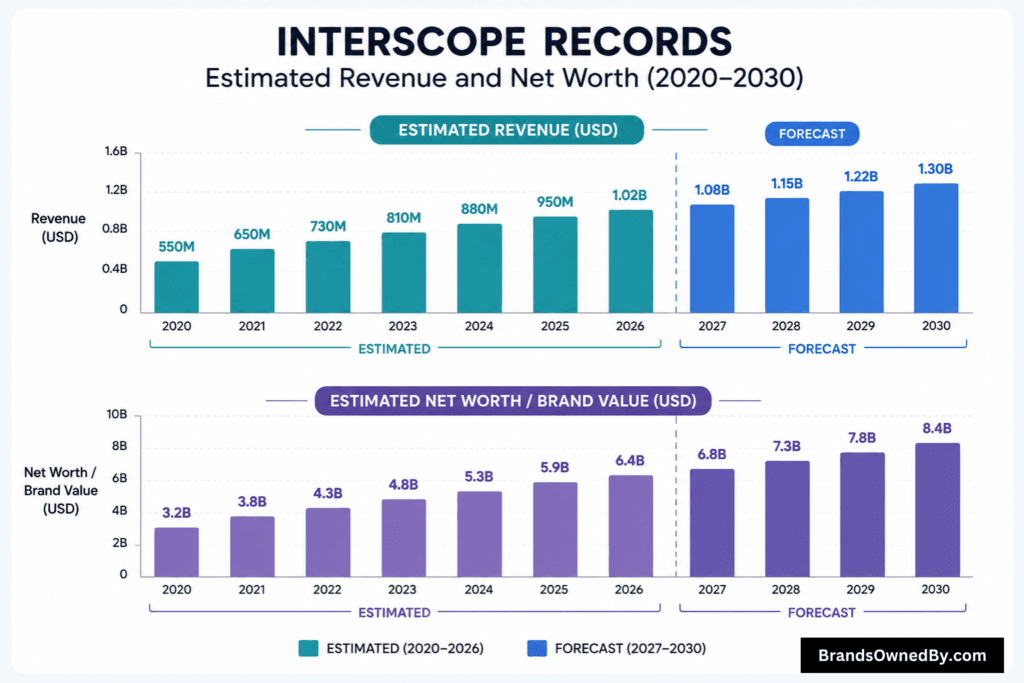
As of June 2026, Interscope Records is estimated to generate more than $1 billion in annual revenue and have an estimated enterprise value of approximately $6.4 billion. Although the label does not release standalone financial statements, industry analysts consistently rank it among Universal Music Group’s most valuable music assets.
The label’s financial strength comes from its extensive catalog, streaming royalties, licensing agreements, artist partnerships, and ownership of some of the most commercially successful recordings of the past three decades.
Revenue in 2026
Interscope Records is estimated to generate approximately $1.02 billion in revenue during 2026.
Unlike traditional record labels that once relied heavily on physical album sales, modern music companies generate income from multiple revenue streams. Streaming remains the largest contributor, supported by platforms such as Spotify, Apple Music, YouTube Music, Amazon Music, Tencent Music, and Deezer.
Additional revenue is generated through music licensing, synchronization rights, merchandise partnerships, artist services, digital downloads, and catalog royalties.
The label’s roster includes some of the most streamed artists in the world. Billie Eilish, Olivia Rodrigo, Kendrick Lamar, Lady Gaga, Selena Gomez, and Imagine Dragons collectively generate billions of streams annually, creating substantial recurring royalty income.
Revenue Growth Since 2020
The streaming boom has significantly increased the value of music catalogs and record labels.
In 2020, Interscope’s estimated annual revenue stood at approximately $550 million. Continued growth in global streaming subscriptions, expanding international markets, and strong catalog performance helped increase revenue to an estimated $1.02 billion in 2026.
This represents estimated growth of more than 85% over six years.
Below are the major drivers of revenue:
Streaming Revenue
Streaming remains the largest source of income for Interscope Records.
Every stream generated on platforms such as Spotify, Apple Music, YouTube Music, Amazon Music, and TikTok contributes to royalty revenue. Because Interscope controls recordings from numerous globally successful artists, the company benefits from both new releases and older catalog streams.
Catalog Royalties
One of Interscope’s biggest financial advantages is its music catalog.
Songs from artists such as Eminem, Lady Gaga, Imagine Dragons, and other major acts continue generating royalties years after release. These recurring revenues create a stable financial foundation for the company.
Licensing and Synchronization
Interscope recordings are frequently licensed for films, television shows, advertisements, sporting events, and video games.
These agreements often generate high-margin revenue while simultaneously increasing exposure for artists and catalog content.
Artist and Brand Partnerships
The label also benefits from partnerships between artists and major consumer brands.
These agreements can include sponsorships, promotional campaigns, exclusive content arrangements, and merchandise collaborations.
Net Worth in 2026
As of June 2026, Interscope Records is estimated to have a net worth of approximately $6.4 billion.
The valuation reflects much more than annual revenue. It includes the value of music rights, intellectual property, future royalty streams, artist contracts, licensing agreements, and the strength of the Interscope brand itself.
Music catalogs have become highly valuable assets in recent years because they produce recurring cash flow. Investors increasingly view successful catalogs as long-term income-generating assets similar to real estate or infrastructure investments.
Below are the key assets that drive its value and net worth:
Music Catalog
The company’s catalog is its most valuable asset.
Thousands of recordings continue generating income through streaming, radio play, licensing deals, and commercial partnerships.
Artist Roster
Interscope’s roster includes some of the most commercially successful artists in modern music.
The ability to attract and retain top talent significantly increases the company’s long-term value.
Global Distribution Network
As part of Universal Music Group, Interscope benefits from one of the largest music distribution systems in the world.
This infrastructure allows artists to reach audiences across virtually every major music market.
Brand Recognition
Interscope has spent more than three decades building one of the strongest brands in the music industry.
Its reputation for discovering and developing talent contributes significantly to its overall value.
Revenue and Net Worth Forecast
Based on current industry growth trends, Interscope’s revenue is expected to continue increasing over the remainder of the decade.
- 2027: Estimated revenue of $1.08 billion.
- 2028: Estimated revenue of $1.15 billion.
- 2029: Estimated revenue of $1.22 billion.
- 2030: Estimated revenue of $1.30 billion.
The increasing value of music rights and recurring royalty streams is expected to support future valuation growth.
- 2027: Estimated net worth of $6.8 billion.
- 2028: Estimated net worth of $7.3 billion.
- 2029: Estimated net worth of $7.8 billion.
- 2030: Estimated net worth of $8.4 billion.
The long-term outlook for Interscope Records remains strong. Growth in paid streaming subscriptions, expansion into emerging music markets, increased licensing opportunities, and continued catalog monetization are expected to support revenue growth throughout the remainder of the decade. As one of Universal Music Group’s flagship labels, Interscope is positioned to remain one of the most valuable brands in the global music industry.
Labels Owned by Interscope Records
As of 2026, Interscope Records operates as the flagship label within the Interscope Geffen A&M organization. While many music fans associate Interscope primarily with its artists, the company also manages several label brands, imprint partnerships, and specialized music businesses across multiple genres.
It is important to distinguish between assets controlled by Interscope and those owned directly by Universal Music Group. The labels below are either operated directly by Interscope, managed through Interscope Geffen A&M, or function as active imprint partnerships within the Interscope ecosystem.
| Label | Founded | Genre Focus | Relationship with Interscope | Notable Artists |
|---|---|---|---|---|
| Geffen Records | 1980 | Pop, Rock, Alternative, Hip-Hop | Operates as a frontline label within Interscope Geffen A&M | Olivia Rodrigo, YUNGBLUD, Lil Durk |
| A&M Records | 1962 | Pop, Alternative, Rock | Relaunched and managed under Interscope Geffen A&M | Blackbear, Soundtrack projects, emerging artists |
| Lost Highway Records | 2000 (Relaunched 2025) | Country, Americana, Folk, Roots | Operated by Interscope as a specialized country-focused label | Focuses on new country and Americana artists |
| Priority Records | 1985 | Hip-Hop, Rap, Urban Music | Operates as a strategic hip-hop label brand within Interscope | Legacy releases from N.W.A., Ice Cube and special projects |
| Aftermath Entertainment | 1996 | Hip-Hop, Rap | Distributed and supported by Interscope | Dr. Dre, Eminem, Anderson .Paak |
| Darkroom Records | 2014 | Alternative Pop, Indie Pop | Operates through Interscope distribution and marketing | Billie Eilish, FINNEAS |
| KIDinaKORNER | 2011 | Alternative Rock, Pop Rock | Imprint partnership within Interscope | Imagine Dragons, X Ambassadors |
| Mosley Music Group | 2006 | Pop, R&B, Hip-Hop | Operates through Interscope’s distribution network | Timbaland-associated artists |
| Shady Records | 1999 | Hip-Hop, Rap | Distributed through Interscope and Aftermath | Eminem, Westside Boogie, Grip |
| Top Dawg Entertainment (TDE) | 2004 | Hip-Hop, R&B | Long-term distribution partnership with Interscope | SZA, Schoolboy Q, Jay Rock, Ab-Soul |
| AWGE | 2014 | Hip-Hop, Fashion, Creative Media | Operates through Interscope partnership | A$AP Rocky and AWGE-affiliated artists |
Geffen Records
Geffen Records is one of the most important labels operating under Interscope Geffen A&M.
Originally founded in 1980 by entertainment executive David Geffen, the label has a long history of signing influential artists across rock, alternative, pop, and hip-hop music. After Universal Music Group reorganized its label operations, Geffen became part of the Interscope Geffen A&M structure.
Today, Geffen functions as a frontline label with its own artist roster, marketing teams, and A&R operations while benefiting from Interscope’s distribution and infrastructure. The label continues to release music from both established and emerging artists, making it one of the most valuable brands within the Interscope organization.
A&M Records
A&M Records is another major label operating under Interscope’s management structure.
Founded by Herb Alpert and Jerry Moss in 1962, A&M became one of the most successful independent labels in music history before eventually becoming part of Universal Music Group. After years of operating primarily as a catalog brand, A&M was officially relaunched as an active frontline label under Interscope’s leadership.
The relaunch allows A&M to sign and develop new artists while leveraging Interscope’s resources and industry relationships. As of 2026, the label continues expanding its roster under the broader Interscope Capitol Labels Group structure.
Lost Highway Records
Lost Highway Records is one of the newest additions to Interscope’s active label portfolio.
In 2025, Interscope Geffen A&M relaunched the iconic Nashville-based label after more than a decade of inactivity. The relaunch was designed to focus on country, Americana, folk, and roots-oriented artists while maintaining the creative independence that originally made Lost Highway successful.
The revived label operates with dedicated leadership in Nashville and works closely with the Interscope organization on artist development, marketing, and distribution. The return of Lost Highway also strengthens Interscope’s presence in the country music market.
Aftermath Entertainment
Aftermath Entertainment is one of the most commercially successful labels associated with Interscope.
Founded by Dr. Dre in 1996, Aftermath operates as an imprint partnership distributed and supported by Interscope. The label helped launch the careers of artists such as Eminem, 50 Cent, and Kendrick Lamar.
Although Aftermath maintains its own brand identity and leadership, Interscope handles many of the business functions that support the label’s releases. The partnership remains one of the most successful relationships in the music industry.
Darkroom Records
Darkroom Records is a modern imprint operating within the Interscope system.
The label gained widespread recognition through its partnership with Billie Eilish and FINNEAS. Darkroom focuses heavily on artist development, digital marketing, and streaming-driven growth strategies.
Its success has demonstrated Interscope’s ability to identify emerging music trends and build commercially successful artists through innovative marketing approaches.
KIDinaKORNER
KIDinaKORNER is a specialized music imprint founded by producer and music executive Alex da Kid.
The label has developed artists across alternative, pop, and rock genres and is best known for its relationship with Imagine Dragons.
Through its partnership with Interscope, KIDinaKORNER benefits from global distribution, promotion, and artist development support while maintaining its own creative identity.
Mosley Music Group
Mosley Music Group was founded by Grammy-winning producer Timbaland.
The label operates through a partnership with Interscope and has been responsible for developing artists across pop, hip-hop, and R&B music.
Over the years, Mosley Music Group has released music from several successful artists while benefiting from Interscope’s marketing and distribution infrastructure.
Shady Records
Shady Records is the label co-founded by Eminem and Paul Rosenberg.
The imprint maintains a close relationship with Interscope through distribution and operational support. Over the years, the label has signed and developed multiple hip-hop artists while remaining one of the most recognizable brands in rap music.
Its connection with Eminem has helped make it one of the most commercially successful imprint partnerships within the Interscope ecosystem.
Top Dawg Entertainment
Top Dawg Entertainment (TDE) has maintained a long-standing distribution relationship with Interscope.
The label became one of the most respected names in hip-hop through artists such as Kendrick Lamar, Schoolboy Q, Jay Rock, Ab-Soul, and SZA.
While TDE operates independently, its partnership with Interscope has helped expand its global reach and commercial success.
Dreamville Records
Dreamville Records, founded by J. Cole and Ibrahim Hamad, has worked with Interscope through distribution and strategic partnerships.
The label has developed a strong roster of hip-hop artists and has become one of the fastest-growing independent brands in rap music.
Its relationship with Interscope provides access to broader marketing, licensing, and distribution capabilities.
AWGE
AWGE is the creative collective and label founded by A$AP Rocky.
The imprint operates within the Interscope network and combines music, fashion, visual media, and artist development under a single brand.
AWGE’s unique structure reflects Interscope’s willingness to support non-traditional music businesses and creative ventures.
Streamline Records
Streamline Records is a pop-focused imprint that has worked closely with Interscope for many years.
The label is best known for its association with Lady Gaga’s early career and has played a role in several successful pop music releases.
Its partnership with Interscope provides the scale necessary to support global artist launches and major commercial campaigns.
Brands and Business Assets Operated by Interscope
Beyond record labels, Interscope also operates several commercial businesses and brand assets.
Interscope Records Brand
The Interscope Records name itself is one of the most valuable assets within the company. The brand has been active since 1990 and is recognized globally across the music industry.
The label’s reputation for artist development and creative freedom continues to attract major talent and industry partnerships.
Interscope Official Store
Interscope operates its own direct-to-consumer merchandise and music retail platform.
The store sells vinyl records, CDs, apparel, collectibles, limited-edition releases, soundtracks, and artist merchandise. This business allows the company to generate revenue directly from fans while strengthening artist engagement.
Interscope Capitol Labels Group
Although technically an operating division, the Interscope Capitol Labels Group serves as one of the company’s most important business assets.
Conclusion
For anyone asking who owns Interscope Records, the answer is Universal Music Group. What began as an independent label founded by Jimmy Iovine and Ted Field has evolved into one of the most powerful brands in the global music industry. Through its position within Interscope Geffen A&M and the broader Universal Music Group network, Interscope continues to shape popular music, develop superstar artists, and generate billions of streams worldwide. Its combination of creative freedom, strong artist relationships, and corporate backing has helped it remain a dominant force for more than three decades.
FAQs
When did Universal Music Group buy Interscope Records?
Universal Music Group began acquiring Interscope Records in 1996 when MCA Inc. (Universal’s predecessor) purchased a 50% stake in the company for approximately $200 million. Universal later increased its ownership and gained full control of the label during the late 1990s. Today, Interscope Records is wholly owned by Universal Music Group through the Interscope Geffen A&M division.
Where is Interscope Records located?
Interscope Records is headquartered in Santa Monica, California, United States. The label’s offices are located in the Los Angeles area, which serves as one of the world’s most important centers for the music and entertainment industries.
When did Interscope Records start?
Interscope Records was founded in 1990 by Jimmy Iovine and Ted Field. The company was created to provide artists with greater creative freedom and quickly became one of the fastest-growing record labels in the music industry.
Who is the CEO of Interscope Records?
As of 2026, John Janick serves as Chairman and CEO of Interscope Capitol Labels Group, which includes Interscope Records, Capitol Records, Geffen Records, A&M Records, Priority Records, and Lost Highway Records. He has led Interscope since 2014, succeeding co-founder Jimmy Iovine.
Is 50 Cent still signed to Interscope?
No, 50 Cent is not currently signed directly to Interscope Records. His breakthrough albums were released through Shady Records, Aftermath Entertainment, and Interscope Records during the 2000s. However, his recording agreements with those labels have largely concluded, and he now focuses primarily on his television, film, and business ventures.
Is Eminem signed to Interscope?
Yes, Eminem remains associated with Interscope through his long-standing relationship with Aftermath Entertainment and Shady Records. Interscope continues to distribute and support releases connected to these labels, making the company an important part of Eminem’s recording career.
Is Kendrick Lamar still with Interscope?
No. Kendrick Lamar is no longer signed to Interscope Records. He departed Top Dawg Entertainment (TDE) as his primary label home and now releases music through pgLang, his company founded with Dave Free. His recent releases have been distributed through arrangements outside of Interscope’s traditional label structure.
Does Dr. Dre own Interscope Records?
No, Dr. Dre does not own Interscope Records.
However, he founded Aftermath Entertainment, which operates in partnership with Interscope Records. While Dr. Dre has had a major influence on the label through artists such as Eminem, 50 Cent, and Kendrick Lamar, ownership of Interscope belongs to Universal Music Group.
Does Eminem own Interscope Records?
No, Eminem does not own Interscope Records.
Eminem co-founded Shady Records with his manager Paul Rosenberg, but he has never owned Interscope Records. The label is owned by Universal Music Group.
Who made Interscope Records?
Interscope Records was founded by Jimmy Iovine and Ted Field in 1990.
Jimmy Iovine was a successful music producer and recording engineer who had worked with artists such as Bruce Springsteen, Tom Petty, and U2. Ted Field was an entrepreneur and film producer who provided business expertise and financial support. Together, they built Interscope into one of the most influential record labels in the world.
Who owns Geffen Records?
Geffen Records is owned by Universal Music Group and operates under the Interscope Geffen A&M division.
Although the label was originally founded by David Geffen in 1980, it is now managed as part of the Interscope organization. As of 2026, Geffen Records remains one of the flagship labels within Universal Music Group’s portfolio.