

- Bloomberg agreed to acquire Canoe Intelligence on July 29, 2026, but the transaction has not yet closed and remains subject to regulatory approval.
- Canoe automates private-market document collection and data processing for more than 500 institutional clients representing over $11 trillion in assets under service.
- Canoe remains owned by its existing shareholders until completion. Its institutional investors include firms connected to Goldman Sachs, Blackstone, Carlyle, F-Prime, Eight Roads, Hamilton Lane and Nasdaq.
- The acquisition would help Bloomberg integrate public and private investment data, but preserving Canoe’s independent partner ecosystem will be an important test.
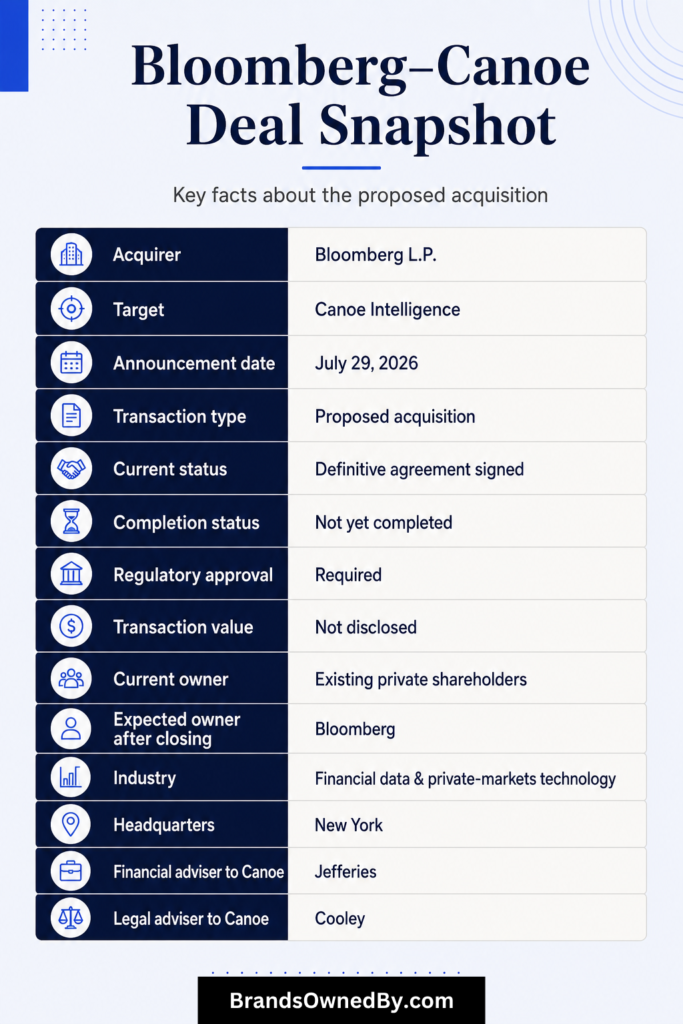
Bloomberg has agreed to acquire Canoe Intelligence, an artificial intelligence-powered platform that organizes and processes private-market investment data. The proposed transaction was announced on July 29, 2026. Financial terms were not disclosed.
This is more than another financial technology acquisition. Bloomberg is buying infrastructure that could help it connect public and private investments within the same data, analytics, risk and portfolio-management environment.
However, the ownership change has not happened yet. Bloomberg and Canoe have signed a definitive acquisition agreement, but the transaction remains subject to customary regulatory approvals. Until it closes, Canoe remains independently owned by its existing shareholders.
What Did Bloomberg Announce?
Bloomberg entered into a definitive agreement to acquire Canoe Intelligence. Canoe provides data-management technology designed specifically for private-market investments such as private equity, private credit, venture capital, real estate funds and other alternative assets.
The agreement represents an intention to transfer ownership of Canoe to Bloomberg once the required conditions are satisfied.
It is important to distinguish between an acquisition agreement and a completed acquisition. Bloomberg does not yet legally own Canoe merely because the agreement has been announced.
The transaction must still receive customary regulatory approvals. Bloomberg and Canoe did not disclose an expected closing date or purchase price in their announcement.
Therefore, the correct current description is:
Bloomberg has agreed to acquire Canoe Intelligence.
It would be premature to state that Bloomberg has already acquired or currently owns Canoe.
What is Canoe Intelligence?
Canoe Intelligence is a financial technology company that automates the collection, extraction, organization and delivery of alternative-investment data.
Private funds produce large volumes of documents. These can include capital-account statements, capital-call notices, distribution notices, performance reports, portfolio valuations, tax documents and underlying investment schedules.
Much of that information still arrives through PDFs, investor portals, emails and inconsistent reporting formats. Investment teams often have to collect it manually before entering it into portfolio-management, accounting or risk systems.
Canoe’s technology is designed to automate that process.
Its software collects private-market documents, identifies relevant information and converts unstructured material into normalized data. That information can then be delivered into the systems used by institutional investors, wealth managers, family offices and asset servicers.
Canoe says it processes more than 1.5 million documents each month across more than 44,000 funds. Its platform serves more than 500 institutional clients representing over $11 trillion in assets under service.
These figures explain why Bloomberg is interested. Canoe is not simply a small software interface. It operates a growing data network connecting private-fund managers, investors, reporting documents and portfolio systems.
Who Owns Canoe Intelligence Before the Bloomberg Acquisition?
Canoe remains privately held while the acquisition is pending.
The company was incubated by principals associated with 10East and 22C Capital. Its institutional investors have included:
Goldman Sachs Alternatives
Growth Equity at Goldman Sachs Alternatives led Canoe’s $36 million Series C funding round in July 2024.
The round was intended to support Canoe’s international expansion and continued development of its artificial intelligence and machine-learning technology. Canoe said its valuation had increased by more than three times since its Series B round in 2023. The company did not disclose the resulting valuation.
Goldman Sachs therefore became one of Canoe’s most prominent institutional investors before the Bloomberg agreement.
F-Prime Capital
F-Prime Capital led Canoe’s Series B financing in 2023 and participated in the Series C round.
Its involvement reflects the broader investment interest in infrastructure supporting private capital markets. As alternative investments expanded, institutions needed more efficient systems for collecting and standardizing private-fund information.
Eight Roads
Eight Roads participated alongside F-Prime in Canoe’s Series B round and remained involved during the later Series C financing.
It was part of the shareholder group supporting Canoe’s growth before the proposed sale to Bloomberg.
Blackstone Innovations Investments
Blackstone Innovations Investments helped lead an extension of Canoe’s Series A financing in 2021.
Blackstone’s involvement was strategically significant. Blackstone is one of the world’s largest alternative-investment managers and also became a Canoe client.
This gave Canoe both financial backing and direct insight from a major institutional user of private-market data.
Carlyle AlpInvest
Carlyle also participated in Canoe’s institutional funding.
Like Blackstone, Carlyle operates extensively across private markets. Its involvement strengthened Canoe’s relationship with the industry it was attempting to modernize.
Hamilton Lane
Hamilton Lane participated in Canoe’s Series A financing and developed a strategic relationship with the company.
Hamilton Lane provides private-market investment management, advisory and technology services. Canoe’s document and data infrastructure complemented the portfolio-analysis services used by private-market investors.
Nasdaq Ventures
Nasdaq Ventures participated in Canoe’s Series A financing in 2020.
The investment supported Canoe’s efforts to automate the processing of alternative-investment documents and transfer normalized data into investment systems.
These investors provided Canoe with capital, credibility and access to major private-market institutions. Bloomberg’s proposed acquisition would replace this multi-investor ownership structure with ownership under one privately controlled financial-information group.
Who Will Own Canoe Intelligence After the Transaction?
Bloomberg is expected to own Canoe Intelligence after the transaction closes.
The exact post-acquisition legal structure has not been disclosed. Bloomberg could own Canoe directly through Bloomberg L.P. or place the business under a subsidiary or operating division.
What is clear is that Canoe’s current investors would no longer control the company following a completed sale, subject to any undisclosed rollover interests or transaction arrangements.
Bloomberg has not announced whether Canoe will continue as a legally separate subsidiary. It has also not disclosed whether the Canoe name will remain as a standalone commercial brand.
Canoe CEO Jason Eiswerth described the transaction as “joining Bloomberg,” which suggests that the platform, employees and capabilities will become part of Bloomberg’s broader private-markets operation. However, that language does not establish the precise legal or branding structure.
Ownership Before and After the Acquisition
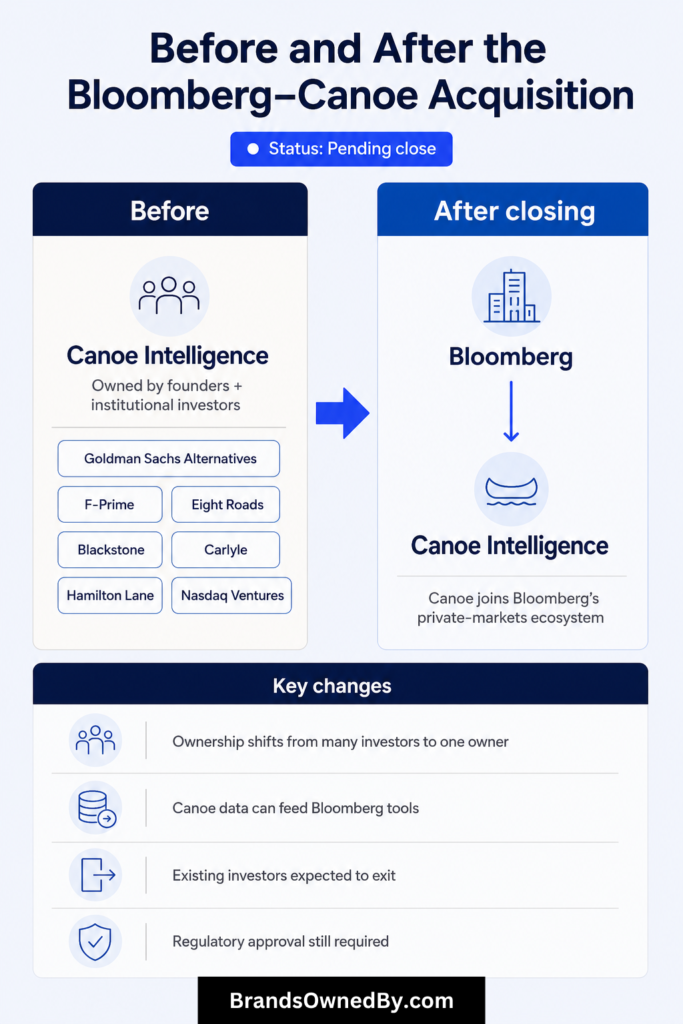
Let’s overview before and after acquisition ownership:
Before completion
Canoe Intelligence remains an independent, privately held company backed by founders, early shareholders and institutional investors.
Its investor group includes firms connected to Goldman Sachs, Blackstone, Carlyle, F-Prime, Eight Roads, Hamilton Lane and Nasdaq.
Bloomberg is a commercial and technology partner, but it is not yet Canoe’s owner.
After completion
Bloomberg would become Canoe’s owner.
Canoe’s technology, customer relationships, data-processing capabilities and private-market fund network would become part of Bloomberg’s financial-information ecosystem.
The existing institutional shareholders would be expected to sell or otherwise transfer their interests under the terms of the transaction.
Because the purchase price and capitalization details are private, it is not possible to calculate how much each shareholder will receive.
The Acquisition Did Not Begin With a Cold Approach
One of the most important details is that Bloomberg and Canoe were already working together before the proposed acquisition.
In April 2026, they launched a certified integration connecting Canoe’s private-fund data with Bloomberg PORT Enterprise.
PORT is Bloomberg’s portfolio and risk analytics system. The integration allowed mutual clients to transfer private-fund information into Bloomberg’s environment and compare private investments with publicly traded assets.
Canoe collected, extracted and normalized the underlying fund data. Bloomberg then provided portfolio visualization, risk analysis, performance comparison and cross-asset analytics.
This appears to have functioned as a practical test of the strategic combination.
Bloomberg did not have to acquire an unfamiliar technology and hope it could be integrated later. The companies had already connected their systems, served mutual clients and observed how Canoe’s data could improve Bloomberg’s portfolio tools.
From a business-analysis perspective, this substantially strengthens the logic of the transaction.
Technology acquisitions often fail because the buyer overestimates product compatibility or underestimates implementation difficulty. Bloomberg had already tested the commercial and technical relationship before committing to the acquisition.
Why Bloomberg Wants Canoe Intelligence?
There are quite a few reasons:
Private markets represent a major data opportunity
Bloomberg built its position around structured, timely and comparable financial information.
That model works particularly well in public markets. Public companies file standardized reports. Exchanges distribute trading data. Securities have identifiable prices, tickers and reporting requirements.
Private markets are different.
Private funds do not trade continuously. Their reporting formats vary. Valuations arrive periodically. Investment information is often distributed through PDFs, spreadsheets and portals rather than standardized public feeds.
This creates a large information gap.
Investors may own public equities, bonds, private-equity funds, private-credit vehicles and real-estate investments within the same portfolio. Yet they frequently analyze those assets using separate systems and different data standards.
Bloomberg wants to reduce that separation.
It already provides information covering more than three million private companies, 50,000 private funds and 16,000 private direct loans. Canoe adds a mechanism for collecting permissioned, investor-specific information after capital has been committed.
That distinction matters.
Bloomberg’s existing private-market data helps investors research markets, companies, funds and loans. Canoe processes the documents and data generated by an investor’s actual private-market holdings.
Together, the platforms could cover more of the investment lifecycle.
Canoe brings data that Bloomberg cannot purchase from an exchange
Public-market data is generated through relatively standardized channels. Private-market portfolio data is fragmented across fund managers and investor documents.
Canoe has spent years building connections, workflows, extraction systems and data standards around those documents.
That gives Bloomberg more than software. It gives Bloomberg access to established private-market data infrastructure and a community of institutional users.
In my assessment, this is the real strategic value.
The fashionable explanation is that Bloomberg is buying an AI company. That is only partly accurate.
Bloomberg is buying:
- A specialized private-market data pipeline.
- Relationships with institutional investors.
- Connections between general partners and limited partners.
- A large fund-data environment.
- Document-processing technology.
- Experienced private-market operations teams.
- A platform already connected to client workflows.
Artificial intelligence helps process the information, but the defensible asset is the combination of technology, data access, workflow integration and industry participation.
Bloomberg wants a complete portfolio view
Institutional portfolios no longer fit neatly into public-market categories.
Pension funds, endowments, insurers, sovereign institutions, family offices and wealth managers hold increasing amounts of private equity, private credit, infrastructure and real estate.
A risk system that only understands public securities provides an incomplete view.
Bloomberg’s objective is to let clients examine public and private investments together. Canoe could improve the flow of private-fund positions, cash movements, commitments, underlying holdings and performance data into Bloomberg’s analytics environment.
This could help users answer questions such as:
- How much exposure does the portfolio have to a particular industry?
- How do private and public assets respond to the same risk scenario?
- How much unfunded capital remains committed?
- Which private funds hold overlapping companies?
- How are cash calls and distributions affecting liquidity?
- What is the total exposure to a country, manager or asset class?
This is strategically more important than adding another standalone software product.
Bloomberg is attempting to make private-market data behave more like public-market data inside its ecosystem.
Why the Transaction is More Important Than Its Undisclosed Price
The absence of a disclosed purchase price may make the transaction appear less significant than a multibillion-dollar acquisition.
That would be the wrong interpretation.
Canoe could strengthen the infrastructure supporting Bloomberg’s core institutional products. Bloomberg does not need Canoe to become a large independent revenue stream for the deal to succeed.
The acquisition can create value by:
- Increasing the usefulness of Bloomberg PORT.
- Encouraging greater Terminal engagement.
- Improving private-market data coverage.
- Supporting enterprise data contracts.
- Strengthening client retention.
- Expanding Bloomberg’s AI capabilities.
- Making Bloomberg more central to institutional investment workflows.
A technology that increases the value of Bloomberg’s broader platform can be strategically important even when the acquired company is much smaller than the buyer.
What Bloomberg is Likely to Do With Canoe?
Bloomberg has outlined several intended areas of development.
Integrate public and private portfolio information
Canoe’s normalized private-fund information could feed into Bloomberg’s portfolio and risk systems.
Clients would gain a more unified view of their holdings rather than managing private assets through disconnected spreadsheets and specialist platforms.
Expand pre-investment fund analysis
Canoe is strongest in post-investment data collection and reporting.
Bloomberg also wants to connect that information with fund screening, benchmarking and comparative analysis before an investor commits capital.
This could create a continuous workflow covering discovery, due diligence, allocation, monitoring, reporting and risk management.
Standardize private-market data
Bloomberg intends to combine Canoe’s data with consistent identifiers such as the Financial Instrument Global Identifier.
Standardized identifiers may help institutions connect fund information across internal systems, service providers and portfolio tools.
Apply Bloomberg’s AI interface
Bloomberg plans to connect the combined capabilities with ASKB, its conversational artificial intelligence interface.
The long-term goal appears to be allowing investors to ask complex questions across both public and private holdings without manually compiling information from multiple sources.
The value will depend on data quality. An AI system can only provide reliable portfolio analysis when the underlying documents have been collected, interpreted and normalized correctly.
Canoe strengthens that underlying layer.
What Changes for Canoe Intelligence?
A lot will change for Canoe after the acquisition:
Access to Bloomberg’s distribution
Canoe currently serves hundreds of institutional clients. Bloomberg already has deep relationships across banks, asset managers, investment advisers, corporations and financial institutions.
Joining Bloomberg could dramatically increase Canoe’s distribution.
Rather than selling its platform entirely through an independent commercial organization, Canoe could become available through Bloomberg’s existing institutional relationships.
More resources for product development
Bloomberg has far greater financial, technical and data resources than Canoe.
That could accelerate product development, international expansion, security investment and integration with other portfolio systems.
Greater platform credibility
Private-market information is sensitive.
Institutions must consider cybersecurity, permissions, data accuracy, operational resilience and regulatory compliance before connecting a vendor to their investment documents.
Bloomberg’s ownership may reduce some of the perceived vendor risk associated with relying on a smaller independent platform.
Possible loss of neutrality
The acquisition also creates a potential concern.
Canoe has built an ecosystem containing many integrations and partners. Some customers may value its position as an independent platform that can send information into multiple systems.
Once Bloomberg owns Canoe, competing portfolio technology providers may question whether Canoe will remain equally open to their platforms.
Bloomberg will need to demonstrate that Canoe can continue supporting a broad ecosystem rather than becoming a closed data channel designed mainly for Bloomberg products.
This may be the most important strategic risk after integration.
What Does Not Change Yet?
The announcement does not immediately change Canoe’s ownership.
Until the transaction closes:
- Canoe remains privately held.
- Its existing shareholders retain their interests.
- Bloomberg remains the proposed buyer.
- Regulatory approval is still required.
- The final legal ownership transfer has not occurred.
- The purchase price remains undisclosed.
Customers should also not assume that Canoe’s contracts, product names, pricing, or integrations have already changed.
Those decisions may emerge after closing and during the integration process.
Is Bloomberg Buying Canoe Mainly for Artificial Intelligence?
Artificial intelligence is part of the transaction, but describing the deal as an AI acquisition alone would be misleading.
Canoe uses AI and machine learning to process private-market documents. Yet document extraction technology is becoming increasingly available.
Canoe’s stronger advantage is the operational system built around that technology.
It has:
- Institutional clients.
- Historical document-processing experience.
- Established fund records.
- Private-market workflows.
- Data normalization systems.
- Industry integrations.
- Relationships with asset managers and allocators.
Bloomberg could develop document-reading models internally. Reproducing Canoe’s network, adoption and operational history would be considerably more difficult.
Therefore, Bloomberg is not merely buying an algorithm. It is acquiring a functioning private-market data network.
What the Acquisition Means for Bloomberg’s Competitors
The transaction increases pressure on financial-data and investment-technology companies serving institutional investors.
Bloomberg competes across different parts of its business with companies such as LSEG, S&P Global, FactSet, Morningstar, MSCI and specialist private-market data providers.
Public-market data alone is no longer sufficient for clients managing total portfolios.
Large information providers increasingly need capabilities covering:
- Private-company data.
- Fund performance.
- Private-credit information.
- Alternative-investment benchmarks.
- Portfolio look-through.
- Capital calls and distributions.
- Private asset risk.
- Fund and manager comparison.
Bloomberg’s acquisition of Canoe suggests that private-market operating data is becoming a core part of institutional financial infrastructure rather than a niche add-on.
Competitors may respond through acquisitions, partnerships or internal product development.
Potential Risks of the Bloomberg–Canoe Acquisition
Here’s a sneak peek into potential risks:
Integration complexity
Canoe works with sensitive data from many fund managers, investors and service providers.
Combining that environment with Bloomberg’s systems will require careful data governance, permissions management and cybersecurity controls.
Customer concerns about data use
Institutional clients may ask how their information will be used after Bloomberg becomes Canoe’s owner.
Bloomberg will need to preserve clear boundaries between client-owned portfolio information, aggregated data, analytics and commercial products.
Partner conflicts
Canoe integrates with technology and service providers that may compete with Bloomberg in certain areas.
Those partners may reconsider their relationships if they believe Bloomberg will prioritize its own products.
Product overlap
Bloomberg must decide which Canoe capabilities remain separate and which become integrated into PORT, the Terminal or enterprise data services.
Poor product rationalization could confuse customers.
Cultural integration
Canoe is a growth-stage financial technology company. Bloomberg is a much larger and more established organization.
Retaining key technical, product and private-market personnel may be essential to preserving Canoe’s value.
Expert Assessment: Is This a Good Acquisition for Bloomberg?
Strategically, the transaction makes sense.
Bloomberg’s strength has always been its ability to collect difficult financial information, structure it and make it useful within professional workflows.
Private markets are one of the largest remaining areas where data remains fragmented, delayed and operationally expensive.
Canoe addresses that precise weakness.
The deal is also more credible because the companies integrated their technologies before agreeing to the acquisition. Bloomberg has already observed how Canoe’s information works inside PORT Enterprise.
This reduces product risk and suggests that the acquisition was based on actual customer use rather than a theoretical presentation.
The main question is not whether Canoe fits Bloomberg. It clearly does.
The more important question is whether Bloomberg can preserve Canoe’s openness and partner ecosystem while integrating its data more deeply into Bloomberg products.
If Bloomberg turns Canoe into a closed feature available mainly within its own environment, it may strengthen the Bloomberg platform but weaken Canoe’s independent network.
If it maintains Canoe’s interoperability while using Bloomberg’s scale to improve coverage and analytics, the transaction could establish a powerful infrastructure layer for private-market investing.
Why This Deal Could Have Long-Term Importance
Private-market investing has grown faster than the systems used to administer it.
Many sophisticated institutions still depend on manual document collection, spreadsheet reconciliation and delayed reports.
That operational weakness limits transparency and makes it difficult to analyze public and private investments together.
Bloomberg helped standardize how professionals access public-market information. Through Canoe, it is attempting to extend a similar model into private assets.
The comparison should not be taken too far. Private markets will not become fully transparent simply because Bloomberg acquires Canoe. Fund reporting remains permissioned, valuations remain periodic and investment structures remain complex.
However, the acquisition could make private-market information more standardized, accessible and usable for institutions that already rely on Bloomberg.
That makes this a strategically meaningful transaction even without a disclosed purchase price.
Final Thoughts on Bloomberg–Canoe Acquisition
Bloomberg’s agreement to acquire Canoe Intelligence is not simply another technology company buying an AI platform.
It is an attempt to solve one of institutional investing’s most persistent problems: private-market information remains fragmented, inconsistent and difficult to combine with public-market data.
Canoe gives Bloomberg technology, fund coverage, institutional relationships and an established private-market data workflow. Bloomberg gives Canoe global distribution, financial resources and access to a much broader analytics ecosystem.
The transaction has not yet changed Canoe’s legal ownership. That will occur only if regulatory approvals are obtained and the acquisition closes.
If completed successfully, the deal could make Bloomberg a more important infrastructure provider for investors seeking one connected view of both public and private assets.
FAQs
Did Bloomberg acquire Canoe Intelligence?
Bloomberg has agreed to acquire Canoe Intelligence, but the acquisition has not yet been completed. The transaction remains subject to customary regulatory approvals.
Does Bloomberg currently own Canoe Intelligence?
No. Canoe remains owned by its existing private shareholders until the transaction closes.
When did Bloomberg announce the Canoe acquisition?
Bloomberg announced the definitive acquisition agreement on July 29, 2026.
How much is Bloomberg paying for Canoe Intelligence?
Bloomberg and Canoe did not disclose the transaction value.
Who owns Canoe Intelligence now?
Canoe is privately held. Its investors have included Blackstone Innovations Investments, Carlyle AlpInvest, Eight Roads, F-Prime Capital, Growth Equity at Goldman Sachs Alternatives, Hamilton Lane and Nasdaq Ventures.
Who will own Canoe after the acquisition?
Bloomberg is expected to own Canoe Intelligence after the transaction receives the required approvals and closes.
What does Canoe Intelligence do?
Canoe automates the collection, extraction and normalization of documents and data associated with private-market investments.
Will the Canoe Intelligence name disappear?
Bloomberg has not disclosed whether Canoe will continue as a standalone brand after the acquisition closes.
Why is Bloomberg acquiring Canoe?
Bloomberg wants to improve its private-market data infrastructure and provide institutional investors with a more integrated view of public and private investments.
Did Bloomberg and Canoe work together before the acquisition?
Yes. Bloomberg and Canoe launched an integration in April 2026 that delivered Canoe’s private-fund data into Bloomberg PORT Enterprise.
![Qualcomm Acquires Modular in $3.9 Billion [Deal Completed]](https://brandsownedby.com/wp-content/uploads/2026/07/Qualcomm-Acquires-Modular-300x157.png)