

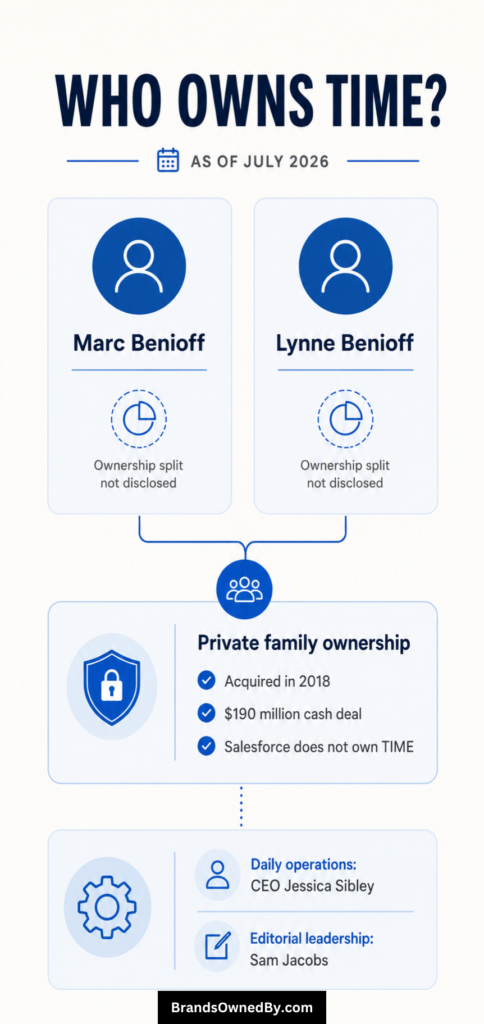
- Marc and Lynne Benioff privately own Time, while Time USA, LLC operates the magazine, website, and related media activities.
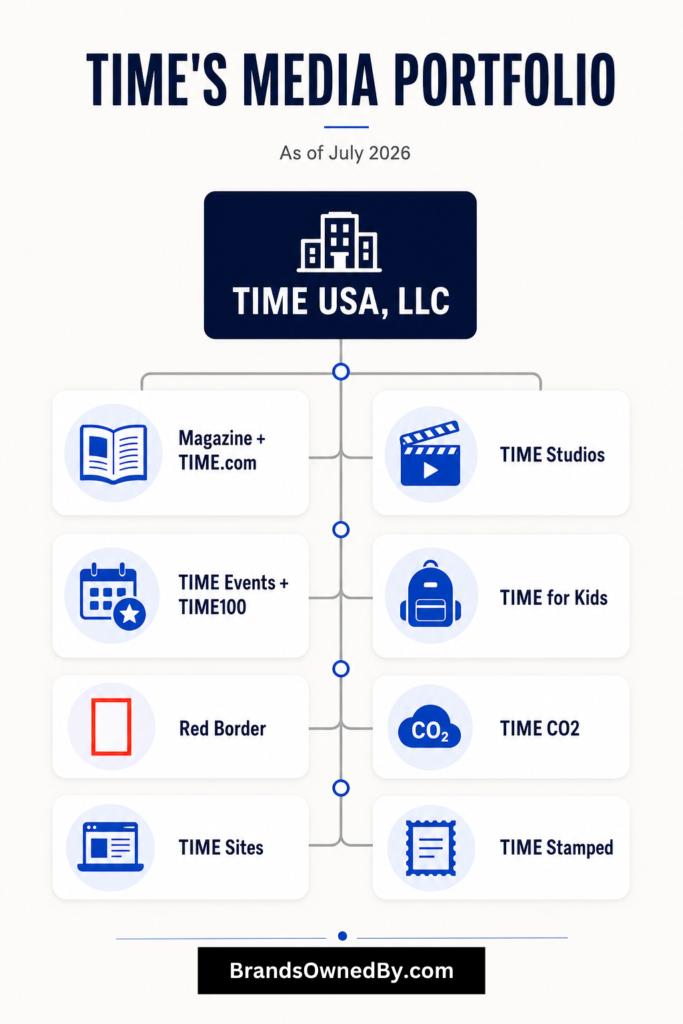
- Time’s portfolio extends beyond publishing to Time Studios, Time Events, TIME100, Time for Kids, Red Border, Time CO2, Time Sites, and Time Stamped.
- Person of the Year, TIME100, and related lists are valuable Time-owned editorial franchises, but they are not independent companies.
- Time does not own former Time Inc. brands such as Fortune, People, Sports Illustrated, Money, or Entertainment Weekly.
Time is an American news and media brand headquartered in New York City. It is best known for its news magazine, annual Person of the Year selection, TIME100 franchise, and distinctive approach to visual journalism.
The business operates through Time USA, LLC. It is privately owned and does not publish annual shareholder reports.
Who Founded Time Magazine?
Henry Luce and Briton Hadden founded Time. The two men met while studying at the Hotchkiss School and later worked together at the Yale Daily News.
They wanted to create a concise news publication for busy readers. Their concept summarized important national and international developments in an accessible format.
The founders established Time Inc. in 1922. The first issue of Time magazine was published on March 3, 1923. It featured former Speaker of the House Joseph G. Cannon on the cover.
Hadden shaped much of the magazine’s early editorial style. Luce concentrated on management, distribution, and business growth. Hadden died in 1929 at the age of 31. Luce subsequently became the dominant figure behind Time Inc.
From Magazine to Media Institution
Time helped establish the weekly newsmagazine format in the United States. Its compact writing and strong visual presentation made complex events easier to follow.
Time Inc. later developed a much larger publishing portfolio. Its former brands included Fortune, Life, Sports Illustrated, People, Money, and Entertainment Weekly.
However, these titles do not belong to the present-day Time company. They were separated through corporate restructurings and individual sales.
This distinction matters. The current Time business is not the same organization as the historical Time Inc. publishing conglomerate.
Time Company Profile
| Company detail | Information |
|---|---|
| Business name | Time USA, LLC |
| Primary brand | Time |
| Founded | 1923 |
| Founders | Henry Luce and Briton Hadden |
| Headquarters | New York City |
| Industry | News, media, publishing, events and entertainment |
| Ownership type | Privately held |
| Owners | Marc and Lynne Benioff |
| Acquisition price | $190 million |
| Chief executive officer | Jessica Sibley |
| Editor in chief | Sam Jacobs |
| Global audience | More than 120 million across platforms |
| Public stock symbol | None |
Time Ownership History
Time’s ownership history reflects the broader transformation of American media. It moved from founder-led publishing to conglomerate ownership, public-company status, and eventually private family ownership.
Henry Luce and Briton Hadden Establish Time Inc.
Luce and Hadden organized Time Inc. before publishing the first issue in 1923. Outside investors helped finance the new company, but the founders controlled its editorial direction and growth strategy.
The company expanded under Luce after Hadden’s death. Time Inc. launched Fortune in 1930, acquired Life in 1936, and introduced Sports Illustrated in 1954.
It later developed or acquired other influential magazine brands. Time Inc. became one of the largest publishing companies in the United States.
Time Inc. Merges With Warner Communications
Time Inc. announced an agreement to merge with Warner Communications in 1989. The transaction was completed in 1990, creating Time Warner.
This placed Time magazine inside a much larger entertainment and communications company. Time Warner eventually controlled publishing, film, television, cable networks, and other media assets.
The magazine remained part of Time Inc., which operated as Time Warner’s publishing division.
The AOL Time Warner Period
America Online acquired Time Warner in 2001. The combined organization became AOL Time Warner.
The transaction was initially presented as a merger between digital distribution and traditional media. It later became one of the most criticized corporate combinations in media history.
The decline in AOL’s value and the collapse of the dot-com market weakened the combined company. The corporate name returned to Time Warner in 2003.
Time magazine remained within the publishing division throughout this period.
Time Inc. Becomes Independent
Time Warner separated Time Inc. in 2014. The publishing company became an independent public corporation.
Time Inc. shares traded on the New York Stock Exchange under the ticker TIME. Shareholders of Time Warner received shares in the newly independent company.
The separation gave Time Inc. direct control over its publishing strategy. However, it also exposed the company to falling print advertising revenue, declining newsstand sales, and substantial restructuring costs.
Meredith Corporation Acquires Time Inc.
Meredith Corporation agreed to acquire Time Inc. in 2017. The transaction was completed in January 2018.
Time Inc. shareholders received $18.50 per share in cash. The total transaction was valued at approximately $2.8 billion, including assumed debt.
Meredith was primarily focused on lifestyle, entertainment, food, and home-related media. It determined that Time, Fortune, Money, and Sports Illustrated did not fit its core portfolio.
The company therefore prepared these publications for separate sales.
Marc and Lynne Benioff Purchase Time
Meredith agreed to sell the Time media brand to Marc and Lynne Benioff in September 2018. The $190 million all-cash transaction was completed later that year.
The purchase covered Time’s global media brand and related operations. It did not include the other former Time Inc. publications.
The Benioffs described Time as a family investment. They also stated that the company would remain separate from Salesforce.
This ownership model resembles other cases in which wealthy individuals have acquired established media institutions. The owner provides capital and long-term support. Professional executives and editors remain responsible for daily decisions.
Who Owns Time Magazine?
![who owns time magazine [infographic]](https://brandsownedby.com/wp-content/uploads/2026/07/who-owns-time-magazine-infographic-484x1024.png)
Time is jointly owned by Marc Benioff and Lynne Benioff. It is not publicly traded. There are no publicly disclosed institutional investors, mutual funds, or outside shareholders.
The precise ownership percentage held by each spouse has not been released. Time does not file the shareholder disclosures required from public companies.
Time USA, LLC is the operating entity associated with the publication. The Benioffs are the ultimate private owners behind the company.
Marc Benioff
Marc Benioff is a co-owner and co-chair of Time. He is also the co-founder, chairman, and chief executive officer of Salesforce.
His position at Salesforce often creates confusion about Time’s ownership. Marc Benioff purchased Time personally with Lynne Benioff. Salesforce did not acquire the magazine.
Salesforce shareholders therefore have no ownership rights in Time. Time’s revenue, expenses, employees, and media operations are not consolidated as a Salesforce business division.
Marc Benioff can influence Time through ownership-level decisions. These may include selecting senior leadership, approving major investments, and determining whether the company should be sold or recapitalized.
He is not responsible for editing individual stories or managing the newsroom’s daily coverage.
Lynne Benioff
Lynne Benioff is Time’s co-owner and co-chair. She acquired the company jointly with Marc Benioff and is presented as an equal partner in the family investment.
Her role should not be treated as incidental. Official company communications consistently identify both Marc and Lynne Benioff as Time’s owners.
Lynne Benioff is also active in philanthropy. Her areas of interest have included health, education, environmental protection, and community development.
The ownership percentage assigned to her has not been disclosed. Claims that Marc Benioff individually owns 100% of Time are therefore incomplete.
Time USA, LLC
Time USA, LLC is the private legal entity through which the current media business operates. Copyright notices, website terms, and other corporate materials identify this entity.
The LLC is not a separate public shareholder. It is the operating vehicle beneath the Benioffs’ ultimate ownership.
Using an LLC provides administrative flexibility. It also means Time does not have to release the detailed financial and shareholder information expected from a listed corporation.
Are There Other Time Shareholders?
No additional Time shareholders have been publicly identified as of July 2026.
There is no verified public evidence that Salesforce, Meredith, investment funds, employees, or Time executives hold material equity stakes in the company.
Private ownership arrangements can include trusts, holding entities, or estate-planning structures. However, their details are not public. It would therefore be misleading to assign unsupported ownership percentages.
Competitor Ownership Comparison
Time competes for audience attention, advertisers, sponsors, subscriptions, licensing opportunities, and influential events. Its competitors use several different ownership models.
The Atlantic
The Atlantic is majority-owned by Emerson Collective, the organization founded and led by Laurene Powell Jobs. Former controlling owner David Bradley retained a minority interest after the 2017 transaction.
This structure is similar to Time’s in one important respect. Both publications receive backing from wealthy, mission-oriented private owners.
Time has joint family ownership through Marc and Lynne Benioff. The Atlantic has a majority institutional-style owner connected to one principal investor.
The Atlantic places greater commercial emphasis on digital subscriptions. Time has increasingly emphasized free digital reach, corporate partnerships, sponsored events, and business-to-business revenue.
The New Yorker
The New Yorker is a division of Advance Magazine Publishers and operates through Condé Nast. Advance Publications is privately controlled by the Newhouse family.
This places The New Yorker inside a large private media group. Condé Nast also operates brands such as Vogue, GQ, Vanity Fair, and Wired.
Time is different because it is a standalone private media company. It does not sit inside a broad magazine conglomerate.
The New Yorker can share technology, advertising, and administrative resources with other Condé Nast publications. Time must build or acquire many of these capabilities within its own organization.
Fortune
Fortune is owned through Fortune Media Group by Thai businessman Chatchaval Jiaravanon. He acquired the publication from Meredith for $150 million in 2018.
Fortune and Time were once sister publications under Time Inc. Both were sold to individual investors after Meredith’s acquisition.
Their present strategies overlap in executive audiences, corporate rankings, conferences, and sponsored content. However, Fortune remains more concentrated on business and finance. Time covers politics, world affairs, culture, science, health, climate, and leadership.
Both companies use events and rankings as commercial extensions of established editorial brands.
The Economist
The Economist operates under a diversified private shareholder structure.
Exor, the investment company associated with the Agnelli family, holds the largest economic stake at 43.4%. Canadian investor Stephen Smith and Smith Financial acquired a 26.9% interest from the Rothschild family in 2026.
The Economist’s governance rules restrict concentrated voting control. No shareholder can exercise more than 20% of the voting rights.
This makes its ownership model substantially different from Time’s. The Benioffs have concentrated ultimate ownership of Time. The Economist spreads economic ownership and limits shareholder voting power to protect editorial independence.
Newsweek
Newsweek operates as a privately held digital and print news company. Its modern corporate history is separate from the original Washington Post Company ownership and the former IBT Media structure.
Newsweek competes more directly with Time in general news, politics, world affairs, culture, and online search visibility.
Time has the clearer publicly communicated ultimate ownership structure. Marc and Lynne Benioff are consistently identified as Time’s owners. Newsweek’s ownership history has involved more corporate restructuring and disputes between private stakeholders.
Practical Ownership Comparison
| Publication | Ownership model | Controlling interest |
|---|---|---|
| Time | Private family investment | Marc and Lynne Benioff |
| The Atlantic | Private majority ownership | Emerson Collective |
| The New Yorker | Private media group | Advance Publications through Condé Nast |
| Fortune | Privately owned media company | Chatchaval Jiaravanon |
| The Economist | Multiple private shareholders | Exor is the largest economic shareholder |
| Newsweek | Privately held | Private ownership through its publishing structure |
Time’s structure offers speed and concentrated decision-making. The tradeoff is limited public financial transparency.
The Economist’s structure offers more formal ownership safeguards. The New Yorker benefits from shared group resources. The Atlantic and Fortune, like Time, depend heavily on the priorities and capital commitments of private owners.
Who Controls Time?
Control of Time operates at three different levels: ownership, corporate management, and editorial leadership.
Understanding these levels helps avoid the assumption that the owners personally approve every article.
Marc and Lynne Benioff Control Ownership Decisions
The Benioffs hold ultimate ownership control. They can influence the company’s long-term direction through their rights as private owners.
Ownership control generally covers decisions such as:
- Appointing or replacing senior corporate leadership.
- Approving major acquisitions, investments, borrowing, or a future sale.
- Setting expectations for growth, profitability, and long-term capital support.
The owners could also influence the company’s mission or strategic priorities through their choice of executives.
Jessica Sibley Controls Business Operations
Jessica Sibley is Time’s chief executive officer as of July 2026. She has held the position since November 2022.
Sibley is responsible for the company’s commercial strategy and operating performance. Her responsibilities include advertising, events, partnerships, product development, revenue diversification, and cost management.
Under her leadership, Time has shifted toward a business-to-business revenue model. The company removed the digital paywall in 2023 to maximize audience reach and advertising opportunities.
Time has also expanded corporate sponsorships and live events. Events and digital products have become increasingly important as print revenue declines.
A practical example is the TIME100 franchise. Its editorial recognition generates global attention. The company can extend that attention through summits, galas, leadership forums, sponsorships, and video programming.
Sam Jacobs Controls the Newsroom
Sam Jacobs is Time’s editor in chief. He has held the role since April 2023.
Jacobs leads the newsroom and is responsible for editorial standards, story selection, journalistic strategy, and coverage priorities.
Corporate management can determine newsroom budgets and overall business resources. However, the editor in chief manages editorial judgment within those resources.
This separation is important for a news organization. The CEO focuses on whether the business is sustainable. The editor in chief focuses on whether its journalism is accurate, relevant, and credible.
The Owners’ Influence Is Real but Indirect
Private owners do not need to edit individual articles to influence a media company. Their most consequential power comes from leadership appointments, budgets, strategic priorities, and investment decisions.
For example, an owner who approves a major expansion into climate coverage can affect hiring and product development. Editors would still decide how individual climate stories are reported.
Time’s stated operating model gives professional leadership responsibility for everyday decisions. The Benioffs remain the final authority on ownership-level matters.
Time Annual Revenue and Net Worth
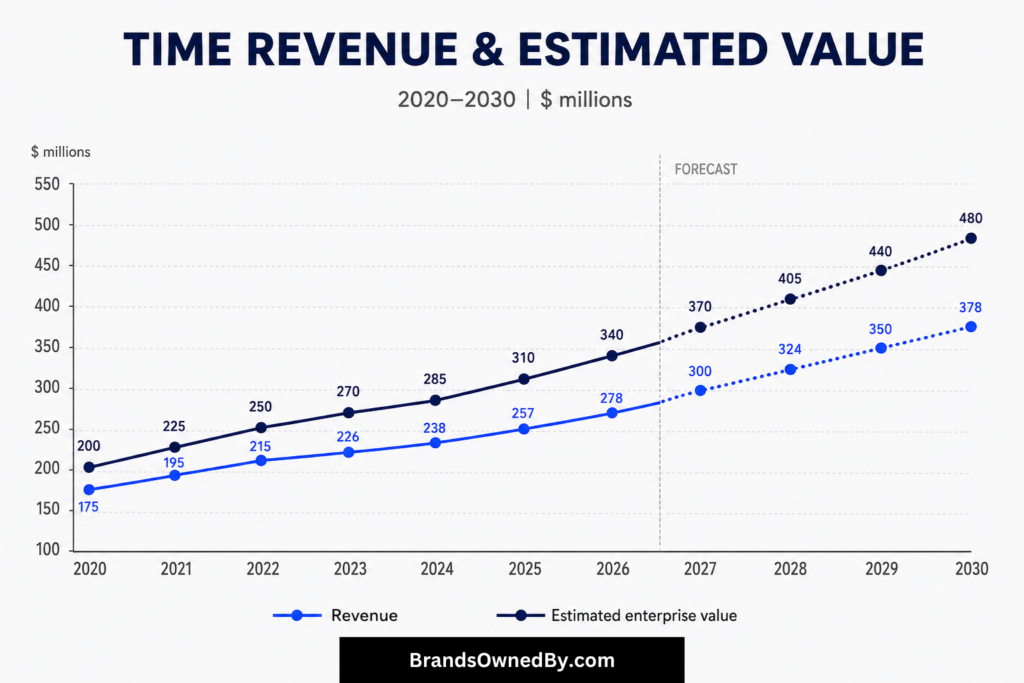
Time is a private company. It does not publish audited annual revenue, assets, liabilities, or enterprise value.
The figures below are analytical estimates. They are not reported financial results. “Net worth” refers to estimated enterprise value rather than the personal wealth of Marc and Lynne Benioff.
Time Revenue in 2026
Time’s estimated 2026 revenue is $278 million. This is a modeled figure because the company has not released consolidated accounts.
The estimate assumes continued growth in live events, integrated sponsorships, digital advertising, content licensing, and production. It also assumes further contraction in traditional print revenue.
Time reported strong advertising momentum in 2025. Events and digital operations were projected to represent approximately half of revenue in 2026. The company also planned more than 40 events during the year.
These disclosures support a higher estimate than revenue-only databases that treat Time mainly as a magazine publisher. Such databases can miss production, sponsorship, event, licensing, and service revenue.
2026 Revenue Breakdown
| Revenue source | Modeled share | Estimated revenue |
|---|---|---|
| Events and event-led sponsorships | 50% | $139 million |
| Digital advertising, partnerships and licensing | 18% | $50 million |
| Print subscriptions and print advertising | 17% | $47 million |
| Studio and production activities | 10% | $28 million |
| Commerce, services and other revenue | 5% | $14 million |
| Total | 100% | $278 million |
The categories overlap in practice. A corporate partnership may include event sponsorship, digital content, print advertising, and video production under one agreement.
The breakdown is therefore a strategic model. It should not be presented as an audited segment report.
Time Net Worth in 2026
Time’s estimated enterprise value is $340 million as of July 2026.
This represents approximately 1.2 times modeled annual revenue. That is a reasonable working multiple for a recognized but relatively small private media company with diversified growth operations.
The valuation is higher than the $190 million paid in 2018. Several developments support that increase:
Time has built a substantial events business. It has expanded Time Studios. Its global audience has increased. It has added branded content, climate, education, e-commerce, and customer-experience operations.
However, the valuation remains conservative compared with high-growth digital subscription businesses. Time still faces declining print economics, advertising sensitivity, and considerable dependence on sponsorship revenue.
Why Revenue Can Grow While Print Declines
Time’s current strategy is not based on restoring the economics of the old weekly magazine.
The magazine supports brand authority. That authority attracts audiences, executives, advertisers, streaming partners, and event sponsors.
For example, a TIME100 recognition can generate several forms of commercial activity. These include a print feature, digital traffic, sponsored video, a leadership forum, a gala, and licensing opportunities.
The print product remains important. Its role has shifted from being the main revenue engine to being part of a broader brand system.
Revenue Forecast for 2027–2030
The model forecasts revenue reaching $378 million in 2030. This represents an annual growth rate of approximately 8% from the 2026 estimate.
The forecast depends on four principal drivers.
First, Time Events must continue attracting major corporate sponsors. Event revenue can grow quickly, but it is sensitive to marketing budgets and economic conditions.
Second, Time must preserve its digital audience as search engines and AI platforms change how people discover news. Licensing agreements can partially offset lost referral traffic.
Third, Time Studios must maintain a commercially viable project pipeline. Production revenue can be uneven because project timing varies.
Fourth, the company must prevent print decline from outpacing growth elsewhere. Print can remain strategically valuable even if its share of revenue decreases.
Net Worth Forecast for 2027–2030
The modeled enterprise value reaches $480 million in 2030.
That forecast assumes Time maintains a valuation multiple between 1.2 and 1.3 times revenue. It also assumes improving cash flow and a more balanced revenue mix.
The valuation could exceed this forecast if events, licensing, or production achieve higher margins. A strategic buyer could also pay a premium for Time’s brand recognition and archive.
The value could be lower if advertising declines, events lose momentum, or ownership needs to provide continuing financial support.
Private-company net worth is ultimately determined through a transaction, financing, or formal valuation. Until such an event occurs, any Time valuation remains an informed estimate.
Brands Owned by Time
The modern Time portfolio includes operating divisions, platforms, editorial franchises, and acquired technology. Not every name is a separately incorporated subsidiary.
Below is a list of the major brands owned and operated by Time:
Time Magazine and Time.com
The print magazine and Time.com form the company’s central publishing operation.
The magazine provides long-form reporting, analysis, profiles, photography, and special issues. Time.com delivers continuous digital coverage across politics, health, science, climate, technology, business, and entertainment.
Time removed its digital paywall in 2023. The decision supported a reach-based commercial strategy centered on advertising, partnerships, events, and influence.
Time Studios
Time Studios is Time’s film, television, audio, and production division. It develops documentaries, unscripted programs, scripted projects, branded productions, and immersive content.
The studio works with streaming services, broadcasters, filmmakers, and corporate partners. Its distribution relationships have included major global entertainment platforms.
Time Studios generated more than $100 million in cumulative revenue during its first several years. This made it one of Time’s fastest-growing businesses.
The division extends Time’s journalism and storytelling beyond articles. A subject introduced through the magazine can become a documentary, television program, podcast, or short-form video project.
Time Events
Time Events operates the company’s live and virtual experiences.
Its portfolio includes large galas, leadership forums, summits, executive gatherings, sponsored programs, and custom corporate experiences.
Events have become a central revenue driver. They allow sponsors to participate in high-profile gatherings built around Time’s editorial authority.
The business expanded from 11 events in 2022 to more than 40 planned events in 2026.
TIME100
TIME100 is one of Time’s most valuable editorial franchises. It identifies influential people across politics, business, entertainment, science, activism, and culture.
The franchise now extends beyond the annual TIME100 list. Related properties include TIME100 Next, TIME100 Companies, TIME100 AI, TIME100 Climate, TIME100 Health, and regional programs.
TIME100 also supports events, video programming, sponsorships, and international partnerships.
It is a Time-owned franchise rather than a separate public company.
Person of the Year
Person of the Year is Time’s best-known annual editorial franchise.
It recognizes the person, group, idea, or force that had the greatest influence on the year’s events. The selection is not necessarily an award for positive conduct.
The franchise supports a major annual issue, digital coverage, interviews, video, events, and advertising packages.
Time for Kids
Time for Kids provides age-appropriate journalism and educational materials for students, teachers, and families.
Its content helps children understand current events while developing media literacy and reading skills. The operation distributes classroom magazines, digital resources, and educational programs.
Time for Kids also supports Time’s long-term audience development. It introduces the brand’s journalistic format to readers at an early age.
Red Border
Red Border is Time’s branded-content operation. It creates paid storytelling and custom media for corporate partners.
Projects can include articles, videos, interactive pages, research, social content, and event-related materials.
Branded content is commercially funded. It must therefore be distinguished from independent newsroom journalism through appropriate labeling and production controls.
Red Border allows advertisers to use Time’s creative capabilities without purchasing only conventional display advertisements.
Time CO2
Time CO2 is Time’s climate and sustainability platform.
It combines editorial visibility, climate-related events, corporate partnerships, and advisory-style initiatives. The platform connects businesses with discussions about decarbonization, environmental risk, and nature-positive strategies.
Time CO2 reflects a broader media-industry trend. Publishers are developing specialist platforms around subjects that attract corporate investment and executive attention.
Time Sites
Time Sites is a customer-experience and website-building platform.
It was developed after Time acquired Brandcast, a technology company focused on no-code web experiences. The platform allows business teams to create personalized digital content for sales, marketing, customer success, and professional services.
Time Sites is strategically different from the magazine. It gives Time exposure to business software and enterprise services.
It is also a practical example of Time acquiring capabilities rather than developing every new business internally.
Time Stamped
Time Stamped is a recommendations and e-commerce content platform created in partnership with Taboola.
It publishes consumer guidance in areas such as personal finance, insurance, banking, credit cards, travel, technology, and other purchasing decisions.
Time can earn commissions when readers complete eligible purchases through affiliate links. The platform is operated under Time’s direction but is distinct from its main newsroom.
TIMEPieces
TIMEPieces is Time’s Web3 and digital-art community.
It launched in 2021 with digital collections involving artists and collectors. The project was designed to connect Time’s media brand with blockchain-based ownership and online communities.
TIMEPieces remains part of Time’s modern innovation history. However, Web3 is no longer emphasized as prominently in Time’s 2026 corporate descriptions as events, studios, branded content, and education.
International Editions and Partnerships
Time has international editions and licensed regional partnerships. These include initiatives such as Time France and Time Canada.
A licensed regional edition should not automatically be treated as a wholly owned subsidiary. In these arrangements, a local partner may manage publishing, sales, or distribution under the Time brand.
Time retains important brand and editorial rights. The regional operating company may remain separately owned.
Brands Time Does Not Own
Time no longer owns Fortune, People, Sports Illustrated, Life, Money, Entertainment Weekly, or other former Time Inc. titles.
These brands shared a corporate parent with Time in earlier periods. Corporate separation and individual sales placed them under different owners.
Time is also unrelated to The New York Times and the British newspaper The Times. Similar names do not indicate shared ownership.
Final Thoughts
Marc and Lynne Benioff own Time magazine as a private family investment. They acquired the brand for $190 million in 2018 after Meredith separated it from the former Time Inc. portfolio.
The owners control major corporate decisions. Jessica Sibley manages business operations, while Sam Jacobs leads the newsroom.
Time is no longer simply a print magazine. It is a diversified media company built around publishing, events, production, education, branded storytelling, and specialist platforms.
That transformation is essential to its future. Print maintains authority and recognition. Events, partnerships, digital products, and studio production increasingly support growth.
FAQs
Who owns Time magazine in 2026?
Marc and Lynne Benioff own Time magazine as of July 2026. They acquired the Time media brand from Meredith Corporation in 2018.
How much did Marc and Lynne Benioff pay for Time?
The Benioffs paid $190 million in cash for Time. The transaction was announced in September 2018 and completed later that year.
Does Salesforce own Time magazine?
No. Salesforce does not own Time magazine. Marc Benioff purchased Time personally with his wife, Lynne Benioff. Time is held as a separate family investment.
Does Marc Benioff own all of Time?
Marc Benioff co-owns Time with Lynne Benioff. The percentage owned by each spouse has not been publicly disclosed.
Is Time magazine publicly traded?
No. Time is a privately held company. It has no public stock symbol, publicly traded shares, or public shareholder register.
The former Time Inc. traded under the ticker TIME between 2014 and 2018. That company was acquired by Meredith and no longer exists as the present Time publishing group.
Who is the CEO of Time?
Jessica Sibley is the chief executive officer of Time as of July 2026. She manages the company’s business strategy and operations.
Who is the editor in chief of Time?
Sam Jacobs is Time’s editor in chief. He leads the newsroom and oversees the publication’s editorial strategy.
Is Time owned by Meredith Corporation?
No. Meredith briefly owned Time after acquiring Time Inc. in January 2018. It sold the Time brand to Marc and Lynne Benioff later that year.
Is Time magazine owned by Warner Bros. Discovery?
No. Time magazine is not owned by Warner Bros. Discovery.
Time was historically part of Time Warner. The publishing division was separated in 2014, several years before the current Warner Bros. Discovery structure was created.
Is Time magazine connected to The New York Times?
No. Time magazine and The New York Times are separate media businesses.
Time is privately owned by Marc and Lynne Benioff. The New York Times is published by the publicly traded New York Times Company.
Does Time own Fortune magazine?
No. Time does not own Fortune.
Fortune was once part of Time Inc. It is now owned through Fortune Media Group by Chatchaval Jiaravanon.
Does Time own Sports Illustrated?
No. Sports Illustrated is no longer owned by Time.
The publication was part of the former Time Inc. portfolio. Its brand rights and publishing operations moved to other owners and licensees following separate transactions.
How does Time magazine make money?
Time earns money from live events, corporate sponsorships, advertising, print subscriptions, content production, licensing, branded content, affiliate commerce, and business services.
Its commercial model increasingly relies on events and business partnerships rather than traditional print advertising alone.
What is Time magazine worth?
Time’s value is not publicly reported. A reasonable modeled enterprise value as of July 2026 is approximately $340 million.
This is an analytical estimate rather than an official valuation. Time’s actual value would depend on its financial statements, debt, cash flow, intellectual property, and the price a buyer would pay.
Is Time magazine profitable?
Time does not publish audited profitability figures. Management has concentrated on improving cash flow through cost controls, advertising growth, corporate partnerships, and event expansion.
Without complete financial statements, its exact operating profit cannot be verified publicly.
Will the Benioffs sell Time?
There is no confirmed sale agreement as of July 2026. Private owners can consider strategic options at any time, but speculation should not be treated as evidence that a transaction is underway.