
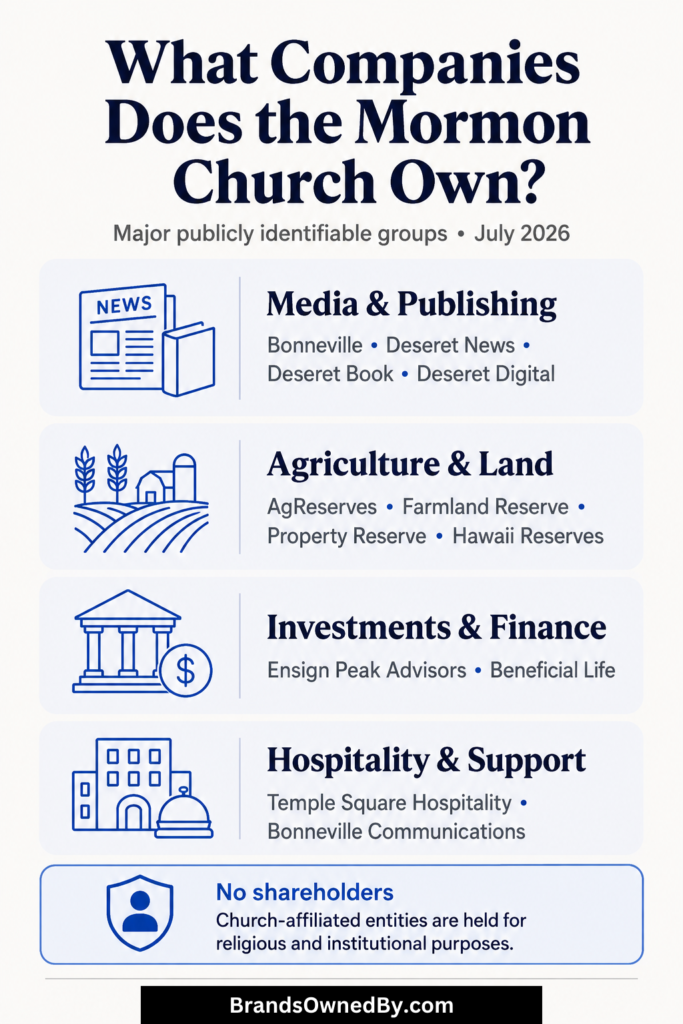
- The Church’s main media and publishing businesses include Bonneville International, Deseret News, Deseret Book, Deseret Digital Media, and Bonneville Communications.
- AgReserves, Farmland Reserve, Property Reserve, and Hawaii Reserves support the Church’s agriculture, land, and real estate activities.
- Ensign Peak Advisors manages investment reserves, but the public-company shares it holds are investments rather than companies controlled by the Church.
- The Church is a nonprofit religious institution with no equity shareholders. Its affiliated entities are held for Church purposes and ultimately operate under Church governance.
The Church of Jesus Christ of Latter-day Saints is connected to a large network of media, publishing, agriculture, real estate, investment, insurance, and hospitality entities. Its best-known holdings include Bonneville International, Deseret News, Deseret Book, AgReserves, Property Reserve, and Ensign Peak Advisors. These are Church-affiliated entities. They are not personal assets of Church leaders or shares owned by Church members.
The term “Mormon Church” is widely used in search, but the institution’s official name is The Church of Jesus Christ of Latter-day Saints. This article uses both terms where helpful.
Mormon Church Founder and Origin
Joseph Smith organized the Church of Christ on April 6, 1830, in Fayette, New York. The organization later adopted the name The Church of Jesus Christ of Latter-day Saints.
The early Church was a religious society rather than a modern corporate group. It still needed legal ways to own land, construct meeting places, publish materials, and enter contracts. Joseph Smith therefore acted as trustee-in-trust for Church property during the Nauvoo period.
That history matters. The Church’s present corporate network did not begin as a conventional business empire. It developed as an administrative framework for holding property and supporting religious operations.
Brigham Young Expanded the Economic Structure
Brigham Young became the central leader of the Latter-day Saint movement after Joseph Smith’s death. He led the migration to the Salt Lake Valley and encouraged community-based economic development.
Under Young, Church-linked publishing, retail, agriculture, transportation, and cooperative ventures expanded. Some early ventures disappeared. Others evolved into organizations that remain influential.
The Deseret News, first published in 1850, is the clearest surviving example. It predates most of the Church’s current corporate subsidiaries.
The Modern Legal Structure
The Church eventually used corporation-sole structures to hold assets and provide continuity when one president succeeded another. In 2019, its two principal U.S. corporations were merged. The surviving corporation was later renamed The Church of Jesus Christ of Latter-day Saints.
This legal entity sits at the institutional center of the U.S. structure. Separate nonprofit and for-profit affiliates handle specialized activities. Their exact legal relationships can vary. Not every subsidiary or special-purpose entity is publicly listed in one consolidated directory.
List of Companies Owned by the Mormon Church
The following list covers the major publicly identifiable companies and operating groups affiliated with the Church as of August 2026. It should not be treated as an exhaustive register of every subsidiary, landholding company, or local legal entity.
Deseret Management Corporation
Deseret Management Corporation, or DMC, is the Church-affiliated for-profit holding company most closely associated with its media, publishing, communications, financial, and hospitality operations.
DMC does not function like a publicly traded conglomerate. It has no outside public shareholders. Its companies are managed commercially, but their ultimate purpose is aligned with the Church’s institutional mission.
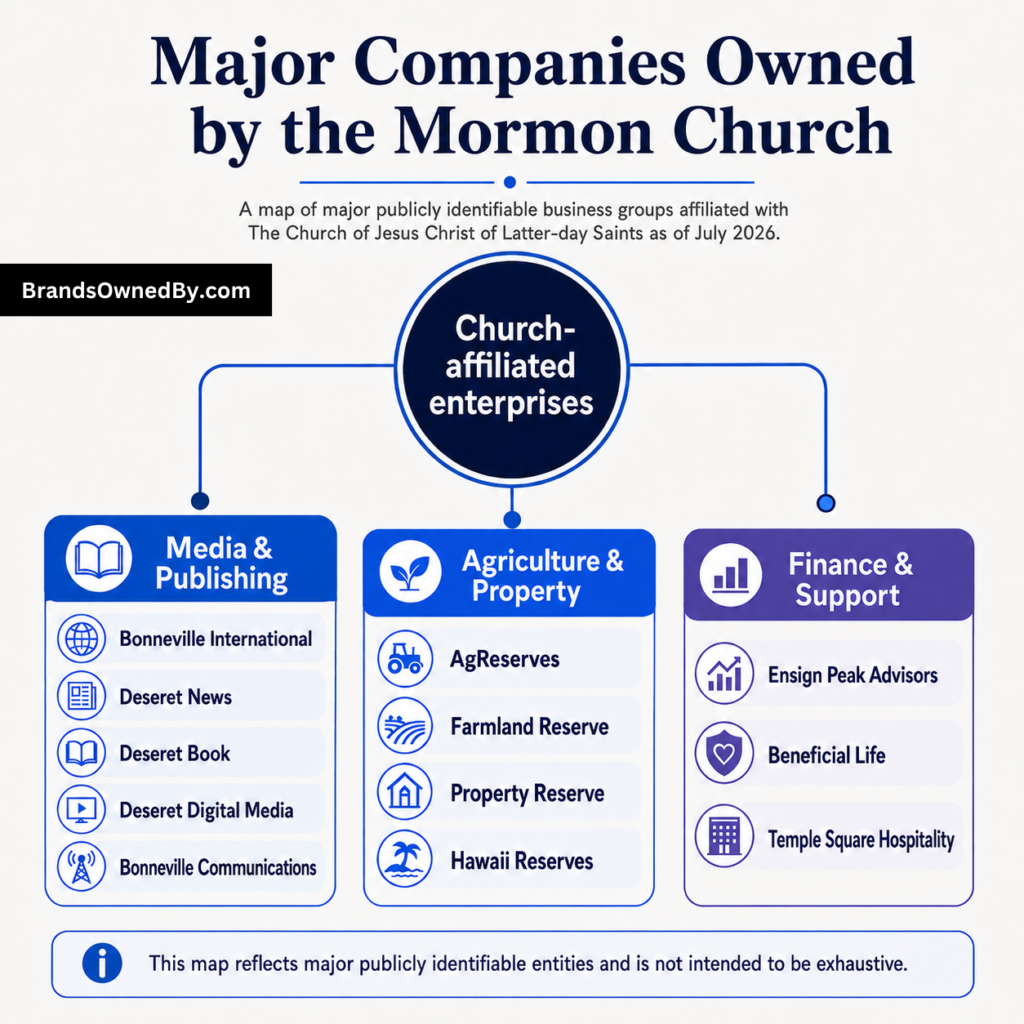
DMC’s portfolio includes Bonneville International, Deseret News, Bonneville Communications, Deseret Book, Deseret Digital Media, Beneficial Life, and Temple Square Hospitality.
Jeff Simpson serves as DMC’s president and chief executive officer as of July 2026. Operating companies also have their own presidents and management teams.
Bonneville International
Bonneville International is a major broadcasting company. It owns and operates radio stations in several U.S. markets and operates KSL-TV in Salt Lake City.
Its roots are connected to KSL Radio, which began broadcasting in 1922. Bonneville International itself was established in 1964. It now acts as the Church-affiliated broadcasting arm within DMC.
The company’s stations operate as commercial media businesses. They sell advertising, develop local programming, and compete for audiences in their respective markets.
The Church does not directly manage daily station schedules. Bonneville’s executive team handles operations. DMC provides ownership oversight.
Deseret News
Deseret News is a news publisher founded in 1850. Its portfolio includes a website, app, newspaper, and magazine.
The organization is one of the oldest continuing businesses associated with the Church. It covers Utah news, national affairs, politics, family, faith, and culture.
Deseret News operates under DMC. Its publisher manages editorial and commercial functions. Church affiliation influences the company’s stated values, but the newsroom remains an operating media organization with professional staff.
Deseret News should not be confused with Church News. Church News focuses specifically on institutional developments and Latter-day Saint communities. Both are associated with the broader Church-linked media network, but they serve different editorial purposes.
Bonneville Communications
Bonneville Communications is a marketing and communications group. Its Boncom operation provides strategy, branding, research, media buying, analytics, and experience design.
The company works on cause-based and values-oriented campaigns. It also supports clients that are not part of the Church.
Radiant Digital sits within this communications group. It operates faith- and family-oriented content platforms. These platforms broaden the group’s reach beyond traditional publishing and broadcasting.
Deseret Book Company
Deseret Book is a publisher and retailer focused on faith, family, and Latter-day Saint culture. Its history dates to 1866.
The business sells books, music, art, home décor, gifts, and other lifestyle products. It also distributes content through physical stores, e-commerce, and digital channels.
Deseret Book owns or operates publishing imprints. Shadow Mountain is its national-market imprint. It publishes titles intended for a broader audience rather than only Latter-day Saint readers.
Deseret Book is a commercial company within DMC. It is separate from the Church’s ecclesiastical curriculum departments, even though some products serve similar audiences.
Deseret Digital Media
Deseret Digital Media, or DDM, manages digital content, marketplace, and technology businesses. Its best-known platform is KSL.com.
KSL.com combines news with classified listings for vehicles, jobs, homes, services, and general merchandise. Utah.com provides travel information and itinerary content.
DDM is important because it turns local media reach into digital commerce. A radio or television audience may use KSL.com to read a story, search for a car, apply for a job, or list a property.
Its connection to KSL does not mean every KSL-branded activity sits inside the same operating company. Broadcasting and digital operations can be organized under separate affiliates within DMC.
Beneficial Life Insurance Company
Beneficial Life was founded in 1905. It is one of the oldest life insurance companies based in the Intermountain West.
The company stopped actively selling new insurance policies after the financial crisis period, but it continues to administer existing obligations and honor policies. This makes it a run-off insurance operation rather than a growth-focused retail insurer.
Beneficial Life remains part of the DMC portfolio. Its value is tied to its insurance assets, reserves, and long-term policy responsibilities.
Temple Square Hospitality
Temple Square Hospitality was organized in 1988 to serve visitors and events connected with Temple Square. Its operations have included catering, restaurants, bakery services, floral services, and guest support.
The business is affected by the long-running renovation of the Salt Lake Temple and surrounding areas. Its venue mix can therefore change as construction progresses and facilities reopen.
Temple Square Hospitality is a commercial service organization within DMC. It should not be treated as ownership of Temple Square itself. Temple Square is a religious and institutional property.
AgReserves
AgReserves is the main agriculture management company associated with the Church. It oversees a family of farms and ranches across multiple regions.
Its operations include cattle, row crops, permanent crops, and land management. The company manages agricultural properties in the United States and other countries.
Doug Rose serves as president and chief executive officer as of July 2026. The company also uses divisional leadership for ranches, permanent plantings, and land management.
AgReserves is often described simply as “the Mormon Church’s ranch company.” That description is too narrow. Its activities extend beyond cattle and include large-scale crop production, agricultural land stewardship, and long-term resource planning.
Farmland Reserve
Farmland Reserve is a Church-affiliated landholding and agricultural investment entity. It acquires and holds farmland, ranchland, forests, and related assets.
Its name appears in significant land transactions. Those holdings may be operated by AgReserves or other affiliated managers, depending on the asset and location.
Farmland Reserve is not a consumer-facing brand. Its function is closer to that of an institutional landowner. This distinction explains why the company can own major acreage without appearing prominently in retail markets.
Deseret Ranches and Deseret Cattle & Citrus
Deseret Ranches is used across several Church-affiliated agricultural operations. Deseret Cattle & Citrus in central Florida is the best-known example.
The Florida ranch is a large cattle and natural-resource operation. It has also become strategically important because surrounding land is part of long-term development planning in central Florida.
These ranch names generally operate within the broader AgReserves and Farmland Reserve structure. They are operating properties and brands, not separate public parent companies.
Property Reserve
Property Reserve is a major real estate arm associated with the Church. It handles investment and development property rather than ordinary meetinghouses and temples alone.
Its work has included office, residential, retail, and mixed-use projects. It may use special-purpose subsidiaries for individual properties or developments.
The best-known example is the Church-backed City Creek development in downtown Salt Lake City. City Creek Center is part of that wider redevelopment effort.
Property Reserve should not be confused with every piece of Church real estate. Temples, chapels, educational buildings, welfare facilities, investment properties, and development land can sit in different administrative categories.
City Creek Reserve
City Creek Reserve is associated with the development and ownership structure behind the City Creek project in Salt Lake City.
The project includes retail, residential, office, hospitality, and public-space components. It was designed as an urban redevelopment initiative near Church headquarters.
Retail operations involve professional commercial managers and tenants. The Church’s affiliation with the project does not mean it owns the brands operating stores inside the mall.
For example, a retailer leasing space at City Creek Center remains owned by its own parent company. The landlord-tenant relationship is not corporate ownership.
Hawaii Reserves
Hawaii Reserves manages Church-affiliated land and community interests in and around Laie, Hawaii.
Its activities include property management, infrastructure, residential and commercial development, and community planning. The company’s role is closely connected to the Church’s long presence in the area.
Laie also contains Brigham Young University–Hawaii and the Polynesian Cultural Center. Those organizations are related to the broader Church ecosystem, but they are not simply divisions of Hawaii Reserves.
Ensign Peak Advisors
Ensign Peak Advisors is the Church’s principal investment manager. It manages financial reserves that include public equities, bonds, cash, private investments, and other assets.
Its U.S.-listed equity portfolio was valued at approximately $53.67 billion at March 31, 2026. That figure covers securities reported on Form 13F. It does not represent Ensign Peak’s complete investment portfolio.
Ensign Peak is frequently misunderstood. If it holds shares in Apple, Nvidia, Microsoft, Amazon, or Alphabet, that does not mean the Church “owns” those companies in the controlling sense. It owns investment positions alongside many other shareholders.
The distinction is practical. The Church controls Deseret Book through its affiliated corporate structure. It does not control Apple merely because Ensign Peak owns Apple shares.
Intellectual Reserve
Intellectual Reserve is a Church-affiliated nonprofit entity that holds or manages trademarks, copyrights, and other intellectual property.
Its name appears in notices connected with Church publications, websites, media, and branding. It is an asset-holding entity rather than a conventional operating company serving outside customers.
Including Intellectual Reserve in a company list requires context. It is important to the legal structure, but it is not a commercial brand comparable to Bonneville International or Deseret Book.
Deseret Mutual Benefit Administrators
Deseret Mutual Benefit Administrators, or DMBA, administers employee benefit programs for eligible Church and affiliated-organization workers.
Its activities include retirement and health-benefit administration. It manages substantial benefit-plan assets, but those assets exist to meet participant obligations. They should not automatically be added to unrestricted Church reserves without checking for overlap and legal restrictions.
DMBA is an institutional support organization. It is not a retail financial company open to the general public.
Brigham Young University
Brigham Young University is sponsored and controlled through the Church Educational System. The Church also sponsors BYU–Idaho, BYU–Hawaii, and Ensign College.
These are nonprofit educational institutions. Calling them “companies owned by the Mormon Church” is legally and economically imprecise.
The better description is that they are Church-sponsored institutions. They serve educational and religious objectives rather than distributing profit to an owner.
Deseret Industries
Deseret Industries operates thrift stores and employment-training programs. It is part of the Church’s welfare and self-reliance system.
It sells donated goods, but it is not merely a retail chain designed to maximize profit. Store operations support job training, rehabilitation, community assistance, and reuse of donated items.
The Polynesian Cultural Center
The Polynesian Cultural Center is a nonprofit cultural attraction in Laie, Hawaii. It has close ties to BYU–Hawaii and provides employment opportunities for many students.
It is part of the broader Church-affiliated institutional network. It should not be grouped with DMC’s for-profit media businesses without explaining its nonprofit purpose.
Who Owns the Mormon Church?
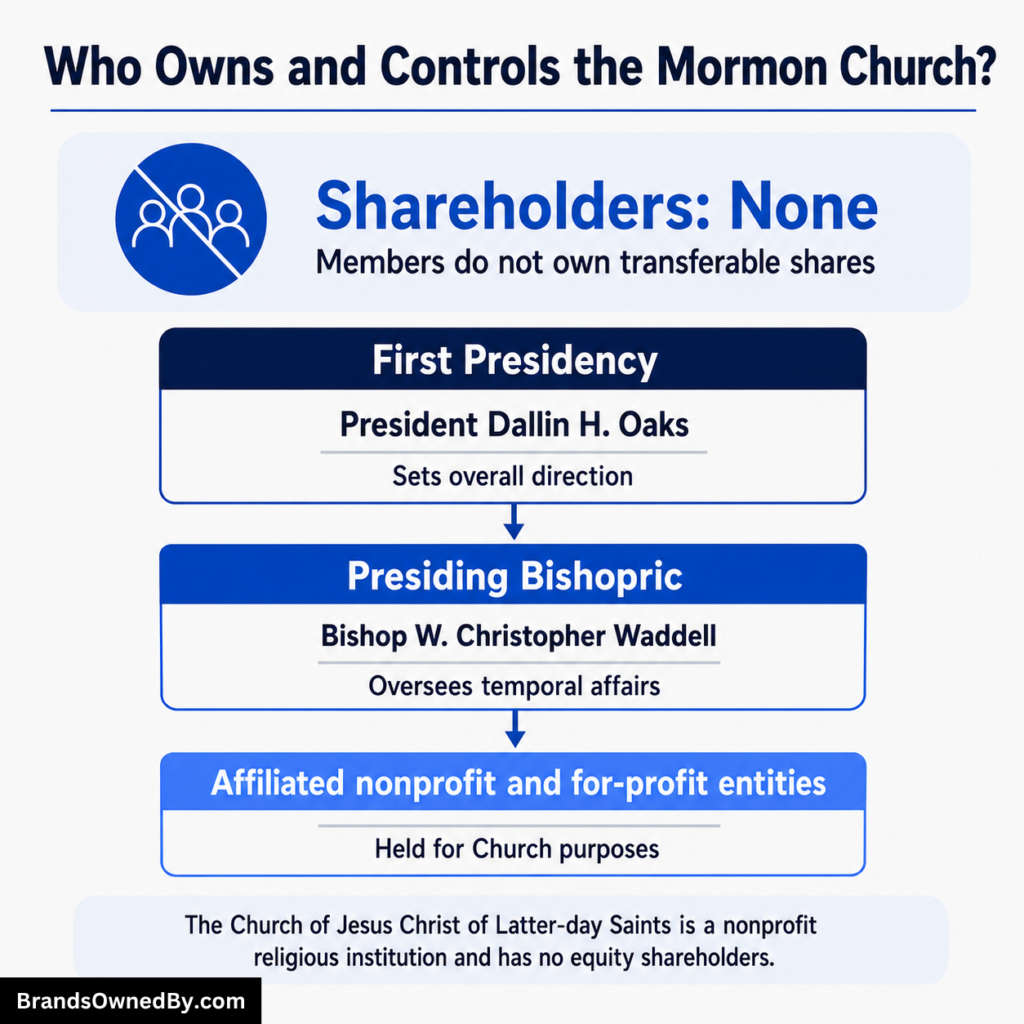
The Mormon Church is legally owned through The Church of Jesus Christ of Latter-day Saints, a Utah corporation sole. The institution has no outside investors, founding-family stake, or publicly traded shares. Its assets remain with the Church when leadership changes.
The Church’s Central Legal Entity
In 2019, the Corporation of the President was merged into the Corporation of the Presiding Bishop. The surviving entity was later renamed The Church of Jesus Christ of Latter-day Saints.
This central corporation holds or controls major religious and institutional assets in the United States. Separate affiliates are used for media, agriculture, real estate, investments, education, and other activities.
Ownership of Church-Affiliated Companies
The Church controls its major operating groups through subsidiary and affiliated entities. These include Deseret Management Corporation, AgReserves, Farmland Reserve, Property Reserve, and Ensign Peak Advisors.
Deseret Management Corporation oversees the Church-affiliated commercial portfolio. Its companies include Bonneville International, Deseret News, Deseret Book, Deseret Digital Media, Bonneville Communications, Beneficial Life, and Temple Square Hospitality.
These businesses do not have publicly disclosed outside shareholders. Profits and asset gains remain within the Church-affiliated structure rather than being distributed to private owners.
Dallin H. Oaks’s Legal Role
Dallin H. Oaks has served as the Church’s president since October 14, 2025. He presides over the central legal entity as part of his office, but he does not personally own its assets.
Church property cannot be transferred to his family or included in his personal estate. When a new president succeeds him, legal authority continues with the office rather than passing through inheritance.
Who Exercises Financial Control?
The First Presidency provides ultimate institutional oversight. As of July 2026, it consists of Dallin H. Oaks, Henry B. Eyring, and D. Todd Christofferson.
The Presiding Bishopric manages the Church’s temporal affairs under the First Presidency. W. Christopher Waddell serves as Presiding Bishop, assisted by L. Todd Budge and Sean Douglas. Their responsibilities include Church facilities, donations, welfare operations, and material resources.
Professional executives manage daily business decisions. For example, Jeff Simpson leads Deseret Management Corporation, while Doug Rose leads AgReserves. These executives operate within policies and budgets approved through the Church’s governance structure.
Who Controls the Mormon Church?
The First Presidency is the Church’s highest governing body. As of July 2026, it consists of President Dallin H. Oaks, First Counselor Henry B. Eyring, and Second Counselor D. Todd Christofferson.
The First Presidency sets overall institutional direction. Major questions involving doctrine, worldwide administration, senior appointments, budgets, and strategic use of Church resources ultimately fall under its authority.
This does not mean the First Presidency manages every radio station, farm, or investment position. It establishes direction and approves major policies. Professional managers handle daily execution.
The Presiding Bishopric Oversees Temporal Affairs
The Presiding Bishopric administers the Church’s temporal affairs under the direction of the First Presidency.
As of July 2026, W. Christopher Waddell serves as Presiding Bishop. L. Todd Budge is First Counselor. Sean Douglas is Second Counselor.
Their responsibilities include tithes and offerings, physical facilities, welfare and humanitarian operations, and other material resources. This makes the Presiding Bishopric central to the governance of the Church’s non-ecclesiastical infrastructure.
Boards and Executives Manage Affiliated Entities
Each major affiliate has executives, directors, and operating controls. Jeff Simpson leads DMC. Tanya Vea leads Bonneville International. Doug Rose leads AgReserves.
These managers make commercial decisions within the mandate of their organizations. A farm manager decides how to operate farmland. A broadcaster manages programming and advertising. An investment team allocates capital within approved policies.
The control chain therefore has two levels. Church leaders provide ultimate institutional oversight. Corporate boards and executives manage the businesses.
Internal Audit and Ecclesiastical Accountability
The Church has an internal auditing function and presents an annual audit statement during general conference. That statement confirms that financial practices were reviewed against approved policies.
It does not provide a consolidated income statement, balance sheet, cash-flow statement, or subsidiary schedule. Readers should not treat the audit statement as equivalent to a public-company annual report.
Mormon Church Annual Revenue and Net Worth
The Church does not publish consolidated U.S. financial statements. It therefore has no official public “annual revenue” or “net worth” series comparable to a listed company.
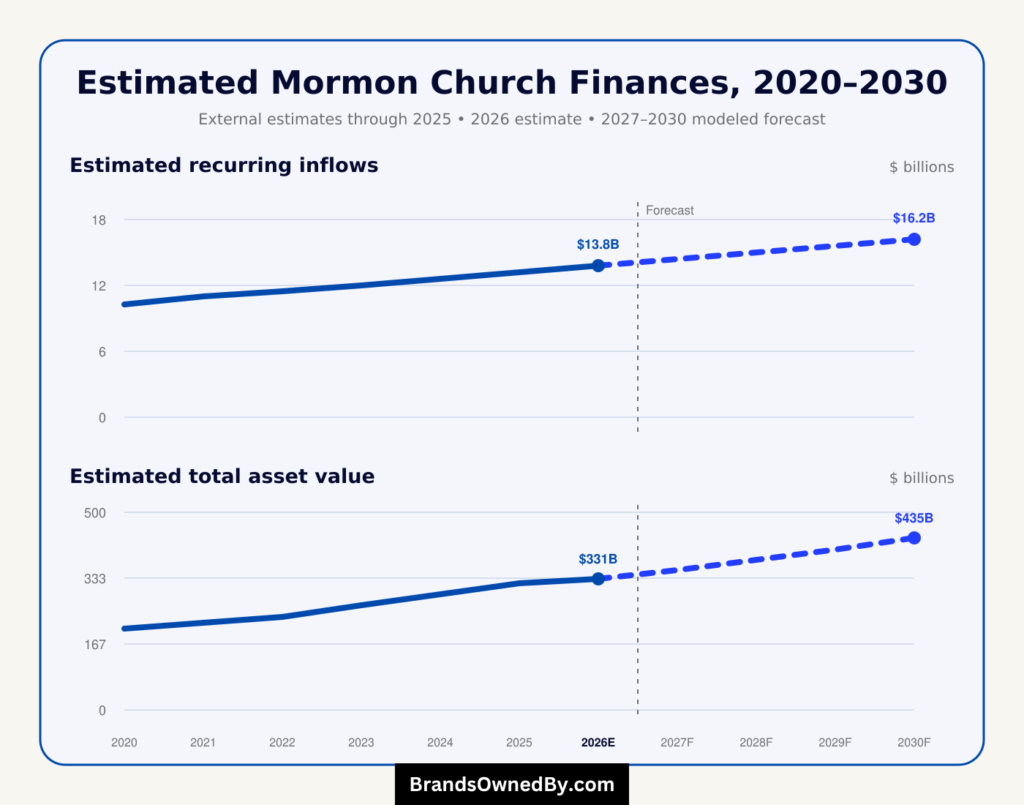
The details below use estimated recurring inflows and estimated total asset value. Recurring inflows include modeled donations, business activity, and recurring investment income. They exclude unrealized market gains. Asset figures are external estimates, not audited Church disclosures.
2026 Revenue and Recurring Inflows
Estimated recurring inflows for 2026 are $13.8 billion. This is not an official revenue figure.
A reasonable model assigns about $7.1 billion to tithes and other recurring donations. Around $3.0 billion can be associated with operating businesses, educational and service activities, and other institutional receipts. Approximately $3.7 billion can be attributed to recurring interest, dividends, rent, and similar investment income.
This approach intentionally excludes unrealized investment gains. If public stocks rise sharply, economic income could be much higher. If markets fall, total investment returns could be negative even while donations and business receipts remain positive.
That is why describing every change in investment value as “revenue” can mislead readers.
2026 Net Worth and Asset Bifurcation
The August 2026 modeled asset value is approximately $331 billion. “Asset value” is a better term than net worth because the Church does not publish consolidated liabilities.
Financial investments account for an estimated $235 billion. This category is broader than Ensign Peak’s $53.67 billion March 2026 Form 13F portfolio. It can include bonds, cash, international securities, private funds, and assets held through other managers.
Religious, educational, and operating real estate is estimated at roughly $75 billion. This includes temples, meetinghouses, schools, offices, welfare facilities, and other institutional property.
Agriculture, operating businesses, and other assets account for an estimated $21 billion. The categories overlap in some external databases, so the bifurcation should be treated as a model rather than an audited valuation.
The 2026 estimate increases only modestly from the 2025 estimate of $321 billion. That cautious adjustment recognizes market volatility. Ensign Peak’s reported U.S. equity portfolio declined from $56.62 billion at the end of 2025 to $53.67 billion at March 31, 2026.
Revenue Forecast for 2027–2030
The recurring-inflow forecast rises from $14.4 billion in 2027 to $16.2 billion in 2030. This represents annual growth near 4%.
Three factors support that rate. Reported Church membership reached 17.89 million at the end of 2025. Donation capacity can rise with membership, employment, wages, and inflation. Commercial rents, media sales, agricultural output, and publishing income can also increase over time. The large financial reserve generates recurring dividends and interest even without asset sales.
The forecast is not aggressive. It assumes no major change in tithing policy. It also avoids counting large market gains as recurring revenue.
The main downside risks are lower member participation, weak advertising markets, agricultural volatility, property vacancies, and falling interest rates. A global recession could affect several income sources at once.
Asset Value Forecast for 2027–2030
Estimated total asset value rises from $354 billion in 2027 to $435 billion in 2030. That implies growth of about 7% a year from the 2026 base.
The forecast is driven mainly by investment compounding. A diversified reserve of more than $200 billion can add substantial value at ordinary long-term market returns. Annual operating surpluses would add further capital.
Real estate also supports the forecast. The Church continues to build temples and other facilities. Agriculture and development land can appreciate over long periods, even when short-term cash yields are modest.
The path will not be smooth. A market correction could reduce the portfolio by tens of billions of dollars in one year. The forecast should therefore be read as a base-case trajectory, not a guaranteed annual balance.
Final Words
The answer to “what companies does the Mormon Church own?” starts with DMC’s media portfolio, AgReserves and Farmland Reserve in agriculture, Property Reserve in real estate, and Ensign Peak Advisors in investment management.
The larger story is structural. The Church uses different entities for publishing, broadcasting, land, finance, employee benefits, education, welfare, and intellectual property. Some are for-profit companies. Others are nonprofit institutions or asset-holding organizations.
None of these businesses is owned by Church members through shares. Church leaders do not own them personally. The assets are held for The Church of Jesus Christ of Latter-day Saints and are controlled through its institutional governance system.
FAQs
Does the Mormon Church own Coca-Cola?
No. The Church does not control The Coca-Cola Company. Ensign Peak may buy or sell shares in Coca-Cola as an investment. Holding a small public-market position is not the same as owning the company.
Does the Mormon Church own Pepsi?
No. PepsiCo is a publicly traded company owned by many institutional and individual shareholders. A Church-affiliated investment fund may hold PepsiCo shares, but that does not give the Church corporate control.
Does the Mormon Church own Marriott?
No. Marriott International is a publicly traded hospitality company. Its founding family includes prominent Latter-day Saints, but the company is not owned by the Church.
Religious affiliation of a founder is not evidence of institutional ownership.
Does the Mormon Church own Ancestry.com?
No. The Church does not own Ancestry. The confusion comes from the Church’s strong interest in genealogy and its operation of FamilySearch.
FamilySearch is a Church-sponsored nonprofit genealogy service. Ancestry is a separate commercial company.
Does the Mormon Church own City Creek Center?
The Church backed the City Creek development through affiliated real estate entities. City Creek Reserve and related entities have been central to its ownership and development structure.
The stores inside the center are tenants. The Church does not own those retail brands merely because they operate in the development.
Does the Mormon Church own KSL?
Yes. KSL’s major broadcasting and digital properties sit within the Church-affiliated DMC network. Bonneville International operates KSL-TV and KSL Radio. Deseret Digital Media operates KSL.com and related digital marketplace services.
Does the Mormon Church own Brigham Young University?
The Church sponsors and controls Brigham Young University through the Church Educational System. BYU is a nonprofit educational institution, not a conventional for-profit subsidiary.
What is the Mormon Church’s largest business?
The answer depends on the metric. Ensign Peak Advisors is the largest financial manager associated with the Church. AgReserves is one of its most important operating groups by land and agricultural scale. DMC is the main umbrella for its visible media and publishing businesses.
How much land does the Mormon Church own?
No complete current global figure is publicly available. Independent land research has identified more than 2.3 million acres in the United States alone.
That estimate includes agricultural and investment land. It does not mean every acre is operated under one company or used for religious purposes.
Are Mormon Church-owned businesses tax-exempt?
Not automatically. For-profit subsidiaries generally pay applicable taxes on taxable commercial activity. Nonprofit religious and charitable entities may qualify for exemptions based on their legal status and use of funds.
The tax treatment depends on the entity, jurisdiction, activity, and type of income.
Can Church members receive dividends from Church businesses?
No. Church membership does not create an ownership share. Members cannot receive dividends or sell an interest in Church assets.
Profits retained or distributed within the affiliated structure are used for institutional purposes rather than paid to members as shareholders.
Is Ensign Peak Advisors a company owned by the Mormon Church?
Ensign Peak Advisors is a Church-affiliated nonprofit investment manager. It manages reserves for the institution.
Its investment portfolio should not be confused with a list of companies controlled by the Church. Most public-stock positions are minority investments.