
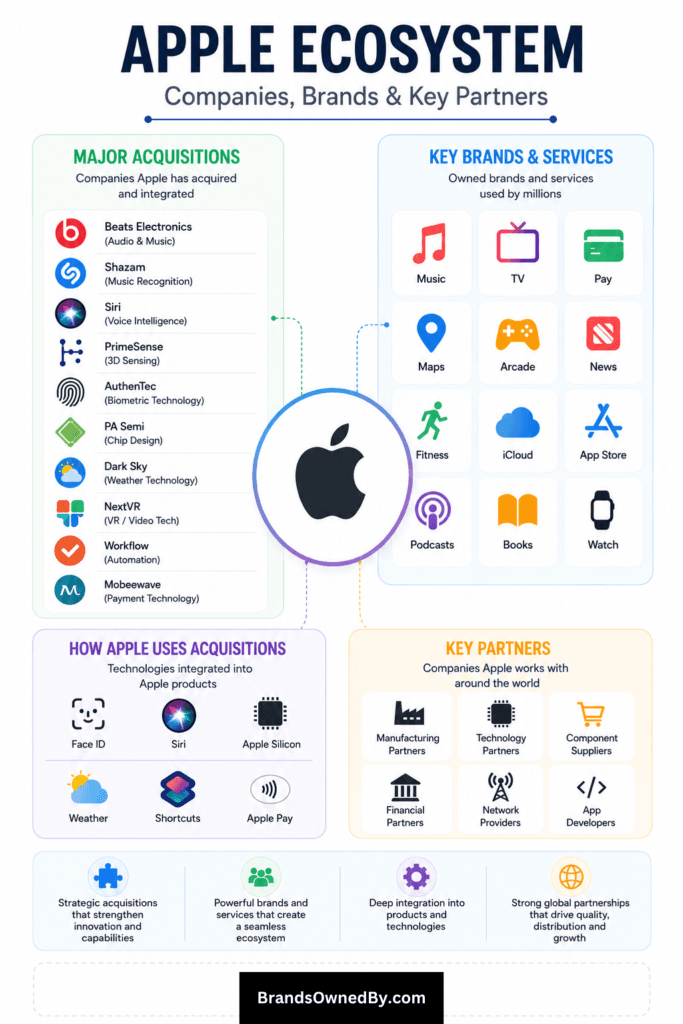
- Apple owns more than 140 acquired companies, with major acquisitions including Beats Electronics, Shazam, Siri, PrimeSense, AuthenTec, PA Semi, Dark Sky, NextVR, Workflow, and Mobeewave, many of which power core Apple products and technologies today.
- Apple’s most important owned brands and services include Apple Music, Apple TV+, Apple Pay, Apple Maps, Apple Arcade, Apple News+, Apple Fitness+, iCloud, App Store, AppleCare, Vision Pro, and Beats, which collectively serve billions of users worldwide.
- Unlike Alphabet and Microsoft, Apple rarely operates acquisitions as standalone businesses. Instead, it integrates acquired technologies into products such as iPhone, Mac, Apple Watch, AirPods, Vision Pro, Apple Silicon chips, Face ID, Touch ID, and Apple Intelligence.
- Apple’s acquisition strategy focuses on strengthening key growth areas such as artificial intelligence, semiconductors, digital payments, cloud services, entertainment, health technology, and spatial computing, helping the company generate more than $450 billion in annual revenue and maintain a market value of approximately $4 trillion.
Apple Inc. is an American technology company headquartered in Cupertino, California. Founded on April 1, 1976, Apple develops consumer electronics, software, digital services, and semiconductor technologies. The company is best known for products such as the iPhone, Mac, iPad, Apple Watch, AirPods, Apple TV, and Vision Pro.
Over the past five decades, Apple has evolved from a personal computer manufacturer into one of the world’s most influential technology companies. Its ecosystem combines hardware, software, and services under a single platform. This approach allows users to move seamlessly between devices while accessing services such as Apple Music, Apple TV+, iCloud, Apple Pay, Apple Arcade, and the App Store.
Apple operates in more than 175 countries and serves billions of active devices worldwide. The company is particularly known for its focus on product design, privacy, security, and custom silicon development. Its Apple Silicon chips now power Macs, iPads, and several other products, reducing dependence on third-party processor manufacturers.
A key reason for Apple’s success is its acquisition strategy. Instead of purchasing large corporations, Apple typically acquires smaller technology companies and integrates their technologies into existing products. Features such as Siri, Face ID, Touch ID, Apple Music, Shortcuts, and advanced mapping capabilities all originated from companies Apple acquired.
Apple Founders
Apple was founded by three entrepreneurs: Steve Jobs, Steve Wozniak, and Ronald Wayne. Each played a different role during the company’s formation.
Steve Jobs
Steve Jobs was the visionary entrepreneur behind Apple’s commercial strategy. He recognized the market potential of personal computers and helped transform Wozniak’s engineering concepts into commercial products.
Jobs played a central role in developing many of Apple’s most successful products, including the Macintosh, iPod, iPhone, and iPad. After returning to Apple in 1997, he led one of the most remarkable corporate turnarounds in business history. His focus on design, simplicity, and user experience continues to influence Apple’s culture today.
Steve Wozniak
Steve Wozniak was Apple’s engineering genius and the primary designer of the Apple I and Apple II computers. He created the hardware architecture and much of the software that powered Apple’s earliest products.
The Apple II became one of the first commercially successful personal computers and established Apple as a major technology company. Wozniak’s technical innovations helped lay the foundation for the personal computer revolution.
Ronald Wayne
Ronald Wayne was the third co-founder of Apple. He provided business oversight during the company’s earliest days and drafted Apple’s original partnership agreement. Wayne also designed Apple’s first logo.
Unlike Jobs and Wozniak, Wayne remained with the company for only a short period. He sold his ownership stake less than two weeks after Apple was founded because he was concerned about potential financial liabilities associated with the startup. At the time, he held a 10% ownership interest in the company.
The Early Apple Story
Apple began in Los Altos, California, where Steve Jobs and Steve Wozniak worked on the Apple I computer. To finance the project, Jobs sold his Volkswagen van while Wozniak sold his HP calculator. Their goal was to make personal computing more accessible to everyday users.
The company’s breakthrough came with the Apple II in 1977. The product became one of the first mass-market personal computers and helped establish Apple as a major player in the emerging technology industry. Fifty years later, Apple has evolved from a garage startup into one of the world’s most influential technology companies.
List of Companies Owned by Apple
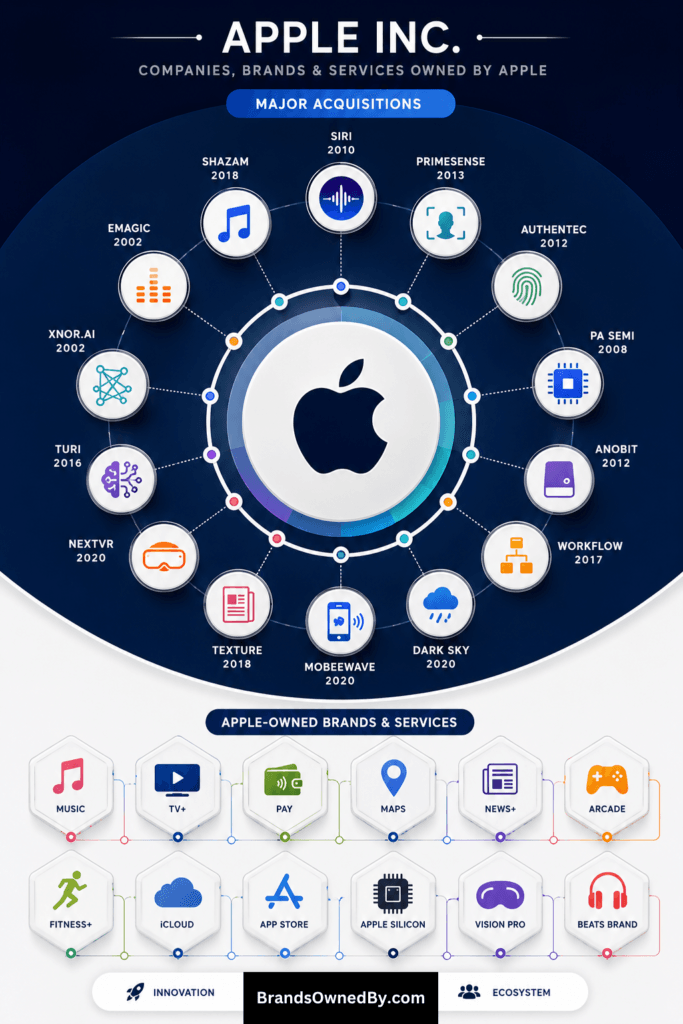
Apple owns several brands, subsidiaries, services, and acquired technology companies. Unlike Alphabet or Microsoft, Apple rarely operates acquisitions as separate businesses. Instead, it integrates acquired companies into its products and services.
Apple has acquired more than 140 companies since its founding. However, unlike many large technology companies, Apple rarely operates acquisitions as independent subsidiaries. Instead, it integrates acquired technologies, talent, patents, and products into its ecosystem. As a result, many of Apple’s most popular features and services originated from acquired companies.
As of June 2026, Apple’s most notable owned companies, brands, and business entities include Beats Electronics, Shazam, Siri, Apple Music, Apple TV+, Apple Pay, Apple Maps, Apple News+, Apple Arcade, Apple Fitness+, and numerous technology companies acquired to strengthen artificial intelligence, semiconductors, security, spatial computing, and digital services.
What Companies Does Apple Own?
Major acquisitions, brands, services, and technology companies owned by Apple as of 2026.
Major Acquisitions
Beats Electronics
Premium audio products and foundation of Apple Music.
Shazam
Music recognition technology integrated into Apple Music and Siri.
Siri
Voice assistant powering Apple’s AI ecosystem.
PrimeSense
Face ID, depth sensing and AR technology.
AuthenTec
Fingerprint security behind Touch ID.
PA Semi
Foundation of Apple Silicon processors.
Anobit
Flash storage and memory technologies.
Workflow
Now powers Apple’s Shortcuts automation platform.
Dark Sky
Weather forecasting technology.
Mobeewave
Technology behind Tap to Pay on iPhone.
Texture
Foundation for Apple News+.
NextVR
Immersive content and Vision Pro technologies.
Turi
Machine learning and AI development platform.
Xnor.ai
On-device artificial intelligence technology.
Emagic
Creator of Logic Pro music software.
Apple-Owned Brands & Services
Apple Music
Music streaming platform.
Apple TV+
Premium video streaming service.
Apple Pay
Digital payments ecosystem.
Apple Maps
Navigation and mapping platform.
Apple News+
Premium magazines and news.
Apple Arcade
Gaming subscription service.
Apple Fitness+
Digital fitness platform.
iCloud
Cloud storage and synchronization.
App Store
Apple’s software marketplace.
Apple Silicon
A-series and M-series processors.
Vision Pro
Spatial computing ecosystem.
Beats Brand
Premium headphones and earbuds.
Beats Electronics
Beats Electronics is Apple’s largest and most recognizable acquisition. Apple purchased the company in 2014 for approximately $3 billion. Founded by Dr. Dre and Jimmy Iovine, Beats built a strong reputation for premium headphones, earbuds, and audio equipment.
The acquisition gave Apple a successful audio hardware brand and access to Beats Music, which later became the foundation of Apple Music. Unlike most Apple acquisitions, Beats continues to operate under its original brand name. Products such as Beats Studio Pro, Beats Solo, Beats Fit Pro, and Powerbeats remain popular worldwide and complement Apple’s AirPods lineup.
Shazam
Apple acquired Shazam in 2018 to strengthen its music ecosystem. Before the acquisition, Shazam had become one of the world’s most downloaded music-recognition applications, allowing users to identify songs within seconds.
Today, Shazam technology is integrated throughout Apple’s ecosystem. Users can identify songs directly through Siri, Control Center, and Apple Music. The standalone Shazam app still exists, but its technology primarily supports Apple’s music discovery and streaming services.
Siri
Siri was originally developed by a startup that Apple acquired in 2010. The technology was first launched as a standalone iPhone application before becoming part of Apple’s operating systems.
Since then, Siri has evolved into Apple’s voice assistant and is available across iPhone, iPad, Mac, Apple Watch, HomePod, Apple TV, AirPods, and Vision Pro. Siri remains one of Apple’s most important artificial intelligence platforms and serves as a core part of the company’s smart-device ecosystem.
PrimeSense
PrimeSense joined Apple in 2013 and brought advanced three-dimensional sensing technology to the company. The Israeli firm was best known for developing technology used in Microsoft’s Kinect motion-sensing system.
The acquisition played a major role in the development of Face ID and Apple’s depth-sensing camera systems. Today, PrimeSense technology supports facial recognition, augmented reality experiences, portrait photography, and various biometric security features across Apple devices.
AuthenTec
Apple acquired AuthenTec in 2012 to expand its biometric security capabilities. The company specialized in fingerprint recognition technology and mobile security solutions.
Shortly after the acquisition, Apple introduced Touch ID on the iPhone 5s. The technology transformed smartphone security and mobile payments by allowing users to unlock devices and authorize transactions using their fingerprints. Touch ID remains widely used on iPads and Mac devices.
PA Semi
PA Semi is one of Apple’s most strategically important acquisitions. Apple purchased the semiconductor company in 2008 to gain greater control over processor development.
The acquisition laid the foundation for Apple’s custom chip business. Engineers from PA Semi helped create the A-series processors used in iPhones and iPads as well as the M-series chips that power modern Mac computers. Apple’s success in semiconductor design can be traced directly to this acquisition.
Anobit
Apple acquired Israeli storage technology company Anobit in 2012. The company specialized in flash-memory management systems that improved storage performance and reliability.
Anobit’s technology helped Apple enhance the speed, efficiency, and durability of storage systems used in iPhones, iPads, and Macs. The acquisition also strengthened Apple’s control over critical hardware components.
Workflow
Workflow was acquired in 2017 and later transformed into Apple’s Shortcuts application. Before the acquisition, Workflow was one of the most popular productivity apps on iOS.
Apple integrated the technology into its operating systems and expanded its capabilities. Today, Shortcuts allows users to automate tasks across Apple devices and has become an important productivity feature for both casual and advanced users.
Dark Sky
Dark Sky was acquired in 2020 and quickly became part of Apple’s weather services strategy. The company was known for highly accurate local forecasts and minute-by-minute precipitation predictions.
Apple incorporated Dark Sky’s technology into the Weather app, significantly improving forecast accuracy and user experience. Many weather features available on iPhone today originated from Dark Sky’s forecasting systems.
Mobeewave
Apple acquired Canadian fintech company Mobeewave in 2020. The company developed technology that allows smartphones to function as payment terminals without requiring additional hardware.
The acquisition led to the launch of Tap to Pay on iPhone, enabling merchants to accept contactless payments directly through their devices. This strengthened Apple’s position in the digital payments industry and expanded the capabilities of Apple Pay.
Texture
Texture was acquired in 2018 and served as the foundation for Apple News+. Before the acquisition, Texture offered users access to hundreds of magazines through a single subscription.
Apple used the platform’s technology and publishing partnerships to launch Apple News+, which provides subscribers with premium magazine and newspaper content through one service.
NextVR
Apple purchased NextVR in 2020 to support its virtual reality and spatial computing ambitions. The company specialized in immersive video experiences, including virtual attendance at sports events and concerts.
Many industry observers believe NextVR’s technology contributed to the development of Vision Pro and Apple’s broader mixed-reality ecosystem. The acquisition strengthened Apple’s position in emerging immersive technologies.
Turi
Turi became part of Apple in 2016 as the company expanded its artificial intelligence capabilities. The startup specialized in machine learning tools and AI development platforms.
The acquisition helped Apple improve features such as image recognition, predictive suggestions, Siri intelligence, and personalized recommendations. Turi’s technology continues to support Apple’s growing AI initiatives.
Xnor.ai
Apple acquired Xnor.ai in 2020 to strengthen on-device artificial intelligence processing. The company specialized in edge AI, which allows machine-learning models to operate directly on devices rather than relying on cloud servers.
This approach aligns with Apple’s privacy-focused philosophy because user data can remain on the device. The acquisition supports Apple’s efforts to deliver powerful AI features while maintaining user privacy.
C3 Technologies
C3 Technologies was acquired in 2011 and became an important part of Apple Maps. The company developed advanced three-dimensional mapping and geographic visualization technology.
Its innovations enabled Apple to create realistic 3D city views and enhanced navigation experiences. The acquisition helped Apple compete more effectively in the digital mapping industry.
Emagic
Apple acquired Emagic in 2002, bringing the popular Logic music-production software into its portfolio. At the time, Logic was already widely used by professional musicians and audio engineers.
Following the acquisition, Apple continued investing in Logic Pro, which remains one of the leading digital audio workstations in the world. The software is used for music production, recording, mixing, and audio editing.
Apple Music
Apple Music is Apple’s music-streaming platform and one of the largest competitors to Spotify. The service provides access to more than 100 million songs, curated playlists, radio stations, artist content, and high-quality audio formats.
Built largely from the Beats Music acquisition, Apple Music has become a central part of Apple’s services business and is deeply integrated across Apple devices.
Apple TV+
Apple TV+ is Apple’s subscription video-streaming service. The platform focuses primarily on original content and has produced award-winning shows and films such as Ted Lasso, Severance, Foundation, Silo, and The Morning Show.
The service represents Apple’s long-term investment in the entertainment industry and competes with Netflix, Disney+, Prime Video, and Max.
Apple Pay
Apple Pay is Apple’s digital payment platform. It allows users to make secure purchases online, in apps, and in physical stores using iPhone, Apple Watch, iPad, and Mac devices.
The service has expanded globally and has become one of the most widely used mobile payment solutions in the world.
Apple Maps
Apple Maps is Apple’s mapping and navigation service. The platform provides directions, traffic information, local business listings, public transit data, and detailed city experiences.
Through multiple acquisitions and years of development, Apple Maps has evolved into one of the company’s most important software platforms.
Apple News+
Apple News+ is Apple’s premium news and magazine subscription service. Subscribers receive access to hundreds of magazines, newspapers, and premium publications through a single monthly subscription.
The service was developed following Apple’s acquisition of Texture and continues to expand its publishing partnerships.
Apple Arcade
Apple Arcade is Apple’s gaming subscription platform. The service provides access to hundreds of premium games without advertisements or in-app purchases.
It is available across iPhone, iPad, Mac, Apple TV, and Vision Pro, making it one of Apple’s fastest-growing entertainment services.
Apple Fitness+
Apple Fitness+ is Apple’s subscription-based fitness platform. Integrated closely with Apple Watch, it offers workout programs, guided exercises, meditation sessions, and wellness content.
The service reflects Apple’s increasing focus on health, fitness, and personal wellness technologies.
iCloud
iCloud serves as Apple’s cloud infrastructure platform. It powers device backups, file storage, photo synchronization, password management, email services, and cross-device connectivity.
The service plays a critical role in keeping Apple’s ecosystem connected and is used by hundreds of millions of customers worldwide.
App Store
The App Store is one of Apple’s most valuable digital assets. It serves as the primary distribution platform for apps on iPhone, iPad, Apple Watch, Apple TV, and Vision Pro devices.
Millions of developers rely on the App Store to distribute software, while consumers use it to access applications, games, subscriptions, and digital content.
Apple Silicon
Apple Silicon is Apple’s internal chip-design division and one of its most important competitive advantages. The division develops the A-series processors used in iPhones and the M-series processors used in Mac computers.
By designing its own chips, Apple controls performance, power efficiency, security, and software integration more effectively than many competitors.
Vision Pro Ecosystem
The Vision Pro ecosystem represents Apple’s newest major platform. It combines hardware, software, applications, and spatial computing technologies into a unified mixed-reality environment.
Built using technologies from acquisitions such as PrimeSense and NextVR, Vision Pro represents Apple’s long-term strategy for augmented reality, virtual reality, and next-generation computing experiences.
Who Owns Apple: Largest Shareholders
Who Owns Apple?
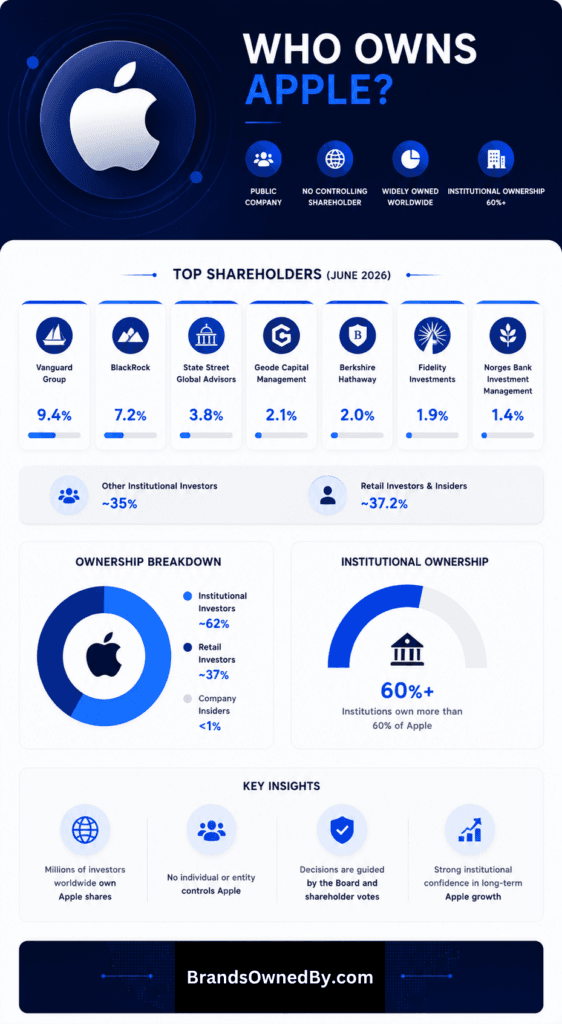
Apple Ownership Structure (June 2026)
Top Apple Shareholders
Apple Inc. is a publicly traded company listed on the NASDAQ stock exchange under the ticker symbol AAPL. Because Apple is a public company, ownership is divided among institutional investors, mutual funds, pension funds, exchange-traded funds (ETFs), company insiders, and millions of retail investors worldwide.
Unlike companies such as Meta Platforms, Alphabet, or Nvidia, Apple does not have a founder or individual shareholder with controlling voting power. Instead, ownership is widely distributed among large investment firms and institutional investors.
As of June 2026, institutional investors collectively own more than 60% of Apple’s outstanding shares, giving them significant influence over corporate governance and shareholder voting.
A simplified breakdown of Apple’s ownership structure as of June 2026 is:
- Institutional Investors: Approximately 62%.
- Retail Investors: Approximately 37%.
- Company Insiders: Less than 1%.
This diversified ownership structure reduces the risk of concentrated control and helps ensure that Apple remains accountable to a broad range of shareholders worldwide.
The Vanguard Group
The Vanguard Group is Apple’s largest shareholder and remains the company’s most influential institutional investor. Through its various mutual funds and exchange-traded funds, Vanguard owns approximately 9.4% of Apple’s outstanding shares.
Vanguard’s ownership comes primarily through passive index funds that track major stock market indices. Since Apple is one of the largest publicly traded companies in the world, it represents a major holding in many Vanguard funds.
Although Vanguard does not participate in Apple’s daily operations, it has significant voting power during shareholder meetings. The firm can influence board elections, executive compensation policies, governance matters, and shareholder proposals.
BlackRock
BlackRock is Apple’s second-largest shareholder. The investment management giant owns approximately 7.2% of the company’s outstanding shares through its various investment funds and ETFs.
BlackRock’s ownership is largely concentrated in index funds such as iShares ETFs and institutional investment portfolios. As one of the largest asset managers globally, BlackRock plays an important role in shareholder voting and corporate governance decisions.
Together, Vanguard and BlackRock control more than 16% of Apple, making them the two most influential shareholders in the company.
State Street Global Advisors
State Street Global Advisors is another major institutional investor in Apple. The firm owns approximately 3.8% of Apple’s shares.
State Street manages large pension funds, retirement plans, and institutional investment portfolios. Its ownership stake makes it one of Apple’s most influential shareholders despite not being involved in daily management.
Like Vanguard and BlackRock, State Street primarily invests in Apple through passive investment products and index funds.
Berkshire Hathaway
Berkshire Hathaway, led by legendary investor Warren Buffett, remains one of Apple’s largest shareholders despite reducing its position during recent years.
As of June 2026, Berkshire Hathaway owns approximately 2.0% of Apple. While this percentage is lower than in previous years, Apple continues to represent one of Berkshire’s most important investments.
Buffett has frequently praised Apple’s brand strength, customer loyalty, ecosystem advantages, and management team. His long-term support has contributed to investor confidence in the company.
Geode Capital Management
Geode Capital Management is among Apple’s largest institutional shareholders and owns approximately 2.1% of the company.
The firm manages index-based investment portfolios and retirement funds for institutional clients. Geode’s ownership position has grown steadily as Apple’s market value has expanded.
Although Geode receives less public attention than Vanguard or BlackRock, it remains one of Apple’s largest investors.
Fidelity Investments
Fidelity Investments holds a significant ownership stake in Apple through numerous mutual funds and retirement products.
The firm owns approximately 1.9% of Apple and is consistently ranked among the company’s largest shareholders. Fidelity’s investment reflects confidence in Apple’s long-term growth prospects and strong market position.
Norges Bank Investment Management
Norges Bank Investment Management, which manages Norway’s sovereign wealth fund, is another major Apple shareholder.
The fund owns approximately 1.4% of Apple and represents one of the largest sovereign wealth investments in the company. Its ownership reflects Apple’s importance within global equity markets.
Retail Investors
In addition to institutional investors, millions of individual investors own Apple shares directly through brokerage accounts, retirement plans, and investment apps.
Collectively, retail investors own a significant percentage of Apple’s outstanding shares. While individual investors generally have less influence than institutional shareholders, together they represent an important ownership group.
Apple remains one of the most widely held stocks among retail investors due to its strong brand, financial performance, and long history of shareholder returns.
Competitor Ownership Comparison
Apple’s ownership structure is very different from most of its largest competitors. While many technology companies remain heavily influenced by founders or controlling shareholders, Apple operates without a dominant owner. No individual, family, or institution controls the company. Instead, ownership is distributed among institutional investors, mutual funds, pension funds, ETFs, company insiders, and millions of retail shareholders.
As of June 2026, institutional investors collectively own more than 62% of Apple. Vanguard remains the largest shareholder with approximately 9.4% ownership, followed by BlackRock with roughly 7.2% and State Street with around 3.8%. Despite these large holdings, none of these investors has enough shares to exercise control over Apple. This makes Apple one of the most broadly owned companies among the world’s largest corporations.
Apple vs Competitors
Ownership Structure Comparison (June 2026)
Apple vs Microsoft
Microsoft has the ownership structure most similar to Apple’s. Both companies are mature public corporations with highly diversified ownership and no controlling founder.
Institutional investors dominate ownership at both companies. Vanguard is Microsoft’s largest shareholder with an ownership stake of approximately 9%, while BlackRock and State Street also rank among its top investors.
Similar to Apple, no executive or founder holds enough shares to significantly influence shareholder voting.
The biggest similarity between Apple and Microsoft is governance stability. Both companies rely on professional management teams, independent boards of directors, and institutional oversight rather than founder influence. This structure has allowed both companies to maintain continuity through multiple leadership transitions while continuing to grow.
Apple vs Alphabet
Alphabet, Google’s parent company, operates under a significantly different ownership model.
Although institutional investors own most of Alphabet’s publicly traded shares, founders Larry Page and Sergey Brin continue to maintain substantial control through the company’s dual-class share structure. Their Class B shares carry significantly greater voting power than ordinary shares.
As a result, Page and Brin retain influence over major corporate decisions despite owning a much smaller percentage of Alphabet’s economic interest than institutional investors collectively own.
Apple does not have a dual-class share structure. Every Apple shareholder generally receives equal voting rights. This means Apple is ultimately governed through collective shareholder voting rather than founder control.
Apple vs Meta Platforms
Meta Platforms remains one of the most founder-controlled companies among major technology firms.
Founder and CEO Mark Zuckerberg controls approximately 61% of Meta’s voting power through a dual-class share structure. This gives him effective control over the company despite institutional investors owning a large percentage of Meta’s shares.
The arrangement allows Zuckerberg to make long-term strategic decisions without requiring approval from institutional shareholders. Investments in artificial intelligence, virtual reality, and metaverse technologies are examples of initiatives that benefit from this structure.
Apple operates under the opposite model. Tim Cook leads the company as CEO, but he has no special voting rights and owns only a tiny fraction of Apple shares compared to Zuckerberg’s influence at Meta.
Apple vs Amazon
Amazon’s ownership structure sits somewhere between Apple’s dispersed ownership model and Meta’s founder-led approach.
Jeff Bezos remains Amazon’s largest individual shareholder and owns approximately 8% to 9% of the company. His stake gives him considerable influence, even after stepping down as CEO.
At the same time, institutional investors such as Vanguard, BlackRock, and State Street collectively own a much larger portion of Amazon’s shares. This creates a balance between founder influence and institutional oversight.
Compared with Amazon, Apple is less dependent on any single shareholder. No Apple executive or director has an ownership stake approaching Bezos’s influence at Amazon.
Apple vs Tesla
Tesla has one of the most concentrated ownership structures among major technology-related companies.
Elon Musk remains Tesla’s largest shareholder with an ownership stake of roughly 12% to 13% as of June 2026. While he does not hold majority voting control, his ownership position and public influence make him the dominant figure within Tesla.
Many investors view Tesla’s future performance as closely tied to Musk’s leadership. Major company announcements, strategic decisions, and even Musk’s public comments can have a substantial impact on Tesla’s valuation.
Apple’s governance model is much more institutional. The company’s performance and decision-making processes are not dependent on a single individual shareholder.
Apple vs Nvidia
Nvidia combines strong institutional ownership with substantial founder influence.
Founder and CEO Jensen Huang owns approximately 3% to 4% of Nvidia’s shares, making him one of the company’s largest individual shareholders. While institutional investors collectively own the majority of Nvidia, Huang’s ownership stake and leadership role provide him with significant influence over strategic decisions.
This differs from Apple, where no executive possesses a comparable ownership position. Tim Cook’s influence comes primarily from his executive role rather than stock ownership.
Apple vs Samsung Electronics
Samsung Electronics operates under a corporate structure that is very different from Apple’s.
Control of Samsung is influenced by the Lee family through a network of cross-shareholdings among Samsung Group companies. Although the family does not directly own a majority of Samsung Electronics, its influence extends across the broader conglomerate structure.
Apple does not belong to a larger conglomerate and does not use cross-shareholding arrangements. Its ownership structure is considerably simpler and more transparent for investors.
Apple vs Berkshire Hathaway
Berkshire Hathaway offers another interesting comparison because it is both a major Apple shareholder and a highly influential public company.
Although Berkshire is publicly traded, Warren Buffett remains the company’s most influential figure. Even after reducing his Apple holdings, Buffett continues to shape Berkshire’s strategy and investment decisions.
Apple, by contrast, no longer relies on founder influence. The company has successfully transitioned from the Steve Jobs era into a professionally managed corporation where leadership is separated from ownership.
Why Apple’s Ownership Structure Stands Out
Among the world’s largest technology companies, Apple occupies a unique position. Unlike Meta, Alphabet, Tesla, Nvidia, and Amazon, it does not rely on a founder’s ownership stake for stability or strategic direction.
Instead, Apple is governed through a combination of institutional ownership, board oversight, and executive management. This reduces key-person risk and ensures that no single shareholder can dominate corporate decision-making.
For investors, this structure offers several advantages. Leadership transitions tend to be smoother, governance is more balanced, and strategic decisions are typically evaluated through broader shareholder interests rather than the priorities of a controlling founder.
This ownership model has helped Apple remain one of the world’s most valuable companies while maintaining a level of governance stability that few technology competitors can match.
Who Controls Apple?
Apple is one of the few trillion-dollar companies that is not controlled by its founder, a family, or a dominant shareholder. Control of the company is distributed across three groups: the Chief Executive Officer and senior leadership team, the Board of Directors, and major institutional shareholders.
As of June 2026, no shareholder owns more than 10% of Apple. Vanguard, the largest shareholder, owns approximately 9.4% of the company, while BlackRock owns about 7.2%. This means that real control comes from leadership and governance rather than ownership concentration.
Tim Cook Remains Apple’s Most Powerful Executive
As of June 2026, Tim Cook remains Apple’s Chief Executive Officer and the most influential individual within the company. Cook joined Apple in 1998 and became CEO in August 2011 following Steve Jobs’ resignation. Over the past fifteen years, he has overseen Apple’s expansion from a company primarily known for the iPhone into a diversified technology ecosystem spanning services, wearables, semiconductors, digital payments, healthcare technologies, and spatial computing.
Although Cook owns only a tiny fraction of Apple’s shares compared to institutional investors, his authority comes from his executive position rather than ownership. Major acquisitions, product launches, strategic investments, manufacturing decisions, and long-term business initiatives ultimately require his approval. Under Cook’s leadership, Apple launched Apple Watch, AirPods, Vision Pro, Apple Silicon processors, Apple TV+, Apple Fitness+, and numerous subscription services.
In April 2026, Apple announced that Cook would step down as CEO on September 1, 2026, and transition to Executive Chairman. However, until that transition takes place, he remains the primary decision-maker within the company.
John Ternus: Apple’s Incoming Chief Executive Officer
One of the most important developments in Apple’s leadership structure occurred in 2026 when the company named John Ternus as Cook’s successor.
Ternus joined Apple in 2001 and has spent more than two decades overseeing hardware development. As Senior Vice President of Hardware Engineering, he has led engineering efforts for many of Apple’s most important products, including the iPhone, iPad, AirPods, Apple Silicon Macs, and Vision Pro.
Unlike many technology CEOs, Ternus comes from an engineering background rather than finance or operations. His appointment signals Apple’s continued focus on product development, hardware innovation, and artificial intelligence integration.
Once he becomes CEO in September 2026, Ternus will assume responsibility for Apple’s global operations, product strategy, acquisitions, and long-term growth initiatives.
Arthur Levinson Holds Significant Governance Power
While Tim Cook manages the company, Arthur D. Levinson is arguably the most influential person on Apple’s Board of Directors.
Levinson has served on Apple’s board since 2000 and became Chairman of the Board in 2011 following Steve Jobs’ death. He is also the founder and CEO of biotechnology company Calico and the former CEO of Genentech.
As chairman, Levinson oversees board activities, governance matters, executive succession planning, and major strategic decisions. He also plays a key role in evaluating CEO performance and representing shareholder interests.
Few individuals outside Apple have had a greater influence on the company’s governance over the past two decades than Levinson.
Apple’s Board of Directors
Apple’s Board of Directors represents the highest governing authority within the company. The board has the power to appoint or remove the CEO, approve major acquisitions, authorize significant investments, review executive compensation, and oversee corporate governance.
As of June 2026, Apple’s board consists of eight members:
Arthur D. Levinson
Chairman of Apple and CEO of Calico. Levinson has been a director since 2000 and is widely regarded as the most influential board member outside executive management.
Tim Cook
Chief Executive Officer of Apple and the only executive director currently serving on the board. Cook provides operational leadership and strategic direction for the company.
Susan Wagner
Co-founder of BlackRock, the world’s largest asset manager. Wagner chairs Apple’s Nominating and Corporate Governance Committee and plays an important role in board oversight.
Ronald D. Sugar
Former Chairman and CEO of Northrop Grumman. Sugar chairs Apple’s Audit and Finance Committee and oversees financial governance and risk management.
Andrea Jung
President and CEO of Grameen America and former CEO of Avon Products. Jung chairs Apple’s People and Compensation Committee and influences executive compensation and leadership development policies.
Alex Gorsky
Former Executive Chairman and CEO of Johnson & Johnson. Gorsky brings extensive experience in healthcare, operations, and global corporate management.
Monica Lozano
Former President and CEO of College Futures Foundation. Lozano contributes expertise in public policy, education, and corporate governance.
Wanda Austin
Former President and CEO of The Aerospace Corporation. Austin joined Apple’s board in 2024 and provides expertise in engineering, science, and advanced technologies.
Apple’s Senior Leadership Team
Beyond Tim Cook, several executives exercise substantial influence over Apple’s direction.
Johny Srouji
Johny Srouji serves as Apple’s Chief Hardware Officer and is widely regarded as one of the company’s most important executives. He oversees Apple’s chip development programs, including the A-series and M-series processors that power iPhones, iPads, Macs, and Vision Pro devices. Apple’s success in semiconductor design is closely linked to Srouji’s leadership.
Craig Federighi
Craig Federighi leads Software Engineering and oversees iOS, macOS, iPadOS, watchOS, visionOS, and Apple’s artificial intelligence software initiatives. He is responsible for many of the software experiences that define Apple’s ecosystem.
Eddy Cue
Eddy Cue oversees Apple’s Services division, including Apple Music, Apple TV+, Apple Pay, Apple News+, Apple Arcade, and iCloud. Since services generate tens of billions of dollars annually, Cue plays a critical role in Apple’s profitability and growth strategy.
Sabih Khan
Sabih Khan serves as Chief Operating Officer and manages Apple’s global supply chain, manufacturing operations, procurement, and logistics network. Given Apple’s dependence on worldwide manufacturing partners, Khan is one of the most influential executives in the company.
Kevan Parekh
Kevan Parekh serves as Chief Financial Officer and oversees Apple’s financial strategy, capital allocation, investor relations, and financial reporting. He plays a major role in decisions involving acquisitions, share buybacks, and cash management.
Institutional Investors Influence Governance
Although they do not manage the company directly, institutional investors exert significant influence through shareholder voting.
Vanguard, BlackRock, State Street, Geode Capital Management, Fidelity Investments, Berkshire Hathaway, and Norges Bank collectively own more than a quarter of Apple’s outstanding shares. Their votes can influence board elections, executive compensation plans, shareholder proposals, governance reforms, and major corporate actions.
However, unlike Meta, Tesla, or Alphabet, these investors cannot individually control the company because ownership is too widely dispersed.
Who Really Controls Apple?
In practical terms, Tim Cook controls Apple’s day-to-day operations until his planned transition in September 2026. After that, John Ternus will become the company’s primary executive leader. The Board of Directors, led by Arthur Levinson, provides oversight and governance, while institutional investors influence the company through shareholder voting.
This distributed power structure makes Apple unique among major technology companies. No founder controls the company. No family controls the board. No shareholder controls voting rights. Instead, Apple operates through a balance of executive leadership, board oversight, and institutional shareholder accountability.
Apple Annual Revenue and Net Worth
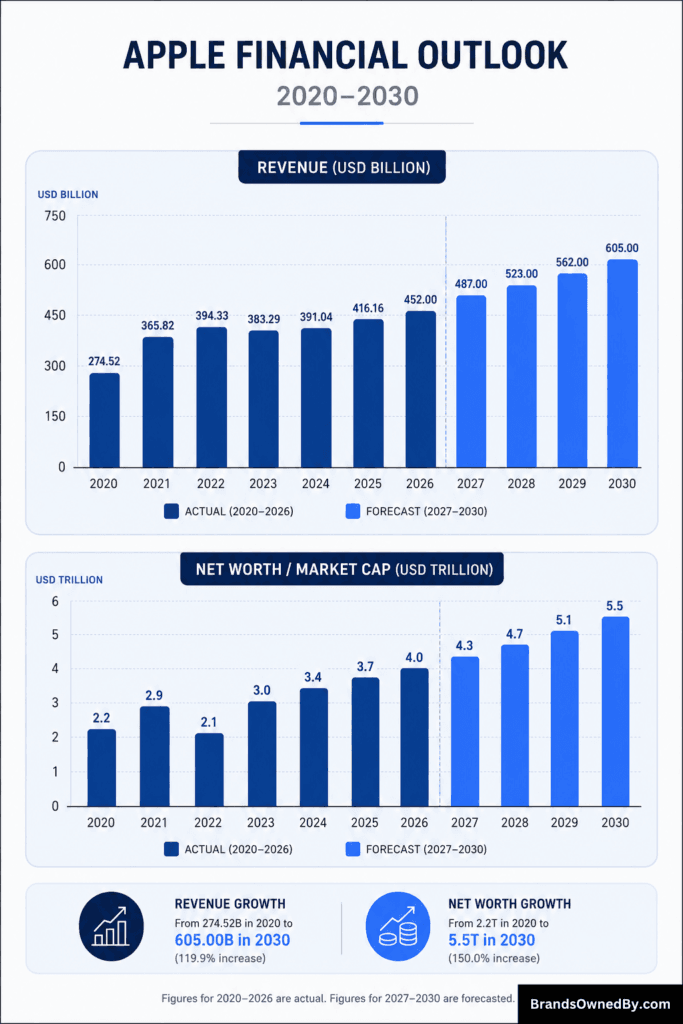
As of June 2026, the company is estimated to generate approximately $452 billion in annual revenue, while its market capitalization, commonly referred to as net worth in business articles, stands at approximately $4 trillion. These figures place Apple among the most valuable publicly traded companies in history.
The company’s financial strength is driven by a combination of hardware sales, subscription services, software ecosystems, digital payments, and growing artificial intelligence initiatives. While the iPhone remains Apple’s largest revenue generator, services such as Apple Music, iCloud, Apple TV+, Apple Pay, and App Store commissions are becoming increasingly important contributors to profitability.
Apple Revenue in 2026
Apple’s estimated revenue for fiscal 2026 is approximately $452 billion, representing growth of nearly 8.6% compared to 2025 revenue of roughly $416 billion.
The company’s revenue comes from multiple business segments. The iPhone continues to account for the largest share of total sales, generating an estimated $225 billion to $230 billion annually. This means the iPhone alone contributes roughly half of Apple’s total revenue.
Mac computers powered by Apple Silicon processors are estimated to contribute approximately $35 billion to $40 billion in annual revenue. The iPad business generates approximately $30 billion, while wearable products such as Apple Watch, AirPods, and accessories contribute another $45 billion to $50 billion.
Perhaps the most important growth driver is Apple’s Services division. Revenue from services is expected to exceed $115 billion in 2026. This segment includes:
- App Store
- Apple Music
- Apple TV+
- Apple Arcade
- Apple News+
- Apple Pay
- AppleCare
- iCloud
- Licensing agreements
Services generate significantly higher profit margins than hardware products and have become one of Apple’s most valuable business segments.
Revenue Breakdown by Business Segment
The estimated composition of Apple’s 2026 revenue highlights how diversified the company has become.
The iPhone remains the dominant contributor, accounting for approximately 50% of total revenue. Services contribute around 25%, making them Apple’s second-largest business segment.
Mac products contribute roughly 8%, while wearables and accessories account for approximately 10%. The iPad business contributes around 7% of total company revenue.
This diversification is important because it reduces Apple’s dependence on any single product category and creates multiple growth opportunities across hardware, software, and subscription services.
Apple Net Worth in 2026
Apple’s estimated net worth, measured through market capitalization, is approximately $4 trillion as of June 2026.
Market capitalization represents the total value of all outstanding Apple shares and reflects investor confidence in the company’s future growth potential. Apple has consistently ranked among the world’s most valuable publicly traded companies and remains one of the few businesses to surpass multi-trillion-dollar valuation milestones.
Several factors support Apple’s valuation. The company maintains one of the strongest brands globally, generates enormous cash flow, possesses a loyal customer base, and controls a highly integrated ecosystem of devices and services.
Apple also holds substantial cash reserves and continues to return capital to shareholders through dividends and share repurchase programs. Its ability to generate tens of billions of dollars in annual profit gives investors confidence in the company’s long-term financial strength.
Why Apple’s Valuation is So High
Apple’s valuation is not based solely on hardware sales. Investors increasingly view Apple as a technology ecosystem rather than a device manufacturer.
More than two billion active Apple devices are currently in use worldwide. These devices create recurring revenue opportunities through subscriptions, digital services, payment processing, cloud storage, and software purchases.
The company’s ecosystem creates strong customer retention. An iPhone owner may also subscribe to iCloud, Apple Music, Apple TV+, Apple Arcade, and Apple Fitness+ while using a Mac, Apple Watch, AirPods, and Vision Pro. This interconnected environment makes it difficult for customers to switch to competing platforms.
Apple’s continued investment in artificial intelligence, custom silicon processors, healthcare technologies, and spatial computing further supports long-term growth expectations.
Revenue and Net Worth Growth Since 2020
Apple’s financial growth over the past decade has been remarkable. Revenue increased from approximately $274.5 billion in 2020 to an estimated $452 billion in 2026. During the same period, market capitalization grew from approximately $2.2 trillion to around $4 trillion.
This means Apple added nearly $177 billion in annual revenue and approximately $1.8 trillion in market value within six years.
Much of this growth came from expanding services revenue, premium device sales, Apple Silicon adoption, and increasing customer spending across the Apple ecosystem.
Revenue And Net Worth Forecast Through 2030
Industry trends suggest Apple could continue expanding revenue through the remainder of the decade. Based on historical growth rates and current business momentum, projected annual revenue could reach:
- 2027: $487 billion
- 2028: $523 billion
- 2029: $562 billion
- 2030: $605 billion.
If these projections are achieved, Apple would add more than $150 billion in additional annual revenue between 2026 and 2030.
Apple’s market value is also expected to continue growing as the company expands its ecosystem and increases recurring revenue streams.
Projected market capitalization estimates include:
- 2027: $4.3 trillion
- 2028: $4.7 trillion
- 2029: $5.1 trillion
- 2030: $5.5 trillion.
Reaching a valuation above $5 trillion would place Apple in a category previously unseen in corporate history and further cement its position among the most valuable businesses ever created.
What Could Drive Apple’s Growth to 2030?
Several major growth drivers could support Apple’s financial expansion over the next several years. Artificial intelligence is expected to become a significant contributor as Apple integrates AI capabilities across its devices and services.
The Services division is likely to remain the fastest-growing segment due to recurring subscription revenue and increasing adoption of digital services. Vision Pro and future spatial computing products could create entirely new revenue streams, while continued adoption of Apple Silicon processors may strengthen Apple’s competitive position in personal computing.
Healthcare technologies, financial services, digital payments, and cloud services also represent substantial long-term opportunities. Combined with Apple’s loyal customer base and premium brand positioning, these factors provide a strong foundation for continued revenue and valuation growth through 2030.
Final Words
Apple’s growth story is not just about creating successful products. It is also about acquiring the right companies at the right time and integrating their technologies into a tightly connected ecosystem. From Beats and Shazam to PrimeSense and PA Semi, many of Apple’s most important innovations can be traced back to strategic acquisitions that strengthened its capabilities in audio, artificial intelligence, semiconductors, security, mapping, and spatial computing.
Today, Apple owns a diverse portfolio of companies, brands, and services that support billions of devices and users worldwide. This combination of strategic acquisitions, powerful in-house brands, and continuous innovation has helped Apple build one of the most valuable and influential business ecosystems ever created, while positioning the company for continued expansion across emerging technologies and digital services.
FAQs
What is the list of companies Apple owns?
Apple owns and operates several companies, brands, and acquired businesses that have been integrated into its ecosystem. Some of the most notable include Beats Electronics, Shazam, Siri, PrimeSense, AuthenTec, PA Semi, Anobit, Workflow, Dark Sky, Mobeewave, Texture, NextVR, Turi, Xnor.ai, C3 Technologies, and Emagic. While many of these companies no longer operate independently, their technologies continue to power products and services across Apple’s ecosystem.
What are the major brands owned by Apple?
Apple’s major brands and services include Apple Music, Apple TV+, Apple Pay, Apple Maps, Apple Arcade, Apple News+, Apple Fitness+, iCloud, App Store, AppleCare, Apple Podcasts, Apple Books, Apple Wallet, Apple Silicon, Vision Pro, and Beats. These brands generate billions of dollars in annual revenue and serve hundreds of millions of users worldwide.
What are the companies that work with Apple?
Apple works with thousands of suppliers, manufacturing partners, software developers, financial institutions, telecommunications providers, and technology companies. Some of its most important partners include Taiwan Semiconductor Manufacturing Company (TSMC), Foxconn, Pegatron, Broadcom, Corning, Sony, Samsung Display, Qualcomm, Goldman Sachs, Mastercard, Visa, and major mobile network operators around the world. These partnerships help Apple manufacture devices, develop components, process payments, and distribute products globally.
Does Apple have investments in other companies?
Yes. Apple occasionally invests in companies that support its strategic objectives. One of its most notable investments was a $1 billion investment in Chinese ride-hailing company Didi Chuxing in 2016. Apple has also invested through supplier support programs, clean-energy initiatives, advanced manufacturing funds, and strategic partnerships. However, unlike companies such as Alphabet or Microsoft, Apple generally focuses more on acquisitions than maintaining large portfolios of minority investments.
What companies has Apple bought?
Apple has acquired more than 140 companies since its founding. Some of the most significant acquisitions include Beats Electronics, Shazam, Siri, PrimeSense, AuthenTec, PA Semi, Dark Sky, Workflow, Texture, NextVR, Mobeewave, Turi, Xnor.ai, Emagic, and Anobit. These acquisitions have contributed to major Apple products and features such as Apple Music, Siri, Face ID, Touch ID, Apple Silicon processors, Apple Maps, Shortcuts, Vision Pro, and Apple Weather.
How many companies did Apple buy?
Apple has acquired more than 140 companies throughout its history. Most acquisitions are relatively small and focus on acquiring technology, patents, engineering talent, or artificial intelligence capabilities. Unlike many large technology companies, Apple typically integrates acquired businesses into its existing operations rather than continuing to operate them as standalone subsidiaries.
Is Apple a $1 trillion company?
Yes. Apple became the first publicly traded U.S. company to reach a $1 trillion market capitalization in August 2018. Since then, the company has surpassed several additional milestones, including $2 trillion and $3 trillion valuations. As of 2026, Apple’s market capitalization is approximately $4 trillion, making it one of the most valuable companies in the world. Its value is driven by strong iPhone sales, growing services revenue, Apple Silicon innovation, digital payments, subscriptions, and a global ecosystem of more than two billion active devices.