
- BRC Inc. is the publicly traded parent of Black Rifle Coffee Company and trades on the New York Stock Exchange under BRCC.
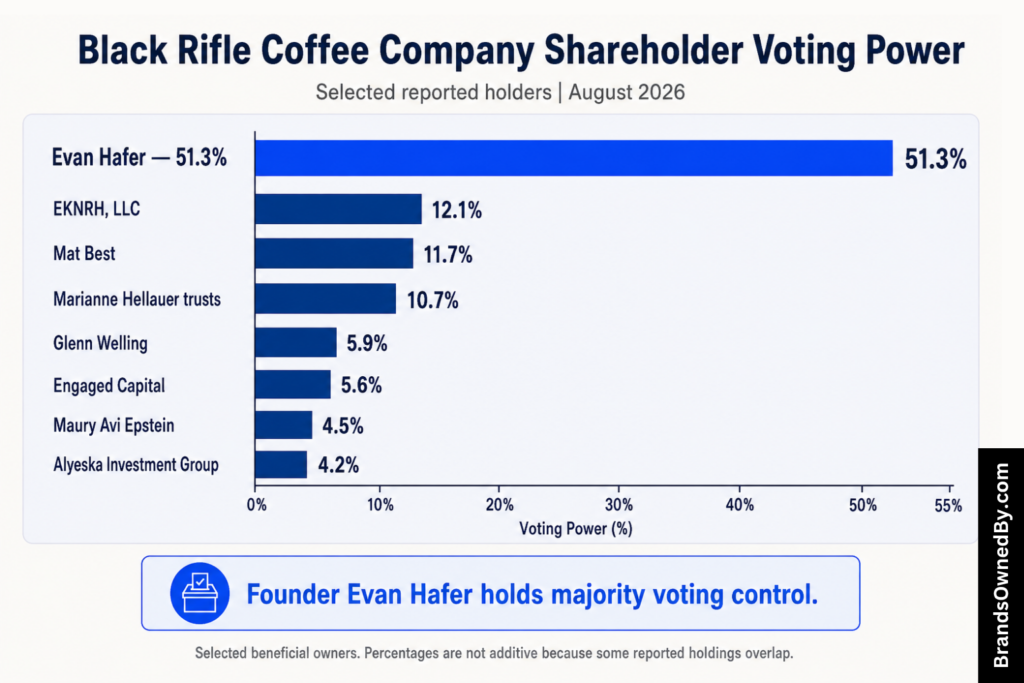
- Evan Hafer is the controlling shareholder with 51.3% of total voting power, although that figure includes shares covered by a voting agreement.
- Authentic Brands LLC is the operating subsidiary solely managed by BRC Inc., while Black Rifle Coffee Company LLC conducts the principal coffee business.
- Mat Best, legacy trusts, Engaged Capital, institutional investors, and public shareholders hold other significant economic or voting interests.
Black Rifle Coffee Company is a veteran-founded coffee, beverage, retail, and lifestyle business. It sells packaged coffee, ready-to-drink beverages, energy drinks, subscriptions, merchandise, and café products.
The operating business sits beneath publicly traded BRC Inc. The company uses wholesale, direct-to-consumer, and physical Outpost channels to reach customers.
Former U.S. Army Green Beret Evan Hafer founded Black Rifle Coffee Company in 2014. Hafer started with a one-pound roaster in his garage. He initially roasted, packaged, and shipped coffee directly to customers.
![Who Owns Black Rifle Coffee Company [infographics]](https://brandsownedby.com/wp-content/uploads/2026/08/Who-Owns-Black-Rifle-Coffee-Company-infographics-683x1024.png)
The direct relationship with buyers shaped the company’s identity. Instead of competing on coffee alone, Black Rifle built a community around military service, first responders, outdoor culture, and veteran support.
Mat Best, Jarred Taylor, Richard Ryan, and other early personalities later helped develop its content and audience. Hafer remains the principal founder in the company’s public disclosures.
The business originated in Utah. Its corporate headquarters are in West Valley City, Utah.
Direct-to-consumer sales were initially the company’s primary growth engine. Black Rifle then expanded into packaged retail coffee, ready-to-drink products, subscription sales, and physical cafés called Outposts.
Wholesale is now its largest revenue channel. This represents an important change from the company’s early dependence on its website and Coffee Club subscriptions.
| Detail | Information |
|---|---|
| Public parent | BRC Inc. |
| Core operating company | Black Rifle Coffee Company LLC |
| Founder | Evan Hafer |
| Founded | 2014 |
| Headquarters | West Valley City, Utah |
| Stock exchange | New York Stock Exchange |
| Ticker | BRCC |
| Corporate form | Delaware public benefit corporation |
| CEO | Christopher Mondzelewski |
| Executive chairman | Evan Hafer |
| Main channels | Wholesale, direct-to-consumer, and Outposts |
| Latest full-year revenue | $398.26 million in 2025 |
| First-half 2026 revenue | $216.25 million |
| 2026 revenue guidance | At least 8% growth |
| Active Coffee Club subscribers | Approximately 159,900 at the end of 2025 |
| Outposts | 35 at the end of 2025 |
| Ownership status | Publicly owned and founder-controlled |
Black Rifle Coffee Company Ownership History
Black Rifle Coffee developed from a privately owned direct-to-consumer business into a publicly traded company. Its public listing preserved the economic interests of legacy owners while keeping voting control with Hafer.
2014: Founder-Owned Business
Hafer established Black Rifle Coffee as a private company in 2014.
The company initially sold coffee through its website. Its military background, direct marketing, subscription program, and media content helped distinguish it from conventional packaged-coffee businesses.
2019–2021: Rapid Expansion
Revenue rose from $82.13 million in 2019 to $163.91 million in 2020. It then increased to $233.10 million in 2021.
Growth created greater requirements for inventory, roasting capacity, distribution, retail relationships, working capital, and corporate infrastructure.
Authentic Brands LLC became the operating parent of Black Rifle Coffee Company LLC. It is unrelated to Authentic Brands Group, the separate brand-management company associated with fashion and entertainment properties.
2021: SilverBox Engaged Agreement
In November 2021, Black Rifle Coffee announced a business combination with SilverBox Engaged Merger Corp I.
SilverBox was a special-purpose acquisition company sponsored by SilverBox Capital and Engaged Capital.
The transaction assigned the combined business a pro forma enterprise value of approximately $1.7 billion at $10 per share. That figure reflected transaction assumptions and future growth expectations. It was not a public-market capitalization.
2022: Public Listing
The business combination closed on February 9, 2022.
BRC Inc. became the public parent. Its Class A shares began trading on the New York Stock Exchange under BRCC.
The transaction did not eliminate the interests of legacy owners. They retained Common Units in Authentic Brands and corresponding Class B shares in BRC Inc.
The Up-C Structure
Black Rifle Coffee uses an Up-C structure.
Public shareholders own Class A shares in BRC Inc. Legacy owners can hold Common Units in Authentic Brands and a corresponding number of Class B shares.
A Common Unit can generally be exchanged for one Class A share. When an exchange occurs, the associated Class B share is cancelled.
As of March 31, 2026, BRC Inc. held a 37.3% economic interest in Authentic Brands. Other holders owned the remaining Common Units.
BRC Inc. still controls Authentic Brands because it is the managing member. It therefore consolidates Authentic Brands and its subsidiaries in the public company’s financial statements.
The 2026 Reverse Stock Split
BRC Inc.’s board approved a one-for-ten reverse stock split on August 7, 2026.
The split is scheduled to take effect on August 21, with split-adjusted trading expected to begin on August 24.
It will proportionately reduce the number of Class A and Class B shares while increasing the quoted value per share. It will not inherently change ownership percentages, economic interests, or relative voting power.
The raw share counts in this article should be adjusted after the split becomes effective. The percentage-based ownership analysis should remain substantially unchanged unless another transaction occurs.
Who Owns Black Rifle Coffee Company: Major Shareholders
Black Rifle Coffee is not owned by a conventional beverage conglomerate. It is owned through BRC Inc., a public benefit corporation created during the company’s 2022 stock-market listing.
Ownership is divided between public Class A shareholders and legacy owners who hold Authentic Brands Common Units with corresponding Class B shares. A voting agreement concentrates control under Evan Hafer.
BRC Inc.
BRC Inc. is the ultimate public parent of the Black Rifle Coffee corporate group.
Its Class A shares trade publicly under BRCC. Owners of those shares hold an economic interest in BRC Inc. and receive ordinary voting rights.
BRC Inc. conducts substantially all business through Authentic Brands LLC and its subsidiaries. It also consolidates their revenue, assets, liabilities, and operating results in its public financial statements.
BRC Inc. is organized as a Delaware public benefit corporation. Its stated public benefit purpose centers on supporting active-duty military personnel, veterans, and first responders.
Evan Hafer
Evan Hafer is Black Rifle Coffee’s founder, executive chairman, director, and controlling shareholder.
The 2026 ownership table attributed the following interests to Hafer:
- 18.79 million Class A shares.
- 108.82 million Class B shares.
- 344,018 exercisable stock options.
- 127.61 million Class A-equivalent shares beneficially owned.
- 51.3% of total voting power.
The total represented 56.7% of the applicable Class A-equivalent ownership calculation.
This does not mean Hafer personally receives the economic benefit from every share included in the figure. His reported beneficial ownership includes shares covered by a voting agreement. Some of those shares are economically owned by other founders, trusts, and investors.
The distinction is important. Hafer controls the voting outcome, but the underlying economic ownership is more widely distributed.
EKNRH Holdings LLC
EKNRH Holdings LLC held 30.14 million Class B shares in the latest company table.
That position represented 20.6% of the applicable Class A-equivalent calculation and 12.1% of total voting power.
Hafer manages EKNRH Holdings. Its interests are therefore attributed to him under beneficial-ownership rules.
EKNRH should not be added to Hafer’s total as though it were an unrelated shareholder. It is one of the principal vehicles through which Hafer holds his legacy economic interest.
Mat Best
Mat Best held 29.18 million Class B shares.
That represented 20.0% of the relevant Class A-equivalent calculation and 11.7% of total voting power.
Best was an important early contributor to Black Rifle Coffee’s media strategy and public identity. His audience helped the company develop a community around its coffee, merchandise, military background, and lifestyle content.
Best remains a significant economic owner. However, shares covered by the voting agreement contribute to Hafer’s reported voting control.
Marianne Hellauer-Administered Trusts
Marianne Hellauer was identified as trustee for trusts holding 26.65 million Class B shares.
Those interests represented 18.6% of the applicable Class A-equivalent calculation and 10.7% of total voting power.
Hellauer was reported as having voting and disposition authority over the shares. She disclaimed personal beneficial ownership except for any direct financial interest she may hold.
The underlying beneficiaries, rather than the trustee, ultimately receive the economic benefits associated with the trusts.
Engaged Capital
Funds and accounts managed by Engaged Capital held 13.94 million Class A shares.
That position represented 12.0% of outstanding Class A stock and 5.6% of total voting power in the company’s ownership table.
Engaged Capital is not simply a passive index investor. It helped finance and sponsor the transaction that took Black Rifle Coffee public.
The investor-rights agreement can allow Engaged to nominate up to two board candidates while specified ownership conditions remain satisfied.
Glenn Welling
Glenn Welling is the founder and chief investment officer of Engaged Capital. He also serves on BRC Inc.’s board.
When Engaged-managed shares, direct interests, vested awards, and a trust position were combined, the company attributed 14.70 million shares to Welling.
That represented 12.6% of outstanding Class A stock and 5.9% of total voting power.
The overlap means Welling’s reported position should not be added separately to Engaged Capital’s holding.
Maury Avi Epstein-Managed Entities
Entities managed by Maury Avi Epstein held 11.24 million Class B shares.
The position represented 8.8% of the applicable Class A-equivalent calculation and 4.5% of total voting power.
Epstein was reported as having authority over those interests but disclaimed personal ownership beyond any actual economic stake.
Alyeska Investment Group Entities
Entities affiliated with Alyeska Investment Group held 10.39 million Class A shares.
That represented 8.9% of outstanding Class A stock and 4.2% of total voting power.
Unlike the legacy Class B holders, Alyeska’s position consists of publicly traded Class A shares. It is an institutional investment rather than a founder-unit interest.
John Miller-Managed Entities
John Miller was associated with 4.35 million Class A shares and 3.95 million Class B shares.
His combined reported position was 8.30 million shares. That represented 6.9% of the applicable Class A-equivalent calculation and 3.3% of total voting power.
The position combines publicly traded shares with legacy operating-company interests.
Thomas Davin
Former co-CEO Thomas Davin held 13,698 Class A shares and 6.91 million Class B shares.
His combined reported position was 6.92 million shares. That equated to 5.6% of the applicable Class A-equivalent calculation and 2.8% of total voting power.
Davin helped lead Black Rifle Coffee through its expansion and public listing. He left the co-CEO position at the end of 2023.
BlackRock
BlackRock reported 5.87 million Class A shares.
The position represented 5.0% of outstanding Class A stock and 2.4% of total voting power.
BlackRock manages these shares for investment clients and funds. Its holding does not mean BlackRock operates Black Rifle Coffee or controls its strategy.
T. Rowe Price is No Longer a Major Holder
The company’s proxy table initially listed T. Rowe Price Investment Management with 7.87 million Class A shares.
A subsequent filing reported only 2,001 shares as of March 31, 2026. T. Rowe Price therefore no longer qualified as a greater-than-5% shareholder at that measurement date.
It should not be treated as a current major owner based solely on the earlier proxy disclosure.
Directors and Executives as a Group
BRC Inc. attributed 136.69 million Class A-equivalent shares to its directors and executive officers as a group.
That represented 59.2% of the applicable ownership calculation and 54.1% of total voting power.
Most of that concentration came from interests attributed to Hafer. The group figure confirms that control remains concentrated around the founder, legacy ownership, and board-connected investors rather than dispersed among public institutions.
Who Controls Black Rifle Coffee Company?
Ownership and operational control are not identical. Hafer controls shareholder voting, while the CEO and executive team manage daily operations under board oversight.
Evan Hafer Controls Shareholder Voting
Hafer’s reported 51.3% voting power gives him decisive influence over matters submitted to shareholders.
Those matters can include:
- Director elections.
- Mergers and major transactions.
- Amendments to corporate documents.
- Certain equity issuances.
- Other proposals requiring shareholder approval.
His control is reinforced by his executive-chairman position and board-nomination rights.
Christopher Mondzelewski Manages Daily Operations
Christopher Mondzelewski has served as president and CEO since January 1, 2024.
He oversees commercial execution, wholesale relationships, pricing, profitability, distribution, personnel, and operating investments. He also serves on the board.
The arrangement separates daily management from founder control. Hafer focuses on governance, mission, brand direction, and long-term strategy.
Board Oversight
BRC Inc.’s board includes Hafer, Mondzelewski, Glenn Welling, Clayton Hutmacher, Kathryn Dickson, Sean Moriarty, Stephen Kadenacy, Melvin Landis, Steven Taslitz, and Lawrence “Chip” Molloy.
Hafer serves as executive chairman. Clayton Hutmacher serves as lead independent director.
The lead-independent-director position is important because Hafer is not considered independent under New York Stock Exchange standards. Hutmacher leads independent-director sessions and supports oversight of the executive chairman.
Senior Leadership
Matthew Amigh serves as chief financial officer.
Andrew McCormick serves as general counsel, chief legal officer, and corporate secretary.
The executive team manages financial reporting, capital allocation, legal compliance, supply-chain decisions, contracts, and operational performance.
BRC Inc. Controls Authentic Brands
BRC Inc. owned 37.3% of Authentic Brands’ economic interests as of March 31, 2026. However, BRC Inc. is the operating company’s managing member.
This gives BRC Inc. control even though it does not own more than 50% of the economic units.
The remaining interests are presented as non-controlling interests in BRC Inc.’s consolidated financial statements.
Engaged Capital’s Governance Influence
Engaged Capital remains a significant Class A shareholder. Glenn Welling, its founder and chief investment officer, serves on BRC Inc.’s board.
The investor-rights agreement can allow Engaged to nominate up to two board candidates while specified ownership conditions are satisfied.
Hafer can similarly possess nomination rights for up to three candidates, including himself, subject to applicable ownership thresholds.
These rights give Engaged meaningful influence. They do not override Hafer’s majority voting position.
Competitor Ownership Comparison
Black Rifle competes with coffee chains, packaged-coffee businesses, energy-drink brands, and direct-to-consumer sellers. Their ownership structures affect strategic independence and access to capital.
Black Rifle’s structure most closely resembles Dutch Bros. Both preserve legacy ownership through operating-company units while public investors hold listed shares.
| Company | Ownership model | Controlling influence |
|---|---|---|
| Black Rifle Coffee | Public Up-C structure | Evan Hafer |
| Starbucks | Conventional public company | No controlling shareholder |
| Dutch Bros | Public Up-C and multi-class structure | Travis Boersma and founder-related entities |
| Black Rock Coffee Bar | Public Up-C structure | The Cynosure Group |
| Peet’s Coffee | Subsidiary of Keurig Dr Pepper | KDP board and management |
| Dunkin’ | Private subsidiary of Inspire Brands | Roark Capital through Inspire |
Starbucks
Starbucks Corporation is publicly traded under SBUX. Its ownership is widely distributed among institutional and individual shareholders.
Vanguard, Capital World Investors, and BlackRock are among its largest institutional investors. No founder, family, or single investor holds majority voting control.
Starbucks follows a conventional public-company structure. Its board appoints management, and shareholders influence governance through voting.
Black Rifle is also public, but Hafer’s 51.3% voting power gives its founder much greater influence.
Dutch Bros
Dutch Bros Inc. is publicly traded under BROS.
Co-founder Travis Boersma remains its most influential shareholder. An August 2026 filing attributed 45.18 million Class A-equivalent shares to Boersma and related entities, representing 25.6% of the applicable class calculation.
Dutch Bros also uses an Up-C and multi-class ownership structure. Its Class B shares can carry enhanced voting rights.
The structural similarity makes Dutch Bros one of Black Rifle’s most relevant comparisons. However, Dutch Bros is primarily a drive-through beverage chain, while Black Rifle earns most revenue through wholesale packaged products.
Black Rock Coffee Bar
Black Rock Coffee Bar completed its public listing in September 2025 and trades under BRCB.
In May 2026, The Cynosure Group and related funds acquired approximately 13.6 million shares from founder-related holders. Cynosure subsequently reported a 52.6% beneficial interest when exchangeable operating units were included.
Black Rock Coffee Bar is therefore publicly traded but controlled by a private investment group.
Black Rifle differs because its controlling influence remains with its founder rather than an outside private-equity investor.
Peet’s Coffee
Peet’s Coffee became part of Keurig Dr Pepper’s expanded coffee portfolio when KDP completed its acquisition of JDE Peet’s on April 1, 2026.
Peet’s is not an independently traded company. It operates within the larger Keurig Dr Pepper group.
KDP plans to separate its coffee and refreshment businesses into two publicly traded companies. Until that separation is completed, Peet’s remains under KDP’s consolidated control.
Black Rifle is significantly smaller but has greater brand-level independence because BRC Inc. is primarily organized around Black Rifle and related operations.
Dunkin’
Dunkin’ is owned by Inspire Brands.
Inspire acquired Dunkin’ Brands in 2020 for approximately $11.3 billion, including assumed debt. Inspire Brands is privately controlled by Roark Capital.
Dunkin’ therefore has no separately traded stock and no direct public shareholder base.
It benefits from Inspire’s franchising expertise and financial scale. Black Rifle has greater founder influence but a much smaller café network.
Companies, Brands, and Platforms Under Black Rifle Coffee
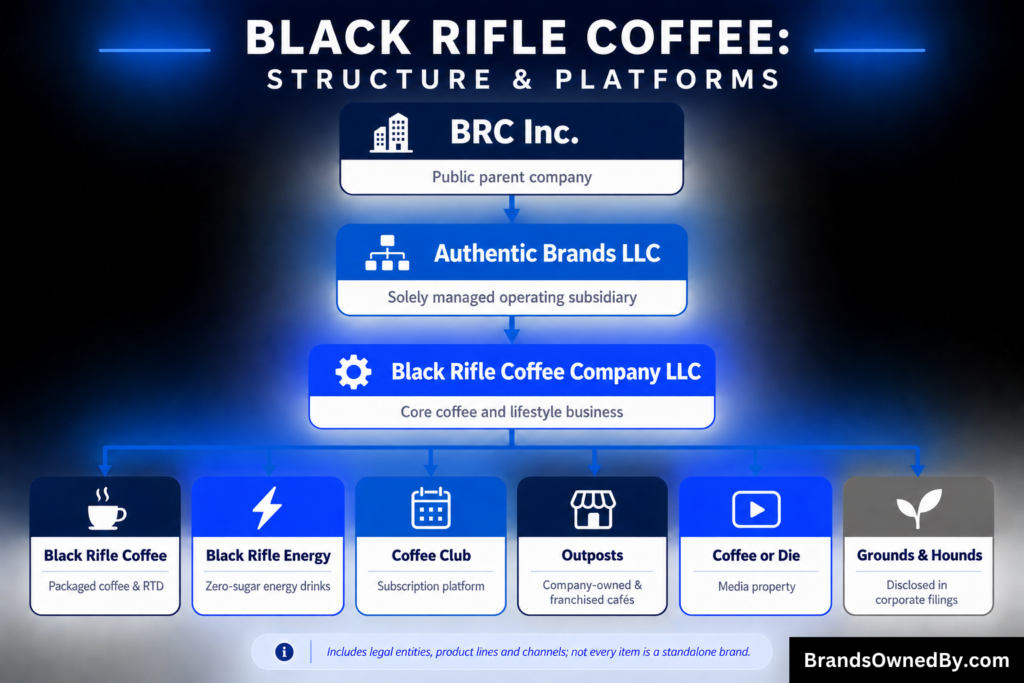
Black Rifle’s structure includes legal companies, consumer brands, product lines, subscriptions, cafés, media operations, and asset-holding entities.
Not every name is an independent consumer brand. This section focuses on the entities and platforms most relevant to understanding the company.
Authentic Brands LLC
Authentic Brands LLC is the principal operating subsidiary managed by BRC Inc.
BRC Inc. held a 37.3% economic interest as of March 31, 2026. Legacy holders owned the remaining Common Units.
BRC Inc. controls Authentic Brands because it is the managing member. Authentic Brands should not be confused with the unrelated Authentic Brands Group.
Black Rifle Coffee Company LLC
Black Rifle Coffee Company LLC is wholly owned by Authentic Brands LLC.
It conducts the group’s principal coffee, e-commerce, subscription, wholesale, merchandise, and café operations.
This is the main legal operating business behind the Black Rifle Coffee Company name.
Black Rifle Coffee
Black Rifle Coffee is the company’s flagship consumer brand.
Its product range includes whole-bean coffee, ground coffee, single-serve products, ready-to-drink coffee, brewing accessories, and merchandise.
Products are sold through grocery stores, mass retailers, convenience stores, the company’s website, third-party marketplaces, subscriptions, and Outposts.
Black Rifle Energy
Black Rifle Energy is the group’s energy-drink line.
The beverages contain zero sugar and 200 milligrams of caffeine per 16-ounce can. Distribution is supported by Black Rifle’s relationship with Keurig Dr Pepper.
The product line contributed to wholesale growth during 2025 and 2026. Its long-term value will depend on repeat purchases and retail velocity rather than initial store placement alone.
Coffee Club
Coffee Club is Black Rifle’s subscription platform.
Customers can arrange recurring coffee deliveries according to their preferred products and schedules.
The company had approximately 159,900 active Coffee Club subscribers at the end of 2025. The program provides recurring revenue and direct customer data.
Coffee Club is a commercial program, not a separately incorporated public company.
Black Rifle Coffee Outposts
Outposts are Black Rifle Coffee’s physical cafés.
The company had 35 Outposts at the end of 2025. Seventeen were company-operated and 18 were franchised.
Outposts sell prepared beverages, packaged coffee, food, and merchandise. They also provide physical locations for customer engagement and product testing.
Outposts generated only 5.7% of 2025 revenue. They support the brand but are not its primary revenue engine.
Coffee or Die
Coffee or Die is a media property associated with military, veteran, law-enforcement, and lifestyle reporting.
The publication has historically operated through Signal Mountain Media Works LLC.
Coffee or Die supports Black Rifle’s content-led marketing model. The company does not separately report its revenue or valuation.
Grounds & Hounds
Grounds and Hounds Coffee Company LLC has appeared as an indirect subsidiary in BRC corporate and financing documents.
It is a separate coffee-focused business with an animal-welfare positioning. BRC does not separately disclose its current revenue, profitability, or contribution to consolidated operations.
Because recent public reports do not discuss Grounds & Hounds as a material operating segment, its current position should be described using this qualification rather than presented as a major Black Rifle product line.
Other Disclosed Legal Entities
Corporate and financing documents have identified additional entities within the operating group. These include:
- Free Range American Media Company LLC.
- Independent Coffee Solutions LLC.
- Good Beans LLC.
- BRCC Operating Company LLC.
- 1144 SLC LLC.
- Spencer 355 LLC.
- 621 Manchester LLC.
- BRCC GC LLC.
- BRCC Copperfield LLC.
Some of these entities support media, production, facilities, property ownership, or café operations. They are not necessarily standalone consumer brands.
A dedicated article about companies owned by Black Rifle Coffee can cover these legal entities in greater depth without diluting the ownership intent of this page.
Black Rifle Coffee Annual Revenue and Market Value
For public years, market capitalization provides the clearest external measure of equity value. Enterprise value, private-company estimates, and public market capitalization should not be treated as interchangeable.
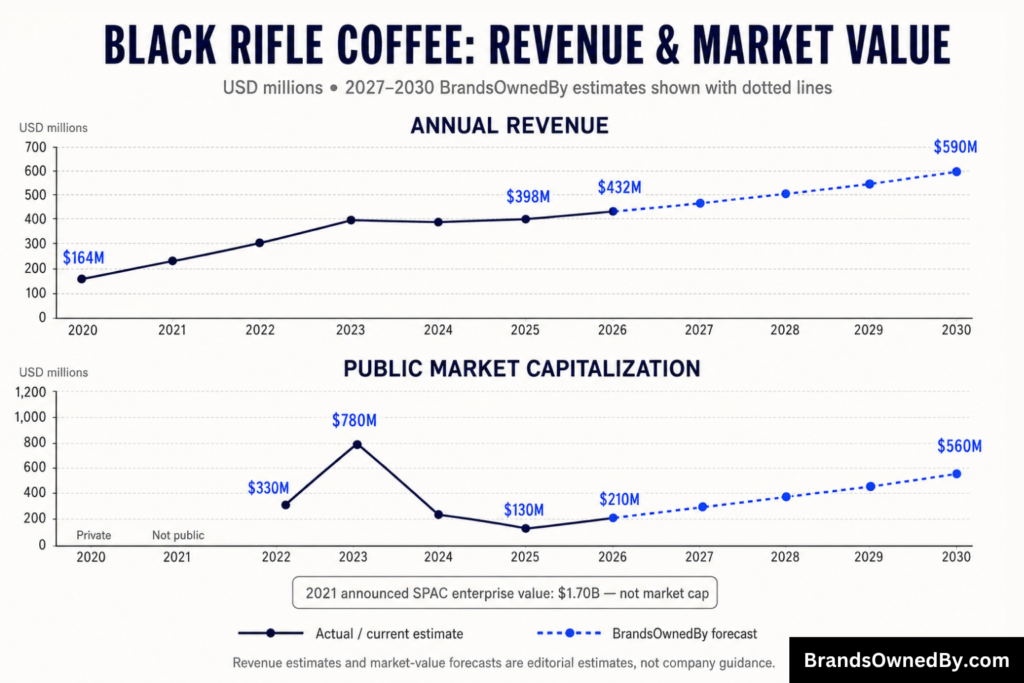
The 2026 revenue figure and all 2027–2030 values are editorial estimates. They are not company guidance.
Revenue in 2026
BRC Inc. generated $216.25 million in revenue during the first six months of 2026.
That was 17.0% above the $184.81 million reported in the comparable period of 2025.
Second-quarter revenue reached $107.02 million. It increased 12.8% from $94.84 million a year earlier.
Management expects full-year revenue growth of at least 8%. Applying slightly more than 8% growth to 2025 revenue produces an estimated 2026 result of approximately $432 million.
Trailing revenue reached approximately $429.70 million for the 12 months ended June 30, 2026. That supports the full-year estimate.
Revenue by Channel
Black Rifle’s business has shifted toward wholesale distribution.
| Channel | 2025 revenue | Share of 2025 revenue | First-half 2026 revenue | Share of first-half 2026 revenue |
|---|---|---|---|---|
| Wholesale | $258.0 million | 64.8% | $145.3 million | 67.2% |
| Direct-to-consumer | $117.6 million | 29.5% | $61.1 million | 28.3% |
| Outposts | $22.6 million | 5.7% | $9.8 million | 4.5% |
| Total | $398.3 million | 100% | $216.2 million | 100% |
Wholesale produced more than two-thirds of first-half 2026 revenue. Distribution gains, packaged-coffee volume, Black Rifle Energy, and higher pricing supported growth.
Direct-to-consumer revenue increased 13.6% to $31.4 million in the second quarter. Third-party marketplaces drove the improvement, while subscription revenue remained under pressure.
Outpost revenue declined 15.0% to $5.0 million. Lower customer traffic and lower average orders affected company-operated cafés.
These results show that Black Rifle is developing primarily as a packaged beverage company. Its cafés support the brand but do not drive the majority of its revenue.
Profitability and Margins
Second-quarter gross profit reached $36.48 million. Gross margin improved slightly to 34.1%.
Pricing, lower fulfillment costs, and inventory improvements supported the result. Green-coffee inflation, tariffs, and marketplace fees remained significant pressures.
The second-quarter net loss narrowed to $0.2 million from $14.5 million a year earlier. Adjusted EBITDA increased to $6.3 million from $2.4 million.
General and administrative expenses fell 35.2%. Salaries, wages, and benefits decreased 2.0%.
Management expects full-year adjusted EBITDA to increase by at least 35% from the $21.4 million reported in 2025.
Black Rifle Coffee Market Value
Black Rifle Coffee’s market capitalization was approximately $210 million in mid-August 2026 when the broader economic share base was considered.
Some financial platforms report a lower figure because they count only publicly traded Class A shares. That approach excludes Class B-linked operating interests and does not measure the same fully converted economic base.
A $210 million value against approximately $429.70 million in trailing revenue implies a price-to-sales ratio close to 0.49.
The low valuation reflects continuing net losses, debt, commodity inflation, execution risk, the Up-C structure, dilution, and weak post-SPAC share performance.
Revenue Forecast for 2027–2030
The forecast assumes that packaged coffee remains the company’s primary growth driver.
It also assumes:
- Continued retail distribution gains.
- Moderate price increases.
- Higher Black Rifle Energy sales.
- Growth through online marketplaces.
- Stable rather than rapidly expanding café revenue.
Revenue is estimated at $470 million in 2027. That requires 8.8% growth from the 2026 estimate.
The model then assumes $508 million in 2028, $548 million in 2029, and $590 million in 2030.
Annual growth gradually moderates toward 7.7%. This is more defensible than assuming a return to the 29%–42% annual growth recorded during the company’s earlier expansion.
Market-Value Forecast for 2027–2030
Revenue growth alone may not increase the company’s value. Black Rifle must also improve profitability, margins, and cash generation.
The forecast assumes a market value of $300 million in 2027. That represents approximately 0.64 times estimated revenue.
The estimate rises to $380 million in 2028, $460 million in 2029, and $560 million in 2030.
The 2030 estimate implies a price-to-sales ratio close to 0.95. That would remain moderate for a profitable branded beverage business.
The forecast depends on several conditions:
- Wholesale distribution must generate profitable repeat sales.
- Gross margins must withstand coffee inflation and tariffs.
- Black Rifle Energy must develop sustainable consumer demand.
- Operating cash flow must improve.
- Debt and share dilution must remain controlled.
The reverse stock split will not create economic value by itself. It changes the number and quoted price of shares, not the underlying business.
Final Thoughts
Black Rifle Coffee Company is owned through publicly traded BRC Inc., but it is not controlled like a conventionally dispersed public company.
Evan Hafer remains the decisive shareholder. His 51.3% voting power, executive-chairman position, board role, and nomination rights give him substantial influence over long-term strategy.
The business has evolved from a subscription-led online seller into a wholesale-focused packaged beverage company. That transition is producing revenue growth, but profitability and cash flow will determine whether the company can rebuild the valuation lost since its public debut.
Frequently Asked Questions
Is Black Rifle Coffee Company privately owned?
No. Black Rifle Coffee is owned through BRC Inc., a publicly traded company listed on the New York Stock Exchange.
Its founder nevertheless retains majority voting control.
What company owns Black Rifle Coffee?
BRC Inc. is the public parent company.
It manages Authentic Brands LLC, which owns Black Rifle Coffee Company LLC.
Who is the majority owner of Black Rifle Coffee?
Evan Hafer is the controlling shareholder. The latest company table attributed 51.3% of total voting power to him.
That figure includes voting-agreement shares and does not represent a purely direct economic stake.
Does Evan Hafer still own Black Rifle Coffee?
Yes. Hafer remains a major economic owner and the controlling shareholder.
He also serves as founder and executive chairman.
Does Mat Best own part of Black Rifle Coffee?
Yes. The latest company table attributed 29.18 million Class B shares and 11.7% of total voting power to Mat Best.
His shares are included in the broader voting arrangement that contributes to Hafer’s reported control.
Who is the CEO of Black Rifle Coffee?
Christopher Mondzelewski is the president and CEO.
He assumed the role on January 1, 2024. Hafer serves as executive chairman rather than CEO.
Is Black Rifle Coffee veteran-owned?
Black Rifle Coffee is best described as veteran-founded and veteran-controlled.
It is publicly traded, so outside investors own Class A shares. Hafer is a military veteran and controls 51.3% of total voting power.
Is Black Rifle Coffee owned by Starbucks?
No. Starbucks does not own Black Rifle Coffee.
They are separate publicly traded companies. Starbucks trades under SBUX, while BRC Inc. trades under BRCC.
Is Black Rifle Coffee owned by Authentic Brands Group?
No. Authentic Brands Group does not own Black Rifle Coffee.
Black Rifle operates through Authentic Brands LLC, an unrelated company with a similar name.
What is Black Rifle Coffee’s stock symbol?
BRC Inc.’s Class A shares trade on the New York Stock Exchange under BRCC.
Is Black Rifle Coffee profitable?
The company remains close to break-even on a GAAP basis but reports positive adjusted EBITDA.
It recorded a $0.2 million net loss in the second quarter of 2026. Adjusted EBITDA reached $6.3 million.
How many Black Rifle Coffee locations are there?
Black Rifle Coffee had 35 Outposts at the end of 2025.
Seventeen were company-operated and 18 were franchised.
Will the reverse stock split change ownership?
The reverse split will not inherently change ownership percentages or voting control.
It will reduce the number of shares while increasing the quoted price per share proportionately.
Does Black Rifle Coffee own Black Rifle Energy?
Yes. Black Rifle Energy is a product line within the Black Rifle Coffee business.
It is not an unrelated energy-drink company.
Does Black Rifle Coffee own Grounds & Hounds?
Grounds and Hounds Coffee Company LLC has appeared as an indirect subsidiary in BRC corporate and financing documents.
BRC does not separately report its current operations, revenue, or financial contribution. It should therefore be described as a disclosed subsidiary rather than a major Black Rifle product line.
Research Methodology
Ownership data was reviewed using BRC Inc.’s proxy disclosures, subsequent beneficial-ownership filings, quarterly reports, corporate governance information, and transaction documents.
Shareholder positions can change between filing dates. Percentages reflect the latest disclosed measurement dates available through August 2026.
Last reviewed: August 16, 2026.