
- Waze is fully owned by Google, which is a subsidiary of Alphabet Inc., making Google the ultimate controlling entity.
- Waze was acquired by Google in June 2013 for approximately $1.1 billion, marking one of the largest navigation app acquisitions and integrating it into Google’s mapping ecosystem.
- It operates as a product group within Google Geo, with all strategic, operational, and financial decisions overseen by Google executives.
- Waze retains internal leadership for day-to-day operations, product development, community management, and advertising, but ultimate control and resource allocation remain with Google.
Waze is a community-based navigation and traffic application. It was founded in 2006 in Israel under the original name FreeMap Israel. The company later rebranded as Waze and focused on real-time, user-generated traffic data.
The app gained attention for allowing drivers to report accidents, police activity, road closures, and congestion. This data is shared instantly with other users. Over time, Waze expanded globally and became one of the most downloaded navigation apps in the world.
A major milestone came in 2013 when Waze was acquired by Google. This acquisition allowed Waze to scale rapidly while keeping its brand and product identity intact.
Since then, Waze has continued to operate as a distinct product within Google’s broader mapping and mobility strategy.
Waze Founders
Waze began as an ambitious idea by a small group of Israeli technologists and entrepreneurs. The first spark came in 2006 when Ehud Shabtai launched a community project called FreeMap Israel. Shabtai was a software engineer with a deep interest in mapping and navigation.
He envisioned a free, crowdsourced digital map that everyday drivers could update and improve. His early work focused on building the map database with help from volunteers rather than relying solely on proprietary data.
As the project gained traction, Shabtai was joined by two key collaborators. Amir Shinar brought expertise in research and engineering, focusing on software development and technical execution. Uri Levine, an entrepreneur with a strong business mindset, helped shape the product vision and strategy.
Together, the trio formalised the project into a company in 2008, establishing Waze Mobile Ltd. Their goal was to democratise navigation by making maps interactive, live, and community-driven.
In the early years, Shabtai served as Chief Technology Officer (CTO), directly advancing the platform’s core engineering. Shinar led research and development as Vice President of R&D. Levine took on the role of president, advocating for community engagement and strategic partnerships.
Their complementary skills helped Waze stand out in a crowded field of GPS tools by focusing on real-time updates generated by drivers themselves.
Major Milestones
- 2006: Ehud Shabtai launched FreeMap Israel as a community-driven mapping project, allowing volunteers to build and edit digital maps collaboratively.
- 2007: The project gained early traction in Israel as more users contributed road data, tested navigation features, and validated crowd-sourced mapping.
- 2008: Amir Shinar and Uri Levine joined Ehud Shabtai, and the project was formally incorporated as Waze, shifting focus from mapping to real-time navigation.
- 2009: Waze released its first mobile navigation application, enabling drivers to share live traffic conditions and road alerts while driving.
- 2010: Waze expanded internationally, entering the U.S. market and establishing a growing global community of map editors.
- 2011: The app introduced points of interest, improved hazard reporting, and expanded rapidly across Europe and Latin America.
- 2012: Waze achieved widespread recognition for features such as police alerts, accident reporting, and congestion avoidance.
- 2013: Google acquired Waze, allowing it to operate as a standalone brand while benefiting from Google’s infrastructure and mapping resources.
- 2014: Waze launched the Connected Citizens Program, later renamed Waze for Cities, enabling data sharing with local governments and traffic authorities.
- 2015: The platform improved voice navigation, routing accuracy, and real-time rerouting based on live traffic conditions.
- 2016: Waze introduced Waze Carpool, expanding beyond navigation into shared mobility services.
- 2017: Community map editing tools were enhanced, giving users more control over road updates, closures, and traffic changes.
- 2018: Event-based routing was expanded to redirect drivers around concerts, sports events, and large public gatherings.
- 2019: Partnerships with municipalities and emergency services strengthened the accuracy of incident and road closure reporting.
- 2020: Advanced lane guidance and route suggestions based on driving behavior were rolled out to improve urban navigation.
- 2021: Neha Parikh became CEO of Waze, guiding product strategy and long-term platform development.
- 2022: Crash history alerts were introduced, helping drivers identify routes with higher accident frequency.
- 2023: Voice-based reporting tools were refined to reduce manual input and improve driver safety.
- 2024: Deeper integration with Android Auto and in-car infotainment systems improved usability and responsiveness.
- 2025: AI-powered conversational reporting began rolling out, allowing drivers to report hazards using natural speech.
Who Owns Waze in 2025?
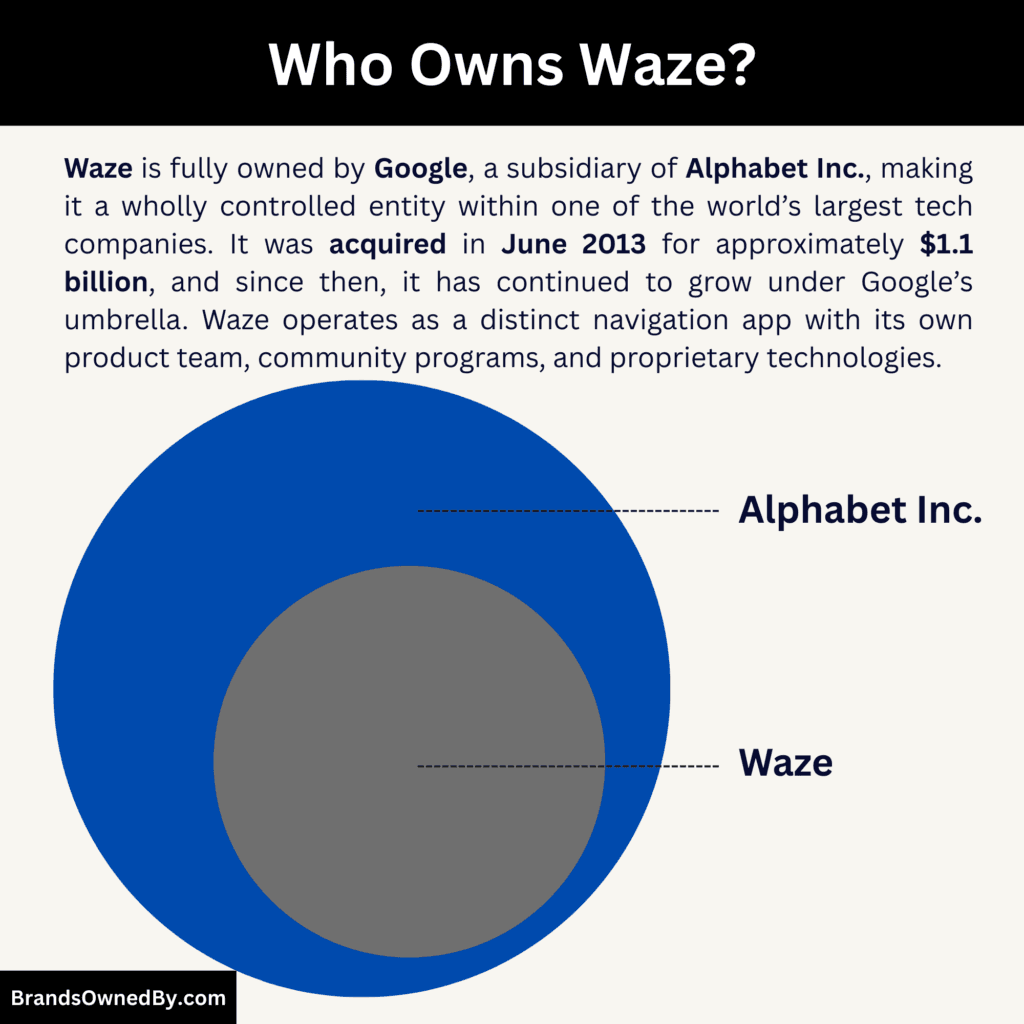
Waze is fully owned by Google. Google acquired Waze in 2013 for approximately $1.1 billion. After the acquisition, Waze became a wholly owned subsidiary. This means Google controls 100% of the company.
Google itself operates under its parent company, Alphabet Inc. As a result, the ultimate owner of Waze is Alphabet Inc. Google manages Waze’s operations, strategy, and long-term direction.
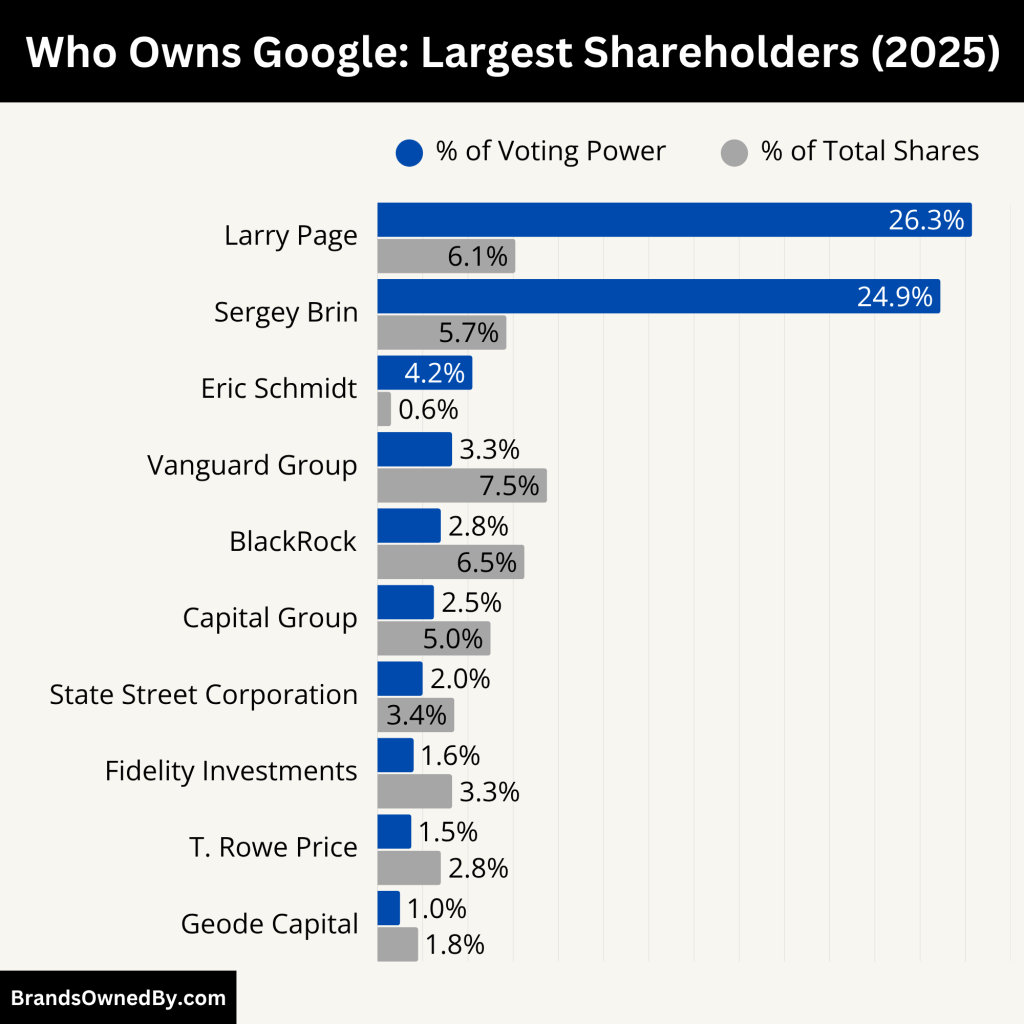
The largest shareholder with control over Waze is Google, through Alphabet’s corporate structure.
Below is an overview of the Waze ownership details as of December 2025:
- Founded: 2006
- Founders: Ehud Shabtai, Amir Shinar, and Uri Levine
- Original company name: FreeMap Israel (later rebranded as Waze)
- Acquisition year: 2013
- Acquirer: Google
- Purchase price: Approximately $1.1 billion
- Payment structure: Primarily cash
- Ownership stake acquired: 100%
- Current owner: Google
- Ultimate parent company: Alphabet Inc.
- Post-acquisition status: Wholly owned subsidiary of Google
- Publicly traded: No
- Independent shareholders: None
- Decision-making control: Google leadership, with day-to-day operations handled by Waze’s executive team
- Brand status: Operates as a separate product under Google
- Headquarters: Remained in Israel after the acquisition.
Parent Company: Google and Alphabet Inc.
Waze is a wholly owned subsidiary of Google. Google is responsible for Waze’s operational oversight, product alignment, infrastructure support, and long-term strategy. Waze does not operate as a separate legal holding entity with its own shareholders. All ownership rights sit entirely with Google.
In 2015, Google became a subsidiary of Alphabet Inc. following Alphabet’s corporate restructuring. Alphabet was created to separate Google’s core internet products from its experimental and non-core businesses. As a result, Alphabet Inc. became the ultimate parent company of Waze.
Within this structure, Waze is categorized under Google’s consumer services and location-based products. Governance flows from Alphabet’s board to Google’s executive leadership and then to Waze’s management team. Budget approvals, executive appointments, and major strategic initiatives require Google-level approval.
Waze maintains its own leadership team and internal product roadmap, but it does not operate independently in legal or financial terms. All compliance, data governance, and regulatory responsibilities ultimately fall under Google and Alphabet. Waze’s infrastructure relies heavily on Google’s cloud, mapping, and advertising systems, reinforcing its integration into Google’s ecosystem.
Google’s Acquisition of Waze
Google acquired Waze in June 2013. The transaction was completed as a full acquisition, meaning Google purchased 100% of Waze’s outstanding shares. The reported acquisition price was approximately $1.1 billion, paid primarily in cash.
The deal followed acquisition interest from multiple major technology companies, including Facebook and Apple. Google’s offer was accepted largely due to its willingness to preserve Waze as a standalone brand and keep its operations centered in Israel.
Key Acquisition Terms and Details
- Acquisition year: 2013
- Purchase price: Approximately $1.1 billion
- Payment structure: Primarily cash
- Ownership stake acquired: 100%
- Post-acquisition status: Wholly owned subsidiary of Google
- Headquarters: Remained in Israel after the acquisition.
As part of the agreement, Waze retained its brand identity, product name, and internal culture. Google committed to keeping Waze operationally distinct from Google Maps, rather than merging the products. This was a deliberate strategy to avoid alienating Waze’s highly active user community.
Employee and Founder Outcomes
Waze’s founders and early employees received payouts tied to their equity holdings. Many senior leaders and engineers were offered retention packages to ensure continuity of development and institutional knowledge. Several founders stayed on for years after the acquisition to guide product growth and integration.
The acquisition also included Waze’s intellectual property, proprietary traffic algorithms, and crowd-sourced data models. These assets were critical to Google’s interest, particularly Waze’s ability to collect real-time driving behavior at scale.
Regulatory and Competitive Considerations
The acquisition required regulatory review in multiple jurisdictions. Competition authorities examined whether Google would combine Waze data with Google Maps in a way that reduced market competition. The deal was ultimately approved without forced divestments.
Google committed to maintaining Waze as a separate product and limiting direct data consolidation in ways that could harm competition. Over time, selective data sharing occurred, but the apps continued to operate independently.
Strategic Impact of the Acquisition
The acquisition significantly strengthened Google’s position in navigation and real-time traffic intelligence. Waze added a layer of human-reported data that traditional mapping systems lacked. This allowed Google to improve traffic prediction models, routing accuracy, and incident awareness across its platforms.
At the same time, Waze benefited from Google’s global infrastructure, scalability, and monetization capabilities. The acquisition is widely regarded as one of Google’s most strategically successful purchases in the mapping and mobility space.
Waze Leadership
Waze operates as a product group within Google’s broader mapping division, and its leadership reflects this integrated structure. While the company no longer has a standalone CEO, a team of senior executives manages day-to-day operations, product development, community engagement, and strategic initiatives. These leaders ensure Waze continues to deliver real-time navigation and crowd-sourced traffic updates while aligning with Google’s global mapping strategy.
Guy Berkowicz – Head of Waze
Guy Berkowicz leads Waze’s operational team in 2025. He serves as the Head of Waze, overseeing day‑to‑day product execution, engineering direction, and team management within the broader Google Geo division.
In this role, Berkowicz is responsible for guiding Waze’s internal teams on navigation product development, global feature rollouts, and coordinated efforts with other Google mapping products while maintaining Waze’s distinct user experience.
His responsibilities include ensuring that Waze’s crowd‑sourced traffic features, routing algorithms, and community functions remain responsive to user needs and aligned with broader strategic priorities.
Berkowicz’s leadership reflects Waze’s transition from an independent subsidiary into a product entity within Google’s mapping ecosystem. He works closely with engineers, product leads, and community managers to balance innovation with consistency and reliability for millions of drivers worldwide.
Chris Phillips – VP & General Manager, Google Geo
Although not a direct Waze executive, Chris Phillips plays a crucial role in Waze’s leadership context. Phillips serves as Vice President and General Manager of Google Geo, an organization that includes Waze alongside Google Maps, Street View, and Google Earth. In this capacity, he provides strategic oversight and corporate leadership for all mapping solutions under Google’s umbrella.
Phillips’s role includes setting long‑term vision, allocating resources, and ensuring coordination across the different mapping products. While he does not manage Waze’s day‑to‑day operations, his leadership influences major decisions about integration with Google’s infrastructure, advertising strategy alignment, and shared technological development across mapping divisions.
Erin Clift – Chief Marketing Officer (Global Partnerships and Engagement)
Erin Clift serves as Chief Marketing Officer at Waze, focusing on global partnerships, marketing strategy, and brand positioning. In her role, Clift’s leadership involves driving Waze’s relationship with advertisers and partners, expanding the reach of Waze’s in‑app promotion platform, and enhancing user community engagement.
As CMO, she manages campaigns, strategic communications, and cross‑regional marketing initiatives, playing a key role in how Waze presents itself in different markets.
Clift’s responsibilities also include shaping Waze’s narrative as part of Google’s mobility and location ecosystem while ensuring that Waze maintains its own identity and relevance among drivers worldwide.
Rapha Cohen – Chief Product Officer
Rapha Cohen holds the position of Chief Product Officer at Waze. Cohen’s leadership focuses on defining and executing Waze’s product vision. This includes user experience design, product roadmaps, feature prioritization, and cross‑functional collaboration between engineering, design, and user research teams.
As CPO, Cohen is instrumental in adapting Waze’s navigation tools to evolving user needs and integrating new technologies within the app while aligning with Google’s overall mapping strategy.
Hila Roth – Head of Waze Communities
Hila Roth leads Waze’s community operations as Head of Waze Communities. This role focuses on managing Waze’s volunteer editors, community support agents, and regional contributors who help curate local map data and live traffic reports.
Roth’s leadership ensures that Waze’s crowd‑sourced model continues to produce high‑quality, timely navigation information.
She coordinates efforts across more than 40 regional community managers globally, enabling local insights to improve the accuracy and relevance of map data, hazard reports, and routing recommendations.
Leadership Without a Traditional CEO Title
Since the organizational integration of Waze into Google Geo, Waze does not have a standalone CEO in 2025. Instead, leadership responsibilities are distributed across these key executives and the Geo organizational structure. This model reflects Waze’s evolution from an independent corporate entity to a product group under the strategic umbrella of Google’s mapping leadership.
Waze Annual Revenue and Net Worth
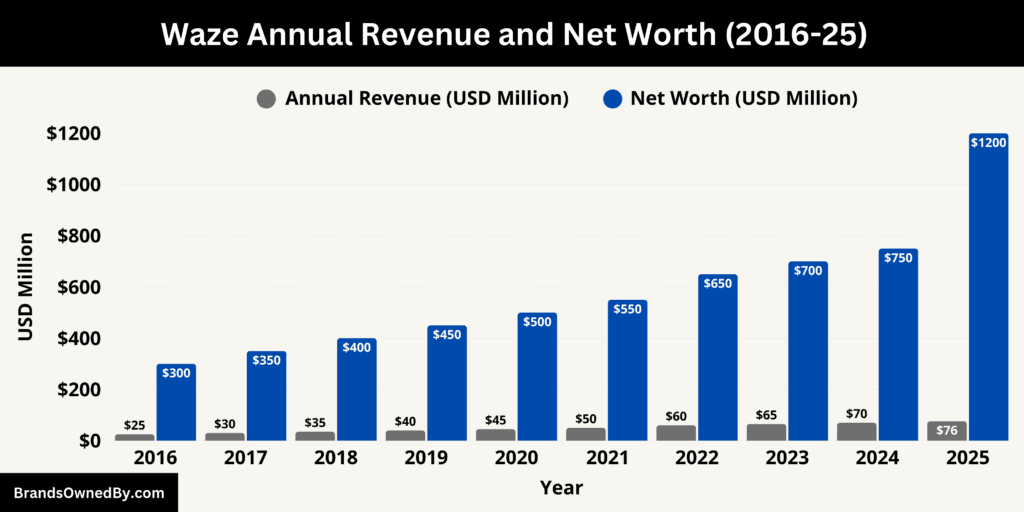
As of December 2025, Waze generates an estimated $76 million in annual revenue primarily through location-based advertising, partnerships, and promoted destinations. Its net worth is estimated at $1.2 billion, reflecting both its revenue potential and strategic value within Google’s global mapping and navigation ecosystem.
Revenue in 2025
Waze’s revenue comes almost entirely from location‑based advertising, partnerships, and promotional features targeted at both local and national businesses. This model allows businesses to display ads, branded pins, and promoted locations to drivers while they navigate. Advertisers pay based on visibility and engagement with active drivers along their routes, leveraging Waze’s real‑time, crowd‑sourced traffic data to target relevant audiences.
Although Google does not break out Waze’s financials separately in its parent company reporting, third‑party industry estimates suggest that Waze’s annual revenue in 2025 is around $760 million.
Waze’s revenue growth has been influenced by changes in monetization strategy, including the integration of its advertising platform into Google’s broader ad ecosystem. This integration has led to adjustments in how ads are sold and delivered, with some legacy Waze Ads products transitioning toward Google Ads management to improve scalability and integration with Google’s advertising infrastructure.
Revenue Drivers
Waze’s revenue in 2025 continues to be supported by several key factors:
- Location‑Based Advertising: Waze’s core revenue stream remains ads that appear along routes or at destinations, tailored to user location and behavior.
- Branded Pins and Promoted Locations: Businesses can pay for enhanced visibility on the map, which can drive foot traffic or brand recognition among drivers.
- Partnerships and Integrations: Collaborations with other platforms, automotive services, and local commerce initiatives help expand the contexts in which Waze’s data and advertising capabilities are used.
- Smart City and Data Services: Emerging revenue opportunities include data licensing for traffic planning and smart city solutions, although these are still developing relative to core advertising income.
Together, these elements position Waze as a profitable business unit within Google’s broader maps and location services portfolio, even if it does not match the revenue scale of flagship products like Google Maps.
Waze Net Worth
As of December 2025, Waze’s net worth is estimated at $1.2 billion. Although Waze operates as a wholly owned subsidiary of Google (Alphabet Inc.), this estimated valuation reflects the app’s revenue-generating capacity, user base, data assets, and strategic importance within the location-based services ecosystem.
Waze’s value is derived from its unique crowd-sourced traffic data, real-time navigation capabilities, and its integration within Google’s advertising and mapping platforms.
This valuation accounts for Waze’s strategic value beyond pure revenue, including its:
- Active global user base contributing real-time traffic updates.
- Proprietary routing algorithms and map data infrastructure.
- Integration potential with Google Maps and other Google services.
- Role in expanding Google’s location-based advertising and mobility solutions.
The $1.2 billion net worth underscores Waze’s significance as a strategic asset rather than just a standalone revenue generator. While its revenue is modest relative to Google’s flagship products, the app contributes:
- Valuable real-time traffic data that enhances Google Maps and other location services.
- A platform for targeted local advertising with high user engagement.
- A unique community-driven ecosystem that differentiates Waze from other navigation apps.
Comparison to Historical Value
Over the past decade, Waze’s implied net worth has grown steadily from around $300 million in 2016 to $1.2 billion in 2025, reflecting its growing user base, technological maturity, and integration into Google’s broader mapping and advertising ecosystem. This growth highlights the app’s transition from a standalone navigation startup to a core component of Google’s location-based strategy, demonstrating both financial and strategic value.
Brands Owned by Waze
Waze operates several brands, services, and internal programs that it fully owns and manages. These entities expand the app beyond navigation, encompassing ride-sharing, advertising solutions, data services, and community tools.
Below is a list of the major brands and internal divisions owned and operated by Waze as of December 2025:
| Company / Brand / Entity | Description | Key Functions / Features | Ownership |
|---|---|---|---|
| Waze Carpool | Ride-sharing service | Connects drivers with passengers traveling similar routes; integrates with Waze navigation | Fully owned and operated by Waze |
| Waze Audio Player Integrations | In-app audio features | Allows streaming of music, podcasts, and audio content while navigating; integrates with major audio platforms | Developed and managed internally by Waze |
| Waze Map Editor Tools | Mapping and editing platform | Enables users and community managers to update and maintain Waze maps; backbone of crowd-sourced data | Proprietary tools fully controlled by Waze |
| Waze Advertising Platform | In-app advertising system | Offers location-based ads, promoted pins, and branded locations targeting users on their routes | Owned and operated directly by Waze |
| Waze Local | Business promotion program | Helps small and medium-sized businesses promote themselves on Waze maps; drives user engagement | Managed internally as part of Waze operations |
| Waze Data Licensing | Data monetization program | Provides anonymized traffic and mapping data to third parties like city planners and researchers | Fully controlled and managed by Waze |
| Waze Beacons | Navigation enhancement hardware/software | Improves GPS navigation in tunnels and areas with poor signal; integrates with Waze mapping system | Designed, produced, and operated by Waze |
| Waze Events and Partnerships | Community and marketing initiatives | Manages campaigns, collaborations, promotions, and community-driven events to boost engagement | Operated and managed internally by Waze |
Waze Carpool
Waze Carpool is a ride-sharing service developed and operated directly by Waze. Launched as an initiative to reduce traffic congestion and provide an eco-friendly commuting option, Waze Carpool connects drivers with passengers traveling along similar routes.
The platform allows users to share rides and costs, leveraging Waze’s navigation technology to optimize routes and timing. While not as large as major ride-sharing competitors, Waze Carpool integrates seamlessly with the Waze app, making it convenient for users already using Waze for navigation.
Waze Audio Player Integrations
Waze Audio Player Integrations are proprietary features that allow users to play music, podcasts, and other audio content directly through the Waze app while navigating. This feature was developed internally by Waze to enhance user engagement and provide a seamless in-app experience.
Waze partners with major audio streaming services to allow integration, but the development, management, and operation of these features are owned and controlled by Waze itself. It represents the company’s effort to diversify app functionality beyond navigation.
Waze Map Editor Tools
Waze Map Editor Tools are internal tools developed and maintained by Waze to allow users and community managers to edit, update, and maintain the Waze maps. These tools form the backbone of Waze’s crowd-sourced mapping model, enabling the company to offer accurate and constantly updated navigation information.
The technology behind these tools is proprietary to Waze, and the company manages the development, training, and community guidelines to ensure high-quality map data.
Waze Advertising Platform
The Waze Advertising Platform is an in-app advertising system fully owned and operated by Waze. It allows local and national businesses to place location-based ads, promoted pins, and branded locations directly on the map. The platform uses Waze’s real-time navigation data to target users effectively based on location and route.
Over the years, Waze has expanded the capabilities of this platform, integrating it with broader ad strategies while keeping the platform development and management internal to the company.
Waze Local
Waze Local is a subsidiary program of Waze designed specifically to serve small and medium-sized businesses.
It provides tools and features to promote businesses on the Waze map, enabling direct engagement with drivers in the vicinity. Waze Local operates as an entity under Waze’s direct management and is focused on monetization opportunities that enhance both business visibility and user navigation experience.
Waze Data Licensing
Waze Data Licensing is an internal entity through which Waze provides its anonymized traffic and mapping data to third parties, including city planners, transportation authorities, and research institutions. The technology and operational management of this data licensing program are fully controlled by Waze, allowing the company to monetize its unique crowd-sourced traffic data while retaining ownership and oversight of data usage agreements.
Waze Beacons
Waze Beacons are proprietary hardware and software products developed by Waze to improve navigation in areas with limited GPS signal coverage. These beacons are installed in tunnels, parking structures, and other challenging environments, enhancing the accuracy and reliability of Waze navigation. Waze designs, produces, and manages this technology internally, ensuring full control over deployment, maintenance, and integration with its mapping system.
Waze Events and Partnerships
Waze Events and Partnerships is an internal division responsible for creating campaigns, community initiatives, and partnerships with organizations that enhance user engagement. This entity manages collaborations, special promotions, and community-driven events, all designed and operated by Waze.
It allows the company to maintain its strong community focus while expanding its reach through strategic collaborations.
Conclusion
Waze has grown into a powerful navigation platform that combines real-time traffic data, innovative services, and community-driven mapping. Fully owned by Google, the company manages its own brands, programs, and technological initiatives, maintaining operational control while contributing to Google’s broader mapping and advertising ecosystem. Knowing who owns Waze and how the company operates highlights its strategic importance, leadership structure, and continued influence in the world of navigation and location-based services.
FAQs
Who owns Waze today?
Waze is fully owned by Google, which is a subsidiary of Alphabet Inc. While it operates under Google Geo, Waze maintains its own product team and internal programs. All strategic and financial decisions ultimately come from Google, making it the controlling entity of Waze.
Is Waze an Israeli company?
Yes, Waze was founded in Israel and retains its strong Israeli roots in terms of origin and development culture. The company was established by Israeli entrepreneurs and continues to employ teams in Israel alongside its global operations, even though it is now owned by Google.
Who is Waze founder?
Waze was co-founded by Uri Levine, Ehud Shabtai, and Amir Shinar. These three Israeli entrepreneurs developed the concept of a crowd-sourced navigation app that collects real-time traffic data from users to improve driving routes. Their vision laid the foundation for Waze’s unique community-driven model.
Is Waze owned by Google Maps?
No, Waze is not owned by Google Maps. Instead, Waze is a separate app that is owned by Google. While it is integrated strategically with Google Maps and shares certain technologies, Waze operates as its own product with unique features, branding, and community-driven data.
Why is Waze separate from Google Maps?
Waze remains separate from Google Maps to maintain its distinctive user experience, community features, and real-time crowd-sourced traffic data. This separation allows Waze to innovate in navigation, social driving, and location-based advertising without being constrained by Google Maps’ broader infrastructure.
How does Waze make money?
Waze generates revenue primarily through location-based advertising, promoted pins, and business partnerships. Local and national businesses can display ads on Waze maps targeting drivers on relevant routes. Additionally, Waze monetizes its traffic and mapping data through licensing and promotes services like Waze Carpool and Waze Local to create further revenue streams.
Why did Google buy Waze?
Google acquired Waze in June 2013 for approximately $1.1 billion to leverage its crowd-sourced traffic data, community-driven mapping technology, and innovative navigation features. The acquisition allowed Google to enhance its overall mapping and location-based services, integrate Waze’s data into Google Maps, and expand advertising opportunities, while letting Waze continue to operate as a distinct app with its unique community and features.