
- Nucor is a publicly traded company listed on the New York Stock Exchange (NYSE: NUE). Its ownership is widely distributed among institutional investors, mutual funds, insiders, and individual shareholders, meaning no single entity controls the company.
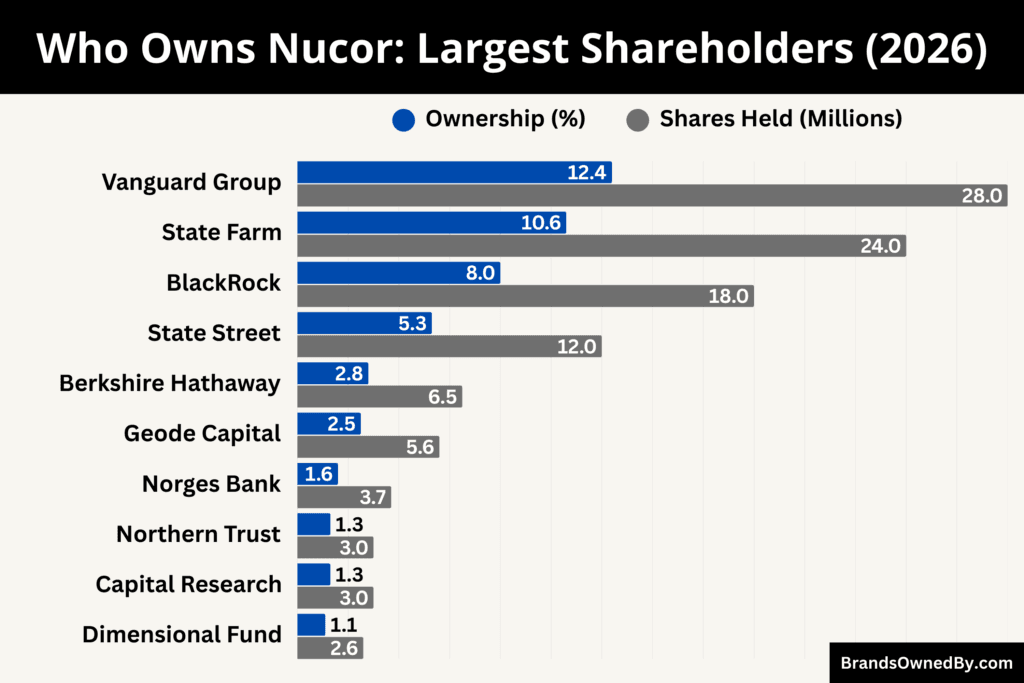
- The largest shareholder is The Vanguard Group, holding roughly 12% of Nucor’s shares, followed by State Farm (10%), BlackRock (8%), and State Street (5%), making institutional investors the dominant owners.
- Institutional investors collectively control the majority of Nucor’s outstanding shares, while company executives and board members hold smaller insider stakes that align management interests with shareholders.
- Because ownership is dispersed, Nucor is controlled by professional management led by CEO and Chairman Leon J. Topalian and overseen by an independent board of directors, rather than a founding family or parent company.
Nucor Corporation is one of the largest steel producers in the United States. The company manufactures a wide range of steel and steel products used in construction, infrastructure, automotive manufacturing, and industrial equipment.
Nucor operates primarily through electric arc furnace (EAF) steelmaking, which melts recycled scrap steel to produce new steel. This process is more flexible than traditional blast furnace production. It also allows the company to adjust production based on market demand.
The company runs dozens of steel mills, fabrication plants, and processing facilities across the United States, with additional operations in Canada and Mexico. Its major products include sheet steel, plate steel, structural steel, steel bars, reinforcing steel, steel tubing, and metal building systems.
A defining feature of Nucor is its decentralized management structure. Individual plants and divisions have strong operational independence. Plant managers make many day-to-day decisions related to production, efficiency, and workforce management. This structure helps the company respond quickly to market changes.
Nucor is also one of the largest steel recyclers in North America. Scrap metal is collected from construction waste, manufacturing scrap, and old steel products. It is then melted in electric arc furnaces to produce new steel products.
Over time, Nucor has expanded beyond basic steelmaking. The company now operates several downstream businesses that fabricate steel into construction materials, engineered buildings, and specialized industrial products.
Nucor Founder
Nucor traces its origins to Ransom E. Olds, an American industrialist and automobile pioneer. He founded the company in 1940 under the name Nuclear Corporation of America.
Olds was already famous for founding the Oldsmobile automobile company. He was one of the early innovators of mass automobile manufacturing in the United States. After leaving the automotive industry, he started Nuclear Corporation of America to pursue opportunities in emerging industrial technologies.
The company initially focused on nuclear instruments, electronics, and scientific equipment. However, these early businesses struggled to generate consistent growth.
During the 1960s, the company shifted its focus toward steel manufacturing. This strategic change eventually led to the creation of Nucor Corporation, which became a major steel producer in the United States.
Ken Iverson’s Role in Building Modern Nucor
Although Ransom E. Olds founded the company, F. Kenneth Iverson is widely credited with building modern Nucor.
Iverson joined the company in the 1960s and became CEO in 1967. He transformed the company by focusing entirely on steel production and introducing a unique management model.
He implemented a decentralized structure where plant managers had significant decision-making authority. He also introduced performance-based pay, where employees received bonuses tied to plant productivity and profitability.
Iverson strongly promoted electric arc furnace steelmaking. This allowed Nucor to build smaller, lower-cost steel mills and compete with larger integrated steel companies.
Under Iverson’s leadership, Nucor grew rapidly and became one of the most efficient steel producers in the United States. His management philosophy remains a core part of the company’s culture today.
Ownership History
Nucor’s ownership structure has evolved significantly since the company was founded. The business started as a small industrial firm with limited investors. Over time, it transformed into a major publicly traded steel manufacturer with thousands of shareholders.
Early Ownership as Nuclear Corporation of America (1940–1960s)
Nucor began in 1940 under the name Nuclear Corporation of America. The company was founded by Ransom E. Olds along with a group of early investors. During this period, ownership was relatively concentrated among founders, private investors, and a small group of shareholders.
The company initially focused on nuclear instruments and electronics rather than steel production. However, many of these early ventures struggled financially. As the company experimented with different industries, its ownership base gradually expanded as additional investors were brought in to support operations.
During the 1950s and early 1960s, the company began restructuring its business model. It started acquiring and investing in steel-related operations. This shift laid the foundation for the company’s future focus on steel manufacturing.
Transition to Steel and Corporate Restructuring (1960s–1970s)
The major turning point in ownership history came during the 1960s when the company moved away from nuclear technology and focused on steel production.
In 1965, the company entered the steel industry by acquiring Vulcraft, a manufacturer of steel joists and structural products. This acquisition proved highly successful and helped stabilize the company’s financial position.
As steel operations grew, the company simplified its structure and gradually divested many of its earlier unrelated businesses. During this period, the company also strengthened its position as a publicly traded corporation.
In 1972, the company officially changed its name to Nucor Corporation. By this time, its ownership was already spread among public investors who held shares through the stock market.
Growth as a Publicly Traded Steel Producer (1980s–2000s)
From the 1980s onward, Nucor expanded rapidly through new steel mills and acquisitions. As the company grew, its shareholder base became increasingly institutional.
Large investment firms, pension funds, and mutual funds began purchasing shares in the company. Institutional ownership increased because Nucor consistently demonstrated strong operational performance and profitability compared with other steel producers.
During this period, the company also attracted long-term investors who viewed Nucor as a stable industrial company with strong management and consistent dividend payments.
Because the company was publicly listed on the New York Stock Exchange, shares were widely distributed among both institutional and individual investors.
Expansion and Institutional Ownership Growth (2000s–2010s)
In the 2000s, Nucor continued expanding through acquisitions and new steel manufacturing facilities. The company also entered several downstream steel processing businesses.
As global financial markets expanded, large asset management firms began holding significant stakes in many publicly traded companies. Nucor was no exception.
Major institutional investors such as Vanguard Group, BlackRock, and State Street Corporation gradually became the largest shareholders. These firms manage large index funds and exchange-traded funds that track major stock market indices.
Because Nucor is included in several major stock market indexes, these funds automatically hold shares in the company as part of their investment portfolios.
Modern Ownership Structure
As of March 2026, Nucor operates as a widely held public company listed on the New York Stock Exchange under the ticker symbol NUE. Its ownership is distributed among institutional investors, mutual funds, pension funds, corporate insiders, and individual shareholders.
Institutional investors hold the majority of the company’s shares. The largest shareholders include major asset management firms such as Vanguard Group, BlackRock, and State Street Corporation. These firms hold shares through index funds and exchange-traded funds that track major U.S. stock market indices.
Other institutional investors, including investment firms and pension funds, also hold notable stakes in the company. Corporate executives and board members own smaller portions of shares, aligning leadership interests with shareholders.
Because Nucor’s shares are widely distributed, no single shareholder controls the company. Strategic decisions are made by the executive leadership team and overseen by the board of directors on behalf of all shareholders.
Who Owns Nucor Steel: Top Shareholders
Nucor Corporation is a publicly traded company listed on the New York Stock Exchange under the ticker symbol NUE. Its ownership is widely distributed among institutional investors, mutual funds, corporate insiders, and individual shareholders. Institutional investors hold the majority of the company’s shares, meaning large asset management firms and financial institutions play a major role in its shareholder base.
As of 2026, institutional investors collectively control a significant portion of Nucor’s stock, while insider ownership remains relatively small. This ownership structure is common among large U.S. industrial corporations and allows the company to operate without a single controlling owner.
The largest shareholders include global investment firms such as Vanguard Group, State Farm Mutual Automobile Insurance Company, BlackRock, and State Street Corporation. These investors hold shares through pension funds, index funds, insurance investment portfolios, and exchange-traded funds.
The Vanguard Group
The Vanguard Group is the largest shareholder of Nucor. As of late 2025 filings that remain the latest available data in 2026, Vanguard owns approximately 12.4% of the company, representing more than 28 million shares.
Vanguard is one of the world’s largest asset management firms. It manages trillions of dollars through index funds and exchange-traded funds. Much of its Nucor stake is held through funds that track major U.S. stock indices such as the S&P 500 and the total U.S. stock market.
Because Vanguard primarily manages passive index funds, it usually does not actively control company operations. However, its large shareholding gives it significant voting influence in shareholder meetings and corporate governance matters.
State Farm Mutual Automobile Insurance Company
State Farm Mutual Automobile Insurance Company is the second-largest shareholder of Nucor, holding roughly 10.6% of the company’s shares, equal to more than 24 million shares.
State Farm is one of the largest insurance companies in the United States. Insurance firms often invest large portions of their reserves in stable industrial companies like Nucor. These investments help generate long-term returns to support policyholder obligations.
State Farm’s large ownership stake reflects its long-term investment strategy. The company typically holds shares in established U.S. corporations with stable cash flows and strong market positions.
BlackRock
BlackRock is another major institutional shareholder in Nucor. As of the most recent filings, BlackRock owns around 8% of Nucor’s outstanding shares, representing more than 18 million shares.
BlackRock is the world’s largest asset manager. It manages investment portfolios for pension funds, governments, institutions, and retail investors. Many of its Nucor holdings come through its iShares exchange-traded funds and other diversified investment funds.
Although BlackRock holds a large stake, its investments are typically passive and diversified across thousands of companies.
State Street Corporation
State Street Corporation is another major institutional investor in Nucor. It holds approximately 5.3% of the company’s shares, equivalent to more than 12 million shares.
State Street is a global financial services firm that manages investment funds and provides asset management services through its State Street Global Advisors division. The company operates several large index funds and ETFs that include Nucor shares.
State Street’s investment strategy is similar to other large asset managers. Its funds invest broadly across major U.S. companies included in stock market indices.
Berkshire Hathaway
Berkshire Hathaway is also among the notable shareholders of Nucor. The investment conglomerate holds around 2.8% of Nucor’s outstanding shares, which represents approximately 6.5 million shares.
Berkshire Hathaway, led by Warren Buffett, invests in a wide range of industries including manufacturing, insurance, transportation, and consumer goods. Its investment portfolio often focuses on companies with strong management, durable competitive advantages, and long-term growth potential.
The company’s stake in Nucor reflects confidence in the steel producer’s efficient business model and its leadership position in the U.S. steel industry. Although Berkshire’s stake is smaller than those of the largest asset managers, it still represents a significant institutional investment.
Geode Capital Management
Geode Capital Management is another institutional investor with a meaningful stake in Nucor. The firm owns roughly 2.5% of the company’s shares, which equals approximately 5.6 million shares.
Geode Capital Management primarily manages index-based investment strategies. Many of its funds track major U.S. stock market benchmarks, which include large industrial companies like Nucor.
Because Nucor is part of several widely tracked stock market indices, Geode’s investment funds hold shares as part of diversified portfolios. The firm’s ownership represents long-term institutional investment rather than direct operational influence over the company.
Norges Bank Investment Management
Norges Bank Investment Management is another institutional shareholder of Nucor. The fund manages Norway’s sovereign wealth fund, which is one of the largest government investment funds in the world.
As of recent filings, Norges Bank Investment Management owns approximately 1.6% of Nucor’s outstanding shares, representing more than 3.7 million shares.
The fund invests globally across thousands of public companies to generate long-term returns for Norway’s national wealth fund. Its investment strategy focuses on diversification across industries and geographies. Holdings in companies like Nucor provide exposure to the global materials and steel sector.
Because the fund holds shares across a large number of companies, it generally acts as a long-term institutional investor rather than actively influencing corporate operations.
Northern Trust Global Investments
Northern Trust Global Investments is another notable shareholder in Nucor. The investment firm manages assets for institutional investors, pension funds, foundations, and high-net-worth clients.
The company holds roughly 1.3% of Nucor’s shares, representing more than 3 million shares based on recent institutional ownership filings.
Northern Trust typically invests through index funds and actively managed portfolios. Its holdings in Nucor are largely part of diversified funds that track major U.S. equity markets.
The firm is known for its long-term institutional investment strategies and risk-managed portfolio management.
Capital Research and Management Company
Capital Research and Management Company is another major institutional investor in Nucor. The firm is part of the Capital Group, one of the largest active investment management companies in the United States.
Capital Research holds around 1.3% of Nucor’s shares, representing slightly more than 3 million shares according to recent filings.
The firm manages a variety of actively managed mutual funds and institutional investment portfolios. Its investment approach focuses on long-term value and fundamental company analysis.
Capital Group funds frequently invest in large industrial companies with strong market positions and long operating histories, which aligns with Nucor’s profile in the steel industry.
Dimensional Fund Advisors
Dimensional Fund Advisors is another institutional shareholder in Nucor. The firm manages global investment portfolios using quantitative investment strategies that combine academic research with diversified asset allocation.
Dimensional Fund Advisors owns approximately 1.1% of Nucor’s outstanding shares, equal to about 2.6 million shares based on recent institutional filings.
The company primarily manages institutional investment funds and retirement portfolios. Its investment strategy focuses on systematic portfolio construction and broad diversification across industries.
Competitor Ownership Comparison
Nucor competes with several large steel producers in the United States and globally. The competitive landscape includes companies such as Steel Dynamics, Cleveland-Cliffs, ArcelorMittal, and POSCO. These companies operate in similar markets and supply steel to industries like construction, automotive manufacturing, infrastructure, and energy.
However, their ownership structures differ significantly. Some companies are widely held public corporations like Nucor. Others have strong family ownership or international corporate control. Understanding how competitors are owned helps explain how decisions are made, how capital is allocated, and how each company competes in the global steel industry.
| Company | Ownership Structure | Major Shareholders / Owners | Ownership Type | Key Notes |
|---|---|---|---|---|
| Nucor Corporation | Widely held public company | Vanguard Group, State Farm, BlackRock, State Street, institutional investors | Institutional ownership | No controlling shareholder. Most shares are held by asset managers and investment funds. |
| Steel Dynamics | Publicly traded company | Vanguard Group, BlackRock, institutional investors, mutual funds | Institutional ownership | Ownership structure similar to Nucor with shares widely distributed among institutional investors. |
| Cleveland-Cliffs | Publicly traded company | Institutional investors, hedge funds, asset management firms | Institutional ownership | More vertically integrated than Nucor, with iron ore mining and steel production operations. |
| United States Steel Corporation | Subsidiary of Nippon Steel | Nippon Steel Corporation | Corporate ownership | Acquired by Nippon Steel, bringing the historic U.S. steelmaker under Japanese corporate ownership. |
| ArcelorMittal | Publicly traded with controlling shareholder | Mittal family, institutional investors | Family-controlled corporation | Lakshmi Mittal and the Mittal family collectively hold around 40% of the company. |
| POSCO Holdings | Publicly traded company | Institutional investors, pension funds, financial institutions | Institutional ownership | Former South Korean state-owned enterprise that was privatized and now has global shareholders. |
Steel Dynamics
Steel Dynamics is one of Nucor’s closest competitors in the United States. The company operates multiple mini-mill steel plants and produces a wide range of steel products similar to Nucor.
Steel Dynamics is a publicly traded company listed on the NASDAQ exchange. Its ownership structure is similar to Nucor’s. Shares are widely distributed among institutional investors, mutual funds, and individual shareholders.
Large asset managers such as Vanguard Group, BlackRock, and other institutional funds hold significant stakes through index funds and diversified investment portfolios. Because ownership is widely distributed, no single shareholder controls Steel Dynamics. Strategic decisions are handled by the executive leadership team and supervised by the board of directors.
This ownership structure allows Steel Dynamics to operate as a professionally managed corporation focused on operational efficiency and long-term growth.
Cleveland-Cliffs
Cleveland-Cliffs is another major competitor to Nucor in the U.S. steel industry. The company operates integrated steel production facilities and is also heavily involved in iron ore mining and raw material supply.
Cleveland-Cliffs is also a publicly traded company, with ownership largely spread across institutional investors and investment funds. Major shareholders include asset management firms, hedge funds, and financial institutions.
Unlike Nucor, Cleveland-Cliffs is more vertically integrated. The company controls iron ore mines, pellet production facilities, and steel manufacturing operations. This structure gives it greater control over raw material supply but also exposes it more directly to commodity price fluctuations.
In 2025, the company strengthened its international partnerships when South Korean steelmaker POSCO announced a strategic investment and collaboration with Cleveland-Cliffs to expand access to U.S.-made steel products.
United States Steel Corporation
United States Steel Corporation has historically been one of the largest steel producers in the United States and a direct competitor to Nucor.
However, its ownership structure changed significantly in recent years. In 2025, Japanese steel giant Nippon Steel completed a major acquisition of U.S. Steel, effectively bringing the company under foreign corporate ownership.
Following the transaction, U.S. Steel operates as part of Nippon Steel’s global steel business while maintaining its headquarters in Pittsburgh, Pennsylvania. The deal created one of the largest steel producers in the world and strengthened Nippon Steel’s presence in the U.S. market.
This structure differs greatly from Nucor’s widely held public ownership. Instead of dispersed shareholders, U.S. Steel is now controlled by a global steel conglomerate.
ArcelorMittal
ArcelorMittal is one of the largest steel producers in the world and a major global competitor to Nucor. The company is headquartered in Luxembourg and operates steel production facilities across Europe, the Americas, and Asia.
ArcelorMittal is publicly traded, but its ownership is highly concentrated within the Mittal family. Lakshmi Mittal and his family collectively hold roughly 40% of the company’s shares, making them the controlling shareholders.
Because of this large ownership stake, the Mittal family has significant influence over corporate strategy and major decisions. This structure contrasts sharply with Nucor’s dispersed shareholder base, where institutional investors hold shares but no single investor controls the company.
POSCO Holdings
POSCO Holdings, based in South Korea, is another major global steel producer competing with Nucor in international markets.
The company was originally established as a state-owned enterprise by the South Korean government. Over time, it was privatized and transformed into a publicly traded corporation. Today, its shares are owned by institutional investors, pension funds, financial institutions, and individual shareholders.
Although the government no longer controls POSCO directly, the company remains strategically important to South Korea’s industrial economy. It also continues to form global partnerships with companies in the steel sector, including recent collaborations with Cleveland-Cliffs to strengthen U.S. supply chains.
Key Ownership Differences in the Steel Industry
The ownership structures of major steel producers differ widely. Nucor operates as a widely held public corporation, with institutional investors holding most shares but no controlling owner.
Steel Dynamics and Cleveland-Cliffs follow a similar model with dispersed institutional ownership. In contrast, ArcelorMittal has concentrated family ownership, while U.S. Steel is now effectively controlled by Nippon Steel after its acquisition.
These ownership differences influence corporate governance, investment strategies, and expansion plans across the global steel industry. Companies with concentrated ownership often have stronger centralized control, while widely held companies like Nucor rely on professional management and board oversight to guide strategic decisions.
Who Controls Nucor?
Nucor is a publicly traded company with thousands of shareholders. However, operational control of the company does not rest with shareholders. Instead, it is exercised through the executive leadership team and the board of directors, which manage strategy, investments, and corporate governance.
Because no shareholder holds a controlling stake, Nucor operates under a professional management structure typical of large U.S. corporations. The CEO leads the company’s strategy and operations, while the board of directors oversees management and represents shareholder interests.
In practice, control of Nucor follows a three-layer structure:
- CEO and executive leadership team manage strategy and operations.
- President and COO oversee operational execution across manufacturing divisions.
- Board of directors provides oversight and protects shareholder interests.
Leon J. Topalian: Chairman and Chief Executive Officer
The primary decision-maker at Nucor is Leon J. Topalian, who serves as Chairman of the Board and Chief Executive Officer as of March 2026.
Topalian has led the company as CEO since January 2020 and has served as chair of the board since 2022. In 2026, he continues to hold the combined role of Chairman and CEO, which gives him significant influence over corporate strategy and board discussions.
He joined Nucor in 1996 as a project engineer at Nucor Steel Berkeley and advanced through several operational roles before becoming CEO. His career inside the company included leadership positions in steel production, international operations, and corporate development.
As CEO, Topalian is responsible for:
- Setting Nucor’s long-term corporate strategy
- Approving major capital investments and acquisitions
- Overseeing steel production and manufacturing divisions
- Managing relationships with shareholders and regulators.
Because he also chairs the board, Topalian plays a central role in coordinating strategy between management and directors.
Stephen D. Laxton: President and Chief Operating Officer
As of January 2026, Stephen D. Laxton serves as President and Chief Operating Officer (COO) of Nucor.
Laxton previously served as the company’s Chief Financial Officer and Executive Vice President before being promoted to the COO role. His promotion followed the planned retirement of longtime COO David A. Sumoski in 2026.
In his role as President and COO, Laxton oversees the day-to-day operations of Nucor’s steel mills, fabrication facilities, and manufacturing divisions. This includes coordinating production strategies, managing operational performance, and implementing corporate initiatives across the company’s facilities.
Laxton works closely with the CEO to execute corporate strategy while ensuring operational efficiency across Nucor’s large network of steel plants.
Nucor’s Executive Leadership Structure
Beyond the CEO and President/COO, Nucor’s leadership includes several senior executives responsible for major business segments.
Key executive roles typically include leaders overseeing:
- Steel mill operations
- Raw materials and recycling operations
- Corporate strategy and business development
- Finance and capital allocation
- Fabricated steel products and downstream businesses.
These executives manage Nucor’s decentralized operating divisions and coordinate investment decisions, plant expansions, and new product development.
This leadership structure allows Nucor to manage dozens of steel production and manufacturing facilities across North America.
Board of Directors Oversight
While the executive team runs daily operations, the board of directors provides governance oversight and represents shareholder interests.
The board includes independent directors with experience in manufacturing, engineering, finance, and corporate leadership. As of recent filings, directors include individuals such as Christopher Kearney, Laurette Koellner, Michael Lamach, Patrick Dempsey, Norma Clayton, Nadja West, and Nicholas Gangestad.
Christopher J. Kearney serves as Lead Independent Director, a role designed to provide oversight when the CEO also serves as board chair.
The board is responsible for:
- Approving major acquisitions and capital investments
- Monitoring executive performance and compensation
- Setting corporate governance policies
- Representing shareholder interests.
Independent board committees, including audit, compensation, and governance committees, provide additional oversight.
Decentralized Operating Model
Another key aspect of control at Nucor is its decentralized management structure. Instead of centralized decision-making, individual steel plants and operating divisions have significant autonomy.
Plant managers and division leaders are responsible for operational decisions such as production levels, workforce management, and cost control. Corporate leadership focuses on strategy, capital allocation, and long-term planning.
This management model has been a core part of Nucor’s culture for decades. It allows the company to operate efficiently while maintaining accountability across its many production facilities.
Nucor Annual Revenue and Net Worth
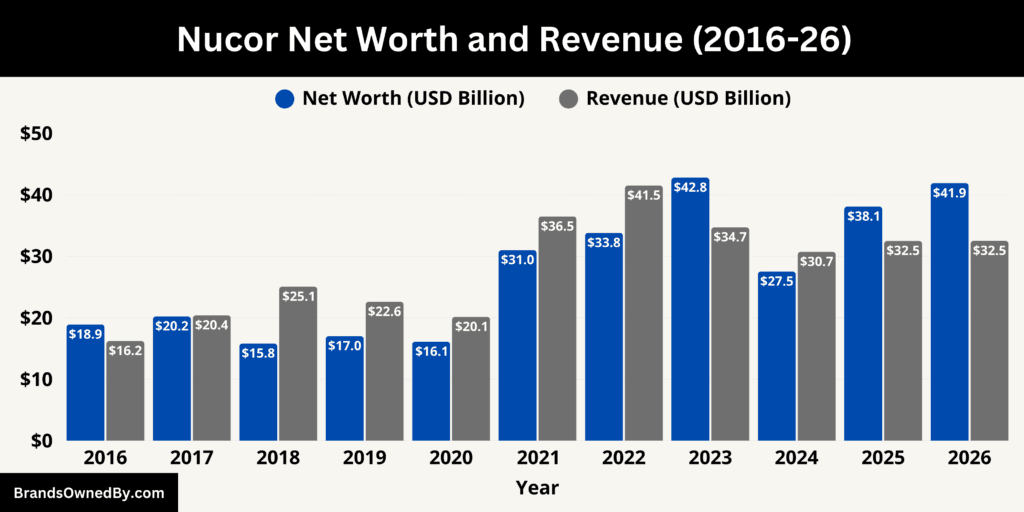
As of March 2026, the reported annual revenue is about $32.49 billion, while its market capitalization (net worth) is approximately $41.9 billion as of March 2026.
Nucor operates through three primary business segments: steel mills, steel products, and raw materials. These divisions together form a vertically integrated system that allows the company to control steel production, fabrication, and recycling.
Revenue Breakdown by Business Segment
Nucor’s revenue is primarily generated through steel manufacturing and downstream steel products. The company’s financial reports show a clear distribution of revenue across its three core segments.
Steel Mills Segment
The steel mills segment is the largest contributor to Nucor’s revenue. It typically accounts for about 60% of total revenue.
Based on the latest annual revenue of $32.49 billion, this segment generates approximately $19.4–$19.6 billion in annual sales.
This division produces major steel products such as sheet steel, structural steel, plate steel, and bar steel. These materials are widely used in infrastructure construction, commercial buildings, automotive manufacturing, heavy equipment, and industrial machinery.
Because this segment directly depends on steel pricing and shipment volumes, fluctuations in steel market prices can significantly affect total company revenue.
Steel Products Segment
The steel products segment contributes roughly 32–33% of total revenue.
Using the latest revenue figure, this segment generates approximately $10.4–$10.7 billion annually.
This division produces finished and fabricated steel products, including steel joists, decking systems, metal building systems, rebar fabrication products, wire products, and fasteners.
These products are commonly used in commercial construction projects such as warehouses, factories, stadiums, and industrial buildings. By manufacturing finished products rather than only raw steel, Nucor captures more value from the steel supply chain.
Raw Materials Segment
The raw materials segment accounts for about 6–7% of total revenue, generating approximately $2.0–$2.3 billion annually.
This division includes scrap recycling operations, scrap trading, and direct-reduced iron (DRI) production. Nucor is one of the largest recyclers of scrap steel in North America and processes millions of tons of scrap metal every year.
Scrap metal collected from demolition sites, manufacturing waste, and old steel products is processed and reused in Nucor’s electric arc furnaces to produce new steel.
Net Worth and Market Capitalization
Nucor’s net worth in financial markets is measured through its market capitalization, which reflects the total value of the company’s outstanding shares.
As of March 2026:
- Market capitalization: approximately $41.9 billion
- Share price range: about $170–$176 per share
- Outstanding shares: roughly 225–230 million shares.
This valuation places Nucor among the most valuable publicly traded steel producers in the United States.
The company also maintains a strong financial position with billions of dollars in operating cash flow and regular dividend payments to shareholders.
Revenue Trend and Financial Performance
Nucor’s revenue has grown significantly over the past decade, although it fluctuates depending on steel market cycles.
| Year | Revenue |
|---|---|
| 2022 | $41.51 billion |
| 2023 | $34.71 billion |
| 2024 | $30.73 billion |
| 2025 | $32.49 billion |
The company reached its highest revenue in 2022 at more than $41 billion, largely due to record global steel prices and strong construction demand.
Although revenue declined after the steel price surge normalized, the company has maintained annual revenue above $30 billion, reflecting stable demand for domestic steel production.
Future Revenue Forecast (2026–2030)
Industry forecasts suggest that Nucor’s revenue will grow gradually as infrastructure investment and domestic manufacturing demand increase in North America.
- 2026: ~$33–$34 billion expected as U.S. infrastructure and industrial demand remain stable.
- 2027: ~$35–$36 billion projected assuming approximately 5–6% annual revenue growth.
- 2028: ~$37–$38 billion expected as new steel capacity and fabrication facilities expand production.
- 2029: ~$39–$40 billion projected if infrastructure projects and energy sector demand increase steel consumption.
- 2030: ~$41–$43 billion potential revenue if large-scale infrastructure, power grid expansion, and industrial reshoring continue.
Several structural trends support this growth outlook, including increased U.S. infrastructure spending, renewable energy construction, data center expansion, and government policies supporting domestic steel manufacturing.
These factors position Nucor to remain one of the most financially stable and profitable steel producers in North America over the next decade.
Companies Owned by Nucor
Nucor operates dozens of specialized subsidiaries and operating divisions. These companies focus on steel production, fabricated steel products, construction materials, scrap recycling, and raw material processing.
As of 2026, Nucor owns and operates several major subsidiaries and brands that support its steel manufacturing and downstream product ecosystem.
| Company / Brand | Type of Business | Key Products / Services | Key Details |
|---|---|---|---|
| Nucor Steel | Steel Manufacturing Division | Sheet steel, plate steel, bar steel, structural steel | Core steel production division operating multiple electric arc furnace mini-mills across the U.S. |
| Vulcraft | Structural Steel Products | Steel joists, joist girders, steel decking | One of the largest steel joist manufacturers in North America serving commercial construction projects. |
| Harris Rebar | Rebar Fabrication | Reinforcing steel fabrication | Major supplier of fabricated rebar for bridges, highways, and commercial construction projects. |
| Nucor Buildings Group | Pre-Engineered Metal Buildings | Metal building systems, structural frames | Designs and manufactures steel buildings used for warehouses, factories, and industrial facilities. |
| Skyline Steel | Infrastructure Foundation Systems | Sheet piles, pipe piles, foundation components | Provides steel foundation solutions used in marine construction and civil infrastructure projects. |
| Nucor Insulated Panel Group | Construction Materials | Insulated metal panels | Produces energy-efficient insulated panels used in cold storage, food processing, and industrial buildings. |
| Nucor Tubular Products | Steel Pipe and Tubing | Structural tubing, mechanical tubing | Manufactures steel tubing used in construction, machinery, and industrial equipment. |
| Nucor Fastener | Industrial Manufacturing | High-strength bolts and fasteners | Supplies specialty fasteners for automotive manufacturing and heavy equipment industries. |
| Nucor Towers & Structures | Energy Infrastructure | Transmission towers, wind energy structures | Produces steel towers for electrical transmission lines and renewable energy projects. |
| Nucor Raw Materials | Recycling and Raw Materials | Scrap metal processing, DRI production | Manages scrap recycling operations supplying raw materials for Nucor steel mills. |
| Nucor-Yamato Steel | Structural Steel Manufacturing | Wide-flange beams, H-beams | Joint venture producing structural steel used in bridges and high-rise construction. |
| California Steel Industries | Flat-Rolled Steel Production | Hot-rolled, cold-rolled, galvanized steel | Joint venture serving western U.S. markets with flat-rolled steel products. |
| Nucor Cold Finish | Specialty Steel Processing | Cold-finished steel bars | Produces precision steel bars used in machinery, automotive parts, and industrial equipment. |
| Nucor Steel Auburn | Specialty Bar Production | Engineered steel bars | Manufactures high-quality bar steel for engineering and industrial applications. |
| Nucor Steel Brandenburg | Plate Steel Manufacturing | Heavy steel plates | Modern plate mill producing thick steel plates used in shipbuilding and heavy equipment. |
| Nucor Data Systems & Corporate Services | Internal Corporate Operations | IT systems, logistics, engineering support | Supports technology, supply chain, and operational coordination across Nucor’s manufacturing network. |
Nucor Steel
Nucor Steel represents the company’s core steel manufacturing division. It operates numerous electric arc furnace mini-mills across the United States.
These mills produce a wide range of steel products including sheet steel, plate steel, structural steel, bar steel, and reinforcing steel. Facilities under this division include major production plants such as Nucor Steel Arkansas, Nucor Steel Indiana, Nucor Steel Texas, and Nucor Steel Berkeley.
This division forms the backbone of Nucor’s business and supplies steel to industries including construction, automotive manufacturing, energy infrastructure, and heavy equipment manufacturing.
Vulcraft
Vulcraft is one of Nucor’s most important subsidiaries and one of the largest steel joist manufacturers in North America. The company produces steel joists, joist girders, and deck systems used in commercial and industrial construction.
Vulcraft facilities operate in multiple U.S. states and supply structural components for buildings such as warehouses, factories, schools, stadiums, and office buildings.
Nucor originally entered the steel business through Vulcraft, making it one of the oldest and most historically significant businesses within the company.
Harris Rebar
Harris Rebar is a major reinforcing steel fabrication company owned by Nucor. It fabricates reinforcing steel used in concrete construction projects.
The company provides rebar fabrication and installation services for infrastructure projects such as highways, bridges, airports, and large commercial buildings.
Harris Rebar operates dozens of fabrication facilities across the United States and Canada. It plays a key role in connecting Nucor’s steel production operations to the construction industry.
Nucor Buildings Group
Nucor Buildings Group manufactures pre-engineered metal building systems used in commercial, agricultural, and industrial construction.
The division produces custom metal building structures that are commonly used for warehouses, distribution centers, manufacturing plants, and aircraft hangars.
These buildings are designed using Nucor-produced steel and provide integrated construction solutions that combine structural steel with architectural components.
Skyline Steel
Skyline Steel specializes in foundation and piling systems used in large infrastructure projects. Its products include sheet piles, pipe piles, and foundation components used in marine construction and civil engineering.
These products are commonly used in ports, bridges, flood protection systems, and waterfront developments.
The acquisition of Skyline Steel expanded Nucor’s presence in infrastructure and civil construction markets.
Nucor Insulated Panel Group
Nucor Insulated Panel Group manufactures insulated metal panels used in industrial and commercial buildings.
These panels provide thermal insulation and structural strength and are commonly used in cold storage facilities, food processing plants, data centers, and manufacturing plants.
The business supports growing demand for energy-efficient construction materials and temperature-controlled building environments.
Nucor Tubular Products
Nucor Tubular Products produces steel pipes and tubing used in industrial applications.
Its product portfolio includes structural tubing, mechanical tubing, and hollow structural sections used in construction, machinery manufacturing, transportation equipment, and energy infrastructure.
The division operates multiple tube manufacturing facilities across North America.
Nucor Fastener
Nucor Fastener manufactures high-strength industrial fasteners used in automotive manufacturing and heavy machinery production.
The company produces specialized bolts and fasteners designed for high-stress applications in vehicles, heavy equipment, and industrial machinery.
This subsidiary helps expand Nucor’s presence in advanced manufacturing supply chains.
Nucor Towers & Structures
Nucor Towers & Structures produces steel towers used for electrical transmission and renewable energy infrastructure.
These towers support high-voltage power transmission lines and wind energy installations. As energy infrastructure expands in North America, this division plays an important role in supplying structural components for the power grid.
Nucor Raw Materials
Nucor Raw Materials manages the company’s scrap recycling and raw material supply operations.
The division operates scrap collection, processing, and trading facilities. It supplies recycled steel scrap to Nucor’s electric arc furnaces, ensuring a stable raw material supply.
The company processes millions of tons of scrap steel annually, making Nucor one of the largest recyclers of steel in North America.
Nucor-Yamato Steel
Nucor-Yamato Steel is a joint venture between Nucor and Yamato Kogyo of Japan.
The company produces structural steel products such as H-beams and wide-flange beams used in high-rise buildings, bridges, and large infrastructure projects.
Its manufacturing facility in Arkansas is one of the most advanced structural steel mills in North America.
California Steel Industries
California Steel Industries is another joint venture partly owned by Nucor.
The company produces flat-rolled steel products including hot-rolled, cold-rolled, and galvanized steel used in automotive, construction, and appliance manufacturing.
Its production facilities serve customers across the western United States.
Nucor Cold Finish
Nucor Cold Finish produces cold-finished steel bars used in precision manufacturing applications.
These products are used in automotive components, industrial machinery, hydraulic systems, and engineered equipment where tight tolerances and high strength are required.
The division specializes in advanced finishing processes that improve steel surface quality and mechanical properties.
Nucor Steel Auburn
Nucor Steel Auburn focuses on producing specialty steel bar products.
The facility manufactures high-quality steel bars used in engineering applications such as gears, shafts, fasteners, and precision mechanical components.
This plant serves industries including automotive manufacturing, aerospace suppliers, and heavy machinery producers.
Nucor Steel Brandenburg
Nucor Steel Brandenburg is one of the company’s newest steel mills and represents a major investment in plate steel production.
The facility produces thick steel plates used in heavy equipment, shipbuilding, offshore energy platforms, and large infrastructure projects.
Its modern electric arc furnace technology allows high-efficiency production of heavy steel plate products.
Nucor Data Systems and Corporate Services
Nucor also operates internal corporate entities that support its industrial operations.
These include technology services, logistics management, engineering development, and corporate supply chain operations.
These internal organizations help coordinate the company’s decentralized production network and ensure efficient management of dozens of steel mills and manufacturing facilities across North America.
Through this network of companies, brands, and joint ventures, Nucor has built a vertically integrated steel production ecosystem. These subsidiaries allow the company to control multiple stages of the steel value chain, from scrap recycling and steel production to fabrication and final construction materials.
Final Words
Nucor stands as one of the most successful steel manufacturers in the United States. For those asking who owns Nucor, the answer lies in its broad shareholder base. The company is publicly traded and owned primarily by institutional investors such as Vanguard, BlackRock, and State Street, along with thousands of individual shareholders.
Operational control rests with professional leadership led by CEO Leon Topalian and overseen by the board of directors. This structure allows Nucor to combine strong corporate governance with flexible operational management.
Through its network of steel mills, manufacturing divisions, and infrastructure-focused subsidiaries, Nucor continues to play a vital role in supplying steel for construction, manufacturing, and energy industries across North America.
FAQs
Who is the owner of Nucor Steel?
Nucor Steel does not have a single owner. It is a publicly traded company, so ownership is divided among thousands of shareholders. The majority of shares are held by large institutional investors such as Vanguard Group, State Farm, BlackRock, and State Street.
Who owns Nucor Corporation?
Nucor Corporation is owned by institutional investors, mutual funds, company insiders, and individual shareholders. The largest shareholder is The Vanguard Group, which holds roughly 12% of the company’s shares, followed by State Farm, BlackRock, and State Street.
Is Nucor an American company?
Yes, Nucor is an American company. It is headquartered in Charlotte, North Carolina, and operates steel mills and manufacturing facilities primarily across the United States.
What companies does Nucor own?
Nucor owns several subsidiaries and operating divisions involved in steel production and fabrication. Major companies and brands include Vulcraft, Harris Rebar, Skyline Steel, Nucor Buildings Group, Nucor Tubular Products, Nucor Fastener, Nucor Insulated Panel Group, and Nucor Towers & Structures. The company also operates joint ventures such as Nucor-Yamato Steel and California Steel Industries.
Does Warren Buffett own Nucor?
Yes, Warren Buffett’s company Berkshire Hathaway owns a small stake in Nucor. The investment represents a minority shareholding and does not give Berkshire Hathaway control over the company.
Does BlackRock own Nucor Steel?
Yes, BlackRock is one of the largest institutional shareholders of Nucor. The investment firm owns roughly 8% of the company’s shares through its various funds and ETFs.
Who is bigger, Nucor or US Steel?
Nucor is generally larger than U.S. Steel in terms of market capitalization and steel production capacity in the United States. Nucor has also been more profitable in recent years due to its electric arc furnace steelmaking model.
Who owns the most Nucor stock?
The Vanguard Group owns the largest stake in Nucor. The asset management company holds approximately 12% of the company’s total shares through its index funds and investment portfolios.
What is the biggest Nucor plant?
One of Nucor’s largest and most advanced plants is the Nucor Steel Brandenburg plate mill in Kentucky. It is a major steel plate production facility designed to supply heavy plate used in shipbuilding, energy infrastructure, and heavy equipment manufacturing.
Who is the CEO of Nucor?
The CEO of Nucor is Leon J. Topalian. He became Chief Executive Officer in January 2020 and also serves as Chairman of the Board as of 2026.
Who founded Nucor Steel?
Nucor traces its origins to Ransom E. Olds, who founded the company in 1940 under the name Nuclear Corporation of America.
Is Nucor a Fortune 500 company?
Yes, Nucor is a Fortune 500 company and regularly ranks among the largest industrial corporations in the United States based on revenue.
When was Nucor founded?
Nucor was founded in 1940 as Nuclear Corporation of America. The company later shifted its focus to steel manufacturing and changed its name to Nucor Corporation in 1972.