
- Black & Decker has evolved far beyond traditional power tools, building a broad consumer portfolio that spans outdoor equipment, home appliances, cleaning products, storage solutions, and DIY tools.
- Some of the brand’s most recognizable businesses and product lines include Dustbuster, Workmate, Matrix, outdoor power equipment, cordless tool systems, and a wide range of household appliances sold worldwide.
- It focuses heavily on homeowners and DIY users, allowing it to compete across multiple consumer categories rather than relying on a single product segment.
- With products found in homes, garages, workshops, and gardens across the globe, Black & Decker remains one of the most diversified and widely recognized consumer brands in the home improvement industry.
Black & Decker is one of the most recognized tool and home improvement brands in the world. The company built its reputation through innovations in portable power tools and household equipment. Today, the brand operates under Stanley Black & Decker and serves consumers, DIY enthusiasts, tradespeople, and businesses across more than 100 countries.
The company is known for manufacturing power drills, saws, lawn and garden equipment, cleaning products, storage solutions, and small household appliances. Its products are sold through major retailers, hardware stores, e-commerce platforms, and professional distribution networks.
Over more than a century of operation, Black & Decker has evolved from a small machine shop into a global brand with a strong presence in the tools and home improvement industry. The company’s success has been driven by continuous product development, strategic acquisitions, and expansion into international markets.
Black & Decker Founders
Black & Decker was founded in 1910 by S. Duncan Black and Alonzo G. Decker, two young entrepreneurs who saw an opportunity to bring innovative power tools to a rapidly industrializing America. Starting with a small machine shop in Baltimore, Maryland, the pair focused on developing practical tools that could improve efficiency for both professionals and homeowners.
Their partnership combined technical expertise with business leadership. This combination helped transform a local manufacturing operation into one of the most influential tool companies in the world. Many of the innovations introduced during the company’s early years laid the foundation for modern portable power tools and helped establish Black & Decker as a trusted name across construction, manufacturing, and home improvement industries.
S. Duncan Black
Samuel Duncan Black was the technical force behind the company. Born in 1882, he had a strong interest in engineering and product design from an early age. His ability to identify practical problems and develop innovative solutions became a key competitive advantage for the business.
Black played an important role in product development and engineering innovation. He helped create tools that were easier to use, more portable, and more reliable than many competing products available at the time. His focus on functionality and user experience helped the company build a reputation for quality and innovation.
One of the most important developments associated with Black’s engineering vision was the creation of the portable electric drill. The design made power tools more accessible to workers and homeowners and became a defining product for the company. Many of the design principles introduced during his tenure continued to influence Black & Decker products for decades.
Beyond product development, Black helped establish a culture of innovation that remains central to the company’s identity today. His commitment to research and engineering excellence enabled Black & Decker to stay ahead of competitors during the early growth of the power tool industry.
Alonzo G. Decker
Alonzo Gardiner Decker was the business strategist and operational leader behind Black & Decker’s growth. Born in 1884, he brought strong managerial and manufacturing expertise to the partnership.
While Black focused heavily on engineering and innovation, Decker concentrated on scaling the business. He helped build manufacturing operations, expand distribution networks, and develop relationships with customers across the United States. His leadership transformed the company from a small workshop into a growing industrial enterprise.
Decker understood that successful products required efficient production and broad market access. Under his guidance, Black & Decker expanded its manufacturing capabilities and established a stronger national presence. His efforts helped the company capitalize on increasing demand for electric tools during the early and mid-20th century.
He also played a critical role in shaping the company’s long-term business strategy. By investing in production capacity, sales infrastructure, and product diversification, Decker helped position Black & Decker for decades of growth. Many of the expansion initiatives that occurred during the company’s early years can be traced back to his leadership and vision.
The Legacy of Black and Decker
The partnership between S. Duncan Black and Alonzo G. Decker is often regarded as one of the most successful founder collaborations in the industrial manufacturing sector. Black provided the engineering innovation, while Decker supplied the operational and business expertise needed to commercialize those innovations on a large scale.
Together, they helped pioneer the portable power tool industry and built a company that would eventually become one of the world’s most recognized tool brands. More than a century after its founding, their influence can still be seen in the products, technologies, and brand reputation that define Black & Decker today.
List of Companies, Brands, and Entities Owned by Black & Decker
Unlike its parent company Stanley Black & Decker, Black+Decker does not maintain a large portfolio of independently operated subsidiaries. Instead, the company primarily operates through proprietary brands, product platforms, and licensed business entities that carry the Black+Decker name.
As of 2026, the following are the most significant brands, business units, and operating entities directly associated with Black+Decker.
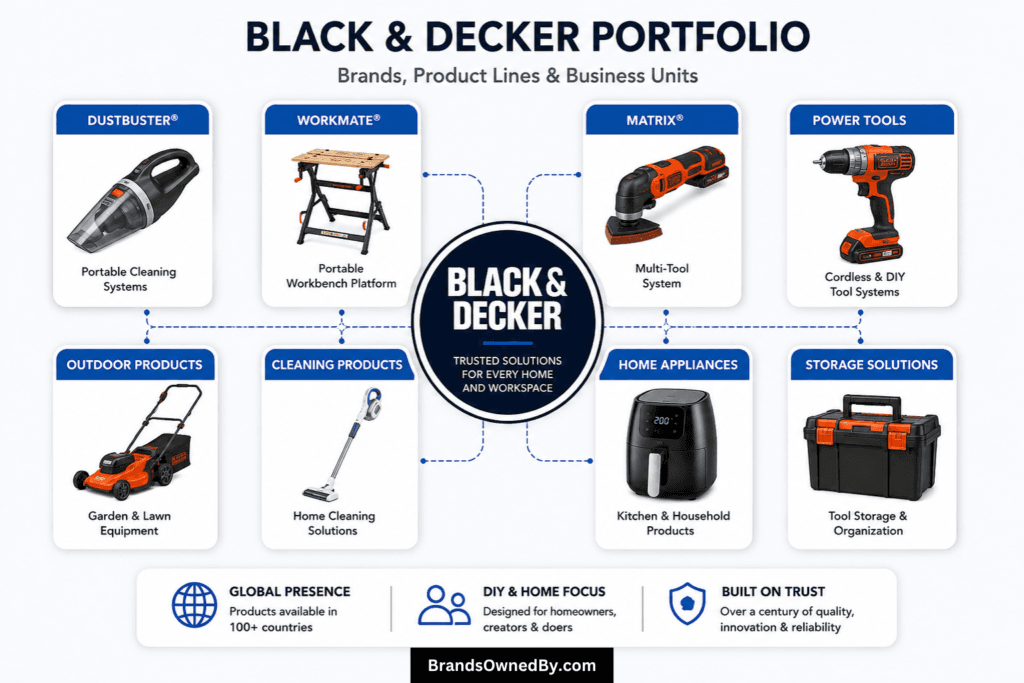
Black & Decker Portfolio Ecosystem
Major Brands, Product Lines & Business Units
Dustbuster
Portable Cleaning Systems
Workmate
Portable Workbench Platform
Matrix
Multi-Tool System
Power Tools
Cordless & DIY Tool Systems
Outdoor Products
Garden & Lawn Equipment
Cleaning Products
Home Cleaning Solutions
Home Appliances
Kitchen & Household Products
Storage Solutions
Tool Storage & Organization
Dustbuster
Dustbuster is the most recognizable sub-brand owned and operated by Black+Decker.
The brand was originally developed from technology used during the Apollo space program and eventually became one of the world’s best-known handheld vacuum product lines. Today, Dustbuster products include cordless handheld vacuums, pet-specific cleaning solutions, automotive cleaning devices, and compact home cleaning systems.
For many consumers, Dustbuster is more recognizable than the Black+Decker cleaning division itself. The product family remains a major component of the company’s home cleaning business as of 2026.
Workmate
Workmate is one of the longest-running product brands operated by Black+Decker.
The portable workbench system combines a workbench, vise, sawhorse, and clamping station into a single product. It is widely used by DIY enthusiasts, hobbyists, woodworkers, and homeowners.
The Workmate lineup continues to be sold globally and remains one of the most successful proprietary brands within the Black+Decker portfolio.
POWERCONNECT
POWERCONNECT is a proprietary battery ecosystem owned and operated by Black+Decker.
The platform allows users to operate multiple products using a single battery system. The ecosystem covers power tools, lawn equipment, outdoor products, and cleaning devices.
The strategy mirrors similar battery platforms offered by competitors and has become a central part of Black+Decker’s product development efforts.
Kitchen Wand
Kitchen Wand is one of the company’s newest proprietary product platforms.
The cordless system uses a single rechargeable power base that supports multiple kitchen attachments. These include immersion blenders, can openers, mixers, food choppers, milk frothers, and other kitchen tools.
The platform represents Black+Decker’s effort to expand beyond traditional tools and strengthen its presence in the home appliance market.
BLACK+DECKER Power Tools
The company’s power tools division remains its largest operating entity.
The division develops drills, drivers, saws, sanders, grinders, oscillating tools, and other equipment aimed primarily at homeowners and DIY users. Unlike DeWalt, which targets professionals, Black+Decker focuses on affordability, accessibility, and ease of use.
The business remains one of the most recognized consumer tool operations worldwide.
BLACK+DECKER Outdoor Products
This division manages the company’s lawn and garden equipment portfolio.
Products include string trimmers, hedge trimmers, chainsaws, leaf blowers, lawn mowers, pressure washers, and other outdoor maintenance equipment.
The business has increasingly focused on battery-powered products that integrate with the POWERCONNECT platform.
BLACK+DECKER Home Cleaning
The Home Cleaning division develops and markets cleaning products beyond the Dustbuster range.
Its portfolio includes cordless stick vacuums, steam cleaners, floor-care systems, and portable cleaning equipment designed for residential use.
The division has become one of the company’s fastest-growing consumer product categories.
BLACK+DECKER Home Appliances
Black+Decker continues to operate a substantial appliance business through brand licensing and product development partnerships.
The portfolio includes coffee makers, toaster ovens, air fryers, blenders, food processors, rice cookers, kettles, irons, and other household appliances.
These products have significantly expanded the brand’s presence outside the traditional tool industry.
BLACK+DECKER Storage and Organization
This business unit develops storage products for homeowners, garages, workshops, and DIY users.
Its product lineup includes toolboxes, storage bins, organizers, shelving systems, workstations, and utility cabinets.
The division complements the company’s broader home improvement ecosystem.
BLACK+DECKER Licensing Business
The licensing division has become one of the most important growth vehicles for the brand.
Rather than acquiring companies outright, Black+Decker increasingly expands through licensing agreements that allow third-party manufacturers to sell products under the Black+Decker name.
As of 2026, Black+Decker-branded products are available in categories such as:
- Smart televisions.
- Water purification systems.
- Consumer electronics.
- Household appliances.
- Lighting products.
- Home accessories.
- Personal care products.
- Pet products.
BLACK+DECKER Smart TVs
One of the newest Black+Decker-branded business extensions is the Smart TV category.
The televisions are manufactured and distributed through licensing arrangements while carrying the Black+Decker brand name. This expansion demonstrates the company’s strategy of leveraging its brand recognition to enter new consumer electronics markets.
Recent Acquisitions
As of June 2026, Black+Decker itself has not completed any major standalone acquisitions.
Most acquisition activity involving the broader organization occurs at the Stanley Black & Decker parent-company level. Black+Decker’s recent growth has instead focused on product innovation, licensing partnerships, category expansion, and development of proprietary platforms such as POWERCONNECT and Kitchen Wand.
Who Owns Black & Decker?
Black & Decker is not an independent publicly traded company. Since the 2010 merger between The Black & Decker Corporation and The Stanley Works, the Black & Decker brand has been wholly owned by Stanley Black & Decker, Inc.
As a result, investors do not directly own shares in Black & Decker. Instead, they own shares in Stanley Black & Decker, which controls the Black & Decker brand along with its associated products, intellectual property, manufacturing operations, and global distribution network.
Stanley Black & Decker is listed on the New York Stock Exchange under the ticker symbol SWK. Ownership is widely distributed among institutional investors, mutual funds, pension funds, asset managers, and individual shareholders. No single shareholder maintains majority control of the company. The ownership structure is heavily institutional, which is common among large industrial corporations.
It operates under a dispersed ownership model. Large asset management firms collectively own a significant portion of outstanding shares, while insiders and executives hold a relatively small percentage.
Institutional investors control the vast majority of voting power. This gives major investment firms considerable influence over board elections, executive compensation policies, capital allocation decisions, and long-term corporate strategy.
Black+Decker Ownership Structure (2026)
Black+Decker is wholly owned by Stanley Black & Decker, Inc. (NYSE: SWK)
BLACK+DECKER
Stanley Black & Decker
100% OwnerLargest Shareholders
Ownership Breakdown
The Vanguard Group
The Vanguard Group is the largest shareholder of Stanley Black & Decker as of 2026.
The investment management giant owns approximately 11.7% of the company’s outstanding shares through its various index funds, ETFs, retirement funds, and institutional investment products. Vanguard’s position makes it the single most influential shareholder in the company.
Because Vanguard manages money on behalf of millions of investors, its ownership stake is spread across numerous funds rather than being held for its own account. Nevertheless, the firm exercises substantial voting power during shareholder meetings.
Capital Research and Management Company
Capital Research and Management Company is one of the company’s largest active institutional investors.
As of 2026, the firm owns approximately 8.3% to 8.4% of Stanley Black & Decker’s outstanding shares. Capital Research is known for taking long-term investment positions in major public companies and has remained a significant shareholder in the business.
Its investment decisions often focus on long-term earnings growth, competitive advantages, and management execution.
BlackRock
BlackRock ranks among the largest shareholders of Stanley Black & Decker.
The firm controls roughly 6.6% of outstanding shares through its iShares ETFs, index funds, and institutional investment products. BlackRock’s position gives it considerable influence over corporate governance matters and shareholder votes.
As the world’s largest asset manager, BlackRock holds ownership stakes in thousands of publicly traded companies, including many of Stanley Black & Decker’s competitors.
T. Rowe Price Group
T. Rowe Price is another major institutional shareholder.
The investment management company owns approximately 6.3% to 6.4% of outstanding shares. Its ownership position reflects confidence in Stanley Black & Decker’s long-term industrial and consumer products strategy.
T. Rowe Price is known for actively managed mutual funds and long-term investment portfolios.
State Street Global Advisors
State Street Global Advisors is among the company’s largest institutional investors.
The firm owns approximately 5.7% of Stanley Black & Decker shares through its ETF and index fund products. State Street is one of the “Big Three” asset managers alongside Vanguard and BlackRock.
Collectively, these three firms represent a significant portion of the company’s shareholder base.
Geode Capital Management
Geode Capital Management maintains a substantial ownership stake in Stanley Black & Decker.
The investment firm manages assets primarily for institutional investors and retirement plans. While smaller than Vanguard or BlackRock, Geode remains one of the company’s notable shareholders and participates in shareholder voting matters.
Other Institutional Investors
In addition to the largest shareholders, Stanley Black & Decker’s ownership base includes numerous institutional investors, pension funds, insurance companies, mutual funds, and asset managers.
Notable investors include:
- Dimensional Fund Advisors.
- Ameriprise Financial.
- Wells Fargo Investment Management.
- Northern Trust.
- JPMorgan Asset Management.
- Bank of America investment funds.
Together, these institutions own a substantial percentage of the company’s outstanding shares.
Insider Ownership
Company executives, directors, and senior management also own shares in Stanley Black & Decker.
However, insider ownership remains relatively small compared to institutional ownership. This means no executive or founder family controls the company through a dominant equity position.
Instead, management’s influence primarily comes from operational leadership and board oversight rather than concentrated share ownership.
Competitor Ownership Comparison
The global power tools and home improvement industry is dominated by a handful of major manufacturers. However, these companies operate under very different ownership structures. Some are publicly traded corporations controlled by institutional investors, while others remain family-owned or foundation-controlled.
Black & Decker itself is not an independent company. It operates as a wholly owned brand of Stanley Black & Decker, making its ownership structure fundamentally different from some of its largest competitors.
Understanding who owns Black & Decker’s competitors provides insight into how these companies make strategic decisions, invest in innovation, and compete for market share.
Black+Decker Competitor Ownership Comparison (2026)
Comparing the ownership structures of major power tool and home improvement competitors.
| Brand | Parent Company | Ownership Type | Primary Controllers | Key Ownership Advantage |
|---|---|---|---|---|
| Black+Decker | Stanley Black & Decker | Public Company Brand | Vanguard, Capital Research, BlackRock, State Street | Global scale, distribution network, manufacturing resources |
| Milwaukee Tool | Techtronic Industries | Public Company Subsidiary | Pudwill Family & Institutional Investors | Strong long-term control and rapid innovation |
| Ryobi | Techtronic Industries | Public Company Subsidiary | Pudwill Family & Institutional Investors | Shared technology ecosystem with Milwaukee |
| Makita | Makita Corporation | Independent Public Company | Japanese Trust Banks & Institutional Investors | Operational independence and focused strategy |
| Bosch Power Tools | Robert Bosch GmbH | Foundation-Controlled | Robert Bosch Stiftung | Long-term innovation without market pressure |
| Snap-on | Snap-on Incorporated | Independent Public Company | Vanguard, BlackRock, State Street | Focused professional tools business |
| Hilti | Hilti Group | Private Family-Owned Company | Martin Hilti Family Trust | Stable ownership and long-term planning |
| Festool | TTS Tooltechnic Systems | Privately Held Company | Private Ownership Group | Premium niche market focus |
| DeWalt | Stanley Black & Decker | Public Company Brand | Same ownership as Black+Decker | Professional contractor market leadership |
| Craftsman | Stanley Black & Decker | Public Company Brand | Same ownership as Black+Decker | Broad retail distribution network |
Milwaukee Tool
Milwaukee Tool is one of Black & Decker’s most formidable competitors in the professional power tools market.
The company is wholly owned by Techtronic Industries (TTI), a publicly traded multinational corporation listed on the Hong Kong Stock Exchange. As of June 2026, Techtronic Industries remains heavily influenced by the Horst Julius Pudwill family, which controls a substantial ownership stake through various investment vehicles.
Unlike Black & Decker, which is owned through a dispersed institutional shareholder base, Milwaukee benefits from a more concentrated ownership structure. This gives TTI’s leadership greater control over long-term strategic decisions.
Milwaukee’s rapid expansion in cordless tools, battery technology, and professional construction equipment has made it one of the fastest-growing brands in the industry.
Ryobi
Ryobi operates under the same parent company as Milwaukee Tool.
Techtronic Industries owns the Ryobi power tools business and uses it to target homeowners, DIY enthusiasts, and value-conscious consumers. This dual-brand strategy allows TTI to compete directly against Black & Decker in the consumer segment while also competing against DeWalt through Milwaukee.
Because both Milwaukee and Ryobi are controlled by the same parent company, Techtronic Industries can leverage shared manufacturing resources, battery technologies, and supply chains to strengthen its competitive position.
Makita
Makita remains one of the few major tool manufacturers that operates as an independent public company.
The company is listed on the Tokyo Stock Exchange and has a highly diversified shareholder base. As of 2026, ownership is primarily spread among Japanese financial institutions, trust banks, pension funds, investment managers, and retail investors.
Unlike Black & Decker, Makita does not have a parent company controlling its operations. This independence gives management greater flexibility but also means the company lacks the support of a larger corporate group.
Makita’s ownership structure is often viewed as one of the most balanced among major power tool manufacturers.
Bosch Power Tools
Bosch Power Tools operates under Robert Bosch GmbH, one of the world’s largest engineering and technology companies.
Bosch has one of the most unusual ownership structures in global manufacturing. The majority of the company’s economic interests are held through the Robert Bosch Stiftung, a charitable foundation established by founder Robert Bosch.
This structure allows Bosch to prioritize long-term innovation and research investments rather than short-term shareholder returns.
Compared with Black & Decker, Bosch faces significantly less pressure from institutional investors and stock market expectations.
Snap-on
Snap-on is one of the few major competitors that remains an independent publicly traded company.
As of June 2026, ownership is widely distributed among institutional investors, including Vanguard, BlackRock, State Street, and numerous asset management firms. No single shareholder controls the company.
This ownership structure closely resembles Stanley Black & Decker’s institutional ownership model. Both companies are heavily influenced by large investment firms rather than founder families or controlling shareholders.
Snap-on focuses primarily on automotive technicians, industrial users, and professional mechanics rather than general consumers.
Hilti
Hilti is one of the most unique competitors in the industry because it remains privately controlled.
The company is owned by the Martin Hilti Family Trust, which maintains long-term control over the business. This ownership structure allows Hilti to focus on strategic growth, innovation, and customer relationships without the quarterly earnings pressure faced by publicly traded competitors.
Hilti’s family-controlled structure has remained largely unchanged for decades and is considered one of the key reasons for the company’s long-term stability.
Compared with Black & Decker, Hilti enjoys far greater ownership continuity and management independence.
Festool
Festool operates under TTS Tooltechnic Systems, a privately held German company.
Unlike Black & Decker, Festool is not accountable to public shareholders. Instead, ownership remains concentrated within private interests that prioritize long-term product development and premium market positioning.
Festool’s ownership structure supports its strategy of focusing on high-end woodworking and professional trade tools rather than competing directly in mass-market consumer categories.
DeWalt
DeWalt presents a unique case because it is owned by the same parent company as Black & Decker.
Both brands operate under Stanley Black & Decker and ultimately answer to the same executive leadership team, board of directors, and shareholders.
However, the two brands serve very different customer groups. Black & Decker focuses primarily on homeowners and DIY users, while DeWalt targets professional contractors, industrial users, and construction firms.
This ownership arrangement allows Stanley Black & Decker to capture customers across multiple market segments without relying on a single brand.
Craftsman
Like DeWalt, Craftsman is also owned by Stanley Black & Decker.
The company acquired Craftsman from Sears and has since expanded the brand across tools, outdoor equipment, storage solutions, and automotive products.
Although Craftsman competes with Black & Decker in certain product categories, both brands ultimately contribute to the same corporate parent. This enables Stanley Black & Decker to maintain a strong presence across various pricing tiers and customer demographics.
Who Has the Strongest Ownership Position?
From an ownership perspective, the industry’s major competitors fall into three distinct categories:
Public Company Ownership
Companies such as Stanley Black & Decker, Techtronic Industries, Makita, and Snap-on are publicly traded and primarily controlled by institutional investors. Their strategies must balance shareholder expectations with long-term growth objectives.
Private and Family Ownership
Hilti and Festool operate under private ownership structures. These companies benefit from greater strategic flexibility and often prioritize long-term development over short-term financial performance.
Foundation-Controlled Ownership
Bosch represents a third model. Its foundation-controlled structure is rare among global industrial companies and provides exceptional stability while supporting large-scale research and development investments.
Who Controls Black & Decker?
Although many people assume Black & Decker operates as an independent company, the reality is different. Black & Decker is a wholly owned brand within Stanley Black & Decker, Inc. As a result, control of the Black & Decker business ultimately rests with the leadership, board of directors, and major shareholders of Stanley Black & Decker.
Because the parent company is publicly traded, no single individual or family controls Black & Decker. Instead, control is shared among executives responsible for daily operations, directors responsible for governance, and institutional investors that influence major corporate decisions through their voting power.
Understanding who controls Black & Decker requires examining each layer of the company’s governance structure.
Who Controls Black+Decker? (2026)
Corporate Control Structure and Leadership Hierarchy
Stanley Black & Decker
100% Owner of Black+Decker
Board of Directors
Approves strategy, acquisitions, executive compensation and major decisions
Chief Executive Officer
Leads Stanley Black & Decker and oversees all major brands
Global Executive Team
Operations, Manufacturing, Finance, Innovation, Marketing & Supply Chain
BLACK+DECKER Leadership
Product strategy, product launches, branding and customer experience
Key Sources of Influence
Institutional Investors
Vanguard, Capital Research, BlackRock, State Street and other major funds influence governance through shareholder voting.
Board Oversight
The Board supervises management, evaluates performance and approves strategic decisions.
Executive Management
Executes corporate strategy and manages day-to-day business operations.
Stanley Black & Decker Exercises Ultimate Control
The most important fact regarding control is that Stanley Black & Decker owns 100% of the Black & Decker brand, trademarks, intellectual property, manufacturing operations, and business assets.
This means all major strategic decisions affecting Black & Decker are made at the Stanley Black & Decker corporate level.
Examples include:
- Product development strategy.
- Manufacturing investments.
- Global expansion plans.
- Marketing budgets.
- Supply chain management.
- Licensing agreements.
- Executive appointments.
- Acquisition and divestiture decisions.
Black & Decker management does not operate independently from the parent company. Instead, the brand functions as one component of Stanley Black & Decker’s broader portfolio.
Christopher Nelson Leads the Parent Company
As of 2026, Christopher Nelson serves as President and Chief Executive Officer of Stanley Black & Decker.
As CEO, Nelson is the most influential executive within the organization and ultimately oversees all major brands owned by the company, including Black & Decker.
His responsibilities include:
- Setting long-term corporate strategy.
- Managing global operations.
- Overseeing capital allocation.
- Leading transformation initiatives.
- Directing operational efficiency programs.
- Managing investor relations.
- Approving major investments.
Because Black & Decker is fully integrated into Stanley Black & Decker, Nelson’s leadership directly impacts the future direction of the brand.
The Executive Leadership Team Controls Daily Operations
While the CEO provides overall leadership, day-to-day control is distributed among senior executives responsible for different areas of the business.
These executives oversee:
- Product development.
- Global manufacturing.
- Supply chain operations.
- Marketing and brand management.
- Technology and innovation.
- Finance and accounting.
- Human resources.
- International operations.
Together, the executive team determines how resources are allocated among brands such as Black & Decker, DeWalt, Craftsman, Stanley, and other business units.
In practice, this group exerts significant influence over Black & Decker’s operational performance and competitive positioning.
The Board of Directors Oversees Corporate Governance
The Stanley Black & Decker Board of Directors represents another critical layer of control.
The board is responsible for protecting shareholder interests and ensuring management acts in accordance with the company’s long-term objectives.
Board responsibilities include:
- Hiring and evaluating the CEO.
- Approving major acquisitions.
- Approving significant divestitures.
- Reviewing capital expenditures.
- Monitoring corporate performance.
- Establishing governance policies.
- Managing executive compensation.
Although directors do not manage daily operations, they possess substantial authority over the company’s strategic direction.
Many of the most important decisions affecting Black & Decker ultimately require board approval.
Institutional Investors Influence Major Decisions
Because Stanley Black & Decker is publicly traded, institutional investors collectively hold the majority of shares.
As of 2026, the company’s largest shareholders include:
- The Vanguard Group.
- Capital Research & Management.
- BlackRock.
- T. Rowe Price.
- State Street Global Advisors.
- Geode Capital Management.
- Dimensional Fund Advisors.
These institutions do not directly manage Black & Decker’s daily operations. However, they exercise significant influence through shareholder voting rights.
Institutional investors can affect:
- Board elections.
- Executive compensation plans.
- Corporate governance policies.
- Environmental and sustainability initiatives.
- Long-term strategic priorities.
- Major merger and acquisition proposals.
Because institutional ownership exceeds 90% of outstanding shares, these investors collectively wield enormous influence over the company’s future.
No Individual Shareholder Controls Black & Decker
Unlike family-controlled businesses such as Hilti or privately held companies such as Festool, Black & Decker does not have a controlling founder, family, or individual investor.
The largest shareholder, Vanguard, owns only a minority stake in Stanley Black & Decker.
This means no single investor has the power to unilaterally direct the company.
Instead, control is distributed across:
- Executive leadership.
- The board of directors.
- Institutional shareholders.
- Corporate governance mechanisms.
This structure is commonly referred to as dispersed ownership.
Brand Management Teams Control Product Strategy
At the operational level, Black & Decker maintains dedicated management teams responsible for the brand itself.
These teams oversee:
- Product design.
- Product launches.
- Advertising campaigns.
- Customer experience.
- Retail partnerships.
- E-commerce initiatives.
- Brand positioning.
For example, decisions regarding a new BLACK+DECKER cordless drill lineup or expansion of the Dustbuster product family would typically originate within brand management teams before moving through corporate approval channels.
While these managers control tactical decisions, major strategic decisions remain under the authority of Stanley Black & Decker leadership.
Manufacturing and Supply Chain Leadership Controls Production
Control over manufacturing and supply chain operations is another important component of the company’s governance structure.
Stanley Black & Decker operates a global manufacturing and distribution network that supports Black & Decker products worldwide.
Supply chain leaders determine:
- Factory locations.
- Production capacity.
- Supplier relationships.
- Inventory management.
- Logistics operations.
- Procurement strategies.
These decisions directly impact product availability, production costs, and profitability.
Who Has the Most Control Over Black & Decker?
When examining the company’s governance structure, control can be ranked as follows:
1. Stanley Black & Decker, Inc.
The parent company owns Black & Decker outright and exercises ultimate authority over the brand.
2. Chief Executive Officer
The CEO is the most powerful individual executive within the organization and has substantial influence over strategy, operations, and resource allocation.
3. Board of Directors
The board oversees management and approves many of the company’s most important decisions.
4. Institutional Investors
Large shareholders influence governance through voting rights and shareholder engagement.
5. Black & Decker Brand Leadership
Brand executives manage day-to-day product and marketing decisions within the framework established by the parent company.
Black & Decker Annual Revenue and Net Worth
Black+Decker Revenue & Brand Value Growth (2020–2030)
Estimated historical performance and projected growth through 2030.
As of June 2026, Black+Decker remains one of the largest consumer-focused tool and home improvement brands in the world. Although the company does not publish standalone financial statements, industry estimates suggest the brand generates approximately $4.2 billion in annual revenue and possesses an estimated brand value of $5.2 billion. These figures reflect the strength of the Black+Decker name across power tools, outdoor equipment, home cleaning products, storage solutions, and household appliances.
The brand continues to benefit from its extensive global distribution network, strong retail partnerships, and more than a century of brand recognition. While Black+Decker’s financial results are consolidated within Stanley Black & Decker’s reporting structure, analysts generally regard it as one of the most valuable consumer brands within the parent company’s portfolio.
Black+Decker Revenue in 2026
Black+Decker’s estimated revenue for 2026 stands at approximately $4.2 billion.
The brand generates revenue from multiple product categories rather than relying on a single business segment. Consumer power tools remain the largest contributor, followed by outdoor equipment, home appliances, cleaning products, and storage solutions.
The widespread availability of Black+Decker products through major retailers, hardware stores, e-commerce platforms, and international distributors allows the brand to maintain a diversified revenue stream across dozens of countries.
Compared with many competitors that focus exclusively on power tools, Black+Decker benefits from a broader consumer product portfolio. This diversification helps reduce dependence on any single market segment and supports long-term revenue stability.
Revenue Breakdown by Business Segment
Based on industry estimates and product category analysis, Black+Decker’s 2026 revenue can be broadly divided across its major business segments.
| Business Segment | Estimated Revenue Contribution |
|---|---|
| Power Tools & Accessories | $1.8 billion |
| Outdoor Products | $900 million |
| Home Appliances | $700 million |
| Home Cleaning Products | $500 million |
| Storage & Organization | $300 million |
| Other Licensed Products | $100 million |
| Total Estimated Revenue | $4.2 billion |
Power tools continue to account for the largest share of overall sales. Products such as cordless drills, saws, sanders, and multi-tools remain core revenue drivers. Outdoor equipment, including trimmers, hedge cutters, chainsaws, and leaf blowers, represents another significant source of revenue as consumers increasingly adopt battery-powered landscaping solutions.
Geographic Revenue Distribution
Black+Decker’s global footprint contributes significantly to its revenue generation.
North America remains the company’s largest market, accounting for the majority of annual sales. Europe represents the second-largest region, followed by Latin America and Asia-Pacific markets.
Estimated geographic distribution of revenue in 2026 is as follows:
| Region | Estimated Revenue Share |
|---|---|
| North America | 58% |
| Europe | 21% |
| Latin America | 11% |
| Asia-Pacific | 8% |
| Middle East & Africa | 2% |
This geographic diversification provides resilience against economic slowdowns in any single market.
Black+Decker Net Worth in 2026
Because Black+Decker is not an independent public company, traditional net worth calculations based on shareholder equity are not available.
Instead, analysts often evaluate the brand using estimated brand value, which measures the economic worth of the brand name, intellectual property, customer loyalty, market position, and future earnings potential.
As of June 2026, Black+Decker’s estimated brand value is approximately $5.2 billion.
This valuation reflects several important assets:
- More than 115 years of brand history.
- Strong consumer awareness.
- Extensive intellectual property portfolio.
- Global distribution network.
- Established retailer relationships.
- Diverse product categories.
- Large installed customer base.
These factors contribute significantly to the brand’s overall economic value despite the absence of publicly reported standalone financial statements.
What Drives Black+Decker’s Brand Value?
Several factors support Black+Decker’s estimated $5.2 billion brand value.
The company’s reputation among homeowners and DIY users remains one of its strongest competitive advantages. Consumers frequently associate the brand with affordability, reliability, and accessibility.
The Black+Decker name also extends beyond traditional power tools into cleaning products, kitchen appliances, outdoor equipment, and home organization solutions. This diversification increases brand visibility and strengthens customer loyalty.
In addition, the company’s global retail presence through major home improvement chains, hardware stores, online marketplaces, and independent distributors contributes significantly to its long-term value.
Revenue and Brand Value Growth Since 2020
Black+Decker experienced substantial growth during the pandemic-driven home improvement boom. Revenue and brand value increased as consumers invested heavily in DIY projects, home maintenance, and outdoor living spaces.
While growth moderated during 2023 through 2025 as market conditions normalized, the brand maintained a strong market position and continued generating billions of dollars in annual sales.
The estimated financial progression is shown below:
| Year | Estimated Revenue | Estimated Brand Value |
|---|---|---|
| 2020 | $3.8 billion | $4.6 billion |
| 2021 | $4.2 billion | $5.2 billion |
| 2022 | $4.5 billion | $5.6 billion |
| 2023 | $4.3 billion | $5.3 billion |
| 2024 | $4.2 billion | $5.1 billion |
| 2025 | $4.1 billion | $5.0 billion |
| 2026 | $4.2 billion | $5.2 billion |
Black+Decker Revenue Forecast Through 2030
Industry analysts expect Black+Decker to benefit from continued demand for cordless tools, battery-powered outdoor equipment, smart home products, and home appliance categories. Assuming stable economic conditions and continued expansion of the brand portfolio, the following revenue projections are considered reasonable:
- 2027: Estimated revenue of $4.4 billion and brand value of $5.5 billion.
- 2028: Estimated revenue of $4.6 billion and brand value of $5.8 billion.
- 2029: Estimated revenue of $4.8 billion and brand value of $6.1 billion.
- 2030: Estimated revenue of $5.1 billion and brand value of $6.5 billion.
These projections suggest that Black+Decker could achieve revenue growth of more than 21% between 2026 and 2030 while increasing its estimated brand value by approximately 25%.
Black+Decker’s long-term outlook remains closely tied to trends in home improvement, DIY projects, battery-powered equipment, and consumer appliances. The company’s diversified product portfolio provides multiple growth opportunities while reducing dependence on any single category.
Continued investment in cordless technology, product innovation, international expansion, and licensing partnerships could further strengthen the brand’s revenue base and overall value during the remainder of the decade.
Final Words
What Companies Does Black & Decker Own is a question that reveals how much the brand has evolved beyond its original identity as a power tool manufacturer. Today, Black+Decker operates a diverse portfolio that spans power tools, outdoor equipment, home cleaning products, storage solutions, and household appliances, allowing it to reach millions of consumers across multiple product categories.
The brand’s strength lies not only in the products it sells but also in its ability to remain relevant through changing consumer trends and technological advancements. From cordless tools and battery-powered outdoor equipment to the iconic Dustbuster product line, Black+Decker continues to expand its presence in homes around the world.
As part of Stanley Black & Decker, the brand benefits from global scale, extensive distribution networks, and significant research and development resources. At the same time, it maintains its own identity as one of the most recognized names in the DIY and homeowner market.
Understanding what companies Black & Decker owns provides valuable insight into the brand’s broader business strategy and demonstrates how a century-old company continues to compete in a rapidly evolving home improvement and consumer products industry.
FAQs
What is the Black and Decker company origin?
Black & Decker was founded in 1910 in Baltimore, Maryland, by S. Duncan Black and Alonzo G. Decker. The company began as a small machine shop and became famous for developing the first portable electric drill with a pistol-grip handle and trigger switch in 1917. Over time, it expanded into power tools, home appliances, outdoor equipment, and consumer products, becoming one of the most recognized brands in the home improvement industry.
Who bought Black and Decker?
Black & Decker was acquired through a merger with Stanley Works in 2010. The transaction created Stanley Black & Decker, one of the world’s largest tool and industrial companies. Rather than disappearing, Black & Decker continued operating as one of the company’s flagship consumer brands.
Does Black & Decker own DeWalt?
No, Black & Decker does not own DeWalt. Both brands are owned by Stanley Black & Decker. DeWalt and Black & Decker operate as sister brands within the same corporate portfolio but serve different customer segments.
What are the Stanley Black & Decker subsidiaries?
Stanley Black & Decker owns and operates numerous brands and business units worldwide. Some of its best-known subsidiaries and brands include DeWalt, Craftsman, Stanley Tools, Black & Decker, Cub Cadet, Hustler Turf, Troy-Bilt, Irwin Tools, Lenox, Powers Fasteners, and Facom. The company’s portfolio spans professional tools, consumer products, outdoor equipment, industrial solutions, and security technologies.
Who owns Black & Decker?
Black & Decker is owned by Stanley Black & Decker, Inc., a publicly traded American company listed on the New York Stock Exchange. Because Stanley Black & Decker is publicly traded, ownership is distributed among institutional investors, mutual funds, pension funds, and individual shareholders.
Does Black & Decker own other brands?
Black & Decker primarily operates as a consumer brand rather than a holding company. Most products and business activities are conducted under the Black & Decker name and related product lines such as Dustbuster, Workmate, Matrix, and its outdoor equipment and appliance divisions. The broader brand portfolio is owned at the Stanley Black & Decker corporate level.
Is Black & Decker owned by Stanley?
Yes. Black & Decker is owned by Stanley Black & Decker. The ownership structure was established following the 2010 merger between Stanley Works and Black & Decker, which created the current parent company.
Does Black & Decker own DeWalt?
No. DeWalt is not owned by Black & Decker. Instead, both brands are owned by Stanley Black & Decker. DeWalt focuses on professional contractors and industrial users, while Black & Decker primarily targets homeowners and DIY consumers.
Did Black & Decker buy Craftsman?
No. Craftsman was acquired by Stanley Black & Decker from Sears Holdings in 2017. Since Black & Decker is a brand rather than an acquiring company, the acquisition was completed by the parent corporation, Stanley Black & Decker.
Is Stanley Black & Decker a Chinese company?
No. Stanley Black & Decker is not a Chinese company. It is an American multinational corporation headquartered in New Britain, Connecticut, United States. The company operates globally but remains based in the United States.
Is DeWalt and Black & Decker the same company?
DeWalt and Black & Decker are not the same brand, but they share the same parent company. Both are owned by Stanley Black & Decker. DeWalt is positioned as a premium professional tool brand, while Black & Decker focuses on consumer and DIY markets.
Is Black and Decker owned by Bosch?
No. Black & Decker is not owned by Bosch. The brand is owned by Stanley Black & Decker. Bosch Power Tools is a separate business that operates under Robert Bosch GmbH and competes directly with Black & Decker in many product categories.
Is Stanley Black & Decker an American company?
Yes. Stanley Black & Decker is an American company headquartered in New Britain, Connecticut. Its roots trace back to two historic American businesses: Stanley Works, founded in 1843, and Black & Decker, founded in 1910. Today, it operates in more than 100 countries and is one of the largest tool manufacturers in the world.