

- Wesfarmers is owned by public shareholders and has no parent company or controlling founding family.
- Its largest wholly owned operating businesses include Bunnings, Kmart, Target, Officeworks, Australian Pharmaceutical Industries, Priceline, and Wesfarmers Chemicals, Energy and Fertilizers.
- Wesfarmers also owns strategic stakes rather than full control in Flybuys, Covalent Lithium, Gresham Partners, Wespine Industries, Queensland Nitrates, Australian Gold Reagents, and BWP Trust.
- The board controls strategy, while CEO Rob Scott and the leadership team manage operations across the portfolio.
Wesfarmers is a Perth-based Australian conglomerate. Its portfolio reaches far beyond the rural business implied by its name. The group owns or controls businesses in home improvement, discount retail, office supplies, pharmacy, beauty services, industrial products, chemicals, fertilisers, energy, data, and digital memberships.
As of August 2026, Wesfarmers employs about 120,000 people. Its businesses include some of Australia’s best-known retail names. Bunnings is the largest earnings contributor. Kmart Group, Officeworks, Wesfarmers Health, and Wesfarmers Chemicals, Energy and Fertilisers add scale and diversification.
![Who Owns Wesfarmers [infographic]](https://brandsownedby.com/wp-content/uploads/2025/02/Who-Owns-Wesfarmers-infographic-683x1024.png)
Who Founded Wesfarmers?
Wesfarmers does not have a conventional sole founder. It began through collective action by Western Australian farmers and their representative organisations.
Walter Harper played a central formative role. He believed farmers should cooperate when buying supplies and marketing produce. That commercial activity needed to remain separate from political advocacy. Under his influence, The Westralian Farmers Limited was registered on June 27, 1914.
The organisation started trading from two small rooms in Howard Street, Perth. Its purpose was practical. It helped rural producers obtain merchandise, market their output, and improve their bargaining position.
From Farming Cooperative to Conglomerate
The original enterprise expanded into wool, livestock, grain, transport, insurance, fertilisers, and rural merchandise. This gave Wesfarmers experience in allocating capital across different industries long before it became a modern conglomerate.
Retail later became the economic centre of the group. Wesfarmers acquired full ownership of Bunnings in 1994. Its 2007 acquisition of Coles Group brought Kmart, Target, Officeworks, and several other businesses into the portfolio. Coles supermarkets were demerged in 2018, but Kmart, Target, and Officeworks stayed with Wesfarmers.
Ownership History
Wesfarmers’ ownership history explains why the company has no modern-day founder-owner. Control moved gradually from cooperative members to an open public shareholder base. The transition took decades rather than occurring through one sale.
1914: Cooperative Origins
The Westralian Farmers Limited was created to serve Western Australia’s rural community. Farmers were not simply customers. The cooperative model tied ownership and commercial participation to the agricultural community.
This structure shaped the company’s early priorities. Its role was to improve services, market access, and purchasing power for members. Profit mattered, but the business also existed to solve practical problems for rural producers.
1984: Wesfarmers Lists on the ASX
Wesfarmers Limited was formed as part of a major restructuring. Its shares began trading publicly in November 1984. The listing gave the company access to permanent equity capital and a broader investor base.
The cooperative did not immediately surrender control. It initially retained 60% of Wesfarmers’ ordinary shares. The remaining shares were distributed to members. This arrangement allowed Wesfarmers to enter the public market while preserving its cooperative influence.
The company’s market value at listing was about A$91 million. It had roughly 40.1 million shares and around 21,000 shareholders. That is a small base compared with the more than 480,000 shareholders associated with Wesfarmers in 2026.
2001: Open Public Ownership Replaces Cooperative Control
Further restructurings reduced the complexity created by the listed-company and cooperative relationship. In 2001, an ownership simplification plan completed Wesfarmers’ transition to an openly traded public company.
Former cooperative members became direct shareholders. The old controlling structure disappeared. From that point, ownership could move freely through ASX trading. No successor cooperative, family, or strategic parent inherited control.
2007 to 2018: Coles Reshapes the Shareholder Story
Wesfarmers acquired Coles Group in 2007 in a transaction valued at about A$20 billion. The acquisition significantly increased Wesfarmers’ scale. It also made retail the dominant part of the portfolio.
The purchase brought Coles supermarkets, Kmart, Target, Officeworks, and other operations under Wesfarmers. The company funded the transaction with a mix of cash, debt, and equity. As a result, the shareholder base broadened further.
Wesfarmers demerged Coles in November 2018. Eligible Wesfarmers shareholders received Coles shares directly. Wesfarmers initially retained 15%, then sold down that holding in stages. It disposed of its final Coles shares in 2023.
Coles is therefore not owned by Wesfarmers in August 2026. The two companies remain connected through their equal 50% interests in Flybuys, but they have separate boards, shareholders, and stock-market listings.
Current Ownership Structure
Wesfarmers now has one main class of ordinary shares. Those shares trade on the ASX. Each ordinary share generally carries one vote, subject to the company’s constitution and Australian law.
Public investors ultimately provide the equity capital. Asset managers, superannuation funds, exchange-traded funds, institutions, and individual investors all appear within the shareholder base. Custodian banks may be recorded as legal holders for underlying clients, which is why a registered-holder list does not always reveal the ultimate economic investor.
Who Owns Wesfarmers: Top Shareholders
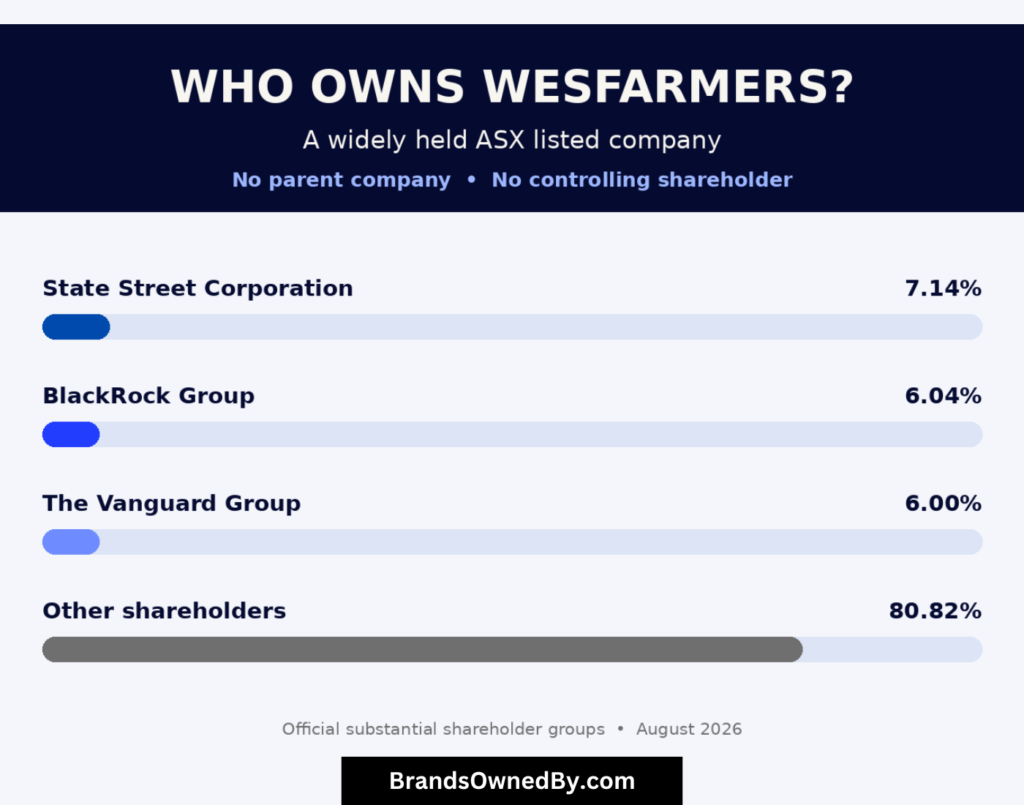
Wesfarmers is collectively owned by more than 470,000 shareholders. However, its shareholder register is not evenly distributed. Three global asset management groups hold the largest disclosed voting interests.
As of August 2026, State Street Corporation and its subsidiaries hold 7.14%. BlackRock Group holds 6.04%. The Vanguard Group holds 6.00%. These are the only investors disclosed as substantial shareholders in Wesfarmers’ latest annual report.
Together, the three groups account for 19.18% of the company’s reported voting interests. The remaining 80.82% is distributed among Australian superannuation funds, international institutions, managed funds, investment companies, employees, nominee accounts, and individual investors.
A substantial shareholding does not necessarily mean that the investment manager supplied all the capital. State Street, BlackRock, and Vanguard hold much of their Wesfarmers exposure through funds and investment mandates. The economic beneficiaries are often the individuals and institutions investing through those products.
State Street Corporation Holds 7.14%
State Street Corporation and its subsidiaries have the largest disclosed interest in Wesfarmers. The group’s 7.14% position represents approximately 81.1 million shares.
State Street’s holding is primarily associated with its investment management operations. Its funds include index products that track major Australian equity benchmarks. Because Wesfarmers is one of Australia’s largest listed companies, funds tracking these indexes must purchase Wesfarmers shares in proportion to the company’s index weighting.
The 7.14% figure is a group-level relevant interest. It can include shares held through different funds, subsidiaries, investment products, and managed portfolios. This is why some financial databases may show a much smaller position for an individual State Street entity. Those narrower figures should not replace the group level disclosure made under Australian substantial shareholder rules.
State Street can exercise meaningful voting influence. A position of this size can affect director elections, remuneration reports, capital management proposals, constitutional amendments, and other resolutions. It also gives State Street sufficient standing to engage directly with the Wesfarmers board on governance and capital allocation.
Its influence is still constrained by the size of its holding. State Street cannot pass an ordinary resolution, block a special resolution, appoint directors, or approve a takeover without support from other shareholders.
The distinction is important. State Street has substantial voting influence, but it does not direct Wesfarmers’ commercial decisions. It cannot determine Bunnings’ pricing strategy, Kmart’s product sourcing, Officeworks’ investment budget, or Wesfarmers’ acquisition policy.
BlackRock Group Holds 6.04%
BlackRock Group holds 6.04% of Wesfarmers. This represents approximately 68.6 million shares based on its disclosed position.
The holding is aggregated across BlackRock Inc. and relevant subsidiaries. It does not belong to one BlackRock fund. Wesfarmers shares can be held through index funds, exchange-traded funds, institutional mandates, retirement portfolios, and actively managed products.
BlackRock’s position reflects Wesfarmers’ importance in the Australian equity market. Funds tracking broad Australian indexes require exposure to the company. Other BlackRock portfolios may hold Wesfarmers because of its retail earnings, dividend record, balance sheet, and diversified operating portfolio.
The investors providing the underlying capital include pension funds, retirement savers, financial institutions, individual fund investors, and insurance portfolios. BlackRock manages these investments and may vote the shares, but the investment gains and losses generally belong to its clients and fund investors.
A 6.04% voting position makes BlackRock an influential governance participant. Its vote becomes particularly relevant when investors are divided over executive remuneration, board appointments, acquisitions, capital returns, environmental targets, or other strategic matters.
BlackRock can also influence Wesfarmers through direct engagement. Large institutional investors routinely discuss governance, financial discipline, risk management, executive incentives, and long term returns with company boards.
However, access and influence are not the same as managerial authority. BlackRock does not appoint Wesfarmers executives or approve divisional budgets. It also cannot require Wesfarmers to acquire, sell, or restructure a business.
The Vanguard Group Holds 6.00%
The Vanguard Group holds a disclosed 6.00% interest in Wesfarmers. That percentage is equivalent to roughly 68.1 million shares based on Wesfarmers’ issued capital.
Vanguard’s position is primarily connected to index funds and diversified investment products. These funds purchase Wesfarmers shares because the company forms part of the Australian indexes or investment universes they follow.
Some ownership databases divide the Vanguard position between entities such as Vanguard Capital Management and Vanguard Investments Australia. These entries should not simply be added together. Separate database records may cover overlapping funds, related entities, different reporting dates, or different methods of calculating investment authority.
For ownership analysis, the 6.00% group level disclosure is the stronger figure. It reflects Vanguard’s reported relevant interest under Australia’s substantial shareholder framework.
Vanguard’s investment structure also separates management authority from economic ownership. The firm manages the funds and can exercise voting rights attached to many shares. The financial return belongs primarily to investors holding units in those funds.
Its voting position gives Vanguard an important role in director elections and governance resolutions. It may also engage with Wesfarmers about board independence, executive incentives, shareholder returns, business risk, and capital allocation.
The holding does not give Vanguard authority over Wesfarmers’ operating portfolio. Vanguard cannot independently determine whether Wesfarmers expands Bunnings, invests further in lithium, restructures Target, sells an industrial business, or increases its healthcare exposure.
AustralianSuper Holds a Significant Position
AustralianSuper is reported by institutional ownership databases to manage approximately 31.9 million Wesfarmers shares. This represents about 2.81% of the company.
This position is below the 5% threshold for classification as a substantial shareholder. AustralianSuper is therefore not included alongside State Street, BlackRock, and Vanguard in Wesfarmers’ official list of substantial shareholders.
The holding is still economically significant. AustralianSuper invests retirement savings on behalf of its members. Its Wesfarmers position gives those members indirect exposure to the company’s earnings, dividends, and share price.
AustralianSuper also has meaningful voting capacity. A 2.81% position can contribute to the outcome of a close shareholder vote, particularly when combined with similar decisions by other institutional investors.
Its investment approach may differ from that of a pure index fund. A large superannuation fund can adjust its exposure based on valuation, portfolio strategy, risk, and long term return expectations. This makes AustralianSuper a relevant capital allocation signal, even though its position does not approach control.
Norges Bank Investment Management Holds a Smaller Institutional Stake
Norges Bank Investment Management is reported to manage approximately 19.4 million Wesfarmers shares. This equals about 1.71% of the company.
The organisation manages Norway’s Government Pension Fund Global. Its Wesfarmers position forms part of a much larger international equity portfolio.
Norges Bank Investment Management is a long-duration investor. Its interest is not connected to operating Wesfarmers or acquiring its businesses. The stake gives the fund exposure to Australian retail, industrial, healthcare, chemical, and lithium operations through one listed investment.
The organisation can vote its shares and engage with Wesfarmers on governance matters. Its 1.71% position is meaningful in financial terms but limited in voting power. It cannot determine the outcome of shareholder resolutions independently.
Other Institutional Shareholders
The majority of Wesfarmers shares are held outside the three disclosed substantial shareholder groups. This includes Australian superannuation funds, international pension funds, sovereign investors, index funds, active investment managers, listed investment companies, insurers, and wealth management platforms.
Many of these positions are individually below 5%. As a result, Wesfarmers does not have to list each investor as a substantial shareholder.
Subthreshold holdings can still carry considerable value. A 1% position in Wesfarmers represents more than 11 million shares. At a share price of A$80, that position would be worth more than A$900 million.
Institutional investors can also become influential without crossing the 5% threshold. If several institutions oppose a remuneration report, director appointment, or capital proposal, their combined votes can alter the result. This does not mean they act as one ownership group. Each investor applies its own mandates, governance policies, and portfolio objectives.
Individual and Employee Shareholders
Individual investors form an important part of Wesfarmers’ ownership base. Some hold shares directly through brokerage accounts. Others receive exposure through superannuation funds, managed investments, or dividend reinvestment.
Employees and senior executives may also hold Wesfarmers shares. Executive interests are often connected to incentive arrangements that link part of management compensation to shareholder returns and long term performance.
Individual holdings are usually small when measured separately. Collectively, however, retail shareholders represent a meaningful voting constituency. They can vote on director appointments, remuneration reports, capital returns, and other resolutions.
Retail shareholders also have a direct economic interest in Wesfarmers’ dividend policy. The company’s fully franked dividends have historically made it attractive to Australian investors seeking income and franking credits.
Registered Shareholders and Beneficial Owners
The names appearing on Wesfarmers’ share register do not always identify the investors bearing the economic risk.
Large custodian and nominee companies may appear among the biggest registered holders. These businesses hold shares on behalf of clients. A custodian can legally hold hundreds of millions of shares while having no independent economic claim on the underlying investment.
For example, a nominee company may hold Wesfarmers shares for superannuation funds, international asset managers, pension plans, and individual investment accounts. The nominee handles settlement and administration. The underlying clients receive the investment returns.
This is why registered ownership, beneficial ownership, and relevant interests must be treated separately.
The registered holder is the entity whose name appears on the company’s register. The beneficial owner receives the economic benefits and bears the investment risk. A relevant interest can include shares that an investment group has the authority to control or vote, even when the capital belongs to clients.
Failing to distinguish these categories can create misleading ownership claims. A large custodian should not be described as owning Wesfarmers for its own account unless evidence supports that conclusion.
Why Commercial Databases Show Different Percentages
Shareholder databases frequently report different figures for Wesfarmers because they use different ownership definitions.
One database may report holdings at the parent group level. Another may separate investment subsidiaries. A third may list individual mutual funds rather than the asset manager controlling them. Reporting dates can also differ.
This is especially relevant to Vanguard. Separate database entries for Vanguard Capital Management and Vanguard Investments Australia may appear to represent independent positions. In practice, both fall within the broader Vanguard organisation, and some reported interests may overlap.
State Street figures can create a similar issue. A database may show the shares attributed to one investment management entity while Wesfarmers’ substantial shareholder disclosure aggregates relevant interests across State Street Corporation and its subsidiaries.
The official group level disclosures are therefore the appropriate starting point. Fund level information can add detail, but it should not be used to inflate the total ownership percentage.
What the Shareholder Percentages Mean in Practice
Wesfarmers ordinary shares generally carry one vote per share. Ordinary resolutions normally require more than 50% of votes cast. Special resolutions generally require at least 75%.
State Street’s 7.14%, BlackRock’s 6.04%, and Vanguard’s 6.00% positions are well below both thresholds. None can pass an ordinary resolution or block a special resolution independently.
Even their combined reported interests of 19.18% would not be sufficient to block a special resolution. More importantly, the three groups are separate investors. Their holdings should not be combined for control purposes unless there is evidence that they are acting together.
Australia’s substantial shareholder rules require an investor to disclose a relevant interest of 5% or more. Further disclosure is generally required when the reported interest changes by at least one percentage point. This explains why State Street, BlackRock, and Vanguard appear in Wesfarmers’ official substantial shareholder information while smaller institutions do not.
The ownership register therefore gives Wesfarmers a broad accountability structure. Large institutions can challenge the board and influence close votes. Smaller institutions and retail investors remain important collectively. No individual investor can dictate the outcome without building wider shareholder support.
Competitor Ownership Comparison
Wesfarmers competes across several industries, so no single company matches its entire portfolio. Woolworths and Coles compete for retail spending and loyalty data. JB Hi-Fi and Harvey Norman compete with parts of Officeworks and Bunnings. Metcash competes through hardware and wholesale distribution.
Ownership affects how these companies allocate capital. Widely held companies answer mainly to institutional and retail investors. Founder-influenced companies can make decisions with a more concentrated voting base.
Woolworths Group
Woolworths is an ASX-listed public company with no parent or controlling family. Its ownership is dispersed, much like Wesfarmers. Reported manager-level positions include State Street at 8.19%, BlackRock at 6.63%, AustralianSuper at 4.98%, and Vanguard Capital at about 3.00%.
The main difference is portfolio focus. Woolworths is concentrated in supermarkets and adjacent retail operations. Wesfarmers is more diversified and does not own a major supermarket chain. It balances consumer retail with chemicals, fertilisers, industrial supply, health, and lithium.
Coles Group
Coles became an independently listed company after its 2018 demerger from Wesfarmers. It is now owned by its own public shareholders. State Street is reported at 7.25%, BlackRock at 6.22%, Vanguard Capital at 2.99%, and Vanguard Investments Australia at 2.79%.
Neither Wesfarmers nor Coles controls the other. Their important remaining connection is Flybuys, which they own equally. That joint venture requires shared governance even though the parent companies compete for consumer spending.
JB Hi-Fi
JB Hi-Fi is also publicly listed and widely held. AustralianSuper is reported as its largest manager-level holder at 14.59%. State Street holds about 6.99%, BlackRock 6.03%, and two Vanguard entities hold close to 3% each.
This register is more concentrated at the top than Wesfarmers’ register because AustralianSuper has a larger single position. However, JB Hi-Fi still has no controlling shareholder. Strategically, it is more specialised. It focuses on consumer electronics, appliances, and related retail through JB Hi-Fi and The Good Guys.
Harvey Norman Holdings
Harvey Norman has the clearest ownership contrast. Executive chairman Gerry Harvey holds about 33% of the company. The estate of co-founder Ian Norman is reported with a further 16.49%. Other Harvey family-linked holdings also appear among major shareholders.
This creates meaningful founder and legacy-owner influence. Wesfarmers has no equivalent block. Harvey Norman’s ownership can support continuity and long-term decision-making, but it also concentrates voting influence. Wesfarmers relies more heavily on independent board governance and broad institutional support.
Metcash
Metcash is a publicly traded wholesaler and retail network operator. Its ownership is spread among institutions and public investors. No founder or parent company controls it.
Metcash competes with Bunnings through its Independent Hardware Group, which supports banners such as Mitre 10, Home Hardware, and Total Tools. The model differs from Wesfarmers. Bunnings is directly controlled within the Wesfarmers group, while Metcash often supplies and supports independently owned retailers.
Who Controls Wesfarmers?
No shareholder controls Wesfarmers alone. Corporate control is divided among shareholders, the board, and executive management. Each group has a different role.
Shareholders Control Fundamental Voting Rights
Shareholders elect directors and vote on matters reserved for them. These can include changes to the constitution, certain capital transactions, director elections, and remuneration-report resolutions.
Large institutions matter because they hold substantial voting blocks. However, they do not manage stores, set merchandise prices, or approve routine investments. Their influence is exercised mainly through voting and engagement.
The Board Holds Ultimate Strategic Control
The Wesfarmers board approves group strategy, business plans, major policies, risk appetite, capital management, and significant acquisitions or divestments. It also appoints and can remove the group managing director.
Michael Chaney is chairman in August 2026. Ken MacKenzie joined the board in June 2026 as chairman-elect. He is scheduled to succeed Chaney after the 2026 annual general meeting. Until that transition occurs, Chaney remains the board leader.
The chairman is a non-executive role. The position guides the board rather than running daily operations. Wesfarmers also requires a majority of independent non-executive directors, which reduces the risk of executive dominance.
Rob Scott Controls Day-to-Day Execution
Rob Scott has served as managing director and chief executive officer since November 2017. The board delegates day-to-day authority to him, subject to defined limits.
Scott is supported by chief financial officer Anthony Gianotti and divisional leaders. Those executives control pricing, operating investment, staffing priorities, supply-chain execution, and portfolio recommendations within approved budgets and delegations.
Practical control is therefore layered. For example, Bunnings management can propose a new fulfilment centre. Group management tests the economics and funding. The board approves the project if it exceeds delegated thresholds. Shareholders do not vote on that individual facility.
Divisional Autonomy Has Clear Limits
Wesfarmers uses a decentralised operating model. Bunnings, Kmart Group, Officeworks, Health, and WesCEF have dedicated management teams. They can respond to their own customers and competitors without waiting for central approval on every decision.
Group control remains strong in capital allocation, governance, leadership appointments, risk, and performance expectations. A division may control execution, but Wesfarmers controls whether capital stays in that division, moves elsewhere, or is returned to shareholders.
Wesfarmers Annual Revenue and Net Worth
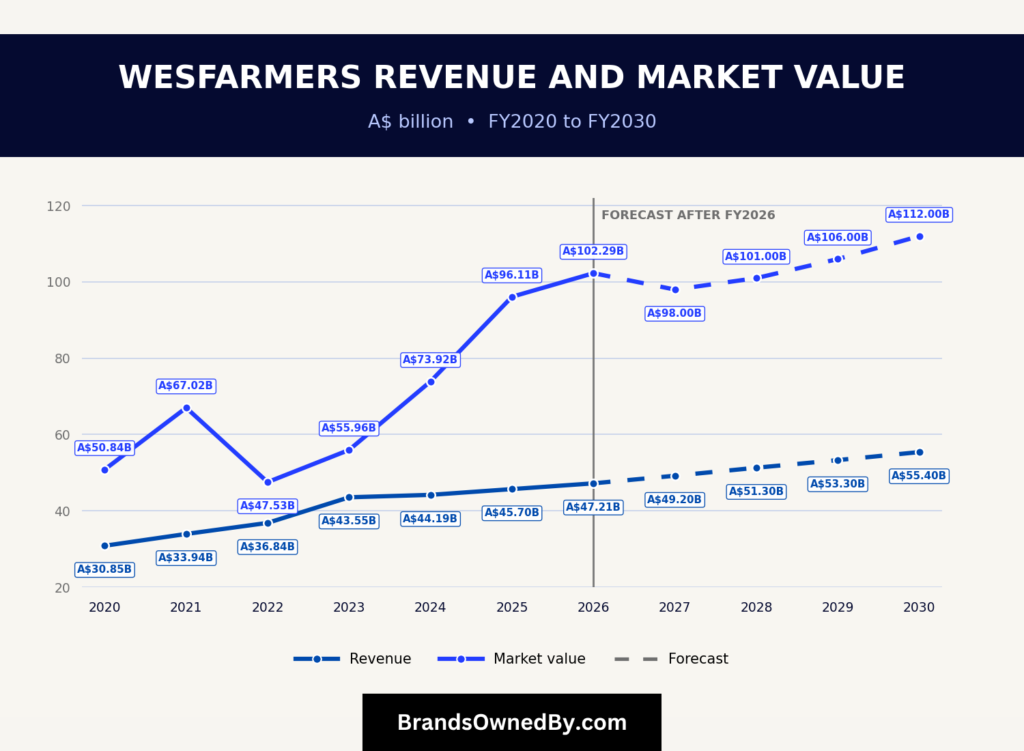
All figures are in Australian dollars. FY2020 through FY2025 revenue values are reported results. FY2026 revenue is an estimate because Wesfarmers will not release its full-year result until August 27, 2026. The 2026 market value is an August 7 snapshot. Later values are scenario-based forecasts.
2026 Revenue
Wesfarmers reported A$24.21 billion of revenue for the six months ended December 31, 2025. That was 3.1% above the prior corresponding period. The second half is normally smaller than the first because the December half includes important holiday trading.
Market consensus in early August places FY2026 revenue near A$47.21 billion. That implies growth of about 3.3% from FY2025. It is also consistent with a second-half revenue estimate of approximately A$23.0 billion.
The estimate is grounded in reported trading rather than a straight-line annualisation. Bunnings, Kmart, and Officeworks all recorded first-half sales growth. Health grew faster. The closure of Catch and the sale of Coregas reduce reported revenue, which partly offsets organic growth.
Revenue Bifurcation by Business
The first half of FY2026 provides the most current reliable divisional mix. Bunnings generated A$10.71 billion, or 44.2% of group revenue. Kmart Group contributed A$6.31 billion, equal to 26.0%.
Wesfarmers Health generated A$3.28 billion, or 13.5%. Officeworks contributed A$1.84 billion, or 7.6%. WesCEF delivered A$1.17 billion, equal to 4.8%. Industrial and Safety contributed A$869 million, or 3.6%. Other items made up the small balance.
This means Bunnings and Kmart Group produced more than 70% of first-half revenue. They also generated most divisional earnings. Bunnings earned A$1.39 billion before tax, excluding its net property contribution. Kmart Group earned A$683 million.
Health is large in revenue but currently thinner in margin. It generated A$38 million of first-half earnings on A$3.28 billion of revenue. Wholesale pharmaceutical distribution naturally carries lower margins than high-return retail formats. The opportunity is to improve the mix through owned retail, digital health, loyalty, and clinic services.
Officeworks shows why revenue alone is not enough. Sales rose 4.7% to A$1.84 billion, but earnings fell 21.8% to A$68 million. Higher operating costs, competitive pricing, and investment can weaken profit even when sales are growing.
Market Value
Wesfarmers had a market capitalization of approximately A$102.29 billion on August 7, 2026. The calculation reflects about 1.14 billion shares and a share price close to A$90.10.
That value is set by investors, not by the board. It can change daily without any change in revenue. Interest rates, expected earnings, market sentiment, and the valuation assigned to Bunnings and Kmart all affect the share price.
The market is valuing Wesfarmers at a substantial premium to its accounting book value. Investors are paying for the earning power of its brands, store networks, procurement scale, customer data, and capital-allocation record. That premium also creates risk. A strong company can still deliver a weak share-price return if its valuation multiple falls.
Revenue Forecast Through FY2030
The base-case forecast assumes revenue grows from A$47.21 billion in FY2026 to A$55.40 billion in FY2030. That represents compound annual growth of about 4.1%.
Bunnings should remain the main contributor. Population growth, repairs, maintenance, commercial customers, digital sales, and expansion into adjacent product categories support moderate growth. The forecast does not assume a housing boom.
Kmart Group can grow through higher store productivity, Anko product development, digital fulfilment, and selective international expansion. Low-price positioning is helpful when household budgets are tight. It can also limit gross-margin upside if competition intensifies.
Health has the strongest potential to outgrow the group. Wholesale volume, Priceline’s network, pharmacy services, InstantScripts, and MediAesthetics provide several growth paths. Integration and margin execution remain the key tests.
WesCEF and lithium introduce more volatility. Higher volumes from Mt Holland and the Kwinana refinery can add revenue. Lithium pricing can move sharply, so the forecast assumes gradual contribution rather than a commodity-price windfall.
Market Value Forecast Through 2030
The market-value path is deliberately more conservative than the revenue path. The scenario falls to A$98.00 billion in FY2027 before recovering to A$112.00 billion in FY2030.
That pattern reflects valuation risk. Wesfarmers traded at a high earnings multiple in August 2026, while the consensus analyst price target sat below the market price. Even if profit rises, the share price can stall if investors pay a lower multiple for each dollar of earnings.
The later recovery assumes earnings grow faster than revenue. Productivity, retail media, supply-chain automation, and a better Health mix can support that outcome. It also assumes no severe recession, major acquisition failure, or prolonged collapse in lithium economics.
This is a reasoned scenario, not a price target. Market capitalization cannot be forecast with the same confidence as store sales. A change in interest rates or investor risk appetite could produce a result well above or below the table.
Companies and Brands Owned by Wesfarmers
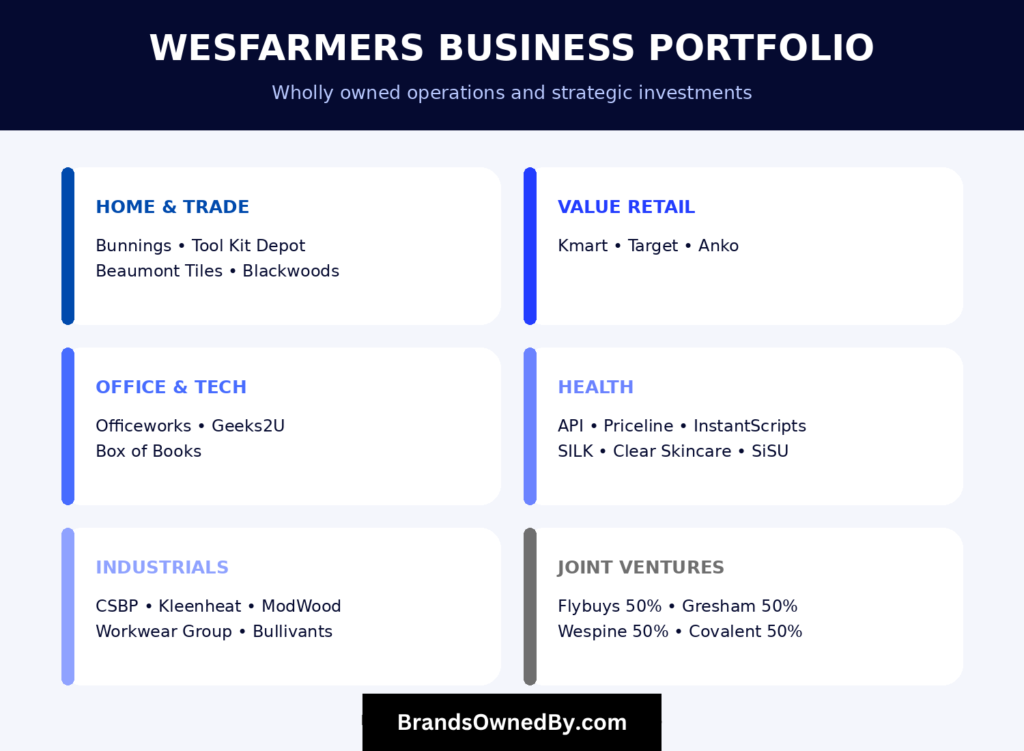
Wesfarmers’ portfolio contains wholly owned subsidiaries, controlled businesses, joint ventures, and minority investments. Those categories are not interchangeable. A 100% subsidiary is consolidated and controlled. A 50% venture requires shared control. A listed stake gives Wesfarmers economic exposure without full authority.
The list below focuses on material operating brands and investments active in August 2026. Catch is not included as an active retailer because it stopped trading as a standalone business on April 30, 2025. Coregas is also excluded because its sale completed on July 1, 2025.
Bunnings
Wesfarmers owns Bunnings Group. It is the group’s largest business and the leading home-improvement retailer in Australia and New Zealand.
Bunnings serves consumers, tradespeople, builders, and organisations through warehouse stores, smaller stores, trade centres, specialist outlets, and digital channels. Its scale, property network, supplier relationships, and high return on capital make it the portfolio’s core asset.
Tool Kit Depot
Tool Kit Depot is owned within Bunnings Group. It developed from Adelaide Tools, which Bunnings acquired to create a specialist tools, equipment, servicing, and workwear offer.
The format targets trade customers and serious DIY buyers. It gives Bunnings a more specialised channel than a standard warehouse department.
Beaumont Tiles
Beaumont Tiles is controlled by Bunnings Group. It operates showrooms, trade centres, studios, and clearance formats across Australia.
The business adds specialist knowledge in tiles, bathroomware, tools, and accessories. It also gives Bunnings exposure to renovation projects that benefit from design support and installation-related expertise.
Blackwoods
Blackwoods is a wholly controlled industrial-supply business. It sells tools, safety equipment, fasteners, abrasives, welding products, apparel, footwear, and inventory solutions.
Wesfarmers moved Blackwoods under Bunnings Group’s oversight as part of its portfolio simplification. The logic is strong. Both businesses serve trade and commercial customers, but Blackwoods handles more specialised industrial requirements.
NZ Safety Blackwoods
NZ Safety Blackwoods serves New Zealand customers with safety, uniforms, engineering supplies, and packaging. It combines several legacy operations in one industrial distribution platform.
The business extends the group’s trade exposure beyond Australia. It also complements Bunnings’ New Zealand presence without using the same retail format.
Workwear Group
Workwear Group is owned by Wesfarmers. It designs, supplies, and manages workwear programs for small businesses and multinational organisations.
Its portfolio includes KingGee, Hard Yakka, Stubbies, Bates, Wolverine, Totally Workwear, NNT, and Incorporate Wear. The business combines owned labels with uniform-program services and international distribution.
Bullivants
Bullivants is a specialist industrial business within Wesfarmers. It supplies lifting, rigging, and height-safety products and services.
Its value lies in technical capability and compliance support rather than mass retail. Customers use Bullivants for safety-critical equipment, inspections, and related services.
Cm3
Cm3 provides contractor risk and compliance software. Its platform supports contractor prequalification, site access, inductions, and modern-slavery processes.
The business adds a recurring digital-services element to Wesfarmers’ industrial offer. It also gives customers access to a marketplace of registered contractors.
Kmart
Kmart is wholly owned through Kmart Group. It operates more than 320 stores across Australia and New Zealand and is one of the group’s most important profit engines.
Its model centres on low prices, high-volume categories, and direct product development. Kmart’s control of product design and sourcing through Anko helps it differentiate from retailers that resell more third-party brands.
Target Australia
Target is owned through Kmart Group. It operates as an apparel and soft-home retailer, with a smaller store network than Kmart.
Target Australia is separate from Target Corporation in the United States. Wesfarmers does not own the American retailer. The shared name does not create common ownership.
Anko
Anko is Kmart Group’s owned product brand and international growth platform. It appears across Kmart categories and supports a high level of exclusive merchandise.
Kmart Group is also testing Anko outside its traditional Australia and New Zealand footprint. This gives Wesfarmers a potential capital-light growth route through stores, wholesale arrangements, or partnerships.
Officeworks
Officeworks is wholly owned by Wesfarmers. It sells technology, stationery, furniture, art materials, education products, and print services through stores, online channels, and business accounts.
Its online penetration is much higher than that of the group’s other major retailers. That creates convenience and range advantages, but it also exposes the business to transparent online pricing and fulfilment costs.
Geeks2U
Geeks2U is owned within Officeworks. It provides on-site computer repairs and technology support for homes and businesses.
The service adds expertise to Officeworks’ product offer. A customer can buy hardware from Officeworks and obtain installation, troubleshooting, networking, security, or backup support through Geeks2U.
Box of Books
Officeworks owns Box of Books, a digital education textbook platform. The service supports schools, educators, students, and families.
It extends Officeworks from physical educational supplies into digital content distribution. The platform can also deepen relationships with school and institutional customers.
Australian Pharmaceutical Industries
Wesfarmers owns Australian Pharmaceutical Industries, commonly called API. The A$740 million acquisition completed in March 2022 and became the foundation of Wesfarmers Health.
API distributes medicines and health products to more than 2,500 pharmacies. It also supports pharmacy banners and member programs. Wholesale scale gives Wesfarmers a national platform, although the activity earns lower margins than its largest retail chains.
Priceline and Priceline Pharmacy
Priceline is controlled by Wesfarmers Health. The network includes company-owned Priceline stores and franchised Priceline Pharmacy locations operated with community pharmacists.
The franchise structure matters. Wesfarmers owns the brand and system, but it does not directly own every pharmacy shop. The group benefits from merchandise, brand, loyalty, and wholesale relationships across the network.
Pharmacy 4 Less and Your Chemist Shop
Wesfarmers Health acquired the Pharmacy 4 Less group in 2025 after the operator entered voluntary administration. The network includes Pharmacy 4 Less and Your Chemist Shop banners.
The acquisition expanded API’s banner network and wholesale reach. It also created integration opportunities across procurement, distribution, digital health, and loyalty.
Clear Skincare
Clear Skincare is owned by Wesfarmers Health. It provides skin treatments, acne services, cosmetic injecting, laser hair removal, and skincare products.
The business sits within the MediAesthetics platform. It gives Wesfarmers exposure to discretionary health and beauty services rather than relying only on pharmacy retail and wholesale distribution.
SILK Group
Wesfarmers Health controls the SILK Group. Its network includes wholly owned, joint-venture, and franchised clinics in Australia and New Zealand.
The platform includes SILK Laser Clinics, Australian Skin Clinics, The Cosmetic Clinic, and Eden Laser Clinics. It offers cosmetic injecting, laser hair removal, skin services, body treatments, and proprietary products.
Soul Pattinson Chemist
Soul Pattinson Chemist is an API pharmacy banner. It operates through independently owned community pharmacies using the banner, supply, and support system.
Wesfarmers owns the brand platform rather than every underlying pharmacy. This distinction is similar to Priceline Pharmacy’s franchise model.
Pharmacist Advice
Pharmacist Advice is another API banner. It focuses on smaller community pharmacies and medicine counselling.
The format targets customers who value direct professional advice. It broadens API’s proposition beyond large health-and-beauty pharmacy formats.
Club Premium
Club Premium is API’s membership program for independent pharmacies. It provides retail programs, services, and business tools.
The platform can improve customer retention on the wholesale side. A pharmacy that uses API’s support services may be more likely to maintain its distribution relationship.
InstantScripts
Wesfarmers Health owns InstantScripts. The telehealth platform provides online consultations, prescriptions, medical certificates, and pathology requests through registered doctors.
The acquisition connects digital care with Wesfarmers’ pharmacy assets. A customer journey can start with a consultation and continue through prescription fulfilment and ongoing health services.
SiSU Health
SiSU Health operates self-service health stations that measure indicators such as blood pressure, body composition, and diabetes risk.
Wesfarmers Health uses the platform to support preventive-health engagement. The stations can create a bridge between physical retail locations, screening, and further care.
CSBP
CSBP is the central operating platform within Wesfarmers Chemicals, Energy and Fertilisers. It produces ammonia, ammonium nitrate, industrial chemicals, and fertilisers.
Its customers include miners, industrial users, and Western Australian farmers. CSBP links Wesfarmers back to its agricultural origins, although the modern business is a capital-intensive manufacturer rather than a rural cooperative.
Australian Vinyls and ModWood
Australian Vinyls supplies polyvinyl chloride resin used in construction and industrial products. Its subsidiary ModWood manufactures wood-plastic composite decking, screens, and related materials.
ModWood uses recycled wood and plastic inputs. It gives the group a differentiated product platform connected to construction and outdoor living.
Kleenheat
Kleenheat is a Wesfarmers energy business in Western Australia. It retails natural gas to homes and businesses and supplies electricity to commercial customers.
Wesfarmers sold its LPG and LNG distribution operations, but retained the natural-gas retail activity. Readers should not assume every historical Kleenheat-related operation remains in the portfolio.
Australian Gold Reagents (75%)
Wesfarmers owns 75% of Australian Gold Reagents through WesCEF. Coogee Chemicals owns the remaining interest.
The company manufactures sodium cyanide for gold extraction. Wesfarmers controls the venture because its 75% holding exceeds the shared partner’s stake.
Queensland Nitrates (50%)
CSBP holds a 50% interest in Queensland Nitrates. The venture operates an integrated ammonia and ammonium-nitrate facility near Moura, Queensland.
This is a jointly controlled asset rather than a wholly owned subsidiary. Major decisions require governance arrangements with the other owner.
Covalent Lithium (50%)
Wesfarmers owns 50% of Covalent Lithium. Its partner is SQM, a major global lithium producer.
Covalent manages the integrated Mt Holland project in Western Australia. The project combines a mine and concentrator with a lithium hydroxide refinery. It gives Wesfarmers exposure to battery materials, but commodity pricing and ramp-up execution create higher risk than its mature retail businesses.
OneData
OneData manages Wesfarmers’ shared customer-data asset. It contains around 12 million customer records.
The platform supports personalisation, measurement, and cross-shopping insights across group businesses. Privacy, consent, security, and data governance are central to its value.
OnePass
OnePass is Wesfarmers’ retail membership program. It connects benefits across brands such as Bunnings, Kmart, Target, Officeworks, Priceline Pharmacy, InstantScripts, and Flybuys.
The program helps Wesfarmers compete for household attention across categories. Its strategic value is greater than subscription revenue alone because it can increase frequency, retention, and cross-brand engagement.
OneReach
OneReach is the group’s retail-media network. It uses Wesfarmers’ digital channels, store networks, audiences, and data capabilities to connect advertisers with customers.
Retail media can create high-margin revenue without requiring a proportional increase in merchandise sales. Its success depends on measurement quality and responsible use of customer data.
Flybuys (50%)
Wesfarmers owns 50% of Flybuys. Coles Group owns the other 50%.
Flybuys is an independent loyalty and data company. It had 10.3 million active members in the first half of FY2026. Neither shareholder can control the joint venture unilaterally.
BWP Trust (23.5%)
Wesfarmers owns approximately 23.5% of ASX-listed BWP Trust. The holding increased after BWP acquired BWP Management Limited from Wesfarmers in August 2025.
BWP owns a portfolio of large-format retail properties, many leased to Bunnings. Wesfarmers is therefore a significant investor and commercial tenant, but it does not own or control BWP Trust outright.
Gresham Partners (50%)
Wesfarmers owns 50% of Gresham Partners Group. Gresham operates in corporate advisory, funds management, property, and capital solutions.
The investment gives Wesfarmers exposure to specialist financial services. It is governed as a joint interest rather than a wholly controlled operating division.
Wespine Industries (50%)
Wesfarmers owns 50% of Wespine Industries. Wespine operates a plantation softwood sawmill in Dardanup, Western Australia.
The business supplies structural timber for construction, landscaping, and packaging. Its Staxa operation also supports imported timber distribution.
Final Thoughts
Wesfarmers belongs to its public shareholders. Large institutions manage notable positions, but no parent company, family, or government holds control. The board sets strategy. Rob Scott and the leadership team execute it through a decentralised operating model.
The more useful question is not simply who owns Wesfarmers. It is what those shareholders own through the group. Their exposure is led by Bunnings and Kmart, then broadened by Officeworks, pharmacy and health, industrial supply, chemicals, fertilisers, data platforms, and strategic joint ventures.
That portfolio creates resilience, but it also makes capital allocation the key management test. Wesfarmers must keep investing behind high-return businesses, improve newer platforms, and exit assets when expected returns no longer justify ownership.
FAQs
Who is the actual owner of Wesfarmers?
Wesfarmers is owned collectively by public shareholders who hold WES shares on the Australian Securities Exchange. It has no single actual owner with a controlling stake.
Is Wesfarmers privately owned?
No. Wesfarmers Limited is a public company listed on the ASX under the ticker WES.
What is Wesfarmers’ parent company?
Wesfarmers has no parent company. It is the listed parent at the top of the Wesfarmers group.
Is Wesfarmers still owned by farmers?
Not through a controlling cooperative structure. Wesfarmers began as a farmers’ cooperative, but completed its transition to open public ownership in 2001. Farmers can own shares on the same basis as other investors.
Does BlackRock own Wesfarmers?
BlackRock manages an estimated 6.04% position in Wesfarmers through funds and client portfolios. It is a major shareholder, not the sole owner or parent company.
Does Vanguard own Wesfarmers?
Vanguard-affiliated managers are reported with combined positions close to 5.92%, split across separate entities. Vanguard does not control Wesfarmers.
Does Wesfarmers own Bunnings?
Yes. Bunnings Group is owned and controlled by Wesfarmers. It is the group’s largest business.
Does Wesfarmers own Kmart and Target?
Yes. Wesfarmers owns both Kmart Australia and Target Australia through Kmart Group. It does not own Kmart in the United States or Target Corporation in the United States.
Does Wesfarmers own Officeworks?
Yes. Officeworks is wholly owned by Wesfarmers. Officeworks also owns Geeks2U and Box of Books.
Does Wesfarmers own Priceline?
Wesfarmers controls Priceline and Priceline Pharmacy through Wesfarmers Health and API. Many Priceline Pharmacy outlets are operated by franchise pharmacist partners rather than being directly owned stores.
Does Wesfarmers own Coles?
No. Coles was demerged from Wesfarmers in 2018. Wesfarmers sold its remaining Coles shareholding in 2023. The companies each own 50% of Flybuys.
What percentage of Flybuys does Wesfarmers own?
Wesfarmers owns 50% of Flybuys. Coles Group owns the other 50%.
Who is the CEO of Wesfarmers?
Rob Scott is the managing director and chief executive officer. He has held the role since November 2017.
Who is the chairman of Wesfarmers?
Michael Chaney is chairman in August 2026. Ken MacKenzie is chairman-elect and is scheduled to succeed him after Wesfarmers’ 2026 annual general meeting.
How many shareholders does Wesfarmers have?
Wesfarmers reports a shareholder base of more than 480,000 investors.
What is Wesfarmers worth?
Wesfarmers had an equity-market value of approximately A$102.29 billion on August 7, 2026. Market value changes with the WES share price.