
- Burt’s Bees is wholly owned by The Clorox Company as of 2026. Clorox acquired the natural skincare brand in 2007 for approximately $925 million after Burt’s Bees had already become one of America’s fastest-growing natural personal care companies.
- Its ownership is tied directly to Clorox shareholders, with Vanguard Group, BlackRock, and State Street Global Advisors collectively controlling a major portion of the parent company’s outstanding shares.
- It operates under Clorox’s Care & Connection segment, where Burt’s Bees functions as a dedicated natural personal care business focused on lip care, skincare, baby products, body care, and clean beauty categories sold across major global retail chains.
- Burt’s Bees maintains separate brand management, marketing, and product innovation teams inside Clorox, allowing the company to preserve its natural skincare identity, sustainability-focused branding, and beeswax-centered product positioning even under multinational corporate ownership.
Burt’s Bees is an American natural personal care brand specializing in skincare, lip care, baby products, and body care solutions. The company became widely known for using beeswax and naturally derived ingredients in everyday consumer products.
The brand focuses heavily on ingredient transparency and environmentally conscious product development. Its products are commonly marketed as alternatives to traditional chemical-heavy skincare brands.
Burt’s Bees sells products across multiple categories, including:
- Lip balms.
- Facial cleansers.
- Moisturizers.
- Baby shampoos.
- Hand creams.
- Natural cosmetics.
The company built its reputation around simple formulations and recognizable ingredients such as beeswax, honey, shea butter, aloe vera, and coconut oil.
One of the biggest strengths of Burt’s Bees is its brand identity. The packaging, product naming, and marketing strategy maintain a rustic and natural image. This helps the company stand out in a crowded skincare market.
Burt’s Bees products are sold through:
- Supermarkets.
- Pharmacies.
- Beauty retailers.
- Online marketplaces.
- Direct e-commerce platforms.
The brand is especially strong in the lip care category. Its beeswax lip balm remains one of the most recognizable products in the natural beauty industry.
Another major aspect of the company is sustainability. Burt’s Bees promotes recyclable packaging, responsible sourcing practices, and reduced environmental impact across its operations.
Practical example: Many consumers choose Burt’s Bees products because they want skincare items without heavy synthetic fragrances or overly complex ingredient lists.
The company also benefits from long-term customer loyalty. Many buyers continue purchasing Burt’s Bees products for years because of consistent product quality and strong brand trust.
What Makes Burt’s Bees Different?
Burt’s Bees entered the natural personal care market long before clean beauty became a mainstream trend. This early positioning gave the company a strong advantage over newer brands.
Unlike many competitors, Burt’s Bees built its identity around a specific ingredient story tied to beeswax and beekeeping culture.
The company also balances natural branding with mass-market accessibility. Its products are available in both premium beauty stores and regular retail chains.
That combination helped Burt’s Bees grow beyond a niche organic brand into a mainstream skincare company.
Founders of Burt’s Bees
Burt’s Bees was founded by Burt Shavitz and Roxanne Quimby in 1984.
The company’s origin story became a major part of its brand identity and marketing appeal.
Burt Shavitz
Burt Shavitz was a beekeeper living in Maine before the company started. He sold honey locally and maintained bee colonies in rural areas.
His image later became central to the Burt’s Bees brand. The company used his face and personality across product packaging and marketing campaigns.
Although Burt became the symbolic face of the business, he was less involved in large-scale corporate management as the company expanded.
His beekeeping background directly influenced the company’s early product development because beeswax became the foundation for its first products.
Roxanne Quimby
Roxanne Quimby played the biggest role in building Burt’s Bees into a commercial business.
She met Burt Shavitz in Maine and later partnered with him to create beeswax candles using leftover beeswax from honey production.
Quimby handled much of the operational and strategic side of the business. She focused on product expansion, branding, retail growth, and manufacturing development.
Under her leadership, the company expanded from candle production into:
- Lip care.
- Soaps.
- Body lotions.
- Facial skincare.
- Personal care products.
Many industry analysts credit Quimby with transforming Burt’s Bees from a small craft business into a nationally recognized brand.
How the Founders Built the Brand
The founders initially sold handmade candles at local fairs and small retail locations.
The business grew because consumers responded positively to natural ingredients and simple product formulations.
As demand increased, Burt’s Bees expanded into broader personal care categories. The company’s rustic branding and environmentally conscious messaging also helped attract loyal customers.
Practical example: The original beeswax candle business helped establish the natural and handcrafted image that Burt’s Bees still uses today.
Over time, the founders took different paths. Roxanne Quimby eventually became the primary business leader, while Burt Shavitz stepped away from day-to-day management.
Even after ownership changes and the Clorox acquisition, the founders’ story remained one of the most important parts of Burt’s Bees’ brand identity.
Ownership History
The ownership history of Burt’s Bees reflects the evolution of the natural personal care industry in the United States. The company started as a small independent business and later became part of one of America’s largest consumer goods corporations.
Its journey includes founder-led growth, private equity investment, and eventual corporate acquisition.
Founding Stage and Early Ownership
Burt’s Bees was founded in 1984 by Burt Shavitz and Roxanne Quimby in Maine.
In the beginning, ownership was entirely controlled by the founders. The business started with handmade beeswax candles created from leftover beeswax collected through Burt Shavitz’s beekeeping activities.
The founders operated the company on a very small scale during its early years. Products were sold at local fairs, small shops, and regional markets.
As the business expanded, Roxanne Quimby gradually became the dominant operational leader. She focused heavily on product development, branding, manufacturing, and retail growth.
Burt Shavitz remained connected to the company’s identity and public image, but Quimby increasingly handled strategic and commercial decisions.
Expansion Into Personal Care Products
During the late 1980s and 1990s, Burt’s Bees expanded beyond candles into personal care products.
The company launched:
- Beeswax lip balms.
- Soaps.
- Shampoos.
- Lotions.
- Facial care products.
This expansion significantly increased the company’s market reach.
At the same time, ownership became more concentrated around Roxanne Quimby. Reports over the years indicated that Quimby eventually controlled the majority ownership stake in the company.
This period was important because Burt’s Bees positioned itself as a natural alternative to traditional personal care brands long before clean beauty became mainstream.
Practical example: While many large skincare brands focused on synthetic formulations during the 1990s, Burt’s Bees emphasized simple ingredient lists and nature-inspired branding.
That strategy helped the company build a loyal customer base.
Private Equity Investment and Institutional Ownership
As Burt’s Bees grew nationally, outside investors became interested in the company.
In 2003, private equity firm AEA Investors acquired a majority stake in Burt’s Bees. This marked the company’s first major transition from founder-controlled ownership to institutional ownership.
The investment gave Burt’s Bees access to:
- Larger distribution networks.
- Professional corporate management.
- Expanded manufacturing capabilities.
- Retail partnerships.
- Operational scaling resources.
Private equity involvement also helped prepare the company for larger corporate opportunities.
During this phase, Burt’s Bees expanded into major national retail chains and increased its visibility across the United States.
The company also strengthened its product portfolio by adding more skincare and body care categories.
Clorox Acquisition
The most significant ownership change happened in 2007 when The Clorox Company acquired Burt’s Bees.
Clorox purchased the company for approximately $925 million in cash. At the time, the deal became one of the largest acquisitions in the natural personal care sector.
The acquisition was strategically important for Clorox because the company wanted to diversify beyond traditional cleaning products.
Burt’s Bees gave Clorox immediate access to the fast-growing natural wellness and beauty market.
The acquisition also showed how large corporations were beginning to aggressively acquire natural and sustainable brands.
Practical example: Similar acquisitions later happened across the beauty industry as major consumer goods companies purchased clean beauty and organic product brands to attract younger consumers.
Why Clorox Bought Burt’s Bees
Several factors made Burt’s Bees highly attractive to Clorox.
Strong Brand Identity
Burt’s Bees had one of the strongest brand identities in the natural skincare industry. Consumers associated the company with authenticity, sustainability, and ingredient transparency.
Loyal Customer Base
The company developed high customer loyalty, especially in the lip care segment.
Many consumers repeatedly purchased Burt’s Bees products because they trusted the brand’s natural positioning.
Growing Natural Beauty Market
Consumer demand for natural personal care products was rapidly increasing during the 2000s.
Clorox recognized that Burt’s Bees could help the company expand into higher-growth wellness categories.
Retail Distribution Potential
Clorox also saw opportunities to scale Burt’s Bees globally through its existing retail and supply chain infrastructure.
The acquisition allowed Burt’s Bees products to enter more international markets and large retail chains.
Ownership Structure After the Acquisition
After the acquisition, Burt’s Bees became a wholly owned subsidiary of The Clorox Company.
This means Clorox gained full ownership and operational control over the brand.
However, Burt’s Bees continued operating under its own brand identity and product positioning.
Clorox largely preserved:
- The original brand image.
- Natural product messaging.
- Sustainability-focused marketing.
- Beeswax-centered branding.
This approach helped Burt’s Bees maintain consumer trust even under corporate ownership.
Current Ownership Status
As of 2026, Burt’s Bees remains fully owned by The Clorox Company.
Since Clorox is a publicly traded corporation, ownership of Burt’s Bees is indirectly tied to Clorox shareholders.
The largest Clorox shareholders are usually institutional investment firms such as:
- Vanguard Group.
- BlackRock.
- State Street Global Advisors.
These firms own shares in Clorox through investment funds and ETFs.
However, day-to-day control over Burt’s Bees remains with Clorox executives and corporate leadership teams.
Impact of Ownership Changes
The ownership transitions significantly changed Burt’s Bees’ scale and market presence.
Under founder ownership, the company operated as a niche natural products business.
Under private equity ownership, it expanded nationally.
Under Clorox ownership, Burt’s Bees became a globally recognized personal care brand with widespread retail distribution.
Despite these changes, the company retained much of its original branding and environmental messaging. This continuity helped Burt’s Bees remain competitive in the increasingly crowded natural skincare market.
Who Owns Burt’s Bees?
![Who Owns Burt’s Bees [infographic]](https://brandsownedby.com/wp-content/uploads/2026/05/Who-Owns-Burts-Bees-infographic-683x1024.png)
Burt’s Bees is fully owned by The Clorox Company as of 2026. The natural personal care brand has operated as a wholly owned subsidiary of Clorox since the acquisition in 2007.
This means Burt’s Bees does not have separate public shareholders or independently traded stock. Instead, ownership of Burt’s Bees is tied directly to Clorox shareholders because Clorox controls the company’s operations, assets, trademarks, manufacturing, and strategic direction.
The Clorox Company itself is publicly traded on the New York Stock Exchange under the ticker symbol CLX. Because of this structure, institutional investors that own Clorox shares indirectly own part of Burt’s Bees.
The ownership structure is heavily dominated by large asset management firms and institutional investors. These firms mainly hold shares through index funds, ETFs, pension funds, and retirement portfolios.
As of 2026, the largest Clorox shareholders include:
- Vanguard Group.
- BlackRock.
- State Street Global Advisors.
These investment firms collectively control a substantial percentage of Clorox’s outstanding shares. Their ownership gives them influence over board elections, executive compensation votes, and major corporate decisions.
However, they do not directly manage Burt’s Bees on a daily basis. Operational control remains with Clorox executives and the company’s board of directors.
The Clorox Company: Parent Company of Burt’s Bees
The Clorox Company is an American multinational consumer goods corporation headquartered in Oakland, California.
The company is best known for household cleaning products, disinfectants, charcoal products, food brands, and wellness-focused consumer goods.
Clorox owns multiple major brands across different categories, including:
- Clorox cleaning products.
- Pine-Sol.
- Hidden Valley.
- Kingsford.
- Fresh Step.
- Glad.
- Brita.
- Burt’s Bees.
Burt’s Bees became one of Clorox’s most important personal care and wellness brands after the acquisition.
Why Burt’s Bees Was Important to Clorox
When Clorox acquired Burt’s Bees, the company was looking to diversify beyond traditional cleaning products.
At the time, consumer demand for natural personal care products was growing rapidly. Clorox recognized that Burt’s Bees already had:
- Strong customer loyalty.
- Premium brand positioning.
- High retail visibility.
- Authentic natural branding.
- Strong sustainability messaging.
The acquisition helped Clorox enter the fast-growing natural beauty sector immediately, rather than building a new brand from scratch.
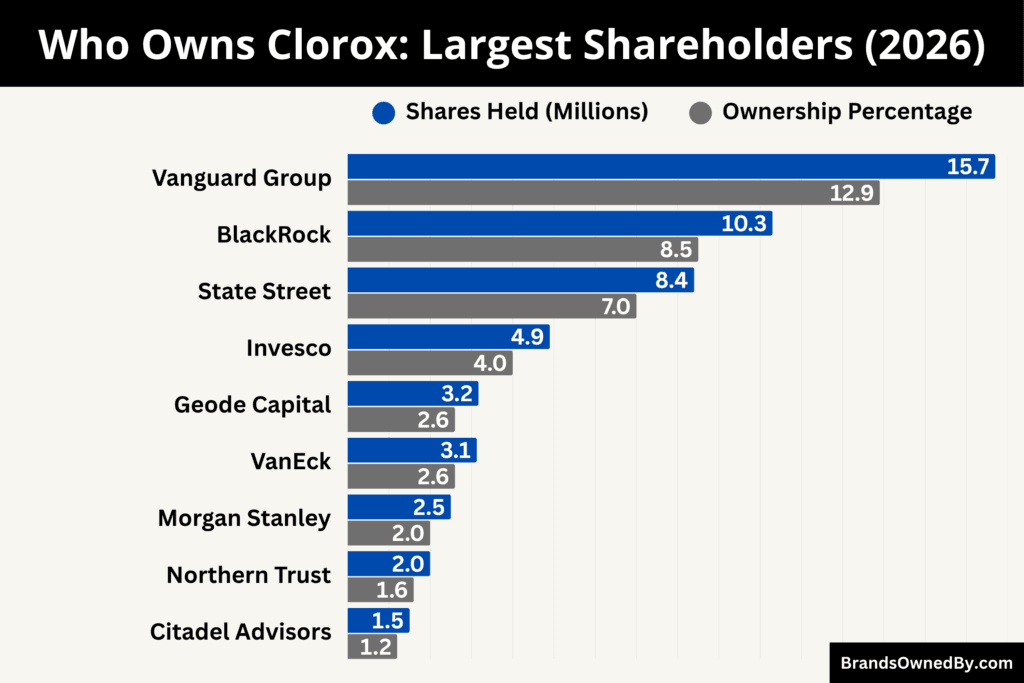
Clorox Shareholder Structure as of May 2026
Because Burt’s Bees is fully owned by Clorox, its ultimate ownership is connected to Clorox shareholders.
The largest shareholders of Clorox as of 2026 are major institutional investment firms.
The Vanguard Group
The Vanguard Group is the largest shareholder of Clorox as of May 2026.
Vanguard controls more than 10% of Clorox’s outstanding shares according to recent shareholder filings.
The company mainly holds shares through:
- Index funds.
- Retirement funds.
- ETFs.
- Mutual funds.
Vanguard’s ownership is considered passive investment ownership. The company does not directly manage Burt’s Bees operations, but it still holds significant shareholder voting power through its Clorox stake.
BlackRock
BlackRock is another major shareholder connected to Burt’s Bees through Clorox ownership.
As of 2026, BlackRock owns more than 8% of Clorox shares.
BlackRock manages massive institutional investment portfolios through its iShares ETF business and other asset management divisions.
The company has increasingly focused on sustainability-related investments over recent years. That aligns closely with Burt’s Bees’ environmentally focused branding and ESG positioning.
State Street Global Advisors
State Street Global Advisors is also one of the largest Clorox shareholders.
The company controls nearly 6% of Clorox’s outstanding shares as of 2026.
Like Vanguard and BlackRock, State Street primarily invests through institutional investment products and retirement-focused funds.
Together, these three firms collectively influence a significant portion of Clorox’s shareholder voting structure.
Burt’s Bees Acquisition by Clorox
Clorox acquired Burt’s Bees in November 2007 for approximately $925 million in cash.
At the time, this was considered one of the biggest acquisitions in the natural personal care industry.
The deal attracted major attention because it reflected a broader trend where large consumer goods corporations started acquiring natural and wellness-focused brands.
The acquisition gave Clorox complete ownership of:
- Burt’s Bees trademarks.
- Manufacturing operations.
- Product lines.
- Intellectual property.
- Retail relationships.
- International expansion rights.
The company was already growing quickly before the acquisition due to rising consumer interest in natural skincare products.
Industry analysts viewed the acquisition as strategically important because Burt’s Bees had already established strong credibility in clean beauty long before many competitors entered the market.
Why Clorox Paid $925 Million
Several factors justified the high acquisition price at the time.
Strong Brand Recognition: Burt’s Bees had developed one of the strongest identities in natural personal care.
Its rustic branding and beeswax-focused product story created strong emotional connections with consumers.
Premium Pricing Power: It successfully positioned its products at premium price points compared to traditional drugstore skincare brands.
Fast-Growing Natural Beauty Industry: Natural and clean beauty categories were expanding rapidly during the mid-2000s.
Clorox wanted direct exposure to this higher-growth segment.
Retail Expansion Opportunities: Clorox believed Burt’s Bees could scale internationally through its existing retail relationships and supply chain infrastructure.
What Changed After the Acquisition
After becoming part of Clorox, Burt’s Bees expanded aggressively.
The company increased its presence in:
- International markets.
- Drugstore chains.
- Supermarkets.
- Beauty retailers.
- E-commerce channels.
Burt’s Bees also expanded beyond lip balms into:
- Advanced skincare.
- Baby care.
- Cosmetics.
- Specialty beauty products.
Despite the corporate acquisition, Clorox largely kept Burt’s Bees’ original brand identity intact.
This decision became one of the key reasons the acquisition succeeded long term.
Many acquired natural brands lose consumer trust after corporate takeovers. Burt’s Bees avoided much of that backlash because its branding, sustainability messaging, and product positioning remained relatively consistent after the deal.
As of May 2026, Burt’s Bees continues operating as one of Clorox’s strongest natural wellness and personal care brands.
Competitor Ownership Comparison
Burt’s Bees competes in the global natural personal care and clean beauty industry, a market increasingly dominated by multinational consumer goods corporations. While many consumers still view natural skincare brands as independent businesses, the reality is very different as of May 2026.
Over the last two decades, major corporations acquired many of the fastest-growing natural beauty and wellness brands to capture demand for clean ingredients, sustainability, and premium personal care products. Burt’s Bees itself became part of this trend when Clorox acquired the company in 2007 for approximately $925 million.
Today, Burt’s Bees competes directly with brands owned by companies such as Procter & Gamble, Colgate-Palmolive, Kenvue, Unilever, and private equity-backed firms. However, the company maintains a distinct position because it combines heritage natural branding with mass-market retail scale.
Unlike newer clean beauty competitors, Burt’s Bees has more than 40 years of brand recognition and one of the strongest retail distribution networks in the natural skincare category.
| Company / Brand | Parent Company (May 2026) | Ownership Type | Main Competing Categories | Key Competitive Strength | Comparison With Burt’s Bees |
|---|---|---|---|---|---|
| Burt’s Bees | The Clorox Company | Wholly owned subsidiary | Lip care, skincare, baby care, natural beauty | Heritage natural branding with mass-market retail scale | Combines mainstream retail distribution with strong natural product credibility |
| Tom’s of Maine | Colgate-Palmolive | Wholly owned subsidiary | Oral care, deodorants, personal care | Strong reputation in natural oral care | More focused on toothpaste and hygiene products, while Burt’s Bees has broader skincare and beauty categories |
| Native | Procter & Gamble (P&G) | Wholly owned subsidiary | Deodorants, body wash, hair care | Digital-first growth and younger consumer appeal | Native is stronger in deodorants, while Burt’s Bees dominates natural lip care and skincare |
| Aveeno | Kenvue | Corporate-owned brand | Sensitive skincare, moisturizers, baby care | Dermatologist-backed skincare positioning | Aveeno focuses more on clinical skincare, while Burt’s Bees emphasizes natural ingredients and sustainability |
| The Body Shop | Private ownership after restructuring | Privately controlled business | Ethical beauty, skincare, body care | Global ethical beauty recognition | The Body Shop relies heavily on branded retail stores, while Burt’s Bees dominates pharmacy and mass retail channels |
| Dr. Bronner’s | Family-owned | Private company | Organic soaps, natural body care | Strong activist-driven and organic brand identity | Dr. Bronner’s has stronger niche authenticity, but Burt’s Bees has significantly larger retail scale |
| Honest Beauty | The Honest Company | Public company subsidiary | Clean beauty, skincare, baby care | Celebrity-backed clean beauty positioning | Honest Beauty focuses more on premium beauty retail, while Burt’s Bees targets broader mainstream consumers |
| EOS | San Francisco Equity Partners-backed ownership | Private equity-backed company | Lip balm, skincare | Strong lip care specialization | EOS competes directly in lip balm, but Burt’s Bees has broader skincare diversification |
| Method | SC Johnson | Corporate-owned brand | Sustainable household and personal care | Eco-friendly household branding | Method focuses more on home care, while Burt’s Bees remains beauty and skincare focused |
| Seventh Generation | Unilever | Wholly owned subsidiary | Sustainable household and baby products | Environmental sustainability leadership | Seventh Generation competes more in eco-household categories rather than beauty and skincare. |
Burt’s Bees vs Tom’s of Maine
Tom’s of Maine is one of the closest ownership comparisons to Burt’s Bees because both companies started as independent natural product businesses before being acquired by major corporations.
Tom’s of Maine was founded in 1970 and later acquired by Colgate-Palmolive. As of May 2026, the company operates as a wholly owned subsidiary within Colgate’s personal care portfolio.
Both brands built their reputations around environmentally conscious marketing and ingredient transparency long before natural personal care products became mainstream. However, their competitive focus evolved differently over time.
Tom’s of Maine remains heavily concentrated in:
- Toothpaste.
- Oral care.
- Deodorants.
- Basic hygiene products.
Burt’s Bees expanded much further into:
- Lip care.
- Facial skincare.
- Baby care.
- Natural cosmetics.
- Body lotions.
This diversification gives Burt’s Bees broader shelf presence across retail stores.
The retail scale difference is also important. Burt’s Bees products are widely distributed through:
Tom’s of Maine has strong retail penetration in oral care aisles, but Burt’s Bees dominates more categories across beauty and skincare departments.
Another major difference is strategic positioning within the parent company.
Colgate-Palmolive primarily treats Tom’s of Maine as a natural extension of its oral care business. Clorox positions Burt’s Bees more as a standalone wellness and lifestyle brand.
That distinction affects:
- Product innovation.
- Marketing investment.
- Brand storytelling.
- Packaging strategy.
- International expansion.
Practical example: Burt’s Bees frequently launches seasonal skincare collections and cosmetic products, while Tom’s of Maine focuses more heavily on functional hygiene categories.
Burt’s Bees vs Native
Native became one of the fastest-growing modern personal care brands after building a strong reputation in aluminum-free deodorants.
Procter & Gamble acquired Native in 2017 to strengthen its position in natural personal care and direct-to-consumer wellness products.
As of May 2026, Native operates under P&G’s massive global beauty and grooming portfolio.
One of the biggest differences between Native and Burt’s Bees is how the brands originally scaled.
Native grew primarily through:
- E-commerce.
- Social media advertising.
- Subscription sales.
- Influencer marketing.
Burt’s Bees expanded through traditional retail distribution decades before digital-first beauty brands became common.
This created very different customer acquisition strategies.
Native remains strongest in:
- Deodorants.
- Body wash.
- Hair care.
- Daily hygiene products.
Burt’s Bees remains stronger in:
- Natural lip balm.
- Beeswax skincare.
- Baby care.
- Sensitive skin products.
- Natural moisturizers.
Another important difference is corporate importance within the parent company.
Procter & Gamble generated more than $84 billion in annual revenue during fiscal 2025 and owns dozens of billion-dollar consumer brands. Native represents a relatively small part of that portfolio.
Burt’s Bees operates under Clorox, which is much smaller overall than P&G. Because of this, Burt’s Bees carries greater strategic importance within Clorox’s wellness and lifestyle business.
That gives Burt’s Bees more focused branding attention compared to many smaller wellness brands operating under massive consumer conglomerates.
Brand identity also separates the companies significantly.
Native uses minimalist modern packaging designed heavily for younger digital-first consumers. Burt’s Bees continues emphasizing heritage branding connected to beeswax, nature, and the company’s Maine origins.
That legacy branding gives Burt’s Bees stronger recognition among mainstream and older consumers.
Burt’s Bees vs Aveeno
Aveeno competes directly with Burt’s Bees in skincare, moisturizers, baby care, and sensitive skin products.
As of May 2026, Aveeno operates under Kenvue, the consumer health company created after Johnson & Johnson separated its consumer products division.
Unlike Burt’s Bees, Aveeno was never positioned mainly as a natural lifestyle brand. The company built its reputation around dermatologist-backed skincare and oat-based ingredient science.
This creates a major competitive distinction.
Aveeno focuses heavily on:
- Clinical skincare research.
- Therapeutic formulations.
- Dermatologist recommendations.
- Sensitive skin treatment.
Burt’s Bees focuses more on:
- Natural ingredients.
- Sustainability messaging.
- Plant-based formulations.
- Eco-conscious beauty branding.
Both companies target consumers looking for gentler skincare alternatives, but they approach the market differently.
Aveeno positions itself as medically trusted skincare.
Burt’s Bees positions itself as naturally inspired skincare.
This affects advertising strategy, packaging design, and product messaging.
Practical example: Aveeno frequently markets eczema-focused and dermatologist-tested formulations, while Burt’s Bees highlights ingredient simplicity and naturally derived moisturizers.
Retail competition between the two companies is intense because both brands compete in:
However, Aveeno typically dominates medically oriented skincare sections, while Burt’s Bees performs more strongly in natural beauty and clean skincare categories.
Burt’s Bees vs The Body Shop
The Body Shop is one of the most historically important ethical beauty companies in the world.
However, its ownership history has been far more unstable compared to Burt’s Bees.
The company moved through several ownership transitions over the years, including ownership under:
- L’Oréal.
- Natura & Co.
- Private restructuring groups.
As of May 2026, The Body Shop continues rebuilding operations after financial restructuring and international asset sales.
This ownership instability created operational challenges involving:
- Retail expansion.
- Brand positioning.
- International operations.
- Store management.
- Strategic consistency.
Burt’s Bees experienced much greater ownership stability because Clorox has owned the company continuously since 2007.
The business models also differ substantially.
The Body Shop relies heavily on branded retail stores and shopping mall locations. Burt’s Bees depends more on wholesale retail partnerships and pharmacy distribution.
That difference became increasingly important after e-commerce growth and declining mall traffic reshaped global retail behavior.
Burt’s Bees adapted more effectively because its products were already deeply integrated into supermarkets, pharmacies, and mass-market retail chains.
Both companies strongly emphasize:
- Sustainability.
- Cruelty-free positioning.
- Ethical sourcing.
- Environmental responsibility.
However, Burt’s Bees focuses more on natural skincare ingredients, while The Body Shop historically emphasized activist-driven ethical campaigns and fair-trade initiatives.
Burt’s Bees vs Dr. Bronner’s
Dr. Bronner’s remains one of Burt’s Bees’ most important independent competitors.
Unlike Burt’s Bees, Dr. Bronner’s is still privately owned and family-controlled as of May 2026.
This independent ownership structure gives Dr. Bronner’s much greater flexibility in areas such as:
- Activist campaigns.
- Organic certification standards.
- Regenerative agriculture investment.
- Ethical sourcing policies.
Burt’s Bees still promotes sustainability, but it operates within the governance and financial expectations of a publicly traded parent company.
That difference affects long-term operational priorities.
Dr. Bronner’s maintains stronger niche authenticity among highly sustainability-focused consumers. However, Burt’s Bees has significantly larger global retail penetration because of Clorox’s distribution infrastructure.
Dr. Bronner’s remains concentrated mainly in:
- Organic retailers.
- Specialty wellness stores.
- Natural grocery chains.
Burt’s Bees products are available through much broader mainstream retail networks globally.
Product diversification also separates the two companies.
Dr. Bronner’s remains heavily soap-focused.
Burt’s Bees operates a much larger beauty and skincare portfolio that includes:
- Lip care.
- Facial skincare.
- Cosmetics.
- Baby care.
- Body lotions.
- Hand creams.
This wider category diversification gives Burt’s Bees stronger overall retail shelf visibility.
Burt’s Bees vs Honest Beauty
Honest Beauty competes directly with Burt’s Bees in clean beauty, wellness-focused skincare, and ingredient-conscious personal care.
The company operates under The Honest Company, which is publicly traded as of May 2026.
Unlike Burt’s Bees, Honest Beauty remains closely associated with celebrity founder Jessica Alba. Celebrity branding continues playing a major role in the company’s public image and marketing strategy.
The competitive positioning between the two brands differs significantly.
Honest Beauty focuses more heavily on:
- Premium beauty retail.
- Digital-first consumer engagement.
- Younger beauty-focused shoppers.
- Higher-end clean beauty positioning.
Burt’s Bees targets a broader mass-market audience while still maintaining strong natural product credibility.
This affects both pricing and retail strategy.
Honest Beauty products are often positioned closer to prestige beauty pricing. Burt’s Bees products are generally more accessible across mainstream retail channels.
Burt’s Bees also benefits from much stronger long-term retail relationships and wider mass-market penetration.
As of May 2026, Burt’s Bees products are more deeply integrated into pharmacy chains and grocery retailers compared to many newer clean beauty competitors.
Another major advantage is longevity.
Burt’s Bees has operated for more than four decades. That long history gives the company stronger consumer trust and broader mainstream brand recognition.
This matters heavily in skincare because repeat customer loyalty often determines long-term market strength.
Why Burt’s Bees Maintains a Competitive Advantage
Burt’s Bees occupies a unique position in the natural personal care market because it successfully combines several advantages that many competitors struggle balancing simultaneously.
The company maintains:
- Heritage natural branding.
- Mainstream retail accessibility.
- Strong sustainability positioning.
- Broad product diversification.
- Corporate-scale distribution infrastructure.
Many independent brands maintain authenticity but lack global scale.
Many corporate-owned brands gain scale but lose consumer trust after acquisitions.
Burt’s Bees managed to preserve much of its original identity even after becoming part of Clorox.
That balance remains one of the company’s biggest competitive strengths as of May 2026.
Who Controls Burt’s Bees?
Burt’s Bees is controlled through The Clorox Company’s corporate governance structure as of May 2026. While the brand operates with dedicated marketing, product development, and innovation teams, final authority over strategy, operations, financial planning, and corporate governance belongs to Clorox leadership and its board of directors.
The company does not function as an independent corporation with its own public board or standalone executive leadership team. Instead, Burt’s Bees operates within Clorox’s “Care & Connection” business segment, which oversees several lifestyle, wellness, and personal care brands.
This structure gives Burt’s Bees access to Clorox’s:
- Global retail partnerships.
- Manufacturing infrastructure.
- Supply chain systems.
- Research and development resources.
- International distribution capabilities.
At the same time, Clorox keeps Burt’s Bees operationally distinct from its traditional cleaning brands because the beauty and skincare industry requires different branding, innovation, and consumer engagement strategies.
Linda Rendle
Linda Rendle is the most powerful executive overseeing Burt’s Bees as of May 2026.
She serves as Chair and Chief Executive Officer of The Clorox Company and has held the CEO position since September 2020. She also became Chair of the Board in January 2024.
Rendle oversees all Clorox business units, including Burt’s Bees, and controls the company’s long-term strategic direction.
Her authority includes oversight of:
- Corporate growth strategy.
- Brand portfolio management.
- Capital allocation.
- International expansion.
- Sustainability priorities.
- Product innovation investment.
- Executive leadership appointments.
Before becoming CEO, Rendle managed several major Clorox divisions and global operations functions. She previously oversaw:
- Corporate strategy.
- Product supply.
- Research and development.
- Marketing.
- Sales.
- International operations.
This experience is important because Burt’s Bees operates at the intersection of consumer wellness, retail branding, and sustainability-focused personal care products.
Under Rendle’s leadership, Clorox continued prioritizing premium and wellness-oriented consumer brands, making Burt’s Bees strategically important within the company’s portfolio.
Nina Barton
Nina Barton plays one of the most direct leadership roles connected to Burt’s Bees.
As of May 2026, she serves as Executive Vice President and Group President — Care & Connection at Clorox.
The “Care & Connection” segment includes wellness and lifestyle-focused brands, making Barton one of the key executives responsible for overseeing Burt’s Bees operations and growth strategy.
Her responsibilities include:
- Business performance oversight.
- Brand growth execution.
- Consumer engagement strategy.
- Retail expansion.
- Innovation planning.
- Product portfolio management.
Barton joined Clorox after leadership roles at:
- Kraft Heinz.
- Johnson & Johnson.
- L’Oréal.
- Procter & Gamble.
That background is highly relevant because Burt’s Bees competes directly in beauty and wellness categories where consumer branding and product positioning are critical.
Her experience in beauty, personal care, and consumer products gives Clorox stronger category expertise for managing Burt’s Bees against competitors such as Native, Honest Beauty, Aveeno, and The Body Shop.
Eric Schwartz
Eric Schwartz serves as Senior Vice President and Chief Marketing Officer of Clorox as of May 2026.
His role directly influences Burt’s Bees because marketing is one of the brand’s most important competitive strengths.
Schwartz oversees:
- Global brand marketing.
- Consumer advertising.
- Digital engagement.
- Retail marketing strategy.
- Brand positioning.
- Customer acquisition initiatives.
This is particularly important for Burt’s Bees because the natural skincare market is heavily influenced by:
- Packaging design.
- Sustainability messaging.
- Social media perception.
- Ingredient transparency.
- Consumer trust.
Unlike household cleaning products, skincare and wellness brands rely heavily on emotional branding and consumer identity.
That makes the marketing function central to Burt’s Bees’ continued growth.
Pascal Montilus
Pascal Montilus serves as Senior Vice President and Chief Supply Chain Officer at Clorox as of May 2026.
He oversees supply chain operations across Clorox’s global portfolio, including Burt’s Bees manufacturing and distribution systems.
His responsibilities include:
- Manufacturing operations.
- Supplier management.
- Global logistics.
- Inventory systems.
- Product availability.
- Distribution efficiency.
This role became increasingly important after global supply chain disruptions affected consumer goods companies over recent years.
For Burt’s Bees, supply chain management directly impacts:
- Ingredient sourcing.
- Product consistency.
- Retail inventory availability.
- Sustainability commitments.
- Packaging operations.
Natural skincare companies face additional sourcing complexity because consumers closely monitor ingredient quality and environmental practices.
Mark Smerznak and Research & Development Leadership
Research and product innovation are controlled through Clorox’s central R&D structure.
As of May 2026, senior research and development operations are integrated within Clorox’s executive leadership framework.
This function influences Burt’s Bees through:
- Formula development.
- Ingredient testing.
- Product safety.
- Packaging innovation.
- Sustainability improvements.
- Regulatory compliance.
Innovation remains critical because the clean beauty and natural skincare industry evolves rapidly.
Burt’s Bees competes in markets where consumers constantly evaluate:
- Ingredient transparency.
- Product effectiveness.
- Sustainability claims.
- Packaging materials.
- Skin sensitivity standards.
The company’s ability to maintain product credibility while expanding globally depends heavily on centralized research and compliance systems.
Clorox Board of Directors
The Clorox Board of Directors provides the highest level of governance oversight for Burt’s Bees.
As of May 2026, the board includes executives and former CEOs from major consumer goods, retail, finance, and technology companies.
Key board members include:
- Linda Rendle, Chair and CEO of Clorox.
- Matthew Shattock, Lead Independent Director and former Beam Suntory chairman.
- Gina Boswell, CEO of Bath & Body Works.
- Stephen Bratspies, CEO of Hanesbrands.
- Esther Lee, former global marketing executive at MetLife.
The board oversees:
- Corporate governance.
- Risk management.
- Executive compensation.
- Sustainability strategy.
- Shareholder interests.
- Long-term corporate planning.
The inclusion of executives with beauty, retail, and consumer branding experience is particularly important for Burt’s Bees because the brand competes in highly image-driven and trend-sensitive markets.
Governance Structure
Clorox operates under a combined Chair and CEO structure as of May 2026.
Linda Rendle holds both positions simultaneously, while Matthew Shattock serves as Lead Independent Director.
This governance structure gives Rendle significant centralized authority over Clorox’s operations and strategic direction, including Burt’s Bees.
At the same time, the Lead Independent Director structure provides additional board oversight responsibilities involving:
- Independent director meetings.
- CEO evaluations.
- Board governance review.
- Strategic oversight.
This governance model is designed to balance executive authority with independent board accountability.
How Burt’s Bees is Controlled Operationally
Operationally, Burt’s Bees functions through a hybrid structure.
Brand-specific teams handle:
- Product development.
- Packaging design.
- Marketing campaigns.
- Consumer engagement.
- Retail merchandising.
Corporate Clorox leadership controls:
- Financial planning.
- Manufacturing investment.
- Enterprise risk management.
- International distribution.
- Supply chain infrastructure.
- Regulatory compliance.
This structure allows Burt’s Bees to maintain a distinct natural beauty identity while still benefiting from multinational corporate scale.
As of May 2026, this balance remains one of the company’s biggest competitive advantages because it combines:
- Corporate operational strength.
- Global retail access.
- Long-term financial stability.
- Natural brand authenticity.
- Wellness-focused consumer positioning.
Burt’s Bees Annual Revenue and Net Worth
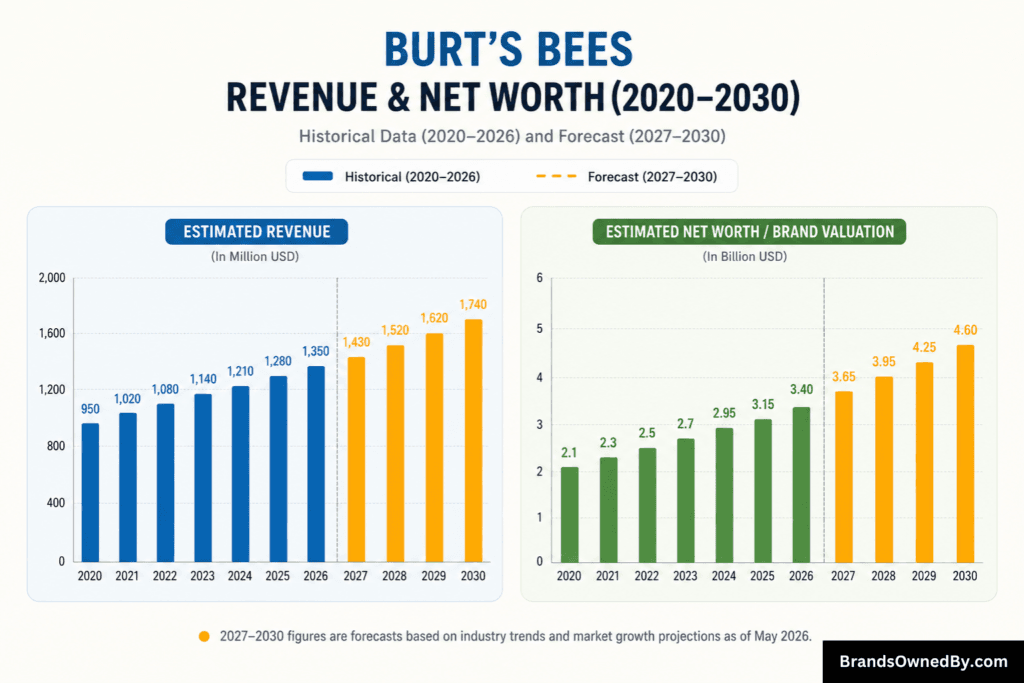
Burt’s Bees generated an estimated $1.35 billion in revenue in 2026, while the company’s estimated net worth and brand valuation reached approximately $3.4 billion as of May 2026.
It remains one of the largest natural personal care brands in North America and one of the most commercially successful clean beauty businesses owned by a multinational consumer goods company.
Its valuation increased substantially over the past decade because of rising global demand for:
- Natural skincare.
- Sustainable beauty products.
- Ingredient transparency.
- Premium wellness-focused personal care.
Although Burt’s Bees does not publish standalone financial statements because it operates under The Clorox Company, analysts regularly estimate the brand’s financial performance using retail sales data, category market share, distribution scale, consumer demand trends, and parent company segment reporting.
As of 2026, Burt’s Bees continues generating most of its revenue from the United States, but international skincare and wellness markets are becoming increasingly important contributors to long-term growth.
Burt’s Bees Revenue in 2026
Burt’s Bees’ estimated 2026 revenue of $1.35 billion reflects strong performance across both legacy and expansion categories.
The company’s revenue is heavily diversified across multiple product lines.
Lip care remains the largest revenue contributor. Burt’s Bees lip balm products continue ranking among the best-selling natural lip care products across U.S. mass-market retailers.
Industry estimates suggest lip care contributes nearly 35% to 40% of total company revenue.
This means lip balm and related lip products alone likely generated approximately $470 million to $540 million in 2026 revenue.
The skincare division represents the second-largest business segment.
Facial skincare products such as:
- Cleansers.
- Moisturizers.
- Acne treatments.
- Facial wipes.
- Serums.
collectively contributed an estimated $360 million to $410 million in annual revenue during 2026.
The company also continued expanding in baby care products.
The Burt’s Bees Baby segment generated an estimated $150 million to $190 million in annual revenue as demand for sensitive-skin and naturally positioned baby products continued increasing.
Body care and hand care products generated additional revenue through:
- Body lotions.
- Hand creams.
- Foot care.
- Soap products.
Natural cosmetics also became a meaningful contributor. Although still smaller than skincare and lip care, the cosmetics division continued expanding through clean beauty demand and premium retail placement.
Revenue Distribution by Sales Channels
One of the biggest reasons behind Burt’s Bees’ revenue scale is its extremely broad retail presence.
As of 2026, the company generates substantial sales through:
Mass retail and pharmacy distribution contribute the majority of total revenue.
E-commerce sales also became increasingly important after the global acceleration of online beauty shopping during the 2020s.
Industry estimates suggest digital commerce now contributes approximately 20% to 25% of Burt’s Bees annual revenue.
Amazon remains one of the company’s strongest digital sales channels because Burt’s Bees products consistently perform well in:
- Lip care rankings.
- Natural skincare searches.
- Wellness beauty categories.
- Organic beauty recommendations.
Why Burt’s Bees Generates Premium Revenue
Burt’s Bees products typically sell at higher price points than standard drugstore skincare products.
This pricing advantage significantly improves revenue generation.
Consumers are willing to pay premium prices because the brand is associated with:
- Natural ingredients.
- Beeswax-based formulations.
- Sustainable packaging.
- Sensitive skin compatibility.
- Long-term brand trust.
Practical example: A Burt’s Bees lip balm generally sells for noticeably more than traditional petroleum-based lip products sold beside it in retail stores.
The company benefits from both high sales volume and premium positioning simultaneously.
That combination is difficult for many skincare competitors to achieve.
Burt’s Bees Net Worth and Brand Valuation in 2026
As of May 2026, Burt’s Bees’ estimated net worth and brand valuation reached approximately $3.4 billion.
This valuation is based on multiple commercial and strategic factors rather than direct revenue alone.
The company’s valuation reflects:
- Brand recognition.
- Retail dominance.
- Consumer loyalty.
- International expansion potential.
- Sustainability positioning.
- Long-term profitability potential.
- Product diversification.
One of the strongest contributors to Burt’s Bees’ valuation is recurring consumer behavior.
Many of the company’s products are purchased repeatedly throughout the year.
This includes:
- Lip balm.
- Moisturizers.
- Cleansers.
- Hand creams.
- Baby care products.
Recurring purchases create predictable long-term consumer demand, which increases overall brand value.
Comparison With the 2007 Acquisition Price
Clorox acquired Burt’s Bees in 2007 for approximately $925 million.
As of 2026, the estimated brand valuation of $3.4 billion means the company’s value increased by nearly 268% since the acquisition.
This makes Burt’s Bees one of Clorox’s most successful long-term acquisitions.
Several factors drove this increase.
Expansion Beyond Lip Balm
At the time of acquisition, Burt’s Bees was still heavily dependent on lip care sales.
Since then, it expanded aggressively into:
- Facial skincare.
- Baby care.
- Natural cosmetics.
- Specialty moisturizers.
- Premium body care.
This diversification significantly increased revenue opportunities.
Growth of the Clean Beauty Industry
The global clean beauty industry expanded rapidly during the 2010s and 2020s.
Consumers increasingly shifted toward:
- Naturally derived ingredients.
- Sustainable brands.
- Eco-conscious packaging.
- Wellness-oriented skincare.
Burt’s Bees was already strongly positioned in these categories before many newer competitors entered the market.
Strong Retail Penetration
The company’s retail distribution became one of its biggest competitive strengths.
Burt’s Bees products now occupy premium shelf positions in:
- Pharmacies.
- Grocery stores.
- Beauty retailers.
- E-commerce platforms.
This retail scale substantially increased both sales volume and long-term valuation.
Sustainability and ESG Value
The company’s sustainability positioning also contributes heavily to its valuation.
As of 2026, investors and consumers increasingly favor companies associated with:
- Ethical sourcing.
- Sustainable packaging.
- Environmental responsibility.
- Cleaner ingredient standards.
Burt’s Bees benefits strongly from this trend because sustainability remains central to its brand identity.
Burt’s Bees Revenue Forecast Through 2030
Analysts expect Burt’s Bees to continue expanding steadily through 2030 because the global natural skincare market continues growing faster than many traditional personal care categories.
Forecasted revenue estimates include:
- 2027 projected revenue of approximately $1.43 billion.
- 2028 projected revenue of approximately $1.52 billion.
- 2029 projected revenue of approximately $1.62 billion.
- 2030 projected revenue of approximately $1.74 billion.
Several factors are expected to support future growth.
International retail expansion remains one of the largest opportunities because Burt’s Bees still generates most of its revenue from North America.
Premium skincare products are also expected to contribute larger revenue shares as consumers increasingly spend more on wellness-oriented beauty products.
Digital commerce growth will continue strengthening direct and marketplace-based online sales.
At the same time, the company’s sustainability-focused branding is expected to remain highly valuable among younger consumers prioritizing environmentally conscious skincare and clean beauty products.
Brands Owned by Burt’s Bees
As of 2026, Burt’s Bees operates primarily as a single-brand natural personal care company rather than a diversified holding corporation with dozens of independently branded subsidiaries. Unlike multinational beauty conglomerates that own multiple standalone beauty brands, Burt’s Bees focuses on expanding its core brand ecosystem across several product categories and operating divisions.
Its operations are heavily concentrated in:
- Natural skincare.
- Lip care.
- Baby care.
- Body care.
- Natural cosmetics.
- Personal wellness products.
As of 2026, Burt’s Bees products are distributed across North America, Europe, Asia-Pacific markets, and selected Middle Eastern and Latin American retail channels.
| Company / Brand / Entity | Category | Main Products / Operations | Estimated Strategic Importance (2026) | Key Details |
|---|---|---|---|---|
| Burt’s Bees Lip Care | Lip Care Division | Lip balm, lip shimmer, lip scrub, overnight lip treatments, medicated lip balm | Highest revenue-generating division | Contributes an estimated 35%–40% of total company revenue and remains Burt’s Bees’ flagship business segment. |
| Burt’s Bees Facial Skincare | Skincare Division | Cleansers, moisturizers, serums, acne treatments, facial wipes, eye creams | High-growth core division | One of the fastest-growing segments with estimated annual revenue contribution of $360 million–$410 million as of 2026. |
| Burt’s Bees Baby | Baby Care Division | Baby shampoo, diaper ointment, baby lotion, baby wash, baby oils | Major wellness-focused segment | Estimated to generate $150 million–$190 million annually with strong demand for sensitive-skin baby products. |
| Burt’s Bees Body Care | Body Care Division | Body lotions, soaps, body butter, hand creams, foot creams | Established personal care segment | Competes directly with wellness and moisturizing skincare brands in mass retail channels. |
| Burt’s Bees Natural Cosmetics | Clean Beauty / Cosmetics Division | Foundations, mascaras, lipsticks, blushes, eyeliners, tinted moisturizers | Expanding clean beauty segment | Helps the company compete in the rapidly growing clean beauty and natural makeup industry. |
| Burt’s Bees Hand and Foot Care | Specialty Wellness Segment | Hand salves, intensive repair creams, cuticle creams, foot moisturizers | Niche but high-repeat-purchase segment | Strong seasonal demand during colder months and high customer retention rates. |
| Burt’s Bees Sensitive Solutions | Sensitive Skin Skincare Line | Fragrance-free cleansers, calming moisturizers, sensitive skin creams | Emerging skincare growth category | Designed to compete against dermatologist-oriented sensitive skin brands such as Cetaphil and CeraVe. |
| Burt’s Bees Sustainability Programs | Sustainability and ESG Operations | Sustainable sourcing, recyclable packaging, environmental initiatives | Major brand identity driver | Supports ESG positioning and strengthens long-term consumer trust among environmentally conscious buyers. |
| Burt’s Bees Retail Partnerships | Retail Distribution Network | Walmart, Target, CVS, Walgreens, Amazon, Ulta Beauty distribution | Critical commercial infrastructure | One of the company’s biggest competitive advantages due to extensive retail penetration across North America. |
| Burt’s Bees International Operations | International Distribution Entity | Global retail expansion and regional distribution operations | Long-term growth driver | Expanding presence across Europe, Asia-Pacific, Latin America, and selected Middle Eastern markets as of 2026. |
Burt’s Bees Lip Care
Burt’s Bees Lip Care remains the company’s largest and most commercially important operating segment as of 2026.
The lip care division built the company’s national reputation and continues generating the largest share of overall revenue. Industry estimates suggest the category contributes approximately 35% to 40% of total company sales.
The division includes:
- Original Beeswax Lip Balm.
- Tinted Lip Balm.
- Medicated Lip Balm.
- Overnight Lip Treatment.
- Lip Shimmer.
- Lip Scrub products.
- Hydrating lip oils.
The Original Beeswax Lip Balm remains the company’s flagship product and one of the most recognized natural lip care products in North America.
The product became successful because of its beeswax-based formula, peppermint oil sensation, and natural ingredient positioning at a time when most mainstream lip care products relied heavily on petroleum-based formulas.
As of 2026, Burt’s Bees lip products compete directly with:
- EOS.
- Carmex.
- ChapStick.
- Blistex.
- Vaseline Lip Therapy.
- Laneige lip treatments.
The company continues expanding the category through premium hydration products, naturally tinted lip treatments, and seasonal flavor collections.
Lip care also remains one of the company’s strongest recurring-purchase businesses because consumers buy these products multiple times per year.
Burt’s Bees Facial Skincare
Facial skincare became one of Burt’s Bees’ fastest-growing operating divisions during the 2020s.
The company significantly expanded this category to compete directly with clean beauty and sensitive skin skincare brands.
The skincare division includes:
- Facial cleansers.
- Moisturizers.
- Acne solutions.
- Eye creams.
- Night creams.
- Facial serums.
- Facial wipes.
- Exfoliating products.
As of 2026, facial skincare contributes an estimated $360 million to $410 million in annual revenue.
The company positioned these products as naturally inspired alternatives to synthetic-heavy skincare formulations.
Burt’s Bees heavily markets ingredients such as:
- Aloe vera.
- Beeswax.
- Honey.
- Shea butter.
- Coconut oil.
- Fruit extracts.
The company particularly targets consumers seeking:
- Sensitive skin products.
- Simpler ingredient lists.
- Sustainable skincare.
- Affordable premium skincare.
Practical example: Burt’s Bees facial cleansers and moisturizers are commonly sold beside brands such as Cetaphil, CeraVe, Aveeno, and Neutrogena in major retail chains.
Burt’s Bees Baby
Burt’s Bees Baby operates as one of the company’s most important wellness-oriented product divisions.
The brand focuses on naturally positioned baby care and infant skincare products.
The division includes:
- Baby lotions.
- Baby shampoo.
- Diaper ointments.
- Baby oils.
- Baby wash.
- Sensitive skin moisturizers.
Burt’s Bees Baby products target parents seeking gentler skincare alternatives for infants and young children.
The company benefits from growing consumer demand for:
- Fragrance-sensitive products.
- Naturally derived ingredients.
- Pediatric-friendly skincare.
- Hypoallergenic formulations.
As of 2026, the baby care segment generates an estimated $150 million to $190 million annually.
The division competes against brands such as:
- Aveeno Baby.
- Johnson’s Baby.
- Honest Baby.
- Mustela.
- Cetaphil Baby.
The baby care business is strategically important because it creates long-term customer relationships with younger families and wellness-focused consumers.
Burt’s Bees Body Care
The body care division expanded significantly after the Clorox acquisition.
The company broadened its product range to compete in premium moisturizing and wellness-oriented body care categories.
The division includes:
- Body lotions.
- Hand creams.
- Foot creams.
- Body butter.
- Soap products.
- Body wash.
- Cuticle creams.
These products are heavily marketed around hydration, natural ingredients, and sensitive skin compatibility.
Body care products also benefit from strong seasonal sales patterns.
Practical example: Hand creams, foot creams, and intensive moisturizers often experience stronger retail demand during winter months because of dry skin concerns.
The body care segment helps Burt’s Bees compete more broadly against wellness and beauty companies such as:
- Bath & Body Works.
- Aveeno.
- Jergens.
- Dove.
- The Body Shop.
Burt’s Bees Natural Cosmetics
Burt’s Bees entered the natural cosmetics market to capitalize on the rapid growth of clean beauty and ingredient-conscious makeup products.
The cosmetics division includes:
- Foundations.
- Lipsticks.
- Mascaras.
- Eyeliners.
- Blushes.
- Tinted moisturizers.
Unlike luxury beauty brands, Burt’s Bees positioned its makeup products in the accessible premium category.
The company focuses heavily on consumers seeking:
- Lightweight makeup.
- Naturally positioned formulas.
- Everyday beauty products.
- Cleaner ingredient profiles.
This division allows Burt’s Bees to compete more directly against clean beauty companies such as:
- Honest Beauty.
- Physicians Formula.
- ILIA Beauty.
- Pacifica Beauty.
The cosmetics category remains smaller than lip care and skincare, but it plays an important role in expanding the brand beyond traditional personal care products.
Burt’s Bees Hand and Foot Care
Hand and foot care products operate as a specialized wellness-focused product segment inside the broader body care division.
This category includes:
- Hand salves.
- Intensive hand repair creams.
- Foot moisturizers.
- Cuticle care products.
- Overnight hydration treatments.
Many of these products became especially popular because of increasing consumer focus on self-care and skin hydration during the 2020s.
The company positions these products as naturally moisturizing alternatives to traditional petroleum-heavy skincare treatments.
This segment benefits heavily from repeat purchases and seasonal demand cycles.
Burt’s Bees Sensitive Solutions
Sensitive Solutions operates as a specialized skincare line designed for consumers with reactive or sensitive skin concerns.
The line includes:
- Gentle cleansers.
- Sensitive moisturizers.
- Fragrance-free skincare.
- Calming creams.
This category became increasingly important because of growing consumer demand for minimalist and dermatologist-conscious skincare products.
The company uses this division to compete more directly against sensitive skincare brands such as:
- Cetaphil.
- CeraVe.
- La Roche-Posay.
- Aveeno.
Sensitive Solutions also strengthens Burt’s Bees’ credibility in more medically adjacent skincare categories.
Burt’s Bees Sustainability and Environmental Programs
Although not separate companies, Burt’s Bees operates several sustainability-focused initiatives that function as important operational entities inside the business.
These initiatives focus on:
- Sustainable ingredient sourcing.
- Recyclable packaging.
- Environmental responsibility.
- Waste reduction.
- Carbon-conscious operations.
The company’s sustainability positioning remains central to its brand identity as of 2026.
Burt’s Bees uses these environmental initiatives both operationally and strategically because younger consumers increasingly prioritize ESG-focused beauty brands.
Final Thoughts
Burt’s Bees is owned by The Clorox Company, which acquired the natural skincare brand in 2007 for approximately $925 million. The acquisition transformed Burt’s Bees from a small independent company into a global consumer brand with massive retail distribution.
Today, the brand remains one of the most recognized names in natural personal care. Its success comes from strong product positioning, sustainability-focused branding, and consistent consumer demand for natural skincare solutions.
Even under corporate ownership, Burt’s Bees has largely preserved its original identity. That balance between large-scale corporate resources and authentic natural branding continues to drive its market strength.
FAQs
Is Burt’s Bees owned by Clorox?
Yes. Burt’s Bees is fully owned by The Clorox Company as of 2026. Clorox acquired the natural personal care brand in 2007 for approximately $925 million.
Who owns Burt Bees company?
Burt’s Bees is owned by The Clorox Company, a publicly traded American consumer goods corporation. The brand operates as a wholly owned subsidiary within Clorox’s Care & Connection business segment.
When was Burt’s Bees founded?
Burt’s Bees was founded in 1984 by Burt Shavitz and Roxanne Quimby in Maine, United States.
Where are Burt’s Bees products made?
Most Burt’s Bees products are manufactured in the United States through company-operated and partner manufacturing facilities. The brand’s operations are heavily centered in North Carolina, where Burt’s Bees established major production and corporate facilities.
Is Burt’s Bees a Clorox brand?
Yes. Burt’s Bees is one of Clorox’s major wellness and lifestyle brands. It operates alongside other Clorox-owned consumer brands but maintains separate branding and product development operations focused on natural skincare and personal care products.
What happened to the founder of Burt’s Bees?
Co-founder Burt Shavitz eventually stepped away from day-to-day business operations as the company expanded commercially. He remained closely associated with the brand’s public image and appeared on product packaging for many years. Burt Shavitz passed away in 2015 at the age of 80.
Who is the CEO of Burt’s Bees?
Burt’s Bees does not operate as a separate publicly traded corporation with its own standalone CEO. The brand is ultimately controlled by The Clorox Company. As of 2026, Linda Rendle serves as Chair and CEO of Clorox and oversees Burt’s Bees within the company’s portfolio.
Is Burt’s Bees owned by Unilever?
No. Burt’s Bees is not owned by Unilever. The company is fully owned by The Clorox Company.
Is Burt’s Bees made in the USA?
Yes. Many Burt’s Bees products are made in the United States, particularly through manufacturing operations connected to North Carolina facilities. The brand strongly emphasizes American manufacturing and domestic product development.
How much did Roxanne Quimby sell Burt’s Bees for?
Roxanne Quimby and other stakeholders benefited from the 2007 sale of Burt’s Bees to Clorox for approximately $925 million. Quimby reportedly held a major ownership stake before the acquisition, making the deal highly lucrative for her financially.
How much is Burt’s Bees company worth?
As of May 2026, Burt’s Bees is estimated to have a brand valuation and net worth of approximately $3.4 billion based on revenue performance, retail distribution, clean beauty market growth, consumer loyalty, and long-term brand strength.