

Nike is one of the most recognized names in the world of sportswear. If you’ve ever wondered who owns Nike, this article breaks down the company’s structure, ownership, and leadership in detail. From its founding to its top shareholders and brands, here’s everything you need to know.
Nike Company Profile
Nike, Inc. is one of the world’s most iconic sportswear and athletic footwear companies. Headquartered in Beaverton, Oregon, Nike designs, develops, markets, and sells footwear, apparel, equipment, and accessories. The company is known for combining innovation with performance and style. It dominates the global athletic market with a strong focus on branding, celebrity endorsements, and sports sponsorships.
Founders of Nike
Nike was founded by Bill Bowerman, a track-and-field coach at the University of Oregon, and Phil Knight, a middle-distance runner and business student. The company began as Blue Ribbon Sports in 1964, with Bowerman and Knight importing and selling Japanese running shoes from Onitsuka Tiger (now ASICS).
Knight handled distribution and business operations, while Bowerman focused on improving shoe performance. Bowerman famously used a waffle iron to create a new type of sole, leading to the invention of Nike’s first original shoe.
In 1971, the company rebranded as Nike, Inc., named after the Greek goddess of victory. The now-famous Swoosh logo was created by a graphic design student, Carolyn Davidson, for just $35.
Major Milestones
1971 – Blue Ribbon Sports officially becomes Nike, Inc.
1972 – Nike launches its first line of shoes under its own brand at the U.S. Track and Field Trials.
1978 – The company goes international and expands into Canada and Australia.
1980 – Nike goes public and is listed on the New York Stock Exchange.
1984 – Nike signs Michael Jordan, launching the Air Jordan line in 1985. It becomes one of the most successful product lines in sports history.
1996 – Nike signs Tiger Woods, strengthening its influence in golf.
2003 – Nike acquires Converse, adding the Chuck Taylor brand to its portfolio.
2012 – Nike becomes the official apparel sponsor for the NFL.
2020 – John Donahoe becomes CEO, bringing a new focus on digital transformation.
2024 – Nike reports over $51 billion in annual revenue, cementing its position as a global leader.
Company Details
- Full Name: Nike, Inc.
- Founded: January 25, 1964 (as Blue Ribbon Sports); became Nike, Inc. in 1971
- Founders: Bill Bowerman and Phil Knight
- Headquarters: Beaverton, Oregon, United States
- Industry: Apparel, Footwear, Sports Equipment
- Ticker Symbol: NKE (NYSE)
- Employees: Over 79,000 globally
- Global Reach: Products sold in over 190 countries
- Famous Slogan: Just Do It
- Logo: The Swoosh
Nike is more than just a brand. It represents performance, aspiration, and innovation. Through its global presence, advanced design, and strong marketing, Nike continues to define and lead the athletic wear industry.
Who Owns Nike: Top Shareholders
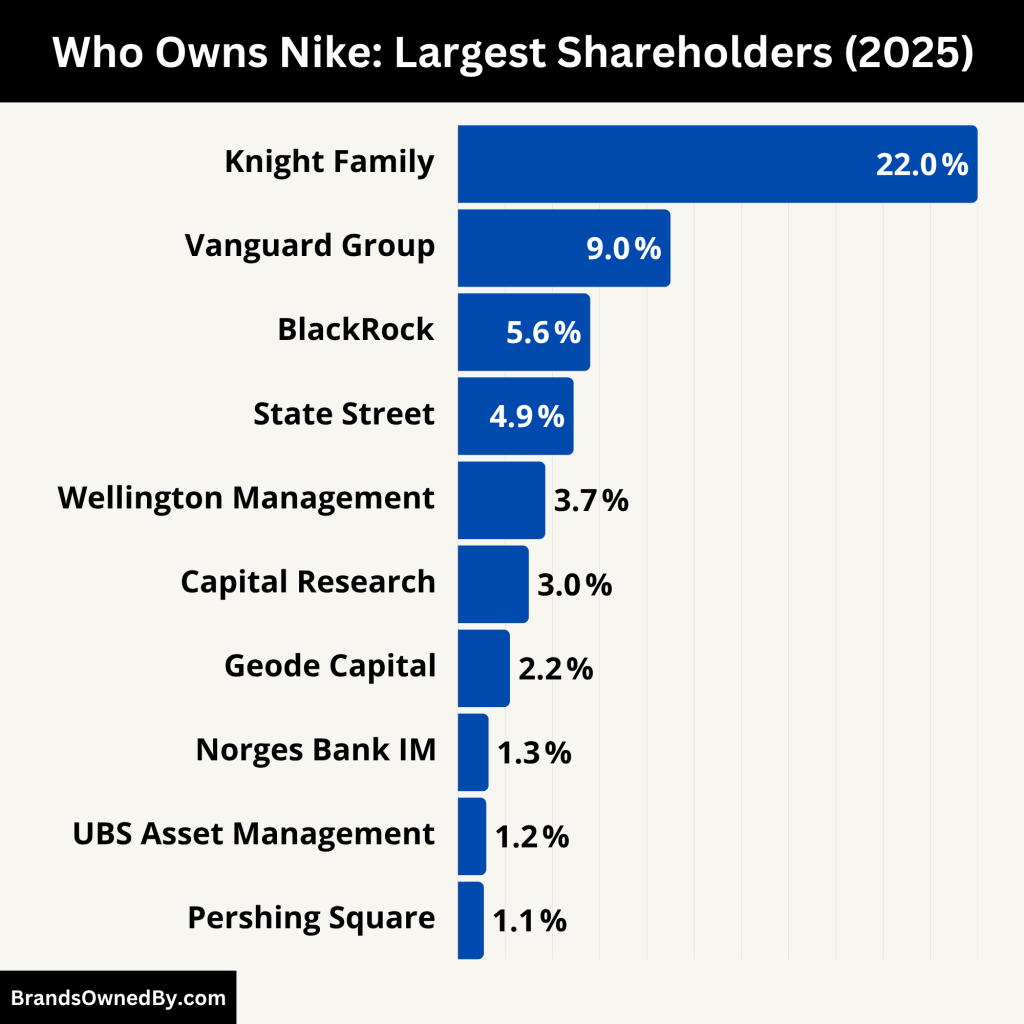
Nike is a publicly traded company listed on the New York Stock Exchange under the ticker symbol NKE. That means the ownership is divided among public shareholders. However, a large portion of voting power remains with the Knight family through Class A shares.
The largest individual shareholder is Phil Knight, the company’s co-founder and former CEO. Although he retired from the board in 2016, he still holds significant control through a trust that owns a major portion of Class A stock.
As of mid‑2025:
- Institutional investors hold around 62–66% of Nike stock.
- Insiders own about 1–1.5%
- Retail shareholders make up the remaining 34%.
Here’s a list of the major shareholders of Nike as of June 2025:
| Shareholder | Approx. % of Total Shares | Share Count (Approx.) | Role & Influence |
|---|---|---|---|
| Knight Family (Phil & Travis via Swoosh LLC) | 17–22 % | 437 M (incl. Class A & B) | Controls 97 % of Class A voting power—dominant board influence |
| Vanguard Group | 7–9 % | 108 M Class B shares | Largest passive institutional investor |
| BlackRock, Inc. | 5.6–6 % | 66–89 M shares | Major passive investor |
| State Street Global Advisors | 3.9–4.9 % | 57–58 M shares | Passive institutional investor |
| Wellington Management | 1.5–3.7 % | 44–46 M shares | Active institutional investor |
| Capital Research & Management | 1.9–3.5 % | 41 M shares | Institutional shareholder |
| Geode Capital Management | 1.6–2.2 % | 26 M shares | Index fund investor |
| Norges Bank IM | 1.0–1.3 % | 15 M shares | Sovereign wealth fund |
| UBS Asset Management | 1.2 % | 31.5 M shares | Institutional investor |
| Pershing Square (William Ackman) | 1.1–1.5 % | 18.8 M shares | Hedge fund; activist positioning |
| Nike Insiders (Execs & Directors) | 1–1.5 % | 12–13 M shares | Includes John Donahoe, Mark Parker—aligning senior leadership with performance |
| Other Institutions & Retail | 32–34 % (Retail); 65–69 % (Institutional) | — | Broad public and institutional ownership |
Phil Knight & Knight Family (via Swoosh LLC and Travis Knight Trust)
Phil Knight remains the dominant force behind Nike. As of June 28, 2024, he personally held 23.9 million Class A shares (8% of Class A) and 32.2 million Class B shares (2.6% of Class B).
Swoosh LLC, created by Knight, owned 230.75 million Class A shares (77.5% of Class A) and an equal amount of Class B shares (16.1% of Class B). A trust linked to his son, Travis Knight, held another 34.8 million Class A shares (11.7%) and 34.8 million Class B shares (2.8%).
Altogether, Knight and family control nearly all Class A shares—granting them about 97% of Class A voting power—while owning roughly 17% of Nike’s total shares, solidifying firm control
Vanguard Group
Vanguard is the top institutional shareholder, holding approximately 109.5 million Class B shares—about 9% of Class B as of June 28, 2024.
This stake translates to around 7.3% of the total company, roughly $7.8 billion in value. Vanguard invests via index funds and ETFs. Its holdings reflect long‑term, passive investor interests.
BlackRock, Inc.
BlackRock is another major institutional investor with 89.8 million Class B shares (7.3% of Class B), representing about 5.6% of total equity ($6.9 billion in holdings). Similar to Vanguard, BlackRock holds its stake passively.
State Street Global Advisors
State Street’s funds own around 56–58 million Class B shares, or 3.7% of Class B ( 4% total holdings, $4.2 billion). These investments add to the 65%+ combined institutional holdings.
Travis Knight Trust
The Travis A. Knight 2009 Irrevocable Trust II holds 34.8 million Class A shares and an equal number of Class B shares, representing about 11.7% of Class A and 2.8% of Class B. Travis Knight is on Nike’s board and helps oversee the Knight family’s voting structure.
Capital Research & Management
This institutional player holds around 40.9 million shares, or 2.8% of total equity (the figure includes shares across its investment divisions).
Wellington Management
Wellington Management owns approximately 26.1–36.3 million shares, which is 1.7–2.5% of Nike’s total stock. A surge of +34.9% in holdings occurred recently. Their stake is actively managed and influences governance through proxy votes.
Geode Capital Management
Geode holds roughly 24.8–25.4 million shares, equivalent to 1.6–1.7% of Nike. As an index fund manager, its influence is significant yet passive.
Pershing Square Capital
William Ackman’s hedge fund Pershing Square owns about 18.8 million shares, roughly 1.3% of total equity, following a 15% increase in late 2024. This stake is more activist in nature compared to broad-index institutional owners.
Norges Bank Investment Management
Norway’s sovereign wealth fund, through Norges Bank, owns approximately 14.9 million shares—about 1.0–1.3% of total equity. This reflects a stable, long-term investment strategy.
UBS Asset Management
UBS holds around 31.5 million shares, about 2.1% of Nike’s outstanding shares, marking a strong institutional position.
FMR, Northern Trust, and Others
Several other major institutional investors include:
- FMR (Fidelity): 11.3–14.7 million shares (0.7–1.0%)
- Northern Trust: 14.4 million shares (0.95–0.99%)
- Wells Fargo, Morgan Stanley, Legal & General, Charles Schwab, and others—each holding between 0.5% to 0.9%.
Nike Insiders (Executives & Directors)
Executives hold roughly 12.6 million Class B shares, equal to 1.1% of Class B or 1.3% of total shares. Notable individuals include:
- Mark Parker (Executive Chairman, former CEO): 2.74 million shares (0.2% of Class B).
- John Donahoe (CEO): 1.71 million shares (0.1% of Class B).
They align leadership incentives with shareholder value.
Who is the CEO of Nike?
Elliott Hill returned to Nike as President and Chief Executive Officer on October 14, 2024, after previously retiring in 2020. He spent over 30 years at Nike, starting as an intern in 1988 and rising to President of Consumer & Marketplace, overseeing global commercial and marketing operations for both Nike and Jordan Brand.
Under Hill’s leadership, Nike restructured into three key areas: Consumer & Sport, Marketing, and Product Creation (Innovation & Design).
He emphasizes a renewed “obsession with sport,” aiming to reduce discounting, invest in innovation, and strengthen relationships with retailers and athletes.
Hill also addressed employees in his first communication, calling for urgency, teamwork, and rapid action to recover Nike’s momentum. His first-year compensation is reported at $27 million.
John Donahoe – Retired CEO & Current Advisor (Jan 2020–Oct 2024)
John Donahoe, appointed CEO in January 2020, came from high-profile roles at Bain, eBay, and ServiceNow.
He led Nike through the pandemic, initiated a strategic pivot to Direct‑to‑Consumer sales, and focused on digital transformation. However, challenges arose: strained retail relationships, supply chain disruptions, and a 48% stock decline during his tenure.
Donahoe retired effective October 13, 2024, and stayed on as advisor until January 31, 2025, to support a smooth transition.
Mark Parker – Executive Chairman
Mark Parker, Nike’s long‑time CEO from 2006–2020, now serves as Executive Chairman. He chairs the Executive Committee alongside Elliott Hill and Travis Knight and supports board governance and succession.
Board & Decision-Making
Nike’s governance operates under a 12‑member Board, elected by shareholders. The Executive Committee includes the Executive Chairman (Parker), the CEO (Hill), and a Knight family representative (Travis Knight).
- The Board sets strategic direction, appoints corporate officers, and monitors management.
- Control is firmly held by the Knight family, via Class A shares and trusts, giving them the power to elect a majority of directors. Combined with active board roles from Parker and Hill, this ensures vision alignment.
- Major institutional investors (Vanguard, BlackRock, State Street) hold publicly traded Class B shares but exercise passive influence, primarily through proxy votes.
Below is an overview of who controls Nike:
| Group | Method of Control |
|---|---|
| Knight Family | Elected by shareholders; approves strategic decisions, oversees management via the Executive Committee. |
| Board of Directors | Owns 17–20% of total shares, but holds 97% of Class A voting power. Elects most board members, firmly guiding strategy. |
| Executive Team | Elected by shareholders; approves strategic decisions, oversees management via Executive Committee. |
| Institutional Investors | CEO Elliott Hill drives day-to-day operations, implements strategy across Consumer, Marketing, and Product Creation. |
Nike Annual Revenue and Net Worth
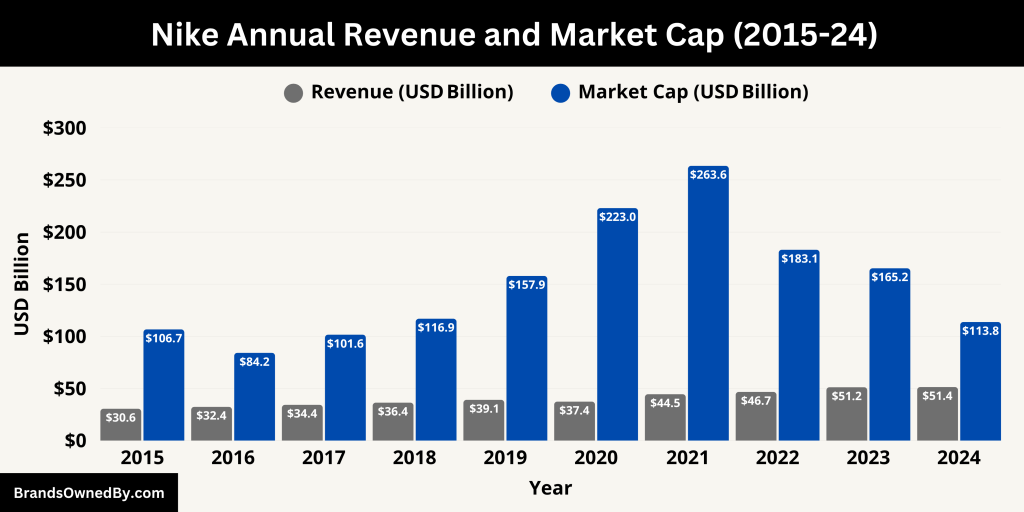
Nike’s fiscal results highlight a $47.8 billion annual revenue, with quarterly declines reflecting both internal strategic recalibrations and external market pressures. Profits have softened, with net income at $4.5 billion TTM, and margins squeezed by cost and inventory dynamics. However, shareholder returns remain robust, supported by consistent dividends and share buybacks under long-term programs.
Despite recent headwinds, Nike’s market cap near $93 billion cements its position as a leading global apparel and footwear company.
Fiscal Year 2025 (Trailing Twelve Months)
- For the 12 months ending February 28, 2025, Nike’s revenue totaled $47.82 billion, marking a 7.3% decline year-over-year (from $51.36 billion in fiscal year 2024).
- The drop reflects challenges such as macroeconomic pressures and softer demand in core product lines.
Quarterly Revenue Breakdown
Q2 FY2025 (Nov 1, 2024 – Jan 31, 2025):
- Total revenue: $12.4 billion, down 8% y/y; on a constant-currency basis, down 9%.
- Nike Direct: $5.0 billion (–13% y/y).
- Wholesale: $6.9 billion (–3% y/y).
- Converse: $429 million (–17% y/y).
Q3 FY2025 (Dec 1, 2024 – Feb 28, 2025)
- Total revenue: $11.26 billion, down 9% y/y (–7% on a constant-currency basis).
- Nike Direct: $4.7 billion (–12%); Wholesale: $6.2 billion (–7%); Converse: $405 million (–18%).
Net Income (Trailing Twelve Months)
- For the 12 months ending February 28, 2025, net income reached $4.508 billion, representing a 13.8% decrease year-over-year.
Q3 FY2025 Performance
- Net income for the quarter was $794 million, a sharp 32.3% drop from $1.17 billion one year prior.
- EPS declined from $0.77 to $0.54.
Gross and Operating Margins
- Q3 gross margin fell by 330 basis points to 41.5% due to increased discounts, elevated product costs, and channel mix shifts.
- Selling and administrative expenses dropped 8% to $3.9 billion; operating overhead decreased 13% to $2.8 billion.
Shareholder Returns
- In Q3 FY2025, Nike returned $1.1 billion to shareholders:
- Dividends: $594 million (6% year-over-year increase).
- Share buybacks: $499 million, retiring 6.5 million shares under its $18 billion program.
- Since program inception in June 2022, 119.3 million shares ($11.8 billion) have been repurchased.
- Q2 FY2025 saw $1.6 billion returned: $557 million in dividends and $1.1 billion in share repurchases.
- Nike has increased dividend payouts for 23 consecutive years.
Market Capitalization & Net Worth
- As of June 4–6, 2025, Nike’s market capitalization stood between $92.65 billion and $92.69 billion, reflecting a 33–34% decline over the past year.
- Enterprise value during this time was approximately $94.2 billion.
Below is an overview of the revenue and market cap (net worth) of Nike from 2015-24:
| Fiscal Year End | Revenue (USD bn) | Net Income (USD bn) | Market Cap at Year-End¹ (USD bn) |
|---|---|---|---|
| 2015 | 30.60 | 3.27 | 106.68 |
| 2016 | 32.38 | 3.76 | 84.17 |
| 2017 | 34.35 | 4.24 | 101.58 |
| 2018 | 36.40 | 1.93 | 116.91 |
| 2019 | 39.12 | 4.03 | 157.94 |
| 2020 | 37.40 | 2.54 | 223.02 |
| 2021 | 44.54 | 5.73 | 263.55 |
| 2022 | 46.71 | 6.05 | 183.07 |
| 2023 | 51.22 | 5.07 | 165.23 |
| 2024 | 51.36 | 5.70 | 113.75 |
Companies Owned by Nike
Nike owns and operates several brands and subsidiaries that expand its reach in the athletic and casual wear market.
Here’s a list of the major companies and brands owned by Nike as of 2025:
| Company / Brand | Year Acquired / Founded | Focus / Industry | Key Details | Ownership Status |
|---|---|---|---|---|
| Nike, Inc. | Founded 1964 (as BRS) | Athletic footwear, apparel | Global leader in sportswear, footwear, and equipment. Includes innovation in performance tech. | Parent company |
| Nike Brand | 1971 (renamed Nike) | Performance and lifestyle | Flagship brand known for innovation, athlete endorsements, and global retail presence. | Fully owned |
| Jordan Brand | 1984 (partnership) | Basketball footwear, apparel | Iconic basketball and lifestyle brand based on Michael Jordan; operates semi-independently. | Fully owned |
| Converse, Inc. | Acquired 2003 | Casual footwear, apparel | Known for Chuck Taylor and One Star sneakers; targets youth and lifestyle markets. | Wholly owned |
| TravisMathew | Acquired 2017 | Golf apparel and lifestyle | Premium men’s golf and lifestyle brand; operates independently under Nike. | Fully owned |
| Nike Digital Platforms | Developed internally | E-commerce, fitness apps | Includes Nike App, SNKRS App, Nike Training Club; focus on consumer engagement and data. | Fully owned |
| Nike Direct | Developed internally | Retail operations | Nike’s owned stores and online channels; major revenue driver and strategic growth area. | Fully owned |
Nike, Inc.
Nike, Inc. itself is the primary company under which all its brands and subsidiaries operate. Founded in 1964 as Blue Ribbon Sports, it was officially renamed Nike in 1971. Nike designs, develops, and markets athletic footwear, apparel, equipment, and accessories worldwide. It is the parent entity managing a portfolio of globally recognized brands focused on sport and lifestyle.
Nike Brand
Nike’s flagship brand is simply called Nike. It is the world’s largest supplier of athletic shoes and apparel. The brand is known for its innovative designs, cutting-edge technology, and strong athlete endorsements. Nike focuses on performance sportswear, running, basketball, football (soccer), training, and lifestyle categories. It has a vast global retail footprint with Nike stores, online platforms, and partnerships with retailers.
Nike’s product innovation includes proprietary technologies such as Nike Air, Flyknit, React foam, and ZoomX cushioning. The brand consistently collaborates with elite athletes, designers, and sports teams to maintain its leadership position.
Jordan Brand
Launched in 1984, Jordan Brand is a subsidiary focused on basketball footwear, apparel, and accessories. It originated from Michael Jordan’s signature sneaker deal with Nike. Over the years, Jordan Brand has expanded beyond basketball into lifestyle and culture segments.
Jordan is renowned for its high-performance basketball shoes like the Air Jordan line, and it also commands a strong presence in streetwear and casual apparel. The brand operates semi-independently, managing its own marketing, athlete endorsements, and product development under the Nike umbrella.
Converse, Inc.
Acquired by Nike in 2003, Converse operates as a wholly owned subsidiary specializing in casual footwear, apparel, and accessories. Converse is best known for its iconic Chuck Taylor All Star and One Star sneakers, which have a significant presence in youth culture, music, and lifestyle markets.
Though separate from Nike’s performance-focused brands, Converse benefits from Nike’s manufacturing, distribution, and innovation capabilities. Converse targets a younger demographic and focuses on style, self-expression, and creative collaborations.
Hurley International LLC
Nike owned Hurley International, a surfwear and lifestyle brand, from 2002 until it sold the company in 2019. As of 2025, Hurley is no longer part of Nike’s portfolio.
Cole Haan
Nike owned Cole Haan, a premium footwear and accessories brand focused on fashion and comfort, from 1988 until selling it in 2013. Cole Haan is no longer part of Nike’s holdings.
Brand Jordan and Nike Digital Platforms
Nike invests heavily in digital commerce and connected fitness platforms linked to its core brands, including the Nike App, SNKRS App, and Nike Training Club (NTC). These platforms help Nike engage consumers directly, offering personalized shopping, product launches, and fitness coaching.
Nike Direct
Nike operates a vast network of owned and operated retail stores globally, known collectively as Nike Direct. This division includes flagship stores, factory outlets, and online sales channels. Nike Direct contributes nearly half of Nike’s revenue and is a strategic focus for driving margin improvements and consumer loyalty.
Other Subsidiaries and Partnerships
- Converse’s Global Licensing: Converse licenses its brand in certain regions through third parties, expanding its reach.
- TravisMathew: Nike acquired this premium lifestyle golf apparel brand in 2017. It operates independently, focusing on men’s golf apparel and lifestyle.
- Other smaller subsidiaries: Nike owns or controls several smaller specialized companies involved in innovation, supply chain, and technology to support its product offerings.
Final Thoughts
Nike is a global powerhouse in the sportswear industry. While it is a publicly traded company, control still largely rests with its co-founder Phil Knight through his voting rights. Its CEO, John Donahoe, continues to steer Nike into a digital-first future. With a diverse portfolio of brands and strong financials, Nike remains a leader in global athletic wear.
FAQs
Who is the real owner of Nike?
Nike is a publicly traded company owned by millions of shareholders worldwide. The largest individual shareholder is Phil Knight, the co-founder, who holds a significant but minority stake. No single person “owns” Nike outright.
Is Nike still family-owned?
No, Nike is no longer family owned. It went public in 1980, making its ownership spread among institutional investors, mutual funds, and individual shareholders.
Who is the king of Nike?
Phil Knight is often called the “king of Nike” because he co-founded the company and served as its longtime chairman and CEO, shaping Nike into the global powerhouse it is today.
Does Michael Jordan own Nike?
Michael Jordan does not own Nike. However, he has a lifetime endorsement deal with Nike, and his Jordan Brand is a wholly owned subsidiary of Nike.
Who runs Nike?
As of 2025, Nike is led by CEO John Donahoe. The company’s leadership team, including executives and the board of directors, manages daily operations and strategic decisions.
Who are Nike’s relatives?
If by “relatives” you mean affiliated brands, Nike owns several key brands like Jordan Brand, Converse, and TravisMathew. These brands operate under the Nike corporate umbrella.
What country owns Nike?
Nike is an American company, founded and headquartered in the United States (Beaverton, Oregon). It is publicly owned by shareholders around the globe.
Is the owner of Nike a billionaire?
Yes, Phil Knight, co-founder and largest individual shareholder of Nike, is a billionaire. His wealth largely comes from his stake in Nike.
Is Nike the owner of Jordan?
Yes, Jordan Brand is a subsidiary fully owned by Nike, Inc.
Does Nike still pay Michael Jordan?
Yes, Michael Jordan continues to receive royalties and endorsement payments from Nike, stemming from their lifetime contract and the success of the Jordan Brand.
Who owns Nike shoes?
Nike shoes are owned by Nike, Inc., the company that designs, manufactures, and sells them worldwide.
What is Phil Knight’s net worth?
As of 2025, Phil Knight’s net worth is estimated to be around $38 billion, primarily from his stake in Nike and other investments.
Who founded Nike?
Nike was founded by Phil Knight and Bill Bowerman in 1964 as Blue Ribbon Sports and officially became Nike, Inc. in 1971.
Who owns the Nike trademark?
The Nike trademark is owned by Nike, Inc. The company holds intellectual property rights for its name, logo, and other branding elements worldwide.
Who is the largest shareholder of Nike?
Phil Knight is the largest individual shareholder, controlling nearly all of the Class A shares through Swoosh LLC. These shares give him significant voting power.
Is Nike privately owned?
No, Nike is not privately owned. It is a publicly traded company listed on the New York Stock Exchange.
Does Phil Knight still own Nike?
Yes, Phil Knight still owns a significant stake in Nike and maintains control through Class A shares, even though he stepped down from the board.
How much is Nike worth?
As of June 2025, Nike’s market value is around $160 billion. Its annual revenue exceeds $51 billion.