

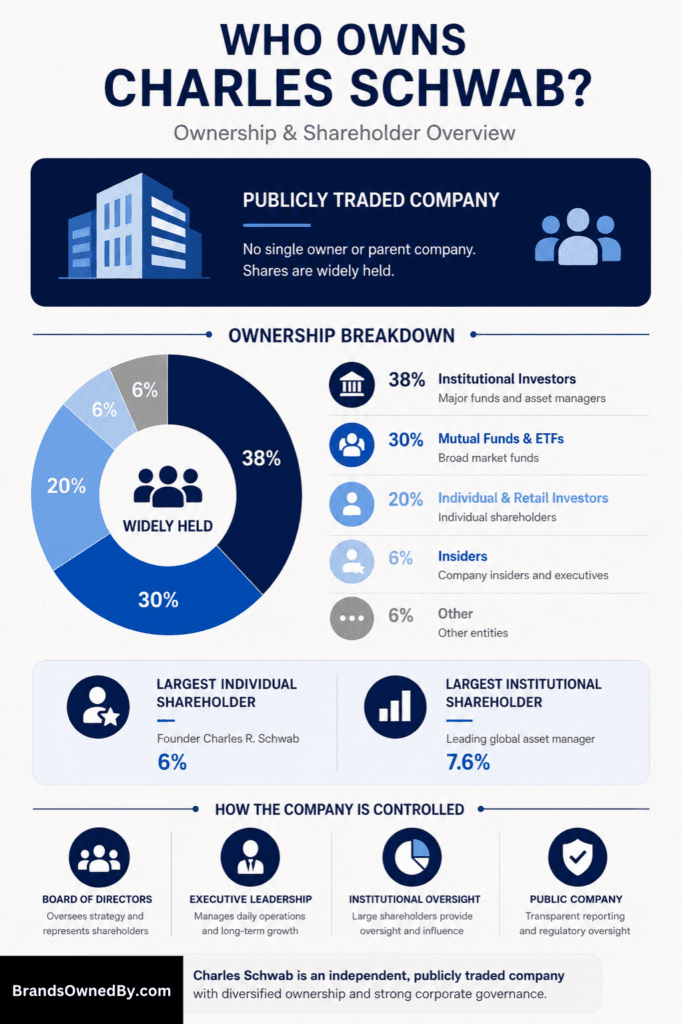
- The Charles Schwab Corporation is a publicly traded company with no majority owner. Ownership is spread among institutional investors, mutual funds, pension funds, retail shareholders, and company insiders, making it one of the most widely held financial services firms in the United States.
- BlackRock is the largest institutional shareholder as of June 2026, holding approximately 7.6% of outstanding shares. Other major shareholders include Vanguard Group, State Street Corporation, Dodge & Cox, JPMorgan Asset Management, Fidelity Investments, and Geode Capital Management.
- Founder Charles R. Schwab remains the largest individual shareholder, owning approximately 6% of the company. Although he no longer manages day-to-day operations, his stake gives him significant influence and aligns his interests with long-term shareholders.
- Charles Schwab is controlled through a combination of its board of directors, executive leadership team, and major institutional investors. Unlike founder-controlled firms such as Interactive Brokers or family-controlled companies like Fidelity Investments, Schwab operates under a diversified public ownership structure with shared governance and oversight.
The Charles Schwab Corporation is one of the largest investment services companies in the United States. Founded in 1971, the company transformed the brokerage industry by pioneering the discount brokerage model and later becoming a leader in online investing, wealth management, and financial advisory services.
The company is headquartered in Westlake, Texas, and serves individual investors, independent financial advisors, employers, institutions, and retirement plan participants. Charles Schwab offers brokerage accounts, retirement accounts, banking products, wealth management solutions, exchange-traded funds (ETFs), mutual funds, financial planning services, and institutional custody solutions.
Following the acquisition and integration of TD Ameritrade, Schwab strengthened its position as the dominant retail brokerage platform in the United States. As of June 2026, the company serves approximately 39.5 million active brokerage accounts and oversees more than $13 trillion in client assets. These figures place Schwab among the largest financial institutions in the world.
Unlike traditional Wall Street firms that primarily focus on high-net-worth clients, Charles Schwab built its reputation by making investing more accessible to ordinary investors. The company’s low-cost trading model, extensive branch network, digital investing tools, and advisory services have helped millions of Americans manage their investments and retirement savings.
Founder of Charles Schwab Corporation
Charles Schwab was founded by Charles Robert Schwab in 1971. He launched the company during a period when stock trading was dominated by traditional brokerage firms that charged high commissions and catered primarily to wealthy investors.
Schwab recognized an opportunity to make investing more affordable and transparent. His vision gained momentum after the deregulation of brokerage commissions in 1975, often referred to as “May Day” on Wall Street. This regulatory change allowed brokerage firms to compete on pricing, enabling Schwab to offer significantly lower commissions than many competitors.
The strategy proved successful. Charles Schwab became one of the first major discount brokerage firms in the United States and helped reshape the entire investment industry.
Who is Charles R. Schwab?
Charles R. Schwab is an American businessman and investor widely regarded as one of the pioneers of modern retail investing.
Born on July 29, 1937, in Sacramento, California, Schwab earned a Bachelor of Arts degree in Economics and later an MBA from Stanford University. Before founding his company, he worked in the investment industry and developed a strong understanding of the challenges faced by individual investors.
His leadership helped Charles Schwab grow from a small brokerage operation into one of the most influential financial services firms in the world. Even today, he remains closely associated with the company and continues to serve as Chairman of The Charles Schwab Corporation.
As of June 2026, Charles R. Schwab owns approximately 6% of the company’s outstanding shares, making him the largest individual shareholder and one of the most influential figures in the organization’s long-term strategy.
Core Business Operations
Charles Schwab operates through several interconnected business lines that generate recurring revenue and support long-term client relationships.
The company’s brokerage business allows clients to trade stocks, bonds, options, exchange-traded funds, mutual funds, certificates of deposit, and other investment products through digital platforms and financial consultants.
Its wealth management division provides portfolio management, financial planning, retirement planning, estate planning assistance, and investment advisory services.
Schwab also operates a substantial banking business through Charles Schwab Bank. Customers can access checking accounts, savings products, mortgage services, pledged asset lines, and cash management solutions through the platform.
Another major business segment is Schwab Advisor Services. This division supports thousands of independent registered investment advisors by providing custody, technology infrastructure, reporting tools, trading platforms, and compliance support.
The company also manages one of the largest ETF families in the United States through Schwab Asset Management, competing directly with investment products offered by Vanguard, BlackRock, and State Street.
Ownership History
Charles Schwab’s ownership history is closely tied to the evolution of the American brokerage industry. Unlike many financial institutions that were created by large banks, Charles Schwab began as an independent company founded by an entrepreneur who wanted to make investing more accessible to ordinary investors.
Over the years, the company experienced acquisitions, management buyouts, public listings, and major mergers that significantly changed its ownership structure.
1971–1983: Charles R. Schwab Establishes the Company
Charles R. Schwab founded the company in 1971 in San Francisco, California. The business initially operated as First Commander Corporation, an investment newsletter publisher and brokerage firm.
At the time, traditional brokerage firms charged high commissions and primarily served wealthy clients. Schwab saw an opportunity to provide lower-cost investment services to retail investors.
Following the deregulation of brokerage commissions in 1975, Schwab aggressively expanded its discount brokerage operations. The company’s lower fees and investor-friendly approach quickly attracted customers across the United States.
During this period, ownership remained largely concentrated in the hands of founder Charles R. Schwab and a small group of private investors.
1983: Bank of America Acquires Charles Schwab
A major ownership change occurred in 1983 when Bank of America acquired Charles Schwab for approximately $55 million.
The acquisition gave Bank of America full ownership of the brokerage firm. For Schwab, the deal provided access to additional capital, technology resources, and a nationwide banking network.
At the time, many analysts believed combining banking and brokerage services could create significant growth opportunities. However, the partnership did not develop as expected.
Differences in corporate culture and strategic priorities eventually led both parties to reconsider the arrangement.
1987: Charles Schwab Buys Back the Company
One of the most important moments in the company’s history came in 1987.
Charles R. Schwab led a management buyout and repurchased the company from Bank of America for approximately $280 million.
The transaction restored independent ownership and allowed Schwab to regain direct control over the company’s strategic direction.
The buyback is often viewed as one of the most successful management buyouts in the financial services industry. It enabled the company to focus entirely on expanding its brokerage and investment services business without being constrained by a large banking parent.
Following the buyback, Charles Schwab accelerated its expansion across the United States and invested heavily in technology and customer service.
1987–1997: Expansion as an Independent Brokerage Firm
After regaining independence, Charles Schwab entered a period of rapid growth.
The company expanded its branch network, introduced innovative investment products, and became one of the first major brokerage firms to embrace digital technology.
Ownership during this period remained largely distributed among public market investors after the company became publicly traded. Charles R. Schwab retained a significant ownership stake and remained the company’s most influential shareholder.
Institutional investors also began accumulating shares as the company’s market value increased.
1997–2019: Rise of Institutional Ownership
As Charles Schwab grew into one of the largest brokerage firms in the United States, institutional ownership steadily increased.
Large asset managers such as Vanguard, BlackRock, State Street, Fidelity, and Geode Capital Management accumulated substantial positions in the company through mutual funds, pension funds, and exchange-traded funds.
This shift reflected a broader trend across publicly traded American corporations. Rather than being owned by a few large investors, ownership became increasingly diversified among institutional investment firms representing millions of individual investors.
Although institutional ownership expanded significantly, Charles R. Schwab continued to maintain one of the largest individual stakes in the company.
2020: TD Ameritrade Acquisition Reshapes Ownership
Another major ownership milestone occurred in October 2020 when Charles Schwab completed its acquisition of TD Ameritrade in a transaction valued at approximately $26 billion.
The acquisition was one of the largest brokerage industry mergers in history.
As part of the transaction, Toronto-Dominion Bank (TD Bank), which previously held a significant stake in TD Ameritrade, became one of the largest shareholders of The Charles Schwab Corporation.
The deal substantially increased Schwab’s client base, advisor relationships, and assets under management while strengthening its leadership position in the brokerage industry.
The ownership structure also became more concentrated among large institutional investors due to the issuance of additional shares during the merger.
2023–2025: TD Bank Gradually Exits Its Stake
Following the successful integration of TD Ameritrade, Toronto-Dominion Bank gradually reduced its ownership position.
During 2023, 2024, and 2025, TD Bank sold portions of its Schwab holdings through public offerings and secondary market transactions.
In 2025, TD Bank completed the sale of its remaining stake, ending its role as one of Schwab’s largest shareholders.
The sale increased the percentage ownership held by existing institutional investors and public shareholders.
This development also reduced the influence of any single corporate shareholder within the company.
2026: Current Ownership Structure
As of June 2026, The Charles Schwab Corporation operates as a widely held public company.
No single shareholder controls the business.
The largest ownership stakes are held by institutional investors such as The Vanguard Group, BlackRock, State Street Global Advisors, Fidelity Management & Research, and Geode Capital Management.
Founder Charles R. Schwab remains the largest individual shareholder with an ownership stake of approximately 6%.
The company’s ownership structure reflects the modern model used by many large U.S. corporations. Institutional investors hold the majority of shares on behalf of pension funds, retirement accounts, mutual funds, exchange-traded funds, and millions of individual investors.
While ownership is broadly distributed, Charles R. Schwab continues to play an important role as Chairman and remains one of the most influential figures in the company’s long-term direction.
Who Owns Charles Schwab Corporation: Major Shareholders
The Charles Schwab Corporation is a publicly traded company listed on the New York Stock Exchange under the ticker symbol SCHW. As a result, ownership is divided among institutional investors, mutual funds, pension funds, ETFs, company insiders, and millions of individual shareholders.
Unlike companies where a founder or family maintains majority control, Charles Schwab has a widely dispersed ownership structure. Institutional investors collectively own more than 80% of the company’s outstanding shares. This means that the company’s largest shareholders are primarily asset management firms that invest on behalf of retirement funds, mutual funds, ETFs, insurance companies, and individual investors.
Founder Charles R. Schwab remains the largest individual shareholder and continues to play an important role as Chairman. However, no single investor controls the company.
Largest Charles Schwab Shareholders (June 2026)
Charles R. Schwab (Founder and Largest Individual Shareholder)
Charles R. Schwab remains one of the most important owners of the company he founded in 1971.
As of June 2026, the Charles & Helen Schwab Living Trust controls approximately 2.8% to 3.0% of the company’s outstanding shares directly, while Schwab’s total beneficial ownership is estimated at roughly 6% when related holdings are included. This makes him the largest individual shareholder of the company.
Unlike institutional investors that primarily hold shares through funds, Schwab’s ownership represents a direct economic interest in the business. His stake aligns his interests with long-term shareholders and gives him significant influence over strategic decisions.
Even after stepping down from executive leadership, Schwab continues to serve as Chairman and remains one of the most influential voices in the organization.
BlackRock
BlackRock is currently one of Charles Schwab’s largest institutional shareholders.
As of 2026, BlackRock owns approximately 7.5% to 7.7% of Schwab’s outstanding shares, representing more than 130 million shares.
The investment is primarily held through BlackRock’s iShares ETFs, index funds, institutional portfolios, and retirement products.
BlackRock’s ownership is significant because the firm manages more than $12 trillion in assets globally. Through its voting rights, BlackRock can influence corporate governance matters such as director elections, executive compensation, shareholder proposals, and ESG policies.
Although BlackRock does not participate in day-to-day management, its voting power makes it one of Schwab’s most influential shareholders.
The Vanguard Group
The Vanguard Group is another major shareholder of Charles Schwab.
Recent ownership filings show Vanguard controls roughly 6% to 9% of Schwab’s outstanding shares, depending on reporting periods and fund holdings. In several filings, Vanguard has appeared as either the largest or second-largest institutional shareholder.
Vanguard’s ownership comes primarily through its index funds and ETFs, including funds that track the S&P 500 and broader U.S. equity markets.
Because Vanguard manages assets for millions of retirement savers and long-term investors, its investment horizon tends to be long-term. The firm generally supports policies that promote sustainable growth, shareholder value creation, and strong governance standards.
Dodge & Cox
Dodge & Cox is one of the most important active investors in Charles Schwab.
The investment management firm owns approximately 4.3% of Schwab’s outstanding shares, making it one of the company’s largest active shareholders.
Unlike Vanguard and BlackRock, which primarily use passive indexing strategies, Dodge & Cox actively selects investments based on fundamental research.
Its substantial position in Charles Schwab reflects confidence in the company’s long-term earnings potential, market leadership, and competitive advantages within the brokerage and wealth management industry.
State Street Global Advisors
State Street Global Advisors ranks among the largest institutional owners of Charles Schwab.
The firm owns approximately 4.1% to 5.0% of the company’s shares through its ETF and institutional investment platforms.
State Street is one of the “Big Three” asset managers, alongside Vanguard and BlackRock. Together, these firms hold substantial ownership stakes in most major publicly traded U.S. corporations.
State Street’s ownership gives it meaningful voting power on corporate governance matters and shareholder resolutions.
JPMorgan Asset Management
JPMorgan Asset Management has emerged as one of Charles Schwab’s largest shareholders.
Recent filings show JPMorgan controls approximately 3.4% of the company’s outstanding shares, representing nearly 60 million shares.
The investment is spread across mutual funds, pension portfolios, institutional accounts, and wealth management products managed by JPMorgan.
Its ownership position demonstrates confidence in Schwab’s ability to continue expanding its brokerage, advisory, banking, and asset management businesses.
T. Rowe Price Associates
T. Rowe Price is another significant institutional shareholder of Charles Schwab.
The company owns approximately 2.8% of Schwab’s outstanding shares.
T. Rowe Price is known for its actively managed mutual funds and long-term investment approach. Its ownership stake reflects a belief that Charles Schwab can continue generating recurring revenue from client assets, advisory services, and banking operations.
The firm’s investment managers frequently evaluate management performance, capital allocation decisions, and growth opportunities when maintaining positions of this size.
Fidelity Management & Research
Fidelity is one of the largest investment management firms in the world and maintains a significant ownership position in Charles Schwab.
Its holdings are spread across numerous mutual funds, retirement products, and institutional portfolios.
Fidelity’s investment reflects Schwab’s strong competitive position in retail brokerage, wealth management, retirement services, and advisor custody solutions.
Although Fidelity directly competes with Schwab in several business segments, it remains a major shareholder because of the company’s strong financial performance and market leadership.
Geode Capital Management
Geode Capital Management is another major institutional investor in Charles Schwab.
The firm manages hundreds of billions of dollars and owns a substantial number of Schwab shares through index-based investment strategies.
While Geode receives less public attention than Vanguard or BlackRock, it consistently ranks among the company’s largest institutional shareholders and plays a meaningful role in shareholder voting matters.
Capital Research and Capital World Investors
Capital Research and its affiliated investment organizations, including Capital World Investors and Capital Research Global Investors, collectively manage hundreds of billions of dollars in assets.
These firms frequently appear among the largest shareholders of major financial institutions and maintain meaningful positions in Charles Schwab through actively managed investment portfolios.
Their investment approach focuses heavily on long-term business quality, management strength, and sustainable competitive advantages.
Other Institutional and Retail Shareholders
Beyond the major investors listed above, Charles Schwab’s ownership is spread across thousands of institutional investors and millions of retail shareholders.
These include pension funds, insurance companies, sovereign wealth funds, hedge funds, university endowments, family offices, and individual investors.
This broad ownership structure helps prevent any single shareholder from exerting excessive control over the company while ensuring that shareholder interests remain diversified.
Competitor Ownership Comparison
The ownership structure of a financial services company can significantly influence its strategy, governance, risk appetite, and long-term decision-making. Some brokerage firms are controlled by founders or families, while others are primarily owned by institutional investors. Understanding how competitors are owned provides useful context when evaluating the company’s position within the investment services industry.
Competitor Ownership Comparison (2026)
Fidelity Investments
Fidelity Investments remains one of the largest privately held financial services companies in the world.
Unlike publicly traded brokerage firms, Fidelity is controlled by the Johnson family. Abigail Johnson serves as Chair and Chief Executive Officer and is the company’s largest shareholder. Through family ownership and voting control, the Johnson family maintains substantial influence over the firm’s strategic direction.
This ownership structure allows Fidelity to focus on long-term investments without pressure from quarterly earnings expectations or public shareholders. The company can pursue initiatives that may take years to generate returns, which is one reason Fidelity has remained privately owned despite its enormous size.
As of June 2026, Fidelity manages more than $15 trillion in client assets and remains one of the largest competitors in brokerage, retirement services, and wealth management.
Morgan Stanley
Morgan Stanley has one of the most institutionally owned shareholder structures among major financial firms.
The company is publicly traded, with ownership dominated by large investment managers such as Mitsubishi UFJ Financial Group, Vanguard Group, BlackRock, State Street, and Capital Research.
Unlike founder-led businesses, Morgan Stanley does not have an individual shareholder with significant control. Instead, governance is influenced primarily by institutional investors and the board of directors.
The company’s acquisition of E*TRADE and Eaton Vance significantly expanded its wealth management and asset management operations, making it one of the strongest competitors in the retail and advisory markets.
Robinhood Markets
Robinhood operates under a very different ownership model compared to traditional brokerage firms.
Although Robinhood is publicly traded, founders Vlad Tenev and Baiju Bhatt retain substantial influence through a dual-class share structure. This arrangement gives founders significantly greater voting power than their economic ownership percentages would normally provide.
Major institutional shareholders include Vanguard Group, BlackRock, Ribbit Capital, Andreessen Horowitz, and Sequoia-related investment entities.
As of June 2026, Robinhood remains one of the few major brokerage companies where founders continue to exercise meaningful control over strategic decisions despite owning a minority of total shares.
This structure allows management to maintain control over product development, expansion plans, and long-term initiatives even when institutional shareholders hold larger economic stakes.
Interactive Brokers Group
Interactive Brokers has one of the most concentrated ownership structures in the brokerage industry.
Founder Thomas Peterffy remains the company’s dominant shareholder and controls a majority of voting power through his ownership interests.
While the company is publicly traded, Peterffy’s influence extends far beyond that of a typical founder-shareholder. His voting control allows him to shape long-term strategy, technology investments, capital allocation decisions, and corporate governance matters.
This ownership model has enabled Interactive Brokers to maintain a strong focus on technology, automation, and international expansion without facing significant pressure from outside investors.
Among major brokerage firms, Interactive Brokers remains one of the most founder-controlled companies in the sector.
SoFi Technologies
SoFi Technologies has emerged as a growing competitor in digital banking, investing, and personal finance services.
The company is publicly traded and primarily owned by institutional investors. Major shareholders include Vanguard Group, BlackRock, SoftBank-related entities, and various growth-oriented investment funds.
Unlike Interactive Brokers or Fidelity, SoFi does not have a controlling founder or family ownership structure. Decision-making authority is distributed among management, the board of directors, and institutional shareholders.
The company has focused heavily on attracting younger investors through digital-first financial products and integrated banking services.
Webull Corporation
Webull has become a notable competitor in commission-free investing and mobile trading.
Following its public listing, ownership became distributed among institutional investors, founders, and early venture capital backers. However, the company’s founder remains an influential stakeholder through insider ownership.
Webull’s ownership structure resembles Robinhood more closely than traditional brokerage firms, combining public ownership with continued founder influence.
The company continues to target active traders and younger investors through technology-focused investment platforms.
Merrill Edge
Merrill Edge differs from most competitors because it is not an independent company.
The platform operates as part of Merrill, which is wholly owned by Bank of America.
As a result, ownership of Merrill Edge ultimately rests with Bank of America shareholders. Major Bank of America shareholders include Berkshire Hathaway, Vanguard Group, BlackRock, and State Street.
This structure provides Merrill Edge with significant advantages, including access to one of the largest banking customer bases in the United States and deep integration with banking products and services.
Key Ownership Differences
The brokerage industry can generally be divided into three ownership models.
The first model is founder-controlled ownership. Interactive Brokers and, to a lesser extent, Robinhood fall into this category. Founders retain substantial influence through voting control or special share structures.
The second model is family ownership. Fidelity Investments represents this category, with the Johnson family maintaining long-term control over the company.
The third model is institutional ownership. Morgan Stanley, SoFi Technologies, and most large publicly traded financial firms operate under this structure. Ownership is spread among investment managers, pension funds, mutual funds, ETFs, and retail investors.
Each model has advantages. Founder-controlled companies often prioritize long-term innovation. Family-owned firms can focus on multi-generational growth. Institutionally owned companies typically benefit from stronger governance oversight and broader shareholder representation.
Charles Schwab Corporation Annual Revenue and Net Worth
Charles Schwab entered 2026 from a position of strength after overcoming the client cash sorting challenges that affected many brokerage firms during 2023 and 2024. Rising client asset balances, higher investor activity, growing advisory relationships, and stronger banking performance have helped the company return to accelerated growth.
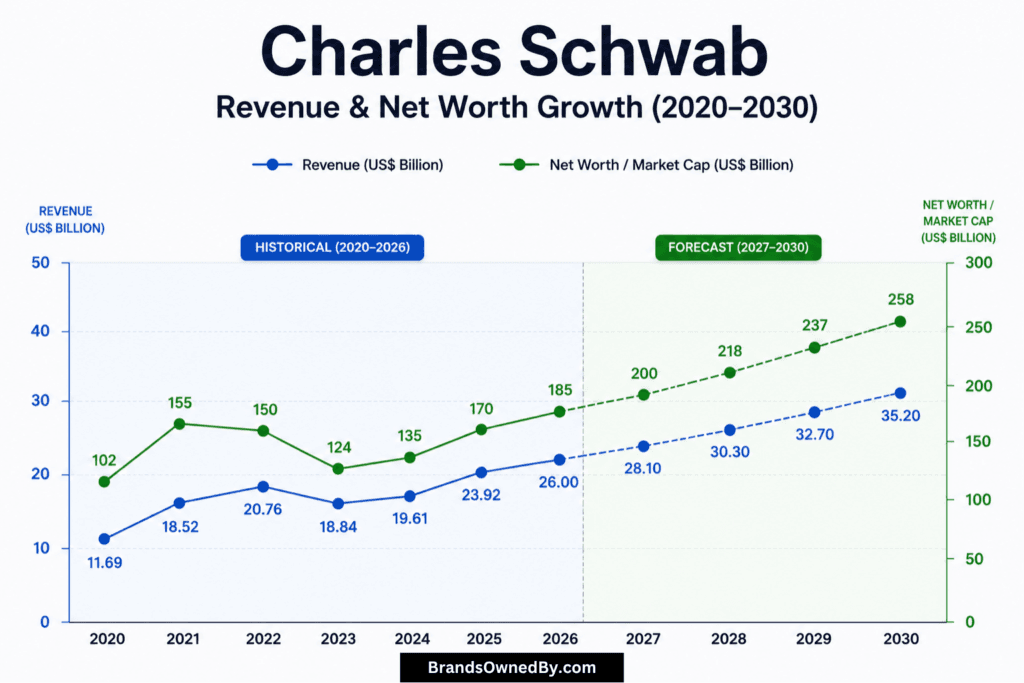
As of June 2026, Charles Schwab is estimated to generate approximately $26 billion in annual revenue, while its market capitalization stands at approximately $185 billion. The company’s valuation reflects its dominant position in retail brokerage, wealth management, advisor custody services, and banking.
Unlike many financial firms that rely heavily on investment banking or trading operations, Schwab generates a large portion of its income from recurring revenue streams. This creates a more predictable business model and supports long-term valuation growth.
Charles Schwab’s 2026 Revenue
The estimated $26 billion revenue figure in 2026 is not driven by a single business segment. Instead, it comes from multiple revenue sources spread across the company’s brokerage, banking, advisory, and asset management operations.
One of the largest contributors is net interest revenue. Schwab earns interest income on client cash deposits held within Schwab Bank, margin loans issued to investors, securities lending activities, and other banking products. Following stabilization in interest rates and improvements in deposit retention, this segment continues to generate billions of dollars annually.
Another major contributor is asset management and administration fees. Schwab manages and administers more than $13 trillion in client assets. Even relatively small management fees applied to trillions of dollars create substantial recurring revenue.
The company’s advisory business also contributes significantly. Thousands of independent registered investment advisors use Schwab Advisor Services for custody, trading, technology infrastructure, and operational support. This division generates recurring revenue while benefiting from growing demand for independent financial advisors.
Trading-related revenue remains important, although it is no longer the dominant source of income. While stock and ETF commissions were eliminated years ago, Schwab continues to generate revenue through options trading, margin lending, payment for order flow in certain products, futures trading, and other transaction-based activities.
The result is a highly diversified revenue base that is less dependent on any single market trend.
Charles Schwab Net Worth
A market value of approximately $185 billion places Charles Schwab among the most valuable financial services companies in the United States.
Investors are not simply valuing the company’s current earnings. They are valuing its ability to generate cash flow from a massive client asset base for decades into the future.
One of Schwab’s most valuable assets is its client relationship network. The company serves approximately 39.5 million active brokerage accounts and oversees more than $13 trillion in client assets. Replacing this customer base would require decades of investment and billions of dollars in infrastructure spending.
The TD Ameritrade acquisition has also strengthened Schwab’s competitive position. The transaction expanded its advisor network, increased scale, improved operating efficiency, and consolidated market share within the brokerage industry.
Another factor supporting valuation is Schwab’s recurring revenue profile. Asset management fees, advisory fees, custody fees, and banking income tend to be more stable than trading revenue. Investors typically assign higher valuations to businesses with predictable cash flows.
The company’s strong balance sheet, extensive branch network, digital investing platform, and leadership position in advisor custody services further contribute to its market value.
Revenue Growth Drivers Through 2030
Several structural trends are expected to support Schwab’s growth throughout the remainder of the decade.
The first is the continued expansion of retirement investing in the United States. As Americans contribute more money to IRAs, 401(k) plans, and taxable investment accounts, Schwab benefits through higher assets under management and administration.
The second driver is demographic wealth transfer. Trillions of dollars are expected to move from older generations to younger investors over the coming years. A portion of these assets is likely to enter brokerage and advisory accounts managed through Schwab’s platform.
Technology is another important growth catalyst. Schwab continues investing heavily in digital platforms, mobile investing tools, artificial intelligence capabilities, and advisor technology solutions. These investments improve client retention and help attract younger investors.
The advisor custody business also remains a major opportunity. Independent registered investment advisors continue gaining market share from traditional brokerage firms, and Schwab remains one of the largest custodians serving this market.
Revenue Forecast Through 2030
Current projections suggest Schwab’s annual revenue could increase from approximately $26 billion in 2026 to more than $35 billion by 2030.
Revenue is expected to exceed $28 billion in 2027 as client assets continue growing and higher-value advisory relationships expand. Growth during this period is likely to come from increased fee income rather than trading activity.
By 2028, revenue could surpass $30 billion, driven by larger asset balances, stronger wealth management demand, and continued growth in advisor custody services.
Revenue may approach $33 billion in 2029 if market conditions remain favorable and client asset growth continues at current rates. At this stage, recurring advisory and administration fees are expected to account for an even larger percentage of total revenue.
By 2030, annual revenue could exceed $35 billion, representing an increase of roughly 35% compared with 2026 levels. This projection assumes continued expansion in client assets, stable market conditions, moderate economic growth, and successful execution of Schwab’s long-term strategy.
Net Worth Forecast Through 2030
Charles Schwab’s market value could potentially rise from approximately $185 billion in 2026 to more than $250 billion by 2030 if revenue and earnings continue growing at expected rates.
A valuation near $200 billion becomes achievable in 2027 if Schwab maintains strong client asset growth and improves profitability.
By 2028 and 2029, increasing revenue, higher earnings, and expanding wealth management operations could push the company’s market value toward the $220 billion to $240 billion range.
Looking further ahead, a market capitalization approaching $260 billion by 2030 is plausible under favorable conditions. This would be supported by continued growth in advisory assets, retirement accounts, banking operations, and recurring fee-based revenue.
The most important factor behind these projections is not trading volume but asset growth. Every additional trillion dollars of client assets creates opportunities for higher advisory fees, asset management fees, custody fees, and banking revenue. That makes client asset growth the single most important driver of Charles Schwab’s long-term financial performance.
Companies Owned by Charles Schwab
Unlike many financial conglomerates that own dozens of unrelated brands, Charles Schwab operates a focused ecosystem of brokerage, banking, wealth management, retirement, asset management, and advisor services businesses.
Most of the company’s assets are organized under wholly owned subsidiaries that support its investment platform. Through acquisitions such as TD Ameritrade, optionsXpress, and USAA Investment Management Company, Schwab has expanded its customer base, advisor network, and trading capabilities.
As of June 2026, the following are the most important companies, subsidiaries, brands, and operating entities owned and controlled by The Charles Schwab Corporation.
Companies Owned by Charles Schwab
Major Subsidiaries, Brands & Acquisitions (2026)
Charles Schwab & Co., Inc.
Charles Schwab & Co., Inc. is the company’s principal brokerage subsidiary and the core operating business of the organization.
The subsidiary provides stock trading, options trading, fixed-income investing, retirement accounts, managed portfolios, wealth management services, and self-directed brokerage solutions.
Millions of investors use this platform to buy and sell securities through Schwab’s website, mobile applications, branch offices, and advisor network.
The brokerage business serves as the foundation of the entire Schwab ecosystem and manages trillions of dollars in client assets.
Charles Schwab Bank, SSB
Charles Schwab Bank is a federally chartered savings bank wholly owned by The Charles Schwab Corporation.
The bank provides checking accounts, cash management services, securities-backed lending, pledged asset lines, mortgage-related services, and deposit products.
Schwab Bank plays a critical role in the company’s earnings because it generates substantial net interest income from client cash balances and lending operations.
As of 2026, the bank remains one of the largest drivers of recurring revenue within the Schwab organization.
Charles Schwab Investment Management, Inc.
Charles Schwab Investment Management is the company’s asset management subsidiary.
The business develops, manages, and distributes Schwab-branded mutual funds, exchange-traded funds, index funds, and institutional investment products.
The division competes directly with Vanguard, BlackRock, Fidelity, State Street Global Advisors, and Invesco.
Schwab’s ETF lineup has become particularly important as investors continue shifting toward low-cost passive investment products.
Schwab Wealth Advisory
Schwab Wealth Advisory serves investors seeking personalized portfolio management and comprehensive financial planning.
The business offers customized investment strategies, retirement planning, tax-efficient investing guidance, estate planning coordination, and ongoing advisory services.
This division targets affluent households and high-net-worth clients who require professional investment management rather than self-directed investing.
The growth of fee-based advisory relationships has made this business increasingly important to Schwab’s long-term profitability.
Schwab Advisor Services
Schwab Advisor Services is one of the largest custodians for registered investment advisors (RIAs) in the United States.
The division provides custody services, technology infrastructure, portfolio management tools, compliance support, reporting systems, and trading capabilities to independent advisory firms.
Thousands of RIAs rely on Schwab’s platform to manage client assets.
Because advisor relationships are typically long-term and asset-based, this business generates highly recurring revenue streams.
Schwab Workplace Financial Services
Schwab Workplace Financial Services manages employer-sponsored retirement programs and workplace investment solutions.
The division administers 401(k) plans, stock plan services, retirement education programs, and employee investment solutions.
This business gives Schwab access to millions of employees participating in retirement and workplace savings plans.
Many workplace clients eventually become retail brokerage and wealth management customers, creating valuable long-term client relationships.
Schwab Charitable
Schwab Charitable is one of the largest donor-advised fund providers in the United States.
The organization helps individuals, families, foundations, and businesses manage charitable giving through donor-advised fund accounts.
Investors can contribute cash, securities, mutual funds, and other assets while maintaining flexibility over future charitable distributions.
The platform manages billions of dollars in charitable assets and serves as an important component of Schwab’s wealth management ecosystem.
Schwab Intelligent Portfolios
Schwab Intelligent Portfolios is the company’s automated investing and robo-advisory platform.
The service uses algorithms and portfolio models to construct diversified investment portfolios based on client objectives, risk tolerance, and investment horizons.
The platform competes directly with Betterment, Wealthfront, Vanguard Digital Advisor, and Fidelity Go.
It has become an important tool for attracting younger investors and digitally focused clients.
thinkorswim
Thinkorswim is one of the most valuable technology assets owned by Charles Schwab.
The advanced trading platform was acquired through the TD Ameritrade transaction and remains widely used by active traders and professional investors.
The platform offers sophisticated charting tools, options analytics, futures trading capabilities, market research, paper trading functionality, and customizable trading workspaces.
Rather than retiring the platform, Schwab chose to maintain the thinkorswim brand because of its strong reputation among experienced traders.
TD Ameritrade Client Assets and Operations
Although the TD Ameritrade brand itself was retired after integration, Schwab still owns the business assets acquired through the transaction.
The acquisition added millions of brokerage accounts, advisor relationships, trading systems, branch locations, technology infrastructure, and operational capabilities.
The transaction remains the most transformative acquisition in the company’s history and significantly increased Schwab’s market share in the brokerage industry.
Many former TD Ameritrade clients continue to use Schwab’s platform today.
optionsXpress
OptionsXpress was acquired by Charles Schwab in 2011 to strengthen its position among active traders and options investors.
The acquisition added specialized options trading technology, experienced traders, and a loyal customer base.
Although the standalone brand has largely been integrated into Schwab’s operations, many of its technologies and capabilities continue to support Schwab’s active trading services.
The transaction helped expand Schwab’s presence in the derivatives and options trading markets.
USAA Investment Management Company Assets
In 2019, Charles Schwab acquired USAA’s Investment Management Company.
The acquisition transferred brokerage accounts, advisory relationships, managed portfolio assets, and financial advisor connections to Schwab.
The transaction significantly expanded Schwab’s customer base among military families, veterans, and active-duty service members.
Many of those relationships remain part of Schwab’s retail and advisory business today.
Forge Global (Pending Acquisition Integration)
One of Schwab’s newest strategic investments is Forge Global.
The acquisition agreement announced in 2025 values Forge at approximately $660 million and expands Schwab’s presence in private market investing.
Forge operates a marketplace that enables accredited investors and institutions to buy and sell shares of private companies before they go public.
Once fully integrated, the business is expected to strengthen Schwab’s ability to serve high-net-worth investors seeking exposure to private equity opportunities.
Final Thoughts
The answer to who owns Charles Schwab is relatively straightforward. The company is publicly owned and controlled by a broad group of institutional and retail investors. However, founder Charles R. Schwab remains the largest individual shareholder with approximately 6% ownership.
Day-to-day operations are managed by CEO Rick Wurster and the executive leadership team. Strategic oversight comes from the Board of Directors and shareholders.
With more than $13 trillion in client assets, a dominant brokerage business, and a growing wealth management platform, Charles Schwab remains one of the most influential financial services companies in the world.
FAQs
Who Is Charles Schwab?
Charles Schwab can refer to both the company and its founder.
The company, The Charles Schwab Corporation, is one of the largest brokerage and wealth management firms in the United States. It provides investing, banking, retirement planning, trading, and advisory services.
The founder, Charles R. Schwab, established the business in 1971 and helped pioneer the discount brokerage industry by making investing more accessible and affordable for individual investors.
Is Charles Schwab a Bank?
Yes, Charles Schwab operates a banking subsidiary called Charles Schwab Bank, SSB.
However, Charles Schwab is primarily a financial services and brokerage company rather than a traditional bank. Through Schwab Bank, customers can access checking accounts, savings products, cash management services, and securities-backed lending.
The company’s core business remains brokerage, wealth management, and investment services.
Who Bought Charles Schwab?
No company has bought Charles Schwab.
The Charles Schwab Corporation remains an independent publicly traded company listed on the New York Stock Exchange under the ticker symbol SCHW.
Over the years, Schwab has acquired other businesses, including TD Ameritrade, but it has not been acquired by another corporation.
How Old Is Charles Schwab?
The Charles Schwab Corporation traces its origins to 1971 when Charles R. Schwab founded First Commander Corporation.
The company adopted the Charles Schwab name in 1973.
As of 2026, the company is approximately 55 years old.
If referring to founder Charles R. Schwab, he was born on July 29, 1937, making him 88 years old in 2026.
Is Charles Schwab a Brokerage?
Yes, Charles Schwab is one of the largest brokerage firms in the world.
Its primary brokerage subsidiary, Charles Schwab & Co., Inc., provides stock trading, ETF investing, mutual funds, options trading, fixed-income investments, retirement accounts, and wealth management services.
The company manages millions of brokerage accounts and trillions of dollars in client assets.
How Many Branches Does Charles Schwab Have?
As of June 2026, Charles Schwab operates approximately 380+ branch locations across the United States.
These branches provide investment guidance, financial planning services, retirement planning assistance, and customer support.
Although Schwab is known for its digital investing platform, its nationwide branch network remains an important part of its client service strategy.
When Did Bank of America Buy Charles Schwab?
Bank of America never bought Charles Schwab.
This is a common misconception because both companies operate in financial services and wealth management.
Charles Schwab remains an independent publicly traded company.
Bank of America owns Merrill Lynch and Merrill Edge, which compete directly with Charles Schwab in brokerage and wealth management services.
Who Is the Largest Shareholder of Charles Schwab?
As of June 2026, BlackRock, Inc. is the largest institutional shareholder of The Charles Schwab Corporation, owning approximately 7.6% of outstanding shares.
Among individual shareholders, founder Charles R. Schwab remains the largest individual owner with approximately 6% ownership.
Other major shareholders include Vanguard Group, State Street Corporation, Dodge & Cox, JPMorgan Asset Management, Fidelity Investments, and Geode Capital Management.
Does Charles Schwab Support Donald Trump?
The Charles Schwab Corporation does not officially endorse political candidates, including Donald Trump.
As a publicly traded company, Schwab maintains political neutrality and serves clients with a wide range of political views.
Individual executives, employees, shareholders, or political action committees may make personal political contributions, but these should not be interpreted as official company support for any candidate or political party.
Which Country Owns Charles Schwab?
No country owns Charles Schwab.
The company is an American corporation headquartered in Westlake, Texas, United States.
Ownership is distributed among institutional investors, mutual funds, pension funds, retail investors, and company insiders.
While investors from many countries may own shares through public markets, control of the company remains in private shareholder hands rather than any government.
What Is the 4% Rule in Schwab?
The 4% rule is a retirement income guideline frequently discussed by Charles Schwab and other financial institutions.
The rule suggests that retirees may be able to withdraw approximately 4% of their retirement portfolio during the first year of retirement and then adjust future withdrawals for inflation.
For example, a retiree with a $1 million portfolio would withdraw about $40,000 during the first year.
The rule originated from retirement research and is intended to help estimate how long retirement savings may last. Schwab often discusses the concept in its retirement planning resources, although actual withdrawal rates depend on individual circumstances, market conditions, taxes, and life expectancy.
Where Is the Schwab Family From?
The Schwab family has German ancestry.
Founder Charles R. Schwab was born in Sacramento, California, United States, and grew up in Northern California.
While the family name originates from Germany, the Schwab family has been established in the United States for generations.
Is Charles Schwab Owned by JPMorgan?
No, Charles Schwab is not owned by JPMorgan Chase.
JPMorgan Asset Management is one of several institutional investors that own shares of The Charles Schwab Corporation, but its ownership stake is relatively small compared with total shares outstanding.
Charles Schwab operates as an independent public company with ownership spread across numerous institutional investors, retail shareholders, and company insiders.
JPMorgan Chase is a competitor rather than an owner of Charles Schwab.