
- YoungLA is a privately owned, founder-led company, with ownership concentrated among its core founders, primarily Gurmer Chopra and Dashmeet Chopra, who together control around 90% of the business.
- The remaining minority stakes are held by early founding members such as Dave Lu and Chris Singh, who also play active roles in marketing, growth, and business development.
- Ownership and control are fully aligned, meaning the same individuals who own the company also manage its strategy, operations, and brand direction.
- As of 2026, YoungLA maintains a stable ownership structure with no major dilution or restructuring, allowing fast decision-making and consistent long-term vision.
YoungLA is a modern fitness and lifestyle apparel company based in the United States. It focuses on creating gym wear that blends performance with street-style aesthetics.
The brand is known for its strong connection with fitness culture. It targets young consumers who are active on social media. Instead of relying on traditional advertising, YoungLA built its identity through influencers and athletes. This approach helped the brand grow organically and quickly.
Its product lineup includes gym essentials like t-shirts, tank tops, joggers, shorts, and hoodies. The designs often emphasize comfort, fit, and bold styling. Limited drops and frequent new releases keep the audience engaged.
YoungLA operates mainly through a direct-to-consumer model. Customers purchase products through its online store. This allows the company to maintain control over branding, pricing, and customer experience.
The company’s rise reflects a shift in the apparel industry. Digital-first brands like YoungLA are challenging established players by staying close to their audience and adapting quickly to trends.
YoungLA Founders
YoungLA was built by a tight group of founders rather than a single individual. The most recognized names include Dave Lu and Chris Singh, along with early founding contributors such as Gurmer and Robby Chopra, who were involved in the brand’s early-stage growth and positioning.
What makes YoungLA different is not just who founded it, but how they built it.
Dave Lu
Dave Lu is widely regarded as the central figure behind YoungLA’s brand identity and growth engine. He has been deeply involved in marketing, athlete partnerships, and product direction.
Unlike traditional fashion founders, Dave Lu did not rely on retail expansion or large advertising budgets. Instead, he focused on building a creator-driven ecosystem. He helped position YoungLA as a “community-first” brand rather than just a clothing label.
His approach emphasized:
- Long-term partnerships with fitness influencers instead of one-time promotions
- Authentic content over polished advertising
- Fast product iteration based on audience feedback.
This strategy allowed YoungLA to scale rapidly while staying culturally relevant. As of 2026, Dave Lu continues to play a leadership role and is closely tied to major brand decisions.
Chris Singh
Chris Singh played a critical role in the operational and structural side of YoungLA. While Dave Lu focused more on brand and marketing, Singh contributed to execution, scaling systems, and business development.
His role has included:
- Building supply chain and logistics systems
- Managing operational efficiency during rapid growth
- Supporting expansion into new product categories.
This division of responsibilities between creative leadership and operational execution helped stabilize the company during its fast scaling phase.
Gurmer & Robby Chopra (Early Founding Team)
Gurmer and Robby Chopra are often associated with the early formation and scaling of YoungLA. They contributed to shaping the company’s initial direction and helped transition it from a small startup into a recognized fitness apparel brand.
Their early-stage contributions included:
- Launching the brand from a small, home-based setup
- Testing product-market fit with early collections
- Establishing the influencer-driven growth model.
The brand reportedly grew from a small bedroom operation into a large-scale e-commerce business, reflecting the founders’ lean startup approach.
Ownership History
The ownership history of YoungLA is defined by one core principle: sustained founder control. From its early days as a small e-commerce operation to its current position as a recognized fitness apparel brand, ownership has remained tightly held within the founding team.
Early Stage: Founder-Controlled Startup
YoungLA was established as a lean, self-funded business by its founders, including Gurmer Chopra and Dashmeet Chopra.
At launch, ownership was simple and concentrated. The founders held full equity and operated without external shareholders. The business initially focused on selling apparel through third-party platforms. This allowed them to test demand with minimal capital.
This phase was critical. It enabled the founders to validate product categories and customer preferences before committing to building a full brand.
Transition to a Proprietary Brand Model
As demand for fitness apparel grew, the founders shifted from reselling to creating their own branded products under YoungLA.
This transition marked a key ownership milestone. The business moved from trading products to owning a brand with its own identity and intellectual property.
Ownership during this phase remained unchanged. The founders continued to hold full control while reinvesting profits into:
- Product development
- Branding and visual identity
- Website infrastructure and direct sales channels.
This reinvestment strategy allowed them to scale without introducing external stakeholders.
Expansion Phase: Internal Scaling Without Ownership Changes
During its growth phase, YoungLA expanded rapidly through influencer marketing and direct-to-consumer sales. New team members, athletes, and collaborators became part of the ecosystem, but not part of the ownership structure.
Key developments in this phase included:
- Building long-term partnerships with fitness influencers
- Expanding product categories beyond basic gym wear
- Increasing operational scale across manufacturing and logistics.
Despite this expansion, equity remained concentrated. The founders did not dilute ownership to fund growth. Instead, operational scaling was financed through internal cash flow.
This approach preserved decision-making authority within the founding group.
Consolidation of Founder Ownership
As the company matured, the ownership structure became more defined but still founder-centric. Core leadership figures such as Dave Lu and Chris Singh became more publicly associated with the brand.
Their increasing visibility reflects operational leadership rather than a shift in ownership control. The company continues to operate as a privately held entity with no broad shareholder base.
Ownership remains concentrated among the founding group and closely aligned leadership. There is no evidence of large external stakes influencing the company’s direction.
Current Ownership Structure as of 2026
As of 2026, YoungLA maintains a tightly held ownership structure. Control sits with the founders and key internal stakeholders.
This structure has several implications:
- Strategic decisions are made internally without outside pressure
- Brand direction remains consistent with the founders’ vision
- Growth strategies can be executed quickly without external approvals.
The ownership history shows continuity rather than change. There have been no major shifts, restructures, or dilution events. Instead, YoungLA has scaled while maintaining the same foundational ownership model it started with.
This level of ownership stability is uncommon in fast-growing apparel brands. It has played a central role in shaping YoungLA’s identity, speed of execution, and long-term positioning in the fitness market.
Who Owns YoungLA?
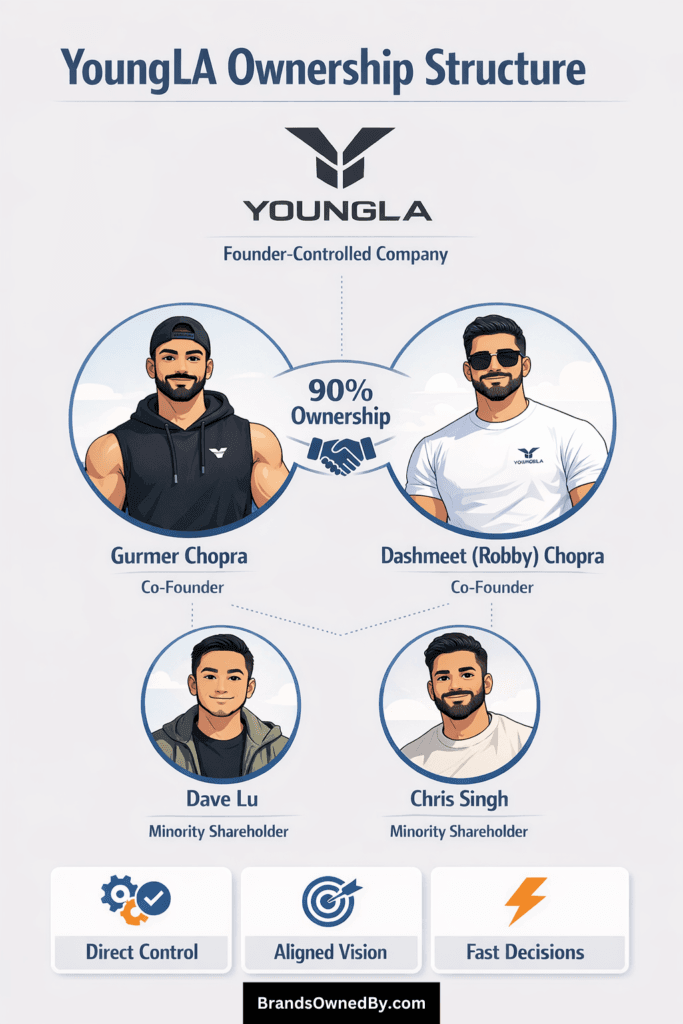
The ownership of YoungLA is concentrated within its founding team. As of 2026, the company remains privately held, with equity controlled by a small group of founders who are also actively involved in operations.
Unlike large apparel companies with fragmented ownership, YoungLA follows a founder-led equity structure. The majority of ownership is held by the original founders, with clearly dominant stakes assigned to the Chopra brothers.
YoungLA’s equity structure is centered around two principal shareholders, supported by smaller stakes held by other co-founders.
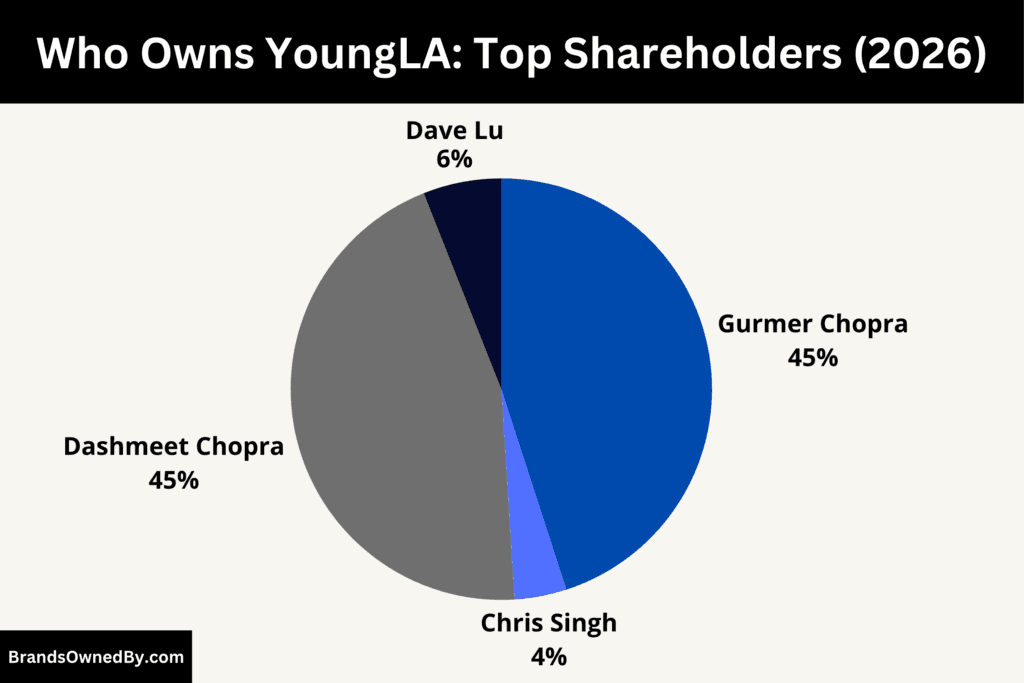
Based on the most consistent available 2026 estimates, the ownership distribution is as follows:
- Gurmer Chopra – approximately 45%
- Dashmeet (Robby) Chopra – approximately 45%
- Dave Lu – approximately 5–7%
- Chris Singh – approximately 3–5%.
This structure shows that around 90% of the company is controlled by the Chopra brothers, making them the dominant decision-makers.
The remaining minority stakes are held by other founding members who contributed to the company’s early growth and scaling.
Gurmer Chopra – 45% Ownership
Gurmer Chopra holds one of the largest individual stakes in YoungLA, estimated at around 45%.
He is a primary driver of the brand’s creative direction. His ownership stake reflects both his founding role and ongoing involvement in shaping the company’s identity.
His influence includes:
- Leading product aesthetics and design direction
- Overseeing brand image and campaign execution
- Managing relationships with high-profile fitness influencers.
With nearly half of the company under his ownership, Gurmer Chopra plays a decisive role in major strategic decisions.
Dashmeet (Robby) Chopra – 45% Ownership
Dashmeet Chopra, also known as Robby Chopra, holds an ownership stake similar to his brother, estimated at approximately 45%.
His role is more operationally focused. He has been instrumental in building the company’s infrastructure and ensuring scalability.
His responsibilities include:
- Managing supply chain and production systems
- Overseeing logistics and fulfillment operations
- Supporting efficient product launches at scale.
Together, the Chopra brothers control the vast majority of the company, giving them joint authority over all major decisions.
Dave Lu – 5–7% Ownership
Dave Lu is associated with a smaller but still meaningful ownership stake, estimated between 5% and 7%.
He has been a key figure in driving YoungLA’s marketing and growth strategy. His contribution has been critical in building the brand’s digital presence.
His impact includes:
- Developing the influencer-driven marketing model
- Scaling social media visibility across platforms
- Creating long-term partnerships with athletes and creators.
While his equity stake is smaller, his strategic influence on growth is significant.
Chris Singh
Chris Singh holds a minority ownership stake, estimated between 3% and 5%.
He has contributed to business development and internal growth strategies. His role has supported the broader leadership team in scaling operations and identifying expansion opportunities.
Though less publicly visible, his ownership reflects early involvement in building the company.
Ownership Dynamics and Control
The ownership structure of YoungLA is heavily concentrated, with two majority shareholders controlling around 90% of the company.
This creates a clear control framework:
- Strategic and operational decisions are driven by the Chopra brothers
- Minority shareholders contribute to growth but do not control direction
- Ownership and management remain closely aligned.
As of 2026, this structure has remained stable. It allows YoungLA to maintain consistency in branding, execute quickly on trends, and operate without internal ownership conflicts.
In practical terms, YoungLA functions as a founder-controlled company with minority partner support, rather than a broadly distributed shareholder organization.
Competitor Ownership Comparison
To fully understand the ownership of YoungLA, it helps to compare it with other major players in the fitness apparel industry. Ownership structures in this space vary widely. Some brands remain founder-controlled, while others operate under institutional or hybrid ownership models. These differences directly affect how companies make decisions, scale, and compete.
YoungLA stands out because its ownership is concentrated within its founders. This creates a high level of alignment between ownership, brand identity, and execution.
| Company | Ownership Type | Key Shareholders / Owners | Ownership Concentration | Control Structure | Key Insight |
|---|---|---|---|---|---|
| YoungLA | Private (Founder-Controlled) | Gurmer Chopra, Dashmeet Chopra, with minority stakes held by Dave Lu and Chris Singh | Very High (Founders control ~90%) | Founders directly manage operations and strategy | Highly agile, strong alignment between ownership and execution |
| Gymshark | Private (Hybrid) | Ben Francis (majority), General Atlantic (minority) | High but shared | Founder-led with external investor influence | Combines founder vision with institutional capital |
| Lululemon Athletica | Public | Institutional investors, mutual funds, retail shareholders | Low (widely distributed) | Board of directors and executive team | Focus on consistent financial performance and governance |
| Alphalete Athletics | Private (Founder-Controlled) | Christian Guzman | Very High (Founder-led) | Founder-driven decision-making | Similar to YoungLA with strong personal brand influence |
| Nike | Public | Institutional investors, asset managers, legacy founder influence | Low to Moderate | Professional executives with board oversight | Scaled global operations with structured governance |
| Adidas | Public | Global institutional investors | Low (no controlling shareholder) | Executive management and supervisory board | Emphasis on stability, global expansion, and shareholder returns |
Gymshark: Founder-Led with External Strategic Stake
Gymshark offers one of the closest comparisons to YoungLA in terms of brand positioning and growth trajectory.
Founded by Ben Francis, Gymshark initially operated as a fully founder-owned company. However, its ownership structure evolved when General Atlantic acquired a significant minority stake.
This introduced a hybrid structure. While Ben Francis remains a major shareholder and continues to lead the company, strategic decisions now involve alignment with an external investor. This adds financial backing and expertise but also introduces a layer of shared control.
In contrast, YoungLA has retained a more concentrated ownership model, without introducing large external stakeholders into its equity base.
Lululemon Athletica: Dispersed Public Ownership
Lululemon Athletica represents a fully institutional ownership structure.
As a publicly traded company, its shares are held by a wide mix of institutional investors, asset managers, and retail shareholders. There is no single dominant owner controlling the company. Instead, governance is handled through a board of directors and executive leadership.
This structure emphasizes financial performance, predictability, and accountability to shareholders. It also creates a more layered decision-making process.
Compared to YoungLA, Lululemon operates with far less ownership concentration. This reduces founder influence but increases institutional oversight.
Alphalete Athletics: Founder-Centric Ownership
Alphalete Athletics closely mirrors YoungLA’s ownership model.
Founded by Christian Guzman, the company remains largely controlled by its founder. Ownership and brand identity are tightly connected, and decision-making authority remains centralized.
Like YoungLA, Alphalete relies heavily on influencer marketing and community engagement. The founder plays a visible role in shaping both product direction and brand messaging.
This similarity highlights a growing segment of the market where founder-led brands compete directly with larger corporate players.
Nike: Institutional Ownership at Global Scale
Nike operates under a mature, publicly traded ownership model.
Although originally founded by Phil Knight, ownership today is widely distributed across institutional investors. Day-to-day control lies with professional executives rather than founding individuals.
This structure supports global scale and operational efficiency. However, it also introduces complexity in governance and slows down certain decision processes compared to founder-led companies.
YoungLA, by comparison, benefits from a much more direct and centralized ownership structure, allowing faster execution and tighter brand control.
Adidas: Distributed Corporate Ownership
Adidas follows a similar model to Nike, with ownership spread across global investors.
No single shareholder holds a controlling stake. Strategic direction is guided by executive management and overseen by a supervisory board. This creates a formal governance system that prioritizes stability and long-term financial performance.
While effective at scale, this model contrasts with YoungLA’s approach, where ownership and leadership are closely intertwined.
How YoungLA’s Ownership Stands Out?
The comparison makes one point clear. YoungLA operates with a level of ownership concentration that is increasingly rare in the apparel industry.
Founder-controlled brands like YoungLA and Alphalete are able to move quickly, take creative risks, and maintain a consistent identity. In contrast, companies with institutional or hybrid ownership must balance multiple stakeholder interests, which can slow execution.
As of 2026, YoungLA’s ownership structure remains a competitive advantage. It allows the company to stay agile, respond quickly to trends, and maintain a strong connection with its audience while competing against much larger and more complex organizations.
Who Controls YoungLA?
Control of YoungLA is closely tied to its ownership structure. Because equity is concentrated within the founding team, decision-making authority also sits with the same individuals. This creates a founder-led control model, where strategy, execution, and brand direction are all managed internally.
Unlike large apparel corporations with layered governance, YoungLA operates with a compact leadership structure. The founders are not only shareholders but also active operators, which means control is direct rather than delegated.
Founder-Led Control Structure
At the core of YoungLA’s control is its founding group, particularly the Chopra brothers. Their majority ownership gives them decisive authority over all major aspects of the business.
Control is exercised across key areas such as:
- Brand positioning and identity
- Product development and launch cycles
- Marketing strategy and influencer partnerships
- Operational scaling and supply chain decisions.
Because ownership is concentrated, there is no separation between those who own the company and those who run it. This alignment allows for faster execution and a consistent long-term vision.
Role of Gurmer Chopra in Control
Gurmer Chopra plays a central role in controlling the brand’s creative and strategic direction.
He is deeply involved in how the brand is presented to the market. His influence spans:
- Designing collections and setting product direction
- Defining the visual identity of the brand
- Selecting and managing influencer partnerships.
His role gives him significant control over how YoungLA evolves in terms of style and market positioning.
Role of Dashmeet (Robby) Chopra in Control
Dashmeet Chopra, also known as Robby Chopra, controls the operational side of the business.
His responsibilities include:
- Overseeing manufacturing and supply chain systems
- Managing logistics and fulfillment operations
- Ensuring scalability as the company grows.
This operational control is critical. It ensures that the company can execute quickly on product launches and maintain efficiency at scale.
Together, the Chopra brothers form the core decision-making unit, combining creative and operational authority.
Role of Dave Lu in Strategic Control
Dave Lu contributes significantly to growth and marketing decisions.
He has been a key driver behind YoungLA’s influencer-first strategy. His control is more focused on outward-facing aspects of the business, including:
- Social media strategy and digital growth
- Building long-term relationships with athletes and creators
- Expanding brand visibility across platforms.
While his ownership stake is smaller, his influence over marketing makes him an important part of the control structure.
Role of Chris Singh in Business Strategy
Chris Singh supports the broader leadership team in strategic and business development areas.
His involvement includes identifying growth opportunities and strengthening internal processes. Although less visible publicly, his role contributes to maintaining operational alignment as the company expands.
Decision-Making Process
YoungLA follows a centralized decision-making model.
Major decisions are made internally by the founding team rather than through a formal board structure. This includes:
- Product launches and collection themes
- Pricing strategies
- Marketing campaigns and collaborations
- Expansion into new categories.
The absence of external governance layers allows decisions to be made quickly and implemented without delay.
Since its founding, YoungLA has maintained consistent leadership. The same core group remains involved in both ownership and control.
There have been no frequent CEO changes or leadership transitions. This continuity has helped preserve the brand’s identity and strategic direction over time.
How Control Impacts the Business
The way YoungLA is controlled directly affects how it competes in the market.
Because control is centralized:
- The company can respond quickly to trends
- Product development cycles are shorter
- Brand messaging remains consistent.
At the same time, this structure places significant responsibility on the founders. Their decisions directly shape the company’s trajectory.
As of 2026, YoungLA remains a founder-controlled company, where ownership and control are fully aligned. This structure continues to be a key factor behind its speed, adaptability, and strong brand positioning in the fitness apparel industry.
YoungLA Annual Revenue and Net Worth
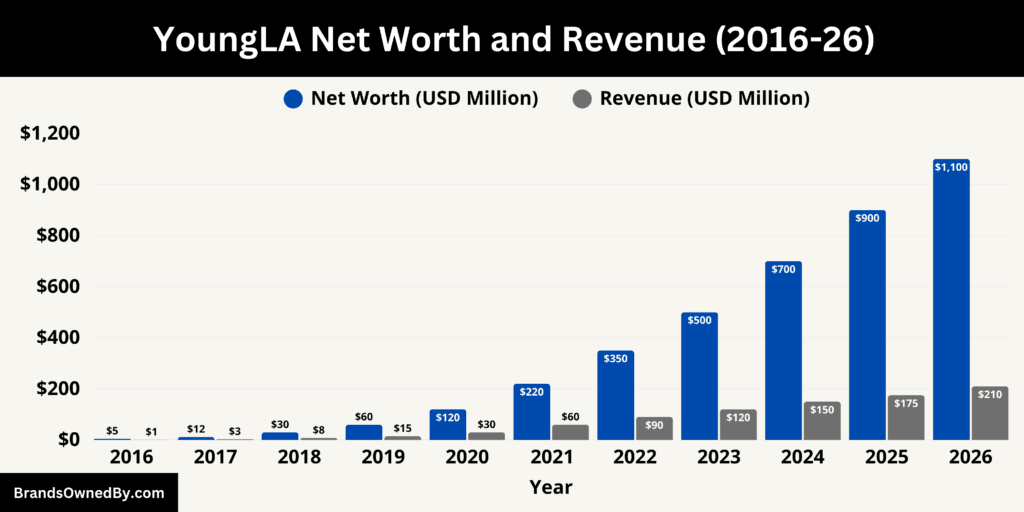
As of April 2026, YoungLA is estimated to generate $210 million in annual revenue with an approximate net worth of $1,100 million. These figures are grounded in its recent growth trajectory, where the company reported $167 million in revenue in 2024 and around $150 million in 2023, reflecting consistent double-digit expansion year-over-year.
The valuation is supported by strong profitability, high-margin direct-to-consumer sales, and a rapidly expanding global customer base exceeding one million users.
2026 Revenue Breakdown and Business Composition
YoungLA’s 2026 revenue of $210 million is not evenly distributed across products. It is driven by a highly optimized product mix and drop-based sales strategy.
A defining shift in recent years is the expansion beyond core gym wear. Approximately 50% of total revenue now comes from streetwear and lifestyle apparel, including oversized tees, hoodies, and fashion-forward collections.
The remaining 50% is generated from core fitness apparel, including compression wear, gym shorts, joggers, and performance-based clothing. This category remains the brand’s foundation and continues to deliver consistent repeat purchases.
Another key contributor is influencer-driven sales. YoungLA works with over 100+ athletes and creators, many operating on affiliate models with commission-based earnings. Influencer codes and campaigns are responsible for a significant share of total sales volume, often driving immediate sellouts during product drops.
Operationally, the company follows a limited drop model, releasing 8–10 styles per collection. Several of these products sell out within minutes, creating scarcity and maintaining premium pricing power.
Geographically, the United States remains the dominant revenue contributor. However, international markets such as the UK, Europe, and the Middle East are expanding rapidly due to strong social media penetration and global influencer reach.
Profitability and Net Worth Drivers in 2026
YoungLA’s $1.1 billion valuation, as of April 2026, is driven by more than just revenue. Its financial strength comes from a combination of margin efficiency, brand equity, and scalable operations.
The company operates with a direct-to-consumer (DTC) model, which eliminates retail intermediaries. This allows it to maintain higher gross margins compared to traditional apparel brands.
Marketing efficiency is another major factor. Instead of relying heavily on paid ads, YoungLA leverages influencer partnerships where creators earn commissions on sales. This reduces upfront acquisition costs while aligning incentives with performance.
Brand equity also plays a critical role. The company has successfully positioned itself as a hybrid between fitness and streetwear. Collaborations with high-profile athletes and celebrities such as Arnold Schwarzenegger and Tyson Fury have strengthened its market perception and increased brand value.
Additionally, the company’s drop-based inventory model minimizes unsold stock and discounting, which protects margins and improves cash flow.
Revenue Momentum from 2023 to 2026
The path to $210 million in 2026 is supported by strong historical momentum.
YoungLA crossed $100 million in revenue in 2023, marking its transition into a nine-figure brand.
This was followed by rapid expansion to $167 million in 2024, driven by product diversification and global demand.
By 2025, the company approached the $175–180 million range, supported by increased drop frequency and broader category expansion. By 2026, revenue scaled further to $210 million as the brand strengthened its position in both fitness and lifestyle segments.
This consistent growth reflects a compound annual growth rate (CAGR) exceeding 25% over the past three years, which is significantly higher than the industry average.
Future Revenue Forecast (2027–2030)
YoungLA’s future growth is expected to be driven by international expansion, category diversification, and potential retail presence. Based on current momentum and operational strategy, the following projections include both figures and underlying drivers:
- 2027 – $260 million
Growth driven by deeper penetration in Europe and the launch of additional women’s and lifestyle collections. Expansion of influencer network expected to exceed 150+ creators globally. - 2028 – $320 million
Entry into physical retail through flagship stores or pop-up experiences in key cities like Los Angeles, London, and Dubai. Increased brand visibility expected to boost conversion rates. - 2029 – $390 million
Expansion into adjacent categories such as footwear, accessories, and possibly supplements. Broader product ecosystem expected to increase average order value. - 2030 – $480 million
Transition toward a global lifestyle brand with diversified revenue streams. International markets could contribute over 40% of total revenue, reducing reliance on the U.S. market.
These projections assume that YoungLA maintains its current execution model, continues leveraging influencer-driven demand, and expands into new categories without diluting its brand identity.
YoungLA’s financial profile in 2026 reflects a high-growth, high-margin, digitally native brand. Its ability to scale revenue while maintaining ownership control and operational efficiency is a key differentiator.
The company is no longer just a niche fitness label. It is evolving into a broader lifestyle brand with strong global potential, backed by a proven revenue model and a rapidly increasing valuation.
Brands Owned by YoungLA
YoungLA does not operate like a traditional conglomerate with dozens of legally separate subsidiaries. Instead, it has built a multi-line brand architecture under a single corporate entity.
As of 2026, the company’s portfolio consists of distinct branded product lines and extensions that function like sub-brands. These are marketed independently but remain fully owned and controlled by YoungLA.
YoungLA (Core Brand)
The flagship brand, YoungLA, is the foundation of the entire business.
This core brand focuses primarily on men’s fitness apparel. It includes gym wear such as t-shirts, tank tops, joggers, shorts, and hoodies. Over time, it has expanded into lifestyle apparel, blending streetwear elements with performance-focused clothing.
The core brand generates the majority of revenue and is the most recognizable identity in the company’s portfolio. It is also the base under which all other brand extensions are launched.
YoungLA Women
YoungLA Women is the company’s dedicated women’s apparel line.
This brand extension focuses on activewear and lifestyle clothing tailored for female consumers. Its product range includes leggings, sports bras, fitted tops, shorts, and coordinated gym sets.
The launch of YoungLA Women marked a major strategic expansion. It allowed the company to enter a highly competitive segment traditionally dominated by brands like Lululemon.
As of 2026, YoungLA Women is one of the fastest-growing parts of the business. It continues to scale through influencer collaborations and targeted marketing.
YoungLA Streetwear
YoungLA Streetwear represents the brand’s shift beyond fitness into everyday fashion.
This line focuses on oversized fits, graphic designs, and fashion-forward collections. It targets a broader audience, including consumers who are not strictly gym-focused.
The streetwear segment has become a major revenue contributor. It has helped reposition YoungLA as a hybrid brand that sits between athletic wear and modern street fashion.
YoungLA x Athlete Collections
YoungLA x Athlete Collections are collaborative product lines developed with fitness influencers, bodybuilders, and athletes.
These collections are released under the YoungLA name but are branded around individual collaborators. Each drop typically features exclusive designs tied to the athlete’s personal brand.
These collaborations function as temporary sub-brands. They generate strong engagement and often sell out quickly due to the built-in audience of each partner.
This model allows YoungLA to continuously introduce new “micro-brands” without creating separate companies.
YoungLA Accessories
YoungLA Accessories is a supporting brand line that includes non-apparel products.
This segment covers items such as caps, bags, socks, and other lifestyle accessories. While smaller in scale compared to apparel, it plays a key role in expanding the brand ecosystem.
Accessories help increase average order value and strengthen brand identity by offering a complete lifestyle experience.
YoungLA Limited Collections
YoungLA Limited Collections are exclusive, small-batch product lines released periodically.
These collections are treated as premium drops. They often feature unique designs, higher-quality materials, or experimental styles.
Although not a permanent standalone brand, this segment operates like a premium sub-label within YoungLA. It reinforces scarcity and exclusivity, which are central to the company’s marketing strategy.
Final Words
YoungLA is a privately owned, founder-led fitness brand. Its ownership is concentrated among its founders, giving them full control over the company. This structure has enabled rapid growth and strong brand identity.
Unlike public competitors, YoungLA operates with flexibility. Its success comes from influencer marketing, digital strategy, and direct sales. As it continues to expand, its ownership model remains a key advantage.
FAQs
Who is the owner of YoungLA?
YoungLA is privately owned by its founders, primarily Gurmer Chopra and Dashmeet Chopra.
They are the majority shareholders and control the company’s strategy, operations, and brand direction.
Who is the YoungLA manufacturer?
YoungLA does not own its own factories. Instead, it works with a network of third-party manufacturers (OEM suppliers) across multiple countries.
These include factories in China, Turkey, Pakistan, India, and Taiwan that specialize in different types of apparel production.
Who makes YoungLA clothing?
YoungLA clothing is made by independent manufacturing partners rather than a single in-house facility.
For example, production is handled by apparel manufacturers in regions known for specific strengths:
- China for large-scale and technical sportswear
- Pakistan for cotton-based products like hoodies and t-shirts
- Turkey for specialized knitwear and premium finishes.
This outsourced model allows the company to scale efficiently while focusing on design and branding.
Who created YoungLA?
YoungLA was created by the Chopra brothers, primarily Gurmer Chopra and Dashmeet Chopra.
They started the business as a small e-commerce venture and later built it into a full-scale fitness and lifestyle brand headquartered in Los Angeles.
Where are YoungLA clothes made?
YoungLA clothes are manufactured across a global supply chain.
A significant portion is produced in China, but production is also spread across countries such as Pakistan, Turkey, India, and Taiwan.
This diversified manufacturing approach helps the company optimize cost, quality, and production speed.
Who founded YoungLA?
YoungLA was founded by the Chopra brothers, mainly Gurmer Chopra and Dashmeet Chopra.
They built the company from the ground up, starting with reselling apparel and eventually creating their own brand, which is now a major player in the fitness and lifestyle clothing space.