
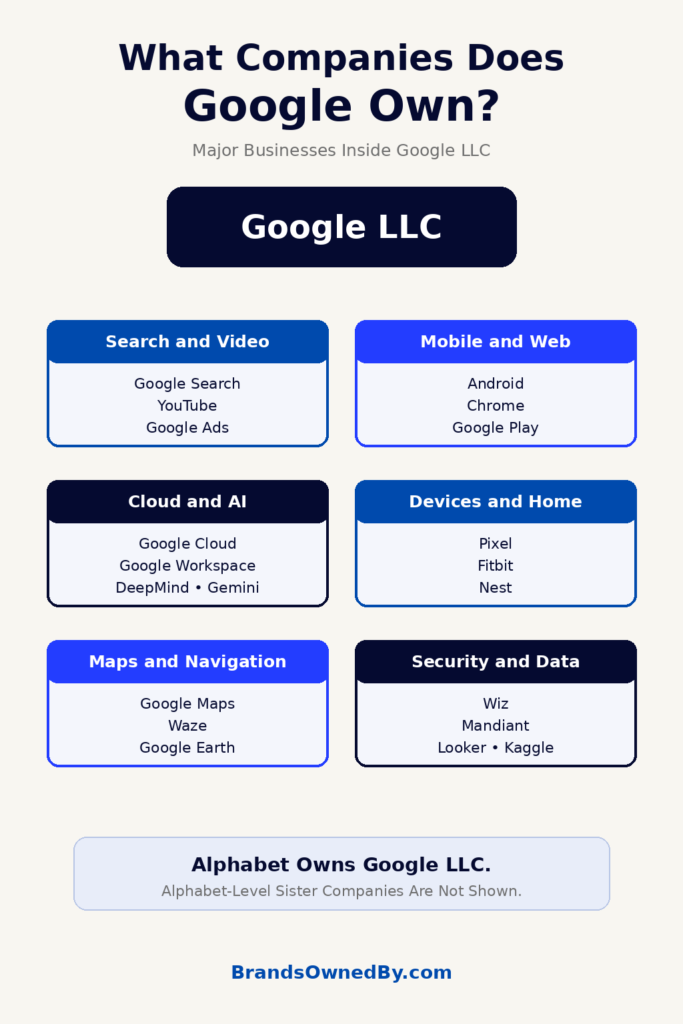
- Alphabet Inc. owns Google LLC, while Google controls major brands such as YouTube, Android, Chrome, Google Cloud, Workspace, Fitbit, Nest, Waze, DeepMind, Mandiant, Looker, and Wiz.
- Alphabet’s non-Google portfolio includes Waymo, Verily, Calico, Wing, Isomorphic Labs, GFiber, X, GV, and CapitalG.
- Google Services remains the financial center of the group. Search, YouTube, subscriptions, platforms, and devices generated $94.54 billion in Q2 2026 revenue.
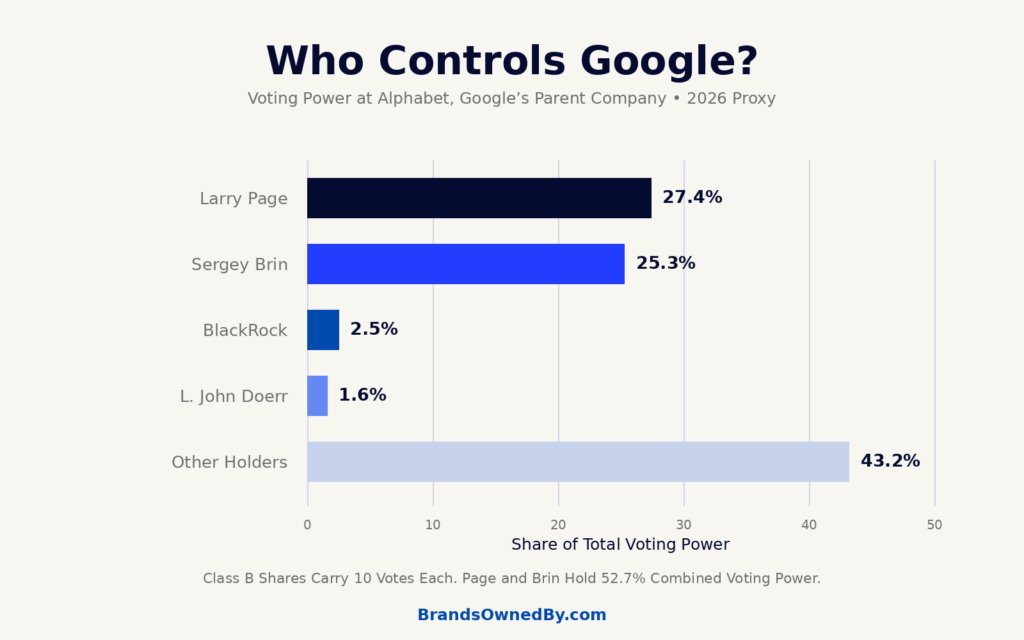
- Larry Page and Sergey Brin hold a combined 52.7% of Alphabet’s voting power through super-voting Class B shares, giving the founders effective control.
What companies does Google own? The short answer begins with a correction. Alphabet Inc. owns Google LLC. Google does not own Alphabet. Through this structure, Alphabet controls Google’s core products and several independent businesses. Its portfolio spans search, advertising, cloud computing, artificial intelligence, cybersecurity, autonomous vehicles, healthcare, life sciences, internet infrastructure, and venture capital.
As of September 2026, the group includes Google, YouTube, Android, Google Cloud, DeepMind, Wiz, Waymo, Verily, Calico, Wing, and several other businesses.
Google Founders and Company Origin
Google grew from a university research project into the central business of one of the world’s most valuable public companies. Its history also explains why its founders still control Alphabet despite owning a relatively small percentage of its total economic value.
Larry Page
Larry Page co-founded Google while studying computer science at Stanford University. He developed the original idea behind PageRank. This system evaluated web pages partly through the number and quality of links pointing to them.
Page served as Google’s first chief executive. He later returned to the role in 2011. He became Alphabet’s first CEO when the holding company was formed in 2015.
Page stepped down as Alphabet CEO in 2019. However, he remains a director and one of the company’s controlling shareholders.
Sergey Brin
Sergey Brin met Page at Stanford. The two worked together on a search system that could rank web pages more effectively than the basic directories and keyword-matching engines available at the time.
Brin served as Google’s president of technology. He later became Alphabet’s president when the holding company was created.
Like Page, Brin left his day-to-day executive role in 2019. He remains a director and retains substantial voting power through Alphabet’s Class B shares.
From BackRub to Google
Page and Brin initially called their search project BackRub. The name referred to its analysis of backlinks between websites.
Google was incorporated in September 1998. Its early funding included a $100,000 check from Sun Microsystems co-founder Andy Bechtolsheim. The company moved from a university project into a commercial search business.
Google’s advertising system became its primary economic engine. Search ads allowed businesses to reach users who were already expressing commercial intent. That model produced the cash needed to fund products such as Gmail, Maps, Chrome, Android, YouTube, and Google Cloud.
The Creation of Alphabet
Google reorganized under Alphabet Inc. in October 2015. The restructuring separated the mature Google business from experimental operations such as self-driving vehicles, life sciences, and longevity research.
Alphabet became the public parent company. Google became its largest subsidiary.
The change improved management accountability. Google could focus on search, advertising, YouTube, Android, cloud computing, and consumer technology. Other businesses could operate with their own leadership, budgets, and development targets.
List of Companies and Brands Owned by Google
The Google ownership structure contains operating companies, acquired brands, internally developed products, research units, and investment arms. Some sit inside Google LLC. Others are separate Alphabet businesses.
The following list covers the group’s principal active companies and commercial brands as of September 2026. It does not include every local legal entity, intellectual-property holding company, or regional subsidiary.
Google LLC
Alphabet owns Google LLC. This is the group’s largest operating company and its primary source of revenue and profit.
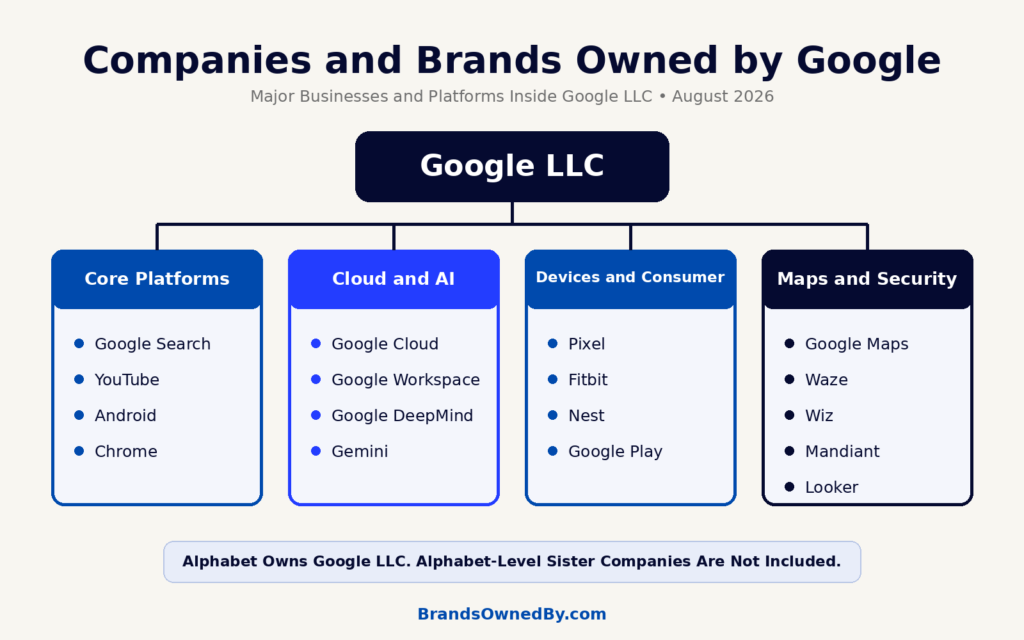
Google LLC contains Search, YouTube, Android, Chrome, Google Cloud, Workspace, Maps, Gmail, Google Play, hardware, subscriptions, and most consumer-facing services. Sundar Pichai serves as CEO of both Google and Alphabet.
Google is not simply one search-engine company. It is the operating platform that connects advertising, cloud infrastructure, mobile software, video, artificial intelligence, subscriptions, and consumer devices.
Google Search
Google Search was developed internally rather than acquired. It remains Alphabet’s most important commercial product.
Search generates revenue mainly through advertising. Businesses bid to place relevant advertisements beside commercial search results. Shopping listings, local results, travel features, and AI-assisted search experiences extend this model.
Google Search and related properties generated $63.27 billion in Q2 2026. That represented approximately 52.8% of Alphabet’s total quarterly revenue.
Google Ads, AdSense and Ad Manager
Google Ads is the company’s primary advertising platform for businesses. Advertisers use it to purchase placements across Search, YouTube, applications, websites, shopping results, and other Google properties.
AdSense allows publishers to place Google-served advertisements on their websites. Google Ad Manager provides broader tools for publishers and media companies managing advertising inventory.
Together, these systems connect advertisers, publishers, creators, application developers, and consumers. Advertising generated $81.63 billion in Q2 2026, or approximately 68.1% of Alphabet’s consolidated revenue.
YouTube
Google acquired YouTube in 2006 for approximately $1.65 billion in stock. YouTube now operates as a major video, advertising, subscription, music, creator, and connected-TV platform within Google.
Its direct revenue sources include video advertising, YouTube Premium, YouTube Music, YouTube TV, channel memberships, and transaction fees. Subscription revenue is reported with Google’s subscriptions, platforms, and devices category rather than YouTube advertising.
YouTube advertising revenue reached $11.06 billion in Q2 2026. That was approximately 9.2% of Alphabet’s quarterly revenue.
Android
Google acquired Android Inc. in 2005. Android later became the foundation of the world’s most widely used mobile operating-system ecosystem.
Google generally provides the core Android operating system without charging handset manufacturers a direct license fee. It monetizes the ecosystem through Search, Google Play, advertising, subscriptions, applications, and commercial agreements.
Android is open source at its base. However, key Google applications and services are proprietary. Manufacturers usually enter commercial agreements to offer products such as Google Play, Maps, Gmail, and Search.
Chrome and ChromeOS
Google developed Chrome internally and launched the browser in 2008. Chrome supports Google Search distribution, web application usage, account synchronization, password management, and access to Google services.
ChromeOS powers Chromebooks and related devices. The platform is particularly established in education and enterprise device management.
Chrome itself does not need to generate substantial direct revenue. Its strategic value comes from keeping Google services accessible and competitive across the open web.
Google Cloud
Google Cloud includes Google Cloud Platform, enterprise security products, data tools, artificial intelligence infrastructure, and Google Workspace.
Customers pay for computing capacity, storage, databases, networking, cybersecurity, artificial intelligence models, application services, and productivity software. Revenue comes from both consumption-based fees and subscriptions.
Google Cloud generated $24.77 billion in Q2 2026. Revenue increased 82% from the corresponding quarter. Operating income reached $8.81 billion.
Cloud accounted for approximately 20.7% of Alphabet’s Q2 revenue. More importantly, it produced around 21.6% of reported segment operating income before Alphabet-level expenses.
Google Workspace
Google Workspace is the commercial productivity suite built around Gmail, Drive, Docs, Sheets, Slides, Meet, Calendar, and related administration tools.
Businesses and institutions generally pay per user. Higher subscription tiers provide additional storage, security, compliance, management, and artificial intelligence features.
Workspace strengthens Google Cloud’s recurring-revenue profile. It also gives Google a direct competitor to Microsoft 365.
Google DeepMind
Google acquired the British artificial intelligence company DeepMind in 2014. Google combined DeepMind with Google Brain in 2023 to form Google DeepMind.
The organization develops foundational artificial intelligence models and scientific systems. Its work includes Gemini, AlphaFold, Veo, Imagen, and other research or commercial model families.
Google DeepMind is now integrated into Google’s broader artificial intelligence strategy. Its technology supports Search, Cloud, Workspace, Android, cybersecurity, robotics, and consumer applications.
Gemini
Gemini is Google’s primary family of multimodal artificial intelligence models and related consumer products. It was developed inside Google rather than purchased as a separate company.
The Gemini brand covers the consumer application, developer APIs, enterprise tools, and models embedded across Google products. These models can process combinations of text, images, audio, video, and code.
The Gemini application had approximately 950 million monthly active users in Q2 2026. Google also reported that Gemini models were processing 22 billion API tokens per minute.
Wiz
Google completed its acquisition of Wiz in March 2026. The final purchase consideration was approximately $29.5 billion after adjustments.
Wiz provides cloud and artificial intelligence security technology. Its platform identifies risks across cloud infrastructure, applications, data, identities, and code environments.
Wiz joined Google Cloud but retained its brand and multicloud approach. This is strategically important. Customers can use Wiz to protect workloads running on Google Cloud, Amazon Web Services, Microsoft Azure, and other environments.
Mandiant
Google completed its acquisition of Mandiant in 2022 for approximately $5.4 billion.
Mandiant specializes in threat intelligence, breach investigation, incident response, and cybersecurity consulting. Google integrated the business into Google Cloud.
The combination of Mandiant, Wiz, Gemini, and Google’s security infrastructure gives Google a broader enterprise-security platform. Wiz focuses heavily on cloud exposure and risk. Mandiant adds frontline threat intelligence and incident-response expertise.
Looker
Google acquired Looker in 2020 for approximately $2.6 billion.
Looker provides business intelligence, data visualization, and analytics software. It operates within Google Cloud and connects with multiple databases and cloud environments.
The acquisition helped Google compete more effectively with Microsoft Power BI, Salesforce Tableau, and other enterprise analytics platforms.
Kaggle
Google acquired Kaggle in 2017. Kaggle operates as a data-science and machine-learning community.
The platform provides datasets, hosted notebooks, competitions, learning resources, and collaboration tools. Companies can use Kaggle competitions to attract external specialists to difficult modeling problems.
Kaggle gives Google a direct relationship with data scientists, researchers, students, and machine-learning developers. That community also complements Google Cloud and its artificial intelligence development tools.
Waze
Google acquired Waze in 2013 for approximately $1.1 billion.
Waze operates as a navigation application with community-supplied traffic reports. It remains a separate consumer brand, although its data and technology increasingly support the wider Google Maps ecosystem.
Google has consolidated parts of the Waze organization with its mapping teams. The Waze application remains available and continues to emphasize driver-reported road conditions, hazards, police locations, and route disruptions.
Google Maps
Google Maps was developed through a combination of internal work and earlier acquisitions. It is not a separate publicly traded company.
The platform provides mapping, navigation, local-business information, location services, and geospatial data. Businesses can also pay to use mapping and location functions through Google Maps Platform.
Maps supports consumer engagement and commercial discovery. A practical example is a user searching for a nearby restaurant and then receiving directions, opening its website, or calling from the listing.
Fitbit
Google completed its acquisition of Fitbit in 2021 for approximately $2.1 billion.
Fitbit develops wearable devices, fitness tracking systems, health metrics, and subscription services. The brand now operates within Google’s devices and services organization.
Google has integrated Fitbit technology into its wider wearable strategy. Fitbit’s health platform and experience also support Pixel Watch products.
Nest
Google acquired Nest Labs in 2014 for approximately $3.2 billion. Nest later became part of Google’s hardware organization.
The brand covers connected-home products such as thermostats, cameras, doorbells, speakers, displays, and smoke or carbon-monoxide alarms.
Nest is no longer an independent Alphabet-level company. It functions as a product brand inside Google.
Pixel
Pixel is Google’s internally developed hardware brand. It includes smartphones, watches, tablets, earbuds, and supporting accessories.
Pixel gives Google direct control over the integration of Android, Gemini, custom processors, cameras, security, and consumer hardware.
The brand also provides a reference model for the Android ecosystem. Google can introduce features on Pixel before making related software capabilities available to other manufacturers.
Google Play
Google Play is the primary application and digital-content distribution platform for most Google-certified Android devices.
Revenue comes from application sales, in-app purchases, subscriptions, games, books, and service fees. Google Play also provides developer tools, application testing, payments, and security screening.
Google reports this income inside subscriptions, platforms, and devices rather than as a separate business segment.
Gmail
Gmail is owned and operated by Google. It was developed internally and launched publicly in 2004.
The free consumer service supports Google account engagement. Its commercial version is included in Google Workspace subscriptions.
Gmail also strengthens Google’s security and artificial intelligence capabilities. Features include spam filtering, phishing detection, automated summaries, suggested replies, and Gemini-based assistance.
Intrinsic
Intrinsic began inside Alphabet’s X research organization. It became an independent Alphabet company in 2021.
The business develops software and artificial intelligence systems for industrial robotics. Its objective is to make robots easier to program, manage, and deploy.
In 2026, Intrinsic moved into Google as a distinct operating group. It now works more closely with Google DeepMind, Gemini, and Google Cloud. It should therefore be treated as a Google-controlled robotics business rather than an independent Other Bet.
Waymo
Waymo began as Google’s self-driving car project in 2009. It became a separate Alphabet company in 2016.
The company develops autonomous-driving hardware, software, mapping, simulation, and robotaxi services. Waymo One is its commercial ride-hailing service.
Alphabet remains Waymo’s parent and principal financial backer. External investors also hold minority interests following private funding rounds. This means Alphabet controls Waymo, but it does not necessarily own 100% of its economic equity.
Waymo is the strongest commercial business in Alphabet’s Other Bets portfolio. It also has one of the clearest paths to becoming a material source of group revenue.
Verily
Verily began as a life-sciences project inside Google X. It became a separate Alphabet company in 2015.
The business develops healthcare data systems, clinical-research technology, chronic-care tools, and medical products. Its operations are increasingly independent from Google’s internal systems.
Alphabet remains Verily’s parent and largest investor. However, outside investors have participated in Verily funding rounds. Alphabet therefore controls the company without necessarily owning all its economic interests.
Calico
Google created Calico in 2013. It became an Alphabet subsidiary during the 2015 restructuring.
Calico studies aging and age-related diseases. Its work focuses on biological research and potential therapeutic development rather than consumer health applications.
The company has a long-running research and development relationship with AbbVie. Calico remains a long-horizon biotechnology investment. It does not make a meaningful contribution to Alphabet’s reported revenue.
Wing
Wing began as a drone-delivery project inside X. It became an independent Alphabet company in 2018.
The company develops autonomous delivery drones, navigation systems, fleet-management technology, and delivery infrastructure. It works with retailers, restaurants, pharmacies, and logistics partners.
Wing’s commercial challenge is not only aircraft technology. It must also manage regulation, neighborhood acceptance, delivery economics, weather, noise, and local infrastructure.
Isomorphic Labs
Alphabet created Isomorphic Labs in 2021. The company applies artificial intelligence to drug discovery.
It uses computational systems related to DeepMind’s scientific research. Its goal is to improve the identification and design of potential medicines.
Isomorphic Labs operates separately from Google DeepMind, although the two share scientific foundations and leadership connections. Its commercial model includes pharmaceutical partnerships and internal drug-development programs.
GFiber
GFiber provides high-speed internet service in selected American markets. The operation was previously known as Google Fiber.
It sells fiber internet and related connectivity services to households and businesses. Its infrastructure model is very different from Google’s advertising and software businesses because it requires local construction, network maintenance, and municipal relationships.
GFiber sits within Alphabet’s broader collection of non-core operations.
X
X is Alphabet’s research and development organization. It was previously known as Google X.
The organization develops high-risk projects that could become independent companies or transfer into existing Alphabet businesses. Waymo, Wing, Verily, and Intrinsic originated within this system.
X is better understood as a business-creation laboratory than a conventional product company. Many projects do not become sustainable commercial operations. The value of the model depends on whether successful projects can justify the cost of unsuccessful experiments.
GV
GV is Alphabet’s venture-capital arm. It was previously known as Google Ventures.
GV invests in independent startups across software, healthcare, artificial intelligence, consumer technology, cybersecurity, and other industries. Portfolio companies are not automatically owned or controlled by Google.
This distinction matters. A minority investment gives Alphabet economic exposure. It does not make every GV-backed company a Google subsidiary.
CapitalG
CapitalG is Alphabet’s growth-investment arm. It generally invests in more mature private companies than GV.
The firm provides capital and access to Alphabet’s commercial and technical expertise. Its investments can produce financial gains when portfolio companies raise money, are acquired, or become public.
As with GV, CapitalG investments should not be described as wholly owned Google companies unless Alphabet has separately acquired control.
Intersect
Alphabet completed its acquisition of renewable-energy developer Intersect in March 2026 for approximately $5.9 billion after purchase-price adjustments.
The transaction supports Alphabet’s need for electricity and infrastructure as it expands artificial intelligence data centers. Intersect’s financial results are consolidated because Alphabet is considered the primary beneficiary of the entity.
This acquisition shows how Alphabet’s portfolio is changing. Energy availability has become a strategic constraint on cloud computing and artificial intelligence growth.
Who Owns Google: Top Shareholders
Alphabet Inc. owns Google LLC. Investors who purchase GOOG or GOOGL shares own an interest in Alphabet, not a direct interest in Google LLC.
Alphabet has three principal common-stock classes. Class A shares trade under GOOGL and carry one vote each. Class C shares trade under GOOG and generally carry no voting rights. Class B shares are primarily held by founders and insiders. Each Class B share carries ten votes.
This structure separates economic ownership from voting control.
Larry Page
Larry Page beneficially owned approximately 389.05 million Class B shares according to Alphabet’s 2026 proxy disclosure.
That represented 46.5% of the outstanding Class B stock and 27.4% of Alphabet’s total voting power.
His economic ownership is much smaller than 27.4%. The higher voting percentage results from the ten votes attached to each Class B share.
Sergey Brin
Sergey Brin beneficially owned approximately 358.94 million Class B shares and a small number of Class A shares.
His holdings represented 42.9% of the Class B stock and 25.3% of Alphabet’s total voting power.
Page and Brin therefore controlled 52.7% of the combined voting power. They can determine the outcome of most ordinary shareholder votes when they vote together.
BlackRock
BlackRock was the only outside institution listed as a greater-than-5% Class A holder in Alphabet’s 2026 proxy ownership table.
It beneficially owned approximately 356.93 million Class A shares. That represented 6.1% of Class A stock and 2.5% of total voting power.
The difference shows why a large public shareholding does not equal control. BlackRock’s shares receive one vote each. The founders’ Class B shares receive ten.
The Vanguard Funds
Vanguard had previously reported aggregate beneficial ownership of approximately 493.78 million Class A shares. Based on Alphabet’s April 2026 share count, that would have equaled 8.5% of Class A stock and 3.5% of total voting power.
However, Vanguard changed its reporting structure following an internal realignment effective January 12, 2026. The Vanguard Group no longer reported the holdings of its relevant subsidiaries and business divisions as one aggregated beneficial position.
Vanguard-managed funds may still collectively hold a large economic interest. The parent organization is no longer presented as a single beneficial owner under the same reporting method. This is a disclosure change, not evidence that all Vanguard funds sold their Alphabet shares.
L. John Doerr
Alphabet director L. John Doerr beneficially owned approximately 22.35 million Class B shares and 472,165 Class A shares.
His Class B position represented 2.7% of that class and approximately 1.6% of Alphabet’s total voting power.
Doerr is influential as a long-serving director and early Google investor. However, his voting position remains far below the combined control held by Page and Brin.
Other Public and Institutional Shareholders
The remaining economic ownership is distributed among index funds, active asset managers, pension funds, hedge funds, company insiders, and individual investors.
Institutional investors own large numbers of Alphabet shares because the company is included in major stock-market indexes. However, these investors do not form one coordinated ownership group.
The practical ownership conclusion is clear. Public investors supply most of Alphabet’s economic capital. The founders retain decisive voting control.
Competitor Ownership Comparison
Alphabet competes across several markets. Microsoft and Amazon compete in cloud infrastructure and artificial intelligence. Meta competes in advertising and consumer platforms. Apple competes in operating systems, devices, browsers, applications, and services. Nvidia competes for strategic influence across artificial intelligence infrastructure.
Ownership structure affects how each company makes long-term investment decisions.
Microsoft
Microsoft has a single-class common-stock structure. Each share generally carries one vote.
The Vanguard Group reported approximately 8.95% ownership in Microsoft’s latest annual proxy disclosure. Other large institutions include BlackRock and State Street. No founder, executive, or investment manager controls a majority of the votes.
Microsoft is therefore management-led but shareholder-accountable. CEO Satya Nadella has considerable operating influence. He does not possess founder-level voting control.
Alphabet differs because Page and Brin can retain control without owning most of its economic value.
Amazon
Amazon also uses a conventional one-share, one-vote structure. Founder Jeff Bezos remains its largest individual shareholder.
Following disclosed and planned share sales, Bezos’s position was around 8.1% in August 2026. He remains executive chair and an influential strategic figure. However, his voting power is proportional to his ownership.
Bezos cannot independently control a shareholder vote. Alphabet’s founders can, because their Class B shares carry enhanced voting rights.
Meta Platforms
Meta is the closest governance comparison to Alphabet. It has a dual-class stock structure.
Mark Zuckerberg owns roughly 14% of Meta’s economic interest but controls approximately 61% of its voting power. His Class B shares carry ten votes each.
Meta’s founder control is more concentrated than Alphabet’s. Zuckerberg can control Meta individually. Alphabet’s control is divided primarily between Page and Brin, who together hold 52.7% of the votes.
Both structures allow management to invest over long periods without needing approval from ordinary public shareholders. They also reduce the ability of outside shareholders to change strategic direction.
Apple
Apple has no controlling founder or insider shareholder. Its ownership is widely distributed among institutional and retail investors.
Large index managers such as Vanguard and BlackRock are major shareholders. However, their voting rights remain proportional to the shares they hold.
Apple’s board and executive team control operations. Shareholders retain greater theoretical power to influence board composition than Alphabet shareholders because Apple has no super-voting founder class.
Nvidia
Nvidia has a single-class share structure. Founder and CEO Jensen Huang owns approximately 3.5% of the company.
Huang has substantial strategic influence because of his leadership, technical authority, and long tenure. He does not have special super-voting shares.
Vanguard, BlackRock, and Fidelity are among Nvidia’s largest institutional investors. No single shareholder has voting control.
Nvidia demonstrates the difference between leadership influence and legal control. Huang directs the business as CEO. Page and Brin can influence Alphabet through majority voting power even without executive jobs.
Who Controls Google?
Google is controlled at three connected levels. Alphabet’s founders control shareholder voting. Alphabet’s board oversees the corporation. Sundar Pichai and his executive team manage operations.
Larry Page and Sergey Brin Control Shareholder Voting
Page and Brin hold 52.7% of Alphabet’s voting power. This is the decisive governance fact.
They can normally determine director elections and the outcome of shareholder proposals when they vote together. Outside investors cannot outvote them through ordinary share accumulation unless the founders’ voting position changes.
Their control could decline if they sell or convert large quantities of Class B stock. Class B shares generally convert into one-vote Class A shares when transferred outside permitted arrangements.
Sundar Pichai Controls Day-to-Day Operations
Sundar Pichai is CEO of Alphabet and Google. He manages strategy, executive appointments, capital allocation recommendations, product priorities, and operating performance.
Pichai has practical management authority. He does not have controlling voting ownership.
This distinction is important. Pichai runs the company. Page and Brin retain the voting power needed to influence who ultimately oversees it.
Alphabet’s Board Provides Formal Oversight
Alphabet’s board is responsible for executive oversight, risk management, compensation, governance, major capital decisions, and shareholder matters.
John L. Hennessy serves as board chair. Page, Brin, Pichai, and independent directors also serve on the board.
The board has formal fiduciary responsibilities. However, the founders’ majority voting position makes it difficult for outside shareholders to force a board change against their wishes.
Business Leaders Control Individual Operations
Several Alphabet businesses have their own leadership structures. Waymo, Verily, Calico, Wing, and other operations can make specialized commercial and technical decisions.
Their independence is limited by ownership. Alphabet controls funding, board representation, consolidation, and long-term capital allocation.
In practice, a business can operate independently while still depending on Alphabet for financial support.
Google Annual Revenue and Net Worth
Google does not report standalone financial statements or have its own stock-market valuation. Google LLC is a wholly owned subsidiary of Alphabet Inc. Therefore, the most reliable figures are Alphabet’s consolidated revenue, operating results, balance-sheet value, and market capitalization.
“Net worth” can also mean different things. Alphabet’s market capitalization reflects what investors believe the company is worth. Its stockholders’ equity represents assets minus liabilities on the balance sheet. These figures should not be treated as interchangeable.
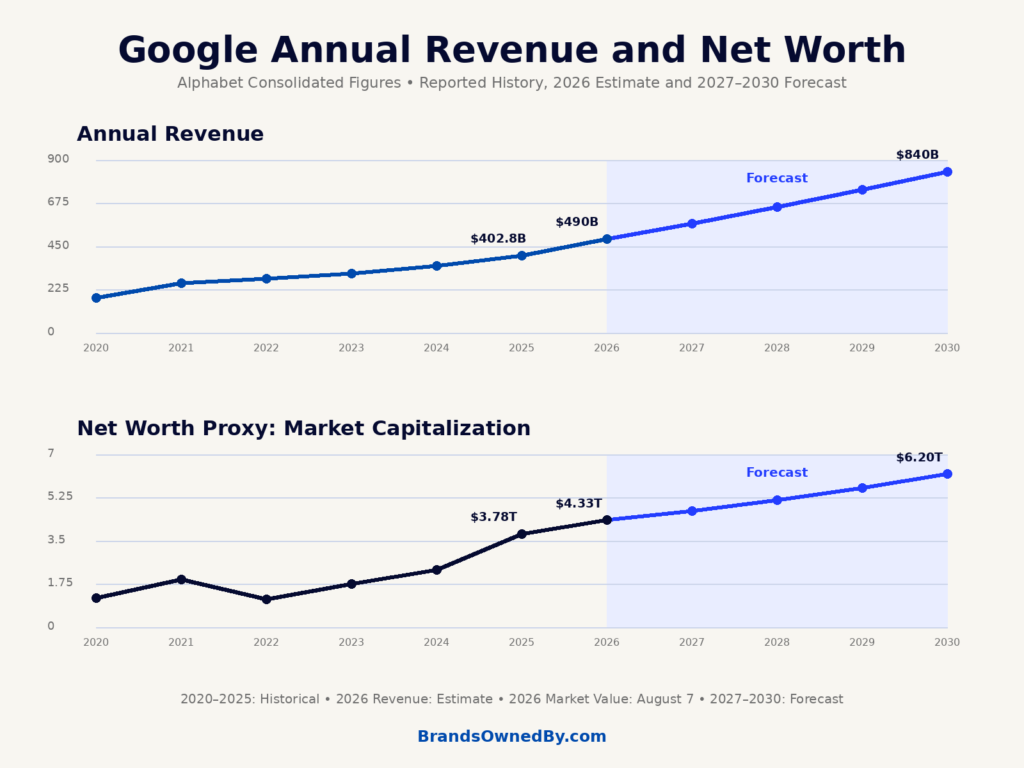
Alphabet Revenue in 2026
Alphabet generated $109.90 billion in the first quarter of 2026 and $119.80 billion in the second quarter. First-half revenue therefore reached $229.69 billion, compared with $186.66 billion during the first half of 2025.
That represents year-over-year growth of approximately 23%. It also means Alphabet had already generated almost 57% of its entire 2025 revenue within the first six months of 2026.
A full-year revenue estimate of approximately $490 billion is reasonable. This assumes some moderation during the second half rather than simply extending the first-half growth rate without adjustment. At that level, annual revenue would increase by about $87 billion, or 21.6%, from 2025.
The estimate is supported by three measurable drivers. Search revenue continues to rise despite concerns that generative AI could disrupt conventional search behavior. Google Cloud is expanding much faster than the wider company. Paid subscriptions and platform revenue are also adding a larger recurring component to Alphabet’s financial model.
Where Alphabet’s Revenue Comes From
Google Services generated $94.54 billion in Q2 2026. This division includes Search, YouTube, Android, Chrome, Google Play, subscriptions, and consumer devices. It accounted for approximately 78.9% of total quarterly revenue.
Google Search and other advertising produced $63.27 billion. This was 52.8% of Alphabet’s total revenue. Search therefore remained the company’s single largest financial engine.
YouTube advertising added $11.06 billion, while Google Network advertising generated $7.30 billion. Altogether, Google advertising revenue reached $81.63 billion. Advertising still represented 68.1% of Alphabet’s quarterly revenue.
Subscriptions, platforms, and devices contributed another $12.91 billion. This category includes paid products such as YouTube Premium, YouTube TV, Google One, Google Play transactions, and hardware-related revenue.
Google Cloud produced $24.77 billion. It accounted for 20.7% of consolidated revenue, compared with approximately 14.1% one year earlier. Other Bets generated only $382 million, or roughly 0.3% of the total.
These figures show that Alphabet remains advertising-led. However, Cloud has become large enough to change the company’s growth rate, profit mix, and valuation.
Google Cloud is Becoming a Second Profit Engine
Google Cloud revenue increased 82% year over year in Q2 2026. Growth came from enterprise AI infrastructure, AI solutions, and established cloud services.
The division also generated $8.81 billion in operating income, compared with $2.83 billion in the corresponding quarter of 2025. Its operating margin reached approximately 35.6%.
This matters because Cloud was once a loss-making growth investment. It is now producing meaningful revenue and operating profit. Google Services remains much larger, but Alphabet is no longer dependent on advertising for virtually all its segment earnings.
Google Services produced $39.54 billion in Q2 operating income. Other Bets lost $1.80 billion. Alphabet-level activities, including shared AI research and development, recorded another $5.79 billion operating loss.
After those costs, consolidated operating income reached $40.77 billion. That was 30% higher than the previous year. The operating margin improved from 32% to 34%.
Revenue rose 24%, while operating income increased 30%. This indicates that Alphabet converted its higher sales into stronger operating profitability despite heavy spending on AI systems, employees, data centers, and computing infrastructure.
Why Reported Net Income Needs More Context
Alphabet reported $112.19 billion in Q2 2026 net income. Net income available to common shareholders was $112.11 billion.
This was not a normal representation of Alphabet’s quarterly operating earnings. The result included $97.98 billion in other income, primarily generated by unrealized gains on equity securities.
Changes in the value of an investment can increase reported earnings without producing an equivalent amount of operating cash. Those gains can also reverse in a future period.
For that reason, Alphabet’s $40.77 billion operating income is a more useful measure of the underlying quarter than its $112.19 billion net income. Investors should also examine cash flow rather than valuing the company from a single quarter’s investment gains.
Cash Flow and the Cost of AI Expansion
Alphabet generated $39.07 billion in operating cash flow during Q2 2026. However, purchases of property and equipment reached $44.92 billion. Quarterly free cash flow was therefore negative $5.86 billion.
The trailing 12-month picture remained positive. Alphabet produced $185.68 billion in operating cash flow and spent $132.40 billion on capital expenditures. That left $53.27 billion in trailing free cash flow.
This is one of the most important figures in the financial analysis. Alphabet’s core businesses are generating substantial cash, but an increasing share is being reinvested in data centers, servers, networking equipment, AI accelerators, and energy infrastructure.
The investment could strengthen Google Cloud, Gemini, Search, and YouTube. It also creates execution risk. Revenue and operating profit must eventually grow enough to produce acceptable returns on this much larger infrastructure base.
Alphabet’s Market Value and Book Value
Alphabet’s market capitalization was approximately $4.33 trillion on August 7, 2026. This represents the combined market value of its publicly traded equity based on the prevailing share price.
Market capitalization is the most useful public-market answer to Google’s “net worth.” However, it is not cash held by Google, the accounting value of its assets, or an amount that could necessarily be realized through a sale.
Alphabet reported $921.98 billion in total assets as of June 30, 2026. Total liabilities were $281.50 billion. Stockholders’ equity, or accounting book value, was therefore $640.48 billion.
The difference between the $4.33 trillion market capitalization and $640.48 billion in book equity reflects the value investors place on assets that accounting statements do not fully capture. These include Google’s search position, proprietary technology, user relationships, advertising network, data, intellectual property, brands, and future earning capacity.
Alphabet also held $242.47 billion in cash, cash equivalents, and marketable securities. That provided substantial liquidity, although long-term debt had increased to $98.17 billion amid acquisitions and infrastructure investment.
How Alphabet’s Valuation Has Changed
Alphabet’s approximate year-end market capitalization increased from $1.19 trillion in 2020 to $1.92 trillion in 2021. It then fell to $1.14 trillion in 2022 as interest rates increased and technology-stock valuations contracted.
The market value recovered to approximately $1.75 trillion in 2023 and $2.32 trillion in 2024. It reached about $3.78 trillion at the end of 2025 before rising to approximately $4.33 trillion on August 7, 2026.
This history shows why revenue and net worth do not move together. Alphabet’s revenue increased every year from 2020 through 2025. Its market capitalization still fell sharply in 2022 because investors were willing to pay a lower valuation multiple.
At $4.33 trillion against projected 2026 revenue of $490 billion, Alphabet was valued at approximately 8.8 times annual sales. That valuation assumes continued growth, strong margins, and commercially successful AI investment.
Alphabet Revenue Forecast Through 2030
Our base case places Alphabet’s revenue at approximately $570 billion in 2027. The forecast then rises to $655 billion in 2028, $745 billion in 2029, and $840 billion in 2030.
These estimates imply growth of 16.3% in 2027, 14.9% in 2028, 13.7% in 2029, and 12.8% in 2030. The declining growth rate recognizes that maintaining 20% growth becomes progressively harder as the revenue base expands.
Cloud is likely to make the largest incremental contribution. Alphabet can sell computing capacity, AI models, cybersecurity, databases, productivity software, and data services through the same enterprise platform.
Search should remain the largest individual revenue source. The financial question is whether AI-assisted results create more commercial activity without allowing inference costs to grow faster than advertising revenue.
Subscriptions offer another credible growth channel. YouTube Premium, YouTube TV, Google One, Workspace, Gemini services, and Google Play can expand recurring revenue without requiring the same advertising exposure as Search.
We would not assign significant forecast revenue to Waymo or other experimental businesses until their commercial scale becomes more visible. These operations provide upside potential, but Google Services and Cloud still need to support the base case.
Alphabet Net Worth Forecast Through 2030
A reasonable base-case market-capitalization path places Alphabet at approximately $4.70 trillion in 2027, $5.15 trillion in 2028, $5.65 trillion in 2029, and $6.20 trillion in 2030.
These are valuation scenarios rather than reported financial results or guaranteed price targets. They imply that Alphabet’s market value grows more slowly than revenue. The corresponding price-to-sales multiple would decline from approximately 8.8 times in 2026 to about 7.4 times in 2030.
That multiple compression makes the forecast more defensible. It does not assume that investors will continue paying an increasingly generous valuation as Alphabet becomes larger.
Reaching $6.20 trillion would require Cloud to remain profitable, Search to withstand AI-driven disruption, and infrastructure investment to produce stronger cash flows. Subscription revenue would also need to expand, while regulatory action would have to avoid materially weakening Google’s distribution or advertising economics.
The downside case is meaningful. Higher capital expenditure could suppress free cash flow. Competition could reduce AI pricing. Regulators could change search-distribution agreements, advertising practices, or app-store economics.
The upside case depends on Google Cloud maintaining exceptional growth, Gemini developing substantial enterprise and consumer revenue, and businesses such as Waymo reaching commercial scale. For now, those possibilities should be treated as additional value drivers rather than guaranteed outcomes.
Final Words
Google owns one of the broadest technology portfolios in the world, but the legal structure matters. Alphabet owns Google. Google then controls the brands and businesses that power Search, YouTube, Android, Cloud, Workspace, Gemini, devices, mapping, and cybersecurity.
Alphabet separately controls ambitious operations such as Waymo, Verily, Calico, Wing, and Isomorphic Labs. GV and CapitalG add investment exposure without making every portfolio company a Google subsidiary.
The economic center remains Google Services. Cloud is becoming the second major profit engine. Other Bets provide long-term optionality but continue to consume capital.
Control ultimately rests with Larry Page and Sergey Brin. Sundar Pichai runs the business, while the founders’ combined 52.7% voting power gives them the final advantage in shareholder decisions.
FAQs
Is Google owned by another company?
Yes. Alphabet Inc. owns Google LLC. Alphabet became Google’s public parent company during the 2015 corporate restructuring.
Is Alphabet the same company as Google?
No. Alphabet is the holding company. Google is its largest operating subsidiary.
Alphabet also controls businesses outside Google, including Waymo, Verily, Calico, Wing, and Isomorphic Labs.
Does Google own YouTube?
Yes. Google acquired YouTube in 2006. YouTube now operates within Google and Alphabet’s Google Services segment.
Does Google own Android?
Yes. Google acquired Android Inc. in 2005. Android is now a Google-controlled operating-system platform.
The open-source portion can be used by third parties. Google’s applications, services, and commercial agreements remain proprietary.
Does Google own Fitbit?
Yes. Google completed its acquisition of Fitbit in 2021. Fitbit now operates within Google’s devices and services business.
Does Google own Waze?
Yes. Google acquired Waze in 2013. Waze remains available as a separate navigation application, although parts of its organization and technology are integrated with Google Maps.
Does Google own Nest?
Yes. Google acquired Nest Labs in 2014. Nest is now a Google hardware and connected-home brand rather than an independent Alphabet company.
Does Google own Waymo?
Alphabet controls Waymo. Waymo is a sister company of Google rather than a conventional operating unit inside Google LLC.
External investors hold minority interests in Waymo. Alphabet remains its parent and principal financial backer.
Does Google own Wiz?
Yes. Google completed the Wiz acquisition in March 2026 for approximately $29.5 billion after adjustments. Wiz operates within Google Cloud while retaining its brand and multicloud security approach.
Does Google own DeepMind?
Yes. Google acquired DeepMind in 2014. The business later combined with Google Brain to become Google DeepMind.
Does Google own OpenAI?
No. Google does not own OpenAI.
OpenAI is a separate artificial intelligence company. Google competes with it through Gemini, Google DeepMind, Google Cloud, and related products.
Does Google own Anthropic?
No. Alphabet has made a significant investment in Anthropic, but Anthropic is not a wholly owned Google subsidiary.
An investment stake does not automatically provide full ownership or operating control.
Does Google own Microsoft or Apple?
No. Microsoft and Apple are independent public companies. Both compete with Google across cloud computing, artificial intelligence, operating systems, applications, devices, browsers, advertising, and digital services.
Who owns the most Google voting stock?
Larry Page has the largest disclosed individual voting position, with 27.4% of Alphabet’s voting power. Sergey Brin holds 25.3%.
Together, they control 52.7% of the votes.
Can ordinary shareholders remove Google’s founders from control?
Not under normal circumstances while Page and Brin retain a combined majority of Alphabet’s voting power.
Their control could weaken if they sell, transfer, or convert enough Class B shares. Ordinary Class A and non-voting Class C investors cannot currently outvote them as a group.
How many companies does Google own?
There is no single useful public count. Alphabet and Google maintain many legal entities across countries, acquisitions, intellectual-property structures, and operating units.
The commercially important portfolio includes more than 25 major companies, platforms, and brands. The exact legal-subsidiary count is much higher.